← The Marketing Millennials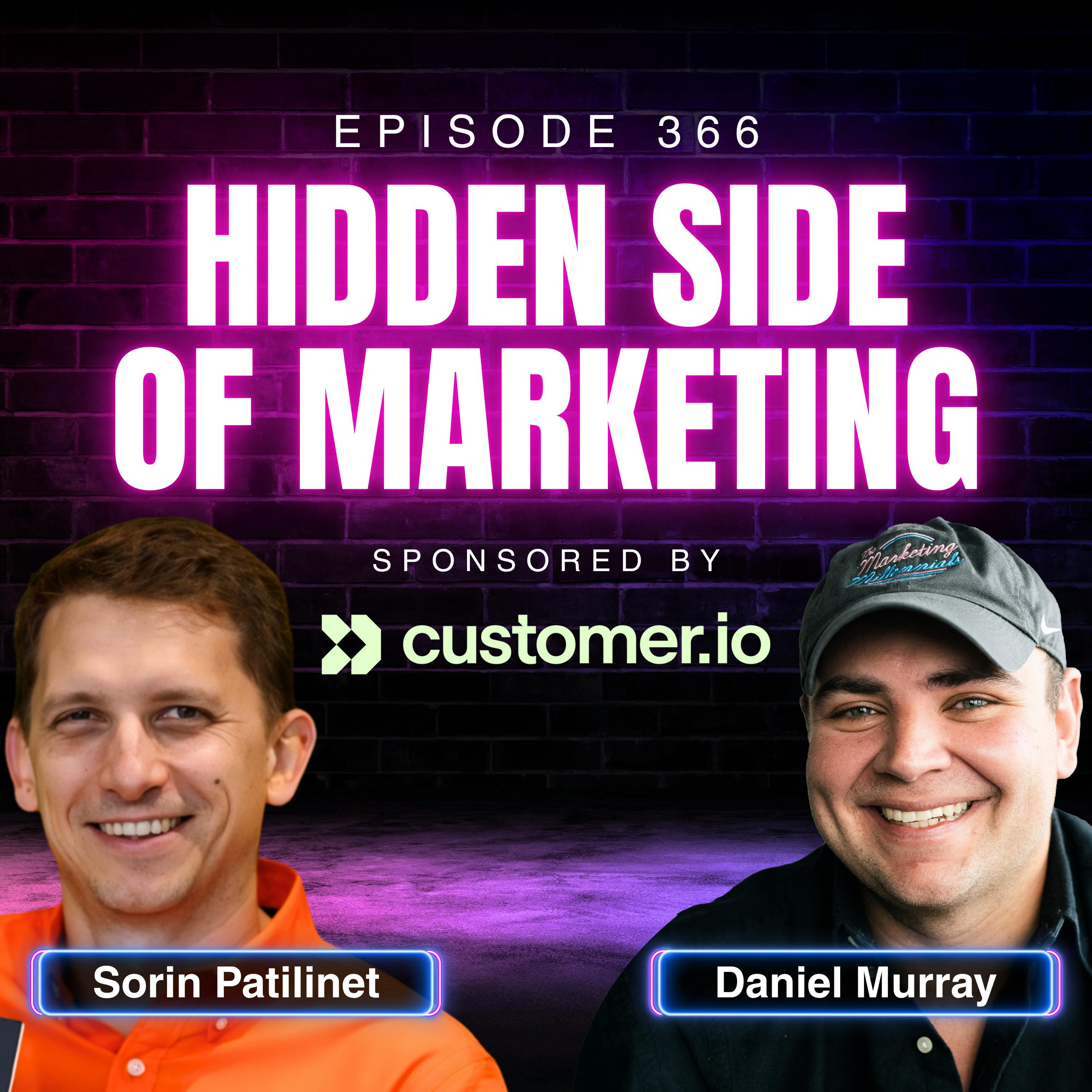
The Marketing Millennials
How to Measure Marketing Effectively with Sorin Patilinet | Ep. 366
00:47:06
Loading summary
Transcript69 lines
- [00:01]
A
Tired of robotic marketing Customer IO helps turn cold hard data into real human connection. Email, SMS, push, webhooks and more. Join 7,800 plus brands using AI powered journeys that connect, convert and don't annoy. Visit Customer IO to start your free trial today. Welcome to the Marketing Millennials, the no BS Marketing podcast. I'm Daniel Murra and join me for unfiltered conversations with the brains behind marketing's coolest companies. The one request I tell our guests stories or it didn't happen. Get ready to turn the up. We are back with another episode of the Market Millennials. I have a really great guest today. He's an author, he loves numbers and he loves marketing science and we're going to chat all about that today. I'm going to let him introduce himself but excited for this episode. So Soren, take it away.
- [01:11]
B
Likewise. Thank you very much Daniel for the invite. It's a pleasure to be here. My name is Sorin Patili. Net. I'm calling in from Brussels in Belgium in Europe. I'm originally from Romania in Eastern Europe. I'm an engineer trained in telecommunication engineering. But from day one of my career I started in marketing and I've never looked back. And I've, I spent 20 years of my life working for, for various global organizations like British American Tobacco, Mars and recently PepsiCo in roles that span marketing, brand marketing and consumer insights. Because I've wanted to bring my passion for analytics, my, my engineering mindset into, into the world of brands and, and that's where I am today. I'm excited to spend the next couple of minutes with you and explore the, the concepts around marketing effectiveness.
- [02:12]
A
Yeah, let's go. Let's first of all just, just get into like why you decided to pick this topic to write about. I know you do it for a living, but what does it actually mean to have like effective marketing?
- [02:24]
B
So marketing effectiveness is actually a trending topic in the world of brands in the sense of it has been always like the number one priority of major advertisers to prove to their CEO CFOs the value of their investment. And with the advent of data and consumer data in particular, the choices that marketeer face every day are more and more accelerating and therefore the ability of ours as a function to keep up with technology is really limited. Therefore, we are questioned a lot. We are asked what's happening with my investment? Are you generating roi? Are you driving consumer engagement? What's happening with, with all this? And I would say that in recent years the, the topic has become More central to, to the conversations that happen in big brands.
- [03:33]
A
Yeah, I think, I mean, especially now. I mean, big brands and small brands, budgets are very scrutinized. And then now like they want to know, okay, dollars in, dollars out, where's our money going? What channels they're going, what channels are actually working. So, so could you describe what you did at Mars and what you're doing at PepsiCo so people know like what your day to day looks like. And then we can dive into how you think about measuring marketing and how you think about your data driven approaches to it.
- [04:06]
B
Yeah, and I would go back to what you said initially, that nowadays marketeers are scrutinized about their choices and their investment. And I think that's happening because data is more present. Everybody feels that data is somewhere here, that we should use it, that we have everything that we need to make the better decisions that we made 20 years ago. So it's just because of this omnipresence of data that is sometimes misleading that marketing has become a much more quantifiable part of the organization, which I don't think it was in the past. I think in the times of Don Draper, clearly it wasn't. So what did I do at Mars? I've been with Mars, the company behind brands like sneakers, M&Ms. Pedigree and IMs for the last 13 years. And I've been slowly building what we call a marketing effectiveness center of expertise there. What does that mean? It means onboarding external partners, building internal solutions with the ultimate goal to make better decisions when it comes to advertising effectiveness, media channel choices and media strategy. So there are three elements of what I'm very proud of, what we've accomplished in that role. One was that we innovated in the way we measure the impact of advertising on sales using single source panels. Second of all, we've innovated when it comes to advertising testing, what is commonly known as pre testing in the industry. And I was very, very clear that what I wanted to do is to run a purely behavioral measurement. And therefore we looked at neurosciences, we looked at attention emotions, and we built our own testing solution that predicts sales impact, which is still used today. And lastly, we've took all the insights that we've generated at scale across all the geographies of the company and we've created what we call the Mars Advertising principles, which is a set of guidelines that tell you how to make better decisions with your media dollars. So that's what was at Mars. It's part of the history now. I can say recently, six months ago, I've moved to PepsiCo, which is a completely different beast. I would say it's a much larger organization, it's much more effervescent and the role that I have there is to innovate when it comes to measurement. Some of those capabilities are already existing there. My role is to scout what's available out there and ensure that more decisions are data driven decisions and that the tools that we are using when it comes to measuring roi, measuring consumer response, measuring brand equity, are top class.
- [07:23]
A
One thing I know you've said before is like marketing effectiveness is not just about roi. So what do you think a lot of marketers get wrong when they only focus on that ROI metric?
- [07:41]
B
So the reason why I wrote this book was that I was a little bit upset, I don't know, I would say pissed off about the fact that most of the conversation that happens at events on LinkedIn, in whatever circles you have, like inter industry conversations around marketing, boils down to advertising and communication. It almost feels like everything that we do is advertising, which is not the case with this book. I'm trying to elevate that conversation at the higher level because marketing effectiveness to me is a holistic solution to understand how your brand is performing. And if you think holistically, you need to look at how effective is your strategy, how effective is your product performance, how effective is your pricing, your distribution, your media, of course, and your advertising, but also the way you implement the insights into the organization. So I'm proposing a framework to look at measuring marketing, not advertising that goes beyond the ROI of Facebook, for example, offering solutions that I've tested over the years and I've used, that could provide a more data informed decision for you.
- [09:12]
A
And I honestly think that what you're saying, I mean when you just measured the ROI metric, there's those levers that you were talking about recently, like distribution, pricing, segmentation that get ignored in that conversation. So can you share like the example where like one of those levers have been like overlooked by a brand or. And what happens if they overlook one of those levers and just focus on that one metric that everybody talks about? I was like, what is my return on meta spend? What is my return on Google spend?
- [09:51]
B
And that's.
- [09:52]
A
That's it.
- [09:54]
B
But I think just to, to clarify why they're overlooked, there's a dynamic in large organization, that marketing department have become communications department because when you have a lot of resources, you tend to segregate different kind of decisions of the marketing. Let's say four P's or whatever we want to call it. So sales is in charge of distribution. Usually the finance department is in charge of pricing. Maybe R D and supply are responsible for product. And what's left in marketing is primarily strategy and communication which makes the marketeer a de facto an advertiser or like a communicator. I think the companies that I've been part of were examples in which those silos were broken by bringing together those departments. And yeah, I think there are numerous examples on pricing and product that are often overlooked. I mean just a simple visit to any store nowadays will tell you how prices have changed across grocery products in the last, in the last years. But I think if a company does not look into consumer willingness to pay, does not look into price elasticity which is the variation in demand that is expected from a difference in price, I think companies might be surprised. Now I don't want to point out any organizations or any brands here, but most pricing decisions in last years were probably taken without looking necessarily at price elasticity and influenced by external factors. Of course. But that's what I'm trying to, to raise the awareness that those things cannot be forgotten. I've run a lot of marketing models that converge to the conclusion that advertising or media or let's say communications is at best 10% of the sales generated by a large scale brand and that there are other factors that influence the other 90% distribution, pricing, all those elements together with baseline. So by focusing just on 10% of your potential, you're just shooting yourself in the foot.
- [12:41]
A
Yeah. And I think, I mean what your, your argument too, which is right is like, I feel like those other levers are marketing levers and per se, like price is part of the offer. Like when you're a marketer, price is an offer where, where it's getting distribution distributed and shown is part of like where is a marketing thing and marketing is not involved in those decisions or market's not seen in those decisions. Like it's, it's way harder for you only have what you're saying is just the advertiser. So you're not influencing a lot of the bottom, bottom of the funnel movements which could move.
- [13:20]
B
No, no, but you could, you could influence those because you, your portfolio is not static. I mean you always launch new innovations, you always launch smaller brands to capture tailwinds in the category. And you could have a differentiated distribution model in which you focus on certain retailers. You could have a specific price point that would differentiate your current range versus the rest of the product. So those are all at our disposals. And the delta in what you get by really approaching them through an analytical lens is much bigger than what you get from optimizing your Facebook campaign in the last week. That's the message that I'm trying to land in the book.
- [14:11]
A
Yeah. So how should marketers, based on the concepts with your book, of what you're trying to do, like, how can marketers be more like, set this up internally? Like, what is like the first one or two moves they need to do today, like, to start, like, making sure they have the right reporting, have the right tracking, start setting this up. Where should they even start?
- [14:38]
B
So I'll tell you where they should not start. They should not start from the data that's available to them. I've been, I'm a fan of technology. I'm an engineer, so I love anything that has zeros and ones. And I'm observing from a distance the progress of technology over the last two decades or three decades. And it's fantastic. It's unbelievable. And marketers, or even market researchers are just looking at that progress, thinking that we are not able to match that progress in what we do. The evolution of marketing, the evolution of marketing research cannot match the evolution of platform innovation or any kind of technology thing. So we're always playing catch up. So starting from the data is probably not the right way. I would look at it for the, for the teams that I work with and I consult, I always tell them that the first thing you should clarify is what are the main decisions that you are going to take in marketing? And then quantify those decisions around the impact that one way or another, that decision will make on your P and L and then rank them. And then you realize that, okay, for this brand, maybe choosing the distribution model is much more important than the mental availability or the communication for this brand. It's pricing for this brand and it starts to create like a decision tree. But it always starts with the decisions. Because at the end of the day, everything we do is test and learn, try and see the results. It's always like we're seeking change in marketing and we want to see the results. So I think that's what I would advise.
- [16:36]
A
Yeah, I, I like the way, I like when engineers and scientists come into marketing because I think like a lot of marketing is you have a hypothesis and you're trying to prove and disprove the hypothesis, but you need to have that to be able to test, learning. And even if the result comes out as like, the result is not your favorable. At least you like tested and learned that. That what. Based on that hypothesis. And I think, like, if you don't, I think a lot of markers just go into things where they don't have that hypothesis and then they can't learn and then they keep making the same mistake because they didn't come from what you said. Like, here's the big decision we need to make. What is the decision? Just the, the steps we need to make. What was the result? Okay, we learned this and that does not make that mistake again. Now let's go back and have the, the next hypothesis and the next hypothesis and the next hypothesis where like, if you don't have that first hypothesis, you're not going to be able to do much and then you're not going to learn from all those mistakes you are making, because you don't.
- [17:42]
B
Yeah, I think, I think it's a way of thinking. It's a way of thinking that you are trained in engineering schools, but you're not trained in business schools to think logically in systems, in. And as you say, test and learn and hypothesis, generating a hypothesis and generating a test and control. But I was actually very surprised when I looked at the list of top 10 companies in the world based on market capitalization. Nine out of 10 of those companies, their CEOs are engineers. The only one that's not there is Amazon. And if Jeff Bezos would have still been around, he would have been 10 out of 10. I think this should, and I think this propagates to other big brands. And this should say something. I mean, your main partner in making budget allocations is your cfo, but at the end of the day, your boss is the CEO. So if most of your bosses are engineers, you need to start at least thinking like an engineer. Now, I'm not advocating here that you need to go to engineering school to become a CMO or a marketeer, but embracing that way of thinking, the analytical way of thinking, will help you make better decision, but will also help you in your career in talking to your boss, because most of them probably are more literate in terms of finance and effectiveness than you are as a marketeer. And that's absolutely how life was. I think we're moving from a world in which marketeers were seen as gut feel and experience driven to a world in which cold hard facts are driving their decisions.
- [19:35]
A
I also want to talk about you and Mars. You implemented ACE and then avi. Could you go into what those are and just so people can get an idea of like how you think about measurement and the strategies you implement.
- [19:56]
B
Sure, I'll pick Ace. I briefly mentioned it before. The biggest challenge that we had seven, eight years ago was that we were producing significant amount of execution of content of creatives and we wanted to find a way to understand the potential of those creatives being a Super bowl ad or like a traditional TV ad or YouTube non skippable or skippable ad. We wanted to understand the potential of that ad to drive consumer behavior or to drive a purchase. I'm a very firm believer that asking people if they like an ad or if they remember an ad is not the right way to do marketing research. A because academics have proven time and time again that people lie in surveys or people choose the easiest route in survey. And, and the second thing is that I would ask you Daniel, when was the last time you took a survey?
- [21:09]
A
We are all marketers here, so I'll say it. I hate batch and blast messages. It's not 2010 anymore. We've got data, let's actually use it. That's why I love Customer IO. It helps you turn first party data into personal messages across email, SMS and push. Build it, automate it and make it not suck. Start a trial and join 7,800 plus brands already doing smarter marketing with Customer IO. Visit Customer IO to start your free trial today. Yeah, I never take surveys. I never, I never, I never, I never know where these like brand surveys come from because everybody says they have a brand survey and I, I've never personally taken a brand.
- [21:51]
B
So who is answering them? That's what we should all be asking and we should check with our, our partners who are offering those services. So I'm skeptical about the entire survey space and without even mentioning how AI is and potential fraud are impacting that space. So we were looking at how can we focus on behaviors, focus on really how people engage while they're exposed to the ad. And we partnered with Nielsen which was at that time the largest neurosciences for marketing organization. And we've run hundreds of ads in lab with real consumers to understand what's the impact of exposure to how the brain reacts to various stimuli. And we knew which ads worked, we knew which ads did not work because these were older executions and we could identify that the drivers of creative excellence are attention, emotions and cognitive load. For that insights, we then looked at solutions that could scale because in lab neurosciences is not something that you can easily run. I mean you can't just put your Facebook ad and bring people in a lab to test it. Because it's hyper expensive and not fit for purpose. So we identified solutions that at that time were quite unique to look at. Measuring attention through facial tracking from respondents that were participating in a research on their devices, wherever they were on the go or at home. And by looking at the camera feed from their phone, an AI was able to understand whether their eyes were on the screen or not, whether they were smiling, were they frowning? So therefore, diagnosing the attention and the emotions and the distraction, which is very, very important. And we created a model that predicted from attention, emotion and distraction the impact of the creative, which has been used extensively. I think it was like 39 markets, hundreds and thousands of ads that were measured second by second and improved second by second. And it was fascinating because we were. When it comes to like even a Super bowl ad, you spend a lot of time in the marketing department to write the brief. And you put consumer insights and you put your heart and soul into that brief, but usually end up with a very large brief. And what comes back from your agency is a very, very complex creative construct with a lot of details, a lot of complexity, which is exactly what research told us you should not do. Humans prefer easy messages, simple to understand, to decode. And frankly, my biggest insight that I had over the last five years of doing that research continuously for our brands was to find ways to simplify the message to reduce the clutter. You don't need to show at the end frame with seven skus, you just show your main skew. You don't need to have multiple storylines. You can easily go with one single storyline. So all sorts of simple ideas on how you can improve step by step. And I think those ideas have legs and have been proven through marketing science and therefore they are part of the elements that I explained explain in the book.
- [25:41]
A
The. I think a lot of people ignore the, the psychology and the neuroscience part of marketing. There's so many things that we and humans are like, innately built to do and we always forget that. I always tell marketers, like, if you start learning human psychology first, when you start marketing, marketing becomes so much easier because there are things that haven't changed in 2000, 3000 years.
- [26:12]
B
Our needs are the same.
- [26:13]
A
Yeah, yeah. Our needs are the same. Where if you're writing for trends and things that are happening now, that's. It's way different. You need to start with the principle of, like here, what are the basic need this product's trying to solve and then write back from that and then see and then you do what you did is really intense and go and look at how brains are responding and stuff like that. But if you start with that, you know that humans are wired a certain way and that hasn't changed like, and it still won't change with like AI coming into this world and still won't change for a long time. Marketing becomes way, way more easier to figure out. I don't think it's, it's easy. Otherwise every brand would be selling millions of millions of dollars very easily. But, but it will be easier than just going on straight like feeling and surveys and.
- [27:12]
B
Yeah, I think marketing is easy, but we complicate it very often because we get bored. I mean, we get bored when our ads are seen for six months in a row and when we think, and then we think that consumers have been, are tired of them. So we change the ads or we, I think not all of us, but some of us make stupid decisions just for the sake of novelty and as you say, chasing the trend or chasing whatever the platforms are telling us to do. Forgetting that there are a lot of insights in behavioral sciences, for example, on how biases influence our decisions and how you can use small nudges that, that can get your, your messages much better across. Yeah, that's another, that's a fascinating topic, the behavioral sciences, which I haven't managed to, to crack.
- [28:10]
A
Yeah, it's funny because like copywriters for the longest time, like Dan Kennedy, for example, he always said like, he asked the question like, to like people in school, like, what is the number one thing if you opened a restaurant was like the number one thing you would want? And people were saying like, I want a burger or I want, like this and I want that. And Dan Kennedy goes like, I just want a hungry crowd. Because you can sell to hungry crowd. So it's like, like those type of things are like, you need to sell to that, that crowd who, like that hunger isn't a human basic need.
- [28:44]
B
And it happens every day.
- [28:46]
A
Yeah, exactly. So it's like if you're writing to that hungry crowd instead of writing to everybody, you have something to, to do something. That's why I think. Super, super interesting.
- [28:58]
B
This reminds me of the best campaign that I've worked on, which is you're not you when you're hungry, which is the sneakers campaign. Yeah, it's, it's fascinating. It was, it was one of the campaigns that we had a lot of debate internally around how to evolve it. And I'm very proud that we, we stick to that message and we, we evolved it naturally. But keep Kept the, the core.
- [29:22]
A
And I mean it turned like a Snickers bar into like a. Not a, a can like a candy and a chocolate bar. Turned it into like where even athletes were having it on the sidelines. Like people were like eating it when they finished running. It was not just like, like people when they had low blood sugar were eating it. Like it was not like it was just becoming. Everything was you. You connected hunger with a basic human need with a bar which is that. Yeah, that's the. And I mean it was brilliantly written and stuff like that. But basic human need with a bar. I think everybody felt and great creative and it helped bridge the gap in humans minds to be like when I'm hungry, I should be getting a Snickers bar. Even I think of that sometimes. Even when I think to this day.
- [30:15]
B
So. And I think this is the. I mean we've been using a lot that. That campaign or that insight in. Because it's a generic insight that's valid across geographies, across demographics. I mean how can you create something like you're not human, you're hungry for your brand. I think that would be like a very good start of a brainstorming conversation inside your, your brand. Because how do you find out that that unique proposition that your brand can answer and that's generally valid for a larger chunk of the population. And I think being in a room when they come up with that probably was. Was a great thing. And they.
- [30:59]
A
And again like they probably. I mean it was a very educated guess, but it still was a guess that they were like, okay, this is like we're testing like this line to see if it works. And it worked, but it still came. It started like you said at the beginning, like there was some sort of like experiment run like okay, let's connect this and that. And that's why if you start thinking like they didn't. They probably had five other 20 other lines lined up and that one became the winner and has been the winner for a long time. So I wanted to go in. You mentioned a little bit about AI with the tracking of the eyes, but how is AI changing the space now? Like how are you using AI to. When you're thinking about the space of.
- [31:49]
B
It's massively, it's massively changing. Because I mean one thing is certain. The amount of content that's produced is just exploding for every single brand nowadays. I mean you will not have the time to even monitor, let alone measure or test whether your content might be working or not. So the natural next Step for any kind of ad testing solution is to use a synthetic data set that would predict the ability of that content to perform whatever your outcome metric is. I prefer sales, some other prefer brand leaf studies or equity. But but to be able to have that model, the synthetic model in which that you believe in, you need to have done the work prior so that you train that model on some existing data. You can't just start from scratch and take an off the shelf model. Then you just trust whatever company you're engaging with that their model is great. And I mean there are some great models out there. But I would say the rise of synthetic in, in research is real and it's coming towards your, your creative measurements very, very soon.
- [33:07]
A
Yeah, I think, I think would you. The, the part you said about what people forget is like you need to have those good inputs to have good outputs and a lot of people forget about like doing the work, the work before to have those good inputs to go to feed AI because it's just like any, anything out there and content as well. Good, bad, bad content in like bad information in, bad information out. AI same thing is like bad data in, bad data out. And you could be, if you have bad, you could. And people are overly trusting of AI. So if you put bad data and like oh this is what data the, the AI is telling if you didn't do the work ahead of time to put in good stuff.
- [34:03]
B
Yeah, I think a lot of people are trusting AI because we got fooled a little bit. I think we misunderstood the opportunity, I think everybody thought the opportunities to create more content while in fact we want to create better content. And yes of course AI can create more content. That's what's been crafted too. But the real question is how can you use AI to create better content, not more content. We don't want more content. We want content that convinces people to make decisions at the point of purchase or at least to build the brand in their minds.
- [34:40]
A
I love that. I think that I've always said that this day and age the ability to have above average content is just going to keep rising up and that's what's going to keep happening. And above average ads, 10 years ago you could win with the best targeting because you can use the systems of data to win. Now you have to use that and be above average because the, the sea of content is just so much so you have the, the bar keeps getting higher every single year to be that B plus to a content. And I think a lot of people, a lot of people are still forgetting that when you do a campaign there needs to be a budget to be putting towards creating great content. Not only putting a budget to the distribution of average content, which is what a lot of brands do.
- [35:37]
B
Yeah, that's the typical conversation that happens a lot day to day around the working media and non working media. I mean we tend to see non working which is what we call the production budget skyrocketing nowadays. But that's something we try to keep into balance quite well. But it's a fascinating topic. So yeah, I would go on forever.
- [36:02]
A
I know you mentioned measuring on sales.
- [36:05]
B
So.
- [36:07]
A
How do you have conversations with teams that are only focused on let's say brand. Let's just say like how do you talk to teams that are just thinking about like I just want to measure on like brand and not, not sales. Like how could you like use your like effectiveness to like influence? Like a brand marketing team that haven't been thinking about the end results? Some team, some teams do that, but how do you think about that of like making sure they use this marking effect of this model?
- [36:47]
B
So I was very lucky to be working in organizations that were driven by quant and where the sales impact or the ROI of the campaign was the number one criteria of decision. I've never been exposed to a brand team that only cared about brand equity irrespective of how much they invest or what's the return of that investment for that campaign. Now there are nuances, of course. I mean we want, we know that advertising builds both long term brand equity and short term sales. So there's always a balance between those. But that balance is mostly, it's mostly a choice of media going more towards retail media when you want short term sales or going more towards brand building media when you want the latter. But what I've always stated as an axiom was that if an ad doesn't sell, it means it's not a good working ad. So because if it sells then there's also an equity benefit. So we've proven that with data, unfortunately private data. But I think it's something that David Ogilvie also used to say that it's how he was checking the performance of creative. So I don't think it's such a big problem. But finding the link between those two, finding the smooth balance between what's an increase in equity versus going to give me in future sale. That's a meaty conversation that I haven't cracked. Yes.
- [38:35]
A
Yeah, yeah. I mean I think I feel like if your goal is to increase brand Equity or brand exposure, eventually that is going to trickle down. Because if you're going from like 10% of the market knowing you to 20% of the market knowing you, there's a. But I was just thinking of like how some people don't over index on like brand equity and not there's a fine balance of Met doing brand equity campaign. But I like what you said that if an ad doesn't sell, I feel like if an ad doesn't sell, it's just art. It's just art. You're just creating art.
- [39:16]
B
And also it's very unlikely, it's very unlikely that there's zero behavior. I mean it's just like, okay, I put that brand in my brain and like in 20 years from now I will buy the Harley. Maybe it works. But it's a, it's the exception. I mean it's, it's usually especially in the high purchase categories where I, where my experience comes from like chocolate, drinks and food, those purchases tend to tend to happen. You don't wait for years until the impact, you see the impact of advertising.
- [39:51]
A
Yeah. So what I'm going to ask you some quick questions and then we can wrap it up. What is one marketing metric most companies track but shouldn't?
- [40:05]
B
I would say any kind of engagement metric would be something that we are very interested in the potential of it, but we probably shouldn't because there are other platform metrics that are more valuable like dual time or time in View, for example.
- [40:24]
A
What is about. I'll ask you the opposite. What is one metric they should track but they usually don't track?
- [40:31]
B
I think dwell time would be something that they should track because again I have another theory or an axiom that if someone decides to spend a little bit longer time with that content than other people, then there is something there that shows impact. So the time you, you spend with it content, because everything is capable nowadays tells you something about the quality of that content.
- [40:58]
A
I love that. I mean it's so helpful. Now on, on for example, like social platforms, that's what people do in organic social now, like measuring how can you get people past that first three seconds, six seconds and beyond. Because if someone's gonna do that and then they share your content, if you get people past that those metrics, it usually means you're creating pretty good content or you have a good hook or something's good in that content. So it wash time, like separating videos into like first few seconds. Is my hook good? If nobody's watching that, then we might have to go Rework the hook. If they're not watching longer, maybe the storytelling's not good in and because that dwell time could tell you, okay, we have a good consumer, but also could tell you, hey, this part of our ad is actually like exactly short.
- [41:57]
B
There's confusion or yeah, something like that.
- [42:00]
A
Lastly, it's kind of like your axiom question, but I asked everybody in this podcast, but what's a marketing hill you would die on?
- [42:09]
B
A marketing hill I would die on. I think the, the marketing hill I would die on would be to always measure consumer behaviors and not settle for easy to source attitudes or questionnaires.
- [42:28]
A
That what you just said right there. A lot of people go to that easy to use. Like I will just send out a survey and that's it, I'm done. Or I won't go talk to you consumers. I won't sit in a room or I won't measure see how people are reacting to content. I'm just gonna play that. And you said at the beginning of this podcast, but I think we should mention is most people lie on surveys because it's easier.
- [42:57]
B
Some, let's say some. Okay.
- [42:59]
A
I won't say blatant.
- [43:00]
B
Allegedly.
- [43:01]
A
Some people, a lot of people lie on surveys and it's not.
- [43:05]
B
And it's not purposeful.
- [43:06]
A
It's not purposeful. Like it's just that like when a question comes, sometimes you just want to pick the quickest, easiest.
- [43:14]
B
Yeah.
- [43:14]
A
It's not like we're doing it on purpose. It's just like I wouldn't say lie. I would say like they're not telling, they're not saying their full feeling because they don't know their full feeling in that moment.
- [43:24]
B
No. And there are some biases that come into play which were proven. I mean there's a big brand bias. Whenever you show a list of brands you're any kind of big brand is more often cited there. I mean there's like a perception bias around some brands are. You don't want to mention, mention them in a survey. So those things you, you, you don't have them when you have behavioral data like for example, sales data from a retailer. But it's, it's not always possible. So that's why I'm not completely against any kind of surveys. There are pros and cons, but as much as possible try to find ways to understand consumer behaviors.
- [44:03]
A
Yeah. I just think that surveys are one data point. I think you shouldn't use it as your only data point. That's where I think, think people get good things wrong is like that is one data point. Measure it as a data point. But there needs to be more inputs in besides surveys. And if it's your only data point you're working with, I feel sorry for you, but it's okay. Like you could try, try it and see if it works for you. Lastly, where could people find your book? You and all that good stuff?
- [44:36]
B
So I write quite often on LinkedIn. You can find my book on Amazon and everywhere else where books are sold. I also have a website called marketing minus effectiveness.com marketing minus effectiveness.com where I try to add a little bit of news related to the chapters in the book because I realized that the book is something that that is once it's written, it's there on paper and the market is evolving so much that I felt the need to basically create like a sort of a replica of the book online.
- [45:12]
A
Amazing. Yeah, everybody go check out Thorin's book and go get it. I feel like this is a topic that any marketer should be learning because you should be learning how to measure marketing, how to make sure marketing is effective, because that's going to keep you in your job longer.
- [45:31]
B
Or promote you.
- [45:32]
A
Yeah, or promote you. So you either could get higher or it also helps you be retained in that company longer if you can prove that what you're doing is working and works towards the P and L and the numbers are working. So thank you so much for coming on and I really appreciate it.
- [45:52]
B
Thank you, Daniel, for having me.
- [45:56]
A
Thanks so much for listening. Keep tuning in to hear more great insights from the show Coolest marketers from around the world. If you haven't already, make sure to subscribe and follow the Marketing Millennials podcast on Apple Podcasts, Spotify, YouTube or wherever you get your podcast. And if you like what you hear, I would greatly appreciate you giving us a five star rating. It helps bring more marketers into our community.