← The Marketing Millennials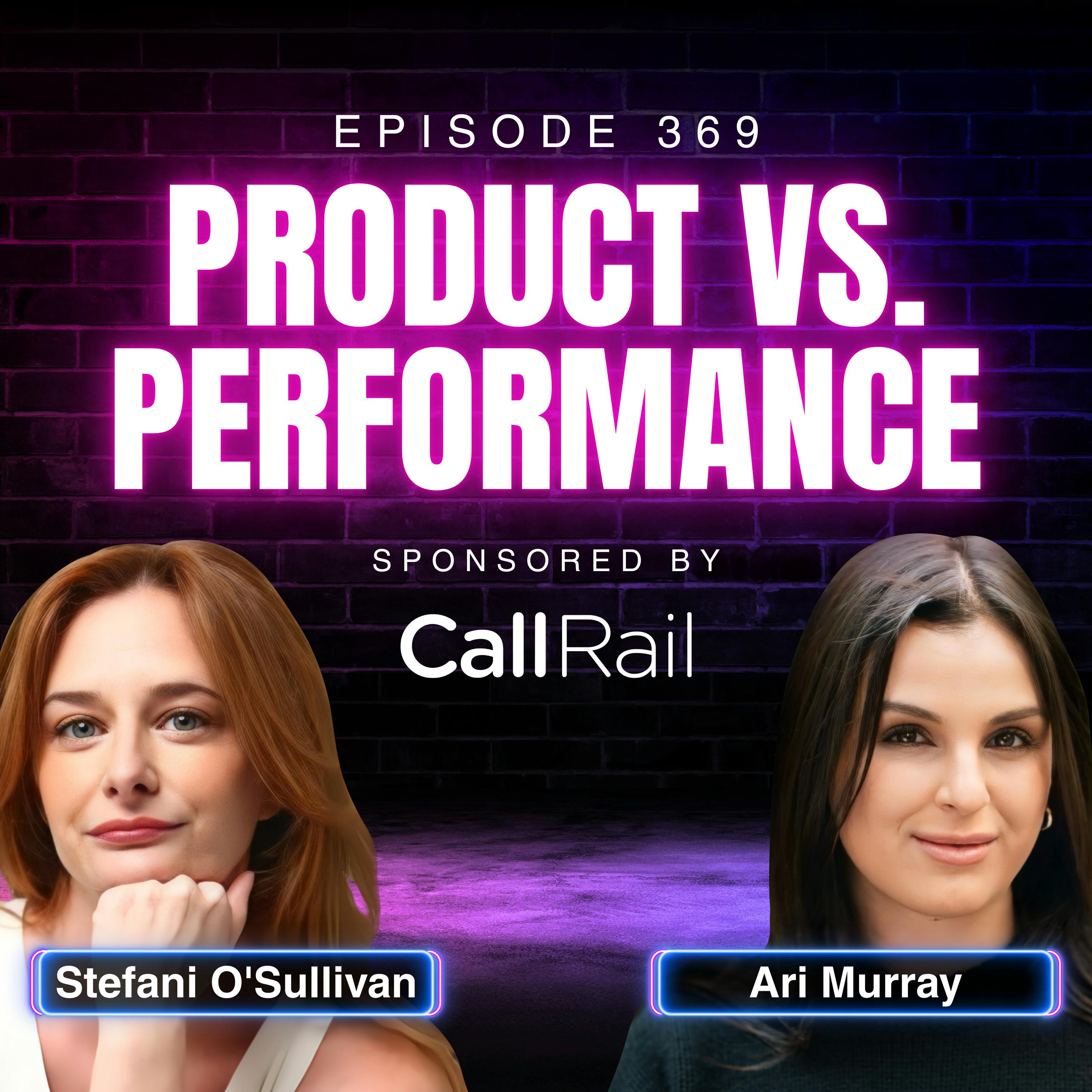
The Marketing Millennials
Product vs. Performance: How Modern Brands Really Scale with Ari Murray and Stefani O'Sullivan (From Marketingland 2025) | Ep. 369
00:29:27
Loading summary
Transcript51 lines
- [00:01]
A
Proving your marketing ROI shouldn't be a guessing game, but when results are hard to track, it's difficult to know if your marketing strategy is working. Meet CallRail. In a few clicks, you can connect every conversation to the exact campaign that started it. So you can focus on what works and drive better marketing outcomes all in one platform. Try it free today@CallRail.com proveit what is up, marketing bestie Daniel here today. I'm bringing you a special episode and this one's straight from Marketland Festival 2025. Yes, we recorded it for you. You're about to hear an amazing conversation between Ari Murray, my wife, also the Chief Digital Officer at Salton Stone, and Stephanie, head of growth at stod. In this talk, they break down how product LED and marketing led brands really grow, how to build a growth org that stays close to product, how to think about new channels like CTV out of home and retail media, and the first move they'd make if they were launching a brand today. It's a very tactical, fun episode and it is also full of nuggets. Let's get into it. Welcome to the Marketing Millennials, the no BS Marketing podcast. I'm Daniel Murray and join me for filter conversations with the brains behind marketing's coolest companies. The one request I tell our guests stories or it didn't happen. Get ready to turn the up.
- [01:41]
B
Hi marketingland, it's us from the past. Steph, so good to see you. Love your background, love your sweater and we have a really important day for you today. When I say it's us from the past. It's currently July 8th. I have to tell you that because I'm nine months pregnant and I just wanted you to know. So we are pre recording and we are going to be with you day of at marketing land. We wouldn't miss it. Daniel wants us to wear Halloween costumes, but we're not those type of girls. We will see what happens. But so happy to be together and I have so much to do and to teach you but really it's all going to be about stuff today and I'm so excited to just learn about your experience and to show you guys why we're in growth. And Steph is a G and she really, really, really knows how to grow and she works at stod, which is one of my favorite brands ever. I want everyone to know that I'm wearing a STOD sweater. Purchase full price. I have two of these. This is my STOD purse. It's really important to me. It's a Tommy. I used it on my 30th birthday and I think they go well together. I'm not leaving my house today. So this is a prop. But Steph just really knows what she's doing. She sells the best stuff. She's formerly of Savage X Fenty Mod Chanel, if you've ever heard of it. And the best day ever. But Steph, thank you for being here and I just can't wait for everyone to get to know you.
- [03:04]
C
Thank you for having me. You gatekeep Daniel wanting us to be in outfits.
- [03:10]
B
Yeah, he's crazy. Every year there's a theme. And I do, I do support this year's theme. And I hope everyone in costume, like, knows we respect you fully for your choices. And we, we love that it's October 30th, we love that so much. But in July, it just seems hard to commit to.
- [03:26]
C
Yeah, it's hot.
- [03:27]
B
We'll see. Yeah. So lots of questions. Let's talk growth. So at stod, the product leads marketing. It's the key to the strategy. But at Savage X Fenty, marketing was more associated as driving the company's growth. How do those dynamics shape your growth strategies in each role? So like a product led growth or a marketing led growth?
- [03:48]
C
Yeah, I kind of came to this product versus marketing, like growth philosophy or theme or something more recently as I was kind of reflecting on previous roles that I've had. I think that at stod, the product is the hero. And so our relentless focus was all built around the product. So growth became about building demand around very intentional product stories and driving urgency around or through exclusive products newness collabs, but letting the product really lead all of that storytelling. Whereas at Savage and a lot of other D2C led businesses, marketing and growth performance marketing were the main levers that were pulled to unlock scale. So the strategy was more about funnel velocity and conversion rate optimization and like real time conversion monitoring to guide kind of where to push and pull. I think that both kind of shaped me in different ways. My philosophy now and what I hope to kind of bring into the future is the blend of both. The blend of like really strong product and product intuition with a healthy, profitable performance marketing flywheel. But ultimately they each require kind of different pacing lever prioritization, business prioritization investments. And it kind of just depends on what the company you're with, what their philosophy is and culture is around growth.
- [05:39]
B
Do you think that when you think of a product led company or a marketing led company, do you think that it matters if the marketing led company has this like celebrity figure, does that play into it or is it agnostic? And it's just if you're data, data, data or product, product, product.
- [05:56]
C
I, I think it's more that I think the celebrity piece. You couldn't be a celebrity brand and be still product driven. Yeah, I kind of feel like ROAD is a good example of that. Everyone's obsessed with road right now. I feel like it's the most tired example but like their crush applies really. A product led brand but led by a celebrity. And then there are product led brands that are, you know, no shade to VCs but VC backed and really just like growth, growth, growth, performance, performance, performance. And so I think it just depends on the values around product and customer and why the brand was founded and maybe what our kind of ultimate maybe exit plan looks like.
- [06:40]
B
I like that. I think the ROAD example to me also it's product and celebrity but they also were very careful with inventory in the beginning. It was very hard to get it. You had to set your alarm. It was always somehow restocked. Wednesdays at 9am and I think that you can be all those things, you can be backed, you can have a celebrity, you can have a product priority and have data but also like you can create your own demand by withholding the product. So it's all, it's all part of it. We can talk about this. Actually my first question guys, this is what happens when I talk to Steph, but what are the trade offs between the two models to you and, and which one do you think is more scalable over time? So product or marketing?
- [07:25]
C
Yeah, I think that my own now philosophy that I'll continue to carry on in my career is that product led models build deeper equity and loyalty and organic demand. With that said, if your focus, if you want to be a product led business and your focus isn't on the product, customer and customer feedback, manufacturing, production efficiency and like speed to market within reason you're kind of maybe like at a little bit of a mismatch there. I also think in a product led business there has to be an element and a culture of product test and learn to help find scale and find products that really hit and become big winners. If you're doing that without performance marketing. I think that a marketing led growth led business drives and can drive faster growth. But without a strong product resonance or product loyalty or brand loyalty, from what I've seen in the market and from the brands that I've talked to that have kind of fallen down this path, it risks a lot of customer churn, rising cacs, the relentless kind of media optimizations of it all. And I think that over time a scalable, healthy, profitable business and model blends both. It lets product guide your focus and your narrative and also your point of differentiation while using performance and media and digital marketing to help amplify and sell at scale.
- [09:15]
B
I like that. I also think what you said about having like an ability to experiment with product and a patience and probably even like a margin of error where you know if you are selling the same skus of deodorant and then you release a new flavor every time. That's like in a product led company if there's always a new flavor twice a month and if one flavor is crazy. But it could be crazy good or crazy bad if you have the model and the cash flow and the ability to let yourself fail versus I think to even in a product led company, in a market company too, there's a lot of pressure if you over buy inventory or if you miscalculate. And I think either model you get into those issues. But in a part of the company like there's a certain trust and know how and you have to be able to like stomach it, which is not easy.
- [10:10]
C
It's not. And I think that I agree 100% and I think that the kind of what I'm getting at around the organic demand piece and even the celebrity piece that you were talking about before with organic demand and product loyalty or even brand loyalty, you have something to fall. You'll always have something to fall back on. Right. Like it's not an. It's not. You're not going to drop yourself off a cliff if your new collection doesn't hit but all these other extensions, iterations, collapse whatever it is hit. And so you have this great baseline in some growth businesses I've seen or businesses that are really reliant on like one single lever to drive like buzzy poppy growth. You block that really great baseline to fall back onto and so you end up with a business that looks like this instead of like this.
- [11:09]
B
The floor is not level.
- [11:11]
C
No.
- [11:12]
B
Yeah. I've also in a celebrity brand too, you're at the mercy of if something changes for them. And I've been there where the celebrity decides they want to be less active or they get cancelled or whatever. The canceled ones are really hard. I'd love to meet a growth marketer that can like overcome that one. I have not.
- [11:34]
C
How do you structure your growth or.
- [11:36]
B
To stay close to product without losing speed and the ability to Experiment.
- [11:41]
C
I think it's, I think it's cultural. I think that if the baseline agreement and the, and the common ground between every team or department in a business is that we love our product and then inherently, because you love your product, you love the customer that loves your product. I am kind of like, how can you go wrong? I think the further removed you are from what you're selling doesn't help you. At least I haven't seen that it has. I think that the closer you are to what you're selling, the richness in storytelling comes through the relentless focus on fit or, you know, whatever product you're selling, the relentless focus on perfection of that product and tapping into what the customer loves about that product is a shared common goal.
- [12:43]
B
And if that's the culture, then the product team, like wants to hear from marketing, wants to show marketing. No, marketing is going to be excited. They know you're gonna ask for a GWP and then they're gonna make your dreams come true and then you're all gonna freak. Like, I think, I think that that culture of it's not separate departments, but an engine.
- [13:02]
C
Yeah. It's hard to have accountability almost.
- [13:06]
B
Well, yeah, because a product makes a foundation that no one likes. You can sell it once and then it's. It all has to be together. It's. They need you and you need them. And I feel like we sometimes all can get siloed into our own niche or expertise. But.
- [13:23]
C
Yep. And then you go down the path of why are cacs $27 higher than we projected them to be? Well, this collection isn't selling. This isn't what our customers wanted. We didn't listen. And that's not a blame. That's just we have this shared goal around this one thing that we're all going to champion because it's how we grow the business whole. To me, obviously, if you're not like a con, you know, product led business and you're selling something different or you're selling technology, all of this will vary within reason and what you're selling. But. But yeah, I think that it's cultural. It has to come from the very top.
- [14:03]
B
Do you think it's gross responsibility to be involved in this? And how do you best get involved, like on a tactical level?
- [14:12]
C
I actually, I think this is actually a really exciting question. I'm glad that you asked this because I've been in growth, performance, whatever you want to call it, for about a decade. I started in growth before it was even called growth. What was it called? Like before it was sex, before it was like the sexy thing, people were like, whatever you're doing over there, that's not cute. And so I think growth and performance has evolved so much over the last decade and, and at first, and still currently some growth leaders and growth roles are so tightly wound to media and then some roles are far more expansive and really lead revenue generation and kind of growth thought leadership for a business. And then there's obviously so much in between. I really value the idea that a growth leader and growth team should be involved in all things business expansion, whether that's a new market, a new channel, a new media channel or a new sales channel, a new product extension or product category, when and where to launch something. Do I think they should be involved in the design process? No. Do I think that they should be giving feedback on designs? Probably not. But I do think that they should be involved as a thought partner and thought leader of how this is going to end up in market and what they're seeing and how this will all kind of fit together. I think that they have a really critical point of view because your growth team, depending on the scope of the growth team, they'll probably have a really great insight into the fluctuations in customer spending and customer engagement because social media and paid channels are just, you get so much rich information what's going on in the market from those channels. And so I'm really, really excited about companies buy companies that are expanding their view of how to engage in value growth leadership in a more holistic strategic arm that's responsible for like a scaled profitable business versus pigeonholing growth into one idea of a part of marketing.
- [16:32]
B
Yeah, I love that. And for me, I'm obviously not on the brand side anymore. I do miss it, if you can tell by my love of all your products. But I, I run an agency and lead a big team of media buyers and of creatives and I don't even like to call my media buyers media buyers. Like I consider them. Like you start as like a growth specialist and then you're a growth manager. And then because I'm trying to teach that if you get an ad, even at like the actual fundamental level of the job, if you get an ad and you read the ad copy and it's assigned to you in a sauna and you're about to stand it up and you think it's, and you think it's going to tank out and you can't just accept mismatched ad copy to an ad to a landing page destination that you didn't choose and stand it up and then say, oh, they gave it to me and the creative handed me this. Like everyone who sets anything live is responsible for their point of view on what they're working on. And you don't have to know everything about video animation to know if something feels off or to know if it doesn't match the patterns of what's working or isn't a test. That's for diversity. And so in any role, you can, like, take your role at face value and you can be a media person or you can be a growth marketer. That's more in the data, which is great to know, but the way you describe your growth team and your level of responsibility, like across the org of how things get to you before they get to you, is how I think all growth teams should run at any level, at any type of business, where you have as much say as you allow yourself to have. And you have to challenge what you're handed. And you don't want to stand up anything or get a product dropped in your lap for Q4 to move that you don't believe in or at least never said anything.
- [18:22]
C
Yeah. You can stay in your lane and be an expert and still have the mindset of a business owner.
- [18:32]
B
That's the punchline for sure. Yeah.
- [18:35]
C
Great.
- [18:36]
B
When expanding into new platforms like ctv, retail media out of home, what signals do you look for that let you know it's worth it? I know there's different levels of measurement on each of these.
- [18:49]
C
Yeah. So I was thinking about this last night, actually, because I was torn on how to answer this because there's the obvious answer of incrementality, brand lift, study, all that good stuff, which I can talk about. But also I went to a dinner maybe two years ago, three years ago, and the CEO of Avocado Mattress was there.
- [19:12]
B
I just got a pillow last week for my hospital bag.
- [19:15]
C
Oh my God. It. Do you like it?
- [19:17]
B
Yeah, it's the pillows I have on my bed. But I decided it like six me out to bring it to the hospital. So I'm getting a new one.
- [19:23]
C
That's amazing. It's a great brand. And so he was telling me about when they launched Avocado Mattress. He only invested in out of home and upper funnel media. He did not do any performance marketing at all whatsoever, at least for the first couple of years. From what he told me, he wanted a physical adjacency to other brands. Whether that's out of home and you're near, you're in a great area or you, there's other billboards with other great brands that you want to be adjacent to. So similarly on television. And he didn't want to live and die by the performance marketing cycle. This was kind of probably po. This was post Covid. And so I think there was also a lot of just fatigue around performance marketing and how much money we're spending. But so I, I've been, I think about that all the time and I remember that experience and I was kind of intimidated by that thought process. But I also think it feels really fresh and exciting if you have the right funding and you can lean into that in a big way. Outside of that incrementality signals like lift in brand search, brand search studies, brand lift studies when you can afford them, if you have, if you're spending enough in that area in those specific channels, any, like organic direct traffic signals are great awareness studies, things like that. Outside of that, I'm also really interested in like retail expansion strategy. And then if you have, if you have a wholesale team or, you know, wholesale retailers that you work with, what doors are really performing, outwardly performing. So that, that can give us indicators where we might have a really strong engaged community, but we aren't physically showing up as a brand. And that might unlock an interesting opportunity for targeting out of home or CTV or something a little bit more upper funnel.
- [21:25]
A
As marketers, we're all trying to answer the same question, which investments are actually driving revenue? And too often the honest answer is an educated guess. CallRail replaces that guesswork with proof. With the help of AI, you can connect every lead to the exact campaign that drove it, analyze your conversations and capture leads around the clock. That's why over 220,000 businesses use CallRail to market smarter. Stop estimating impact and start proving it. Try CallRail for free@CallRail.com prove it.
- [22:04]
B
I love that answer. The Avocado example. I've never heard a brand describe themselves as marketing in that way. As like, this is our move, we're going to go top of funnel first. I think it's obviously hard to know if it pays off. And I get worried sometimes when I worked on brands like a big alcohol brand that was launching. We're supposed to be really big. We're so excited about it. And like the day of the launch we are told there's 2 billion PR impressions and like, oh my God, amazing. And there's 30K in sales and you're like, oh God, we missed it. And so I think that's not the same type of top of funnel you're describing, but I think in the sense the Avocado example is showing up where the big brands show up or in ways that small new brands that are not able to normally spend there or don't have the guts to spend there, it kind of like builds a different type of trust. And if you're buying an expensive pillow or an expensive mattress, you don't want to feel like you're buying from an. Maybe like an Instagram ad brand and maybe that's what that accomplishes.
- [23:12]
C
So I like saturating out of home CTV versus saturating TikTok, Facebook meta, whatever.
- [23:21]
B
Yeah, yeah. Like it takes total guts. I want to one day I need some funding, but I want to do that for sure. How do you think about messaging consistency when you're juggling product launches, performance ads, organic? How does it, does it matter? Are you stickler here? Do you want it to just be whatever it needs to be?
- [23:46]
C
I think that my, my. The main thing that I talk about often with my teams is respecting context. And so I think that consistency builds trust, memorability, launch cohesion. But rigidity can limit your relevance, whether that's relevance across different channels or relevance across all the diverse audiences that you're looking to engage. And so I think aligning on a core narrative or message or feeling that you want for a launch or a product is important, but then allowing that to run free. It's almost like when you're bowling and you get the kitty, the little kitty. Bounders. Yeah, yeah, Bumpers like that. I feel like you have this campaign there, but then you need to be able to like bounce it back and forth, flex it, shorten it, expand it, change it a bit within boundaries, again by channel and by audience, to keep that messaging consistent, to respect the context.
- [24:51]
B
I like it. I think bumpers is a really good example. And I, I teach my teens at least. Like, let's say we have a brand guideline we've been given or a deck for a new product launch, but it might have enough content within for us to understand, like two lines of copy that we can write. But I don't only want to run ads that are short form. I want to also run especially if it's a technical product or a supplement or something people need to trust. You can still bring in Evergreen working stats or you can. It doesn't always have to be exactly the brief, but you have to sort of fight that sometimes too. But I think it matters. Okay, I have one last question for you. If you were launching a brand from Scratch tomorrow. What's the first growth move that you'd make?
- [25:43]
C
I. I think that.
- [25:47]
B
Okay.
- [25:47]
C
Have you ever heard of Shop My? Have you? Are you using Shop My?
- [25:50]
B
Yeah. Okay, explain to everyone.
- [25:54]
C
I'm on a Shop My high right now. They're like a, like to know it sort of vibe, but they're new. They're. I mean, I think they're maybe two or two years old or three years old. Don't quote me on that. But anyways, they're a community driven influencer affiliate platform. But the influencers and content creators are so engaged and I think that if I were launching a brand tomorrow, I'd want to penetrate multiple different types of important communities with really solid orbits of people and community around them that align with our product and storytelling and values and build that amazing word of mouth and product engagement and get people to touch and feel and use the product. Um, and to talk about it. I think that you could have a multimillion dollar. I've seen it. You can have a multimillion dollar business before you even start CRM paid media by just focusing on that.
- [26:58]
B
I love that Shop My story for us is one of my brands was launching this spring and we were contacting Shop My to get them there like as a brand that sells on Shop My and Shop My like would not give us the time of day because it was a celebrity brand that was very stealth so I wouldn't tell them the name of the celebrity. And it took me a long time to like get meeting and then they like weren't that nice to us over email and then we got the meeting and they like really wanted my celebrity and then it all changed.
- [27:25]
C
But like I think.
- [27:27]
B
Come on in. That is not that I don't like Shop My because I, I really do believe in it and I get it. But they're very protective of what is allowed to be sold and who's allowed to be a creator. And it feels cool. And I think I agree with you. A million dollar, multi million dollar brand, it doesn't need like an abandonment flow. If someone that you love is wearing the product, showing the product, linking out seamlessly and it feels trusted in the way that other like it's not like linking out to Amazon. It just you feel like you're, you're cool and people want to be cool and they, they really don't just let anyone in. I can affirm that because it was hard to get there. So thank you so much for being here, Steph. I can't wait to see you in October. Reminder, this is not live, but it's about to be because we're going to do a Q and A, we're going to answer your questions, and I just can't wait for everyone's Halloween costumes and for us all to be together right now. So thank you Steph. And thank you Marketing Land, for having us. And proud of you, Daniel.
- [28:25]
C
Thank you both.
- [28:29]
A
Thanks so much for listening. Keep tuning in to hear more great insights from the coolest marketers from around the world. If you have haven't ready, make sure to subscribe and follow the Marketing Millennials podcast on Apple Podcasts, Spotify, YouTube, or wherever you get your podcast. And if you like what you hear, I would greatly appreciate you giving us a five star rating. It helps bring more marketers into our community.