← The Marketing Millennials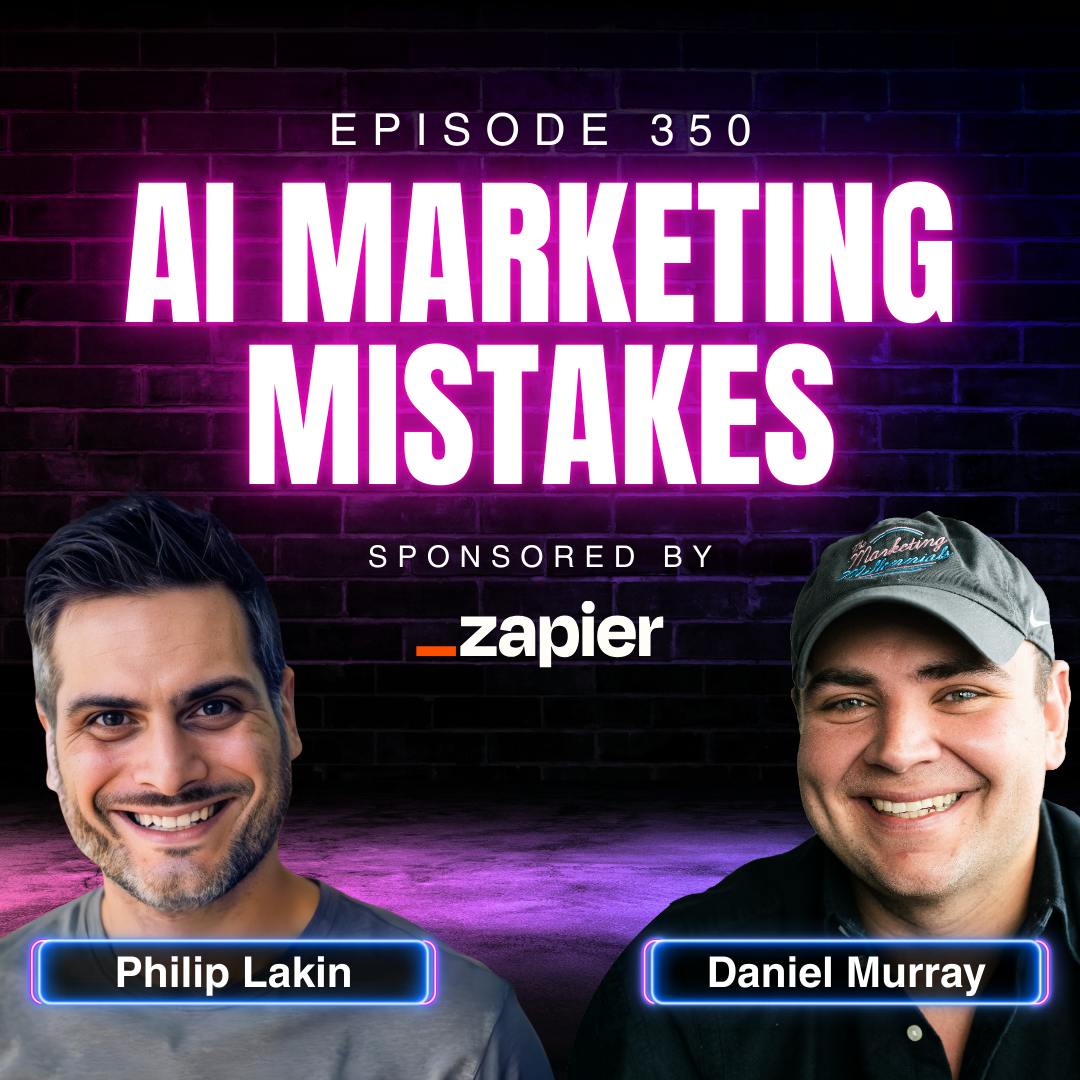
The Marketing Millennials
The Biggest Mistakes Marketers Make with AI (And How to Fix It) with Phil Lakin, Head of Enterprise Innovation at Zapier | Ep. 350
00:50:47
Loading summary
Transcript95 lines
- [00:01]
A
As a marketing ops guy, I used to juggle a lot of disconnected systems, CRMs, email platforms, analytics. It was a lot. Now Zapier can put AI to work for your team with automation and real business workflows so you can focus on what actually moves the needle. Visit try.zapier.com TMM to unlock a free trial of AI orchestration. Welcome to the Marketing Millennials, the no BS marketing podcast. I'm Daniel Murray and join me for unfiltered conversations with the brains behind marketing's coolest companies. The one request I tell our guests stories or it didn't happen. Get ready to turn the off. What's up Phil? Welcome to the podcast.
- [01:00]
B
Good to be here. Thanks for having me.
- [01:02]
A
I want people to know your background so we could talk AI and prove that you actually are in the weeds doing this every single day. So could you give a little background of who you are and why they should listen?
- [01:15]
B
Sure. Well, hey, my name is Philip Laken. I'm the head of Enterprise innovation at Zapier and I came into this role about a year ago through acquisition of my company no Code Ops, where we were a big part of the no code movement. We built the first observability tool in like the no code and automation AI space as well as built the first community dedicated to operations professionals, not just entrepreneurs and founders building stuff with no code and automation. So think marketing ops, sales ops, rev Ops, people ops, etc. And so we've been working with that audience for quite some time now. And since I've been here at Zapier, I've been really spending most of my time doing content for our top of Funnel and doing a lot of like content led innovation stuff all the way down to product packaging and pricing through helping one of our newer programs called the AI Transformation package where me and my team go into companies, embed into companies and help them go AI native within one year. And so with their teams getting hands on and building themselves, we're not just building the stuff for them. So I'm spending all my time translating real world problems that different departments have, especially on the GTM side with like marketing sales revenue into orchestrated AI solutions. So you know, I'm both talking very top of funnel about this stuff and you know, making sure the terms and the things make sense and that, you know, we're talking about the stuff in the right way and marketing this as well as the person on the, you know, in the very bottom, like helping folks build the programming and automations to help the whole company. Thrive. So that's me.
- [02:55]
A
Amazing. So yeah, everybody. So when we're talking, Phil really understands because he's actually implementing this today. So I mean, I used to use, I've been using Zapier for 10 plus years and it used to be like the go to tool for automation. And now it's still great, the go to tool for automation, but now it is moving to, to an AI first approach. So the question I have for you is like, what is the biggest mistake marketers make when adding AI into their workflow?
- [03:30]
B
Oh man, there's a bunch. So I guess let me rewind that for a second. I'll break that out into two areas, right? Because there are several ways that you can use AI within a tool like Zapier. And let's talk about the mistakes after that, right? How they kind of map. So look, Zapier got famous for like automation, like if something happens over here, then do something over here. So very like simple triggers and actions and those expanded over time into like paths and conditions and you know, 8,000 different apps, 30,000 different actions and triggers, right? Without having to write a single line of code. So that grew and grew and grew and grew and grew. And when AI gen AI came, you know, around a few years ago, we brought it in in a few different ways into the product. So one is just like every other SaaS product under the sun. We have some AI features that are really helpful. We have a copilot that can help you build zaps. We have a copilot that can help you build entire systems of multiple zaps and other tools like tables and interfaces within Zapier. You know, we have AI to help you do error, error resolution, right? So you don't have to like read code or, you know, anything like that anymore to figure out errors. So we're using AI in a lot of ways to help you use the product better. But also the most popular version of AI is the second one, which is you can bring an AI step into Zapier. And so what that means is let's say someone submitted a form and you got a bunch of fields on that form and say you delivered all that stuff to your SDR to reach out to the person if they were qualified, say, hey, write this person email maybe here's a template of the email. Feel free to customize and send. And it might just be like some basic template, right? Well now what you can do with an AI step is instead of that marketer taking all of your stuff, throwing that into ChatGPT and rewriting it for themselves. You can actually have the AI step in Zapier, use all of the fields that were submitted, some basic prompt from you, right, with some past examples that have worked really well and generate a personalized response to that person that then you're sending to the SDR to press approve or reject or whatever on. And so you're saving a whole, you're doing two things there. You're saving an entire step where the SDR doesn't have to go to ChatGPT to do that stuff. And you're allowing that not every SDR needs their own GPT that like the best learnings are coming back up and hitting that earlier prompt that you control. So they're all getting the best, you know, the best version of a first draft and that is super powerful. So and then there's a third wave, you know, using AI and Zapier, which is agents. And agents kind of break the mold of the traditional. Like, you know, if this happens, then do this, this, this. You know what I just described was AI in a workflow. Unlike all of the LinkedIn gurus out there that think that that is an agent. That is not an agent, that is simply AI in a workflow. An agent is when you say you've got a trigger and then after that trigger happens, you've got, you know, here's some knowledge I'm going to give you access to. And that could be our wiki, it could be our HubSpot, it could be Salesforce, you know, maybe it could be the whole Internet. Do some Google searching, right? I'm going to give you some instructions, like a job description, like I would give an intern. First I want you to start by doing this and then do this and then do this and then maybe read this, maybe send this thing and then I'm going to give you access to tools, right? So you know, you're allowed to read this, you're allowed to send a slack on my behalf, you're allowed to update this HubSpot field, right? ET cetera, et cetera. Now they're less deterministic than the other workflows, they're more inference based so they can make their own decisions. Now the nice part about Zapier is that you can say all I want you to do is this one job. So maybe do some Internet research and do some qualification 1 through 10 about this person based on some of these knowledge sources. I give the agent access to write about who's like our best icp. And then you can bring all of that data back into A deterministic workflow so you can get the advantage of both things. In zap, you carve out different things for different jobs. Which brings me to the biggest mistakes that I see marketers make here, which is they think that now that AI is a thing, you can just like, throw everything at an AI or at a chat or at an agent and just be like, cool. It's just going to fix things. It's not. You still have to think through the process. You still have to break down what parts of the process you want a workflow to own versus an AI step to own versus an agent to own and how you want those to work together. You've still got to battle, test the outputs of the agents. Just like you would never give an intern, like an overly enthusiastic Internet intern with, you know, access to the Internet, just like, hey, go figure it out. Like, you know, then I'm never going to look at your work again, right? Like, no, you're going to sit with them the first few times and battle, test and see what's working, what's not working, give them feedback. You're going to check in on them every now and then, right? So the same type of thing, you might have different levels of interns, right? You might have, like, you know, interns that are level one and interns that are level three, right? And you're going to want to give them different types of work. And so you, you're going to break things out a little bit. You know, you want to choose what you want to give to who, right? In intern level one, you may just, like, want to have run in a very simple deterministic workflow with a very little AI step, something you trust a little bit more and you've really checked the outputs of. Maybe you want to give to an agent, right, where it has a little bit more free will and inference. So the biggest problem that I see is that people aren't breaking these things out and they're, they're not, they're not thinking about what is the best tool for the job at every step of the way, and they're not spending time learning the difference between these tools and how they can actually work. And the funny thing is that 95% of all this stuff existed before AI. It's just AI made it super popular.
- [09:07]
A
So, yeah, you know, I always used to say to people when I was in marketing ops is you have to be able to do the process manually and know what good looks good manually before you start automating the process. And I think it's the same as AI. Like how are you going to know what good looks like or what great looks like if it hasn't been done before in your company or have someone who knows what you've got to speak the language? Because I could say, yeah, I'm like, I can say str, go do this. But if I don't know what good sales outreach looks like, I don't know what a good email looks like, I don't know what a good script looks like, I could just put it, the AI could be doing things. I'll be like, oh that's great. But is it right? Probably not. So you always need to. I like what you just said. Go through the process first, map out the process. It's the same thing 10 years ago with automations like map out, eat automation. It's just now it's just doing a lot more in a little bit of time which is the good part of it saving us a lot more time is automation saved us the first 10 to 15 hours and now this is saving us another 20, 30, 40 hours to do non manual work that we, yeah, that we more strategic stuff for the business.
- [10:30]
B
I think the other thing that the other biggest mistake I see marketers make here, I think there's two of them say one of them is they think that when AI does something it means AI has to do everything. And that's not true. You can have AI be a part of a human in the loop process. So I'll give you some examples. Like if you have an inbound workflow, right? And I have an AI agent that I'm passing off some of that data to that came in through the initial form saying like hey, look at all the knowledge sources that I just gave you access to in our company. Grade this person 1 through 10 and then maybe if they're like, you know, if they're a five or below, send them, just put them on a sequence and let them have fun, right? Like you know, if they're a, you know, 8, 9 or 10, assign them an AE and write that initial outreach message from the AE using an AI step and send that to them. But if they're like I guess six or a seven, right? This is kind of like in that maybe zone. What I want you to do is send me a slack message and this is a step in Zapier called request approval. Send me a slack message with two buttons in it and show me in that slack message all the information you had about that person, why you graded them a six or a seven and Let me make the decision right of which path they should go down. The other thing too is you can have like say the emails coming directly from you. I can always, instead of just sending an email for me that was AI generated, I could say just send me a draft, put it in this label and send me a slack link to that draft. And so basically I just get a slack link that I just have to go click, review, maybe edit, judge a bit and then send. So just because AI is a part of the process doesn't mean it has to take over every little step. I think it's the other thing marketers are a bit scared of that they shouldn't be. It's just a matter of who has what job.
- [12:13]
A
I love, I love that. I think we, I mean the scoring thing is that example alone saves a lot because we used to have like an ACP at my last company, like an acceptable customer profile. And we didn't really do. We had to like have a whole process on this. But if we can just have a tiger team of AI that we put to do the initial outreach, that's a great step. Or people who are DQ'd. Send, let the AI send them like tutorials, blog, yeah, call it a day. And then the ones that are fast tracked have a more of a design process, acceptable process, like accepting process where a human is involved because you actually need. Humans still need to be part of the process, especially in sales because these are big accounts. You can just blame an AI that account.
- [13:13]
B
And that's where you can mix determinism and non determinism, right? You can say like, look, if it's 500 plus people, I don't care who they are, I want to talk to them. You know what I mean? You can have overrides too. You even write those overrides into the agent. They're really good at responding to that type of stuff. But let's get super meta and crazy for a moment. A lot of these times these lead routing things have been built into very deterministic rule sets, right? Like all routing is or like all qualifications, just like a set of rules and scores, right? Not that crazy, right? Maybe we're replacing some of that stuff with an agent. But here's the cooler part. What I can then do is have a separate agent outside of this whole system that we just built in the inbound side here, right. Looking at every week or every month. Right. So the trigger would be time based. Right. So you know, every week or every month your job is to look at all of our Closed one or all of like the things that are looking likely to close. Look at the messages that were sent to those folks. Right. And you know, or the ICP or deter or the demographics or the technographics of those companies that we know about and write a report and show that versus where our current qualification agent is currently in that prompt and make a suggestion to update our prompt to better score people based on what's actually working. So you can use live data.
- [14:37]
A
Yeah, that's amazing. I remember we had a six years ago manually every month we had a rescore based on new data that came in. If AES are closing closed one, which one's closed one or are the other qualifications now they can also. You can have the AI agent look for other qualities that better determine a close one off based on the fields on the record too. So it's like you could go even more meta and find things that find qualities that you weren't even looking for because you can't look at the data all day. Which I think is things that people aren't doing where you aren't looking for extra qualities that people. But I want to also go back a step. Okay. We talked about mistakes a lot of marketers made, but I did have one.
- [15:31]
B
More which is really simple.
- [15:33]
A
Okay, you go ahead.
- [15:35]
B
There's the third, which is as pretty easy. I find that marketers get really jazzed about like point solutions that are essentially just like some type of database, some type of workflows and some type of AI model that they're hitting. Right? But it's highly opinionated towards like a specific area. They just give you an example, like I don't know, like a revenue orchestration platform or something like that, or like a lead router or I don't know what, you know what I mean, like where it's just like they're basically just like a few rules, you know, workflows, AI and a database with like some fancy features and some opinionated thinking. And some of those in the extreme end of opinionated thing I think are still super valuable. But I think there's a lot of them that like if you just spend the time to sit down with Zapier or like a tool, like an orchestration tool, I guess you could be replacing hundreds of thousands of dollars of point solutions in your stack should you learn the basics. And the biggest mistake is just like seeing something and being like we want to buy that, we have to integrate it versus like what if I just gave you the building blocks to own that on your own for like 5% of the cost.
- [16:44]
A
I love that because also now where marketing have gone is like their data, their own, own database is the source of truth. Where 10 years ago Salesforce or some other tool was the source of truth data, now you can connect that to your database or something like that and have rules out the database, which changed a lot more of like letting a platform control all the rules that you have, which. And then connecting, like you said, a point solution to that platform because that platform didn't know how to do that one thing. Usually it is just a bunch of point solutions attached to one big platform, 100%.
- [17:28]
B
And now imagine the power of building most of those point solutions in one system with the same fundamental building blocks. It puts you in control, it allows you to customize. Look, it does come with a cost of maintenance. I don't want to hide that. Right. There is a cost of maintenance on some stuff, but oftentimes that cost of maintenance is way less than the cost of a point solution. Right.
- [17:50]
A
I mean, I would say this cost of maintenance of all these, like, someone has to run.
- [17:54]
B
You still got to go maintain the point solution also, right?
- [17:57]
A
Exactly. Someone has to run that tool. Someone has to run the connection between that tool to the other. And someone probably owns a point solution and it may be owning the database. So you have to work with five different people to get one thing done. So that's. But I wanted to take a step back and also say for marketers just Starting like implementing AI, they probably have used ChatGPT. ChatGPT a little bit. They may be inputting data into ChatGPT a little bit. What are some. I wouldn't say too detailed. Example, what are some quick wins that marketers could do right now? That. Or what are some. You've seen with some of the. Your customers examples that they can implement and today that could help their marketing or, or change their marketing or. I mean, obviously whoever's listening there, it's different for every company. But there are some, There probably are some quick wins that you're seeing that people aren't even thinking about. They're pretty easy to implement.
- [19:06]
B
Yeah. Look, I'd say on the thinking side, one thing that you can always do, right? And I see people do this a lot, like make this mistake a lot where it's just like come up with a good marketing campaign idea for this. Right. And it's just like, no, that, that, like, that is like telling an intern who has no idea about any very little about your company to like go do that. I always say Overload with context. Right? Like always put in a lot of context. But beyond that, find the public work of people in that area. You're asking AI to build the thing. Go search for those people and ask AI, like, ask your ChatGPT if you're seeing ChatGPT, right? Being like, I want you to give me feedback on this initiative, or I want you to create this initiative from the standpoint of these two or three people working together. Right? So it will research those folks and how they think about the world. And now it's going to give you a lot more specific of an output. Right? As was like general thing. So basically you're telling the intern, like, look, you don't know much about our company yet. Here's a whole bunch of context about the company. Here's a whole bunch of context about, you know, X, Y, Z. Oh, by the way, here's three people to go research that I really love. Take all of that and then give me back a first draft. And you're going to get a way better output. So the more specific you can get with AI, the better you're going to get an output for.
- [20:26]
A
Yeah, I love that. I want to just stop on that point. I think too many people are not spending enough time on the prompt. They're just saying, hey, AI do, like, do this or that for me instead of details. Just like an intern. The more information you give them, the better job they would do. The AI still needs that. And so many people are falling short of just saying one little line. Hey, could you figure out how to do this? Instead of telling them who they need to act like what they need to research, here's context of our company. Because it could be different from every company and going in more detail, prompting them instead of. So I think that's a great point.
- [21:13]
B
That's gonna be huge. And if you're confused about how to write a great prompt, don't even think you need to research it. Just putting your initial, you know, okay, level prompt. And just ask AI, what do you need for me to improve this prompt? And then it's going to ask you, and then you're going to respond with that. And then ask it to now write the prompt with that. Right? So just like with an intern, I could say, go, come up with this campaign. I could make. But also like intern with the way that you like to communicate and the way that you work in your working style. What do you need to know from me? And then it'll just tell you, and.
- [21:47]
A
Then you can communicate with it.
- [21:49]
B
It's like working with a coworker, you know?
- [21:51]
A
Exactly. I'll let you go to any other wins that you think could be good too. Wasting time running from platform to platform is just bad ops, but it still happens all the time in marketing, even in the age of AI. This is where I turn to Zapier. No matter what you do, Zapier has an AI use case for you automatically qualify leads, route support tickets, sync customer data while you sleep. No trying to remember where the latest data is. No unnecessary back and forth. It's time to put AI to work with real business workflows so you can scale faster. Go to try.zapier.com TMM to unlock a 14 day free trial of AI organization orchestration.
- [22:45]
B
Yeah, look, I think I kind of mentioned one earlier where it's just like trying to replace, you know, certain point solutions I think is very, very powerful. I would say find one area, just one area where you're like repetitively going to chat GPT or whatever kind of, you know, chat model you're using for a certain thing where you're like, okay, every week I'm writing this report, I'm having ChatGPT help me do a thing or you know, every day we get these types of requests in and I'm using chat GPT to rewrite these things and send it back out. Whatever it is, something repetitive, we're just constantly going to chat GPT. What I would do is try to use an orchestration platform like Zapier to say the trigger is this, wherever that data is coming into you via, right? The next step is an AI step where it's going to mix some of that data from the inputs of that with a prompt that I'm typically using and then it's going to output into a slack message that comes to me for approval to send to wherever, right? That way you don't have to be going back and forth all the time. The data will find you, the draft will find you and like you can always update the prompt and the inputs and all that stuff. But like that saves me so much time every day, every week. So if there's reports you're prepping for certain leadership folks, if there's like, if there's reports you're getting from leadership that you need to translate to your different departments, like bring AI prompts into that workflow to help you come up with the first drafts where you can just dump in the original thing and get everything you need and then edit from there as opposed to having to go back and Forth and write like 20 different things and have 20 different prompts.
- [24:21]
A
Like yeah, I. Another question I have is, I mean you started a pretty big community for Ops folks. You said a little bit earlier, one of the things you should do is say go research these three people. But what are some ways that people, what are some communities you think about or resources you think about that people can join to start improving their knowledge base of AI or finding these people? Because that's sometimes half the battle is finding where to go to get inspired, right? Yeah, exactly.
- [25:02]
B
I think there's a few man think of course like the community that we started, no Code Ops is still owned and operated by Zapier and Claudia is our community manager who's incredible, still runs it. It's a free discord. So it's just no code ops.com I think operations Nation is another really great one. I think that generalist world is quite phenomenal. You know, more for generalists who are just kind of going across different areas which I think marketers kind of have to learn how to be a little bit more because I think we're going to leave some specialization stuff like look, just so you know, the world of sales is teaching us what's going to happen. A lot of roles are going to fold into like what the GTM engineer equivalent is, right? Because of like how fast people can now move. And so I think marketers are going to have to learn how to become generalists a little bit where they know a little bit of strategy, they know a little bit of, you know, content creation, they know a little bit of the automation side, they know a little bit of the system side. They can combine all of those things to be like a secret, you know, I got secret weapon for all of those in one. And so I love kind of the ideas of generalist world there. And then honestly, like I would just like I would be on TikTok and LinkedIn looking for this type of stuff. Like I get inspired every day from stuff I see on, on TikTok and LinkedIn. Just seeing what other people are doing, you know, make sure you're interacting with content content and doing searches around AI and marketing and like your feed will you know, kind of help you out on the algorithm side of that. But like, dude, I'm learning so much stuff from just curating my own feeds.
- [26:37]
A
So you know what, it's actually kind of funny just how you mentioned like the go to market engineer becoming the new role. But it's funny, Ops used to be builders and then they, they made the Changed it into a role where they had to be builders and insights, but now it's like, gone back to, you have to be a heavy builder again. Because before it was, like, a lot less building and more just connecting, and now you have to go build systems again, which is what the OPS role was, at least marketing OPS for.
- [27:13]
B
I think so, too. But I think we're seeing, like, a combination of all of those things, right? Where it's like, I'm seeing strategists have to become OPS people. I'm seeing OPS people have to become strategists, right? Like, the reality is the first one to do both is gonna win, right? And so, like, you know, I think people have to get a little bit uncomfortable here, right? Because if in the ops world, creating a system that, you know, maintaining a system used to take, you know, 30 hours of your week now only takes 10, right? You know, maybe save some of that time to go hang out with your family and kids, right? But, like, in the other part of that, you should be learning the strategy side. Like, you shouldn't just be settling and stopping. You should be learning the insight side. You should be learning the data side. You should be learning this, you know, the strategy side. Because I'm telling you, companies are going to get smaller with all of these things. It is just. It is. It is what's. Like, I'm very optimistic about all of this stuff, and I think that new roles are going to evolve and change, but, like, the folks that are going to be the most well suited on the most stable ground are going to be the folks that are going to get a little bit uncomfortable during this time and be like, if I only really feel good at OPS or I really feel any good in strategy, at least learn some of the language of the OP stuff. At least sit in an AI bootcamp where you learn what the heck is possible, right? Like, you know what I mean? Like, get a little bit uncomfortable here.
- [28:26]
A
I think that. I mean, that was always. I feel like going out of college to the marketing role was one of the hardest roles to get. And going into marketing ops was just a way for me at least to separate myself a little and learn the skill that nobody really wanted to do for a little bit. So I was. I didn't really want to do it either, but I knew it was the role that everybody wanted. So, like, it's the same thing happening now, is there? You need to know the strategy, but you also need to know how to implement these AI tools. And now even deeper, learning how to build Your own agent, even if you're in any role, you should learn how to do this, which is before they're.
- [29:09]
B
Good and not good. Right. It's its own employee. And so the more time you spend with AI, the more you just intuitively learn like what this thing is good at and not good at. And so that's even super helpful. And so like, you know, like you have no idea how valuable it is to be that marketing kind of overall kind of person where a marketing leader could come to you and be like, oh, can we just do this with AI? And your response is something like, well, we can do this part with AI, we can do this part with offshore staffs. And this part still needs to be humans in order to get the optimal results. That response is worth a million bucks. Right. So knowing how to organize teams around strategies too, is very powerful.
- [29:49]
A
Yeah, it's becoming you. Now you have to learn how to manage people and AI, which is before, like managing AI is a job, it is a real good job. And that's like some people are going to start hiring a person just to hire, like be control of agents, like that's their percent.
- [30:11]
B
But the role is not that. The funny thing is, if you were to pick a camp of people who would be better at that role, right? Of managing a crew of agents. Let me ask you this. Do you think the better person to do that would be deep in the weeds of AI person learning about how to manage, or do you think it would be a people manager just starting to learn about AI? Which one do you think would be.
- [30:37]
A
Better deep in the weeds, which is.
- [30:40]
B
But I like the AI person.
- [30:43]
A
I think someone who like. Because what I've learned about someone, one of my good friends is, I would say not a great people manager, but he could talk to AI, whatever, however he wants to, and he's way better at handling. I would just tell them to handle AI, AI and not people manage ever again. Because he's just so good at that. But I think it also people managers know how to talk to people, but you don't have to talk. So I think it's a little bit of they have to do.
- [31:15]
B
But can I tell you, the technology continues to evolve. So as an example, in Zapier to build an agent, you just literally talk plain English, right? It's just like a jd, right. So my argument is that the first type of person who is like deep in AI, just learning how to manage all these different things, they were the best because they could talk to these kind of complex systems and Build these complex things. Now these things are getting easier and easier and easier to build and orchestrate. I think the managers are going to win if they're willing to learn AI.
- [31:45]
A
I love that. I love that. I think that's a good. Because I think at the. I never thought of it like that. I think, I think the people the reason why I probably have that answer because as of now, I would say the people who really understand AI could just talk to people.
- [32:02]
B
But I think it's so good now that you can just. Because here's the thing. AI is only as good as you know how to do things with it. And if you're making a team out of it and then need to report on the progress of that team, keep that team updated, keep that team in the loop, give them context. Dude, those are all things people managers know how to do really well, right? Like engineers, like, you know, for the most part fricking hate working on teams. A lot of them, right, they just like, like getting shit done. They don't like meetings, they don't like this. And they, you know, like people managers eat that stuff up, right? And so like when the tools get that easy to use, having an org chart of who does what and thinking about the different roles and how you're giving feedback to those roles and how you're reporting up on the performance of those roles and how you're looking at what they're doing and you know, giving them reviews. Dude, that's all people management stuff.
- [32:51]
A
Okay, well, you saw. Well, you sold me on the people manager side of things because I do, I do think, I think the. Probably the deep people right now are winning.
- [33:02]
B
They're an advantage today.
- [33:03]
A
Yeah, they're the early advantage, but if they don't, I think you could fall into the trap of not having to learn how to people manage and then you'd lose to the people managers who have been. Because it's so easy now too. So I do. I'm on your side now.
- [33:22]
B
It's almost like middle management has become a superpower, which is so funny, which.
- [33:27]
A
Is great because I think middle management was always what I've tried to prove, that we're doing the work. They were always the ones in the weed who understood what the people who are actually executing are doing, where the one step above it just get a report up that say, oh, we executed this, this and this. Here are the results. It's knowing how to do the thing that wins. Which I think that's why the people who are one step above who are not Going in the weeds a little longer to learn AI. Are you just going to get.
- [34:03]
B
Let me give you a quick example, right? A lot of engineers think well if it's just built, it should speak for itself. By the way, automation and no code engineers have the same problem as this, right? If it's just built and it works, that should be good enough, right? But what a people manager knows inherently that an engineer does not always know is that that's only one third the battle. The other third is I've got to like, you know, work with it, maintain it and keep giving it updates and keep giving it context from like you know, other parts of the org. So I've got to communicate down to it. But the other third is I've got to communicate up their work. How is it going? What is the ROI we're seeing from this, right? Like they know how to do all of that upwards communication to management that is still needed because management is still human. Maybe one day it won't be and we'll work for robots, but in the meantime the management is still human and so like it needs that context. And so by you saying okay, I need this, you know, you're even help creating this report up, that's something an engineer might not even think of.
- [35:06]
A
Yeah, I, I'm, I'm on, I'm on. You convinced me on your side of things now. I think I do, yeah. I do think that's why people man, like people who have spent time managing teams is just such that in the age of just what you said before, which I think I've always been on the boat that marketers should have be more and more generous. Back in the day it made sense to be specialist. But I like the top of the T of a marketer has become even more and more needed because now you could get, if you understand the whole puzzle, like inputs of the whole puzzle, you can use AI to help you with other parts of the puzzle. But if you only understand, as long.
- [35:53]
B
As you know the right questions to ask, you're good.
- [35:56]
A
Yeah, exactly. That's why forever people are saying marketers should learn a financial statement how the business runs the inside out to the business, not only how SEO works on your website and how it doesn't apply to any other specialty, you only know that not how it's going to help demand gen, how it's going to the finance department, how it's going to help.
- [36:21]
B
So feeding those reports in and translating them to your needs is a really good trick. Do you want to hear one of my Other top secret agents. Not top secret but like you know, fun little agents I have in Zapier.
- [36:32]
A
Yeah, top secret agents like you have like little spies in Zapier?
- [36:37]
B
I do actually, yeah. I love that. I hate reading. Okay, like to the point like I love physical books. Do you know what I mean? But I can only pay attention to them if I'm also listening to the audiobook at the same time. I'm like turning the page, you know, it's like I really like if it's a long thing, my eyes just glaze over and I'm like done. So I have to listen to it or I have to like.
- [36:57]
A
Or me.
- [36:58]
B
Yeah, some the same way so. And then never mind. The got our Slack is insane, right? All the doc updates are insane. We're a fully remote organization of almost 800 people. Right? So it's nuts. So our Slack Coda, Google suite, I think some other assets are all drive are all hooked up to Glean, which is like an AI like search repository for internal knowledge. But I never found myself really going there. So what I did is I built a Zapier agent on top of Glean where I fed it my projects and my job description and I said every week just tell me the things from last week that are updates across all these relevant things that I need to know about and then like I'll have it read it out loud to me.
- [37:50]
A
So smart. It's so smart, you know what I mean?
- [37:53]
B
And like give me the relevant slack threads and give me this so I can reply to folks or whatever. But like dude, it's so. It's that pattern recognition it's so good at. I'm so terrible at. So like now I come to a thread and look like a genius or like someone who's really paying attention.
- [38:07]
A
I mean the things that you said is like for someone who is like adhd like me who will forget to like know I supposed to do something but don't want to read 80 things that just came up. I just want to know what's relevant. But humans inherently are not going to specialize information for you. So you just get an agent to do that for you.
- [38:30]
B
It's a great translation layer for neuro spicy people like us, you know what I mean? Like I don't write long documents anymore. I just talk out loud to chat and have it write out the first draft every time.
- [38:41]
A
Smart. I mean that's, I mean that's how I, I've done like now to get things in my voice I. I have to talk to AI to make sure that it understands how I talk in every day in everyday language.
- [38:57]
B
So you still have to say remove em dashes and whatever. Whatever. Fine.
- [39:00]
A
You know, but I mean I rather do that than have to write a first try. Yeah, yeah, exactly.
- [39:08]
B
Blank page syndrome is real.
- [39:11]
A
Yeah. Like talk about. Here are the 80 things I might talk about. Like help me think about.
- [39:18]
B
Or have it go back and forth with you. The easy thing to do is the basic, which is just like I'm talk out loud. Formalize this into a doc. The better thing to do is say I'm going to talk out loud. The goal is to write of this for these folks. Here's the context. What else do you need to know from me to further flesh out a final draft here? Right. Use it as a thought partner, not just like a dictation person. Right.
- [39:42]
A
I mean the hardest job I thought in Ops back in the day was documentation. And now going back, if I could go back five years and had AI and I could just say I'm going to tell you each step I just built and I'm going to read it out loud to you and you could make this into a document for me and Doc, I will would have saved me an hour or just here, let me screenshot this step. Let me screenshot this, this step. Let me screenshot this step and read it out loud. It would have saved me hours and hours of creating documentation.
- [40:16]
B
Yeah, you can now just like, like and there's tools to even help like that that are vertical sass, that are helpful like tango, you know what I mean, that use AI and allow you to just click through things and you know, but yeah, like literally talking out loud to documentation is the best way to create it. And just looking at the thing because what I find is that I like to verbally do this type of stuff, but other people like to read and not do that. And so and if they want to hear it, they can also just, you know, they can hear my recording or that, you know, whatever or they can listen to a, you know, the voice version of the thing. But that's very powerful is like pre translating that stuff for folks. And like I just find that, you know, text is just a lot more, it's a lot more easily searchable, a lot more easily findable. Like you know, it's just the common language for everyone. So just put it out like that. Huge. Huge. Especially when marketing ops seems to be doing 100 different things. They need to know what each other is up to.
- [41:11]
A
And also like doc, not even ops like other teams need to. Because being an ops person, you're dealing with 10, 15, sometimes stakeholders in the company that each need a certain different type of response. Like you're talking to sales, you're talking to it, you're talking to the marketing leader, you're talking to, you're talking to finance. And you have to be that glue and that in the company to make sure you know everything. And if you don't have a process to do that. Now, this has made it really easy. But I do have a question for you also that I ask. Everybody in this podcast is what's a marketing hill you would die on?
- [41:59]
B
Okay, here's a spicy one.
- [42:03]
A
I love a spicy one.
- [42:04]
B
In today's world where social, you know, networks have made it so easy to reach larger audiences, whether it's YouTube, podcasts, LinkedIn, TikTok, I'd argue that any, any marketer not religiously creating content on their personal brand about their company to learn what works and doesn't work in terms of language, program, everything is not doing their job to the best they could be. Not even close. I am learning every single day in a fast way that I don't have to wait on my organization for to learn what my audiences care about and don't care about every single day. It's content led innovation. And I'm not waiting on larger company posts. I'm not waiting on like, you know, bigger internal reports about stuff. I'm looking at those things. But I'm constantly micro testing things to the point that, like, give you a perfect example, I did a lot of testing on like, how to talk about this stuff with the transformation program we run at Zapier. And I feel like I got enough data back to then test a second order of stuff, which is I'm just going to put out a post to see if people would even like this. And that one post gained us over $6 million in funnel, like qualified funnel. And thus far I think over 500k of it is closed from one post. Right? Because I did all the testing before that. Right. And so I didn't have to wait for a big campaign. Now we're building bigger campaigns based on that. Right? That knowledge. But I didn't have to go through like, because I'm just learning what people want, how to speak about it way faster than a whole team could ever.
- [44:00]
A
Yeah, you're learning. And social is the best way to get quick feedback fast. It literally tells you, hey, this person likes this post or this person doesn't. Like, it's shown in the feed or not showed that.
- [44:18]
B
Well, I guess that's how we should speak to it. You know what I mean?
- [44:20]
A
Yeah. Oh, nobody cares about this. No, you didn't write a, you didn't write a crappy post. There's nobody, you probably wrote a crappy post one or nobody cares about it and nobody wants to talk about it.
- [44:30]
B
And the language matters. The language, how you present it, how you frame it, all of that stuff matters, you know, like so you have to get good at that no matter what type of marketer you are in this world. And you know, and so you can work with that like through audio, you can work with that through text based stuff, you can work with that through video or that through image. But like you running micro experiments is the number one thing that's going to get you to create better, faster. And, and there's no problem using AI to help you with that stuff, right? Like I have a GPT that helps me like where I talk out loud about my ideas and then it helps refine that into my post style and then I edit it from there and then I post. But that's what allows me to move so fast and learn faster.
- [45:13]
A
I mean that and communities too are some of the best ways you could just put it out in the community. Here's an idea I'm thinking about and that's people in your own like people who get you if it's your audience and you just say I'm thinking about this and let people respond and take those comments and you could even feed those comments in AI and say what are the most common ones for my company there's so many ways to just like communities and social are like the two best ways to like get quick feedback without waiting did this and also, also launches are, are terrible because you're waiting on one big moment to see if it's splash or not. And you can hit a bad algorithm day, you can hit a bad and it could be good, but you hit a bad day for launching.
- [46:04]
B
And we learned this in the lean movement with products. Right? Don't go in a vacuum and build a product, never talk to anybody and then launch it and hope it works. Right? Like mvp, right. You know, and lean thinking the same thing and building in public the same thing is true for marketing. Right? How can you test things at the small scale? The small scale you can test things like put out a post. You know what I mean?
- [46:27]
A
Exactly, exactly.
- [46:29]
B
So easy.
- [46:31]
A
Lastly I have for you is where could people find you or find out how to build an agent or.
- [46:40]
B
Use.
- [46:41]
A
AI bots and sapier to. To build their own thing.
- [46:47]
B
Well, first of all, you can always hit me up on LinkedIn. Philip Laken Phillip with 1L on on LinkedIn. I'm super active on LinkedIn. I'm starting to be more active on TikTok, which is fun. And then on my website, just, just my name. Philiplaken.com if you go there, there's a button to click to sign up for my SMS drops. That's where I send you usually like one to two week of just like SMS drops to folks. And those could be things like courses I'm finding really interesting out there that are free or giveaways to certain events that I really love or job postings that I'm finding that are really interesting or promoting someone in my network who's looking for their next role to people that are hiring. So like it's just like kind of my inside scooping track that instead of like having to go through the algorithm or you always get it no matter what, it just comes right to your phone in a short text message once or twice a week. And it's free.
- [47:42]
A
I mean that's a good way to get people on your list. I'm going to use that from now on. Oh yeah.
- [47:46]
B
Anyone wants to know the company that I use for it's called Slicktext. It is ridiculous. My engagement rates and open rates. Like I hate writing email newsletters and I hate reading them. So I found this thing called Slick Text that allows me to do via text. And the cool thing is if you text me back, I get all my texts in one separate phone number in a separate app on my computer or on my phone and then I can like has a mini CRM and like all of this stuff works with Zapier so it's great. But yeah, I, I use Slicktext for all of like my, my kind of broadcast to my audience stuff. I don't use email anymore.
- [48:21]
A
Cool. So there's another way to another distribution channel you should all try marketers not only for promos and stuff, but actually getting information.
- [48:33]
B
People just think about it for promos or for like props or whatever and it's like no man. If you can get your message down to a quick little bit, people eat it up.
- [48:44]
A
Cool. Yeah. Well, thank you so much for being on the pod and I learned a lot today and you convinced me managers will be the best at managing AI.
- [48:54]
B
So by the way, I only know that insight because I'm a terrible people manager and I'm finding that I have to get better at it like I was. I'm the one in that first camp that's learning how to be in the second camp. So that's the only reason I know that insight.
- [49:07]
A
It's like I'm so bad at managing people. Why is the AI not giving me all these, these details that I should be getting?
- [49:16]
B
Yeah. Have you ever written a jd? Have you ever given feedback? Have you ever sat with someone while they're messing up? Have you ever reported up on, you know, your employees progress or been terrible at any of those things? No. Well then, good luck.
- [49:29]
A
Well, everybody start learning how to be. That's a skill set that people should start learning. Just become a people manager. It's like start learning that right now.
- [49:38]
B
So transferable.
- [49:40]
A
Well, thank you so much.
- [49:42]
B
Cool. Thanks for having me, man.
- [49:45]
A
Thanks so much for listening. Keep tuning in to hear more great insights from the course Coolest marketers from around the world. If you haven't already, make sure to subscribe and follow the Marketing Millennials podcast on Apple Podcasts, Spotify, YouTube or wherever you get your podcast. And if you like what you hear, I would greatly appreciate you giving us a five star rating. It helps bring more marketers into our community.