← The Marketing Millennials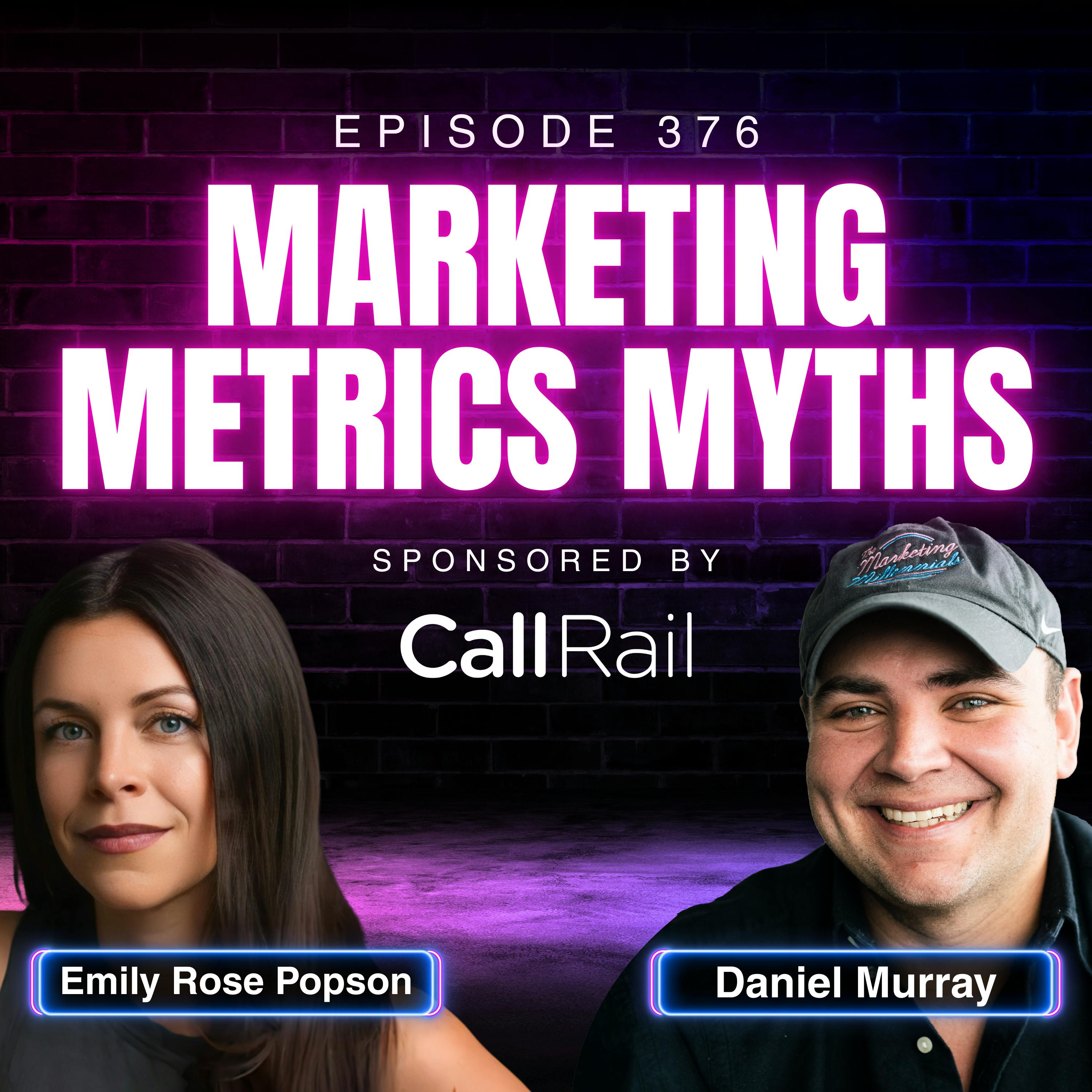
The Marketing Millennials
The Marketing Metrics Everyone Misunderstands with Emily Popson, VP of Marketing at CallRail | Ep. 376
00:40:00
Loading summary
Transcript44 lines
- [00:01]
A
Proving your marketing ROI shouldn't be a guessing game. But when results are hard to track, it's difficult to know if your marketing strategy is working. Meet CallRail. In a few clicks, you can connect every conversation to the exact campaign that started it. So you can focus on what works and drive better marketing outcomes all in one platform. Try it free today@CallRail.com proveit.
- [00:28]
B
Welcome to the Marketing Millennials, the no BS marketing podcast. I'm Daniel Murray and join me for unfiltered conversations with the brains behind marketing's coolest companies. The one request I tell our guests stories or it didn't happen. Get ready to turn the up.
- [00:53]
C
We are back with another episode of the Market Millennials podcast. I am here with Emily, the VP of marketing at CallRail and we're going to talk about some BS that is on LinkedIn. Some myths. We need a bus. Emily has some hard feelings about the way things are really said online that are not the full truth or partial truth or and we need to get into them. But I want Emily, could you give a little background of who you are and how did you get into marketing and then we can go bust those myths.
- [01:25]
D
Yeah. Thanks Daniel. Great to be here. They are hard feelings, aren't they? You know that everyone else is about to learn that. My name is Emily Popson. I'm the VP of Marketing at CallRail. I've been in marketing my entire career in B2B SaaS. I've worked at large scale enterprises, I've worked at five person startups and most recently here at CallRail developing marketing analytics solutions and AI solutions for marketers at small businesses and and the marketing agencies that support those. We provide lead intelligence to those businesses and really democratize lead intelligence for businesses of all sizes so that any marketer can market with confidence. I found my way into marketing really accidentally and that's the short and easiest version of the story. I always wanted to be a lawyer. I got into law school, saw how much it costs to go to law school and said I think I'm going to go make some money first before I do that and just got really fortunate to wind up at a marketing focused software store startup in New York City and really got the SaaS bug from there and have never left the game.
- [02:28]
C
That's actually a funny story because my wife is actually a one semester law school dropout and then she got into E commerce. So she has a background. Yeah, so she went to law school actually she hated it and was like I need to go do something else with my career.
- [02:43]
D
So she has no regrets either.
- [02:45]
C
No regrets at all. But I want to get into this. I think the first myth I want to talk about is around the mql. So what are you seeing online that you want to debunk that people are.
- [02:59]
D
Saying, here's the thing, I'm sure you've seen it. You're very active and aware of what happens on LinkedIn. You are one of the best in the biz. For the last five years, there has been this war on these three little letters, and it's been so curious to me to watch. And the longer it's got on, really, the more concerned I've gotten for the marketers out there who built MQLs into their MarOps systems to measure something and are now sitting here going, well, gosh, do I have to go redo all of that? Am I a terrible marketer? Because I just shipped a report to my CMO or my CFO or my head of sales reporting on how many MQLs I delivered delivered last month, and I think it's causing such unnecessary confusion. And I understand where it comes from. We got into a bad place as marketers maybe 10 years ago, where we just every we. Everything was measurable. And so the bar kept dropping. You know, well, we measured a click here, we measured an email read here, we measured a touch point here. And the bar for MQL went lower and lower and lower. And sales confidence in those MQLs got lower and lower and lower and frustration got higher and higher and higher. And it's perfect fodder for LinkedIn commentary. But I think leaving it as MQLs are worthless and so are you as a marketer, if you measure them or even say the letters or type the letters somewhere, it's just not productive because marketers need to measure something. MQLs are nothing but a delivery system for what should be a core quality revenue opportunity for your business. And so what? The way I like to think about this and reposition it for marketers is it's a delivery system. You are in control of it. The MQL is not worthless. Your definition of it is. Go back to the definition. It is not the letters. It is not the fact that you have a delivery system. It is how you defined it instead of an MQL being. We've all seen this. Five points for, you know, opening the email, whatever. Five points for visiting any site page on your website. 20 points because they spent half a second on pricing even though they didn't mean to. Sales go follow up, redefine it as it's someone in your ICP perhaps who has read every single email that you've sent to them over the last however long has Strong started a free trial or has called a couple of times. Whatever it is, get it. Bring it closer to what your sales team or your business needs. At my team, my team is a inbound PLG company. Their primary KPI is driving free trial. So to us an MQL is synonymous with someone ready to utilize the product. It is not synonymous with someone who is somewhat aware of our brand and sales should go spend time because ultimately that's not efficient for our business, it's not efficient for our resources. It erodes credibility and marketing. But we need marketers to go back and redefine, take the reins back to MQL and rebuild that credibility and just change. Have a more nuanced conversation about what's really wrong here and be more specific about how to fix it. You've worked in OPS before. You know to go back through all your go to market systems to change those three little letters. It's not really the most productive thing marketers could spend their time on or the OPS teams could spend their time on.
- [06:40]
C
Yeah, that's why I always think I hated the scoring system that people built. I always say go off of your ICP and always look is your ICP changing or not? Because I think the problem is if you do it off those little numbering system that is not telling you if that person is a great person for. Because someone could read a thousand emails and they're not in your ICP and you can consider that I think having the, a clear definition of like what is a quality lead. Also someone who raises their hand usually that starts a free trial or clicks request a demo or is very high intent. I don't care what anybody says. So if they filled out the form and clicks a demo, that is a high intent thing. I, I get worried when people and I think it's definition, I think that's what you said from the beginning. I get worried is when it's someone in your database that hasn't shown any like clear signs of intent and is just opening emails. And then now like sales goes right.
- [07:50]
D
Or they have some ABM tool. They've actually done nothing other than like their company raised some funding and so now they're an MQL or whatever it might be. Like it's not even their own behavioral trait. It's redefining it and it's not relying so much on these old scoring models. That are really the root cause of the problem to your point.
- [08:12]
C
And I think that if you just use it as a directional metric because you have to measure it and use like are they converting into pipeline? Are they converting into revenue and use it that I think the problem is when marketer's only metric is MQL and then like you could. It's easy for a marketer to game an MQL and that's where the. I think the problem started happening is that people started gaming like an MPO because that was their only metric. I think the problem is usually there's no alignment internally of like what an MQL is and there's no alignment on like we are all responsible for revenue and pipeline and let's go at it. And then an MQL is just something that directly tells marketing and it should only be a marketing metric to be honest.
- [09:02]
D
Like I, I couldn't agree more. Yeah, it like on my team we don't even send MQLs to sales. We generate MQLs and then we do things with them through the marketing system, through marketing systems. But we also don't report on them. They are an indicator to us. We use them to inform the journey and the experience that we're executing and creat. But we don't. They're not, they're not even in our list of KPIs. We just use them as a delivery system to signal that something else in the buying journey is ready to occur or a different experience is ready to be delivered. And we orchestrate all of that through marketing. And we don't hand a basket of MQLs and say happy birthday to sales every month.
- [09:48]
C
Yeah. And I think it's just what I used to look at is every channel has a different like value system of what somebody come in. But you have to measure like if someone fills out a form coming from Facebook, you have to measure how much that person costs to generate that form fill from that channel. It has to be measured somewhere because you need to know cost just for a marketing team directionally that Facebook is trending higher for costs or whatever events are trending higher or lower. So you directly know how you're spending as a marketing team. I think that's where I, where I. Because then if you're spending more on quality, it doesn't really matter. If you're spending more on junk, then it matters. So I think the next part of this is which kind of goes hand in hand with MQL is like reporting attribution. A lot of People say let's just throw it out markers. It sucks. Don't think about attribution. But so what is your opinion on attribution?
- [11:00]
D
Yeah, I think attribution is garbage has been the headline floating around and it just really grinds my gears a little. Daniel, I because again, it leads marketers astray and it's, it's not productive because first of all, marketers and your podcast talks a lot about this. We for marketers to be most successful, they need to directly attribute their role and their work to revenue. It comes down to revenue. Are you delivering revenue growth for the business? Attribution is the act of attributing your efforts to revenue, to units, to growth. There's never ever, ever, ever, ever ever going to come a time when marketers don't have to answer the question is what you're doing, is what you're investing in delivering revenue growth for our business? And how do you know that? I think where attribution has gone astray is. Well, it's a couple things. It's when marketers rely too much on in platform metrics or last touch or first touch attribution and they attempt to oversimplify the role of their investment, it undermines the credibility of the data that they are reporting on and it leads everyone to feel inside like is this just garbage? Should we abandon this? But the truth is the next month will come around and you have to answer the same question. So we need to find a different way of doing it, not abandon attribution altogether. My personal opinion is that attribution is entering a bit of a renaissance and it's just time to approach it differently, starting with collecting more data. Most marketers, I'm sure most of your listeners are relying on solely some form of software based attribution, whether that is just their in platform click attribution, whether that's GA4, whether that's something like Marketo measure Bizzible of old or something like CallRail for small businesses. We're all in the attribution game. The problem with only utilizing those data points is it's trying to only it's using software and the data points software can collect to simplify and attribute a single lead, a single unit to a dollar of revenue. I think as AEO takes on more and more space in our worlds, I think as dark social has become a greater part of buying journeys, as the landscape at large has changed, those practices have become largely outdated. We need to bring in more connect more data sets to really understand what our buying journeys look like. And get away from this single unit to single channel to single dollar methodology and get closer to unlocking insights about common buying journeys. And AI has made that easier than ever. Like the simplest version of this. If you like get out of like traditional B2B marketing world, right? Maybe you have all those tools available. Pretend you have nothing. You're day one in marketing and you want to answer the question to your cfo, CEO, cmo, is anything you're doing working? Take all your click data, get your GA4 sessions, download those. Do you have a form somewhere either from sales or on your website or somewhere where you're collecting answers to the question how did you hear about us? How did you find us? That's self reported attribution. That is really valuable data if you're using any type of conversation intelligence tool which marketers absolutely should be doing. And we should talk about that. If you're using anything like that. Can you have your tools listening for signals like that about. You know, maybe I'm like, yeah, I'm using your tool because Daniel referred me to you. You want that data point because maybe I just went and googled you and you're going to attribute me to branded search. But really I'm here because Daniel, I'm not here because of branded search. You were. That made it easy for me to connect with you, that made it easy for you to capture me. But the influence of my buying came from Daniel came from a personal slash business referral. If you're not collecting these data sets together self reported attribution with software based attribution and even session data and using AI to uncover insights, you're going to be stuck in this old way and it's getting more outdated every single day that we remain in the game.
- [15:56]
C
Yeah, I love that we used to and this is before AI I would say we used to because I used to run marketing ops. We used to have a Friday audit on attribution and we would have a report of okay, here's all branded. A branded search report. Because always branded search is some other channel usually because someone heard about you somewhere to be able to know it's branded search. And I, I love Google's still helping there but sure. And then we would have another and then we would go through like what you said, like what did you hear? How did you hear about us compared to. And if there was any conflicts we would then make the changes in the system that needed to be made. But we had a flagging system to be like because we also had people on our team like flag, like oh, there was a call and the call said, like in the transcript said someone said they heard about us here. That should be flying.
- [16:58]
D
Right.
- [16:59]
C
Um, so we had a flagging system that like either an SDR said something different, AE said something different when they asked the question like, where did you hear about us? So I think that that's thing but with AI now it's even better. And I also, I also go back to like the E commerce is doing it way better and I, they used to do it way worse because they have increment incrementality testing where it's like they know that if I did a big LinkedIn campaign, I'm going to put that into the dashboard as an event and look at how it's affected other channels. When I did like a dark social thing or I had an influencer post go out or I had this go out and see increment. Yeah, like, but we don't do it in B2B. We do this. Okay. It came from visible. Visible is the end all, be all. It came from Facebook. Facebook's end all be all and instead of data should be put into an unbiased system and then reported on, not on something that's trying to make you money.
- [18:01]
D
Right. And it's redefining. I'm sorry, I think the marketing gods are coming for me. The sun has gotten so bright in Atlanta. Do you see like the orb? I think they're coming for me.
- [18:11]
C
The halo.
- [18:12]
D
I think Jay's presence is here or something. He's, he's angry. It's okay, Jay, it's going to be okay. It's redefining the question that we're answering. I think the old way, the visible way. And listen, we're visible users. It's providing really, it allows us to collect the software based data I'm looking for. But it's no longer, we no longer report on that by itself. It's not insightful enough. It's redefining the set of questions we're answering. It's no longer what is the single channel you can attribute that, that dollar of revenue to? It's what is the common buying journey? What are the commonalities across the revenue that you've generated? What versions of those are driving the greatest return on investment? And can you replicate that? That was idealism, like 10 years ago. I think in attribution we would have these conversations with our MarOps teams could we ever get there. And it was so complex. But again, as we've said, AI is changing that. I Mean you can simply take all this data uploaded into your AI tools and prompt it to look for these trends for you. We're moving our platform in that direction to support small businesses as well. But I think it's table stakes because even with AI, you can really only get the LLMs. You can only get directional, somewhat influential attribution data on the role they're playing. You're never going to capture all that in the archaic attribution methodologies. You're just not.
- [19:55]
C
I mean, for example, there are ways that we could talk about right now of capturing, let's say off platform ways of attributing like for example CallRail, like having numbers on flyers, having numbers on billboards, having numbers like at a booth. There's, that's one way to capture off platform. There's QR codes. We're getting pretty good of like at least having directional. And all this, all this to be said is we need to know where someone like came from. It doesn't mean that that was their first interaction with that brand. I think separating those things. And then also like I used to used to say is, like I used to like stabilize metrics before I use another channel and then say like is. Is blended cacs like still going trended in the right direction? Are we dropping like, we're still having blended CAC at where I like it. I still am going to invest in that channel for a long time. But if I, my, my CAC member. But yeah, I want to. How do you so like you. So let's go on how you guys use it. So you're visible tracking some of the things you have. What other. How are you, how do you look at data and decide I want to invest in this channel versus this channel. This channel is working. That channel is working.
- [21:24]
D
Yeah. In terms of the data sets, we're looking at our session data, we're looking at the visible attribution data which through a W shaped model works for us really well because I'm trying to distribute the influence of the channels there. But then we've introduced this concept of influence reporting which takes essentially that broad set of touch points which is the visible language. Right. It's you, Daniel and my system have 17 touch points and six of those are across various versions of search and five are across various social platforms and the rest are an email and a call and whatever. So I have this like touch, this view of the various touch points and through the W shaped model, right. It's distributing those touch points and ultimately divvying up Daniel across the channels it's giving like 25% of you here and et cetera. But what we've built is take the whole of the touchpoints and tell me which channels show up at the highest rate across our unit, our new units and our revenue. So it's like, and then we use both data sets. What's the attribution data telling us, the software based attribution data? What is the influence data telling us about the rate at which channels are showing up on our revenue, generating our new units and then bringing in the conversational insights, the self reported attribution and then the trial data signal. So like my team, the demand generation team is organized by vertical. So each vertical marketer is watching their trial volume every day. And while they can't attribute that the day they were at this event or that this big influencer launched with us, we can't see it invisible that that drove that trial spike that day. They know that was the, the differentiation that day in the market. And so then we bring those data points in as well. And then we've changed, we show the data, but they are responsible for reporting on what that means for the business and what that means for where we should invest. And we look at map, we call it, we have cac which obviously brings in the cost of sale, whole cost of sales and marketing. And then we look at marketing acquisition cost, we call it Mac internally by channel. And how is that trending? How is the blended trending? How are conversion rates trending? Did any of them create drought? More pressure on convert? You got to look at all of it, you know, and this is, goes back to what we're saying. You can't, the, the old way stopped working five years ago where you're just relying on the output of a single set of attribution data. You need to be attempting to move in the direction of triangulating larger sets of data about what's actually influencing buying and what investments are actually moving the needle and generating revenue. Because that's how you build credibility with your cfo. We have my demand gen team, the director demand gen and her whole team goes in front of our CEO and CFO once a month. They have it on this coming Monday. They dry run it with me this morning. And, and they go, this is what's happening in every channel. Here is qualitative insights, here are the quantitative insights, and here is what it means. They show their data, they show their path and then they translate it and then they make their case for what their investments are to come. And it's all rooted still in data, but a different type of data that's evolved with the way buying has evolved.
- [24:49]
A
As marketers, we're all trying to answer the same question, which investments are actually driving revenue? And too often the honest answer is an educated guess. CallRail replaces that guesswork with proof. With the help of AI, you can connect every lead to the exact campaign that drove it, analyze your conversations and capture leads around the clock. That's why over 220,000 businesses use CallRail to market smarter. Stop estimating impact and start proving it. Try CallRail for free. Free@CallRail.com prove it.
- [25:28]
C
And I also think that the, which I think people confuse. There's marketing only dashboards and like attribution and then there's the attribution you show publicly. And I think, and that's like something that people conflate to is like, like there's like marketers should collect as much data points as they need to make the best decision possible. But the best decision shouldn't, all those data points shouldn't be shown to everybody because then it's going to confuse the hell out of the business. Like you diagnose those points and then like your demand gen team is probably like taking all those points seeing like, okay, this influence, this influence. Now I'm going to make a executive decision that this channel drove this, this channel drove this, this channel drove this. We should invest more here because this is happening, this is happening, this happening. But it's also what you said. It's like we only are doing this because we're judged so hard on results, which is fair. But we have to report to show that, to get more money. Otherwise we're not going to get more money.
- [26:36]
D
I know I tell my marketers that all the time. They're so lucky that they're able to tie every move they make to revenue. That's where you want to be as a marketer. You don't want to just be seen as a cost center. You want to be seen as an investment center that delivers revenue growth. And you need to be able to do these things to maintain that standing, I think in both the executive spaces, but also broadly at your company.
- [27:02]
C
And I think, I mean the next level of this I think we all want to talk about is, I mean we are in the era of like conversational data, first party data, how we collect first party data, what is important of that. So you want to go over a little bit of like what people say in the market versus what is actually true or true to you and let's.
- [27:24]
D
Go down to yeah, I'm convinced this is truly actually reverse psychology being used on all of us. But I'm happy to be wrong. This is like an unspoken myth. It's that tools like GONG or other conversation intelligence tools, we make one for small businesses, but there's so many of them out there. Go to G2 and you can see all of them that those are really like sales tools. And this to me is this secret unlock that my marketing team seems to figure it out and many marketing teams we work with have figured out. But broadly when I'm especially in the B2B space, I do not see this being utilized enough. I see maybe they have their product marketing teams logging into GONG to, you know, say they listen to calls or make sure sales is talking about some offer or whatever it might be. But conversations in general, AI in general and some of these AI tools, whether it's like AI SDRs or it's conversation intelligence tools, are not just for sales. Marketers, I would argue need to care just as much if not more about what's happening with these different pieces of software that are increasingly available. On the conversation intelligence side, a couple of the ways I think marketers tomorrow should be using this and should go find whatever tool works for them. There's many that are industry specific. If you're smaller, call rail is a great one. If you're bigger, Gonk's a great one. There's a lot in the middle as well and around the French areas. But one conversion signals. You can be to your point earlier. Having your systems listening to conversations for indicators of a variety of things. Readiness to buy or booked appointment if you're in this trades or book demo if you're in SaaS and sending those signals automatically back to Google from the conversation or from to your various ad platforms like this is just like a no brainer. Everyone should be doing this and they should be doing this for like a year. And if you're not doing it, start today. But there's more nuanced things that I think are going to help differentiate marketers and marketing execution, segmentation and personalization. You can be using these tools to extract unique details that help make your emails more personalized and more engaging and drive more reply rates that make your segmentation more more immediate and timely. Like imagine if all your conversations, there's no way for you as a marketer to know did everyone in my segment, in my base just have a positive or a negative conversation with sales or success or no conversation? If you have data on like someone just had a really bad conversation, their sentiment just dropped and you have trigger set up to automatic scrub them from your email list. You can that automatically can improve your your Persona and your standing with that customer or prospect. Or maybe you set up a trigger or and to not only scrub them but now put them to trigger another automation that tomorrow you send them for marketing a little like moment of delight somewhere like a $5 Starbucks. We know you had a tough call yesterday or don't acknowledge it, but something that like meets them where they are a little bit more and connects those dots. There's without conversation intelligence tools you just there's no way to scale that type of insight from every conversation. But you could also use it for like really simple things like keyword research. Create keyword bubbles on common words being used across your conversations. Use it for offer research. Like we have this one great example where like a business kept getting calls asking if they were doing anything for this upcoming holiday. And they were like oh no, we've never even thought about that. And then they launched an offer because they realized through this word this world bubble kept getting bigger that people are asking are you doing do you have a small business Saturday offer? I forget the specific holiday that it was tied to by having that data instantly being generated from AI analyzing your conversations versus you going through transcripts and looking for insights. And there's such a lag to that, you would never be able to really take advantage of those insights. I think it's just going to marketers doing that are going to stand apart. And the Same is for AI SDRs or AI voice assistants, whatever you call them. The category is poorly defined and exploding. But like marketers need to care yesterday about their call rate. If you have a missed call rate that is above a couple percent, you need to care because you are out there busting your butt trying to get build awareness for your brand, build awareness for the problems you solve, the solutions you offer. And calls are often the highest intent form of a lead. When people really need you or really want to do business with you, they do pick up the phone and dial. So if you are not answering every single one of those calls, you're applying downward or upward pressure on your cac, downer pressure on roi. And right now you probably feel totally out of control of that situation. But you're not. Because now that we have the ability to have fully customizable prompt directed SDRs working on our behalfs, being full control of our brand, not shipping off our overflow call volume to inconsistent Human based services. You know, humans have bad days. AI doesn't humans forget that you don't want your brand to be referred to as cost effective or budget friendly. You want to be only portrayed as premium. You only prompt that once and it's never going to show you as anything other than premium again. So that I think that that is where marketers need to be caring the most about making sure that they are not letting their leads go missed and not missing opportunities to influence results. I think again before AI that was a lot harder to influence and therefore not somewhere marketers leaned in. But the times have changed and I think again yesterday marketers need to be pulling their missed call rate and starting their business case for why they need A SDRs and AI voice assistance in place.
- [33:36]
C
Yeah, I'm going to just double down on what you said on like just conversations. I think, I think before like there was an excuse that it takes a lot of time to look over transcripts and look up, listen to calls and blah blah, blah, which you should be doing anyway. But now like I don't think there's. You could dump all this data into a. Yeah, into an LLM and figure out is my positioning right? What are some common words my customer is saying? You could do it for attribution. You could be like where are people mostly saying they're coming from? You could say like, like anger, like. And you could take all those bubbles you're talking about too and say like what is, what is some com. Like there's so many things you just could feed into to fix your positioning, to fix your offers, to fix your, your homepage, to fix your attribution. And now you could like transcripts and you, and you could feed that first party data now into your, your whatever, your data warehouse, your CRM, whatever, and use AI to scrub that data for you. Which five, 10 years ago that was extremely hard. And you, you had to rely on word bubbles only and you had to rely on you listening to conversations. But the excuse that you're not taking that data and at least putting it into an LLM and prompting it and getting insights is that's a horrible excuse because that takes five minutes. It doesn't take 20 hours like it used to do.
- [35:05]
D
I couldn't agree more.
- [35:08]
C
So yeah, I'm a big fan of like now we have so much and marketing should be knowing like marking is marketing is every touch point which I, I don't get. Like even though an SDR is marketing has to have influence because we're in charge of positioning we're in charge of, like, how we talk about our brand. We talk about. We're charge of a lead came from somewhere. Like, how, how we're gonna. What's the end result of that lead? So literally, like, if people are not saying things correctly or if AI is not saying something correctly, it's on marketing to fix that. And we should know how to fix that. And now with AI, it should be super easy to fix that, those problems.
- [35:54]
D
I couldn't agree more. I'm glad to see we're on the same page. The gods have backed off, so I think we're on the right track here.
- [36:02]
C
Yeah, I mean, there's things that. I get it. If you weren't using AI 10 years ago, it was hard to listen to a bunch of conversations. It was hard to. You still should have been doing it. But it was harder than ever to just like carve out five hours of your week to do that. But now it takes 10 minutes of your day to put a transcript into an LLM and prompt it something. Or like set up that infrastructure beforehand. So it saves you the 20 hours a week to do that, where you can automate transcripts putting into your LLM. So there's a lot of ways to do it right now. So.
- [36:38]
D
Yeah. So here's my final word. I'm going to say on all of this because you and I could probably keep talking for another couple hours on all the other BS that's out there. I think marketers need to trust their guts, start doing the things we talked about today, get back to confident marketing. I'm not going to say spend less time on LinkedIn, because I feel like that would not align with your personal endeavors and professional endeavors. But I'm going to say take it all with a grain of salt and ultimately make the decisions for you as a marketer and your business that are right for your business. And don't live and die by what LinkedIn influencers are telling you. Make or break marketers.
- [37:20]
C
And going back on that, everybody in LinkedIn, even me, even you, even Jay whoever, are all coming from a biased position of what worked for us and what from our experiences and stuff like that. So when we say something that are like, you should do this, you should always, I would always say you test it. But don't, like, take our word at 100% because it worked for us doesn't mean it's going to work for you. Because your business is different, your problems are different, your outcomes are different, the way you measure things are different. So don't use everything we say. Just use it as a source point of like nutrition.
- [37:57]
D
It's like kale changed my life. Well, what if I'm allergic to kale? What's going to change my life? You got to find what's going to change your life, what's going to change your performance. And that's going to be There are common truths and there is also individualization for every business. So I couldn't agree more.
- [38:14]
C
Last question before we hop is what is a marketing hill you would die on?
- [38:20]
D
Haven't I died on a few today?
- [38:23]
C
No, I'm just trying to be like, what is the one you want to die on today?
- [38:27]
D
The one I'm dying on today is attribution's not garbage and I want marketers to remain in the boardroom. And you're never gonna stop for the rest of your career having to prove your value and prove your impact. So evolve your attribution, don't ditch it.
- [38:41]
C
Okay. And lastly, where can people find you CallRail and all that good stuff?
- [38:45]
D
You can find me on LinkedIn Emily Poppson, or find us@CallRail.com orllrail on all the socials.
- [38:51]
C
Cool. Well, thank you so much. I'm glad we at least had some myths busted on your side and thank you for joining.
- [38:58]
D
Thanks Daniel.
- [39:01]
B
Thanks so much for listening. Keep tuning in to hear more great insights from the coolest marketers from around the world. If you haven't already, make sure to subscribe and follow the Marketing Millennials podcast on Apple Podcasts, Spotify, YouTube, or wherever you get your podcast. And if you like what you hear, I would greatly appreciate you giving us a five star rating. It helps bring more marketers into our community.