← The Master Investor Podcast with Wilfred Frost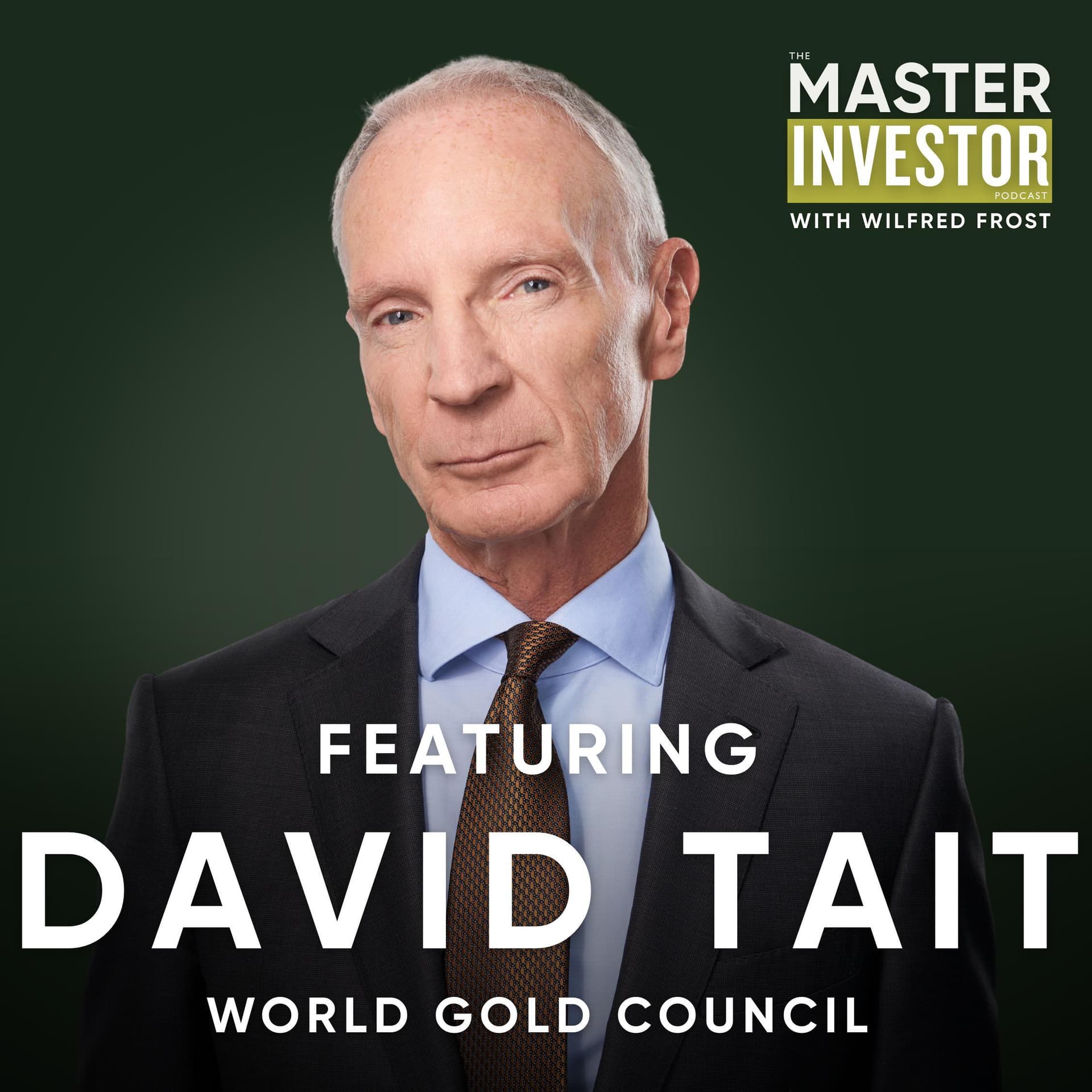
The Master Investor Podcast with Wilfred Frost
David Tait: Inside Gold’s Relentless Bull Market
00:51:35
Loading summary
Transcript114 lines
- [00:00]
David Tait
I think the main driver for most of the central bank buying over the course of the last few years has been more economic. I don't think the geopolitical incidents around the world, albeit many of them, are the individual drivers. In some respects, you could say tariffs and without demeaning it, the war are almost red herrings. I think the main reason the central banks have been buying is a deep, deeply felt fear of a debt spiral. The runaway debt situation that is not really far away from our door at the moment. The US has three alternatives, austerity, default or inflated away. Grow and inflated away. I think they're doing the third. If they pull that off, that could be the top I'd be looking for. But right now it's a big ask. It's interesting how my childhood events changed my attitude to life and my trading career. I walked into Goldman Sachs so brutally ruthless that it gave me a massive edge. Looking back, I didn't know at the time because I didn't really care about anything. I didn't care where I lived or died, frankly.
- [01:12]
Wilfred Frost
So you took more risk than you would have done?
- [01:13]
David Tait
Yeah, luckily considered risk, but at the same time I was able to jump where people would worry about landing and I was already in the air. And so that really helped me. But I didn't know that at the time.
- [01:25]
Wilfred Frost
Foreign.
- [01:29]
Podcast Host/Announcer
Welcome to the Master Investor Podcast with me, Wilfred Frost, where we celebrate and learn from the success of the greatest investors, business leaders and politicians in.
- [01:37]
Wilfred Frost
The world, giving you our listeners, the edge.
- [01:40]
Podcast Host/Announcer
The Master Investor Podcast is sponsored by BNY Investments, LSEG and Interactive Brokers. Please do remember the views expressed in this podcast are for general information purposes only. Nothing in the podcast constitutes a financial promotion, investment advice, or a personal recommendation. More on that in the show notes.
- [02:03]
Wilfred Frost
My guest today is David Tait, the CEO of the World Gold Council. He built his career at various investment banks and hedge funds as a trader, from Goldman Sachs to Bluecrest to UBS to Credit Suisse, where he rose to be global head of Fixed Income Macro Products. He then made the transition to commodities to gold, specifically at the World gold council in 2018, and he has led it ever since. He's also unbelievably climbed Mount Everest five times, raising over $10 million for the NSPCC, a children's charity here in the U.K. in the process, something that we'll get to later on. David, a very warm welcome to the Master Investor Podcast.
- [02:44]
Podcast Host/Announcer
It's great to see you.
- [02:45]
David Tait
Great. Thank you for having me.
- [02:46]
Wilfred Frost
I'm very flattered and you have Brought with you a prop of extraordinary proportions.
- [02:52]
Podcast Host/Announcer
It's actually the first day that we're.
- [02:53]
Wilfred Frost
Using my new prop, the logo in Perspex you've completely swamped it with. And I was just lifting this up. I literally can't even lift it up. Lee know if I do this, I.
- [03:04]
Podcast Host/Announcer
Know it is from this position.
- [03:06]
Wilfred Frost
I mean, how much does this weigh?
- [03:08]
David Tait
13 kilograms. I think roughly 13 and a half that one.
- [03:11]
Wilfred Frost
13 kilograms. Incredibly shiny, unbelievably valuable and worth 1.8.
- [03:17]
David Tait
Roughly million dollars as of today.
- [03:19]
Wilfred Frost
Incredible. I know, Incredible. And I mean, I'm not faking trying to put this down. I don't want to drop it. Get it back. Shining beautifully in between us. I'll straighten that up again. Can't waste a $1.8 million prop. Thank you so much for being. I mean it really is a treat and we've been taking lots of photographs with it, all of us in the lead up.
- [03:40]
Podcast Host/Announcer
And this is one of.
- [03:42]
Wilfred Frost
I mean, so $1.8 million worth of how much that the World Gold Council oversees.
- [03:49]
Podcast Host/Announcer
Because you guys have the two biggest.
- [03:51]
Wilfred Frost
Gold ETFs in the world.
- [03:52]
David Tait
Yes, they were invented back in 2003. GLD was the original one, which is an investor style ETF and that has the majority of the gold in it. And then five or six years ago we started a more public version of an ETF called GLDM and that has I think 16 or 17 billion dollars in it. But in total we're looking around about 160 billion dollars. 1.
- [04:17]
Wilfred Frost
Wow. And all of that is, I mean, obviously is the products. So they are physically backed. Anyone can buy them on their platforms and take a share in one of these bars. But the bars exist.
- [04:28]
David Tait
The bars 100% exist and are verified there every single day.
- [04:32]
Wilfred Frost
And this one has come from obviously one of the vaults in London.
- [04:36]
David Tait
One of the vaults in London, yes. We have a lot of most of the gold is in London, but we also hold some of the gold in New York as well. The vast majority is in London. The.
- [04:44]
Wilfred Frost
I mean, I'm just blown away by the fact we've got one point million dollars right between us.
- [04:48]
Podcast Host/Announcer
And then in the vaults you've got.
- [04:50]
Wilfred Frost
So give me the number again. 100.
- [04:52]
David Tait
Roughly $160 billion as of yesterday. It's an amazing sight. When you do see it, it goes on forever. It's a sea of gold. But I just want to assure everybody it is absolutely 100% gold backed.
- [05:05]
Wilfred Frost
There is, you know, incredible. I mean, I'd love to see the vaults at some Point if we can. I know it was. This was already a massive win to bring one bar and do it here in the studio. This is worth $1.8 million. If we did this a year ago, It'd be worth 1.2 ish.
- [05:21]
David Tait
1.1, absolutely.
- [05:23]
Wilfred Frost
Because of this huge surge in the gold price last year, 65% calendar year. Why did it rally that much last year?
- [05:30]
David Tait
There are many drivers, many people have focused on many, many things. The main buyer throughout the world really, at least the previous two years, has been central bank buying has been a large contributor to it. Roughly a thousand, over a thousand tons a year for the previous two years. We think 2025 will be slightly less than 1000 tonnes. But really across the world you've seen investment bars and coins and ETF buying all go through the roof, so there's no one buyer. The drivers for this are many, but the actual buying has come from those three places.
- [06:06]
Wilfred Frost
Let's then touch a little bit on the drivers, I guess, because everyone's question is going to be, will it continue this year? The central bank drivers, I think, very interesting one. A lot of people point to the Ukraine invasion, the Russian invasion of Ukraine and the sanctions that followed on Russia with it over the last month in December, whether the EU would seize Russian assets or not in Brussels, and I guess most recently with Venezuela as well. The question that for foreign central banks, if you put your money in US dollars, it might get taken away from you. Is that a critical driver?
- [06:43]
David Tait
It's a driver, but I'm not certain it's a critical one because there's no way of verifying that thought process. I know it's a common lexicon to think of it in those terms, but remember that gold has been going up since actually the very day I joined the World Gold council, which is 1150. It was brilliant timing back in 2018, 19 and has been going up for a variety of reasons ever since. The central banks view their own portfolios much like you do yourself, so they want to diversify. And it's worth remembering that most of the central bank buying has been coming from developing central banks, not the developed ones who haven't done much at all. So those banks hold a relatively low proportion of their reserves in gold and yet they're the most at risk of not holding gold because their currencies are vulnerable. They have prone to inflation shocks, bond market rallies, runs, I should say, and over the course of the years they have developed an appetite to try and rebalance their reserves. So most of the buying from Central banks is from Eastern, should we say developing central banks?
- [07:46]
Wilfred Frost
Is it? I mean, you would know this better than most, but I read a lot of articles that say actually China's buying even more than is showing up on publicly stated records. Is that possible, do you think that There's a lot more buying by the likes of the Chinese than perhaps.
- [08:01]
David Tait
We realize it's very difficult to get complete and utter facts from many central banks. We'd have a great relationship with nearly 190 of them, apparently. But not everyone discloses those numbers. Is it likely there is more buying than we'd be estimating? Yes, I do think that. Can I prove it? Absolutely not. Many of the central banks who do liaise with us prefer not to disclose their numbers. But it's logical when you think about it, because many of them have got all the same worries that you as an individual have. And everybody's worries are different. Cumulatively, there's a compelling case why they will continue to buy.
- [08:44]
Podcast Host/Announcer
This episode is sponsored by BNY Investments. BMY Investments is part of bmy, a global financial services company supporting investors and institutions around the world. This sponsorship does not constitute investment advice.
- [09:02]
Wilfred Frost
I mean, you said you've got great relations with all these central banks. They might not tell you what they're thinking, but is your assessment that Russia, Ukraine was a turning point and the sanctions on on U.S. treasury holdings, that possibly Venezuela as well, are these an added wind in the sail of the rationale for why a central bank of a developing nation in particular might want to own gold?
- [09:26]
David Tait
Yes, an added wind in the sail is a good way of putting it. But personally, I think the main driver for most of the central bank buying over the course of the last few years has been more economic. I don't think the geopolitical incidents around the world, albeit many of them, are the individual drivers. In some respects, you could say tariffs and without demeaning it, the war are almost red herrings. I think the main reason the central banks have been buying is a deep, deeply felt fear of a debt spiral. The runaway debt situation that is not really far away from outdoor at the moment. I know many people decry that as a main driver, but I do think the continued currency debasement, the threat of US debt running away, which I think going back to April when tariffs were imposed, and there was that moment when the US yield curve shifted en masse, didn't just steepen, it shifted in one go because of a lack of trust in the US government, which we'd not really experienced before. And what that would mean to the debt spiral runaway. I think that's the main reason they're buying it because it hedges them in a world where hypothetically we fall into that trap and there's no way out of that trap. Many people regard it as a financial Armageddon. And that's what I think the main driver is the undercurrent, the in the belly driver. Everything else has just added wind to the sail as you say.
- [11:03]
Wilfred Frost
Really interesting and brings me to the sort of next type of buyer which is investors at large, not just central banks specifically and was going to come to that reason and the sort of fear of inflation, fear of monetary debasement and or fear of financial Armageddon in an extreme circumstance because last year wasn't a normal year of gold price appreciating in the face of monetary debasement, particularly Q4 where it really shot up. So do you think now investors, based on the gold price surge last year, are pricing in that financial disaster as opposed to just ongoing monetary debasement? How do you try and gauge where we're at with that run? Because I guess it hints to where we go from here.
- [11:51]
David Tait
It does, it does. And it's difficult because you speak to some people and everyone will pick a reason why the gold price is going up. There's a plethora of them and some people look at it cumulatively and say well look at all these things. This is the bigger, the whole world's falling apart, et cetera. And then you get particulars and for instance, the investment trading community in London, the world I came from, will look at it in a far more macro sense. Interest rates are here, dollars here. Therefore gold goes up. And when it does the opposite, the Lady Bird book of economics says it should be going down. And incidentally, over the rally over the last few years there have been moments when the trading community have been completely blindsided by the remorselessness of the rally because the fundamentals as they understand them have not dictated that gold should go up. So they've all stood aside and yet the central banks just carried on buying because their motives are somewhat different. The investment bond coin community somewhat different. The, the people who have bunkers in middle America, for instance, their goals are different. But I do think that the drivers, the main drivers, which I, I perceive As a Core 6 drivers, are the main things that are driving gold forward. And I think there's only one or two, one real scenario that could ever really at the moment paint gold in a negative light. But the main drivers that are taking it up are very clearly defined in my mind.
- [13:19]
Wilfred Frost
Which are the six?
- [13:20]
David Tait
Well, there's the macro ones I described, there's that one. There is the core fear of debt. There is the Japan situation, which I think is coming online. We can talk about that. There is the India situation and deregulation in China. They are the main drivers of that, I think. And then you've got the geopolitical scenario that is making people run for cover. But those six, all of them are pointing in the same direction, but most of them are macro driven. Our fear of debt. And even when I refer to China, India and Japan, they are debt driven fears in my honest opinion.
- [14:01]
Wilfred Frost
Let's go through each of those three and then hit the one negative case for gold that you alluded to. So Japan, I heard you talking about this, I think actually on a podcast or event you did in India, ironically. And we'll come to the India argument in a second. But outline for me the point you made there about why potentially Japanese investors might, might be about to buy a lot more gold than they have previously.
- [14:23]
David Tait
And we've seen this over the last 18 months. In particular, it occurred to me that there is a vast amount of money being held by old people in Japan. Generational change, I mean quite literally and depending on who you talk to, and I might get this number wrong, but 50% of all of it's in cash held at home, quite literally under the buttress. That generation have obviously been very defensive and a young generation are appearing on the scene and that money is going to get passed down to them. In my opinion, those people are far more adept. They have electronics, they're broader minded, less conservative than their parents. Also fund managed money managers are changing generation as well. And so they're going to be more inclined to look broader and invest their money more widely. The most important thing is that most of my trading career from 1980 through to 2010, Japan was in deflation and nobody could do anything about it. But only now, most recently, are they experiencing inflation for the first time. Whole generation doesn't even know how to spell the word technically. They've got geopolitical problems in the region, they've got a sense of nationalism in the country, sense of tension for the first time, what has been a depreciating currency, a very, very high debt to GDP burden already, which had never really shifted. And that realization, that opportunity to divest some of your assets into gold at this point seems to me an obvious thing to be doing. Now we advocate for 8 to 10% allocation, a strategic one, not Tactical, full, long term. But we found that most Asian countries tend to hold much more than that. They're inclined to do 10 to 20%, and we are fully supportive of that. So I think those people are going to lunge into the gold market. I really do. We are making a big push in the region to try and educate people on the merits of holding it within a portfolio. And I think the gold ETF market, gold backed ETF market that this BoA comes from is the perfect vehicle for them to do it. You can hold it on your phone, it's real gold. It's more difficult to take delivery, I accept. But you're holding real gold and I think that's the real opportunity. And the wallet is vast. In Japan, that's untapped.
- [16:40]
Wilfred Frost
What about you mentioned there, deregulation, if we come over to China from Japan, what do you mean by that?
- [16:48]
David Tait
Over the last seven to nine years at the World Gold Council, little plug for ourselves here. We worked remarkably hard with the Chinese government to deregulate their insurance industry. Again, the wallet is in the tune of $5 trillion. And we set up a fund when I first joined the World Gold Council as an example of how if you had gold as part of a portfolio, it would demonstrate its worth from a diversification aspect, from a rate of returns, volatility, all those things that we can prove. We set this fund up, I'm glad to say, and I would say more by luck than judgment, I hit the right timing. I got the Chinese economy declined, the stock market declined, the property market declined, and gold went up in a straight line. So of course my fund outperformed every other fund. And I have to say, I admit more luck than judgment. But it proved a point. We had 40% gold in that fund and it outperformed every other fund. As a consequence of that evidence, the Chinese insurance market has deregulated at the beginning of this year and have allowed 10 insurance companies to hold at first just 1% to demonstrate that it works. They will expand that I'm due because it will work. They will prove the math. And we hope, like I said just now, that they expand that to 10 to 15%. That market is a $5 trillion market. So there's two $5 trillion markets currently untapped.
- [18:14]
Wilfred Frost
That's good timing as well for them to start their 1% position, I guess as well. And India, India.
- [18:20]
David Tait
India, obviously, as probably everybody knows, is very focused on gold jewelry. It's the gold jewelry capital of the world, to be honest. 25,000 tons held by people at Home. It's amazing amount of money. That being said, a younger generation are probably less, in my opinion, less inclined to buy jewelry than their parents were. Weddings will persist, but the younger generation are different. And so what we're trying to do is try and open their minds to alternative ways of holding gold alongside jewelry, I must say. And gold ETFs once again are the clever way of doing it. You can buy it with a QR code, you can hold it forever, you can trade it in, you can sell it, and it's as quick as a couple of clicks. But you're exposed to gold price. And as part of a portfolio, which many of the educated young people are all have now is an obvious avenue. One and a half billion of them, and every single one of them's got a phone. And as long as you can prove that the gold is that the ETF is fully gold backed, which it is. And it's not just our ETF, it's many other ETFs. I think 23 have opened this year alone. So I believe that to be another way in which people will buy brand new gold, not, not turn away from jewelry, but an alternative way of doing it.
- [19:37]
Wilfred Frost
What's the one negative case you said?
- [19:40]
David Tait
Well, risk adjusted, it's very unlikely to happen, but, and this will be interesting for you future guests, my feeling is, my feeling and it's personal opinion is that the US Administration is probably going to try and inflate its way out of its debt burden and try and do it that way in a very fair point of view, very subtle way of doing it. And I think what they're trying to do is, as you've seen, is try and force down interest rates, generate growth, perhaps tolerate a higher level of inflation for the very reasons I mentioned. And if they're lucky enough to generate enough growth, just imagine a situation where we got a 6 or 7% growth rate in the United States.
- [20:30]
Wilfred Frost
Just imagine for today, nominal rate.
- [20:32]
David Tait
Yeah. And you got that. You'd have a situation where the current account would materially start to close and you'd have the ability to project a declining gross debt, sovereign debt burden. You'd be able to say in 2030, perhaps hypothetically, that instead of $30 trillion or $27 trillion in 2030 will be 26. And that will be a notable turnaround. That will be an amazing change in mentality that the market, many of whom think that the constant devaluation of dollars and printing of the currency, which we do to constantly finance debt, has an end game. And if that debt continually goes up, which I think has been the main driver, in my opinion, of why the gold has been going up. As I've said, if you're able to project the opposite or a natural decline in that, that would, I think, start to get a lot of people less concerned than they are now. Not necessarily sell gold, but it might take the wind out of the upward sails. That's if I've read this right now. I remember, and it was reported that Mr. Besant stepped in in April to calm the markets when that yield curve, as I said, shifted en masse, higher. Because I think if I read it right, that was the oh God moment. We can't let that happen. Because what do you do? Do you sit around a room at some point and debt forgive each other? The wealth destruction is apocalyptic. So I think that the most important thing is that we. Well, I think that there is a chance, a remote chance that Mr. Trump pulls that off. A remote one. And I'm just putting it out there because if people were looking for a top, that wouldn't surprise me. If it was the top, but risk adjusted, it's a low probability that he gets this right.
- [22:28]
Wilfred Frost
Yeah, certainly appears, even though not explicitly stated, like there's some of that strategy behind what they're doing. And you wouldn't bet against Scott Besson. He's done a pretty good job, I think, so far. We'll see what happens.
- [22:45]
Podcast Host/Announcer
The Master Investor podcast is sponsored by Interactive Brokers. Building wealth starts with the right broker. And Interactive Brokers helps you reach your goals with powerful tools, global market access, low costs and unmatched financial strength. That's why the best informed investors choose IBKR. Learn more at ibkr.com master investor what.
- [23:11]
Wilfred Frost
That just leads me to is a broad point about whether gold performs in bad times versus can it also perform in good times? And it's a fairly sort of layman's point. But I think a lot of people think of, gosh, the world's going to end, let's buy gold. I think from what I'm hearing, you're saying that that good news, bad news argument does apply to gold specifically as it relates to the outlook for. For US Debt.
- [23:38]
Podcast Host/Announcer
Is it wrong to say that it.
- [23:40]
Wilfred Frost
Applies more broadly than that, I. E. We might have a recession, but when we come out of the recession, if growth is looking good, if things are all right, will gold take a pause? Or do you think that that is too simple a kind of perspective on gold?
- [23:54]
David Tait
Well, I think there is always a very, very positive reason for holding Gold in a portfolio. And I think the main reason people have not held it in a portfolio in the past is a combination of ignorance, apathy and complexity in the past. From a capital perspective, it's worth noting that in 35 years of trading, I never once traded gold of all the asset classes and I traded literally everything you could mention. I never traded gold because it was complex, it was capital heavy, it ate up into my capital and my returns were reduced as a consequence of it. And so a whole generation of traders and investors just sort of went round it. So part of what I've been trying to do over the last six years is reduce those capital burdens by improvements, digitalization, things like that, to try and improve that market. But I think most people's perception is gold is the disaster trade. But over the course of the last six years it started to change and we've been educating people that to have it in a portfolio strategically is one of the things that will benefit you. But of course you're not going to do it if it's going to impinge upon your returns. So as we progress into this new generation of an ability to trade gold in a digital light capital way, which is what we've been working so hard on, there should be no burden for you to have it as part of your portfolio going forward. So the long answer to your question is crises. The stuff we read about increasingly every single day only has a short shelf life in our minds. We get over things remarkably quick. Ten years ago, 20 years ago, the mention of a nuclear exchange would have driven markets into frenzy, doesn't create a blip anymore. So we get used to that stuff. What we won't ever get is ignore is positive returns from an investment in an asset class. That's a fundamental. It's the way we work. I've just been working to make it more available and more accessible. So I think over time these events will become less of a driver of gold and people will think of the asset class as you do dollars or bonds or equities in future.
- [26:14]
Wilfred Frost
Everything we've touched on so far largely has been talking about why people might have demand for gold. I want to touch on supply. How certain are we that the supply is limited and there's not going to be the equivalent of a fracking development to transform the supply of oil and gas, for example, going forward, could there be a massive deposit that we haven't found?
- [26:37]
David Tait
Well, I'm no geologist could. Yes, I suppose, I suppose there is. But what I do know is that my members who are the 33 large scale miners of the world spend a remarkable amount of resources trying to find this stuff. I'm not the expert on this, I'm not speaking for them, but I understand that most of the large deposits that are available are now getting are too deep and uneconomic to actually mine. But with the rising gold price they should become more and more accessible. But it seems to me that there is a relatively limited amount of gold on earth unless you can go beyond certain parameters that are beyond technology at the moment. But it doesn't seem to me that there's going to be a moment where supply doubles. It just doesn't. It's not feasible to do that because the lead time into production is enormous as well.
- [27:33]
Wilfred Frost
But interesting though, even to make the point that the higher price makes some existing deposits economical that they weren't before. What about Venezuela? I mean it's obviously in the news this week. A lot of focus on their oil reserves. I've seen a lot of talk about gold as well, but no numbers and details on it. Do they have a lot of gold that hasn't been mined?
- [27:53]
David Tait
I think they do. Many of the South American countries do, but most of it is mined illegally and mined using artisanal small scale miners. The authorities, as I understand it just reading from the press, have been marshaling those illegal forces to collect together the gold and sell it or smuggle it out of the country. I don't have any numbers and no one does for Venezuela for obvious reasons. Are we trying to work with authorities throughout the world to try and stem those flows? Absolutely. But is it going to be of a quantum that's going to make a material difference to gold prices? Is it another 5,000 tons a year? That's that 4,000 tons a year that is produced by large scale? No, it's not going to be anything of those measures.
- [28:38]
Wilfred Frost
Going back to the demand side of all of this so much as you said, it comes back to this growing pile of debt and the fear of fiat currencies being debased. Do you accept that those arguments to buy gold apply to to Bitcoin as well? Do you think Bitcoin is digital gold?
- [28:59]
David Tait
No. I understand why people use the phrase. I do. I think if you are an average portfolio holder dependent on your risk tolerance, it behoves you to have. If you've got Bitcoin, it definitely behoves you to have gold in your portfolio as an offset, as a diversifier. They complement each other in many respects. One isn't a substitute for the other. And when the Ukraine invasion happened and bitcoin fell, collapsed, much like all the equity markets with other risk assets, it declined in exactly to the same proportions. All those illusions that bitcoin was going to be the alternative, great white hope evaporated, in my honest opinion, because the only thing that survived in that scenario was actually gold. So to my point, you should have both. The problem with bitcoin, the obvious problem, is there's nothing behind it, but the main problem is that it correlates with other assets at the moment, and that's of no help to anybody. If you want to, why not buy more equities? Why not buy something else that correlates, that has more depth to it and more substance? If you want to buy bitcoin, and I've got no credit, I'm not criticizing it at all, far from it. It's just an asset class. You do stand the risk of it one day hypothetically going to zero. There is. Imagine a situation where if it did the day after, we'd all go, well, that was sort of obvious. Whereas other asset classes. It doesn't work that way.
- [30:24]
Wilfred Frost
I mean, there's a couple of things that come to mind for me. One, by the way, to your point about correlation, I actually thought last year was more interesting because it was a year where gold outperformed to the upside. Whereas I think you could excuse, even if bitcoin long term acts like gold in the younger portion of its life, why it might be correlated to risk assets. Whereas I thought last year was very interesting. But to your point just there about substance behind it, if you could take away the argument that gold can be used for jewelry, which I accept you can't, but if you could, what is.
- [31:01]
Podcast Host/Announcer
The substance to gold?
- [31:02]
Wilfred Frost
I mean, we can't walk into the restaurant and pay for our lunch with this, so it doesn't have a immediate use in the same way that bitcoin doesn't. Well, it's not a currency in that regard.
- [31:13]
David Tait
No, it's not a currency. No, it's not a currency. There are moves to try and by.
- [31:18]
Wilfred Frost
The way, I think we'd get away with a meal if we gave them this. But you get my point.
- [31:21]
David Tait
By the restaurant. Yeah, but I think that we are in the process of digitalizing gold. We're in the process of working with the London market to try and turn gold into a probably a currency, but not as a means of exchange. We have developed a third alternative market which we're running, the proof of concept in London at the moment between a group of Banks and developing what's called a pooled gold interest. So people are going to be allowed access to physical gold rather than in a fractionalized sense. And so there's the allocated unallocated market, there's going to the pool gold interest market as well.
- [32:03]
Wilfred Frost
That to me sounds like why you'd buy a physically backed etf. Why is it different from that?
- [32:09]
David Tait
Because it allows gold for the very first time to be used as collateral. That's the main goal of this exercise at the moment. At the moment, gold can be used as collateral and can be held as collateral. But the problem is if you're an institution and I need to pledge collateral to you at five o' clock in the afternoon, quite literally this bar and tons of it has to be shipped to you in fully fledged physical form to constitute that. So it's completely impractical. So we developed, we are developing a third method where gold gets pooled by a group of participants, it's held by custodians, it's fractionalized down to the nth degree. And then the institutions around the world, and it is institutional, are able to transfer gold in a physically formed, with no custody risk between themselves for the purposes of collateral going forward. An extension of that could be in the future where it could be used in the outside world as a means of transaction. It's a long way from being able to buy something at a Starbucks. But essentially what we're working on is trying to figure out a system where gold can be used in that way.
- [33:18]
Wilfred Frost
So the pulled step, the first step of that through institutions, I mean, I don't know which the big banks are. If you can tell me, I'd be interested in the big banks of the world, I'm guessing is almost like banks bringing back a portion of their assets onto a gold standard, even if governments won't.
- [33:36]
David Tait
It's a stretch from the gold standard. It is a means of actually utilizing the gold that they already have. But by extension, is it possible to see a situation where if all banks in the world pooled their gold into this system and it created a pool of responsibly sourced, proven gold that effectively is digitalized into a standardized format, is it possible to see an industry asset germinating from that? And I hesitate to use the words token, but essentially for today, token that could be used as a means of exchange? Yes, it is possible. Is it possible to see an ability to. But that's at an institutional level. I've not yet managed to land on a, on a, on a mechanism or A theory whereby you could actually go into a, into a Starbucks for one and exchange it physically pay for it by gold. What you can do today is buy one of these cards where you load and essentially it looks like you're spending gold, but you're not. What you're doing is you're spending the dollar equivalent of gold and this fiat mechanism in the background. But to circumvent the fiat mechanism and pay for gold, things need to be priced in gold. And it's just not practical.
- [34:55]
Wilfred Frost
It's really. I mean, if that works, the institutional step, it almost would then feed one of the drivers for gold in the first place because it would kind of undermine a lot of the fiat currencies in turn down the line. So it's really, really fascinating all of that.
- [35:13]
Podcast Host/Announcer
This episode is brought to you by lseg, the leading global financial markets infrastructure data and analytics provider. To learn more about how ELSEG connects businesses, investors and markets worldwide, visit elseg.com.
- [35:32]
Wilfred Frost
I guess my next area I was interested in to touch on is how people should get exposure to gold if they want to. And I guess I know your answer to this in the ETF space, but is that the way for most people to get exposure rather than should they hold a little bit themselves? Not as big a bar as this.
- [35:53]
David Tait
But if they can, they should.
- [35:54]
Wilfred Frost
They can.
- [35:55]
David Tait
Yes, yes. They're really, really physical or ETFs really are the only main ways of doing it. I think the majority of people hold gold in physical form throughout the world by far.
- [36:10]
Wilfred Frost
Really.
- [36:11]
David Tait
I believe that most ETF holdings are only 6% of all gold holdings in the world internationally. And that's a remarkable thing to think about, to be honest. Most of it's held at home. People hold gold bars. You've probably heard the Costco stories in the States that keep selling out of gold bars. And I'm working on trying to work on a plan whereby the average person who walks into Costco can actually just get comfortable with clicking their phone and buying it in a digital form rather than taking it home. But most people to the experience you had when you picked up that gold bar like that, they like it. Not just from the novelty.
- [36:46]
Wilfred Frost
I did like it a little.
- [36:47]
David Tait
There's a sense of security that comes with that moment where you first hold it. You think it's different, it's different and it's very sticky. Very few people actually sell when they buy physical bars because it's a bit of a love affair. But that being said, in today's digital world, I think there's a great opportunity for people to try and be more secure and use an electronic source and not necessarily our ETFs. There's tons of them out there. But it's a clever way of managing portfolios. You can see it in front of your eyes.
- [37:21]
Wilfred Frost
I wanted to play this clip. You've made the case very clearly. This clip from Howard Marks, legendary investor from Oaktree, joins the show a few months ago, an episode I highly recommend people go back to. But here is a clip of him ultimately questioning why people would own gold.
- [37:39]
Howard Marks
Benjamin Graham, who was Warren Buffett's teacher at Columbia and first boss when Buffett worked at Graham Newman Hedge Fund, said that in the long run, the market is a weighing machine. It assesses merit. But in the short run, it's a voting machine. It reflects popularity. And gold is having its day in the sun now with great popularity. So I think that's the main reason. Now people would say, oh no, no, that's not it. People are worried. People are terrified and they're worried about the United States and the deficits and the debts. They're worried about China and Taiwan and Rare Earths and they're worried about the Middle east and they're worried about the quality of leadership in politics around the world. Russia, Ukraine, there are so many worries. That's why everybody's running to gold. Well, if that were true, then would the stock market be at an all time high and would the world's currencies be relatively stable? People are worried about the dollar. Is that why they're running to gold? Well, the dollar has been stable for six months, so I don't think you can make that point. But if you talk about assets that don't produce cash flow, and we're talking about paintings, diamonds, furs, oil, gold, crypto, it doesn't produce cash flow. You can't talk about what the right price is. I mean, what's the right price.
- [39:07]
David Tait
For.
- [39:07]
Howard Marks
An ounce of gold? How do you derive it, how do you calculate it? And you know, there is no intelligent way to assess the intrinsic value. These assets sell at a price, the term for which is what the market will bear, what the buyer will pay and the seller will take. That's where it sells, period. So you can invest in gold because you're scared. You can invest in gold because you're aggressive and want to be in on it, or you can invest in gold as a superstition. You just can't do it analytically because you can't tell me what the right.
- [39:44]
Wilfred Frost
Price is, what's Your pushback to that.
- [39:50]
David Tait
I understand the point of view. First, I can see what he's saying. I would say that many people buy equities not because of discounted cash flows, because many people buy them and hold them and sell them at a higher nominal value. And some equities have great discounted values and some don't. I would say that most people, all the reasons that he mentioned there, that people are holding gold, are legitimate. Is it possible? Does it have an intrinsic value to society? Yes, it's always been a medium in exchange in the vast majority of the world, a source of investment, a source of conserving value for the family. In the vast majority of the world, it's very easy to just think of our place in London. The rest of the world doesn't think that way. And I think that it's also used in manufacturing to a lot, to a smaller extent, but it is starting to use in high tech. So there are various indicators as to its value in the world and society. It's not the typical. Mr. Marx's view is based off, you know, valuing companies, the price, earnings ratios, value of future earnings. But it's not really like that. It is, to an extent, a feeling. Many investments are Bitcoin most definitely is, and he's right with that. But at the same time, to the vast majority of the people of the world, the vast majority, it has more than a discounted value value. And I think that is some of the drivers that he's underestimating in his estimation. But I do see why he sees it in that way. He's a conventional investor, if I can use the phrase in a polite way. I mean it. And it does look like, as Mr. Buffett, I believe used, it's an unexplainable relic, but it means an awful lot to more people than equities do.
- [41:48]
Wilfred Frost
I want to get your final advice to our listeners on Gold in a moment, but before we do, just to pause and touch on a bit of your career personally and your life personally, because I think there's extraordinary story there. You grew up facing profound challenges in your childhood, which you've spoken about in the past, and that has led you to being very committed to raising money for the nspcc, which for our US listeners is one of the leading, if not the leading, UK children's charity to protect children. You've climbed Everest five times. I don't think there's many people alive that have done it five times. You probably know exactly how many have and raised an awful lot of Money doing that. If you don't want to go back to why that charity is so focused for you, I totally understand. But if you do, we'd love to hear it. But what has the process taught you? Coming through the other side and now doing such great work for a cause so close to your heart?
- [42:48]
David Tait
Yes, you're. You're right. It is a very close to my heart. I've chosen to use my story as a. As a means of raising money for the charity and helping people who are not able to take that step to talk about it in the hope that it helps others. When I was 10, I was badly abused for around about four or five months. I was kept hostage pretty much by a group of men over the course of a long period. And it quite obviously disrupted my. My growing up changed my life in many respects. And then at some point early when I was about 30 years old, I decided that I was trying to turn a corner. There was a big event, somewhat cliched event, where I was thinking of departing this mortal coil at that point. And I decided I would use it as a weapon and as I the phrase I use, and no longer hide behind it as a shield. And so I've decided to try and use it. And it's been. Climbing was just one vehicle in many ludicrous efforts to try and raise money. Crashed cars, jumped out of planes, done.
- [43:53]
Wilfred Frost
Everything ridiculous and raised over $10 million.
- [43:55]
David Tait
It's eight. Yeah. Eight million pounds. Yes. For the charity. And now I speak on behalf of the charity to continue to raise awareness and stuff. What it's done for me is by making this decision to talk about it. And it's been almost like a brand new summit of Everest every time I change someone's life. Yes. The first time I climbed Everest, there was a large part of it wanted to do it for myself. And then I found as I raised so much money doing it each year, I felt compelled to go back because it was such a money making exercise. But it became less about me, more about the charity. By the end of it, I was glad to give up doing it, to be perfectly honest. But it's interesting how my childhood events changed my attitude to life and my trading career. I walked into Goldman Sachs so brutally ruthless that it gave me a massive edge. Looking back, I didn't know at the time because I didn't really care about anything. I didn't care where I lived or died, frankly.
- [44:56]
Wilfred Frost
So you took more risk than you would have done?
- [44:58]
David Tait
Yeah, luckily considered risk. But at the same time I was able to jump where people would worry about landing and I was already in the air. And so that really helped me. But I didn't know that at the time. Subsequent to that and the rest of my career, it's helped because I've been to such a place that worries about capital requirements or RWA and investment bank and everybody pulling their hair out is a laugh. I mean, it's comical how much people worry about the silly things in life. But I'm lucky. I've got this vision in my mind, this place where I've been that makes everything look rather easy by comparison. And that's not to diminish anything that people are going through. But if you have stared into the abyss, it. Everything is good.
- [45:48]
Wilfred Frost
Well, it's remarkable and frankly inspiring the way you've turned that all around. And I guess who am I to say this, but we thank you for that amazing way you have turned it around and used the desperation you faced for such positive reasons. I was going to come back and I still will on your advice for our listeners and Gold, but I think it sort of pales into insignificance in comparison to if you've got broader advice for people listening, whether it's career advice or life advice that you're open to sharing.
- [46:23]
David Tait
Yes, I take a bit of pride in bringing in as many young interns as I can only need to ask. This is a dangerous thing for me to say.
- [46:32]
Wilfred Frost
We've got quite a lot of listeners now.
- [46:34]
David Tait
Yes, I know. But the one lesson I always try and tell them is be brave, take chances. You've only got so much time. Before you know it, it's gone. And you will always benefit from taking those chances. Do not be timid. I think I've come into the World Gold Council and changed the mentality from being relatively quiet organization into something that's prepared to rattle cages, irritate if necessary, change things for the better. But you don't do that without taking chances, taking risks and being prepared to fail. Many people are resolutely against putting themselves in those points of failure. Now, I'm the first person to say that something happened in my past that gives me. Makes that easy for me. I accept that. And it's not easy for everybody. But if they want a piece of advice, it's to jump and don't worry about where you're going to land.
- [47:34]
Wilfred Frost
What happened in your past, I think most people would say made everything that follows hard for you. And it's amazing your perspective that you've. You're so positive. And again it's incredibly inspiring and striking. What, David, is the final piece of advice for people with gold. Because I think you've already said you advise. You know, I think 8 to 10% is a good amount of portfolios. I think it's interesting you're not saying go all in. What about after last year? I mean, it surged. I can't imagine you think it's going to go up another 50, 60% this year. What should people do short term, long term?
- [48:09]
David Tait
Long term, hold gold in a portfolio? Sorry, just to repeat exactly what you've said, we recommend 8 to 10% as part of a portfolio for the long term. And you can change that weighting as you see fit. We think that is mathematically proven and we can do that. And you can find that on our website, if you were prepared to look it up. Do I think that the gold price is going to go higher from here? It's not going to be without its drawdowns. That's obvious. I think everybody should understand that. But at this moment, I cannot see a scenario, well, only the one I described, where it could go down. Could that happen tomorrow? Could I be wrong? There'd be another alternative, yes. But on balance, I think it's going to go higher. For now. There will come a time nothing is a straight line. I don't believe the central banking communities chase the price like traders do. I think they are patient. I think they sit under the price and let it decline into these buying moments. But I've not got any sense of concern at the moment, which of course is famous last words, as always. But right now, if I'm right, that the main driver has been an inherent deep in your gut feel of this isn't right. The world's going to fall over financially at some point if we don't deal with this. If that is the main driver, and I believe I'm right on that, then watch for a turn in that perception. It's not going to be Ukraine, it's not going to be tariffs, it's not going to be this and that. They're trivial. Venezuela, forgive me, but trivial in this scheme of things. The worst situation we could have is a point at which we get massive defaults. The US has three alternatives austerity, default, or inflate it away, or grow and inflate it away. I think they're doing the third. If they pull that off, that could be the top I'd be looking for. But right now it's a big ask.
- [50:08]
Wilfred Frost
It's been such a pleasure, David. Thank you. So much for joining us on the Master Investor Podcast. It's been a really, really great episode. You're too kind to give me this gift as well. Very kind of you. And to all future guests, gifts of this value are now expected. No? We will let you and your security team take this away. An extra treat for you to have brought this along.
- [50:31]
David Tait
Pleasure. I'm glad we could do it.
- [50:32]
Wilfred Frost
Extraordinary. $1.8 million sitting right there for the episode. David, thanks again for joining us on the Master Investor Podcast and do stay tuned as always. Next week on the podcast we'll be joined by Tom Lee of fundstrat Global Advisors, who joined us last year for a very well received episode. So please do return for that one. Until then, once again, David, thank you so much.
- [50:54]
David Tait
Pleasure. Thank you.
- [50:55]
Podcast Host/Announcer
The Master Investor Podcast is sponsored by BMY Investments, Elseg and Interactive Brokers. Please do remember the views expressed in this podcast are for general information purposes only. Nothing in the podcast constitutes a financial promotion, investment advice, or a personal recommendation. More on that in the show. Notes this podcast is produced by Paradine Productions and Master Investor limited In association with Birdline Media. If you've enjoyed the show, please do subscribe on YouTube or click follow on.
- [51:30]
Wilfred Frost
Your podcast platform and you'll be automatically.
- [51:33]
Podcast Host/Announcer
Notified each time a new episode drops.