Loading summary
Transcript385 lines
- [00:00]
Demetra Papayani
This is an iHeart podcast.
- [00:02]
Sponsor/Ad Voice
Guaranteed Human summer is messy in its own way. Sand, sweat, snacks, water, gear. And you don't want anything slowing you down. WeatherTech is built for it, giving you the freedom to go all in. Floor liners, cargo liner and seat protectors. Keep up with your summer adventures. I we literally I have WeatherTech in
- [00:23]
Steven Rinella
all of our vehicles.
- [00:25]
Sponsor/Ad Voice
American made, built to last, easy to clean. If you're going to go all out this summer, you need WeatherTech. Visit weathertech.com today.
- [00:33]
You know that moment, the one when you realize you left your favorite sunglasses in the woods or on the roof of your car, or at the gas station three states away? Well, I've been there too. When I was in my early 20s, I remember telling my wife that I would know that I was a mature human being, a man, when I knew exactly where my sunglasses were at all times. That's a true story. But then I found Shady Rays and it changed the game. These sunglasses are made for real life. Good looking, polarized, durable and not stupidly expensive. And here's the wild part. If you lose them or break them even on day one, Shady Rays will send you a brand new pair. No guilt trip, just replacements. That's pretty incredible. So now I can actually wear and use my sunglasses without fear. Even though I do like to keep up with them. On hikes, at concerts, on the boat, when I'm hunting. Wherever Shady Rays is eyewear backed by lost and broken protection, we've teamed up with Shady Rays to bring you an exclusive offer. Head to shadyrays.com and use code BEAR for 50% off two or more polarized sunglasses. Try for yourself The Shades rated five stars by over 300,000 people. I've been wearing Shady Rays and I love them.
- [01:52]
O'Reilly Auto Parts can help take the guesswork out of check engine, ABS or maintenance lights in your vehicle with O'Reilly Variscan. The service is free and provides a report with solutions verified by ASE certified master technicians. OReilly VeriScan can identify the most likely problem with just one scan. If you need help, O'Reilly Auto Parts can recommend a shop for you. Don't ignore a check engine, ABS or maintenance light. Ask for OReilly Veracan today, a free service exclusively at O'Reilly Auto Parts.
- [02:41]
Steven Rinella
This is the Meat Eater Podcast coming at you shirtless, severely bug bitten, and in my case, underwearless podcast.
- [02:50]
Demetra Papayani
You can't predict anything.
- [02:52]
Sponsor/Ad Voice
Brought to you by first light. When I'm hunting, I need gear that won't quit. First Light builds no compromise. Gear that Keeps me in the field longer. No shortcuts, just gear that works. Check it out@first light.com. that's f I r s t l I dot com.
- [03:15]
Steven Rinella
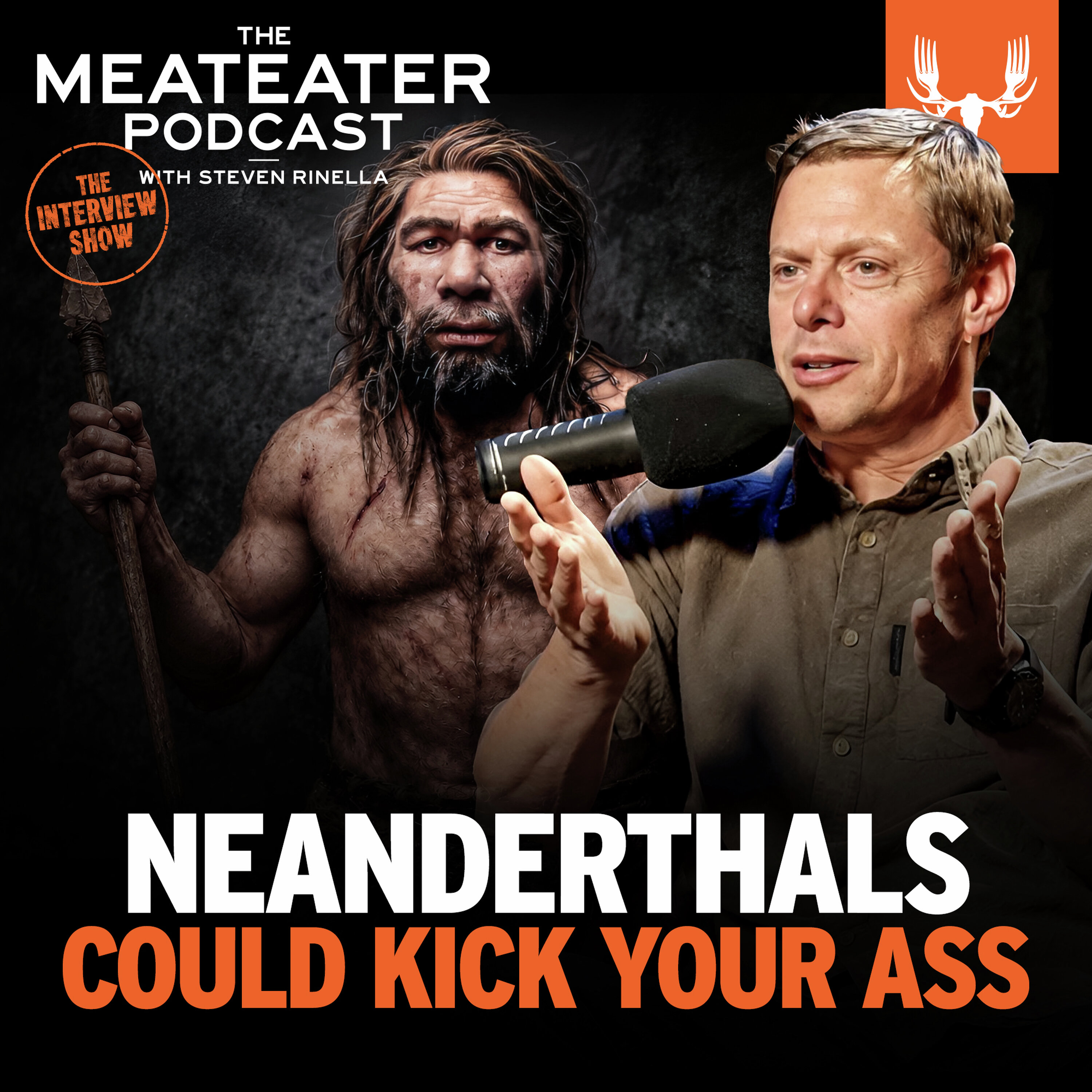
All right, everybody. It's finally happened after years of talking about it. We have our. We have Neanderthal experts in the room. This is the white. This is the white. My white whale. This is. This is my, you know, my Moby Dick story. I've said for years, I want to talk to some people that actually know something about Neanderthals. And here you are.
- [03:32]
Mike Morse
These.
- [03:33]
Demetra Papayani
You find us.
- [03:34]
Steven Rinella
They have a book. It's. Well, first names, Demetra, Papa Gianni is how it's spelled. Papa Yanni, Demetra, Papayani and Mike Morse. And they have a book that's in its third edition. So the. The Neanderthals rediscovered how modern science is rewriting their story. It's in its third edition. It was originally published in 2023. They were just explaining to me that 2013. Oh, sorry, I had that written right here. Sorry, my fault. Originally published in 2013. Originally. But. And this is part of partly why you're here, our understanding of Neanderthal culture has changed so much that in that time, you've had to really overhaul the book and, and make major changes.
- [04:24]
Mike Morse
Right.
- [04:24]
Steven Rinella
So something that happened a long time ago, our understanding of it has changed so much that it's caused you to constantly need to go in and. And update your work at some point.
- [04:33]
Mike Morse
Demetra said we really need to update this every three years if we want to stay current. It's hard to do that, but, you know, we're doing the best we can.
- [04:41]
Steven Rinella
Yeah. Because it's so rapidly evolving. And part of the reason I want to talk to you about Neanderthal is not just in my lifetime, but in the last few years, I've started to feel like I had this image of Neanderthal culture. And in a minute, I want you to explain what Neanderthal is. But I've had this image of Neanderthal culture and the way it's portrayed in, like, cartoons and things. You just picture people with big clubs and they're hitting each other with clubs and dragging their knuckles along the ground. And then I would read, just as a. Just an interested party reading common news sites. I would read like, oh, they seemed that they had art. Oh, perhaps they had jewelry. Perhaps they mated with. With humans. You know, they were divers. They were. They were collecting shellfish. They suffered from swimmers, year, whatever. I don't know how much of all that is True, but it's just been that I started to visualize them less like some kind of glorified ape and more like a. You know, they just became more human to the point where I can almost picture that something I had never thought of before, that they were. There was personalities and.
- [05:53]
Mike Morse
Right.
- [05:54]
Steven Rinella
And, and so as my understanding has changed, I just wanted to have someone in who could speak to like who really were they? What happened to them? What did they do? You know, if I saw one across the room, would I instantly know that I was by something different? This is what I want to talk about, this is why you're here. But first off, and I don't care any of these questions, I don't care who answers it, but when we say Neanderthal, what is that? What does that mean?
- [06:28]
Demetra Papayani
They were our ancestors, but they were part of our ancestors, part of what came before us as humans. They were essentially an offshoot of our direct evolutionary line, a side branch of which a little bit remains in us. For most of their part, they lived at the same time as our ancestors, but in different parts of the world. Later on they met and they were mostly in Europe, but again later in their span of existence in the old World expanded towards Asia, towards the Middle east and Siberia. And they chronologically what we call pre Neanderthals or the earliest forms of Neanderthals could be going back as far as half a million years. But where we start seeing kind of Neanderthals with the features that we identify as Neanderthals is closer to about 350,000 years, give or take. And they disappeared from Europe, let's say around 40,000 years. And I guess there is give or take and new dates and so on. So this is the time span that we are talking about in terms of their morphology. They were shorter than us, a little bit shorter than ours and, and bulkier built. They had some distinct features like the shorter than us limbs proportionally also smaller than us. And they had big barrel shaped chests and their faces were. If you take one of our faces, you kind of pull it forward so you will have this part sticking out farther. Their noses were sticking out farther. Their brow ridges were bigger. They didn't have chins. So kind of imagine a more bird like profile in a way. They didn't have chins. No. We don't even know why we have chins.
- [08:56]
Steven Rinella
It's not clear why we have chins.
- [08:57]
Demetra Papayani
No. There are many theories of why we have chins and what they do, but they did not have chins.
- [09:01]
Steven Rinella
I never Thought about that.
- [09:03]
Demetra Papayani
Yeah.
- [09:04]
Steven Rinella
A Neanderthal could kick a normal person. Like a Neanderthal could. Could beat up.
- [09:09]
Demetra Papayani
Yeah, probably a Neanderthal woman could beat up a modern human man. Yeah.
- [09:14]
Steven Rinella
Just across the board. Like big, like strong.
- [09:16]
Demetra Papayani
No, not. Probably not across the board, depending on their lifestyle and.
- [09:22]
Mike Morse
But they were very muscular, very strong bones.
- [09:25]
Steven Rinella
I noticed you say Neanderthal.
- [09:27]
Demetra Papayani
Yes.
- [09:28]
Mike Morse
We're going to give you the long answer to this, please.
- [09:30]
Steven Rinella
What do you do? What do you go with?
- [09:31]
Mike Morse
So I grew up saying Neanderthal because I grew up in the United States. Yes. Where that's normal. Then we lived in the UK for 15 years where everyone says Neanderthal.
- [09:42]
Steven Rinella
Okay.
- [09:44]
Mike Morse
My view is they're both right. It doesn't know. Neanderthal is going to come back and correct us. So we're good. But I think it's worth going to the etymology, please. Yeah.
- [09:55]
Steven Rinella
Because there's a valley in Germany.
- [09:57]
Mike Morse
Exactly.
- [09:58]
Steven Rinella
They call that the Neanderthal valley or something.
- [10:00]
Mike Morse
So the German word for valley is tall.
- [10:03]
Steven Rinella
Okay.
- [10:03]
Mike Morse
Oh, and. And originally it was spelled with a th, but the H was silent. So in German, it's tall. And this is something that we all should know because virtually everyone watching this says. Says the German word for valley every day. And now I'm going to go into the etymology. So Neanderthals came from the Neander Valley. That's where the major discovery was made. And that valley was named after a guy named Joachim Neander. He wrote hymns, and so they named the valley after him. The Neander Valley. The Neanderthal. There was another tall. There's another valley called the Joachimstall where they had a mint. And so the money that was made from the Joachim stall was called the Joachimsthalers, and that got shortened to taller. And so that's where the word dollar comes from.
- [11:02]
Steven Rinella
Oh, really? Okay.
- [11:04]
Mike Morse
So we say dollar, we don't say thaler. You can say Neanderthal if you want. It's spelled with an H in English. I think it's easier to say Neanderthal. The point is, once you start saying it one way, it's very hard to change. Once we were talking.
- [11:20]
Steven Rinella
I've changed two times.
- [11:21]
Mike Morse
Yeah, there you go. Once we were talking with a geneticist, and we were saying Neanderthal and Denisovan, and he was saying Neanderthal and Denisovan, and we understood each other. No one was correcting. It was fine. It doesn't matter how you pronounce these things.
- [11:38]
Steven Rinella
Got it. All right. Good to get that cleared up.
- [11:41]
Mike Morse
Yeah, we're fine.
- [11:42]
Steven Rinella
So over the whatever. Since the days of 23 and me came out and any person could send in, you know, saliva and get a genetic profile of themselves. People would even call it, you know, I did. I 23 and Mead myself. I did 23andMe, whatever. And all of a sudden everybody's talking about what percent Neanderthal they are, or it would give it to you. Like, less than average. More than average. I was disappointed to see that. I'm. I think less than average. I was disappointed to see. What do you. Do you guys buy that? And what are people really saying when they say that? Right. When people look and they get their profile and they see that they're blank percent of Neanderthal descent, what are we saying?
- [12:41]
Demetra Papayani
So it's. It's accurate.
- [12:47]
Steven Rinella
Okay.
- [12:48]
Demetra Papayani
So the percentage you were given. The percentage I was given is. I'm sure it's accurate. There are other things in the 23andMe, and this kind of sequencing that I'm not so comfortable with, with the conclusions. You know, I'm like 30% Italian. It doesn't really work this way. But the Neanderthal bit is one of the most reliable things. Okay. What it means, though, is basically that all of us who have our ancestors outside sub Saharan Africa have a component of Neanderthal DNA. But my. Let's say 3%. My 3% of Neanderthal DNA is not necessarily the same as yours or his. Okay. And if you pull them all together, you can actually reconstruct about. At this point, it's about, I think, 70% of Neanderthal DNA. So we have different bits of Neanderthal DNA in us.
- [13:58]
Steven Rinella
I see.
- [13:59]
Demetra Papayani
And for most of it, we don't know what it does or if it does anything. And essentially, I mean, it doesn't mean all that much. It simply means that a little bit of our ancestors lives in us because they interbred with us. And actually, even modern humans who come from sub Saharan Africa, they also have a tiny bit of neonatal DNA. That's one of the very recent findings. We thought that they had none. They had a tiny bit because at some point there was migration back to Africa and intermixing with them, but it's different. So the big genetic difference in us, in modern humans generally, is that everyone who is from sub Saharan Africa has much bigger genetic diversity than the rest of us and a tiny bit of Neanderthal DNA. But the big story about them genetically is that they are much more diverse than us because we as a species developed in sub Saharan Africa. And it's a whole different story how, where and when, but at some or at different points. It wasn't only one point. There were several, probably waves of leaving Africa, some less successful than others. But basically you have what you call a bottleneck event. Imagine that you have the big bottle in Africa and then just a segment of that population leaves. And this is what the modern humans, us Homo sapiens, who come from outside sub Saharan Africa, we are much genetically diverse than the sub Saharan African.
- [15:51]
Mike Morse
Much less diverse.
- [15:52]
Demetra Papayani
Yes, much less diverse genetically. And because of ancestors mixed with Neanderthals and Denisovans, we have that little bit of Neanderthal DNA. For most of it, we don't know what it does, and for most of DNA, we don't know what they like. If you take a specific gene, we still don't know. For some of them, we don't know they may cause this disease or that. But generally we are not yet at the point where we'll say, oh, this gene does this? No, we don't know yet. It's like a language that we cannot quite read yet.
- [16:27]
Mike Morse
I think there's a bigger question about are you above average or below average Neanderthal? And to me, the big answer is most of the world outside of Africa is about the same. It's like 2% plus or minus a little bit. I mean, originally, when you first could send your DNA off to get it sequenced, it would be between 1 and 4%. And you could get excited by that. When they've refined it, it's mostly towards 2% everywhere around the world outside of Africa.
- [17:00]
Steven Rinella
Yeah.
- [17:01]
Mike Morse
Which to me tells an amazing story, which is that when that bottleneck of Homo sapiens left Africa, they must have intermixed very quickly with Neanderthals because, you know, Europe is not that different from East Asia, for example, or, you know, for. Or even the people that made it to the Americas. It's all about the same percentage of Neanderthal DNA.
- [17:24]
Steven Rinella
That that a little bit surprises me because I would picture, as humans are spreading around the world, I would picture that some bands of people, some clans, social or whatever social organization structures there were, I would picture that some would go in whatever direction and have a different level of run in a different level of integration with Neanderthals and then carry that off in whatever direction they went, especially people that went out on colonized islands, that I would just guess that if you went around the world, you'd find much greater concentrations of whatever in some area. Because those people that became those people had just a different experience, I think. Does that make any sense at all?
- [18:20]
Mike Morse
Well, the numbers were so small back then. So we went to see this geneticist, Josh Akey, and I don't quite know what these numbers mean, but he said the Homo sapien breeding population was about 10,000. So that doesn't mean there were 10,000 human beings. But in terms of who is of an age and ability to reproduce, and the Neanderthal breeding population, they think was about 1,000 at the time that they met. So it was about 10 to 1. And in fact, from very early on, the kind of hybrids that they find are modern humans with about 10% Neanderthal DNA. So if as they're coming out of Africa, they're part of the same breeding population, then that 10% kind of spreads around to everyone, and then it's been slowly getting whittled down, it's being selected out.
- [19:17]
Steven Rinella
Understood.
- [19:18]
Mike Morse
So, I mean, another genetic. Geneticists use the term toxic. That Neanderthal DNA is toxic.
- [19:27]
Steven Rinella
That's a brand. That's a branding problem for Neanderthals.
- [19:29]
Mike Morse
Yeah. So. So, you know, as. As life goes on, we have less and less of it.
- [19:37]
Steven Rinella
Got it, Got it. Do you. How do you imagine. How do you. Matt, what is the interaction? I mean, I know we don't know. I know, I know we don't know, but how do. How do we imagine it was the interaction, was it around that Neanderthals are kidnapping Homo sapien females?
- [20:00]
Mike Morse
Is it.
- [20:01]
Steven Rinella
They're living in bliss. They're living in mixed communities. There's sort of a. There's sort of a warfare element to it of taking captives and breeding with those captives. What are some of the. Like, what are some of the guesses? What are some of the guesses of. Or they go like, wow, these people are amazing looking. I'd love to breed with one of them.
- [20:25]
Demetra Papayani
I think we can. I think we can safely say that there wasn't only one scenario.
- [20:33]
Steven Rinella
Okay.
- [20:35]
Demetra Papayani
And, you know, people met and it could be a whole range of things from a chance encounter or a chance mating episode to I wouldn't say living together, because culturally we don't see that level.
- [20:54]
Steven Rinella
Okay.
- [20:56]
Demetra Papayani
But maybe. Actually, now that I think of it, there has. You probably referred to a kind of a recent story just a few months ago about a sex bias.
- [21:07]
Steven Rinella
Yes.
- [21:09]
Demetra Papayani
Now, the sex bias, in that case, they mean it basically how sexes are represented in the DNA.
- [21:14]
Steven Rinella
Not necessarily primarily male Neanderthals breeding with female humans.
- [21:20]
Demetra Papayani
No, no, no, no. So the bias could be that you had more Neanderthal men interbreeding with more modern human women. Okay. But it could also be that the Neanderthal female DNA was filtered out because it was not, you know, what he called toxic.
- [21:46]
Steven Rinella
Got it. So it's not conclusive.
- [21:48]
Mike Morse
To me, the main takeaway of all this, and it's not just humans, but it's all mammals, is that they're just. They're very promiscuous. Like, there's, if you can imagine, sexual combinations. They're happening somewhere in nature. Mm. And so maybe it shouldn't have been a surprise. It was a big surprise when it turned out we. We carry Neanderthal DNA in us, but maybe it just shouldn't have been. Maybe, you know, there's just mixing everywhere.
- [22:17]
Steven Rinella
Got it. Yeah. Like our. Our being shocked about it was sort of looking at human exceptionalism and not considering what you see in the. In the broader community of mammals in general.
- [22:30]
Sponsor/Ad Voice
Do you? They had a language, you think they were talking.
- [22:35]
Mike Morse
Absolutely.
- [22:36]
Steven Rinella
How complex?
- [22:38]
Mike Morse
That's one of those words that. So for years, the idea was that what, you know, the question is, what makes us special? And it's really disturbing that you've got these really strong, you know, Neanderthals, really strong, kind of strange faces, slightly different bodies, living about the same time that Homo sapiens were. But. And, but we've got to explain what makes us special. So for years, the idea was, well, we have complex language, and they must not have. And then. Well, it turns out they did have language. Well, ours was more complex. I just think it's one of those words to hide behind. Like, we're still special. I tell you, we're still special.
- [23:16]
Steven Rinella
Yeah.
- [23:18]
Mike Morse
You know, we. I mean, we. At some point, we need to get into the whole. There's a whole theory, the social brain hypothesis.
- [23:27]
Steven Rinella
Okay.
- [23:27]
Mike Morse
And which, which is a theory that explains when language should have first appeared. And it. It kind of predates both Homo sapiens and Neanderthals, according to that theory. Well, we'll get into that. But there's this idea we still need to keep something for ourselves. And yes, modern humans, Homo sapiens, do stuff that Neanderthals didn't do. It doesn't mean that you're going to see that in language. Perhaps, but not necessarily.
- [23:56]
Steven Rinella
Yeah. So the word complex language, doesn't. That doesn't mean anything?
- [24:02]
Mike Morse
Well, to me, it's. It's a way to hide behind. But. But our language is better than their language. Like, because for a long time as we. They didn't have language. We have. We're the only species that has language. Well, it turns out we're not so, but I was. We're the only species that has this really, really complex language.
- [24:20]
Sponsor/Ad Voice
Summer is messy in its own way. Sand, sweat, snacks, water, gear. And you don't want anything slowing you down. WeatherTech is built for it, giving you the freedom to go all in. Floor liners, cargo liner and seat protectors. Keep up with your summer adventures. I, we literally, I have WeatherTech in
- [24:39]
Steven Rinella
all of our vehicles.
- [24:40]
Sponsor/Ad Voice
American made, built to last, easy to clean. If you're going to go all out this summer, you need WeatherTech. Visit weathertech.com today.
- [24:48]
You know that moment, the one when you realize you left your favorite sunglasses in the woods or on the roof of your car or at the gas station three states away? Well, I've been there too. When I was in my early 20s, I remember telling my wife that I would know that I was a mature human being, a man, when I knew exactly where my sunglasses were at all times. That's a true story. But then I found Shady Rays and it changed the game. These sunglasses are made for real life. Good looking, polarized, durable and not stupidly expensive. And here's the wild part. If you lose them or break them even on day one, Shady Rays will send you a brand new pair. No guilt trip, just replacements. That's pretty incredible. So now I can actually wear and use my sunglasses without fear. Even though I do like to keep up with them. On hikes, at concerts, on the boat, when I'm hunting. Wherever Shady Rays is eyewear backed by lost and broken protection. We've teamed up with Shady Rays to bring you an exclusive offer. Head to shadyrays.com and use code BEAR for 50% off two or more polarized sunglasses. Try for yourself The Shades rated five stars by over 300,000 people. I've been wearing Shady Rays and I love them.
- [26:07]
O'Reilly Auto Parts can help take the guesswork out of check engine, ABS or maintenance lights in your vehicle with O'Reilly Veriscan. The service is free and provides a report with solutions verified by ASE certified master technicians. O'Reilly Veriscan can identify the most likely problem with just one scan. If you need help, O'Reilly Auto Parts can recommend a shop for you. Don't ignore a check engine, ABS or maintenance light. Ask for O'Reilly Veriscan today, a free service exclusively at O'Reilly Auto Parts.
- [26:48]
Steven Rinella
Well, how do we know they. How do you know they had language? I mean, like, so let's. If you're looking at bones, how do you. How do you know that they were talking to each other?
- [26:57]
Mike Morse
Because the bones that you're looking at. Well, the bones that you're looking at are the skulls.
- [27:01]
Steven Rinella
Okay?
- [27:02]
Mike Morse
And brain size is. Is a big thing, but within the brain is pre. Prefrontal cortex.
- [27:09]
Steven Rinella
Good.
- [27:10]
Mike Morse
And so which is this part. So, yeah, so there is. So let me just rewind. There was a day that when Demetra was a postdoc at Southampton in the uk, she came home one day and she's like, mike, I saw this guy, Robin Dunbar, speak, and he explains everything. And I'm like, okay. And you were just, like, bursting with excitement. It's like, okay, what does he explain? You're like, why do people sing at soccer matches? Why do people sing in church? Why do we have language? What's our social organization? It all comes together in this one big theory.
- [27:44]
Steven Rinella
So please tell me the theory.
- [27:45]
Mike Morse
So here's the theory. So. So the theory is that. So prefrontal cortex is correlated with group size. So if. If you look at chimpanzees, which is a nice proxy for our ancestors, pre Homo, our oldest ancestors, from 6 million years ago, they live in groups of 50 to 55 individuals. So how do they keep the group together? How do they know that they're in that group? They do grooming. They spend a lot of the day picking little insects off each other's backs. If you've ever had someone rub your back, it's incredibly relaxing. You know, there's brain changes, there's endorphins. You feel very close to this person. So in chimpanzees, they groom each other to the point that they all feel like one unit together.
- [28:36]
Steven Rinella
Got it.
- [28:38]
Mike Morse
So as your prefrontal cortex grows, as the brain gets bigger, the group size gets bigger. So we today have a natural group size of 150, which is called the Dunbar number.
- [28:50]
Steven Rinella
Okay?
- [28:51]
Mike Morse
And this. And there's so many incredible things about the Dunbar number. My favorite is that it's a. It's a hard stop at 150. So if you have, like, a group of 151, it will break up into two groups. It's just our brains can't. We don't have the capacity for a group larger than 150. And so you'll see this in the ways companies are organized, the way the military is organized. I once experienced this myself when I went to a conference that had 135 people there. And after a couple of days, you could walk up to anyone in that conference and just say, hi, I'm Mike. Here's what I'm doing. Who are you? And you could just have the most amazing conversation the next day. You would feel like old friends. If there were a thousand people at that conference and I walked up to someone and said, hi, I'm Mike, they might think, who is this guy? You know, like, coming up to me like this. So we obviously live in.
- [29:46]
Steven Rinella
Yeah. That's interesting that the size of the group. It does. The size of the group informs or dictates what would be an appropriate way to approach somebody, People that you can
- [30:00]
Demetra Papayani
maintain daily contact with.
- [30:02]
Steven Rinella
Okay.
- [30:03]
Demetra Papayani
And that's fairly small because you have to. You have to. You have to think of it in terms of how much time, how much of your own time and energy you have to spend to maintain that contact. There is the bigger group of people that you are in contact with regularly, like your friends, but they don't live in the same town. Maybe every once in a couple of weeks you exchange a text message or there's something like a sporting event that you suddenly interact with a lot for a small amount of time. And then you don't forget about them, but you kind of don't interact with them for like a month. But they're still there. They're still in your brain. You still spend some time with them. And there is the people back then, when Robin Dunmer wrote this series that he called the Christmas Card group, the people that the hundred plus that, you know, you consider them your friends. You consider them part of your network, but you may not even talk to them in the year. Still, you'll send them a card.
- [31:05]
Steven Rinella
Yes. Who you'd invite to your wedding if you had a good budget.
- [31:07]
Demetra Papayani
So think of it this way. Or if you. Even in a dinner party, if you have a small dinner party with four, that's fine. If you have a bigger group, eventually people will kind of split naturally into smaller groups. And the idea is that in an evolutionary sense, though, if you project that in an evolutionary sense, you can't do this sort of grooming that primates do with a group of even 50 people. So what do you do instead to maintain those connections? He says you gossip. That's where language comes in. That instead of spending time, one on one grooming, you can spend time with a bigger group at a time. And you spend that time, you know, telling stories, discussing things, gossiping about other people. And that's how you maintain that network in terms of time. It's a more efficient language, gives you a more efficient way to maintain that network. Okay. And then you build other things in like, you know, now we call it dinner parties back then it was, I killed a big deer. Do you want to come over and help me with butchering it and take some of the food and, and I know that you will invite me over when you do the same thing.
- [32:27]
Steven Rinella
Yeah.
- [32:28]
Mike Morse
And so, so at some point between the kind of 55 maximum of chimpanzees and the 150 of us, there had to be language to maintain that group size. And Robin Dunbar puts it somewhere between a million years ago and 500,000 years ago.
- [32:45]
Steven Rinella
Do you feel that if you look at the timing of, of humans leaving Africa. Okay, would the timing be that the, if the, the Neanderthals had a language they spoke Neanderthal, let's say,
- [33:06]
Sponsor/Ad Voice
would it
- [33:06]
Steven Rinella
have been incomprehensible to Homo sapiens? To me, like was the right amount of time gone by that they would have developed these entirely different languages. And by that I mean if you look at when humans are spreading around the world, Europeans developed a certain skin tone language families. Right. So that when they finally come together with Native Americans, all those years later they're coming from a common place, when they finally re meet, the languages are incomprehensible. The cultures are largely incompatible. They look totally different. They don't even reckon, they don't barely recognize each other. They, they have, there's a reluctance to even accept them as fellow human beings. Right. So would Neanderth like Neanderthal language out in Western Europe would have been probably something totally different than what Homo sapiens spoke when they met. They weren't yelling hello across the valley.
- [34:11]
Demetra Papayani
Yeah, I think when we talk about Neanderthal language, I think we, I don't think they had the same old Neanderthals had the same language.
- [34:20]
Steven Rinella
Okay.
- [34:22]
Demetra Papayani
I mean it's completely theoretical now, but I can't imagine that people who were not in regular contact would speak the exact, the same language. Yeah, they probably had something similar to maybe our families of languages or you know, groups that were in western, in southwest France probably had different language from groups in Germany.
- [34:48]
Mike Morse
Got it.
- [34:49]
Steven Rinella
So different Neanderthal communities might have had totally different words, quote unquote, words for things.
- [34:56]
Demetra Papayani
I don't think we know for how language works. Unless you are regularly interacting with another group, you wouldn't have the same language. I mean even now French and German are part both in the European languages and have a relatively very recent ancestor, common ancestor as languages. But you can't, they're not the same. I mean it takes, it's closer than Greek and German which also again in the European languages, but it Takes time to learn it. Even if you have like Russian and Croatian, they're closer genetic in terms of evolution as languages, they're closer together. But still, you can't just walk from one country to the other and just speak as if you speak their language, it will be easier to understand, will be faster to learn it. But it's not. I just can't. You know, Neanderthals in Siberia wouldn't speak. If they met a Neanderthal in France, they wouldn't speak the same language.
- [36:04]
Sponsor/Ad Voice
That's a good point.
- [36:04]
Steven Rinella
I had a linguist explain. I had a linguist one time say that if you had, at the time of the American Civil War, if, at the end of the American Civil War, you had taken the Mason Dixon Line and built a sort of impenetrable wall that prevented communication with people south of the Mason Dixon Line and people north of the Mason Dixon Line, he said in that amount of time they would now not be able to communicate.
- [36:31]
Demetra Papayani
Yeah, it doesn't take a lot of time.
- [36:34]
Steven Rinella
All the words would have gone different.
- [36:36]
Mike Morse
Look at it the other way, which is when you're talking about hunter gatherers, they're on the move, they're traveling a lot, and they're going to run into other people. Whether it's Neanderthals running into Neanderthals, modern humans running into Neanderthals, modern humans running into modern humans, you're going to run into other people. And the first thing you have to figure out is, are these people going to kill us? And so it's, it's kind of. It's a human capability to make friends and communicate whether or not you share a language. And I think the language can come. You know, you can learn each other's languages later, you can, you can embed, you can live with them. And you know, after whatever amount of time, there are going to be people that, that are fluent in both. But to me, it's not a question of can we understand. I mean, that's like a modern problem. You know, if I, if I travel somewhere, am I going to understand the locals? But if you're a hunter gatherer, you're kind of doing this all the time.
- [37:33]
Steven Rinella
Got it. I know language is hard because it's like there's no record, there's no record of their words. But let's talk about something. There is a record.
- [37:43]
Demetra Papayani
What we do have, we have some anatomical stuff like from Neanderthals that we know that they could produce sounds and a big range of sounds. How it sounded like maybe was more high pitched. Than ours.
- [37:58]
Steven Rinella
Really?
- [37:59]
Mike Morse
Yeah. They squeaky. These big guys with squeaky little voices.
- [38:03]
Demetra Papayani
Yeah. Because of how they're.
- [38:06]
Steven Rinella
That squeaky little voice.
- [38:08]
Mike Morse
That's the theory.
- [38:08]
Demetra Papayani
That's the theory, yes. But I think in terms of if you met a Neanderthal. When a Neanderthal met in modern human, it was probably mostly gestures to understand each other and see, who, is this guy, gonna kill me or not? And one side. I don't want to talk too much about modern humans because we always do a disservice to Neanderthals because we always talk about us. But the question is, once you move more and there are more people around and you interact with more people, how do you signal to them who you are and what you are? Or this is your land or this is your river? And that may be where the advantage of modern humans was, because they thought they came up. Came up. They used ways that could have been kind of calling cards of who they are.
- [39:09]
Steven Rinella
I see.
- [39:09]
Demetra Papayani
It could be. I'm wearing this necklace that has shells from this coast. You know, it could be the Mediterranean coast. It could be the Black Sea coast. Or I have this, you know, these figurines, this portable art. What do they do? We don't know what they did. What were they? Were they the sign that we are here? Or maybe even with art on rock art, is that a sign that this is our group, this is our land? Yeah. So when we talk about complex language, what is a complex language? And what is. Is it the vocabulary? Is it the syntax? Is it that you talk about abstract things? Is it that you can talk about yourself as a group versus the other group? And how do you signify that if you don't, you know, you come across as other people, you don't speak the same language. How do you tell them who you are? How do you tell them, oh, we haven't met, but I am friends with those other guys, and they gave me some of the shells in this necklace. So maybe that's how you show it. Or I am strong and I have, you know, I rule this land. And you can see from the, I don't know, the teeth of the animal that is hanging on my neck that we can hunt those things and we run this territory. Yeah, I'm speculating here, but this is ways that we try to read from artifacts and from material culture. What were they using this for? What were they trying to signify this for? That's a big difference between Neanderthals and modern humans. It's not the. Oh, I see. You will we hunt together. We are a group of 20 people and want to coordinate who is gonna, you know, how we drive these animals to this narrow ravine maybe to be able to hunt them better that I think we know from material culture they could do. We know from the hunting they did. We know the number of animals that they killed. They were pretty good at that. They were pretty good at exploiting the resources together, sharing the food and so on. But the more you can call it sophisticated, complex, abstract of relating with people, you don't see maybe every day. That's where modern humans probably had an advantage.
- [41:55]
Steven Rinella
Is there evidence that they ate each other?
- [41:58]
Demetra Papayani
Yes,
- [42:00]
Steven Rinella
the humans and Neanderthals were eating each other.
- [42:03]
Mike Morse
Oh, each other. There's lots of evidence that, that Homo sapiens reading Homo sapiens and that Neanderthals were eating Neanderthals, but I don't know
- [42:13]
Steven Rinella
if there's evidence that Homo sapiens are eating Homo sapiens.
- [42:17]
Mike Morse
It's, it's incredibly well documented in, in almost every period of, of our past that cannibalism happened.
- [42:26]
Steven Rinella
But. But there's not physical evidence of a Neanderthal campsite and among their artifacts are butchered Homo sapiens remains.
- [42:36]
Demetra Papayani
No. Huh.
- [42:38]
Mike Morse
Well, because. So there, there are a lot. I mean, I'm thinking like half a dozen famous Neanderthal cannibalism sites, and mostly those are too old for there to be modern humans being. Being a part of it.
- [42:57]
Steven Rinella
Yep.
- [42:58]
Mike Morse
There was actually. There was a site in Belgium that just came out a couple of weeks ago that actually does fall into the time frame that, that modern humans would have been around. And it was like this little family that was butchered and eaten and.
- [43:14]
Steven Rinella
Butchered. Eaten by who?
- [43:16]
Mike Morse
Well, you know, they didn't leave their calling card, so we don't.
- [43:20]
Steven Rinella
So we know someone butchered a family.
- [43:23]
Mike Morse
Yeah.
- [43:23]
Steven Rinella
Of modern humans.
- [43:24]
Mike Morse
No, no, Neanderthals.
- [43:25]
Steven Rinella
Oh, Someone butchered native family of Neanderthals. And the timing could be that it was modern humans, but we don't know.
- [43:33]
Demetra Papayani
Yeah, it could be. Yes. But there is no indication that there were any modern humans nearby.
- [43:40]
Steven Rinella
So it could have been by other Neanderthals.
- [43:42]
Demetra Papayani
Yes. So for modern humans, we have evidence of cannibalism, as he said, in all time periods. And it can be for. Because of starvation, it can be for ritualistic reasons. You kind of.
- [44:04]
Mike Morse
You can honor the dead.
- [44:06]
Demetra Papayani
Honor the dead? Basically, yeah. Or you keep a part of the dead, or it could be even for part of a war and displaying how ferocious and fearsome you are and so on. It's the whole Range. But most of it, I think, am I right? Is not in a violent context in modern humans. For Neanderthals, we have sites with evidence of cannibalism from 40,000 years, for 120,000 years, even pre Neanderthals, early hominids in
- [44:46]
Mike Morse
Europe, before Neanderthals, the very oldest skull from. In Europe was at a Puerca Homo antecessor, almost a million years old. And that was eaten.
- [45:00]
Steven Rinella
Really?
- [45:01]
Mike Morse
Yeah, by. So the oldest Homo of any kind in Europe was. Was eaten by other humans.
- [45:08]
Steven Rinella
Because it has butcher marks on it.
- [45:09]
Demetra Papayani
Yeah, it has butcher marks, and it has butcher marks. And also in. There's a site in France and site in Croatia that you can see that the bones are snapped and cut up exactly the same way that they snap and cut up the animal bones.
- [45:25]
Steven Rinella
Oh, really? That's like an eating for food. If you look at, like the history of. Go look at the history of Great Lakes tribes, tribes along the St. Lawrence, the Iroquois in New York, right. They would practice a widespread cannibalism related to warfare, meaning you'd catch prisoners. And there was a sort of ritualistic cannibalism, very widespread, very well documented, again and again and again. But it was usually tied to. It wasn't tied to, like, boy, I'm hungry. It was tied to, like a type of domination. Right. Perhaps some sort of religious element to it. But it wasn't like, I'm going out to get something to eat. I'll go hunt down a human to eat. But with this case, that might be what was going on. It might be like you viewed him as a food source.
- [46:23]
Mike Morse
Warfare is real. Is a really recent thing in terms of human behavior, like organized warfare against other groups where you, you, you kill off a lot of people and you take control. That's like one of the most recent Homo sapien behaviors to develop. That's reason, like, so, like 20, 30,000 years.
- [46:50]
Demetra Papayani
What?
- [46:51]
Steven Rinella
Really?
- [46:52]
Demetra Papayani
Yeah.
- [46:52]
Mike Morse
Yeah.
- [46:53]
Steven Rinella
So you don't think there were wars between Neanderthals and modern humans?
- [46:57]
Mike Morse
It's not that they're. Well, there were fights, let's say, because there's always fights and battles. But in terms of let's go and kill everybody, you know, or let's take the women and kill everyone else. That's. That's a much more recent development.
- [47:12]
Steven Rinella
Like, we make a big old plan. It's got step one, step two, step three. Yeah, yeah.
- [47:17]
Mike Morse
But a lot of. A lot of cannibalism is linked somehow to protein shortages.
- [47:23]
Steven Rinella
Okay.
- [47:24]
Mike Morse
That. I mean, the, the biggest state example is the Aztec empire.
- [47:29]
Steven Rinella
Okay.
- [47:29]
Mike Morse
Which, you know, was a very, it was, you know, probably one of the, at its heyday was probably one of the biggest in the world before the conquest. And they, they had kind of state organized cannibalism of prisoners of war, but they also, you know, they, they didn't have a lot of other good ways to feed protein to the whole population.
- [47:50]
Steven Rinella
So you think it was, it was that cannibalism in the Aztec was driven by like literally a need for food.
- [47:59]
Mike Morse
This is now I was, I was a graduate student in anthropology and this is a very unpopular view in anthropology departments.
- [48:07]
Steven Rinella
Oh yeah, no, I know, it happens. What I was telling you about the Great Lakes tribes in the Iroquois people. It's ridiculous, but it's, it's, it's somehow controversial to talk about things that are like incredibly well documented.
- [48:19]
Mike Morse
Yeah, yeah. Well, well, there's always a reluctance because cannibalism is a, is a slur against a group. Oh, they practice cannibalism. That means they weren't quite as civilized as us.
- [48:30]
Steven Rinella
I want to, I want to clarify. I don't hold that opinion right. I mean, I don't practice, I don't, I don't practice. But like when we're talking about people live hundreds of years ago, I don't hold it as a, I don't count it against them.
- [48:42]
Mike Morse
Well, we can go to the store and buy as much meat as we want, but if, you know, if there's a certain kind of hunger, like if you can, you can eat as much nuts and fruit and vegetables as you want, but if you haven't had enough protein, there's a certain kind of hunger that's almost unbearable. Yeah, I see. And yeah, I don't. It's always been a part of our ancestors behavior. And it could be a respected elder died and you honor him by consuming everything and then everyone gets fed. Or it could be, you know, as part of a, as part of a battle against some group. I mean, so like this, the site in Belgium I mentioned is like a Neanderthal family. We don't know that there were the
- [49:29]
Steven Rinella
dynamics of the family.
- [49:30]
Mike Morse
Well, I think it was the, it was, I think it was the men were closely related and the women had come in from somewhere else.
- [49:40]
Steven Rinella
Okay.
- [49:41]
Mike Morse
But even that, we don't know how
- [49:42]
Steven Rinella
big was the, how big was the group.
- [49:43]
Mike Morse
There's like six or so individuals, but we don't know that they were all like slaughtered and butchered at the same time. It could be because things get preserved in caves that. It could be that you know, and you know, frankly, that's a lot of meat. You know, that's six people is going to feed hundreds. Yeah. So you wouldn't kill six people in Neanderthal times purely for food. Maybe they, maybe it was done one or two at a time and they just happened to wash into the Washington.
- [50:16]
Steven Rinella
How heavy was a Neanderthal if you had to guess?
- [50:21]
Mike Morse
I think let's say 150 pounds.
- [50:23]
Steven Rinella
Okay. So I would say humans would have a poor yield, like if the deer. 40%. But I bet you humans have a super low yield. A super low meat yield.
- [50:37]
Demetra Papayani
Yeah.
- [50:38]
Steven Rinella
So if you have 100, let's say you have a 150 pound Neanderthal. Let's say you get 50 pounds. Yeah. It's a lot. 50 pounds of flesh off that sucker.
- [50:51]
Mike Morse
Well, and the Aztecs could cook them into a soup, but Neanderthals didn't exactly have big cauldrons, you know, to get it to really ways of cooking soup though.
- [51:02]
Steven Rinella
But that's a really interesting idea to think about. They'd be like, that's a lot of meat.
- [51:06]
Demetra Papayani
Yeah. There are a couple of studies that it wouldn't be very Neanderthals wouldn't be. Or humans are not generally very nutritious to eat. I don't know. Because they're generally lean. I don't know. But I think in the context of starvation, then that probably changes the equation. I mean, you asked earlier, 40,000 modern humans may have been there, may have been nearby, and that may have increased the pressures on that population on that small group of Neanderthals. And I mean just. And as Mike said, we have these individuals in a cave, but a cave is not a reflection of what was actually happening in that group. It's whoever happened to be brought back to the cave, cut up, eaten up and so on. They probably were more people from that group over a hundred years say who died and never didn't die in the cave. Never brought to the cave. Because why would you do that unless you have. You really want someone in the family to bury them properly and bring them in a cave.
- [52:20]
Mike Morse
Yeah. Maybe they only brought the butchered people into the cave.
- [52:25]
Sponsor/Ad Voice
Summer is messy in its own way. Sand, sweat, snacks, water, gear, and. And you don't want anything slowing you down. Well, Weathertech is built for it, giving you the freedom to go all in. Floor liners, cargo liner and seat protectors. Keep up with your summer adventures. I, we literally, I have Weathertech in
- [52:44]
Steven Rinella
all of our vehicles.
- [52:45]
Sponsor/Ad Voice
American made, built to last, easy to clean if you're going to go all out this summer. You need WeatherTech. Visit weathertech.com today.
- [52:53]
You know that moment, the one when you realize you left your favorite sunglasses in the woods or on the roof of your car or or at the gas station three states away? Well, I've been there too. When I was in my early 20s, I remember telling my wife that I would know that I was a mature human being, a man, when I knew exactly where my sunglasses were at all times. That's a true story. But then I found Shady Rays and it changed the game. These sunglasses are made for real life. Good looking, polarized, durable and not stupidly expensive. And here's the wild part. If you lose them or break them even on day one, Shady Rays will send you a brand new pair. No guilt trip, just replacements. That's pretty incredible. So now I can actually wear and use my sunglasses without fear, even though I do like to keep up with them on hikes, at concerts, on the boat, when I'm hunting. Wherever Shady Rays is eyewear backed by lost and broken protection. We've teamed up with Shady Rays to bring you an exclusive offer. Head to shadyrays.com and use code BEAR for 50% off two or more polarized sunglasses. Try for yourself The Shades rated five stars by over 300,000 people. I've been wearing Shady Rays and I love them.
- [54:12]
O'Reilly Auto Parts can help take the guesswork out of check engine, ABS or maintenance lights in your vehicle with OReilly VeriScan. The service is free and provides a report with solutions verified by ASE certified master technicians. OReilly VeriScan can identify the most likely problem with just one scan. If you need help, OReilly Auto Parts can recommend a shop for you. Don't ignore a check engine, ABS or maintenance light. Ask for O'Reilly Veriscan Today, a free service exclusively at O'Reilly Auto Parts.
- [54:53]
Steven Rinella
Like take a cave for instance, from those time periods, like with a Neanderthal site. Do you have a bone bed or a debris pile or a midden where it has deer, it has cattle bones, it has sheep bones. And just interspersed interlayed with it are Neanderthal bones, meaning that they're just routinely eating what I bring home today. Today I brought home a turtle. Yesterday I brought home a horse. Last week I brought home Last week I brought home another Neanderthal.
- [55:31]
Demetra Papayani
Yeah.
- [55:31]
Steven Rinella
And it was just all treated the same or does it seem different somehow?
- [55:37]
Demetra Papayani
It's hard to tell. Like he does ask me nice crappiness like that and I said who knows because it Was Krapina, which is a site in Croatia.
- [55:44]
Steven Rinella
Okay.
- [55:45]
Demetra Papayani
That has.
- [55:46]
Mike Morse
It has like 30 at least. I mean, the numbers go back and forth, but probably 30 individual Neanderthals, a lot of whom were butchered in a Neanderthal camp. In a cave site.
- [55:56]
Demetra Papayani
In a cave site. But I said, who knows? Because it was excavated and almost completely excavated. The whole thing was dug out, excavated
- [56:06]
Mike Morse
like 120 years ago.
- [56:08]
Demetra Papayani
And probably we have no idea, basically. But they kept the human bones. They probably threw away a lot of the animal bones. Now, if we excavated it now, it would go in really fine detail and take a lot of time to excavate it and actually see. Did they come from the same.
- [56:26]
Steven Rinella
Yeah, there was a bias of what they were looking, what they were looking for.
- [56:29]
Demetra Papayani
Yeah, there was a bias. It wasn't a bias. It was that the methods were very different and they just couldn't look at this. Didn't want to. Didn't have the same questions that we have. Couldn't look at this level of detail. And you just can't go back and reconstruct it.
- [56:44]
Steven Rinella
Got it.
- [56:44]
Demetra Papayani
I understand more in more recent excavations, you begin to ask those questions and you do things. What I said, like what I said, they're cut up the same way. But then caves are not. It's not like you go in and do something this year or this spring, and then you go back in the fall or next year and so on. You can see that nicely laid out in layers. Caves are often. Stuff is often compressed. And what you see in a slice like this could be a few hundred years, could be a few thousand years. You can't really go into that level of detail.
- [57:23]
Steven Rinella
Yep. Everything is kind of ground in together.
- [57:26]
Demetra Papayani
Yes. Again, not always, but often in some cases you have in caves what could be burials of Neanderthals. There are even, like in Sidron, it wasn't mixed together. We just know that they were. They ate those.
- [57:49]
Mike Morse
Sidron is a cave in Spain. It's another famous site of where it seems like a small group of closely related Neanderthals were butchered.
- [57:58]
Demetra Papayani
Huh.
- [57:59]
Mike Morse
But also. But also butchered animal. I mean, how do you know that it was butchered? Because the butchering looks just like the animal bones.
- [58:05]
Demetra Papayani
Yeah. In a sense, they were not treated as more special.
- [58:10]
Steven Rinella
Yeah, I got it. That was, you know. You know, the. You guys remember the downer party.
- [58:16]
Mike Morse
Yes. Right.
- [58:17]
Steven Rinella
These many years later, these researchers went into the. The trash. The midden sites were. The Donner party were eating their dogs and some. Some things they killed and their Livestock.
- [58:32]
Mike Morse
Right.
- [58:32]
Steven Rinella
And they were. Expect. They were wondering, where are the human bones? Because we know that members of the Donner Party were practicing cannibalism. They don't find the human bones. So then people pointed out, well, they must not have done it. The question is, perhaps they regarded those remains differently. Meaning you were forced to commit cannibalism. You were forced to eat your relatives, but that doesn't mean that you flicked the bones out with the dog bones.
- [59:04]
Mike Morse
Right.
- [59:05]
Steven Rinella
They might have had a separate way, out of respect or whatever, that they would have entombed those remains or burned them up in a fire or something that was more ceremonial. Even though they ate them. Something was more ceremonial than throwing them in the garbage pile.
- [59:23]
Mike Morse
Well, there's also a huge difference in timescales. So you could go to the Donner Party, which was not that long ago. You can go to that site and see where things are. But a lot of these Neanderthal cave sites, the bones all get washed down into a gully. So we don't know where they were originally, but the reason they're preserved is that they're washed into a. Like an. An easy to. A hard to get to place in the cave.
- [59:48]
Steven Rinella
Okay, I got you. What. What evidence do we have of how they dressed and did they. And I remember seeing, like, this idea that they had jewelry. And I can't remember the details, but someone throwing out the idea that maybe they were getting the idea of wearing jewelry from modern humans.
- [60:13]
Demetra Papayani
Okay. Yep.
- [60:15]
Steven Rinella
Like, what were they wearing? And were they, like, beautifying themselves?
- [60:18]
Demetra Papayani
Yeah. Okay. So some of these things we can answer and some we cannot. I'll start with the beautifying. Okay. And the skin, I mean, we do tattoos, we. We do coloring with red ochre or whatever. None of this will survive.
- [60:35]
Steven Rinella
Got it.
- [60:35]
Demetra Papayani
So they could be having elaborate rituals of getting together and painting. And, you know, my group does this, your group does that. We will have no idea about that.
- [60:48]
Steven Rinella
There would be no way to know if they were tattooing themselves.
- [60:51]
Demetra Papayani
No. All we would have. All we do have sometimes is the pigments. We know that sometimes they used pigments. Not as much as the finds are not as frequent as for modern humans later. But we do know that they were aware of them. There could be whole areas of stuff that they were doing that we just cannot have any handle on whether they used clothing they did because they wouldn't have survived in Ice age Europe without clothing. Now, saying Ice Age Europe, it wasn't always uniformly cold. Some periods were fairly warm, even as warm as today. But Generally, to survive, especially overnight, it would require some kind of clothing.
- [61:46]
Sponsor/Ad Voice
Would it require tailored clothing?
- [61:48]
Steven Rinella
Or do you think they could have just draped themselves with skins?
- [61:51]
Demetra Papayani
So tailored clothing would definitely have been better. We don't have any evidence of needles from Neanderthals. We have them from modern humans very early on, but not from Neanderthals. But we do know that they could make string and maybe they could fashion something this way. So the general thing is that they must have used, you know, they had some kind of clothing. How going back to the elaborate, the word elaborate that can we can use for anything, how elaborate it was, whether it was fashioned enough to provide better protection from cold. We don't quite know. Jewelry. We have some evidence of using jewelry. And going back to that crappiness site they had. I can't remember.
- [62:56]
Mike Morse
Eagle talons.
- [62:57]
Demetra Papayani
Eagle talons? Yes, the eagle talons that now. Now the researchers think that they were fit together in a sort of necklace because they also have kind of wear on the sides from rubbing against each other.
- [63:12]
Steven Rinella
Like a necklace of eagle talons.
- [63:14]
Demetra Papayani
Yes. Again, it's not all that common, but we know that they did and they did perforate shells. The thing that you mentioned about, did they learn it from modern humans? There is this time frame in southwest France, we have Neanderthals and modern humans at the same time. Towards the end of the. The presence of the Neanderthals and the beginning of modern humans in Europe. We have some sites where they overlap, but overlap in a prehistoric, in a Paleolithic sense. Which means that one could be here, Neanderthals could be here now for a few years in one side and then leave. And then 100 years later or 50 years later, modern humans come. No actual direct interaction with them.
- [64:09]
Steven Rinella
Understood.
- [64:09]
Demetra Papayani
And we were talking earlier about genetics and interbreeding and so on and how things have changed. Back when we were graduate students, the idea was that modern humans and Neanderthals were in that part of France at the same time, but they did not mix with each other because we didn't know the whole genetics things hadn't come in yet.
- [64:35]
Steven Rinella
Yeah, like we didn't know that they were hooking up.
- [64:37]
Demetra Papayani
Absolutely not. Had a barrier. They did not want to do that. They were not doing that ever. There was somebody actually, somebody who wrote a book. It's kind of. He writes more popular, more archaeology for a bigger audience. And he wrote a little book, I think, or paper, I can't remember. He said no sex via Aurignacians. Aurignacians is the culture Name of the earliest modern humans in southwest France. We call the stone tools and stuff that they produce.
- [65:06]
Steven Rinella
Or he was making a book saying there was no sex between humans.
- [65:10]
Demetra Papayani
It was a joke. It was a joke. It was a joke on other people saying, no, they had no contact.
- [65:16]
Steven Rinella
I got you.
- [65:16]
Demetra Papayani
I mean, strictly speaking, it was true. We had no evidence to show that they had contact, but we kind of everyone. Most people were saying they did not anyway. So the idea was there that. So the Aurignacian side was modern human. We thought it was modern human. And the Chateau Peronian, which is the other culture, the other layers that we found, we thought they were Neanderthal. And there are tools in the Chateau Pyronion and shells that looked. That look similar to what modern humans were doing. And the idea was doing that was that the Neanderthals. Oh, maybe the Neanderthals saw them and thought, oh, this works, this works. Well, this looks like it could be a good thing to make.
- [66:07]
Steven Rinella
Got it.
- [66:08]
Demetra Papayani
And they kind of recreated the shape, but with a different method of knapping the stone.
- [66:15]
Steven Rinella
Got it. Got it.
- [66:16]
Demetra Papayani
And the idea was also the shells, maybe they just saw them from modern humans and then they found their own and started using that. Now, this.
- [66:29]
Steven Rinella
Yeah, that's really interesting that it was that they knew the end goal, but developed a different process to achieve that thing.
- [66:39]
Demetra Papayani
Yeah, yeah. So you see something, you say, ah, I can make that, but you don't actually make it the same way as the person who made it.
- [66:46]
Mike Morse
So this was. So this was stone tools, but it was also jewelry.
- [66:49]
Demetra Papayani
Yes.
- [66:49]
Mike Morse
So it's like primitive Neanderthal jewelry, or that's what they thought it was.
- [66:52]
Demetra Papayani
Yes, but now the thinking is more that the nanodubs developed these things, could have developed these things on their own. But also we have evidence of modern humans in Europe earlier than just the 40,000 years. Small, very small, very localized. So personally, I would not be surprised if five years from now, there is clear evidence that Neanderthals did shells and jewelry and art on their own, Developed it on their own. And I would also not be surprised is actually we have more modern humans, and maybe there was more interaction and exchange and learning from each other than we thought.
- [67:43]
Steven Rinella
Man, we're never gonna know enough to know enough. You're never gonna answer all that. Like, you know, we're never gonna know was there ever. Whatever, you know, was there? Like, they ran in and. And. And a modern human and a Neanderthal had, like, a relationship and split off and.
- [68:05]
Demetra Papayani
Oh, I'm sure family you know, and
- [68:08]
Steven Rinella
like in some cave or whatever, like we'll just never.
- [68:11]
Mike Morse
It's just.
- [68:11]
Steven Rinella
It's frustrating. It's frustrating. The things we'll never know about how they interacted again.
- [68:18]
Mike Morse
We've been talking to all these geneticists and one of them said, I think we just have to accept that things were messy and that we're not really going to know the full story.
- [68:26]
Steven Rinella
Yeah. There's a quote we use a fair bit on the show and it was introduced by a guest and it was. The past is a strange country.
- [68:37]
Mike Morse
Right.
- [68:37]
Steven Rinella
And then here you get to. It was a, I don't know, real strange. The past was a real strange country.
- [68:44]
Demetra Papayani
Foreign country, somebody.
- [68:45]
Steven Rinella
Yeah, yeah, the past. That's right. The past is a foreign country.
- [68:47]
Demetra Papayani
Yeah.
- [68:48]
Steven Rinella
So because it's just. There's no.
- [68:55]
Mike Morse
You.
- [68:55]
Steven Rinella
You can get a little bit like, you can look at all the times and like when Europeans kind of in, in the 1300s, 1400s, 1500s, when, when Europeans kind of broke out of the continent and we had trans oceanic ships, right. And they started running into all these long lost relatives, right. They reach South America, whatever, they reach the high Arctic and you have these interactions and the perception of. The perception, like people that did pair off, right, like, like French that would come over and they would build a family with a Native American woman. How that was perceived, right. The cultural clash of it, the way their peers looked at it, just that we'll never know what the perception was. How is it perceived socially that. That humans and Neanderthals are pairing up? You know, I mean, like we'll just never understand it.
- [70:01]
Mike Morse
Or would they have, would they have noticed it at all? Or would it have just felt like another case of oh, there's some guys over there. Oh, and.
- [70:12]
Steven Rinella
And yeah, yeah, that's true too. Maybe there wasn't this. Maybe there's comprehension that they were a different people with a different history. It was just. They were a thing. They were.
- [70:19]
Mike Morse
Yeah.
- [70:20]
Steven Rinella
Maybe it's just a thing that was mostly like me.
- [70:21]
Mike Morse
Maybe it just happened.
- [70:23]
Steven Rinella
Well, I had considered that. I always like to think of it in terms of like really dramatic encounters.
- [70:29]
Mike Morse
It's an us and them thing. But to me the perspective is that it was all us. Like it wasn't us Homo sapiens and them Neanderthals. It was part of a big breeding population. And it wasn't just those two. There was Denisovans. There's evidence of some very archaic, perhaps Homo erectus ancestor with introgression into Denisovans. There's talk of ghost ancestor. Is A term that geneticists use when they know that it's old, but they don't know what it is. And there are cases in West Africa of really recent, like 20,000 years introgression from something archaic that we haven't identified. We don't know what it is. And there's even one model that says, you know, 2% of our DNA is Neanderthal. Up to 20% could be a ghost ancestor. Oh, and by that it could be just. There's a lot of mixing in. I mean this, I keep hitting this mixing in is just something that is part of our past.
- [71:32]
Steven Rinella
I know that you explained that you had these people. The Neanderthals are spread over this huge area. So you can't speak like what the calendar looked like for Neanderthals in Siberia was different than what the annual calendar was for Neanderthals on the Mediterranean. Right. But what, what was their diet? And do you see that their diet was different than modern humans? The, the com. Was the component of their diet significantly different than what modern humans utilized when they arrived on the same landscape.
- [72:11]
Mike Morse
Neanderthals, like you said, they kept surprising us the last 10, 20 years. Oh, they did this. They did this. It was all very modern. The one thing that they, the one threshold that they haven't fully crossed is fishing. That Homo sapiens had really sophisticated harpoon spears to fish for catfish far earlier than we, than anyone expected, than anyone realized. And well, as Neanderthals did seasonal shell, you know, seafood, collecting mollusks and maybe did some fishing, the level was completely different. And I think that was a, that was a major change in diet.
- [72:59]
Steven Rinella
Were Neanderthals making hooks?
- [73:01]
Mike Morse
No.
- [73:01]
Demetra Papayani
No.
- [73:02]
Steven Rinella
Oh, I see.
- [73:03]
Mike Morse
We went to see the earliest harpoon points, which are at the Smithsonian. And it's just mind blowing that these things are 90,000 years old and that they were. That modern humans in Africa were spearing catfish.
- [73:18]
Steven Rinella
That was that, right?
- [73:19]
Demetra Papayani
Really?
- [73:20]
Mike Morse
Yeah. And if you think about it like a catfish, a 70 pound catfish is going to feed a lot of people.
- [73:26]
Sponsor/Ad Voice
Summer is messy in its own way. Sand, sweat, snacks, water, gear. And, and you don't want anything slowing you down. WeatherTech is built for it, giving you the freedom to go all in. Floor liners, cargo liner and seat protectors. Keep up with your summer adventures. I, we literally, I have WeatherTech in
- [73:45]
Steven Rinella
all of our vehicles.
- [73:46]
Sponsor/Ad Voice
American made, built to last, easy to clean. If you're going to go all out this summer, you need WeatherTech. Visit weathertech.com today.
- [73:55]
You know that moment, the one when you realize you left your favorite sunglasses in the woods or on the roof of your car or. Or at the gas station three states away. Well, I've been there too. When I was in my early 20s, I remember telling my wife that I would know that I was a mature human being, a man, when I knew exactly where my sunglasses were at all times. That's a true story. But then I found Shady Rays and it changed the game. These sunglasses are made for real life. Good looking, polarized, durable and not stupidly expensive. And here's the wild part. If you lose them or break them even on day one, Shady Rays will send you a brand new pair. No guilt trip, just replacements. That's pretty incredible. So now I can actually wear and use my sunglasses without fear, even though I do like to keep up with them on hikes, at concerts, on the boat, when I'm hunting wherever. Shady Rays as eyewear backed by lost and broken protection. We've teamed up with Shady Rays to bring you an exclusive offer. Head to shadyrays.com and use code BEAR for 50% off two or more polarized sunglasses. Try for yourself The Shades rated five stars by over 300,000 people. I've been wearing Shady Rays and I love them.
- [75:13]
O'Reilly Auto Parts can help take the guesswork out of check engine, ABS or maintenance lights in your vehicle with O'Reilly Veriscan. The service is free and provides a report with solutions verified by ASE certified master technicians. O'Reilly Veriscan can identify the most likely problem with just one scan. If you need help, O'Reilly Auto Parts can recommend a shop for you. Don't ignore a check engine, ABS or maintenance light. Ask for for O'Reilly Varascan Today, a free service exclusively at O'Reilly Auto Parts.
- [75:54]
Steven Rinella
Do you see in Neanderthal campsites or in caves, is there a lot of evidence that they were processing nuts and seeds or did they seem to be primarily carnivorous?
- [76:04]
Demetra Papayani
When you excavate very carefully and with techniques that are available now and were not available even 10 or 20 years back, you find the little seeds, you find the plant remains. You can go into the plaque of teeth.
- [76:24]
Steven Rinella
Oh, really?
- [76:25]
Demetra Papayani
And you know, they, you know, luckily for us, they didn't have hygienists, so a lot of it is still left on their teeth. So you can remove that and you can find what they, you can find even remains of seeds or caked onto their teeth. Yes, caked on their teeth. Oh, you can see the scratches on their teeth.
- [76:45]
Mike Morse
My favorite one was evidence that they were eating chamomile yes. So like we. So they might have been big game hunters, but they enjoyed their cup of herbal tea.
- [76:57]
Demetra Papayani
Maybe it was for medicine. We use it as medicine. Maybe it was for flavoring. And it's actually a few years back, in a cave in Iraq, Shanidar, they found a sort of flatbread type of thing. Flatbread,
- [77:18]
Mike Morse
I don't know well, but made of lentils.
- [77:21]
Demetra Papayani
It was basically lentils or a form of lentils in water, probably soaked in water and that kind of mushed, pulverized and then mixed with nuts.
- [77:36]
Steven Rinella
So they had a little recipe.
- [77:38]
Demetra Papayani
Yeah, they did. And they baked it. And basically, because the people who published it studied this in this site and another site in Greece that also has a long sequence, that same similar recipe, more or less modern humans made it also at the same site, really again and again later. You know, if you look at the cause these. Some caves have long sequences that can go for tens of thousands of years, not uninterrupted, but you can find slices in time. And you know, even so the neanderthal thing was 70,000. Is 70,000 years old, roughly. There was modern human stuff from 30,000 years. And for younger also, that they made a similar. Cause they had access to the same plants, basically.
- [78:28]
Steven Rinella
Oh, that's fascinating.
- [78:29]
Demetra Papayani
So a similar kind of thing, processing lentils and adding nuts, adding even grasses. I don't even. You know, I'm not very good with plants. I'm not one of these people who recognize plants where they see them. But they had like wild olives, which was my favorite. Wild grapes.
- [78:49]
Steven Rinella
They would eat wild olives. Yeah, little charcuterie plates and stuff.
- [78:53]
Demetra Papayani
Yeah, I guess, you know, that little flatbread, you could add a piece of.
- [78:59]
Steven Rinella
No, I would have never guessed that.
- [79:00]
Demetra Papayani
A piece of grilled meat on top. Wouldn't it taste great?
- [79:05]
Steven Rinella
That'll be the next article that Neanderthals invented pizza, right?
- [79:10]
Demetra Papayani
No more gyro, you know, not pizza. But. And in terms of will we ever find this? Will we ever find that? We also, 10 or 20 years ago, never thought that we would find genetic material, be able to say this person was related to this person. You know, this were mother and daughter. We never thought we would find a hybrid and be able to say that this girl actually had a Neanderthal father and Denisovan mother. We never thought we would find this stuff. We also never thought we would be able to find the degree of plant remains that we find now. Or fish, for example. Yes, fewer fish bones from Neanderthal sites. But to find the fish bone in an Archaeological site. It takes a lot of work and it takes a lot of sieving very, very carefully, which most people didn't do. People didn't do this stuff routinely even 20 or 30 years ago. And if you go to these old sites in Europe, in Europe, we know a lot about Neanderthals in Europe, and that's great. And we are all interested in that because we know a lot, but also a lot of these old sites that our knowledge comes from are destroyed. Yeah, they were completely excavated when they were excavated. Now we go very carefully, very slowly, we leave part of the site so that people, archaeologists who come 20 or 30 years later and say, oh, we can look at this question now. You know, you have questions like, how did they interact? What did they do? We can look at this question now at this site that we know has this potentially relevant evidence and look at it in much more detail with what we know now. So now we intentionally leave a lot of the site untouched so people can come in the future and do it and apply. We can't go back to Krappina and see what they had because there's nothing left to actually go and excavate in the site. Again, I'm.
- [81:11]
Steven Rinella
I'm imagining the end of Neanderthals.
- [81:17]
Sponsor/Ad Voice
Historically, I pictured it.
- [81:18]
Steven Rinella
Not historically, like in my mind's eye, I pictured the end as being that there's, you know, one little family left in a cave somewhere hiding, you know, and the modern humans are, you know, eventually stumble across them and kill them off, and they're like, ha, we did it. You know, we rid. We've rid Europe of the scourge of the Neanderthal, you know, now it's our time to take possession of the continent and shine. You know, there's. There's that narrative, right? But then there's this other narrative that, that it didn't go that way. And you said it was this metapopulation of people and there was far more modern humans on the landscape than there were Neanderthals on the landscape. And in certain circumstances they interbred. And then maybe without anyone noticing one day, gradually, one day, they're just. There weren't any. Or because they'd been absorbed into the population, you know, do you imagine it more like. More like them dying out? Right, like, so the passenger pigeon, like we know who the last passenger pigeon was. It was named Martha. It died and whatever, 1903 in the Cincinnati Zoo or whatever the hell it was. Like, do you imagine it like that? Or do you imagine it like a fading that Wasn't realized by anyone that the Neanderthals didn't even know that they were vanishing.
- [82:58]
Mike Morse
I think it's a fading. I mean, there's this. They call it the Lapido child. This young boy skeleton in Portugal. It's like 24, 25,000 years old. A Gravettian we were talking about. The Gravettians were these amazing people who came into Europe and much more advanced. And debate went on for years. There seemed to be some Neanderthal traits in him. Some of his bones kind of looked a bit Neanderthal. And so, like the old school who thought at the time they were, the new school was saying, no, that's impossible. There were no hybrids. Modern humans had completely replaced the Neanderthals by then. So we're talking about if the last identifiable neanderthal bones are 40,000 years old. So we're talking about 15,000 years later. There's the skeleton that kind of looks like a hybrid. So I think it's more like that fading out that the kind of. Like at some point, there were no more purebred Neanderthals. But in a way, there's no such thing as a purebred anything in human evolution because there were mixing events happening all the time. But to me, it would have faded out that way of the mixed populations looking less and less Neanderthal until you could no longer see it. You can't see it in us. You can just get it from our DNA.
- [84:23]
Steven Rinella
Yeah. Rather than. Because if you're gonna make a movie about it, man, you'd make a movie where they knew they were at the end. Well, you know, they knew they were the last ones left, you know, but that's putting, like, a level of drama on it that maybe wasn't there.
- [84:41]
Demetra Papayani
I don't. Yeah, I think over the area of where the Neanderthals were, probably different scenarios played out. In some cases, you could have had Neanderthals who disappeared from their land or left that land and never came back, even. Maybe even before modern humans showed up.
- [85:01]
Steven Rinella
I got last question for you. What would you. Each. I'll ask this to each of you. What is the thing you wish you knew the most about Neanderthals? Like. Like, if you could have a question answered, what would it be, you know,
- [85:19]
Demetra Papayani
the most, now or new? Like. Like sometime in the past.
- [85:22]
Steven Rinella
Like, what is it? What is the burning question? And even if it's something that you know you'll never answer, like. Like what is a sort of easily understood question that you have.
- [85:35]
Mike Morse
I mean, I would. I Want to get back to your question of was their language as complex as ours? I would, I would want to know if they understood nuance, if they, if they could laugh at a subtle joke. To me, that's, that's a big part of humanity. And they, they had so much, but they didn't have everything that Homo sapiens had. And that to me is like, would they laugh if I said some stupid joke? Would they get dad jokes? That's what I would want to know.
- [86:04]
Steven Rinella
Yeah. Would they ever roll their eyes at someone?
- [86:07]
Demetra Papayani
Yeah.
- [86:09]
Steven Rinella
Like, oh, that guy.
- [86:10]
Mike Morse
Yeah, I mean, I think they would roll their eyes at someone, but like, subtle jokes. Yeah, that's what I'm thinking.
- [86:18]
Steven Rinella
That's a good question.
- [86:19]
Demetra Papayani
Yeah. I guess they would put it also in the. How their minds worked. I would. In the same area how their minds worked. But maybe how, how they planned forward, how much, how much they were able to say, I'm going to pick up the stone and it will do this and then do that.
- [86:41]
Steven Rinella
Got it.
- [86:42]
Demetra Papayani
And kind of how much they, how much forward planning they had.
- [86:47]
Steven Rinella
Yeah. If they thought, like, I would like to make X in the future, but first I'll need to go do this and this and this in order to get ready for that down the road.
- [87:00]
Demetra Papayani
Yeah. So if I sit on this, if, if me and my mate sit on the, you know, outside this cave and we watch the animals over there migrate, would they be able. How much would they be able to see? Okay, so if I stay here in the spring and they migrate south and if I bring. They do this and then do that, and if we kind of move them, direct them this way, me and my friends can trap them over there because how much knowledge they had of the world around them and how much they could plan ahead and coordinate with others and what to do?
- [87:42]
Steven Rinella
Yeah. My question is not really a question, but like, I, you know, I married a modern human just because of no options. But I do wonder, had I encountered that Neanderthal woman with the eagle claw necklace? Do you know what I mean? Would I been into her? Yeah. Would I have been strict? Would I have fallen in love, you know, with that necklace? You know, that's the question. And the other one is like, I brought up earlier is just, again, it just, it burns in my head is like, what was the comprehension level of could they comprehend themselves as a thing? And if they could, could they comprehend of it as being a thing that was coming to an end? And you're like, just. Probably not. Yeah, probably not. Because without written record, you know, they
- [88:43]
Sponsor/Ad Voice
Wouldn't have a notion of what the
- [88:44]
Steven Rinella
total pot, what their total population size was at some point and that they're now less and that they're losing ground. You know, like any sort of notion of history.
- [88:54]
Mike Morse
I think it's only really recently that we modern humans think of ourselves as one thing.
- [89:00]
Steven Rinella
Yeah.
- [89:01]
Mike Morse
I mean when just the term Homo sapien was developed, there were five subcategories. And you mentioned when, about the discovery, when Europeans discovered the Americas and there were people there, there was a debate. Are these from the same creation?
- [89:19]
Steven Rinella
Sure.
- [89:21]
Mike Morse
So the notion that we Homo sapiens on earth today are one, it's a new idea. And so if Neanderthals are thinking we're talking about group size, they probably had their 130 and that was their world. Those are my people. They didn't think beyond that. And then if they encountered other Neanderthals, they probably thought that's something different.
- [89:50]
Steven Rinella
Yeah, like you imagine, like take like. Bison. Okay. We, we, we have very few of them, very few of them left relative to how many there were. Right. Those individual animals, as far as we know, those individual animals carry with them no recognition of what they once were or what happened to them or no idea that there's something less than that. Their empire collapsed. Do you know what I mean? We know it, but as far as we know the way we can comprehend it, they have no idea of what their history is. They're just right. They're aware of the ones around them. But they would have no way, they would never have a way of conveying like we used to dominate this landscape.
- [90:49]
Demetra Papayani
But even that idea that we have is pretty recent.
- [90:56]
Steven Rinella
Yeah, yeah.
- [90:57]
Demetra Papayani
Like if you were even a farmer in medieval Europe, did you even know what Europe is?
- [91:05]
Steven Rinella
Yeah, that's true.
- [91:06]
Demetra Papayani
I mean you had, but still, people had stories, they had religion, they had traditions, they had stuff that was passed down from generation to generation. So they had some notion of where they came from, what their group was without having this. They had never seen a map of Europe. Equally homo sapiens in 30,000 year old Europe had never seen a map of Europe. Had no idea, oh, my ancestors came from Africa and we, you know, we have taken over the world and now we're going to take over Europe also. There wasn't such a thing.
- [91:42]
Steven Rinella
Yeah, I understand.
- [91:43]
Demetra Papayani
Or you could. But they probably, and even the Neanderthals probably did have the notion of their group was coming to an end.
- [91:52]
Steven Rinella
Yeah.
- [91:53]
Demetra Papayani
Their family and maybe their parents and grandparents, you know, as far back they would go that, I mean, we don't know, but probably when they sat in the campfire or whatever equivalent they had, they did tell some stories. They did transfer to their kids the way of doing things. You know, you work the stone this way, you cut up the animal this way, and you prepare, cook the food this way. All this was stuff presumably was passed down from generation to generation. And along that some idea of where they. That they had ancestors, that they were a group, but how farther geographically or chronologically and notion they had it was certainly nothing similar to us now. But also most of our ancestors did not have that perception of a world that went so far beyond them. Most of our, often quite of our. A lot of our ancestors did not move very far from where they were born.
- [93:04]
Steven Rinella
Do you guys think you'll.
- [93:07]
Mike Morse
Do you.
- [93:07]
Steven Rinella
Do you envision a fourth edition of your book as new stuff comes out?
- [93:13]
Demetra Papayani
I was actually thinking when you started that the different editions to update it. Our book started because the previous book from the same publisher was completely out of date.
- [93:28]
Steven Rinella
Okay.
- [93:29]
Demetra Papayani
And I was at that point teaching and teaching continuing education class for adults. And I said at some point, I'm like, I don't know what to tell these people to read because they can't just go to the library and read all the articles with all the new stuff and there is no easy way, no book to give to them. And he goes, well, why don't we write that? And the person who wrote the previous book, or one of the two also previous was my postdoc mentor. And I think at some point I said to him, would you want to do that? He goes, oh, my God, no. That would be writing the book from scratch. There's no. There's no rewriting that book because it's too far out of date. I suspect that.
- [94:23]
Mike Morse
I think we're there.
- [94:26]
Demetra Papayani
I suspect that if we redo it, it will take a lot of work.
- [94:29]
Steven Rinella
It needs to be. At some point, it needs to be like a demolish and rebuild.
- [94:33]
Mike Morse
Well, the categories, like, if you were reading a Neanderthal book, you would want all the questions you asked. Where's the section on ornament and clothing? Where's the section on Neanderthal diet? 10 years ago, there wasn't enough to fill a section of either of those things. Where's the section on Neanderthal cave art that didn't even exist? So now there are all these new sections. And so we would just. We would organize it differently if we had to do it today.
- [95:00]
Demetra Papayani
I guess so, yeah.
- [95:01]
Steven Rinella
Well, if you want to find out what. If you want to find out what's known now. Okay. The current landscape. Check out the Neanderthals rediscovered how modern science is rewriting their story. Make sure you get the third edition, right.
- [95:17]
Mike Morse
That's right.
- [95:18]
Steven Rinella
Yeah. Don't get the first to get the third edition authors. Demetra, I'm gonna do the phonetic Papa Gianni.
- [95:26]
Demetra Papayani
Okay.
- [95:27]
Steven Rinella
Papa Gianni. Just so you know, when you're reading it, it's pronounced. I was laughing earlier because Giannis, my beloved colleague, his father, we call Papayani and say your last name, Papayani. So Demetra Papa Gianni or Papayani and Mike Morse. And then if you want, you know, as things change and update, look to these, look to these authors to keep you up to speed. Thank you for joining.
- [95:56]
Mike Morse
Thank you so much. This has been fun.
- [95:58]
Steven Rinella
Appreciate it.
- [96:25]
Sponsor/Ad Voice
Summer is messy in its own way. Sand, sweat, snacks, water, gear, and. And you don't want anything slowing you down. WeatherTech is built for it, giving you the freedom to go all in. Floor liners, cargo liner and seat protectors. Keep up with your summer adventures. I, we literally, I have WeatherTech in
- [96:44]
Steven Rinella
all of our vehicles.
- [96:45]
Sponsor/Ad Voice
American made, built to last, easy to clean. If you're going to go all out this summer, you need WeatherTech. Visit weathertech.com today.
- [96:53]
You know that moment? The one when you realize you left your favorite sunglasses in the woods or on the roof of your car or at the gas station three states away? Well, I've been there, too. When I was in my early 20s, I remember telling my wife that I would know that I was a mature human being, a man, when I knew exactly where my sunglasses were at all times. That's a true story. But then I found Shady Rays and it changed the game. These sunglasses are made for real life. Good looking, polarized, durable, and not stupidly expensive. And here's the wild part. If you lose them or break them even on day one, Shady Rays will send you a brand new pair. No guilt trip, just replacements. That's pretty incredible. So now I can actually wear and use my sunglasses without fear. Even though I do like to keep up with them. On hikes, at concerts, on the boat, when I'm hunting. Wherever. Shady Rays is eyewear backed by lost and broken protection, We've teamed up with Shady Rays to bring you an exclusive offer. Head to shadyrays.com and use code BEAR for 50% off two or more polarized sunglasses. Try for yourself The Shades rated five stars by over 300,000 people. I've been wearing Shady Rays and I love them.
- [98:12]
O'Reilly Auto Parts can help take the guesswork out of check engine, ABS or maintenance lights in your vehicle with oreilly Veriscan. The service is free and provides a report with solutions verified by ASE certified master technicians. Oreilly VeriScan can identify the most likely problem with just one scan. If you need help, O'Reilly Auto Parts can recommend a shop for you. Don't ignore a check engine, ABS or maintenance light. Ask for O'Reilly Veriscan today, a free service exclusively at O'Reilly Auto Parts.
- [98:52]
Demetra Papayani
This is an iHeart podcast. Guaranteed Human.