Loading summary
Transcript619 lines
- [00:00]
Steven Rinella
From Thursday, November 21st to Monday, December 2nd. Take advantage of Black Friday sales from First Light. FHF gear, Phelps game calls, Dave Smith decoys and the Meat Eater Store. With discounts up to 50% off, it's a great time to stock up on some of our best selling merino base layers as well as all of your western and whitetail apparel needs. Don't miss out on the biggest sale of the year and head over to firstlight.com that's F I R S T L I T E dot com this is the Meat Eater Podcast coming at you shirtless, severely bug bitten, and in my case, underwear. Listen.
- [00:50]
Evan Hafer
The Meat Eater Podcast.
- [00:52]
Steven Rinella
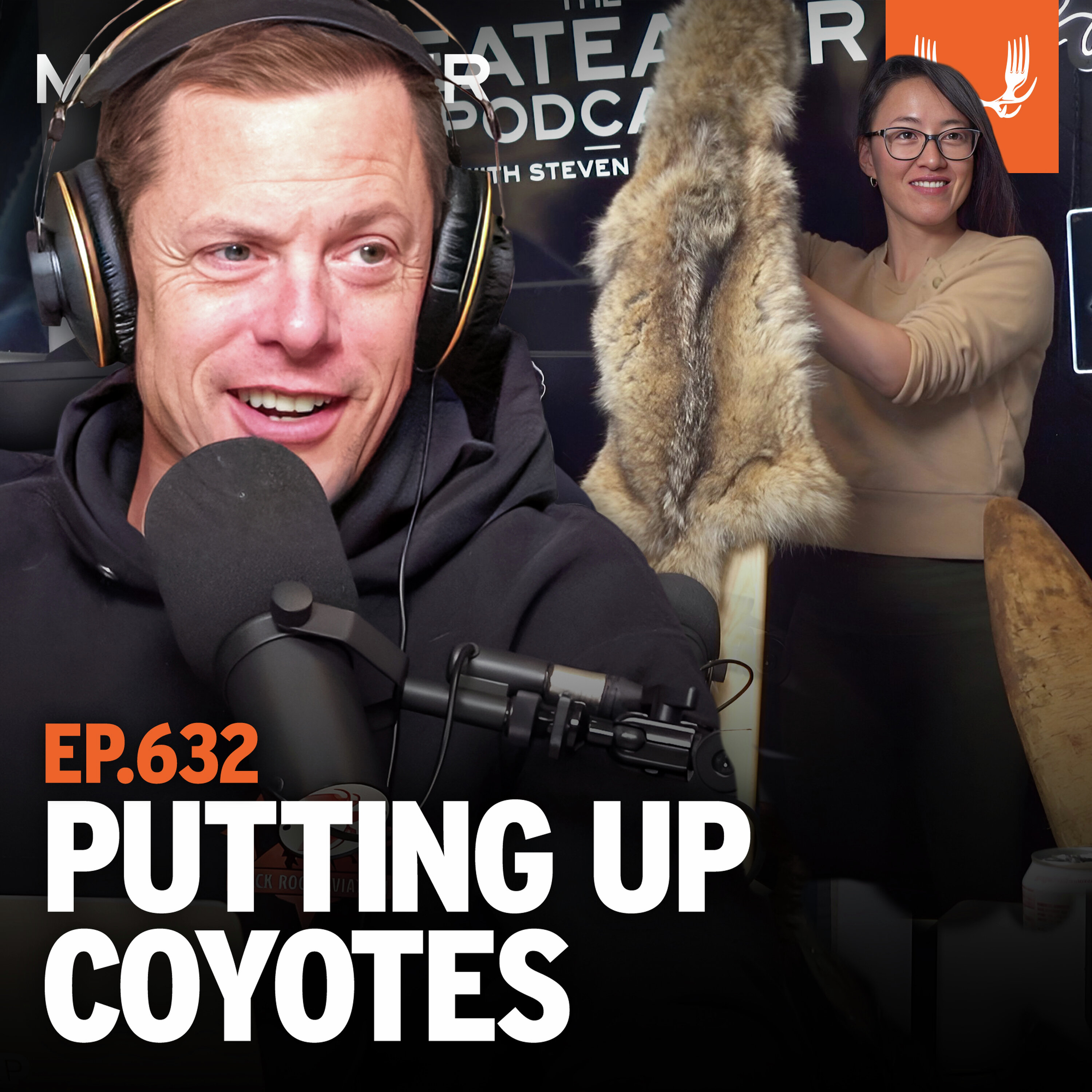
You can't predict anything. The Meat Eater Podcast is brought to you by First Light. Whether you're checking trail cams, hanging deer stands, fans are scouting for elk. First Light has performance apparel to support every hunter in every environment. Check it out at firstlight.com f I r s t l I t e dot com welcome to the show. Today Corinne is. Among other things. Well, no, she's only doing one thing. Among other things that will happen on today's show is Corinne. You'll be able to listen to Corinne. Unless you're on YouTube, then you can watch it happen. Does she got a camera at her, Phil? Yeah, you'll be able to listen to and or watch Corinne flesh her first coyote. Huge applause.
- [01:41]
Corinne Schneider
Is that like a homemade ulu there?
- [01:44]
Steven Rinella
This is a homemade. I did not make this. I'll tell you about it in a minute. All right, Corinne, did you grow up calling them coyotes, Wiley? Okay, now that you've got one, you'll switch. I found that people. Yeah, people that say coyote have likely gotten one and people that say coyote haven't.
- [02:03]
Tyler Friel
I say coyote. Does that track.
- [02:07]
Evan Hafer
I code switch?
- [02:09]
Steven Rinella
There's a number of tools here that she's gonna be doing in my. She's gonna. I'm reluctant to let her use this. This is a Dexter. This is a sable draw knife or flashing knife. You know, you might call it a necker knife. This is a good way for you to put a hole in that. Right.
- [02:28]
Phil Taylor
Which I don't want.
- [02:29]
Steven Rinella
But I'm gonna let you use the back side. So this is your cutting edge. Okay. This is your pushing edge. You're allowed to use the pushing edge because the cutting edge you'll have to spend more time figuring out on.
- [02:43]
Evan Hafer
And for listeners, it's a 16 inch blade with a draw knife handles at both sides.
- [02:48]
Steven Rinella
You better get yourself. For listeners, get yourself a new metal tape.
- [02:52]
Corinne Schneider
Kind of looks like a Machete with a handle on both ends.
- [02:55]
Steven Rinella
Oh, don't boomerang. It's like a ninja sword. Yeah, it's a ninja sword.
- [03:00]
Evan Hafer
A katana.
- [03:01]
Steven Rinella
Cut it in half and put a handle on the other end of the blade. Katana, Is that what they call them?
- [03:07]
Evan Hafer
Oh, that's the traditional. Yeah, yeah.
- [03:09]
Tyler Friel
That curved blade.
- [03:10]
Steven Rinella
Yeah. You know what I highly recommend for parents speaking of ninja swords is nunchucks. No, man. We have more fun throwing stars. We buy ninja throwing stars. You can't buy them on Amazon. You have to go to ninja supply houses. But we go to online ninja supply houses and buy ninja throwing stars. There is nothing more fun.
- [03:29]
Corinne Schneider
Did you ever make them out of a sheet metal and shop class?
- [03:33]
Steven Rinella
Back in the day we never could make anything that was as good as what you could buy.
- [03:37]
Randall
Still fun, but kid safe ones at Costco. Now the throwing stars.
- [03:41]
Tyler Friel
No, sorry.
- [03:42]
Corinne Schneider
What are they made out of? Velcro or something?
- [03:45]
Randall
I couldn't tell you what they're made out of. Little plastic things that.
- [03:48]
Steven Rinella
No, no, no, no.
- [03:49]
Evan Hafer
If it's kid safe, it's not a throwing star.
- [03:51]
Steven Rinella
I'm talking eight in the shape of a star. We like seven and eight point.
- [03:56]
Randall
Yeah.
- [03:56]
Steven Rinella
Four star ninja throwing star. A four point ninja throwing star means that half time it don't do anything. You get an eight point ninja throwing star. That's some is gonna stick.
- [04:07]
Corinne Schneider
You got a big block of wood, big round of wood out in your.
- [04:10]
Steven Rinella
Yeah. We took a big slab of cottonwood and I hung it from chains. So you know like a swing set has those angled supports, like saw leg style things. I put a s. Or eye bolt and up on that, on the, on the saw horse legs of the swing set, I put an eye bolt so I could suspend a cottonwood stone. They. They dry out and fall apart. But you put that cottonwood stump up and then next very important step. Oh, that is such horseshit.
- [04:40]
Corinne Schneider
Yeah.
- [04:41]
Steven Rinella
What? Come on, kid safe.
- [04:43]
Evan Hafer
It's like a nerf bow.
- [04:45]
Steven Rinella
Yeah. So no, the next step that's very important is you take all these throwing stars you just purchased and you spray paint them blaze orange.
- [04:56]
Corinne Schneider
I was just going to ask if you had any. Get sucked up in your laundry is.
- [05:00]
Steven Rinella
Like MIA and it's blaze orange.
- [05:03]
Evan Hafer
Oh, you don't like put up a carpet backstop or something?
- [05:07]
Steven Rinella
No, I paint a blaze orange one. I don't. I'll never understand what happened to it. We've taken the metal detector. We can't find it. Blaze orange, ninja throwing star missing.
- [05:15]
Evan Hafer
Do they practice from different positions? You know like kneeling?
- [05:20]
Steven Rinella
No, I've showed them. You know, we do it like you hold it like you're pinching it between your thumb and the main knuckle on your forefinger. And I was telling them that in ninja movies, I don't really know what the move is, but they kind of got like a.
- [05:33]
Corinne Schneider
They do a.
- [05:33]
Steven Rinella
They're like. They kind of got like. It's like a do. I don't know. They got their fingers out Spider man style.
- [05:39]
Corinne Schneider
It's like this. It's like.
- [05:40]
Tyler Friel
Yeah, they're like. They're like palming it almost. And then they.
- [05:43]
Steven Rinella
Is that what they're doing? Yeah, that shit.
- [05:45]
Tyler Friel
I don't know how that's cool.
- [05:46]
Steven Rinella
Oh, they're palming it.
- [05:47]
Corinne Schneider
Yeah.
- [05:48]
Tyler Friel
And then it's sort of like a frisbee move, I think like a discus. Yeah. Or there's between the fingers. But I think that's more for style than substance.
- [05:56]
Steven Rinella
Yeah. I remember there was a ninja movie and they, when they were training they had that string with a weight on the end and you'd have to pin that string, man. But the problem is you're never going to kill anybody with a ninja throwing star. And it's coming from a guy that owns something.
- [06:10]
Corinne Schneider
The old movie like dude would get hit and he'd just fall over dead.
- [06:13]
Steven Rinella
Oh yeah, yeah.
- [06:14]
Evan Hafer
Right in the chest.
- [06:15]
Steven Rinella
What would really happen if you hit someone with a ninja throne star? They're gonna go, oh Jesus. That's probably what you. That's right.
- [06:21]
Evan Hafer
Yeah. I've got a one inch cut.
- [06:26]
Steven Rinella
I love. What else? The other tool we have here is Tyler Friel who's been on the show before, made this ULU knife. You know it's cool as. So I'm holding up a ULU knife right now that he made and he said it in antler single bevel man. We. This project I'm working on that I haven't been able to talk about what it is we were. We actually filmed with Met and Aaron from the Kent State Archaeological Experiment Lab and he made an ULU with an obsidian blade.
- [07:03]
Evan Hafer
Sweet.
- [07:04]
Steven Rinella
And you see that and hold that in your hand and you immediately understand the. The evolution of the Ulu knife.
- [07:10]
Corinne Schneider
Does it have a handle or it's just a chunk of rock?
- [07:13]
Steven Rinella
No, it's got the same handle and a batted into is a big obsidian blade. And you're like, oh, that's where ulus came from. 100 man crim might be using this ulu. I don't know. I don't know what she's. What I Don't know what.
- [07:26]
Phil Taylor
There's, like, meat over here.
- [07:27]
Steven Rinella
You're not gonna get that off.
- [07:29]
Phil Taylor
What if I. Okay, it doesn't matter. Like, pretend.
- [07:32]
Steven Rinella
Don't take that off. Don't take it off. Let me explain. Let me explain where we're at on this coyote flashing project. I. Okay. Stu Miller, the fur handler and trapper. Stu Miller. I flesh or I flesh some coyotes with Stu Miller. Stu Miller traps in southern Illinois. He flushes his coyotes down clean, clean, clean down to the leather. I was curious about how, like. Because I hear different ways, and like, Mercer Lawing would not flush them all the way down. I asked Mercer, I said, how clean do does when you send it into a tannery? Not for the fur trade, but you do it the same way. So this is fur trade or not? Well, as we're talking, can they see that coyote that's on that board? Yeah, that coyote on the board, for instance, that would. That's prepared in a way that it would be suitable for the fur trade, or it would go to a tannery just like that, off the board. And I asked Mercer, I'm like, hey, how. If you're. If you're sending the coyote to the tannery, how clean do you flesh it? And he had the brilliant idea of. He said, why don't you call the tannery? Never would have occurred to me. I called the tannery. I said, how do you like coyotes? They said, excess fat, excess muscle.
- [08:57]
Corinne Schneider
And did they give you.
- [08:59]
Steven Rinella
I knew what they meant.
- [09:00]
Corinne Schneider
Well, what do they mean?
- [09:02]
Steven Rinella
What, I'm having her.
- [09:03]
Corinne Schneider
No, I'm saying, like, why do they prefer them that way?
- [09:07]
Evan Hafer
So you don't overdo it.
- [09:08]
Steven Rinella
I think that you're. That you're taking it all off. And now they have these wheels, these kind of, like. They have these wheels they can thin the leather with anyways if they need to.
- [09:18]
Corinne Schneider
But there's got to be other critters where you're trying to get.
- [09:21]
Steven Rinella
There's a lot of stuff that's clean. A raccoon is clean, right? Yeah. Like a muskrat. You leave the saddle, like, right now. Corinne's on the saddle. Pinch that little thing there.
- [09:31]
Phil Taylor
It feels like it's not doing anything.
- [09:33]
Steven Rinella
That's like a saddle. Just cut the. Take. Take the. Ooh. Take this flat tail. The final tool, an MKC flat tail made by a man who sat right where Brody's sitting one time. Take the flat tail and cut that way like you. Like you're cutting the diaphragm out of a deer and you're gutting it. That's kind of a weird way you're doing that.
- [09:55]
Phil Taylor
Do you want me to, like, peel it off or just.
- [09:57]
Steven Rinella
No, you got it. You got it. That's the saddle. On a muskrat, you leave the saddle on. On a mink, you leave the saddle on. On a red fox, you leave the saddle. On a raccoon, the saddle comes off. Beaver clean. Nothing gets left on.
- [10:12]
Corinne Schneider
Right.
- [10:12]
Steven Rinella
You know, in a coyote, I think they used to do them clean, but they told me don't do it clean. So that little membrane there, but you see down. When she gets down by the teats.
- [10:24]
Phil Taylor
Yeah.
- [10:24]
Steven Rinella
That's a female, right? Oh, she just put a damn hole in it.
- [10:27]
Corinne Schneider
No, not yet.
- [10:28]
Evan Hafer
Not yet.
- [10:28]
Phil Taylor
Okay. Damn it.
- [10:31]
Corinne Schneider
Excess fat and excess meat.
- [10:32]
Evan Hafer
Corinne, cameras are rolling.
- [10:34]
Tyler Friel
This is the worst case scenario for someone doing this to a coyote for the first time.
- [10:39]
Steven Rinella
How so?
- [10:40]
Tyler Friel
A lot of pressure. Got you at the table and three cameras pointing at her.
- [10:44]
Steven Rinella
The meat eater Cyber Monday sale. This is your last chance. This is your last chance to take advantage of the cyber Monday sale. First light, FHF gear. Phelps game calls. Dave Smith decoys and the meat eater store. Okay, it shuts off at 11:59pm what time zone? Like, if you're gonna get that specific. Oh, it probably rolls. It probably rolls.
- [11:12]
Evan Hafer
Yeah, yeah, yeah.
- [11:13]
Tyler Friel
And hey, Corinne, you've got no mics. You got to use your outside voice whenever you say it.
- [11:17]
Evan Hafer
I think it would.
- [11:17]
Phil Taylor
Okay.
- [11:18]
Evan Hafer
Depending on your IP address. Yeah.
- [11:22]
Steven Rinella
11:59 tonight. Don't be trying to shop at midnight. Too late. 50 up to 50% off until 11:59 tonight. I would. I challenge someone to try and make a purchase at 11:59 in 30 seconds too late.
- [11:41]
Evan Hafer
And by tonight, we mean December 2nd.
- [11:45]
Steven Rinella
Is that what this is?
- [11:47]
Randall
Correct. Monday to December 2nd. Monday, December 2nd, 11:59. Mountain time.
- [11:51]
Steven Rinella
Up to 50% off. First light gear. So, like. Yep, first light gear. FHF gear. Phelps game calls. Dave Smith decoys. Go to firstlight.com and do all your shopping there. Have we covered our tools? Yeah, we got the ULU knife, we got the flat tail.
- [12:09]
Corinne Schneider
What's that black handle thing there? No. Yeah.
- [12:12]
Steven Rinella
Oh, little horner.
- [12:14]
Corinne Schneider
I gotcha.
- [12:15]
Steven Rinella
Little horner. So there's that. A lot of feedback. This is one of those things that continues. Oh, I was gonna say something else. The hell's I gonna talk about? What's that? His Time out.
- [12:29]
Phil Taylor
Kids podcast.
- [12:30]
Corinne Schneider
No trapping or fur stuff.
- [12:33]
Evan Hafer
Don't shop at 11:59.
- [12:35]
Steven Rinella
Don't shop at 11:59. No.
- [12:39]
Tyler Friel
Don't get them wet. Don't feed them after midnight.
- [12:41]
Evan Hafer
Don't take too much stuff off the coyote. The saddle effed up.
- [12:45]
Randall
Shitters calendars.
- [12:48]
Steven Rinella
No, Cory's a good calendar.
- [12:50]
Evan Hafer
Cory's a good company man here.
- [12:52]
Steven Rinella
It's a great calendar There day I was talking about the ad I dreamt up about the calendar with Santa Claus in it.
- [12:59]
Randall
I might have to walk that one up the ladder if you're cool with that.
- [13:02]
Steven Rinella
No, it's phenomenal idea. If we need Randall needs to play Santa.
- [13:06]
Evan Hafer
I would love to.
- [13:07]
Randall
Yeah, perfect.
- [13:07]
Evan Hafer
I would love to consider it done.
- [13:10]
Steven Rinella
On a recent episode we got a lot. The feedback keeps coming. I remember there was a. There's been other subjects in the history of the show where. Where it just kind of kept going. You know, you like you cover something and then there's feedback and you cover the feedback and then the feedback gets feedback sometimes for years and it. The feed reverberates. It becomes what might be called a feedback loop of feedback and it never ends. And then I'll say this is it. And then a while later we'll cover it more and eventually it'll die.
- [13:42]
Evan Hafer
So here we go again.
- [13:44]
Steven Rinella
On the show we covered pre chewing food for your children. In particular that when our kids, we have three of them. When our kids would get to be nine months old, I would chew up deer meat and I'd give them the chewed up deer meat and they would eat that and I would say ha. His first thing ever was that deer meat or something to that effect. And we were talking about pre chew deer meat and we had follow up from Durkin, Pat Durkin talking about eating pre chewed meat. Our kids all ate pre chewed meat. And we have some feedback including feedback from a. A DDS. What does that mean, Dr. Randall?
- [14:28]
Corinne Schneider
It's dentist Doctor of dental surgery or other science.
- [14:34]
Evan Hafer
Science.
- [14:35]
Steven Rinella
Oh, you know, dentists all kind of stick together in a weird little way.
- [14:38]
Corinne Schneider
Well, I mean does that surprise you?
- [14:40]
Evan Hafer
Doctor of dental surgery.
- [14:41]
Steven Rinella
Do you guys remember we had it. My dentist came on the pot on the show.
- [14:44]
Evan Hafer
Yeah.
- [14:44]
Corinne Schneider
Great guy that day.
- [14:46]
Evan Hafer
Goat killer.
- [14:46]
Steven Rinella
Yeah. Y mountain goat. Maybe.
- [14:48]
Corinne Schneider
I was here.
- [14:49]
Steven Rinella
I have the only dentist in America who's killed 10 mountain goats.
- [14:52]
Evan Hafer
He's killed well.
- [14:53]
Steven Rinella
Well, cuz he. He grew up in southeast Alaska. They'd get off school and go goat hunting.
- [14:57]
Corinne Schneider
It's like hunting back 40 for.
- [14:59]
Steven Rinella
Yeah, like how you might go like hunt for an evening for white tails. When he was growing up, he'd go hunt goats after school. Only Dennis in America like that. He came on the podcast. I can't remember if he won, he did really well.
- [15:12]
Evan Hafer
Yeah, he won. Yeah, I believe he won in overtime, actually.
- [15:16]
Steven Rinella
And he just fixed my daughter's hockey helmet.
- [15:19]
Evan Hafer
Really?
- [15:20]
Steven Rinella
It's like he's trying to one up me. Did he fix another man's daughter's hockey helmet?
- [15:25]
Evan Hafer
Did he have to use a particular dental instrument to do that, or is he just. No, a helmet guy.
- [15:30]
Steven Rinella
He texted me and let me know he fixed my daughter's Steven sports.
- [15:34]
Tyler Friel
You know, and he's also a doctor, and then we know how Steve feels about that.
- [15:38]
Steven Rinella
Yeah. So he's all built up now he thinks he's the man.
- [15:41]
Evan Hafer
Yep.
- [15:41]
Steven Rinella
He's a doctor. He's a dentist. He fixed my daughter's hockey helmet. Keep your hands off my daughter's hockey helmet.
- [15:46]
Randall
Did he first say something was wrong with the helmet? Like, hey, let me see that helmet. Something's wrong with it.
- [15:50]
Steven Rinella
We've been aware of a slight problem with her helmet for a year. Okay. Missing a screw that holds the face mask on. I always think I'm going to replace that screw. And then once he tried to one up me, I did. I went in and replaced it last night, and I asked him if he wanted his screw back, and he texted me that he did that. To which I followed up, you guys want to come for dinner on Monday? And he said, he does. Great.
- [16:12]
Phil Taylor
I think he was saving you money.
- [16:13]
Corinne Schneider
Then you guys can have your little.
- [16:14]
Steven Rinella
Argument about then I'm gonna take him aside, and I'm gonna be like, what's with you trying to fix my hockey helmet?
- [16:19]
Evan Hafer
You make a nicer dinner than he made the last time.
- [16:22]
Phil Taylor
Because if she gets into an accident, her jaw is coming off her face. So he can see that.
- [16:29]
Evan Hafer
That was graphic. Yeah.
- [16:31]
Steven Rinella
Yeah.
- [16:31]
Evan Hafer
I guess you could see that he.
- [16:33]
Steven Rinella
Wouldn'T fix it, hoping that something bad would happen to have problems.
- [16:38]
Evan Hafer
Yeah, it's like a collision repair guy, you know, saying, hey, you ought to replace those tires. If he was unscrupulous, he'd just leave it alone.
- [16:47]
Steven Rinella
But now I'm starting to like the guy all over again. I liked him before I got all wound up on this subject. Now I'm back to liking them.
- [16:53]
Randall
Tighten your lug nuts.
- [16:54]
Steven Rinella
So the hell was I saying? Oh, how they stick together. So he came on the podcast, and we just point out he's dentist. He's on the podcast. Well, guess what? Other dentists contact him to offer him hunting permissions. Oh, it's like, a little, like, Dennis, like, hunting club.
- [17:16]
Evan Hafer
I've not heard From a history PhD offering me anything of value.
- [17:21]
Steven Rinella
He Got hunting. Yeah, he get. He got hunting invites. He got hunting invites off it for being a dentist.
- [17:27]
Evan Hafer
That's pretty solid because you know what they're like.
- [17:29]
Steven Rinella
You know what, buddy? I understand. All we do is make children cry. Why don't you come out and hunt my place?
- [17:33]
Evan Hafer
Yeah. You know, they've been through it together.
- [17:36]
Steven Rinella
Anyways, a guy wrote in a DDS, a dentist wrote in, given his 2 cents on pre chewed food. And he was pointing out, which seemed to me to be totally reasonable. He was pointing out that the quicker you can get a little kid chewing chewy foods, not super processed, ultra processed foods which are all. If you think about ultra processed foods are all soft chewing real whole foods. That's a two handed draw knife.
- [18:05]
Phil Taylor
I just don't want. I'm being so delicate here.
- [18:13]
Steven Rinella
Pre chewed foods preacher. He was saying that you got that a child. He was saying a child needs to ex. Needs to have resistance training in his jaw the same way that you get, you know, other exercise muscles. So he said the quicker you get your child resistance training his jaw, he'll get a beefy good jaw. And as people switch to those little tubes that you squeeze your food out of which their consumption has gone up 800%. We were pointing out from not. But Brody pointed out anything that gets invited, anything that gets invented has season explosion and growth. Because it didn't. Wasn't there before.
- [18:47]
Evan Hafer
Yeah.
- [18:48]
Corinne Schneider
Like cell phones.
- [18:50]
Steven Rinella
Yeah.
- [18:50]
Evan Hafer
There's been skyrocketed since the 1950s.
- [18:56]
Steven Rinella
Yeah. And when it came out with those shoes that have five toes on them. Usage skyrocketed.
- [19:01]
Evan Hafer
Yeah.
- [19:02]
Steven Rinella
800.
- [19:04]
Tyler Friel
Among other things.
- [19:08]
Steven Rinella
So he had that say. Now another guy wrote in and he's trying to. Okay, he says this. I'm just gonna let him speak for himself. In episode 620. This is from a gentleman named Matt. Matthew. Matthew says hi. Meat eater in episode 620amax care. That was the. That was the DDS's name letter was referenced in the discussion regarding pre chewed food as Matt flaunted his dds. I feel obligated to mention that I am an exercise physiologist and nutritionist.
- [19:42]
Corinne Schneider
I wonder if they stick together.
- [19:43]
Steven Rinella
Does that. Do they get PhDs? What does that mean? How. How could I get one of those?
- [19:48]
Evan Hafer
I don't know how you credential that.
- [19:50]
Steven Rinella
Can you look it up? Like could I just. Could I have one by the end of the day?
- [19:54]
Evan Hafer
No, I don't think so. I'm guessing it's probably a master's degree.
- [19:58]
Steven Rinella
Well, that's what he is he's an exercise physiologist and nutritionist. He goes on the. He is very unhappy with what this guy said. He goes on the idea that a baby needs resistance training for the jaw for appropriate mandibular development is like saying they need to do pushups so they can crawl on time for. For nearly all healthy infants this is continuing the letter. For nearly all healthy infants their rate of development all gets washed out by the time they are two. It's just silly fear mongering that folks use to support their ideology and sell whatever they are selling. Probably the most flawed of these is the statement that breastfeeding is superior to formula. Getting controversial.
- [20:57]
Evan Hafer
I have a feeling this feedback I've.
- [20:58]
Steven Rinella
Heard that breastfed babies snugly. I don't know if that's true. He goes on. Probably the most flawed of these is the statement that breastfeeding is superior to formula. Funny how he neglects to mention the millions of lives saved by the advent of formula. These correlations are drawn from the predominance of poor nutrient profile in most commercial formulas. They are not causal in any way. For example, if a mother is breastfeeding but she is an alcoholic, is that going to be better? Is that going to better support development than a mother who can breastfeed and is using a whole fat high quality formula? Of course not a little bit taken.
- [21:48]
Corinne Schneider
That's a little, it's a little because.
- [21:49]
Steven Rinella
Let me give you an example. Let's say I said, let's say I said I'm not feeding my baby at all. And they're like well that's terrible. And I said well or I'll feed it mercury.
- [22:01]
Evan Hafer
Right?
- [22:03]
Steven Rinella
What's better now? Do you know what I'm saying?
- [22:08]
Evan Hafer
I can honestly say that's the first time the image of someone feeding an infant mercury has ever crossed my mind.
- [22:13]
Corinne Schneider
Now if they're bottle feeding them, he's.
- [22:17]
Steven Rinella
Going to like why he's going like way out there.
- [22:20]
Evan Hafer
I take his point though that like if most formulas are poor in nutrition you'd, you know, there's a point to be made there. But it doesn't mean that formula by default is so.
- [22:33]
Steven Rinella
Yes. Is it okay? Is it better? I agree. Who could argue this that he's, he's, he's saying this. What's better? A whole fat high quality formula or mother's milk from a drunken alcoholic.
- [22:52]
Corinne Schneider
Let me think about that one. But we're talking about. Yeah, the whole thing. We're talking. Come on.
- [23:02]
Steven Rinella
Ergo.
- [23:04]
Corinne Schneider
I think he's being a little harsh on Our guy Max. Like, we're talking about, like, if you exercise muscle, it's going to get stronger, right?
- [23:11]
Steven Rinella
I mean, come on. I like this guy.
- [23:13]
Corinne Schneider
And Max sent us a nice card. Corinne, where's that card?
- [23:16]
Randall
Oh, is that from him?
- [23:17]
Phil Taylor
It's. Open up my laptop top. It's right on the inside of that.
- [23:20]
Steven Rinella
Oh, I know what I was going to talk about now.
- [23:22]
Phil Taylor
Yep.
- [23:22]
Steven Rinella
I shouldn't talk about. No, that's. I shouldn't do. I want to set it up that way. What's this?
- [23:28]
Phil Taylor
Oh, that's a card from Max. Oh, there's a message to each of us.
- [23:31]
Randall
I almost threw it on that random ear on the table.
- [23:38]
Corinne Schneider
Matthew, this guy does say is mostly joking, so we should.
- [23:41]
Steven Rinella
Well, I like him, I think, but this. Remember? I just remember what I was going to talk about. It's something I shouldn't talk about because it's going to get me in trouble with my wife, my kid, and my kid's school.
- [23:51]
Corinne Schneider
How much trouble?
- [23:52]
Steven Rinella
Minor.
- [23:53]
Corinne Schneider
Go for it.
- [23:56]
Steven Rinella
My kid. I just had to go to the parents meeting for speech and debate. Okay. And I'm down there and. And I'm sitting with my wife, debating with her. No. Oh, I did.
- [24:09]
Evan Hafer
I was gonna say.
- [24:10]
Steven Rinella
This is, like, sat through the whole parents meeting. And I said to her afterward, the second the guy was done talking, we're still sitting there, and I said, I have one of those things for you that you're going to be annoyed that I said you're not going to take it seriously, and you're never going to give it its due. And this intrigued her to want to know what exactly it was. And it was this. I'm like, I don't like any part of this whole thing. Why would you want to train without knowing these kids? All these kids in high school, they're even talking about parents donating money to support speech and debate.
- [24:53]
Corinne Schneider
Okay, I got to hear more about why you don't like it.
- [24:56]
Evan Hafer
Well, I'm gonna get, like, teaching your kids martial arts.
- [24:58]
Steven Rinella
No, I'm getting there. It occurred to me midway something. It occurred to me midway through this whole thing. I don't know their ethics and ideology. Why would I want to spend money training them and being convincing when I don't know what they're going to try to convince people of? I would spend it in infusing them with my ethics and ideology. And then of those who adopted that, teach them. I would then teach them to be convincing. But how could I just come in to a room of high school kids and want them all to Be convincing when? I don't know. And I came up with a slogan. Today's kids are tomorrow's enemies.
- [25:40]
Corinne Schneider
That's a good one.
- [25:41]
Steven Rinella
It's like that.
- [25:43]
Tyler Friel
That's one of your best.
- [25:47]
Steven Rinella
It just occurred to me and my wife, in fact did not give it its due. She still hasn't given me what she thinks about the whole.
- [25:54]
Tyler Friel
Well, I think the idea is that it's like they're teaching them. They're giving them a template that they can slot in ideology as they get older and form their own opinions and.
- [26:02]
Steven Rinella
But how certain? How do we know that we don't take a kid and make him super good at being convincing and then. And then he goes out and convinces.
- [26:11]
Corinne Schneider
People to do horrible stuff, becomes an anti hunting like.
- [26:15]
Steven Rinella
Yes.
- [26:16]
Evan Hafer
Yeah.
- [26:16]
Steven Rinella
Oh, and it'd be like, people like, my God, how'd he get so good at convincing everybody of that? And I'd be like, oh, you know, I donated $20 to his speech and debate program. Perhaps I'm to blame.
- [26:29]
Evan Hafer
I thought this was going to be one of those scenarios where like the ex pro basketball player is watching his son get coached by a guy who never played pro basketball. He steps in, that's not how you do that.
- [26:42]
Steven Rinella
That's got to happen. No, it really, it really shook. It really shook me up. Hey, can you name every single subscription you have? Meaning when you're scrolling through your credit card statement, are there things on there where you're like, what the hell is that? I feel like I see it all the time. It's because you wind up signing up for subscription services sometimes without knowing you're doing it, and then you forget about it and you just slowly pay out that money over the course of months and years. Okay, if this happens to you, you're not alone. Over 74% of people have subscriptions they have forgotten about. Well, Rocket Money. It's a personal finance app that finds and cancels your unwanted subscriptions. It also can help monitor your spending and lower your bills so you can kind of grow your savings. Rocket Money has over 5 million users and has saved a total of $500 million in canceled subscriptions, saving members up to $740 a year when using all the app's features. Stop wasting money on things you don't use and cancel your unwanted subscriptions by going to rocket money.com meat eater that's rocket money.com meat eater. Rocket money.com meat eater it's getting to be that time of year where you gotta start thinking about holidays. In fact, at the Ronella household We just solidified both our Thanksgiving and Christmas plans and we like our holiday traditions right. But you gotta think about this too. Not just what's gonna happen when you're around, but how that's gonna happen when you're gone. You have to protect your family's future and your peace of mind. And you can do so by using Policy Genius. With Policy Genius, you can find life insurance policies that start at just 292 bucks per year for a million dollars in coverage. Some options are 100% online and let you avoid unnecessary medical exams. Policy Genius makes finding and buying life insurance simple so your loved ones have a financial safety net they can use to cover debts and routine expenses or even invest that money to earn interest over time. I always say me, my wife got serious about life insurance once we started having kids and just felt so much better having gotten that taken care of. Secure your families tomorrow so you have peace of mind today. Head to policygenius.com or click the link in the description to get your free life insurance quotes and see how much you could save. That's policygenius.com when I was in college, I lived for a while in this old kind of rundown house and I lived up in the attic and you had to sort of crawl through a little hole to get into my area and the only thing I could fit in there for a mattress was that old orange shipping foam that little kids always pull little chunks out of. That was my mattress. And let me tell you this, now that I'm grown up and I got my own bedroom and my own Helix mattress, it's a hell of a lot better than it used to be. Love that thing. I landed in a better place than I ever thought I deserved when it comes to mattresses with my Helix mattress. Now if you want to get one, find out what a real comfy mattress feels like when you're a real grownup. You can take the Helix Sleep quiz, come straight to your door free of charge. Just shows up, bring it in your room, open it up, poof. Sweet mattress during the month of November. Get 25% off site wide plus two free dream pillows with any mattress purchase at helixsleep.com meteor plus you'll get a free bedding bundle which is two dream pillows, a sheet set and mattress protector with any lux or elite mattress order. Let's go to helix sleep.com me eater to get this new deal.
- [30:19]
Phil Taylor
Can I interrupt for a second? How. How good are we?
- [30:23]
Steven Rinella
Spin it. You're looking very good. Spin it. Spin It. Okay, we gotta sew that hole.
- [30:31]
Phil Taylor
Yep.
- [30:31]
Steven Rinella
With what's called a baseball stitch.
- [30:33]
Tyler Friel
Corey, can you pull that other mic towards you so we can see the. No, the. Yeah, there you go.
- [30:38]
Steven Rinella
You're 100. You're 100. Clean view. Now you'll see that there's a set nail on the bottom of that stretching board. Corinne, behind you, a double headed nail on the bottom.
- [30:49]
Phil Taylor
Over here.
- [30:50]
Steven Rinella
No, the bottom of that stretching board. You're pointing to a fleshing beam.
- [30:56]
Evan Hafer
The one against the.
- [30:57]
Steven Rinella
Turn your attention to the fleshing to the stretcher.
- [31:00]
Phil Taylor
Yeah.
- [31:01]
Steven Rinella
And you'll see at the bottom of it there is a double headed nail.
- [31:04]
Phil Taylor
Okay.
- [31:04]
Steven Rinella
Pull that double headed nail out. That will collapse and you can pull that caillou off that board. Make sure there's no thumbtack in it anywhere. How easy is it come out anyways? He says, so kindly inform Max Care DDS this is the part I like the most. We're back to this. So kindly inform Max Care DDS that my formula drinking pre chew dear me eating baby would whoop his baby any day of the week. That would be a great show. If we had babies come and fight on this table.
- [31:45]
Evan Hafer
I think we could charge a pretty.
- [31:46]
Tyler Friel
Penny for tomorrow's enemies.
- [31:48]
Evan Hafer
Yeah. And that's where he adds the mostly joking at the end of that.
- [31:55]
Steven Rinella
No good. You raise good points, but you raise good points. Thank you, Matthew. Who, who, who wants to set the. We're going to move. Move our attention over to. To Virginia. Well, it's kind of a letter that someone wrote in, so we'll just tack. We'll. We'll tackle this whole thing. My good friend bubbly Doug Durin, who I adore. He's got some gripes. He's got some landowner gripage about this next subject. We're talking about deer hunting with hounds.
- [32:35]
Corinne Schneider
Like personal experience gripage or he just generally. It makes him uncomfortable.
- [32:41]
Steven Rinella
No, no. I gotta explain a thing because I'm a little ahead of myself. We're gonna move our attention to deer hunting with hounds in Virginia. The debate around that. Now that's in the south. You can do that just generally, like, there's a culture of hound hunting for deer in the south. There's not a culture of hound hunting for deer in the north. In the north, it's, it's illegal. And there's a handful of southern states. No, no, no, no, no, no, no, no, no. You remember a podcast episode we had that was called Skip the flip? Oh, we're not skipping the flip.
- [33:14]
Tyler Friel
For those listeners at home. He's referring to kin on the stre.
- [33:18]
Corinne Schneider
Let's get back to the town thing.
- [33:20]
Steven Rinella
You got to put them on inside out.
- [33:22]
Phil Taylor
Oh.
- [33:23]
Steven Rinella
And then you dry them overnight. Inside out. And then you flip it or else it'll dry to the board.
- [33:28]
Phil Taylor
Right. Skip the flip.
- [33:30]
Steven Rinella
So skip the flip. Because Mercer long lives in the Mojave Desert, and he was pointing out that where he lives is so dry that they don't do. He doesn't need to do the two part dry. He skips the flip and just puts it on hair side out.
- [33:48]
Phil Taylor
Right.
- [33:49]
Steven Rinella
But you need to dry the outside and then flip it so that it doesn't stick to the board and get rotten.
- [33:55]
Phil Taylor
Got it.
- [33:56]
Steven Rinella
So it'll flip in the morning.
- [33:58]
Phil Taylor
Okay. All right. I'm going to pull kind of nose.
- [34:02]
Steven Rinella
Y. You're getting there.
- [34:03]
Phil Taylor
How much do we pull it kind. I like the nose. I don't want to stretch the nose.
- [34:08]
Steven Rinella
No, don't. Don't stretch. Just snug it up. Stretch. It'll get snug it up on there. Okay.
- [34:12]
Randall
You'll get more nose.
- [34:14]
Steven Rinella
And then go ahead and pin those ears up so it looks like that one for now. Just pin them up. Yep, yep. Just give them a light. Don't. Don't lay it. Kind of roll it. Yeah. So, yeah, don't. Not tight. You don't want to make a lot of surface connection there. Just a light little pinning. Hound hunting for deer. And. And I know that like Doug has. Where Doug lives is popular to run coyotes with dogs. And Doug has. Doug, I hate to put. I'm not putting words in his mouth.
- [34:47]
Corinne Schneider
We'll find out if you're.
- [34:47]
Steven Rinella
Well, Doug is brought up. Doug has brought up the difficulty of, in his area, the near impossibility of preventing your do from hunting other people's property.
- [34:56]
Corinne Schneider
Because you're talking about small farms, right?
- [34:58]
Steven Rinella
Yeah. It's like, you know, you got an area of small dairy farms, and you turn them out on a coyote. The coyote goes wherever he wants. The dogs are going wherever the coyote went. And you can't really even kind of suggest that you have any control over your dogs being in other people's places. So you're sitting there deer hunting all. You know, here comes everybody's pack of dogs. And he says it causes a lot of consternation in this area.
- [35:25]
Evan Hafer
It's.
- [35:26]
Corinne Schneider
There's no rule against letting your dog run on other people's ground.
- [35:32]
Steven Rinella
I don't know. Is that true?
- [35:33]
Corinne Schneider
No. I'm asking, like, I would assume it's legal for it. Like, there you're not doing anything raw and wrong if your dog runs a coyote across three or four different properties.
- [35:43]
Steven Rinella
Well, I know this. In this state that we're sitting in right now, if a dog attacks your livestock, there's no questions asked. You can kill that dog. Right. For harassing your livestock. Right. Anyways, so here's a listener feedback. This is from a listener, right? Yes. Okay. The guy says this. Recently my state rejected regulations around the use of dogs for deer hunting, the mandated use of GPS collars and making reasonable effort to. To ensure dogs can't enter property where owners have requested dogs not be run. I'm torn on this issue because I see it as a slippery slope on both sides. Meaning. Okay, so he's saying the state considered but ultimately rejected regulations that would have mandated deer hound hunters, mandated that they put the GPS collar on their dog so that they know where the dog is, and then with using that GPS tracking collar, make effort to keep their dogs off of people's property.
- [36:51]
Corinne Schneider
With a lot of those units, you can hit like a callback button at that dog will stop doing whatever it's doing and turn around.
- [36:59]
Steven Rinella
He says, I'm torn on this issue because I see it as a slippery slope on both sides. On the one hand, I do not run dogs to hunt deer and have had many deer and turkey hunts in recent years. Disturbed by a pack of dogs, Dogs running through the properties I can access given the limited weekend time I have to hunt. Between work responsibilities and small kids, having game run off because of a pack of dogs coming onto a property is frustrating. I can also understand the frustration of property owners who have a pack of dogs run through and disturb their land, their livestock, or the game and habitat on their property. On the other hand, I recognize that hound hunting deer is an important tradition that many people in Virginia is an important tradition to many people in Virginia. And though I don't run dogs for deer hunting, I have hunted. I have fox hunted with a pack of hounds, a pretty similar practice. I realize that in this way, my stance is somewhat hypocritical. Regulations on hunting fox with dogs in places like England have made my state one of the last. I. I'm going to edit this a little bit.
- [38:13]
Corinne Schneider
Yeah.
- [38:14]
Steven Rinella
He's saying that his state is one of the last refuges of the sporting tradition of hound hunting with dogs. What?
- [38:22]
Evan Hafer
Fox hunting with dogs?
- [38:24]
Corinne Schneider
No, it's just like. He's just saying it's one of the last places you can use hounds, which is a little.
- [38:31]
Evan Hafer
He's saying regulations on fox hunts in.
- [38:35]
Steven Rinella
England have made My state, one of the last.
- [38:40]
Corinne Schneider
Fox hunting is awesome. I got you.
- [38:42]
Steven Rinella
Oh, I got you. No, no, no, no. He's saying. Here's what he's saying. I think he's saying, like, hey, man, in places like England, yeah, They've regulated the piss out of hunting with dogs, fox hunting, to the point where you basically can't do it. So he's saying. So with England out of the picture, Virginia has become one of the last places for the sporting tradition of hunting fox with hounds. That's what he's saying.
- [39:07]
Corinne Schneider
Yep.
- [39:08]
Steven Rinella
And he's saying that being able to hunt foxes with hounds is very effective in helping to manage fox and coyote populations. And he says, also, just like deer hunting with dogs is constantly under attack, fox hunting is also constantly under attack in Virginia from the usual suspects in the animal rights community. He goes on, I recognize the near possibility of keeping a large pack of dogs together and off adjoining properties while they are on the hunt. And I realize that hound hunters don't want to give an inch on the deer hunting issue because of the need to guard the gate. Meaning deer hound hunters in Virginia are fighting for the defense of their lifestyle and they're not in the mood to entertain compromises. And he says, which I fully understand and support. I also personally don't believe that the most recent proposed regulations would be all that effective in keeping a pack of dogs off adjoining properties. So that being said, what do you think can be done in cases like this where hunters are adversely affected by the actions and traditions of other hunters? I do think there is a legitimate question around the rights of private property owners, which would benefit me personally. But by regulating one group of hunters in this way, aren't we cracking open the door for the slow erosion of other hunting traditions? Very well put.
- [40:38]
Corinne Schneider
Yep. That's the problem. Like, like, you know, it doesn't bother you unless it's affecting you directly. Right. But then when it affects you directly, it's like, you know, where does that put you? There's no good answer. Right. Like, no.
- [40:54]
Steven Rinella
If I came from otter. If I lived on a planet, outer space. I was telling my kids the other day that from other planets perspectives, we're in outer space.
- [41:04]
Evan Hafer
I was going to say, you live on a planet.
- [41:07]
Steven Rinella
You know what I'm saying?
- [41:08]
Evan Hafer
Yeah.
- [41:08]
Steven Rinella
They have a very like them centric worldview. I was trying to be like, you know, we're in outer space. If someone isn't on another planet, if.
- [41:15]
Corinne Schneider
Aliens came here, we're talking about aliens.
- [41:17]
Tyler Friel
Yeah.
- [41:18]
Steven Rinella
They're talking about us being in Outer space. Anyhow, if I lived on a planet in outer space and I was totally not, I was like totally rational, but completely unhip to social mores on Earth, you follow me? And someone said, hey man, you know, as a Martian, do you think that someone should be able to take a big pack of dogs and the person can't go on the neighbor's place, but he can send his dogs over on that neighbor's place to chase the deer back over to his place so he can shoot them. As a Martian unattuned to not tuned into mores on planet Earth, I would be like, no, I don't think you should be able to do that. Yeah, it's called Mars Justice. Sounds like a show like, I'm not into any kind of. As a Martian, I'm not into any kind of long term, you know what I mean? I just take face value arguments. I don't know the history.
- [42:21]
Evan Hafer
Yeah, that makes sense.
- [42:22]
Steven Rinella
But I'm not from Mars.
- [42:25]
Corinne Schneider
I mean, if you had a pack of dogs screw up your hunt a time or two, it'd be, It'd be hard to have the attitude like, I'm going to take one for the team here. Right.
- [42:34]
Steven Rinella
I'll put that Martian thing another way. Let's say you're setting up a whole new state. Like you got a whole new state and you're in charge of setting up a whole new state and you gotta like figure out all the rules. And when this came up and they said, well, what are we going to do about like, we all agree that you can't go on another guy's land without permission, right? And everybody's like, oh yeah, that's obvious. And they go, what about if he sends his big old pack of dogs all around in the neighbor's place, it brings all them deer back and then he gets them on his place. What should we do in our new state? There's no tradition. Yeah, there's no tradition. Part of that's what I'm trying to get at with this Martian stuff. There's. I'm, I'm not considering tradition. Yeah, I would be like in this state, this traditionalist state, I would say that I don't think you should be able to do that.
- [43:25]
Corinne Schneider
Yeah, but we're not talking about a new state. We're talking about a state that has a long tradition of this is like.
- [43:31]
Tyler Friel
This is like, this is like your if days were 48 hours long argument. Then why it would be okay to wear the same outfit for those 48 hours.
- [43:39]
Steven Rinella
Why I wear my clothes two days in a row. Yeah.
- [43:41]
Tyler Friel
If we lived in a completely different reality, then this would be different. Yes.
- [43:47]
Evan Hafer
I. I mean, this, I think, raises the question, like, in Montana, we actually did create a new hound hunting opportunity for black bears recently. And at the time it was proposed, I was a little nervous that going out in the spring, it would be a different experience. And it wasn't like, I didn't. It's not like. It's not like I don't support hound hunting.
- [44:11]
Steven Rinella
You know, you're straying all over the place. Because this is about private property, buddy.
- [44:15]
Evan Hafer
Well, no, I'm. We're talking about tradition and whether we're creating tradition or, like, creating a new opportunity. And I will say, like, my concerns about. That.
- [44:26]
Steven Rinella
You're talking about my new state.
- [44:28]
Evan Hafer
Yeah, that. I was following up that question. Like, I mean, there are instances where it's not just a new state, but there are new traditions being proposed.
- [44:37]
Steven Rinella
Understood.
- [44:38]
Evan Hafer
And I will say, like, it. It didn't change the spring black bear hunt in the way that I thought.
- [44:42]
Corinne Schneider
It might, but I got an answer for this guy. He just needs to get a pack of dollars.
- [44:46]
Steven Rinella
Here we go.
- [44:46]
Evan Hafer
Yeah, there's an answer.
- [44:47]
Corinne Schneider
He just needs to get a pack of dollars, and problem solved.
- [44:53]
Steven Rinella
Yeah.
- [44:53]
Evan Hafer
But I do think if you can't.
- [44:54]
Steven Rinella
Beat them, join them.
- [44:55]
Evan Hafer
The private property thing is weird because I killed. I killed a lion a couple years ago, and when the dogs were chasing that lion, they picked up another lion, and some of the lion. Some of the dogs went down and treed a cat on private property in, like, a little subdivision.
- [45:11]
Corinne Schneider
But in Montana, you're allowed to go legally. Go get your dogs off of.
- [45:15]
Evan Hafer
We. I mean, we went down and knocked on the door and got the dogs and the cat, presumably.
- [45:23]
Corinne Schneider
I'm pretty sure Yana said you can go, like.
- [45:25]
Evan Hafer
But it's. But it was still. I mean, it still feels very uncomfortable. Right. I'm kind of like. Because I do think, like, if. If I were that homeowner and I looked out my window and there's, like, a couple guys pulling their dogs away from a tree, and there's a cat up there. Like, yeah, that's. It's a little weird, and I felt funny about it, but I've totally don't know what you're gonna do.
- [45:46]
Steven Rinella
I've totally changed my mind now that I thought about it more. Now, if I was setting up a new state and someone brought this up, you know what I would think to myself?
- [45:55]
Evan Hafer
Everybody has to have dogs.
- [45:57]
Steven Rinella
No, picture this. Just let me walk. Let me Picture a scenario here. We're looking at extremes. I'm looking at the extreme of the. He sends all of his dogs over there. He sends, like, 30 dogs over there to do, like, an organized drive. Yeah, Right. And, like, strip this guy's property of deer. That's an extreme. But picture this. Picture little Tommy. Little Tommy Dickinson is hunting rabbits with his beagle on the fence line with old man Morgan. So we got little Tommy Dickinson hunting old man Morgan's fence line, and he's got his little beagle, Patsy. Patsy, periodically, is under the fence. Across the fence, under the fence, across the fence. What do you do? Shoot Tommy Dickinson or his dog shoot Patsy? Is that what you're saying?
- [46:51]
Evan Hafer
Shoot them both?
- [46:52]
Steven Rinella
Of course not. He can't control. Patsy's going around. Old man Morgan's in his place.
- [46:58]
Evan Hafer
Yeah.
- [47:00]
Steven Rinella
No one would want to live in a place like this.
- [47:02]
Randall
What if that rabbit runs under Morgan's deck and the dog followed him under.
- [47:06]
Steven Rinella
The deck and Morgan's on the deck sleeping?
- [47:09]
Evan Hafer
What if the dog goes into Morgan's house and starts eating his cat's food?
- [47:15]
Randall
Then it gets sticky.
- [47:16]
Steven Rinella
That's why. That's why. This is a tricky one. Because it's a tricky one. You'd almost want to make a rule that says, like, don't push it.
- [47:26]
Evan Hafer
Oh, yeah, yeah.
- [47:27]
Steven Rinella
If you're a hound hunter, don't push it.
- [47:30]
Randall
Control your dogs.
- [47:31]
Steven Rinella
Don't push it.
- [47:33]
Evan Hafer
Yeah.
- [47:34]
Corinne Schneider
Or look, you could kind of train up hound hunters to be like, we're doing a deer push here with our hounds. Knock on some doors in advance. Let the landowners know. Maybe they'll. I don't know, like, there's ways to, like, handle this that might make it more palatable to people.
- [47:53]
Steven Rinella
Okay, let me hit you with this one then. Since we're playing this game, I talked about this. We have the. Our rough cut episode. We got a rough cut episode. We talked about a bunch where me and Seth are rattling bucks down in Texas. Now we're hunting on a property where they don't do any kind of, like, food feeding licks, mineral licks, nothing. Just got natural water. Well, like, dirt tanks for cattle and natural food. That's it. They don't lift a finger for the deer, for feeding them. The neighboring place is a very managed deer property. Okay. And they got all the feeders and all that kind of stuff they're putting out. Like, they're, like, deworming the deer. All kinds of.
- [48:36]
Corinne Schneider
But not high fences or. They do.
- [48:38]
Steven Rinella
No, no.
- [48:39]
Corinne Schneider
Gotcha.
- [48:40]
Steven Rinella
No, but they're, like, taking care of Deer managing deer. We would make a habit of sitting close to that border, rattling, trying to rattle over the big.
- [48:50]
Corinne Schneider
Those real healthy ones.
- [48:51]
Steven Rinella
Trying to rattle supplements. Rattle over these, like, high protein mega bucks. Could you make the case your sound is coming onto my property, taking my deer.
- [49:09]
Corinne Schneider
No, you couldn't. Come on. It's a dog versus some rattling.
- [49:18]
Steven Rinella
It's just if you're setting up a new state, this is all stuff you got to consider.
- [49:22]
Evan Hafer
Yeah, yeah. I mean, I. That one is. I don't think there's any, like, wrong there, but. Yeah. If I was, like, managing my deer herd and the neighbor just always set up on the property line. Right.
- [49:36]
Corinne Schneider
You might put a fence up.
- [49:37]
Evan Hafer
Yeah, I might put a fence up.
- [49:39]
Steven Rinella
That's a big part of growing up, though, is whatever place you have permission to hunt on or whatever public land you got, like, you get to the edge of it. You know, the best hunting is right on the edge. You could get permission to be like, some guy's got 300 acres. You look over at that neighbor's place, and you're like, I'm gonna sit right on the edge. It's gotta be better over there. And the neighbor's thinking to say anything about your place. So his tree stand is also right on the edge of the property you got permission on. But, you know, but I can only take this new state mars stuff so far because, like, there is the tradition thing. I've just really. My sympathies go out to the hound hunters who are doing the same thing, but the. The culture is changing around them.
- [50:31]
Evan Hafer
Yeah.
- [50:31]
Corinne Schneider
Let me ask you this.
- [50:33]
Steven Rinella
They're like holdouts.
- [50:34]
Corinne Schneider
If. If this was Virginia. Yeah. Let's say a ballot box movement came up to just outlaw hound hunting. Deer hound hunting. Like, what? You know, something just happened in Colorado.
- [50:51]
Steven Rinella
I'd fight it tooth and nail.
- [50:52]
Corinne Schneider
Okay. That's. I mean, that's what it boils down to.
- [50:56]
Steven Rinella
Yeah. I'd carpet bag it from out here.
- [50:58]
Corinne Schneider
Yeah.
- [51:01]
Evan Hafer
Yeah. I think, like, you know what?
- [51:02]
Steven Rinella
That's a reference to someone throwing some.
- [51:06]
Corinne Schneider
Bags in a carpet or carpet in a bag.
- [51:08]
Steven Rinella
Reconstruction.
- [51:09]
Corinne Schneider
I know.
- [51:10]
Steven Rinella
Oh, why'd you act like you're dumb? Because you.
- [51:13]
Corinne Schneider
You obviously wanted to explain it.
- [51:19]
Steven Rinella
Well, thank you. You're like, he's gonna explain it no matter what.
- [51:24]
Evan Hafer
Why did you act like you were dumb? Because I knew you wanted to act like you were smart.
- [51:28]
Randall
Tee it up.
- [51:32]
Steven Rinella
Thanks, man. Thanks for looking out.
- [51:35]
Evan Hafer
My reaction to this guy's letter is like. Yeah, it's complicated, you know? Like, I. He sees it from a lot of different Ways. And I do, too.
- [51:44]
Steven Rinella
I'll propose it. I'm gonna propose the most. The only constructive thing I have to say on this thing. I would. If I was a. If I. I'm not a deer hound hunter in Virginia, but I'm a occasional recreational trapper in Montana. I don't always do just what. I don't always do what I could. I don't always do what I could totally. Because in my mind, I'm like, yeah, you know, you could do that. You could do that. You might get someone real upset, but you can do it. But I could also do it over there and not have anybody get real upset. And sure, I could do that, but I'm just not going to do it.
- [52:40]
Evan Hafer
Yeah.
- [52:41]
Steven Rinella
Because I don't want to. You know, I don't. When I sense that I'm doing a thing that like. Well, yeah, you could. But I shy away from those. In those moments, you know? And if I was a deer hound hunter in Virginia and I thought there's nothing stopping me from hunting. What was his name? The old man?
- [53:05]
Tyler Friel
Morgan.
- [53:06]
Evan Hafer
Morgan. Morgan.
- [53:08]
Steven Rinella
I know old man Morgan has asked me a hundred times not to hunt his place on the opening day, but he can't stop me.
- [53:18]
Corinne Schneider
Yeah.
- [53:19]
Evan Hafer
Well, it's the.
- [53:19]
Steven Rinella
So I'm going to hunt old man Morgan.
- [53:21]
Evan Hafer
I feel like the same way when I'm going to go hunt a spot and there's two trucks parked where I wanted to park, My attitude isn't like, I can do whatever I want.
- [53:32]
Steven Rinella
Yeah.
- [53:32]
Evan Hafer
It's kind of like if I were parked here, I wouldn't want someone to pull in behind me.
- [53:36]
Steven Rinella
You know, I was gonna put decoys on that pond, and no one can stop me. So move your decoys over.
- [53:43]
Evan Hafer
I was gonna sit in that tree, and there's a guy sitting in this tree. I'm gonna sit right next to him.
- [53:48]
Steven Rinella
Yeah.
- [53:48]
Corinne Schneider
I'd say if you're a deer hound hunter in Virginia, the best way to make sure it sticks around for a while, to just show some courtesy and some restraint now and then.
- [53:57]
Steven Rinella
This show is sponsored in part by Better help. And we're coming up into the holiday season. And listen, during the holiday season, like, we're going to go visit the grandmas, everything. I love spending time with family. I like to cook for family and friends. It's a great time of year. But I'm not the first one to point out that the holidays can bring on a lot of stress. It can bring up a lot of family dynamics that are hard to deal with. And maybe you will come into or out of the holiday season thinking that you might like to have someone to talk to and try to run through some of the things that are going through your mind. Someone who's impartial. It can help you work through some issues. Well, that's the case. Give better help a try. Okay, it's entirely online therapy. It's designed to be convenient, flexible, suited to your schedule. You just fill out a brief questionnaire and get matched with a licensed therapist. And you switch therapist anytime for no additional charge. So find some comfort this December throughout the holiday season with BetterHelp. Visit betterhelp.com Meat Eater today you get 10% off your first month. That's BetterHelp H E L p.com Meat Eater O'Reilly Auto Parts in the business of keeping your car on the road, O'Reilly Auto Parts offer friendly, helpful service and the parts knowledge you need for all your maintenance and repairs. I was in an O'Reilly Auto Parts not too long ago chasing down a battery for my boat and also some windshield wiper blades and some gasket sealer and got everything I needed. They got thousands of parts and accessories in stock either in store or online so you never have to worry if you're into jam. The team at O'Reilly Auto Parts can test your battery for free in or out of your car, need your windshield wipers replaced, a brake light fixed, or a quick service. They'll help you find the right part or point you to the nearest local repair shop for help. Whether you're a car aficionado or an auto novice, you'll find the employees at O'Reilly Auto Parts are knowledgeable, helpful and best of all, friendly. And that is true. They are. The professional parts people at O'Reilly are your one stop shop for all things auto. Do it yourself and you can find what you need in the store or online. Stop by O'Reilly Auto Parts today or visit us at O'Reilly Auto.com Meater that's O'Reilly Auto.com Meat Eater one of my favorite products in the world. One of the things that brings me most happiness is like basically anything by Sonos. I have my whole house rigged out in Sonos. Sonos works with award winning artists, producers and sound engineers to fine tune products ensure they deliver the highest quality sound. If you're listening to music, if you're listening to podcasts, if you're watching movies, it just sounds good. My absolute favorite headphones I have ever owned are my new Sonos Ace headphones. They have a noise cancellation system that Is unbelievable. Great for phone calls. And the main thing is it is just beautiful. Listen to music on these Aces. I have used competitor products. When I got my ACE headphones, I gave my other ones which were pretty nice. I gave them to my kid. Sonos has great gifts for everyone on your list and people are going to love the ace headphones. Visit sonos.comforward/meat eater to save 20% on select products. That's a great deal. That's sonos.com meat eater. And again, check out the Ace headphones for anyone you know and love who loves to listen to music or podcasts or watch movies. Moving on across the country to Arizona.
- [57:41]
Corinne Schneider
No, we're not doing this. We're skipping this, remember?
- [57:44]
Steven Rinella
Well, no, he's just asking a question.
- [57:46]
Corinne Schneider
No, no, this is, this is not.
- [57:49]
Steven Rinella
Oh, we're skipping this.
- [57:50]
Corinne Schneider
Yeah, we're skipping this. Should have just.
- [57:53]
Steven Rinella
Yeah, moving on across the country to reciprocity. The Dakotas. Yeah, moving to the Dakotas kind of across the country. Good. Across a chunk of it. On a recent podcast episode 617, if you haven't put this together yet, we're talking about old podcast episode discussion points. We touched on a thing that states do called reciprocity. And I had always known reciprocity only under the interesting little management I'm struggling here. I had known reciprocity only in one context. Infer bearer management. They use reciprocity to even the playing field from one state to the next according to how their policies toward non residents. That was a terrible sentence, but hear me out. Montana historically has not allowed non residents to buy a fur harvester license. Okay, so of the species that are live are managed as fur bearing animals. Muskrat, mink, otter, beaver, bobcat. Okay, they're managed as fur bearing animals. There was no non resident opportunity to per to do with that in Montana. They changed it, but there wasn't. So they would set. Other states would set up a thing called reciprocity. Meaning a state would say we will sell you a non resident trapping permit if your state would sell one of our residents a non resident trapping permit. And because of reciprocity, if you lived in Montana, you didn't fur trap out of state In a state that practice reciprocity because they're like, dude, you can't prevent like you're preventing our citizens from buying the tags. But then you want to come here and buy one of ours.
- [60:01]
Corinne Schneider
They do the same with license prices too in some cases.
- [60:04]
Steven Rinella
Oh, do they?
- [60:05]
Corinne Schneider
I. I think maybe like you come to a state and Pay thousand bucks for an elk tag.
- [60:11]
Steven Rinella
Okay.
- [60:14]
Corinne Schneider
People from that state come to your, your state to buy a deer tag and they're going to charge you. I think their example, they'll stick it to them. Yeah.
- [60:22]
Steven Rinella
Well, the other example that I was even aware of is South Dakota had a reciprocity. Was it north or South Dakota had this. South Dakota had a. No, the spear fishing one. Oh, North Dakota.
- [60:38]
Evan Hafer
North Dakota, yeah.
- [60:39]
Steven Rinella
North Dakota had a reciprocity around spear and pike through the ice. They're like, you can spear pike through the ice if a North Dakotan can spear pike through the ice on your place. And I was musing about this reciprocity issue because I was saying, let's say Colorado had passed, it failed, but let's say Proposition 127 had passed in Colorado and suddenly you cannot hunt lines in Colorado. Would a state ever exercise reciprocity to a Colorado resident? Meaning a Colorado resident wants to come to Montana and they're like, hey, I want to buy a mountain lion tag. Montana would say no, because our residents can't hunt mountain lions in your state.
- [61:22]
Evan Hafer
Right.
- [61:22]
Steven Rinella
I was musing about this, just the issue of reciprocity and we got some listener feedback from it. A guy writes in I had the opportunity to tune into the Pop and Corks podcast does a name of an episode where the topic of reciprocity was discussed from a wildlife management perspective. While I can stack hands, I never heard this expression before. While I can stack hands on the idea of states and their respective agencies dictating reciprocity rules for state managed species, I find it a hard pill to swallow when it comes to the topic of federally managed species, specifically and selfishly, waterfowl. He goes on, why is it that a state such as South Dakota can have a non resident lottery for a federally managed species? I buy a federal duck stamp, which presumably some of this money goes to habitat and conservation activities in the state of South Dakota among all others. Why then would I not have the same opportunity as a resident? He goes on, you know, he's not advocating to pay a resident rate, blah, blah, blah. I don't mean to blah, blah, blah out of disrespect, but I mean that's, that's the basic idea. What he's saying. What, he's overlooking something. Oh, he goes, there's one. In another point he makes, this became more top of mind to me when the limitation of non resident hunters was brought up with respect to Stuttgart, Arkansas. He says, indeed, reciprocity is a slippery slope. Alec, you're overlooking something Ducks aren't just. They're not just federally managed. They're state and federal and international.
- [63:14]
Evan Hafer
And I also think, like, the reciprocity thing is a little more complicated than just treating residents and non residents the same. The reciprocity is about one state treating non residents in their state and another state treating non residents to that state in the same way. Right.
- [63:31]
Steven Rinella
Yeah. It's a state having. It's a state having varied attitudes toward non residents depending on what state they come from and what the rules are there.
- [63:42]
Evan Hafer
Yeah. So here I'm not clear how the reciprocity. He seems to have more of a complaint with the difference between residents and non residents.
- [63:53]
Steven Rinella
It got him thinking. Yeah, the reciprocity thing got him thinking.
- [63:56]
Evan Hafer
Yeah, yeah.
- [63:58]
Steven Rinella
About this. Yeah, they're okay. Just a couple things here before take. Really taking on the question. You're right. There's federal oversight of waterfowl regulations. Waterfowl regulations are jointly managed by the feds in the state. You might say, well, why the hell is that? Well, think about it. They're migratory. Okay, so let's say you had one state that totally shit the bed on waterfowl management and they kill every duck that comes through their state. Well, that state is then screwing over other states along the flyway. So there's like some federal oversight. Meaning these birds aren't stationary. They move internationally in some cases. I mean, there's many birds that are. They're nesting in northern Alaska. They fly all across Canada. They fly over six or seven states, maybe more, on the way down. And they ultimately, you know, some of our teal will winter in the Bahamas, will have ducks that winter in Mexico. Right. So there's an international bird. So there's international and federal oversight on waterfowl management, but the state still plays a very important role in rule setting and enforcement. And when they look at things like bag limits on ducks, the feds factor in the importance of the state to waterfowl preservation in general. Meaning if you're a state that has. That hosts a lot of breeding pairs of birds for a long period of time, you're going to be treated differently than a state that maybe they only pass through for a month out of the year. All fair. So it's like it's not just federal, it's federal and state. That's the thing. That's why you got to have a state waterfall stamp and a federal waterfall stamp. So I don't think the feds are saying. The feds aren't saying. And I got an idea they're not Go. They're not going. Like the feds aren't going. And let's have it be that in South Dakota, non residents can't hunt. That's not coming from the feds. That's coming from the state. Who has management authority.
- [66:15]
Evan Hafer
Yeah.
- [66:17]
Corinne Schneider
What exactly. Like, what kind of lot are we talking about? Lottery for drawing.
- [66:22]
Steven Rinella
They capped. South Dakota is capped. You gotta draw to hunt ducks in South Dakota. I drew it a couple years ago. We went hunt. We went hunted ducks in South Dakota. We, like, drew the.
- [66:31]
Corinne Schneider
Is it a statewide deal or specific areas or.
- [66:35]
Steven Rinella
I feel like it's statewide, but I could be wrong. I can't remember.
- [66:38]
Evan Hafer
It looks.
- [66:38]
Steven Rinella
And then they have different dates, too.
- [66:40]
Corinne Schneider
And it's just.
- [66:41]
Steven Rinella
They have a resident opener. A non resident opener. His whole gripe. I think his whole gripe is he's saying, how could you have a thing where there's federal oversight.
- [66:50]
Corinne Schneider
Yeah.
- [66:50]
Steven Rinella
But you have states making up their own rules. And it's like. I guess the simplest answer is it's not just federal oversight.
- [66:58]
Corinne Schneider
Yeah. The state. South Dakota's fishing game agency is also managing those ducks and geese. Simple as that.
- [67:06]
Evan Hafer
In addition to.
- [67:09]
Steven Rinella
Here's another guy on reciprocity. He says. He points out what he's eating as he writes this. He's eating eggs, chicken and pomegranate seeds.
- [67:24]
Phil Taylor
That is an interesting combination.
- [67:28]
Steven Rinella
He says, let's say you invite me to your home. Okay. He says, let's say you invite me to your home and you let me know. There's a no shoes in the house policy for the purpose of keeping your carpet clean.
- [67:45]
Phil Taylor
Like every Asian household.
- [67:46]
Steven Rinella
I obviously, it's like, man, my wife's trying to pull that on me right now. Oh, she's trying to. After all these years. She claims that it's always been that way. I just haven't listened.
- [67:57]
Phil Taylor
No, it's just so much better. You just leave your shoes. You just leave your outside shoes.
- [68:01]
Tyler Friel
Hard disagree.
- [68:02]
Steven Rinella
But you're Asian.
- [68:03]
Phil Taylor
Yeah. Yeah. Yes.
- [68:04]
Steven Rinella
It's like. No, it's obvious to you, especially when.
- [68:07]
Corinne Schneider
You'Re, like, going in and out of the house, doing. You got to take them off, put them on.
- [68:11]
Steven Rinella
That's my whole thing.
- [68:11]
Corinne Schneider
Yeah, they're all dirty.
- [68:14]
Steven Rinella
Like, I get my hands all dirty untied. Indoor crock.
- [68:18]
Phil Taylor
An outdoor exiting. See, there you go.
- [68:21]
Steven Rinella
I have a pair.
- [68:21]
Phil Taylor
He's got a thing.
- [68:22]
Steven Rinella
I have these wool over shoes that you put. You slip your feet into to then run through the house. Yeah.
- [68:28]
Phil Taylor
Or you could do that. But no, just.
- [68:30]
Steven Rinella
It's like a giant flip flop. No, it's like a giant slide in.
- [68:34]
Corinne Schneider
You got to get your kids to buy into it too, if you got kids. And that's difficult.
- [68:38]
Steven Rinella
Yeah, that's the other thing. It's like the dog don't take its feet.
- [68:41]
Phil Taylor
Well, some people white wash their dog's feet feet before they go inside.
- [68:46]
Evan Hafer
That's just too. We just mop.
- [68:48]
Phil Taylor
I. I will.
- [68:49]
Steven Rinella
I might switch. I might switch cuz my wife. It drives my wife bananas.
- [68:53]
Randall
You think he's eating a fried egg or scrambled eggs with his chicken and pomegranates?
- [68:58]
Phil Taylor
You think the pomegranates raw, like, you.
- [69:00]
Steven Rinella
Know, like fried egg and chicken. That's a little bit like that. Fried egg and chicken. It's like that old Testament prohibition against e. Meat and milk together. Like you can't eat. Like you wouldn't boil a calf and it's mother's milk.
- [69:18]
Phil Taylor
Like separating the.
- [69:19]
Steven Rinella
Yeah. It's like a chicken and the egg. It's like, sheesh, what came first?
- [69:24]
Tyler Friel
Am I right?
- [69:25]
Evan Hafer
Give him a break.
- [69:26]
Randall
Reminds me when I was in Hawaii eating scrambled eggs and there was a chicken pecking at my feet. It's kind of weird.
- [69:32]
Steven Rinella
Yeah. He's like, it's my babies.
- [69:34]
Evan Hafer
Circle of life.
- [69:35]
Corinne Schneider
Let's get back to this show.
- [69:36]
Phil Taylor
I love that rabbit hole.
- [69:40]
Steven Rinella
He okay, so I tell him, hey man, I look, this guy here, he writes in. I tell him, I said, hey man, don't wear your shoes in my house. I want to keep my carpet clean. He says, I obviously respect that rule and leave my stinkers. It's a euphemism for shoes, I gather. Leave my stinkers at the door outside.
- [69:56]
Corinne Schneider
Unless he's got really smelly feet. Then you'd want him keep his shoes on.
- [69:59]
Steven Rinella
Here's where it gets rich.
- [70:00]
Evan Hafer
Good point.
- [70:00]
Phil Taylor
Here's where it gets rich on the inside.
- [70:02]
Steven Rinella
He goes on to say, one week later, I invite you to my home. I do not have such a shoe rule. In fact, I have no carpet in the house. But since I had to take my shoes off at your house, I then tell you to leave your shoes at the door as I walk around in my own shoes.
- [70:31]
Tyler Friel
Sounds deranged.
- [70:32]
Steven Rinella
He's equating all of this to reciprocity.
- [70:35]
Phil Taylor
Yep.
- [70:35]
Steven Rinella
But then I got lost my.
- [70:39]
Corinne Schneider
He's kinda on track.
- [70:40]
Evan Hafer
No, but he says, that's petty and irrational. I think the better metaphor is you come into my house and I crack open a beer and I tell you, I don't let people who don't live in this house eat or drink in my house. And then I Go over to your house and I want to eat your food. Right. Like, there's not a. This is silly because it doesn't affect anybody. But the reality is, like, if you. If you told somebody that they can't have any of, like, a beer in the fridge, and then you went over to their house and grabbed a beer out of their fridge, that would be weird.
- [71:19]
Steven Rinella
Yeah. Yeah. I used to want to open a business where I would help people rationalize irrational decisions.
- [71:31]
Corinne Schneider
You got to come up with a good name for that.
- [71:32]
Phil Taylor
We've got a podcast to do that on. That can be a new segment.
- [71:36]
Steven Rinella
Well, because it'd be like, let's say a guy wants to buy a new truck, but just makes zero sense. Right. He call and I'd be like, hey, man, you work hard, you know?
- [71:45]
Evan Hafer
Yeah.
- [71:46]
Steven Rinella
I mean, do you feel like your full self in that old truck? Like, don't you feel that you're going to show up better at work and show better for your family when you feel more confident?
- [71:56]
Evan Hafer
Everything.
- [71:56]
Corinne Schneider
So what you're going to be is an enabler and a pusher.
- [71:58]
Steven Rinella
And then he'll hang up, be like, God, I am going to buy that truck.
- [72:01]
Tyler Friel
Putting American families in debt since 2024.
- [72:03]
Randall
And then you get a little commission.
- [72:05]
Steven Rinella
From Ford or whatever.
- [72:06]
Phil Taylor
We should bring Susie or Mod back on the show.
- [72:09]
Steven Rinella
Yeah, yeah.
- [72:10]
Tyler Friel
Listeners decide if they want.
- [72:11]
Steven Rinella
Yeah. So it's like, you help. And this is his thing. This guy could start a little project where he takes complex law issues and brings them home, you know, complex law issues, and he brings them into, like, household analogies.
- [72:27]
Evan Hafer
Yeah.
- [72:28]
Phil Taylor
But if you like Steve's idea, then write into the meat eater podcast@themeedeater.com with your dilemmas.
- [72:37]
Steven Rinella
Yep. Something you need to justify, but you just can't. Or I'll help you. If you're trying to, like, get something out of your wife or get a concession out of your wife, but you can't think of how to approach it. I'll walk you through it.
- [72:50]
Phil Taylor
What do they put in the subject line?
- [72:52]
Steven Rinella
I need help.
- [72:55]
Phil Taylor
That's perfect. I need help.
- [72:57]
Evan Hafer
I don't know. We occasionally get emails every now and then from people who really do need help. So we might just. Yeah, there might be a boy cried.
- [73:04]
Steven Rinella
Wolf situation there on the same subject. Sort of the same subject. It really, like, the reciprocity thing really got folks.
- [73:14]
Phil Taylor
Yeah, a lot of people wrote in.
- [73:15]
Steven Rinella
Okay, so here's this one. Not the same thing as reciprocity, but a. A something that seems unfair. Okay. Dear Me Eater crew, I know the subject of paying higher prices if you are a non resident. Has been covered on the podcast. But I'm in a situation that I don't think has been cover and would like to get everyone's thoughts. I'll try to make a long story short. I grew up in the northern lower peninsula of Michigan where my family owns hunting land with a camp. After I graduated high school, I joined the military. Did 20 years here. He's stacking the deck.
- [73:59]
Corinne Schneider
He is. He's setting himself up as he's stacking the deck. He's trying to like gain points in.
- [74:05]
Steven Rinella
His favor but has nothing. With all due respect, respect it.
- [74:10]
Tyler Friel
Thank you for your service.
- [74:10]
Steven Rinella
Thank you for your service.
- [74:11]
Tyler Friel
This is it.
- [74:12]
Corinne Schneider
Should have.
- [74:13]
Steven Rinella
No.
- [74:15]
Phil Taylor
He may have taken the class that your kids.
- [74:18]
Corinne Schneider
Right.
- [74:18]
Steven Rinella
But nothing he's saying, oh no, yeah, that's true. This is the kind of thing I would help someone with.
- [74:24]
Corinne Schneider
It would be like if Steve murdered someone and they were like, buddy was a really good guy.
- [74:29]
Evan Hafer
What about. What about if he had written in if I graduated high school and I never quite really figured out what I wanted to do. Kind of bounced around for a while.
- [74:36]
Steven Rinella
Got in trouble with the law and now I'd like to buy a resident hunting license. So you're st. You know, he's stacking the deck, but I'll let him do it. I'll give. I'll let him do it. After I graduated high school, I joined the military, did 20 years. Thank you for your service. I'm. He's stacking the deck.
- [74:56]
Evan Hafer
Well, I think it. And it can. Yeah.
- [74:59]
Steven Rinella
So. So put that out of your head. And weighing the fairness of this, he's. He tainted the jury, they call it. He tainted the jury.
- [75:05]
Corinne Schneider
He would start here.
- [75:06]
Steven Rinella
Yeah. And now. So now we're back to the fact of the matter. With all due respect. And now I am a permanent resident of Wisconsin, which is where my wife is from. That's a good detail. That's not stacking the deck. He goes on. I do bow hunt in Wisconsin. He doesn't mention this as a resident. Under resident pricing. He doesn't mention that I do bow hunt in Wisconsin, but I still go to Michigan every year for the firearm deer season to hunt at our camp. And of course now I have to pay for a non resident license. Last year my dad took his name off the deed and added mine to it. I am now part owner along with a couple other family members, which means I'm paying my part of the property taxes, utilities, and everything else that goes along with owning a hunting camp. It Seems to me that this is a little on the unfair side because of all the other monies I am paying to the state of Michigan by owning land, that I still have to pay full price for a non resident hunting license. He proposes a third category. He feels that there should be a third category called the non resident landowner.
- [76:31]
Corinne Schneider
To be fair.
- [76:32]
Steven Rinella
No, no, no.
- [76:33]
Corinne Schneider
Just wait.
- [76:33]
Phil Taylor
Can go so many ways.
- [76:35]
Corinne Schneider
Montana has that coming home to hunt thing, which is.
- [76:38]
Evan Hafer
Yep, yeah, really love that.
- [76:41]
Corinne Schneider
But anyway, he's. What he's saying is he's deserves a discount, right?
- [76:46]
Steven Rinella
He says, hey, I'm paying property taxes and Michigan, I deserve a discount. But here's the thing. From a state fish and game agencies perspective, you can only be a resident of one state.
- [76:53]
Corinne Schneider
That's right.
- [76:54]
Steven Rinella
Does he vote twice?
- [76:55]
Evan Hafer
I don't understand why, why this is so like fuzzy, you know, like if you get busted for poaching, your name goes into a database and then you lose hunting and fishing privileges.
- [77:11]
Corinne Schneider
Right.
- [77:11]
Steven Rinella
In all these other compact states, in 40, 44 states.
- [77:15]
Evan Hafer
Why don't we just have a database where you, you are a resident of this state and it just cross references it. Because you hear all the time about people buying three or four.
- [77:23]
Steven Rinella
Oh sure, you get in trouble for it.
- [77:25]
Corinne Schneider
When, when I was running the fly shop, like we were a licensed vendor back in Colorado and there's a lot of second homeowners in the valley we lived in and this shit came up all the time for fishing licenses, elk tags. They'd bring in bills, they'd show you, they're like, they show you all sorts of. To like be like, look. And I'm like, dude, what is your driver? You're not a resident. Like, there's nothing I can do about it.
- [77:51]
Steven Rinella
He goes on to bring up another gripe. I'm not hacking on the guy. He's great questions. He brings up another gripe. There's a lot of elk in that area, but it's a draw. But the elk draw isn't. And he's got elk to come onto his family's property, but he's not eligible for the elk draw because he's not a resident. I would look at it like this. His name's Scott. Scott. I would think about a little bit like this. Would you write us saying, hey man, I vote in Wisconsin, but I own a place in Michigan, so I'd like to vote there too? Or would you write into us and say, hey, I'm applying for unemployment privileges in Wisconsin, but I have a place in Michigan, I want to apply for unemployment benefits. In Michigan too.
- [78:38]
Evan Hafer
I mean, of course not. It wouldn't surprise me if there were a state out there that had a non resident landowner category pricing difference.
- [78:47]
Steven Rinella
No. Because you know there's going to be a lot of money that's put into lobbying for that rule.
- [78:52]
Evan Hafer
Yep.
- [78:52]
Steven Rinella
And you could picture how that rule.
- [78:54]
Evan Hafer
Would come to be non resident landowner preferences in the draw, which has been a, you know, a thing.
- [78:59]
Steven Rinella
Oh, this guy should know about this. Scott, you're gonna dig. You're gonna dig this one. If the, if your situation was going on in other states, there'd probably be a thing where you were eligible. There might be a thing where you guys were eligible for landowner tags that wouldn't matter where you were a resident. This is all happening to you in the wrong state.
- [79:21]
Corinne Schneider
Yep.
- [79:22]
Evan Hafer
But I'd look at it this way. You got a great hunting camp in Michigan. You're resident of Wisconsin, so you can hunt there. Tags are a little more expensive, but it sounds pretty good.
- [79:33]
Corinne Schneider
Yep.
- [79:34]
Phil Taylor
How much are tags there? Like how much are we talking about?
- [79:37]
Steven Rinella
A couple hundred bucks.
- [79:38]
Corinne Schneider
Not western price, non resident prices.
- [79:41]
Phil Taylor
So it's not like if he. That he'd be saving like thousands of dollars.
- [79:45]
Corinne Schneider
And I'll bet you can shoot a whole pile of deer on that Michigan license if you wanted to.
- [79:52]
Steven Rinella
Sorry.
- [79:52]
Phil Taylor
Scott transfers his residence to Michigan and becomes an out of stater in Wisconsin.
- [79:57]
Evan Hafer
Non resident looks like 190 bucks versus.
- [80:02]
Corinne Schneider
That's a smoking deal.
- [80:03]
Evan Hafer
40 bucks.
- [80:04]
Steven Rinella
What I feel Scott should. If he was gonna, if he was gonna rate out what chaps his ass more, I feel like he should have greater ass chap over the elk thing.
- [80:13]
Evan Hafer
Yeah, yeah.
- [80:15]
Steven Rinella
That would chat my ass more than the 190. Because he's hunting at home for 20 bucks. Yeah. In Wisconsin.
- [80:25]
Evan Hafer
Yeah. The elk thing's tough.
- [80:27]
Steven Rinella
Oh, you know what? Here's the deal too. I could. Okay. My mom still lives in the house I was brought up in. I could say to my mom, I could be like, hey, mom, we need to get my name. I want to get my name on the deed to the house.
- [80:43]
Evan Hafer
Yeah.
- [80:44]
Steven Rinella
So that I can start hunting there as a resident.
- [80:47]
Evan Hafer
Yep. I mean that's the.
- [80:50]
Steven Rinella
That's a low right blow.
- [80:52]
Evan Hafer
That's. I feel like that's why residency has to be very particular, you know, like because. Because there's all kinds of ways guys could fuzz it up.
- [81:01]
Steven Rinella
Yeah. You know what I would do? I would go around to every state and I'd be like, I'd call, I'd call a realtor. I'd be like, yeah, I want to buy the dumbest, shittiest little lot you can find. Yeah, like, it doesn't even need to be big enough for me to stand on.
- [81:14]
Evan Hafer
Yeah.
- [81:14]
Steven Rinella
Like, if you can find any weird little thing I can buy, that way I can be a resident in a.
- [81:19]
Evan Hafer
County with the lowest taxes.
- [81:20]
Steven Rinella
That way I can hunt as a resident there. You know, Scott should be ashamed of yourself. Scott from green. I don't know.
- [81:32]
Phil Taylor
Thanks for being a listener, Scott.
- [81:37]
Corinne Schneider
Sorry, buddy.
- [81:39]
Steven Rinella
I love you to death, Scott, but I just. Oh, he even. You know what I failed to say? He says, am I just whining over nothing?
- [81:46]
Evan Hafer
Yeah, I took.
- [81:51]
Corinne Schneider
He's not whining over nothing.
- [81:52]
Steven Rinella
We could have shortened that whole thing up and said, huh?
- [81:55]
Evan Hafer
Yeah. I mean, he's not saying. He's not saying I want to get a resident tag. To be fair. He's not saying I should be able to get a resident keys. He's just saying somewhere in the middle.
- [82:04]
Corinne Schneider
Like, cut him a break, yo.
- [82:06]
Evan Hafer
Somewhere in the middle, cut the guy a break.
- [82:07]
Steven Rinella
Yeah. 20 years in the military, cut me a break. Yeah.
- [82:09]
Randall
Let him apply for an elk tank.
- [82:11]
Steven Rinella
So he ends his thing. In all fairness to Scott, he ends his thing. So do I have a legitimate complaint about paying non resident fees? No. Nor am I just whining over nothing. Thanks for your thoughts on this. I, you know, he should do. He should go hunt Doug's place.
- [82:36]
Corinne Schneider
With dogs?
- [82:37]
Evan Hafer
Yeah, with dogs.
- [82:39]
Steven Rinella
He should get a big pack of dogs and go down and run them through Doug's property.
- [82:43]
Evan Hafer
And where is sho. Where is shoes in Doug's house?
- [82:47]
Phil Taylor
Doug wouldn't care.
- [82:48]
Steven Rinella
Dude, at Doug's house, you got to put your shoes on to go inside. Yeah, you do. The floor will make you look. Yeah, I think I'll put my shoes on.
- [82:57]
Evan Hafer
Put my rubber boots.
- [82:59]
Steven Rinella
I don't mean Doug's house. That's mean. Doug's the farm camp. The farm, their camp. But now then he cleans up and he kind of got. He used to have this thing where he. You know those. Those little ladybugs that aren't ladybugs.
- [83:13]
Phil Taylor
Are there those, like, white ones?
- [83:15]
Steven Rinella
No, it looks just like a ladybug, but it's a Asian.
- [83:18]
Corinne Schneider
Japanese. You're not talking about Japanese beetles.
- [83:20]
Steven Rinella
Yeah, yeah, yeah.
- [83:21]
Corinne Schneider
We had a lot of those around.
- [83:23]
Steven Rinella
Oh, my God. They'd carpet the place.
- [83:24]
Corinne Schneider
They'll eat the out.
- [83:25]
Steven Rinella
You know, like you. You know those little pull cords in the upstairs, they got like a four foot ceiling.
- [83:30]
Evan Hafer
Yeah.
- [83:30]
Steven Rinella
Where we sleep up there. And he's got pull cords, you know, turn light on. And off. It'll be that. It'll be that. They'll. Those little Japanese beetles will be covering.
- [83:42]
Phil Taylor
The pumpkin bean beetle. I don't think.
- [83:45]
Corinne Schneider
No, they're like a shiny copper color.
- [83:48]
Steven Rinella
It looks like a ladybug.
- [83:49]
Corinne Schneider
Well, then we're not talking about the same thing.
- [83:51]
Steven Rinella
Son of a gun. I was just trying to wrap the show up. Hold it. Type in like six people with computers.
- [83:58]
Tyler Friel
Let's see how long this takes.
- [83:59]
Evan Hafer
Pigs looks like a ladybug, but not. It is a. Dude Looks like a lady by Aerosmith.
- [84:09]
Steven Rinella
Asian lady. Asian lady beetles.
- [84:11]
Phil Taylor
Mexican bean beetle. Look at that.
- [84:17]
Steven Rinella
Asian lady beetles. So Mexican.
- [84:20]
Phil Taylor
Asian.
- [84:20]
Steven Rinella
So many of those were in his place that, you know those pull cords you go turn the lights on and off, it would be. I'm not. You think I'm exaggerating? I'm not so many of them on that string that the ones on the bottom are like falling away. And there's more coming across the ceiling and getting on the rope. And like the lower guys are like, I can barely hang on. I mean, you wake up, they're in your hair. So. Yeah, when that was going on, you'd have to put your shoe. You'd want to put shoes on to go in. But he had a. He had a infestation exterminator type dude come out and put some stuff in the walls to try to get a grip on it. It was bad. So now I need to talk about the flies.
- [85:06]
Phil Taylor
Oh, this is interesting about the Asian lady beetle, Doug.
- [85:09]
Steven Rinella
I love that place, man. It's my favorite place in the world. All right, thanks for joining everybody. Tune in next time. But I overcompensate my ugly st on the ground or tree look your opponent see all I need, all I need from this world 10 fish and squirrel American made fox of grace Stare in the eye of the black face on the ground or tren seed on me on my knee in your home of leaves and weeds I'll fulfill this ancient de As I dream As I dream and fish and Squirrel from Thursday, November 21st to Monday, December 2nd. Take advantage of Black Friday sales from First Light. FHF gear, Phelps game calls, Dave Smith decoys and the meat eater store with discounts up to 50% off. It's a great time to stock up on some of our best selling merino base layers as well as all of your western and whitetail apparel needs. Don't miss out on the biggest sale of the year and head over to firstlight.com that's F I R S T L I T E dot com.