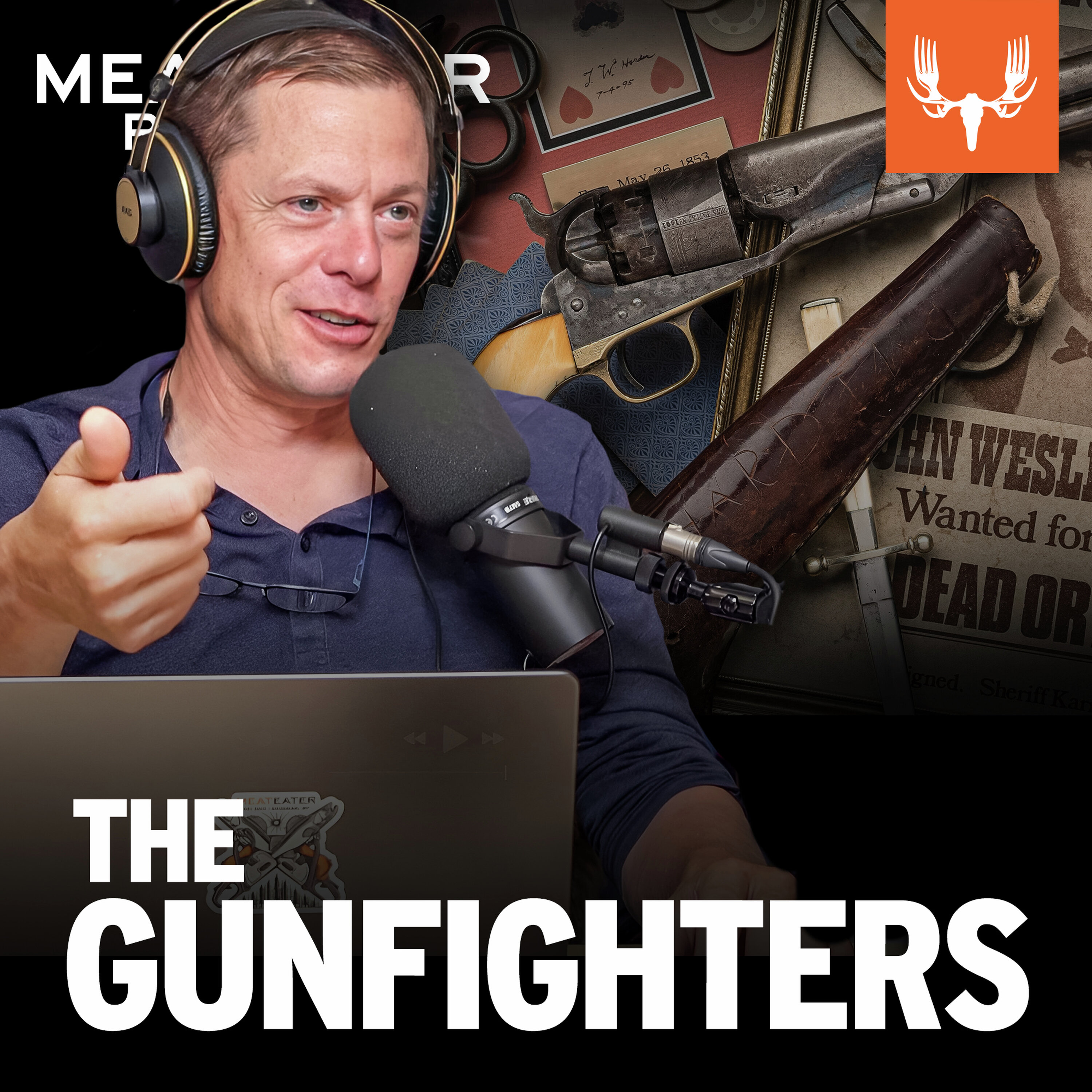
Loading summary
Transcript441 lines
- [00:00]
Brian Burrow
This is an Iheart podcast.
- [00:04]
Steve Rinella
You ever drive past a piece of land and wonder who owns that? Or maybe you need to know where exactly a property line runs. Well, that is where ONX Hunt comes in. And it's not just for hunters. There are folks using Onx for their jobs every day throughout the country. If you need the best land ownership maps, aerial imagery, and property boundaries in your pocket, Onx Hunt is the tool for the job. Try it free for 7 days. Download onx hunt in the app or Google Play store or visit onxmaps.comhunt to get started. This is the Meat Eater Podcast coming at you shirtless, severely bug bitten, and in my case, underwearless. We hunt the Meat Eater Podcast.
- [00:57]
Brian Burrow
You can't predict anything.
- [00:59]
Steve Rinella
The Meat Eater Podcast is brought to you by First Light. Whether you're checking trail cams, hanging deer stands, or scouting for elk, First Light has performance apparel to support every hunter in every environment. Check it out at first light.com F I r s t l I t e dot com Brian Burrow dude, this book makes me so happy. Like, I like. I love reading it. I'm not done with it. I'm halfway through it. I love reading it.
- [01:27]
Brian Burrow
Well, I'm happy for you.
- [01:29]
Steve Rinella
It is how you can have so much fun reading about so many people getting shot.
- [01:34]
Brian Burrow
Well, that was the primary challenge of the book.
- [01:36]
Steve Rinella
Sure.
- [01:36]
Brian Burrow
Is how to convey one's enthusiasm for a pastime and get people to keep reading a book that is, you know, averages three or four dead people every page or so.
- [01:47]
Steve Rinella
Yeah. It's incredible. A lot of the reading I do, I have to read stuff just because I'm reading it for work. Research stuff. Right. This is my. This is me. Like, when I want to have fun, I work on reading your book. It's not work. I just enj. I love the book.
- [02:02]
Brian Burrow
Well, thank you. I, as you can probably tell, loved doing it.
- [02:06]
Steve Rinella
Yeah.
- [02:06]
Brian Burrow
You know, I've kind of reached the age I'm 63, where I stopped doing stuff I don't want to do.
- [02:11]
Steve Rinella
Okay.
- [02:11]
Brian Burrow
And I just want to pursue projects that I really want to go disappear into a room and learn about for five, six, seven years. This one took seven. And. And, dude, I've been reading about gunfighters since sixth grade, since I was 11. This is a book I've wanted to do for, like, 50 years.
- [02:27]
Steve Rinella
Yeah. You're from Texas. I am, yeah. And as you point out, we'll get into it. Texas is, like, just kind of is a force that pushes gunfighters out into the American West.
- [02:41]
Brian Burrow
It's probably the most important of a number of sources. Yeah, I think that's fair to say.
- [02:45]
Steve Rinella
Yeah, you got a bunch of. You got a bunch of books. I'm going to tell people about your books because they might recognize some of them. Barbarians at the Gate. You have eight books. Four New York Times bestsellers. Public Enemies, America's Greatest Crime Wave and the Birth of the FBI, 1933-34. The Big Rich. The Rise and Fall of the Greatest Texas Oil Families. Forget the Alamo. The Rise and Fall of an American Myth. We need to talk about that for a second. I read that one. And we're here now to discuss the Gunfighters. How Texas Made the Wild West. Can we touch on the Alamo?
- [03:24]
Randall
West Wild.
- [03:25]
Brian Burrow
Yeah.
- [03:25]
Steve Rinella
What am I saying? How Texas Made the West Wild. I don't have my glasses on.
- [03:31]
Randall
Two W's. I get it.
- [03:32]
Steve Rinella
Well, not only that, it's. Crin. Put it in italics. Which one? You. As you. As you age. As you age and you start losing your ability to see letters up close. Italics is. Becomes your worst enemy.
- [03:45]
Brian Burrow
Italics as hell.
- [03:46]
Steve Rinella
Yeah. Becomes your worst enemy. So you just leave your glasses on at all times?
- [03:50]
Brian Burrow
Yeah.
- [03:50]
Steve Rinella
I could leave mine on, but then this would be clear and you'd get blurry.
- [03:55]
Brian Burrow
Can't help you.
- [03:56]
Steve Rinella
It's like a real.
- [03:57]
Phil
You gotta drop them down.
- [04:00]
Steve Rinella
Was that what you're doing right now?
- [04:01]
Brian Burrow
Oh, yeah.
- [04:02]
Phil
And look there.
- [04:03]
Randall
I thought you just did that to look pretentious.
- [04:06]
Brian Burrow
Nope.
- [04:06]
Phil
That's what happens when you get old.
- [04:08]
Steve Rinella
No, because no matter what, if you got a hoodie and a hat on. I don't care what you do with your glasses, you're not gonna look preten.
- [04:15]
Randall
I just.
- [04:15]
Brian Burrow
There's.
- [04:16]
Phil
Maybe if I put doctor in my.
- [04:17]
Randall
There's a certain feeling when someone looks at you over the top of their glasses. It makes me think that I did something like.
- [04:23]
Steve Rinella
You're getting scolded.
- [04:24]
Randall
Authoritative.
- [04:25]
Steve Rinella
Yeah.
- [04:25]
Randall
It's a power move. I feel like.
- [04:27]
Steve Rinella
What's your take? Do you think. Do you think. See, you're from Texas, so I don't know if I. You're not going to give a straight answer because Texas get prickly about this subject. Do you think Crockett. Crockett. They caught him alive, or do you think that Crockett got killed in action?
- [04:43]
Brian Burrow
The versions that we have from people on the ground, which are Mexican soldiers, because, let's face it, all the Americans died. There are multiple versions that say that he was captured and executed.
- [04:54]
Steve Rinella
Yeah. So you believe that?
- [04:56]
Brian Burrow
I don't have any reason not To, I mean, it's the only nonfiction based source for Crockett information. Most of kind of the famous stuff about him swinging Old Betsy is kind of neo fiction.
- [05:12]
Steve Rinella
Yeah. So no source. It's a good point. You're saying the only sources that could have described what happened at the end of the battle would be Mexican soldiers. Right. And there's no source that ever came forward to say, oh no, Crockett went down swinging his rifle.
- [05:28]
Brian Burrow
The problem is, for years that just made sense. Right. We didn't really have much information until decades after the battle about that some people might be captured. For the longest time it was just assumed that everybody died because ultimately they died. The idea that some of them were executed after being captured is an idea that really didn't start popping up till maybe 50 years after the battle.
- [05:49]
Steve Rinella
Got it, Got it. What's your primary argument in the, in the book? Like I said, I haven't read it. I'd like to, but why forget the Alamo?
- [05:59]
Brian Burrow
Well, we at Texans have put, are enormously proud of our creation and should be. But you know, we wrote the book with a sense that we love history, we love the accurate stories of history. We don't believe that the accurate stories of history make Texas, Texas any less special. I think the argument that got people most irked was when you go back and you read Stephen F. Austin, father of Texans memoirs, when you go back and read a lot of people, you realize that the primary driver that split Texas from Mexico was the Texans insistence that they could only live there if they were able to use slaves to bring in their cotton. Because that's why they came. That's the only way they knew to raise cotton. And so for that first 10 years, from 1820 to 1830, that was primarily what they were arguing about. And there's ample evidence of that.
- [06:55]
Steve Rinella
Got it. Got it. And you dig into that in the story. Oh, yeah. Yeah. I got a bone to pick with you about this one here.
- [07:04]
Brian Burrow
Okay.
- [07:05]
Steve Rinella
Like I, I, Yeah, I don't really get a thing you did. So everyone that reviewed your book. I read a bunch of reviews of your book which are all good. I haven't found any bad ones yet. And they're all like, they all, all the reviewers get a kick out of you saying that Hickok was a titanic fraud. Okay. Yes, the Hickok was a fraud. Hickok wasn't a badass. He wasn't the ultimate gunfighter like people think he might have been.
- [07:35]
Brian Burrow
I, I, I argued that he was came into public view as a titanic Fraud.
- [07:41]
Steve Rinella
No, you say he was a titanic fraud.
- [07:43]
Brian Burrow
Well, in terms.
- [07:43]
Steve Rinella
And then you go on to totally contradict yourself at that point.
- [07:47]
Brian Burrow
He was a titan.
- [07:48]
Steve Rinella
Because you're blaming. You're blaming Hickok. So Hickok, just to refresh. You could tell the story. I'm just gonna give a little quick outline, just so you understand my. My gripe. Some journalists, early on in Hickok's life, some journalist, or some, you know what passed for a journalist in those days, interviews Hickok or whatever and comes out saying, oh, Hickok killed 100 men with his pistol and all. Hickok doesn't contradict him. Hickok's like, if he wants to say that, that's fine, and then goes on to shoot all kinds of people. And you're saying he's a titanic fraud, but it's not his fault. He couldn't control what the guy said.
- [08:29]
Brian Burrow
And we don't. I don't argue that it was his fault.
- [08:31]
Steve Rinella
No, you.
- [08:32]
Brian Burrow
Same reason. The same reason. The same reason with Johnny Ringo. Johnny Ringo is a titanic fraud, and he never once made a claim. They were all made years after his death. But with Hickok. Yeah, he was the only reason. You know his name is that article by. Oh, yeah. You'd never know of him otherwise.
- [08:48]
Steve Rinella
But you start the book with him shooting a guy.
- [08:51]
Brian Burrow
Yes. But that does not make you some notable gunfighter. That you shot one guy, what makes you the nation's first gunfighter is to claim that you shot 100 guys when the actual number at that point would appear to be like two.
- [09:05]
Phil
That's how you build a reputation.
- [09:08]
Steve Rinella
I don't know, but I just think titanic fraud. I was thinking when I said that, when I read that in the reviews. I don't want to start out negative here. When I read that in the reviews, I thought, okay, he's going to dismantle Hickok. But then I'm reading the book, and I'm like, the hundred. That notwithstanding that hundred thing, he still was kind of a remarkable gunfighter.
- [09:30]
Brian Burrow
I. Yes. But when he first became known, he became known for what I think was a fraudulent fact that he'd killed over 100 people. I think what's notable about him is that after that, you can argue, as I think you're trying to, that he grew into his legend, that he became a notable lawman and became a notable gunfighter. But I'm sorry, when it was first written in 1867, he wasn't.
- [09:53]
Steve Rinella
Okay, not gonna say you win, but lay out the premise of the book. Like how you lay it out in the beginning, you know, you kind of define you first. You kind of go, like, what is a gunfighter? Like, what is. And you. You kind of. You kick around different people that carried pistols and different western icons. And then you settle at. When I say a gunfighter, here's what I mean.
- [10:17]
Brian Burrow
Yeah. The first thing to do is to. To define our terms. A gunfighter is generally acknowledged as someone who was involved in exchanges of gunfire among civilians on the. On the old western frontier. So not involving soldiers, military of any kind, and not involving Native Americans, generally speaking. What I set out to do was I identified, you know, what do all these guys have in common, From Wyatt Earp to Hickok to Jesse James. The only thing that they really had in common is a. They got famous shooting people, mostly for shooting people. And it all happened during a period from 1865 till I ended it, 1901. So I've grandly dubbed this the gunfighter era. And I set out to tell a narrative history of. Of those 36 years.
- [11:03]
Steve Rinella
And you set out explaining, sort of asking this question, why is it. Why is it seen to be Texans?
- [11:13]
Brian Burrow
Well, that was one of the first things you notice if you re. If you immerse yourself in this literature, is that if you look at what I call the marquee gunfights, that is, the famous ones, the ones that made the newspapers and the history books, a startling thing leaps out at you almost immediately, and that's the sheer number of Texans who were involved in these gunfights. I would argue some pl. If you tottered them up, I would say between 50 and 70% of these gun. Of these famous gunfights from Kansas to Texas to New Mexico, Wyoming and Arizona, involve Texans. At first, that didn't make a lot of sense because not to get all into it here, but the. I only discovered, late understood how there was this Tieck, this Texas diaspora, this spread of Texans across the frontier that came with the spread of longhorn cattle. If you look at the great cattle ranches, the great cattle herds from Montana all the way down to Arizona, 90% of them came from one place. They came from Texas, and they came.
- [12:16]
Steve Rinella
With Texans, and they came with pistols.
- [12:19]
Brian Burrow
They sure as heck did. Look, look, I would never argue that Texans created the gunfighter archetype or certainly created gun violence. Gun violence in the West. They didn't. I wouldn't want to overstate this, but what I'm saying is that Texans had an impact on what we remember. That's far more Significant than we remember.
- [12:42]
Steve Rinella
And you get into it in the beginning of the book, you get into this. This. This idea of that people wanted to. Would defend their honor at all costs. And you kind of talk about how they had these. That at that time, it seemed like people had, like, somewhat fragile egos.
- [13:06]
Brian Burrow
Well, that's one way to see. That's one way.
- [13:08]
Steve Rinella
That's not your word when you look at their behavior.
- [13:11]
Brian Burrow
That's the way it seems to us. I think another way to interpret this is that during the 19th century, the 1800s, the. At a time where we didn't have a whole lot of university degrees or financial statements for ordinary men and women to brag about, what emerged, especially in the south, and I'm arguing, gravitated out onto the western frontier, was a male honor system that. Well, it's a little. It's almost hard to explain, but it's a little like pornography. I know it when I see it. You know, when I have attacked your honor, maybe I call you ugly or your wife or your dog. The thing about the Southern honor system, more really, you could argue the American honor system in those days is if you felt your honor had been impugned, if you'd been insulted, you had an opportunity and in many cases an obligation to respond with violence, even deadly violence. You know, that famously, I mean, I argue in the book that the genesis of all this gunfighter behavior was duels, duels. Back in the old south, that's really the only place you can point to American men shooting each other in kind of structured contest with. With guns before this, you know, that's.
- [14:21]
Steve Rinella
The thing people talk about how caustic American politics has become. I think to myself, not like, then, dude, you. I mean, like, people. You'd have an election. The election would be resolved, and it'd be like. It'd be like Biden. It'd be like Biden and Trump would. The election would be over. Trump's like, I don't. You know, there's a fishiness to the results. They'd be like, okay, let's have a duel. And at noon, whoever lives. And that'll wind up being like. That'll wind up being the final say. The voters, in fact, have not spoken.
- [14:59]
Brian Burrow
In the years leading up to the war, there were fistfights and worse on the floor of Congress, as well as any number of duels involving politicians. Andrew Jackson, as you know, was involved in one. Abraham Lincoln almost was until he talked his way out of it. And our great Texas president Sam Houston was involved in one, which he aimed a little low and end up shooting the other gentleman in the crotch, you know.
- [15:24]
Steve Rinella
What was that role you explained? It's not heard of it before. What was that role in a duel, like, where you bring, like, your second. Yeah. You bring, like an advocate. Yeah. Can you explain. Can you explain that in duels, in.
- [15:37]
Brian Burrow
The formal duel, as laid out in rules written by the governor of South Carolina in 1837, you were, you know, it laid out exactly how this is supposed to happen. Now, how often people went by the formal rules, I can't argue. But one of the things you did see in many, if not most duels is the. You would bring a buddy who was officially called your second, and they would, you know, kind of argue for the reasons that they should have a duel and should not have a duel. And, you know, often people went ahead with it. But the main place where you. Where the duel, where the second could come in is if one of you broke the rules. Let's say I fired at you and then fired again before anyone was allowed the second could take a shot at you. And so there were all sorts of famous duels where, like, Joe. Joe.
- [16:26]
Steve Rinella
I think we should bring this back.
- [16:27]
Brian Burrow
There were all sorts of duels where, like, Joe and Jim would go out to an island in the Mississippi, they would shoot at each other from Tintec from 10 paces and then miss. And the famous. One of these involved the Texas hero Jim Bowie, who was a second. And both men were so angry, and their seconds were so angry, they just. A melee, you know, broke out and they started shooting each other. And Bowie had this, you know, six foot short, sort of a nice knife, the famous Bowie knife. So I almost don't want to emphasize the formal rules of duels too much because I think there were many more that were informal.
- [17:01]
Randall
But the fact that there were formal rules speaks to how prevalent it was and widely accepted.
- [17:06]
Steve Rinella
Yeah.
- [17:07]
Brian Burrow
You know, the funny thing you saw in the south from the high watermark of duels, which is, say, the 1790s and the 1830s, which I know overlaps with some of your work, is a sense that everybody said you weren't supposed to do it. The preachers, women's associations, formally, you weren't supposed to do it, but everybody was like, wink, wink. This is the greatest thing since sliced bread. I mean, nobody ever got. No. No sheriff ever walked out into the middle of a field yelling, stop. You're all under arrest.
- [17:37]
Steve Rinella
And they'd have, like, towns that have, like, a formal. Maybe not formal, but they would have a. They would have A what was understood to be the dueling grounds. Yeah.
- [17:46]
Brian Burrow
Every Southern city. Not just some. Every single one. I can't. You know, St. Louis had an island out. I think they call it Bloody island out in the Mississippi. The famous one, the most famous one was you could still go there in the oaks and underneath the oaks in City park in New Orleans at the end of Esplanade. And, you know, there were so many duels there during the 1830s that you practically have to make an appointment. There were some Sundays. Right, right. Because there would be 10 or 12 duels on a single afternoon. Now, the big asterisk there is. In New Orleans, duels were almost always done with swords rather than guns. And typically, those duels ended when one man drew blood.
- [18:27]
Randall
That's the French Connection.
- [18:29]
Brian Burrow
Exactly.
- [18:31]
Steve Rinella
He talked about, too, a style of duel where you take, like, you and me, bind our left hands, right. And then you get a knife. Dude, that's a wicked duel right there. Do you know what I'm saying? Like, me and Randall, we bond.
- [18:48]
Brian Burrow
No, no.
- [18:49]
Steve Rinella
Me and Randall clasp our hands. Left. Our Clasp our left hands. And they bind them, tie them.
- [18:57]
Brian Burrow
Yep.
- [18:57]
Phil
What if you're a lefty?
- [18:59]
Steve Rinella
That's what. That's my whole gripe.
- [19:02]
Brian Burrow
Then you complain.
- [19:03]
Steve Rinella
Yeah.
- [19:04]
Randall
Your second has got to make a case for you.
- [19:06]
Steve Rinella
Yeah. And then you. Then you're like, on the count of three, and you each got a knife and your hands are tied, and on the count of three, go, go.
- [19:14]
Brian Burrow
Stab you in the fight wherever.
- [19:15]
Steve Rinella
Okay.
- [19:16]
Brian Burrow
Yeah, it was a, you know, a structured knife fight from a distance of about two and a half feet. The only problem with that is I at least was unable to find a single one. In the nonfiction annals of history, it remains popular in some movies. If you remember The Long Riders, 1980, Walter Hill movie of the James Gang. There was a beautiful one involving Cole Younger and Sam Starr. The problem is we just can't find any that actually happened.
- [19:48]
Randall
We run into that a lot with our audio projects. There's just stories that you hear about the mountain men did this or the mountain men did that. And then you spend months reading every mountain man account you can find. And it just seems to be an invention of later authors, or I prefer.
- [20:07]
Brian Burrow
To call it folklore.
- [20:08]
Randall
Folklore, yeah.
- [20:09]
Brian Burrow
Suggesting that they're probably, and I suspect this practice that we're talking about now did not arise out of nowhere. It came from something. But the thing is, they didn't have Harvard professors with them in Wyoming in 1831. And a lot of those guys didn't live to author Memoirs. So I don't doubt that there were incidents where men tied their hands together and went after the wind knives. I just think that a lot of documentation about that stuff in the early. Especially in the early frontier is pretty, Pretty sparse.
- [20:39]
Steve Rinella
I'm from Michigan. Do you think that I could put, like, if you saw me running around, I keep thinking about switching to those shirts you got on, but I feel like it'd be like, you know what I mean? Might not be cool if I switched to a guaya vara. Being from Michigan, what would you think?
- [20:56]
Brian Burrow
I think you can pull it off.
- [20:57]
Steve Rinella
Really?
- [20:57]
Brian Burrow
Oh, yeah. Now, I mean, if you're. I think it's a geographic thing.
- [21:01]
Steve Rinella
Okay.
- [21:02]
Brian Burrow
I think it's harder to pull off north of Texas, north of areas that don't have a large Latino population. I think he's also age appropriate. I don't see a ton of 25 year olds or youngsters your age wearing them. But once I got to 60, I.
- [21:16]
Steve Rinella
Was like, I'm 50 years old.
- [21:17]
Brian Burrow
Okay. Well, coming up on the H, my.
- [21:20]
Steve Rinella
Buddy Brad from Texas. He wears the same shirts.
- [21:22]
Brian Burrow
They're the most comfortable thing you can wear.
- [21:25]
Steve Rinella
God, I want to switch bad, man.
- [21:26]
Phil
That's close with trying to pull off a cowboy hat.
- [21:29]
Steve Rinella
That's what I'm worried about. Yeah, that's what I'm worried about. I want to buy five or six, get rid of all my other shirts and just run y of ours.
- [21:36]
Brian Burrow
I got 10 or 12. And in Texas, we can wear them 11 months a year. And they're just. They're just comfortable as I'll get. As I'll get out.
- [21:44]
Steve Rinella
You look like a writer in that son of a bitch.
- [21:46]
Brian Burrow
No, see, I've also been told I look like a waiter.
- [21:51]
Steve Rinella
No, not to me, man. You look like a Texan and a writer.
- [21:54]
Brian Burrow
Well, thank you.
- [21:56]
Steve Rinella
You mentioned James gang. Yeah. You one of the. I kind of laughed out loud in your book where you're like, I don't want to put Jesse James in my gunfighter book. I'm only putting him here because you think he should be in here.
- [22:12]
Brian Burrow
It's true.
- [22:13]
Steve Rinella
And then you go on to explain at great length why he does not.
- [22:16]
Brian Burrow
Belong in your book, Jesse James killed people with guns. But we are talking about the old west, and Jesse James was most certainly not a creature of the old West. He was a midwestern bank and train robber. He pulled jobs in Minnesota, in Alabama.
- [22:34]
Steve Rinella
Why do people think he's a western guy?
- [22:36]
Brian Burrow
Because the dime novels and the pulp fiction that came after him for some reason began gravitating his story, which is extensively in Missouri, out West, because that's where people expected bang, bang. And gunfighters and bank robbers and all that.
- [22:53]
Steve Rinella
Yeah. You even explained in that chapter people didn't rob banks in the West.
- [22:58]
Brian Burrow
Well, not. Not until the 1890s. It was all but unheard of because.
- [23:02]
Steve Rinella
There'S no money there.
- [23:03]
Brian Burrow
There just wasn't enough hard currency. The one place where you could rob something making serious money was trains. And even that was pretty rare.
- [23:12]
Steve Rinella
Yeah, but the banks, like. Oh, sorry.
- [23:14]
Randall
Oh, no, this. Sorry. I was just. The other point that you made in there that I appreciated was there's people shooting each other in eastern cities all the time. And they're not. Obviously there is a higher rate of violence in the west and in Texas. But you're like, no one's writing.
- [23:35]
Brian Burrow
You.
- [23:35]
Randall
Know, folklore about somebody shooting someone on the streets of. Of Brooklyn or anything like that. But there's this whole cultural.
- [23:42]
Steve Rinella
No, but there's a whole genre of music about that called gangster rap.
- [23:46]
Randall
Yeah, well, I mean, it's a similar thing. Like there's certain parts of the country that you associate with violence, but there's violence everywhere. It's only what the culture chooses to focus, fixate on.
- [23:57]
Steve Rinella
Right.
- [23:58]
Brian Burrow
Well, that was one of the first things that I had to confront is a. Let's face it, gunfighters do not seem to be a hugely important aspect of our history. There's no political or sociological impact, nothing that would justify putting them in. In a history book, a textbook. So I had to figure out why is it we're still talking about them 150 years? And obviously where I came down is that they're important culturally for America. We have decided that there is something in these exploits that connects with us. There's a reason that gunfighters became an aspect of 20th century, especially entertainments of movies and literature. And I don't spend a lot of time trying to get all academic about why they were important, But I do think I had to address, at least address why, you know, this. The only gunfighters that anybody remembers rose in America on the frontier in that 35 year. In that 35 year period.
- [24:58]
Phil
I want to ask you a question that's like a 21st, 20th century, 21st century gun control spin on that era. Would that gunfighter era have occurred without the proliferation of six shooters after the Civil War? Like when that technology.
- [25:21]
Steve Rinella
That's a big part of the book.
- [25:23]
Brian Burrow
Yeah, yeah. I think you have to argue they were. I mean, what made the gunfighter era possible? What made all These famous shootings possible was the invention of the revolver by Samuel Colt in the late 1880, 1830s and its adoption and thus popularization by the Texas rangers in the 1840s. When you talk about the phenomenon that we call today open carrot carry, it was not unknown before the revolver. You can find memoirists who tour southern areas and rural areas. They're like, gosh, I saw a guy carrying a gun this in Arkansas in 1837. But after the war, especially after, in 1865 and 1866, the federal government auctioned off or gave away something, the order of 1.3 million sidearms. I think you have to acknowledge that open carry became not only prevalent, but accepted. You can find memoirs writing about at the time who are like, good Lord, can you believe men are wearing guns like they used to wear bow ties? And I think that these gun fights, what you needed for them to happen were revolvers. Something where you can fire a lot, cause a lot of mayhem. You don't really have gunfights pre war, back in the day where the primary handgun was a single shot.
- [26:44]
Steve Rinella
Short gun fights. Yeah.
- [26:46]
Brian Burrow
You know, the typical duel be bang, bang, and then everybody takes 10 minutes to reload. Yep.
- [26:52]
Randall
Oh, there's a very similar phenomenon. I mean, I'm not just vaguely. The Tommy gun arrived too late on the scene in World War I to really be issued to troops. So they sold all of those after the war, like in hardware stores. Right. And that's the rise of.
- [27:11]
Steve Rinella
Oh, no kidding.
- [27:12]
Randall
Of the. The 1920s gangster.
- [27:16]
Brian Burrow
I would. I abs. I wrote an entire book that. That argued in part.
- [27:20]
Steve Rinella
I knew you could speak to that.
- [27:22]
Randall
Which is why I brought up my face.
- [27:24]
Brian Burrow
The spread of surplus Tommy guns in the 20s did as much to Al Capone as anything else. Because suddenly, if you could shoot 100, 100 rounds a minute or whatever it was some sheriff named goober out in Iowa. Just, you know, he said he's not going to be able to face off with you.
- [27:38]
Steve Rinella
Yeah. You know. You know, I want to. I want to talk about the Colt pistol, but I want to back up to minute to the man that doesn't belong in the book, but he's in there. Yeah, yeah. Can you explain to folks like, who was Jesse James? Like, like what did that world that he came out of? Right. Because that, that winds up having a little bit of an impact on a number of these people. It does, yeah. That, that's the, the. Some of the goings on in the Civil War shaped a lot of these individuals.
- [28:10]
Brian Burrow
One of the things that a Number of the early gunfighters, those who kind of began their careers in the late 1860s have in common is a number of them, from Jesse James to John Wesley Hardin of Texas to Doc Holliday, were inveterate and angry Southerners. Jesse James was the biggest one in terms of his fame. He was a teenage boy during the Civil War whose brother Frank was out there fighting at a time that the warfare in Missouri was much less about the movement of armies and much more about rural guerrillas descending on farms and burning up farms and such. Frank was into that. Jesse joined him. Jesse was shot twice in the chest during the war, survived, and then goes utterly black for four years. We don't know much about him, but we do know that many of the Confederate guerrillas known as bushwhackers did begin to engage in crime in Missouri in the late 1860s. And the first time we see Jesse and Frank, the first time they walk out onto the pages of history, is 1869 in Gallatin, Missouri, far north. They walk into a bank, ostensibly to rob it, but you learn immediately that robbery was just second. They go up to a gentleman who's sitting at a desk and they call him by name, let's say Burleson, whatever it was, and shoot him in the head. They thought this guy had killed one of their commanding officers. They were there to exact repair, and they were wrong and they killed the wrong guy. That led to Jesse and Frank forming a group that two years later began robbing banks and continued very successfully for 10 years. Jesse James, in his career as a bank and train robber. What's important for people to understand is what a unicorn he was. There was nobody like this in the country that was doing this, that was doing it this much or making this money. And when you look at the entirety of this period from 1865 and 1901, there's nobody else that comes close. I mean, the close. If you wanted to say who was the second most successful outlaw of the Old west, if you put Jesse James at the top, you'd probably say Butch Cassidy was, was a, was a distant second. But Jesse James was the first household name criminal in American history. But he was not, as you point out, he was not a gunfighter.
- [30:40]
Steve Rinella
Yeah, you say he was just a murderer.
- [30:42]
Brian Burrow
Well, he never actually even did anything that we can figure out west of the, of the Missouri Kansas line, which is kind of the beginning of the Old West. When you look at the people that Jesse James Shot, 5 or 6, everyone was essentially executed with a shot to the head because he did Something that pissed Jesse off during a robbery.
- [30:59]
Steve Rinella
Yeah, it wasn't like going out into the street and being like, draw. It was just. He was a shoot. He'd just shoot people.
- [31:04]
Brian Burrow
The only time we knew Jesse James was in a legitimately contentious gunfight situation. A detective out of St. Louis somehow stumbled upon him and one of his cousins on a wooded road in Missouri in the 1870s. And the detective came right up to him and there was an exchange of gunfire. All three guys missed at a distance of like 15ft. Like, like. You can look at some of these gunfighters. Hickok, Ben Thompson, the Texan, Butch Cassidy, who did an awful lot of practicing. Billy the Kid practiced daily, as did Hickok. There's not a single story that I could find in any of the ten Jesse James biographies I read that showed Jesse James ever practiced with a gun. And I think it shows.
- [31:47]
Randall
He's the kind of guy that would go out and buy one box of ammo and it would last him 10 hunting seasons.
- [31:51]
Steve Rinella
Yeah, like when I was a kid, if you bought a box of ammo, yeah, it was good for like, yeah, 20 shells. You're like, that would be good for 15, 16 deer every few years. I'll make sure my gun's still accurate.
- [32:04]
Brian Burrow
Well, the thing to remember about Jesse James is if he's in a gunfight, he's failed. You know, he wants to be able to walk into a bank, point a gun, maybe shoot a single shot into the ceiling and get out with the money before anybody notices him. So there's a reason that he probably didn't hone his gun skills.
- [32:23]
Steve Rinella
Who wrote the Assassination of Jesse James by the coward Robert Ford? It was. He's a real good writer.
- [32:30]
Brian Burrow
Robert Hanson.
- [32:31]
Steve Rinella
Was it Hanson? Someone typed that in.
- [32:34]
Brian Burrow
Way didn't read the book.
- [32:35]
Steve Rinella
The Assassination of Jesse James by the coward Robert Ford. It was made into a movie.
- [32:39]
Brian Burrow
Ron Hansen.
- [32:40]
Steve Rinella
Ron Hansen. That's a hell of a book. Are you much so, so Robert Ford kills James. Robert Ford kills Jesse James.
- [32:49]
Brian Burrow
Bob, yes.
- [32:50]
Steve Rinella
Bob Ford kills Jesse James. Have you read much about the guy that then killed Bob Ford?
- [32:55]
Brian Burrow
No, I put it in a footnote. I know that he was killed by a guy that basically walked into a bar he owned or was working in.
- [33:02]
Steve Rinella
Ten, 15 years later, many different versions of what happened. It's agreed upon that he shot him with a double barreled shotgun.
- [33:09]
Brian Burrow
Well, you know, there is, there is a, there is a fence around this book. There are, there are places that I kind of go up to the fence and going, okay, that's probably a footnote. I'm not going to read three more books.
- [33:23]
Steve Rinella
Hanson. Ron Hanson. What was his name? Ron Hansen.
- [33:25]
Randall
Robert Hansen. Is the FBI.
- [33:27]
Steve Rinella
No. And all of a sudden, mole. Ron Hansen's the author. Ron Hansen, the author. So he writes a novel, but it's like very informed right in there. He has this detail that the guy that kills Robert Ford has a coach gun, has a shotgun, and he took a bunch of pipe, cut the pipe in little teeny discs, and then took a hammer and chisel and cut those discs into little shards and then took a funnel and funneled the shards down into the shotgun. Because when you're reading about the guy that. When you're reading about the guy that killed Bob Ford, everybody talks about he was nearly cut in half. Some say cut in half at the waist, some say cut in half at the jaw. But it's agreed upon that he was very shot up. And I was wondering if you knew about that detail, if that's true or not, about filling that gun full of pipe shavings, which is a dirty deed.
- [34:21]
Brian Burrow
I don't. And I feel like a personal failure that I can't address that for you.
- [34:26]
Steve Rinella
But you know what? Here's where you can find cover for yourself. You argue that he shouldn't even be in your book. So the last thing you need to do is spend a whole bunch of time talking about the guy that technically went through the guy and then the guy that killed him. It's just getting very removed.
- [34:39]
Brian Burrow
At some point you got to realize people probably are not going to read the 800 page version of this. So I do have to make. I have to make a lot of calls.
- [34:48]
Steve Rinella
Gunfighters, speed versus accuracy. Yeah, that was the thing that would debate.
- [34:55]
Brian Burrow
It was typically journalists that would ask them. And we don't have a ton of those interviews and exchanges, but of those we do. Earp was weighed in on this, as did Hickok. Those men who lived long enough to tell the story argued strongly in favor of accuracy. That the dumbass thing to do, and you see people doing it repeatedly through the. In this book, is to draw and shoot from the hip. Just as a question of accuracy, especially at distance, that's pretty questionable in the gunfight that opens the book in which Wild Bill Hickok kills this fellow Davis Tutt at 75 yards.
- [35:35]
Steve Rinella
The Titanic fraud. Wild Bill Hickok kills a man at 75 yards with his pistol.
- [35:39]
Brian Burrow
That's right. You know, Tutt fired. Fired from the hit. Hickok famously had a navy Colt. He thrust his Left arm forward, placed the barrel of the Navy Colt across his forearm, took what, a millisecond longer than the other guy and shot him in the chest.
- [35:57]
Steve Rinella
Well, there you have it.
- [35:58]
Brian Burrow
Earp did the same thing. Any number, you know, any number of people he shot in the OK Corral fight, you know, Billy, I forget the guy's name. Shot. Made the mistake of shooting from the hip.
- [36:09]
Steve Rinella
Yeah. And he would draw a bead on him.
- [36:11]
Brian Burrow
Yes.
- [36:13]
Steve Rinella
The Colt pistol, it didn't take. I couldn't believe when I was reading this that it wasn't immediately popular. It was a Colt revolver. Like people didn't want it.
- [36:24]
Brian Burrow
No, the original was introduced in, like, I would say, 1837, about a year after the Alamo. And it was large and it was unwieldy, and it could take five, six minutes to. To. To me, you practically had to dismantle it to reload it. So while Colt was able to. To unload some of these onto the federal government and was used, we're told, during the Florida's Seminole War in the early 1840s, I want to say it was not a big deal. In fact, by the time a group of Texas Rangers stumbled upon some of These pistols in 1844, seven years later, Colt had gone out of business. And it was only when the Rangers began using them in firefights against the Comanche and then later in the Mexican War that one of them, one of the Rangers who used it, a fellow named Samuel Walker, went back east and said, colt, this would be a great gun if you could just lighten it up and make the reload a little bit easier. And working together, Walker and Colt created the gun that created the gunfighter era. The original six shooter, the Walker, Colt.
- [37:29]
Steve Rinella
And some of these dudes, I always thought it was like, from just a joke from Westerns, but some of these dudes you're talking about would actually. They would wear two of them and they would rig them for cross draw.
- [37:40]
Brian Burrow
Right.
- [37:41]
Steve Rinella
For real.
- [37:41]
Brian Burrow
That was news to me.
- [37:43]
Steve Rinella
I always thought that was like a. Just goofy.
- [37:46]
Randall
When I read that detail, I had to figure how that was faster.
- [37:50]
Brian Burrow
Well, me too.
- [37:51]
Randall
I mean, I think the idea is like, you swing it and you're aiming it in one motion rather than drawing and bringing it up.
- [37:58]
Steve Rinella
But.
- [37:58]
Brian Burrow
Well, let's define our terms real quick. Most people who wore a gun wore a single pistol low on the right hip or low on their shooting hip. It was somewhat rare to wear two guns. We know John Harden, Wesley Hardin did it. We know Hickok did it. But now what we're talking about is the way Hickok and certain others, Jim Courtney, the marshal of Fort Worth, did it as well. They wore their holsters high on their hip. So practically with the holster, the northern end of the holster in their stomach. And their argument was that if you are pulling from low on your hip, you've got to pull up and then point with a cross draw. You pull out and the barrel is already pointed the way it should go. So they would argue, and I am not a shooter, and I've never used a cross draw. That the cross draw worked because it required one less motion. Yeah.
- [38:50]
Randall
I was doing this in bed the other night. I put my Kindle down and I was reaching across to this side and.
- [38:58]
Steve Rinella
Yeah. Told your wife, go stand across, drawing at the ceiling.
- [39:01]
Brian Burrow
I was gonna say that was the excuse for all those movements when your wife walked into the room.
- [39:05]
Steve Rinella
Yeah, yeah.
- [39:08]
Randall
Everybody had been asleep for hours, the dogs.
- [39:11]
Steve Rinella
The guy that kills Buster Scruggs in the very excellent battle to Buster Scruggs, he's rigged high for cross draw. Hmm. And Buster Scruggs, I think, carries on his hip. Yeah, yeah. Once these guys got it, they made. They kind of made the Rangers kind of made it famous in, like, a particular engagement. Right, right.
- [39:34]
Brian Burrow
Battle of Waller Creek, 1844. The first time the Rangers took these.
- [39:38]
Steve Rinella
Revolvers and they got him, like, through army surplus or something. Right.
- [39:41]
Brian Burrow
It was worse. And it was. I love telling this story in. In Texas, because the Rangers discovered these pistols unused and left over by the Texas Navy. Like, don't you just love that Texas had a navy when it was an.
- [39:56]
Steve Rinella
Independent country and then they disbanded it. Right?
- [39:59]
Brian Burrow
They did, because guess what? They didn't need a Texas Navy. Nobody was going to invade from Seaside. So these guns were put, I imagine, in some type of surplus warehouse where a young Ranger named John Jack Hayes found him and took him out. That day he had a patrol with 23 Rangers, and they ran into a group of about 100, best estimate, about 100 Comanche out in the hill country northwest of San Antonio. The Comanche withdrew into a wooded hilltop, as they often do, and chided and yelled at the Rangers, come on, come on, let's fight. Well, for as long as the Rangers had been out fighting Native Americans, the way you charged was you took a single shot with your musket, put it back in the. Whatever you call a musket, holster, and then you would take a single shot with your single shot pistol, and then you would go in fighting with knife and sword. And this was the first time in history where anybody charged a group of Comanche with single shot musket, put it away. And then six shot revolver. The numbers that I recall is one ranger died that day in something like 25 Comanche. And the takeaway quote years later from the Comanche chief who'd been present that day is I shall never fight that Jack Hayes again. For he has a bullet for every finger on his hand.
- [41:16]
Steve Rinella
That's good. Who's Harden? Is a guy you spend a lot of time talking about, right. John, is it? John Wesley.
- [41:25]
Brian Burrow
John Wesley Harden. I call him Wes Harden.
- [41:27]
Steve Rinella
Yeah, you spent a lot of time talking about him. Like here is a kind of like a maniacal, indisputable, unstable gun. Yeah. Gun fighter.
- [41:39]
Brian Burrow
Well, Wesley Harden, who is probably one of the, the big five, I would call him. And he's certainly more well known in Texas than he is elsewhere. He's the bridge from the violence that kind of took over Texas in the decade after the war. He's the bridge into the more the later era of gunfighters that we know it was. You know, Hardin, you know, faced off with, with Hickok and Abilene. One of the things that's, that's startling about John Wesley Hardin, if you know nothing about him, is of course he is credited or with killing between 26 and 42 people by the time he was 21.
- [42:18]
Steve Rinella
Wow.
- [42:19]
Brian Burrow
And most of it when he was 18. He got into trouble at the age of 15 when he killed a black man who he had wrestled with and they argued afterwards and then was obliged to become a fugitive when federal troops looked for him. And so for the next how many years? Six years, he kind of wandered Texas and ultimately a little bit into Kansas. And the wild thing about his career is we call him maniacal, but it's hard to point to a heck of a lot of those shootings that were planned. They were almost always because he got into some type of argument. You remember, the most famous one, of course, was he shot another Texas cattleman through the wall of his hotel room at 4 in the morning in Abilene, Kansas. And the story that got told about 10 years later is that he did it because the man was snoring. And for about 100 years it's been cool to say, oh, that's a bunch of B.S. come on, that's just Texans making up this stuff. But I'm sorry, why else do you shoot someone through a hotel room wall at 4 in the morning? You think he got into an argument with him? I suspect snoring makes a Lot of sense to me.
- [43:23]
Randall
I've never done that.
- [43:24]
Steve Rinella
I wanted to. Yeah, I know.
- [43:26]
Brian Burrow
My ex wife did.
- [43:27]
Steve Rinella
I always think about opening their throat with a. With a razor blade. Always when I'm sleeping next to a snore. Like dirt.
- [43:37]
Brian Burrow
Oh, you just dream of like.
- [43:39]
Steve Rinella
I just dream. Oh, just like very delicate. So delicate. He doesn't even wake up at first.
- [43:43]
Randall
You said when he opened his throat, you meant like one of those mouthpieces.
- [43:47]
Phil
That's why I always make sure I'm sleeping in a different tent.
- [43:50]
Brian Burrow
I was about to say, can we really. Can we rethink that?
- [43:53]
Steve Rinella
Camping just. I would go up the dirt and I'd be like, sleep, sleep, it's okay. And just like take a blade and just open up that artery in there. He's so nice. I think he'd understand.
- [44:03]
Randall
Yeah, he wouldn't even be mad.
- [44:05]
Steve Rinella
It's okay. I'm not mad. It's just. I can't handle it. I'm sorry. I just can't handle it anymore. Card games, man. A lot. A lot of bloodshed and gun fighting.
- [44:24]
Brian Burrow
Over playing cards, which I didn't understand because on its face, it doesn't make any sense. If we're playing five card draw, I throw down my two aces and you throw down your two kings. What's to argue about, right? I mean, it should. I just never understood the fact that easily half of the marquee gunfights that I'm writing about here had something to do with an argument over. Over cards. And it wasn't until I started reading about the history of gambling that I realized that things changed in the Old west or in the years leading up to the old West. In 1843, a riverboat gambler published a book and then went out on the lecture circuit to explain to Americans how prevalent cheating was and how professional gamblers did it. Whether it was with hidden cards they hid in their clothes, sometimes entire decks. They would have pulleys and things that they could pull up an ace from their foot. I mean, they would have. They wore rings with mirrors beneath them so that they could see every card that they dealt. So what I argue in the book, and I think I'm on pretty solid ground here, is that what was different about the Old west and what explains much of this violence is two things. Number one, cheating was epidemic. More importantly, number two, now everybody knew it. So at just about every game of chance on the old frontier, I'm arguing, people were almost as keen to spread, to spot whether other players were cheating as they were to win. And of course, any type of accusation of cheating, which, let's face it, comes up a lot when somebody loses and is irked about it. Any accusation, and certainly any proof of cheating was about as acute an affront to a man's honor as you could get. So there were a lot of gunfights, some of them in the moment, Some of them, you know, I'll meet you outside. Some of them, you know, I'll see you a week later and I'm still pissed, and so I'm going to shoot you. I mean, gambling became one of the main sources of dispute on the. On the old frontier.
- [46:25]
Phil
Was it also like a major source of income for a lot of these guys? Like, how are they paying the bills like gambling? I mean, some were robbing people, obviously.
- [46:33]
Brian Burrow
But think of, think of the jobs on the old frontier. I mean, schoolteacher, cowboy, barkeep, none of these people are getting rich. The only people are getting rich, by and large, are absentee mine owners and such, cattlemen. And gambling filled two holes there. One in a landscape that didn't have video games or Internet or board games or much of anything. Primarily it was entertainment, but also it became kind of the omnipresent gig work of the frontier. Everybody, if you're making 80% of what you should make, I mean, you're going to try to make extra. And the easiest way to do that on the frontier was gambling. And so you see almost all the major gamblers, and I think like almost all the men on the frontier moonlit as gamblers. I mean, the Earps were quasi professional. They would occasionally set up shop in a casino. And then you had the professionals, Doc Holliday, Luke Short, Ben Thompson, who became, frankly, more. More famous as gunfighters, fighting off challengers as they were as gamblers.
- [47:44]
Steve Rinella
But these were guys that were. That were like making their living playing cards.
- [47:50]
Brian Burrow
Yes, they would typically take Doc Holliday. He had come west from Georgia because of his tuberculosis, was thought drier air was good for. Tried to be a dentist, and he was a dentist and he tried to open a practice in Dallas. Unfortunately, tuberculosis, the cough and dentistry don't exactly meet. So, you know, he starts. He gets a buckboard and a girlfriend slash lady of the night named big nose Kate, and begins basically touring the west. And he would go from the Rio Grande to Montana, stay as long as he felt that there were still suckers to be fleeced, or until he irked someone so bad he needed to leave town. And it was a thing, it was a type of job. Gamblers Actually talked of a circuit being up here in the mining towns, maybe in the. In the winter, being in the Kansas cow towns. Or in Texas itself in the summer.
- [48:42]
Steve Rinella
And they would go to towns where there was a lot of money flowing.
- [48:47]
Brian Burrow
Well, was easier to make money in those places than in poor towns.
- [48:51]
Steve Rinella
Yes. Yeah. Like. Like gold rush gold. Like, they would kind of follow mining. Mining booms and stuff like that. Or.
- [48:58]
Brian Burrow
Or, you know, the. The Kans. With. With all the money coming in from. From Texas Cowboys during the 1870s. Any place there was any type of. Of boom, Whether it was around minerals or cattle, you would find prostitutes and gamblers, because that's where the money was.
- [49:12]
Steve Rinella
Yeah. You're gonna see that my knowledge of your book starts to fade pretty soon, because I. I'm only halfway through, so you'll have to help me.
- [49:22]
Brian Burrow
It's all right. I'll just talk more.
- [49:23]
Steve Rinella
Yeah, please. But you lay out this. This deal that, like, tell the story of the longhorns, because this winds up having. A big part of the book is this. That there's kind of a collapse or a lull in cattle activity. Right. And then there's a great spike in cattle activity. And. And that. That pushes out a lot of that. That pushes out a lot of gunfighters to the north.
- [49:49]
Brian Burrow
Well, the eating of beef wasn't a huge thing in the antebell years before. Before the war. And 90% of the beef cattle in the country were in south Texas, in the plains, on those ranches, Famously King Ranch, south of San Antonio. And it was during the war that trade just stopped. Because you couldn't anymore get. You couldn't drive to New Orleans to market. There was no more money, not enough money in Texas for people to be having beef dinner. So essentially, that trade. Frozen amber. And so, you know, cattle did what cattle do for about five years during the war. They made little cattle. And by the time the war was over, there was something. Order of 5 million cattle roaming free in south Texas unowned. No, they were owned.
- [50:39]
Steve Rinella
Oh, they were.
- [50:39]
Brian Burrow
They just weren't. Barbed wire wasn't a thing. Okay. So this was open range.
- [50:43]
Steve Rinella
So someone would have claimed ownership of them, Whatever level of control they had over by branding. I see.
- [50:49]
Brian Burrow
So you would brand your cow and then allow him to run free. And then when it was time to go to market, Wherever they might be, you had to go out and round and round them up.
- [50:57]
Steve Rinella
I see. So during those years, just. They weren't. There was nowhere to send them.
- [51:01]
Brian Burrow
That's exactly.
- [51:01]
Steve Rinella
So your herd just built to Build.
- [51:02]
Brian Burrow
And what happened immediately after the war in 1865, 1866, was Northerners wanted those. They started to open the first ever stockyards in Chicago. And they. They needed those cows to get north. Unfortunately, there were no railroads in Texas to get them up there. Ipso facto, cattle drives. The nearest railroad railroads to Texas were in Kansas, Abilene, Wichita, and ultimately in Dodge City. And so the way that Texans and Texas longhorn cattle, and I've argued kind of this hyper violent ethos of Texas gunmen, the way that began to spread across the frontier was first up the Chisholm Trail to Kansas.
- [51:38]
Steve Rinella
And they would come, they would establish a point of sale, and then you'd have all these dudes, lot of money, real, real violent, tearing up the town. And you explain how the towns would sour on this, right?
- [51:52]
Brian Burrow
There were five principal Kansas cattle town from 1869 to 1879, beginning with Abilene, then Wichita, then Ellsworth, ultimately ending in Dodge City. And the Texas cowboys would drive large herds up there to each of each of these towns. They kind of handed it off being the place like a baton because the Texans were so violent and so uprising and the murder rates would go so sky high that each of the towns, you know, one after another was like, that's it, we're done. You know, which doll. You take these guys, Dodge City, you take them. And that's really where the first nationally famous gunfights occurred. The first ones that we still write about today. We know gunfights happened before that, but this was now in the north. This was within range of northern newspapers that suddenly were like, wait, Texans are up here doing what? And, you know, I argue in the book that, you know, this was. This kind of made these Kansas cow towns the Madison Square Garden of the gunfighter era. It's the first place you hear of so many of these police people from Wyatt Earp on down.
- [53:01]
Steve Rinella
Oh, Brody had a question about mercenaries.
- [53:02]
Phil
Oh, well, I mean, it might even relate to, like the cattle drives like, like in western movies a lot you see, where, like, someone hires the gang, right? Like, was that a thing where these guys would get hired to do some kind of mercenary work for good or bad reasons.
- [53:23]
Brian Burrow
It happened, but I would argue it didn't happen as much as the movies would suggest. The most famous incident that. Well, first, there's two things we're talking about here. Individual gunmen who are hired as assassins as what we might call hitmen, Right? That was a thing you may dimly remember, a pretty good Steve McQueen movie from the 70s called Tom Horn.
- [53:41]
Steve Rinella
Oh, yeah.
- [53:43]
Brian Burrow
Oh, I forget where I am.
- [53:45]
Steve Rinella
He was the last man legally hung in Wyoming.
- [53:47]
Brian Burrow
And Tom Horn was pretty clearly a hired killer.
- [53:50]
Steve Rinella
Yeah, he's a stockman. He's a stock detective.
- [53:53]
Brian Burrow
He was a stock detective. But I think most people, at least in Tom Horn's case, knew what he was doing. But then there were others, like Deacon Jim Miller in Texan, who, when he was strung up, his last words were, let, let. Let the record show I have killed 51 men. Now hiring an entire group of. Of hired killers. And I can think of any number of movies where that happened. Yeah, it happened. The most famous one was in Wyoming, Johnson, during the Johnson county war in 1892, in which the Wyoming stockman's Association basically judged that Johnson county was allowing rustlers to run free and wouldn't convict them even when they were indicted. And so the Wyoming cattlemen decided that they were going to invade Johnson county, kill all the public officials, the newspaper editors and the rustlers. For this, they dispatched a man to wait for it. Texas. We're in Dallas. He hired and brought north. 21 hired Texas gunman. You probably know the end of that story. It did not end well for the Texas gunman.
- [54:57]
Steve Rinella
Can I tell you a funny Tom Horn story, please? We used to hunt this dude's place named Tom Horn. And he was a rancher. And when we'd go in and we'd shoot the breeze with him, and I'd always be like, does he, like, does he know about Tom Horn? And one day, I'm not kidding you, man, I'm talking to him was like, we'd hunt rabbits on his place. So as a joke, one day we get him a carrot cake. Okay? We get a carrot cake, and it's got, like, little rabbits and carrots on top of it decorated. And we go and we give him the carrot cake. And I'm trying to ascertain if he, like, is getting the joke. Like, he gave us rabbit hunting permission. So here's a carrot cake. And I'm also wondering, like, does he know about Tom Horn? And I'm looking through him and, like, right off of his right ear, I realize on his shelf is a book. Is Tom Horn's book. I'm like, oh, good. He doesn't get the carrot cake joke. But he does at least know that there's. That there's another very famous Tom Horn. When you say it doesn't go well, explain what happened. Doesn't go well for the Texas gunman.
- [56:04]
Brian Burrow
The Texas gunman. You know, they come into Cheyenne and they start riding up to Johnson county. And at one point, when they're just on the edge of the county, a scout comes in and says, wait, wait, the King of the rustlers and a couple of other three bad guys are nearby on this ranch. Let's go over and get them. First big argument breaks out. The Texans go over and get this guy. They surround this cabin. I think two of the bad guys get away and two of them are killed. One of them, the so called king of the rustlers at this time, and it speaks to the pervasiveness of Texans even in Wyoming, was a Texan named Nate Champion who, you know, wrote in a journal as they were, you know, shooting into the, into the cabin and then starting to burn the cabin down. He ultimately ran out into their pistols a la Butch Cassidy, and was killed. But that gave the locals time to raise a super posse, which was about twice the size of the incoming invaders. The incoming invaders withdrew to a ranch, called to the governor for help. He was in on it. The governor called to the White House, who called in the seventh Calvary who rescued the poor Texas invaders. About three days later, they all went away to nice Wyoming prisons and were quietly allowed to go on their way.
- [57:16]
Steve Rinella
You know who, in reading, in reading your book, you get into Billy the.
- [57:20]
Brian Burrow
Kid.
- [57:23]
Steve Rinella
And throughout the book, at least the half I'm reading, I'm reading little bits that I'm like, this is kind of like from Young Guns, but the movie Young Guns, they, they make a real pot pre out of a ton of different.
- [57:36]
Brian Burrow
Yes.
- [57:37]
Steve Rinella
Like, what are they even talking about in that movie?
- [57:40]
Brian Burrow
Look, I would argue that as bad.
- [57:42]
Steve Rinella
Are you familiar with this movie, the.
- [57:44]
Phil
Young Young Guns and the sequel?
- [57:45]
Brian Burrow
I've seen it twice now.
- [57:47]
Steve Rinella
Look, like, what are they like the whole story talking about from all over the west, man.
- [57:53]
Brian Burrow
Well, that is kind of what Hollywood does. They take the best. Look, Young Guns is not awful. There are worst, including Young Guns too. It's much worse.
- [58:03]
Steve Rinella
I, I, Yeah, Young Guns too. Well, the beginning was pretty sweet.
- [58:07]
Phil
It's not bad in that it's not inaccurate as you might think.
- [58:12]
Brian Burrow
I'm not judging it on entertainment value, but on factual.
- [58:16]
Phil
There was some real history in there.
- [58:18]
Steve Rinella
Yeah, Young Gun's like Bon Jovi was not there.
- [58:22]
Brian Burrow
Really? No, no. God, you're crushing me. You know, I thought Young Guns contribution, the original to Billy the Kid was that I don't think Billy the Kid was the most stable of guys. And Emilio Esteved did a good job of suggesting there are moments when he wasn't all There, Right. And I.
- [58:43]
Phil
That ain't all there.
- [58:45]
Brian Burrow
That spoke to me. That's in the movie. And the idea that these. It was a small group of gunmen in this feud kind of being chased and dominated and overwhelmed by larger criminal group. Lincoln, Lincoln County War, 1880. 1881. That felt right. But I mean, they started to lose me a little Young Guns during the great peyote sequences. I mean, you know, but they were.
- [59:09]
Steve Rinella
Kind of mixing up their landscapes too, right?
- [59:11]
Brian Burrow
I mean, like, remind me, it's been a few years.
- [59:14]
Steve Rinella
Well, so the link. Where was the Lincoln County War? Where did the Lincoln County War occur?
- [59:19]
Brian Burrow
It's all New Mexico. Billy the Kid is all New Mexico.
- [59:22]
Steve Rinella
Okay, all right. So they. So that was because I thought they were borrowing stuff from the. The sheep. The fence cutter wars up in Wyoming.
- [59:30]
Brian Burrow
Well, I. I can't. I can't speak to that. I mean, the thing about Billy the Kid is.
- [59:37]
Steve Rinella
Let's just talk about the real Billy the Kid. Tell the story of the real Billy the Kid. Never mind young guns.
- [59:41]
Brian Burrow
Well, the. The.
- [59:41]
Steve Rinella
As good as it is, the problem.
- [59:43]
Brian Burrow
The Kid, if you're an author or an historian, is I can take the accepted facts of Billy the Kid and I can write 10 different books that would take. That would. The book one would be of him as the worst villain and murderer you've ever read about all the way to book number 10, which would be what a sweet, misunderstood guy is. Because the elements of this guy's career and his personality could back up almost anything. You know, from the kind of. The dastardly point of view. He was a murderer and a cattle rustler. Okay? From the good point of view, even then, people admired his daring, his bravery.
- [60:19]
Phil
Like in real time, like in the.
- [60:21]
Brian Burrow
News, the New Mexico newspapers at the time that he was at the peak of his regional fame for about a year were split. Some of them said he was a demon spawned from hell. Others said, well, you know, you can understand why he's doing this. He's outnumbered, that type of thing. Billy the Kid was an orphan raised and kind of escaped from Silver City, a town down in southwest New Mexico. He went out into Arizona, which was remote and undeveloped, and came back having killed a man who picked on him because he was so small. He was 17 at the time, and he was. He was a small kid. And in the west, by the way, they're all small and they're all called the Kid. Like, I can give you 15 guys named the Kid, Harry the Kid. I mean, just, you know, some of.
- [61:06]
Steve Rinella
These guys, this book, 125 pounds.
- [61:08]
Brian Burrow
Well, I think that American men were smaller back in those days. Billy the kid was what, 5, 7, 12 5, something like that?
- [61:16]
Steve Rinella
Probably malnourished for a while, while he was young, maybe.
- [61:19]
Brian Burrow
Billy the Kid's career is neatly cut into two parts. The first is, as you mentioned, the Lincoln County War, where he had gone to work for a cattleman who got into a big feud with the local members of power. And Billy the Kid was on the losing side and hounded out of that. After two or three years in which he killed two or three people after that, he went. He moved over, up toward Las Vegas. Las Vegas, New Mexico, Northeastern New Mexico, and became the fancy word for him. People will say he was an outlaw. Outlaw, Shm. Outlaw. He was a cattle rustler. That's all he did was buy and sell cattle. And he rose to fame when New Mexico cattlemen came after him. And ultimately they, much as the governor of Texas in the 1930s, brought in Frank Hamer to chase down Bonnie and Clyde. The cattlemen of eastern New Mexico, almost all of whom were originally Texans, brought in a young fella named Pat Garrett, who was known. He was little known for anything beforehand. He'd basically been a bartender. But his one claim to fame seemed.
- [62:29]
Steve Rinella
To be Garrett did some hide hunting.
- [62:31]
Brian Burrow
He did, as a matter of fact. He was really tall. He was. At a time I think the average American male was like 5, 8, 5, 9. He was 6, 4.
- [62:38]
Steve Rinella
Wow.
- [62:39]
Brian Burrow
And Pat Garrett was symbolic of the changes, overgoing frontier law enforcement. You know, up until those years, in the early years after the Civil War, you could kill almost indiscriminately. It was pretty unusual for somebody to get put away for murder. But in the 1870s, you start to see lawmen like Wyatt Earp and Pat Garrett, who are notably more professional. You know, until then, you had a lot of drunks, a lot of corruption, and after that, less. And Garrett, you know, famously tracked Billy down to the town where pretty much everybody knew he was hiding, Fort Sumter, and went in one night with two other. With his two deputies, both Texans. And they. They surveilled the town. There was nothing going on. So they knew the jefe, they knew the mayor, and they, after midnight, circled around to his house, and while the two deputies sat out in the yard, Pat Garrett went in through the open door, sat on his friend's bed, and woke him up and started to ask him, you know, have you seen Billy? Is he ever around? And at that moment, Billy the Kid walked over from his mistress's house. Which was about 50 yards away, came into the yard. He had a butcher knife in his hand, and he was going to cut a steak off a beef that was hanging from one of the eaves when he saw.
- [63:58]
Steve Rinella
So relatable.
- [63:58]
Brian Burrow
When he saw the two men in the room.
- [64:00]
Steve Rinella
I mean, not the mistress.
- [64:02]
Brian Burrow
The mistress happened to be Pat Garrett's sister in law. But that's another. That's another story. Well, Billy walks into the yard and sees these two strangers, and he's speaking only in Spanish. He demands, who. Who are they? Who are they? And the Garrett's two deputies are so stunned, they don't even know what to do. They certainly don't know that this agitated young guy is Billy the Kid. There's an open door there into the bedroom where Pat Garrett is sitting on the bed. And Billy has his two pistols out, pointing at the deputies. He backs into the open door into the darkened bedroom where the mayor is laying there in bed. And what? Oh, yeah, and Garrett's sitting on it. Garrett sees a shadowy figure come in. Billy sees a shadowy figure on the bed. Nobody knows who anybody is. And that's when the mayor, whose name is escaping me, basically says two words. He says, els, it's him. And Garrett, on only that, fires two guns into the shadowy figure. He hears gurgle, gurgle fall, walks out to clear the gun smoke, walks back in, and he realizes he has in fact killed Billy the Kid.
- [65:09]
Steve Rinella
Well, he didn't, though. He let him go. And that's young guns, too.
- [65:17]
Brian Burrow
You don't understand how there are entire towns, including the town of Hico in Texas, that have built museums around Billy the Kid. Who? The Billy the Kid that actually lived into the 1930s. We know our Uncle Jesse was.
- [65:32]
Steve Rinella
So you explain. I haven't gotten that far. In the book, you tell that story about cutting the beefsteak and getting shot by Pat Garrett.
- [65:37]
Brian Burrow
In the book, chapter 13.
- [65:39]
Steve Rinella
I can't wait.
- [65:40]
Brian Burrow
It's a good chapter.
- [65:41]
Steve Rinella
That's how that happened.
- [65:43]
Brian Burrow
Am I giving. Am I giving too much away?
- [65:44]
Steve Rinella
Oh, hell no. There's no such thing, man.
- [65:47]
Phil
You, you mentioned, like, Pat Garrett being more of like whatever, kind of a straight laced lawman or, you know, like.
- [65:55]
Brian Burrow
Better than the son that had gone before him.
- [65:57]
Phil
But, but like, was it also a thing where, like, at any given time, some of these gunfighters would be on one side of law?
- [66:04]
Brian Burrow
Oh, God.
- [66:04]
Phil
Like, you hear that a lot, you know, you know, that's portrayed.
- [66:07]
Steve Rinella
Yeah, that's. That's the thing that comes out as kind of weird is like the fluidity. You make jokes like a guy, like, does all these criminal acts, you're like. And of course, his next job was sheriff.
- [66:18]
Phil
Yeah, yeah, yeah, yeah.
- [66:19]
Brian Burrow
Because in many cases, communities didn't especially care about your moral character. And they also didn't have a ton of people willing to take the job. You know, there weren't a lot of people out. I mean, a lot of these places were pretty small. But what they were looking for, you saw this time and time again, they were looking for somebody with bravery and, and a reputation that might dissuade criminals and in the, in the end, who knew how to use a gun. So. So you absolutely saw people who had been rustlers or criminals of some type who would go be a marshal for a season or two and then go back.
- [66:52]
Steve Rinella
You know, I've often argued that Shakespeare stole a lot of his stuff from the show Three's Company, but there's a time problem there. I feel like Billy the Kid, they kind of stole stuff from your book a little bit. Because even though that came first, because he even uses that flip move, which you explain in great detail. The border flip.
- [67:15]
Brian Burrow
That's Harden. Harden does it twice.
- [67:17]
Steve Rinella
No, no. And sorry, this is the last mention of young guns in Young Guns.
- [67:23]
Brian Burrow
Oh, you're right. He does it in the movie.
- [67:25]
Steve Rinella
Billy the Kid does that little, A little move where he's like going to hand a gun handled. Someone's like, hey, give me your pistol. And he goes to hand it to him and then flips it on him.
- [67:35]
Brian Burrow
Yeah. We don't know that he ever did that in real. But John Wesley Harden did.
- [67:37]
Steve Rinella
Yeah. And.
- [67:38]
Brian Burrow
But twice.
- [67:38]
Steve Rinella
Yeah. So I'm done now talking about young guns. It's, it's, it's dumb. It doesn't make any sense. It's a movie. But in your book, you give name to that move and talk about. It's called, like the border agent or the border flip or something.
- [67:52]
Brian Burrow
I've heard. Seen the border roll. I think more more commonly it's called the road agents spin.
- [67:58]
Steve Rinella
Yeah. And it's a thing. It was a real.
- [68:01]
Brian Burrow
Like, it was a thing. But one wonders if it was a thing. People bragged about doing more than they actually did.
- [68:08]
Steve Rinella
Yeah. Can you explain it?
- [68:09]
Brian Burrow
Well, you would. There were two instances of it in Wes Hardin's career, one that he told of later and one that we know actually happened. The one he told is the classic one when Hickok went to disarm him at a bowling alley in Abilene. Because as we all know, bowling alley bowling was the Sport of the old.
- [68:29]
Steve Rinella
I had no idea.
- [68:30]
Brian Burrow
True. You know, he was causing ruckus for over what we don't know. Hickok went in with his guns drawn, knowing full well who he was, and demanded his guns. And Hardin turned around, realized, okay, I'm not going to win this. The guy's already got his guns out. So he said, moving very slowly, pulled both his guns he wore too, and handed them butt forward toward Hickok. Hickok then put his guns down and reached for Hardin's, at which point Hardin spins them, and thus that the barrel is now pointing forward rather than the butt. And he's got Hickok, you know, right where he wants him. At which point you would think gunfight, right? No, that didn't happen. Hardin actually shooed off his buddies and said, nobody, nobody shoots, shoots this man but me. And then a strange thing happened. You know, WES Harden was 17 at the time.
- [69:23]
Steve Rinella
Oh, man.
- [69:24]
Brian Burrow
Hickok was in his 30s. And Hickok, we don't. We don't have the exact words, but clearly said something like, dude, chill, come on, let's go have a lemonade. And basically talked him down.
- [69:34]
Steve Rinella
Little seltzer on there.
- [69:38]
Brian Burrow
The sense you get is Hardin was so stunned, he didn't really know how to do it, but he could do it. Oh, he could have just. If he wanted to shoot Wild Bill Hickok, he could have done it right there.
- [69:48]
Steve Rinella
Oh, yeah.
- [69:49]
Brian Burrow
And then he. We also know that Hardin successfully used the spin. It's documented in the killing of a Texas state policeman later that same year.
- [70:02]
Steve Rinella
The border agents flip, what's it called in your book, the border roll or.
- [70:07]
Brian Burrow
The road agents spin?
- [70:09]
Steve Rinella
The border roll.
- [70:11]
Brian Burrow
I've never been able to do either.
- [70:12]
Steve Rinella
Yeah, I haven't experimented.
- [70:14]
Brian Burrow
No, me either.
- [70:18]
Steve Rinella
Journalists. Here's the part that's so confused. I accept that it's true, but I just can't picture the sort of thought process. If there's a guy in one of these towns and he gets in some skirmishes, he gets in some of these shootouts over card games and whatnot, and they're always getting cleared like, oh, it was self defense, or there's no witness, therefore we're going to let you go, or it's unclear what happened, therefore we're going to let you go. And then journalists want to come, then talk to them and interview them about their disputes, like again and again and again. And they kind of like craft these sort of through these articles, craft these personalities. And you talk about a unique aspect of a lot of these gunfights is. There are many eyewitnesses. So you can really. In the later years, there's very detailed descriptions of he said this, he said this, he did that, he did that. At times you find that there's contradicting details, but it's just like, can you address that a little bit? That, like, how were they sort of arguing that this was. How. How are journalists arguing that this was like, productive or serving the public good or whatever to kind of like profile and make heroes out of people that we would today recognize as just like flat out murders?
- [71:50]
Brian Burrow
In large part, the press accounts don't rise them up as heroic, as unusual. Yes, as in Hickok's thing. But you don't find a lot of moralistic commentary, except to the extent that they're saying, this is bad, this is murder.
- [72:05]
Steve Rinella
Okay.
- [72:07]
Brian Burrow
I will say that to the extent that you do find just the fact that writing about them at all glorifies them, it reflects a fascination with them at the local level. We know that the first and greatest fans of gunfighters were the people who lived in their communities. They didn't have a lot else to talk about. Mark Twain tells a great story of going out west. And there was a gunfighter forgetting his name at the moment who was prevalent in. In the Civil War years. And he said, you know, as he. As he rode out on the. On. On a stagecoach for Nevada, it was the only subject that anybody wanted to talk about was this guy, and he'd killed somebody recently. There wasn't a lot of news out there. So gunfighters were news. I think the worst that you could say about the journalistic coverage is that it ended up being pretty gullible. I'm thinking of a character named Wild Bill Longley who was arrested in 1877 in Texas and claimed to kill something on the order of 42 people. This was like a year or two after Hardin had been arrested and imprisoned for a murder murdering a ranger. And so this guy Longley went to the gallows, having claimed to kill something like 42 people. And he got written about by a lot of journalists. And later in the 20th century, there were books and even a TV series about this guy in the. In the 1950s, which was kind of the high water mark of what a fascination with these type people. And it was until the 1990s, when the retired district attorney in Central Texas set out to write a new biography, that he was unable to find evidence of maybe five or six of these 42 killings, all of whom were men shot in the Back or in other words, murdered rather than any type of contentious gunfighter situation. So there were a number of kind of bogus counterfeit gunfighters. Longley would be one Johnny Ringo, who kind of is often seen as one of the major guns up against Wyatt Earp. And Tombstone is often represented, you know, as one of the great gunfighters. In fact, he never fired a shot in anger.
- [74:18]
Steve Rinella
Yeah, I haven't gotten there yet. But tell what happened at okay Corral and, and, and, and why is it still so debated? I like, you know, like every night on some cable network. There's a thing about me and Rand were joking about this. You could spend your whole life just watching shows.
- [74:39]
Brian Burrow
Yes.
- [74:40]
Steve Rinella
Arguing about who did what at OK Corral.
- [74:42]
Brian Burrow
You know, OK Corral, which we should, of course, if we were going to get super accurate here, we need to be calling this the gunfight beside the OK Corral.
- [74:49]
Steve Rinella
Okay. Yeah, tell us about it.
- [74:50]
Brian Burrow
It wasn't in the corral. It was in a vacant lot next to it. Well, I think most people probably understand if you've ever seen the movie Tombstone the 93 Kurt Russell I. While it opens with a fictitious massacre, it's pretty darn close to accurate, as is the Kevin Costner Wyatt Earp, although from a year before, which puts me to sleep. Long story short, Wyatt Earp was an occasional lawman there. His brother Virgil, who had come to town, and his brother Morgan were actual lawmen who had come to town. And they. They came to Tombstone from various places in the west to make money at a. In a. In a new boom town where silver had been found.
- [75:27]
Steve Rinella
They wanted to make money gambling.
- [75:29]
Brian Burrow
They wanted to make money any way they could. They first they tried it. They put their initial capital into buying vacant lots and claims. When mining claims in vacant lots are not the greatest sources of immediate cash flow. They all actually had to find jobs. And so they, you know, worked different things at different seasons. But typically as lawmen, assistant U.S. marshals, saloon keepers, and most commonly, gamblers. They then came into conflict of what is now generally acknowledged to be the largest outlaw gang of the old west, more than 100 strong, centered there in southeast Arizona. It did most of its work stealing cattle In Mexico, above the border, they were known as the cowboys, typically cow hyphen boys. But below the border in Mexico, they were known as the Tejanos because so many of them came from Texas. And over time, the Earps came into conflict with this group. And the key thing that happened was we now know was Wyatt Earp wanted to be marshal he'd been a very successful lawman in Kansas and a somewhat successful lawman in Missouri, but he felt like people in Arizona didn't really know him. So he needed some type of achievement. There was a. There was a. The cowboys from time to time robbed stages. And he thought. Everybody thought they knew who was behind a big stage. Roger, big stage robbery. And so Wyatt approached the most prominent of the cowboys, a guy named Ike Clanton, and said, if you'll set this guy up for me so that I can arrest him, I'll give you the 300, or I think it was $3,000 reward. And Ike agreed to do this. Unfortunately, the guy that they sought was killed in the interim. And afterwards, Ike realized he was in serious trouble. Because if Wyatt Earp or any of his buddies spread the word that Ike Clanton was going to rat out and set up one of his criminal brethren, Ike Clanton's life span could be measured in days. And so that's what happened that that windy day in October, Ike and several other cowboys came into town. They accused Wyatt Earp and his brother Virgil and Doc Holliday, their friend, of starting to spread the. This story, which was a true story, that he was a rat. And it went on most of the night. And it didn't get bad. It meaning Ike's behavior didn't get bad until after dawn that next morning, by which point all the Earps and other and everybody else involved had been up all night playing cards. They were all out going, having naps that morning when Ike Clanton started going saloon to saloon, casino, casino there in Tombstone, saying that the next herp that any of the cowboys saw in the street was going to be killed. And he didn't announce why. He just said, you know, they were skunks and bad guys and such. And so what happened was everybody then rushes to each of the Earps homes and wakes him up by noon and like, you gotta stop this. Something bad is gonna happen. And Virgil, who was the marshal at that point, realized he had to go disarm them. There was a. As in Dodge City, as in Abilene, there was a municipal ordnance against open carry. And Ike and the cowboys were seen carrying their guns. And so Virgil and Morgan and Wyatt all woke. And there's this wonderful moment where they're standing at the edge of a saloon about to go down to this vacant lot to disarm the cowboys, when out of nowhere, Doc Holliday walks up and says, what's going on? He'd been asleep. He didn't know of Any of this. And Wyatt said, we're getting ready for a fight. They used the word fight for gunfight as if by then there was no other kind. If I said I'm going to fight you, it was understood it would be guns and, and, and Doc Holliday who kind of worshiped Wyatt. That part of the movies is pretty close to accurate, I'd say. He says, well, I'm offended that you. He was a Southern. I'm going to put on my fake Southern accent. Well, I'm offended. I'm offended. Why would you, why would you not be. Be asking me to help out and white, sir. Well, it's going to be a tough one. And Doc Holliday actually said, well, those are the kind I like the most. And so the four of them actually like a Western, you know. We have eyewitness account. Begin walking shoulder to shoulder to shoulder. Four guys straight across down to this vacant lot where Ike Clanton and five of the other cowboys were waiting and had been overheard cursing and threatening the Earps. Long story short, all four of them walk down there. They come up, they come up to this vacant lot and it's small, it's the size of, you know, a big living room. It's like 17ft across. There's six cowboys attending two horses and there's three Earps and Doc Holliday. They come up four against six. All that happens. The only thing that happens, that triggers it is Virgil Earp sees that they're carrying their guns and calls for them to disarm, to give up their guns. And the cowboys that were present, it was almost like they didn't hear the words. They just saw Earps and guns and they pulled and they drew. Three of the cowboys did not. They backed off, hands up like, ah, we don't want any of this. So they immediately lose the numbers game. So suddenly you now have four Earps and Holliday against three bad guys. And two of the bad guys are holding horses which immediately start to buck at the first, first gunshots. What we know is it lasted about 30 seconds at the end of which. And I could take you through this second by second. Unfortunately, this is what I get paid to do. All three cowboys were dead or dying. Virgil had a bad. Had been shot in the calf of his right leg. Morgan had been shot badly through. A bullet went in his right shoulder and went across his back. Doc had been grazed and Wyatt Earp was the only one that died. Yeah, but anyway, you talk about the controversy. The controversy is not about OK Corral. That by and large, is considered by observers and by newspapers at the time to have been a pretty fierce fight. I mean, after all, the cowboys shot first, shooting, as we know, from the hip, stupid. The controversy becomes after. In the months that follow, phantom unidentified gunmen badly wound Virgil and kill Morgan. And it's then that something inside Wyatt are breaks. Like he'd always been a pretty much by the numbers lawman, certainly by Old west standards, but by then, you know, after Morgan's death. Morgan died in his arms, shot in the back at a pool hall as he was shooting pool that Wyatt said he was going to go get him, and he did. He's that. That's what started what's classically called the Vendetta Ride. It lasted, what I want to say, three or four days in which Wyatt put together a group of five or six other riders and they went out and they killed three or four of the cowboys, including their acknowledged leader, Curly Bill Brocius, at which point they washed their hands of Tombstone and they rode off, never to return. But, you know, they left a big controversy and an American legend in their wakes.
- [82:53]
Steve Rinella
So how's your book end?
- [82:56]
Brian Burrow
Literally, how does it end?
- [82:57]
Steve Rinella
Yeah. What happens in the end of the book?
- [82:59]
Brian Burrow
Well, the last chapter of action has to be the last marquee outlaws of the Old West. That's Butch and Sundance. So the narrative of the book before an epilogue. The narrative of the book begins with these guys saying it's no good being an outlaw anymore. The lawmen are out there and the Pinkertons are everywhere. And so Butch gets this idea that he's going to go to Argentina and set up a cattle ranch. He does the famous thing that was.
- [83:27]
Steve Rinella
I've been a bunch of those little sites down there. Every place claims to be some Butch Cassidy thing down there.
- [83:34]
Brian Burrow
He was down there for seven years until they finally got him. And then there's an epilogue that basically goes through whatever happened to everybody, what their graves are like now. I take readers on a little tour of Dodge City and Tombstone in Lincoln just to get a sense what. What that. What that world is like these days.
- [83:51]
Steve Rinella
Yeah. So the Last gunfighters, as I'm reading along, I'm going to find that the. A case to be made that. That Butch Cassidy, according to your definition, is the last of the gunfighters. Is that true?
- [84:05]
Brian Burrow
I would say he's the last of the prominent ones. Look, nobody would ever argue that gunfighting or criminality law, you know, ended up in the old west in 1901, but I do think it's that moment that a lot of those activities started moving from the headlines in history.
- [84:21]
Steve Rinella
Yeah.
- [84:23]
Brian Burrow
So I thought, you know, you got to end it somewhere. And that. That. That felt fair to me. The penultimate chapter, the one before that would be much more deadly. Group of fellows, the Dalton Gang, in. In Oklahoma.
- [84:35]
Steve Rinella
Oh, okay. Well, I know that name, but I'm excited to read about those guys.
- [84:39]
Brian Burrow
It's a pretty good story.
- [84:40]
Steve Rinella
Yeah. I'm gonna keep reading this book even though I already talked to you.
- [84:43]
Brian Burrow
Well, I will. One of my best friends, who is kind of a pacifist guy, doesn't like guns. He said, well, I'm gonna try to read this. And he, like my wife, got exactly halfway through the book, about 10, 11 chapters, and he had to put it down.
- [84:59]
Steve Rinella
He said, I have that problem with my wife.
- [85:00]
Brian Burrow
Just too much. Just too much killing. And he went back. He went back afterwards to read it, and he said not only did he like it, but that he thought initially that the story of gunfighters would just be one of chaos, just people getting drunk and shooting each other, and there's plenty of that. But he said he found a real moral component, a real sense of right and wrong. By the time he get done, he got done. So I'll be. I'll be deeply curious what you think.
- [85:25]
Steve Rinella
Well, now, what was your wife's gripe with it?
- [85:28]
Brian Burrow
Well, my wife grew up on ranches in West Texas, and she shot her first deer when she was, like, 12, and by 15 or 16, she'd had enough. And it just. Still, she's just queasy with killing.
- [85:40]
Steve Rinella
Got it. Got it. Yeah, but, you know, I don't know, man. It's like a. It's like. It's not like a sociology book, but it's. It's like. It just does a great job of explaining, like, a period in history. I don't think it's like. I don't think you have to read it because you want to celebrate people dying. It's just like. It's an explanation of stuff that happened.
- [86:01]
Brian Burrow
Right.
- [86:01]
Steve Rinella
And, like, why it happened.
- [86:02]
Brian Burrow
Well, that certainly.
- [86:03]
Steve Rinella
And why it stopped happening.
- [86:04]
Brian Burrow
Well, that certainly was my point of view. I didn't write this because, wow, it would be great to write about 1100 murders. I wrote about it because it was fat. I wanted to understand why it happened in this period of American history. But I can also acknowledge and appreciate that there are people to whom blood and gore and killing is just hard to read about.
- [86:23]
Steve Rinella
Yeah, but, you know. You know, that whole genre of tell, like, doing documentaries, whatever, about, like, serial Killers. Right. You could try to dress that up as being that it's something other than just, you know, reveling in someone. Yes, reveling in someone's sadistic behavior. Like there's not, like it's not history, you know, when I watch those things, I hate watching them. The ones I have seen. It's like, it's not even masquerading as like history or sociology, like little serial killer series. They're kind of disgusting, I think. But this is, I mean this is explaining, explains like this really important part of American history. And we tend to go like, okay, the Civil War happened, then the Civil War ended and that was it. Right. But this is about, well, what of those people? You know, what of those habits, what of those technologies? And here's sort of what they did. And then it touches base with. Perhaps you've heard of blank, blank and blank. You know, you've probably heard of Billy the Kid, you've heard of Doc Holliday and people have, but people don't know. I'm saying like people in general don't know what they actually did and who they actually were.
- [87:35]
Brian Burrow
Well, from a purely commercial point of view, if I can apologize for this, I thought that would be one of the appeals of the book is that there's a lot of people out there these days that didn't grow up on these stories the way I did 50 years ago. But know the names. But you're probably not going to go buy a 450 page book about Billy the Kid and drill that deep in. Yeah, but if you want like an introduction to all these guys and by the way, you know, suggestions of other books to go read about each of them, this is a really good place to start.
- [88:04]
Steve Rinella
Yeah, you're very generous with citing, putting out source material and recommendations for further reading.
- [88:09]
Brian Burrow
I just assume that people are going to want to know more. And so I take great joy in saying this is a great book. Go read this, go read that, don't read this.
- [88:17]
Randall
I like your, I liked your footnotes because they're very conversational. Well, I could like get a sense of your personality from your footnotes.
- [88:26]
Brian Burrow
I have a lot of challenges and personal problems in life, but enthusiasm for my material is not one of them. As I said at the very beginning. Yeah, I had a heck of a lot of fun doing this and I hope it, you know, I mean the one thing you worry about, like I really worried about this is okay, I'm a 63 year old white guy writing a book about in which 1100 people are killed and it's the 21st century and oh, by the away. It's conversational and almost a little humorous in places. What could go wrong?
- [88:57]
Steve Rinella
Yeah.
- [88:58]
Brian Burrow
And so I've been, you know, obviously the reviews, the reception has been very generous and that's been, it's been one among. I thought this was a prime candidate to be canceled.
- [89:09]
Randall
Well, it's, it's. I mean, I think there's, there's a lot of.
- [89:12]
Steve Rinella
It's a new era, though, man. There's been a vibe shift.
- [89:15]
Brian Burrow
You're not the first person to say great time for this book.
- [89:20]
Randall
There's like a very simplistic understanding of this era where it's like people move out beyond the reach of the law and then the criminals do what they want. And then there's this class of heroes that rise up and sort of. That's what naturally happens when people are out in the wilderness. Right. And I think what's very. What I really appreciate is how you set it up with these cultural undercurrents that come out of the Civil War and come out of southern culture and even come from Europe. That just adds a texture to it. But then at the same time, it's very funny and it's very readable.
- [90:00]
Steve Rinella
No, you're a funny writer.
- [90:01]
Randall
Like, there's a depth. There's a depth of analysis that's very satisfying. But then it's also very funny.
- [90:07]
Brian Burrow
Well, and the thing there is you don't. Look, I want to give. The challenge for me is I want to give the reader kind of the most up to date academic thinking. But you don't want to get all fusty and fuddy duddy and academic about it.
- [90:23]
Steve Rinella
No, you avoid all that.
- [90:24]
Brian Burrow
So the idea is. Yeah, I mean, if you're going to read one of my books, if nothing else, it's. I always say I want it to be an easy read. I want it to be friendly. And if at the end of it you learn something, okay, that's great. But I'm not going to tell you what it should be.
- [90:39]
Steve Rinella
Most academic writing isn't boring because they want it to be boring. They're not good enough to make it interesting. I don't know, but you're like, you're like. It's like they like the language. Yeah. It's like they decide to have it be unapproachable.
- [90:52]
Brian Burrow
Yeah. I don't know. I think there's a class of academic that just loves being obscure or difficult to get through. That's like a point of pride.
- [91:00]
Steve Rinella
Do you know, Corinth McCarthy wrote a thing about, like, advice to academic writers.
- [91:05]
Brian Burrow
I. I didn't know that, but I would. I would go pick it up within 20 minutes of leaving.
- [91:10]
Phil
I gotta ask you one question before we finish up, since it's a Texas book. We were talking about a lot of the bad guys. Did the Texas Rangers, like.
- [91:20]
Brian Burrow
Did they.
- [91:20]
Phil
Did they earn their reputation as, like, someone these guys didn't want to cross?
- [91:25]
Steve Rinella
Should they have a baseball team?
- [91:27]
Brian Burrow
Texas Rangers existed. They were. They existed like three or four different times during the 1900, during the 1800s. And Texas. The chaos in Texas got so bad after the war that they were reintroduced in, I want to say, 1874. And my judgment is. Rarely in American history have we set a more effective introduction of a law enforcement entity than the Texas Rangers. When they came into being, the state was overrun by random bad guys. A lot of feuds around cattle, just a lot of violence. And that stuff. That stuff just pretty much ends in four or five years. And I think that as much as anything, is a moment where all the frontier begins to realize, hey, we don't have to live with this level of chaos, this level of criminality or violence. And, you know, Texas was not a perfect place thereafter. But I think that the worst of the chaos following the war began to ebb with the introduction of the Rangers. They were the real deal.
- [92:29]
Steve Rinella
He's got a. There's a quote in there from you where he says something like, the Texas Rangers set out to clean up some town. And then Brian writes, and, boy, did they. All right, everybody. The Gunfighters. How Texas Made the West Wild by Brian Burrow. Holy smokes. It's a good book.
- [92:53]
Brian Burrow
Thank you.
- [92:54]
Steve Rinella
I've been reading it on my phone, but I'm going to switch over. Can you sign this for me?
- [92:57]
Brian Burrow
Hectic.
- [92:58]
Steve Rinella
Here, watch. Phil, cover this. We've got it. Let's do a little lesson.
- [93:04]
Brian Burrow
Is this okay to use or. Somebody got somebody?
- [93:07]
Steve Rinella
No, no, I've got a Sharpie right here.
- [93:09]
Brian Burrow
Yeah, that's what I need.
- [93:10]
Steve Rinella
This is the page you're supposed to sign. If you sign the wrong. They used to call this page. There's one page that they used to call the bastard page. You ever hear this?
- [93:18]
Brian Burrow
I have not.
- [93:19]
Steve Rinella
In book publishing, there's a page that doesn't have the publisher. And they would call it the bastard page. Or maybe I'm mixing up. It doesn't have the author. Like, see how here there's a title. Yeah, but maybe this is the bastard page. It's a fatherless book. That makes sense. A fatherless book. But then you get to this page. Title, author, publisher.
- [93:44]
Brian Burrow
Yep.
- [93:45]
Steve Rinella
So sign that page for me. You got say to the to my favorite man.
- [93:55]
Phil
It's the best gunfighter I know.
- [94:00]
Steve Rinella
My favorite man. Practice.
- [94:02]
Randall
Practice your border roll.
- [94:06]
Brian Burrow
We should do some kind of video.
- [94:08]
Steve Rinella
Thing where you practice the moves.
- [94:10]
Brian Burrow
Look real cool, dude.
- [94:11]
Steve Rinella
With one of those five pound pistols up. Break my finger. Thanks, man. Thanks for coming on.
- [94:19]
Brian Burrow
My pleasure.
- [94:19]
Steve Rinella
I hope people check out the book. I think they'll get a real kick out of it.
- [94:21]
Brian Burrow
Thanks again. This is an I heart podcast.