Loading summary
Transcript217 lines
- [00:00]
A
This is an iHeart podcast.
- [00:05]
B
Oh oh oh, O'Reilly you need parts.
- [00:10]
C
O'Reilly Auto Parts has parts.
- [00:12]
B
Need them fast. We've got fast. No matter what you need, we have.
- [00:17]
C
Thousands of professional parts people doing their part to make sure you have it. Product availability Just one part that makes O'Reilly stand apart the professional parts people.
- [00:28]
B
Oh oh oh O'Reilly.
- [00:32]
C
Auto Parts Warning. This product contains nicotine. Nicotine is an addictive chemical. Black Buffalo products are intended for adults aged 21 and older who are consumers of nicotine or tobacco. If you're 21 or older and use nicotine or tobacco, it's time you charge ahead to America's only credible smokeless tobacco alternative. Black Buffalo. Established in the good old US of A in 2015. It dips just like the real thing without the tobacco leaf or stem. Is made from barn cured leafy greens with USP grade nicotine. Now available at thousands of best in class retailers across the USA like Wawa, Circle K Sheets loves Pilot, Racetrack and even more places that you can see on their store locator@blackbuffalo.com Black Buffalo Tobacco Alternative. It's everything you love about dip and nothing you don't. This episode is brought to you in part by Little Camper. And this is apropos because I recently uncovered out in the woods camping some guy's old stash of rusted green £1 disposable propane canisters, which annoyed me no end. Well, hear this. Zero waste camping is possible. You got to find the right gear that's durable, sustainable and won't actually end up in a landfill once it's worn out. That's why Little Camper makes it easy to choose zero waste propane for your next camping trip. Pick the exchangeable zero waste 1 pound propane cylinder. Find a retailer at Little Camper that's with a K.commeater little camper, what fuels you?
- [02:41]
B
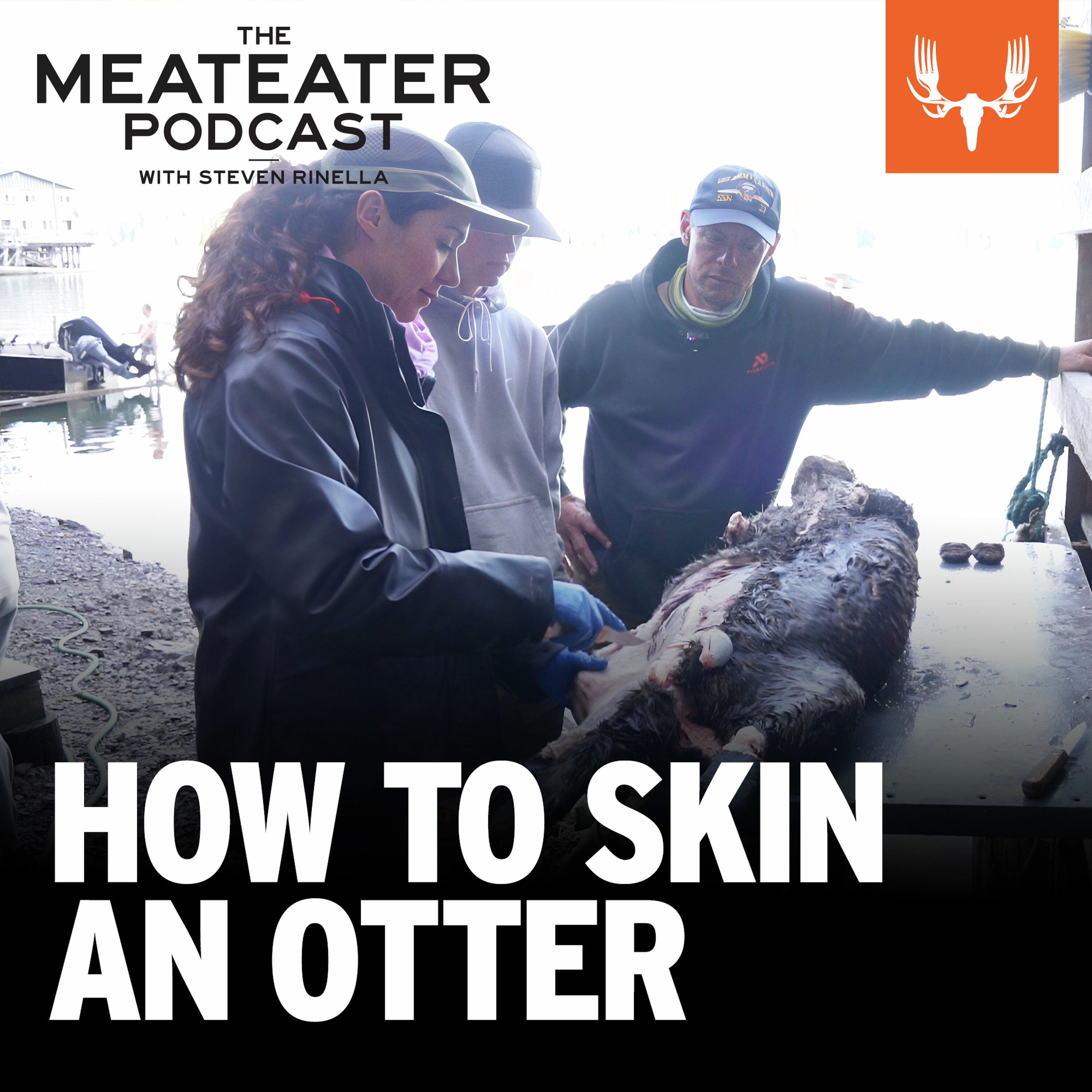
Okay everybody, welcome to a meat eater flop episode. This is the second flop we've done out of Alaska. The first flop we talked to a bush pilot who claims he's not a bush pilot. And those guys are all gone now, so. But a pilot that one would call a bush pilot who says he's not a bush pilot was fought one. Now we're going to talk to a genuine sea otter skinner, Heather Duville, AKA Moosey. Kind of the last of the dying breed or the not the last of a dying breed. The new specimen of an emerging breed of sea otter hunters. And before you have a heart attack, Heather will Explain why it comes that she is allowed to hunt and skin sea otters. And why, say, me or my son James here, are not.
- [03:30]
A
Okay, so this sea otter was legally harvested because by the Marine Mammal Protection act and the agency, I'm able to participate and hunt marine mammals and work with their furs. So.
- [03:48]
B
So you can hunt it, you can skin it, you can make stuff out of it. You can't sell the hide hole, but you can. You make and sell products from sea otter.
- [03:55]
A
H. Right.
- [03:56]
B
The sea otter fur is the densest fur.
- [03:59]
A
Yeah, it's the densest fur out of any mammal. So if you look closely, you guys, this sea otter, you know, I hosed it off. But when you part their fur, that undercoat stays dry. So I brought a little piece of tanned fur, and if you dunk it under the water, you know, it'll look wet. But when you part the fur, that undercoat's always dry. And that's what keeps sea otter warm. They don't have a fat layer like seals do. Not really. Like seals have a thick blubber. Sea otter depend on their incredibly dense coat and these unique properties and their extremely high metabolism, which is why they eat so much. So this one weighs 82 pounds. We weighed it. So this one would consume, like, 20 pounds of shellfish per day.
- [04:54]
B
Wow.
- [04:56]
A
So they have extremely high metabolism.
- [04:58]
B
He's good for 20 pounds of shellfish a day.
- [05:01]
A
Per day. So they can decimate an area pretty quickly when a group of them, you know, move in and.
- [05:11]
B
Damn.
- [05:13]
A
I start by removing the paws. And you can see it on its paws here. That has some scars from digging.
- [05:20]
B
That's the cutest little paw in the world right there.
- [05:23]
A
Got some little retractable claws like a cat. Then I just go around.
- [05:33]
B
Okay, so you moved the front feet. Move the front at the wrist joint. You taking the back feet all the way off?
- [05:39]
A
Nope, I just cut around.
- [05:41]
B
Okay.
- [05:43]
A
And up like this.
- [05:45]
B
Cut up to the vent.
- [05:48]
A
And then same thing on this side.
- [05:51]
B
How many otters are you skinning a year?
- [05:55]
A
Last year, almost 200, and this year, I got about 120 so far.
- [06:03]
B
Okay, and what number are you shooting for?
- [06:09]
A
I've maxed my.
- [06:10]
B
Don't keep the tail.
- [06:11]
A
I've maxed my personal budget for tanning.
- [06:14]
B
That's the limiting factor.
- [06:16]
A
This is my last one.
- [06:18]
B
Okay.
- [06:18]
A
Until I could sell so some items and. And sell them and try to reconnect.
- [06:23]
B
Because it's so expensive to get them tanned.
- [06:25]
A
Yeah, it's about $108 a piece.
- [06:28]
B
All right.
- [06:28]
A
If you send a large Volume, you get a price break. And the price break is about 108.
- [06:33]
B
I noticed you don't retain the tail.
- [06:35]
A
Yeah. So I'm not saving the tail. And I also don't save the face.
- [06:39]
B
So in that way, it's a lot different than normal, skinny, normal furbearers. Because in a normal furbearer, you want. You gotta have the tail and the face or else they'll call it damaged.
- [06:48]
A
Right. And we can't sell whole pelts.
- [06:51]
B
Yep. So you just want. Usable to you.
- [06:54]
A
I used to skin the whole thing and keep the face and tail on the pelt. But since it's illegal to sell whole pelts and it's illegal for anyone who is ineligible through the Marine Mammal Protection act to obtain one, they've gone missing. When I've sent them off to tanneries, they've gone missing off air cargo from. From a tannery I had used. So if they're not whole to begin with, they're less likely to go missing. And I haven't had one go missing since we've had boxes of them go missing.
- [07:33]
B
No kidding. Whole high. So if you. Even if you didn't sell it, but gave it to me, I legally wouldn't be able to retain this.
- [07:40]
A
Right. Not a whole pelt. It has to be converted to what is called a authentic native handicraft. This is a male. Yeah. It has to be sewn into something where you can't make it whole.
- [07:57]
B
Got it again. And then getting started here is your limiting factor in how many products you make. Because you make scarves, hats, mittens, pillows. Is your. Are you limited mostly by how many you can sew? Like how much you can sew? Or are you limited by how much you can hunt?
- [08:16]
A
I would go out and hunt every day if I could. As many as I can, whenever I can. Because they're trying to hunt to achieve some sort of balance in our ecosystem because there's just an overabundant population of sea otters and we're not able to harvest, you know, the shellfish that we used to anymore. But I prefer to hunt. I like to be outside on this, you know.
- [08:44]
B
You prefer that to sewing?
- [08:46]
A
Yeah. And I. I reserve sewing for those late fall and winter months where it's pouring rain, blowing 60 dark. Yeah. My dad sharpened this knife. It's so sharp.
- [09:03]
B
He told me he did. It's sharp. It's ridiculously sharp. So he said sharp. Yeah.
- [09:09]
A
The only other person that sharpened my knife and got it razor sharp, like my dad does, as you. He sharpened My knife one time.
- [09:17]
B
Yeah.
- [09:18]
A
And I was like. So I took this first cut. I was like, ah. Because I got close, because I cannot get my knives this sharp. But you and my dad are pros now.
- [09:30]
B
Just for people that aren't. This is on video if you want to go check it out on video. But there's a good chance you're just listening, so.
- [09:37]
A
Oh, okay.
- [09:39]
C
Heather has gotten the otter.
- [09:42]
B
Cut around the bait. Cut around all four legs, cut around.
- [09:44]
C
The base of the tail.
- [09:45]
B
Open it up from chin down to chin to groin.
- [09:49]
A
And we skin this on a table flat. Well, typically at home, I'd use my tailgate truck. So you don't hang them.
- [09:58]
B
Why a tailgate?
- [10:01]
A
It works better for us to just skin them flat and roll them.
- [10:06]
B
Okay.
- [10:07]
A
Same as a seal. So we'd skin a seal the same way. I have two different knives. Not a drop point girl. This is my skinning knife. So I prefer a skinning knife that isn't a drop point. And then I have this flat, like a four and a half inch knife for roughing around the paws, you know, to remove them. And going around those bony areas is.
- [10:33]
B
The bruising on the hide from getting in a fight with another otter.
- [10:41]
A
Yeah. Sometimes they have bruises like there was one we saw here.
- [10:47]
B
They do get out with each other.
- [10:48]
A
They scrap. Especially these. These big males are pretty aggressive. And they.
- [10:52]
B
Yeah, this sucker is like.
- [10:53]
C
I. I just would never guess that these.
- [10:56]
B
That they're as big as they are.
- [10:57]
C
Like, you've.
- [10:57]
B
You've gotten them close to 100 pounds.
- [11:00]
A
Yeah, this one weighs, you know, like 82 pounds. But the. The largest one I ever got was 99 pounds. And.
- [11:16]
B
You know, I got a question for you. Like, in just while we're on it here, just interrupt you.
- [11:21]
A
Yeah.
- [11:23]
B
In, like cleaning normal furbearers, you never would want to skin them soaking wet like this. You'd always want to dry them first. How do you venture. How do you dry it?
- [11:35]
A
So I would flesh it. I flush all these with the pressure washer. So as you can see, I'm skinning it and I'm just roughing it out.
- [11:45]
B
Yep.
- [11:46]
A
Because you can spend an hour skipping skinning it real close, or I could spend 10 minutes skinning it like this and 10 minutes flushing it with the pressure washer. So when working with large volumes, you want to be as efficient as possible.
- [12:00]
B
And you're going to get it wet when you flush it anyways.
- [12:02]
A
Yeah. And so then I would salt it, you know, let it drip after I flush it. Salt it, fold it the hot dog way, you know, in and roll it and let it cure for like three days. And that'll dry it out, shake it out. And you have to hang it with a dehumidifier in my greenhouse, which is now my fur drying shed. And they dry. They're cured and dried. So here's another bruise. See that on its back?
- [12:32]
B
That's him duking it out with his bodies. Yeah, or enemies. So would a male like this be territorial over a certain area or do they move around?
- [12:42]
A
I think so. The big males like this, they tend to be more like lo, this guy was alone, not with the pod. And usually when you see a single one like that. Can I. He's by here just a minute. Usually when you see one just single, it's typically a bigger male.
- [13:05]
C
The rivalries, the marching bands, the upsets. Saturdays just got way more fun. College football is back. Think you know the game? Put your knowledge to the test with DraftKings sportsbook and turn your picks into big payouts with live betting, rivalry week, odds boosts, and more. DraftKings sportsbook has everything you need to own every Saturday. Here's something special for first timers. New DraftKings customers bet $5 and get $300 in bonus bets instantly. Download the Draft Kings sportsbook app and use Code Me Eater. That's Code Me Eater for new customers to get 300 DOL bonus bets instantly. When you bet just five bucks in partnership with DraftKings Sportsbook, the crown is yours. You got a gambling problem, call 1-800-GAMBLER in New York. Call 877-8-HOPE NY or text HOPE NY. That's 467-369. In Connecticut, help is available for problem gambling. Call 888-789-7777 or visit 7ccpg.org Please play responsibly on behalf of Boot Hill Casino and Resort in Kansas. Fees May apply in Illinois 21 +. Age and eligibility varies by jurisdiction.
- [14:27]
B
Void.
- [14:27]
C
In Ontario, bonus bets expire seven days after issuance. For additional terms and responsible gaming resources, see DKNG co Audio. You ever drive past a piece of land and wonder who owns that? Or maybe you need to know where exactly a property line runs. Well, that is where ONX Hunt comes in. And it's not just for hunters. There are folks using ONX for their jobs every day throughout the country. If you need the best land ownership maps, aerial imagery, and property boundaries in your pocket, ONX Hunt is the tool for the job. Try it free for 7 days. Download onx hunt in the app or Google Play store or visit onxmaps.comhunt to get started. Warning. This product contains nicotine. Nicotine is an addictive chemical. Black Buffalo products are intended for adults aged 21 and older who are consumers of nicotine or tobacco. If you're 21 or older and use nicotine or tobacco, it's time you charge ahead to America's only credible smokeless tobacco alternative, Black Buffalo. Now available at thousands of best in class retailers across the USA like Wawa, Circle, K Sheets, Loves Pilot, Racetrack and many more that you can find using their store locator. Black Buffalo Tobacco Alternative was established in the good old US of A in 2015. It dips just like the real thing without the tobacco leaf or stem. Black Buffalo's long cut and pouches are made of barn cured leafy greens with food grade ingredients and USP grade nicotine. Brand ambassadors like MMA hall of Famer Cowboy Cerrone, professional race car champion Ryan Blaney and country music star Larry Fleet all proudly dip Black Buffalo. An American brand built on respect. No compromise. If you're looking for a real dip experience, long cut or pouches, go to blackbuffalo.com and use their store locator to find a retailer near you or ship Black Buffalo products directly to you. In most states. Black Buffalo Tobacco Alternative it's everything you love about dip, nothing you don't.
- [16:39]
B
How long did it take you to skin your first one compared to where you're at now?
- [16:44]
A
I just talking about this. Oh man, I remember my dad, my dad teaches you, he shows you once. That's how he learned. Then he gives you the knife. So. So I'm out there by myself in the dark with the headlamp. You know, it's winter and it took me like an hour and a half and I thought, oh man, I'll never be able to do this. And he's so good at it and.
- [17:08]
B
Oh, so your dad is good at. Was good at skinning otters already?
- [17:12]
A
Yeah, like 10 minutes. So after a lot of practice, you know, now I could skin one in about 10 minutes too. But initially it took me like an hour and a half. I was pretty discouraged, but I didn't want to give up. So I'm going to turn this guy around and same thing on this side. So. And sometimes this is called the usyk.
- [17:47]
B
Yeah man.
- [17:48]
A
Sometimes those are broke.
- [17:50]
B
Oh really?
- [17:51]
A
Yeah.
- [17:52]
B
Huh. So I always check my dad had a term that would basically in Italian. What was it that you were a dead dick. That would. Well, that would. He would qualify.
- [18:09]
A
You know, sometimes they're broke because they're pretty aggressive.
- [18:14]
B
But. Huh.
- [18:16]
C
You've seen broken Usyk's sea otter?
- [18:19]
A
Oh actually don't know if I've ever seen the other kind of Usyk. But yeah, sometimes they're broken. Sometimes you find sea otter at bullets in them. And I, I have a jar. Every year I keep a jar and whatever I pull out of them. Bird shot. 22 bullets. 223 I pulled out of there. I keep them.
- [18:46]
B
Okay.
- [18:46]
C
So now the otter's on his back.
- [18:48]
B
She's skinning from the center line back the yard direction. He's half done, right?
- [18:54]
A
Yeah, half done.
- [18:57]
B
And then just. We won't see this part but just as you're doing this so you're gonna get this skin off and like you said you're going fast. So you leave on, you're leaving on a lot of. Leaving on a lot of muscle, some fat. We did a flop with some guys skin in Africa and they clean skinned so they didn't go back and flesh anything. They would just take two guys take all the time in the world just to totally clean skin something. But you're doing a rougher skin kind.
- [19:24]
A
Of roughing it out because typically you'd hunt in larger volumes. So if you have 15 to skin and they're, they are incredibly dense fur is going to hold that body heat. You get the pelt off. Got it.
- [19:38]
B
Got it.
- [19:38]
A
You can't wait till tomorrow. They'll get a green belly and it will start to spoil.
- [19:42]
B
So and when you. And you'll flash with, you'll lay it out down by the beach so you don't make a mess and you flush with a pressure washer.
- [19:51]
A
Yeah.
- [19:52]
B
And that comes off just clean.
- [19:54]
A
Yeah, it's pretty incredible tool.
- [19:57]
B
And then from there so then you got a soaking wet but clean flesh hide. And then you're laying it and really just packing it in salt, gonna lay.
- [20:08]
A
It flat, let it drip, you know, and then rub salt on it just like you would salt any hide.
- [20:13]
B
Okay.
- [20:14]
A
And then both sides. Nope, just the, just the skin side.
- [20:18]
B
Okay.
- [20:19]
A
Sometimes I put just the salt from the table. It's you know, there from previous hides.
- [20:25]
B
And I mean but a hide like this is going to use a few pounds of salt, right.
- [20:30]
A
I think I can salt about 10 pelts with a 50 pound bag of salt.
- [20:35]
B
Okay. All right.
- [20:36]
A
I usually go through over a thousand pounds of salt a year.
- [20:39]
B
Okay. So you pack 5 pounds of salt on a hide like this.
- [20:43]
A
Yeah.
- [20:44]
B
And it has to be sit there how many days to cure?
- [20:46]
A
About three days you want at least three days. We live in, you know, a really wet climate, so you want to make sure it's fully cured. Then you shake it out and hang it up to dry. I use a dehumidifier to aid in the drying process, or else I don't think it ever would dry. Where we live, it's just too rainy, too humid. And each tannery has a different preference and how you mail your pelt. So some. Some tanneries for sea otters, they'll flesh them for you.
- [21:24]
B
Really?
- [21:24]
A
So you just skin them like this, rough them out, salt them, and chip them. But the tannery I use wants them skin fleshed, salted, and dried.
- [21:33]
B
Got it. What do you think of this matty, man? Yeah, I think you like Seth's camera angle.
- [21:39]
A
Should we see what it's been eating when we're all done? My guess is clams hang tight for.
- [21:45]
B
What it's been eating, buddy.
- [21:46]
A
And, hey, we know the clams aren't hot if it's got clams.
- [21:50]
B
That's true. That. We just eat them straight out of there. Okay, now you're on the finishing touches. You've skinned both sides back to the backbone, and now you're just skinning down the backbone.
- [21:57]
A
So sea otter's on its belly, skinning, and it does have a little. Normally they're. This would be all purple, so no fat at all. Sea otters where I live on the other side of the island are pretty skinny, actually.
- [22:15]
B
And it's. What interesting thing about these sea otters, too, is, like, you think of people that. People that first came when, like, Euro Americans first showed up. Well, not just Euro Americans. People come from Mexico and all over the world. Yeah. Showed up in, like, California was like the gold rush brought in outsiders. In southeast Alaska, it was sea otters brought in outsiders.
- [22:41]
A
Yeah, they were. They were referred to. Their fur was referred to as soft gold.
- [22:47]
B
Soft gold.
- [22:47]
A
And it took a hundred years for, you know, Russians and the fur trade. It took a hundred years to wipe out the population. Yeah. And so in 1911, with the fur seal treaty was signed that ended the fur trade, there was zero sea otters in most of the state. I think there's just a few left in the Aleutian chain.
- [23:11]
B
Took a century to do it.
- [23:12]
A
Yeah, a hundred.
- [23:14]
B
So I never thought about, like, I never thought about the timeline on that.
- [23:19]
A
Yeah. And anyway, I'm going around the face here. So I'm just sort of cutting around the nose because I don't, you know, I don't save the face or the Tail. And then we can take a look and see what it's been eating. And I collect data on all the sea otters that I get.
- [23:46]
B
That's it. Hides off.
- [23:47]
A
Hides off.
- [23:48]
B
Hold it up for the camera. Okay, Jimmy, help hold that up.
- [23:55]
C
That's a slick table.
- [23:56]
B
That's not actually a table. There's a lid to some kind of box.
- [24:00]
A
Oh, no, it's hooked. There you go.
- [24:04]
B
So holds off. No, holds off. You're fine.
- [24:09]
A
Here we go. I could rinse it. It would look better.
- [24:14]
B
About 5ft tall.
- [24:15]
A
It weighed more than the halibut that was caught today.
- [24:18]
B
Yep. Weighed more than a big halibut.
- [24:22]
A
And we could see what it's been eating.
- [24:24]
B
Okay, that'll be the end of the. That'll be the end of our flop is the reveal.
- [24:27]
A
Can I set this right here, Maddie?
- [24:29]
B
Man.
- [24:30]
A
All right, Any guesses?
- [24:31]
B
Maddie? Clams.
- [24:36]
A
I'm gonna guess clamps.
- [24:38]
B
How much weight will that hide retain compared to. Would this be a 70 pound?
- [24:45]
A
Oh, that's a good question. I mean, because the hide has, you know, some of them.
- [24:50]
B
Yeah, Mad. You can perch up on that table or whatever and stand and watch, but don't get in front of that camera. Okay. Don't block the view, but you can perch up and watch what's going on.
- [24:59]
A
Any guesses on what it's been eating? Guess. Shrimp.
- [25:03]
B
Shrimp.
- [25:03]
A
I'm going to guess clams now. Sea otter guts is one of the worst smells I've ever smelled. Are you ready?
- [25:14]
B
What's that?
- [25:15]
A
Sometimes I do. Sometimes I wretch.
- [25:18]
B
Seriously?
- [25:19]
A
Yes. It's. It's. I never know.
- [25:23]
B
You want to change your guess from shrimp? I like the sounds of shrimp.
- [25:26]
A
He's guessing, Mabel.
- [25:27]
B
What's your guess, buddy? What he's been eating.
- [25:35]
A
Fish.
- [25:36]
B
Fish. We got shrimp. We got fish. Kindly urchins. Urchins, Conley.
- [25:42]
A
I guess clams.
- [25:43]
B
You going clams? Shrimps. To clams. Connie, what are you guessing?
- [25:48]
A
Oh, man.
- [25:50]
B
Yeah. Damn.
- [25:51]
A
It's the worst.
- [25:52]
B
Like that.
- [25:53]
A
Wow.
- [25:53]
B
Yeah, that's strong. Who thought a sea otter's guts would smell so bad?
- [26:00]
A
So I noticed in the warmer. On the warmer days, a lot of times their belly's empty.
- [26:07]
B
Yeah, like his. Look at that.
- [26:08]
A
Because they don't need as much food to keep warm. Oh, God. Nothing. Nothing.
- [26:18]
B
Who guessed nothing? No, Connolly, you never made a guess.
- [26:23]
A
You could see what it's been eating.
- [26:24]
B
Yesterday, what he meant to say was nothing. When he held his. When he held his tongue, he meant nothing.
- [26:29]
A
What about yesterday?
- [26:32]
B
He hasn't eaten yet today.
- [26:33]
A
Yesterday. Lord knows crab Is it crab legs? Is that what I see in there?
- [26:40]
B
Well, that one's a crab leg. You see a crab leg in there? Look, right here.
- [26:46]
A
This is. I just. This is such a strong smell. Oh, is this an. Oh, little crab.
- [26:52]
B
Shrimp? No.
- [26:54]
A
See the little.
- [26:55]
B
What are you seeing there, Jimmy? Get your nose in there and tell me what you see.
- [26:59]
A
Oh, urchin. Who said urchin?
- [27:02]
B
A little bit of everything. Urchin. Crab. Is that clam? The shells right here.
- [27:10]
A
See the needles? That's an urchin, which I'm shocked it even found one.
- [27:14]
B
Taste that, Jimmy. Are we allowed to possess you? Do it all. Do it, Heather.
- [27:21]
A
As gringos or No, I think that. I tried to check and I think there's no provision. I don't know. I shouldn't say this because I don't. I'm not.
- [27:33]
B
We gotta look.
- [27:34]
A
From what I. Yeah, I heard, I heard, but look, it's not. They're usually never intact because you shoot them in the head.
- [27:44]
B
All right, there you have it. Ladies and gentlemen. Me Eater Flop Episode Sea Otter Hunter Skinner Heather Duville. Skin to how much? 82 pounder. 82 pounds into 82 pound otter. The work has just begun. If you're curious, he did not eat today. Yesterday he had a quite a little variety. Hit a captain's platter yesterday of seafood items.
- [28:07]
A
Found an urchin.
- [28:08]
B
Yeah. And we had a kid named Conley who kind of made the right guess by not saying anything when I asked what it ate.
- [28:14]
A
Perfect. Nothing.
- [28:15]
B
Thank you for joining.
- [28:27]
A
Foreign.
- [28:34]
D
This podcast is supported by BetterHelp, offering licensed therapists you can connect with via video phone or chat. Here's BetterHelp, head of clinical operations, Hesu Jo discussing who can benefit from therapy. I think a lot of people think that you're supposed to be going to therapy once you're like having panic attacks every day. But. But before you get to that point, I think once you start even noticing that you feel a little bit off and you can't maintain this harmony that you once had in relationships. That could be a sign that maybe you want to go talk to somebody. There's always a benefit in talking to someone because we can all benefit from improved insight about ourselves and who we are and how we behave with other people. So if you're human, that's like a good indicator that you could benefit from talking to somebody. Find out if therapy is right for you. Visit betterhelp.com today. That's betterhelp.com.
- [29:30]
C
Replace doom scrolling with deer scrolling or deer scouting. Introducing Moultrie's newest line of cellular trail cameras, the Edge 3 and Edge 3 Pro on your phone, you'll get crystal clear images day or night, with improved image quality and faster trigger speeds. Use on demand to instantly receive trail cam photos or videos anytime you want. No matter where you place your camera, the Edge 3 finds the strongest cell signal, automatically ensuring a reliable connection. Download the Moultrie app today and get yourself an Edge 3 cellular trail camera@moultrie.com this episode is brought to you in part by Little Camper. And this is apropos because I recently uncovered out in the woods camping some guy' stash of rusted green £1 disposable propane canisters, which annoyed me no end. Well, hear this Zero Waste Camping is possible. You got to find the right gear that's durable, sustainable, and won't actually end up in a landfill once it's worn out. That's why Little Camper makes it easy to choose Zero Waste Propane for your next camping trip, pick the exchangeable zero waste 1 pound propane cylinder. Find a retailer at Little Camper that's with a k.comeater little camper what fuels you?
- [30:54]
A
This is an iHeart podcast.