Loading summary
Transcript1 lines
- [00:00]
A
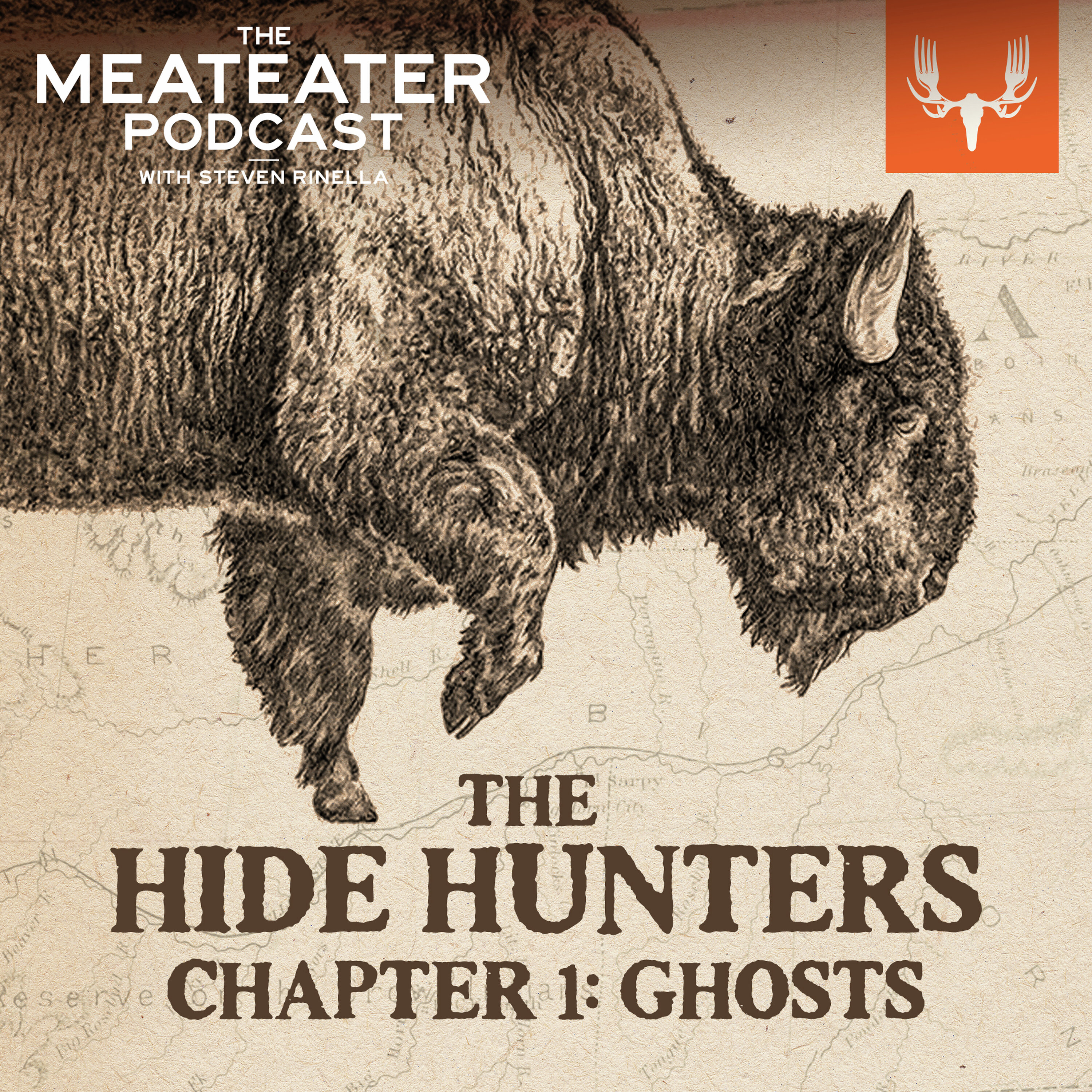
This is an iHeart podcast. Real hunts rarely go as planned. That's where first lights navigator hoodie earns its place. Our crews have run it from September climbs to cold front sits it manages temps, stays quiet and close encounters and wicks moisture on the uphill push. One layer that adapts without hesitation. No matter the pursuit, the Navigator delivers versatility in any situation. Shop now at first light.com that's F I R S T L I T E dot com thanks for listening to our latest bonus drop of the Meat Eater Podcast. What you're about to hear is a chapter from our new audio Original Meat Eaters American History The Hide Hunters 1865-1883 if you like what you're hearing, you can go find the complete work anywhere that you get your audio books. Again, Meat Eaters American History the Hide Hunters, 1865-1883 and here's a little taste called Ghosts Chapter 1 Ghosts Foreign let's get something cleared up right away before we even begin this story. There is no difference between the animal known as the American buffalo and the animal known as a bison. Both names refer to the creature whose scientific name is Bison. Bison. The confusion about this meaning, the confusion about whether you call them buffalo or bison, stems from the fact that Europeans who arrived in what is now America didn't know what to make of these 1000 pound or even 2000 pound cattle, like creatures with sharply curved horns, hugely humped backs, woolly textured hides, and delicious meat. At various times, various people called them cows, crook backed oxen, and le boeuf sauvage, which translates to wild beeves. But eventually they settled on buffalo because the animal did look a hell of a lot like its distant relatives, the Cape buffalo of Africa and the water buffalo of Asia. Eventually, though, it began occurring to folks that similarities be damned, the animal wasn't technically a buffalo species, so the name began to gradually shift to bison. And the bison adopters started to correct the buffalo users in classic know it all fashion, usually by saying something like did you know that it's actually called a bison? So if you are one of these folks who has to roll their eyes or feign confusion whenever you hear them called buffalo, I'm sorry, you are in for a rough ride on this story because this is a story about buffalo. American buffalo. If you know only one thing about these animals, it's probably this. There used to be a hell of a lot of them, and now there aren't that many. For most Americans, the buffalo doesn't symbolize wild nature in the way that a wolf or an elk or a mountain goat does. Instead, these massive creatures call to mind a lost world. When we look at the animals in the few places where they still exist as a wild creature, they bring to mind a sort of sadness or a sense of regret that things hadn't gone differently for the species, and in a way, differently for us as Americans who love wildlife as well. This here is the story of the men who brought that unfortunate reality into existence. They refer to themselves as buffalo hunters, but we know of them today as the hide hunters. In little more than a decade after the end of the Civil War, they wiped the Great Plains clear of their most stunning, most visible and most important wildlife species, the American buffalo. In the 1870s and early 1880s, commercial demand for leather made from the skin of these animals allowed the hide hunters to make a living shooting and skinning them by the thousands, individually, and by the millions collectively. At the most basic level, hide hunters were market hunters, A term that refers to individuals who kill wild animals to sell their meat, skin, feathers, horns, or any other part of their bodies that has commercial value. Over the course of American history, there have been a number of market hunting booms. And it's no coincidence that these eras have left us with some of our wildest tales of wilderness adventure. Daniel Boone was a market hunter who trafficked in white tail deer skins in the mid to late 1700s. Davy Crockett was a market hunter who trafficked in bear meat and bear grease in the early 1800s. Jim Bridger and John Coulter were market hunters who trafficked in beaver skins for a handful of decades, ending at around 1840. Each of these generations and each of these individuals pursued this unique existence for a variety of different reasons. But above all else, their primary motivation was financial. Whitetail hunting for Boone, beaver trapping for Bridger, buffalo hunting for the hide hunters was a lifestyle, sure, but most importantly, we need to understand it as a livelihood. These buffalo hide hunters did their work with ruthless efficiency from the sweltering plains of Texas to the frozen plains of the Canadian border, Armed with what we might call the next generation weapons of their day. High powered breach loading rifles, some with telescopic sights that could drop a £2,000 bull buffalo at distances that most shooters today would have a hard time matching. Despite how foreign the actions of these men might seem to US in the 21st century, this tragic, stunning, jaw dropping, awe inspiring saga took place in a world that is not so terribly distant from the one we live in now. In addition to shooting guns that fired brass casings, they read newspapers, they traveled by train, and they ordered some of the things they wanted, including sometimes their rifles through the mail. Many of them, years after the slaughter, would flip light switches. Some would even drive cars. And yet they carried out a campaign of unintentional eradication that is unthinkable to us today. The hidehunters didn't arrive in ships from across the ocean. They weren't exploring places that had never been seen by a white man. They didn't rack up a list of crazy firsts. The first person of European descent to reach the Texas Panhandle, where a good hunk of this story takes place, got there 324 years before the start of this story. It was the Spanish conquistador Coronado, the first non indigenous people to cross the continent. The Lewis and Clark expedition had done so 60 years before the start of this story. There are no frontier luminaries in here. There are no Daniel Boone's or Jim Bridgers among the hidehunters. We've mythologized those hunters and trappers into honorary founding fathers. They star in countless films and TV shows and songs and campfire tales. But the hidehunters, they don't make movies about them. Children don't play games pretending to be them. Sure, a few of the hidehunters became well known for doing other stuff later on, like being gunfighters and ranchers and entertainers and conservationists. But their names as hidehunters are largely absent from the annals of history. There were maybe about 5,000 of them in total who worked as either a shooter, a skinner, or simply a hired hand. There were many colorful characters, some with quite descriptive nicknames. You had Charles Squirrel Eye, Emery, Sore Toed Joe, Limpy, Jim Smith. You had Snuffer, Soda Water Jack, Three Finger Foley, and Buffalo Jones. Dirty Face Jones got his name when a bullet intended to kill him missed his head. But his would be killer was so close that the burning flash of powder seared his cheeks and nose. You could be forgiven for confusing Dirty Face Jones with Powder Face Hudson, but it's two different fellas. Wrong Wheeled Jones committed an innocent act of stupidity that he never lived down when he insisted to a group of his fellow hunters that it was impossible to replace a broken wheel on the right side of a wagon with a wheel from the left side. To illustrate the fraught nature of their work, consider just a few short things about skunks. The hide hunter Skunk Johnson is largely remembered for an episode when he was trapped inside his cave like shelter, known as a dugout by a party of hostile Indians. The siege lasted 15 days, during which time he only ate skunks. Another hunter, known as Kentuck, was bitten by a rabid skunk, causing him to crawl underneath a railroad water tank in a delusional fit, where he died. A third hidehunter, whose name is lost to history, also suffered a bite from a rabid skunk. When he felt the beginning of a spasm of hydrophobia, as the condition was known, he walked out behind a building and swallowed a gulp of strychnine, which the hide hunters used to protect their stacks of buffalo skins from bugs, vermin and other prairie scavengers, and also on occasion, to poison wolves for a little side money that could be made from selling their hides. These were not wealthy or well connected men. They were as blue collar working class as it gets. They were poor guys, born in places like Pennsylvania and Georgia and Illinois to farmers and blacksmiths and barrel makers. A great many of the hide hunters had been tangled up in the horrors of the civil war on both sides of that conflict, as fighting men, killing buffalo by the dozens and sometimes upwards of 100 in a day per man, the hide hunters wrought perhaps the most egregious episode of natural resource over exploitation in the history of the United States. States, if not the world. We simply don't have any other examples, at least in the historical era, of a comparable widely distributed wildlife species pushed to the brink of collapse so quickly by the hands of man. Whatever one thinks about the outcome of all that killing, and there's really only one thing to think, which is what an incredible waste. You can't escape from the reality of that these guys were absolute masters of their craft. They were tough, they craved adventure. They had incredible endurance. They could think fast, they could shoot, they could fight, they were brave to the point that it resembles a suicidal recklessness. And man, they could work like work harder than anyone you're ever likely to encounter in your own life today. What made the era of the hidehunters possible was a combination of factors too big and complex for most of them to have fully comprehended. In hindsight, it looks like a perfect storm. For one, consider the impact of the railroads. Long hunters like Daniel Boone and mountain men like Jim Bridger were distinctly pre industrial. They operated within the natural constraints of muscle and bone, the great bottleneck. And their operations was the cold reality of needing to move goods, deer skins and beaver pelts respectively, to market on the backs of horses and mules. For Boone, this meant leading a small string of horses over rough trails through The Cumberland Gap and across the Appalachian Mountains. The mountain men who plied the streams of the Rockies in the 1820s and 1830s moved their furs via an annual pack train that took several weeks to cross the plains. Even in good weather, their operations were fueled and limited in scale by equine conveyance. For the hidehunters, the railroads transformed everything. The heavy, cumbersome, quite rigid hides of buffalo were shipped back to the tanneries of the east in such quantities that they could not possibly have been moved by wagon train or horseback. The timeline alone reveals the connection with stunning clarity. It is no coincidence that the hunt in Kansas erupted in 1872, the same year that the Topeka and Santa Fe railroad arrived in Dodge City. It is no coincidence that the height of the killing in Texas followed the arrival of the railroad in Fort Worth on July 4, 1876. And once again, it is no coincidence that the northern herd was quickly wiped out following the extension of the Northern Pacific Railroad to Miles City in 1881. At the same time, the proliferation of factory machines and the accelerating industrialization of the American economy created an insatiable demand for tough, elastic leather that could be used as drive belts, as in factory belting. Picture for a moment the timing belt in your car or in your snowmobile. It's essentially a strap running around two wheels, so that when one wheel turns two, typically powered by a motor, the wheel on the other end turns as well. Simply put, a belt transmits power from one place to another. And in the ever expanding industrial economy of the late 1800s, miles of belting were needed to apply power generated by steam or water wheels to looms, saws, lathes, and any number of applications where machines were doing work that was once done by hand. Buffalo leather, which compared to cattle leather, was more elastic, while also incredibly tough, served as an ideal material for machine belting. And at the very moment that transportation networks were able to deliver buffalo hides by the millions to eastern tanneries, and those eastern tanneries were able to sell unlimited quantities of those processed hides. Advances in firearms technology accelerated by the Civil War, made the American rifleman exponentially more effective than his predecessors of only a few decades before. Earlier breech loading rifles, to say nothing of the muzzleloaders that came before them, were too underpowered, too inaccurate, and too clumsy to reload to have been capable of the buffalo killing that the hide hunters unleashed on the plains. We'll get into the specifics of those rifles later on. But just as our story would have been impossible without the railroad, it would have been impossible without the cutting edge firearms of the post Civil War era. The Civil War lurks in the background of this story as a sort of dark prequel. In the title of this work, you'll notice the date range 1865 to 1883. Well, 1865 is the year the Civil War ended. The aftermath of that bloody war between the states pushed out westward a restless generation of men in search of work and opportunity. It pushed them away from the war ravaged cities and agricultural communities of Southern Reconstruction, away from the strictured discipline and meager rations of military service, away from the insecurity and claustrophobia of the family farm, away from the starvation wages of the northern factory floor. On the distant plains of the American west, they saw a new life of promise, adventure and cash. When the temperatures drop and the rut heats up, your system needs to hold up. This is where First Light's core and thermic kits come in. The core kit adds warmth without bulk, perfect for all day, sits during shifting weather. And the thermic kit? It's built for the brutal, cold, silent, durable, and designed for hunters who don't head back to the truck when the forecast turns. Because late October isn't forgiving, Cheap gear folds, bulky layers get noisy. First light helps you stay focused when everything else is working against you. There's no shortcuts, no compromise. The long sit starts here. Head over to first light.com and get cold front ready. That's first light. L I t e dot com a couple of years ago I sat for a lengthy interview for a Ken Burns documentary on the history of the American buffalo, and during the editing process I was invited to offer feedback. My primary concern with an early version of the series was that its short treatment of the subject of the high hide hunters dehumanize them. It made it seem as though they were motivated by some sadistic desire to destroy American wildlife. It's understandable how people would get that idea, but it's naive. Rather than imagining the hide hunters as soulless hellbillies, it's better to see them as the vanguard of industrial capitalism on the western plains. In today's world, serious thinkers don't personally blame an Appalachian born coal miner for air pollution. We don't blame frontline soldiers for the conflicts they fight in. And we don't blame the guys driving concrete trucks and hanging drywall for suburban sprawl. Now to that you might say, well, the buffalo hunters knew what they were doing, and the collective consequences of their individual actions were incredibly costly. Well, if in 50 years all of the most apocalyptic predictions about global warming have come true. I'm not going to say that a guy making a living in a North Dakota oil field was a bad guy, and I'm not going to cite all of the times you turned on your air conditioner or failed to organize carpools instead of driving alone. I'd instead point my finger at political inertia, societal indifference, the perceived imperative of economic growth, and the human tendency to endure changes for the worse rather than trying to remedy them. Not that these guys were saints. They most certainly were not. It's fair to say that most held the same prejudiced views of Native people that were common at the time, and they did not keep those prejudiced views to themselves either. Some of them were objectively villainous figures, and many had a real penchant for violence. And I hope it's clear by now that I mourn the consequences of their actions. At the same time, to understand them as real people requires recognizing the larger systems and structures of which they were just one small part, and acknowledging that everyone has limited choices from which to choose. As the hide hunter Frank Mayer said of his time shooting buffalo on the plains, he had a hide. The hide was worth money. I was young, 22. I could shoot. I'd like to hunt. Wouldn't you have done the same thing? If I'm answering that question honestly, as your author sitting at a microphone, as a guy who lives for hunting and fishing, and I put myself back in Frank Mayer's shoes, I think the answer would be, yeah, I would have done the same damn thing. If you've never heard of Frank Mayer, you can forgive yourself. To put a human face on old Frank, here's a bit about him. Born in 1850, he was a 13 year old drummer boy for his father's artillery unit when he witnessed the Battle of Gettysburg firsthand, where one man died for about every 10 seconds of fighting. From age 22 to 28, Mayor hunted buffalo on the plains of Kansas and Texas, killing thousands. By the time the old Hyde Hunter died on February 12, 1954, my own father was 30 years old. Hugh Hefner was publishing Playboy magazine, and the Korean War was over. Mayer had survived some of the bloodiest battles of the Civil War and lived into the age of nuclear submarines, Burger King and Corvettes. Mayer is one of those hidehunters we know a lot about. There are some others, such as Charles Rath and J. Wright Moore. These guys were pioneers of the trade, recognized by their contemporaries as influential characters. If you read anything about this era, you'll run into their names again and again. They appear throughout the historical record in ledgers, diaries, receipts, newspaper articles, and legal documents related to their careers as hidehunters. Other hidehunters recorded their experiences in great detail later on in life, either for posterity's sake or to make a little money. Among those is John Cook, who published a memoir, the Border and the Buffalo, in 1907. During the Civil War, Cook fought for the Union along the bloody boundary between Missouri and Kansas, where guerrilla forces committed some of the most gruesome atrocities of that conflict. Afterward, like many of his fellow veterans, he drifted westward. From the fall of 1874 until the spring of 1878, Cook hunted the panhandle of Texas. His descriptions of the day to day business of hunting and skinning are vividly detailed. Many hidehunters, like George Rygard, were interviewed later in life by local reporters writing for readerships hungry for stories from the so called Old West. Reigard was born in Pennsylvania in 1847 and enlisted in the 22nd Cavalry one month after the Battle of Gettysburg, at 16 years of age. After being wounded and discharged from the army, he set out for western Kansas where he drove freight wagons and marveled at his strange new surroundings before adopting the occupation of a hide hunter. Between 1871 and 1873, Reigard killed more than 5,000 animals. It was, he recalled, buffalo butchery by wholesale. What makes the story you're about to hear so historically significant and so viscerally tragic is that the hidehunters came at the end, or rather caused the end, of a long procession of buffalo hunters who'd been chasing the animals for more than 10,000 years across the landscapes that we now call the United States. Their actions closed out one of the longest running cultural and economic life ways that this planet has ever seen since the arrival of the very first humans in North America. And indigenous people nurtured a relationship with these animals that, while it took on different forms at different times, is most remarkable for its sustainability. The first American buffalo hunters were Ice Age immigrants from Siberia who killed a somewhat longer horned variety on the grasslands of northern Alaska using atlatls. Later on, there were buffalo hunters who killed great quantities of the animals by driving them over cliffs in Alberta and Montana and even down into Texas. There were buffalo hunters in the Dakotas who crept up on the animals camouflaged beneath the skins of freshly killed buffalo calves, close enough to sink a carefully placed arrow into their rib cage. And with the spread of equestrian culture among the Plains tribes after the Spanish introduced horses into North America, America, we had Buffalo hunters in western Kansas who chased buffalo down on horseback and got so close they could have jumped onto the buffalo's back, but instead held a smooth bore musket barrel right up to the crease behind the buffalo's shoulder in order to deliver a lead ball into the heart. Without a doubt, the story of each of those buffalo hunting cultures is worthy of a project like this. But this here is not a holistic analysis of the different ways that different people hunted buffalo. Nor is this a comprehensive history of the destruction of the buffalo. That tale of shrinking range and collapsing numbers actually spans hundreds of years in a huge swath of the continent. For our journey ahead, though, a quick overview of that will be helpful to you. When Europeans started penetrating into the various corners of North America over the 1600s and 1700s, they found scattered groups of buffalo and sometimes impressive herds in the woods of Pennsylvania, in stands of cane, along the Ohio river, along streams, in what is now Nashville, Tennessee, on the shores of Chesapeake Bay, and in the rolling hills and tall grass prairies of Wisconsin. And in western Minnesota and Iowa, Daniel Boone frequently targeted them for meat. In Kentucky, as Boone and his contemporaries spread out and pushed ever westward, those eastern buffalo herds were killed off one by one by pot hunters feeding their families and small scale market hunters looking to make a buck. The various states buffalo populations fell like European nations in the wake of the German blitzkrieg. Boone's own son Nathan killed the last buffalo in Virginia in 1797. North Carolina wiped out theirs in 1799 and Kentucky did the same one year later. Pennsylvania the year after that. Louisiana killed its Last Buffalo in 1803 and the last in Illinois and Ohio died in 1808. Tennessee, 1823. West Virginia 1825. Wisconsin 1832. By the close of the Civil War in 1865, which again begins the story of the hide hunters that I'm going to tell here, the animals were still mind blowingly abundant in what you might think of as the core of their historic range, the American Great Plains and the intermountain valleys of the Rockies. Buffalo were still in the panhandle of North Texas. They were still in western Oklahoma, western Kansas, western Nebraska. They were still in north and South Dakota. Montana, Wyoming and Colorado were loaded. There were still buffalo in northern New Mexico. Admittedly the best research out there today indicates that the herds wiped out by the hide hunters were were already diminished by a host of factors besides bullets. A record drought between 1856 and 1864 helped the diminishment. Competition for grass from wild horses helped diseases like anthrax and bovine tuberculosis introduced by European cattle, perhaps helped some added to that indigenous hunting pressure. And harvest numbers certainly increased after the ascendancy of equestrian Austrian hunting culture, which inspired many tribes to move onto the plains in pursuit of meat for their families and buffalo robes to be sold to American traders. So, in terms of what the hide hunters destroyed after the Civil War, how many buffalo exactly are we talking about? Historians and ecologists are still fighting about that today. A total population of around 15 million is a safe, currently fashionable number. Compare that to the estimated population size in the year 1883, the end date used in the title of this work. At that point, 1883, the number of buffalo that were still left alive in the United States was less than 1,000. Or put another way, it was 99 0.99% fewer than at the close of the Civil War. Here's a thing we ought to clear up before we get too far along. Common American history lessons about the destruction of the herds like to include sordid details about the gross excesses of Western travelers and tourists gunning down buffalo from moving trains or shooting them simply to see how many they could get. Sir George Gore, an Irish nobleman, famously took a multi year safari in Wyoming's Powder river country in the mid-1850s. Accompanied by a small army of servants, a selection of fine wines and a French carpet for the floor of his tent, Gore killed some 2,000 bison using 75 different rifles he brought along. He's one of the most obnoxious, reviled characters of the American west, and there's no doubt there were a lot of buffalo killed just for the sport of it. But was it enough to wipe them off the face of the continent? Hardly. Another frequently repeated claim is that the US army deliberately exterminated the buffalo in order to starve the tribes of the plains and force them onto reservations. To be fair, there is some anecdotal evidence of individual officers and units targeting local buffalo herds in a scorched earth style tactic. And some hidehunters fought side by side with army units, including African American units known as buffalo soldiers during periods of hostility, especially on the southern plains. But was there an actual policy or a broader military strategy targeting the buffalo? The most frequently cited evidence of anything resembling that General Philip Sheridan's address to the Texas legislature in 1875, has been thoroughly debunked as a hoax invented later in life by a hidehunter who wanted to drape the shame of his younger years in the flag of patriotic duty. If you start reading a lot about the history of the buffalo. You'll encounter that mention of Sheridan's speech again and again and again. It's BS and in truth, all the train shooting and army shooting didn't even matter. Biologically, it was inconsequential. Today, driving across certain stretches of the Great plains, say Interstate 90 between Billings and Miles City, Montana, Interstate 70 from Abilene, Kansas all the way to Colorado, or Interstate 40 from Oklahoma City across the Texas Panhandle, you will feel the hide hunter's legacy in your bones, that haunting emptiness where millions of buffalo should be grazing. This story is an effort to resurrect those men who last experienced the great herds, those men who lived and hunted among them and who destroyed them. It's an effort to bring them forward, to summon them so we can ask them some questions. Where did you come from? How exactly did you do what you did? What did it cost you? What did you gain in return? And why did you do it? We will ask those questions and seek their answers in the coming chapters. Here's a rough idea of how it will go. We'll begin by establishing some essential context for the hidehunter story, a deep time history of people in buffalo on the Great Plains and the emergence of the first market for buffalo skins in the form of the robe trade. Here you'll get a sense of the significance of the animal to the original inhabitants of the American west and the pre industrial constraints on its commodification. From there we'll jump to the aftermath of the Civil War in which a generation of displaced veterans looked westward for new opportunities at the same time that the transcontinental railroads connected the resources of the Great Plains with the industrial East. Ground zero for this explosive new economy was Dodge City, Kansas, the subject of chapter four. It was in this upstart railroad town where the business of the hide hunt took on its characteristic form and its impact on the resource was almost immediately made clear. From there we'll follow the hide hunters as they push into bloody Texas in violation of treaties signed between native tribes and the US Government. The second phase showcases the speed and thoroughness of the slaughter, as well as the dangers faced by hidehunters as they endured unforgiving landscapes and the ever present potential for hostility. Then finally, we'll head north to the plains and badlands of eastern Montana, northern Wyoming and the western Dakotas, where the hide hunters endured brutal cold as they finished off the last remaining herds of the Great Plains. Along the way we'll discuss the weapons and tactics that made the hidehunters such effective killers. We'll explore how a camp full of these rugged characters undertook their day to day work and how they passed a little bit of free time when they weren't engaged in shooting and skinning. We'll also give you an in depth examination of how they process buffalo for the market and what happened to those hides once they were loaded onto eastbound trains. And lastly, we'll dive into the scene that faced the Hidehunters when their grisly work was done and the plains had been emptied of herds that once numbered in the tens of millions. Throughout this story you'll come to see the hidehunters not as larger than life characters or storybook villains, but as historical actors faced with a certain set of choices. And you'll see how their story shaped our contemporary understandings of environmental degradation, commercial exploitation and the mythology of the American West. Throughout, we'll point to the facts of how we know what we know so you understand the sources and research that went into this. In case you want to do some things, follow up reading on your own. As for the sources, it would be a sin if I did not acknowledge the work of three historians, Miles Gilbert, Leo Reminger and Sharon Cunningham, who have published two initial volumes, A through D and E through K of an ambitious encyclopedia of buffalo hunters and skinners. It's the most comprehensive resource out there for researchers who want to track down the names of hidehunters and figure out what published and archival materials might exist in order to better tell their story. Trust me when I say that our telling of the Hidehunter story would be missing some choice details and incredible anecdotes if it weren't for these unique works. Now let's get on with our story. The Smell of Freshly Ground venison. It is the sweet reward from a hunting season of hard work and for generations Lem Products has been the trusted leader in turning your wild game into sustenance. From their humble beginnings in a garage, this Ohio based family owned company has built a legacy of innovation. Their commercial grade equipment, from the iconic Big Bite grinders to their top of the line vacuum sealers is built to last. Go to l e mproducts.com and use code me eater for 25 off plus free shipping. Again l e m products.com code me eater 25 off when the temperatures drop and the rut heats up, your system needs to hold up. This is where first lights, core and thermic kits come in. The core kit adds warmth without bulk, perfect for all day, sits during shifting weather and the thermic kit. It's built for the brutal, cold, silent, durable and designed for hunters who don't head back to the truck when the forecast turns. Because late October isn't forgiving, cheap gear folds bulky layers get noisy. First Light helps you stay focused when everything else is working against you. There's no shortcuts, no compromise. The long sit starts here. Head over to firstlight.com and get cold front ready. That's first light. L I t e dot com this is an I Heart podcast.