Loading summary
Transcript381 lines
- [00:00]
A
This is an iHeart podcast.
- [00:02]
B
Guaranteed Human At Tractor Supply, they know the days are getting longer, warmer and it's time to get back outside. Whether you're working the land, heading to the woods or getting back out on the water, Tractor Supply has new gear ready for the spring ahead. From new UTVs and zero turn mowers to truck accessories, tools and workwear, your life outdoors starts at Tractor Supply this spring. Man, I'll tell you, it wasn't long ago my older boy was kind of catching up to me in height. Now he's an inch and a half
- [00:33]
C
taller than I am.
- [00:34]
B
It's crazy watching your family grow up. And as your family changes and grows up, you got to make sure that your life insurance policy is tracking along with those changes. You can prioritize peace of mind and lock in your life insurance today so that your family is taken care of if something were to happen to you. Policy Genius is an online insurance marketplace that allows you to compare quotes from some of America's top insurers side by side for free. Their licensed team helps you get what you need fast so you can get on with your life easily. Find what you need Coverage Amounts, Prices, terms. No guesswork, just clarity. Policygenius helps you find your most affordable policy that meets your needs. They have helped over 30 million people shop for insurance place in over $200 billion in coverage. Policygenius works for you, not the insurance companies, so you can trust the guidance you receive. Protect your family with a policy that grows with your life. With Policygenius you can see if you can find 20 year life insurance policies starting at just $276 a year for a million dollars in coverage. Head to policygenius.com to compare life insurance quotes from top companies and see how much you could save. That's PolicyGenius.com spring turkey season is one of the best times to hand the hunt over to your kid. Part of the problem hunting turkeys with kids is a lot of the pre game stuff is all happening in the dark. They can't really visualize what you're talking about. But with Onx Hunt you can show them what you're talking about on your phone and make the whole thing real. Let them learn why their moves work and why they don't. You can show them exactly where you're allowed to hunt. You can decipher direction and judge distance on a gobbler with Waypoints in compass mode and build a setup together instead of just telling them what to do. It turns a morning in the woods into a lesson, they'll carry the rest of their hunting life. Download the Onx Hunt app and use spring turkey season to make better hunters. One spring morning at a time.
- [02:46]
C
This is the Meat Eater podcast coming at you shirtless, severely bug bitten, and in my case, underwearless.
- [02:53]
B
The Meat Eater podcast.
- [02:55]
C
You can't predict anything.
- [02:57]
B
Brought to you by first light. When I'm hunting, I need gear that won't quit. First Light builds. No compromise, gear that keeps me in the field longer. No shortcuts, just gear that works. Check it out@first light.com that's f I r s t t l I t
- [03:17]
C
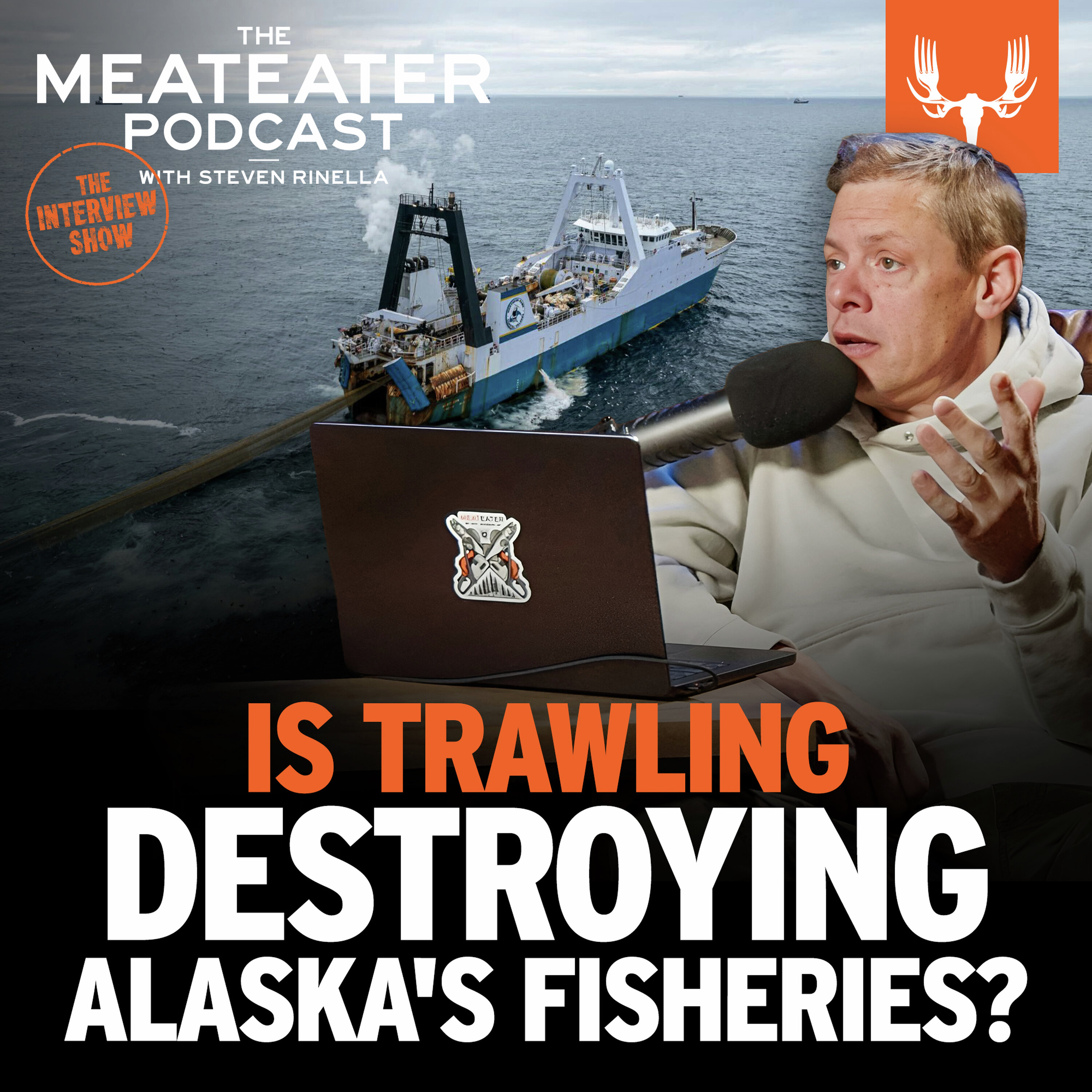
e.com all right, everybody, we got a hot one today coming out of Alaska. Real controversial issue, it turns out. We're going to talk about trawling, okay? We're going to talk about fisheries, fisheries management, habitat issues, all leading out of a lot of conversations that people have been hearing about having about declining king salmon numbers, declining halibut numbers, guys, that
- [03:44]
B
if you go up to fish, sport
- [03:45]
C
fishing in Alaska, you dream of going up to fish, halibut and salmon in Alaska. This is an issue you got to pay attention to. Where this conversation came out of is on the news show. We recently covered this, I don't want to call it an emerging controversy around trawling and impacts to fisheries and bycatch and all these conversations. This is an age old, this is an age old discussion, okay? This is an age old discussion. It's a discussion that sort of plays along in any region where you have declining fisheries and people have to start looking at, there's like the pie, right? The fishery, who's drawing from the fishery and what is leading to fishery declines. Oftentimes in these conversations, the conversations will turn to what fisheries are having the greatest ecological impact. And those discussions take place, okay? Trawling is an, is an age old controversy. There's places in Alaska where they, you
- [04:47]
B
used to be able to trawl.
- [04:48]
C
We're going to talk about all these definitions, so don't worry. There's places in Alaska used to be able to trawl and the fisheries been shut down, okay? On the news show, we were talking about an increased focus among fishermen on the impacts of the trawling industry in Prince William Sound or the Gulf of Alaska in general, okay? The Bering Sea and whether or not this, this commercial fishery is linked to declines in salmon and halibut numbers. And we're just talking about this on the news show, all right. Talking about how it's a heated up political issue, man, that led to A lot of feedback from. For a lot of listener feedback. We heard from a bunch of sport fishermen, charter captains. We heard from Halit longliners. We heard from Sam and Pers. Right. Talking about the damages of the trolling industry. And then we heard from a lot of people from the trolling industry talking about basically, hey, it ain't our fault. The numbers are wrong. The numbers are misleading. This is all coming from outside interest. There's nothing to see here. Okay. So I thought based on the amount of conversation that our conversation generated, I wanted to dig in on this a little bit. So number one guest we're having on right now is David Bayes. Okay. David Bayes is a leader of a Facebook group called Stop Alaskan Trawler by Catch. He is a former. He. He's a fishing guide in Alaska. Used to have his own charter outfit. Still. Still in the business. He was a 2024 Sam McDow Award winner. He's the former chair of the Alaska Charter association and the Homer. Homer Charter association and a former member of the Homer Area Alaska Department of Fish and Game Advisory Committee. All right. Welcome, David.
- [07:00]
A
Yeah, I appreciate it.
- [07:01]
C
Thanks for coming on, man.
- [07:02]
A
Yeah.
- [07:03]
C
So start out, start out. We're gonna get into all these definitions. Okay. And now that was a terrible intro, but we'll sort the intro out. How'd you get started fishing in Alaska?
- [07:14]
A
So I was born and raised there in Homer. And, I mean, that was what you did as a kid in the 80s. Okay. If we had people in town or just any free weekend. We grew up next to the Anchor River. You know, it was 200 yards away. You could walk down there. So that was. That was all I wanted to do, you know, fish on trap, every second of it. And we were in the right spot for it.
- [07:36]
C
Okay, and so you gradually got into the charter business, targeting Hal a bit.
- [07:41]
A
Yeah. So I, you know, I was big into fishing, but when I turned 16, that was my first moment that I had a driver's license and could get myself to work, essentially. So that was the first year that I started into charters. And then while I was in college, I bought a boat, started a business, had that about 20 years, and sold that recently. But I still work for the new owners, essentially, or people have the boat. So.
- [08:06]
C
Okay, so you're from Homer.
- [08:08]
A
Yep.
- [08:09]
B
Next question.
- [08:09]
C
Are you a billionaire?
- [08:11]
A
Not that I know of.
- [08:12]
C
Okay. Because that's important to ask because when we brought up on the news show, when we brought up the controversy around trawling and targeting forage fish. Okay. Targeting you Know whatever billions of pounds of forage fish, the related impacts of by catch on large game fish, halibut, salmon. Whether or not there is a relationship between, between this fishery, this industrial fishery, whether there's a relationship between that and declining numbers of halibut, declining numbers of salmon. We were assured by many people that this is being, that this narrative is being pushed by outside billionaires. Okay. So I just wanted to make sure you're not a billionaire, but you're from Homer.
- [09:03]
A
From Homer.
- [09:05]
C
And you started your Facebook page where.
- [09:08]
A
So I didn't actually start it. Jody Mason had started it. I'm a moderator. I do most of posts on there. But Jody Mason is another charter operator and Homer. So yeah, one of the other admins on there is the executive director of the Alaska Outdoor Council. I do charter boats. Jody does charter boats. But it came to a head because before they set charter halibut limits, each year they take trawl bycatch of halibut off the top. So when you're talking about that pie, each year gets bigger and smaller with fish populations. Every fish that trawl takes out of it shrinks that pie down. And so we got to where us on charter boats taking out people with rod and reel fishing. They said, well, we're going to cut you guys back by about 30% to protect the resource. But we take 2 million pounds of halibut a year spread out across all these anglers. And at that time, trawl was dumping, you know, 5, 6 million pounds of juvenile halibut per year. So close to a million individual fish. And so then it just creates this hypocrisy of. What do you mean they can waste more than we catch? You know, like.
- [10:10]
C
Yes.
- [10:11]
A
And we're being told that we're cut back for conservation.
- [10:13]
C
So yeah, let's, let's, let's back way up because. Yeah, not way up. Are you doing great? What is a trawler? Like, like what is a trawler? What is a bottom trawler? What is a. A mid ocean trawler. Can you, can you lay this out?
- [10:29]
A
Yeah. So it. Well, to start it off, you have to think about scale of boats. So when we think about fishing boats, you know, we think of A lot of people have seen like the time band on Deadliest Catch. That's a. The biggest fishing boat they can imagine. It's huge for most of us, it's about 113ft long. But the biggest trawler fishing in Alaska now is 376ft long. So if you put that in a Super bowl stadium, it would go from goal post to goal post, and it's about six stories high. So when you think of volume of. Of fish that a boat like that catches, they catch about a half a million pounds of fish per day. They can hold about 5 million pounds of fish in their boat. So as we talk about troll specifically, we're talking huge numbers. Billions of pounds of catch, millions of pounds of bycatch. But the way they fish is. You'll often hear them referred to as draggers.
- [11:20]
C
Is the other, you know, that's the name, that's the term I'm familiar with is draggers. But then it was. You have a little problem where. You have a problem where I talked like we. We previewed this subject on the new show. So then I got a lot of people, and I need to be. I need to be honest here. Right. I had a lot of people explain that the way I characterize some of the questions like that. I mischaracterized some issues. So I think I. I like. I'm familiar with people calling them draggers, but then I was introduced to the idea that that's not. That's not the industry term.
- [11:57]
A
Yeah. I think the industry term, they don't like it because it is sensed as derogatory or. There's been so many shutdowns of drag fisheries across the United States. But we actually see one good example of this. There's an industry group in Alaska that used to be like the Alaska Whitefish Draggers Association.
- [12:16]
C
Okay.
- [12:16]
A
Something like that. But they changed their name to something like a cooperative, you know, where they dropped the dragger name essentially 10 or 15 years ago. But they didn't change their gear, they didn't change their boat and change their bike catch much. They just got rid of the word dragger.
- [12:31]
C
Yeah. Okay, so. So. So get into the gear.
- [12:33]
A
Yeah, yeah. So they pull for not saying drag. They pull. They drag a big, huge net. So the biggest ones, they say you can fit four 747 jets, plus the Eiffel Tower on its side into this net. So there again, when you and I think of fishing and fishing boats and what extraction of a natural resource is, this is almost incomprehensible. They'll pull up like a quarter million pounds of fish in one sweep, essentially with this net. But it has. It has a. A chain or cable along the bottom to weight it. And on those biggest ones, that's about a quarter mile wide. So if that's dragging on the bottom, then you're cutting about a quarter Mile wide swath of sea floor. Yeah. So they say the biggest ones will tow about 6 square miles of sea floor per boat per day. There's probably 40 of these factory trawlers fishing in Alaska. They have a long season. So if you say 40 boats 6 miles per day fishing 200 days per year, the number of square acres of seafloor potentially covered is just unimaginable. Astronomical. I think it's 48, 000 square miles
- [13:39]
C
if you can hit six square.
- [13:40]
A
If you do it that way. Yeah, yeah. Because they fish 24 hours a day. It's this floating factory ship essentially that
- [13:46]
C
makes my halibut jigs that makes it seem impotent, man.
- [13:49]
A
They do complain about. They complain about crab pots in these regulatory meetings and say you guys anchored here, you know, or you dropped a crab pot and ignore that, that they're fishing this way. But the. Anyway, so. So huge nets and they. There's kind of two divisions that they're cut into. One is the bottom trawl that will target fish that always live on the bottom. So like flounder and sole, those are made to always be on the bottom. They kick the fish up, scare them into the net. And bottom trawl across the world has this bad name. You know, that's what's associated mostly with draggers. Entire nations have banned it. I think Bali and Hong Kong are no bottom trawl at all. There's a lot of European nations are kicking it out of their marine protected areas. Bottom trail is bad word. It always has been. There's really not much debate on that. People at home can Google like impact bottom trawl and pick it up. You don't have to take my word for it. There's 10,000 results that say this is an ecological disaster and that on bottom
- [14:51]
C
trawling, just so we're understanding the gear. Right. Like legitimate bottom trawling where you're legitimately dragging. The argument is not only the fish. Right. Like not only a. Not only a relatively indiscriminate harvest mechanism, but also bottom damage, seafloor damage.
- [15:12]
A
Correct.
- [15:13]
C
That's the. That that's like. That's kind of what drives the argument against bottom trawling or dragging.
- [15:20]
A
Absolutely. And so we see. So I was saying there's two types of trawl. So we see this bottom draggers that are always hard on bottom. They've been banned a lot of place in the world. Alaska in fact has, I think about 60% of Alaska has been closed down to bottom trawling because we acknowledge that it's this kind of ecological disaster. It kills the coral, it kills the fish on the bottom, all the habitat. But then there's this other category of trawl, which they call midwater trawl.
- [15:47]
C
Yeah.
- [15:47]
A
And so that's primarily used for the pollock fisheries up there, which is about a 3 billion pound extraction per year. Not a lot of people know what pollock is. It's essentially like the bait fish of the. The North Pacific. And they. That fishery actually began because they were targeting roe, which is caviar, essentially, to sell to these other nations.
- [16:08]
C
So they're targeting pollock roe or herring roe?
- [16:10]
A
Pollock roe.
- [16:11]
C
Oh, really?
- [16:11]
A
Yeah. Yeah. So it's. They push back hard now and say, we're feeding the world. But the origin of this fishery was for caviar, essentially. And it's still a huge driver that's. They get about 5 pound, $5 per pound for the Pollock Roe versus about 10 cents per pound for pollock flesh.
- [16:27]
C
Dude, that's okay. I just wanted to touch on this myth because I don't want to forget to talk about this is when you think about fish, harvested commercial fish, or like when you think about walking in. Into a fish shop, I don't care where you go buy fish. Let's say you go into, I don't know, Whole foods or something, and you go look at fish. I always. I always look into those cases as a way of justifying my fishing because I'm like humming this fish. Like these fish we catch, you know, he'd be like, yeah, sable fish, 20 something, halibut, whatever pound, salmon, whatever pound. It makes me feel like. I feel like going to my wife.
- [17:06]
A
Like I was gonna say, it's your wife watching this.
- [17:08]
C
Dude, you should. I should fish more.
- [17:09]
A
Yeah, we're making money.
- [17:11]
C
And so you see the value of, like, what we think of as the fish that we serve on a plate to our family. When it comes to as. As a product that looks like fish, the high value of that and fishermen getting, you know, fishermen getting at the dock. We get accustomed to fishermen getting at the dock. $2 per pound, $5 per pound, $7 per pound, 10 per pound. Right. So like a valuable resource. I remember having burgers and a beer with a pollock guy down in Seattle. He was based out of Seattle, and he ran one of these big pollock processor boats.
- [17:44]
A
Yeah, okay.
- [17:44]
C
He was the captain on one. And I remember sitting there and he's talking about, we do good when the
- [17:54]
B
price goes up a couple pennies.
- [17:56]
C
And this isn't the exact number, but I'm not Far off on the number. As I'm sitting there with him ahead of him, going up, he was saying like, if it like five, this isn't far off. At five cents a pound, it's a bummer. At eight cents a pound, it's good.
- [18:15]
A
It's bonanza. Yeah.
- [18:16]
C
And I remember thinking, like, how could there be. How could there be a fish in the ocean that is so unvaluable?
- [18:24]
A
Yeah. Well, and so that's what brings us to why they use trawlers in the first place and why we don't see trawlers or draggers everywhere is that they really shine on super low value, high volume fish, which coincidentally ends up being like a lot of the bait fish type species. That's what's super plentiful. But their case is that they could never catch enough pounds of it to make money off of it unless they were dragging it up, you know, six square miles of the seafloor per day type deal, or £200,000 at a time.
- [18:56]
C
Okay.
- [18:58]
A
But what we've really found to be the scandal, if you will, in all of this is that. So we said that bottom trawl is bad. It's banned a lot of places. There's really not much argument about that. Even the bottom trawlers in Alaska just kind of hunker down as this conversation happens. Because the more people find out that it even exists up there, the more people want it banned. That's just established across the world. Yeah, but kind of the, like I say, the sandal of it is that we've actually found out that the midwater nets now are on bottom 20 to 100% of the time. But where that really the rubber meets the road on that is that those midwater nets are allowed to fish in these critical habitat areas where bottom trawl has been banned. So the fish regulators understand that these huge nets are on the bottom sometimes, all the time, but they haven't taken this next step to ban them from where bottom trawling is bandwidth, just this huge disconnect.
- [19:56]
C
So to help me understand the mid water thing, and I'm not, I'm anything but like, talk to me like I'm 5 years old, but I'm a 5 year old who looks at pollock schools on fish finders. If you're in 200ft of water and you're looking at a pollock school, this is just, I mean, this is like very anecdotal. Okay. If I'm looking at a school of Pollock in 200ft of water, that school of pollock is Stacked in maybe the bottom 10, 12 frequently.
- [20:26]
A
Yeah.
- [20:27]
C
So.
- [20:27]
A
But.
- [20:27]
C
But what? Like, how do you define mid ocean? Does it mean like, don't touch the bottom, or does it like if you're in varying depths, like, what is the definition of that?
- [20:37]
A
Well, so that's where it's.
- [20:39]
C
You're.
- [20:40]
A
This sounds unbelievable, but it's essentially not defined. Or they call it mid water because they will sometimes lift the nets up off the bottom. So it's not the fish. The difference between bottom trawl for target species like flounder and sole is that those fish always live in the mud buried in the bottom.
- [20:57]
C
So you're scraping them out of the mud.
- [20:58]
A
They drop that net to the bottom 100% of the time. Pollock spend a whole bunch of their time within, you know, 1, 2, 3, 4 or 5ft to the bottom, but they'll also sometimes raise up.
- [21:11]
C
Okay.
- [21:12]
A
And so they, they have this weird deal where they say it's not illegal to drag a midwater net on bottom, but the only reason that would be illegal or the only reason they say it was on bottom for regulatory purpose is if it pulls up 20 or more crab. So weird deal, okay. In a single drag of the net, but they say if it pulled up 19 crab, that it wasn't on the bottom. And so it's this crazy regulatory concept that just doesn't really hold up.
- [21:39]
C
So being on bottom or not is defined by how many crabs are you catching? Because we know the crabs aren't mid level.
- [21:47]
A
Correct.
- [21:47]
C
I got you.
- [21:48]
A
But they. If you start digging into their bycatch numbers. Over the last five years, this Bering Sea Pollock fleet had 345 metric tons of starfish that they brought up to the deck of the boat as bycatch. And they have about 40 million pounds of just flounder and sole, these fish that live hard on the bottom. And so then you start to see these conundrums. And so in about 20, 20, 2021, there was this big crab crash. You might have seen the headline of like 10 billion crab lost in the Bering Sea. So the same regulatory agency, but that
- [22:20]
C
was related to water temperature, was it not?
- [22:22]
A
Maybe, yeah.
- [22:23]
C
Yeah. Okay. I don't know.
- [22:24]
A
Yeah. That's the official standpoint. There's water temperature change. But what that triggered was this fisheries management that regulates crab in the Bering Sea also regulates trawl. And so their crab scientists, the crab science side of it, started to look into this and they found out that the trawlers were actually fishing in this closed to bottom trawl area of the Bering Sea, this crab nursery or crab habitat area.
- [22:50]
C
Okay.
- [22:52]
A
And that was where this document came out that. Well, it was the, the midwater trawl captains themselves, the pollock captains that said, we know our Net's on bottom 20 to 100% of the time. You know, it said, but we can't get in trouble for that because the regulators knew it too. Like this isn't new news. This is just how we fish.
- [23:10]
C
Okay.
- [23:10]
A
But that has set off this chain reaction obviously of, well, we have all these areas closed off of Alaska to protect habitat because we don't want bottom trawls there. But they're not close to midwater trawls dragging on bottom. And so that gets super important because when we start to look at like essential fish habitat and how much of the seafloor has never been touched by a net. All these areas close to bottom trawl we say are pristine, 100% habitat essentially. But the reality is that the mid water nets have been hard on bottom there for a long time. And so then it just really throws off all the calculations and you get into like, well, how can this fisheries regulatory agency make this miss, you know, or how can we know that they're on bottom but not regulate it that way? And that's where we get into revolving door and like trawlers on the regulatory agency and on and on all the way up to Washington D.C. so that's been a huge can of worms that Alaska's been going through lately.
- [24:08]
B
Yeah, I've been sleeping on a Helix mattress for years. It's just one of those things. It's like we never talk about needing to get a new one, replacing it, upgrading it. It's a perfect product. King size Helix, we love it. It's not going anywhere. Helix is the most awarded mattress brand tested and reviewed by experts like Forbes and Wired.
- [24:28]
A
Hello.
- [24:29]
B
Helix delivers your mattress right to your door with free shipping in the US Rest easy With seamless returns and exchanges. The Happy with Helix guarantee offers a risk free customer first experience. Designed to ensure you're completely satisfied with your new mattress. The Helix Sleep quiz matches you with the perfect mattress based on your personal preferences and sleep needs. It makes buying a mattress easy. All you gotta do, you gotta go to helix sleep.commeater for 20% off site wide. That's helixsleep.comme eater for 20% off site wide. Make sure you enter our show name after checkout so they know we sent you. Once again, helixsleep.com meat eater this show is Sponsored in part by Liquid IV I was down in the Bahamas on a spear fishing trip. You don't associate being wet with like exertion and sweating, but man, you're working your butt off when you're spear fishing. I'd climb back up in the boat, slam me a bottle of Liquid iv, rest for a minute and I would come back fighting strong every time. Liquid IV is clinically demonstrated to hydrate faster than water alone and right now you can get 20% off your first order with code Me Eater at checkout. Powered by Liquid IV Hydra Science, an optimized ratio of electrolytes, essential vitamins and clinically tested nutrients turn ordinary water into extraordinary hydration. Compared to water, Liquid IV delivers longer lasting hydration and retains hydration for up to 4 hours. Explore delicious sugar free options including white peach, lemon lime, rainbow sherbet and more. I'm telling you, next time you're feeling whooped or thirsty or dried out, drink a Liquid iv. I'm telling you you're going to feel better. Stay hydrated for every adventure. Get on the go hydration from Liquid IV tear pour live more go to liquid I.com and get 20% off your first purchase with code me eater at checkout. That's 20% off your first purchase with Code Me eater@liquid I.com Spring turkey season is one of the best times to hand the hunt over to your kid. Part of the problem hunting turkeys with kids is a lot of the pre game stuff is all happening in the dark. They can't really visualize what you're talking about. But with Onx Hunt you can show them what you're talking about on your phone and make the whole thing real. Let them learn why their moves work and why they don't. You can show them exactly where you're allowed to hunt. You can decipher direction and judge distance on a gobbler with waypoints in compass mode and build a setup together instead of just telling them what to do. It turns a morning in the woods into a lesson. They'll carry the rest of their hunting life. Download the Onx Hunt app and use spring turkey season to make better hunters One spring morning at a time.
- [27:29]
C
I want to talk for a minute about. We talked about the equipment. Explain. Explain the bycatch issue to me. Like how much bycatch is actually there. And as we talk about this, there's a couple things I'd like us to hit on in no particular order. You you get it? Maybe you can tell me. We talked about some staggering amount of by catch. But industry people pointed out to me that, that the bulk of it is cod. Well, the bulk of it's jellyfish. They're like, well, it's jellyfish and cod. There's a question about waste. And, and, and the industry is like, well, we don't, we're allowed, we're permitted to retain a lot of this stuff. So we're not actually pitching it. It's mostly jellyfish, which are unregulated. And then at some point, I want to get into the question of, of. Well, I'm gonna say that I want to get into the question of king salmon, okay. Where they're getting caught, where they're coming from. But first, explain.
- [28:34]
B
The reason I want to talk about
- [28:35]
C
by catch is because I want to narrow in on the fish itself. Okay. The pollock.
- [28:40]
A
Right.
- [28:40]
C
Because you know anyone who's, you know, any, any kid who went through like the most basic sign class, science classes for the food chain idea, right? You have a, a large prey species, large number of prey species, they get eaten by bigger fish. The bigger fish get eaten by bigger fish. And so there's this question of, in addition to a conversation about bycatch, there's a, there should be a conversation about the stability of the food base. So forage fish. Right. And what the impacts of removing all these forage fish might be. So put that on hold while we get into to the, the by catch thing. Help me understand the by catch issue. Okay? If it, if it's all jellyfish, what's the problem?
- [29:27]
A
So they say. So there's, it gets fuzzy here again. You're not going to like this. They. There's two categories of bycatch. One is observed bycatch, which is the stuff that comes up onto the boat. Somebody digs through the catch, extrapolate out the numbers and say you guys definitely killed X amount of pounds of. X amount of species.
- [29:46]
C
These observers are federal observers, correct?
- [29:50]
A
Yeah, they're required by the feds, but they usually work through like an independent intermediary agency that staffs them like a staffing group.
- [29:57]
C
Okay. Okay.
- [29:59]
A
They. So there's two categories. There's the observed numbers. Those come up to the deck. They get counted. Those are pretty good numbers. But then there's also the unobserved bycatch. So we talked about these nets might drag six square miles of sea floor in a day, but nobody's calculating, you know, how much stuff got knocked down or killed or dredged up. Bottom sediment that doesn't make it up on the boat to be quantified Other countries have taken stabs of that. There have been some research to find out how much biomass is in 1 square feet of mud in the Bering Sea, etc. But the USA in that sense just says we don't think it exists or they ignore it.
- [30:35]
C
Okay. And they want to stick to what's observed.
- [30:38]
A
Yeah, got it. But that benefits trawl quite a bit to do it that way.
- [30:41]
C
Understood.
- [30:42]
A
The. So the observed bycatch, they told us that over the last 10 years all trawl groups in Alaska combined have 141 million pounds of bycatch per year. So that's about 16,000 pounds per hour. That's about 1 million pounds every two and a half days. It's three and a half billion pounds since I graduated high school in 2021. Okay, so you're talking massive.
- [31:06]
C
Tell me the annual number again.
- [31:08]
A
£141 million per year of.
- [31:11]
C
Of sea life.
- [31:12]
A
Yeah, correct. All species combined. Yeah. And so they, so you'll. And it's a pretty. It's an indiscriminate gear type. That's why trawl works, is that it scoops up a bunch of stuff. You bring it up to the deck. Sometimes the government says you can't keep that fish. Sometimes the fish isn't valuable. Sometimes it's jellyfish that doesn't have a commercial market. But kind of like if you looked at, you know, dragging a net through a wheat field or whatever, you know, there's honeybees and stuff that you would throw out. But when you start taking huge millions of pounds of stuff out of any ecosystem, you can run into trouble. And I don't know if jellyfish is that, but they're there, you know, and they've made it however many thousands of years there. But the really big, you know, the highlighted species or the more controversial species are what they call prohibited species catch psc.
- [32:02]
C
Okay.
- [32:03]
A
And so those are typically either the more slow growing or commercially valuable or often the fish which are already allocated to other industries. So when we fish for halibut Alaska, if money is involved. So if you're a long liner that catches them to sell at the store or charter fisherman taking people out, we have these real super tight limits of, you know, £1.999 million or whatever it is, they float up and down each year. And there's this acknowledgment that if trawl wastes some of spycatch, then we can't. It's going to affect these other industries. So they say Troy you can't have them at all. And there's a conversation about, well, maybe trawl should be able to sell them. But then the concern is. So last year halibut fishermen were getting about $8 per pound at the dock for halibut, but pollock is worth about 10 cents. So there's this concern that if you allow them to catch these super valuable fish and sell them because we caught them anyways, then that you essentially incentivize that you'll see them shifting from, well, we accidentally caught this, but it was
- [33:01]
C
worth more if you just did a micro, like just a micro shift.
- [33:05]
A
Yeah.
- [33:05]
C
To, to pick off more halibut and you had the incentive to do it. Like, why not do it?
- [33:09]
A
Yeah, I mean, you're talking about like maybe my master. I'm close to a thousand percent more, you know, if you go from 10 cents a pound to a fish that's worth $10 a pound. So anyways, these. But when they. They don't want trawl to catch any prohibited species at all. But fisheries regulators over time have gotten this claim from trawl of, well, the nets are so big, we have to use big nets to make money. We just can't help it. And so they have made these acknowledgments that, okay, we're going to give you a limit of how many king salmon you can catch per year. A limit of how many halibut. We don't want you to catch them. You're not supposed to catch them, you're not supposed to target them. But we acknowledge that it might happen. So this for.
- [33:48]
C
Yeah, but you can't have them.
- [33:50]
A
But yeah. So they say that they either can be donated or they can be discarded, but they can't enter into commerce because they're going to try to prevent it from becoming this incentivized thing.
- [34:01]
C
Yeah. And a guy from the industry, from the trawl industry pointed out to me that they're sending halibut to food banks some.
- [34:09]
A
Okay. They. So one of the big problems with psc, these prohibited species king salmon and halibut get the most airtime. They're the most controversial, essentially. But they are also caught as juveniles. A lot of this straw bycatch is juvenile fish. So the average halibut as caught as bycatch a few years ago in the bering sea was 4.75 pounds. So we call them ping pong paddle halibut. So the average king salmon was about five pounds. So we think that.
- [34:39]
C
So their poundages wind up being a little bit Misleading.
- [34:43]
A
Yeah. But we also, in strictly in terms of what goes to food banks, we think of like, wow, a food bank would love to get this 100 pound halibut or this 35 pound king salmon. Think of how many people that would feed. But that's not what shows up. What we see is something which yields, you know, two pounds of fish and then the or fish flesh and in the case halibut, those fish are, are being cut down essentially just a couple years before they would spawn the first time and the salmon are, you know, being cut down before they've ever spawned. And so, so while the like food bank conversation is valid and maybe that's better than them being dumped over, they a couple years ago they had this report that they donated about £300,000 of fish in that one year versus £141 million of total bycatch. So they get a tax write off for it. It's a great PR blitz. You can open up an email to a stranger with it or talk to somebody in D.C. and say we get this bycatch but we donate a lot of, you know, we donated a hundred thousand pounds, but they might have had £7 million of a bycatch of this halibut or halibut and salmon combined. So that one tends to fall apart. But they, with this PSC limit. So they made this acknowledgment that, yeah, you guys have kind of indiscriminate nets. You're going to have some halibut sometimes, you're going to have some salmon. We don't want to shut you down every time you have it. But they're never supposed to catch it. And so it would be like if Fish and Wildlife Service said that they were going to allow duck hunters to take two bald eagles per year or something, you know, like this accurate. There was an eagle flying behind the ducks. This guy shot on accident. He's not going to go to federal prison for the first couple. But if it gets beyond that, it's a problem. But at no point at the end of the year if nobody'd gotten the eagle quota would somebody go out and point blank shoot two bald eagles. You know, that's just not the intent of this regulation. But what we've seen with trawl is that they take this prohibited species catch kind of for granted. They say, we know we can catch 45,000 king salmon this year, so we don't care if we get up to 44.5 thousand as long as it doesn't shut us down. Or they Say we need to use this PSC to fully catch our limit type thing. But that's just a big wander away from what it had originally been created for.
- [36:58]
C
Got it. And roughly how many. And you know, another thing we got to set up is lay out where we're talking about. So you said areas of the southeast. The practice has already been. The practice has been banned in areas of the southeast for over 20 years. Southeast Alaska.
- [37:14]
A
Correct.
- [37:14]
C
So it's currently like areas in the Gulf of Alaska. If someone looks at the map, imagine like that big basin, you know on. On the western edge you got the illusions coming down on the eastern edge
- [37:28]
A
you got pro tip.
- [37:30]
C
Yeah, there you go. There's pro tip. Hold that up. But for people listening, I don't know
- [37:33]
A
if you can see it. The.
- [37:35]
C
How you can, you can make an Alaska.
- [37:36]
B
It's not as good as how you
- [37:37]
C
can make a Michigan with your hand, but you can make a decent Alaska with your hand.
- [37:40]
A
So the. Yeah. Is this point towards the camera?
- [37:45]
C
Phil's that aiming at the camera?
- [37:46]
A
Yeah, it is.
- [37:47]
C
You're in there.
- [37:47]
A
I was trying to pull up a real picture of Alaska to help you guys. It might, it might take a second. Boring. The. So this is roughly the state of Alaska. So this is southeast Alaska. It comes down towards Canada and Seattle. This is the Aleutian chain. It extends out towards Russia. Anchorage is about right here. But most of the trawl happens in the Gulf of Alaska. So a little bit south of Anchorage and Homer and then a big part of it in the Bering Sea, which is where like the deadliest catch crabbing is. But you're right, it was banned in southeast Alaska, which is a pretty interesting story because they historically they'd never really. There hadn't been big trawl fisheries in southeast Alaska. It's pretty rocky bottom. They didn't have the populations of fish that they wanted, etc. Etc.
- [38:29]
C
But was that what kind of keeps them out of there just like the fjord kind of the fjord geology and hydrology of the area?
- [38:36]
A
Well, the Gulf of Alaska has it too, but really it's that the fishable populations of these like low value non like pollock and flounder just weren't there. So it. But where it came to a head is the most of these boats that fish trawl in Alaska in summertime will do their off season down in Seattle, Washington.
- [38:57]
C
Okay.
- [38:58]
A
And so they had this incident very particular one moment where one of these boats had left Seattle, Washington, it came up into southeast Alaska. It was legal to fish there. And I don't know if they wanted to see what was down there. They want to test their net, whatever they're fishing legally. And so they unrolled their net fishing for a day, and they essentially caught the entire rockfish quota for all of this area in a single day.
- [39:21]
C
Kid.
- [39:22]
A
Which means nobody else can fish for him this year. And so that, as you can imagine, put up this hellstorm of conflict. And so they eventually got them banned because they obviously that was bad, but in that instance it was a little bit different because they didn't really want to fish there anyways. You know, it was kind of an accident that they'd hit this limit. And so while that does set precedent that it can happen in Alaska and like the regulatory channels are there, we're seeing a way different thing when we start talking about this idea of it being banned or heavily restricted in these main areas.
- [39:57]
C
Okay, so so hit me with Gulf of Alaska and Bering Sea. Hit me with a little bit more on what's getting caught on the. On the halibut front.
- [40:06]
A
So the Sorry, you got to keep talking your mic. Yeah, sorry.
- [40:10]
C
The we're cool on the map. People would see it, you know, be crazy if a dude like one. If a new prime minister. What do they got in Canada for a president prime minister, if he's like, man, from now on, it's goal for Canada
- [40:26]
A
don't get into it. The so the most of the halibut bycatch currently happens in the Bering Sea, and that comes from this. They call it the amendment 80 bottom trawl fleet. It had been created to specifically target these bottom fish out there. And they get pretty close to £4 million of reported bycatch each year. But when they report that that's halibut by catch. Halibut bycatch mortality. So this is what you've gotten into in that news clip of. They don't. They don't necessarily assume that all fish cotton trawl that comes up and is then released is going to die. And so they had kind of trall had co authored a study with federal regulators a few years ago that essentially it used to be assumed that every time they had a halibut come up in this net might be packed in with £100,000 of other fish. It's been towed for four or five hours. They used to just get dumped straight into the fish hold and they would assume that all those halibut died. But they came up with another program called the deck sorting program where instead of dumping the net straight into the fishold. They would instead dump it out on the deck of the boat. And then crew members have about half an hour to go through and throw back as many halibut as they can. And if they participate in this program, they assume only about 50% of the halibut die. But, but from a sport fishing perspective, I mean, we've seen.
- [41:53]
C
Tough one, dude.
- [41:53]
A
That's a real tough one. We, you know, we have rivers in Alaska where if we are doing catch and release fishing for a salmon and we lift it all the way out of the water to take a picture, that's a crime. You know, that's illegal for us because we could have killed that fish, essentially. So when you start looking at a halibut that's been packed in £100,000 with this net stepped on, sorted through for half an hour, I mean, just pulling the net out of the water takes half an hour and then you got another half an hour.
- [42:20]
C
Yeah, I don't know, it seems, I don't know, but I'm again, man, I've had, you know, fair bit of exposure, you know, to Hal, but over the years, that, that, that's tough for me, it is, but I don't really know. I mean, a survival rate of 50% seems, seems difficult.
- [42:37]
A
It is. And so a lot of other nations don't allow that. So a lot of them will do what they call full retention of bycatch. They say if it came up in a trawl net, we're assuming it's dead even as good as fins are wiggling a little bit. So you guys have to bring it all back to shore. We're going to go through all of it in this neutral facility. So it's not like there's an observer out there with, you know, six crew members hanging over their shoulder. They just say if it came up in the trawl net, it's dead. You guys bring it back to shore so we can get an accurate count.
- [43:05]
C
Got it.
- [43:06]
A
But Alaska doesn't do it like that. And especially on halibut, it doesn't do it like that. So what we've seen up there is they get about. So last year, I think it was £4.3 million of halibut bycatch mortality. So those are the ones they assume dead.
- [43:19]
C
Okay.
- [43:20]
A
Closer to £8 million would have been brought up onto the deck, they threw them all back and they assumed about half of them live.
- [43:26]
C
Okay, so let's hover on that number for a minute and you tell me the number again, like the agreed upon
- [43:31]
A
number 4.3 million pounds. Okay.
- [43:33]
C
4.3 million assumes a 50% survival rate. Kicked off the deck, thrown off the deck, back into the water.
- [43:40]
A
Well, the survival rate's already been applied to that 4.3 million. So those are the ones that definitely died. Another 4.3 million got released and were assumed to have lived or around there.
- [43:50]
C
All right, so the agreed upon dead. The agreed upon dead pile, how big in that. In that region, how big. What is the commercial harvest on halibut of intentional halibut catch?
- [44:04]
A
So it in that region is pretty small. I don't have that number memorized, but I do have the data on the. As of 2015, the average bycatch halibut they got in that region was 4.76 pounds per fish.
- [44:18]
C
Okay.
- [44:19]
A
And so that makes about 850,000 fish that they assume died last year through this bycatch.
- [44:24]
C
Okay.
- [44:25]
A
And that is more individual halibut than the entire state of Alaska. All other halibut fisheries combined, more individual halibut. Individual halibut. And the halibut spawn at kind of like the males and females start at different ages, but like 7 to 10 pounds per fish. And so when we talk to biologists about this, they'll say, oh, we kind of have this deal where if you, you can never assume that one fish taken out of a population would have affected the total population because there's a good chance a fish dies. Sure. Yeah. But I find that hard to believe with five pound halibut. You know, when a halibut egg is laid. Yeah. 99% of them die or when the halibut's in the larval stage, another 99% of them die or whatever. But once you get up to this five pound fish that's about two feet long, it's buried in the mud and it's just almost made it to work
- [45:13]
C
and spawned, its annual survival rate is going up at that point.
- [45:17]
A
Yeah, yeah. So, so that's a tough one to look at. And they'd actually.
- [45:21]
B
How, how, what size again does the
- [45:22]
C
hal start to spawn?
- [45:24]
A
Like 7 to 10 pounds.
- [45:25]
C
Why, why is there, why is there so much emphasis on protecting? Like, like, just if you just. I'm just talking to listeners here. If you go, when, when you see £150 halibut or someone like catches a 150, a 171, like those are females. Right. And that is a. And people will talk about the, like, there's anglers will encourage you to cut those fish loose, even if you're allowed to have them because. Be like, those are your big spawners.
- [45:56]
A
Sure.
- [45:58]
C
Is it just because the volume of eggs they're putting off is so great?
- [46:02]
A
Yeah.
- [46:02]
C
Or do you think that that's not really a good way of looking at it, that you need to save the big halibut because those females are producing the eggs?
- [46:09]
A
Well, so I look at it both ways. So this charter business I'd owned, we used to have this. I called it the Release the Beast program. If somebody would let a halibut over £250 go, I'd give them a free fishing trip the next year to encourage.
- [46:21]
C
Oh, really?
- [46:22]
A
Okay. People would do this and they say that a fish that size is laying about 4 million eggs per year. So, yeah, they got a lot of eggs in them. But the reality is from a biological side, the most of the halibut caught over about 20 pounds are females. And those have.
- [46:38]
C
Over 20.
- [46:39]
A
Yeah, yeah. And those have the potential to spawn, you know, maybe 25 more times in their life. Say they're going to live to be 40 years old or whatever it is, versus the big fish. They have a lot of eggs per spawn, but maybe they've only got five years left to live, essentially. And so the halibut biologists take. We've, they've been pinned down on this because this is a big, you know, social issue in Alaska. You guys are terrible because you killed this big fish. But when we asked the IPHC about it, this Pacific Halibut Commission, they say, we don't think there's any impact to actual halibut populations because they're just not that many big fish and they're not going to spawn them any more times. But, oh, but that also takes genetics out of it. So I, I mean, and that's why I've done this program of like, we'll give you a free trip because these are the fish that have, you know, beat the odds and they've made it and survived and. Yeah, anyway, so it can go both ways.
- [47:32]
C
But they like that, that, that the large, that the fact that these fish are getting large is a demonstration of fitness, viability. So allowing these big fish to be in the, in the population, contributing genetics to the population, you argue like you could be like helping perpetuate traits that lead to longevity.
- [47:55]
A
You could. I mean, yeah, it's like the conversation of like selective deer and elk harvest type thing, selecting for genetics. But by the same token, we've killed a lot of them. And I leave it up to the fisherman's choice, you know, but, but, but
- [48:09]
C
A seven pound female, Hal, is kicking
- [48:13]
A
off eggs seven years old. So that gets us up to around maybe 15 pounds.
- [48:18]
C
Okay.
- [48:19]
A
Yeah.
- [48:19]
C
Okay. So she starts, she can start producing eggs at about 7 years of age.
- [48:23]
A
Correct. And I think it might be the males that start at age 7 and the females start at age 10. But anyways. Yeah, yeah, it's pretty.
- [48:30]
C
Spawning is not relegated to giants.
- [48:32]
A
Absolutely correct.
- [48:33]
C
Like a 20 pound hell. But could be a sexually viable spawning female.
- [48:36]
A
Absolutely. Yeah.
- [48:37]
C
Okay. Understood. Understood.
- [48:38]
A
Yeah. All right.
- [48:39]
C
Now what about. So we talked about the Bering Sea.
- [48:42]
A
What.
- [48:42]
C
Tell me about the, the, the Gulf of Alaska.
- [48:45]
A
So the Gulf of Alaska has trawl fisheries too, but they're typically not as big, but they. One of the big issues we run into in the Gulf of Alaska is that they, the Gulf of Alaska and Bering Sea have different regulatory regulations, different rules to fish by. And one of the big hot button issues in the Gulf of Alaska is that there they have this dedicated bottom trawl fleet. So some of the dirtiest, they hard on the bottom all the time ripping up habitat, but they only have an observer rate of about 20 to 30%. And so you'll hear trawl in the Bering Sea will say, we have a 200% observer rate. We have 100% obs. Right. We're this model of sustainability. But they conveniently ignore that right next door is this other fleet where they only send an observer along for about one out of three trips.
- [49:39]
C
Okay.
- [49:40]
A
And so there's been this kind of widespread insinuation from former crew and current crew there that it becomes cheaper for a boat operator there to essentially throw a trip when the observer's along than risk what the observer then risk that the observer sees what they actually catch, and then extrapolates that out to the entire season. Because if they catch, you know, 2,000 king salmon and this one day when the observer's along, then the observer says, well, the other 70% of the trip, you're probably catching 2,000 king salmon too, which risks shutting them down. So there's this pretty wide insinuation that instead of actually going out and fishing hard or fishing for a full trip, you'd set the net out once before midnight, fish for a couple hours in a spot you wouldn't normally fish, set it out again after midnight, fish for a couple hours, and then say, yeah, we had two days of observed fishing, now we have eight days without it type thing.
- [50:31]
C
Got it.
- [50:32]
B
Spring turkey season is one of the best times to hand the hunt over to your kid. Part of the problem hunting turkeys with kids is A lot of the pre game stuff is all happening in the dark. They can't really visualize what you're talking about. But with Onx Hunt, you can show them what you're talking about on your phone and make the whole thing real. Let them learn why their moves work and why they don't. You can show them exactly where you're allowed to hunt. You can decipher direction and judge distance on a gobbler with waypoints in compass mode and build a setup together instead of just telling them what to do. It turns a morning in the woods into a lesson they'll carry the rest of their hunting life. Download the Onx Hunt app and use spring turkey season to make better hunters one spring morning at a time. This episode is brought to you in part by Row Nutrition's Liposomal Liquid Creatine Roe makes a creatine that's different from the powder most people picture. Creatine's reputation is tied to the weight room, but it's actually one of the most studied supplements out there, and your body uses it to produce cellular energy, both in muscle and your brain. If you've ever been three days into a hunt, low on sleep, hauling weight and still needing to make a good call, it doesn't just come down to grit. That requires energy, physical and mental. And here's the thing. Creatine supports the system that fuels that kind of output. Row creatine is liquid and stability tested. Liquid creatine can break down over time. If it's not done right, theirs is tested to make sure it actually holds up. It's also liposomal, which basically means it's designed to move through your system efficiently instead of just sitting in your gut. It's not about getting jacked, it's about maintaining strength and mental clarity when conditions aren't ideal. Check out rose liposomal NAD plus@rownutrition.com and use code Meat Eater for 20% off site wide. That's Code Me Eater for 20% off site wide@rhonutrition.com hey, it's Steve Ronella from the Meat Eater podcast. If you're putting together an outdoor space and you want it to really stand out, here's something worth knowing about. Decking with surestone technology is made through a patented process that uses get this crushed rock instead of wood fiber, which is what most composite boards rely on. That difference matters. It gives each board a level of strength and durability that holds up in the real world. Weather, moisture, heavy use all of it. Decorators also engineered the surface to give you better traction when it's wet, which is a big deal if you live in a rainy area or you've got people moving in and out with wet boots. And one thing I appreciate, you're not locked into one look. With more than 40 different color and size combinations, you can build a deck that actually fits your home and feels like something you designed, not something you settled for. It's comfortable, it's safe, it's durable, and it's going to stand out. Build season is coming up fast, so order a sample today. Visit decorators.commee eater to get your free sample of decking made with Surestone technology. That's decorators with a K. Again, decorators.comme
- [53:46]
C
eater how much are these fish moving? Like, what are we understanding about that? If you're. Let's say, I mean, like kind of the halibut charter mecca, Right. Like, if someone's going to go up to Alaska and. And they want to be like, what's the best halibut area I could go to? I think a lot of people are gonna be like, go to the, you know, Homer man. It's like hell, but. Seems like hell, but capital of the state, right?
- [54:08]
A
That's what the sign says.
- [54:09]
C
Yeah. So our bearings. How much of these fish moving are king salmon that are running rivers in the Gulf of Alaska, southeast Alaska? Are those kings ever winding up in the Bering Sea? And. And vice versa. Are there halibut that are spawning in the Bering Sea? That maybe we're spending time in the Gulf of Alaska? Are these. Are these trading fish?
- [54:32]
A
Totally. And so they are.
- [54:33]
C
Okay.
- [54:34]
A
Halibut's one of the easiest examples of that. So they make this assumption to halibut biologists that essentially the entire populate halibut population of Alaska and Canada move out to, like, 3,000ft of water to spawn in the winter.
- [54:47]
C
Okay.
- [54:48]
A
All their eggs and stuff mix there. And then the trending currents carry them up to the Bering Sea, and that is where the larvae settles. So they have these, what they call designated halibut nursery zones in the Bering Sea. And then they say as the fish get older, they have a clockwise migration, so they move south and east.
- [55:06]
C
So back up from it. They're spawning in 3,000ft of water.
- [55:10]
A
Yeah. Yeah. And we've seen them. You know, I've seen, like, ready to spawn fish in a couple hundred feet of water, too.
- [55:16]
C
Sure.
- [55:16]
A
But that's the.
- [55:17]
C
I guess they can spawn in 3,000ft.
- [55:19]
A
Yeah. I think it's like ducks migrating. Like some of them migrate every time and then you have local ducks. Got it. But the. Anyways. Yeah. So essentially the biological assumption is that the vast majority of halibut begin their life as larva settling in the Bering Sea.
- [55:33]
C
Okay.
- [55:34]
A
Then they go clockwise, which brings them to the Gulf of Alaska, brings them to southeast Alaska, brings them to Canada, Washington, Oregon, all the way down. And so when we talk about how there's £4 million of juvenile halibut being wasted a straw bycatch in the Bering Sea each year, that means we're hitting homer in the Gulf of Alaska, Southeast Prince of Wales, Canada, gets really crabby about this. Washington, Oregon have like a halibut season of just a couple days now because the population's doing so poorly.
- [56:05]
C
Yeah.
- [56:06]
A
And so each year when they set these harvest limits, all these, these other countries in these other areas are saying, oh my God, you got to. We can't waste this many halibut in the Bering Sea each year because it affects all of us. But we've seen the trawl industry kind of become this powerhouse in our regulatory agencies. And they say, well, we make a lot of money from it. You can't, can't shut that down, you know.
- [56:25]
C
Yeah. And what about the kings salmon, for instance? Are they moving?
- [56:30]
A
Yeah. So you can pull up various charts where they definitely moving. Yeah. So we'll see them go from like the Gulf of Alaska into the Bering Sea and feed. You see the ones from like Oregon, Washington and Canada will come up into the Gulf of Alaska and feed. And they've got, they all have this like four year loop. And then there's a lot of fish from the Bering Sea area that go and do a loop in the Bering Sea. But one of the things we've seen with king salmon, coast wise, or the entire, you know, Oregon all the way up to Nome, is that they're doing very poorly. And they, before we started to see them crash all the way or fisheries be shut down, we've seen this huge shrinking size at age. So the fish have over, you know, we used to see these 100 pound king salmon out of the Columbia River, 100 pound king salmon out of the Kenai River, 80 pound kings out of the Yukon River. And before they quit coming back at all, we were seeing them get smaller, smaller, smaller, smaller. And we've seen the same thing with halibut. So halibut size at age, how big they are, depending on how old they are, has decreased by over half over the last 30 years.
- [57:34]
C
Yeah.
- [57:35]
A
And so that really points people towards a food source issue. And that again is where you get into pollock as this forage fish of the North Pacific that, you know, maybe £3 billion a year isn't sustainable. And so then we come into this conversation of yeah, this moves us beyond
- [57:51]
C
this move beyond the by.
- [57:53]
A
I was chasing this the whole time.
- [57:54]
C
Food issue, right? Yeah, yeah, yeah.
- [57:57]
A
And also the habitat issue. So when I look at it, I see there's three points. One is that the bycatch, the raw pounds which they can defend and say, oh, it might have been jellyfish or as a percentage, this isn't that much of a particular river. Okay, we can give them that. But then you get into the food issue of we're seeing fish and seabirds. They said the crabs starved to death during that warm water event. Halibut size that age, salmon size that age. There's an issue with gray whales not getting enough food in the bearing sea to finish their migration to Mexico and back. They've had big starving events with those. And then we look at, well, how could this be? Well, we're taking £3 billion of bait fish out of the year or out of the water every year. And we're also the third part of this is what the seafloor habitats, what kind of hits we're doing there. So you've got the raw pounds of bycatch, bait fish coming off the bottom of the food chain and then the sea floor impact of dragon, say six, six miles of seafloor every day.
- [58:55]
C
But you and me both know that, that a population can have what we call a sustainable yield. Meaning you can, let's just put this in the simplest terms. Let's say you sneak onto the local golf course and fish bass, right? And you like to make fried largemouth sandwiches. If you, if you're frying three large mouths out of this golf course pond every year, you might realize that over the years you can catch three large mouths just as quick as any other year. And that you eat in those large mouth sandwiches seems to be having no impact on the population in that pond. Meaning if you didn't catch those three large mouths, they're probably about the same amount of large mouths in that pond. The pond is going to produce blank pounds of largemouths. You have a sustainable yield. Okay, like what, what evidence is there that that it is having a population level impact on pollock? Like are they needing to fish longer and harder to catch the pollock? Are they needing to use to change tactics? Are they needing to Move to new areas that haven't been previously exploited. Like is there some evidence that, that they're putting a hurt on the pollock and that it's not sustainable yield?
- [60:13]
A
Well, so the place. So you have to look at kind of the progression of ships over time. So you know, 50 years ago we had low horsepower engines. They couldn't tow as big of a net. We didn't have near the electronics that we have now. We didn't have Starlink. We didn't have like this real time communication between ships. And we were catching about the same amount of pollock then as we are now. But we weren't seeing other species that would depend on pollock starve to death simultaneously. But now we fast forward 50 years and we're seeing the size and age of the pollock are quite a bit smaller. Which has been a precursor to a lot of other fisheries crashes. As the fish get smaller and smaller and smaller and go. We've seen trawlers complain about that. But the technology that we're using to catch essentially the same amount of fish is through the roof. You imagine the last 20 years of, of where the boats have gone. And I don't have data on how many toes they do or how many days they have to fish. But that had come up. We talked about like that Bering Sea crab crash. They had a tough time catching crab that year. And so they were fishing assumably new places and longer and more days. You know, so all those kind of factor in. But the this year in particular, they'd done this survey of the pollock. And they said in the Bering Sea that the total pollock population had dropped by about 30%. But they didn't reduce the troll harvest Pollock by 30%. They said you guys catch the same amount, but if that means everything else, you know, all these predator fish rely on everything that's left. The humans didn't lose 30% of their pollock every all the predator fish lost 30%. You know, that has to come out of somewhere.
- [61:58]
C
Understood.
- [61:59]
A
And they, they assume there's about £8 billion of pollock in the, in the Bering Sea each year is this population and we're harvesting about 3 billion pounds of it. So wow. It's not like you're leaving 99% in the water. You know, you're at like 40% or so. So there's not much room for error. And trawl will make this case that, you know, we talked about this 375 foot boat. It might cost $100 million to be built. They say we can't Fish less because we have these huge boat payments and every day we're tied up to the dock means that we're losing money. You know, we just, our businesses can't survive on that. But that's a pretty poor way to manage a wild resource. You know, like imagine we said that we don't tell guides that with bighorn sheep, you know, or whatever it may be. If the sheep are having a bad year.
- [62:49]
C
Yeah.
- [62:49]
A
Then you guys are tied up. And we're seeing that in Alaska that sport fishermen on the Yukon, subsistence on the Yukon, sport fishermen for halibut. Everybody else is getting cut back big time to protect the resource. But trolls been able to make this economic case of well, we, we lose our boat, you know, where the banks would default on us or you know, whatever it may be, job loss, whatever.
- [63:09]
C
Yeah, yeah, but then, but that you don't see as much of that conversation in, in other commercial fisheries that are suffering as well, right?
- [63:21]
A
Yeah, well, they try, but they just, they don't seem to have the, the sympathetic ear from the fish regulators.
- [63:28]
C
Yeah.
- [63:29]
A
And so that brings up another interesting point with how these fisheries are managed. There's a federal board which regulates these traw fisheries and the majority of that is made up of people who are vested in the trawl industry. So an example is one of them is a vice president of a, a group which lobbies or as an industry rep for trawl. Another one is a CFO of a, a group that has trawl quota. They're out there fishing for these pollock and those are the guys in charge making this decision of well, should we cut back the pollock catch? Because they just dropped 30%. And they say they're impartial. They say it wouldn't matter. But then there's this question of could they keep their job if they cut their employers fish harvest back by 30%? You know, and that doesn't, that doesn't line up. And they're again fishing on a wild population under the sea where we can't see it, just taking huge risks on maybe we're right, maybe we're wrong, but we're just teetering on this edge of if we're wrong one time, it could have big ramifications.
- [64:26]
C
You know, you brought up the Yukon River. Let me, let me hit you with some feedback I got. I had made the statement on the news show. I had made a statement when I was just digging into this subject. I've been aware of it, but I was digging into it. I made the statement about how the draggers are killing more kings as by this is my words, okay, the draggers are killing more kings, meaning king salmon. The draggers are killing more kings as bycatch than make it to the upper Yukon. So what I was referring to is in numbers, right? There's more king salmon getting caught as bycatch by the trawl industry than the number of salmon that make it to the upper Yukon. Now the reason the Yukon is, is an important consideration here is people in the Yukon, on the Yukon river there's a, there's a 10,000 year old king salmon fishery there. Okay? But in recent years people have been prohibited from fishing kings at all in the Yukon, right? So there's been like a, a closure of some subsistence practices because there aren't enough kings to sustain the fishery. An industry person pointed out to me, he says the statement's not accurate. Now I, I want to clarify a point here. I said, I said the numbers, okay? I didn't say that they were catching more Yukon fish than are making it to the Yukon, but they're catching more kings than make it to the Yukon. But the person pointed out they do genetic testing on kings, okay? He says the Bering Sea pollock fishery had a chinook bycatch of 11,855 king salmon. They're claiming only 27 of those fish came from the Yukon river. Okay. The Gulf of Alaska pollock Fishery they caught 18,432 kings. Their claim 0 came out of the Yukon. Okay, so the, so this is 2023 numbers, 30,287 Chinook of which 27 came out of the Yukon and that year 2023. He's saying that at the pilot station sonar they were counting in the Yukon 58, 529 fish. So the, the total Alaska pollock fishery killed 30,287 chinooks in 2023. 2023 numbers. And in that year they saw 58, 529 fish. That's the escapement. Okay. Escapement not incoming. Right. What do you make of this?
- [67:38]
A
Oh no, escapement is what returns.
- [67:40]
C
Oh, so okay, so okay, okay, so escapement is incoming fish. Yeah, I got it. Okay, understood the clarification.
- [67:46]
A
Never repeat this, but I think the troll guy's right on this one point. So they, where are those fish from
- [67:53]
C
if they're not out of the Yukon?
- [67:55]
A
Well it's a huge, I mean so if you think of Alaska people don't get this. But if you superimpose the state of Alaska over the lower 48 of the US the east side is over in like New York City and the west side is over to California and it goes from Canada to Mexico. So the. Just the state of Alaska has more shoreline than the entire rest of the United States combined.
- [68:17]
C
Let me interrupt you, Phil. Can you pull up that deal where they show Alaska overlaid on the lower 48?
- [68:22]
A
Yeah, sure.
- [68:22]
C
With the illusions and whatnot.
- [68:25]
A
Go on the. So they. So there's thousands of rivers, what I'm getting at. And there's. They encounter fish from other countries. Russia has fish that come in, but they. An interesting part of this is that you'll see troll kind of play with these big numbers where it suits them. But they might say that only 1% or less than 1% comes into the Yukon river, which is 1 out of 500 rivers in Western Alaska, all of which are essentially shut down to king salmon fishing preemptively to save the resource. But then they'll say that about 50% of the Kings they catch are from western Alaska rivers. So they pull it out and say that, well, this one we didn't get very many, but close to half of them total came out of this general area, essentially.
- [69:12]
C
Yeah, but, but that doesn't. I appreciate the clarification and the point.
- [69:18]
A
It hurts me to agree with these.
- [69:20]
C
Yeah, I guess it brings this up and this. I don't want to say that this is the crux of it, but it brings us up. You spent your life fishing, hunting, trapping. Okay, so you're familiar. Like you know that when again to go to the pie analogy, you have any different thing? What are we talking about? Mule deer? We're talking about king salmon, sea cucumbers, whatever the hell, anything. You're going to have the pie, which is the total population that can be harvested. And then you're going to have. Who's getting their pieces of the pie. And the thing I've picked up in my career of paying attention to this and I'm. And I participate just right along with everybody else. There's a human tendency when the pie shrinks. There's a human tendency to look at other people's usage, to look at their piece and go, your piece. Like your piece is too big. It could be. If it's, if it's elk, what are we going to say? Oh, it's the non residents, it's the guides, it's the whoever. Right. There's this human tendency to usually look and, and blame other people. Like no one usually goes like, man, I've looked in the mirror long and hard and I'm the reason I'm not seeing big bolts. You know, you're going to go like, oh no. Non Minnesotans are the reason you're not seeing big bulls. The guides are the reason you're not seeing big bulls. The out of state land owners are the reason you're not seeing big bulls. It's not you. So on this question I think you get where like it is.
- [71:04]
B
It's empirically true.
- [71:06]
A
Yeah.
- [71:07]
B
No serious person, like no serious person.
- [71:11]
C
This is me talking, but I've had a lot of conversations.
- [71:14]
B
No serious person is going to say
- [71:16]
C
that we're not seeing a major pie shrinkage for sure on king salmon.
- [71:21]
A
I got a couple things to bail you out on this.
- [71:24]
C
Well, let me finish the point. Yeah, it's, it's, it's empirically true. Okay. It's like an objective reality that we are seeing a shrinking pie on halibut. Right. No serious person is going to come and say that king salmon numbers are better than ever in the Pacific. No serious person would say that. So if, if we agree on that, like to what degree? And I'm just asking you this question, I'm getting to a question, believe me. Like, to what degree is it that, to what level of confidence can we look and be like. It's like that is the issue, Trawl is the issue. And to what is it? Like, is it that it's death of a thousand cuts, Right? Maybe, maybe trawl is a little bit of a problem. Maybe charter is a little bit of a problem. Acidification of the oceans, a little bit of a problem. Warming oceans and climate change, a little bit of a problem. But we're, but we're pointing and trying to be like, no, it's actually your fault. It's not these other issues. It's your fault and you alone. Right. How do you speak to that question?
- [72:38]
A
For sure. So that brings us back to kind of these three points. Withdrawal. So they'll talk about bycatch, they'll talk about genetics in the Yukon River. But if you're going to make an analogy about that, like bighorn sheep in the Missouri breaks. So you could say that somebody wanted to strip mine the breaks or whatever. They wanted to mow down all the sagebrush out there for whatever reason to make a parking lot. They could start doing that. They stretch a chain between two bulldozers, they start to rip up the Missouri river breaks. And they might only have that bulldozer or that chain might only run into two bighorn sheep in a year and kill them. But when they Destroy all the habitat and they destroy all the food. Then the entire population suffers. And so that's where we keep coming back to this pollock as a bait fish. And we're not seeing just king salmon shrink or not come back. We're seeing it across a dozen different species. Marine mammals, whales, fur seals, king salmon, chum salmon. And there's also this conversation of well of course you guys aren't catching many fish out of the Yukon River. The entire fishery crashed. I mean they're not there.
- [73:47]
C
Yeah, that's there to be caught.
- [73:48]
A
Yeah, I'm not, I'm not turning down many blonde girls because there's not many blonde girls that want to go out me in the first but you know like this cause and effect here. But the a good year on the Yukon river used to be like 500,000 fish. It used to be 10 times bigger. So functionally this fishery has already crashed, you know. And yeah, your bycatch of it has gone down proportionally but not necessarily because you're fishing cleaner, not because you're effective at avoiding them, but just because the fish aren't there. And so what we actually saw with trawl a couple times in the last five years is oh, one year in the Bering Sea I think they had 8,000 kings as bycatch. One year they had 10,000. This is in a year long their whole thing. And so they're telling us God we are good at avoiding king salmon now as everything else has crashed. But this year in about two months I think they've already got 11,000 kings. So maybe there's more kings around. But they're not necessarily fishing cleaner. They're just kind of I can't profiting or getting luck fortunate off of these low returns. And if you start to look at like a 30 year history, I don't have the number in front of me but those bycatch re port statewide show about 1.1 million kings lost as trawl bycatch which there's a lot of other fisheries that fish for king salmon too. But when you combine that raw by catch plus that they're losing their food source, plus they were towing these midwater nets on bottom and wrecking the seafloor habitat, then you get kind of this perfect trifecta. And there's definitely a conversation about ocean acidification, other fleets, climate warming, climate change, whatever you want to call it. But they a lot of that is uncontrollable by humans or uncontrollable in the short term. But trawl could be Fixed tomorrow or reined in, but not without economic pain to the people doing it. So there's a select group that's making a ton of money off this. Billions of dollars. And they say, well, even if we are kind of the most obvious outlier here or the most controllable variable, you can't cut us back because we're making a lot of. A lot of money off of it.
- [75:51]
C
Yeah.
- [75:52]
A
And where that really connects is that.
- [75:55]
C
So to be clear, they don't say we're making a lot of money off it. They say we're creating a lot of jobs.
- [76:01]
A
Ah, yes, they, they do say that. They. Yeah, so, and where it gets, it really interconnects, and this is something a lot of people don't realize is that the Fisheries Management Council in Alaska, which regulates trawl, exists under NOAA Fisheries. So you hear about NOAA like save the whale, save the turtles, NOAA weather, but they don't realize that NOAA is a division of the Department of commerce in D.C. and so we think of every time that Trall starts to make this economic claim and says, if we don't catch the Pollack, the Russians will or we're gonna. This is going to create a trade deficit between the USA and other nations. You know, the US Fish and Wildlife Service or Department of Interior or EPA probably wouldn't bite on that. They'd say we got to protect the fish first, and then how much money you guys make comes later. But when you present that to the Department of Commerce, they say, that's a pretty good point. We're not, we're not going to make the USA lose money on this. Even if Alaska only gets fractions of that money total, you know, and so then you set up kind of this like Alaska versus Washington, D.C. how do you want these natural resources used? It would be like, so one example is that trawl claims that it only drags about 1.4% of the entire Bering Sea. They say our impact is really small. But anybody that has fish knows that not all fishing ground is equal. There's seamounts, there's ledges, there's these super productive areas.
- [77:25]
C
And so I fish less than 1% of the area. I fish less than 1% of the area where I fish by fish where the fish are.
- [77:31]
A
For sure, that's it. And so that would be like, say that this logging or mining company came and made this claim to the Department of Commerce that, hey, we want to log 1.4% of North America. Like, that's it. All this Other forest will be here. But if you look at how much forest is contained within, like Washington or sorry, Montana, Wyoming, Colorado, Utah, that's about one and a half percent. So you effectively wipe out the entire Rocky Mountain elk population. And so that's where these percentage.
- [78:01]
C
Yeah, you can really start messing.
- [78:02]
A
Kind of becomes gay.
- [78:03]
C
But I wasn't familiar with that one.
- [78:04]
A
Yeah, yeah. Anyways, so it. Yeah, you can. You can play with percentages where it is advantageous to you. But there again, it's this wild population that does have all these external factors on it. And we know that they're causing problems and going to cause problems. So common sense says that we should slow down the manageable take of that, the human harvest, because we acknowledge that there's these bumps in the roads. It's just like if you're driving down the highway, if you don't slow down when it gets bumpy, you wreck your car. We're not seeing that in fisheries management of these trawl fleets. The road is doing this through everything else, all these external factors and trawls saying we gotta go full speed ahead, we'll never crash. But common sense doesn't agree with that.
- [78:46]
C
How worried are you about the. How worried are you about the industry coming after you real hard? Like you personally?
- [78:52]
A
Well, yeah, that's. Yeah, I. It's definitely a concern. The. And I. So I get tangled up in. We talked about. There's a Stop Alaska trawler Facebook group. It's got about 55,000 people in it. The state of Alaska only has 750,000 people. Not everybody in that group's from Alaska, but it's a huge voting bloc contingent. And my real drive is that I want to see these common sense rules be enforced. And then if that means it puts trawl out of business somewhere down the road, say that they. Right now we talk about these halibut nurseries. Nobody can fish for halibut there because we're going to protect the halibut on their nurseries. But trawl can trawl there so they can have bycatch of halibut because they're not targeting them. But it's an area shut down for everybody else. And we talked about these midwater trawls can fish in areas close to bottom trawl because we're trying to protect the habitat there. But they say if they got kicked out of there with their midwater nets that they'd go out of business. And they make this argument successfully to the Department of Commerce, but no other sportsmen or no other group gets to exist under these rules. So that's what really gets me is I want to see these enforced common sense. If trawl can still continue to fish under that and thrive, then that opens up a new conversation of do we want them in the state, is this good for society, etc. But if it shuts them down through enforcing common sense regulations, then so be it. And I take a lot of heat for that because I think they know that they would effectively be shut down if those common sense regs went into effect. Yeah, but they don't get a pass on this. Not with a wild resource, you know, and not in Alaska where so many people depend on, I mean, fish's culture there essentially.
- [80:35]
C
And, and this fishery has been, this fishery has been booted out of various places over the years.
- [80:40]
A
Yeah. So they, most of the. If you really go back in the history books, there's a really neat book called An Unnatural History of the Sea and it has a section on trawling and it says that the first references to trawling in history were where they were banned. And so you see in like the, I think it's 1376 in Europe was the first mention of this trawl net which would be drug along and indiscriminately catch everything. And it was banned then. So 700 years ago, close to it. Then the next reference is from the 1500s where it had become a capital offense. So they killed two people who had added chains to the bottom of their dragnets. But as the fishing, you know, productivity of the oceans decreased and as more money got into fisheries, the lobbying came with it, you know, and so, and with that was this detachment of where fisheries regulators live relative to where the fishing happens. So when we talk about a trawl fishery, we're talking to senators in Washington D.C. or you know, this D.C. political machine that has no idea of what trawl is, what Alaskan issues are. Besides that, the trawl lobbyists show up in their office every day and say
- [81:56]
C
they've already gotten their ear.
- [81:57]
A
We've made a lot of billions off of this. You know, you can't shut it down. These guys are crazy. We only caught 33 kings out of the Yukon this year. Don't ask us about the halibut, don't ask us about whether or not these are bait fish. And that has been effective. But we also see that a lot of times it comes wrapped with this campaign check of like, don't worry about it. Yeah.
- [82:17]
C
And then this fisher is mostly out of Seattle it is.
- [82:22]
A
So there is a. About 10%. So when they. The USA and really the world has done what they call rationalizing commercial fisheries. So it used to be that it was open entry. You, if you owned a boat, you'd go pay $10 to register and anybody could go out and fish like crazy until a quota was caught. Then everybody quit. But that created this race for fish where even if the weather was terrible, if we only had two days to catch what we catch, we'd go and maybe somebody sink or die. And it flooded the canneries with fish all at once. It was a. It didn't work in that way. So they rationalized it and said, hey, if you guys have always caught a million pounds of pollock, you know, for these last five qualifying years, then we're just going to say that for the rest of forever we're going to give you a million shares of pollock. And sometimes that goes up, sometimes it goes down. But you own it now. You can buy it and you can sell it, which is a crazy thing with a natural. I mean, imagine they did that with elk. But they. I forgot what I was talking about.
- [83:18]
C
Also where the fisheries based out of.
- [83:20]
A
Oh, yeah. All right. So they. So when they rationalized the straw fisheries in Alaska, most of the participants at that point, like in the 80s, early 90s, had been these big factory trawlers out of Seattle, Washington. But they said, we're going to do this 10% set aside for communities that are actually live in Alaska. They live next to this Bering Sea.
- [83:40]
C
Okay.
- [83:41]
A
They've fished on it for thousands of years. And we don't want them to be aced out of this resource. And so now we see some of Those, they're called CDQ, community development quota groups have about 10% of this total fishery.
- [83:54]
C
We heard from some of these guys.
- [83:55]
A
Yeah, yeah. And they'll. And some of them have gone beyond 10% of it. So some of them lease their quota out to these big Seattle boats. But some of them have doubled down to buy their own trawlers. And as other fisheries have crashed, essentially this pollock and this trawl quota has become a larger and larger part of their portfolio. So now it's like, even if they're like the residents of these communities are morally objecting to trawl, they're invested in this $100 million boat. They can't just go fish for crab. Cause crab are gone. They can't fish for alibut salmon. Those are gone. So they're in kind of this use it or lose it scenario now. Yeah, which is just a crazy concept for a a rural village on the edge of the Bering Sea. You know, they kind of got drug into it in that way.
- [84:42]
B
Spring turkey season is one of the best times to hand the hunt over to your kid. Part of the problem hunting turkeys with kids is a lot of the pregame stuff is all happening in the dark. They can't really visualize what you're talking about. But with ONX Hunt, you can show them what you're talking about on your phone and and make the whole thing real. Let them learn why their moves work and why they don't. You can show them exactly where you're allowed to hunt. You can decipher direction and judge distance on a gobbler with waypoints in compass mode and build a setup together instead of just telling them what to do. It turns a morning in the woods into a lesson they'll carry the rest of their hunting life. Download the ONX Hunt app and use spring turkey season to make better hunters one spring morning at a time. This episode is brought to you in part by Row Nutrition's Liposomal nad. RO makes a daily NAD plus design to support cellular energy, which is important to pay attention to as you get older. When you spend time outdoors hunting, fishing, traveling, sleeping in weird places, you notice something. It's not that you can't handle it anymore, it's that you just aren't bouncing back like you used to. You feel it. After a few nights of short sleep and long days, the recharge just takes longer. NAD is a molecule your body already uses to produce energy at the cellular level, and over time, levels naturally decline. Rose NAD is liposomal and designed for daily use anywhere. It's not an artificial spike like you'd get from caffeine. It's just support for the systems your body relies on to keep you going. Don't think about it as a performance boost. Think about it as maintenance. Check out Ro's liposomal NAD plus@rownutrition.com and use code Meat Eater for 20% off site wide. That's code Meat Eater for 20% off Site wide at R H O nutrition.com hey, it's Steve Rinella from the Meat Eater podcast. If you're putting together an outdoor space and you want it to really stand out, here's something worth knowing about. Decking with Surestone technology is made through a patented process that uses, get this crushed rock instead of wood fiber, which is what most composite boards rely on. That difference matters. It Gives each board a level of strength and durability that holds up in the real world. Weather, moisture, heavy use, all of it. Decorators also engineered the surface to give you better traction when it's wet, which is a big deal if you live in a rainy area or you've got people moving in and out with wet boots. And one thing I appreciate, you're not locked into one look. With more than 40 different color and size combinations, you can build a deck that actually fits your home and feels like something you designed, not something you settled for. It's comfortable, it's safe, it's durable, and it's going to stand out. Build season is coming up fast, so order a sample today. Visit decorators.commeater to get your free sample of decking made with Surestone technology. That's decorators with a K. Again, decorators.comeater
- [87:56]
C
can I hit you with a conspiracy theory?
- [87:58]
A
Do it.
- [87:59]
C
Okay. They did that. The conspiracy theory is that this isn't about salmon. The conspiracy theory is it's not about fisheries. It's like it somehow is using fisheries to get Alaskans worked up politically to seek broader political change and that no one really cares about these fish. They just want to push in a different political agenda. And this is this. You're not here about fish.
- [88:32]
A
Yeah.
- [88:33]
C
So that, I mean, how right am I?
- [88:36]
A
Well, so you're definitely. So trawl like we talked about from the very start, bottom trawl and now these midwater trawls that it's been found out that they're on bottom. There's a worldwide push to shut down bottom trawl. And it's been around for decades. You mentioned this poll that Alaska did, said 74 of Alaskans wanted us total ban.
- [88:56]
B
Yeah.
- [88:56]
C
I don't understand that poll. And someone dismissed it saying it was a push pole. Oh, like it was a manipulative poll. I don't know. I'd like to see the polling data. I haven't seen it.
- [89:03]
A
I got a website the anyways, but it I think you'll see like in the comment sections on your video this not quite universal support, but if there's 2000 comments, you'll see 25 from trawl reps that get paid to interact and write comments. And the rest of them are, you know, Alaskans and people that have dealt with trawl fisheries and. And gotten the short on the stick that are really vehemently against it.
- [89:27]
C
Well, that. And I'm not. And I'm not. I'm not criticizing anyone that wrote In. But the people that we wrote in, in defense of, of big trawl or eventually the trawl industry. The people that wrote in are in the industry. Yeah, but that might be because they're the ones that, that, that they're the ones that have a understanding of it. But I'm not hearing from, I'm not hearing from anglers, I'm not hearing from rod and reel fishermen. Yeah, defending it.
- [90:06]
A
Yeah, that's. You'll never hear anybody that wakes up tomorrow and says, you know what, I'm in favor. I think bottom trawl is a good eco friendly way of catching fish. And so what I was getting at with trawl has a big problem that everybody already disliked bottom trawl before they figured out it happened in Alaska. The midwater nets are on the bottom. So they're kind of bottom trawl. So to me, strategically, their last possible move that they could make would be to try to make this a political issue. Alaska is this historically red state, super resource extraction. People work in oil extracting resources or they're in fishing extracting resources. And so anytime you get into this, anytime somebody can say, well, these are the eco terrorists or these are the greenies coming in trying to control us, then they have this opportunity. And I think trawl sees that as their one last ditch move. But what they're forgetting is that the Republican side is big into conservation. I mean, Pebble Mine had come through like Trump Jr. You see these stories out of Africa where hunters had preserved the land, that was this big success story on and on. And so I fish too. There's this extent of like, we want to protect the fish so that we can kill the fish, which has some irony, obviously, but we want it to be sustainable and we want our kids to kill the fish too. And what we really want is the habitat and the bait fish left intact so that that can happen indefinitely and no other fishery impacts, those factors near like trawl does. It's kind of like you could say you were managing deer in a forest. You could hunt these whitetails down until there was one buck and one doe left in this entire forest. Stop hunting, and in 10 years you'd probably have a decent deer population. But if you cut down the forest and paved over it in the process, you lose those deer forever. And so that's the concern with trawl and especially the bottom, like the seafloor impact.
- [92:04]
C
So.
- [92:06]
A
And that's not tough to understand for most people, you know.
- [92:09]
C
No, it's not, man. It's not so what if you had to make like, let's say, let's say you were emperor of the world, all
- [92:18]
A
of a sudden it's a good idea.
- [92:20]
C
Okay, you're emperor of Alaska. Like, like hit me with what? Based on your research, what you hear from people, your personal opinion, what do you feel is a. What, what do you feel is a reasonable, in your mind, a reasonable step to take both either to validate or invalidate the notion that this is, that this is partially responsible for the collapse, the fisheries collapse we're seeing around, I want to say collapse on halibut, but the degradation of the halibut fishery, the collapse of the king salmon fishery. Right. How would you find out whether that's true? If you were going to jump into management changes, what would you propose? Like, like what do you think a next step would be?
- [93:06]
A
So I want to see the common sense stuff checked off first. And so this is 2026 is a election for our new governor in Alaska. And that's important to this issue because the governor of Alaska chooses a majority of the voting members on this federal NPFMC fisheries council that regulates trawl. And what we've seen with the past governor is this trawl vested group would donate 100,000 to his campaign and then he would put, you know, the vice president of this corporation on this council to regulate trawl. And it's a majority goes vote system on there. So if it's dominated by trawl, it doesn't make matter if it makes sense, doesn't matter if it's ethical. If they vote in favor of it, then we're stuck with it essentially. And so first step for me is that we need to have a governor that commits that they're not going to put active trawl reps on this regulatory council anymore, or at least people who are, are neutral. You know, I don't want it full of a super green side, I don't want it full of an ecological side because I fish too. But they at least need to not be making hundreds of thousands of dollars personally.
- [94:10]
C
Got it.
- [94:11]
A
And so once you get that in there, then you can start putting forward these motions of hey, we need to, if we've acknowledged that there's Bering Sea halibut nurseries and trawl is still allowed in there, it needs to be banned right there. They can still fish everywhere else, but we're going to kick them out of there. There needs to be an acknowledgment that pollock are a forage fish. So Forage fish get these special considerations.
- [94:34]
C
What are they regarded as right now,
- [94:36]
A
long story, as a just target species. And there's this weird deal in federal regulation where a fish can't simultaneously be regulated as a forage fish and as a target species. And so Trawl successfully makes this case that, you know, there's studies out there that say 85% of the forage base in the Bering Sea is made of pollock. They say that the number two most commonly eaten thing for chinook salmon in the bering sea in 2024 was Pollock. It's huge for halibut, huge for whales.
- [95:03]
C
What was the number one?
- [95:06]
A
Capelin or needlefish, something like that. The. Anyway, so there's this, there's all this documentation saying that it's this crucial link, but they, the npfmc, essentially the straw regulated body says it's not going to explore that because there's also this understanding that if they started to take that into consideration and say that, well, maybe the halibut are smaller, maybe the king salmon are smaller because they don't have enough pollock, that would create a cutback in limit for how much pollock the troll flea could catch. So they fight that tooth and nail. But there again, it's a super common sense thing. And if it failed, you know, after five years of study, then I get that. But it's at least, at least needs to be brought to the table. So I'd kick them out of the halibut nurseries. I'd say we gotta ask this question of whether pollock should be a forage fish. Another big one that we've run into is that a lot of the bycatch limits were set 20 years ago when the fish were a lot more abundant. Okay, so with king salmon in the bering Sea specifically 15 years ago they said that if there are a bunch of king salmon around, you guys can catch 60,000 of them as by catch, or if there's not as many king salmon around, you can catch 45,000 as by catch. But in the 15 years since that, they've crashed down to essentially nothing. You know, most people can't fish for them in a river because that hasn't been adjusted. But the 45,000. Yeah. Is still sitting up there.
- [96:30]
C
Yeah.
- [96:31]
A
And we've seen that with.
- [96:32]
C
Would it be weird if that number wound up being higher than the number of kings?
- [96:36]
A
Well, yeah. So that brings up a really big philosophical debate of if there's only one king salmon left, who has the ethical right to catch it? Should it be the subsistence user that Lives in the middle of nowhere on the Yukon River? Or should it be a trawler to waste it when it's five pounds? And that's a really easy question for people to answer. And unfortunately we're drifting off in that direction. So those would be some really big ones. The other one is this issue of. At the start of this, we talked about there's two types of bycatchers observed bycatch, and there's unobserved by catch. And we said that trawl says they only impact about 1 1/2% of the Bering Sea. But the Bering Sea is incredibly huge. So the 1.4% of the eastern Bering Sea is, I think, 390 billion square feet. And if you start to look at how much life is in a square foot of seafloor, it's like if you're on a trout stream and you walk, lift up a river, everything darts out of there. But you can apply different levels of what might live there. Say it's 5 grams per square foot. You come up with essentially billions of pounds of unobserved bycatch. So this is the stuff kicked up by the mud drug over by the nets. But since it doesn't make it to the deck of the boat, we just pretend it doesn't exist. But other nations have taken that on and we could be taking it on too, if there was the will within this regulatory body to say, hey, maybe this is a problem. But there again, trawl knows that it's a real big problem if we start to quantify it or go down that rabbit hole. And so they essentially roadblock it at a DC or a regulatory level. So that's my push is that I think there's all these common sense concepts that just need to be explored. They have to it we have to have a regulatory system which allows us to bring these concerns to the table and take a look at them. And right now we don't have that.
- [98:25]
C
Yeah. Last question is, is there a possibility, is your current governor term limited out or what's going on?
- [98:33]
A
Yeah.
- [98:34]
B
So.
- [98:34]
C
So someone new is coming in.
- [98:36]
A
Correct.
- [98:36]
C
And is there a chance that that with the. That is there a chance that both parties would have a candidate that was committed to looking at this?
- [98:47]
A
Absolutely.
- [98:47]
C
Yeah.
- [98:48]
A
So they. Alaska does an open primary. So right now we have, I think, 19 people that have really put their name in the hat. Yeah.
- [98:56]
C
Are you in there?
- [98:57]
A
No, they got. No, they. So 19 people have put their name in the hat, and I think we've heard from half of them that have taken essentially an anti troll stance or
- [99:07]
C
so from both sides, Republican and Democratic.
- [99:09]
A
Yeah, yeah. And independent.
- [99:12]
C
So there's a possibility that in the end the final ballot could come out and each side of that ballot could be saying, I'm committed to looking into this issue and taking some regulatory steps. That's possible.
- [99:24]
A
Correct. And so that is what has got trawl through the roof. Because those governor candidates, when they say they're against trawl, they don't have to say that they're going to shut it down tomorrow. All they have to do is say that they're just not going to put trawlers on this regulatory board anymore, or at least not a majority of them. And just that simple threat is enough to put, to have the hackles way up on trawlers.
- [99:47]
C
And that's why we're hearing about this so much right now.
- [99:49]
A
Absolutely. They don't think they can continue to win and they don't think they can continue to catch the volume of fish anymore if somebody besides trawlers start to regulate the fishery in a more common sense way. So, and I think there's a good chance that that is where we're headed, is that we're going to have a Democrat and an independent and a Republican governor that have all said, hey, we're gonna, we're gonna put different people on this regulatory council and, and what shakes out, shakes out. So,
- [100:18]
C
so let me say this, man. I said I was. My last question. Here's my real last question. Let's say trawl practices were the. The harvest was adjusted, the halibut nursery was off limits. And you saw, we saw a recovery of fish. Okay, so 10 years down the road, 20 years down the road, we see a recovery and it's recovered. And people are like, hey, we're back in a strong position. Let's revisit. Maybe it's time to have the. Maybe it's time to invite the trawl industry back into, you know, into these waters. What would be your attitude about that?
- [100:56]
A
Well, we'd have to. So we've actually seen that start to happen. Some sort of. You talked earlier about how we've had these big crashes in the US so grand banks caught in the mid-90s, early-90s, had crashed all the way. We saw west coast groundfish, early 2000s, crash all the way. And so now we're 25, 35 years later than that, and they're just starting to open those fisheries up again. The fish have started to come back a little bit. Nothing compared to Historic rates. But when we look at the regulations that they put on trawlers down there, it is insane compared to what we see in Alaska. So that's become this frustrating disconnect for us because it's still federal NOAA fisheries regulating all of them. But after they've crashed, they say, oh my God, we could never let you guys get away with that kind of bycatch. Or we couldn't send you out with an observer or we're not going to assume that half the halibut survive. You bring it all back to the dock and we're going to check it ourselves. That in Alaska, they say, everything's great, just keep doing what you're doing.
- [101:56]
C
That is interesting, man, because those fisheries, I mean those fisheries you named are places that crashed hard.
- [102:02]
A
And we actually see a fair amount of boats now fishing in Alaska with the same owners, same boats, same crew. Probably not the Same crew after 30 years, but same ownership structure have come from like there's a fleet in Alaska that's home ported in Rockport, Maine. And if you look at the company timeline on their history, they had fished up until the early 90s. And then they said, well then we decided to send our fleet to Alaska. But what they don't mention is that the cod fishery they were fishing on crashed and they were forced to go somewhere else or lose their boats.
- [102:33]
C
They became like a refugee.
- [102:35]
A
Yeah, and that, that's been another big deal with this. This concept of a factory trawler is it's essentially a floating, pretty self sufficient city. And so even now the factory trawlers fishing in Alaska, most of the crew isn't from there. I think 97% of the crew is non Alaskan. So they fly to this boat, they live on it for two weeks, they work, they fish, they come home and they don't really care where that boat is. That boat could be in Nicaragua or could be in the Arctic or the Antarctic or wherever. It's not like you and I go out and fish in this pond in our backyard. They're flying to the boat, they work and it's this mobile city that moves around. So because of that trawl has never had to have this local investment. You know, if you and I lose our fish in the backyard or we lose the elk in Montana, you know, that might be the end of our fishing or hunting. But when you're from this like factory platform, you just move to another continent or you move to another area and you keep doing what you're doing, it doesn't impact you in the same way. And you know, you're not worried about what your kids are going to do because your kids could fly somewhere else too.
- [103:38]
C
So yeah, you know, it's not a death sentence to wipe an area out.
- [103:42]
A
Sure. Not in the same way. And there again that's crazy that you know, we have a wild resource that we regulate in this way and take this bigger risks with because we see all the protections, you know, sage grouse or bighorn sheep or whatever it may be. We're, we're counting a single species and those we can go out with a helicopter and look at. But what happens in the ocean is a whole new ball game.
- [104:04]
C
You know, one of the craziest things. Just a final thought that I was reading about this morning. So these fish that the trawl fish, they're catching, they're moving them from the west coast over to New Brunswick. So they're moving them over to Cannon. They're going through the Panama. These fish are going through the can process. Fish are going through the Panama Canal. Yeah, but there was some like some regulatory advantage to using Canadian rail.
- [104:37]
A
Yeah, the Canadian railroad scam.
- [104:38]
C
Okay. There's some regulatory advantage to using Canadian rail. Okay. So these dudes, they got in trouble for this. These dudes hit on this scheme where they, they load these fish up. I think it was it pollock, I think it was pollock. Pollock or herring, I can't remember. Yeah, they load these fish up and take them by ship through the Panama Canal. Up. But when they get up there, when they get to the Canada, they'd put them on a train that would go 100ft back and forth and then they would take them off the train. It went nowhere. They loaded them and unloaded them in the same spot and the train traveled 100ft and they'd offload them in order to be able to, to be that there was a Canadian rail product. They got busted. It was funny. Reading about it is like, it seems like such a weird little scheme but I was reading about there's like this years long investigation. It's like how much do you need to investigate that?
- [105:39]
A
Well they, so that's, that's the most,
- [105:42]
C
it's like the most cynical thing I've ever. Yeah, so funny. Dude, can you imagine like working there and being like home. And now what? Now I'm supposed to put these fish on this train and move them 100ft back and take them back off again.
- [105:53]
A
Well, I think that was actually part of the breaking story was there was this videotape of this worker like LAUGHING it's not even a train. You drive the entire semi on this rolly cart and it goes there and it goes back and then the semi drives off. But they. So that was. American Seafoods was at the center of.
- [106:09]
C
That was the funniest story, man.
- [106:11]
A
But they. There's this Jones act regulation that says if you're shipping from the usa, one port in the USA to another port in the usa, you're required to use American ships with American crew. But that is, it's more expensive to ship American made or American in that way. So they dodged that by they'd use this. But there's an exception to that that says if the fish lands in another country and it is transported somewhere on rail, then it can come back into the USA and it never had to travel on this American ship. Oh, so they found this big savings of they'd send this foreign ship around to Canada, right? North, you know, 40 miles north of the U.S. border, drive the truck on the rolly cart, roll it back and forth on a train track and then drive it back into the USA and dodge all this.
- [106:59]
C
Oh, that's what they. Okay, that's expensive, dude. That was the. I had laughed this morning drinking my coffee on the couch and I was reading about that scheme. Dude, that is just, just, it's just. You gotta laugh, man.
- [107:12]
A
But there's more to that story. So this American Seafoods, there's this regulation that foreign interests can't own these shares of an American fishery. But American Seafoods was started by this guy in Norway. It has a Norwegian CEO and the majority owner in it right now is a private equity company out of New York City that has. Its parent company is over in Switzerland. So then you start to look at this essentially foreign country that's scamming the US out of using US workers. They had a bunch of EPA fines, etc. Etc. So there again, when we think of guys that go fishing or when we hear from the trawl lobbyists that say we're just common fishermen too, you know, sorry about. I'm not well spoken. I'm just this little low key fisherman. The biggest pollock holder in the Bering Sea is American Seafoods that's half owned by private equity, you know, with backing in another nation.
- [108:07]
C
So I'll be curious, man, I'll be curious as someone like after hearing your conversation, right? I'll be curious who reaches out that wants to explain. Yeah, that wants to explain. Like if they, if they want to explain the other side of this or if it, if it's just too. That they. That if they find that it's better not to talk about it, I'll be curious to see what happens.
- [108:34]
A
Yeah, it's been really fascinating for me to watch this reaction in Alaska because, like we say, nobody wakes up tomorrow and decides suddenly that they just love trawling. If you make money from it, or your parent company makes money from it, or a family member does, then you'll see people that'll defend it and say, well, it's an economic engine, maybe this isn't right, but nobody just converts.
- [108:55]
C
So would you ever do a debate?
- [108:58]
A
I don't know. The interesting thing to me is that I don't really see it as a debatable issue. You know, there's this ethical component of this that's pretty hard to get around. So, you know, we could say you were going to debate whether hunting is ethical or not. And I know what your stance is going to be. And if there's somebody from peto, we know what their stance is going to be. And you guys could debate and they'd throw out a thousand facts and you draw out a thousand facts and the people listening wouldn't get anything out of it.
- [109:29]
C
Yeah. So, yeah, they would talk about. If I was debating someone from PETA, they would talk about a set of concerns that I'm not. That they would talk about concerns that I'm about.
- [109:39]
A
Yeah, yeah, yeah, yeah. And so. And it's also that, you know, I do this. It's not fun anymore, but it was an important issue to me to take on personally. And so I do it on my own time, on my own dollar, you know, but if you get up against like these multibillion dollar corporations, they have entire teams of lawyer, they hire a lot of the fisheries regulatory people, they hire a lot of the Alaska Department of Fish and Game gets hired into their essentially lobbying wing. So if you go and talk to somebody about it, it's not like you and I talking about something we don't know. One side's got essentially a team of lawyers and all this data set on the back. And it's me saying, but it's still not ethical. You know, it's still not ethical. So it's interesting in that way. And I think we're going to see it come up in like these Alaska governor debates. I think there's a couple candidates there out of this 19 that have started to do like some kind of pro trawl commercials. So I think we're going to see it come up in like these political debates. There wow.
- [110:39]
C
Wouldn't that be interesting?
- [110:41]
A
Yeah, yeah, it will be. They. There was one. Dave Bronson's one of the guys running for governor up there, and he said he was digging around this nbfmc, this federal fisheries council that regulates it, and one of the guys there told him anonymously that he said if they ever tried to regulate pollock as a forage fish or somebody from that regulatory agency brought that up, that they would lose their job or essentially be eliminated from that process, because that's such a threat for them to have to consider that, hey, there's other stuff that eats pollock, too. So there's a lot going on in the background.
- [111:14]
C
Well, I'll be watching, man. I'll be curious. Yeah, it's been. Yeah, it's a.
- [111:19]
B
It's a.
- [111:19]
C
Interesting debate, and I think that, like, I'm interested in it because I'm. It's. It's a fishery that I'm exposed to. It's a fishery that I love. A lot of people that I'm very close to are involved in, you know, built their lives around those fish. So I care about that. I'm also interested in it from when I made that point about when it comes to wildlife resources, and we have shrinking pie or in some cases, expanding pies, and. And what those wedges look like and who gets those wedges and. And that understanding how those. That plays out, whether it's, you know, understanding how that plays out, whether it's like bobcats in. In Nevada, you know, San Bardir off an island in Florida, fish up in Alaska, whatever. Like, that question will always be relevant. And I think that, you know, I. I would like listeners to just pay attention to how it goes. How it goes in other places, what the debates look like, because eventually this kind of conversation is gonna. This is. This kind of conversation is coming to
- [112:25]
A
you about something, you know, and I think that's. So that's been a big, like, near and dear issue to me is that now there's this accusation that this is like a big green movement in Alaska or people from the outside want to come and force their conservation rules onto us. And I've. So we've had that Facebook group about six years. I'm the main person that posts on there, and I've had probably hundreds of messages or seen comments of people that say, hey, we have to get. I'm gonna make more enemies. We have to get Greenpeace in here. We have to get PETA in here or Sea shepherd or whatever it may be. And I say, oh, my God, no, Like, we don't. That's not how we want conservation to go. We're fishermen ourselves. We run this big risk of if this becomes too much of a headline issue. And trawl feeds off of this as it messages Alaskans. They run this fear factor deal of, hey, we're going to get these guys in here that think fishing is unethical completely, and they're going to shut it all down for you guys. But that is really not the vibe.
- [113:24]
C
You know, Mike, I'm glad that your instinct, because a lot of people will be like, a lot of people will take whatever kind of partner they can find in something and. And it can. It'll come around and bite in the ass. Like, we've been covering this situation on Catalina island with them wanting to eradicate mule deer on Catalina Island. And you see like. Like, you know, maybe some hunter group being like, hey, we're kind of on the same opinion with Humane Society about this. You know, let's partner up. I'm like, dude, those guys will cut your throat first chance they get, for sure. Watch out for those hosers.
- [113:58]
A
Yeah.
- [113:59]
C
All right. Well, man, I appreciate you coming on the show and talking about it. I'm sure we'll talk about it more. Yeah, I'm not going to invite you down to do a debate because I think you're probably right. It probably wouldn't be too productive, but we'll see, man. Like, if.
- [114:10]
A
Oh, you'll get some letters.
- [114:11]
C
Well, no, and I might talk to somebody about it. Would have to depend. I'd have to kind of see what they had at stake. You know, I'd a little bit want to know, like, what, what, what. What they felt was threatened, how personal it was, you know?
- [114:26]
A
Yeah. I mean, so I think the question to ask the other side is, like, you know, with the midwater nets on bottom, they say, hey, if we're not allowed to fish for pollock on the bottom with these midwater nets, we'll go out of business. But does that really make sense to somebody to say that, you know, or they say, hey, if these pollock were regulated as. As a bait fish because everything eats them, then that could put us out of business. And I think they need to be pushed on that. Of. Is that because you're getting paid, you know, millions of billions of dollars to catch these fish, or is that. Because that's common sense and good conservation? And for me, it's when they exclude that to even say that, hey, we might. We're going to get fired from this fisheries regulation process if we even bring up the idea that pollock should be regulated as a forage fish is essentially corruption, you know, or it's not. It doesn't follow the intent of good governance that we all depend on and we live by, you know, so understood. As that starts to fall apart, it has ramifications for wildlife everywhere. So.
- [115:27]
C
All right man. David Bayes. He can be frequently found at the Stop Alaskan Trawler by Catch Facebook group. He can frequently be found fishing halibut out of Homer, Alaska.
- [115:42]
A
You should come up there sometime and
- [115:44]
C
we fish south there. I should though, because that's where the big ones are. All right, thanks for coming on, man.
- [115:50]
A
Yeah, thanks a lot.
- [115:52]
C
SA.
- [116:18]
B
Hey, it's Steve Rinella.
- [116:19]
C
If you're building an outdoor space and
- [116:21]
B
you want to really stand out, Deckorators Sure Stone technology is worth a look. Decking with surestone technology is made with a patented process that uses crushed rock instead of wood fiber. So every board has the kind of strength and durability you want outside. And they engineered the surface for better traction when it's wet, which is something I pay attention to in any outdoor setup. It's a comfortable, safe, long lasting deck surface that just performs. Build season is coming up, so order a sample today. Visit Deckorators.com Meeater to get your free sample. That's decorators with a K again decorators.comeater hey, if you like the feeling of preserving a bunch of fresh venison, you're
- [117:11]
C
going to love the feeling of getting
- [117:12]
B
you some Lem Products. Lem Products has been the trusted leader in turning your wild game into sustenance for years. They started out in an Ohio garage and they're now a family owned company with a legacy of innovation. Their commercial grade equipment, from the iconic big bike grinders to their top of the line vacuum sealers which I'm running these days, are all built to last. Go to LemProducts.com and use code 7Steve20 for 20% off your order. Process your own. Honor the animal and feed your family
- [117:48]
D
a better help ad Financial stress affects the majority of Americans, often causing anxiety, sleep disruption and even depression. It's also one of the leading sources of conflict for couples. When money feels uncertain, it can weigh on your thoughts, your relationships and your sense of stability. And that emotional weight can be hard to carry alone. Finding the right type of support can help. Therapy can give you the space to talk through what financial stress brings up for you and help you build tools to manage uncertainty with more confidence. With BetterHelp you can connect with a licensed therapist from the comfort of your home on a schedule that works for you. It's flexible, convenient, and designed to make getting started feel simple. If you've been feeling the impact of financial stress, you don't have to navigate it on your own. See, if therapy's for you, visit betterhelp.com for 10% off. That's Better he lp com
- [118:47]
A
this is an iHeart podcast.
- [118:50]
C
Guaranteed human.