Loading summary
Transcript20 lines
- [00:07]
Nate DeMaio
Hey, folks, it is Nate. Before we get started, I want to ask you to consider two things. I'm talking to you today at kind.
- [00:14]
Unknown
Of a pivotal moment in the history.
- [00:16]
Nate DeMaio
Of this history project that you know as the Memory Palace.
- [00:21]
Unknown
Here's the first one.
- [00:22]
Nate DeMaio
On November 19th, I have a book coming out, and I am delighted about that. For years, I have wanted to collect the sorts of stories that I do in this podcast in a book, like something that you can hold in your hands, give as a gift, and something that could live on your shelf. As a kid, I grew up loving these old paperback collections of Ripley's Believe it or not, also things like where the Sidewalk Ends, the poetry book by Shel Silverstein. It's collections of short pieces that you could turn to again and again. You could find new things every time you took it off the shelf and maybe find that they connect differently this.
- [00:58]
Unknown
Time now that you're that little bit.
- [00:59]
Nate DeMaio
Older or a little bit changed since last time you read it. And I want to make one of those books, you know, but for adults that might have a little bit of that same magic. And I'm excited now to see that if that magic trick works. And so I am here today, days before its release on November 19, to encourage you to order the book, to help it jump out of the gate with some momentum so other readers might find it, especially people who don't listen to the show like you do. So that is thing one and thing two is deeply related.
- [01:33]
Unknown
This show, book or no book, successful.
- [01:37]
Nate DeMaio
Book or flop, will go on. And it will go on, thanks to listeners like you. Each year, we at Radio Utopia ask you directly to support the work that we do. We are one of the rarest, and I am more convinced all the time in this time of increased media consolidation and corporate nonsense and private equity raiders, that independent media is vital. I look around my industry and I see layoffs and cost cutting at big podcast companies. I see terrific shows getting worse because some corporate suit says they need to come out more often the episodes and more often that the people can make them or at least make them well. Or these shows are just shutting down because some investor needs someone to cut some bottom line to meet second quarter estimates. And that doesn't happen at Radiotopia. At Rodeotopia, what shows sound like, how often they come out, is up to people like me. The people make them. And whether those shows survive and thrive, it's up to you, honestly. Listener support provides the foundation of each of these shows, including mine. It allows me to keep the lights on at the Memory palace even in times like these when ad revenue is vanishing. It has allowed me in this last stretch, which has been fairly rough honestly, to wait out the storm. It is thanks literally to listeners like you. So if you would like to join.
- [02:57]
Unknown
The tiny fraction, the select group, the.
- [03:00]
Nate DeMaio
Elite squad who contributes, if you want to do it this time, in this moment, for this show and for the uncertain times here in these United States, it is a perfect time to join them and join us. You can donate to help this show and the work that Radiotopia is doing, the fight we are fighting in this very strange landscape. We are very proud of what we have built together and we would love you to be a part of it. So donate today if you can at Radiotopia fm. Donate and thank you so much.
- [03:43]
Unknown
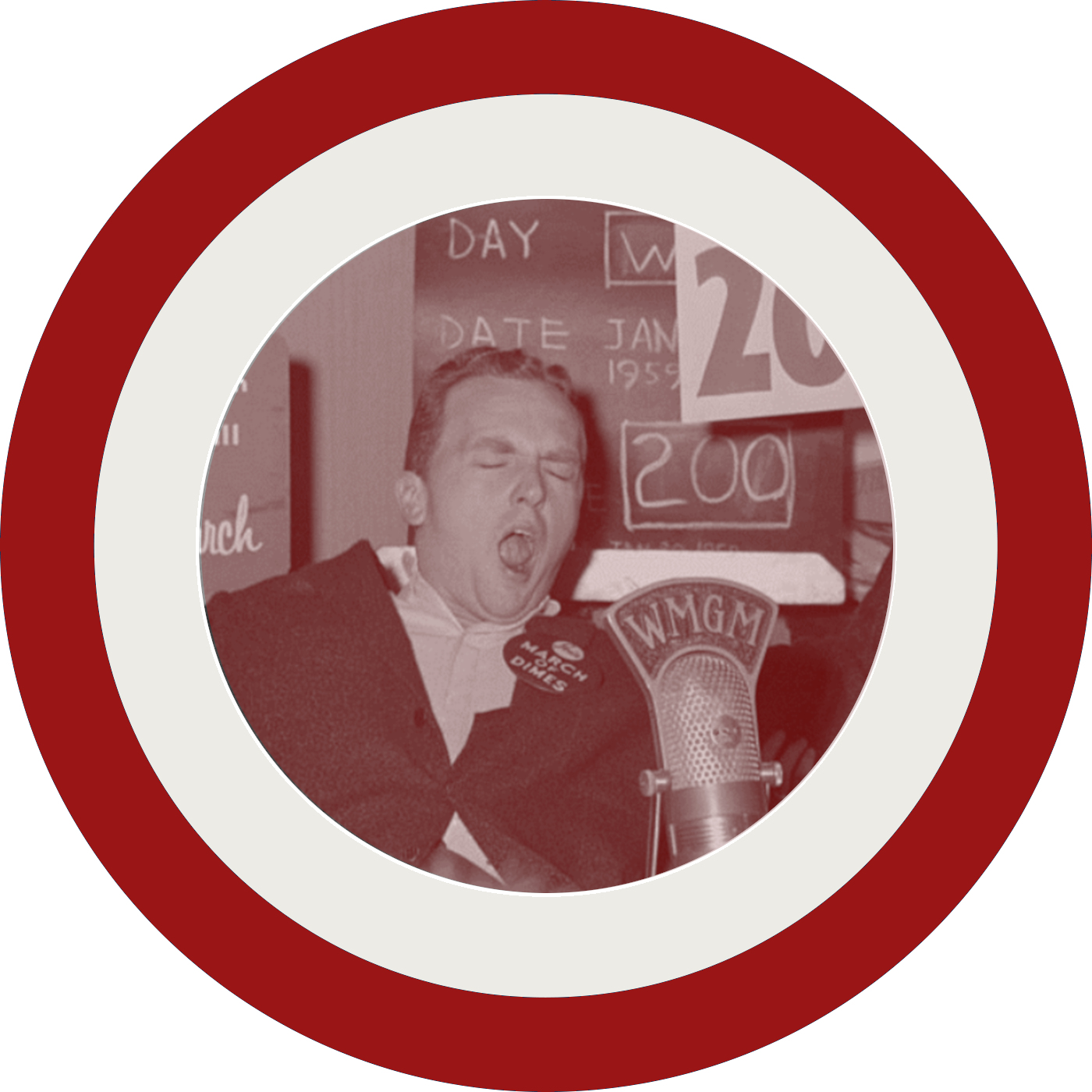
This is the Memory palace. I'm Nate DeMaio. There are things missing from the official government report published in 1966, seven years after the incident. It documents, though there are no redactions and no known conspiracy. But the report does not tell us which song Peter Tripp, then a 32 year old resident of New York City employed as a disc jockey, played first when he began his shift at the microphone in a glass booth in Times Square. It may well have been this one by the vocal group the Platters, as that single was the most popular in the country on that day, 20 January 1959, as it still would be the following week when Tripp was scheduled to sign off some 200 hours later, having not slept a wink that whole time. This was the kind of thing people were doing all the time then, or at least trying to. The papers of mid century America were virtually filled with word of some publicity seeking wannabe, someone attempting some feat of endurance or skill, the record breaking hula Hooper or pogo stick hopper or bubblegum bubble blower. It was an era of modest wonders and of brief cresting crazes rising up to lift Americans from all walks of life out of the ordinary and into the light. And the craze it seems then crusting among the nation's disc jockeys was trying to stay awake for some insane amount of time. When Peter Tripp awoke at 11:30am from the last sleep he would be allowed to enjoy for more than eight days and nights and headed into work in a makeshift studio that had been set up in a military recruiting booth to begin his assault at the record for sleeplessness. There were two other DJs, both in Florida, trying to do exactly the same thing. There was a guy in tallahassee another in Jacksonville. Each of these three men was doing it for publicity. Each was also raising money for charity. But only Peter Tripp was doing it for science. For there in the booth with him, along with his microphone and his records, were two nurses and a team of medical researchers from the University of Oklahoma, Cornell, the Albert Einstein School of Medicine, and the United States military. The effects of sleeplessness had been keeping scientists up at night back then. The military in particular was obsessed, trying to figure out just how far it was possible to push its fighting forces while at war. At what point does these sleepy soldiers stop shooting straight? Would the Marine push past his physical limits, aim astray, addled and bleary eyed, recover his faculties fully after he was allowed to sleep? And how much sleep and how often? And how about drugs? Was there a pharmaceutical fix that could render sleep unnecessary? Some unknown number of soldiers and sailors and airmen had been used as guinea pigs in government experiments during and immediately after the war. But in 1953, researchers suddenly had a new population of subjects for study. More than 50American service members who had been captured and held by Chinese and North Korean forces during the Korean War were returned to the United States. Nearly all of them had broken under interrogation, made statements praising their captors, or had denounced the United States in the American way, had made largely false confessions regarding various American war crimes. People thought these men must have been brainwashed through some inscrutable new communist method of mind control. But a young psychiatrist named Julian west found that the truth was much simpler. The men had been forced to stay awake and they fell apart. Some of the men were never the same. Sleep deprivation has been part of CIA interrogation techniques ever since. That same psychiatrist was in the booth with Peter Tripp, drawn by the prospect of a controlled experiment. He told the Associated Press that the effects of extended sleeplessness mirrored that of a number of mental health disorders. And these were inherently difficult to study. A scientist could run tests on a patient suffering one of them only after their symptoms had revealed themselves. Here was a rare chance to, in effect, induce mental illness in a controlled, supportive environment and then reverse it with some shut eye. So he and the other doctors and psychiatrists and sleep experts met with Tripp prior to his attempt, ran him through various physical and psychological examinations, determined baseline readings for any number of cognitive abilities, and found him to be of sound mind and body, a perfectly average American. As Tripp began his first daily three hour shift behind the microphone, hundreds of other average Americans jockeyed to get good spots by the windows of the recruiting station, pressing noses to the glass to get a peek at the suddenly famous dj, see if they could catch him nodding off. They wouldn't be the ones to notice if he did, what with the team of professionals observing his every eye flutter. This was not the case in Florida, where the two other DJs were largely alone. If either established a new world's record, the world's people would have to take them at his word. Peter Tripp's achievement, were he to last the eight days and nights, would not be disputed. His victory in this peculiar competition would be pure in more ways than one. For he was undertaking the endeavor without the aid of stimulants, including his morning coffee or any of the 30 cigarettes he had smoked in a typical day prior to having given up the habit as he began to train for his moment in the sun. And so there was nothing surging through his system when he began but adrenaline and ambition. This was by far the most attention he had ever received in his career. He may have been thinking as he put the needle down on his first record and looked out at the gawkers fogging the windows of his booth there in the heart of Manhattan, that he was poised to join the ranks of celebrity DJs. He could be a mere 200 hours away from being the next Alan Freed. Or maybe even make his own records like the Big Bopper. And what would that mean for his life, for his wife and their baby? Their first was due that very spring. Could they finally get that bigger place, live out their dreams? But we don't know what he was thinking. It isn't in the government report. It does tell us that 24 hours in he was holding up just fine. Sleepy, sure, maybe a little irritable, but everything perfectly normal for that foggy zone that most of us have been in at some point having pulled some all nighter or another. Most of us, however, haven't done two all nighters, not in a row. With no chemical assistance. Our bodies do their best to keep us from doing it. And so the medical observers weren't surprised to see Peter Tripp begin to struggle a couple of days in fighting to stay awake, nor see the scores on his brain games go down. Weren't surprised to hear him complaining, though they may have been surprised by his candor when he told a reporter, I have gone through terrible torture and anguish. I've had arguments with myself over how I ever got myself into this and how I can get out of it. He said that with more than 140 hours left to go, he didn't tell those Reporters about the spider webs, the ones he said were covering his shoes but weren't there at all. The scientists who had come to New York hoping to watch someone go crazy, well, they were in luck. The government report says Peter Chipp's hallucinations began at the 50 hour mark, beginning first with insects, the cobwebs, crawling ants. And then not an insect, but certainly similarly creepy. Crawly Trip convinced himself that one of his visitor's suit jackets wasn't made of tweed but of writhing, wriggling, hairy worms. Once, while taking a brief break at the hotel across the street where he would freshen up and change clothes, he opened a drawer and saw that it was on fire and ran out of the room and out into the street and had to be subdued by his nurses, who could not convince them that there was no fire. 100 hours in and he was struggling to complete even the simplest task on the cognitive tests. And that made him furious. He appeared to be in agony. One of his doctors wrote that he looked like a blind animal trying to feel his way through a maze. Tripp became convinced that the face of an old friend kept appearing on the face of a clock and then became confused. First because, sure, that is confusing. But then wondering if his friend's face was his face. Was he Peter, or was he the friend? Whose face was it on that clock? Was the clock his friend? Was his friend a clock? Could it be that he was a clock? He demanded to see his driver's license. He would not rest, would not budge until someone could give him answers. Was he, in fact, himself? 70 hours later, crippling paranoia began. He thought the doctors were conspiring against him. First to imprison him, and then when one of the psychiatrists had him take off his shirt and lay down on the examination table, as he had done multiple times a day all throughout the experiment. Peter Tripp had an epiphany. The man was an undertaker. He was there to embalm him and prepare him for burial. But he wasn't dead yet. He was pretty sure, and he knew he better get out of there before he wound up six feet under. So he bolted out of the door and had to be dragged back by the doctors. The report does not mention what kept him going or specify why. The research team made the decision after he had been awake for a full week to begin to test the effectiveness of amphetamines on the subject. They did keep him awake, but otherwise the effects weren't great. Objects appeared to change size. The doctor's ties would change color. He would talk to people who weren't there. The researchers determined that despite giving every appearance of a man awake, his mind was in a state that was identical to dreaming. The line between waking life and sleeping life had disintegrated, for Peter tripped and then he went to bed. He had stayed awake for 201 hours and 10 minutes. He had signed off at his 200th hour, but then he had to pose for some pictures and walk to the hotel where the plan was he would have some chicken, consume and then take a couple of final tests. But he passed out over soup. They got him under the covers, where he slept for the next 13 hours and 13 minutes and woke up fairly refreshed. The government report does not mention how Peter Tripp felt about the experience, nor does it get into the feelings of one Robert Souta, a 23 year old graduate student at the medical school of the University of Oklahoma who served as a control for the study, submitting to cognitive and physical examinations, all while enjoying full night's rest and as many naps as he felt compelled to take. The report doesn't mention specifics about the experiences of the other DJs. One claimed to have tapped out at 190 hours and 43 minutes after a persistent headache became too much to handle. The other, Jacksonville's Dave Hunter, broadcasting from an auto dealership, claimed to have bested Peter Tripp's record by more than 18 hours. It is possible he did. It is likely he didn't. The report, which again appeared in a public journal several years later, does discuss the case of Randy Gardner, who at 17, under the supervision of three respected sleep researchers in San Diego, bested Peter Tripp's record by nearly five full days. His 264 sleepless hours are still the record as of this recording. The report says that the teenager fared quite a bit better than Tripp. While he certainly suffered cognitive decline and experienced frequent hallucinations, the white high school senior became convinced that he was in fact a famous black longtime veteran of the National Football League. It seems that he didn't suffer suffer. This, the report says, is in significant contrast to Peter Tripp's experience, a difference that they suggest may have been due to Tripp's more advanced age and the additional stress he was under. What were the people watching both outside the glass and within, and other pressures he may have felt regarding his job performance during the experiment and the implications that performance might have on his life afterward. As for that life, the afterwards covered in the report extends less than a year beyond the experiment. It mentions that Tripp experienced a three month period of mild depression that appeared to resolve. And so we are left to Wonder whether those 201 hours spent awake in 1959 played any role in the dissolution of his marriage not long after, or in the dissolution of any of his three other marriages, or in his arrest in the Paola scandal when he illegally accepted money to play certain records and it effectively ended a career that never took off the way he may have once dreamt, at least when he was allowed to dream he would never be Alan Freed or make his own records like the Big Bopper. One of the only recordings we have of Peter Tripp on the air is this one, and it is appropriate WMGL.
- [17:08]
Drive 18 minutes before 8:39 degrees according to the WMGM thermometer. Number three time the biggest instrumental of 1959 Santa Johnny Sleepwalk.
- [18:14]
This episode of the Memory palace was written and produced by me, Nate DeMaio in April of 2024. This show gets research assistance from Eliza McGraw. It is a proud member of Radiotopia, a network of independently owned and operated listener supported podcasts from prx, a not for profit public media company. I say the date this episode was written, yada yada, in April of 2024, mostly because these credits tend to stay here at the end of their specific episode and one could be listening. You could be listening right now, in 2025 or 2055 for all we know. And some years ago I kept having this thing happen where someone would listen to an old episode and in the credits I would announce some information about an upcoming live performance and they'd write to me and say why can't I find tickets? I hear you're coming to my town.
- [19:05]
Nate DeMaio
And I sheepishly had to tell them.
- [19:07]
Unknown
That no, the show was the year before, but here In April of 2024, I'm happy to tell you that Normal Gossip, one of my fellow Radiotopia shows and one of the best shows there is. Period. A True, True Delight is just kicking off its new season. You can find out more about it at Radiotopia FM and any of the other Radiotopia shows.
- [19:33]
Nate DeMaio
I also get to say here in.
- [19:35]
Unknown
April 2024 that I am very close to being able to give you all sorts of information about the Memory palace book, which will be published by Random House later this year, toward the end of the year. And I really can't wait for you to read this thing. And I can't wait to show you.
- [19:54]
Nate DeMaio
The COVID and give you the release date and all that stuff.
- [19:57]
Unknown
And I will be making announcements as I am able to here in the credits, but also on social media, on Twitter and Facebook, Thememory palace at Instagram and Threads, Thememory Palace Podcast, and in a new newsletter that I will be launching soon through Substack, where I will be writing a bit about each new episode. I will be keeping people updated about the book, about live performances. I will be fielding the occasional listener and reader question, those sorts of things. So it's exciting times around the Palace. It's a big year, and I'm looking forward to having you along with me during all this, and I'll talk to you soon. Radiotopia from PRX.