Loading summary
Transcript7 lines
- [00:07]
Nate DeMaio
Hey, folks, it is Nate. Before we get started, I want to ask you to consider two things. I'm talking to you today at kind.
- [00:14]
Nate Tomeo
Of a pivotal moment in the history.
- [00:16]
Nate DeMaio
Of this history project that you know as the Memory Palace. Here's the first one. On November 19th, I have a book coming out, and I am delighted about that. For years, I have wanted to collect the sorts of stories that I do in this podcast in a book, like something that you can hold in your hands, give as a gift, and something that could live on your shelf. As a kid, I grew up loving these old paperback collections of Ripley's Believe it or not, also things like where the Sidewalk Ends, the poetry book by Shel Silverstein. It's collections of short pieces that you could turn to again and again. You could find new things every time you took it off the shelf and maybe find that they connect differently this time now that you're that little bit older or a little bit changed since last time you read it. And I want to make one of.
- [01:05]
Nate Tomeo
Those books, you know, but for adults.
- [01:08]
Nate DeMaio
That might have a little bit of that same magic. And I'm excited now to see that if that magic trick works. And so I am here today, days before its release on November 19, to encourage you to order the book, to help it jump out of the gate with some momentum so other readers might find it, especially people who don't listen to the show like you do. So that is thing one and thing two is deeply related. This show, book or no book, successful book or flop, will go on. And it will go on, thanks to listeners like you. Each year, we at Radio Utopia ask you directly to support the work that we do. We are one of the rarest, and I am more convinced all the time in this time of increased media consolidation and corporate nonsense and private equity raiders, that independent media is vital. I look around my industry and I see layoffs and cost cutting at big podcast companies. I see terrific shows getting worse because some corporate suit says they need to come out more often the episodes and more often that the people can make them or at least make them well. Or these shows are just shutting down because some investor needs someone to cut some bottom line to meet second quarter estimates. And that doesn't happen at Radiotopia. At Rodeotopia, what shows sound like, how often they come out, is up to people like me. The people make them. And whether those shows survive and thrive, it's up to you, honestly. Listener support provides the foundation of each of these shows, including mine. It allows me to keep the lights on at the Memory palace, even in times like these when ad revenue is vanishing. It has allowed me in this last stretch, which has been fairly rough, honestly, to wait out the storm. It is thanks literally to listeners like you. So if you would like to join the tiny fraction, the select group, the elite squad who contributes, if you want to do it this time, in this moment, for this show and for the uncertain times here in these United States, it is a perfect time to join them and join us. You can donate to help this show and the work that Radiotopia is doing, the fight we are fighting in this very strange landscape. We are very proud of what we have built together and we would love you to be a part of it. So donate today if you can at Radiotopia fm. Donate and thank you so much.
- [03:43]
Nate Tomeo
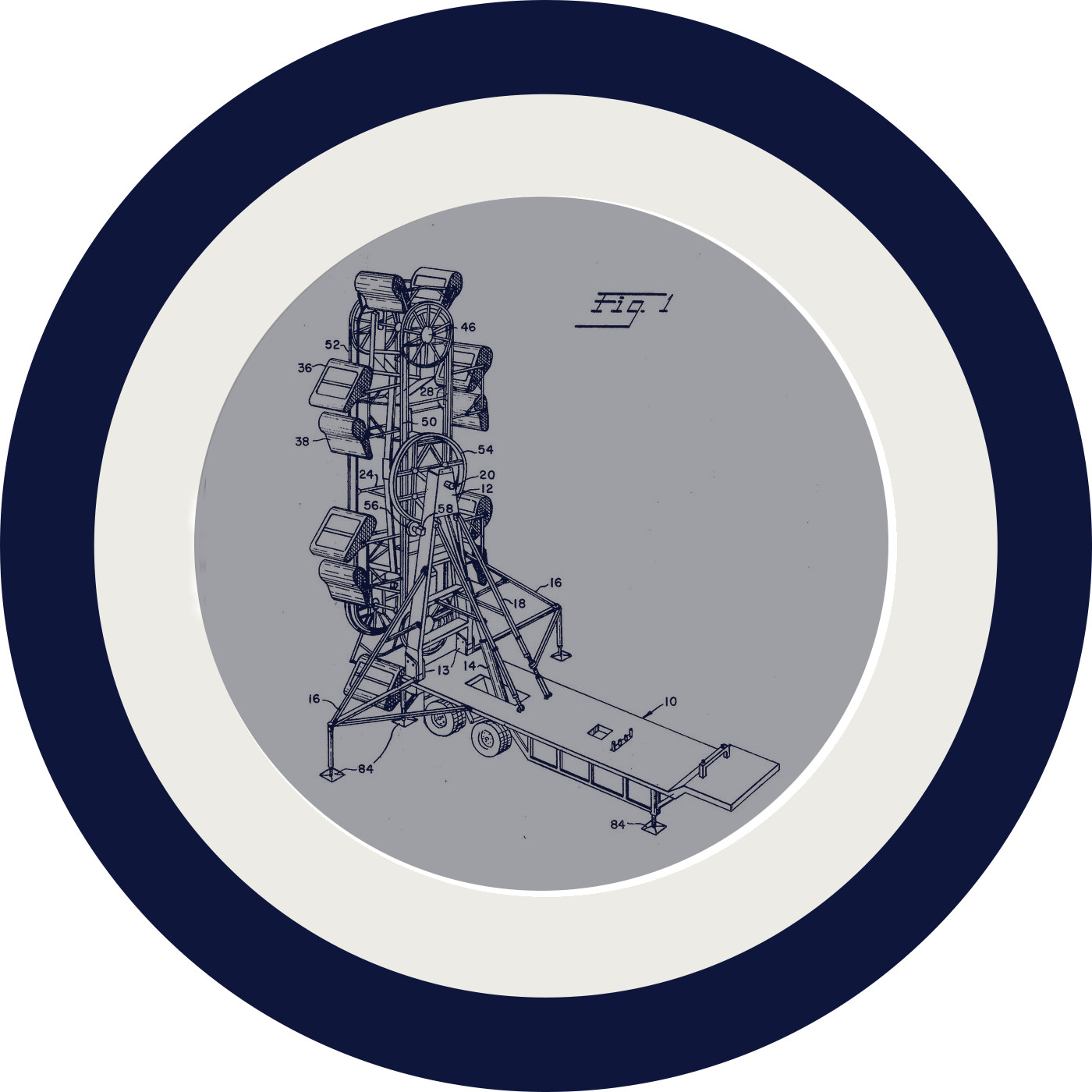
This is the Memory Palace. I'm Nate Tomeo. This one was different. You don't know where the ideas come from all the time when part of your job is coming up with ideas. But it seems that one day at work, Joe Brown saw something in a piece of plywood. There was something there, maybe. He took it to a table saw and cut out a shape a little different than the ones that folks there at Chance Amusements of Wichita, Kansas, typically used when they made their rides. A change from those flat bottom circles, the little setting suns that might hang from a Ferris wheel or if you flip them over, could spin like a teacup. He cut out a new shape that looked a bit like an apostrophe or a particularly cartoony lowercase b depending on how you oriented it. Hadn't tried a shape like that before. Could be something, but how would he attach it? Pictured people sitting in a cart the shape of that piece of wood. He picked up a metal rod and placed it to one side behind the imagined backs of the imagined people. That wasn't anything. That was just another affairs. Put the rod on the top and the cart would swing about a bit. But so what? That had been done. But then a light bulb went off. One of those blinking carnival light bulbs, maybe one that's fritzing out a bit, maybe making you worry that maybe the carnies aren't really keeping up with maintenance like they should at this carnival. Anyway, Joe Brown has an idea. He drills a hole in the plywood just a bit off center, puts the rod through the board and holds onto each end of the rod and starts to move the model up and around through space. This was something. This one was different. Harold Chance first found business success helping people take it easy in the middle of the 1960s, he was America's foremost manufacturer of miniature railroads, the tiny engines that pull tiny cars filled with passengers, big and small, slowly around amusement parks, public gardens, and the occasional sprawling estate. But he was born Harold Chance, and one does not waste a last name like that playing it safe all the time. So he bet on excitement. He purchased the patent for a ride called the Trabant. It was his company's first foray into thrill rides. Looked a bit like a teetering roulette wheel that spins and rocks up and down and thrills or nauseates, depending on the rider. And it was a huge moneymaker, thanks in large part to Harold Chance's first major contribution to the history of amusements. He figured out a way to build the Trabant, sometimes branded as the Wipeout or the Mexican Hat. He figured out a way to build that ride such that it could be easily disassembled and put onto the back of a single flatbed truck. And so now he didn't just have an exciting ride that he could sell to amusement parks, but one he could sell to folks who ran traveling carnivals who can now take the Trabat with them as they went from town to town. The one truck ride, it was a revolution in the business of things that make lots of revolutions. So he was very excited to hear that Joe Brown, his plant manager and primary ride designer, had a new one truck ride to show him. There is an interview that Harold Chant sat for not long before his death in 2010 at the age of 88. In it, he remembers the first day he encountered Brown's new ride, the day that would change his life. He is pretty nonchalant about it, he says. As the founder of the company, he had to be the first person to test it out. He kind of shrugs and says he wouldn't build anything he wouldn't ride. But was he that nonchalant at the time, on that day in 1968, when he first took in the sight of the zipper, rising 57ft off the ground, A long, oblong tower that spins in its center like a Ferris wheel, but along its edge run parallel cables that pull a dozen cars carrying two passengers each around that tower as it turns in the opposite direction. And the cars are attached like Joe Brown's original plywood apostrophes, a bit off center, so they wobble as they hang there, as the ride is loading, rocking back and forth as anxious passengers adjust in their seats and wait for the ride to start spinning, spinning in three directions at once. The tower turning at the center the carts going around that tower. Then each of those carts tumbling and flipping as they go up and over and around and around. Harold Chance hopped in, strapped in, and off he went. The tower whipping around the carts zipping about the tower as the whole thing is whipping around those carts tumbling, going around and around Harold Chance's little apostrophe cart, almost flipping over with all that whipping and zipping. The thing was fast, it was scary, and it was going to be huge. Never again did anyone ride the Zipper the way that Harold Chance did that day. Turns out that the next time they tested it, they loaded the passenger seats with passenger sized sandbags and belted them in and turned on the Zipper and it zipped and whipped and the cars flipped and the Zipper flung those pretend passengers out to smash down in a cloud of sand when they hit the concrete. So they installed a metal cage around each of the carts and the Zipper went on sale. It was a sensation. The carnival operators loved it. One truck, two carnies, two hours, and the Zipper would be up and running. It was new, it was flashy and it was tall. It could be seen for miles, blinking above the treetops or aglow in the fog by the shore. And it was loud. Not the ride itself. That was just the typical generator humor. It was the screams, a siren call across the dirt parking lot. Teens running to try this new monster. Little kids gawking, wondering if they would breathe that brave one day. Older folks wondering at the way that summers just seemed to slip away. Carnies loved the Zipper too, because an off label benefit of all that flipping and spinning was stuff would just rain out of the passengers pockets as they tumbled through the air. Put up the sign that says the management isn't responsible for lost articles and the carnies could just rake it in at the end of the night. Change by the cupful. Lost wallets. This became such an added attraction for the carnies that the folks back at Chance Rides actually changed the spacing in the mesh in the cages so it was big enough to allow coins up to silver dollar size to slip through. But for the riders, it was probably worth it to say you had dared to ride the Zipper, to have managed to hold onto your lunch, if not your lunch money, to have defied death. But not everybody did. By the late 1970s, there were 93 zippers operating around North America. Thousands of people riding them each day and night during the fleeting summer carnival season. A handful of those riders died after two girls were thrown from two separate rides. One in Arizona, one in Pennsylvania. Killed two weeks apart. In the summer of 1977, a congressman tried to ban the Zipper. The Consumer Product Safety Commission sought an injunction to shut down the ride until a task force, eventually led by the mother of one of those girls, made sure it wouldn't happen again. And thanks in large part to her effort, the Zipper still rises above fields and clearings and church parking lots each summer, as it has for more than 50 summers. Even as time marches on, as roller coasters get wilder and wilder, adding new thrills, new twists on twists, the Zipper endures. It is safer now with latches and locks that can as easily come undone. The whole ride spins more slowly than it used to, but it still terrifies the newspaper stories about injuries and deaths, about a possible ban made the zipper into something of a legend, added to its allure to the kids staring up, maybe thankful that they weren't this tall yet to ride the ride, not this summer, maybe wondering the whole next year whether they could really do it. For the teenagers high fiving, jumping up and down in the midway lights, having conquered it, swearing they weren't scared at all. You were screaming, they weren't screaming to the dad wobbling away, having kept a promise, maybe needing to sit down for a minute, but having made a memory that will last a lifetime, there is still some summer this episode of the Memory Pals was written and produced by me, Nate DeMaio in the summer of 2024. This show gets research assistance from Eliza McGraw. It is a proud member of Radiotopia, a network of independent artist owned and operated listener supported podcasts from prx, a not for profit public media company. If you listen to this show regularly, you know that from time to time I like to shine a little light on one of my fellow Radiotopia shows. And today I want to tell you that if you have not made Song Exploder a regular part of your podcast listening experience, it is time. Rishi, the host and I have been friends for years. We joined the network at the same time and getting to be in this thing with him has been one of the great pleasures of my professional life. Song Exploder is simply one of the best podcasts that there has ever been. You can listen each episode to artists breaking down a single song, how it started, how they put it together. You will be introduced to new artists and then sometimes you will hear a beloved song from your past. Like I just look down on my feed and there are the Flaming Lips talking about how they wrote do youo Realize? Which is one of the best songs there has ever been. Learn about Song Exploder and all the Radiotopia podcasts at Radiotopia fm. You can learn more about this podcast by following me on Twitter and Facebook at Thememory palace, on Instagram and Threads Thememory palace podcast and on Substack, there's a newsletter at themorypalacepodcast.substack.com follow me wherever you'd like to find out more about what's happening with the show about the Memory palace book that is coming out on November 19, 2024 from Random House. And you are always also welcome to write me an email@natehmemorypalace us. Just yesterday I got the nicest emails from a few people who had heard me on an episode of Radiolab and it was just lovely. It is always nice to hear from folks. I will talk to you guys again.
- [14:48]
Nate DeMaio
Radiotopia from PRX.