Loading summary
Transcript27 lines
- [00:07]
Nate DeMaio
Hey, folks, it is Nate. Before we get started, I want to ask you to consider two things. I'm talking to you today at kind.
- [00:14]
Narrator
Of a pivotal moment in the history.
- [00:16]
Nate DeMaio
Of this history project that you know as the Memory Palace. Here's the first one. On November 19th, I have a book coming out, and I am delighted about that. For years, I have wanted to collect the sorts of stories that I do in this podcast in a book, like something that you can hold in your.
- [00:33]
Narrator
Hands, give as a gift, and something.
- [00:36]
Nate DeMaio
That could live on your shelf. As a kid, I grew up loving these old paperback collections of Ripley's Believe.
- [00:42]
Narrator
It or not, also things like where.
- [00:44]
Nate DeMaio
The Sidewalk Ends, the poetry book by Shel Silverstein. It's collections of short pieces that you could turn to again and again. You could find new things every time you took it off the shelf and maybe find that they connect differently this.
- [00:58]
Narrator
Time now that you're that little bit.
- [00:59]
Nate DeMaio
Older or a little bit changed since.
- [01:02]
Narrator
Last time you read it.
- [01:04]
Nate DeMaio
And I want to make one of.
- [01:05]
Narrator
Those books, you know, but for adults.
- [01:08]
Nate DeMaio
That might have a little bit of that same magic. And I'm excited now to see that if that magic trick works. And so I am here today, days before its release on November 19, to encourage you to order the book, to help it jump out of the gate with some momentum so other readers might find it, especially people who don't listen to the show like you do. So that is thing one and thing two is deeply related.
- [01:33]
Narrator
This show, book or no book, successful.
- [01:37]
Nate DeMaio
Book or flop, will go on. And it will go on, thanks to listeners like you.
- [01:42]
Narrator
Each year, we at Radio Utopia ask.
- [01:44]
Nate DeMaio
You directly to support the work that we do. We are one of the rarest, and I am more convinced all the time in this time of increased media consolidation and corporate nonsense and private equity raiders, that independent media is vital. I look around my industry and I see layoffs and cost cutting at big podcast companies. I see terrific shows getting worse because some corporate suit says they need to come out more often the episodes and more often that the people can make them or at least make them well. Or these shows are just shutting down because some investor needs someone to cut some bottom line to meet second quarter estimates. And that doesn't happen at Radiotopia. At Rodeotopia, what shows sound like, how often they come out, is up to people like me. The people make them. And whether those shows survive and thrive, it's up to you, honestly. Listener support provides the foundation of each of these shows, including mine. It allows me to keep the lights on at the Memory palace, even in times like these when ad revenue is vanishing. It has allowed me in this last stretch, which has been fairly rough, honestly.
- [02:50]
Narrator
To wait out the storm.
- [02:53]
Nate DeMaio
It is thanks literally to listeners like you.
- [02:55]
Narrator
So if you would like to join.
- [02:57]
Nate DeMaio
The tiny fraction, the select group, the elite squad who contributes, if you want to do it this time, in this moment, for this show and for the uncertain times here in these United States, it is a perfect time to join them and join us. You can donate to help this show and the work that Radiotopia is doing, the fight we are fighting in this very strange landscape. We are very proud of what we have built together and we would love you to be a part of it. So donate today if you can at Radiotopia fm. Donate and thank you so much.
- [03:43]
Narrator
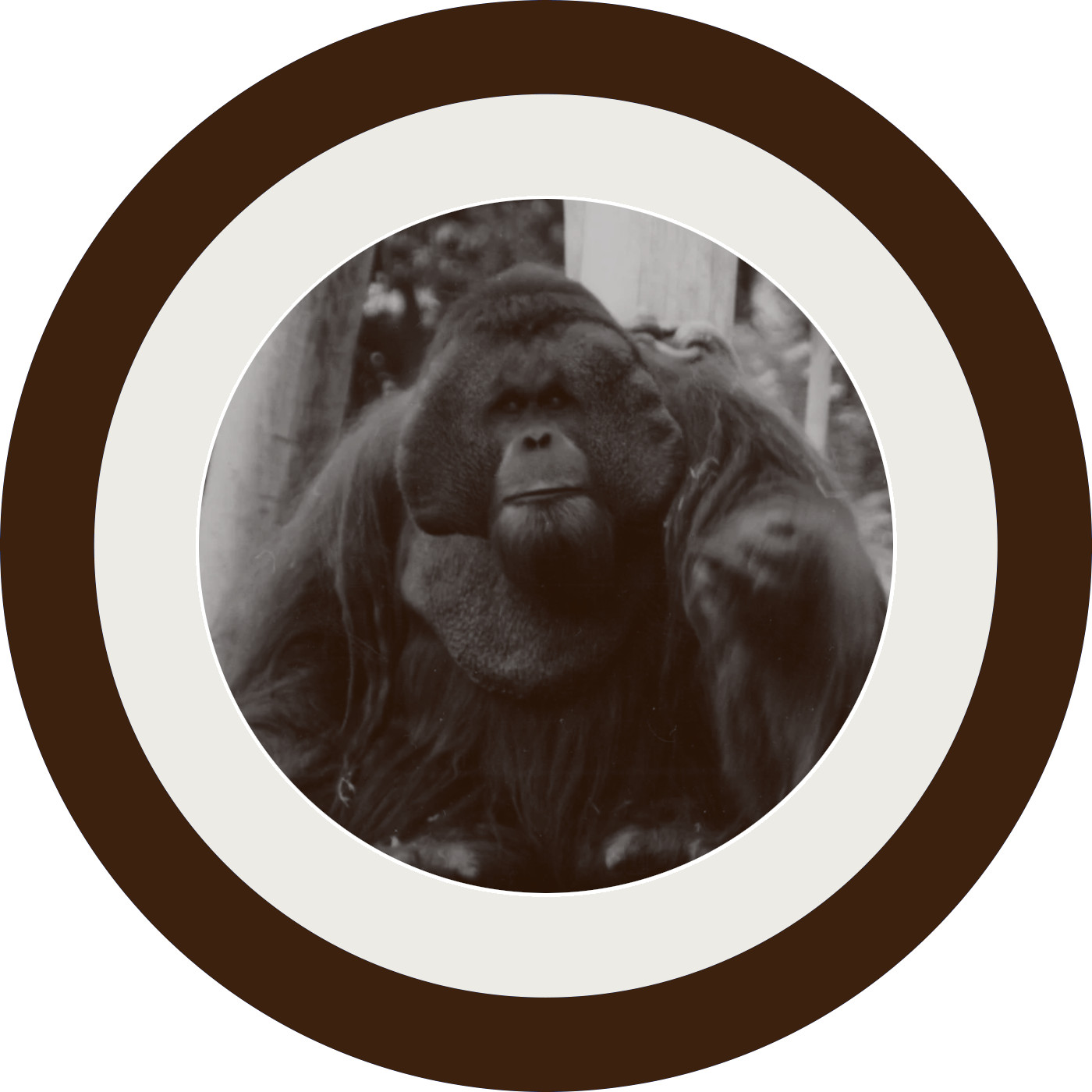
This is the Memory Palace. I'm Nate Tomeo. Ken Allen was born to be observed. He was an orangutan. I should clarify, as the name Ken Allen doesn't exactly scream orangutan. He got the name shortly after his birth in captivity in 1971, thanks to the close observation of two men, one named Ken Willingham, another named Ben Allen, who noticed that his mother was about to smother the infant orangutan and they jumped in to save the fuzzy orange little guy's life, a life that would be spent entirely within the confines of the San Diego Zoo. Then, as now, that institution was at the vanguard of a movement to make zoos more humane by making their enclosures less human. Normal prison bars, fewer cramped spaces, habitats with a bit more room, if not to roam, then to explore, to rest, to find some stimulation, typically in a simulation of, if not the animals, literal homes for so many of the zoo's creatures, like Ken Allen, are born there, then, like their ancestors, homes with jungle plants or desert brush or tall grasses upon which to graze that would provide some instinctual comfort, perhaps, and proper nutrition for the animal, while making things look a little like Africa or the steppes of Central Asia to the humans wandering the winding paths from exhibit to exhibit. And Ken Allen, a Borneo orangutan by blood, but a Southern Californian by birth, went on display in a state of the art habitat, complete with region appropriate vegetation and things to climb and swing around on. Thanks to the learned and earnest zoologists, animal behaviorists and a vast number of skilled and mission driven professionals charged with the care and feeding of the zoo's residents, all while under observation by zoo goers and also the countless researchers who come to the San Diego Zoo to study animal Behavior and husbandry. To better understand and simply better the lives of the captive creatures. And to gain insights that might help wild creatures around the world. Ken Allen was fun to observe. Orangutans are adorable. And young Ken was no different. He was especially smart as a very young ape. During a period of his life when he spent most of his time off display, as they say. He figured out how to unscrew bolts. The zoo workers would screw them back in, and Ken Allen would take them out again. As a teenager, he turned out to be a handful. One day, there was a camera crew at the zoo filming a segment for local TV about the gorillas who lived in a habitat just down the path from the one where Ken lived with some other orangutans. Ken Allen picked up rocks from the ground, climbed up into the tree and started pelting the news crew. There is no footage of this as the cameras were pointed at the gorilla. But you can just picture it. Maybe the sound guy is there with his headphones on and his microphone. And he's wondering what that cracking noise is. And then he is suddenly bonked in the noggin with a rock. The cameraman scampers for cover. A newswoman, or a news guy made up and hairsprayed, is standing with a thin microphone. And then realizes in horror. Those aren't rocks coming over the fence anymore. That Ken Allen has run out of rocks and has started to throw his own feces. There is no footage, though there were plenty of witnesses. But for all that observation, no one could say what motivated Ken Allen, teenage simian, to throw stuff at the camera crew. He wasn't prone to throwing things. People walk by his enclosure all day long. So why that day? What was it about those people or what they did or the noises they made? Was he protecting the gorillas? Was it just random? Maybe he was jealous of the spotlight. Not even the most experienced newswoman would ever be able to get a direct answer. And the researchers and behaviorists could just use this incident as a data point. And the zookeepers could just try to figure out how to make sure it didn't happen again. But it did happen again. A few years down the road. Ken and several other orangutans in the exhibit would occasionally go on rock throwing jags. Maybe the others had learned it from Ken Allen, or maybe not for all of the observers. No one could say definitively the humans could just take what they knew or thought they knew about orangutan behavior. And then apply what they knew about engineering and construction and combine that with whatever information they could gather about zoo operation and orangutan husbandry. Best practices from academic papers and conferences and symposia. Call up colleagues at other institutions and brainstorm, Try to find some solutions to combat this new emergent social behavior, this culture of rock throwing that had developed among this community of apes and this place. In the early 1980s, the humans adjusted the design of the enclosure, but the orangutans started throwing the rocks to try to break the windows. To what end? Again, no one really knew. Maybe they were trying to escape or just entertain themselves and alleviate boredom. Maybe it felt good in their shoulders. Maybe they liked the way the light looked when refracted and rainbowed in shattered safety glass. Maybe it looked like it did through dappled leaves in an ancestral Sumatran rainforest. These creatures would never know. We will never know. But the zookeepers knew the apes couldn't keep breaking the glass and throwing the rocks. It wasn't safe for anybody, including Ken and his cohort. So they brought in some men to get rid of the rocks and put in a new type of floor for the exhibit. But with no rocks to throw, the apes figured out how to pull tiles off the wall and throw them instead. And some observers took this as a sure sign that the orangutans really wanted out. But there is no surety. There is just behavior and observation. And so I offer no interpretation. At least I attempt not to, Though I am only human when I tell you that. On June 13, 1985, a typically temperate and breezy San Diego day, zookeepers and zoo goers were surprised to find on one of the manicured paths that wind about the grounds from animal enclosure to animal enclosure, One of those animals, Ken Allen, was just wandering around, not looking all that much different from any of the guests, except for looking a lot different. But he wasn't agitated or angry. He was just out and about checking out some of the animals. People watching the zookeepers were alarmed, But Ken Allen apparently wasn't, and he was perfectly compliant. When they led him back to the safety of captivity, they tried to figure out how he'd escaped. No one had seen him do it. They thought that he might have made a ladder, which sounds surprising, especially if you, like me, had been taught or had just absorbed the notion that humans are the only animals that make tools. That notion that has been debunked countless times and increasingly in recent years as we have developed all sorts of new cameras and techniques and means of observation. Humans have now confirmed that dozens of species, numerous whole families, even if I remember those now outdated categories of classification for the animal kingdom. So many creatures make tools. And as far back as the second Reagan administration, Ken Allen had been observed, to the fascination of researchers and his keepers, making a ladder out of fallen branches, methodically refining and testing its design. But in this case, the case of the escaped ape, no ladder was found. Nor was any open door or piled up objects or a tree left accidentally unpruned, such that the canopy stretched conveniently close to the edge of the enclosure. It was a mystery. All that the people who ran the zoo could do was try to make the habitat more secure. So they built a higher fence and crossed their dexterous human fingers. But a month later, Ken Allen was found once again wandering around outside his habitat. People were walking up to him and taking Pictures with the 200 pound brown orange ape. The zookeeper swept in and ushered him back inside. Once again, there was no ladder. There was no open door. Once again the fence went higher. Once again, dexterous human fingers were crossed. This time they even brought in some rock climbers to go into the enclosure and find all the handholds and cracks and crevices that a creature who might want to escape might use to make its way up and over the ever higher fence. Then a construction crew came in and smoothed out the wall to make it unscalable by man or beast. They put in a moat. Because behaviorists knew that orangutans are afraid of getting into the water. But Ken Allen escaped again and again. They didn't know how. They tried another tack. They had had some success back during Ken and his hen shapes rock throwing days with applying some simian psychology to the case. Simian psychology, 101 level stuff, if you ask me. Because if the orangutan was about to throw a rock, the zookeepers would get them to trade it for a banana, which sounds on the nose, but it did help. And so here the people at the zoo figured if a reward from the primal food drive category had worked, they would try something from the primal sex drive category. They introduced some female orangutans into the habitat to keep Ken Allen occupied. And meanwhile they ramped up their observation. Zookeepers were stationed to keep an eye on Ken so they could catch him in the act if he tried to escape again. But quickly those people noticed that Ken was keeping an eye on them right back. So the zookeepers started to come in disguise, dressed as regular tourists, 1985 style. So lots of neon, maybe a fake mustache and a T shirt with a California raisins on.
- [13:34]
Nate DeMaio
It.
- [13:35]
Narrator
Whatever. Either way, it didn't work. Ken Allen was totally onto them, which they figured out one day when they noticed that a construction worker had accidentally left a crowbar in the enclosure. Now, with Ken Allen, and honestly, most orangutans, if you leave a tool in the habitat, they will start using it. In fact, these apes were so savvy about human tools and human observation that they would typically grab the screwdriver or hammer immediately and then hide it and start using it in the middle of the night when no humans were watching. So the zookeepers realized that Ken Allen knew that the zookeepers were watching because he just stood by the crowbar. He didn't pick it up. He just hovered nearby, waiting, they assumed, for one of the undercover keepers to turn their back so he could grab the crowbar and snatch it somewhere. So they didn't turn their back. But that wasn't his plan. His plan, apparently, was while he was standing there, under the watchful eye of the zoo spies, one of the new lady orangutans was in the corner, trying to pull out the molding between two sections of glass and make her own escape. Ken Allen didn't just know who the spies were. He knew they would keep watching him as long as he hovered by the crowbar. He knew how to cause a diversion and how to work with a confederate, the female ape, who did not manage to escape, but who did crack both planes of glass. And then they had to be replaced and ultimately redesigned. The zoo even installed an electric wire around the top of the enclosure. And the humans kept watching. And Ken seemed pretty content. It just went back to regular zoo ape behavior. But he was actually just biding his time. He made another break for it. This time, he was caught in the act, though the zookeepers couldn't believe what they saw. First, Ken waded through the moat. Orangutans weren't supposed to do that. And then he walked to the edge of the enclosure where two glass walls came to a corner, and he climbed, put his hands and feet out and just shimmied his way up. The behaviorist did not know orangutans could do that. They had no idea their fingers were that strong. Ken Allen made it all the way up to the electric wire and got a jolt. Not enough to hurt him, but it did scare him. He had figured out a lot about human life in captivity, but this was his first encounter with electricity. Then things went quiet. The zookeepers kept watch, but Ken was just doing around 10 things. Eating some bugs, chilling. But one day, maybe he knew, somehow Maybe he had learned to recognize the hum of the electrified fence, or maybe he just got lucky. But either way, one day they were repairing the pump in the moat and had to turn the electricity off. And off Ken Allen went. It wasn't as easy to get him back inside after this escape. They usually bribed him with a banana. Usually just kind of led him back through the door. But this time he seemed agitated. He didn't seem to want to go back in. The zookeepers grabbed tranquilizer guns and even regular guns because he just don't know. With an ape, he was adorable. The tourists loved him, called him Harry Houdini. But if an ape that big and that strong got angry or frightened, it could get bad. It didn't. He eventually kind of turned himself in. Maybe he understood what would happen if he didn't. Who knows? And that was Ken Allen's last escape. Though the next year, one of his mates herself escaped. A couple of tourists rounded a corner and saw an orange ape on the path in front of them. Probably dropped their popcorn in surprise. It is quite possible that the female orangutan had learned from Ken Allen a technique. Or maybe he had opened up the possibility of escape. And eight months later, that same female got out again. And this time it was clear, though astounding, how she'd done it. The evidence was right there. She had enlisted her sister's help. Her accomplice had held up a broom handle to help give her a boost. This kind of coordination, however it happened, because how do they plan? How do they communicate about planning? How far in advance what even is time to an ape, was unheard of, at least for orangutans in captivity. We're for all the care that the best zoos, and surely San Diego counts as one of the world's best, one of the world's most innovative and most humane. These apes aren't allowed to express and experience their inherent apeness in all of its unknowable ways. The captive life, the observed life, is a different kind of life. It was ken Allen's life. 29 years spent in what is called a habitat. Though unlike almost every other of his fellow residents in the San Diego Zoo, he spent several hours of the years he had free, at least to a point. His remarkable exploits, his ingenuity, his intelligence, are something of a local legend. They made him an international star, at least to the small community of researchers who study orangutan cognition and behavior, who try to expand human knowledge and better the lives of these apes in and out of captivity. Though for all their care and thorough inquiry, keen observation, they cannot tell us what Ken Allen felt about the life he was given. They cannot tell us if he would ever be able to understand that peculiar push and pull of the people who dedicate their lives to caring for and understanding and simply saving these animals who spend their careers living at the center of the contradiction of zoos, of knowing that these animals shouldn't be there. But by being there, humans might be better able to help the animals who aren't, can better advocate to maintain habitats, survive this world we live in, and can help the humans who come to the zoo to understand them a little bit, to fall in love with them, maybe even go on to help them, even if they can't tell us what Ken Allen thought about those several hours he spent on the other side of the fence. We cannot really know other animals, but we know people. And so as we remember Ken Allen, who died at The Zoo on December 1, 2001 after being diagnosed with prostate cancer, we remember too the humans who were lucky enough to observe him and who loved him till the end. They were only human after all.
- [20:36]
Nate DeMaio
SA.
- [21:22]
Narrator
This episode of the Memory palace was written and produced by me, Nate DeMaio in September of 2024. The show is a proud member of Radiotopia, a network of independent listener supported podcasts from PRX, a not for profit public media company. There are exciting things going on all the time here at Radiotopia, including soon the triumphant return of the wonderful, monumental, I dare say second season of Wait for It that is weigh the brilliant host Ronald Young's groundbreaking and lovely and just delightful exploration of life in bigger bodies. This show is special. Find out more about it in other Radiotopia shows at Radiotopia FM and a quick reminder and pitch that now is a wonderful time to pre order your copy of the Memory Palace. This is a book by me from Random House. It is coming out November 19, 2024 but you can purchase, purchase and pre order a copy now. Go wherever you like to buy books. Pre orders in particular make an enormous, enormous difference for me and for the prospects of the book. I would be greatly appreciative if you pre order the book. If you want to follow me on Twitter and Facebook, I am Thememory Palace. On Instagram and threads, I am Thememory Palace Podcast and you can also subscribe to my newsletter where I will be writing about this episode and how I am attempting to navigate this whole book promotion situation. That is at thememorypalacepodcast.substack.com and you are always welcome to drop me a Note @nate themorypalace us. I will be back with a new episode in a couple weeks. In the meantime, I think I'm going to be dropping some favorite older episodes into the feed. These are stories that simply didn't work for the book because they were too dependent on the listening experience because they had a piece of audio or there was just something about the way that they work. It really should be an audio only experience. I've been thinking about a lot because a lot of the fun of the book was figuring out what worked well on paper and what didn't and then also what might work best on paper. So the new stories that I written for it often hinge upon a visual element, which is kind of a whole new way of thinking for me and I really love doing it. I'm excited to share it all with you. Anyway, there is going to be more in your feed and more on the new Memory palace book and more new Memory palace episodes coming all the time. I will talk to you soon.
- [24:07]
Nate DeMaio
Radiotopia from PRX Everything.