Loading summary
Transcript35 lines
- [00:02]
Nate DiMeo
This episode of the Memory palace is brought to you by Magic Spoon. You may have heard me talking about the nostalgic kick of Magic Spoon, the way they have brought back the fun to your classic cereals with fruity and chocolatey and frosted flavors. But they have updated both for this era of eating and, let's face it, this era in the lives of the people eating it. No more sugary cereal. Try 13 grams of protein, 0 grams of sugar and just 4 grams of net carbs. The only thing missing is the reading material. It is time to bring it back. You know the way you used to sit as a kid in the pre phone past and read the back of the cereal box over and over because that was all the entertainment that you got back then. It is time for Magic Spoon to, I don't know, put New Yorker articles in the back because otherwise it's a perfect product. Cereal and treats for the way you live. Now, reading material aside, get $5 off your next order at magicspoon.com memory or look for Magic Spoon on Amazon or in your nearest grocery store. That's magicspoon.com memory for $5 off. This episode is brought to you by Progressive Insurance. Do you ever think about switching insurance companies to see if you could save some cash? Progressive makes it easy to see if you could save when you bundle your home and auto policies. Try it@progressive.com Progressive Casualty Insurance Company and affiliates. Potential savings will vary. Not available in all states. Hey, if you are going to be or want to be in the New York city area on June 13, I am going to be doing a special live show to close out the Tribeca Audio Festival. Me reading stories from the Memory palace with animation and slides and music. Including reading a story that is in my audiobook that only exists in my audiobook that I will only perform once at this very special event. And I will also be joined by two of my audiobook's readers, the wonderful actresses Carrie Coon and Lily Taylor. Couldn't be more excited about this and hope you will join me. You can find a link to tickets at thememorypalace US Event this is the Memory Palace. I'm Nate dimeo. It wasn't live. It was never going to be. It could have been live. Theoretically, it was 1937. Bigger stations at that point could manage the technical and logistical hurdles to broadcast from places other than radio stations. They could do a remote broadcast from an important event, a presidential speech. But this wasn't that.
- [02:42]
Herbert Morrison
How do you do everyone? We're greeting you now from the Naval Air base at Lake Hurst, New Jersey, from which point we're going to bring you a description of the landing of the mammoth airship Hindenburg.
- [02:49]
Nate DiMeo
You can hear it in the recording here. Herbert Morrison attempting to puff up the significance of the event he was sent to New Jersey to cover.
- [02:57]
Herbert Morrison
Just one year ago today, May 6, that the Hindenburg made its first regular passenger flight to America. The flight that inaugurated the first air service across the Atlantic. So this occasion is doubly significant. It is the first anniversary of the inauguration of the the service and marks the first flight of this year.
- [03:13]
Nate DiMeo
And so Herb Morrison, a 31 year old Chicago radio host, will in roughly 20 minutes time from that moment, become not just an eyewitness to history, but the interpreter of that history. Because the Hindenburg is coming back to America as it will in a regular schedule throughout the warm weather months of the rest of 1937, which is noteworthy, though I'm not sure all that newsworthy. Definitely not worth all the hassle of doing a live broadcast. In fact, this whole thing is kind of a corporate boondoggle.
- [03:42]
Herbert Morrison
We both flew down from Chicago yesterday afternoon aboard one of the giant new 21 passenger flagships of American Airlines.
- [03:49]
Nate DiMeo
And so when he says, and incidentally.
- [03:50]
Herbert Morrison
American Airlines is the only airline in the United States which makes connections with.
- [03:55]
Nate DiMeo
The Hindenburg, there is nothing incidental about is an ad. It is Sponcon. He and his engineer, Charlie Nielsen, get a free trip to New York on a fancy plane. And in turn he gushes about American Airlines. He also gets a chance to try out some new technology. He gets a company to gift him a new gadget for the occasion that would record live sound directly onto an acetate disc. It would cut a record right there in the field and then they would take it back to the studio and play a clip. Basically just drop the needle on the record and then drop some audio into the middle of a live news broadcast. It was a good deal. He and Charlie would be flown to a landing field in New Jersey, try out the new recorder, ooh and ah at the Hindenburg and the wonders of American Airlines. Grab some dinner in the city, maybe a show, then they get flown back to Chicago. And the station could drop a little bit of sound from the Hindenburg's first seasonal arrival in New York into its Sunday night newscast. And so we have this recording now in the National Archives. Most of it is Herb Morrison just vamping, coming up with stuff to talk about as he waits for the Hindenburg to land.
- [05:02]
Herbert Morrison
Now, while we're waiting for the Ship to come back over the airport and to come into the mooring mast. Let me say a few words about the preparations which have been made here at Lakehurst.
- [05:12]
Nate DiMeo
He has read up on it so he can be ready with facts and figures.
- [05:15]
Herbert Morrison
There are two decks, A and B, A being the main one.
- [05:18]
Nate DiMeo
And it goes on and on. Herb is professional. He can just go on riffing all night. Though he does seem to have come with a few pre planned lines, locked and loaded.
- [05:30]
Herbert Morrison
Station deck on the eastward side and sparkling like glittering jewels on a background of black velvet. And every now and then, or maybe.
- [05:37]
Nate DiMeo
Not, maybe he is just kind of poetic on the fly.
- [05:41]
Herbert Morrison
The ship is riding majestically tortoise like some great feather, riding as though it was mighty, mighty proud of the place. It's playing in the world's aviation.
- [05:49]
Nate DiMeo
And then it all goes wrong, just.
- [05:50]
Herbert Morrison
Enough to keep it from. It bursts into flame. And it's falling. It's crazy. Watch it, watch it. Get this started. Get this started. And it's crashing. It's rising. Terrible. Oh my. Get out of the way, please. It's burning, bursting into flames. And it's falling on the morning pass and all the folks between it. This is terrible. This is one of the worst catastrophes in the world. Oh, this place is 2004 or 500ft into the sky. And it's a terrific crash, ladies and gentlemen. The smoke and the flames now. And the frame is crashing to the ground. Not quite to the mooring mass of humanity and all the of clarity screaming around you. I don't do it. I can't talk to people, especially around there. I can't talk, ladies and gentlemen, honestly. Just laying down massive smoking wreckage. And everybody can hardly breathe and talk and screaming. Lady, I'm sorry. Honestly, I can hardly breathe. I'm going to step inside where I cannot see it. Tony, that's terrible. Listen, folks, I'm going to have to stop for a minute because I have lots of voices. This is the worst thing I've ever witnessed.
- [07:12]
Nate DiMeo
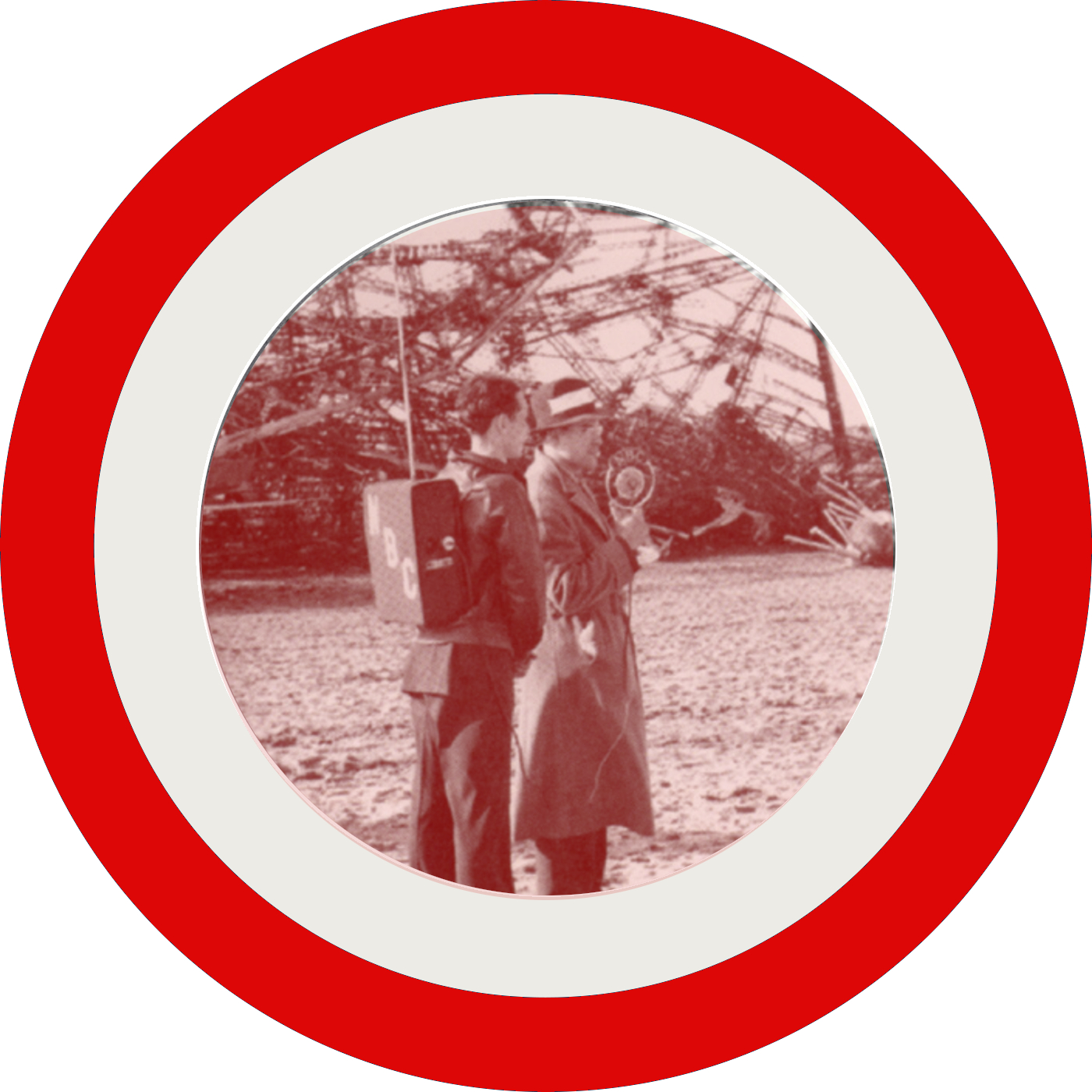
And so this is a recording of both the Hindenburg disaster, one of the most spectacular. And I mean that in the literal way, the one free of judgment. It is a spectacle. You can see it, I bet. The Hindenburg in flames. You probably know the picture by a freelance journalist named Sam Sher, who came not knowing what was coming. Like Herb Morrison, narrating one of the most famous disasters in American history. Making a recording of that, while making a recording of the worst thing he had ever witnessed, leaving behind a 42 minute document of one of the Most harrowing and strange nights of his life. It is not the whole night. He takes breaks.
- [07:56]
Herbert Morrison
Ladies and gentlemen, I'm back again. I've sort of recovered from the terrific explosion and the terrific crash that occurred just as it was being pulled down to the mooring mast that's still smoking and flaming and crackling and banging down the.
- [08:10]
Nate DiMeo
He pauses to go off to report.
- [08:11]
Herbert Morrison
If you'll fade it out just a minute.
- [08:13]
Nate DiMeo
At one point he signs off and then a second later he's back.
- [08:16]
Herbert Morrison
Ladies and gentlemen, I'm back again. I raced down to the burning ship and just as I walked up to.
- [08:22]
Nate DiMeo
The ship over and he fills in the gaps.
- [08:24]
Herbert Morrison
I met a man coming out. Days he couldn't find his way. I grabbed a hold of him, all his hair is burned off. But he's walking and talking plainly and distinctly.
- [08:33]
Nate DiMeo
And he tells the story of this thing that had just happened to him, this thing that he had just done, which in his telling, harried and urgent, seemed almost disbelieving of this thing that he himself had just experienced. This moment when he realized that he could help this man who was burnt, who had jumped out of the Hindenburg, realized that there was this man in need in front of him and he could help him, even though that is not what journalists do. And he does. Gets him off to safety, reunites him with his terrified family. And then there is everything that takes place after they ran out of space in the record, when there's no more they can do and they start to realize, or they think they do. I'm not sure they could be sure in the chaos that the Hindenburg people, the representatives of the Reich, want their recording. Maybe they are purely intentioned. Maybe it's the closest they can come to a black box recorder on an airplane. Or maybe it is something darker, a cover up. They want to limit the embarrassment for Hitler's Germany. And Herb and Charlie start running. They slip out as fast as they can. Later they find themselves at a diner in Newark. They are ragged, they are starving. Herb eats with the acetate recordings of the Hindenburg disaster hidden inside his coat. When they land back in Chicago, when they rush to the station, they do not know if there is anything even on the recording. They don't know if it worked. Maybe they screwed something up, or maybe it malfunctioned. They find a hole in it because when the Hindenburg exploded, the blast, the force of it shook the recorder and this stylus cut straight through the acetate disk. But then they are listening along with much of America, as The Hindenburg disaster that so many in the audience had just read about in the morning paper. But Herb Morrison and Charlie Nielsen saw it happen as it fills the air in their living room. And that recording will go on to be played again and again for decades. Someone will pair it with newsreel footage, put it in history documentaries. It will get used in montages that will serve as shorthand for whole eras of American life. And Herb Morrison will hear it over and over for the rest of his life. He died in a nursing home in West Virginia in 1989 after a celebrated career in radio and TV and academia, a career built in no small part on the fame he'd earned on that night. He talked about his experience in that field in New Jersey in 1937, a lot. In the years that followed, he was interviewed many times, rolled out on round, numbered anniversaries. He would be asked about it by students. He would weave it into speeches he'd give when he received various honors, spoke about it so much. In 1975, after he was hired as a technical consultant for a movie about that night, Universal Pictures sent he and George C. Scott, the movie's star, out on a promotional tour. As far as I've been able to figure, he never talked about that, about what it was like to talk about it, or to have a document of himself witnessing the worst thing he had ever witnessed, at least as far as we know, anyway. I sure hope it was. Here was that one night again and again, decade after decade. And here was Herbert Morrison, the man who was there. There is this thread of inquiry that pops up now and again where some academic ponders the phrase, oh, the humanity that is so famous, still has been quoted and parodied, and has never slipped all that far from the cultural consciousness for nearly a century. Now, was that a thing that people said? Was it a stock phrase that could have popped into anyone's head as that head reeled and swirled and tried to reign in the chaos of living through language? Or did it just come out a moment of invention, this thing that Herb Morrison said once? It seems like it did. There are countless citations for the phrase in the past decades, but they all start there, on that night, with that recording. Someone found one other instance, one single documented time that someone said, oh, the humanity. Before Herb Morrison did it was in a letter, a poetic report of sorts, from a Union soldier to his sweetheart in the Civil War, trying to get across to her the sadness that he had witnessed. Herb Morrison never saw that letter. There's no way. He just saw the flames. And he knew the names of so many people on that aircraft, had read all about them, knew how many people worked in the engine room, how many waiters and bartenders and bell ops, and was sure that they were all dead. Didn't know then that some had survived and the words just came, some guy. Some days after the disaster, while the whole country obsessed with the ongoing coverage, we're still talking about Herb Morrison's on the ground reporting. Someone wrote a takedown of that report, and a paper in Baltimore pegged Herb's emotion as undignified, blathering beneath a broadcaster and worse, beneath any man. In an interview in the late 60s, maybe early 70s, Herb Morrison would dismiss that take as a product of the times, that for some reason, in the late 1930s, in those backwards days, boys weren't supposed to cry. But I don't know how long it took him to come to that comfort, don't know how it felt to be called out for a feeling. And I don't know what it felt like to keep hearing himself feel, though it didn't sound like himself to him, but not in that way that no one's voice in a recording sounds the way that it does in one's head. The actual recording was too fast, so his voice was too high. That odd quality to his speech that I always assumed was a strange 1930s affectation was just an artifact of a falsely calibrated belt that spun the acetate disk at the wrong speed. Some years ago, a researcher named Michael Beale at Morehead State University in Kentucky slowed it down, tinkered with a pitch to do his best to recover what Herb Morrison really sounded like.
- [15:17]
Herbert Morrison
And is falling on the floor. All the folks believe that this is terrible. This is one of the worst catastrophes in the world. Four or 500ft into the sky, it's a terrific crash, ladies and gentlemen, that smoke and his flames. Now Andy Frame is crashing to the ground, not quite in the mooring mass. All the humanity, all the plans are feeding around you. I can't talk, ladies and gentlemen.
- [15:43]
Nate DiMeo
And so you can hear him now, sounding a bit more like he must have as he worked his way through the chaos, the UN understanding, the fear and sadness that happen sometimes in life, though there's usually not anyone there recording us when it does. And you can hear him in something close to real time, catching his breath, catching himself, calming himself down and processing the whole thing, turning it into a story, finding some way to make sense of this life, even when it doesn't.
- [16:18]
Herbert Morrison
Everybody's doing their utmost to bring about.
- [16:22]
Nate DiMeo
The easiest.
- [16:25]
Herbert Morrison
End to this horrific tragedy that we've had now. I'll be back to fry later.
- [16:33]
Nate DiMeo
Oh the humanity.
- [16:36]
Herbert Morrison
It.
- [17:16]
Nate DiMeo
This episode of the Memory palace was written and produced by me, Nate DiMeo in May of 2025. The show gets research assistance from Eliza McGraw, who is a proud member of Radiotopia, a network of listener supported, independently owned and operated podcasts from prx, a not for profit public media company. I just got back from a book tour of the Midwest which included, besides terrific events in four lovely communities, a tense but ultimately safe experience at the St. Louis airport as the weather went insane and tornadoes touched down nearby and you know, baseball sized hail rained down. And for what it's worth, I just wanted to say that I'm thinking about all of those folks who weren't lucky enough to be in a safe fortified building where they didn't have to be terrified. Because as a non Midwesterner, I had never seen anything like that. And I am thinking about those places and those people right now. Yeah, on a brighter note, the Midwest is a special place. And it is filled with special bookstores, it turns out. And here, as Father's Day approaches, it is the perfect time to go to your local independent bookstore and pick up or order a copy of my book of stories, new and Beloved, the Memory Two Short Stories of the Past by Nate DiMeo. It is filled with those stories and with memoir and found photographs and beautiful illustrations. For what it's worth, as I read this while I am wearing my incredibly soft and stylish sweatshirt from Golden Hour Books in Indianapolis, I bought the green one, although the blue one was lovely too. I just want to say that one thing I have learned doing these events and interacting with folks who work at or own these bookstores. I want to say that independent bookstores are magic. I've always understood that one should support one's local bookstore, but I always figured that that wasn't for the same reasons that you should support any local business like you support your local donut guy, because otherwise there'll just be some Dunkin Donuts. There's so like you like going to your local bookstore and you want it to stay there and so you shop there because otherwise it gets turned into a Starbucks or a Citibank or whatever. But I did not realize that to be an indie bookstore is to be indie in the same way that an indie filmmaker or an indie musician or indeed an indie podcaster is like these people are out there and they are not just running their own business, but they are making choices based on their passions, like the things they love and is the books they are putting on their shelves are based in knowing their neighborhoods and their customers. Like no publishers paying them to put a giant stack of some new big book by some weird TV pundit. As happens at a lot of the big chain stores, they're calling all the shots on everything and they're applying their expertise and their aesthetic and like their moral compass to figure out which books they're going to stock, which books they're going to recommend. And for what it's worth, every time I walk into an indie bookstore and I see my book on the shelf, I feel legitimately grateful because I know that there's that there is someone, a person, not some algorithm, who found room for it there on the shelf or who saw the COVID and thought it was worth taking a chance on it, or who had never heard of it. And then a customer walked in and said, oh, you should get this. You should stock this. This guy's great. In every single place that I have been to in the last couple of months, big and small, in a bright blue city, deep red town, these bookstores have been the beating hearts of the best of their communities. I have loved getting to know places through their bookstores. It's been wonderful. And so all of this like long thing to say thank you to these bookstores that have hosted me where or even kindly replied that they wish they could, but their schedule is tight and to encourage you all like legit to think about your own indie bookstore in your own town next time you were looking for a book. They are magic, I tell you. Not a bookstore event, but an audiobook event. I am going to be doing a special live show on June 13, 2025 in New York City to close out the Tribeca Audio Festival. I'm going to be reading stories to music and animation and slides as is my usual live deal. But I'm going to be joined on this night and this night only by two of my audiobook readers by Carrie Coon and Lily Taylor. I'm super excited to do this. You can find a link to tickets at thememorypalace Us event. You can follow me on Twitter and Facebook, which are polar opposites of indie bookstores he Memory palace or on Instagram and threads in Substack Hememory palace podcast and on bluesky where I am myself aate dimeo D I M E O. You can send me an email@natethememorypalace us and you can hear another new story here in a couple of weeks. Talk to you again. Radiotopia from prx.