← The Michael Knowles Show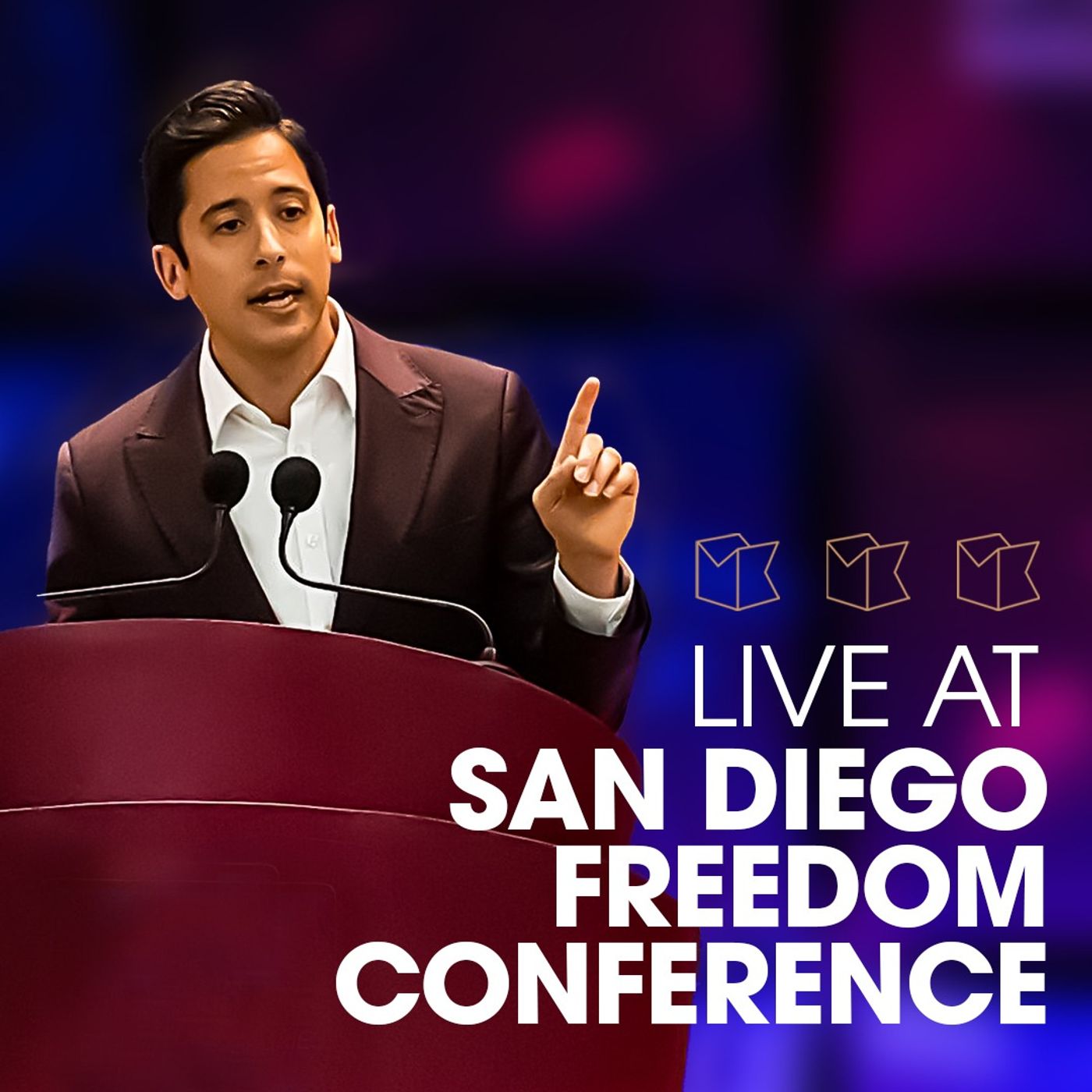
The Michael Knowles Show
Michael Knowles Live at YAF - "Ordo Amoris: The Hierarchy of Political Love"
00:46:21
Michael Knowles speaks at the YAF Freedom Conference in San Diego to discuss Vice President JD Vance's comments on the "order of love" and our obligations to faith, family, and society. Watch on DailyWire+ as Knowles equips conservatives to defeat the Left's attempts to redefine marriage, gender, and truth itself.
Loading summary
Transcript22 lines
- [00:03]
Michael Knowles
Big Mike. I love it. Oh, wow. That's a good nickname. It's been applied to other people in politics, but I'd like it to be referring to me. Thank you very much for having me. Thank you for the invitation. It is a true pleasure to be here. Thank you to Yaff. Especially thank you to Yaff for the honor of allowing me to participate in the William F. Buckley Jr. Lecture series. I'm a great admirer of the great man. I've tried to perfect his accent over the years. I'm not quite patrician enough. I spent too much time in the Bronx. But I'll work on it over the course of this lecture series. It is always so nice to be here in San Diego. I feel even better about it now that we have a functioning southern border again. We are less than 20 miles from Tijuana, but since January 20th, our odds of running into face tattooed foreign gangsters have dropped precipitously. I suspect they will drop even further as this administration goes on. Now, the gangsters from other countries who are still here are most likely in hiding right now. They know that at any moment Tom Homan might leap out from around a corner with a big butterfly net and just drag them all back to Latin America. So this is a happy turn of events. But some on the left seem not to realize it. Some on the left argue, some even on the squishy right, I'm afraid, argue that rounding up and deporting even the very worst illegal aliens in our country is somehow anti American. That's very strange to me because whatever you think of mass deportation, it's quite silly to argue that it's not American. Deporting people is a tried and true American tradition. Actually, this is whether we're talking about the 1830s or the Palmer raids in 1919 and 1920. That was when we deported foreign communists. Apparently we didn't deport enough. Whether we're talking about deportations during the Second World War, during the 1950s, of some million people in a single year in 1954, whether we're talking about the deportation of Haitians and Cubans who arrived during the Mariel boat lift in 1980, or any other number of deportations, one can argue over the necessity or prudence of those various deportations, most of which ironically were carried out under Democrat presidents. But no one can argue that they're not American. As a simple matter of history, mass deportations are as American as apple pie. The anti American charge. Vanquished opponents of immigration enforcement will next argue that that deportations are Somehow anti Christian. This claim is contradicted by the plain text of Scripture. Deportations, or worse, usually worse, are frequently carried out with the approval of God in the Bible. Just ask the Canaanites or the Hittites or the Jebusites or the Perizzites or the Hivites. A lot of people. Now, in fairness, Scripture also instructs us not to oppress or mistreat foreigners who live in our lands. Thou shalt not molest a stranger, nor afflict him for yourselves. Also were strangers in the land of Egypt. Quite right. But what exactly does it mean to molest or afflict the stranger? We are not left idly to wonder. Scripture actually tells us. Just 10 chapters prior, in the book of Exodus, we read, there shall be one law for the native and for the stranger who sojourns among you. Further, in Deuteronomy, we read, cursed be he who perverts the justice due to the sojourner. To hear the open borders crowd tell it, it is the enforcement of the law which oppresses the foreigner. But Scripture says precisely the opposite. Scripture tells us that it is lawlessness which oppresses the foreigner. The injunction not to oppress the foreigner does not run contrary to justice. Rather, it is bound up in the execution of justice. God demands that the civil authority give the foreigner his due. He does not demand that he give him more than his due. He tells us that there must be one law common to native and foreigner alike. He does not insist that foreigners be given a more lenient law, that foreigners be given special privileges over and above those afforded to citizens. Civil authorities must give appropriate care to foreigners, but civil authorities have to care for their own citizens, too. So how do we determine the right balance between hospitality to foreigners and. And the enforcement of justice owed to citizens and foreigners alike? Our Vice President, J.D. vance, took a stab at this question on TV last week, and his answer sparked a national debate. Vice President Vance said, quote, these are his exact words. Not taking anything out of context, he said, there's this old school and I think, very Christian concept, by the way, that you love your family and then you love your neighbor, and then you love your community, and then you love your fellow citizens and your own country. And then after that, you can focus and prioritize the rest of the world. This is a simple enough concept, I think, at least, let's say you're walking by a swimming pool and you see a random little kid drowning. Any decent person would jump in to save the kid. This actually happened to my father a few years ago. He was walking by a pool at his condominium. They saw a kid drowning. He jumps in, pulls the kid out of the pool. Everyone applauds. You're a hero. Now imagine you are walking past the same swimming pool. It's a very large swimming pool. And you see two kids drowning, each one at a different end. One of the toddlers is that same random kid you saw the first time. The other one is your own son. You, being a decent person, want to save both of them, but what do you do? You help your own son first, of course. In fact, if you did not, if you were to ignore the cries of your own son and go to help the other boy first, everyone would not applaud you when you climbed out of the pool. You would not be a hero. You would have made a moral error because you, as a father, have a greater responsibility to your own son than you do to someone else's son. This is common sense. But is it Christian? That's the question. Immediately after Vance's remarks, a former UK government minister turned Yale professor. That's not a good sign. This is Rory Stewart. He said no. He wrote a bizarre take on John 15:12 to 13, which, for those of you who don't have your Bibles in front. I know Governor Walker can do this from memory, but some of you might not be quite as biblically literate, so I'll read it. I'm not. As biblically literate says, this is my commandment, that you love one another as I've loved you. Greater love has no man, that a man lay down his life for his friends. One of the most famous lines in the Bible, he says a bizarre take. Less Christian and more pagan, tribal. We should start worrying when politicians become theologians, assume to speak for Jesus and tell us in which order to love. This comment was ironic, of course, because Rory Stewart is himself a politician who is presuming to speak for Jesus. He is presuming to speak for our Lord with far less knowledge and seriousness than J.D. vance. J.D. shot back. He wrote just Google ordo amoris, which means order of love, a concept developed most notably by St. Thomas Aquinas. Now, could we just take a quick pause for a moment? Could we just have a moment to appreciate how beautiful it is that we live in a time in which the vice President of the United States is lecturing leftists on moral philosophy in Latin? I knew. I knew the second Trump administration was going to be good. Okay? I had high hopes. Even I did not have Vice President explicating scholastic philosophy in Latin. Kind of hopes. That was not on my bingo card. I remember in 2016, after the primaries, general election comes about, there were many who didn't. They didn't want to vote for Trump. And people yelled at me. Many of my friends yelled at me because I said, I think I'm going to vote for Trump. And they said, he's not really conservative. Well, look, whatever was going on then, now his vice president is invoking St. Thomas Aquinas in Latin on Twitter. That is as conservative as it gets. You know, there is no greater depth than I think of conservatism. But I digress at this point in the conversation, after JD had dunked on the UK politician turned Yale professor, another Yale figure, James Suroviecki, editor of the Yale Review, he decided to chime in to claim that ordo amoris is not in the Gospels. He claimed it's an essentially Aristotelian concept that Aquinas cleverly, if unconvincingly, imported into Catholic theology. Up until this point, up until this point, I was aware that very few people presently associated with Yale had even a passing familiarity with the Bible. With that comment, it became clear that these Yale luminaries did not even know their Aristotle. This is very, very embarrassing. I don't know what has gotten up in New Haven, but something needs, someone needs to investigate that the ordo amoris, or the ordo Caritatis, as St. Thomas Aquinas would call it, is not essentially Aristotelian. And St. Thomas, among the clearest thinkers ever to live, did not import that or any other concept un unconvincingly into Catholic theology. Aristotle touches on the concept broadly in book four of the Nicomachean Ethics, in which he writes that the liberal man, liberal in this case meaning generous, not meaning crazy, says the liberal man, like other virtuous men, will give for the sake of the noble and rightly, for he will give to the right people the right amounts and at the right time, with all other qualifications that accompany right giving. Early Christian writers, notably Saints Augustine, Gregory the Great, Bernard of Clairvaux, they also discussed this order of charity which St Thomas brings to its fullest expression. And he brings it to its fullest expression in the Summa Theologiae secunda secunde question 26, where he writes, quote, there must needs be some order in things loved out of charity, which order is in reference to the first principle of that love, which is God. So we are obligated as a matter of reason to love God before ourselves. This according to St. Thomas, and to reason, you know, one in the same frequently when we read St. Thomas Aquinas, we are obligated to love God first, then we love ourselves, then we are obligated to love ourselves before our neighbors, then to love our neighbors before our own bodies, then to love those neighbors nearer to us sooner than those further away, then to love those connected to us by ties of blood before others, and so on and so forth. Thomas reasoning is, as always, clear and persuasive, though we don't have time to get into all of it. So maybe, if anyone is interested, we can get into it in the Q and A for our purposes right now. That very first line about loving God before we love ourselves suffices to prove that the Yale Review guy had absolutely no idea what he was talking about when he claimed that the Ordo amoris is not in the Gospels. Not only is the ordo amoris in the Gospels, it is the principle that is articulated in the most famous line of the Gospels, Matthew 22:37, 39 you shall love the Lord your God with all your heart, and with all your soul, and with all your mind. This is the great and first commandment, and a second is like it, you shall love your neighbor as yourself. There is, in other words, an order of charity, a hierarchy of love, and this order is the very foundation of Christian morality. We must love God first and only then and upon that basis do we love everything else. This order does not just comprise two categories. It's not just God and everyone else. We find further scriptural evidence of the order of charity in 1 Timothy, chapter 5, verse 8. If anyone does not provide for his relatives, and especially for his own family, he has disowned the faith and is worse than an unbeliever. A man does not necessarily disown the faith. He's not necessarily worse than an unbeliever if he does not care for some random guy on the other side of the world, if he does not send all of his money to the IRS to give to USAID to fund transgender ballet performances in Thailand or something. However, if you neglect the care of your own family, you are worse than an unbeliever. You have abandoned the faith. We have greater obligations to those who are closest to us. This moral insight is attested to both by philosophy and religion, by reason and revelation. And yet many liberals deny it. We know they deny it, not just because of their snarky tweets about JD Vance, but also from social science, because shortly after Ordo amoris implausibly went viral on social Media. A graph also went viral. It is this graph. I brought a prop with me today. I so rarely bring props when I speak, but it was this graph. You might have tweeted it, you might have posted it to Instagram. It comes from a social scientific survey about how people love and what people care about. It is a 2019 study called Ideological Differences in the Expanse of the Moral Circle. The graph depicts heat maps indicating highest moral allocation by ideology. So you can see the moral circle rings extend outward. In the center, you have your immediate family right there, followed by your extended family, all your closest friends, then all your friends, including the distant ones, then your acquaintances, then all the people that you ever met in your entire life, then your countrymen, then people on your continent, then all people, then all mammals, then all other animals, all living creatures, including amoebae, all potential life in the universe, including ET Aliens, all living things, including plants and trees, all nonliving things, including rocks, and finally, all created things that are or could be in existence. This was all studied by a bunch of scientists. The study found that conservatives, being normal, they tend to care more about the things closest to them. They tend to care more about their immediate families than they care about rocks. Liberals being the sort of people who hug trees and hate their dads. Science. I'm not throwing bombs, I'm just quoting the scientists. They tend not to care about things that are closer to them. The study found, I'M quoting directly here, that the more liberal people were, the more they allocated equally to humans and to non humans. A distinguishing feature of right wingers, I kid you not, is that they are more likely to morally prioritize humans over non humans. Oh, that's something nice you can say about us. You don't like the cut of our jib, but at least we prioritize human beings over stuff. Now, some liberals have attempted to argue that conservatives are simply misunderstanding the study. They argue that the study shows that conservatives don't care more about their families than liberals do. It's just that liberals care more about everything. So it's not that they care any less. You know, they just. They also care about the rocks and the amoeba and the aliens. Now, even if that were true, that is a perfectly plausible hypothesis. By the way, given the liberals frequent inability to control their own emotions, it is perfectly plausible that they might just care so much, they're just overflowing with feels. However, even if that were the case, it would still be extremely disordered to care more about strangers than to care about one's own parents, no matter how much one cared about his own parents, even if they cared more overall, which it turns out they do not, liberals really do care more about rocks and trees than they do about their families. We don't need a chart or a study to show us that. Just ask a liberal about climate change and abortion. Liberals will rend their garments and gnash their teeth over environmental threats to the coral reef, but they will dance in the streets to celebrate the murder of their own children through abortion. And it turns out the study shows as much because again, I'm quoting directly here. The study quote, constrained the number of units that participants could assign to each group, forcing participants to distribute moral concern in a zero sum fashion. So the more that you say you care about one thing, the less you can say you care about another thing. The researchers did this because other research suggests that that is really how people do distribute their care and their concern. You know, it's a finite world. We've only got so many hours that we can worry. We only have so many tears that we can shed. But just to prove how deep this moral perversion runs on the political left, the researchers conducted another study to test what would happen if they did not constrain people to zero sum moral thinking. What they discovered was that even when participants allocations were not constrained, the same pattern replicated. Conservatives, the researchers showed, exhibit greater concern and preference for family relative to friends, the nation relative to the world, and humans relative to non humans. So what conclusion are we to draw from this? Is it just a matter of preference? You know, conservatives, you know, we love our family and friends and you know, liberals love trees and rocks. Die Gustubus and disputante mest. You know, it's just all. You like chocolate, I like vanilla, right? Is that how that works? I don't think so. Any reasonable person knows that one should care more for his children than for rocks and trees. If liberals do not, it is because they have made a moral error. And the liberals did not necessarily fall into this moral error because they're wicked. More likely, I think I'm not even just trying to be as charitable as I can to the liberals. I also think this actually motivates them. More likely, I suspect they have fallen into this moral error because they are trying and failing to be good. I suspect most of the time it actually comes from a place of love. But the love is misplaced. The love is out of order and disordered. Love tends to evil, just as the road to hell is paved with good intentions. GK Chesterton explains this phenomenon with regard to his very close friend George Bernard Shaw, who was an atheist and a socialist. Bernard Shaw, Chesterton writes, has a heroically large and generous heart, but not a heart in the right place. And this is so of the typical society of our time. The modern world is not evil. In some ways, the modern world is far too good in it is full of wild and wasted virtues. When a religious scheme is shattered, Chesterton concludes, it is not merely the vices that are let loose. The vices are indeed let loose, and they wander and do damage. But the virtues are let loose also, and the virtues wander more wildly and the virtues do more terrible damage. The modern world is full of the old Christian virtues gone mad. Our nation's, our whole civilization's religious scheme has obviously been shattered. The vice president invoked Thomas Aquinas, and our political elites were left drooling and scratching their heads as though they had never heard of this man before. The scheme has been shattered. The virtues have wandered. And these wandering virtues, these errant loves, have caused our present political ills. The only remedy to that is to restore order, not just to our streets and to our communities, that's good, too. But also to restore order to our loves, if for no other reason than that without order, without caring for ourselves and our own, we cannot properly care for, for anyone else either. Thank you very much. Very kind. Thank you very much. I have been told we have time for some questions from the audience.
- [23:36]
Audience Member
Yes, we do.
- [23:37]
Michael Knowles
All right.
- [23:38]
Audience Member
We will now begin our Q and A portion. Please stand in the line by my colleague Hunter in the back. And once you get to the microphone, please state your name, your school and your brief question.
- [23:52]
Michael Knowles
You know, usually the Daily Wire has a rule, and it's a rule with which I greatly disagree. But the rule is that if you disagree with me, you can cut to the front of the line. Now, I'm seeing a lot of nice ties and blazers here, a lot of parted hair. So I don't think anyone disagrees with me about anything in this room. And I don't even agree with the rule as it stands. But in any case, look at all these wonderfully well dressed, orderly, proper young conservatives. I'll take the first question.
- [24:30]
Audience Member
Hi, Mr. Knowles. Thank you for speaking to us today. My name is Janine, and I go to Northwestern University up in Chicago, which is probably one of the most liberal universities in the nation. So I believe that our nation works better when under the guiding principles of Christianity. And I would agree with Vice President Vance there and with you. However we are in a society that is increasingly hateful of Christians and of religion in general. And I see that firsthand on my campus. So what would you say to these professors and to these students who are actively anti the Gospel, anti the Bible, and anti the principles that are the bedrock of our nation?
- [25:15]
Michael Knowles
Well, you could just speak the truth in love is probably what you should begin with, certainly when you're talking about your colleagues or your classmates, rather, because you're so right. At these liberal schools, there are all sorts of kids who are very hostile to religion. I was one of them. When I arrived at college, I was politically right wing still. I mean, I was basically born with parted hair, smoking a cigar. But in terms of religion, I would have called myself an atheist. It's just in the air, you know, it's kind of how we grew up. And so it's a great opportunity for you. Because one thing I noticed, having been an atheist and then coming out of it is the atheists don't know anything, obviously. You know, they deny the fundament of reality. So they're not all that big and scary. And if you begin to appeal to. For some of them, it will be appealing to their intellect. For some of them, it will be speaking in a more numinous way or speaking to their emotion or however. But you have a great opportunity to win people over. So I think that's really wonderful. When it comes to the professors, that's a different story. You can do your best to win them over. However, if professors are discriminating against religious students in class, as sometimes happens, you should get them fired. They have no right to a job. Good. You should. You should. You know, your question is apt because we're here at the William F. Buckley Lecture Series. William F. Buckley, Jr. Helped to launch the conservative movement with a book called God and Man at Yale, God and Man at Yale, which was a handbook in getting atheist communist professors fired from universities. Okay, so the subtitle of the book, We Forget it now, is the Superstitions of Academic Freedom. Buckley famously said during a Firing Line episode with Leo Chern, he said, I don't want society to be more open. I actually want society to be considerably more closed. I'm an epistemological optimist. I think we can make certain exclusions. And the purpose of the university is to seek the truth. That's what they're after. So if you exclude the truth himself from the university, you're not going to have a good time. And these commie atheist professors don't have a right to indoctrinate students and the trustees ought to flex their muscles. That's what Buckley said in the 50s. That's what I say now. It was right then, it's right now. And I think we have the political backing to do something about it. So maybe work that side of it too. It's the stick in the carrot. You know, a little bit of love and a little bit of tough love.
- [27:48]
Audience Member
Thank you.
- [27:57]
Hi Michael. My name is Jake from the University of Central Florida. Thank you for speaking to us today. It was an honor to hear from you. Me and my colleagues at the table were having a discussion on Catholicism versus Protestantism. And it quickly developed into the realm of free will. Now the question was whether free will is limitless or whether we are a product of our environments and whether free will is sort of within a box. So, for example, during your lecture, I certainly have the free will to shout out and interrupt your lecture, but I never would because I was raised to respect those who are speaking. So I was hoping that you could shed some light on this issue of free will. Is free will limitless and do we have the ability to basically do whatever we want or are we a product of our environment and our sort of free will is constrained in that way?
- [28:52]
Michael Knowles
What a beautiful question. What a beautiful, intelligent question that you would find at a YAF conference and would never find on most university campuses. Beautiful question. The key to understanding this question is the acknowledgement of two competing conceptions of liberty. Isaiah Berlin famously has his essay on the two conceptions of liberty, positive and negative liberty. That is not the dichotomy that I'm talking about. I'm talking about the liberal conception of liberty, meaning including the classical liberal conception versus the classical conception of liberty. The liberal conception of liberty posits that freedom is the ability to do whatever you want to get up and yell during the lecture or whatever. And that the maximization of individual autonomy is the expansion of liberty. That is not the classical understanding of liberty. The classical understanding of liberty is that liberty is not just neutrality in choosing, but that liberty is willing. Willing, which is predicated on knowledge. And I think this is a much sturdier conception of liberty because it ignorance compromises our liberty. People who are totally ignorant cannot truly be free. This is why we have ages of consent. This is why we don't let 5 year olds vote because they're just not educated enough yet to vote. And then willing is also important here. You have to be in command of your will. You can be as book smart as anybody in the world, but if you are just constantly consumed by vice, if you're not able to control your impulses, then you can't really be free. Hunter Biden. I don't even mean to make a Hunter Biden joke. He's a very intelligent, educated guy, graduated Yale Law School. He's got all the training and all the book smarts, but he can't control himself. So he's not really free. You know, he's a crack addict and hopefully he's recovered from that. But that compromises your freedom. So that's the matter at hand here is your freedom is limited by your knowledge and by your self control. So only God is truly free. We are only free inasmuch as we make ourselves more like God. This is straight from the scripture, but it's also from philosophy. You know, this is why our Lord says that the man who sins is a slave to sin. But you should take my yoke upon you. My yoke is easy and my burden is light. There is a kind of a yoke and a kind of a burden to following God. But it's light, it's good, you know, it will actually make you free. The man who the son of man sets free is free indeed. So this is why you have to work on your self control and on your knowledge. And it's why to bring it back down to earth. It's why our founding fathers and the wise men of that era understood that real liberty is actually grounded in limitations. Just like if you want a good poem, there have to be limitations on the poem. A good life requires limitations on that freedom. Otherwise you're going to be consumed by a false liberty. You will, as the men who built our country wrote into law, you will abuse your liberty into licentiousness and you'll totally lose your freedom. Thank you.
- [32:23]
Audience Member
Hey, Michael. My name is Mateen. I'm an Iranian American and I go to Golden Miss College in California. My little brother is probably watching this right now. He just turned 13 and you're his favorite Dale Bar host.
- [32:33]
Michael Knowles
All right. He's got great taste. He's got really good taste.
- [32:37]
Audience Member
So let's bring a little bit of disagreement here. I know you're not a big fan of secularism, but I'd like to make a case in favor of secularism. And concluded with a question. Most of my background was spent under the Islamic Republic of Ragheads. That's what I call them. I've seen firsthand how miserable the enforcement of religion by the state can be. Of course, Islam being such a barbaric religion makes this whole thing worse, unlike Christianity, but overall, religion is something that people feel passionate about, and too much passion can lead to extremism. How do we keep a balance in our nation? And don't you think secularism would be the best way to do so?
- [33:10]
Michael Knowles
No, secularism is just. Is just another bad religion, because religion is just a habit of virtue that inclines the will to give to God what he deserves. So we talk about religion as though it's like a clothing brand or something. You have the Polo religion and I have the Brooks Brothers religion. No, religion is getting at a fundamental human need and desire that cannot be stamped out even by the worst tyrants in the world, though they've tried. So the question is, okay, we have this intuition that God exists. We can actually know that God exists merely through natural reason, though he reveals other things about Himself to us. So what do we do about that? You know, how are we supposed to worship Him? And even. How are we just supposed to live our lives in accordance with his will? That's what religion is. So some religions get it closer than others. And what you're saying is, look, my family and I, we grew up under a bad religion, this, Islam, that in its practice in Iran was really terrible. And I don't doubt that. I'm sure you're right about that. But I don't think that the answer then is to pretend that God doesn't exist. He does. You don't want to live in lies. And I don't think the solution to that is to pretend that there's no such thing as a moral order. One, because that's not possible. You know, the law requires us to make certain moral determinations. You can't pass a law. You can't pass a law about parking tickets if you're not engaging in some kind of moral reasoning, much less a law about murder or about property or about anything like that. So you're going to have some kind of religion. As Cardinal Manning tells us, all human conflict ultimately is theological. So I'm with you. I wouldn't recommend we import the mullahs into the United States. The country was founded as a broadly Christian country. John Adams says that the general principles of Christ Christianity are the principles on which independence was won. And he famously says the Constitution's built only for a moral and religious people. Now, does this mean that we send the purity police around like the mullahs do to go stamp out any dissent? No, that's really not in the Christian tradition. It's not in the modern Christian tradition. It's not in the medieval Christian tradition even. You know, there's a lot of fake news about the Inquisition and the Middle Ages and all that, but actually, broadly speaking, Christian civilization has been quite tolerant, has really always been quite tolerant, just about everywhere. So what would I recommend we do for religion in America? Probably what we did when the country worked. Well, that would be what I recommend, which is we recognize that God exists. I mean, he's in our national anthem and he's on our money. I think it's pretty clear he exists in our. The whole premise of the Declaration is that God exists and gives us rights. So we acknowledge that fact and we practice our traditional kind of Christian religion. And if people don't want to go along with it or they want to have their own religious practices, we basically are tolerant of that. And, you know, we make accommodations and things, but we don't just throw the baby out with the bath water. I think the new atheists in the early 2000s, they exploited 9, 11, when the Muslims had engaged in this horrible terror attack on America, to try to lump all religion in together. But not all religion is the same, just like not all philosophy is the same, just like not all ideas are the same. Some are better than others, and we should embrace the good ones and throw out the bad ones.
- [36:34]
Audience Member
Hello, my name is Sophie Yzatinsky, and I go to Cedarbu University in Ohio. One of the unique characteristics of your show that sets it apart is the hopeful mindset that you bring into your interviews and social commentary. As a Christian, I would presume that this stems from your faith, but could you share more about that and how you maintain hope in the world we live in today?
- [36:54]
Michael Knowles
Sure. What a great premise. Like, Michael, you're so handsome. Tell us about. You know, I wake up, I comb my hair. Yeah. But thank you. I'm glad that you find some hopefulness in my show. When I began my show, I was told by wiser and, frankly, more successful conservative pundits than I that there were only two routes to being a popular conservative. You had to be a comedian or you had to be really angry all the time. And I said, well, I'm out of luck then, man, because I'm not a comedian and I'm rarely angry. I'm angry about twice a year. I mean, I feel a. A kind of righteous indignation at the things that are appropriate, but I don't let it get me down too much. And so you say, why? Is this because of your religion? I say, of course. You know, I mean, I don't mean to be glib in any way, but why am I not moping all the time? Because my savior lives and I have a conception of how things are going to end. Good cause for celebration. But of course, this doesn't mean that we should not take seriously the practical challenges that we face and that we should not confront them in blunt terms and fight against evil and try to do some good. Because there is a tendency among liberals, and even, especially in liberal Christianity, to universalize everything. That's in fact, what we were talking about a lot tonight, that the libs don't want to talk about particulars. They don't want to care for particulars. It's just about the human race. You know, the liberals love humanity. They just don't like any particular humans all that much that they've ever actually met. So we need to engage in the particulars, that particular piece of legislation that is about to fail in the Senate, but we can maybe get it over the finish line. We have to engage with that. That particular candidate who's flawed, who said something we don't like, who holds a position that we don't like, who we would be so much better than if we ran. But if he's our standard bearer, sometimes you got to unify and you got to engage in the practical fight that comes from our religion, too, because in certain religions, God just kind of gives us some poetry or something. It's a kind of general, vague mythology. But Christianity is not based primarily on poetry or philosophy even. It's based on journalism. It's based on historical facts that happened in the fullness of time, you know, during a particular reign, the reign of Caesar Augustus, in a particular empire, the Roman Empire, which had jurisdiction over the world. By claiming the right to tax the whole world, the son of God is born into history and accomplishes real things in real times with real people. You know, that tells us something about not only the whole scope of salvation history, but the very tiny little sliver of history that you and I find ourselves in and how we can advance the good in our own way by cooperating with God's grace while we're here.
- [39:52]
Audience Member
Thank you so much. Hi, my name is Lucy, and I'm a senior in high school. I'm Catholic. So I'm wondering, how do you balance your faith and political ideas with people who believe the same things politically but not religiously? And so it's important to spread prominent truths that are key to this country and life itself. But how do we do this while having extreme differences that are so key to each person in their lives, such as religious versus non religious teachings.
- [40:32]
Michael Knowles
I try to drag them to the inquisitor and make sure they're tortured long enough that they eventually believe what I do. Usually if there's an inquisitor nearby, which there isn't always necessarily so maybe I have to do it myself. I try to keep it simple, and I think simplicity is really helpful here. I totally recognize and respect that. I have plenty of friends who have different religious views than I do. Even different cultural views. They even have different political views. In as much as if you line up 100 libs in a room, 99% chance they all agree on every single thing and they will unify. They're all different shades of progressive, maybe the same shade of progressive. If you get 100 conservatives into a room, you all know this. What is the first thing they want to do? They all want to figure out the one issue that they disagree on. Then they want to rip each other apart and say, you're not a true believer. No, you're not. No, I'm the real conservative. So this really extends even beyond the realm of religion into thoughts more broadly. And the way I think of it is I just believe certain things and I believe certain things with varying degrees of confidence, and I prioritize certain beliefs more than others and certain views that I hold that I consider to be true. I recognize that sometimes we have to make prudential compromises, not in the belief, but in the coalitions that we can form to actually do something good in the world. And I just kind of approach politics that way. So if a friend of mine comes up and he says, michael, I believe that God exists and morality exists and babies are babies and marriage is real and boys can't become girls and borders need to exist and we need some restraint and flourishing in America. But I prefer the Novus ordo Missiae to the Tridentine right of the mass. So you're out. You're off my team. No, you can't possibly say that. You know, the paramount political virtue is prudence. It's not exactly justice, it's not exactly courage. Courage is a prerequisite of the other virtues, but it's prudence. So you have to come to prudential compromises. And purists and in political life will say no, they'll call you a sellout, they'll yell all sorts of things, but they'll be doing that from their couch because they're not doing anything at all. And you're going to be out there actually improving Things. And it's, I think, better to be the man in the arena. And I think, at least my religion is one that recognizes man as a political creature, an incarnate creature out in the world living out sacramental realities. And that's a perfectly fine thing.
- [43:09]
Audience Member
Thank you. We have time for one final question.
- [43:18]
Michael Knowles
That's because I've been blabbing so much. We've gotten to so few questions. I got. I'll try to keep this one shorter.
- [43:23]
Audience Member
Hey, Mr. Knowles, my name is Juan Diaz. I'm from the University of Texas at El Paso. And my question to you is. Coming from a border city, many leftists use religion to justify open border policies. Yes. They often dismiss theological arguments against them. How can I effectively challenge open border policies using secular reasoning?
- [43:40]
Michael Knowles
Hmm. We can speak in secular terms. I'm happy to do it. I did it for a lot of my speech tonight. But ultimately, good and bad, efficient and inefficient, ultimately those kinds of terms are going to prove themselves to be insufficient to deeper terms like sin and grace. You know, ultimately is what we're going to get down to. So if you want to appeal to secular reasoning, you can say, well, for starters, that it's illegal to cross the border illegally. You could say. You could point to the civil law, you could point to immigration law. You could point to the Constitution, which establishes us as a nation distinct from other nations. That would be some secular reasoning. You could point to natural reason, the Aristotelian arguments that we were discussing tonight for liberality in giving to people just generously, but not to excess. You could do all of that, I guess. However, I think the more effective way to move the ball down the field with something like immigration, where, as you point out, so many religious institutions and organizations are putting so many resources behind subverting our immigration law and funneling millions of people into the country, probably the most effective thing you can do is get a bunch of nerds to go do an audit of the federal government and recognize that millions and millions, billions of your taxpayer dollars have been going to fund those very religious organizations that are subverting not only our immigration law, but also the religions that they purport to serve. And if we just cut them off from the public dole for even, like, five minutes, they will wither away because they are creations of. Of a liberal patronage system that has been identified and is increasingly being nuked by a South African rocket man and electric car maker. So in a very practical sense, that is what I would focus on. I would focus on the very real and even material sticks and carrots that exist to create this funnel of people coming into the country. And then you can make your secular arguments. But then you should ask your interlocutors, you say, but why do we have to make secular arguments? Ultimately, you know, like God exists and morality is real, and we all behave as though that's true 24 hours of the day. Even when we're sinning, we behave. That's true, because we feel guilty about it. So, you know, cut the nonsense, man. Let's just talk turkey. It's just me and you here, kid. You know, that's how I would talk about it. And perhaps you'll disarm them, and maybe you'll be able to convince them of things that are even more important, believe it or not, than the southern border. Thank you very much. Wonderful to be with you. Thank you.