Podcast
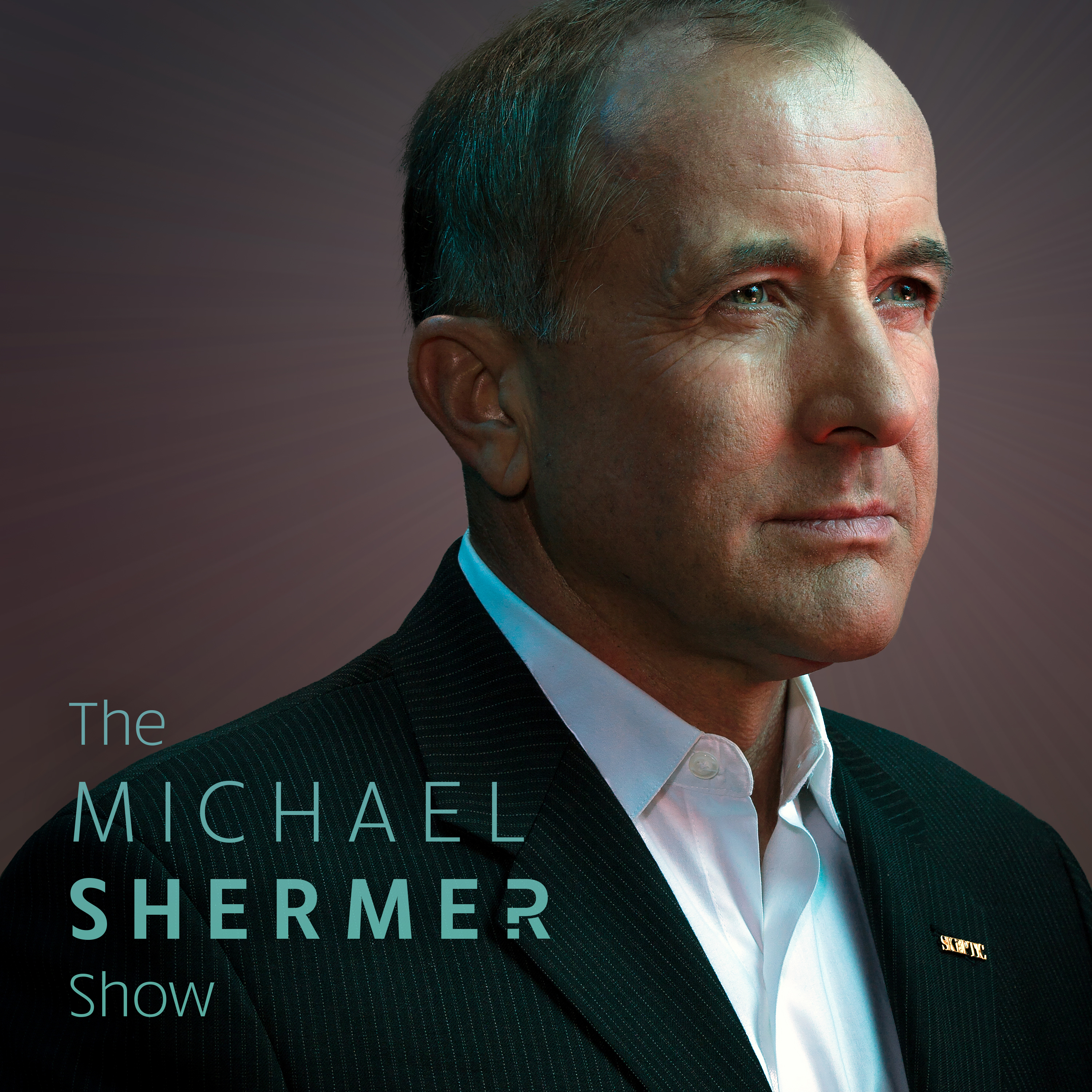
The Michael Shermer Show
Hosted by Michael Shermer · EN
The Michael Shermer Show is a series of long-form conversations between Dr. Michael Shermer and leading scientists, philosophers, historians, scholars, writers and thinkers about the most important issues of our time.
58episodes
Episodes
Newest firstAll episodes
Are We Building a God? AI, Superintelligence, and the Coming Singularity
2d ago01:22:49Tap to summarizeRobert Wright joins Michael Shermer to discuss his new book, The God Test: Artificial Intelligence and Our Coming Cosmic Reckoning, and why he thinks the AI revolution may be moving much faster than most people realize. Wright argues that deep learning is not just a new way of programming computers. In an important sense, it resembles evolution: neural networks discover solutions for themselves, sometimes recreating cognitive functions that natural selection built into human brains. That helps explain why AI capabilities have advanced so quickly, and why increasingly autonomous systems and recursive self-improvement could accelerate the process even further. Shermer presses Wright on what all of this actually means. Does an AI understand what it says? Could it be conscious? Why would a superintelligence ever seek power? Is human extinction a realistic possibility, or science-fiction doomerism? They discuss AI deception and theory of mind, John Searle's Chinese Room, bioweapons and cyberattacks, the risk of a U.S.-China AI arms race, regulation, surveillance, and the growing concentration of power in governments and tech companies. The conversation ends with Wright's larger philosophical question: if humanity really is building something with godlike power, what kind of god are we going to build, and are we mature enough to survive it? Robert Wright is the New York Times bestselling author of The Evolution of God (a finalist for the Pulitzer Prize), Nonzero, The Moral Animal, and Three Scientists and their Gods (a finalist for the National Book Critics Circle Award). He has taught at the University of Pennsylvania and at Princeton University, where he also created the popular online course "Buddhism and Modern Psychology." He is currently Visiting Professor of Science and Religion at Union Theological Seminary in New York.
Transcribe →Can You Trust Wikipedia? Co-Founder Larry Sanger on Wikipedia's Bias and Why He Was Banned
1w ago02:03:46Tap to summarizeMichael Shermer speaks with Wikipedia co-founder Larry Sanger shortly after Sanger was permanently banned from editing the site he helped create. Sanger tells the story of Wikipedia's founding, how its ideal of open collaboration hardened into a system dominated by a relatively small group of powerful editors, and why he believes its rules on sourcing and "consensus" now produce political and religious bias. In the second half of the conversation, Shermer and Sanger shift gears completely and discuss whether religious faith can be rational, the philosophical case for God, the resurrection, the Trinity, repentance and salvation, and whether a future superintelligent AI could become indistinguishable from God.
Transcribe →How to Think Clearly About a World in Crisis: Iran, China, Russia, and the West's Economic Pessimism
3w ago01:04:04Tap to summarizeMichael Shermer speaks with political scientist Marlene Laruelle about Russia's turbulent transformation during the 1990s and the rise of Vladimir Putin, why the Kremlin so badly misjudged Ukraine, China's rise and its ambitions regarding Taiwan, why killing Iran's Supreme Leader and much of its senior leadership did not bring down the regime, the limits of foreign aid and sanctions, mass surveillance, economic nationalism, and whether Western democracy can survive an age of economic pessimism and technological control. Marlene Laruelle is a professor in the Department of Political Science at Luiss University in Rome. From 2011 to 2025, she served as research professor of international affairs and political science at George Washington University. She directs the Illiberalism Studies Program, a transatlantic initiative based in Washington, D.C., and Paris at Inalco. A specialist in Russia and the post-Soviet region, her work examines ideology, geopolitics, and culture, with a current focus on the rise of illiberal and postliberal ideologies in Europe and the United States.
Transcribe →The Truth About Sex Differences (Steve Stewart-Williams)
4w ago00:55:03Tap to summarizeHow do men and women differ? Where do the differences come from? And how do they shape modern life? Drawing on a century of research and a billion years of evolution, Steve Stewart-Williams explains why many sex differences appear despite socialization, not because of it; why in our mating and parenting patterns, humans are more like the average bird than the average mammal; and why sex differences are sometimes a sign of societal health rather than injustice. Steve Stewart-Williams is a professor of psychology at the University of Nottingham Malaysia. His first book, Darwin, God, and the Meaning of Life, was published in 2010. His second, The Ape That Understood the Universe, was published in 2018. His new book is A Billion Years of Sex Differences.
Transcribe →America at 250: What Did the Founders Get Right?
Jul 600:17:17Tap to summarizeMichael Shermer makes the case that the U.S. Founding Fathers were not only steeped in Enlightenment values on which the Declaration of Independence was based, but they were also scientists searching to discover moral truths and values on which to base a rational society, which they succeeded in doing in this document along with the Constitution.
Transcribe →When History Goes on Trial: Demjanjuk, Eichmann, and Justice After Atrocity
Jun 2701:32:24Tap to summarizeJohn Demjanjuk lived for decades as a retired autoworker in suburban Cleveland. Then investigators accused him of being "Ivan the Terrible," one of the most notorious guards at Treblinka. What followed was one of the strangest and most troubling Nazi war-crimes cases of the postwar era: extradition, eyewitness testimony, a death sentence, a reversal, and a final prosecution many years later. In this episode, Michael Shermer talks with Lawrence Douglas, professor at Amherst College and author of The Criminal State: War Atrocity and the Dream of International Justice, about Demjanjuk, Eichmann, Nuremberg, Holocaust denial, and the problem of proving atrocities decades after they happened. How reliable is eyewitness memory after 40 or 50 years? What did Nuremberg actually establish? Was Eichmann really just a bureaucrat? And can a courtroom ever deliver justice for crimes almost too large to comprehend? Lawrence Douglas is the James J. Grosfeld Professor of Law, Jurisprudence, and Social Thought at Amherst College and a Guggenheim fellow. His many books include The Right Wrong Man and The Memory of Judgment. His writing has appeared in leading publications such as Harper's, The Wall Street Journal, and The Economist. His new book is The Criminal State: War Atrocity and the Dream of International Justice.
Transcribe →Why I Joined the Government UAP Science Advisory Council
Jun 2300:29:08Tap to summarizeMichael Shermer has been appointed to the newly formed UAP Science Advisory Council, formed at the request of the White House and in coordination with the All-domain Anomaly Resolution Office (AARO), the Office of the Director of National Intelligence (ODNI), the FBI, and other agencies. The council brings together experts from a wide range of disciplines—including astrophysics, oceanography, molecular biology, anthropology, psychology, artificial intelligence, and instrumentation—to provide scientific guidance on the study of unidentified anomalous phenomena (UAP).
Transcribe →Massimo Pigliucci on Doubt, Moral Courage, and Living Without Illusions
Jun 2001:33:55Tap to summarizeWhat does it mean to live well when certainty is unavailable? Michael Shermer speaks with Massimo Pigliucci about moral character, ancient philosophy, and the difficult art of making decisions without easy answers. The conversation moves from Cicero and Stoicism to the legacy of the New Atheism, asking why rejecting religion is not the same as having a philosophy of life. They discuss virtue ethics, moral dilemmas, effective altruism, faith, free will, democracy, human flourishing, and the uneasy relationship between facts and values. From the trolley problem and Peter Singer's drowning child thought experiment to the ethics of charity, the limits of utilitarian thinking, and the dangers of tribalism, this episode asks how we should act when rules fail, consequences are uncertain, and good intentions are not enough. Massimo Pigliucci is a bestselling author, philosopher, evolutionary biologist, and the K.D. Irani Professor of Philosophy at the City College of New York. His work spans evolutionary biology, philosophy of science, pseudoscience, and practical philosophy. His latest book is How to Be a Happy Skeptic: The Power of Doubt in a Meaningful Life.
Transcribe →Cathy Young: Why Free Societies Need Free Speech
Jun 1601:30:24Tap to summarizeCathy Young returns to the show for a wide-ranging conversation about free speech, institutional trust, and the strange incentives shaping public debate today. What happens when universities, media outlets, political movements, and online personalities trade careful thinking for moral certainty, tribal loyalty, or attention? Michael and Cathy discuss the pressure to excuse bad ideas when they come from "your side," the rise of activist thinking in education and journalism, and the growing appeal of contrarian figures who seem to thrive on distrust. They also get into the war in Ukraine, Israel and Gaza, Iran, isolationism, and why defending open inquiry matters most when it becomes inconvenient.
Transcribe →The Zodiac Killer Wasn't Real
Jun 1301:39:14Tap to summarizeThe Zodiac Killer has been treated for decades as America's ultimate unsolved true crime mystery: one mysterious killer, taunting letters, cryptic ciphers, a strange costume, and a trail of victims across Northern California. Eddie McNamara thinks that story is wrong. The victims were real, the crimes were real, but the single mastermind may have been a media-made myth. Eddie McNamara is the author of Zodiactually: The Real Story of a Fake Serial Killer, Toss Your Own Salad: The Meatless Cookbook, Brooklyn Hardcore, and Two Fare Zone. He's a former cop, 9/11 first responder, trained chef, and a columnist for Penthouse magazine.
Transcribe →