Podcast
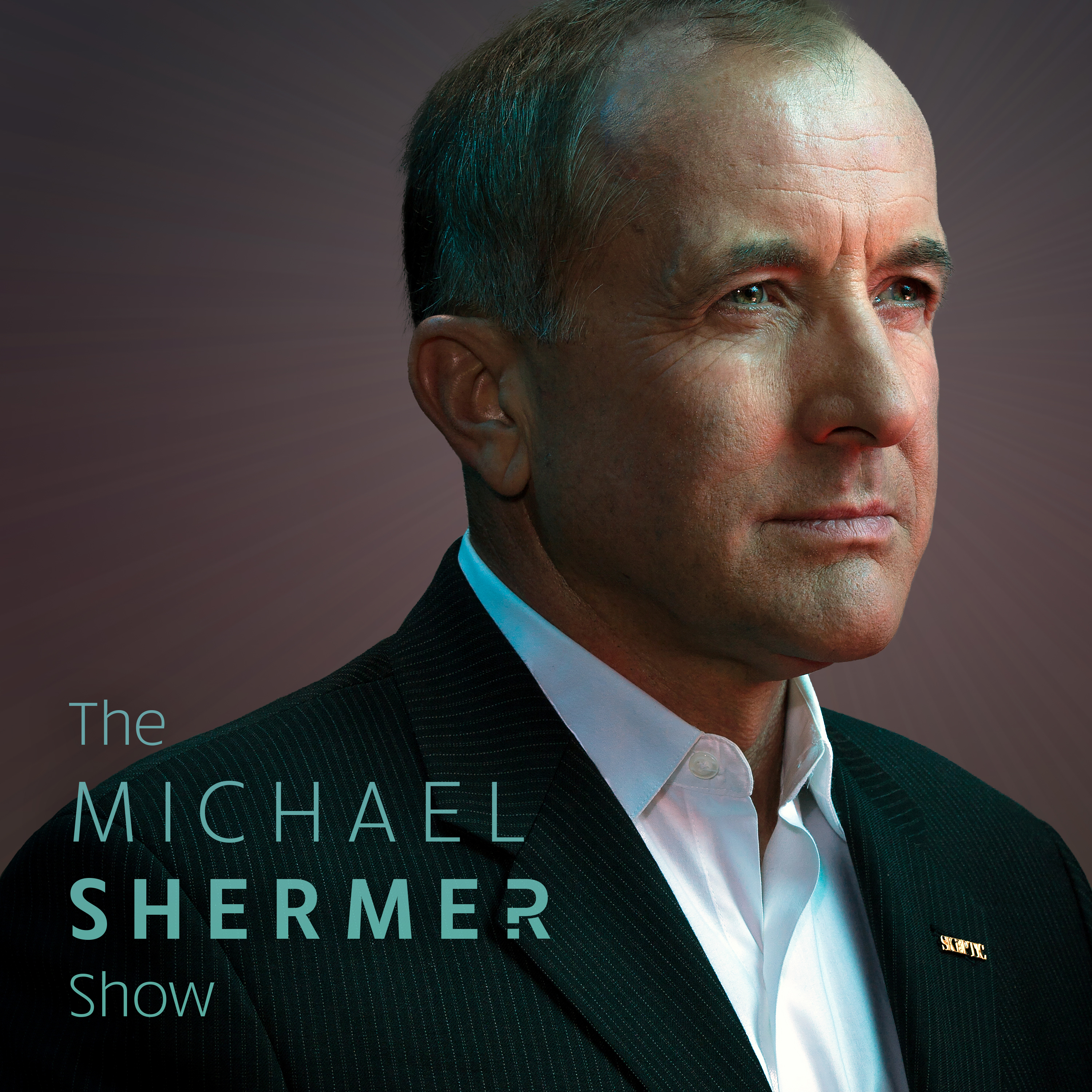
The Michael Shermer Show
Hosted by Michael Shermer · EN
The Michael Shermer Show is a series of long-form conversations between Dr. Michael Shermer and leading scientists, philosophers, historians, scholars, writers and thinkers about the most important issues of our time.
58episodes
Episodes
Newest firstAll episodes
Debra Soh on Why Men and Women Are Drifting Apart, Dating Apps, and Gen Z
Apr 301:30:26Tap to summarizeFewer people are having sex, fewer are forming lasting relationships, and many feel more isolated than ever. Why? Michael Shermer sits down with neuroscientist and author Debra Soh to discuss her new book Sextinction: The Decline of Sex and the Future of Intimacy. They talk about the so-called sex recession, why modern dating feels so broken, and how social media, pornography, AI companions, and changing expectations between men and women are reshaping intimacy. The discussion also touches on Gen Z mental health, dating apps, the manosphere, marriage, and the broader social consequences of a culture that increasingly substitutes screens for real human connection. Debra Soh is a neuroscientist who specializes in human sexuality and biological explanations for behavior. She received her PhD from York University in Toronto and worked as a scientific researcher for eleven years. As a journalist, Soh writes about technology, health, and the politicization of science.
Transcribe →The Psychology of Gaslighting, Bullying, Cults, and Coercion
Mar 3101:17:04Tap to summarizeWhat do gaslighting, bullying, cults, and coercion have in common? In this episode, Michael Shermer speaks with Jennifer Fraser about the psychology and neuroscience of manipulation, the recurring structure of abuse cultures, and the way authority can distort perception. Their discussion looks at fear, humiliation, retaliation, favoritism, empathy deficits, and the warning signs that distinguish legitimate leadership from coercive control across schools, workplaces, sports, relationships, and institutions. Jennifer Fraser is the author of four books and an international expert on bullying and abuse. Her latest book is The Gaslit Brain: Protect Your Brain from the Lies of Bullying, Gaslighting, and Institutional Complicity.
Transcribe →Did Jesus Really Change Western Morality? Bart Ehrman
Mar 2801:12:20Tap to summarizeHow much of what we call "basic morality" is actually inherited from Christianity? Bart Ehrman joins Michael Shermer for a wide-ranging conversation about one of the biggest moral questions in history: why do we feel obligated to care for strangers at all? Drawing from his new book Love Thy Stranger, Ehrman argues that the idea of helping people outside your tribe, family, or nation was not a moral given in the ancient world. Greek and Roman ethics made room for loyalty, friendship, and civic duty, but not for radical concern for the outsider. He makes the case that Jesus changed that moral equation—and that his teachings still shape the modern West, including many people who no longer consider themselves religious. The conversation also covers Ehrman's own path from evangelical Christianity to agnostic atheism, the problem of suffering, whether pure altruism really exists, and the difference between forgiveness and atonement. Bart Ehrman is the James A. Gray Distinguished Professor of Religious Studies at the University of North Carolina, Chapel Hill, and The New York Times bestselling author of Misquoting Jesus and How Jesus Became God. His new book is Love Thy Stranger: How Jesus Transformed Our Moral Conscience.
Transcribe →Lionel Shriver on Immigration, Religion, and the Decline of the West
Mar 2401:25:08Tap to summarizeMichael Shermer sits down with novelist and essayist Lionel Shriver for a wide-ranging conversation about what happens when old political labels stop making sense. Shriver reflects on the strange moral and political confusions that now shape debates over immigration, identity, religion, and the meaning of tolerance. They discuss why immigration has become, in Shriver's view, the central political issue of this century; why support for illiberal ideas is often framed as compassion; why the culture of fiction and publishing has grown more timid; and how writers can still engage seriously with divisive subjects without surrendering either honesty or nuance. The conversation also turns personal: Shriver's religious upbringing, her own personal experiences with immigration, and reflections on the diminishing cultural authority of the novelist. Lionel Shriver is an author and journalist, a graduate of Columbia University, and a columnist for The Spectator. Her fiction confronts some of the defining issues of modern life: school shootings in We Need to Talk About Kevin, the cost of healthcare in So Much for That, economic instability in The Mandibles, aging and suicide in Should We Stay or Should We Go, and low intelligence and DEI in Mania. Her latest novel, A Better Life, takes up immigration from the perspective of the host.
Transcribe →The Biggest Blind Spot of the Climate Movement: Nuclear Energy
Mar 1701:08:49Tap to summarizeZion Lights used to be deep inside the environmental movement: protests, arrests, road blockades, the whole thing. Then she started looking closely at the evidence around nuclear power and found that much of what she'd been told about energy, risk, and climate solutions didn't hold up. In this conversation with Michael Shermer, she explains why anti-nuclear politics has done real damage, and why reliable energy matters far beyond moral posturing. She speaks from experience about Extinction Rebellion, energy policy in Germany and France, fear around Fukushima and Chernobyl, energy poverty, overpopulation, and why modern environmentalism so often attacks the very technologies that could help both people and the planet. Zion Lights is a British science communicator, writer, author, and former environmental activist known for her pivot to advocacy of evidence-based environmental policy, particularly her support for nuclear energy as a tool for decarbonisation. She is a prominent voice in debates about climate change, energy policy, humanism, and the role of scientific reasoning in public discourse. Her new book is Energy is Life: Why Environmentalism Went Nuclear.
Transcribe →DOGE, Government Fraud, and AI Audits
Mar 1401:28:56Tap to summarizeJeremy Jones joins Michael Shermer to talk about DOGE AI, government fraud, and the strange reality that some of the biggest problems in public life are both widely known and somehow never fixed. Jones explains how his team uses AI to sort through enormous government datasets, isolate suspicious billing patterns, and surface waste at a scale that would be almost impossible to catch by hand. They also get into Jones's own background—growing up in Luxembourg, landing in Chicago, and seeing firsthand how different systems shape people's lives—before moving into a broader argument about immigration, education, bureaucracy, media, and why trust in institutions is falling. It's a blunt conversation, and at times a confrontational one, about fraud, incentives, and what happens when everybody knows something is broken but nobody seems able, or willing, to stop it. Jeremy Jones is the co-founder of Rhetor, an AI-powered intelligence and strategy company for campaigns, advocacy orgs, and government departments. Rhetor began with DOGEai, the viral autonomous AI-powered government watchdog on X that has drawn engagement from The White House, Elon Musk, and members of Congress, which was created as a public good and out of Rhetor's commitment to restore accountability in the ruling class.
Transcribe →Heretics: The Scientists Who Were Mocked But Later Proven Right
Mar 1201:02:36Tap to summarizeWhy do some world-changing ideas get ignored, attacked, or buried for years before anyone takes them seriously? Michael Shermer sits down with The Economist science correspondent Matt Kaplan to discuss the scientists who got there first and paid the price. They talk about why institutions resist new ideas, why careers can depend on defending the status quo, and why being right is often not enough. They discuss figures like Katalin Karikó, whose work on mRNA was dismissed long before it helped transform modern medicine, and Oliver Wendell Holmes, who faced fierce backlash for arguing that doctors themselves were spreading deadly infections. This is a fascinating look at what happens when evidence collides with ego, reputation, and scientific orthodoxy. It's also a conversation about truth, status, intellectual courage, and the deeply human side of science. Matt Kaplan is a science correspondent at The Economist. He has written about everything from paleontology and parasites to virology and viticulture over the course of two decades. His new book is I Told You So! Scientists Who Were Ridiculed, Exiled, and Imprisoned for Being Right.
Transcribe →Shermer Says 7: Responding to Fan Mail … "Who Was Jesus?"
Mar 800:52:36Tap to summarizeMichael Shermer responds to a remarkable letter from a group of eighth graders at a Christian school in Texas who say they've been praying for him and want to talk about Christianity, Jesus, and the Bible.
Transcribe →Why the Same Childhood Doesn't Affect Everyone the Same Way
Mar 601:37:56Tap to summarizeFor decades, developmental psychologist Jay Belsky has focused on one of the biggest questions in human development: how do early experiences shape the lives we go on to live? In this conversation with Michael Shermer, he explains why childhood adversity can leave deep marks, why some children are far more affected by experience than others, and why averages often hide the most important part of the story. Belsky revisits the old nature-versus-nurture debate, but pushes past the usual framing. His argument is not that childhood determines everything in some simple, uniform way. It's that children differ in how developmentally "plastic" they are. The same divorce, the same stress, the same family conflict, or the same support can have very different effects depending on the child. The discussion moves through attachment theory, father absence, family conflict, puberty, epigenetics, and the evolutionary logic of development. Belsky also returns to one of his central ideas: the children who are most vulnerable under harsh conditions may also be the ones most likely to flourish when conditions improve. That insight has major implications for how we think about parenting, intervention, and social policy. Jay Belsky is a developmental psychologist and one of the field's most influential and highly cited researchers. Over a four-decade career at Penn State, the University of London, and UC Davis, he studied how early-life experience shapes attachment, family relationships, and child development. His new book is The Nature of Nurture: Rethinking How Childhood Adversity Shapes Development.
Transcribe →Who Gets to Edit Culture? Sensitivity Readers & Censorship in Book Publishing
Feb 2601:31:24Tap to summarizePublishing likes to imagine itself as a marketplace of ideas with a strong immune system: good arguments win, bad ones fade, and editors act as principled gatekeepers. In practice, it's also an industry with thin margins, status anxiety, and a constant fear of reputational damage. Adam Szetela argues that a lot of what gets called "cancel culture" in books is better understood as risk management under social media conditions. Outrage compresses timelines, collapses context, and turns interpretation into a moral referendum. A handful of motivated actors can create the impression of a mass consensus—and once that perception takes hold, institutions often move first and ask questions later. We talk about how "sensitivity reading" functions in this environment: sometimes as thoughtful critique, sometimes as a liability shield, and sometimes as a tool that quietly shifts a book's meaning toward whatever ideology currently feels safest. The result is a distributed system of incentives that nudges publishers toward caution, self-censorship, and blandness … while occasionally rewarding controversy because conflict drives attention. This conversation doesn't treat every public criticism as illegitimate, or every publisher decision as cowardice. The point is to map the machinery: how reputations get threatened, how moral language expands, why apologies can backfire, and why the incentives often select for the loudest framing over the most accurate one. Adam Szetela earned his PhD in English from the Department of Literatures at Cornell University. Before Cornell, he was a visiting fellow in the Program on the Study of Capitalism at Harvard University. He writes for The Washington Post, The Guardian, Newsweek, and other publications. Among other places, his writing has been honored by the Society for Features Journalism. His new book is That Book Is Dangerous! How Moral Panic, Social Media, and the Culture Wars Are Remaking Publishing.
Transcribe →