
Podcast
The MicroCast
Hosted by Microcosm Coaching · EN
The Microcosm Coaching Podcast helps endurance athletes—whether you're a road runner, trail runner, or training for your first marathon or 100-miler—get more out of their training with evidence-based advice, effort-based coaching, and expert mindset support. Hosted by professional coaches and athletes, each episode explores practical strategies for race prep, running recovery, mental performance, and sustainable training. If you want to build fitness, avoid burnout, and find more joy in running, you're in the right place.
38episodes
Episodes
Newest firstAll episodes
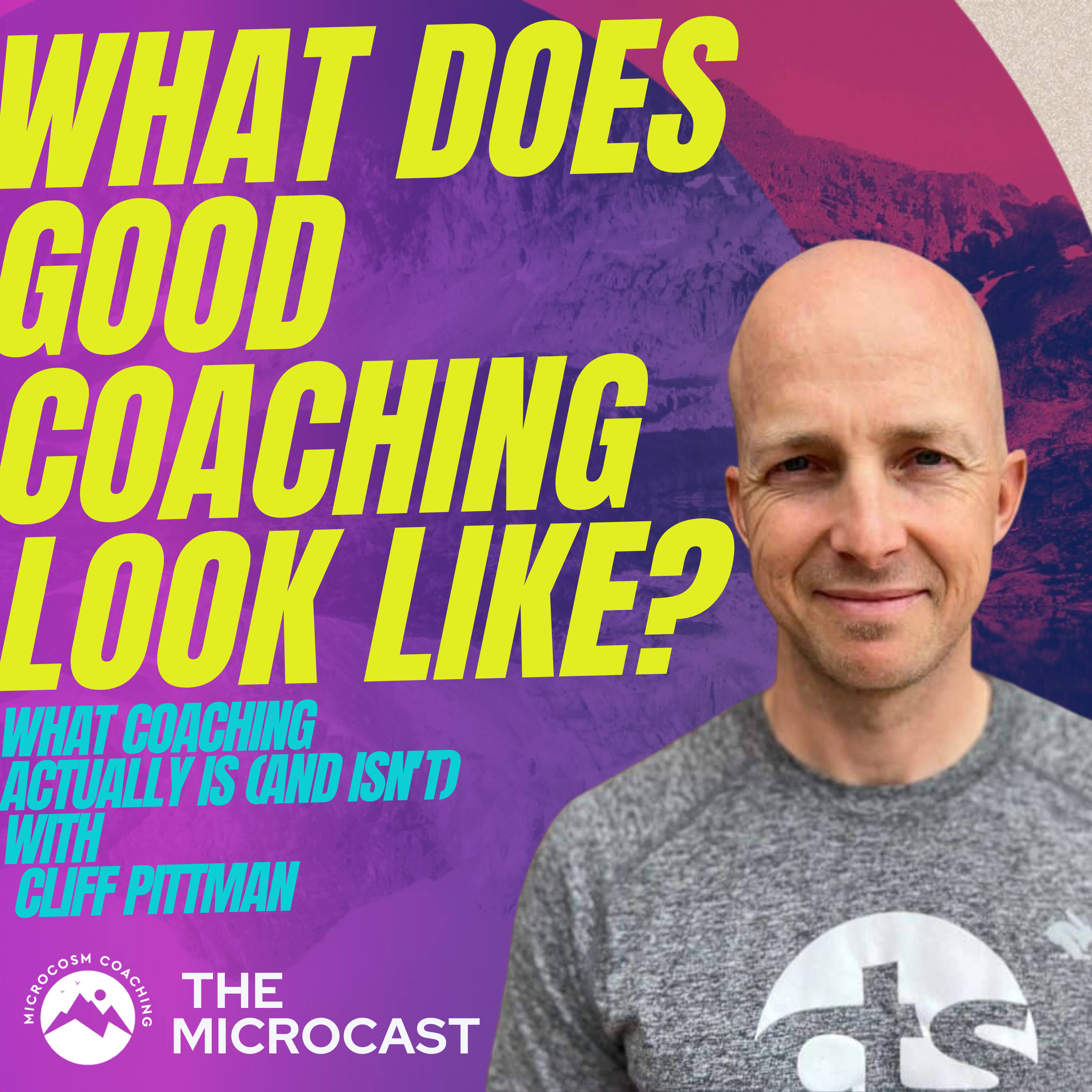
What Good Running Coaching Actually Looks Like (And How to Find It) with Cliff Pittman, CTS Coaching Development Director
Feb 2500:57:39Tap to summarizeWe brought in the person we trust with our own training. Cliff Pittman is the Director of Coaching at Carmichael Training Systems, which means he's essentially a coach of coaches, overseeing the education and development of CTS's entire coaching staff. He's also, full disclosure, our coach. So we wanted to have an honest conversation about what coaching actually is, what it isn't, and the massive gap between what athletes see and what goes on behind the scenes.Cliff walks us through the three pillars of good coaching: personal connection, evidence-based training, and data-informed decision making. We get into the invisible daily work that most athletes never see, why individualized coaching matters so much more than a static plan, and when a good coach should say "that's above my pay grade." We also dig into scope of practice, the uncomfortable gap between what athletes expect coaching to cost and what it actually costs, and how to find a coach who's the right fit for you, not just the most credentialed person on paper.Whether you're currently coached, thinking about it, or coaching athletes yourself, Cliff brings a perspective shaped by a decade in the military, executive coaching, and now leading one of the biggest coaching organizations in endurance sports.Plus, a quick introduction to Microcosm coach Zack Russell at the top of the show.
Transcribe →
Is Running 30 Ultras a Year Actually Destroying Your Body? The Science
Feb 1801:09:38Tap to summarizeIs your watch making you a worse runner? We dig into two powerful books — The Way of Excellence by Brad Stulberg and The Score by C. Thi Nguyen — to unpack how metrics, Strava segments, and training scores can quietly hijack your motivation and identity as an athlete.We also tackle a wild listener question: a 23-year-old running 30 hundred-milers a year. We break down the real physiology — rhabdomyolysis, acute kidney injury, endocrine suppression — and the psychology of the attention economy, dopamine loops, and identity fusion.Plus Hot or Nots on running onesies, ankle weights, and legs up the wall. And meet Microcosm coach Kristin Layne, who specializes in multi-sport coaching for busy athletes.Key topics: value capture, intrinsic vs. extrinsic motivation, the 4 phases of competence, running by feel vs. running by data, RPE, and defining success on your own terms.Books discussed:The Way of Excellence — Brad StulbergThe Score — C. Thi NguyenWant coaching? microcosmcoaching@gmail.com | microcosm-coaching.com
Transcribe →
The Science of Going Long: How to Train Beyond Your Comfort Zone
Feb 1000:51:59Tap to summarizeWired article on the Enhanced Games: https://www.wired.com/story/enhanced-games-freestyle-record-las-vegas-steroids/You've got a distance that sounds impossible — maybe it's a marathon, maybe it's a 100-miler. The process for preparing to go longer than you ever have is more similar across distances than you might think. TJ and Zoë break down the physiology, psychology, and practical strategies behind training for longer distances, from glycogen depletion and fat oxidation to the central governor theory and how to build your long run without getting hurt.Plus: Meet Microcosm coach Kristin Layne, and a new batch of Hot or Not — the Enhanced Games, face glitter, stair steppers, and smart shoes.Topics covered:Why your body enters a different metabolic reality after 90–120 minutesThe glycogen ceiling, fat oxidation, and mitochondrial densityWhy connective tissue adapts 6–12 months slower than your cardiovascular systemHow to build your long run gradually (and why it shouldn't exceed ~30% of weekly volume)Time-based training vs. mileage-based trainingThe central governor theory and training your brain to go furtherFueling for long efforts: 60–90g carbs/hourWhy back-to-back long runs are smarter than one mega-long runRPE guidelines for long runs (stay at 5–6)Strength training for durability at ultra distancesJoin Foothills: microcosm-coaching.com | Code: FOOTHILLS10Contact: microcosmcoaching@gmail.com
Transcribe →
7 Biggest Nutrition Mistakes Runners Make (And How to Fix Them)
Feb 401:10:43Tap to summarizeIs fasted running sabotaging your performance? Are you accidentally under-eating on your hardest training days? This week, we break down the seven most common nutrition mistakes runners make, from calorie restriction at the wrong time to blindly copying elite protocols, and explain why the science says you probably need to eat more, not less.We cover why your gut issues might actually be a training problem, not a food problem. We talk about why "clean eating" is often just restriction in disguise. And we explain why doing what Kipchoge does probably isn't what you should be doing.Plus, we answer listener questions on accountability and whether high-carb fueling causes diabetes (spoiler: it doesn't). And Coach James Nance joins to talk about coaching multi-sport athletes, helping runners recover from overtraining, and his TrainingPeaks hot take that might surprise you.In this episode:Why restricting calories on training days backfiresThe truth about fasted running and morning workoutsHow to actually fix gut issues during exerciseWhy "clean eating" can become problematicWhat 90-120g of carbs per hour actually means for recreational runnersHow to evaluate nutrition advice and follow the moneyStudies and resources mentioned are linked below.Get involved: Join our Foothills coaching community—one-on-one coach access, twice-monthly roundtables, and a supportive crew of runners. $10/month with code FOOTHILLS10 at microcosm-coaching.com.Questions? microcosmcoaching@gmail.comREFERENCES:Burke, L. M., Ross, M. L., Garvican-Lewis, L. A., Welvaert, M., Heikura, I. A., Forbes, S. G., Mirtschin, J. G., Cato, L. E., Strobel, N., Sharma, A. P., & Hawley, J. A. (2017). Low carbohydrate, high fat diet impairs exercise economy and negates the performance benefit from intensified training in elite race walkers. Journal of Physiology, 595(9), 2785–2807.Costa, R. J. S., Hoffman, M. D., & Stellingwerff, T. (2019). Considerations for ultra-endurance activities: Part 1 – Nutrition. Research in Sports Medicine, 27(2), 166–181.Cox, G. R., Clark, S. A., Cox, A. J., Halson, S. L., Hargreaves, M., Hawley, J. A., Jeacocke, N., Snow, R. J., Yeo, W. K., & Burke, L. M. (2010). Daily training with high carbohydrate availability increases exogenous carbohydrate oxidation during endurance cycling. Journal of Applied Physiology, 109(1), 126–134.Loucks, A. B., & Thuma, J. R. (2003). Luteinizing hormone pulsatility is disrupted at a threshold of energy availability in regularly menstruating women. Journal of Clinical Endocrinology & Metabolism, 88(1), 297–311.Melin, A. K., Heikura, I. A., Tenforde, A., & Mountjoy, M. (2019). Energy availability in athletics: Health, performance, and physique. International Journal of Sport Nutrition and Exercise Metabolism, 29(2), 152–164.Mountjoy, M., Ackerman, K. E., Bailey, D. M., Burke, L. M., Constantini, N., Hackney, A. C., Heikura, I. A., Melin, A., Pensgaard, A. M., Stellingwerff, T., Sundgot-Borgen, J. K., Torstveit, M. K., Jacobsen, A. U., Verhagen, E., Budgett, R., Engebretsen, L., & Erdener, U. (2023). 2023 International Olympic Committee's (IOC) consensus statement on Relative Energy Deficiency in Sport (REDs). British Journal of Sports Medicine, 57(17), 1073–1098.
Transcribe →
6 Principles for Training Through Big Life Changes
Jan 2801:13:41Tap to summarizeHow do you keep training when life gets stressful? Whether you're navigating a new job, new baby, a big move, or personal loss, your body processes all stress the same way—and that changes everything about how you should train.In this episode, we break down the science of stress and running performance, including how the HPA axis works, why your "stress bucket" has a finite capacity, and why the same workout that built fitness last year might dig a hole this year. We share six practical principles for training through life transitions without burning out or losing the fitness you've built.We also tackle Hot or Nots on splitting your runs (why two 4-milers isn't the same as one 8-miler) and running in extreme cold (when to embrace the treadmill). Plus, we debunk that viral Noakes study claiming you only need 10 grams of carbs per hour—spoiler: it's a cherry-picked narrative review from low-carb advocates with ketone patents.What you'll learn:– How cortisol and the HPA axis affect your training and recovery– The "stress bucket" model and why your capacity changes during transitions– Why RPE increases at the same pace when life stress is high– How to flip your training hierarchy so life leads and running follows– The detraining timeline (it's slower than you think)– How to set "conditions of enoughness" for your current season– Why frequency beats volume during chaotic periodsAlso in this episode: Meet Coach James Nance, who specializes in multi-sport athletes, injury cycles, and RED-S recovery.microcosmcoaching@gmail.com | microcosm-coaching.com | Join our Foothills community for $10/month
Transcribe →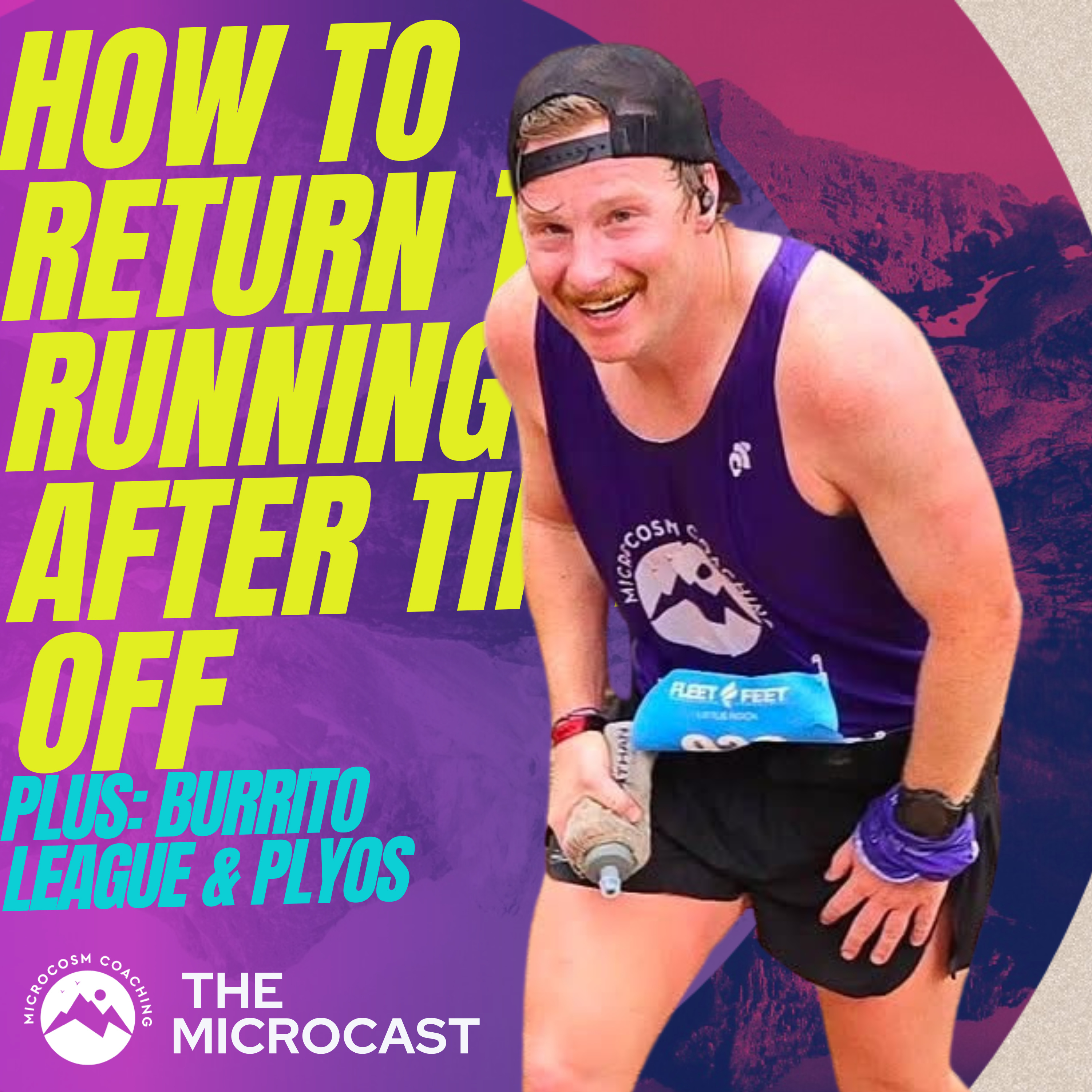
How to Return to Running After Time Off , Plus: Burrito League and Plyometrics!
Jan 2100:54:11Tap to summarizeTaking time off from running, whether from injury, illness, or life—doesn't have to derail your progress. In this episode, we break down the actual physiology of detraining and give you a science-backed framework for returning smarter, not just faster.We cover what happens to your body during time off (spoiler: it's not as catastrophic as your brain tells you), why connective tissue is the real limiting factor in comebacks, and how to use RPE and walk-run protocols to rebuild safely. Plus, we get into the mental game of accepting where you are versus where you were.Also in this episode: We weigh in on Burrito League (not hot), Strava's AI workouts (also not hot), and whether plyometrics belong in your training. And Zoë asks TJ a question from her own training log about whether running faster on good days is actually worth it.
Transcribe →
When Cross-Training Helps Runners (And When to Just Run More)
Jan 1400:58:03Tap to summarize📧 microcosmcoaching@gmail.com🌐 microcosm-coaching.com💬 Foothills Community: $10/month (code FOOTHILLS10)Does cross-training actually help runners, or is it just a distraction from the main thing? We break down the research on what transfers to running performance and what doesn't, covering AlterGs, curved treadmills, ellipticals, cycling, swimming, yoga, and Pilates.The key finding: VO2 max transfers between modalities, but running economy does not. Runners who replaced all running with elliptical for five weeks maintained their aerobic engine but got slower. We dig into who actually needs cross-training (masters athletes, injury-prone runners, those at their volume ceiling) versus who should just run more.Plus: Hot or Not rapid fire on cross-training equipment, including the truth about weighted vest walking and why curved treadmills make you work 30% harder for worse results.
Transcribe →
5 Signs Your Runs Aren't Easy Enough
Jan 801:02:24Tap to summarizeHappy New Year! Welcome to our first episode of 2026.We kick things off with our Athens Big Fork Trail Marathon race recap—Zoe ran an 8-minute PR after 4 years of training (that's 30 miles per second of improvement), while TJ ran his worst time ever and learned some valuable lessons about mental performance and showing up when things don't go your way.Then we answer a listener question: Does shoe cushioning actually matter for injury prevention? The 2024 research from Malisoo et al. might surprise you—it's not about how soft your shoes are, it's about something else entirely.Our main topic: 5 signs your easy runs aren't easy enough. This is the single most common mistake we see as coaches, and fixing it might be the highest-leverage change you can make to your training. We break down the physiology of why slow running makes you faster, what the 80/20 research actually says (including a 2025 meta-analysis), and give you 5 concrete signs to watch for.In this episode:• Athens Big Fork Trail Marathon race recap• The math behind 4 years of training for an 8-minute PR• How to compete hard even when having a bad day• Shoe cushioning research: perception vs. mechanics• The physiology of aerobic vs. glycolytic training• What 80/20 polarized training really means• 5 signs your easy runs aren't easy enough• How Kipchoge's easy pace compares to recreational runnersStudies referenced:• Rosenblatt et al. 2025 (Sports Medicine) - Polarized training meta-analysis• Jong et al. 2025 (Applied Sciences) - Sleep and injury risk in runners• Malisoo et al. 2024 (European Journal of Sports Science) - Shoe cushioning perceptionConnect with us:Email: microcosmcoaching@gmail.comWebsite: microcosm-coaching.comJoin Foothills group coaching ($10/month with code FOOTHILLS10)
Transcribe →
5 Science‑Backed Pacing Rules for Ultras
Aug 1901:05:21Tap to summarize🔥 Want to finish your next ultra stronger and avoid the dreaded late-race fade? This episode breaks down five science-backed pacing strategies every runner can use—whether you’re lining up for your first 50K or chasing a 100-mile PR. Drawing on data from UTMB, Western States, and Ultra-Trail Cape Town, Coaches Zoë and TJ share the training and mindset tools that separate strong finishers from blow-ups.🎙️ In this episode, we cover:Hot or Not: stacking two ultras close together, GPS watches vs. RPE, and sodium pre-loadingThe science behind interval design: VO₂ max, threshold, steady state, and strides—made simpleFive proven pacing strategies, including why uphill pace predicts finish time, how to keep pace variation small, and why “don’t bank time, build it” is the rule that saves racesPractical training takeaways: back-to-back long runs, uphill workouts, durability training, and how to pace climbs smarter⏱️ TIMESTAMPS00:00 – Intro & Boot Camp recap08:20 – Hot or Not: racing back-to-back, GPS watches, sodium pre-loading29:15 – Listener question: Is interval design random or scientific?44:10 – The science of pacing ultras: five strategies that work1:13:00 – Training takeaways + coaching insights📣 SUBSCRIBE so you never miss an episode💻 Learn more about 1:1 coaching with Microcosm Coaching: https://www.microcosm-coaching.com📸 Follow us on Instagram: https://www.instagram.com/microcosmcoaching/
Transcribe →Who Gets to Be an Athlete? Endurance Fueling Myths, Carb Periodization & Race-Day Resets
Aug 14, 202500:46:20Tap to summarizeWho gets to call themselves an athlete — and how should you fuel like one? In this special crossover episode from Your Diet Sucks, Coach Zoë and registered dietitian Kylee Van Horn tackle common endurance nutrition myths, from carb loading to high-carb fueling in larger bodies, and why “earning” the athlete label is holding runners back.You’ll hear practical tips for training your gut, troubleshooting race-day nausea, and avoiding the pitfalls of constantly changing your fueling plan. Plus: the science behind carbohydrate periodization, why hydration is the foundation of fueling, and how to rethink your athlete identity to train smarter and recover faster.In this episode:High-carb fueling strategies for endurance athletesCarb loading for training vs. race dayGut training and avoiding mid-race stomach shutdownsFueling considerations for larger-bodied runnersWhy everyone who trains is an athlete — and should fuel like one⏱ TIMESTAMPS00:00 – Intro & training updates03:02 – Athlete identity and fueling mindset16:07 – High-carb fueling in larger bodies24:31 – Carb loading & carbohydrate periodization36:22 – What to do when you can’t eat or drink mid-race42:09 – Beam Minerals and electrolyte marketing claims📣 Subscribe so you never miss an episode💻 Learn more about 1:1 coaching with Microcosm: microcosm-coaching.com📸 Follow us on Instagram: @microcosmcoaching
Transcribe →