← The Morning Edition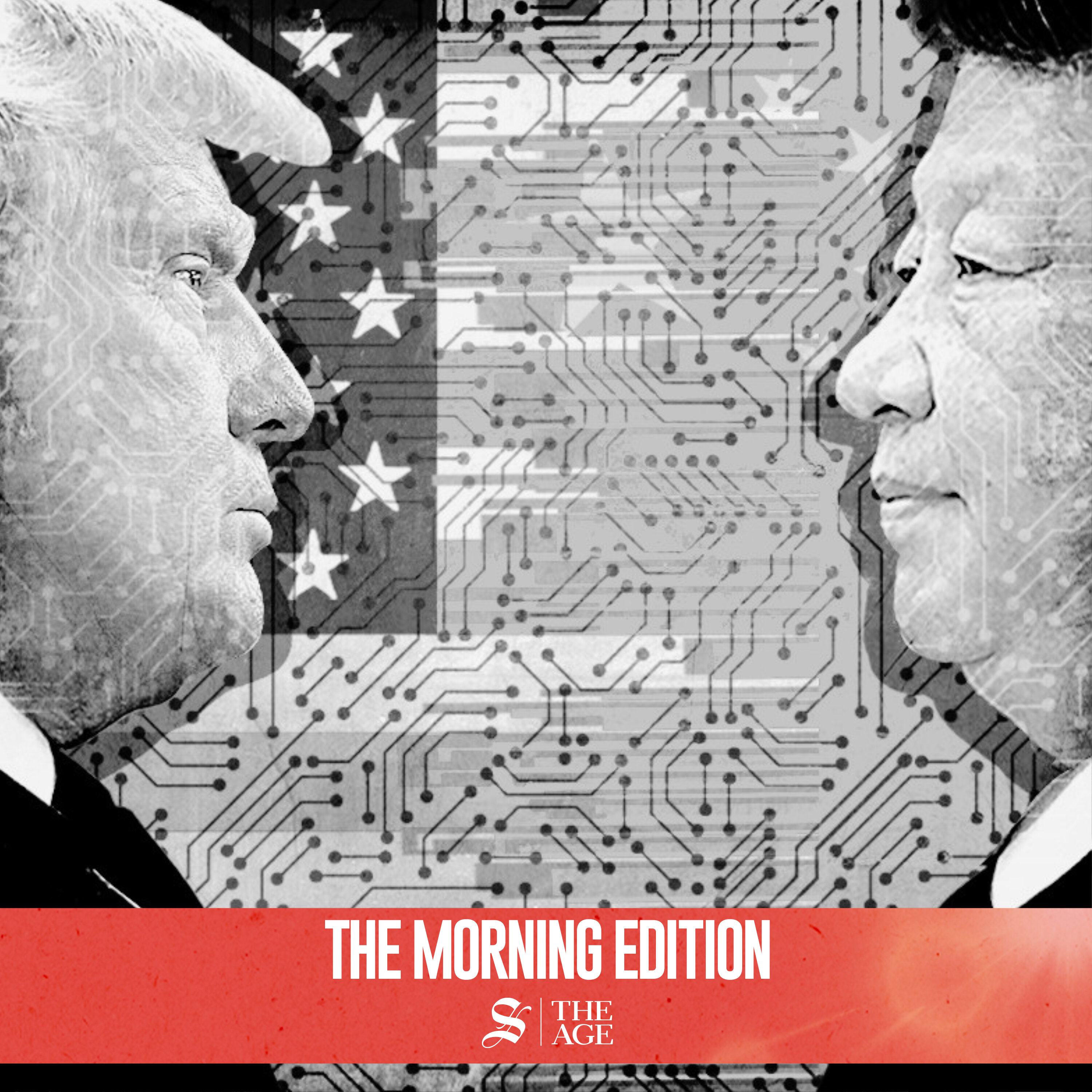
Loading summary
Transcript59 lines
- [00:08]
A
There's a battle brewing over which country will come out as the leader in AI, and the United States is betting the house economically that it will come out on top. I'm Samantha Salinger Morris, and you're listening to the Morning Edition from the Age and the Sydney Morning Herald Today. International and political editor Peter Harcher on what previous infrastructure booms, like the craze for building railways in the 1840s or the dot com boom of the 1990s tells us where this will lead economically and which countries might be hit hardest in an AI bust. It's August 6th. Peter welcome back to the podcast.
- [00:50]
B
Pleasure, Samantha.
- [00:51]
A
Okay, I'm so looking forward to this because many of us, we think of AI, we think of maybe our mate who's using it to craft a wedding speech, or perhaps some of our friends who use it to, you know, cheat at uni on on ess. But you've pointed out in your most recent column it's actually sort of the cornerstone, or it will be, of any country given power. So just remind us, how is that?
- [01:15]
B
Well, the threshold question really is do you want to be a country in control of its own fate or a country that is at the whim of other countries that have greater technological advantage than you do? You could use a parallel going back to the times of imperialism and colonialism. The countries that had the technological edge of being part at the early part of the Industrial Revolution were the countries that took over all the other countries. So AI is a new level of capability now, which will be not all, but one of the distinguishing factors between countries that can control their own destiny and sovereignty and the countries that can't. That's the core proposition.
- [01:57]
A
Okay, no small thing. But there's also the potential, and you've written about this, to unleash major chaos, right. Which as part of, I guess your ability or a country's ability to take over possibly another country. So I guess tell us about that, whether in the context or not of maybe recent AI launches or just what the capacity either is at the moment or what it will be.
- [02:19]
B
Yeah, well, to create chaos, I mean, absolutely. Countries can already do that using warfare, kinetic warfare. This is a new type of chaos, and we've had a fair flavor of it through one example is cyber attacks and great outages, failures online. AI takes this stuff to a new level. In fact, a couple of weeks ago, I quoted the former head of the Australian Signals Directorate. The ASD is a highly sophisticated secret signals interception and surveillance agency. It's, I suppose, the equivalent of America's NSA National Security Agency, Rachel Noble. Rachel said to me that, she said, this is already totally operating in our systems. We're already completely dependent on it. Everything from space, gps, cybersecurity. She said, for example, we're going to need it to defend against other countries. She said, already we know ASD has put out advisories that they have detected Chinese malware implanted throughout critical infrastructure systems and sites in Australia. Very hard to detect, inactive. We need to be able better to track it. This is what she told me. And she was the top signal spy for the country. And AI gives China greater capacity to do more, to potentially disrupt other countries. And as Rachel Noble said, this malware sits on your system until the hostile state decides it's the moment they want to activate it, push the button and knock out all your systems. She said, we need a better capacity to detect it and our enemies will want a better capacity to inflict it. So it's really basic nation state, state on state warfare in a new dimension. It's geopolitics by other means, and we're already seeing it.
- [04:26]
A
I believe there's been reports that the United States military reportedly used, Claude, I think AI built by Anthropic in the bombing of Iran and before that the Venezuela raid in January. Yes, so, and further to that, you've written that the US is betting its economic house on. On AI. So what do you mean by that?
- [04:45]
B
Yeah, well, part one of your question. A famous professor of international relations, Hal Brands, has written that all wars are AI wars from now on, and already we see examples, as you say. Doesn't mean that because you have AI, you'll win the war. Like with any type of power, you have to deploy it intelligently in pursuit of a sound strategy. If you, I mean, take the case of the U.S. we've talked about this extensively, but the U.S. against Iran doesn't matter how much raw power it has in pursuit of a stupid strategy, it will fail. So you still need to have good strategy. But if you have two countries with equal strategy and capability, AI is a potential source of advantage. And all countries, of course, will want that advantage. As for the Americans betting their economic house on AI, there's a few ways you can slice this particular salami. One way is that the huge surge of investment to set up the infrastructure for this industry is responsible for, depending on the month, most economic growth in the US or down to about a third of economic growth in the us. So this is just one industry. Just think of the size of that economy and all the Industries across the whole thing. And this one sector is accounting for between a third and two thirds or more of US growth in any given month or quarter. That's one dimension. Another dimension is look at the stock market and this is where it gets out of control. So the actual hard investment in systems and data centers and chips and all of that stuff. Four of the big American tech companies, the so called hyperscalers, until this year are estimated to have spent or have disclosed investment of US$1.1 trillion in setting up their AI structures, right? So that's Amazon, Google, Meta, Microsoft, and they're estimated to spend this year on top of that 1.1 trillion, another US$745 billion. So that's just four of the companies, just up till today essentially to the end of this year. But then looking beyond that, there are credible estimates that the whole sector will spend $9 trillion in physical investment in this sector over the next four years to 2030. So to put that in perspective, total US annual GDP is 30 trillion and 9 trillion in investment in one sector. You can see this is a huge new source of investment and activity. But then, so that's the physical investment. Then you get to the stock market where all the speculation is going on and that's where it really gets out of control. The market capitalization today, it fluctuates. But today approximately won't change that much. In the next 24 hours of all AI related companies on the US markets is US$27 trillion again compared to 30 trillion annual GDP. So just the size of the market value of those companies is roughly the size of the entire output of the US economy in a given year. Now you could say, well isn't that good? That's impressive. It's a huge transformative technology. Why not put a lot of money into this? Well the problem Samantha, is that this is a classic investment frenzy, a boom.
- [08:20]
A
And we know what follows. A boom.
- [08:22]
B
Yes, we do know what comes after a boom. Also starts with the letter B. Yeah, two ways of coming at this one. I'll read a paragraph from the bank of International Settlements annual report in June. The bank of International Settlements is often called the central bank of central banks. It coordinates all the central banks around the world and they put out an annual report on risks to the economy as well as prospect. They talked about instructive parallels being the canal mania of the 1830s, the British Railway in the 1840s, the electrification exuberance of the late 1920s and the.com boom of the late 1990s. They all shared one common trait. A genuine technological breakthrough. Okay. That attracted capital in excess of what commercial returns could ultimately justify. These episodes ended with an eventual reversal in investment inducing economy wide recessions bust and the current Wall street frenzy the bank described as bearing resemblance to these precedents. So that's one. This is a standard pattern. There is a real technological breakthrough. But investors in the excitement and shall we say greed of wanting to get in on the boom, go over the top, invest way more than the actual underlying companies and technologies can ultimately return and they go. The market collapses and there's so much wealth tied up as there is today in those shares that when they crunch it drags the whole economy down. And as they've said the most recent was the dot com boom from 99:20 which we well remember. The other way of looking at this is just to get a gauge I guess a numerical indicator. The best I think. And I wrote a book about the. In fact I predicted the global financial crisis in a book I wrote called Bubble Man. That's right, Alan Greenspan. My great crime though Samantha was I was two years early. But you know, that's worse to be now.
- [10:29]
A
You know, keep all your good ideas, just bank them, bank them for a couple years and you'll only push the
- [10:34]
B
button when you see it starting to crumble.
- [10:35]
A
Yeah, exactly.
- [10:36]
B
But this measure is market capitalization. So the total value of shares on the market in this industry compared to or the overall market, total stock market compared to a country's GDP. Historically when you get significantly over 100% when the market capitalization is more than the total value of the underlying economy in a given year, that's red zone territory where you can expect there's going to be a bust on the other side of it. In the case of the dot com boom, it got up to about 140, 150% of GDP.
- [11:13]
A
Wow.
- [11:15]
B
With the AI frenzy in Wall street it's up above 200% of GDP. So this is really out of whack.
- [11:24]
A
It's currently. Wow.
- [11:26]
B
Yeah. Okay, so there's 27 is the AI related stocks alone, $27 trillion worth. But if you take the whole market covering all US industries and that's the comparative measure that I'm using, it's well over 200% of GDP. So by historical standards in recent centuries this is a whopper. And as you say with a boom, the bigger the boom, the bigger the bust. Timing is the tricky part, but it will bust. So there are a couple of the ways in which you can not only see the Patterns, but you can see the dimensions and hence the original phrase you use. The US is betting the house on AI.
- [12:12]
A
After the break.
- [12:13]
B
If you're in a competitive market, you can't afford to be charging way more than your competitor. I mean, look at what the Chinese system has done with electric vehicles where they now command 60% of the world market and the Americans are being crushed.
- [12:35]
A
Okay, so you know how I love to ask you to pull out your crystal ball. So does any of this, and the precedents, does any of this suggest when this AI bust might be coming for all of us?
- [12:46]
B
Well, I'll just dust off the crystal.
- [12:49]
A
Yeah, exactly.
- [12:50]
B
It's gone very foggy.
- [12:51]
A
Yeah. Yeah.
- [12:51]
B
Well, there's a famous quote from John Maynard Keynes, the noted British economist who said that markets can remain irrational longer than you can stay solvent. In other words, just trying to tease that out.
- [13:07]
A
Yeah.
- [13:07]
B
In other words, bull markets run longer than anybody expects. Okay, so who knows? But this is a well advanced bull market. We saw it take a hit. It was a big scare, big shudder a couple of weeks ago, hit the Korean market, hit the US market and had reverberations around the world. It could happen at any time. You need a displacement event. A displacement event can any shock that changes the outlook. It can be a change in official interest rates, monetary policy, it can be an investment shock, or it can be a shock from a competitor, let's say China.
- [13:42]
A
Well, this is what I wanted to ask you about because if the US is betting its house, economically speaking, on AI, I guess tell us what's happening with China, because there's really a battle now, right? It's really China versus the USA in terms of who's going to come out at top in terms of AI capability and infrastructure and so forth. So tell us how China's doing then. Are they also betting the house?
- [14:03]
B
Well, the orthodoxy until early last year was that the US was years ahead of everybody, including Chinese friends.
- [14:11]
A
Yes.
- [14:12]
B
And then early last year there was the so called Deep Seq shock, Deepseek being the Chinese company that produced a new AI model which was at the same or similar level to frontier models in the US Just as capable, but had two advantages. One, much cheaper. It had been developed at the cost of about 8% of the ChatGPT equivalent that it was compared with and used far fewer chips. And like all the Chinese models coming onto the market, it's so called open weight versus the US ones, which were all closed systems. Open weight simply means you can down, anyone can download these models and you can tinker with them, you can customize them according to your own company's needs or institutions needs or whatever it is. The American proprietary systems are all tightly locked and closely guarded. And that rattled everybody. But pretty soon the juggernaut on Wall street resumed. Just overlooked that. But it's happened repeatedly now. And the latest one was just two weeks ago when a company called Moonshot produced its new model Kimi 3, which again was right up there in the top, comparable with the top two, three most advanced and most expensive US models. But the advantage of the Chinese offering of Kimi 3 is that you could operate it at one third the cost and it's open weight, so you can model it to suit yourself. So this gave the market a big shock. Wall street took a hit again, but it only took a couple of days. There were some strong earnings results from the big American tech companies and the market said, oh, let's just get on with this, we're in the middle of the bulls are running, let's just keep running.
- [16:01]
A
And they did.
- [16:02]
B
And so the market recovered and will continue for a while. But this is a really important moment because it shows that the, the Chinese system first of all is capable of producing not just one or two. There have been multiple of these companies now, AI startups that are capable of producing top notch competitive AI models that cost a fraction, a small fraction of what the US companies are producing now. If you're in a competitive market, you can't afford to be charging way more than your competitor. I mean, look at what the Chinese system has done with electric vehicles where they now command 60% of the world market. And the Americans are being crushed. Look at the next one, which is humanoid robotics, where Elon Musk has been bragging about how he's going to produce this great robot. They're still struggling to get it into production. The Chinese in the meantime have got 180 manufacturers already selling humanoid robots fully functional on the global market. More than 300 models and last year accounted for 90% of the global market because quality is good, price is cheaper, EVs, humanoid robots. And now we're going to see this play out in AI.
- [17:21]
A
So essentially what you're saying is the American AI market, is it inevitable then? Are we at that point where it's inevitable that the AI market in America and elsewhere is just going to be crushed by the Chinese AI market?
- [17:31]
B
It's not inevitable. And Lord knows this is frontier stuff, on the technological frontier, so anything can happen, right? But if you were a betting person, you would look at, for example, the Technological tracker maintained by aspe, the Australian Strategic Policy Institute, which is an internationally recognized benchmark where they say of the. I think it's 64 technologies they rate as critical advanced technologies in the world today. China is leading the US in 59 of those, nearly all of them. And the Chinese technological momentum is surging and carrying the Chinese systems to the fore in almost every sector. So the pattern and the momentum is distinctly with China to catch up to or surpass the US in various multiple, almost all technological fields. This is why it's on the cusp with AI, is now on the cusp of seeing which way this goes. So we've talked about the massive investments in the trillions of dollars that the US Companies are making. Last year, according to Stanford University, they have a lab that monitors all things AI. According to them, Chinese private sector investment in AI last year was just US$12 billion. 12 billion. At the same time, each of the major US companies is spending many multiples of that, each one of them spending in collectively trillions against 12 billion. No wonder the Chinese can charge lower prices because they have lower capital outlays. So this contrast is striking, and it's increasing, and we'll see where it goes.
- [19:14]
A
Okay, so if everyone, though, is partaking in this AI boom and therefore a bust is headed, presumably at some point, possibly even a recession, does that mean that China would be slightly insulated from that? Like, if it's spending way less than, say, everybody else's, or in particular the US is, might it be less vulnerable to a bust or recession than, say, America or even us?
- [19:37]
B
Exactly right. It's a really important point because if you're only spending that much. So while the Wall street Companies have got AI companies and related to AI companies have got capitalization of 27 trillion outstanding in the marketplace, their Chinese equivalent is about 4 trillion. So, you know, the US crash has got that much to fall, the Chinese crash has only got that much to fall. We head into this phase with the US having bet the house on AI, whereas China's just bet maybe a couple of the bedrooms.
- [20:08]
A
Right, okay. Well, I wanted to, I guess, just to wrap up, Peter, I wanted to talk about, I guess, what's happening more immediately, perhaps things that threat, perhaps the American market and beyond. Because, of course, Donald Trump still has two and a half years left of his presidency, so his economic stewardship will be around for a while, but I'm
- [20:26]
B
sure it'll pass in a breeze.
- [20:28]
A
Oh, that's right. Yeah. I'm sure it'll be effortless for everybody. Involved. But he is struggling right now, isn't he, to rein in the economic chaos that he has arguably unleashed with this war with Iran. The chaos sort of comes and goes, the market reacts, goes up and down depending on what's happening with the Strait of Hormuz. So I guess, just tell us the latest, is Trump any way to inking a deal with Iran that will convince the Iranians to reopen the Strait of Hormuz and not impose shipping fees for entrance? Because that's sort of been the long running. I mean, it's been going for a while now.
- [20:59]
B
Yes.
- [21:00]
A
And the markets don't like it.
- [21:01]
B
Yes. We've seen this two step dance.
- [21:03]
A
Yes.
- [21:03]
B
Well, nobody really likes it.
- [21:04]
A
No one likes us.
- [21:05]
B
Everybody would like to have a predictable supply of oil, fertilizer, hydrogen, all the other things that flow through the Strait of Hormuz. But we've seen this two step dance from Trump many times. On one day it's going to be he's going to end their civilization the next day. They're great friends and smart people.
- [21:22]
A
That's right.
- [21:24]
B
So yesterday it was going to be the biggest attack Since World War II he was about to launch on Iran.
- [21:30]
A
Right.
- [21:30]
B
And then today, not only does he say they're negotiating, but Scott Bessant, his Treasury secretary in the last few hours has said that a deal is imminent. At the same time, however, the Iranians are saying there is no negotiation whatsoever.
- [21:45]
A
That's right.
- [21:46]
B
So take your pick.
- [21:47]
A
And then on Monday, I think Trump was saying all they do is make me angry. They just make me more angry. I think he was saying that the Iranians were unbelievably duplicitous. But apparently Scott thinks things are going great. So.
- [21:59]
B
Well. Scott thinks it's going well. And of course, the Iranians have a different view because they say that twice now where the US has commenced attacks on Iran last year and then again this year, they were in the middle of negotiations with the US across the table at the time the Americans launched hostilities. So they would see the duplicity coming from the other side. Yes, but look, they've both got themselves in this Gordian knot of antagonism and distrust and it's impossible to know how and when that will ultimately resolve. So come back next week and we'll have another look.
- [22:34]
A
That's right. Well, thanks, Peter, as always for your time.
- [22:37]
B
Pleasure to chat with you, Samantha.
- [22:44]
A
In other news today, experts say concerns about recent buyers going into negative equity in the current downturn are overblown with less than 1% of homeowners in negative equity across Australia. AI could deliver the national economy at desperately needed productivity boost worth almost $120 billion and support the creation of tens of thousands of jobs, according to Nation Leading analysis of the burgeoning boom. And former international English cricketer Ben Stokes believes that cricket's relationship with alcohol has not moved on as the game has become more professional, but denied that the England team he captained for around four years had a drinking problem. You can read more@the age.com or smh.comau Today's episode was produced by Chi Wong, our executive producer is Tammy Mills, and our podcasts are overseen by Lisa Muxworthy and Tom McKendrick. If you like our show, follow the Morning Edition and leave a review for us on Apple or Spotify. Thanks for listening, positioning.