← The Morning Edition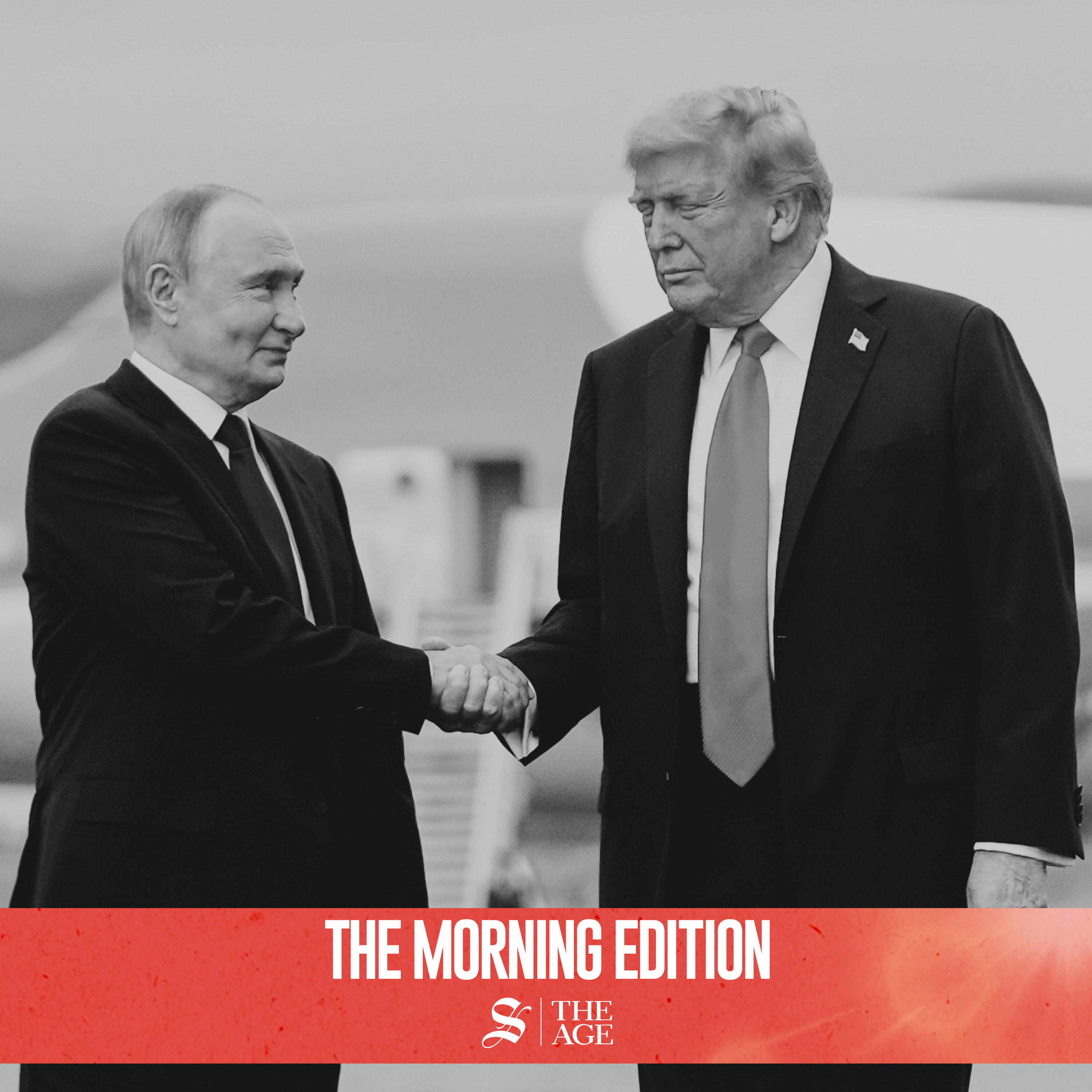
The Morning Edition
Deep misjudgments and awful consequences: Peter Hartcher on Trump and Putin
00:22:19
Loading summary
Transcript30 lines
- [00:00]
Ryan
Hey guys, it's Ryan. I want to tell you about my new pastime, Chumba Casino. Chumba Casino has been around for over a decade delivering the most fun you can have online. Play social casino style games for free, anytime, anywhere. So sign up@chumbacasino.com no purchase necessary VGW Group Void board prohibited by law. See terms and conditions 21.
- [00:23]
Narrator/News Anchor
They are wars on different fronts, but both are showcasing what international and political editor Peter Harcher says about are the deep misjudgments of leaders reporting this week revealed US Armaments are running low as war continues in the Middle east and the ramifications of the unbelievable nuclear deal that US President Donald Trump signed with Saudi Arabia are beginning to surface. As for the Russia, Ukraine war, Harcher says the decisions being made by Vladimir Putin aren't much better. With the Russian president poised to begin a widespread and deep desperate recruitment drive for more soldiers today, Peter Harcher on what he calls the inglorious, disgraceful and counterproductive decisions of Trump and Putin.
- [01:12]
Samantha
Peter, welcome back to the podcast.
- [01:14]
Peter Harcher
Pleasure to be with you, Samantha.
- [01:17]
Samantha
Okay, I'm really hoping you can help us make sense of where things are at with the US Iran war, because on Tuesday Australian time, Trump declared on Air Force One that the US Was having good talks with Iran. And then around the same time, we saw news of Iranian strikes on Saudi Arabia, Jordan and Iraq.
- [01:36]
Narrator/News Anchor
Peter, what's happening?
- [01:38]
Peter Harcher
Well, you're asking me to make sense of what is essentially a pretty nonsensical set of circumstances and straight after the events you've described. We then saw the US Accusing the Iranians of attempting the surprise attack by firing ballistic missiles at a range of US Bases in the region. So it makes no sense, primarily because I think of the geopolitical bipolar performance that Donald Trump puts on for the world every day, where on Monday it'll be, I'm going to bomb you to the Stone Age, I'm going to destroy your civilization. Nothing will be left. And then the next day they've agreed to all my terms and then we're having, as you said that you said they're having good negotiations. He called them very friendly talks when the Iranians are busy targeting and firing ballistic missiles at US Assets in the Gulf. I think the world has really grown a bit weary of this performance. It's like a high speed tennis match where you get whiplash, your head going from one side to the other. So that's why it's so difficult to make sense of it. The global oil market is having Just as much trouble as traders and investors try to discern the signal through the noise. And ultimately, the only real way of gauging, of finding the signal through all the noise is to watch the actions, the combat actions, or lack of them on the ground. And if we look at that, we see that the Iranians have established a new form of leverage, a new great threat, a new source of power for their regime over the US and the world, and that's by closing the Strait of Hormuz, something they had not attempted before this war. And they've now discovered it's a tremendous source of power. And we see them continuing to enjoy that use that resist all US Efforts at either coercion or negotiation, and simply continuing with what they're doing while we see this bipolar performance from the U.S. president.
- [03:56]
Samantha
That's right. And you know, the last time we spoke, or I think it was a couple months ago, you reflected on how badly this war is going for Donald Trump. Obviously, it's a war of choice. He said it'd be over very quickly. We're now in the fifth month. And back then, a couple months ago, you described him as dumb as a bag of hammers, reflecting on the choices he'd made, which you know were going badly on most fronts. And now you've said that he's running out of hammers, by which you mean that the US Is running low on armaments. But, you know, that sounds, that sounds not good, Peter. So how low are we talking?
- [04:29]
Peter Harcher
Well, we're talking low enough that last Friday, when Trump had threatened more strikes on Iran, that a meeting between Trump and his military chiefs, specifically Dan Kane, the general who's the a chair of the chiefs of the Joint Chiefs of Staff in the US Military, advised Trump at this meeting that although they could continue to target Iran with missiles and more fire, that it would send their stocks of a range of munitions, but most crucially Patriot interceptor missiles, to dangerously low levels where they might not be able fully to protect their, their own bases, their own assets, and the bases and assets of the Gulf allies of the U.S. if Iran were to retaliate, which of course, Iran would do. Now, that news was brought to us by the New York Times, Eric Schmidt and Jonathan Swan, and since confirmed by multiple other credible US Outlets, the Wall Street Journal, Reuters and so on. Look, to be fair to Trump, Samantha, I should point out that going back to the Biden administration, in the last few years of the Biden administration, I was in briefings where senior officials, senior security officials from the US Were saying, but Then they were deeply concerned about the low stockpiles of US Missiles and other munitions. And they were deeply concerned because they could see the possibility of a war breaking out with China, which has done nothing but increase its stockpiles of every type of weapon system, ammunition, certainly for the last 13 years since Xi Jinping has been president. They were deeply worried then, and they had requested that the prime contractors in the defense industry in the US Increase their level of production. Since then, we've seen the Trump and Israeli war against Iran last year. That was a brief 12 day exchange, but it still uses large numbers of munitions. And now we see this war, which Trump confidently forecast would last two to four weeks and is now in its fifth month, using up their munitions at a furious rate. So the White House has declined to update specific numbers of munitions stockpiles for very good reason that you don't want to tip off your enemy about what your possible limits or vulnerabilities might be. So that's one very clear indicator that they're in deep trouble. And we will find out ultimately the exact numbers. But we can assume that their numbers of interceptors for the Patriot system, which is essential to intercepting incoming ballistic missiles, is in that range of hundreds of missiles, not thousands.
- [07:43]
Samantha
And so you wonder if that's the Iranians almost trolling the United States, knowing that its stocks are running low with its recent drone attacks on Saudi Arabia and Iraq and Jordan, I believe it was. And then you and I were speaking just before recording, and you, you reminded me, of course, that Trump is also sort of enraging the Iranians in a roundabout way around the same time. So can you just remind us about Trump's decision to ink a nuclear deal with the Saudi Arabians and then how the Iranians would be sort of looking upon that decision?
- [08:17]
Peter Harcher
Well, this is another case. I mean, talk about dumb. This is an extraordinarily willful, erratic, ill considered decision. Like this war on Iran itself, from the US Point of view, so aimless a war that when I asked the doyen of Australian strategic commentators, Paul Dibb, a couple of months ago, when was the last time we'd seen such an aimless war, he had to reach back to the Crimean War 170 years ago. It's just unbelievably amateur, ill considered and counterproductive. But this lays a whole extra layer of misjudgment and miscalculation and ultimately counterproductive outcomes. On top of all that by, well, first of all agreeing to give Saudi Arabia civilian nuclear capability, which in turn would give them the ability to generate a fuel supply for a nuclear armament should they choose it. Now, first of all, that violates all the principles of non proliferation of nuclear weapons. But second, it then enrages Israel. Israel then complains. Trump then changes course and after having signed the deal already with the Saudis, changes the terms and says, okay, we'll only give the Saudis these systems, these reactors and other nuclear systems if they agree to diplomatic recognition of Israel. Which means the Saudis have now objected and said, no way, we can't do that with this war on the Palestinians and all the rest of it. So now the Israelis are upset, the Saudis are upset. But even more counterproductive, Samantha, is that Trump went into this and he's used multiple justifications for the war and Iran. But if there's one that he keeps coming back to above all the others, it's that he wants to deny Iran the ability to have nuclear weapons. Well, what greater incentive could he have? What greater incentive could Trump give the Iranians to want to develop nuclear weapons than arming the Saudis with a civilian nuclear system which could be used to produce nuclear weaponry? Because of course the Saudis and the Iranians are enemies, have been for many years, and now they're literally at war with each other. So now Trump has said that he will give the Saudis, one of the enemies of Iran, this nuclear capability. So it's directly counterproductive and counter to the aim that he's tried to achieve of a denuclearized Iran by giving Iran potentially a strong new incentive to go ahead and resume its nuclear weapons program. Unbelievable on every level.
- [11:09]
Narrator/News Anchor
After the break.
- [11:10]
Peter Harcher
This is what we are seeing as this war grinds through its fifth year. Grinds through an estimated total injured and killed Russians of 1.2 million men.
- [11:31]
Ryan
Hey guys, it is Ryan. For years, chum has been setting the bar for online social casino fun. And it just keeps getting better. With new games released every week and daily bonuses to collect, the fun never stops. So claim your welcome bonus now@chumbacasino.com no purchase necessary bgw group void prohibited by law see terms and conditions 21 plus
- [11:49]
Samantha
that would be unbelievable enough, right? That would be enough for one column and enough unbelievable military, I guess. Poor decisions or counterproductive decisions that we'd be marveling at for months, let alone a week. But your last column didn't just cover that. It also covered another leader who is faring extremely badly in his war against a much tinier nation. And that, of course, is Vladimir Putin. So Tell us about Putin's now desperate recruitment drive for soldiers.
- [12:17]
Peter Harcher
Well, yes, I was so generous, Samantha, in my column as to call them dumb and dumber.
- [12:23]
Narrator/News Anchor
Yeah, that's right.
- [12:25]
Samantha
Which would be funny if it wasn't so potentially catastrophic, Right?
- [12:28]
Peter Harcher
It would be funny if people weren't dying. Yes. And if all of the other consequences to flow weren't flowing. But they are, and this is just a shocking series of misjudgments by both these powers, which of course, were the superpowers of the last century now reduced to these wars of hubris, which are producing these deep misjudgments, producing these awful consequences. So, yes, Vladimir Putin is running out of troops to put in the front line because they are being killed and maimed at such a high rate. You will recall that at the outset of his invasion, his full scale invasion of Ukraine four years ago, four and a bit years ago now, he made a general mobilization of 300,000. All the reservists in Russia deeply unpopular, tens of thousands, maybe hundreds of thousands of Russian men of military service age rushed to the borders and left the country. And he's been trying to avoid, Putin has been trying to avoid repeating a general call up or a widespread mobilization. They've had trouble recruiting soldiers for years now. They've had programs in Russian jails to offer release and payment to criminals who would like to serve in the Russian military against Ukraine. They've run campaigns among homeless people, very poor, the impoverished. Now they're targeting. They've got a campaign going among university students. They're paying unheard of wages. They're offering for a 12 month contract to serve in the front line against Ukraine, up to $100,000. In a country where the median income is 14,000, we're talking US dollars. So these are the measures they've been going to, and yet it's still not enough. So in the last couple of days, we've seen the Ukrainian president, Volodymyr Zelensky, say that according to their intelligence, Russia is now asking North Korea to supply 30,000 new North Korean fighters to go to the front line and fight for Russia. Last year, you'll remember, the North Koreans sent an estimated 14,000 troops, of whom some 2,000 were killed in the war, another 5,000 approximately injured, and then after having served, they returned home. Now Putin's asking for 30,000 more, which will not get him out of trouble because at the current rates of attrition, that will only do him for about a month. That's only a month's worth of replenishment of his army. That's the rate at which the Ukrainians have been either killing or maiming Russian soldiers. So further to that, Zelenskyy tells us that he the Ukrainian intelligence system, which generally, I should say from the beginning of this war has been accurate in its intelligence insofar as we've heard about it. He is hearing that the Russians are preparing for a general mobilization. They've got parliamentary elections coming in September. So perhaps after those elections. And we do see some signs, for example, just in the last few days, the Russians have closed rail crossings into three neighboring countries, perhaps closing escape routes for service age men. So this is what we are seeing as this war grinds through its fifth year, grinds through an estimated total injured and killed Russians of 1.2 million men.
- [16:09]
Samantha
I mean, it's just astonishing. I think it's sort of easy to lose sight of it in and amongst the daily news, but also, like you say, this full scale war has been going for so many years now. And I was, I have to admit, I was left a bit gate mouthed by something that you included in your latest column about this. And this is that according to Washington's center for Strategic and International Studies, the authors wrote, quote, no major power has suffered anywhere near these numbers of casualties or fatalities in any war since World War II. The talking there about the Russian casualties and fatalities. So I mean, I guess how much longer does this perhaps suggest that Putin can keep going? You know, he has so far, of course racked up so many losses, only tiny gains. And in that study, those report authors Seth Jones and Riley McCabe said that at the current rates, combined Russian and Ukrainian casualties could reach 2 million by a few months from now, essentially. So that's terrifying.
- [17:06]
Peter Harcher
It is. And you have to feel for the Russian citizens, the civilians who have been called up, bribed, misled, they've got a whole recruitment program running, by the way, in Africa, trying to mislead African men, offering them various employment contracts, getting them to Russia and then giving them a gun and pushing them onto the front line. So he's been desperate for a long time. He's getting increasingly desperate. But he obviously feels that his own political survival is more important than the lives pointlessly lost because he's making no real progress and hasn't been for months. If anything, the tide has turned in Ukraine's favor. The sheer pointlessness of this exercise, the pointlessness of the injury and death to this whole generation of Russian men. Well, I shouldn't say generation because they're now recruiting. They have been recruiting and snaffling and press ganging old guys as well. Anybody, basically even men who have been medically discharged with a leg blown off are being sent back on crutches into the front lines. So this level of desperation is only increasing. He's putting his own political survival above the survival of his own people. And he judges presumably that the costs to him of surrender politically would be greater than the costs, the risks to him politically of continuing. So he presumably thinks he can get away with continued political domination at home so long as he keeps this nationalist triumphalist narrative running and the deceit of his people that this is a glorious war being fought in a great and glorious cause, when in fact it's entirely inglorious, disgraceful and counterproductive.
- [18:57]
Samantha
Okay, well, Peter, just to wrap up, you know, at the very beginning, we've spoken about how you were referring to Trump and Putin as dumb and dumber in terms of their massive geopolitical blunders. So you've sort of walked us through all of Trump's. How would you rate Putin in return?
- [19:14]
Peter Harcher
Well, quite apart from the domestic price that the Russian people and economy are paying for this, if you take a step back. Well, let me refer to the president of Finland, Alex Stum, who told me in an interview last year that he thinks this is at that time the greatest geopolitical blunder in modern history. It'd be interesting to ask him to rate that now against Trump's as well. But the reason he made that case was he said, going into this war, Putin wanted to dismantle NATO, divide the EU and therefore dominate Europe. Instead, what he's achieved is Sweden joined NATO, Finland joined NATO. NATO has been enlarged, not, not contracted at all. Russia's border with NATO countries has more than doubled. Although Donald Trump has been doing great damage to NATO in his own right, NATO still remains a functional entity. As far as we can tell, the EU has never been more united. And Europe, generally led by the Germans, despite their pacifist post war policies, are now leading a rearmament of Europe to defend against Putin in a way that is only counterproductive to his aims and strengthens Europe in the medium term. So there you have it. Exactly which of these leaders is guilty, Trump and Putin, of the greatest, grandest strategic blunder in modern history. We can only really judge when they've finished these operations and we can see the consequences. But I think it's very clear that both of them are counter to their own initial intentions and being compounded by their political vanity in continuing without conducting good faith negotiations in either case.
- [21:20]
Samantha
Well, thank you so much Peter, as
- [21:22]
Narrator/News Anchor
always for your time.
- [21:24]
Peter Harcher
Tough subject, but good to chat with you, Samantha.
- [21:33]
Narrator/News Anchor
In other news today, the number of first home buyers looking to take out a home loan has fallen in a year, even as property prices soften in some parts of the country and investors move out of the market. Australia's largest oil and gas producer, Woodside Energy, has emerged as one of the nation's biggest corporate beneficiaries of the Iran war, reporting nearly a 30% revenue jump to $6 billion over the past three months. And Melbourne Fashion Festival today announces that it's rebranding to be called Australian Fashion Festival. The change is part of a suite of updates seek to do deepen the organization's commitment to being a consumer led program and strengthen designer relationships. You can read more@the age.comau or smh.com Today's episode was produced by Chi Wong, our Executive producer is Tammy Mills and our podcasts are overseen by Lisa Muxworthy and Tom McKendrick. If you like our show, follow the Morning Edition and leave a review for
- [22:36]
Samantha
us on Apple or Spotify.
- [22:37]
Narrator/News Anchor
Thanks for listening.
- [22:50]
Ryan
Hey guys, it's Ryan. I want to tell you about my new pastime, Chumba Casino. Chumba Casino has been around for over a decade delivering the most fun you can have online. Play social casino style games for free, anytime, anywhere. So sign up@chumbacasino.com no purchase necessary. BGW terms and conditions 21 +.