← The Morning Edition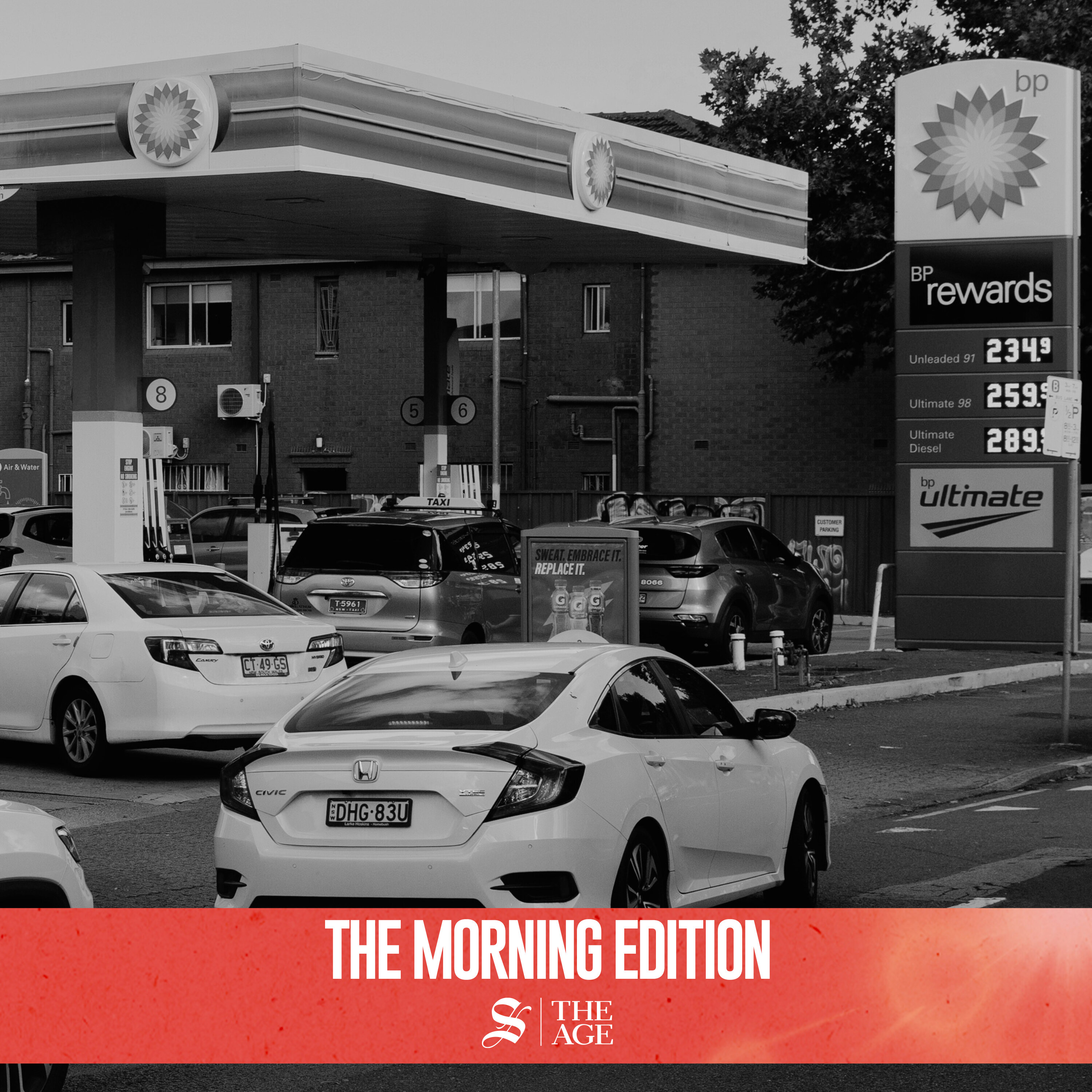
Loading summary
Transcript30 lines
- [00:00]
A
The Global Gaming League is presented by Atlas Earth, the fun cashback app. Hey, it's Howie Mandel and I am inviting you to witness history as me and my How We do it gaming team take on Gilly the King and Wallow $267 million gaming in an epic global Gaming league video game showdown. Plus a halftime performance by multi platinum artist Travy McCoy. Watch all the action and see who wins and advances to the championship match right now@globalgamingleague.com that's globalgamingleague.com in partnership with Level Up Expo.
- [00:34]
B
You've noticed the hike in prices at the petrol pump, but how high might prices go? And are we at risk of running out of petrol? I'm Samantha Sellinger Morris and you're listening to the morning edition from the Age and the City Morning Herald Today energy reporter Nick Toscano on what plans our government and fuel companies have to manage this crisis and how long it might take for prices to return to normal. It's March 24th. Hey, Nick, welcome back to the Pod.
- [01:04]
C
Hey, Sam, thanks for having me back.
- [01:06]
B
Oh, I'm. I'm so happy to have you back because I'm sure many listeners are like myself and they're quite confused by this. So before we get into everything that's been happening, can you just tell us where we actually get our fuel from in Australia?
- [01:18]
C
Sure. Well, I guess that's a question with an answer that's changed quite a bit over the past couple of decades. Australia, we once had a considerable fleet of our own domestic oil refineries. So these are the sort of sprawling industrial complexes of pipes, machines and giant chimney stacks that turn crude oil into the fuels that we actually use every day, like petrol, diesel and aviation fuel. At the turn of the century, we had eight oil refineries spread across the country that produced not all, but a good chunk of our liquid fuel needs. Today, we're left with just two. That's the Geelong oil refinery in Victoria, which is run by Viva Energy, and the Litton Oil refinery in Brisbane, which is operated by Ampol. So I guess what's happened is that refined fuels in this day and age are so widely available from so many different parts of the world, they can be easily shipped to buyers anywhere as far afield as Australia. And it's easier, it's simpler, and in most cases cheaper to import fuels into the shipping terminals here instead of going through the effort to produce them ourselves. So while there's been a desire to, a strategic desire from the industry and from governments to retain some of our capacity to be able to produce our own fuel. Australia has the problem of having a relatively small market and that means we have relatively smaller and higher cost oil refineries, which have found themselves in the past little while just increasingly less and less able to compete with cheaper imports coming from the mega refineries of Southeast Asia in particular, that can pump out fuels for a fraction of the cost and have really pressured the profit margins of the plants that we have left then rewind. A couple of years ago, the onset of the COVID 19 pandemic, as we saw, you know, basically brought travel and petrol and diesel use to an absolute standstill everywhere. And that was sort of the final crushing blow for, for a couple of the last refineries that we did have in Perth and another one in Melbourne's western suburbs. So that forced the closures of two more, leaving us with just two remaining. And that's left us reliant on imported fuels from places including, but not limited to Malaysia, Singapore, Korea, China, for our fuel needs. And we get smaller amounts from, from the Middle east and from America. So as things stand today, imported products account for about 90% of, of our total liquid fuel needs.
- [03:43]
B
And you know, this has gone beyond the headlines now because we are seeing the impact on prices at the petrol pump right across the country. So can you just explain to us how this war is driving prices?
- [03:54]
C
Well, since the outbreak of the war a couple of weeks ago now, the price of petrol has shot up dramatically. It's gone up 30% in the space of a couple of weeks. It's actually reached an all time high. We've never seen prices, national average prices this high were $2.19 a litre for unleaded, which is a record. So primarily the high cost of petrol comes down to one thing most of all, and that's the fact that the price of oil, the cost of a barrel of oil has surged faster and higher than we've seen for years and years. The cost of a barrel of oil before the war at the start of the year was about $70 a barrel, and that's blown past the $100 mark. It's even briefly touched $120 a barrel. Crude oil is the natural resource that is refined into petrol, diesel and jet fuel, and therefore makes up the biggest and most important and I guess most volatile input costs to the fuel that we use. The reason this has happened, Sam, is the countries in the Middle east around the Persian Gulf where much of the fighting is taking place. So we're thinking Iran Saudi Arabia, the United Arab Emirates, Bahrain, they account for a massive chunk of the world's overall supply of oil, and a good portion of that supply is now disrupted. The biggest cause there is that Iran has done something that energy markets and governments around the world have long feared it would do if it ever came under attack. And that's forcing the effective shutdown of a shipping corridor which you're no doubt familiar with now called the Strait of Hormuz, which is off Iran's southern coast. Typically, in ordinary times, that shipping channel accounts for about one fifth of of all of the world's oil and natural gas supplies. And that's basically come to a complete standstill, a complete halt. Now, Iran has been threatening to attack any foreign oil tankers that attempt to pass the strait, and that's basically left all this oil and refined fuel from those Persian Gulf countries with essentially no way to exit, with essentially no way to get their oil out into the ocean and take it to customers who want it. The world has been trying to reduce its reliance on oil and other fossil fuels for a long time now by pushing harder to add more renewables and drive electric vehicle uptake. But oil is still hugely important. The world consumes in excess of 100 million barrels of oil every day. And the stuff that's stuck in the Persian Gulf now, it's about 20 million barrels. So it's literally 20% of our overall supply.
- [06:18]
B
Wow. And of course, we've seen reports of people panic buying and petrol stations being out of petrol. So how bad is the problem? Like, are we actually, actually at risk of running out of petrol?
- [06:29]
C
No, we're not. At least not yet. Sam, There are localised problems that we're seeing emerge across the country, in regional areas, in metropolitan areas as well. People are getting worried. They're reading the headlines, they're seeing prices rise. There's been what the industry is calling a rush on demand rather than any structural supply deficit. Yet. People are filling up jerry cans with fuel to stock at their homes. People are filling up their cars unnecessarily. And what that's done is it's caused supply disruptions. These are localised disruptions. The fuel industry says they're typically resolved swiftly, but it goes to show, I guess, the volatility of the market right now that people are making a dash for the petrol station, people are often finding the bowsers having run dry. At the moment, Sam, there's no risk of a shortage. The fuel industry and the federal government say we have more than enough supplies to cover demand. So A lot of these problems are being driven by, by consumers panic buying. There are still ships arriving to Australia. There are still lots of oil and refined fuel arriving on our shores. We have a significant national stockpile of fuel, enough to cover more than a month's worth of typical demand of diesel and petrol. We still have more than a month's worth there, even though we've released some of that recently. So things aren't at the pointy end yet, even though we're seeing prices rise. I guess the sense coming out of the fuel industry and the people that I've spoken to over the past week is that things are okay now, but a lot will depend on what happens next and how long this goes for. And if we're still having this conversation in a month's time, it'll be a different conversation.
- [08:09]
B
After the break.
- [08:11]
C
I think what will happen first is if there's no resolution to this conflict and suppliers continue to come under pressure and be choked into the Asian region, we'll see prices rise, even potentially rise even further than they're trading at now. Beyond that, there could well be a shortage of product coming into Australia.
- [08:34]
A
The Bleacher Report app is your destination for sports right now. The NBA is heating up, March Madness is here and MLB is almost back. Every day there's a new headline, a new highlight, a new moment you've got to see for yourself. That's why I stay locked in with the Bleacher Report app. For me, it's about staying connected to my sports. I can follow the teams I care about, get real time, scores, breaking news and highlights all in one place. Download the Bleacher Report app today so you never miss a moment.
- [09:04]
B
And so how is it that ships of fuel are still making their way to Australia? Is it because these are ships that had already sort of stocked up on the fuel from the Persian Gulf and they'd already sort of been made their way before the Straits of Hormuz essentially was closed.
- [09:17]
C
Well, again, Australia gets most of its fuel not from the Middle East. We source most of our fuel and some of our oil from the Asian region in particular. They're our biggest sources of supply. The problem that we're seeing emerge now, the problem that's coming into view is that the Asian region sources much of its crude oil to process into fuels at its mega refineries from the Middle East. And there's been a notable drop off of oil tankers arriving in Asia that's going to eventually disrupt the traditional flow of oil and fuels that we source from at the same time, that problem's being made worse by the fact that China, a huge customer and a huge supplier of refined fuels, have basically cut off their exports. They typically account for 15% of the Asian market. They've put a halt on all that. That's going to hit home eventually, too.
- [10:09]
B
And so what are the contingency plans then? Like, what does the government and fuel companies, what have they said that they're going to do about it?
- [10:15]
C
Well, the first and most important thing I think, that the federal government's done is they've tapped into the strategic reserve, the strategic stockpile of fuel, to provide something of a buffer. Australia is in breach of its requirement as a member of the International Energy agency, to hold 90 days worth of refined fuel products. But we still have more than a month's worth of supply. I think it's three or four billion litres. At last check of fuels, the Energy Minister, Chris Bowen, has decided to release, I think, five or six days worth of petrol and diesel to help provide that sort of cushion and help insulate us from the. From the effect of any shock. There may be another drawdown soon, we don't know. The other thing is, other initiatives that have, that have happened in the past couple of weeks have been a decision to enable Ampol, which is the operator of the Litten Ore refinery in Brisbane, to supply the market with fuel that would ordinarily be in breach of emissions limits for Australian vehicles. Fuel that it would normally export, it's now delivering into local market. Ampol has also delayed a planned maintenance closure of the Litton Oil refinery. It was going to come offline for a couple of months as of June. That's now been pushed back to April to enable it to pump out another 300 million litres of fuel product into the economy.
- [11:31]
B
And so you've mentioned there that sort of month mark, you know, should we be talking about this in another month? Should this war still be going on and the Straits of Hormuz closed for another month? That might be, I guess, a sort of tipping point. Is it like, is that when things might start to get a bit more serious in terms of us looking down the barrel of a possible real significant fuel shortage?
- [11:51]
C
That's the prevailing fear. I think what will happen first is if there's no resolution to this conflict and suppliers continue to come under pressure and be choked into the Asian region, we'll see prices rise, even potentially rise even further than they're trading at now. Beyond that, there could well be a shortage of product coming into Australia. And the other thing the fuel industry is doing in response to all this is they're working around the clock to try and lock in additional sources of supply from countries where we wouldn't normally source a huge amount of our, of our refined product from, including the EU and including North America to try and make up to try and offset the declines that we're seeing into Asia.
- [12:29]
B
Okay, well, let's look at the other side of the coin, which is the question that if the war ends tomorrow, how long would it take for prices to drop and the supply to go back to normal?
- [12:38]
C
That's a good question. There would be an impact seen almost immediately. Prices would begin to ease. Obviously, petrol prices take longer to fall than they do to rise in these sorts of scenarios. But the fact of the matter is the world has no shortage of oil and of refined fuels. What's happened here is that there is this huge disruption at this choke point that's causing this big bottleneck. Before the outbreak of the war, the oil price was at US$70 a barrel. In a context of a weak global economy, rising inflation, which led to subdued demand. So the world had more oil, more oil and fuel than it needs. Nothing structurally changed over the past two weeks that would change that environment. It would return to an environment of oversupply, but there would be some impacts that would take longer to recede. Not only is there the Strait of Hormuz being blockaded, but there's also now been, as especially over the past week, serious damage inflicted on oil and natural gas infrastructure in the region. There's actual, you know, actual refineries, actual production fields that have been, that have been blown up or that have been. That have been struck by drones or what have you. To return to your question, it may take a lot longer than just the reopening of the Strait of Hormuz for all of that price pain to recede, given the world may take longer for supplies to catch up.
- [13:57]
B
Again, what you've just mentioned there, of course, the gas production sites that have been hit and strikes. And that brings me to what I wanted to ask you about, which is that will other sources of energy be affected in Australia with regards to what's of course, going on in and around Iran?
- [14:11]
C
The other big commodity that's been affected by all this is natural gas, which is a fuel that's used in Australia and around the world for cooking, for heating, for hot water. It's used to power our electric grids, and it's used in a range of industrial processes. Qatar is the world's second biggest supplier of liquefied natural gas. So that's lng, that's natural gas that has been super cooled down to the point that it becomes a liquid and then it can be put onto ships to be sent around the world. Qatar's main LNG production hub was hit by a drone strike in the early days of this conflict. In itself that knocked out about one fifth of the world's LNG supply. Qatar is a major supplier to Asia, and Asian economies are very heavily dependent on imported LNG for their energy needs. So what's happened there is prices have gone through the roof in Asia, They've gone through the roof in Europe. Australia hasn't been affected so badly, at least yet. We are a big gas exporter ourselves. We produce a lot of gas for the domestic and for the international markets. So far, our prices have remained steady, even though there is often a link between the price that we pay here and the prices that our exporters are earning from selling cargoes into international markets. At the moment, it's been pretty steady. They've stayed around the $10 a gigajoule mark this whole time, which is historically quite subdued. But again, the longer this drags out and the more there is a overall international shortage causing a mad scramble for any spare gas supplies, there's a fear that that could start being felt here at home as well.
- [15:46]
B
And Nick, just to wrap up, I mean, I really want to ask you what the lesson is in all of this, or what it perhaps should be, because we know that this is far from being the first oil shock that Australians have experienced in their lifetime. There was a massive fuel crisis in 1973, in 1979 again. So what should we take from all of this?
- [16:06]
C
Well, I guess the biggest thing, probably, Sam, is the risks of relying on globally traded energy supplies that are critical to our needs, but that can be essentially held for ransom in geopolitical events like this. The closure of the Strait of Hormuz has been something that's been long feared, but it's never really come to pass until now. I guess what's happening now just shows. It just underscores the significance of the threat of relying on other countries for our energy supplies. Advocates of renewable energy and some political leaders say that we shouldn't be wasting this opportunity to double down on transitioning our energy system, to adopt more sources of renewable energy to reduce our reliance on other countries. And yet you can't hold the wind and the sun hostage like you can hold fossil fuels hostage. Obviously, driving the uptake of electric vehicles speaks to the same issue. I guess the other lesson from this is I'm not sure what the government will take away from it, but there has been this long running debate about how much fuel, how much oil products we should be holding in storage. It's a tricky one for the government because it costs a lot of money. I think the last estimate from the federal government was if we were to increase our fuel stockpiles from 35 days to the 90 day benchmark set by the International Energy Agency, that would cost another $20 billion. Is that a cost that taxpayers and consumers would be willing to wear? That's obviously a debatable point, but I mean, it's like an insurance policy. You only need it when you need it. And I imagine there will be a significant discussion taking place on the other side of this conflict about whether our stockpiles do provide enough of a buffer for a country like Australia that's at the very end of a global supply chain.
- [17:58]
B
Well, Nick, we are so lucky to have you to walk us through this. It is quite complicated. So thank you so much for your time.
- [18:05]
C
No worries. Thanks Sam.
- [18:12]
B
And in other news today, the long awaited Australia EU free trade deal will be finalised today. Under it, Australian red meat exports to Europe are set to rise tenfold. Union groups have joined churches, health organizations and community advocates to demand that Prime Minister Anthony Albanese move urgently to enact gambling reform, citing the $32 billion that Australians lose every year. And children and teenagers who turn to AI companion chatbots for relationships are being exposed to sexually explicit content and are being encouraged to self harm or suicide, according to a new report by the eSafety Commissioner. Today's episode was produced by Josh Towers. Our executive producer is Tammy Mills and our podcasts are overseen by Lisa Muxworthy and Tom McKendrick. If you like our show, follow the Morning Edition and leave a review for us on Apple or Spotify. Thanks for listening.
- [19:17]
A
Save on family essentials at Safeway and Albertsons this week at Safeway and Albertsons Signature select spiral ham bone in is 127 a pound. Member price with digital coupon limit 1 while supplies last and Fuji Gala or Granny smith apples are $0.79 per pound. Member price selected sizes and variety of Pepsi Pure leaf tea, Rockstar Energy Propel water or Gatorade are 97 cents each. Member price with digital coupon limit 10. Visit safewayoralbertsons.com for more deals and ways to save.
- [19:49]
C
Hey, it's Bubba Wallace from 2311 Racing. You know what it feels like forever sitting on a plane waiting for takeoff. Good thing I've got Chumba Casino. With daily Boost and Social Casino games on tap, this is the kind of fun that makes time fly. Why not turbocharge your downtime play now at chumbacasino. Com? Let's Jumba.
- [20:11]
A
Sponsored by Chumba Casino. No purchase necessary. VGW Group voidware prohibited by law. 21/ Terms and Conditions apply.