← The Morning Edition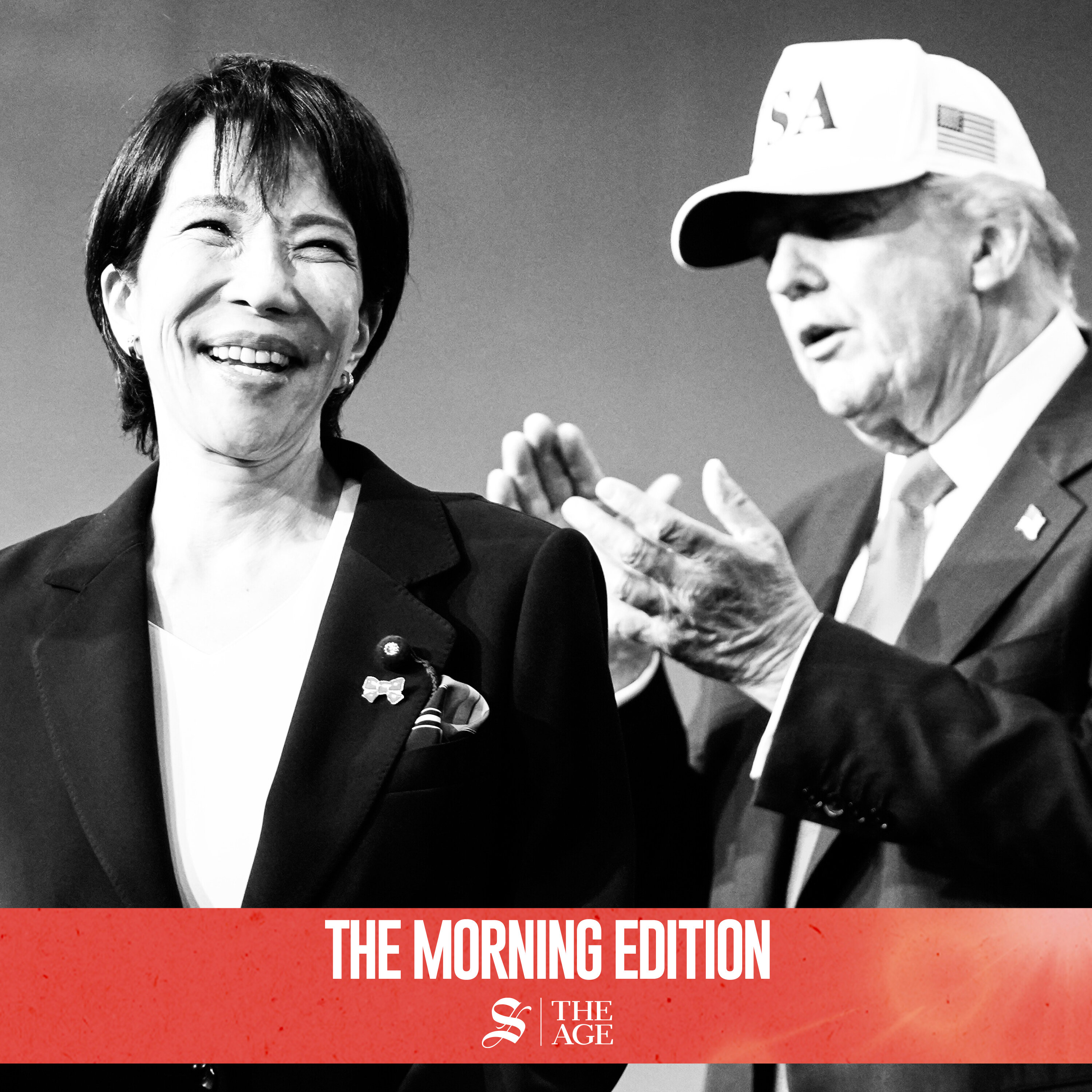
The Morning Edition
Japan’s new PM is the 'Trump whisperer'. Will she compel Albanese to follow suit?
00:20:06
Loading summary
Transcript28 lines
- [00:04]
A
The new Japanese Prime Minister, Sanae Takaichi, is so pro Donald Trump that she's become known as the Trump Whisperer. She's also just gained an enormous amount of power over the weekend in a historic landslide election win. So what will this do to Australia if, as predicted, she encourages Prime Minister Anthony Albanese to strengthen our ties with the United States? Hi, I'm Samantha Salinger Morris, and you're listening to the Morning edition from the Age and the Sydney Morning Herald Today International and political editor Peter Harcher on how Australia manages this new relationship with the Japanese Prime Minister while heeding calls to decouple from the United states. It's Thursday, February 12th. Hey, Peter.
- [00:54]
B
Hi, Samantha.
- [00:55]
A
Okay, you've got to tell me about this historic landslide that Japan's first female prime minister secured just over the weekend. How did Sanae Takaichi manage this? And what powers does this now give her to make serious changes, perhaps to how Japan behaves in the world?
- [01:12]
B
Well, she not only smashed all tradition by becoming the first female Prime Minister of Japan when her party first voted her into that position three months ago, she then proceeded to smash all records for the size of a government majority in Japan since World War II. Since World War II, the polls said she would probably win and win big. They didn't predict that she would win more than 2/3 of the entire lower house of Japan's Parliament.
- [01:43]
A
It was less than three weeks ago.
- [01:45]
B
That Japanese Prime Minister Sanae Takaichi declared this snap election.
- [01:50]
A
And now it appear her gamble has paid off. Japan's Prime Minister Sana Takechi has secured a sweeping mandate from the people after winning yesterday's snap election in a landslide.
- [02:02]
B
So that gives her a lot of, a lot of power. It means that she doesn't have to worry about what the opposition thinks in the lower house. She can just steamroll them. It also means she can overrule the upper house with the 2/3, or they call it supermajority. The upper house becomes irrelevant. So she can make law with a free hand, unhindered by the opposition in either chamber. The other power it gives her is to launch the process, but not actually to achieve the outcome of revising Japan's peacetime pacifist constitution, which famously renounces war for all time and the ability to wage war, meaning no defence forces. It gives her that ability to at least begin the process, but you still need to go through steps, including a national referendum and a 2/3 majority. So that's still a distant prospect. But these are the powers that are now on her desk.
- [02:59]
A
That's incredible. And I am particularly interested in, you know, this potential reform to the country's pacifist constitution. I know we've spoken about this before. It's been in place since 1947. So obviously this would be a massive change. And I guess how could this change the game completely in terms of terms of how Japan engages with China? Because we know that she recently made comments suggesting that Japan could intervene in a conflict over Taiwan so that that could be a military conflict with China potentially. And this of course, had massive ramifications. So tell us about this, Peter.
- [03:33]
B
Yes, so you, you've hit the nail on the head. This is why Takaichi's victory and in such fine style is a major geopolitical moment. So first of all, let's deal with the constitution question and then let's talk about the Japan China relationship. Because Taka Ichi is determined to stand up to China. She doesn't see Japan as in any way being inferior and sees Japan as a great power that will confront China with US help and with Australia's help as well. On the constitutional question, Japanese governments for decades now have, rather than try to confront that very thorny question of a constitutional revision rather incrementally tried to creep their way around it and succeeded to some extent by gradually building up Japan's military forces and gradually incrementally changing the laws that control how they can use those forces. So Japan is spending about 2% of its GDP on its military, same as Australia, and it's built up a substantial capability, including one of the world's biggest navies. It's about the number four or five military spender in the world simply because the scale of its economy, it remains the world's fourth biggest economy. So it's built these forces and incrementally liberalized the laws under which it can engage those powers. So whether Takaichi decides it's worth the trouble to try and actually change the constitution and take that huge political risk, or whether to continue this incrementalism, we will have to wait and see. But it was on exactly this subject that she brought on a confrontation with China. She became the first Japanese prime minister clearly to state that any contingency or Chinese move against Taiwan, she said, would be an existential issue. Facing Japan would determine whether Japan could survive as a nation state. And therefore, she said, it would trigger the law that allows Japan to deploy its military forces in mutual self protection, self defense. So this is the beginning of the ruction with China, she said it Unapologetically, Xi Jinping, the Chinese Communist Party, reared up in tremendous indignation, imposed trade sanctions, canceled the Chinese tourist trade to Japan, banned Chinese rare earths sales to Japan and other sanctions as well. She didn't apologize. She didn't take a step back. And this is now where the situation stands. A newly elected, newly empowered, very determined, very tough nationalist leading Japan with tremendous popular support and stating that she will confront China's expansionist inclinations, which I guess.
- [06:46]
A
We could see come to a head, I guess, later this year, because China's going to be hosting the APEC summit in November, and I guess Takaichi and Xi Jinping could meet then. But I think we really are getting to the crux of your piece, which is why her win really marks what you've called a geopolitical earthquake. And I wanted to talk to you or ask you more about why she doesn't think Japan is a middle power. She thinks it's a great power. Can you sort of elaborate on that?
- [07:14]
B
Yes. She doesn't see Japan as having to be an endless price taker in world power and alliance relationships. She sees a Japan that can be a price maker. She sees a Japan that can return to its previous greatness as a force in the world. So Japan, of course, has a history of being a country that muddles along until some savage crisis is upon it. And then it has a history of being able to reorganize very quickly and reconstitute itself after World War II, when it defeated, occupied, and its economy smashed to pieces with comprehensive Allied, mainly US bombing of all its manufacturing infrastructure. All its infrastructure in short order. By the 1960s, Japan was a major exporting powerhouse. And the rest we know is history. By the 1980s, it was being acclaimed as a great power. There were very, very excited books being written by Americans predicting a war between Japan and the US There were serious proposals from Japanese politicians that Japan should buy the state of California from the US Because Japan needed more land. This was the sort of hubris and headiness that was going on in the 80s. And then, of course, after its bubble economy punctured in 89, it's really become an overlooked country and a forgotten land. Of course, at the end of World War II, Japan, like many countries, subcontracted its defense and national security to the U.S. she wants to bring that back. She wants to remain a powerful ally. She says, I want to make Japan an indispensable ally, indispensable ally to the US but she wants Japan to be a great power in its own right as it has been in the past. And she can see that happening again. Japan now is located in the middle of the fighting zone. The Chinese expansionist envelope, the threat envelope, if you like, has expanded to put Japan squarely in the center. And it's been under military pressure, continuous encroachments from China's Navy and Air force now for years, to the point where it has to scramble its air force an average of every one and a half days to cut off an incursion of Chinese Air Force jets. And now Japan is the front line. And that's how Takaichi sees it. And she sees it as being a firm line in the alliance that will do everything it can to confront China.
- [09:58]
A
After the break.
- [09:59]
B
Trump has complimented her many times on her strength, her grace. They went together to a US Aircraft carrier and stood on the deck and Trump said positive things about her and Japan, and she started jumping and dancing around and pumping her fist in the air.
- [10:24]
A
Well, this is so interesting what you say about Take Ichi wanting to, you know, develop an even stronger alliance with the United States, because this, of course, completely flies in the face of the message that we've been hearing, and it's been analyzed almost ad nauseam over the last few weeks, ever since Canadian Prime Minister Mark Carney gave what is now a famous speech at the World Economic Forum at Davos last month. And this is, of course, when he said that middle powers should decouple from countries that seek to dominate them. He didn't mention the United States, but it was clearly who he was referring to. So Takaishi, she's known as the Trump whisperer, she's completely taking a different tack. Quite an opposite tack, I would suggest. So what does this mean, I guess, in terms of how she might relate to Donald Trump?
- [11:10]
B
Yeah, it's. It's a different view altogether. And the two countries, Japan and Canada, are under different pressures, of course, although both of them are long standing and close US Allies that have relied heavily on the US So Taka Ichi also is a conservative leader, a woman, and somebody who's been positive about Trump from the beginning. Trump has responded lovingly. Trump has complimented her many times on her strength, her grace.
- [11:37]
C
I want to just let you know, anytime you have any question, any doubt, anything you want, any favors you need, anything I can do to help Japan, we will be there. We are an ally at the strongest level.
- [11:51]
B
He visited Japan after she was elected prime minister by her party. But before the general election, they went together to a US Aircraft carrier and stood on the deck. And Trump said positive things about her and Japan.
- [12:06]
C
This woman, This woman is a winner. So we become very toast friends all of a sudden because their stock market today and our stock market today hit an all time high. That means we're doing something right.
- [12:27]
B
And she started jumping and dancing around and pumping her fist in the air, which was criticized uniformly by serious commentators in Japan who said, this is not how a Japanese Prime Minister should behave. She's more like a cheerleader for America than a, you know, a statesperson. She didn't care. She is that much of a pro American leader and pro Trump, and he is unabashedly pro her. Congratulated her on her big election win the other day and she replied by saying, our alliance is limitless. So she sees the alliance as being as strong or stronger than it's ever been. And Japan as a bigger, more active participant in the alliance. Very different to the Carney approach of wanting to decouple, to hedge against the US and to hedge against the US by building stronger relationships with other powers. Witness his visit to China just a couple of weeks ago. No Canadian Prime Minister had been there for what, eight, nine years? Carney was very demonstratively saying to the US, look, we have options. We can go to China as our partner. If you're not going to be any use to us, take Ichi doesn't have that option. So that's an explanation of the fundamental standing and why those two US allies, or most wild US Allies in the case of Canada, are going in different directions.
- [13:52]
A
Okay, well, I really want to ask you what sort of pressure I guess this might put on Prime Minister Anthony Albanese because we've been hearing some commentary within our own country. I know that Alex Bristow from the Australian Strategic Policy Institute, he just told the Australian Financial Review that Sanae Takaishi's visit to Washington in March is a vital opportunity for Japan, Australia and other US Allies to persuade Trump not to make a grand bargain with Chinese President Xi Jinping when he visits Beijing in April. And you wrote that Mike Green, the political analyst, told you that Takaishi might very well encourage Albanese to sort of, I guess, encourage Trump to get things happening on the trade front and sort of, I guess, strengthen that alliance. So how receptive might Anthony Albanese be to encouragement from Japan to perhaps strengthen the alliance with the United States and Donald Trump?
- [14:45]
B
Yes, good point. Good question. Australia and the US are not only going to have that bilateral relationship and Taka Ichi, of course, as you said, will be involved and wanting to bring Australia in. And remember that in the last couple of years Australia's relationship with Japan has been intensified. It's really, it's now Australia's secondary ally. But also remember that there is this forum called the Quad and she is very enthusiastic about using the Quad to advance Japan's case. The Quad is Japan, the U.S. australia and India. And she intends to use that as a forum for bringing the U.S. as you say, to the priorities that suit her and the other Quad members. And they will include being firmer with China, being more reasonable with trade and tariffs and less aggressive with US Allies with tariffs to engage more with Southeast Asia and India. So it will be like a little posse of allies that does try to work on Trump. And I think we can expect that. To your question, how receptive will Albanese be? I think the answer is very. I think the answer is very.
- [15:58]
A
Okay, that's very interesting because you've just mentioned there that Australia and Japan, their relationship as allies has intensified over the last couple of years. But I've noticed with great interest that in the last few months it seems like our government has also grown closer to the Canadian government. In October, our two countries signed something of an agreement or of an understanding on critical minerals to collaborate there in some capacity. Albanese, of course, has invited Mark Carney to speak at our parliament, which he'll be doing next month. And in November, the president of the Canadian Border Services Agency signed a customs mutual assistance agreement with our Commissioner of Border Force to sort of strengthen information sharing and hopefully prevent smuggling and trade related crime. So I guess could this wedge, Albanese, you know, if Canada's trying to perhaps push us to decouple from the United States and Japan is pushing us to strengthen our ties to America, could this put Albanese in an uncomfortable position?
- [16:54]
B
Yeah, interesting angle. And very early in Carney's term, he cancelled a Canadian order for F35 fighter jets from the US and instead he turned to Australia not for fighter jets, but he signed a deal with Albanese to buy Australia's over the horizon radar for something like $6 billion. Was a very clear sign. We're not going to buy from you guys anymore. We prefer to buy from the Australians or anybody else as long as it's not the US and that's rational response for a Canadian leader. But I don't think he's going to be in a position to pressure Australia to do anything in particular except to intensify its relationship with Canada. He's there to extract maximum benefits for Canada in the case of Albanese Albanese, while subtly wanting to diversify in any way he can from the US Is not in a position to be so forthright or direct as to start canceling defense or strategic arrangements with the US Even if it's only for the Aukus submarine and technology deal which weds the two countries together for decades in a major strategic compact. Also note that Trump has been prepared to welcome the Australian alliance and hasn't yet insulted hasn't yet insulted Australia. So it's a different situation. And Australia will, while trying to work its way around problems with the US Also try to salvage whatever it can from the US alliance because we are an exposed country that cannot resist on its own Chinese pressure and needs the US to be standing in between US and China if we have any hope of resisting Chinese coercion in the years ahead.
- [18:44]
A
Thank you so much, Peter, for your time.
- [18:47]
B
Always a pleasure, Samantha.
- [18:51]
A
In other news today, major infrastructure projects funded by the federal and Victorian governments hosted drug trafficking, systemic corruption, bribery and bikie gangs at an estimated cost to the taxpayer of 15 billion, according to a landmark report into CFMEU corruption. Internal Hamas documents show the militant group spied on and interrogated World Vision staff and suspected whistleblowers as part of a coordinated effort to obstruct an Israeli terrorism trial involving the charity's former Gaza director. And Amy Taylor, the lead singer for Australian punk band Amyl and the Sniffers, is suing a photographer in an American court over ownership of images that were shot for Vogue. Today's episode was produced by Chi Wong. Our executive producer is Tammy Mills, and our podcasts are overseen by Lisa Muxworthy and Tom McKendrick. If you like our show, follow the Morning Edition and leave a review for us on Apple or Spotify.
- [19:56]
B
Thanks for listening, Sam.