← The Morning Edition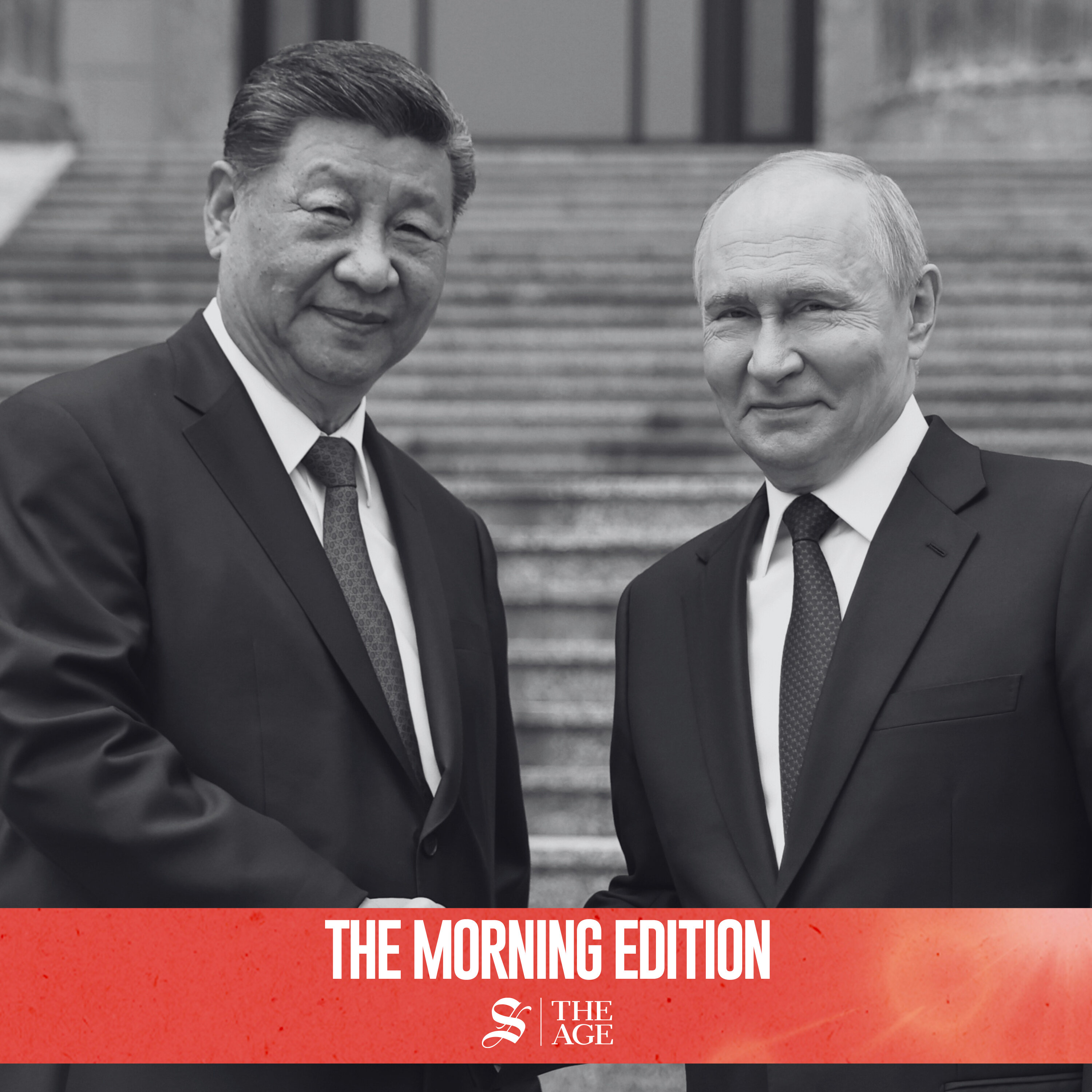
The Morning Edition
Now, it’s Putin’s turn. Will Xi Jinping encourage Russia to end the Ukraine war?
00:23:27
Loading summary
Transcript42 lines
- [00:00]
A
Foreign.
- [00:07]
B
Russian President Vladimir Putin has landed in China to meet with Xi Jinping only days after the Chinese leader hosted American President Donald Trump. But will Putin swoon like a teenager on a date in a nice restaurant when he's with Xi Jinping, as Trump reportedly did? Hello, I'm Samantha Sellinger Morris, and you're listening to the Morning Edition from the Age and the Sydney Morning Herald Today international and political editor Peter Harcher on the historic concessions that Trump has made to China and what Putin is hoping to get out of xi Jinping. It's May 21st. Welcome back, Peter.
- [00:52]
A
Pleasure to be with you, Samantha.
- [00:53]
B
Okay, Peter, I'm hoping you can walk us through the most consequential results of the summit that Donald Trump had with Xi Jinping last week. Some moments seemed even surprising to me, even for Trump. So I can't wait to hear what you think. So let's start with what Trump told a reporter on Air Force One after the summit when the American president was asked if he raised the issue of China's cybersecurity campaign against the US With Xi Jinping.
- [01:21]
A
Well, he said he did, but this is Trump, so it's in an unconventional way. He said that he had discussed it and that he said, you're talking about spying. He said, we spy on them like hell.
- [01:38]
C
The question was asked to me yesterday, I guess, what about the fact that China's spying in the United States? I said, well, it's one of those things because we spy like hell on them, too.
- [01:49]
A
He said that he'd said to Xi Jinping, we're doing stuff to you that you probably don't know about, and you're doing stuff to us that we probably do know about. He said, you know, we're all, he said to the reporters, you know, we're all, we're doing stuff to them. They're doing stuff to us. Now, as a statement of fact, it's hard to fault it because that's exactly what goes on and has been going on for decades. But as a political and national position for a US President, it's a remarkable thing to say because of the equivalence it grants the two countries, the two efforts. And it's like very early on, Trump was asked a question in his last term, asked a question about Vladimir Putin, about how he was going to treat Putin. And somebody said to him, Putin is a killer. And Trump's response was, well, do you think we're so pure? So once again, it's Trump putting the US Putting himself on the same footing as the dictator of Russia and the dictator of China and the two countries national purposes and efforts on the same footing. Complete equivalence. This is a break with all U.S. practice. Does it advance the U.S. national position to effectively be excusing aggressive moves by the Russians, the Chinese against the us? I don't think so. And, you know, Trump openly says, maybe they're doing nasty stuff to us and we're doing it to them. A few years ago, I asked Mike Rogers. Mike Rogers was the American admiral who headed the National Security Agency and was simultaneously head of the cyber war and cyber defense institutions. I said, is it true that the Chinese and the Russians are burying malware deep inside the controlling infrastructure for your critical systems? In the us, you know everything from transport, aerospace, transport, water supply, satellite controls. And do you know what he said to me? Mike Rogers said, we'll only know when they push the button.
- [04:11]
B
Wow.
- [04:12]
A
He said, we have no idea how. We said, we know they do it. We don't know how extensive it is or where it is. So this is how deeply they've been infiltrated to the point where they lost track.
- [04:23]
B
Wow.
- [04:23]
A
And they allowed their defences to be overcome in the cyber realm. And now Trump seems incapable of doing anything to defend or advance the American interest and simply makes excuses for it. And we even saw reporting from the summit that Donald Trump had with Xi Jinping. Apparently, Donald Trump said to Xi Jinping that he, the two of them should get together with Vladimir Putin to work against the International Criminal Court, that they all hate it and they should work against, to try and defeat it. Go to war against it was the expression I think he was reported to have used. So Vladimir Putin already has an arrest warrant issued against him by the International Criminal Court. The other two don't. But it tells you not only that Trump might be worried about his future, but that. And not that the US has ever recognised the jurisdiction of the International Criminal Court, but. But it also tells you that at some personal and political level, he identifies with these guys more than he does with Democratic leaders.
- [05:32]
B
Which brings us to the news today as we're recording on Wednesday, because, of course, President Vladimir Putin has landed in Beijing to meet with Xi Jinping. So do we know what they're planning on discussing and should we read anything into the timing of this visit? I understand that it's been long in the works, this meeting, but that it was only confirmed hours after Trump wrapped up his visit to Beijing. So tell us what to make of this.
- [05:54]
A
Well, he's looking for a big deal.
- [05:55]
B
Yeah.
- [05:56]
A
There's already a big gas pipeline that runs from Russia into China. It's been running for about six or seven years now. It's called the Power of Siberia 1. Putin is now pushing hard to get a second massive gas pipeline. The first one supplies around 10% of China's total natural gas needs. And another One, Power of Siberia 2, imaginatively named, would deliver about the same or a bit more gas from Russia. Putin is sweating on this deal. He needs this deal. Beijing has signed on to a memorandum of understanding. Let's go ahead. But has yet to commit because the Chinese haven't agreed to the price. So a trip by Putin to China in the first half of the year was on the books. That was going to happen at some point, but this date was only fixed recently. And it is no coincidence that Putin wants to talk to Xi Jinping shortly after the Trump visit, mainly to find out what's going on, what Xi Jinping might have learned, and specifically whether Xi Jinping had given any encouragement or succor or discouragement to Donald Trump. We know from the Financial Times reporting that Xi Jinping had said to Donald Trump it may be that Putin comes to regret his invasion of Ukraine. Now, that's a pretty powerful statement from a country. Beijing has said that Putin must not be allowed to lose the war against Ukraine, said that a few years ago. And now here's Xi Jinping saying he might come to regret it. This is hardly the staunch defence of an ally that Putin would expect. And I'm imagining that that reporting would have made him a bit anxious.
- [07:47]
B
So tell us a bit about that, because we know that Western countries have been urging Beijing to pressure Moscow into ending this war. And we also know that Moscow is heavily dependent on Beijing economically. China's the main buyer of sanctioned Russian oil. So do we anticipate. Again, I'm asking you to pull out your crystal ball here, Peter, which is horrible, but I'm going to press ahead. I mean, could Xi Jinping be pressuring Putin to end this war?
- [08:13]
A
It's. We don't know. Yeah, my crystal ball gets cloudy at that moment. But we do know that Vladimir Putin fears that. He probably doesn't have a lot to fear on that score, but in the video that he pre recorded and published while he was en route to Beijing, he did say he talked up the relationship at an unprecedented level. The usual guff, but there was a specific phrase where he said that this relationship is based on each of us supporting the core interests. Core interests of the other. Russia and China are actively expanding their
- [08:58]
B
contacts in politics, the economy and defence While broadening humanitarian exchanges and encouraging person to person interaction. It means that together we are doing
- [09:07]
A
everything that can further deepen bilateral collaboration and advance the comprehensive development of our countries. If you decode that, it has a very specific meaning for China. Core interest applies to Taiwan and the future of Taiwan and China's plans eventually to annex it, whether peacefully or forcibly. They've kept all the options open. And core business for Russia is the Ukraine war. So that's a statement of his expectation that he will offer support to China over Xi Jinping's plans for Taiwan, and he expects China to continue supporting and cooperating with him in the war against Ukraine. Because so far, China has been absolutely essential to that war, not only in the dual use technology, the electronics technology that they've been supplying, but the sheer volume of cash that China spends buying Russian oil, which is the single biggest factor allowing Russia to remain solvent as a nation state and to continue fighting the war.
- [10:12]
B
Okay, so tell us what's happening with Taiwan then, because we spoke about this last week when, you know, obviously it's a hugely contentious issue. So what happened when Trump and Xi Jinping discussed Taiwan and whether the United States would continue its decades long tradition of supplying arms to Taiwan to defend itself against any Chinese attack?
- [10:33]
A
Yes, going into that meeting, this was the single most neuralgic question, really, or the single most potent question about this relationship. And, well, surprise, surprise, Donald Trump crashed through the existing rules and protocols that had governed this. So since 1979, when the US Congress passed the Taiwan Relations act, the US has been committed by law to supply arms to Taiwan to defend itself against the mainland because of an overhang of guilt and responsibility towards Taiwan after switching diplomatic recognition from Taiwan to Beijing. And as part of that, Ronald Reagan in 1982 had issued what's known as the Six Assurances to Taiwan, one of which was to undertake that the US Would undertake not to consult with Beijing on arms sales to Taiwan. In other words, we're not going to consult the Chinese. We're not going to give them an opportunity to negotiate or get involved. Our responsibility to you is to arm you so you can defend yourselves. What Donald Trump did, a reporter asked him, did you talk about arms sales, US Arms sales to Taiwan? And Trump said, no, that didn't come up. And then a few seconds later, he said, we talked about it in great detail.
- [11:52]
C
No, I didn't say anything about it, but certainly he brought that up. He talked about that to me, obviously. So what am I going to do? Say I don't want to talk to you about it, because I have an agreement that was signed in 1982. Now, we discussed arms sales to. And what's his request? We discussed in Taiwan, you know, the whole thing with the arms sales was in great detail, actually.
- [12:16]
A
So we now know that he broke the 1982 Reagan rule that has applied to every other president since. There's a $14 billion US arms package that his White House put together that is pending for White House approval now. And Trump has said, I'm not sure what I'm going to do about that. I might approve it, maybe I won't. But Xi Jinping is very concerned about it. After the break, the trade deal that Trump ended up doing with Xi Jinping was by traditional standards and by Chinese US Standards, trivial. But in return for that, he was prepared to go soft on all the other issues, including Taiwan.
- [12:59]
B
You spoke with Kurt Campbell, who was in the Biden administration, and he had some words to say about the fact that Trump has broken this long standing tradition that, you know, previous American presidents stood by, which was, of course, this arming of Taiwan. So what did he have to say and why does it matter? I guess because, you know, this many years into Trump leading the country, he, you know, the one through line, I guess that could be said he has, is that he breaks tradition. So why does this one matter so much and is it consequential?
- [13:30]
A
Well, in that it shifts the balance between of security and degrades Taiwan's security. And Xi Jinping will read into that the same thing that everybody else is reading into that, a preparedness to sell out Taiwan's interests to curry favor with Beijing. Trump was in Beijing looking for a trade deal and he was making clear that he was prepared to trade Taiwan's interests. Now later in a separate interview, he said, oh, no, the policy hasn't changed, but the fact is he changed it by having that conversation. Kurt Campbell, Kurt was the Deputy Secretary of State under Joe Biden, but he's been a senior official, one of the most experienced Asia officials in the entire UK US in the Pentagon, the White House, State Department for senior positions for over 30 years. He was the man who, the architect of the U.S. pivot to Asia. He said to me that it was a clear breach by Trump of that protocol. And he said, I detect a distinct waft of Russia, Ukraine in this, China, Taiwan, weighting that Trump's applying. In other words, he's seeing the same thing, the same pattern play out where Trump gives precedence to Russia, a dictatorial traditional enemy of the US Over Ukraine, a smaller democratic state. And that's played out now, as Kurt Campbell is observing, in the way Trump gives priority to the dictatorial, traditional enemy of the US over the smaller democratic nation.
- [15:15]
B
Okay, so he's breaking rules and traditions there that might of course, impact global security and the balance of power. I wanted to ask whether he might be doing the same thing on the trade front. I'm just wondering whether Trump signaled during his summit with Xi that the US Perhaps is past competing with China and instead it's sort of like in a let's cooperate acquiescing sort of mood, because we know that China's foreign minister spoke during the summit about the U.S. and China, quote, respecting each other's core interests and major concerns. That would seem to suggest he's saying, hey, America, you better put an end to your competitive measures against us. So I'm just wondering if Trump said anything that would suggest that, yeah, he's planning on doing just that.
- [16:00]
A
Well, he went to see Xi Jinping in a weakened condition because he's caught up in this war in Iran, which he doesn't seem to be able to win or to withdraw from. So he's stuck there. In fact, there's a close parallel between these two leaders who've both come to bend the knee to Xi Jinping in Beijing in this last week. Donald Trump, on the one hand, caught up in this quagmire in Iran and Vladimir Putin caught up in his own quagmire in Ukraine. In both cases, they don't seem to be able to win, but they don't seem to be able to withdraw either, which just highlights the strength of Beijing's position. And in fact, the Beijing party owned media have been talking this up. They've been talking up China's new centrality at the center of global diplomacy. And it's true, both Putin and Trump went as supplicants to see Xi Jinping. They both want support and they both above all want trade deals they need, or think they need, in Trump's case, think they need the cash. The trade deal that Trump ended up doing with Xi Jinping was by traditional standards and by Chinese US Standards, trivial. But in return for that, he was prepared to go soft on all the other issues, including Taiwan. Is this an end to strategic competition between the US And China? No, because other elements of the US and the Trump administration are still imposing tough measures on China.
- [17:35]
B
Like what?
- [17:35]
A
Tariffs or so sanctions on, for example, a Chinese company provided targeting information access to one of their satellites to Iran to help them bomb US Planes and assets. In the Middle east during this war. So the Treasury Department has now applied sanctions to the Chinese company and Chinese companies who were involved in that effort. So that sort of stuff still occurs. But at the top level, Trump has stopped the competition. You'll remember last year, he applied massive tariffs, 145% plus to China. China simply stepped up and said. And punched him back and said, well, say goodbye to your supply of rare earths and critical minerals. Yes, Trump dropped his attempt at tariffs within two days. And they've now entered this sort of stasis or truce, really, where neither is taking new trade measures against the other. So at the top level, so far as Trump's concerned, he does seem to be in some ways abandoning strategic competition with China. Yes. And the other thing that he has done with his treatment of Taiwan, and Kurt Campbell made this point, too. By demoting or degrading apparently, US Commitment to the defense of Taiwan, he has made all US Allies in the region anxious, including Australia, including Japan, South Korea, the Philippines, because if he's prepared to trade off Taiwan, and I should point out the Taiwanese president issued a statement immediately saying, we refuse to be traded or bargained off. But if he's prepared to trade the security of Taiwan for other equities with the Chinese, then all allies in the region think two things. One, if he's prepared to do it with them, he might do it with us. And second, in the event that China, one way or another, does establish effective control over Taiwan, it allows that then allows the People's Liberation Army Navy to push further and beyond into the Western Pacific and simply making it much more difficult for the US Navy to operate in the Western Pacific. That would be an historic loss of space control and hegemony for the US
- [19:57]
B
and it's got to be noted that Xi is scheduled to visit the US on September 24, and that Donald Trump and Xi Jinping may meet again at conferences scheduled for November and December.
- [20:07]
A
That's an interesting point. Nobody in this line of work in the US That I talked to can remember the last time a Chinese president committed specifically to a particular visit on a date known well in advance like this. Normally, it's reserved as a bit of a negotiating.
- [20:26]
B
So what does that suggest?
- [20:27]
A
Well, Kurt Campbell's summary to me was this shows a level of confidence that Beijing has got Trump under control that we've never seen before. Xi Jinping's thinking, I've got absolutely nothing to lose dealing with Donald Trump. Yes. Because I know how to deal with this guy.
- [20:45]
B
Well, I might wrap up Peter by just getting you to comment on something I read. Like, is there bromance at a high? Much to the detriment, I would imagine, for Americans because I read one journalist put it like this. In China, Xi took him, meaning Trump, on a tour of a private garden. And like a sweet, swooning teenager on a date in a nice restaurant, Trump asked whether the Chinese leader ever took other foreign guests to the same place.
- [21:09]
A
I was just like, oh, no, it's pretty embarrassing. In fact, Trump was lavishing flattery upon Xi Jinping and Xi Jinping stood back. I mean, he said it was a historic visit and it was an important moment and all of that stuff. But he did not lavish put personal praise on Donald Trump, not one bit. Trump was all over him.
- [21:30]
B
It's like an Archie comic. But geopolitical power and economic security.
- [21:35]
A
If I'm an American and I'm not, hasten to add, yes, I would feel embarrassed to see my president behaving like that with the dictator of China. Absolutely.
- [21:48]
B
So you and I should be on the lookout for swooning. Coming over global videotapes, September, November and December.
- [21:55]
A
Cover your eyes.
- [21:55]
B
Okay? Thanks, Peter, as always.
- [21:58]
A
Pleasure, Samantha.
- [22:09]
B
In other news today, Australia's health practitioner watchdog is investigating four dentists at one of the country's largest cosmetic dental chains following allegations that they use predatory practices to encourage patients to access their superannuation early to fund veneers. According to the executors of Graham Richardson's estate, the former Labour senator, lobbyist and master of stealth enrichment died penniless. And the enhanced games will kick off in Las Vegas on Monday, Australian time and feature Olympic medalist using performance enhancing drugs under medical supervision. We have everything you need to know about this competition that's been likened to a steroid fueled circus. You can read more@the age.com or smh.comau Today's episode was produced by Chi Wong. Our executive producer is Tammy Mills. And our podcasts are overseen by Lisa Muxworthy and Tom Tom McKendrick. If you like our show, follow the Morning Edition and leave a review for us on Apple or Spotify. Thanks for listening.