← The Morning Edition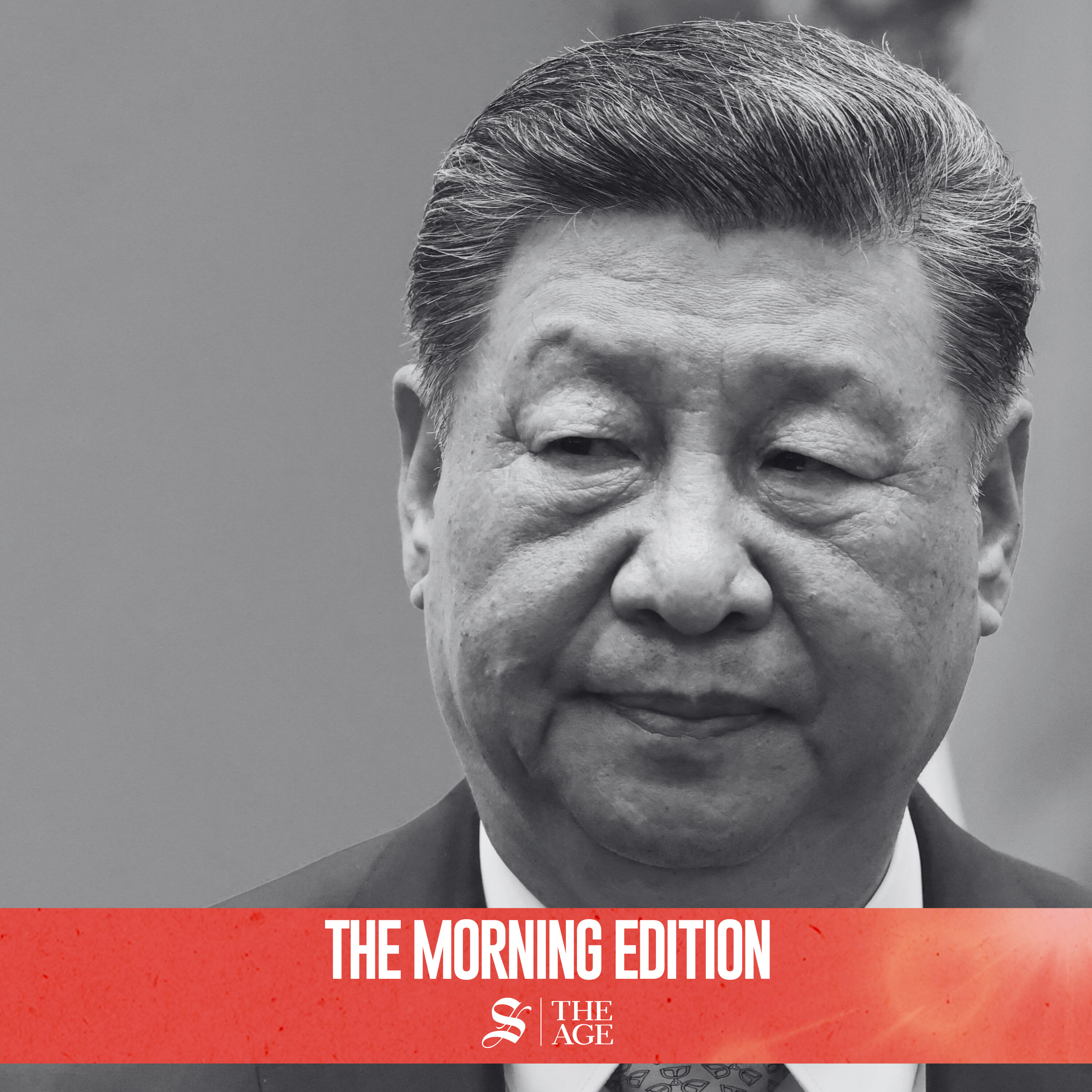
The Morning Edition
Taiwan, trade and the balance of power: What’s at stake when Trump meets Xi Jinping
00:24:13
Loading summary
Transcript43 lines
- [00:07]
A
When Donald Trump meets with Xi Jinping this week, it will be a geopolitical heavyweight matchup with enormous stakes, according to Joe Biden's former deputy secretary of state, because on the table is everything from global trade to security. And this at a time when the American president is arguably at his weakest and the Chinese leader at his most paranoid. I'm Samantha Salinger Morris and you're listening to the MORNING EDITION from the Age and the Sydney Morning Herald Today international and political editor Peter Harcher on whether Trump may inadvertently lead the United States into unilateral concessions and unintentional appeasement and what this might mean for the rest of us. It's May 14th. Peter, welcome back to the podcast.
- [00:56]
B
Pleasure to be here, Samantha.
- [00:57]
A
Okay, so it's very timely what you've just written about because Donald Trump is landing in China when this episode goes to air on Thursday morning. Now we're recording this on Wednesday, so it's before the meetings have taken place. But do we know what's on the agenda when Trump meets with Xi Jinping? We know it's Trump's first visit to China in nine years. So kind of a big deal, right?
- [01:17]
B
Yes, it is. It's a big deal beyond the transactions that are going to be on the table themselves because this is a top level meeting between the long reigning global hegemon and the new already regional hegemon with aspirations to displace the US as the global hegemon. And Xi Jinping has a favorite phrase that he's used in recent years. We are seeing changes unseen in a hundred years. And as he said to Vladimir Putin, you and I are the ones driving that change. He sees this very much as to use another one of Xi Jinping's favorites, the east is rising and the west is declining. And he hopes to accelerate that trend at this meeting. That is the big picture in Xi Jinping's mind. Donald Trump has a more transactional approach, as we well know, also more unpredictable, less consistent and more episodic. He's talking about big trade deal. A lot of people have speculated that he will be asking China for help with the Iran war because Iran is a long standing friend and close, close partner of China. Trump. Trump has said in the last hours that America doesn't need any help because the war is going so splendidly for him in Iran. So will so he won't be consulting Xi Jinping apparently on that. But he has said he's looking for a big trade deal. He's going to be trying to Get Xi Jinping to agree to buy a bunch more US Products and agree to cut back on the supply, the flow of fentanyl, the opioid essential to the US because of the horrible health consequences it has on US Citizens. But we've been here before, Samantha. There's a lot of media excitement about this trip and the prospects for a big trade deal, and Trump talks that up himself. We in the media are often accused of having short memories. And, you know, I'm pleading guilty, guilty as charged here. But in this case, I, I did take the opportunity to check the record. And in Trump's first term, when Xi Jinping, same two men, agreed to a big trade deal, hundreds of billions of dollars of Chinese commitments to buy US Products Xi Jinping didn't deliver. According to the Peterson Institute of International Economics, which is a credible Washington think tank, the Chinese government ended up buying 30, 51% of what they had promised to buy. 51. The fentanyl side of things. Xi Jinping has been promising US Presidents, including Obama, Biden, for years, that China would stop the flow, curb the flow. It changes the flow. It masks the flow. It has never stopped the flow. So what we are seeing here is Donald Trump going in to do the same thing he's done before in which he failed to get the concessions he sought, but hoping to succeed now where he failed before. That's either eternal optimism or the definition of insanity.
- [04:38]
A
Okay, good point. But it's not just trade though, right? Because we've also got potentially the balance of regional power in Asia sort of happening here or at stake, I guess. So walk us through that.
- [04:49]
B
Yes, there's a lot at stake. There's the relative competition of the two countries, their economic position, their technological dominance, in which China has been and continues to overtake the US in cutting edge areas. And then there is the security dimension. The really touchy point here for especially for Beijing, is Taiwan. And while Trump says that Xi Jinping will try to talk him out of selling US Arms to Taiwan, which Taiwan obviously uses to defend itself, and try to fend off any Chinese military action, Trump hasn't given any sign about how he will respond to Xi Jinping's pressure on Taiwan. But it is the jewel in the crown for Xi Jinping. And he will attempt to either get concessions somehow in U.S. policy on the treatment and protection of Taiwan, or he will try to gauge Donald Trump's ability, willingness to resist any plans he may have for wresting control of Taiwan. A lot of talk about a military invasion. I think my view is that's much less likely. It's the dumber way to do it. Xi Jinping has much more success, proven success, in his strategic affairs with a careful incrementalism that falls just short of kinetic violence. His forces, his military has been rehearsing a trade embargo, a transport and all sorts of freight, air movement embargo around Taiwan in the last year or two. That sort of blockade is much more likely the sort of tactic he would use if he resorts to forceful means to try to subdue Taiwan. So he'll be looking at Donald Trump and thinking, are you going to try to interfere? Are you a US President who will try to stop me, or will you, like your predecessors, let me just continue to push you out of the region the way I've been doing since I took this job in 2012 as President of China.
- [07:01]
A
Now, we know that Donald Trump is very erratic, so I don't know how much weight we should put to what he says or doesn't say. But he was almost aggressively non committal. Right. About Taiwan. I think in the lead up to this, I think Donald Trump said something along the lines of, yeah, Xi doesn't want us selling arms to Taiwan. And I don't know, we're going to talk about it as though he was talking about, you know, what he was planning for lunch or something.
- [07:22]
B
I like aggressively non committal. Yeah, that's good.
- [07:25]
A
That's what it sounded like to me, because I know that some people do worry that Trump's unpredictable China policy may inadvertently lead the US into unilateral concessions and unintentional appeasement. So I guess how much of a concern is there with this particular meeting? Because you've written that the Xi Jinping that Donald Trump is going to encounter is increasingly paranoid. So I don't know, might that dynamic lead possibly Trump in one direction or the other in terms of his willingness to stand up to Xi when it comes to the defense of Taiwan?
- [07:56]
B
Well, predicting Donald Trump, of course, is a mugs game.
- [08:00]
A
It's a horrible thing to do to youth departure, I know.
- [08:02]
B
Yeah, absolutely. So we just don't know. But another line of his on Taiwan in the last day or so, and he's used this line before, he said, Taiwan is 67 miles from China and 9,000 miles from the US yeah. Implicit in that is it's their sphere of influence, it's their near territory, and I'm gonna let them have it. And why should we bother? We are so distant. When he first used that phrase, his former vice president Mike Pence said, what is distance to a global superpower? Is the US a global superpower or not? That is a nice way of framing exactly how Xi Jinping will be looking at it. There's been a lot of talk and theorizing and hypothesizing in US Strategic circles in recent months and years about whatever the Trump Doctrine is. Does he have a Monroe Doctrine or Don Row, they're calling it, to carve the world into spheres of influence. And if so, the US Is going to be satisfied with the Western Hemisphere in the Middle east and leave the Indo Pacific to China or whatever. If he is even remotely moving in that direction. That is music to Xi Jinping's ears. That is precisely. The long term goal of the Chinese Communist Party is to force the US out first of the Western Pacific and then beyond. And taking control of Taiwan is a critical step in achieving that. In terms of the paranoia in the Chinese leadership, it's a really, really interesting phenomenon. So in absolute terms, the Iran war has weakened both countries. It's weakened the US And Trump's position because of what it's done to fuel prices. And his popularity and inflation have all suffered because of this pointless war that he's found himself in.
- [09:52]
A
And presumably minimizing military stocks and so
- [09:54]
B
forth as well, really running down not only their literal ammunition stocks, but also their credibility in the world and demonstrating further weakening of US alliance structures, NATO in particular, which is the singular. The single most important source of power the US has had in the world over other countries is that alliance system. No other country has anything like it. Trump's busy damaging it. But China also has been damaged by the Iran war. Iran is one of its affiliates. Iran is weakened. It's also punishing stocks of supply of fuel, fertiliser and other supplies to China. So everybody's suffering. The relative standing of the two leaders, that's the absolute standing. The relative standing is that Trump is much weaker. To quote the German Chancellor Friedrich Mertz, Trump is being humiliated by Iran, and we see that every day. And Xi Jinping is stronger. Xi Jinping is now 13, 14, depending on which job you want to use, whether it's secretary of the party or president. He's 13, 14 years into his job. He's stronger than ever. He's more dominant than ever in China. He's had the Constitution amended so that he can serve beyond two terms. This is his third five year term. He'll very likely still be in the job when Donald Trump, his term runs out. He has purged the political System, the military, the commercial sector, he's purged the security services, he's purged everything and everybody to cement. The problem is if you're a dictator and you're constantly concerned not only about the state of your, the legitimacy of your claimed power, but if you've got there through scheming, these are constant sources of worry and concern. And he's become increasingly paranoid. The more powerful he gets, uneasy lies the head that wears the crown. And Xi Jinping demonstrates that. And just two very brief anecdotes from the last two weeks. Just the last two weeks, yeah.
- [12:02]
A
One of them you said was quite unusual even for Xi Jinping, who obviously is.
- [12:06]
B
Yeah, well, one of them, I suppose they're both unusual. One was more unusual than the other.
- [12:10]
A
Yep.
- [12:11]
B
So he's purged the military. So although he puts a huge premium on control, control of everything within that, he uses instability as a tool of control and he's used that in, in the military. He purged the military, appointed all his own people, but then having all his own people there, he's purged it again. And last, just last week, two former defence ministers that he had appointed, both generals were sentenced to death in Chinese courts for bribery and as a two year reprieve on the death sentence, they may or may not end up being killed, they may get jail for life, but this is a, these are his own men. After the break, the bigger and more powerful his military becomes, the more paranoid he is and that even his own appointees to those jobs have to be purged.
- [13:14]
A
And so the purpose of this is what, just to put everyone on, you know, in the crouch position, so to speak?
- [13:18]
B
Yes, I think, I think that's exactly right. The pretext is always corruption, but it's a pretext you have to be corrupt and be scheming or somehow seem to be disloyal to be purged. The Central Military Commission of China, which is the paramount body of power, chaired by the President himself, until recently it had eight members, including Xi Jinping. Well, Xi Jinping purged six of them and there's just him and one general left on that committee now. And the general isn't even a real military general, he's a political commissar. He's there to keep an eye on the military. It's a pretty lonely sort of meeting to go from eight people to two and none of them are actually military commanders. So that's really interesting that, you know, the more, the bigger and more powerful his military becomes, the more paranoid he is and that even his Own appointees to those jobs have to be purged, getting the job and sentenced to death. Some of them. This is pretty strange stuff, but.
- [14:19]
A
And then he did something, I guess, strange you'd call it, to sort of an alert to the young people in China.
- [14:25]
B
Yes, yes. This is.
- [14:25]
A
What's he doing with them?
- [14:27]
B
This is not just unusual, this is really quite bizarre to our way of thinking. I suppose he has the secret police issuing a public statement and a video with a little AI generated guy in a police uniform giving life advice to the Chinese youth about what, three weeks ago, I suppose it was the Ministry of State Security, which is the premier intelligence and control and spying agency in China, put out this announcement directed to the youth of China to tell them that you have to stay sharp, remain ambitious, work hard and remember your goals and make China great. And to warn them against a phenomenon known as lying flat. Lying flat? Tangping they call it, which is essentially giving up or opting out of the mainstream economy, labour market. So these are young people who've mostly come out of university, have a great deal of difficulty finding a job. With unemployment rate high, the economy's in a bit of a slump. They're finding even if they can get a job, there's this so called996culture where you're supposed to work from 9am to 9pm Six days a week. They're not feeling that they're getting ahead. It's impossible to have the lives that their parents had. Does this sound familiar? It's got its echo echoes in the west, in Australia. Yeah. Which is being worked out right now in our federal budget and political processes. So this is kind of familiar, but they call it lying flat. What's the point of trying? We're gonna give up and lie flat.
- [15:57]
A
And so it's actually a bit of a rebellious stance, isn't it, for the young people there? Yeah, yeah.
- [16:02]
B
It's kind of through history, it's kind of common, it's nothing unusual, but this has been running now for about five years. But it's a post Covid phenomenon. Xi Jinping warned against it in 2021. He said, no more lying flat. Get out, work hard. I know things are difficult. Endure hardship. And he used the specific phrase eat bitterness. His advice to the youth was eat bitterness. Well, they didn't really.
- [16:25]
A
I would love to hear that.
- [16:27]
B
Globally they lapped it up, which is why five years later, they've now got the Ministry of State Security coming out and sending out this dictat. Don't surrender to this Tang Ping thing. Because lying flat is being promoted. You might just think it's a social phenomenon. It's actually the sinister hand of hostile foreign intelligence forces.
- [16:46]
A
That's right. This is the CIA. This is the foreign spies who are getting you to do this.
- [16:51]
B
Yes, exactly.
- [16:52]
A
So tell us about this. Why is this so strange? Because lay people will be listening to this and they'll be going, well, Secret service in China, they meddle in all kinds of ways. And I believe people in China still have to read the manifesto of Xi Jinping, of Xi Jinping Daily. So for those who are thinking going, well, isn't this just par for the course? How is this not just par for the course, Peter?
- [17:12]
B
Well, the.
- [17:13]
A
And why does it matter?
- [17:14]
B
Well, the Ministry of State Security hasn't done this sort of life advice thing before. Is it going to work? Well, if it does, it'll only work because, I mean, one of the reasons I think it's so pernicious is that there's an implicit threat in that if you're a young Chinese person and you decide life is too difficult, I'm going to move home, stay with the folks a few years longer, just give up for a while. They've now put you in the frame as being a tool of a hostile foreign force. You're now supposed to be a suspect. I think this is a really unfortunate sort of framing. And is it going to be productive? I think unlikely to actually be productive. And a Sinologist, an Australian Sinologist, Jeremy Barmay, said he thinks it is, quote, incredibly insulting to say to Demean to be so paternalistic and condescending to say to China's younger generations, in Bamei's words, he's sort of voicing the implicit logic here from the Chinese Communist Party. We've raised and educated the smartest generation in Chinese history. And now you guys, you're too stupid to figure out what lying flat is and whether you're being manipulated by a hostile foreign force. Just very insulting.
- [18:31]
A
It is. Okay, okay. But just to push back a little bit. So for those of us non Sinologists who hear this and go, okay, well, we vaguely hear of, you know, Chinese Communist Party and other factors, you know, trying to control its citizens. How is this any different? And why does it matter? You know, like, I mean, obviously it sounds horrible, but why does it matter on a global stage? Why does it matter in the context of this particular meeting between Xi Jinping and Donald Trump and how the tenor of what's happening in China might impact, I guess, on global affairs?
- [19:01]
B
I think it's striking because it is an outward sign of an inward paranoia. The system is so fragile and so insecure in itself that it sees this as a threat. Young people who can't get work and opt out or whatever it is, is some sort of threat to the political structure and the tenure of the Chinese Communist Party. That's the importance of this.
- [19:28]
A
It sounds like this could be a very, a tipping point moment. Like if you've got an increasingly paranoid Xi Jinping, who obviously is dead set on increasing his power in his hemisphere, and then you've got Donald Trump, who he's suffering in this war, in this overseas adventurism. He had a platform of not interfering in foreign powers and such, so he might be in an appeasement mode. Could this be a typical tipping point where he does say something as explosive as, yeah, we might really strongly consider stopping selling arms to Taiwan and, you know, we're just, we're just pulling back
- [20:03]
B
here, like it's entirely possible, as we've learned with Donald Trump. Yeah, anything, absolutely anything is possible.
- [20:12]
A
Yeah. And I guess just to wrap up, Peter, we know that Kurt Gamble, he served as Deputy Secretary of State and Indo Pacific Coordinator during the Biden administration. He has said this summit could change the course of US China competition. Now, you've mentioned some of the factors involved in that, but do you think, I mean, is that over egging it? Is that really possible? And if it does really change the course of US China competition, is that something that's likely to affect us here in Australia?
- [20:40]
B
Well, Donald Trump has already done a lot of things to change the competition between those two powers, and we've talked about a few already. But just look at the technology question. The Biden administration had put restrictions on exporting the most high quality silicon chips, semiconductors, to China, the ones which the US Companies are using to try to establish global advantage in artificial intelligence. Well, Trump lifted those bans and said, go ahead, you can sell them. Ceding American technological advantage in one of the few areas where it still had an edge. So he's already conceded so much power to Xi Jinping, who knows what he will give, what he will take. But could it affect the balance? Absolutely. Even a slight hint from Donald Trump that he would be indifferent to China, making some sort of move on Taiwan would change the balance of power, not just between the two of them, but in the world, because it would encourage Xi Jinping and hasten perhaps plans that he has. He has said that this is an inevitable task and a generational one. The so called reunification, the annexing of Taiwan has to be accomplished by his generation. So that's a pretty clear cut intent. Now, if Trump gives him any hint that he will be indifferent to whatever Xi Jinping has in mind, then that will change the balance of power. It will affect the position of the US in the region. It will threaten the security of Japan, of Korea, South Korea. It will threaten the position of the Philippines, the Vietnamese, everybody right down from the South China Sea all the way down to the Straits of Malacca and beyond into the Indian Ocean into will directly affect Australian power and ability to navigate in the world. Literally to navigate where our submarines and our commercial vessels may or may not be allowed to go, and where the scope of US Military power may be redefined. These are the stakes. That's why it's important we await to see the outcome of this summit.
- [22:58]
A
Very interesting. Well, thanks, Peter, as always.
- [23:01]
B
Always a pleasure, Samantha.
- [23:07]
A
Today's episode was produced by Chi Wong with technical assistance by Debbie Harrington. Our executive producer is Tammy Mills, and our podcasts are overseen by Lisa Muxworthy and Tom McKendrick. If you like our show, follow the Morning Edition and leave a review for us on Apple or Spotify. Thanks for listening.