← The Morning Edition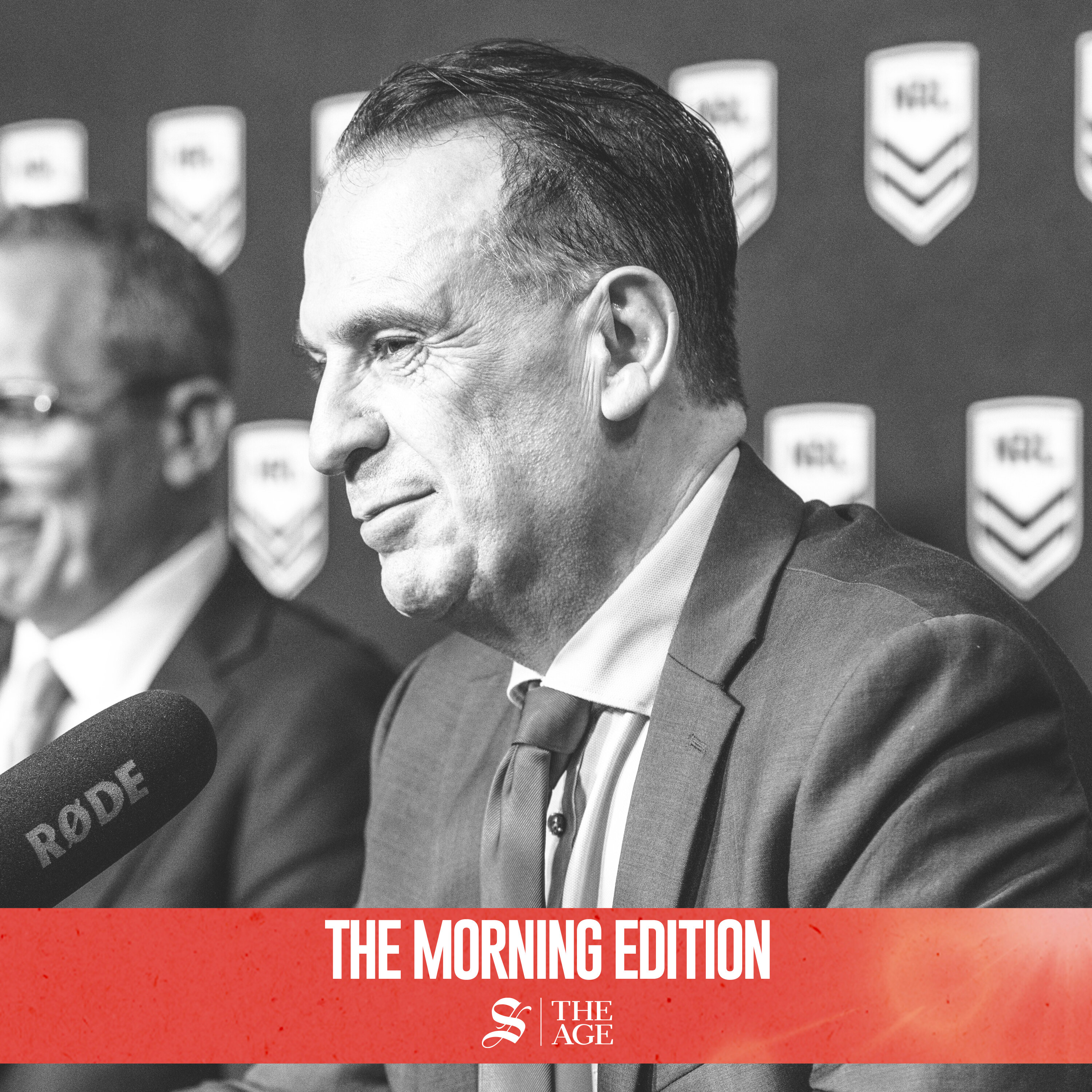
Loading summary
Transcript31 lines
- [00:01]
A
Who says renting can't feel like home? Make your rental feel like yours. It all starts with one scroll. Download TikTok to discover easy home decor ideas. State of origin is rugby league's night of knights as Queensland and New South Wales battle it out for supremacy. But as the teams take to the field tonight, there's a battle of a very different kind playing out in the epicentre of power in the nrl.
- [00:38]
B
Breaking news in the rugby league world this morning with reports NRL CEO Andrew Abdo has stepped down from.
- [00:44]
A
Executive Andrew Abdo announced today that he's quitting to join Tennis Australia.
- [00:49]
B
I'd like to thank the fans and the rugby league community for taking me in, making my family and I feel truly Australian. The players are amazing athletes, the clubs.
- [01:00]
A
I'm Bevan Shields filling in for Samantha Sellinger Morris and you're listening to the morning edition from the Age and Sydney Morning Herald. Today, national head of sport Neil Breen on the politics of the NRL and whether too much power may land in the hands of one man. It's Wednesday, May 27th. Brieni, thanks for joining me today.
- [01:25]
B
Thanks for having me, Bevan.
- [01:27]
A
Tonight, the state of origin series kicks off, but it's really what's happening off field that has all of us talking. So maybe start by telling us what has happened this week. What news dropped on Monday about the league's CEO Andrew Abdo?
- [01:43]
B
Yeah. So Andrew Abdo has been the chief executive officer of the NRL for six years. He was appointed during COVID and obviously rugby league led the way in global sport in showing sports to get back on the field while we had all of these strange things going on in all of our societies with regards to Covid and protocols. And so he's done a great job as CEO, but really in that time as CEO, he has been number two in the code to Peter Verlandis and Peter Verlandes, who's the chairman of the ARL Commission and he's also the boss of Racing. He's the CEO of Racing in New South Wales, which is his day job, has been this great visionary who's come along in sport. He's become this master sports administrator who has ideas and is somehow able to execute them. But behind the ideas are unbelievable lieutenants. And that's really what Andrew Abdo as CEO was. He was the lieutenant who made things happen. The season launches in Las Vegas, all of these expansions, all of these ideas that Peter had that Abdo was this like, he's an accountant by trade. He's a meticulous guy, and he got the job done. Now, a guy like that is highly sought after because of the success of rugby league. Revenue's through the roof. Viewers are through the roof on television. Everything about the game, all the metrics are amazing. And so he threw his hat into the ring to be the boss of Tennis Australia. We know that Craig Tyler's run Tennis Australia and the Australian Open at the same time with an iron fist, but he's been headhunted by USTA Tennis in America. So he's running Tennis in America. Left the door open and Andrew Abdo secured that job. It's a big job for him, it's a great job for him. But it leaves the rugby league in a really interesting place.
- [03:29]
A
So there's now an opening at the top of the NRL with Abdo's exit, is there? But then. Well, that's the question. There's a lot of speculation about what might happen. There's a very big name circling around who might take that job. And that name is Peter Verlandis. Now, he's stepped in as the interim CEO for the time being, but everyone's wondering whether he'll eventually become executive chairman. So he will retain his role as chairman. He'll also effectively become the CEO and merge both roles. Now, at a press conference on Monday, one journalist said to Peter Valandi's well, there's a feeling in the game that the NRL's gonna conduct this big worldwide search and surprise, surprise, it's gonna land on you. Now, before we get to what might happen there, just again, take us back and describe to listeners who are maybe not NRL fans who Verlandis is and why he is such a huge figure in the Australian sporting context.
- [04:33]
B
So Peter Verlandes is a Greek migrant to Australia. He spent his childhood in Wollongong. Sport was the thing that he felt gave him inclusion into society. And he found by playing rugby league at his local school and his local club, he became a member of Australian society. So that's something that has fuelled him in his life.
- [04:57]
A
And he's sort of the boy, the boy from the gong done good, right? He's got the Prime Minister on speed dial, the Premier on speed dial, everybody.
- [05:03]
B
He's got the whole nation on spe speed dial. He's the. He's one of the most influential people in the country. Don't worry about in sport. He's one of the, like, if you did a power list of New South Wales, I think he, like, he rivals Mins. The premier.
- [05:18]
A
Yeah, he.
- [05:19]
B
He's right up there. But what happened was he, he got involved in racing administration and his first big job, sort of, I don't even know if he was 30. It was around the age of 30, he took over the running of the trots at Harold Park. And his first big thing that he did, he was running the trots. He had all these crazy ideas with trots and all old stodgy trot people, but he was this guy, but he suddenly getting crowds and everything. And he was able to do that and parlay that job and the success he had in that job into becoming the CEO of Racing New South Wales, which was 21 years ago. And he went into racing New South Wales and, you know, like racing's run along for years and years. You got Ramwick and Rose Hill and Canterbury and Warwick Farm and you got all the country tracks and they just go week to week, year to year and do their business, have all their races. He was never content to do that. He had ideas he was all about, you know, how to make more people, young people, go to the races. But the big thing that he did and the thing that made him was that forever in a day in Australia, there were bookmakers who were on course. Then you were able to bet with them by phone. And there was the tab. And you could go into the tab in your suburb and place your bet. But the digital economy came along hot off the heels of other bookmakers being licensed to take phone bets. And so what happened was the tab, which would take $0.15 to $0.21 in the dollar, depending on what bet you had, and distribute to the racing industry, the tab lost the market. It still had a fair chunk of it to Sports Bet Centre Bet out of Darwin, all these other places, okay? Then the digital thing happened. People are betting on their phones at the same time that was happening. Those betting companies weren't paying a license fee to racing. The tab had to to fuel racing. But the other companies weren't. And Peter Velandes went to court and argued that those race fields that they put on their websites for you to place a bet on were the intellectual property of racing. And you have to pay to use our ip. Everyone said he'd lose. He didn't. He won big. That was the thing that made him millions, billions of dollars. After the break, people in racing started to think, well, hang on, he's got now too much power. Then the jealousies kind of started. At the same time, he got into war with Victoria.
- [07:52]
A
Now you would think that all of that success, all of the riches he's brought to racing the way he's revived racing in New South Wales to make it a genuine competitor to a traditionally dominant state like Victoria. You would think he'd have a legion of fans in the racing community, but he did. He doesn't, does he? He's very polarizing.
- [08:13]
B
Why? He did for a long time. He did for a long time up to including and after the running of the first Everest in, What was it, 2017, which was the race that he came up with to put on in the springtime to beat Victoria's dominance of owning spring racing. He made racing and people in racing untold riches. The breeders in particular, through the sale of racehorses. But people in racing, over time, he's very, very dictatorial. He's very his way or the highway. And people in racing started to think, well, hang on, he's got now too much power. Then the jealousies kind of started. At the same time, he got into war with Victoria and so the Victorians thought he was an upstart until he wasn't an upstart until he was. The real deal wins the court case, comes up with the Everest, knocks around the Victorian establishment of the running of racing, and next thing you know, he was at loggerheads and everyone was brawling. And this is the perfect time for him to get out. 21 years is a long time.
- [09:26]
A
So his position at Racing New South Wales as CEO is on shaky ground at the moment. He's been involved in dust ups. He's been. There may be a time here for him to be able to jump, to be able to go. He could go to the nrl. Is that possible, though, at the nrl? Could he be executive chairman? That is a very unusual setup. Lots of other codes. Even businesses of that size, they have a CEO who runs the business, makes it go. You have a chair who runs the board, set strategy. Rarely do you have these two things in one. So is that possible and what would need to happen for him to be able to do that at the nrl?
- [10:05]
B
Overall, in most circumstances, corporate governance is not a great model. We know that. And the evidence is the world over that you have a board, board sets direction, and the CEOs and the executive management, you know, do the plans and all that sort of stuff and report back to the board. Now, Peter Verlandis, the difficulty for Velandes is he gets, you know, a little over $200,000 a year to be the chair of the NRL, but he earns well in excess of a million dollars as the CEO of Racing New South Wales. He can give that up any day he wants. But how's he going to earn a million dollars for all of his talents? And when you start earning a million dollars and you're living at Hunter's Hill like you get used to the money. So you know he wants to keep a job of that size and he
- [10:50]
A
should have it, but the only place he can really find it is the NRL. Andrew Abdo I believe was paid about 1.5 million a year as a base salary. So off he goes over there. His salary may well stay flat.
- [11:03]
B
It'll be, it'd stay flat and he'd be fine. But to do it, to become the executive chair would require a constitutional change. So the NRL was established after the Super League war ended and the old ARL and News Corporation got back together and they came up with a new set of rules and everything about how the game will run and they established the nrl and quite rightly at the time and on purpose, by design, to the credit of both sides, they made the rules pretty strict. So they have to be able to change the rules for him to do both jobs. Now I can tell you for a fact, there'll be toing and froing just as the same as they'll be in Racing. There'll be lobbying going on over the new CEO. There'll be lobbying and people wanting this. The game's so awash with money. The end of the day, if the States aren't happy, they'll just get more money. I'm just telling you this will happen. If he wants to do that job, he'll do it. And I'm telling you that I believe that on July 15, when the handover happens from Andrew Abdo, when he leaves the NRL and Peter takes over as executive chairman and begins his four months long service leave at Racing, he won't go back to Racing after that.
- [12:10]
A
I think that's right. I mean it speaks to what you discussed earlier, which is the network and relationships and loyalty that he has built not just in public life but within the league will carry the day, we'll
- [12:25]
B
carry the day in rugby league. So whereas in racing the walls have closed in on him a little bit. It hasn't in rugby league. Like you've seen it, Bevan, you've been at rugby league games and Peter Valandis is walking to the ground down the street. People get selfies with him, they mob him.
- [12:41]
A
I've been to Vegas with him twice and seen him walk through the corridors and he's swamped with, he's swamped. Everyone wants to and deep down, he'll brush it off and, you know, pretend to be humble. He loves it. He loves that. The same thing happens at the Everest. When I've seen him at the Everest, if people get a look at him, they're all over him. So I guess that to that point, what does this mean for fans and
- [13:08]
B
the game itself if he does this? Yeah, I think it'll be status quo. I think they'll see more ideas and more innovation. All of these things that have happened on the field in recent years that have sped the game up, like the repeat sets of six, they're all the creation. Or like someone might have had the idea, but it's Peter who's gone. Yeah, we're going to do that. And so I think fans won't see much difference at all. I think administratively the code will without Andrew, unless they get a good. Like he didn't need a really strong chief operating officer.
- [13:44]
A
Yes, because the dynamic between Velandes and Abdo that I've observed is you have sort of the visionary leader comes up with the big, bold, slightly crazy strategies. That is, that is Peter. But it does take someone meticulous, methodical, more grounded, like an Andrew Abdo to make that stuff happen. But to be the boring process guy, is this not too much power in the hands of one man? Is that a risk? Now, it may be maybe a reward in that it pays off, but there's also a risk there as well.
- [14:18]
B
It is, and I think in a corporate governance sense it is a risk. But I'm just being a realist here. It's a risk that the NRL as a collective, and I'm talking about the clubs that everyone will be willing to take. You know, like there'll be some hard bargains driven. Everyone will want their pound of flesh out of him, but at the end of the day, he's made this thing way more successful than it was a decade ago. And they've all ridden off the success. They're not going to get rid of him. No way.
- [14:54]
A
Bruni, fascinating to talk to you. Your sport department is going to be very busy over the next couple of months following all the twists and turns here. What's your tip for state of origin tonight?
- [15:04]
B
I think Queensland will win in by 12 points. I just think, look, I'm a Queenslander, even though I'm the sports editor of the Sydney Morning Herald, I think their spine's better.
- [15:15]
A
Ok, you've heard it. You've heard it here first. Thanks for joining us.
- [15:18]
B
Thanks, Bevan.
- [15:22]
A
In Other News Today, 19 Australian women and children linked to Islamic State arrived in Australia from Syria last night. Property investors have exited the market due to increased interest rates or tax changes, new data shows. And if you want more Rugby league, follow our weekly NRL show, 4020 with Neil Green, Christian Nicolusi and Zach Bailey. You can read more at theage.com au or smh.com Today's episode was produced by Chee Wong with help from Josh Towers. Our executive producer is Tammy Mills, and our podcasts are overseen by Lisa Muxworthy and Tom McKendrick. If you like our show, follow the Morning Edition and leave a review for us on Apple or Spotify. Thanks for listening.