← The Morning Edition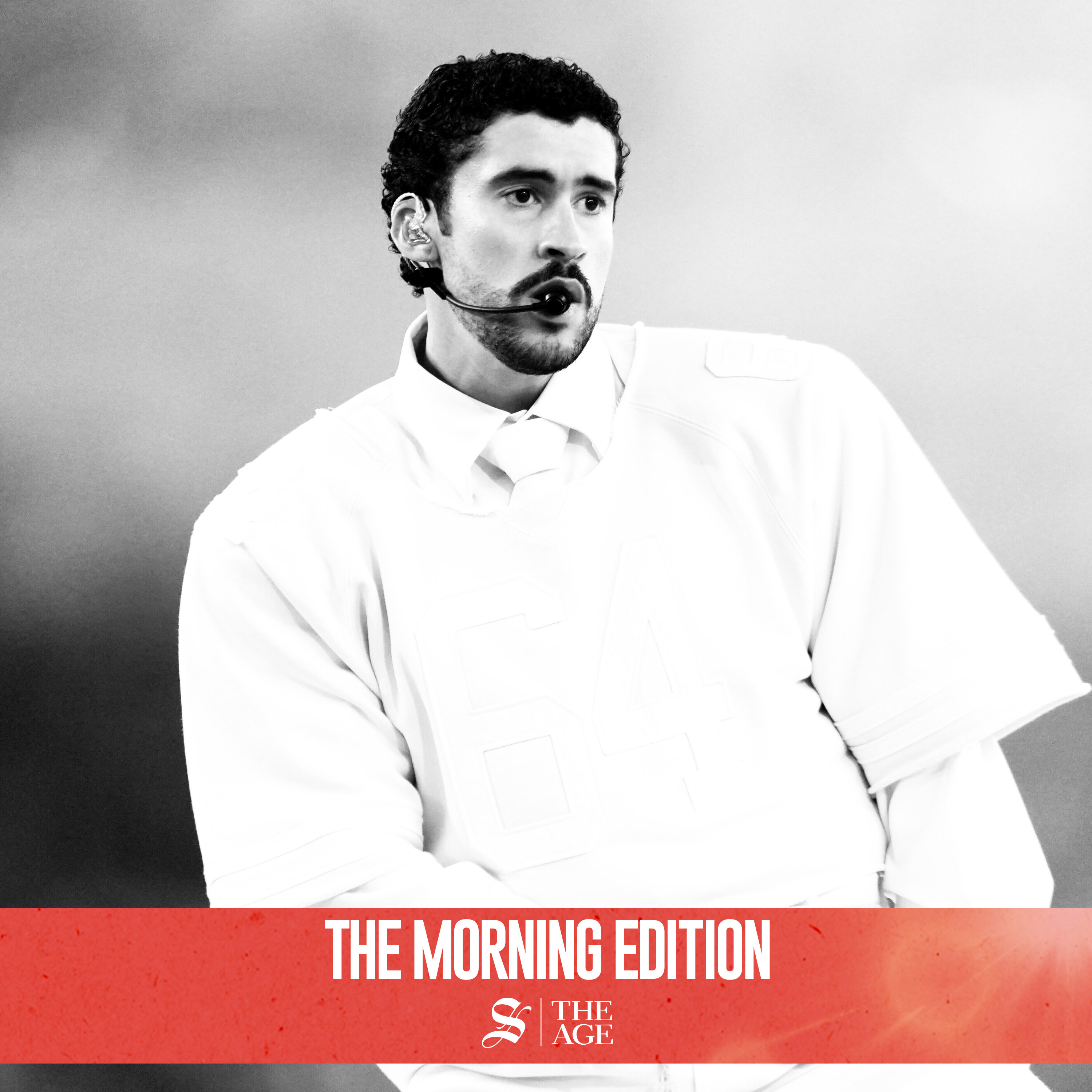
Loading summary
Transcript19 lines
- [00:00]
A
God bless America. Fresh off the back of his major Grammy wins, Bad Bunny. I never heard of him. I don't know who he is. I don't know why they're doing it. A lot of conservatives are freaking out.
- [00:12]
B
Okay, he's not an American artist, but he's Puerto Rican. That's part of America, dear. If you've taken even a passing glimpse at the news over the past week, you would have come across the name Bad Bunny. The Puerto Rican musician won three, three Grammy Awards over a week ago and just performed on the biggest stage in the world as the headline act for the NFL Super Bowl's halftime show. The 29 year old's selection and performance has not been without controversy. I'm Samantha Salinger Morris and you're listening to the Morning Edition from the Age and the Sydney Morning Herald. Today culture editor at large Michael Idotto on why Bad Bunny has become a focal point for conservatives, the anti ice immigration movement and the Trump administration. Michael Lodato, you have just been at the Super Bowl. You are speaking to us from San Francisco. Of course, many listeners, they know the name Bad Bunny, but they might not know who he is. And you know why it is that he isn't just a megastar, but someone who really embodies just this massive cultural moment. So tell us, Michael, who is Bad Bunny?
- [01:22]
A
Bad Bunny is a Puerto Rican rapper, I guess. Singer, performer. They say record producer, but I feel like everyone in music is a record producer, right? Everybody seems to produce their own music now. He's a, a Latin performer. He is immensely popular. If you're old like me, you probably don't really have a firm handle on him. If you're young, he's kind of the biggest thing going on. Very handsome, very energetic, extraordinarily talented singer. His kind of thing is a genre they call reggaeton, which is basically a kind of Panama, Puerto Rico, 80s 90s thing that blends Jamaican dancehall, Spanish reggae and American hip hop. It's a really, he has a really bouncy, fun sound. It's great music to listen to. It's very addictive. It's easy to kind of fall into the rhythm of. That's, that's Bad Bunny. If you, if you're a young cool kid in 2026, Bad Bunny is the sun around which the solar system of your life probably orbits.
- [02:30]
B
And he isn't just a phenomenally talented musician and producer, though he is. He's also quite unique, isn't he? In the sense that he almost never sings or raps in English, right? Like, unlike his predecessors in Latin music, like Marc Antony and Shakira, you know, they used to have to record perhaps if they wanted, and then they'd have to do an English version, whereas he hardly ever does. Right. I mean, that's pretty. That's unique, right? This is a real. He's a game changer.
- [02:58]
A
That's his M.O. and I think, essentially, I mean, he's a kid who has come from Puerto Rico. He's American. Puerto Ricans are Americans. It's an American territory. He. Spanish is his. Is his native language. He sings in Spanish. And I think that there is, I think, an idea around the fact that. The fact that you are compelled to sing in English, to somehow cross a bridge, I think that's something artistically he rejects. And I kind of. I understand that and I respect that. It's very unapologetic. There is a kind of. I would not call him a political artist, but there is a bit of lowercase politics in his music. And I think the rejection. It's not a rejection of English language. It's a rejection of the expectation that you have to somehow deny a piece of yourself and your art in order to build a bridge to a segment of the audience who quite frankly, seem to, you know, not want to bother to come to you. You know, he opened the song with. Which is basically. I know enough Italian to understand the song. It's a song about a boy who's got lots of girlfriends and an auntie who, because the song actually means the title, literally means Auntie asked me. The song is literally about a boy with lots of girlfriends whose auntie is constantly pestering him about, when are you going to get married? And you kind of go, this is a really relatable song. He doesn't need to sing in English to build a bridge. To me, like most smart people, I think the onus is on me to actually take three steps towards the art and try to understand it as it's presented.
- [04:24]
B
And he really, I guess, capitalized on that I guess, uncompromising, perhaps, attitude last year because he had this 31 concert residency, and he very intentionally held that in Puerto Rico. You had to go to Puerto Rico to go to these concerts. He specifically did not have any of the concerts on mainland American territory. Which I guess leads us to my next question, which is that Bad Bunnies performance at the halftime show today has been hugely anticipated, but also controversial. Tell us why, Michael.
- [04:55]
A
So, essentially, when it was announced, obviously it came with a clear expectation he'd perform in Spanish. That seemed to get up the nose of the White House, to put it bluntly. They seemed offended somehow that it was un American, which is one of those things where you go, this guy's not a foreigner. They kind of talked about him like he was a foreigner. And the truth is he's like all Puerto Ricans. He's an American citizen born in an American territory. So essentially what sprang out of that was that sort of very American, you know, oh, you know, why isn't you going to sing in English? This is very un American. I mean, the irony, of course, that Americans are speaking a language called English, which actually is a borrowed language that came with immigrants from England and still in fact is called English because it's named after England, where it originated. This is the madness of the world in which we live. So what that created, though, was that kind of right wing social media commentary at Echo Chamber, where it just suddenly became a whole thing that this was happening. I think to the NFL's great credit, they were just like, steady as she goes. This is a really clear. I think, you know, if we even take the NFL in a really cynical way, this is a really clear, simple transactional exercise for them. They're a gigantic institutional franchise, a sport. They want young people to engage with their sport. And young people love Bad Bunny. There is a secondary layer to it, which is that obviously Bad Bunny himself. Let's, as I said before, let' lowercase P political. As an artist, he obviously has had some very clear things to say about the Trump administration, about the very violent presence of ICE Border patrol on American streets and what they have done to American citizens in the last few months. Particularly before I say thanks to God, I'm gonna say, eyes out. We're not savage, we're not animals, we're not aliens. We are humans and we are Americans. I think also critically, the failure of the American government really, to respond properly to the hurricane in Puerto Rico, which would have affected him very personally. And to talk to your last point, the answer to why he would have taken his residency to Puerto Rico is because I think like all lowercase pieces, political artists, he understands that he is big business. And the very least, he can gift his birthplace, you know, the island that he was born on and that he derives his identity from. The very least he can gift them is the economic boom of all of the business that that residency would have brought. Lots of people flying to Puerto Rico, staying in Puerto Rican hotels, engaging in the Puerto Rican economy, and actually bringing something home, in effect, from his fame, rather than doing what a lot of people do, which is you could be born in Puerto Rico. You move to New York and everything, you sinks billions of dollars into the mainland American economy and never really trickles back to the people who, you know are your family and your friends and your neighbors.
- [07:58]
B
It's so interesting to me you make that point, of course, that some people responded to the fact that Bad Bunny was performing at the halftime show as un American when. And we know that Donald Trump, after the halftime show, he posted on social media. It makes no sense. It's an affront to the greatness of America and doesn't represent our standards of success, creativity, or exc. But it's quite fascinating because I guess one could argue there's nothing more American than making money. And on your point about NFL, you know, I was gonna ask you, why would they select someone who of course, is gonna be so controversial and who would draw the ire of the Trump administration? And what's really interesting is I was doing a bit of a deep dive before speaking to you about this, and I discovered that, of course, NFL team owners themselves overwhelmingly lean Republican, both in their voting habits and in with the way they donate money. And right before the 2024 presidential election, about 83% of the money donated by NFL owners had gone to conservative candidates and causes. And it was a massive amount of money. It was like $28 million or something like that. So I would argue that Bad Bunny, I mean, he knows about making money and the NFL knows about making money. This is all American completely.
- [09:13]
A
And I think, look, I think that what you also see in modern American politics is everyone in power sort of trying to have an. I think, and I think a really good example of that is Tim Cook, the CEO of Apple, who basically, you know, he donated to Trump's inauguration fund. And yet on the same breath, Apple obviously is the sponsor of the halftime show and has been for some years. And prior to the Super Bowl, Tim Cook himself was on social media popping out a quick photo of him and Bad Bunny because in the end, you know, these guys, they know how the system works. They know where the money needs to go to serve them and their businesses. They also know what's popular. And, you know, they would have. It's all of that kind of controversy around Big Bunny performing. All of that is happening at the kind of the social media right wing commentary at noise level. None of it's happening in the boardrooms of NFL football teams. They're all sitting back. They all know really clearly that the future of their sports code is a White, black, brown. You know, it's a multicultural future. In the end, they want to sell tickets and they know that the ticket buying public comes from the broad cultural spectrum that makes America. You know, and look, I mean, what Donald Trump says about art and excellence, the truth is bad bunnies, all of those things. He's artistically brilliant, he demonstrates excellence, he's commercially successful, he's in every way the exemplar of all of those ideals. And if you wanted to boil all of it away and take the most cynical approach and say that really America is just a violent, aggressive, angry capitalist economy that is constantly chasing money, well, Bad Bunny is a big old bag of money happening right in front of us. And no two ways about it, he's an incredibly successful commercial artist on top of everything else. So at the very least, you know, you would think Donald Trump the businessman would be shrewd enough to look at it and see all of the money flowing the way it does and understand, you know, the value of what this guy does.
- [11:09]
B
Well, that's right. And we know that Donald Trump, of course, famously said that he was not going to attend the Super Bowl. You know, he was very much championing, you know, the, I believe it was called the All American Halftime show, which was the one, you know, featuring Kid Rock and, you know, that was sort of put on by the right wing nonprofit organization Turning Point usa. Anyway, we're not gonna talk about that. We really wanna talk about the Super Bowl. So you've gotta tell us, what was the show actually like? Like, what was the atmosphere like? Because we do know that Trump's Homeland Security Secretary, Kristi Noem, she flagged that ICE was gonna be quote all over, unquote, the concert, the Super Bowl. You know, her special assistant, Corey Lewandowski, was even more explicit saying about the super bowl, you know, ICE was gonna target. He said, we will apprehend you, we will put you in a detention facility and we will deport you. So could you feel any of that tension there? Like, what was the show like?
- [12:03]
A
So that the. So there's two things going on there. There's the super bowl itself as a piece of kind of fuller sports theater, and obviously there's the halftime show in the middle. The fullness of the experience is extraordinary. It's incredibly energetic. It's very tribal. It's also very beautiful. There was no, I felt there was no tangible ICE policing presence. That is not, I think, a reflection of their, their fear, specifically around the Super Bowl. I suspect what we were seeing was part of a Wider withdrawal from public spaces, and they're plunging popularity and the clear political indicators, you know, that they're going to be completely demolished at the midterms. So I think what you're seeing is a general pullback because they know simply the optics are destroying them. And the optics of ice on the streets harassing Americans is. Is an optic that has basically set them up for demolition at the midterms. So I don't think ice was absent because they were afraid specifically of the Super Bowl. I think Trump himself was absent because, you know, no one likes to be booed. And I think he's worked out that wherever he goes, he's going to get a big boo. The Vice President just got a gigantic BO Olympics in Italy.
- [13:22]
B
And I guess just to wrap up Michael, I mean, it has to be said that, you know, I'm glad to hear there was parts that were beautiful. But certainly Bad Bunny, I think he did hit some political moments, right? We know that at the very end, he sort of listed off a bunch of countries in South America, Central America. The sign behind him, as he sort of finished his set, you know, said the only thing more powerful than hate is love. And he was holding a football, I believe, that said, together we are America. Those are very clear signs that counter the divisiveness of Trump, obviously, and his incredibly anti immigrant messages. So I guess, do you think this perhaps will rile up bad bunnies, Hispanic voter, you know, voters or fans? Because we are heading into the midterm elections, we do know that the Hispanic community was really quite instrumental in bringing Trump, winning him the White House for a second time. I'm just wondering, do you think that that message is gonna be sort of picked up by the fans? I mean, I was reading just before we began this interview that, you know, there's now an estimated more than 68 million Latin Americans in the US population right now. For the first time in American history, one in five people living in the US Identify as Latino. That was from October last year. So, yeah. Do you think this might rile people up to sort of vote with their feet in November? I guess it's one of those things.
- [14:45]
A
Where, you know, kind of how you interpret it depends at the perspective that you come at it. Which is to say is this is Bad Bunny's performance a performance that will ignite the Latino voter base? Yes, it will, but I don't think it's that simple transactionally. I think it's also equally true to say that Bad Bunny's performance is a reflection of an existing sentiment in the wider Latin community in America, which is anger, frustration, rage, fear, all of these emotions in reaction to the horrific scenes we're seeing played out on the evening news on the streets of America against American citizens. So I think there's a kind of, it kind of. It's like a transaction in a sense, that cuts both ways. Absolutely. I think he, these, this, the political messaging in his performance is. Is strong, not overt. I think it was clearly he, you know, he had a very wild Grammys acceptance speech last week for album of the Year. He said, we're not savage, we're not animals, we're not aliens, we are humans, and we are Americans. And it was an incredibly, very potent, explicit statement. I thought the most revealing thing in his performance was that in all of that beautiful Spanish language, the three English words that he sang in the middle of it all were God bless America. And I thought it was very telling that they were the three English words he chose to use in a sea of Spanish lyrics. I don't think the messaging in the super bowl halftime show was overt, but it was certainly present. And I think absolutely there's, there's a, that, you know, is this the moment of cultural ignition, you know, for a change in America? I think it's certainly reflective of a shift in thinking and feeling. And I think feeling is a, is a really useful word there as much as thinking within, you know, Latin communities around how they want to, you know, you know, use their share as shareholders in the great American experiment.
- [16:55]
B
Well, it's a lovely note to end on, Michael Odato. So thank you so much for your time there on the ground in San Francisco.
- [17:03]
A
Pleasure to speak to you always.
- [17:06]
B
In other news today, Israeli President Isaac Herzog has declared antisemitism a global emergency during his visit to Bondi beach in Sydney, accusing pro Palestinian protesters of seeking to undermine Israel's right to exist. The families of two Australian teenagers who died of methanol poisoning in Laos have condemned a secret court deal that saw 10 people punished with $185 in fines, describing the outcome as beyond comprehension. And businesses have doubled their planned spending on data centers to fuel the AI revolution in just six months, with Australia now only second to the United States as the global destination for new technology. Today's episode was produced by our executive producer, Tammy Mills, and our podcasts are overseen by Lisa Muxworthy and Tom McKendrick. If you like our show, follow the Morning Edition and leave a review for us on Apple or Spotify. Thanks for listening. It's so weird. This app shows that my credit score is pretty good, but I couldn't get the car loan. Are you using myfico.com?
- [18:26]
A
No, it's some other company.
- [18:28]
B
Oh, you should get a MyFICO account instead. FICO scores are the ones used by 90% of lenders, and other credit scores can vary up to 100 points.
- [18:36]
A
That would have been helpful yesterday. Get the scores lenders use. Get the right FICO credit score for your credit goal, including your FICO scores used for mortgages, auto loans and credit cards. Visit myfico.com or download the MyFico app to get started today.