← The Morning Edition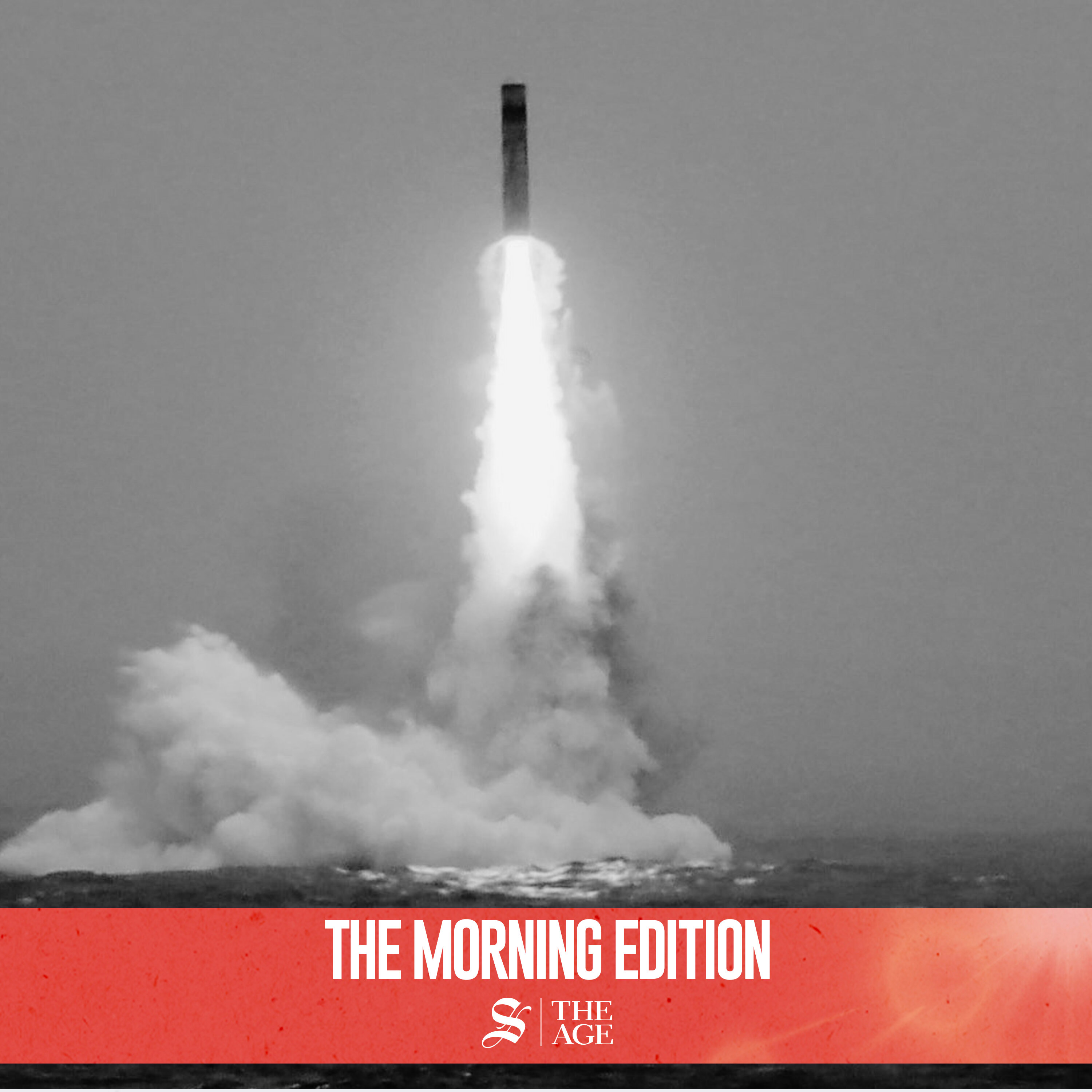
The Morning Edition
‘The world has changed’: Peter Hartcher on China’s extraordinary missile test
00:20:35
Loading summary
Transcript23 lines
- [00:01]
A
Virginia Giuffre helped vanquish a prince and a millionaire. And I won't stop fighting. I will never be silenced. But one of her toughest battles was a very private one. It was the worst thing that could have happened to her, her children or her life. Virginia A podcast from the newsrooms of the age, the Sydney Morning Herald and WA Today coming soon. China launched a rare ballistic missile from a nuclear powered submarine into the Pacific on Monday. It wasn't just putting the countries nearby, like Australia, on notice. It was making a statement that has changed the world, according to international and political editor Peter Harcher. I'm Samantha Sellinger Morris, and you're listening to the Morning EDITION from the Age and the Sydney Morning Herald. Today, Peter Harger joins me to discuss why this missile launch differs so greatly from the one that China launched two years ago and why we have yet to hear from Donald Trump. Welcome back, Peter, to the podcast.
- [01:18]
B
Pleasure.
- [01:19]
A
SAMANTHA okay, so tell us about this missile that China launched on Monday. Why did it anger so many countries?
- [01:27]
B
Different countries, different reasons. It's an intercontinental ballistic missile capable of reaching across the entire Pacific, capable of reaching Australia and depending on which precise model, capable of reaching parts of the US as well. But it landed in the middle of what's been known for decades now as the Pacific Nuclear Free zone, which is a pact signed by all the Pacific island countries plus Australia and New Zealand. And it's a gesture of utter contempt for the nuclear free zone because this is a nuclear capable icbm. It's the second leg of the nuclear tripod that nuclear superpowers deploy. So two years ago China tested a land based icbm. Now it's tested a submarine launch, sea based icbm. The third and final will be when it tests an airborne icbm. And that will complete the nuclear triad and that will finalize that will put it on a full and equal footing with the US in nuclear war. So for that reason, it has been described by the State Department as an act of nuclear proliferation. This isn't just a missile test. The State Department says that by testing this in international waters deep into the Pacific, it overflew Guam, which is a huge US Base. That's the principal US Base in the Pacific this side of Hawaii, and landing in the middle of the Pacific, in the middle of these smaller Pacific island states, the US Says it's an act of nuclear proliferation. More than that, I would call it a challenge to US Hegemony in the Pacific, a direct challenge to the US And a test for Donald Trump, for all the Pacific island countries that have been proud of this nuclear free zone. It's incredibly insulting. It's a total act of disrespect and contempt for every country in the region. And they're the reasons why it's upset so many countries, from the tiniest, from, you know, Nauru to Walu, the Solomon Islands, all the way up to the
- [03:45]
A
U.S. okay, so I want to just clue in listeners to something that you said right before we started recording. You said the world changed. So is this why? Is this why? Just based on what you've just said, is that how the world changed? Or is it something even larger?
- [03:59]
B
Xi Jinping gave a speech in 2012. He'd just been appointed as General Secretary of the Communist Party. He wasn't yet even the president, but he gave a speech which was kept secret for six years and eventually published. And you can see why it was kept secret, although the world kind of failed to take him at his word. But if you take him at his word, he said, there, I will put China in a position to take the initiative and establish dominance. To take the initiative and establish dominance. That was 14 years ago. We now see that being realized. This is the world changing because it is China establishing, asserting dominance over the world's largest ocean, an ocean which until now has been unchallenged. The unchallenged hegemon has been the United States. And now China is saying, no, this is our zone. Do you want to do something about it? And that's why it's a test for Donald Trump. It is a direct challenge to the power and position of the U.S. on the planet and the U.S. s ability to operate freely in the region which is the centre of the global economy. The Asian economy, the Indo Pacific economy is decisively the biggest and fastest growing part of the global economy and the center of global population as well. So one of the reasons that US Strategic thinkers put a priority on trying to match China and preempt any Chinese expansionism was that any country that can command the Asian economy commands the resources to control the planet. Wow. That's why the US has, until this moment, jealously guarded its hegemony in the region and sought to block Chinese expansionism. Now that is directly under challenge. And what we see from Xi Jinping, what we see from Beijing now, is this challenge to US Dominance and a statement of China's own assertion of dominance.
- [06:14]
A
Okay, well, this is what I really want to ask you because your commentary and the reading that I've been doing since this happened, of course, on Monday has left Me a bit flabbergasted as to why Donald Trump hasn't responded yet, at least as when we're recording this on Wednesday morning. Because I'm no submarine expert, I'm no missile expert, I think, as you know, Harcher, but my understanding, neither am I.
- [06:36]
B
I mean, full disclosure here.
- [06:37]
A
Yeah, exactly, exactly. But even the minimal reading that I've done would suggest, suggest that this launch that China just did is markedly different to the one that it did on land two years ago. Because this one gives China the ability to retaliate massively to an enemy's surprise. Like it actually gives it second strike capability. Right. Which as I understand it, if it's sort of, even if its country is sort of like largely destroyed, it can retaliate. Yes, right. So that's massive. I would have thought as a layperson this is something that Donald Trump would have some feelings about or perhaps those around him. So can you help us make sense of the fact that Donald Trump, as we record this, has not yet responded?
- [07:17]
B
Well, you are absolutely right. The reason that great powers have the ability to have nuclear powered submarines and China is turning out two a year, two new nuclear powered submarines per year carrying nuclear missiles is so that if their country is attacked and caught unawares and land based, and perhaps even their air based nuclear capability is destroyed in a first strike by whomever, then you have a submarine capability which is very hard to find deep under the ocean, which is capable of retaliating. And that uncertainty is designed to stay the hand of an aggressor and by giving the country a second strike capability, a retaliatory ability to wipe out the aggressor. So you're right, it is a big development. Its nuclear survivability is now established. Why has Donald Trump not responded? Good question. Perhaps he's just distracted. But look at what he's distracted by.
- [08:24]
A
The World Cup.
- [08:25]
B
Well, there's the World Cup. He's prepared to call FIFA, but he's not prepared to call Xi Jinping apparently. But look, he's been busy at the NATO summit as well in Europe. Now, Samantha, this is the world turned on its head. Here you have a U.S. president going to NATO, withdrawing troops from NATO, threatening and blustering in NATO against U.S. allies while at the same time having so far nothing to say about an ICBM launched by China into the center of the US Zone of hegemony and a direct challenge to US Power and dominance. This is a world turned on its head. Donald Trump has been going very soft, very easy on China And Xi Jinping. And the defining moment, I think, in that relationship came last year when Donald Trump kept ramping up tariffs on China until they got to 145%. And at that point, Xi Jinping said, well, we'll see you and we'll raise you. No more rare earth supplies for your economy. Donald Trump only lasted a couple of days, and then he completely caved in. And since then, no more threats against China, only flattery of Xi Jinping and what a great man he is and a hero and all the rest of the. And bilateral visits. So that confrontation over economic power seems to have persuaded Donald Trump that he needs to back off. The other critical way in which Trump has really gone soft on China is on Taiwan policy. He's never shown any real great interest in defending Taiwan against China's ambitions to take it over. But in recent months, that's even disappeared from formal statements of U.S. defense strategy and policy in a way that it never has. Plus the fact that he continues to talk about Taiwan as, you know, a war in Taiwan is the last thing we need, he said a few weeks ago. A war nine and a half thousand miles away, he said a few weeks ago. Earlier, he compared Taiwan to the tip of his pen. He said, this is. This is Taiwan. And this indicating the Resolute desk in the Oval Office is China. In other words, you know, a trifling, it's not important. Constantly accusing Taiwan of having stolen the US's semiconductor industry, and to which his former vice president, Mike Pence had the perfect riposte. When Trump complained about it being so far away, he said, It's 100 miles from China and 10,000 miles from America. And Mike Pence, his response in a piece in the Washington Post was, what is distance to a global superpower? So now what we see is China is saying, America, you are no longer a global superpower. We are claiming Pacific Ocean, we are claiming the Indo Pacific, we are claiming the dominant global economy. What are you going to do about it
- [11:39]
A
after the break?
- [11:41]
B
This is a statement of intention that this is China's zone of control and that countries will be able to operate only at China's pleasure.
- [12:00]
A
Okay, so if that's the sort of macro picture, if you will, I guess what sort of risk or threat does this pose to the countries that are in this region? You know, to, of course, Taiwan, it sounds like that's a signal from China to Taiwan saying, this is imminent, like we really are going to strike. I don't know if that is what it is. But what greater Risk, I guess, is there for those countries that are, that are close to this zone.
- [12:25]
B
The level of risk has been rising for some time. First, because questions about Trump's commitment to allies anywhere. Second, because of his distraction with the Iran war, where it's still not settled, where Iran is still controlling some oil supplies in and out of the Gulf. Iran has discovered that it has this power to control oil flows out of the Gulf of Hormuz, and it doesn't want to give it up. So he's given Iran that opportunity, they're exercising it. He is at a loss about what to do about it, except to prolong the antagonisms. In the process of that war, he's drastically run down US and allied missile stocks and anti air and anti missile defence systems in the Indo Pacific, including in Japan and South Korea. So the level of risk for this region has been rising continuously under Donald Trump's presidency. And the risk to Taiwan has been rising. The Chinese Communist Party has been rehearsing blockades, tightening its blockade rehearsals year by year, month by month. Now, with this ICBM test, it's also effectively a warning shot to the US that if we decide to move on Taiwan and you want to get involved, we now have this demonstrated capability, which is new, and you're going to have to reckon with. So what does that mean for countries like ours? New Zealand, right the way up from Australia through the Pacific Islands, Papua New Guinea, Solomons, through to Indonesia, Malaysia, Philippines, Vietnam, Japan, South Korea, we're talking a huge slice of the globe. And of course, the South China Sea, Malacca Straits, Sunda Straits, I mean, if people got worked up about the Strait of Hormuz, the commercial shipping through the South China Sea and the straits to the south, it's the dominant global commercial lifeline for the world economy. So for all of those countries, for that commercial shipping artery, this is a statement of intention that this is China's zone of control, sphere of influence, sphere of hegemony, call it what you choose, and that countries will be able to operate only at China's pleasure.
- [14:59]
A
So I guess the next question for you, Harcher, is how is Australia responding? We know we heard from Foreign Minister Penny Wong. I believe she made a comment that, you know, this is a destabilizing action, but surely this would put our Aukus arrangement under question. Perhaps.
- [15:16]
B
So the Australian response, the good news is that the pretense ended. Remember, this government has said that its policy with China is a stabilization policy. Anthony Albanese discarded that and spoke the obvious truth, that this is a destabilizing act. Penny Wong said the same thing. So that's the end of a pretense that this is a stabilized relationship. You've heard me say before, Samantha, from the time they said it, I said, that's like declaring putting a picnic table on top of a live volcano and saying, oh, look, we've stabilized the volcano. And just sitting there, the volcano gets a say too. And it was only ever going to be stable until the day when Beijing decided to destabilize. And the recognition from the Australian government is the beginning of the end of the pretence that it can be stabilized. It's also from our Chinese friends, an eloquent statement of why we need a better quality submarine capability. Our current submarines, the six Collins class, were all supposed to have been retired by now. They're having their lives extended indefinitely. Limping around. At any one time there's lucky if there's more than one of them that's even usable in the water in the meantime, because this country spent decades faffing around pretending to buy submarines. Pretending, you know, remember Abbott pretended to buy them from the Japanese, and then Turnbull pretended to buy them from the French. And then finally we get around to the current deal, which is now five years old. Yeah, a bipartisan deal put together by Morrison. We are now in a very difficult position waiting for new submarines while Chinese future overlords are producing new ones at a great rate.
- [17:05]
A
Okay, well, this leads me to my last question, Peter. Does this missile launch of China on Monday, does it sort of signal or foreshadow the next technology that China is likely to be working on? That might pose different problems.
- [17:21]
B
The Chinese state has been advancing on all fronts with technology, civilian and military. In fact, they have an official policy, civil military fusion. There is no clear distinction between civilian and military technologies in China. They're all harnessed for the state's pleasure. And as you know, China is racing the US constantly for technological supremacy in every realm. Most prominently recently in AI, where Chinese AI, according to the best Western experts we can divine, China is perhaps a few months behind the US at with the absolute cutting edge of the most capable AI capability. But it is providing it. It is selling the tokens at one sixth the cost and is determined to be the global dominant player. And by the way, the models it's supplying corporations are open so that they can modify them at their own will. The US companies aren't doing that. So it's presenting itself as a more attractive AI partner at the same time that it's developing every kind of military technology. And of course, those fuse. If you're using conventional military hardware enhanced by AI, it's a pretty nice meeting of technologies. So they're working on everything and depending on which particular missile. This was tested by the People's Liberation Army Navy. Whether it's the JL2 or JL3, it has a range of either 7,000 kilometres or up to 11,000 kilometres. But you can be sure of this, the next model of ICBM they produce will have an even longer range and even greater capability.
- [19:15]
A
Wow. Well, thank you so much for your time.
- [19:17]
B
Always a pleasure.
- [19:25]
A
In other news today, rents have jumped across Australia in the last quarter, with Sydney house rents now at a record high of $850 a week, Melbourne at 600 a week and Brisbane at 700 a week. The nation's outgoing defence chief, David Johnston, has called for China to be less secretive about its increasingly assertive military activities. As he warns, the Australian Defence Force must spend taxpayer money more wisely. And if you want the definitive list of the best spots to stay warm and toasty this winter, good Food has tracked down your next perfect winter restaurant. You can read more@the age.comau or smh.comau Today's episode was produced by Chee Wong. Our executive producer is Tammy Mills, and our podcasts are overseen by Lisa Muxworthy and Tom McKendrick. If you like our show, follow the Morning Edition and leave a review for us on Apple or Spotify. Thanks for listening, Sam.