← The Morning Edition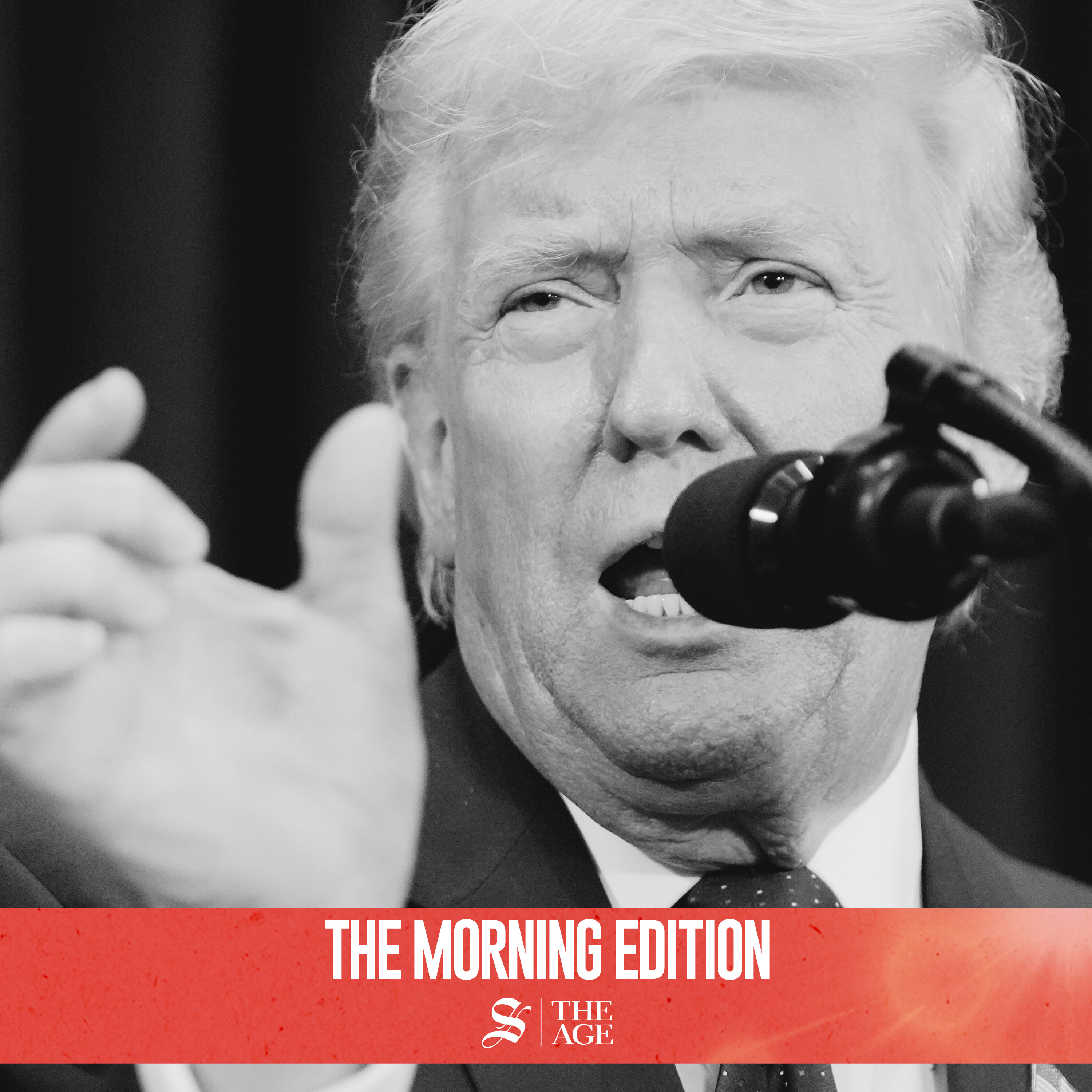
Loading summary
Transcript102 lines
- [00:07]
A
It could be argued that no American president has been as enamored with violence as Donald Trump has. He appears to relish all of it, the spectacle, the promise of it taking place and lately its bloody reality, as at the time of recording, American bombs continue to drop on Iran. So is this the key to understanding Trump's motivation for all the other wars he's planning? I'm Samantha Selinger Morris, and you're listening to the MORNING EDITION from the Age and the Sydney Morning Herald Today International and political editor Peter Harcher on which
- [00:43]
B
country Donald Trump has his sights on
- [00:45]
A
next and whether Australia is now at war with Iran. It's March 12th.
- [00:55]
B
Welcome back, Peter.
- [00:56]
C
Always good to be with you, Samantha.
- [00:59]
B
Okay, well, let's launch in because you have got a theory that addresses what's got to be the 600 million dollar question that everyone is asking right now, and that is what is behind all of these wars that Donald Trump has either instigated or has plans to instigate. What's your theory, Peter?
- [01:16]
D
Well, I would say it's More like a 100 trillion dollar question, Samantha, which is roughly the total value of global GDP because the global economy is affected and in some respects is very vulnerable to this war in Iran.
- [01:34]
C
So just looking at the facts before
- [01:35]
D
you get to the theory.
- [01:37]
C
The facts are that when Donald Trump
- [01:40]
D
was still in the process of getting Maduro, the Venezuelan president, charged and tried in a New York court, he was
- [01:50]
C
already talking about going to war in Iran when the war in Iran had been running for just one week. So last weekend, Donald Trump talked openly about war on Cuba.
- [02:04]
D
He addressed a group of leaders of nations from the Western Hemisphere, so South America, Central America, Caribbean leaders, and said Cuba is in its last days as
- [02:15]
E
you know it, so looking forward to the great change that will soon be coming to Cuba. Cuba's at the end of the line. They're very much at the end of the line.
- [02:25]
D
It's the end of Cuba as it is.
- [02:27]
E
They have a bad philosophy, they have a bad regime that's been bad for a long time.
- [02:35]
C
So very clear planning to change the
- [02:40]
D
regime or at least kill the leader in Cuba.
- [02:43]
C
And so I just was asking myself, what's the rush? You're doing one big operation and you
- [02:50]
D
haven't even finished it and you're talking about the next.
- [02:52]
C
That was the Venezuelan one into Iran and now you're in Iran, missiles are flying, the world economy is teetering and you're talking about Cuba. And then in that very same speech to those leaders where he's talking about Cuba being next. He talks to them about the purpose
- [03:13]
D
of that particular gathering, which was to
- [03:15]
C
launch an initiative called the Shield of the Americas, an American led military operation
- [03:21]
E
to, to eradicate the criminal cartels plaguing our region. And you have a lot of it.
- [03:27]
C
One of the things which, as Pete Hegseth, his war secretary, has warned, could involve the imposition of U.S. forces into
- [03:35]
D
those countries against their will. And again, Trump was there to promote that.
- [03:39]
C
So what's the haste in all this? He's only been in power a little over 400 days. He's still got 1400 days left in this term, this continuous flurry before one is finished, another is launched and then another. So I did have a suspicion. But Samantha, it didn't become a theory until I talked to an American presidential and political historian and a professor of
- [04:03]
D
political management at GWU George Washington University in the US Matt Dalek is his
- [04:08]
C
name and he said it's pretty straightforward. His theory or his explanation, which does seem to make sense of this, is that Trump traditionally likes a crisis. He likes to generate a crisis, but then quickly to move from one drama to the next, partly to keep the globe's attention and the electorate's attention on him, which works very much for him because it serves his purpose of dominating the agenda, the political space, the debate, and dominating his political opponents. But it also serves his apparent pathological need to use violence as. Is it a source of dominance, perhaps. Is it a source of theatre, entertainment and political attention getting? Is it a source of some political, some personal satisfaction and need to dominate? Don't know about that. But what Matt Delick explained is that Trump traditionally hops from one crisis to the next, partly to keep attention, but also as a way of drawing away attention from problems in the crisis of the moment. Venezuela, for example, all he did was change the leader. The deputy stepped up.
- [05:28]
D
The regime hasn't fundamentally changed.
- [05:30]
C
Venezuela's problems are not solved. It's made it more pliable to the US and its promise to open its
- [05:36]
D
oil once again to the U.S. but that's it.
- [05:40]
C
Otherwise it's very much unfinished business.
- [05:42]
D
Then you get into Iran, which is
- [05:44]
C
still in the throes of a hot
- [05:45]
D
war, and he's talking about Cuba.
- [05:47]
C
So Matt Dallek's theory, or exclamation, fits the facts, that he just wants a constant procession of war of dramas to generate attention and to keep the initiative politically and to dominate.
- [06:05]
B
And so obviously Trump has a lot that he would want to possibly distract from. Of course, there's a cost of living crisis. The price of oil, of course, is going up because of what's happening in Iran. There's obviously the Epstein files that he, you know, really wishes was born behind him. And he seems to have this fondness, I guess, for certainly for spectacle, but possibly for violent spectacle. And you've written about his plans for the celebration of United States independence from Britain, and it's got a, well, you say he's going to be turning the White House into a cage match. So I guess just tell us about that, Peter.
- [06:42]
D
Yes.
- [06:43]
C
So a year ago, Trump did say
- [06:46]
D
he did promise that for the 250th birthday of America, he would host a UFC fight at the White House, courtesy of his friend, old mate, donor collaborator Dana White, who runs the UFC franchise, Ultimate Fighting Championship. For anybody who doesn't know about this franchise, it's sort of a community unto itself, very popular with young men, has a huge international following and it's known for being hyperviolent.
- [07:23]
C
And he did promise that. And on the weekend, the same weekend when he's talking about the Shield of
- [07:29]
D
Americas and military intrusions into Latin, South America, Caribbean, Central America, the same weekend he's talking about Cuba being next, the same weekend he's still trying to manage war in Iran, he announces the details, and the UFC announces the details of this event at the White House coming up in June. And it's, by the way, just happens to the event just happens to be held on Trump's birthday and he'll be hosting it at the White House.
- [07:56]
C
It's going to be a series of six UFC fights.
- [07:59]
D
They're planning 5,000 people in, you know, stadium style seating on the South Lawn of the White House with explosions of music and riots of Kama and the whole spectacle of ufc. So this is the plan for celebrating the US Declaration of Independence.
- [08:21]
C
After the break, it would be naive of us to say that we are not in a state of hostilities with Iran. Already we have been at their instigation and we need to know, we need to remember who our enemies are and
- [08:35]
D
who our friends are.
- [08:41]
B
But just tell us, Peter, I guess for some context, how much does this depart from, say, the manner in which previous American presidents would celebrate America's birthday? Because I don't imagine bare chested fighters emerging from the Oval Office was part of that. But I wasn't there, so.
- [08:58]
C
Well, you're right, this is a big departure.
- [09:02]
D
Traditionally, it's been celebrated with presidential speeches, parades, military parades. It's been celebrated with barbecues, presidential picnics.
- [09:13]
C
John F. Kennedy, in a speech he gave in 1962, at the celebration of Independence Day, talked about the importance of
- [09:21]
D
Independence Day as a revolution in human affairs. This year, we have to wonder if this celebration marks a regression in human affairs.
- [09:31]
C
It's, you know, this theatrical display of violence for Trump's benefit.
- [09:37]
D
But with all the cameras and all the violence, in this case hand to
- [09:41]
C
hand combat rather than state on state. Combat does seem to be all of a piece with Donald Trump's approach to political display, political theatre, the conduct of politics and policy itself, the need for constant displays of violence. And when he's not actually conducting violence, he's promoting it or fantasizing about it. For example, in his last term, in his first term as president, he urged the US Military, the Chairman of the Joint Chiefs, Mark Milley, to shoot American protesters in the legs.
- [10:22]
D
Mark Milley, of course, declined. It's not the military's job to go around shooting American citizens in America in this term. He told a meeting of 800 assembled generals and admirals that they should use America's cities as training grounds for their combat techniques. Again, the military has politely declined that invitation. He has thoroughly thought about using the
- [10:45]
C
Insurrection act to allow the military, that's
- [10:48]
D
been much speculated, to operate on U.S. soil against U.S. citizens. That hasn't happened.
- [10:55]
C
He has tried, you know, in other ways to operate political violence in America on American soil.
- [11:03]
D
The ICE raids are the closest thing.
- [11:05]
C
Well, they were quite violent and two
- [11:07]
D
American citizens were murdered by ICE agents. Outcomes which Trump initially applauded before realizing the political consequences and then backing off.
- [11:17]
C
But Matt Delick, the political historian, makes the point that Trump seems to have found executing political violence domestically is too hide bound, too rule bound, and it's too difficult to go through the Congress
- [11:31]
D
and do it at home.
- [11:32]
C
So hence the president, the man who said he was the president for peace,
- [11:37]
D
who would never start a war, he
- [11:38]
C
would only end wars, suddenly becomes this constant warmonger waging new and more conflicts at a feverish pace. And you know, that Independence Day plan for a UFC fight on the South Lawn of the White House. And the huge spectacle does seem to be a metaphor for his presidency and the importance he places on violence, not necessarily to get an outcome, but to produce a theatrical effect.
- [12:12]
B
And I imagine a lot of Australian listeners will be thinking, as I'm thinking, that, okay, it's one thing, you know, we can laugh about bare chested fighters coming out of the Oval Office to celebrate America's birthday and how ridiculous this is, but I guess the question is, is Australia now become a target for Iran as A result of what Trump's doing because thinking about Anthony Albanese's announcement on Tuesday that the Australian government is providing missiles to the United Arab Emirates. And he has since announced that Australia is also sending 85 ADF personnel to the UAE, not to mention, of course, the three members of the ADF who were on board a US submarine that sank an Iranian warship earlier this month. And then we've got the five members of the Iranian women's soccer team who just escaped their Iranian handlers on the Gold Coast a few days ago to take refuge here. So, Peter, have we entered this war?
- [13:10]
C
Well, partly, yes. Through the uae?
- [13:13]
D
Yes. That's the bold truth. The UAE has requested, apparently with full cognizance and approval from Washington, has asked Australia for help defending itself against Iran. And Australia has agreed. And this position has been supported by both the major parties in Australia coalition and the current government. Only the Greens have objected to this.
- [13:42]
C
But the, you know, the contribution is minimal.
- [13:46]
D
It's one of Australia's six Wedgetail AWAC planes which is capable of battlefield management and surveillance and coordination and a supply of some air to air missiles to allow the UAE to shoot down incoming Iranian missile or drones and the crews to operate those. It's a good talking point for the Greens to get excited about, but it is a pretty minimal contribution. I'd just add one more point, and this is something that governments in Australia have operated for decades. But, and it's not a secret, but they just don't talk it up, which is that the Al Minad Air Base in the uae, the Australian Air Force, the Australian military has operated through there for decades. The UAE has been a very willing host. Now, Australians don't know that, but for that relationship to exist, and the political, trade, economic relationship is also a pretty healthy one, means that when they turn to Australia and say, well, can you give us a hand defending ourselves against these thousands of Iranian missiles and drones,
- [14:50]
C
you can see that knowing that fact
- [14:52]
D
of the history of cooperation with the Air Force, that it would be pretty churlish to say, well, no, bugger off.
- [14:58]
C
The other point would be in support of this deployment, Samantha, is that, is it in Australia's interests to allow the
- [15:06]
D
early resumption of commercial air traffic through
- [15:08]
C
the UAE through Dubai, Abu Dhabi? Is it in Australia's interests to see
- [15:13]
D
the resumption of oil through the Straits of Hormuz? Not just oil, but LNG fertiliser and all the rest.
- [15:19]
C
And if you think the answer is yes, then you would have to say surely, then it's in the national interest
- [15:26]
D
for Australia to be making this contribution in response to a UAE request for support while it's under attack.
- [15:34]
B
For sure, I can see how it's in Australia's interest, but we know that Anthony Albanese and the Defence Department, they've been at pains to say that we're sort of not wholly involved in this conflict. You know, we're not protagonists. Albanese has just said. What we're doing, of course, is like you've just said, providing for the defence of the UAEE and of Australian cities citizens. He's saying the missiles that they've sent can only be literally used to hit drones and missiles. So it's purely defensive. But I just want to push you on this a little bit because I'm thinking, well, the Iranians, do they distinguish between, of course, defensive moves and offensive moves? I'm just going to quote here from defense analyst Michael Shubridge, who had it in our mastheads just yesterday. You know, we're best just admitting that we're now a part of this war, not just sitting in some quarantined corner. Offense and defense are just different sides of, of the coin of war. Like, would that not be how the Iranians see it?
- [16:28]
D
Well, the Iranians have burst out in a frenzy of violence against all sorts of targets, including civilian targets, many civilian targets throughout the Gulf states. So of course they'd see it as a legitimate target.
- [16:44]
C
The justification for hitting all the Gulf
- [16:46]
D
states is that they host US bases, therefore their targets.
- [16:51]
C
So if an Australian Air Force plane
- [16:54]
D
turns up operating out of the uae, of course it's a target for the Iranians. And if they get the opportunity and they have the munitions left, they'd be very happy to destroy it. They'd be very happy to kill the Australians.
- [17:08]
C
But why wouldn't they? I mean, we know that they've been operating hostile efforts against Australia, even here on our own soil, for a long time.
- [17:19]
D
Last year, the Iranian ambassador was expelled
- [17:22]
C
by the Australian government because the government had uncovered that two terrorist attacks against Jewish targets in Melbourne had been orchestrated by the Iranian government. They have been waging undeclared war on our country. And so for us to enter into the defence of the UAE against Iran is really just simply the continuation of the war that they declared by other means that we're now joining in kinetic means in a very low risk and contained way. It doesn't compare with previous Australian engagements
- [17:56]
D
where it's joined with the us, for example, in Iraq, where we sent ground troops. Australia is not talking about and will not send ground troops anywhere near Iran in this deployment.
- [18:07]
C
It would be naive of us to say that we are not in a state of hostilities with Iran. Already we have been at their instigation.
- [18:14]
D
This is a part of Australia's response to that.
- [18:16]
C
And we need to know, we need to remember who our enemies are and
- [18:20]
D
who our friends are.
- [18:22]
B
Well, it's obviously a fast moving situation, so thank you so much, Peter, for your time.
- [18:27]
C
Always a pleasure to chat these things
- [18:29]
D
over with you, Samantha.
- [18:38]
A
In other news today, Melbourne has been crowned the best best city in the world for 2026 by Time Out. It's the first time an Australian city has taken the top spot on the 50 Best Cities list, with the Victorian capital beating London and New York. 2.5 million Australians are in the early stages of kidney disease, but don't know it, a situation which will not only impact their lives, but threatens to overrun the nation's health system in the coming years. And popular ranges of rat and mouse poisons will be restricted for use within weeks and could be pulled from supermarket shelves. To find out more, go to our
- [19:17]
B
websites, theage or smh.com au Today's episode
- [19:22]
A
was produced by Chi Wong. Our executive producer is Tammy Mills, and our podcasts are overseen by Lisa Muxworthy and Tom McKendrick. If you like our show, follow the Morning Edition and leave a review for
- [19:35]
B
us on Apple or Spotify.
- [19:37]
A
Thanks for listening.