← The Morning Edition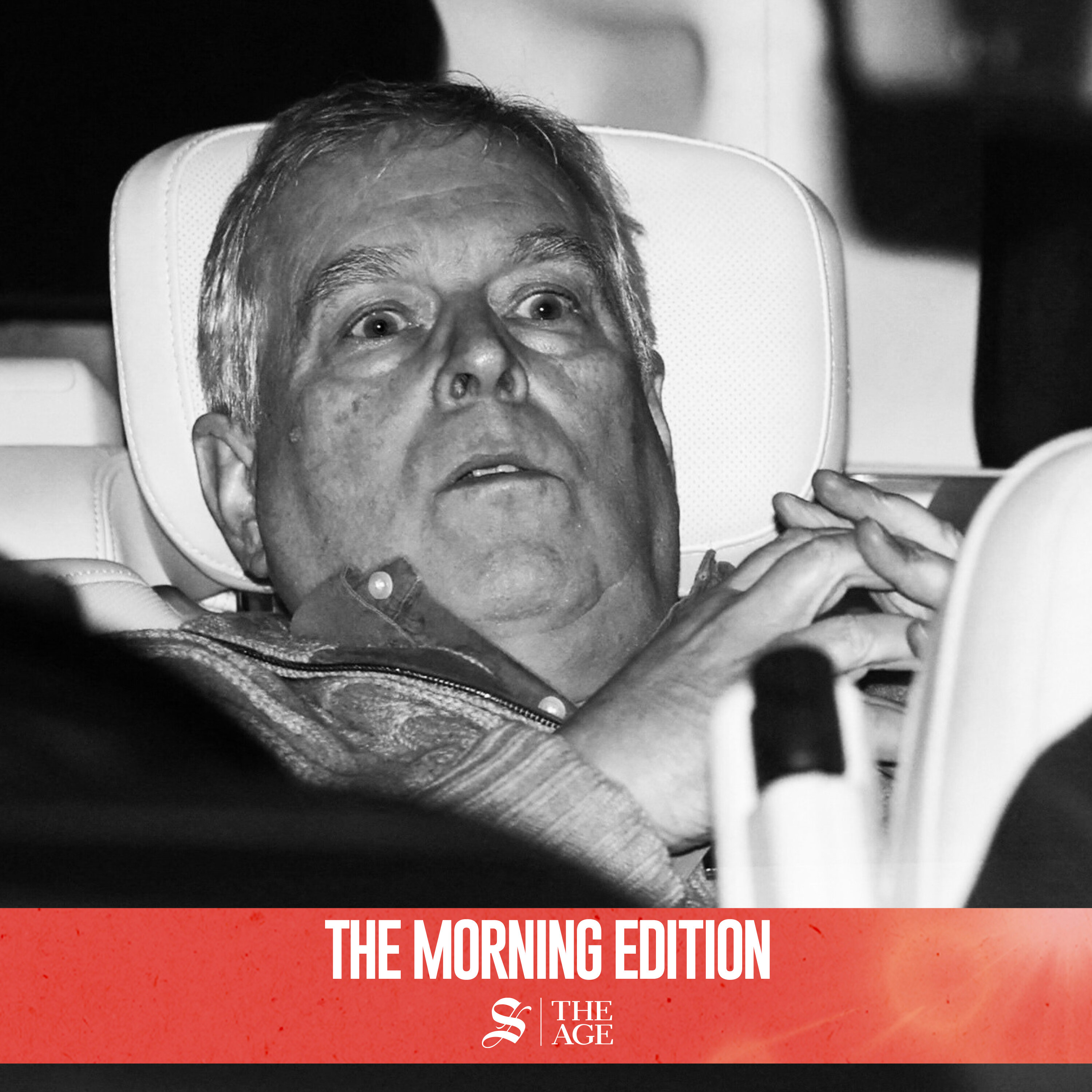
Loading summary
Transcript27 lines
- [00:05]
A
When Andrew Mountbatten Windsor was taken into police custody on his 66th birthday last week, it was the first time in nearly 400 years that a British royal was arrested. I'm Samantha Selinger Morris, and you're listening to the Morning Edition from the Age and the Sydney Morning Herald Today Europe correspondent David Crowe on what it means for the British monarchy that. That Andrew Mountbatten Windsor was finally arrested after years of scandal and recriminations and why he hasn't been charged. It's February 24th. David, welcome back to the podcast.
- [00:46]
B
It's great to be talking on the podcast again. Samantha, good to see you.
- [00:50]
A
Well, it's great to see you. And there's no better person to speak to about this at the moment because you, of course, are in London. You were there, of course, when the news broke that the former prince had been arrested. So take us back to that moment. How did that news unfold?
- [01:04]
B
Pretty amazing, really, when you think about it. Even though we've been reporting for so long that there've been these questions over Andrew Mountbatten Windsor, it's still quite shocking to get to that point where they've actually turned up at his country residence, police in unmarked cars and then taken him away and put him in custody.
- [01:29]
A
It's been an extraordinary day in UK history. Andrew Mountbatten Windsor arrested by British police of allegations of misconduct in public office after documents in the Epstein files suggested he passed secret government information to the disgraced financier.
- [01:46]
B
And that's still something that I find incredibly dramatic. People might say, look, you shouldn't be shocked. You know, the writing's been on the wall. In fact, I think there's always been a question about whether police have, and other authorities really had it in them to take this to the point where they brought him in for an interview to ask him about all this history. And I think the tipping point, I mean, I think you could argue that the tipping point should have been some of the concerns raised about the treatment of younger women and girls by Jeffrey Epstein and the cohort around him many years ago. But this time the tipping point was really a matter of the disclosure of confidential government information. The emails which gave, I think, authorities something concrete to say here. We've got something to ask about. And they decided that they would move.
- [02:44]
A
Okay, well, we'll get into the allegations in just a moment. But first, let's get into, as you say, that shocking moment where there's that image of Andrew Mountbatten Windsor in the back of a police car. He's slumped in the back, his eyes are wide, he's got his hands clutched together. What was the reaction over there in the uk? Because you and I were discussing just before we started recording that this is the first arrest of a British royal in nearly 400 years. The last one was King Charles I and that led to his execution. And the temporary the monarchy was, was they got rid of the monarchy there for about 11 years. So it was massive. So what was the reaction to this really monumental arrest?
- [03:27]
B
This has been a slow motion investigation in some way a slow motion scandal because it's happened over such a long period of time. And so even though I found the moment of arrest to be a really dramatic moment, when I went to Buckingham palace to talk to British people, I found it so fascinating that the common response multiple times was this should have happened earlier. There wasn't a sense from British people I spoke to that, oh my goodness, you know, I've never, I've never seen anything like this. I'm so shocked. There was a kind of a pent up frustration. I think that Andrew had been shielded for too long and that this had been a long time coming.
- [04:13]
A
But of course, the main point here is that Prince Andrew has not been charged or he wasn't arrested for anything to do with alleged sexual impropriety or sexual crime. This is about his time as the trade envoy. So let's get into the nuts and bolts. What has he actually been arrested for? What are the allegations?
- [04:34]
B
When I talk to people, that's all a bit of a blur to some of the Brits I spoke to because they just think he should have been dealt with earlier on a whole range of fronts. But I think it's important to be specific about what he's facing. He's not being charged, he's facing an investigation. He's been released under investigation. So they held him in custody while they presumably questioned him. But it's about his conduct as a trade envoy. Now, in 2001, after he left the Navy, he was appointed a trade envoy, which gave him a public duty because he was in an official role. But it also gave him a lot of latitude to travel around the world to do deals, to see a lot of people, to build connections and have a network of investors, wealthy people, people like Jeffrey Epstein. And in that role we now know, but people weren't sure about it at the time. He was in touch with Jeffrey Epstein and sending information. How much information we can't be certain about. But we do know from the emails released by the U.S. department of justice that the Prince, as he was at the time, was sending government documents, assessments of trade missions or assessments of investment opportunities to Jeffrey Epstein. Whether they were of incredible financial value to Jeffrey Epstein, we can't know because the emails released by the Department of Justice don't include the attachments. So we don't know what those documents showed. But we do know that in one case, the Prince, as he was, got information from his office, I think, government document about a trade mission. Five minutes later, he sent it on to Jeffrey Epstein. So there was this regular pattern of communication. Even after that point, when Prince Andrew said to the BBC and others that he didn't have anything to do with Jeffrey Epstein, he was still in contact with a key individual who was talking to them both. So I think there were back channels, there was information being traded, in a way, and the way I've seen it is in some of the emails. When you go through them, you're seeing these insiders, this network around Epstein, trading information. Then in the next email, they're talking about girls, right? It was this network of sleazy behaviour at Epstein's Island. At the same time, there was dubious conduct going on with the exchange of information. And let's face it, Epstein was an investor and a financier and there was huge scope for him to use inside information.
- [07:20]
A
So tell us a little bit more about what the police are actually investigating here. It's improper conduct in public office. So what is that all about? Is the suggestion, or the concern perhaps, that he just gained financially from passing over confidential information that he gained as trade envoy to people for his own gain? Is it that he could have been harming British security? What is the concern here? And tell us a bit more about this alleged offense, which we have to say Andrew Mountbatten Windsor denies any wrongdoing.
- [07:50]
B
The offence is misconduct in public office and he was in public office. He had a public duty as the trade envoy within a government agency. But it's been interesting for me to read some of the advice from prosecutors about stacking up a case of this kind, because it's very clear that there's a high benchmark. It doesn't necessarily have to be financial misconduct, although I think we'd all think that that's obviously one way in which misconduct can arise. There is interesting language from past cases about how it really needs to be established that there is willful misconduct. It really has to have that intent or that awareness, that knowledge. Well, this is, for me, a key reason why, in my writing about it over the last couple of days, I have not assumed that the former Prince will be charged because I think that there's a lot of work that needs to be done to really establish some of the evidence to show that there was willful misconduct. And so I think the way I've put it is Andrew Mountbatten Windsor may be somebody we always talk of as being arrested for misconduct in public office, not as somebody who was charged with misconduct, let alone convicted of misconduct.
- [09:00]
A
But we do know it's a big deal. My understanding is that often when really high profile members of the public in Britain and elsewhere for that matter, you know, when there's some suspicion that they've done something wrong, my understanding is that usually the course of events is that the police might invite them for an interview and they're not sort of obligated to be interviewed, but they might get a warrant and their house might be, you know, searched for documents and they've been invited for an interview. But that's absolutely not what happened here. He has been arrested and my understanding is for him to have been arrested by police in the UK over this, they would have to have reasonable suspicion and they would have to have had documents and evidence would suggest that there is serious concern here. He's not just being invited to be interviewed. Why do you think there's been his arrest now? Like, why this tipping point after so much time, so many allegations of wrongdoing of various kinds into the former Prince Andrew?
- [09:54]
B
I think it's because of the emails that came out from the Department of Justice at the end of January and in fact, full credit here to the BBC, because there was a BBC reporter who found the first instance of a confidential government document being forwarded to Jeffrey Epstein, and that then led other people to search through the files to find similar cases. And bear in mind the Department of Justice in the US didn't find them and reveal them and say, here's something a bit curious. They just released millions of files and it's really been the work of the media to search those files that's turned up. The thing that I think led to the public debate becoming so strong that it was just untenable for authorities to sit back and say, oh, look, we're really not sure, we better not do anything. I think that really created a situation where they had to do the interview, had to call him in and they had to do it by going and searching two properties and arriving unannounced. Because, of course, the calculations there are that if you tell somebody, you're going to call them in for an interview. Then they destroy documents.
- [11:11]
A
After the break.
- [11:13]
B
But what's being done now is, in some ways, the King's work to make sure that it's dealt with as strongly as possible in order to protect what the repercussions would be for Prince William down the track.
- [11:31]
A
And so what's actually the latest in the investigation? And can you talk us through what the process is and why Andrew was released without charge? You know, obviously it's very serious. He was arrested, but like you say, he has actually been released without charge.
- [11:45]
B
What we have seen is that they've continued with their searches. They continued searching his former house at Windsor, they continued that into Monday. So that's interesting, because he was moving out of that residence. Clearly they thought there's something more they needed to look at there. So that's ongoing. But at this point, there's been no further statement from police. And also, really, key point to make, there's been no statement from Andrew Mountbatten Windsor, not through his lawyers, not through any public relations outfit that he's got working for him, just total silence. I find that interesting because often you get a very basic statement from lawyers, but here it's total silence. So the onus in that sense is really on the authorities to put up a case. And without that next step, he may never feel that he needs to say anything at all.
- [12:49]
A
And reporting in the last 24 hours is that the government is actually planning to remove Andrew from that royal line of succession. He is around 8th in line to the throne. So I guess one could question what the real point is. But tell me, has there been a shift towards how the public feels about the monarchy?
- [13:08]
B
I think that there's a shift in thinking that's been happening in the UK because the government here has been signalling that it's willing to consider passing law to remove him from the succession. They weren't talking about that last October, November. They said it wasn't a priority. They've got a lot of other important work to do now. I think there's a realisation that it's so bad they have to be crystal clear that he cannot be in line to the throne. And that, I think, would then raise the question, where in Australia. I'd be surprised if they didn't take the same position in government, which is, yes, we're willing to consider that even if there are no charges laid and it never moves to another step, there is still this scandal that surrounds Andrew Mountbatten Windsor, so he'll never escape the questions about his personal conduct. And that I think will tarnish him for the rest of his life. It means that the Royal Family has to isolate him, which they are doing, which can't be easy for a king to have to do that to his own brother. But it's something that is being done to protect the monarchy, protect the institution and protect the House of Windsor. I do find the dynamic interesting in the sense that there will always be, I guess, a stench from this scandal and that will last into future reigns, including the reign of Prince William. But what's being done now is, in some ways, the King's work to make sure that it's dealt with as strongly as possible in order to protect what the repercussions would be for Prince William down the track.
- [14:44]
A
But I want to put this to you, because ever since this has come out, I've started wondering, could this even, and wait with me here for a moment, strengthen the monarchy? And the reason I say that is because I've seen so much commentary surrounding how King Charles has responded to this. We know he took a very unusual step in a statement to state that he stood, quote, ready to support police if they were approached. And I believe within hours of his brother being arrested, he was at a fashion show. And I've seen commentary of people going good on him, you know, business as usual. He is just, you know, backing the police and getting on with the jobs. Which made me wonder, could this even strengthen the monarchy? Or perhaps King Charles's standing?
- [15:23]
B
I wouldn't underestimate the ability of the monarchy to survive this. I am not one of those who have been writing, oh, this will. This is a huge problem for the monarchy, and the monarchy's now on notice. I don't see it playing out that way. When I talk to one guy outside Buckingham palace, he said he was 100% behind the monarchy. He said there are black sheeps in every family. He believes in the institution. And others I spoke to as well were the same. They believe in the institutional arrangements of the English structure, the British structure. And I think there are many in Australia who would see things the same way, even though there's a stronger republican movement in Australia than there is in the uk. I think also they have been getting on with business as usual. William and Kate went to the baftas, right? So they're at a high glamour event in London at the Cinema Awards with high profile actors. King Charles has got a lot of supporters. All the things that they do, it's easy to mock, but the fact is that they resonate with a lot of people. And so they still have that reservoir of goodwill in the community. And it is kind of, you know, there's an irrational element to it that they're not going to be dragged down and destroyed by this scandal in their own family. But I think that on the balance of probabilities, that is the way it's going to pan out.
- [16:50]
A
But we do have to talk about the fact that there's something like 3 million files of the Epstein files that have not been released. And Even among the 3 million or so, you know, pages of documents of the Epstein files that have been released, of course, Prince Andrew comes out of it looking very badly. There's still these questions about his treatment of young women and especially the claim by the late Virginia Giuffre that she was forced to have sex with him as a 17 year old. So how are people feeling in England about the fact that he's been arrested not over the way he's treated women, but about leaking information?
- [17:24]
B
Yes. You never know what else could emerge. We'll never be sure about whether another document could land at any moment. Although I also feel that when you've got a police investigation, as soon as an arrest is made and the police call somebody in, you often find that things quieten down because people won't answer questions. I'll say, oh, that's a matter before the police, and I can't talk about that. So you do sometimes find a bit of silence. But getting to that point of you never know what can emerge. Andrew Mountbatten Windsor and Ghislaine Maxwell said for years that the photograph of the former prince with Virginia Roberts Giuffre was false, was a fake. And in the emails that have emerged from the Department of Justice, there's an email from Ghislaine Maxwell where she admits it was true. Fifteen years ago, journalists got in touch with Jeffrey Epstein to ask about his use of RAF airfields in England. And they denied, denied, denied in the emails. There's an email where Jeffrey Epstein admits he was using RAF airfields in England. Did Andrew Mountbatten Windsor help him to do that? Was there a connection there? Well, that's one avenue for investigation, but again, it's only emerged out of these emails. So, yes, you never really know what else may emerge.
- [18:56]
A
Well, it seems like this is far from over for Andrew Mountbatten Windsor. So thank you so much, David, for your time.
- [19:02]
B
Thanks, Samantha. It's always good to talk. See you next time.
- [19:13]
A
And in other news today, a key architect of the Bob Hawk and Paul Keating era of economic reform has pleaded with the Albanese government to deliver real tax reform that rewards young Australians. Police in New South Wales investigating the kidnapping of a Sydney grandfather are combing through bushland searching for the 85 year old. For the latest developments, head to our websites. Read these headlines and more on the smh.com au and theage.com au Today's episode was produced by Josh Towers. Our executive producer is Tammy Mills, and our podcasts are overseen by Lisa Muxworthy and Tom McKendrick. If you like our show, follow the Morning Edition and leave a review for us on Apple or Spotify. Thanks for listening.