← The Naval Aviation Ready Room Podcast with Ryan Keys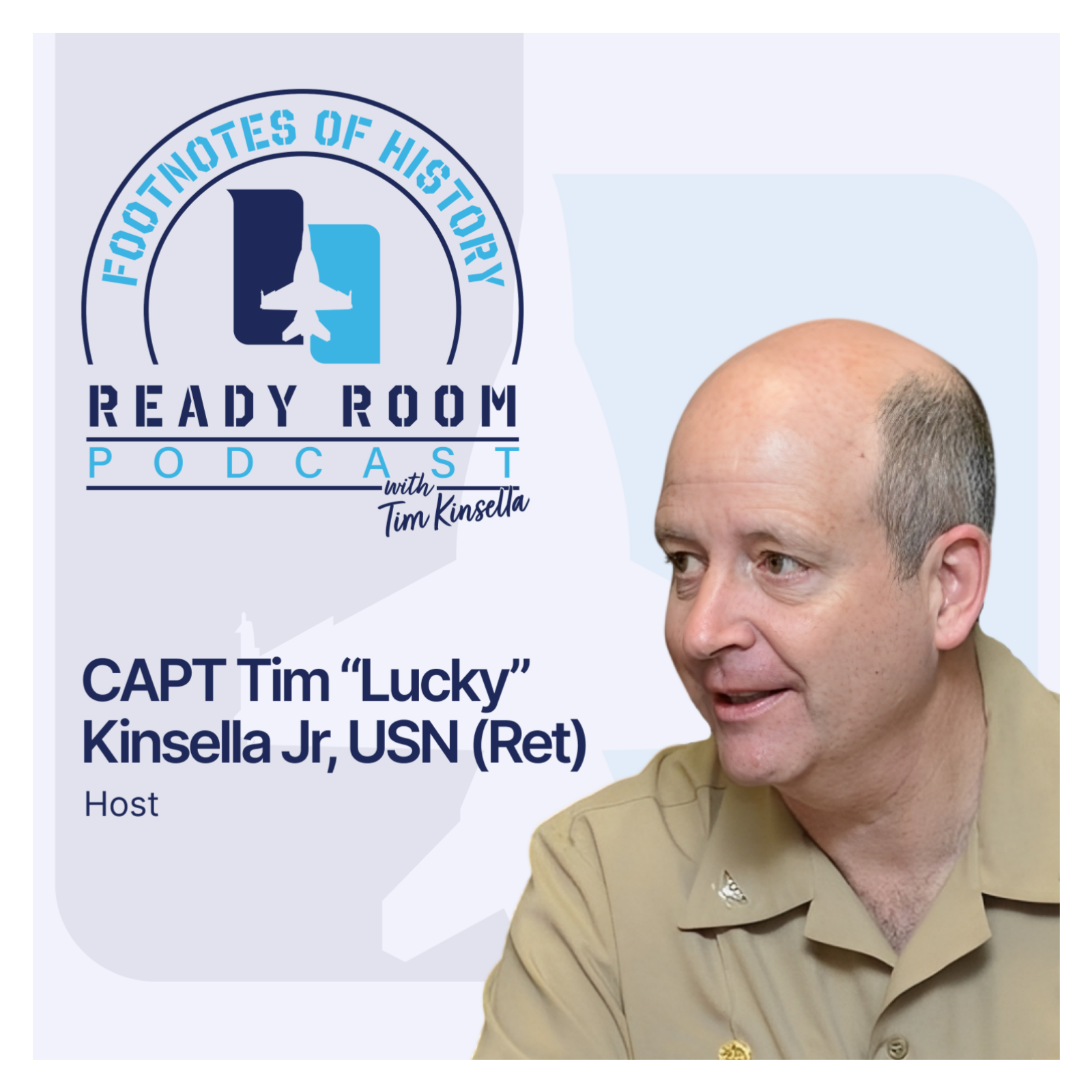
The Naval Aviation Ready Room Podcast with Ryan Keys
Racing into the Devil’s Jaw: The Honda Point Disaster of 1923
00:37:41
Loading summary
Transcript6 lines
- [00:00]
A
So in that September 7th briefing, Watson issued orders that would prove fateful. Navigation would be centralized. Only the flagship USS Delphi would take radio direction. Finding bearings. Other ships in the column were prohibited from independently contacting shore stations for their own positional fixes. They were prohibited from leaving formation to sight the coastline.
- [00:24]
B
You know, the big battles, the famous names, the headlines. But what about the stories history forgot? I'm Ryan Keyes, host of the Ready Room podcast, and in this special series, Footnotes of History, retired Navy Captain Tim Kinsella discusses the obscure, the overlooked, and sometimes downright unbelievable chapters of military history. Here's lucky
- [00:48]
A
There's a stretch of California coastline about halfway between Santa Barbara and San Luis Obispo that Spanish explorers in the 16th century refused to name kindly. They called it La Quijada del Diablo, the Devil's Jaw. Even then, centuries before radar, before radio, before any of the technology we now take for granted at sea, these early mariners, they knew the place was different. The rocks they lurked beneath, the surface of the dark crested waves, hidden in kelp forests and surge channels, waiting in the fog that rolled in thick off the Pacific. On most evenings, local fishermen gave the area a wide berth. Pilots of coastal steamers marked it on their charts with instinctive caution. The whole headland, officially called Point Pedernales, was informally known to those who sailed these waters as Honda Point, named for the creek that ran down from the hills above it. And Honda Point had been collecting ships for as long as ships have been foolish enough to come close. On the night of September 8, 1923, 14 of the United States Navy's fastest, most modern destroyers had a rendezvous with destiny at Honda Point. Seven of them never left. So let's go back before that fateful day to understand the Navy of 1923 and the men who commanded and crewed her ships. The Great war, World War I, had ended five years earlier and the Navy had emerged from it flush with ships, flush with pride. And because of the fiscal pendulum of government that inevitably swings towards extreme caution following a war, a navy almost immediately strapped for cash. Congress, in the grip of post war isolationism and fiscal austerity, had slashed the naval budget with a kind of gleeful enthusiasm. New construction was frozen. Operational budgets were trimmed. Destroyers, the long, lean, fast ships that had been the beating heart of the wartime fleet. They found themselves tied up at piers for weeks at a time because there wasn't money to fuel them. Speed limits were imposed on routine transits, a 15 maximum to save on coal, and maintenance officers who had come of age in the roaring pace of wartime operations, now found themselves commanding vessels. They couldn't push beyond a gentle cruise. So into this atmosphere of bottled up energy came a new fiscal year, and with it, a small but significant release valve. The Navy's commander of destroyer forces on the west coast, Rear Admiral Sumner Kettell, signed orders permitting encouraging even a 20 knot speed trial on the upcoming transit from San Francisco to San Diego. The Destroyer Squadron 11, or Dezeron 11, would make the run south, not as a routine passage, but as an engineering test. How fast could they go? How well could they sustain high speed through the night? For the Mana Destroyer Squadron 11, it was like all their birthdays came at once. It was Christmas morning. These were the Clemson class destroyers, known in the fleet simply as Flush Deckers, or more affectionately as the greyhounds. 314ft long, 32ft wide, displacing about 1400 tons when fully loaded, they were sleek and they were low in the water with a silhouette that looked almost hungry, like a shark that had learned to run on steam. In ideal conditions, they could reach 35 knots. At 20 knots sustained, they threw a bow wave that climbed halfway up their hulls and left a white churning wake stretching back for miles. Their crews loved them for their speed, even when they cursed them for everything else. Because these were notoriously spartan ships. They were narrow, they were cramped, they were prone to rolling violently in any kind of sea, and they were hot as furnaces below decks in the summer. But my goodness, they were fast. Gloriously, intoxicatingly fast. On the evening of September 7th, the night before that run, Captain Edward H. Watson gathered his officers in the wardroom of the tender USS Melville anchored in San Francisco Bay. And he laid out a plan. Watson himself, he's worth pausing on because he's one of the most complex figures in this story. Edward Howe Watson was 50 years old in the autumn of 1923. He's a Navy brat. His father was a commander, part of the fabric of the service, and Edward had followed him into it as naturally as breathing. And his middle name, he's named after a famous Royal Navy admiral. He graduated from Annapolis in 1895, served in the Spanish American War, and he spent the next quarter century accumulating the kind of broad, substantial career that marks a very serious naval officer. He'd commanded a troop transport during the Great War, and he'd commanded the battleship Alabama and earned the Navy Cross fort. He'd served as naval attache in Tokyo for three years, which in 1923 was a posting of real strategic importance. Given the growing complexity of American Japanese relations. So, by any measure, Watson, he was skilled, he was decorated, and he was a very experienced officer. His peers respected him and his superiors trusted him. He was also, by the accounts of those who served with him, a man who did not like to slow down. There had been an incident, a collision involving one of his squadron ships during recent fleet maneuvers, and that had cast a shadow over Desron11's reputation. Watson didn't like that. He was keenly aware of it. And some who analyzed the events of September 8 would later suggest that his awareness of this slight on his squadron's reputation, it colored his decisions, that there was an unspoken pressure, never stated but palpably felt, to execute the speedrun flawlessly, to arrive in San Diego on time, to demonstrate his squadron's competence by completing the transit without a single hitch, to slow down for soundings or to break formation to check bearings. That would be to show uncertainty. And Watson, I don't think he could feel that he could afford uncertainty just then. Captain Toomb of Desrond 12, however, who received the same directive, considered Cattell's instructions permissive rather than a requirement. And Watson, by contrast, he treated them as preemptory. And on top of that, I do think that he wanted to make this passage in record time, to rehabilitate his squadron's tarnished reputation after the recent collision incident. So in that September 7th briefing, Watson issued orders that would prove fateful. Navigation would be centralized. Only the flagship USS Delphi would take radio direction, finding bearings. Other ships in the column were prohibited from independently contacting shore stations for their own positional fixes. They were prohibited from leaving formation to sight the coastline. They were prohibited from slowing down to take depth soundings. The Delphi would navigate, everyone else would follow. It was, in its way, a perfectly reasonable doctrine for wartime steaming. Keeping radio silence, maintaining speed and formation discipline. But the thing is, this wasn't wartime and the rocks off hand a point they didn't give a damn about. Doctrine. The man Watson put in charge of actually navigating the Delphi was Lieutenant Commander Donald T. Hunter. He was the ship's captain, and he had assumed primary navigational responsibility on his own initiative, effectively sidelining Delie's actual navigator, a young lieutenant, junior grade, named Lawrence Blodgett. Hunter was, by any formal measure, an exceptionally qualified navigator. He had taught navigation at the Naval Academy for two years. He knew celestial, he knew charts, he knew. He knew the mathematics of dead reckoning, with a kind of practice fluency that comes from years of Teaching it to other sailors. What he did not know, and more importantly, what he had not fully accepted, was radio direction finding. It was a newfangled gadget that he didn't trust. Rdf radio direction finding. It was a relatively new technology. In 1923, shore stations transmitted signals. Ships equipped with RDF receivers could take a bearing on those signals and use them to triangulate their position. In principle, it was a navigational revolution. In practice in 1923, it was a technology in its adolescence. Imperfect antennas, ambiguous readings, results that required interpretation and judgment. And Hunter had seen RDF bearings he trusted and bearings he didn't. And he had developed a general skepticism about a technology that was, in isolation, not unreasonable. Good navigators don't blindly trust any single instrument. That's the reason we still use paper charts on navy ships today. But good navigators also don't dismiss instruments categorically. And that, in the end, is what Hunter did. Blodgett, the junior officer Hunter had effectively pushed aside, would later tell investigators that he had noticed the RDF readings diverging from Hunter's dead reckoning plot. He had tried to raise it, but Hunter had not been receptive. And in the culture of the Navy in 1923, when a junior grade lieutenant did not second guess a lieutenant commander who had taught navigation at Annapolis, Blodgett did what junior officers do. He wrote down what he observed, said what he could, and he deferred to his boss. That is the kind of institutional silence that kills people. So now let's go back one week, and we need to go 5,000 miles west. On the morning of September 1, 1923, which was August 31 in California, the Great Kanto earthquake tore through the main island of Japan at 11:58 in the morning. The magnitude has been estimated at 7.9 on the Richter scale. The epicenter was in Sagami Bay, just south of Tokyo, and the shaking lasted for several minutes. And when it stopped, two of Japan's greatest cities, Tokyo and Yokohama, were in ruins. More than 100,000 people died. The fires that followed the quake burned for days. It was one of the deadliest natural disasters in recorded history. And the earthquake also did something less visible, but no less consequential. It sent a pulse of energy through the Pacific Ocean. Seismologists and oceanographers in the years since have confirmed that major submarine earthquakes can generate unusual current patterns across wide stretches of open water, patterns that persist for days, moving in directions unrelated to wind or tide. In September of 1923, ships along the California coast reported unusually powerful Swells and currents that defied prediction. A captain of a coastal steamer would later testify that passing Honda Point that very afternoon, his compass readings were off by what seemed like 10 miles of position. He thought it was electrical interference, and he may have been right. For Hunter's dead reckoning calculations, this was absolutely catastrophic. Dead reckoning, Doctor, in naval parlance, is essentially a mathematical estimation. The term is a corruption of dead reckoning. That's D E D reckoning, which is an abbreviation for deduced reckoning. You observe your last known position, then deduce where you must be based on your heading, your speed, and your lapse time. The abbreviation DED Gradually got read aloud as dead, and the original meaning was lost. This explanation shows up in nautical literature as far back of this as the 17th century. It's been around a long time. And in dead reckoning, you know your speed, you know your heading, you know how long you've been steaming, and you calculate where you must be. It's reliable when the variables are reliable. But the earthquake currents were pushing the entire squadron slightly faster and slightly further east and north than Hunter's calculations assumed. And the effect was subtle. No single variable that would have made a navigator sit up and say, something's wrong. It was the kind of drift that accumulated quietly over hours and invisible in the numbers until it wasn't. By early evening on September 8, Hunter believed the squadron was roughly 15 miles offshore, but they were actually considerably closer, a mile and a half, some estimates suggest. He believed that they were still south of Honda Point, approaching the northern entrance to the Santa Barbara channel. But they were, in fact, several miles north of where they needed to be to make that turn safely. The RDF station at Point Arguello has been sending bearings all evening. Hunter had received them. He looked at them, and one by one, he had dismissed them, noting in his log that the readings seemed inconsistent, seemed unreliable, seemed to conflict with his own carefully maintained plot. He was not wrong that individual RDF readings in 1923 could be inconsistent. But the rarings from Point Arguello were not inconsistent with each other. They were inconsistent with his dead reckoning. And Hunter, the man who had taught navigation at Annapolis, trusted his mathematics over a machine that he didn't fully believe in. There's one man in the squadron who did believe in the RDF readings, however, and that was Commander Walter Roper, who was in charge of Division 32, the rearmost group of ships in the column. Kennedy, Paul, Hamilton, Stoddard and Thompson. His four ships. His flagship was the Kennedy and the Kennedys radio operator had been monitoring the same point Arguello bearings that Hunter had dismissed. Roper plotted them himself. He ran the numbers and he became increasingly convinced that the squadron was too far north. That Watson's turn into the Santa Barbara Channel whenever it came, would not be a turn into open water, but a turn into rock. The problem was, how do you tell your commanding officer that he's about to drive 14 destroyers into a cliff? In the United States Navy of 1923, you did so with extraordinary care, if you did so at all. Roper is not a timid man, but he was also a professional who understood the chain of command, who knew that Watson had centralized navigation precisely to prevent this kind of second guessing, and who, by his own later admission, believed that Watson would be unreceptive to last minute debate from the rear of the column. So Walter Roper did something that in retrospect saved his four ships and every man aboard them. He decided that when his division reached the point where Watson planned to turn, he would slow down. He would not challenge the order. He would not break radio silence with an argument. He would simply not follow blindly into whatever was ahead. It was a decision that required courage of a particular kind. The courage to disobey quietly, to trust your own judgment in the face of institutional authority, knowing that if you were wrong, if you had broken formation that potentially cost the Navy a speed trial, and knowing that if you were right, you might still face a court martial for it. Roper would not face a court martial. By nightfall, the 14 destroyers of Dezron 11 were in column formation, steaming south in heavy following seas at 20 knots, wrapped in fog so thick that the ship immediately ahead was sometimes invisible. The fog had rolled in during the afternoon and was now total. The kind of Pacific coast fog that doesn't reduce visibility, it eliminates it. Officers on the bridge of ship after ship could see almost nothing beyond their own bow wave. They were every single one of them, relying entirely on the Delphi to know where they were. At 9 o' clock precisely, Watson approved Hunter's recommendation and ordered a course change. The column turned to a heading of 095 degrees, essentially due east at 20 knots into what they believed was the northern mouth of the Santa Barbara Channel. They were not at the mouth of the Santa Barbara Channel. They were at Honda Point five minutes later, five minutes, going 11 yards per second. The USS Delphi, flagship of Destroyer Squadron 11, ran full speed onto the rocks of the Devil's Jaw. What followed in the next five minutes was one of the most catastrophic sequences of events in the peacetime history of the United States Navy. The Delphi hit bow first at full speed. The rocks tore her hull open like paper. The ship lurched, shuddered, swung sideways against the reef. Men below decks were thrown from their bunks. In the engine rooms. Men were trapped as fires broke out around them. On deck, sailors were hurled against metal or over the rail, entirely into dark water thick with oil, slicking up from ruptured fuel tanks. Watson, on the bridge when the ship struck, immediately ordered two radio signals sent. The first, keep clear to the westward. The second, a nine turn signal, a simultaneous 90 degree turn to port intended to swing the trailing ships north away from the coast. He also activated the Delphi's sirens. The fog swallowed the sound almost immediately. The USS SP Lee was a few hundred yards behind the Delphi. Her watch officers saw the flagship suddenly stop, a terrifying thing to see in the fog, and turned hard to port to avoid a collision. They avoided the Delphi. They did not avoid the coast. The Lyse swung herself broadside into the bluffs just north of the Delphi, her hull crumpling against a rock and stuck fast. The USS Young was third in line. The Young had no time to turn. She ran directly over a submerged rock pinnacle that ripped her open from nearly stem to stern. Water flooded in instantly. The ship rolled onto her starboard side in what witnesses described as a matter of minutes. Some said less than a minute. Men on deck were thrown into the sea. Men below decks, in the engine rooms, in the boiler rooms, in their bunks, were trapped as the ship rolled. The water came in faster than anyone could respond. Twenty men died on the Young. They are the largest share of Honda Point's death toll. And they are the ones who haunt this story the most. Survivors. Those who made it to the surface, those who clawed their way out through hatches and portholes before the hull rolled. They found themselves in open water, in the dark, coated in oil, surrounded by wreckage and rocks and screaming men. The coastline was a hundred yards away, and in normal circumstances, a hundred yards is nothing. In oil slicked water, in fog, with the surge from a Pacific groundswell pushing you toward jagged rock, a hundred yards is a lifetime away. The men of the Young who survived the capsized did so by clinging to the exposed port side of the overturned hull. They held onto smashed porthole openings to any protrusion that gave purchase while the sea tried to wash them off. An area perhaps 6ft wide, 25ft long. That was the island of the Young's surviving crew. Behind the Young, the rest of the column was coming at 20 knots into whatever lay ahead, the USS Woodbury turned to starboard. She struck a rock offshore. The rock she struck was fortunate. About 25ft high, big enough to shelter her crew above the waterline, high enough that the surge couldn't sweep them off entirely. Woodbury's captain had the presence of mind as his ship settled onto the rock to order food, water and fuel transferred to the stone outcropping so his crew would have supplies if they were stranded through the night. The crew evacuated across the line, hand over hand, working against the ship's role, trying to snap the rope. A survivor from the Young was found floating alongside and pulled from the water. The USS Nichols turned to port. She also struck her bow, eventually broke off entirely in the pounding surf. Her crew would not be rescued until after dawn, when the lifting fog revealed her position to shore parties who hadn't even known she was there. The USS Fuller struck next to Woodbury, stranding offshore on a rock with no easy way to reach safety. Her captain ordered her boat lowered in heavy seas, a desperately dangerous thing to do. To try to ferry his crew to the rock where the Woodbury's men had taken shelter, A junior officer, Lt. Walter Seed, stripped off his uniform and swam 75 yards through the turbulent oil fouled surf to take a line to the rock, making rescue by rope possible. Seed was later cited for what the court martial board called, and I'm paraphrasing, extraordinary bravery in defiance of near certain death. He survived. The USS Chauncey had, by some accounts, narrowly avoided the initial disaster. Her officers had heard Delphi sirens and were slowing, coming left, trying to read the chaos ahead. Then they saw the men of the Young in the water. They saw the overturned hull with its cluster of survivors and the Chauncey's captain, Lieutenant Commander Richard Booth, made a decision that would later be debated endlessly. He turned toward the Young to attempt a rescue. It was an act of moral courage and professional obligation. You do not steam past men dying in the water. But the Chauncey herself ran aground in the attempt. Her stern was caught by the undertow and thrown against the Young's exposed port propeller blades, which ripped into the Chauncey starboard hull. The collision flooded the engine room and she lost power. A wave slammed her onto a reef. She was now as stuck as the rest. But crucially, her bow was within 25 yards of the Young survivors. A line could be rigged. That line became the difference between life and death for most of Young's crew. Chief Bosun's Mate Arthur Peterson entered the Cold, dark, violent waters and swam from the Young to the Chauncey through oil slicked Pacific water in order to rig that line. Then he swam back. Then through his exhaustion, he helped supervise the crossing. Eleven trips were made. Nearly 70 sailors from the Young made it across to the Chauncey hand over hand on a rope barely visible in the fog, some so coated in fuel oil that they slipped and had to be dragged back and tried again. Peterson was cited for his bravery and he deserved everything the citation said, and probably a lot more. Farther back in the column, the USS Farragut and USS Summers had heard the sirens in time to slow sharply. They hit the rocks lightly and were able to back off, damaged but not lost. It was as close as it gets. And at the rear of the column, Commander Walter Roper's Division 32, Kennedy, Paul, Hamilton, Stoddard and Thompson, all those ships stopped. Roper had slowed his ships and as they approached the turn, when the chaos on the radio became clear, when it was obvious something had gone catastrophically wrong ahead, he ordered his ships to stop entirely, then to stand off and send boats. His ships became the rescue fleet. Through the night and into the following morning, Kennedy's whaleboats and the boats of his division worked through fog and wreckage, picking up oil soaked men from the water, ferrying survivors from hulk to hulk, doing the quiet brutal work of rescue in horrific conditions that were genuinely life threatening for the rescuers themselves. Meanwhile, on the cliffs above the disaster, because Honda Point, it's not a beach, it's actually a cliff and the ships had run aground at the base of that cliff at the top of those cliffs, local ranchers had been woken by the sounds because the noise of a destroyer hitting rock at 20 knots is not a subtle thing. The noise of 1,400 tons hitting an unmovable rock at over 20 miles an hour creates a sickening crash followed by the groans and shrieks of metal twisting in on itself. Several ranch hands made their way to the clifftops in the dark, rigged improvised breeches, buoys from whatever rope and gear they had on hand and lowered them down the stricken ships. It was an extraordinary piece of improvisation. The entire crew of the SP Lee, every single man, was brought up those cliffs on breeches buoys rigged by California ranchers. In the middle of the night, a nearby railroad station became an emergency headquarters. Coastal trains stopped at the site. The first northbound train took the 13 most severely wounded men to a hospital in Santa Barbara. The southbound freight at 2 in the morning brought food, blankets, and in a detail that strikes Me as perfectly and heartbreakingly human, the wife of one of the railroad men who had come out in the dark to help. A shortage of coffee mugs hampered distribution of hot coffee among the hundreds of shivering sailors on the clifftop. Dawn broke on September 9th to reveal seven United States Navy destroyers broken on the rocks of Honda Point, their holds already beginning to come apart in the surf. 23 men were dead. 745 had been rescued. The Navy's greatest peacetime disaster was over, but the reckoning was just beginning. The court of inquiry convened 17 days after the disaster. For 19 days, it heard testimony from survivors officers, radio operators, ranchers, fishermen and and naval experts. It sifted through logs, charts bearing records and the increasingly uncomfortable mathematics of where 14 destroyers had actually been versus where their navigator believed they were. The conclusions of the court were not kind. The court recommended that 11 officers be brought before general courts Marshal Watson, Hunter and Blodgett from the Delphi, the two division commanders who had lost ships and the captains of each wrecked vessel. At the same time, the court cited 23 officers and enlisted men for outstanding conduct in saving lives, among them Chief Peterson, Lieutenant Seed of the Fuller, and Commander Calhoun of the Young, commended for his coolness, intelligence and seamanlike ability while his ship capsized beneath him. The court martial convened on November 1, 1923, 11 officers simultaneously facing charges, was the largest single court martial proceeding in United States Navy history. All eyes were on Watson, and he did not disappoint. Watson's attorney was Admiral Thomas Tingey Craven, a distinguished figure in his own right brought in to defend the squadron commander. The legal strategy available to Watson was substantial. He could have leaned hard on the earthquake currents. He could have argued the unreliability of the 1923 era RDF technology. He could have pointed to the institutional culture that encouraged speed at the expense of caution. He could have spread the blame widely and convincingly because it was generally spread across many decisions, many men, and many failures of system and culture. Captain Watson chose to do none of that. On November 7, Watson made a public statement before the proceedings. He stepped onto the witness stand and said under oath that he was wholly responsible for the disaster. Not partially wholly. He testified freely about his own culpability. He volunteered his opinion that none of his subordinates should bear the blame. He said, and these words were quoted widely in the press, that he was ready and anxious to take my medicine. The army and Navy Journal, perhaps the most respected professional publication in the American military at the time, wrote in response. Captain Watson has given a splendid example of the finest attributes of character, overcoming the elemental instinct of self preservation, voluntarily waiving the fundamental right of a defendant to place the burden of proof upon the prosecution. He took the witness stand and not only freely testified to facts relating to his own culpability, but also volunteered his opinion under oath that he was wholly responsible for the disaster and that none of his subordinates should be blamed. The public and the Navy took notice. Here was a man, 50 years old, a decorated veteran of two wars and 30 years of service, a Navy Cross holder, standing in a courtroom and asking to be punished. Secretary of the Navy Edwin Denby had called the disaster incomprehensible in the immediate aftermath, a statement that prejudged the inquiry and generated considerable controversy in the Navy would call that undue command influence. Public sentiment had actually shifted somewhat in the officer's favor. The New York Times ran a front page story within days of the wreck headlined garbled Wireless, Fog and Currents, Doomed Destroyers. And many readers saw the men as victims of circumstances rather than authors of negligence. Watson's conduct in court shifted public sentiment back toward the Navy itself. Here, people said, was what the service was supposed to look like. The court's verdict was, in the end, measured rather than severe. Three officers were found guilty. Watson, Hunter and Lieutenant Commander Roche, captain of the Nicholas. Roche's conviction was set aside by the fleet commander. Watson and Hunter were both convicted of culpable inefficiency in the performance of duty, a serious finding, but not the most serious charge available. They were stripped of their seniority, meaning that no matter how long they continued to serve, they could never be promoted again. Their careers, for all practical purposes, were over. The eight other captains who had been court martialed were acquitted. William Calhoun, captain of the Young, the ship that capsized and killed 20 men, was cleared of all blame and formally commended. It was one of the stranger verdicts of the proceeding, and also arguably the correct one. Calhoun had followed orders, had navigated his ship under the doctrine that Watson had imposed, and had conducted himself with remarkable composure while his vessel rolled over around him. He went on to serve with distinction. By 1938, he was a rear admiral. By the Second World War, he was commanding the Navy's Pacific base in Honolulu, responsible for keeping the fleet supplied and operational through four years of the most sustained naval warfare in history. One commander would save him later. There was nothing the fleet wanted that Uncle Bill wouldn't get. He retired in 1946 as a four star admiral. The disaster that nearly ended his career instead became perhaps the crucible that forged it. Watson served out his remaining active duty years as assistant Commandant of the 14th Naval District in Hawaii, a respectable posting, but a quiet one. He retired in November 1929. He died in Brooklyn in January 1940, two months after Pearl harbor, never seeing the war whose currents had, in a strange way, begun at Honda Point 19 years earlier. Hunter retired the same year as Watson. 1929. Neither man ever commanded another ship. In the immediate aftermath of Hunter Point, the Navy convened review boards, issued studies, and talked seriously about operational reform. And some things did change. Radio direction finding was taken more seriously, not just as a technology to be adopted, but as a skill to be trained and integrated into standard practice. The arrogance of dismissing RDF readings that conflicted with dead reckoning was no longer officially acceptable. Charts were improved. Communication protocols between ships and formation were reviewed. The culture that made it professionally dangerous for a junior officer like Blodgett to challenge a senior navigator like Hunter. That was harder to change, but Honda Point at least put it on record. The deeper problem, though, was what historians of military disasters sometimes call the normalization of deviance, the process by which a series of small shortcuts and cultural assumptions became so embedded in practice that they stopped being recognized as shortcuts at all. Watson's decision to centralize navigation, to prohibit ships from seeking independent confirmation, to maintain speed at the cost of precaution. None of these were rogue decisions. They were consistent with a certain kind of aggressive, competent naval professionalism. Speed was good. Formation discipline was good. Technology was suspect. Slowing down was weakness. These were not Watson's personal eccentricities. They were the culture. And the court martial, for all its drama and publicity, did not fundamentally change that culture. Naval historian Thomas Cutler, writing in Naval History magazine, notes pointedly that no major changes were made to operational procedures as a result of the Handlepoint disaster. The regulations that might have required depth soundings or independent navigational confirmation, or reduced speed and fog near coastal hazards, they were discussed and then not implemented with any lasting force. The Navy was also, in a practical sense, somewhat cushioned from the institutional consequences because of treaty restrictions. Following the Washington Naval Conference of 1921, a large number of Clemson class destroyers were already in mothballs. Dazran 11 was reconstituted without particular difficulty. Seven destroyers were gone. Yes, their hulls and equipment sold to a scrap merchant for the princely sum of $1,035. But the organizational machinery continued more or less as before. There's a photograph taken from the air sometime in the days after the disaster that captures the scale of what happened at Handa.5 of the seven wrecks are visible in a rough line at the base of the bluffs. Delphi, Young, Woodbury, Fuller, Chauncey. Their hulls already broken, their superstructures tilted at impossibly awkward angles. The ocean is very calm in the photograph, indifferent to the carnage it wrought. The cliffs above are brown and empty. You can see how close the ships are to each other, how little distance separated life and death in those five minutes. The ships were never salvaged. The Navy stripped them of records and weapons and then put them up for sale, engaging what one historian described as several amazingly inep salvage companies who failed to clear the coast. Eventually the sea did the work itself. Currents and surge and decades of Pacific swells slowly grinding the steel into the reef. By 1929, when the German airship Graf Zeppelin made its famous circumnavigation of the globe and passed over the California coast, film footage from the airship shows the wrecks still clearly visible on the rocks, rusting and broken. Today, Honda Point is part of Vandenberg Space Force Base. The area is restricted. The cliffs erode, the access is limited. And in any case, the base has other things happening along that coastline. But at low tide, in the right conditions, divers who make it there can still find wreckage on the bottom. Steel plates, machinery, the occasional piece of a hull. There is a memorial on the clifftop above weathered plaques, a ship's bale from the Chauncey and Lompoc nearby. The propeller shaft of the Delphi stands outside the Veterans Memorial Building. Pulled from the Sea in 1983, it is a big, serious piece of machinery, the kind of thing that makes you understand viscerally the scale of what was lost. 23 names are on the list of the men who did not come home from Honda Point. Most of them were young, 20, 22, 25, mostly engine room men and boiler room men who never had the chance to reach the deck when the young rolled. Their names are not famous. The disaster was famous. The men are a statistic within it. History does that sometimes. There's a question that hangs over Honda Point, and I don't think it has a clean answer. Was Watson a bad commander? Was Hunter a bad navigator in the narrow sense? No, I don't think so. Watson was an exceptional officer with a distinguished record. Hunter was technically superior to almost anyone else who could have been navigating that ship. The disaster was not the product of incompetence in the ordinary sense. It was the product of competence. Experienced, confident, decorated competence. Operating, however, without sufficient doubt. Institutional hubris, perhaps. Watson was too certain they were on the right track. Hunter was too certain that his dead reckoning was superior to a radio bearing. The speed trial was too important to slow down, for the chain of command was too formal for a junior lieutenant to insist loudly enough that the numbers didn't add up. These are not exotic failures. They are ordinary human failures, the kind that occur in organizations whenever confidence hardens into arrogance, whenever hierarchy silences dissent, whenever technology is adopted without the humility to acknowledge its advantages over tradition. Walter Roper, the quiet commander at the back of the column who slowed down when his instincts told him to, he understood this. He was not smarter than Watson or Hunter. He was perhaps more afraid. And fear in the right quantities is a survival skill. Watson understood it too, eventually, standing in that courtroom in November of 1923, waving his right to self defense, saying, I am ready to take my medicine. That was a man who understood what had happened. Not just a navigational error, not just the earthquake currents, the whole architecture of certainty that had led 14 destroyers into the Devil's Jaw. He took responsibility for all of it. And that act, in the end, is the most memorable thing about Honda Point. Not the seven ships, not the five minutes, not the fog and the rocks and the dark Pacific water, but the choice of one man to stand up in a courtroom and say, this was mine. I own it. The ships are still there in whatever form the sea has left them. The rocks are still there, the fog still rolls in off the Pacific most evenings, and Hundo Point is still there, waiting for the next captain who thinks he's smarter than Mother Nature. So that's all for now. My friends. Thank you for listening to the history that happened before the history you know. If this episode interests you, if it moved you, please give it a like and a share and support your National Naval Aviation Museum and the Museum Foundation. Until next time, this is Lucky signing off.
- [37:24]
B
Thanks for tuning in to the Ready Rooms miniseries Footnotes of History, hosted by Captain Tim Kinsella, where you experience the obscure, the overlooked and often unbelievable chapters of military history. Don't forget to like subscribe and leave
- [37:38]
A
a five star review.
- [37:39]
B
Fly Navy.