← The New Yorker Radio Hour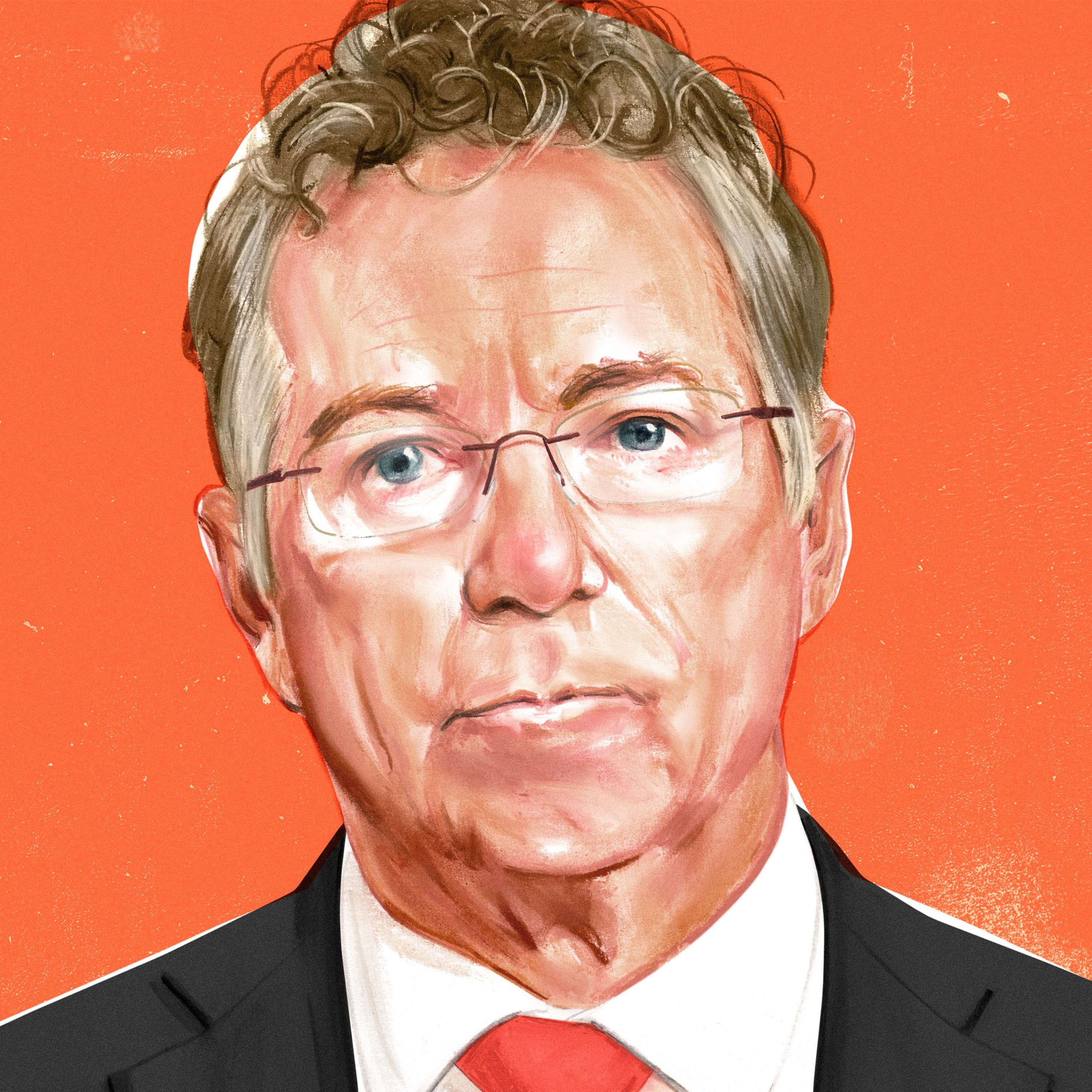
The New Yorker Radio Hour
Why Senator Rand Paul Voted to Limit Donald Trump’s War Powers
00:29:53
The libertarian-leaning Republican discusses his effort to restrain the President’s actions in Iran, and how he would campaign against other G.O.P. Presidential candidates in 2028.
Loading summary
Transcript67 lines
- [00:00]
WNYC Studios Announcer
WNYC Studios is supported by Odoo. When you buy business software from lots of vendors, the costs add up and it gets complicated and confusing. Odoo solves this. It's a single company that sells a suite of enterprise apps that handles everything from accounting to inventory to sales. Odoo is all connected on a single platform in a simple and affordable way. You can save money without missing out on the features you need. Check out Odoo at o d o o.com that's o d o o.com
- [00:33]
Senator Rand Paul
the
- [00:33]
WNYC Studios Announcer
New Yorker Radio Hour is a co production of WNYC and the New Yorker.
- [00:39]
David Remnick
Welcome to the New Yorker Radio Hour. I'm David Remnick. There was a time when libertarians in politics seemed extreme somehow, their concerns esoteric. The core libertarian principle of a small, even minimal government aligned with the Republican platform, but just to a degree. At the same time, libertarians have often taken a very distinct approach on civil liberties and many other social issues. But as Donald Trump tries to impose a more and more authoritarian style of government, one of the most consistent critics within his party has been Rand Paul, the libertarian leaning senator from the state of Kentucky. Senator Paul was the sole Republican to vote in favor of restricting Trump's power to prosecute war in Iran, one of the few remaining deficit hawks. He's bucked Donald Trump's priorities on tariffs, funding the Iran war, and the ballooning budget for ice. During a fight over the tax bill last year, Trump said, rand Paul, quote, loves voting no on everything. He's called him a sick wacko. Rand Paul ran for president in 2016, and he may well be a contender in 2028. And we spoke this past week, Senator, we're going to talk at some length about the war in Iran and about President Trump. But before I engage the war itself, it's not gone unnoticed in a lot of circles, whether left, right or center, that the nature of the things that the president has said and how he said it, whether it's about wiping out a civilization of 92 million people or just how he's conducted himself in the course of these wars, has been very worrying to a lot of people, whether in the Republican Party or Democratic Party. What is your sense of his behavior, his utterances, his language? Are you confident in his ability to carry out his office?
- [02:44]
Senator Rand Paul
You know, I think when we talk about diplomacy or how you achieve peace after you're at war, there are a lot of people who have commented over time things that are necessary. You know, one is to recognize that your enemy or your adversary needs A way to save face. They need a way to come to peace. And that if you insult them or make this about a religious nature or that, you know, make this about unconditional sort surrender or an absolute desolation of a civilization, that it makes it harder for an enemy to come to peace. And I think most of the things that I've heard that trouble me and worry me about trying to find peace in Iran is that, you know, people quoting the Old Testament about smiting the enemy. If this becomes Christians versus Muslims, I don't see a quick end to a war. I see a war that if you're a religious zealot and people tell you that we're attacking you because of who you are, or they mock your religion, I think it makes it much more difficult to find peace. And I want peace, the sooner the better, for many different reasons. And so my advice would be that talk is good, diplomacy is good, but if I want something from you, I wouldn't start out by insulting you or I wouldn't continue to provoke you by saying something about your religion. We're unlikely to find peace. So I think these things all make peace less likely and make war more likely for a lot of people.
- [04:10]
David Remnick
The fact that Donald Trump declared himself an America first non interventionist politician was attractive. I think that was attractive to you, despite whatever other policy problems you had with Donald Trump. What happened? He seems to have turned on a dime.
- [04:30]
Senator Rand Paul
Well, I've said too much time with Lindsey Graham, but the irony is that I would say Lindsey Graham and John Bolton are somewhat the same creature. They're both neoconstructing conservatives who almost always believe in intervention, almost always believe war is the answer, that diplomacy is not, and that strength is the way we should present ourselves to the world. But the interesting thing is John Bolton was cast out, Lindsey Graham remained. But really, John Bolton's ideas are winning this White House in a way that to me is probably contradicts so much of the rhetoric and the campaigning of Donald Trump over the years. It really is. What drew me to his campaign and drew me to support Donald Trump was the idea of less intervention overseas. I don't know if I'd call him a non interventionist, but I'd certainly say he's for a more restrained foreign policy, less intervention, less chronic war. And the interesting thing is, if he were sitting here right now, I think he'd still say he is. And I think he would argue that it doesn't mean I'm not going to use force. I'm just going to Use a lot of it for short periods of time, that I'm going to come home. And it's why my hope still is that there will be a fairly quick end to the war. I wasn't for the war. I'm not for the war. But I think the war could end quickly, if that's still what he wants. But that's why it's useful maybe for someone like me to point out that unconditional surrender rarely happens in war.
- [05:55]
David Remnick
Was there an imminent threat to the United States preceding these attacks?
- [05:59]
Senator Rand Paul
I've seen no evidence of that. The intelligence reports show no evidence of a change or an increase in the centrifuge activity, a change or an increase in the enrichment of uranium. We were told last summer by the Trump administration, after the 12 day war and the bombing of the new nuclear facilities, that they were obliterated. So either they were or they weren't. Tonight I can report to the world that the strikes were a spectacular military success. Iran's key nuclear enrichment facilities have been completely and totally obliterated. Iran, the bully of the Middle east, must now make peace. Most of us said at the time that enriched uranium isn't really obliterated. It probably remained. It could have been spirited out before the attack, or it could have been found in the remnants of the wreckage of the attack. But no evidence. And this was reported. You know, when Tulsi Gabbard testified recently before the House, one of the lines that was in her report was there was no evidence of enhanced nuclear enrichment. It's not to say it's not a risk, but it's about the same risk that it's been for decades. So there was no imminent reason. And a lot of people misinterpret the War Powers act to say that it's just a reporting requirement after its 60 days. It actually says in the beginning of the War Powers act, you don't go to war at all unless it's been authorized by the. By the Congress, declared by Congress, or there's an imminent threat. So the first obstacle you have to meet is imminent threat. And when they say, well, they declared war on us 47 years ago, well, that's a stretch. But that also wouldn't be very imminent if it was 47 years ago. So I don't think there was an imminent threat or an imminent change. It's not to say I don't think they're a threat or to say that a nuclear weapon is a threat. It's just to say that there was no imminent a threat and there was Plenty of time. Look, it took two weeks to send all of our ships and planes over there. During that period of time, there was going to be no surprise and there was plenty of time for Congress to meet to vote on this.
- [08:01]
David Remnick
I talked to a lot of analysts in Israel, in the Gulf, in the United States, and a number of them say, independent of their politics, generally speaking, that the original sin here, what's caused the problem, is that because Donald Trump couldn't stand to see a success from the Obama administration stand, that his decision in 2018 to get rid of the JCPOA, the Iran Nuclear deal, is the origin of this disaster. Do you agree?
- [08:34]
Senator Rand Paul
I don't know if it was made out of petulance towards Obama or towards trying to mete out a failure to President Obama. I do think that it was a miscalculation to think that maximum pressure and more sanctions would change their behavior. I've been of the opinion, and I ask people from the State Department and from every administration, I ask them, what behavior has Iran changed because of sanctions? Or what behavior has China changed because of sanctions? What behavior has Russia changed because of sanctions? I don't think sanctions work. In fact, I think sanctions are of only of value at all if you're willing to trade, removing them for a behavioral change. So I think if you want China not to sell dual use parts to Russia to use against Ukraine, you might be able to trade relief of sanctions on China for that. But you can't tell China we're going to put five more sanctions on you if you sell dual use parts. It doesn't work. But I think you could do the opposite. I think you could reduce or repeal sanctions in exchange for behavior. And it actually might work. So sanctions actually only work in reverse. They don't work when you put them on people because unless you're an incredibly weak country, you're going to react badly to someone telling you what to do. But if someone comes back and says, oh, the carrot is I'll take off the sanctions, you might actually get some behavioral changes.
- [09:55]
David Remnick
I began by asking you about the behavior of the President. I want to ask you another question in that realm. Recently the Wall Street Journal reported that the President was excluded from the planning session about the rescue mission for the US Pilots who had been shot down over Iran because he was being too disruptive, that he was getting in the way, that his temper was such, and he was acting erratically. What credence do you give to such reports? And doesn't that present a danger to the nation?
- [10:27]
Senator Rand Paul
I have no information about it. I don't know if it's true or not. My first suspicion would be that it's not true. I know Donald Trump pretty well and I know him not to be a shrinking pilot. And I don't see him being excluded from any meeting in his administration. So my first thought would be not true.
- [10:44]
David Remnick
But what about the description of his behavior as erratic?
- [10:48]
Senator Rand Paul
You know, I haven't seen any evidence of that. If you look at back, if you look for consistency, I'm not saying I agree. I've been an all parts critic, you know, of a lot of things for the administration. But if you look at Donald Trump, there are several things I think that have been true for 30 or 40 years. He felt like the southern border was a problem. We had to do something about it. He did, and I think that was largely a success. In the first couple of months, he did something Biden could never do, controlled the southern border. I think he also has been against trade and feel like we're ripped off on trade. I think he's wrong, but he's always been that way for 30 years. And I think he's always been a little bit of, even though he's been restrained against land war, he's always been a little bit of a hawk and taken Israel's line as far as Iran being this imminent threat. So I don't know that any of that has changed really. People were surprised by the Iran war and I was hopeful that it wouldn't occur. But I think if you look at his rhetoric over time, he's all, you know, he's been sort of all in that Iran is this dire threat for a long time.
- [11:50]
David Remnick
You are a pretty lonely voice in Congress, especially in the Republican Party, about insisting on approval for this action. Why are you such a lonely voice in your party? Is your party really the cult that it's described to be? Is it far too obedient to the president?
- [12:08]
Senator Rand Paul
I think, to be fair, both parties are. And so I'll give you an example. During the Biden administration, I was opposed to national emergency power of the president and thought that when a president declares it, it should automatically expire after 30 days unless affirmed by Congress. And this is a reform of emergency power. I had mostly Republican supporters. Many of them have fallen away as we have a Republican. But I also have more Democrat supporters now than I had during the Biden administration. So I think both parties are guilty of judging behavior based on who is in the White House. And so, for example, on trade and on presidential authority, you know, Biden continued some of the trade policy of Trump, some of the tariffs continued through executive order. There wasn't a whole lot of Democrat pushback in the last administration. Now there's considerable and I'm glad that there's a number of people for it. But I would say there's guilt on both parties. It's not a one way street that only Republicans defend the president of their party. Democrats do likewise.
- [13:11]
David Remnick
There's no question that Donald Trump has insisted upon a stronger and stronger presidency and he's not the first one in American history, but he's a dominant voice in this. When people describe him as having authoritarian power tendencies, do you agree?
- [13:32]
Senator Rand Paul
I would lump all the presidents together. And really our founding fathers looked at it that way too. They didn't look at one bad president, one good president, one authoritarian, one non authoritarian. They looked at that every individual by the very nature of their imperfection. One of the imperfections of men and women is that they once given power, want more. That power is a corrupting force.
- [13:56]
David Remnick
And so you'd say that's no more in Donald Trump than it is in Barack Obama or George Bush.
- [14:01]
Senator Rand Paul
Well, well, I'll give you, I'll give you an example, a more recent example. So Biden, during his administration through executive authority got rid of the student loans and says you don't have to pay them. The court told him no and he just simply kept doing it. You know, he really was acting outside the law in a unilateral excess of executive power. You can argue President Trump has done the same and I have made criticisms of that, but I don't see a lot of difference between the two on that. I, Trump is a more activist president because he's a more active person. I think you had President Biden in his decline and I don't think he was nearly as active, but he was active in the sense of breaking the law, particularly on the student loan problem, in a similar way that Trump has been active. But on war, they've all been the same. There's been not a dime's worth of difference between Republicans or Democrats on usurping the war authority. There's been almost none. You know, I criticize President Obama for bombing and setting up up air patrol over Libya in 2011 without the authority. Now the only difference was is we had enough of a rally of people then that we did chasten him and he didn't go further into that. But he think he still did act illegally in setting up the no fly zone over Libya, although during the Bush administration and also the results turned out to not be so good either.
- [15:25]
David Remnick
The run up to the Iraq war is chaotic and horrendous and the as it was and the result being the misery that we know. There was a vote in the Senate.
- [15:36]
Senator Rand Paul
Absolutely. And so I do point back to that, that yes, we did actually vote in Congress both after 911 for the war that became the Afghan war, and we voted again for the Iraq war. Now it was almost unanimous after 9 11. I point that as the time when we were attacked, when even someone like myself as against war as I am, I would have voted to go back and.
- [15:59]
David Remnick
But there was nothing here.
- [16:00]
Senator Rand Paul
People who attacked us during the Iran
- [16:02]
David Remnick
for Iran, there was absolutely nothing.
- [16:04]
Senator Rand Paul
And that's why it's incredibly important that we do have voices that stand up on both sides and say this isn't what our founding fathers intended. This isn't what the Constitution dictates.
- [16:14]
David Remnick
I understand that. But to compare it, it seems incomparable. It seems like President Trump's behavior was far more sudden. There was no justification or explanation for the war to the American people or to our congressional representatives. There was a negotiating process that went on and overnight at 2:00 in the morning, there was a taped announcement that we're going to war with Iran. That seems radically different than the past.
- [16:45]
Senator Rand Paul
It's without question a war of choice. And it's not my choice. I don't support it.
- [16:55]
David Remnick
I'm speaking with Senator Rand Paul of Kentucky. We'll continue our conversation in a moment. This is the New Yorker Radio Hour. Hi, New Yorker Radio Hour listeners, this is Adam Howard and I'm a producer on the program.
- [17:19]
Senator Rand Paul
And we want to hear from you.
- [17:21]
David Remnick
We have a few questions, a survey that will take about 20 minutes and we'll use your feedback to help make the program better. No wrong answers, just your honest take. Take the survey@newyorkerradio.org survey I'll say that one more newyorkerradio.org survey, we'll be grateful. Thanks a. This is the New Yorker Radio Hour. I'm David Remnick and I've been speaking today with Senator Rand Paul of Kentucky. He's the chair of the powerful Homeland Security and Governmental Affairs Committee. Rand Paul was a doctor, an eye surgeon, before entering the Senate in 2011. He followed in the footsteps of his father, Ron Paul, a Texas OBGYN who went to Congress and then campaigned three times for the presidency. Rand Paul himself entered the presidential primary in 2016, and now he's weighing a run again in 2028. And if he does run, he would carve out a lane. As a Republican who's notably disagreed with Donald Trump on a wide range of issues, causing the president to rebuke him in his inimitable way. We'll continue our conversation now. Do you get punished by President Trump for disagreeing with him?
- [18:42]
Senator Rand Paul
We have separate branches of government. I can't be told to go to my room. It doesn't work. Didn't work well when I was a teenager and certainly doesn't work well now. But there is no form of punishment that will probably work. And the thing is, the more I am in a small minority, the more from my point of view, I figure it's necessary. And so I continue. Look, I had a good job before I came here. I can go back to being a physician and there isn't some sort of permanence that is I am here and you know that getting rid of me is not something that can happen. It could happen, it may happen. But I think someone has to speak truth to power. And it's even more important when it's from the same party. People expect the other party to do it. It's less expected when it's from within a party.
- [19:33]
David Remnick
But there's so little of it from your party, it's almost absent. So much so that you are seen as this radical exception. And therefore we hear discussions about cult like behavior in the Republican caucus in Congress. How do you react to that?
- [19:50]
Senator Rand Paul
I think it's important for the future of the Republican Party to remember that we believe in principles, that we aren't a party of a person. I say this all the time. We were and had a large portion that was for free markets, free trade. The more libertarian wing of the party, even among traditional Republicans, of believing that trade makes us richer as a country. In fact, most economics departments for the last 70 years have taught that, Republican or Democrat, that trade is good, it makes us all richer. So it is important that we not lose that. I don't want the Republican Party to be lost either to blindly following one person, but also to lose our bearing in the sense that the things that made America great, that made America rich and, and made us great beyond belief were capitalism and our capitalism and free markets and the ability of innovation to occur and international trade. So I continue to fight for those every day.
- [20:43]
David Remnick
Senator, how do you feel about the Secretary of Defense, the Secretary of War, whatever he's calling himself, Pete Hegseff, conflating his job as a warrior, as he puts it, with religion in his rhetoric, which is not an exceptional Thing it seems to happen in, you know, loads of his public utterances.
- [21:05]
Senator Rand Paul
And I say the same to every
- [21:06]
David Remnick
American who wants peace through strength.
- [21:11]
Senator Rand Paul
May Almighty God continue to bless our troops in this fight.
- [21:15]
David Remnick
And again to the American people, please
- [21:17]
Senator Rand Paul
pray for them every day on bended knee with your family, in your schools,
- [21:26]
David Remnick
in your churches, in the name of Jesus Christ.
- [21:30]
Senator Rand Paul
Yeah, I think it is a terrible and tragic mistake to take one's religion and justify war and also to take one's religion particularly and sort of come up with the Old Testament takedown that we're going after these infidels or these pagans. If you make the war in Iran one between Christianity and Islam, this is a war that doesn't end. It's a war that goes on, on and on and on. And what you do is it is a country that's ruled by religious zealots. You know, peace is a lot less likely to happen if you tell them, hey, the Christians are coming and we're going to control your oil in your country. So it's a bad thing. And it's a really bad. You know, I think people say, oh, throughout our history, if we've quoted religion. Well, we have, but more in a generic there is providence. And that the, you know, the commander in chief is trying to do all of these things and particularly in a defensive manner and defending one's country. I think it's easier to say that, you know, and may God be with you and God is with us. But the idea of specifically saying, you know, the Old Testament's commanding us to come in and smite our enemy or, you know, quote quoting Pulp Fiction, none of that stuff, I think is admirable, nor is it useful in trying to come to a peace.
- [22:48]
David Remnick
How is the war going to affect the midterms for your party?
- [22:53]
Senator Rand Paul
I think it's always difficult, you know, for the president's party to do well in the off election year. So there's a lot of history and reasons why people tend to sort of see something and then react to it. So I think this is going to be a difficult election. I think the war makes it worse. In my experience, one of the things that people notice and write letters to the editor about is the price of gas. When you meet people that are only filling their car up halfway because they can't afford to fill it all the way full, it's a big expense for people, and people calculate how much it costs them to go to work. If they live 30 or 40 miles away, they know what that expense is each year. So I think the war is not good for the elections. And right now, unless the war can end, the sooner the better. And I want that because I don't want our soldiers to die. I don't want us to spend billions of dollars. But I also want it because I think the economy will do better and I think my political party won't do very well if we're still at war in another month or two.
- [23:53]
David Remnick
Are you losing faith with Donald Trump?
- [23:56]
Senator Rand Paul
You know, there are many things that he does very well that I'm a fan of. For example, I think one reason the economy still percolates along and does pretty well is because of the permanence of the tax cuts. The idea that if I'm a construction guy and I buy a bulldozer and it costs me $150,000, that I can write that off in one year, those are all good things. The expensing provision, the lowering of the tax rates, leaving more money in the economy. Absolutely. I agree with that. Getting rid of the Department of Education, sending that back to the states, trying to make it smaller. I agree with not letting 8 to 10 million people come across the border unaccounted for. I agree with that. There's been significant criticism on other fronts. But, you know, if I had the choice, and it's Donald Trump versus Kamala Harris, without question, I choose Donald Trump a million times.
- [24:45]
David Remnick
So you're willing to absorb the behavior that comes along with it. He's called you a sick wacko. How do you.
- [24:51]
Senator Rand Paul
How do you.
- [24:51]
David Remnick
Well, you're laughing, but I don't think Barack Obama or George Bush or any of you, his. These predecessors would ever dream of using such an epithet.
- [25:01]
Senator Rand Paul
Well, I'm not saying I love that or love the attacks, and I'm not saying I love every policy. And I haven't been quiet about it. I object, and I do speak my mind on the policy, and I object to things on a daily basis. But I don't think you can lose sight of it's all of the policy. So if it's all of Donald Trump versus all of Kamala Harris, you know, I want what's good for our country. And I don't think, you know, big government and control of everything and regulations everywhere and expenditures without limit is a good thing from either party. And so I think there are problems with the debt on the Republican side. But look at what.
- [25:38]
David Remnick
But that instability, that behavior, you don't think that erodes our standing in the world to a way, to a degree that's really deleterious, right?
- [25:50]
Senator Rand Paul
Well, the thing is, is some of it I see, has actually been helpful. For example, I think that Ukraine is more of a concern of Europe than it is of ours. They believe in this domino theory, which was basically discarded 50 years ago. But if they believe in it, and they think Russia is going to conquer all of Europe, Europe needs to rise up and pay more.
- [26:09]
David Remnick
And you're willing to turn your back on Ukraine.
- [26:11]
Senator Rand Paul
And frankly, with regard to NATO, I think that Donald Trump's been right with NATO. The European countries need to pay more. You know, the thing is, you have the little Baltic countries, Germany, Poland, they ought to be rotating troops in and out of there. Now, Germany has started to do this, but that's where it needs to be. I mean, it's much easier to convince somebody who lives in Germany or Poland that Russia is a problem than it is somebody who lives in Montana. So, yeah, I do think it is largely Europe's problem. And it's not turning your back. It's saying that this is largely a European problem. But we also have to understand that NATO is part of what brought Putin into Ukraine because we rattled the cage, our country and the Europeans all saying, we're going to put this former part of the Soviet Union into NATO. That was incredibly provocative. You know, we haven't learned a less from it. In my committee in Foreign Relations, they're still beating the drums to put Georgia, the country of Georgia, into NATO. You want another civil war? You want another Ukraine? Senator, put Georgia in NATO.
- [27:10]
David Remnick
Senator, I know we have limited time. What happens very soon as people start Talking about the 2028 elections? Your name has been mentioned that you're thinking about running. So far, probably Marco Rubio and J.D. vance are the top candidates. How would you differentiate yourself against them? You, in fact, are against this war. Would the Iran war be a critical issue for you in a 2028 run?
- [27:35]
Senator Rand Paul
That'd definitely be one issue. Being for a balanced budget would be another that I don't believe that expenditures, even if they're military expenditures, are something that should be unlimited. On trade, I think trade makes our country richer. If you look at the curve of GDP per capita over the last 100 years, it's an exponential curve. Jonathan Hyde has called it the most incredible chart in history, the history of mankind, because of looking at the extraordinary wealth that's come with the Industrial Revolution. So I don't think any of them are talking about that. They all seem to hate trade. They all seem to think the debt's not a problem, and they all seem to think war is glorious and we should have a Department of War and we should parade around spouting the Old Testament about smiting our enemies. I think there's a clear contrast.
- [28:23]
David Remnick
It sounds like you think you could win in 2028.
- [28:26]
Senator Rand Paul
I think that what I'm for attracts more. Here would be a good poll to do, and this would be great for the Yorker to do. Poll independents and put a bunch of names out there, Republican and Democrat, and see who gets more independent. Vote me or JD Vance. Me or Marco Rubio. I think you find the independents aren't too excited about war in Iran right now. They're not too excited about the gas price. They're not too excited about the military industrial complex. And many independents, I think, believe that trade has actually made us rich or not poor.
- [28:56]
David Remnick
Who might you expect to oppose on the democratic side in 2028? Who do you see as emerging there?
- [29:03]
Senator Rand Paul
I think it's actually even more wide open than the Republican side. I really don't know and don't follow the internal politics enough to know who's gonna come forward. But I haven't seen anybody that I think is going to dominate the political debate. I could be surprised, but I haven't seen anyone yet.
- [29:18]
David Remnick
Not Gavin Newsom.
- [29:20]
Senator Rand Paul
You know, all I think about every time I hear Gavin Newsom is when he told me and other regular people we couldn't go out to eat. He was at the French Laundry eating, you know, drinking $500 bottles and eating a $2,000 dinner and whooping it up. And his kids are in private school while the rest of us were stuck not going to school for a year and a half. I don't think people. People don't like hypocrisy. I don't think they care whether it's Republican or Democrat. They don't like hypocrites.
- [29:47]
David Remnick
Senator, thanks so much. I appreciate your time.
- [29:50]
Senator Rand Paul
Thank you.
- [29:55]
David Remnick
Rand Paul has served as Senator from Kentucky since 2011. I'm David Remnick and that's our program. Thanks for listening. See you next time.
- [30:10]
WNYC Studios Announcer
The New Yorker Radio Hour is a co production of WNYC Studios and the New Yorker. Our theme music was composed and performed by Meryl Garbus of Tune Yards with additional music by Louis Mitchell. This episode. This episode was produced by Max Balton, Adam Howard, David Krasnow, Jeffrey Masters, Louis Mitchell, Jared Paul and Ursula Sommer with guidance from Emily Botine. And we had assistance this week from Pran Bandy. The New Yorker Radio Hour is supported in part by the Cherina Endowment Fund. Spring is the perfect time to refresh your wardrobe. And Old Navy is making it easy with wow Denim. Old Navy's wow Denim is all about the styles and washes you'll love at prices that make it easy to say yes. Try a new fit, whether it's a mid rise boot, high rise wide leg, or a relaxed, baggy vibe. And with WOW prices Starting at just $22, grabbing more than one pair is a no brainer. Shop wow denim now@oldnavy.com or head to your nearest Old Navy store. Today, WNYC's journalism and storytelling is heard by millions of passionate listeners. Sponsors of our programming gain our listeners attention and their respect. Learn about how your organization can support WNYC and wnyc studios@sporship.wnyc.org.