Loading summary
Transcript76 lines
- [00:02]
Krisha Collier
You are listening. You're listening. You are listening. You're listening to a TVO Today with TVO Today. TVO Today podcast, A listener note. The following podcast contains course and sexual language, descriptions of violence and sensitive themes which may not be suitable for younger audiences. Listener discretion is advised. Imagine being a fly on the wall during someone's therapy session. It's pretty rare. What might you hear? You'd likely hear about their deepest secrets, their biggest traumas, their worst fears. Honestly, I can't think of a place where someone would be more vulnerable or that's why therapists are expected to meet the highest levels of professionalism and trust. But what happens if the doctor violates that trust?
- [01:02]
Patient X
He was like a father figure to me. He was a very significant, authoritative figure in my life who I trusted with my well being and he exerted great influence on my decision making.
- [01:16]
Krisha Collier
This is patient X and the person he's talking about is his psychiatrist, Dr. Melvin Lawrence Izco. We've changed Patient X's voice to conceal his identity. He's going to take us inside his sessions and walk us through his memories of how he feels. Dr. Izkov twisted his emotions to confuse him.
- [01:37]
Patient X
Pretty early on, he tried to convince me that I was homosexual. I was quite adamant that that wasn't the case. I was genuinely interested in women. I was quite shocked and horrified when he tried to convince me of this. And I was too afraid to talk to my parents and tell them that this was going on.
- [01:57]
Krisha Collier
Did you see him as someone who's helping?
- [01:59]
Patient X
I unfortunately found myself in a very vulnerable position with somebody in a place of authority who utilized his, you know, knowledge and influence to. To groom me. I couldn't have seen that coming. I still wonder how my life might have been different had this not happened.
- [02:26]
Krisha Collier
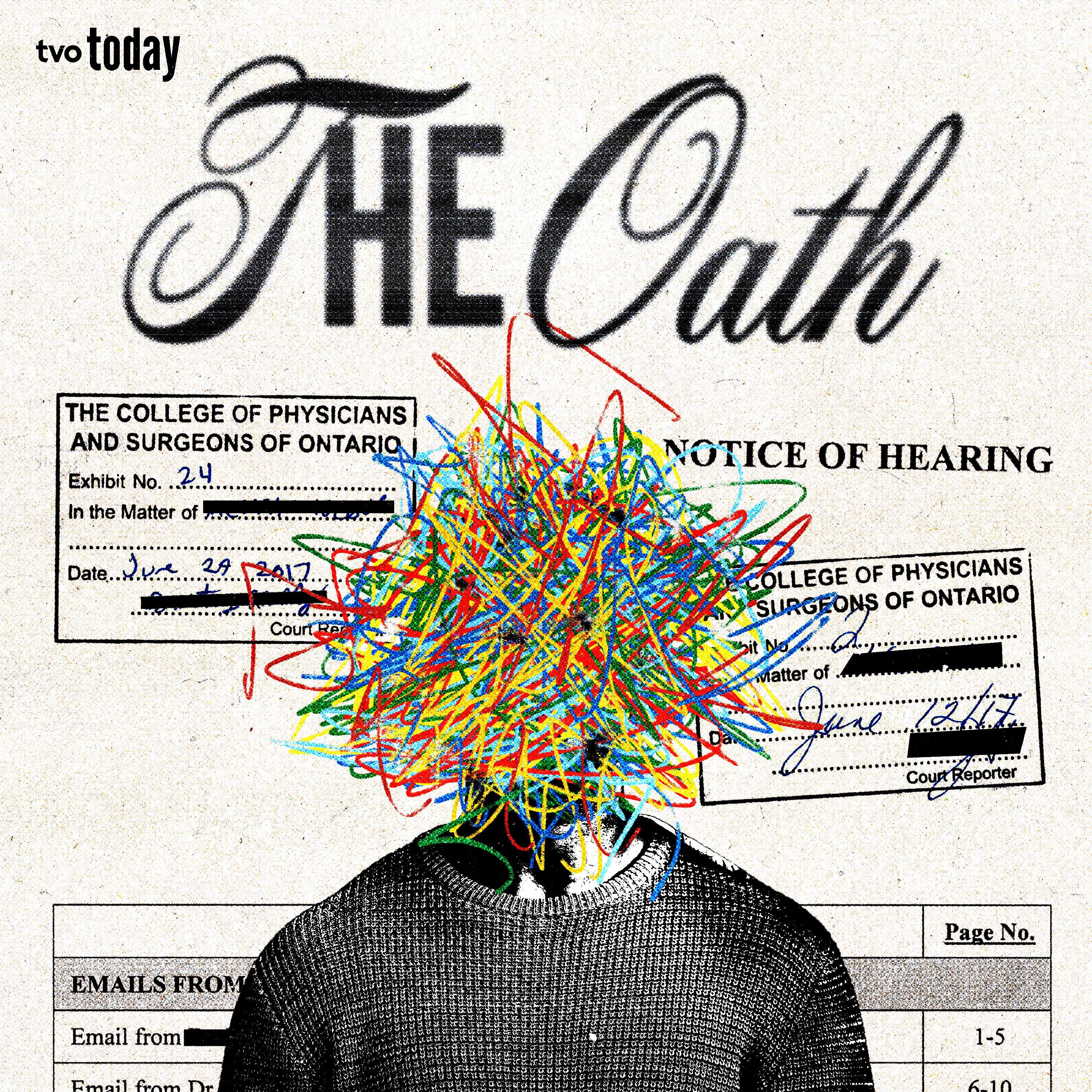
For TVO today, this is the Oath. I'm Krisha Collier. This is episode one, the Case. I've been a journalist for 15 years and more than a year ago, I was looking through court cases online, as I sometimes do when trying to find story ideas, when I stumbled across a hearing that stood out. It was about Dr. Izcove and how he lost his medical license in 2018 for allegedly sexually abusing two of his male patients, including the man you just heard from. In Ontario, most complaints against doctors are dealt with by the province's medical regulator, the College of Physicians and Surgeons of Ontario, CPSO for short. So these aren't criminal investigations, but they're serious nevertheless. Izcoaf was accused of two different acts of professional misconduct. The first Sexual abuse of patients. The second, engaging in conduct that would be deemed disgraceful, dishonorable, or unprofessional. Their words. One example, Izcov allegedly sold things to a patient. Essentially, it all boils down to boundary violations. Izcove adamantly denied both allegations, by the way. We'll explore that in an upcoming episode. But the CPSO's Discipline Committee found the accusations credible. That's why the college revoked his medical license. Izcov was in his early 70s at the time. To be honest with you, the allegations themselves weren't the shocking part for me. And I don't mean that flippantly. It's just a lot more common than you'd think. Google it. You'll see a lot of cases. I've investigated stories about sexual abuse and assault several times in my career. But the more I read the written decision from the discipline committee on this particular case, the more unusual it seemed.
- [04:54]
Brennan Lefler
Hi. How you doing?
- [04:54]
Krisha Collier
Good, how are you?
- [04:56]
Brennan Lefler
I'm good.
- [04:57]
Krisha Collier
That's my co producer, Brennan Lefler. You'll be hearing from him a lot throughout this series. He's covered stories involving the CPSO before, so I brought him in to get his thoughts. Did you see the case?
- [05:10]
Brennan Lefler
Yeah, I read it. It's really weird. And these books that he was giving out.
- [05:16]
Krisha Collier
Yeah, that really hit me, too. Like, I feel like there's more here.
- [05:20]
Brennan Lefler
I think that there's definitely more than they're writing about. I mean, I haven't seen anything like this before.
- [05:26]
Krisha Collier
Okay. I definitely think there's something there, and I think we should look into it. Okay, thanks, Bren. I'll talk to you a little bit later.
- [05:32]
Brennan Lefler
Yeah, talk to you later.
- [05:33]
Krisha Collier
Bye. Let's take a pause here for a moment. I need to tell you a bit about how the Ontario Physicians and Surgeons Discipline Tribunal works, because it's a big part of the story. At the time of Izcoast's hearing, it was known as the Discipline Committee. It's a quasi judicial court. It holds hearings with lawyers and witnesses, similar to a regular court system. But it can't lay criminal charges, and it can't convict anyone of a criminal act. The worst it can do is strip a physician of their medical license. But again, it's not a criminal court, so we need to be clear. We don't think criminal charges were laid against Izcov, and we couldn't find any evidence that the police investigated Izcov's conduct at all. So Brennan and I spent a lot of time trying to figure out exactly what happened and how? We started by searching for Izcov's two accusers, whose stories are outlined in the committee's decision. We're calling them Patient X and Patient Y. Their identities are both subject to a publication ban.
- [06:46]
Patient X
Check, 1, 2. Check, check, check, check. 1, 1, 2, 3, 4, 5.
- [06:50]
Krisha Collier
Patient X did agree to meet with me and talk. He told me he began seeing Izgov when he was a teenager.
- [06:57]
Patient X
My parents were patients of his back in the 80s. And then around the age of 17, 18, I've started experiencing feelings of malaise and anxiety and told this to my parents, and they suggested I go speak to Mel about it, which I did, apprehensively.
- [07:16]
Krisha Collier
Patient X says the therapy continued on and off for about 20 years. During that period, he says, he became really dependent on Izcov.
- [07:27]
Patient X
I was pretty naive and inexperienced, and he had a pretty strong Persona and made great efforts to discredit other therapists and other modalities of therapy, and I was fearful to go elsewhere.
- [07:41]
Krisha Collier
There's one thing I want to point out right now. In its written decision, the committee said Iscov, quote, has a special interest in the treatment of patients with problems related to homosexuality. It's important to keep that in mind because it's going to come up a lot. When he started saying, oh, I think you're gay, started saying, oh, I think you're homosexual.
- [08:03]
Patient X
Yeah.
- [08:04]
Krisha Collier
Was that pretty early on or early on?
- [08:07]
Patient X
I would say it was probably in the first several appointments that we had.
- [08:11]
Krisha Collier
And so you felt like he was pressuring you to say you're gay?
- [08:15]
Patient X
Yeah, I think there was a great deal of pressure to acknowledge that and to, I don't know, submit to that on some level and accept it, and it just didn't ring true for me.
- [08:32]
Krisha Collier
And so how often would he bring up your sexuality?
- [08:35]
Patient X
Oh, every. Every appointment that I mean, Ironically, I think it increased, if anything, my anxiety and depression.
- [08:43]
Krisha Collier
Now, this is where things get kind of weird. In order to understand what happened to Patient X, we had to go all the way back to New York city in the 1940s and 50s to a mostly forgotten psychoanalyst named Dr. Edmund Burglar. Patient X remembers Izkov bringing Burglar up early. And often we'll get into the connection between them later. But for now, what you need to know is Izkov is a fan.
- [09:13]
Patient X
You got me to read some passages from the Burglar's books on homosexuality. You gave me reading material to take home with me.
- [09:22]
Krisha Collier
Much of Burglar's analysis focused on neuroses and psychic masochism. And some of his books do contain outdated ideas, most notably that homosexuality is an illness that can be cured. Remember, the height of Burglar's career was more than 70 years ago, but he's mentioned dozens of times in the decision because Izkov promoted Burglar's work a lot.
- [09:45]
Patient X
He told me not to talk to anybody about this, that it could be damaging, or that they might not understand that there was opposition to this kind of therapy.
- [09:58]
Krisha Collier
We weren't able to connect with patient White, Izcov's other accuser, but he did talk to the CPSO. He said IzCOV also cautioned him against telling anyone. Since most hearings are public by law, we wanted to see if we could learn more. Brennan reached out to the college to request a copy of the exhibits. Getting those wasn't easy. He made the request in February 2023. He had to follow up about 12 times before we got the documents. When we finally received them, it was late September, almost seven months later.
- [10:38]
Paul Hart
The college has prioritized privacy of physicians over transparency to the public, in my opinion, in a way that doesn't reflect the public interest.
- [10:49]
Krisha Collier
Paul Hart is a longtime critic of the way the CPSO operates. He's dealt with the organization often in his roughly 30 years as a medical malpractice lawyer. Brennan contacted him to help us make sense of what was going on.
- [11:04]
Brennan Lefler
We requested those exhibits, I think, in February, and we got them last month.
- [11:11]
Paul Hart
Either the college is not properly resourced, or they're taking an inordinate amount of time to respond to something which inherently should be focused on speed.
- [11:27]
Krisha Collier
The college is a self regulating body that gives it a lot of discretion to choose how cooperative to be when releasing information. Hart says in his experience, it's not unusual for it to respond slowly to requests as it did with us.
- [11:44]
Paul Hart
I have a problem, frankly, with the whole transparency of exhibits. These hearings are public by statute, but the college routinely seals the exhibits and won't release them. In my mind, there has to be a much more efficient and effective way for members of the public to get copies of the evidence, the exhibits, because without that, you're left to try and puzzle through what exactly they're talking about.
- [12:20]
Krisha Collier
These are photocopies. I printed them out. When we finally got the exhibits, we were surprised to see all these photocopies of Burglar's work. I'm gonna pass you some because there's a lot.
- [12:32]
Brennan Lefler
Okay. Yeah. Oh, yeah. There is a lot.
- [12:37]
Krisha Collier
Wow. Reviewing the pages, there were a Bunch of things that jumped out at us. A lot of it was about homosexuality, stuff like this.
- [12:46]
Brennan Lefler
So look at this book. The title is Counterfeit Sex, Homosexuality, Impotence, Frigidity. So I guess Izkove gave one of them that book.
- [12:57]
Krisha Collier
Can I show you something?
- [12:58]
Brennan Lefler
Yeah.
- [13:00]
Krisha Collier
It reads, I have used the phrase sick people deliberately. All attempts to prove homosexuality to be anything but illness have, in my opinion, failed. And it continues on other pages.
- [13:14]
Brennan Lefler
So here's another thing that Burglar wrote. The homosexual's whole personality is neurotically sick. It raises a lot of questions that Izcov was using these materials from Burglar so recently.
- [13:27]
Krisha Collier
Absolutely. It's definitely shocking to hear that today. Just to let you know, while it may feel very clinical or dated at times, we use the term homosexuality often in this podcast to accurately reflect the language used in this case. According to the decision, patient Y remembers Izkov giving or lending him about 16 of Burglar's books. One was called Homosexuality, Disease or Way of Life. The decision goes on to say, when patient Y first started seeing Izcov in his early 20s, he was struggling with depression and anxiety over fears he was gay. It pointed out patient Y understood that as far as Burglar was concerned, homosexuality was a clinically curable condition through psychoanalytic treatment with excellent chances of cure. So you can see why that got our attention. So one of the questions we're going to have to look at down the line is, is it appropriate to give burglars material to patients in this day and age, or even in the late 90s, 2000s?
- [14:35]
Brennan Lefler
Yeah, well, that's the question.
- [14:37]
Krisha Collier
Right.
- [14:38]
Brennan Lefler
So you can kind of get like, maybe in the 50s and 60s that maybe that's the way psychiatrists thought of homosexuality. But now sexual orientation isn't viewed as a condition to be cured.
- [14:50]
Krisha Collier
Exactly. As recently as the late 1960s, homosexuality was classified as a mental disorder. That belief has long been debunked. In fact, it was cut from the Diagnostic and Statistical Manual of Mental Disorders, known as the DSM in 1973. The DSM is considered the gold standard by many healthcare professionals. To us, Burglar's methods sound a lot like what's often called conversion therapy, a practice that basically aims to change a person's sexual orientation or gender identity. So called conversion therapy has been widely discredited and is now illegal in Canada. But it wasn't a crime at the time ISCOV was treating patient X. Burglar's.
- [15:35]
Patient X
Theories about homosexuality, I think, were part and parcel of Conversion therapy. You know, he claims to have cured a number of homosexuals over the years. I think at one time, I even asked Iscove if he had cured any homosexuals of their, quote, unquote condition. And I don't remember if he answered me with a straightforward answer.
- [15:56]
Krisha Collier
In its decision, the committee wrote, Izcov was unwilling to agree. He characterized homosexuality as an illness that could be cured. But patientwise, story seems to paint a different picture. In addition to what he was reading in Burglar's books, he testified, there were certain phrases that were repeated during his therapy sessions, including Burglar's claim, there is no such thing as a happy homosexual. The decision mentions, at almost every appointment, there were discussions about patient Y's fantasies. Sometimes Izcov would ask if they were about him. Patient X testified he had a similar experience. A warning. The next section contains adult content and graphic sexual language. Were there questions that he said over and over again to you?
- [16:45]
Patient X
What are you fantasizing about? What are your. What are you thinking about? What are you not telling me? Was the favorite question. Tell me about your dreams. You know, those kinds of leading questions. When you talk about penis sucking enough and repeat it again and again, it starts to become a visual that automatically comes to mind.
- [17:08]
Krisha Collier
He would say that to you.
- [17:09]
Patient X
He would say, are you having any penis sucking fantasies? You know, that kind of thing. And naturally, when he mentioned it, then, you know, I would have a visual about what it might be like, and that's what was perpetuated. And then, of course, I was fearful that he was going to ask that question and that I was going to have to tell him.
- [17:28]
Krisha Collier
For the other complainant, patient Y, his relationship with Izcov appears to have changed. In the 2000s, he testified, Izkov offered him a hug at the end of an appointment, which he accepted. The same thing happened at two or three more sessions. But during these times, the hug was accompanied by questions. Questions, what are you thinking you want to do? Followed by, you may touch me if you like. And it went even further. The committee wrote, patient Y touched Iskov's erect penis through his trousers. It progressed to Izcov removing his penis from his pants and the patient doing the same. On later occasions, there was mutual masturbation and oral sex. Let's stop here for a second. You might ask yourself, how could a doctor have this kind of hold over their patients? So we asked Dr. Gail Robinson. She's been a psychiatrist for more than 40 years. She's been a leader in the fight against Sexual misconduct by health care providers and has even testified in court as an expert witness on sexual violence and boundary violations.
- [18:39]
Dr. Gail Robinson
With any doctor, there's an automatic power differential. First of all, the doctor is seen as somebody who's educated, probably financially better off, and in this very important position. When people are in psychotherapy, very intense emotions can get stirred up. The psychiatrist can become very idealized. So it's very easy for the patient to develop very positive feelings towards the psychiatrist.
- [19:13]
Krisha Collier
Dr. Robinson explains that sexual contact doesn't usually happen right away. It takes a while for abusers to cross that line. The patient might not even realize it's happening.
- [19:24]
Dr. Gail Robinson
It starts with just nice compliments and maybe letting the patient stay longer. And the boundary crossings are very gradual. The patient can feel, well, this is a person who makes them feel special. It's a wonderful con job. The patient doesn't know if that's wrong.
- [19:45]
Krisha Collier
Put it all together, she says, that's exactly how this kind of thing can happen. And so when he's telling you not to tell people, way back at the beginning, did you think that was normal? That made sense, or were there any red flags?
- [20:01]
Patient X
No, no red flags. He seemed legit and the real thing. And he had all the paperwork on the walls to demonstrate that he was, you know, a graduate of the U. Of T. Medical program. And so I never really questioned too much.
- [20:19]
Krisha Collier
How did things start to escalate?
- [20:22]
Patient X
I guess I was at a weak point, and I thought that, you know what, maybe there's some truth to what he's saying. Maybe I'm in denial and that I can't see what he's telling me as being true. And maybe I need to embrace this and see if it's factual or not. And so I decided and expressed to him that I was thinking about having some kind of encounter with a man in order to see if this was really something I wanted. His response was, well, it might be unsafe to do that out publicly for whatever reasons. And somehow he gave me the impression or led me to understand that that was something he and I could explore together in the safety of his office. And obviously, that should have been a huge red flag for me. But being naive and foolish and also kind of overwhelmed with some of the things that were going on with my life at the time, I couldn't really discern clearly what steps to take.
- [21:19]
Krisha Collier
Patience says in that fragile state, he and Iscov started engaging in sexual activities. He testified it started at Isco's office, and it happened about 12 times. The committee noted that the last three were at Izco's house the final time.
- [21:38]
Patient X
That we had any kind of face to face contact. He had invited me to his home and we were in his bedroom and we were getting undressed and I saw myself in the mirror and I thought, you know, this isn't who you are. So that was finally a moment of clarity for me and I basically left and that was it.
- [21:55]
Krisha Collier
But in many ways that wasn't it. It was only the first chapter. True. Melvin Izcove isn't allowed to practice medicine anymore. As we told you at the start of the episode, his license was taken away. That took years to happen.
- [22:11]
Patient X
I don't wish any bad karma on anyone. But what he did was wrong and very unfortunate because he could have helped people rather than undermining their deepest confidence.
- [22:30]
Krisha Collier
When we first started, we thought it would be fairly straightforward, getting answers to some fairly straightforward questions like just who is Melvin Iscove? Why was he using the theories of Dr. Edmund Burglar? And were there any other complaints made against him? But we were met with stony silence. Nobody was willing to say much about the case, not people we believe are Izco's friends, not his colleagues, and not the cpso. But what about Izco's other patients? What would they have to say? So we went searching.
- [23:07]
Patient Y
There are about four or five turning points in my life. He's one of them. I didn't have a sound mind because if I did, I would have ran out of there.
- [23:20]
Krisha Collier
As we found out, Isco's particular brand of treatment left a lasting impression on others.
- [23:26]
Patient Y
I was afraid of this person a long time ago. Is he ever going to own up to what he's done?
- [23:38]
Krisha Collier
That's on the next episode of the Oath. The Oath is hosted, written and co produced by me, Krisha Collier. Brennan Lefler is a co producer and writer. Sound design and editing by Damien Kearns. Editing and technical support by Matthew o' Meara. Theme music by Alison Layton Brown. Special thanks to the Barry and Lori Greene Family Charitable Trust who made this podcast possible for tvo. Katie o' Connor is the managing editor of Podcasts and Digital Video. Lori Few is the executive producer of Digital. John Ferry is Vice president, Programming and content. Thank you for listening.