Loading summary
Transcript86 lines
- [00:02]
Krisha Collier
You are listening.
- [00:03]
Brennan Lefler
You're listening.
- [00:03]
Charles Dennis
You are listening.
- [00:04]
Krisha Collier
You're listening to a TVO Today with TVO Today. TVO Today podcast. A listener note. The following podcast contains coarse language and sensitive themes which may not be suitable for younger audiences. Listener discretion is advised. Previously on the Oath. Did you see the case?
- [00:27]
Brennan Lefler
Yeah, I read it. It's really weird. I think that there's definitely more than they're writing about.
- [00:33]
Carol Dattasti
Pretty early on, he tried to convince me that I was homosexual. I was quite adamant that that wasn't the case.
- [00:40]
Krisha Collier
And so how often would he bring up your sexuality?
- [00:44]
Carol Dattasti
Oh, every appointment. He got me to read some passages from the burglar's books on homosexuality. You gave me reading material to take home with me.
- [00:55]
Brennan Lefler
With any doctor, there's an automatic power differential. It starts with just nice compliments and maybe letting the patient stay longer. The boundary crossings are very gradual.
- [01:11]
Carol Dattasti
I unfortunately found myself in a very vulnerable position with somebody who utilized his knowledge and influence to groom me. I couldn't have seen that coming.
- [01:26]
Krisha Collier
When Carol Dattasti met Dr. Melvin Iscove, she didn't know quite what to expect. The year was 1972. They were in Albany, New York. Dr. Iscove was still training to be a psychiatrist, and Carol was one of his patients.
- [01:43]
Brennan Lefler
I was nervous and full of anticipation, so I walked up. I believe it was on the second floor. He opened the door and we introduced ourselves.
- [01:56]
Krisha Collier
Back then, Carol was graduate student. A friend had told her about his sessions with Izcov, and she was intrigued because she had been struggling with her mom's death for a while. She also had some relationship issues she wanted to work through. I mean, who doesn't, right?
- [02:14]
Brennan Lefler
I was vulnerable to begin with because I asked to see him. I believed that he was going to be able to help me and that the treatment was going to help me.
- [02:25]
Krisha Collier
It's been 50 years, and you'd think her memories would have petered out by now. But Carol says she remembers her treatment really well.
- [02:33]
Brennan Lefler
The first sessions, I took notes. I wrote things down. I wrote poetry. Did he put you at ease or I have to laugh? You make me laugh because. What? I'm sorry. At ease put me at ease. You know, I would leave the session miserable. So I'm not going to forget. I am not going to forget.
- [03:01]
Krisha Collier
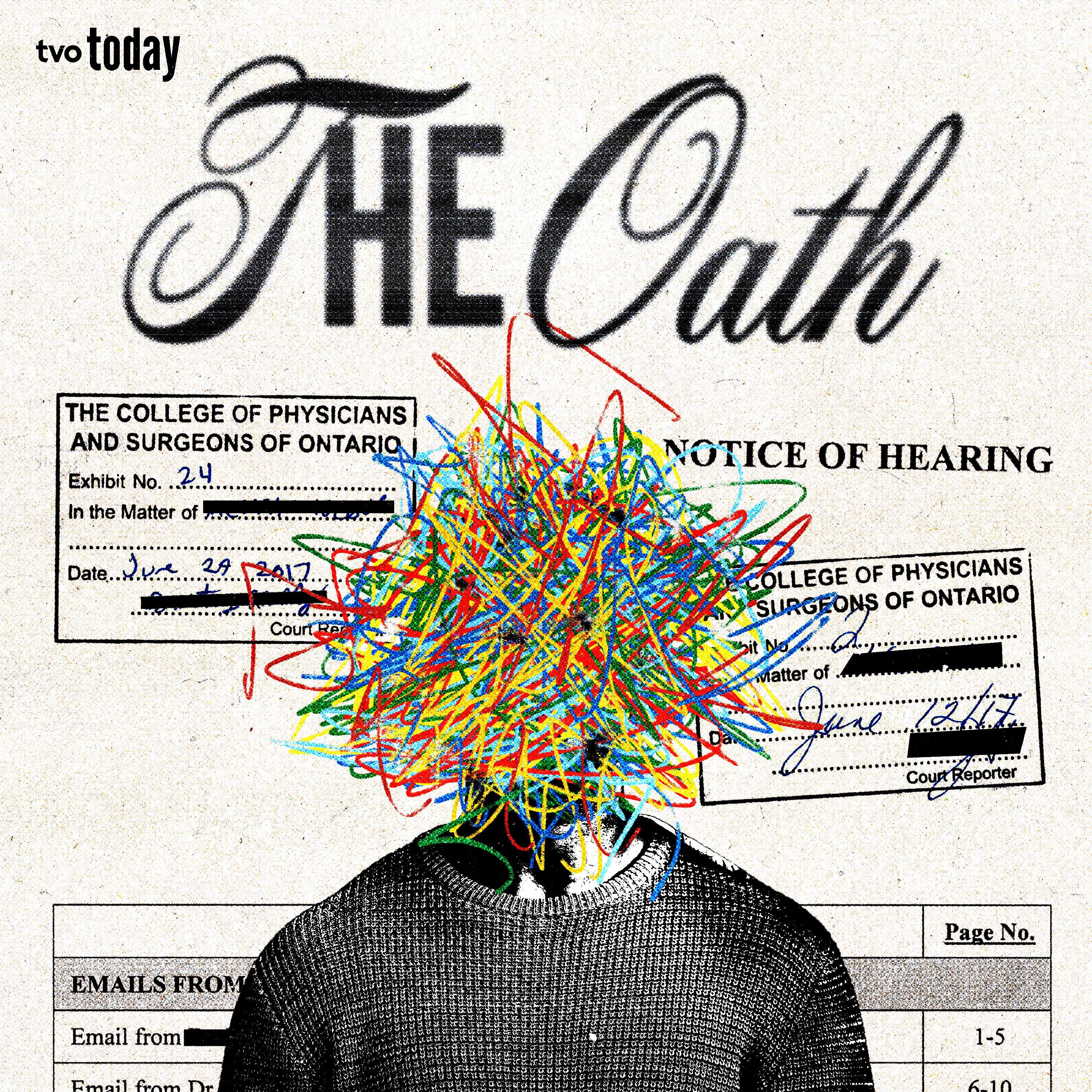
For TVO today, this is the Oath. I'm Krisha Collier. Episode 2 the Doctor. In the first episode, we told you about Dr. Melvin Iscoe's professional downfall. He's the Toronto psychiatrist who lost his medical license in 2018. The College of Physicians and Surgeons of Ontario allege he sexually abused two of his patients. In this episode, we're going to focus on the doctor himself, because people are complicated. They can be more than one thing. And Izkov was even to his accusers, according to the discipline committee's decision. One of them testified he called Izcov when he had a medical emergency, and Isco says he picked him up and drove him to the hospital. So we decided we needed to find out more about him. We scoured the Internet for information. We read comments on news sites, blogs, and social media posts, trying to find anyone who might know him. That's how we found Carol Datosti. My co producer, Brennan Leffler, tracked her down in New.
- [04:25]
Brennan Lefler
Hello?
- [04:25]
Krisha Collier
Hey, Carol, it's Brennan. How are you? I'll tell you right off the bat, Carol isn't really fond of Izcov. She hasn't seen him in a long time. But she and her friend, who also went to Iscove, still talked. Sometimes they wondered whatever happened to him. Occasionally, they'd search the web. And one day, Carol got a huge surprise.
- [04:47]
Brennan Lefler
I just happened to look online and I just googled Melvin Iscove.
- [04:53]
Krisha Collier
Bam.
- [04:54]
Brennan Lefler
I could not believe what I saw. I could not believe what I saw. What? I mean, what? I did not imagine any of this was possible. I mean, if you looked at him, he was as ramrod straight, not only in posture, but in approach toward everything. And his life was perfect. He had the wife, he had the kids, he had the house.
- [05:22]
Krisha Collier
The news about her old psychiatrist brought her right back to her treatment. In the first year, Carol says she saw Izkov twice a week at his home office. She remembers the layout of the apartment he lived in. She says you had to pass through the living room to get to the office. The path to get there was kind of narrow, mostly because one item dominated the space.
- [05:47]
Brennan Lefler
And the reason why it was so narrow is because a huge grand piano was in the living room of that apartment. Huge. Huge. Okay. So I'm like, whoa, look, you know, somebody plays a piano.
- [06:04]
Krisha Collier
That may seem like an odd detail to include, but it's not, because classical music, piano in particular, has been a big part of Izco's life. Almost everyone brought it up. Patient X, one of the complainants, said Izkov was cultured and very knowledgeable on classical music. He remembers it playing in Izcov's waiting room. Izkov is actually an accomplished pianist. He talked about it during his hearing. He testified that he got an associate diploma from the Royal Conservatory of Music when he was 15. That's considered a pretty big deal. Isco's cousin, Charles Dennis remembers Isco played with an icon of Canadian music.
- [06:47]
Charles Dennis
He played with Sir Ernest macmillan, for God's sake. And it was on the radio across Canada. You know Soloist Mel Iscove Melvin Isco.
- [06:57]
Krisha Collier
Charles grew up in Toronto, but he spent most of the last five decades abroad, pursuing a career in the performing arts. He's lived in California for more than 20 years.
- [07:08]
Charles Dennis
Mainly these days, I say I'm a filmmaker. I'm a film historian. I'm an actor. I'm a playwright.
- [07:15]
Krisha Collier
Charles admits he and Izco didn't know each other very well growing up, but they reconnected in the late 90s. Later, when Charles would come to Toronto, he says he'd stay at Izkof's place.
- [07:27]
Charles Dennis
Mel is a big, big opera buff. Several times he invited me to a dress rehearsal for the opera. People there all knew him. All the opera buffs, they all knew each other. Oh, hello, doctor.
- [07:39]
Krisha Collier
Exhibits introduced at Isco's hearings show he also invited a patient to be his guest at a rehearsal for the Canadian Opera Company, which the committee thought was a boundary violation. By the way, he donated to the Royal Ontario Museum, the National Ballet, the Toronto Symphony Orchestra, as well as the opera. From what we've heard, family was an important part of Izcov's life, too. He was married for more than 20 years. Charles says Izcov and his wife did get divorced, but he adored his children. How would you describe him as a father?
- [08:16]
Charles Dennis
Totally devoted to his three daughters, always immensely proud of his daughters and their families. And I say he was always on Skype. He was always on Skype at some ungodly hour.
- [08:32]
Krisha Collier
Isco's family came up at the hearing. He testified that he traveled overseas to help when one of his grandchildren was born. The exhibits show he shared baby pictures with family, friends and patients by email. At the penalty hearing, Izco's lawyer presented five letters of support. Four were from Patience. We got a hold of those messages, but most of the names were redacted, so we couldn't contact the people who wrote them. The one person whose name wasn't blacked out is a longtime friend. On his behalf, his wife declined our request for an interview. The letters describe Izkov in glowing terms. Professional, kind, and considerate, incredibly caring. They called the therapy helpful and extremely successful. And they said they wish they could continue. And after the committee's decision came down, apparently not everyone believed the abuse really happened.
- [09:31]
Carol Dattasti
There are other people who I know who went to see a Scov who defended him.
- [09:37]
Krisha Collier
Defended him how?
- [09:38]
Carol Dattasti
Total rejection. Total disbelief. Never happened. People are making stuff up. It's all bullshit. He would never do anything like that. Never tried anything like that with me, stuff like that.
- [09:51]
Krisha Collier
That's Henry, which is not his real name. He is one of Isco's former patients. He agreed to speak with me on the condition of anonymity. So we've altered his voice. Henry was in therapy with isco for roughly six years. He started in the mid-80s after his father passed away. How did he present himself during sessions?
- [10:14]
Carol Dattasti
Very professional. You know, always suit and tie, shaven. A regular nerdy guy.
- [10:20]
Krisha Collier
Did you ever find him caring and open and easy to talk to?
- [10:24]
Carol Dattasti
Yeah, I didn't have any problem talking to him, except to say that I expected him to do the mining, to delve into my psyche. It was more a question of him expecting me to be forthcoming. And that wasn't always the case.
- [10:42]
Krisha Collier
Henry says at the time he would sometimes disagree with Izcov's assessments, but was pretty neutral on his approach. He felt the sessions were fine, aside from a few awkward moments.
- [10:54]
Carol Dattasti
The only times that I felt a little bit uncomfortable was at the conclusion of our sessions. It was traditional for us to hug at the end of a session before I left. I didn't invite it, but I didn't try to make him feel uncomfortable about it.
- [11:13]
Krisha Collier
Hugging came up at the hearing, too. Patient Y testified Izkov hugged him. When questioned about this, Izcov answered, I do not hug my patients. When asked again, have you ever hugged your patients? Izcov responded, no, I don't hug my patients. But there were things he didn't deny. In his testimony, Izcov confirmed he asked patient X and patient Y to keep their therapy private. And Carol claims it was the same for her.
- [11:46]
Brennan Lefler
You can't discuss this with anyone. No way. I'm not supposed to discuss this treatment with my dead relatives, okay? Let alone a human being. This is just between us, okay? Just between us. Because of the doctor patient relationship, Izcove.
- [12:07]
Krisha Collier
Had a reason for that. He testified he was following recommendations set out by Sigmund Freud. Izkov described to the committee how sometimes a patient would be making progress, then talk to friends and family who don't understand the treatment, and they'd make comments like, that's what your dream meant. That sounds crazy. It sort of undermines the process. Izkov testified, quote, this is the kind of interference that Freud was aware of. After many years of work and I've seen it myself. Okay, fair enough. Charles says personally he always found Izkov to be secretive and, well, uptight and just strange.
- [12:48]
Charles Dennis
No, it was very secretive. You know, it took me a year of different visits on and off to get the. He would have to reset the WI FI for me. He'd never give me the password. I mean, in retrospect, so friggin weird. He was peculiar.
- [13:08]
Krisha Collier
What made him peculiar?
- [13:11]
Charles Dennis
Just something about his. His aura, his bearing and everyone's got the right to be peculiar as long as you don't frighten the horses. And he was frightening the horses, it turns.
- [13:24]
Krisha Collier
In 2016, after years of staying with his cousin during visits to Toronto, Charles says he and Izcov had a falling out. They haven't spoken since. He would have been under investigation by the college, right?
- [13:40]
Charles Dennis
Oh, I have no idea.
- [13:41]
Krisha Collier
Yeah, he never mentioned anything.
- [13:43]
Charles Dennis
No, he never told me anything.
- [13:46]
Krisha Collier
Charles says they never really discussed Isco's work or his patients either. But when I brought up the abuse allegations, he wasn't surprised. When you read the Toronto Star article, you must have been surprised.
- [13:59]
Charles Dennis
No, not in the least.
- [14:00]
Krisha Collier
Really.
- [14:02]
Charles Dennis
I was like, oh boy.
- [14:05]
Krisha Collier
Izkove denies the allegations of sexual abuse and that he acted improperly in any way. We'll dive into this more in a future episode. From the get go, Izkov has been a bit of a mystery to us. He graduated from one of the top medical schools in the country, the University of Toronto, in 1969. He did a three year psychiatric residency at Albany Medical Center Hospital. In 1974, he got a specialization in psychiatry from the Royal College of Physicians and Surgeons of Canada. How he became enamored by the theoretical stylings of psychoanalyst Dr. Edmund Berglar along the way is sort of a head scratcher. The only real hint we got was from a transcript we located of Isco's 2017 testimony. In it, he said he came across some of Burglar's books when he was in pre med. I was always interested in psychology and psychiatry and therapy issues, so I started buying his books and reading them. And something resonated with me. How this turned into a lifelong devotion is another thing. What we know is many of Izco's patients were encouraged to read Burglar's books. His accusers were Carol and Henry. Say they were too. When did he introduce you to Dr. Edmund Burglar and his theories?
- [15:27]
Carol Dattasti
I would say within the first three months. I was introduced to Edmund Burglar and he said, I want you to take this book. I want you to read it. And I can't even remember which book it was. There were a number of them. But I know that the forward to the book was written by Dr. Iskov. The fact that he had written the forward to his book suggested to me that he was a student of Burglar, Lock, Stock. And Beryl.
- [15:51]
Krisha Collier
Henry says at first Iskov would dictate notes to him and he would write them down. It was primarily about psychic masochism. That's what a lot of Burglar's work was about. The way Izkov explained it to the committee. We see psychic masochism in people who find pleasure in displeasure. It's similar to when people say, that guy is a glutton for punishment.
- [16:15]
Carol Dattasti
As he started to teach me more about burglars positions on certain things, I came to understand that a neurotic is somebody who's a psychic masochist who creates situations for themselves in which they can be hurt. And then they. They bring great pleasure in feeling sorry for themselves because they were hurt.
- [16:36]
Krisha Collier
Carol recalls psychic masochism coming up a lot in her sessions with Izcov, too. She says the therapy was heavy on the concept of taking responsibility for your own troubles, which on its own doesn't sound bad, but she says it was actually pretty bruising.
- [16:52]
Brennan Lefler
When I would discuss things that happened, it was always how it was my fault. It was always not forgive yourself. It was always, that's masochistic, or you know, you did that, you got yourself into that trouble. It was always, I am superior and you really don't know much, and you have to learn from me.
- [17:16]
Krisha Collier
At this point, it's fair to wonder if Carol just didn't like what Iskov was telling her, and that could be the case. But she kept seeing him for years, even after Izkov left Albany and moved back to Toronto. Remember, this was the 1970s. There was no video conferencing back then. She had to travel from New York to Toronto for sessions.
- [17:39]
Brennan Lefler
And I didn't have a sound mind because if I did, I would have ran out of there and I would have said, this is ridiculous. I would have sought other therapies.
- [17:51]
Krisha Collier
It's important to tell you Carol never accused Izkov of sexually abusing her. But in some ways, her experience was similar to Patient X. And Y's Patient X revealed to me his sessions with Izcov were painful. He compared the anticipation of going to getting a tooth pulled at the dentist. And he told the committee he felt he needed to Continue seeing Izkov because he was emotionally dependent on him. Patient Y, the other accuser testified he felt he could rely on Izco's advice about almost every aspect of his life. In what we determined was his patient impact statement. Talking about Izcov, patient Y wrote, you spent years ensuring I would trust you, rely on you, be afraid of you, need your approval, and on and on. Both described Isco as something of a father figure.
- [18:45]
Brennan Lefler
They looked up to him as a father figure, an authority, and I certainly looked to him as an authority figure. This God, this guy that I looked up to and thought was perfect. More and more I was backing myself into a corner. I had to go to him. I had to hear, you're cured of your neurosis from Iscov.
- [19:09]
Krisha Collier
According to the committee, Izcov acknowledged he had a role in influencing his patients, although he denied it was a major one. He also had an explanation for his bedside manner, the committee said Izcov testified that he would identify self destructive behaviors and point them out to patients so they could find a way to stop doing them. As I said earlier, Henry kept seeing Izcov for years. He had always maintained he didn't really think he needed therapy, but says his wife thought otherwise and wanted him to keep going. Finally, in the early 90s, he decided to stop. Did you find it helpful in any way?
- [19:49]
Carol Dattasti
No. The longer that I continued in my therapy with him, the more I felt like I was just wasting my time.
- [19:58]
Krisha Collier
Six years is a long time to see someone. What was it about him that kept you continuing to see him year after year?
- [20:07]
Carol Dattasti
Keep the peace at home.
- [20:11]
Krisha Collier
It took even longer for Carol to sever ties with Izcov. About a decade, she says part of the reason she kept seeing him, she was under the impression there wasn't another burglarian that he could recommend in the United States. In Toronto, there was Izcov himself and another psychiatrist named Dr. Benjamin Wintraub. Wintraub died in 2003, so we couldn't speak with him. But Izkov testified they met when he was in med school. He found out Wintrob had trained with Burglar. Izcove said he spent years working with Wintrob to learn how to use burglar's methods in his own practice.
- [20:48]
Charles Dennis
He was the direct line to Burglar. Burglar's boy was Windrob, and Wintrob's boy was Mel.
- [20:56]
Brennan Lefler
So Windscraub was mentioned by Iscov during the times that I had sessions with him in Albany. So I knew that he was his mentor, and he would refer to him, and he said, winschub is going to have a session with you. If it's okay, he'll have a session with you, and he will psychoanalyze you.
- [21:15]
Krisha Collier
Didn't you think, like, why is he bringing this other person in?
- [21:19]
Brennan Lefler
By that point, I had been so worn down. Anything he said, I did. Winscrub comes in. I was scared. He's asking questions. And he asked me about a dream. He said, did you ever have any homosexual dreams? Or he may have said the word lesbian. So I said, yes, I did have one. You know, it was in college. And I said, I've never had any lesbian relationships. I'm not a lesbian.
- [21:45]
Carol Dattasti
Mel will often ask me about dreams that I had had. Sometimes I would remember them, sometimes I would not. When I did, we got into a description of what the dream was about, and he would provide you with his interpretations.
- [22:00]
Krisha Collier
Do you recall anything he would have said about your dreams?
- [22:03]
Carol Dattasti
Not specifically, but I did feel like most of his interpretations leaned toward the sexuality part of interpretations that he would make from the dreams.
- [22:15]
Krisha Collier
And would your dreams be of a sexual nature or no?
- [22:19]
Carol Dattasti
No, not necessarily.
- [22:22]
Krisha Collier
Questions about dreams and fantasies appear to be a common theme. It's certainly in line with the type of questions both patient X and Y say Izcov, asked them. Were those questions a standard part of the process? So much seems to point back to Dr. Edmund Berglar. Charles says it was clear Izkov was deeply committed to him.
- [22:45]
Charles Dennis
I think he felt he walked on water, probably. I mean, he was one of the big three, except there really wasn't. You know, Freud, Jung, oh, Adler, they were the big three. And then there was this sort of footnote, this guy Burglar, who I never heard of until Mel told me about him.
- [23:04]
Krisha Collier
Izkov didn't only use Burglarian methods with his patients. He also spent a lot of time working with two different charitable organizations. The mission was to keep Burglar's ideas alive.
- [23:17]
Charles Dennis
He was always off in New York taking care of stuff for the. What was it called? The Burglar Foundation.
- [23:23]
Brennan Lefler
He was convinced, along with Winschroth, that Burglar was the answer to mankind's neurosis. The foundations were supposed to spread the word, you know, get the word out there through his books.
- [23:37]
Krisha Collier
Despite the foundation's efforts, several experts we asked had never heard of Burglar. And as far as we could find, there are no books written about about his life. But maybe there was more to Burglar than we were aware of. We needed to go deeper, so we went looking. Surely there was somebody who would know something and could give us insight into who Burglar was and why Izkov was so taken by him. Turns out Burglar does still have some loyal followers, and their devotion may be almost as strong as Izcov's. That's next time on the Oath. The Oath is hosted, written and co produced by me, Krisha Collier. Brennan Lefler is a co producer and writer. Sound design and editing by Damien Kearns Editing and technical support by Matthew o' Meara. Theme music by Allison Layton Brown. Special thanks to the Barry and Lori Greene Family Charitable Trust who made this podcast possible for tvo. Katie o' Connor is the Managing Editor of Podcasts and Digital Video. Lori Few is the Executive Producer of Digital. John Ferry is Vice President, Programming and Content. Thank you for listening.