← The OCD Whisperer Podcast with Kristina Orlova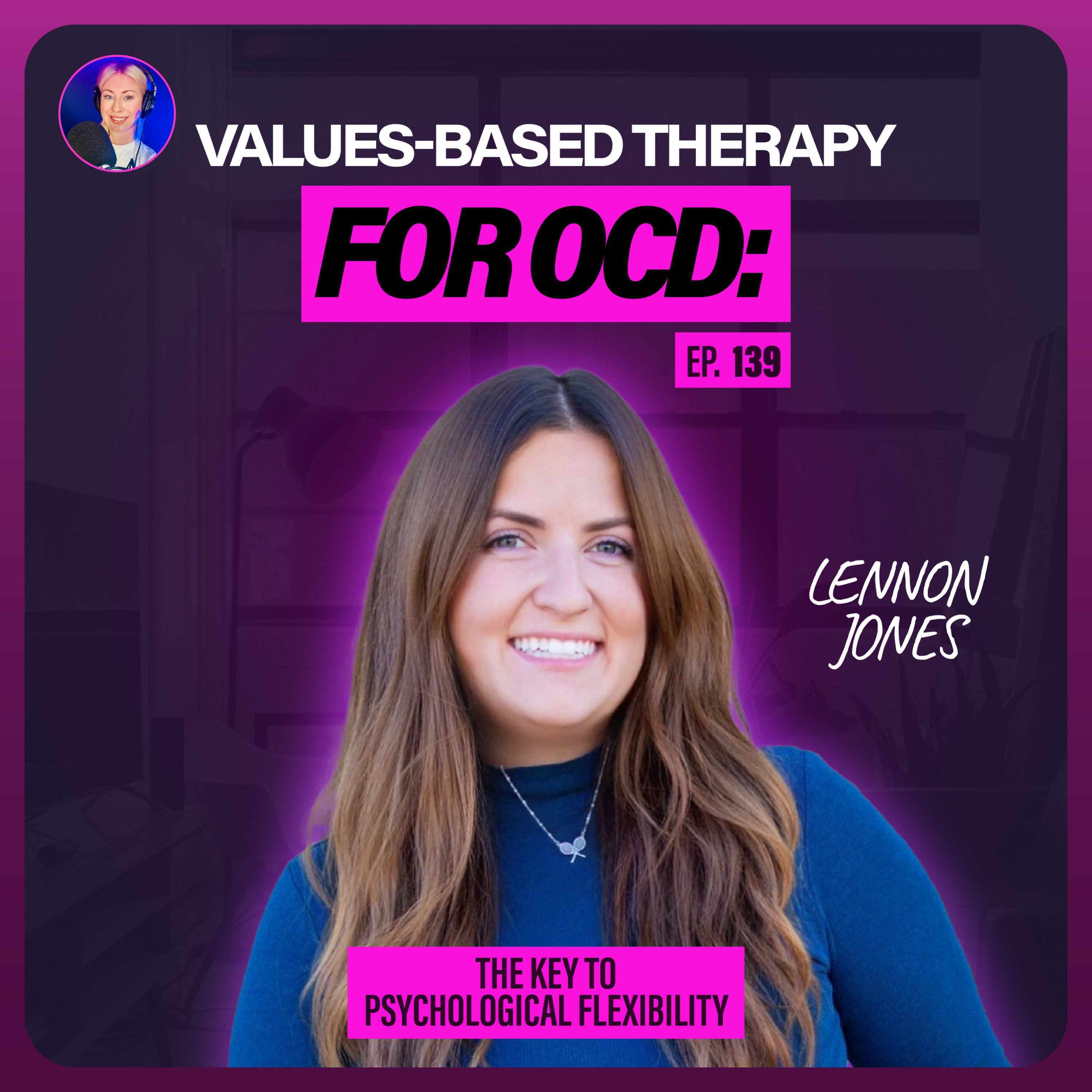
The OCD Whisperer Podcast with Kristina Orlova
139. Values-Based Therapy for OCD: The Key to Psychological Flexibility
00:28:19
Loading summary
Transcript25 lines
- [00:02]
A
Hi, I'm Christina Orlova, host of the OCD Whisperer podcast. As someone who lives with ocd, I understand the struggles firsthand. If you're here, you're not alone. Before we start, grab your free OCD survival kit at www.corresults.com to help you take control. That's k o rresults.com now let's dive into today's episode. Welcome to OCD Whisperer Podcast. Today with me, I have Lennon, who's an OCD therapist located in Southern Utah. She has worked for numerous nonprofits and currently supports an initiative providing free therapy to Ukrainian refugees. She currently works in private practice and runs Golden Hour OCD and Anxiety, an online platform to support those in their journey with OCD and other mental health concerns. Welcome to the show.
- [00:53]
B
Thank you. I'm excited to be here. I've been listening to your podcast for a while and so it's. I don't know, I'm fangirling right now. I don't know what you want to call it.
- [01:04]
A
I actually love that. I didn't know that. That's cool. Look at you saving that little piece when we went live. That's really awesome. I appreciate hearing that and that you found this to be a resource and something valuable. And it's great to have you on the show so we can dive into kind of something we talked about a little bit before. This is values and building a good, solid foundation for working on ocd. So I'd love to just get your perspective on what do you mean when you say that?
- [01:37]
B
Just summing that up in the simplest way I could put it. I think a lot of times, because as some people, and maybe some people aren't familiar with exposure and response prevention, I think it can gotten to be scary when you first hear about it because it's just exposure. We're just going to. I explained it to my client even earlier today where it's just like you're. We're going to have you stare at the sun and you're just going to stick there with it. Sometimes I think we forget that that key component in that response, prevention. But not only that, but I think, and as a lot of people have voiced on your show before, like exposure therapy should not be torture. And if it doesn't have that, those values, beliefs like that trust in yourself behind it, like a lot of times it can be torturous for people. And so I think that's something I really, I mean, if my clients heard this right now, they'd be like, oh, Lennon, quit it with the values and the going back to that. Because it's just. It's so important in my mind just as equally as much as the exposures are. And really getting to those core, I think, is something that helps. What I think sometimes when people are doing work in that OCD realm, there's so much focus on repetitive behaviors or so much focus on, okay, go. Some of my clients go, I'm eating gummy bears off the toilet, and I'm licking dumpsters, and I'm going into these social situations and I'm doing these silly, embarrassing things, but now I'm just doing them for the sake of doing them. I'm. I'm not. What's the reasoning and the meaning behind those actions that we're taking? Because I think a lot of times people can get right as again, most people say sometimes those things can turn compulsive because then it's, if I don't do that, then who am I? And that fear comes in. If I don't expose. And if I'm not in recovery, doing treatment, doing all these things, then I'm nothing. And so I think that act therapy, or that being able to fall back on those values is crucial to be able to manage the ebbs and flows that the uncertainties of life bring us. So that was quite a long summary, but there you go.
- [03:58]
A
I mean, there's so much in there, though, that's really great, because what I'm hearing is one, creating your exercises in such a way that there's some meaning for you behind it. There's something more or at least a good reason for why. Right? Why would I do something that would seem like clearly something I don't want to do or really seems scary or daunting? Especially when we're talking about taboo themes or something that's morally repulsive or sexual nature stuff, anything like that. Those really have some extra feeling there, right? An extra. Not that any OCD is easy. All ocd. I forget who said it once, but somewhere in some conference I heard, like, what OCD is the most. The hardest to live with. It's like the one you're living with, right? Because that's the one you're dealing with, right?
- [04:46]
B
OCD is. OCD is ocd.
- [04:48]
A
But I do think that there are certain. I've noticed over time, there's some things just because we know, like, generally these things are not great, or they're really looked down upon, or they're just really perceived as really bad, if you will, in the world. And society that we can have this additional fear of, wait, how do you want me to do an exposure to what? To this horrendous thing that my brain is producing or this horrendous image I have in my head, or there's something that's considered perverse or like, horrible. Why would I do that? And that's a big thing we hear, too. And so to your point, it's what I'm hearing is, well, let's find that out, right? Like through values, through figuring out what are your values and what would you then do and how would you do it. And then the other piece I heard you say is learning to trust and lean into who we are. I guess what I'd love to know is how would you then use values in that instance, right? When something seems so daunting and just horrible. Let's start with that.
- [05:48]
B
So that's again, that's why I love the blend of exposure and response prevention and act therapy. Because then that's where you do have to come in and say, hey, maybe I am all those things. Maybe I. Maybe I am that, truthfully, that horrible person that these intrusive thoughts have told me time and time and time and time and time again. I've heard it. I think a big thing backpedaling a little bit is oftentimes when people are met with those, oh, come on. Of course that's not you. Of course that's not what you would want to do. Like, it can seem comforting. But also someone who's usually making those comments is someone that's maybe on occasion slept into that OCD cycle once or twice like they have. I always use my husband as, like, the anti OCD example, because I'm like, he would have a thought like this offhand, like, intrusive thought about himself. It would cause him some anxiety and distress. It would be a little disconcerting. But then he could. He's easily able because he's able to manage it and not just find temporary relief, but those actions and steps that he takes would bring him real resolution. Like, there wouldn't be. It would just stop right now. I tell someone now, if my husband had that thought enter into his brain a hundred times that day, eventually he's going to go, does this mean something? And so I think that's where again, now it's not like all things, right? It's not a simple answer of, okay, how does just having these values override these thoughts? Because a lot of times it doesn't, right? Like, there is. I think it can seem Bleak at times, especially when you're doing those kind of exposure scripts with people and kind of working on those. Those different kind of responses of them. Maybe not. Or even I can't think of his name now, but I. I love watching his videos on YouTube. And his word is, certainly that's going to happen. You know, it in, like, in scrupulosity terms, right? Certainly I'm the devil incarnate. Like, certainly I'm a son of perdition. Yeah. You know, certainly I'm damned to hell. So then what? Right? And the word I like to use a lot is regardless. Right. Regardless of if that's true or not. Right. I don't need to figure that out right now. So what do I want to go do? And sometimes we're not always in that position. Like, sometimes we're at that 12 out of 10, and we don't really have that. We're not in that good mindset or headspace to fully use our autonomy in that moment. But being able to bring ourselves back down there to be able to say, hey, I don't have to figure that out right now. I'm gonna go. I'm gonna go live and love according to my values. I'm gonna go spend time with my husband, even though I'm wondering if he's even the right one for me. And maybe I'm having. Is it because I've lusted towards someone else? Is it because I did I cheat on him and not know it? And that's why I'm feeling this way? Is that why I'm feeling this hesitancy in our relationship? There's just as. There's an endless amount of what ifs that can come. And I've really found with my clients, if you don't have at least that solid base, even if it is just that kind of answer of logically, I know this about myself. Logically, I know I'm someone who appreciates and values kindness, caring, order. Like, I value, like, all these things. I value imagination, risk, like, practicality, like, but in those moments when you're really tussling with those intrusive thoughts and that excessive doubt, like, that's usually the first furthest thing that fills from the truth for you in that moment. So that. That's, again, I might be trailing off here, but that's where I go when I think of, like, how do I actually use values in those scenarios?
- [10:14]
A
And I think too, what we're talking about is the evolution of, I think, ERP therapy too. Right? Because I think we can't Skip over that in the beginning. And I certainly will say even in my own training, gosh, years ago at this point, but the kind of way that I was taught, ERP and I went through the international OCD foundations, it's called the BTTI Institute. Yeah, did that training was in a group practice and I jumped in completely and immersed myself in all of this. And I started doing intensive outpatient program work. I was doing individual outpatient work. And through that training, consultations, everything at the time was more like from what as therapists would say, the habituate learning. So we're going to get used to it. If you just stick with it long enough, you'll desensitize, you'll, you'll adjust. Then came this next flow of inhibitor learning where like, okay, we might not always, like our anxiety might not always drop or change, but you can still learn, you can still move forward. We also then have the acceptance movement therapy piece of. Wait a second, we don't have to just be pushing through. Let's look at what about this is going to bring us closer to our values. I think in there also metacognitive therapy also has this notion of how can we globally start to develop a different relationship to this experience and what then do you want to do? Because you know you want X more and X would be this value, this thing that's important to me. Use a connection. Say, okay, connection is actually really one of my values. So then if I'm having a relationship based OCD and not sure about my partner, but I know connection is of value for me, then yeah, maybe I'm going to go and spend time with my partner even though I'm feeling anxious and uncomfortable. But that really in itself would be an exposure. Right. And respect prevention is that I'm not going to sit here and seek reassurance. I'm not going to be asking 50,000 questions. I'm going to monitor ways that I want to get pulled into my head to ruminate and instead I'll focus on really being there, being present, really actually connecting and in that way basically living my value. And that's really what that would look like, right?
- [12:27]
B
Yeah, absolutely. I think as always you're very on point. Right. I think to add too, right. Like when. And this is what always drives my clients crazy when I say this. But a big part too, that is exposure in and of itself is that a value per se is not measurable. Like they can't, you can't reach a certain level of perfection in the value. Well, I always, I'm like this is just something you appreciate and maybe you're close to it one day and maybe you're just off base the other. And that's just going to have to be the case for that day. Sometimes I, even with clients, I have this lovely list of a hundred different values. And usually when I'm working with someone with a high level of anxiety or OCD that when I split them up, very important to, hey, I see the value in it, but it's neutral to take it or leave it. You bet your bottom dollar that 75 of those values or more are in very important, like I must follow them to a T. And so I think that's another thing to help not just identify those, but really parse out that, that black and white thinking like that perfection to total failure, feast or famine, do or die, this or that. Like it, it really helps increase that psychological flexibility, which is the key and the goal of exposure therapy is, hey, we want to be more flexible in these situations. We want to be not as hypersensitive to these things. We want to be able to just enjoy our lives. And I think that's so important.
- [14:19]
A
Yeah, you're introducing a new concept here. Right. Psychological flexibility. So let's talk about that for a second. What does that actually really mean? I think you and I probably know as both clinicians and certainly with some lived experience, but let's say anybody listening and they hear this now and they're like, what do you mean, psychological flexibility? Yeah. What is that reference point we hear that's what we want to live towards, but what does that really actually mean?
- [14:41]
B
Yeah, and I think this is where I almost want to throw the question back at you because I explained just a little intro to it, even in what I was just saying. But I'm curious to know on your point, like on, on your side of things, like, how do you. Because again, I'm going to introduce another thing in this conversation, but you are a clinician that does a lot of icbt. And so I almost want to know, like, how do you incorporate that psychological flexibility into your work with icvt?
- [15:14]
A
That's a whole different question, to be honest. So I will say this, that ICBT really sees OCD as a completely different process than the way ERP sees it. So I really can't say that I'm blending per se. It's not, it doesn't quite. Not quite like that. But I will say for myself, for example, when I learned ERP and even aspects from ACT that I've really resonated and love to put fuse it together. Like, I really liked imaginal exposures. Not everybody does, but I like them because I noticed that as uncomfortable as it was, and it was super uncomfortable because thoughts would be so intense. But I did learn that the sooner I can go into and write it out and just start leaning into it and repeat it really frankly ad nauseam, it actually helped to detach from that thought. The thought became thought. With imaginal exposures. What I liked is that when I would do them, as uncomfortable as they were, I did notice and start to observe that the sooner I could lean into it and do it, the faster the thought would release and the easier it would become for me to no longer compulsively ruminate on it. So I became a fan of that exposure style because it allowed me to take if you a little bit of control over the situation, knowing fully well that at the time when I would be doing that strategy, I would still feel extremely anxious and uncomfortable and have all the feel sweating, et cetera, heart pumping, right, all the things. But I'd give it time and then there'd be some space created. The difference is with ICBT in learning that modality over the last almost three years soon what it did is it showed me where I'm basically arriving at this conclusion that this thought or this thing actually has some significance or that there's something there I actually have to worry about. So it really showed me where my own reasoning process and how I was thinking about things was actually ill informed. And essentially like cognitive distortions, there was a distortion going on. There really was a lot of faulty process that I just didn't realize I was doing. I really thought I was thinking, okay, I understood compulsive rumination, but I would still think a certain way around things that were my triggers. And now for example, I don't do that. I notice whenever I wants to start doing it, but I can now see what it is. So I step away from it. So what I we engage in then we would say is more like your yourself, like your baseline. So it's not per se like flexibility concept. It's more like coming back to what you know and who you actually are and operating from that state. That's what I would say is a little different. When I'm using ERP modality though, I absolutely talk about that because we talk about cognitive distortions, we talk about how we can misperceive things, we talk about that all or nothing thinking and really rigidity. OCD brain is notorious for coming up with these kind of intense rules, like it has to be X or Y and there's no mental zone. And so we do. I do a lot of that in icbt, we're really talking about the whole goal. There is inferential confusion. That's really what we're after, is learning how to resolve that so that you're not concluding things that have no relevancy to what's actually happening in this moment. So that's why it's a little different.
- [18:35]
B
Yeah.
- [18:36]
A
And so depending on what modality I use with a person, you know, we'll have those conversations outside of that, though, like all of us. Right. If we're not having an OCD trigger and we're just being ourselves, I think we tend to have more straightforward however we think. Right. Whatever that natural thing is. I don't know, I love orange juice or. Yeah, I don't know, I feel like going for a walk today or I don't know, I'm not in the mood. Right. We have that kind of everyday thought process and all that stuff. Right. So it's like coming back to that and operating from there is a really different place. So it just depends on the modality that I use with folks. But when I think of psychological flexibility, that's what comes to mind. It's like learning how to recognize our own rigidity, especially when having OCD going to take hold. And I think, again, somebody else said this. It's like, it's this all or nothing. Like you're either Gandhi or you're Hitler. And I'm like, golly, like, it's so extreme, man.
- [19:36]
B
Oh, hey, you might just be an average Joe. You might just be an okay human. Yeah, exactly.
- [19:42]
A
Exactly. Yeah. So, like, from ACT perspective, though, because. And I love that you're working with ACT and erp, what are some ways if somebody listening. Because I'm also a big fan of always asking my guests, like, what could be one tool or one strategy? And I know it's a big ask, but I don't know what comes to mind if you were going to leave people to, like, as they're listening to this and kind of reflecting for themselves, like, what could be one thing that they could do or a way they could become aware of their own kind of way where they might not have psychological flexibility.
- [20:17]
B
Yeah. I think a very simple thing that. That I work with clients in terms of. Okay. Because that is the big question. Right. Whether I'm doing app therapy or doing exposures with people. The question is always, what does that look like or how, right? How do I know that I'm doing it and I'm not doing something harmful? And so, for example, like I'll use myself as an example today. And again, this is very simple. This is not a step by step clinical intervention, but it's just how do I lean in to what we call, right, like that values driven life, instead of being so rigid, so into the being driven by those intrusive thoughts, those fears, that avoidance that, the compulsions, all those things. So today, like, obviously I was preparing for today I see clients doing some work, a million things, and the anxiety was swelling up inside. And when that happens, you best believe that there's going to be some, just some awful, intrusive thoughts that follow with that. And never good, always very shaming, always very overwhelming. It really can bring you up to that, you know, 10 out of a 10. And really in that moment, utilizing that, that ERP and saying, hey, maybe those things are true, right? Maybe I am going to fail at all this, right? Maybe I am going to make a fool of myself on this podcast. Maybe I am going to say something wrong and some therapist is going to message me out of the blue and say, who do you think you are to be telling people all these things, right? And maybe that is going to happen. And the things, I can't find that out right now, or I can't be certain that will, or it won't happen. And then using that moment, because sometimes, again, like with erp, it's okay to sit with that, right? But I think sometimes we get lost in the semantics of sitting in anxiety and that people just envision, okay, I've just got to sit there and meditate with that. Like I said earlier at the beginning, they envision like that they just got to stare at the sun until it's not going to hurt them anymore. And the thing is that might just never happen. Like, it's just not a good, it's not a good type of exposure, right? So at that point it's, hey, I'm going to close the laptop and going back to those values, right? Even though everything's feeling shaky and uncertain right now, I'm going to do something that helps me live according to those. And for me today, that was, I'm gonna go to the movie theater. My grandpa, I love him to death, he is obsessed with movie theater popcorn. I went and bought him one of those. You can buy a little tub here in Utah at the movie theater and you get like a year's supply of popcorn and they give you A little tag, and I walk through the door as a surprise with it, carrying this big old tub of popcorn and I wear. And I just hung out with my grandparents for 30 minutes of my day. I went and picked it up, dropped it off. It fulfilled those values of, hey, service, the connection, like you mentioned earlier. And it, it was giving me exposure to that. Oftentimes when I'm working with clients, like, sometimes I remind them like this. The exposure we're trying to do is exposing yourself to who you really are. Yeah, right. Pushing all those other things aside. Right. Pushing the anxiety, the compulsions, all those things aside, and saying, okay, who am I at my core and let's live according to that the best we can. And we know that those bumps along the road are going to come up. And guess what? I went and hung out with my grandparents and then I came right back home and I had to take care of business. I had to go right back into those difficult things that I was already doing and preparing for and working on notes and sending things to clients and doing things like that. And those thoughts were still there, but they weren't as strong and I was a little more. As a little more comfortable with them being there. So that's my, my values based tool.
- [24:54]
A
Yeah, yeah. And it is, it inherently has some flexibility. It's inherently, I'm hearing like, I got to do something that actually is meaningful for me and also brings me closer to one of the values that, that I actually find important. And just even in having that experience, like, you get information, you get real life data about like, you. And look at that. I can do this. This is my behavior, this is something I chose. And I'm getting to now be here. And then now I come back and, okay, what's the next thing? And so. Right. It's almost like changing our focus as well. Changing it from focusing almost like internally so much. And that kind of can foster that rumination and more focusing outward and focusing on what matters to me and what are the things that I want to be doing and how do I want to be doing them and really putting more effort and energy into that process.
- [25:41]
B
Yeah. And I think you highlighted something that I'm trying to get to with clients, because when you said, this is something I chose, I think that's a feeling, right. That like you rarely feel in these cases. Like, I didn't choose this feeling, I didn't choose these thoughts. I didn't choose this distress, I didn't choose this disgust I felt with myself at times when these thoughts come up and so I think a great point in that is like, when you can give yourself experiences, however small, where it's like you are using your own autonomy and you are making a choice, like it's no longer that gun to your head feeling and you either got to jump off the cliff or die. And. Right. Kind of coming back to that flexibility of, oh, there are other. There are other options. Right. Like you said, like, it's not, I can't be a person. It's not like either am the savior above or. Right. Like I'm Satan himself. Like I can just be me. And that actually works. Like, it's actually okay.
- [26:45]
A
Yeah. That you can trust that process. And I know you said earlier, like a relearning almost how you can trust yourself and trust your kind of, like, intentions. Right. And that I, I know I'd like to do this and I get to do that and I get to learn that. Yeah, this. And I love that you said that. Yeah, I can be me and it's okay. Yeah, I love it. I want to thank you so much for coming on the show. And so anybody that's listening to this today and if they would like to come and find you, how can they find you?
- [27:11]
B
So really right now, like, the biggest platform I'm on is just through Instagram. It's OCD therapy with Lennon. Or you can just search up and Google golden hour OCD and anxiety and it'll be the first one that pops up. That's the easiest, quickest way to get a hold of me. It has all my contact info that you could possibly have about me on there. So that's usually the best way to get in contact with me.
- [27:36]
A
Awesome. Thank you so much for coming on the show.
- [27:38]
B
Of course. Thank you for having me.
- [27:40]
A
Thanks for listening to the OCD Whisperer podcast. Remember, freedom from OCD is a journey and you're not alone. Visit www.coraresults.com to explore self help masterclasses like Sneaky Rituals with Jenna Overbaugh or ICBT Masterclass with Christina and Abe. Don't forget to grab your OCD CBT journal tracker and planner while you're there. If you found this episode helpful, please subscribe, share and leave a five star review to help others find the podcast. Together we can make a difference. Keep going and I'll see you in the next episode.