← The OCD Whisperer Podcast with Kristina Orlova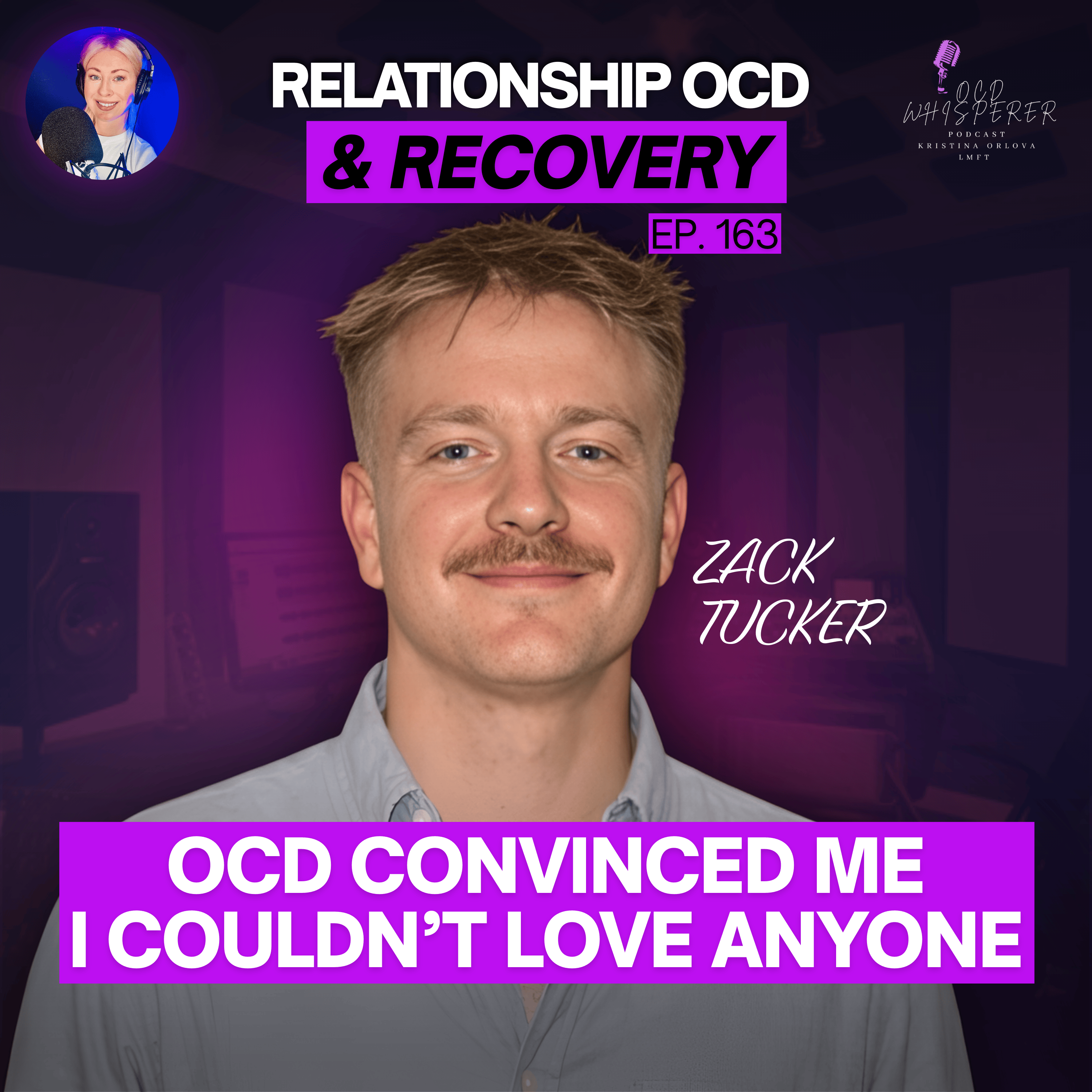
The OCD Whisperer Podcast with Kristina Orlova
163. Relationship OCD, Shame, and Recovery: Learning to Live With Uncertainty
00:26:45
Loading summary
Transcript29 lines
- [00:01]
A
Welcome to OCD Whisper Podcast. If you find these conversations helpful or grounding, you're always welcome to subscribe so that you don't miss an episode. And today I am joined by Zach, and you might know him from Instagram through his page called OCD to Stigmatize, and he openly shares his lived experience with ocd. Welcome to the show.
- [00:25]
B
Thank you for having me.
- [00:26]
A
Absolutely. Hi, I'm Cristina Orlova, host of the OCD Whisperer podcast. As someone who lives with ocd, I understand the struggles firsthand. If you're here, you're not alone. Before we start, grab your free OCD survival kit at www.corresults.com to help you take control. That's K O R results.com now let's dive into today's episode. So one of the things I appreciate about your work is that you don't just kind of talk about symptoms. You talk about what OCD really feels like. So I want to ask you when OCD was at its worst and what did it train you to believe about yourself? That maybe kind of which of those beliefs took the longest for you to unlearn?
- [01:19]
B
So I think the longest. The thought that took the longest to learn for me was around relationship ocd. I had a. A lot of my. In fact, every single one of my relationships from about 18 to 24 were completely ruined by this feeling that I can actually love someone. So every time I'd get into a new relationship, I just have this thought that would come into my head. I remember the first time it happened where I finally told my partner that I loved them. And I'd been with them for a while, and up until that moment, there was no issues. And, you know, I really thought I loved them. And then the moment I said that, I had this thought come into my head, which was just like, well, how can you be sure? And it just sent me into this, like, deep loop where I was just constantly playing over and over and over again in my head that. That I couldn't be sure that I love this person. I started doing these compulsions. My compulsions would be buying them flowers or buying them gifts and over overcompensating in romance to try and make up for the fact that my brain was saying that I hated them and saying that I thought they were ugly and thought that I was. They were disgusting. That's just. The thoughts would just do that over and over and over again all day, from the moment I woke up, the moment I went to bed. And it had a real impact on my Self esteem. And throughout university especially, I started to just hold this belief that I couldn't love anyone and that all I was able to do was hurt people because I. I had proof that every relationship I'd had had ended because I had to end it, because my mental health had got too bad. But I'd always end it without any real reason because from the outside you couldn't see that I was going through OCD and my partner couldn't see that I was going through ocd and I was too ashamed to tell them about it. So I would just break it off out of nowhere and it would come completely out of the blue. And it just kind of, it led me to a place where I started seeking more promiscuous and shallow relationships where I was the only person who could get hurt. So I'd go over people I knew who had hurt me, but I had no chance of hurting them. And it just had this whole collateral damage on my entire life and my entire self esteem and my confidence and really made me believe that I wasn't able to love anyone.
- [03:33]
A
That's a lot going on in there. And I mean, thank you first of all for sharing so openly and honestly about that. And I guess kind of a follow up question to that, what became. Because it sounds like there's a lot of, kind of turning against yourself almost and making it more like let me be not the one responsible for hurting another person. But I'm curious, like, especially in the beginning from what you're describing, because I think a lot of people with OCD struggle with this. The difference between how or did you even know that in the beginning that what is it? What difference between, let's say, regularly questioning and doubting? Being a little unsure. Okay, Do I really love this person? I think I do. Okay. I tell them. And then, you know, sometimes I have those secondary, you know, worries, doubts versus this OCD process.
- [04:19]
B
Yeah, I think I always say the relationship OCD in my opinion, is one of the hardest themes to deal with because of how close to reality it can be. Because everyone experiences doubts in relationships, right? It's. It's the most human experience of wondering whether you're with the right person. So trying to figure out whether that is if. Whether these thoughts are genuine doubt and whether you actually want to be with them or whether they are this overwhelming, overwhelming feeling that you aren't with the right person. It's really hard to tell. I think over time I very much learned that when OCD really rears its head, it's just so Relentless. And having now experienced later in life times where I've genuinely fallen out of attraction to someone, I. I'm able to feel it a bit better where I can. I can kind of tell where my heart actually is. And I. I'm more able to recognize when it's ocd because OCD is just so loud and evil. And I just don't think that in my experience, especially when it's genuinely been falling out feelings, that those thoughts have been that relentless. And it's more just a feeling that I know if that makes sense.
- [05:29]
A
So that's actually like a pretty important moment right there you're talking about, which is you learn over time that difference to clue in and hone in on more when it's like, wait a second, this is really a genuine experience I'm having that. That's really kind of fully connected to my entire self versus when OCD brain gets loud and. And you start to have this incessant doubts and the questioning and kind of turning against yourself and stuff like that.
- [05:52]
B
Yeah, I've definitely, like, even. Even in times where I've broken up with a partner. Partner. So my last partner was. It's the first time I've broken up with someone knowing that it was an ocd. Up until that moment, every time I had broken up with someone, it had been because of my ocd. So this is the first time that I had certainty for the first time that I wanted to break up with someone. And I didn't have much OCD in that relationship as well, which, which was nice. And I think that's a lot to do with my recovery and how far I've come in and doing all the hard work and being consistent with just self care and making sure that I'm doing all I need to do to manage my ocd. But even after that breakup, my. That's when my OCD finally read its head and it was like, well, what if you didn't make the right decision? What if this is the person you're supposed to be with? And then the narrative changed. So it's always been, what if you hate this person? And then suddenly it was like, well, what if you actually do love this person? And then I had like a new form of spiral, which was, which is very bizarre. But I remember the. The first time, and this is such a weird silver lining thing. Silver lining moment. I had this moment where I was broken up with for the first time. So I had been, you know, dating this guy for about, I think, six months. And this entire time I'D been relentless OCD thoughts. And I was really struggling, but I was really trying to push through it. I was on medication. That was another thing. Every time I get into a relationship, I'd get onto medication. And it was the only time that my OCD really reared its head, especially now. I had a lot of OCD when I was younger, but the only theme that has remained consistent in my life was relationship ocd. So, yeah, I remember when I was broken up with for the first time and it was, it was sad and it was horrible, but I remember thinking, oh, wow, this is the first time I've been broken up with. And it was such a relieving. Yeah, it was such a feeling of relief that I could be broken up with and that I've already tried with this and that it was something that ended as a result of just a difference in life and that it fizzled out naturally. And it was my first moment in my life where I felt hope again that I could date. And now that. And that was four years ago. And since then I had that more recent relationship that I broke off without any ocd. And now I'm in a relationship that I've been in for 10 months and I've been able to manage my OCD very successfully.
- [08:13]
A
Oh, my God, that's so awesome. I mean, I love that, right? Like, so many ups and downs. But also, how cool is that, that there's kind of a flip experience you had, which is I was broken up with because typically I would break up because of ocd, like a self detection almost. And like, wow, actually the inverse happened and then you learned so much about that and now you're finally able to be, you know, in a relationship where you could just really be in it.
- [08:35]
B
Yeah.
- [08:36]
A
And I mean that's, it's definitely.
- [08:37]
B
Yeah, it's definitely still present. Like I still. In this relationship, I'll have moments where the OC comes back, but I'm a lot more, I'm a lot more able to rationalize, I think now, and sit with the thoughts and sit in that uncertainty. And when my mind is like, what if you hate them or if you want to break up with them? I can just say, oh, yeah, okay, yeah, maybe I do. But that's not today's problem. I'll figure it out another day. Which has been really helpful. And it's having that mindset of just, it's okay, it's okay that maybe I want to break up with them. It's fine.
- [09:10]
A
Yeah, like, I don't have to answer all the questions all the time. And actually that beautifully leads into my next question, which is, you know, online, a lot of people talk about recovery. So when we talk like, what parts of OCD would you say didn't disappear for you? And it sounds like there's some you're already describing. Right. And so how did your relationship to those things change instead?
- [09:28]
B
Yeah, so recovery is a really interesting thing to me because when I was younger, as I'm sure many people who can relate to, I was told that OCD is a chronic disorder and that I wouldn't be able to. I'll have this for the rest of my life. Which is the most daunting thing. When I originally, when I initially had OCD as well, it was pocd, so it was a fear of being a pedophile. That was the first theme that I really dealt with. But it kind of, over time, I changed the narrative of what recovery could be for me. And suddenly it became that I wasn't trying to stop these thoughts. And that was never the aim of recovery was to stop these thoughts. Thoughts from happening. It was just to get to a place where I could have those thoughts and they wouldn't mean anything. To which I think is the same as stopping the thoughts, because the thoughts aren't causing me the anxiety they used to. In the same way that someone who doesn't have ocd, who does get these thoughts as well, because everyone has intrusive thoughts, has no reaction. So I'm much more likely to just have no reaction. But of course, there are still aspects of OCD that still affect me, especially to do with relationships and health anxiety and health OCD as well. I still get quite health anxious. I'm in. I'm in a country that's quite rampant with rabies, which is one of my biggest fears. And that's always been one of my big fears. Even when I was in a country where there was no rabies, I was terrified that somehow I catch it. So it's been a big exposure being in Vietnam where there are stray dogs on the streets and there's always a. You know, I've got my vaccinations and everything, but I'm still terrified that what if I. What if I don't know that a dog bit me and now I'm waiting for the rabies to kick in. So, yeah, there's definitely, like, aspects of OCD that still affect me, but I just think that I'm not debilitated by OCD anymore. I'd say that OCD is kind of constantly on a maximum of 20% of my brain now, when it used to be 100% of my brain. But most of the time I'd say that OCD is completely switched off and I'm not thinking over and over and over again about thoughts. I'm just kind of living and existing and not even clocking that I'm having the intrusive thoughts that once upon a time would have made me spiral.
- [11:39]
A
Okay, so there's like two follow up questions I have because you've hit on a couple of really big points here, right? So one is, let's start with the kind of where we're at right now. You just mentioned rabies. So like you're in a situation where here's an actual now real life place, right, where you're like, oh, this is actually much more probable. Realistic, the chances are significantly higher. This is not one of those things that, you know, I'm just thinking about. And statistically it's extremely low to none. So how did, how are you with the recovery process differentiating with that? Right. Like you said, okay, I, I took the steps to get my shots and now I'm here. So how do you manage that? How do you walk that line?
- [12:25]
B
I think it really, it's a really hard one. It's been so difficult and I've definitely got a lot better at it even in the last four or five months of being here because there, there are times like, you know, I, I'll touch the good dogs and I'll touch the cats here because generally they're vaccinated, especially I'm in a big city. So, you know, rabies really only exists in the suburbs of Vietnam. But yeah, so I've, you know, been challenging myself to pet dogs and stuff. But when I get those, those thoughts, it's a really horrible place to be in. But I will just be like, okay, well, I guess I'll find out tomorrow if I have rabies because that's how long it normally takes. So. And if tomorrow I have rabies, then I guess, then I guess then I'll worry about it. But now I have no symptoms of arabes. There's nothing to show me that I have rabies. So me going to the doctors to get a rabies shot where they'll probably turn me away because I haven't got a bite or anything. So I can't imagine, especially here in Vietnam where mental health isn't as understood as in the western world, I wouldn't have necessarily the same reaction to going in over and over and over. Again saying, I think I've got rabies. I think I've got rabies. I think they'd probably be a lot more like, well, you don't. With. Yeah, so it's been.
- [13:51]
A
Yeah, but you're also mentioning something kind of important, right? You're talking about, like, okay, I'm also taking a moment to slow down and kind of realize, okay, well, right now I don't have some of these things to lead me to, like, okay, let me really go take care of this. And so until some further notice, almost like we're gonna just move it along. And if something did somehow happen somewhere, it sounds like I'm going to let myself kind of let that be.
- [14:17]
B
Yeah. Which is figure it out. Because. And I think that's what's the most scary part for me when I'm doing it is because when. When the symptoms of rabies come in, then that's like, it's too late. You're. You're stuck, and you. You will die, effectively. That's. That's what rabies is. So by telling myself that I'm waiting for rabies, I'm. I'm. I'm basically saying to my brain that, like, okay, yeah, like, you're. It's. If the, if the rabies happens, then, like, you'll just deal with it. And sure, the outcome is bad, but it's. You're fine, basically. So it's been very hard, really, fighting that need of, like, well, what if. What if the symptoms do happen and then it's too late and then. And then I'm. And then I'm stuck and then I'm. And then I have to say goodbye to everyone and then I'm gonna die. It's been really, really horrible and.
- [15:09]
A
A.
- [15:10]
B
Grueling process trying to get through that anxiety. But so far I've managed very well. And I'm definitely a lot less anxious about it and passing. Passing animals here more, more frequently and not having those intense worries about catching rabies anymore because, yeah, I'm not. I'm not exposing myself to it. They haven't. Obviously, if a dog bit me or if a dog licks me or something, then I'd be like, okay, I will go to the hospital, because that is what you're supposed to do. But until then, nothing that hasn't happened to me. So, yeah, I had. When I, When I first got here, I would scan my legs and, like, my arms to make sure that it wasn't a secret bite or something that. Or like a bat. I have bats as well. Like I'm. I was a bit like, well, what if a. What if. What if I have a drink and like, I'd be at a bar and a bat would fly over because there's a lot of bats here. And I'd be like, well, what if that bat just peed in my drink? Or what if. What if that bat just like, was bleeding and some blood dropped to the blink drink and I can't see and that bat had rabies? Just. Yeah. So just lots of really just being like, okay, well, I'm gonna drink the drink anyway and just exposing myself to a lot more here. So I think in a, in many ways, Vietnam has been such a exposure therapy for me. Not only in, in my health, OCD and my fear of rabies, but also in my relationship ocd. Because I've gone from being so worried about relationships and, and wanting to. I'm worrying that I'll fall out of love or worrying that I don't actually have feelings to being in a long distance relationship where I'm thousands and thousands of miles from my partner. I haven't seen him in months and I won't see him now for another three months. So those two big things. And on top of that, another thing is that I'm working with kids. I'm. POCD was my biggest theme growing up. And I am a full time teacher teaching children for a living. So I'm really tackling three of the biggest themes I've dealt with. Being out here and doing it successfully, I'd like to say, which I'm really, really proud of myself for because it's been a long time to get to where I am and all of those things put together, a young me would never have been able to do. So I'm very proud of myself.
- [17:27]
A
I mean, I do want to say, I can't help but just say I want to commend you for really taking your life and living it, um, and, you know, really breaking those shackles of OCD and saying, I'm gonna go for it. I mean, it sounds like you really, truly have. You. You've put yourself in a place that directly is facing everything, right? All the things. And you're like, wow, this is no longer just a potential. Maybe like I'm actually in a real life experience where all of them are up and, you know, again, thank you so much for sharing all that, but this was my second question, which is, you know, you mentioned that the younger me just would never even fathom this. Or, you know, before it was 100% OCD. And I know this is something that everybody struggles. I know the audience listen that listening to the show, this is always a top question, you know, when you're having these thoughts and especially now when you're right in the thick and in the thick of it all, and yet you're in recovery. How did you get to that place? What did you do to truly create that separation? It sounds like, be able to, I guess, accept the thoughts, roll with the thoughts, not have to answer all these kind of questions and, and this incessant doubt process, like, how did that happen? Because. Right. That's the hardest thing for people.
- [18:50]
B
Yeah, honestly. And I think my experience maybe is just quite niche generally. But so firstly, obviously I've had a lot of erp. I've done lots of. It's just all about consistency with OCD therapy. And it's not about beating yourself up and it is about, it's about letting yourself do compulsion sometimes as well. I think there is such a focus on, in OCD recovery on that you need to stop everything and it needs to be cold turkey. But for me, OCD works very much the same as an addiction works. You know, it's as a compulsion, as an obsession. And for people who have addiction, the compulsion is drinking or it's taking a drug. And you would never tell an alcoholic to stop drinking alcohol. Right. It's. You've got to wean off it and it takes time and it's a whole process. And I think that the same applies for OCD is that sometimes you are going to need to do a compulsion and that's okay. And you don't need to beat yourself up for it because you've done that compulsion. It's okay in that moment to be kind yourself and be like, look, the point is that I am slowly taking this down over time and that I'm not stopping it right now because stopping right now just leads to this sense of failure and shame that I think then fulfills the prophecy that you'll ever recover from OCD and, and makes yourself. It can make yourself worse because you, you start to lose faith. So I'd say that. But in big part, my recovery has been because of my mental health page. I, I started this page in 2021 and it was because I was fed up of living in the shame of OCD and being like, oh, like, how do I talk to people about this? People. People are going to think I'm so weird if I say, yeah, sometimes my brain says I'm a pedophile or sometimes my Brain tells me I'm going to get rabies from a drink in a country with no rabies. And I was just like, I'm fed up of feeling like this. I'm just going to put it on the Internet and hope for the best. Because if it's on the Internet, everyone knows it and I have nothing to be ashamed of. And that's truly how it started. I just started talking about my own experiences and mental health and just trying to expose myself that way and be very candid with my experience. Always talking about things like the groinal response, Always talking about things like OCD and sex. OCD and masturbation. Just everything nitty gritty. And it's just slowly, over time, I've just got much better at it and more open about it and just feeling like a lot of the shame is gone. Because again, everything that my OCD has told me I have to be ashamed of is now on the Internet for anyone to see. And, yeah, so I'd say that a big part of my recovery has been thanks to my page. And I'm really glad that that's got me to where I am, because, yeah, I don't feel any shame.
- [21:35]
A
I mean, I love that, because you stopped making those things taboo, right? You decided to say, you know what? I'm going to take control and this is how I'm going to do it. As I'm going to get ahead of this, I'm going to put it out there, I'm going to talk about all this stuff, and now that's it. It's like, okay, what else are you gonna try to latch onto ocd, which of course we know can latch onto a lot of things, but at least not some of these.
- [21:54]
B
Yeah, I think at least. At least I don't have the shame around it and I can talk about it. I think that in itself has helped because even though obviously, you know, that the page didn't stop ocd, but it just meant that when I was having these bad spirals, I had a space where I could talk about it and rationalize it and have a video where I could look back and. And see what I was saying and understand it from an outsider perspective, the OCD I was going through, if that makes sense.
- [22:20]
A
Yeah, absolutely. And, I mean, I know that not everybody can do that, and that's not everybody's outlet. But, I mean, listen, if it's yours and it works, why not, right? And I think it's amazing and it is empowering. And, you know, if I can ask you one last Question. If you think about that younger version of you who is still trying to kind of figure things out, and really I'm thinking about all the people out there that are still kind of in that place, what would you tell that younger version of you?
- [22:50]
B
I would say more than anything, just be kind to yourself. It's such a horrible, horrible disorder. It's debilitating, It's a really tough time. And surviving OCD is true warrior status. Doing ERP is true warrior status. If you're putting yourself in those positions, it's terrifying and you're doing a really brave thing. So just keep reminding yourself that this is no easy feat what you're doing. And it does get better because it has to get better. There's, there's, there's one way and, and sure, that way it can be very rocky and sometimes there's a lot of lows and dips, but inevitably when you're climbing a mountain, there's going to be peaks and troughs, right? But every time you go down a trough and come up and you don't, you don't say, oh, I'm back at the beginning of the mountain, right? You, you say, well, I've still climbed about 50% of this mountain. I'm just, I'm just in a bit of a dip right now. And that's no different when it comes to recovery. Because, yeah, recovery isn't linear. And there are going to be times when you are 100% OCD. There's a, there's times when your brain is going to be 60% OCD and there's going to be times when your brain is 80% OCD or 0% OCD. And when your brain goes from 0% OCD back to 60% OCD or 100% OCD, that isn't a sign of failure, it's a sign of the human brain. And the human brain is unpredictable and does have dips and it does have peaks. So just every step you take with OCD recovery, no matter where you are, no matter if you're in a, in the greatest part of your life or if you're in the lowest peak, the lowest trough of ocd, just keep, try as hard as it is, try and keep perspective of how hard you've already fought and that you can keep fighting. And if you do keep fighting, it will get better. I never thought I'd be doing any of the things I'm doing right now, but here I am. And like, I can't even fathom 19 year old me. I remember the thoughts of being like. Of thinking when I was going through really bad pocd, thinking how am I ever not going to think about this again? It was so debilitating that I couldn't imagine a life where this wasn't affecting me because it was so intense. That just is just no way I could go back to. I couldn't just go back to normal after going through that. But somehow I did and I did and I don't think about it ever anymore. And it's, it's, it's baffling that young me couldn't see that. But I understand why he didn't see it. But here I am and I'm alive and I'm well and things are much better for me. It's just about hard work and consistency. Just be consistent, be kind and put in the work and you will be fine.
- [25:30]
A
I think that's beautiful. Thank you so much for coming on the show and just sharing openly and publicly your journey and your story and your experience.
- [25:38]
B
Thank you for having me. It's always really lovely to talk about it. As I said, it really helps with me. Anyway, it's very good for my OCD and my shame. So I really enjoy these opportunities.
- [25:50]
A
I love that. Yeah. And so anybody listening, you can find him on Instagram and it's OCD to stigmatize. I'll include it, of course, in the show notes. And if you enjoy these conversations, please make sure to subscribe and follow us on Insta on YouTube. Thanks for listening to the OCD Whisperer podcast. Remember, freedom from OCD is a journey and you're not alone. Visit www.coraresults.com to explore self help master classes like Sneaky Rituals with Jenna Overbaugh or ICBT Masterclass with Christina and Abe. Don't forget to grab your OCD CBT journal tracker and planner while you're there. If you found this episode helpful, please subscribe, share and leave a five star review to help others find the podcast. Together we can make a difference. Keep going and I'll see you in the next episode.