← The OCD Whisperer Podcast with Kristina Orlova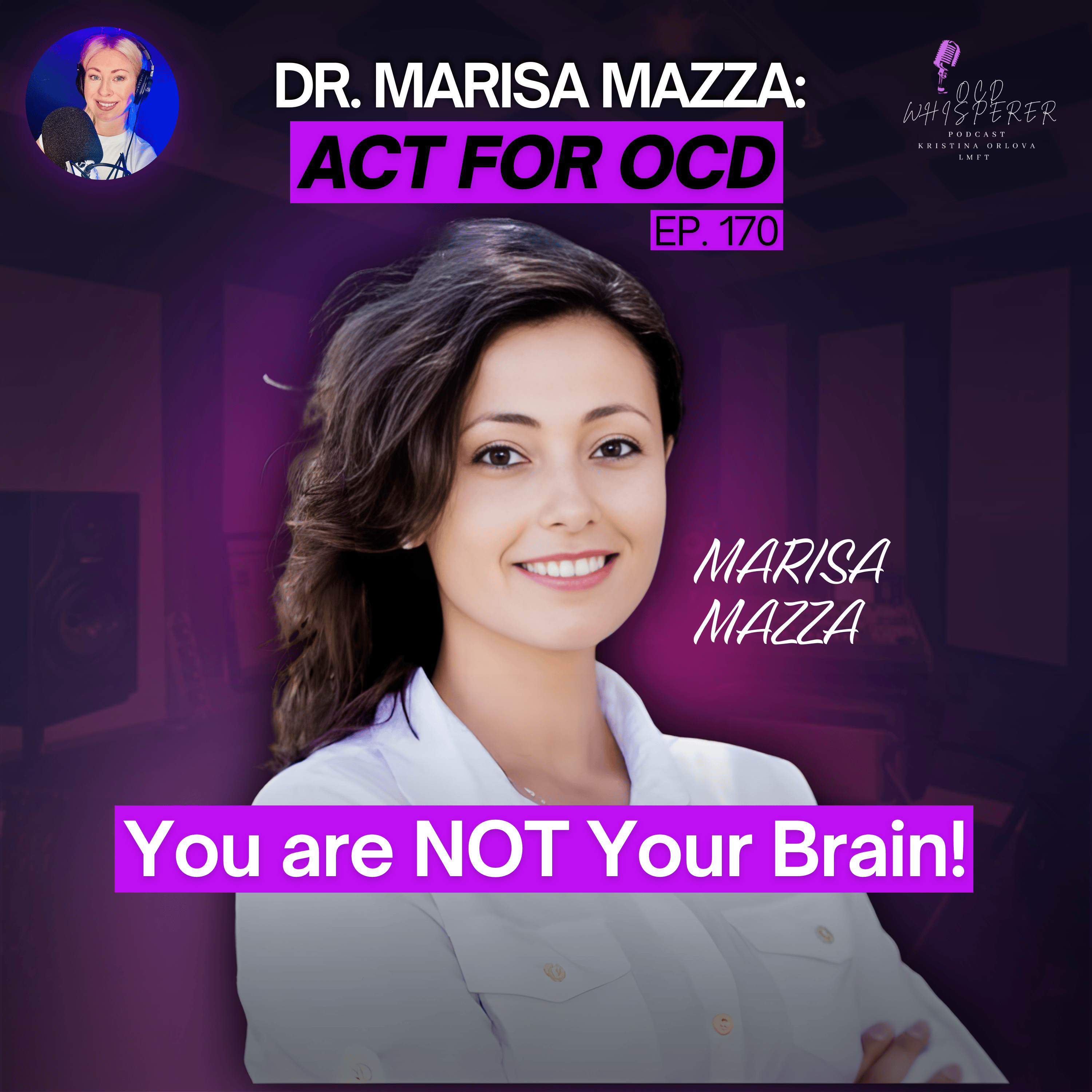
The OCD Whisperer Podcast with Kristina Orlova
170. Why ERP Isn’t Enough: Using ACT to Build a Life Beyond OCD Symptoms
00:31:43
Loading summary
Transcript61 lines
- [00:00]
Christina Orlova
Welcome to OCD Whisperer Podcast. If you like these episodes and you find this information useful, please hit like and subscribe so that you don't miss any episodes. And today with me, guys, I have Dr. Marissa Maza and she is somebody who specializes in acceptance commitment therapy. And I often get requests to try to understand what does that really mean? How do you use it with exposure, response, prevention? How is it different or how is it the same? So we've partnered up to give you guys a four part series where we will be diving into different aspects of acceptance commitment therapy, different strategies and techniques and answer these questions. So before we go any further, I'd like to welcome Dr. Marisa Maza. Thanks for coming on today.
- [00:41]
Dr. Marissa Maza
Thank you so much for having me. I'm really excited to be here and to talk about acceptance and commitment therapy. I've been doing this work for a little over 15 years now and I'm traditionally trained in actually exposure and response prevention and learned ACT a little bit later on. And it was through that journey that I ended up writing and publishing the ACT workbook for ocd. And currently I have a private practice in California. I'm also psy pact and I also spend a lot of my time helping other therapists learn how to integrate ACT and ERP to help people live make beautiful lives with ocd.
- [01:23]
Christina Orlova
I love it. And also I'm gonna put a plug in, I don't think you said this, but you're also a faculty member for the Behavioral Therapy Training Institute. And I put that out there because if you're somebody who's considering to become a specialist, that is one of those things you wanna go through to get that specialized training. And so we're really blessed to have a faculty member today.
- [01:43]
Dr. Marissa Maza
Thank you so much for having me.
- [01:46]
Podcast Host Announcer
Hi, I'm Christina Orlova, host of the OCD Whisperer podcast. As lives with ocd, I understand the struggles firsthand. If you're here, you're not alone. Before we start, grab your free OCD survival kit at www.corresults.com to help you take control. That's K-O R results.com now let's dive into today's episode.
- [02:14]
Christina Orlova
Okay, so you and I talked about the four different episodes. So I'm going to kind of read off out loud so that folks know, here's, here's our plan, here's what we're going to be covering so that you can stay tuned and know what to expect expect. So today we're going to be talking a bit about acceptance commitment therapy we're going to introduce and define psychological flexibility. Like what does that really mean? And we're going to dive a bit into also understanding how does this kind of contrast or go with exposure, response, prevention, you know, is it the same, is it different? How does this really work? Then our next episode will be about unhooking from the mind. So we're going to be talking about diffusion and acceptance. And I know that's probably, probably gonna be a big one for folks because most of the time people struggle with the whole concept of acceptance of any bad thoughts or feelings. Then we're gonna get into getting grounded, being in the present moment, and understanding yourself as your full sense of self and in present day context. And we're gonna end with living a meaningful life. How do values and committed action play a role in all of this? So before further ado, let's dive on in on what the heck is psychological flexibility.
- [03:17]
Dr. Marissa Maza
Great question, great question. So, and I'm gonna like rewind even further and talk about. So it's, it's acceptance and commitment therapy. And you'll often hear it referred to as act. And ACT includes eight different core processes. That includes present moment, so focusing on being in the here and now. It includes values, so having a strong sense about what is important to you, what gives you meaning and purpose in your life. It includes committed action, so actually committing to those things that give you purpose and meaning. Another core process of ACT is self as context, which is one of the trickier concepts, I think. But it's basically being able to step back and recognize that you are not any one of your experiences. So for example, you are not your ocd, you are not your thoughts, you are not your anxiety. And that there's a part of you that's bigger and can observe these sorts of experiences.
- [04:21]
Christina Orlova
I love that.
- [04:23]
Dr. Marissa Maza
Yeah, yeah. And so one of the other core processes is diffusion, which is all about unhooking from thoughts and recognizing that thoughts are letters and words and sentences strung together, but they're not necessarily the truth. Right. Which is a huge kind of game changer in OCD treatment. And then we also have, last but not least, acceptance. And acceptance is very much a willingness and openness to experience whatever's happening internally, so unwanted thoughts and feelings, as well as externally what's happening in your life around you. And so the idea is that these see six core processes then build psychological flexibility.
- [05:13]
Christina Orlova
That's interesting.
- [05:14]
Dr. Marissa Maza
Right, right. And so to kind of get back to your question, it's kind of like, like let's say your brain is constantly throwing different what ifs at you. Right. What ACT tries to help you do is rather than fighting these experiences or wrestling these thoughts the ground or completely like suppressing and ignoring these thoughts, what it does is it teaches folks how to have a different relationship with those thoughts. A relationship that allows them to sort of acknowledge them and then refocus their attention on the present moment. And that's really kind of getting into that psychological flexibility, which means can, can you sort of be present with your experiences, even the unwanted experiences, while focusing in and doing the things that matter to you? So showing up in a flexible way, in a values driven way, rather than engaging in some of the repetitive and rigid behaviors that OCD or anxiety might encourage you to do.
- [06:22]
Christina Orlova
Can I, can I ask. Because I know that act, you know, it wasn't like it was specifically designed for ocd. So let's. Can we talk a little bit about them? Because, I mean, I love the concept of psychological flexibility and I think in general. Absolutely. People with ocd, myself included, you know, before you kind of get treatment, you can get very rigid, very kind of fixated, and you know, be really be 100% unwilling to have any uncomfortable thoughts or feelings. But you know, in everything you're describing in these processes. Right. That really, I think kind of says that, you know, we can get back to that place where we have the ability to kind of roll with things a little bit more, open up a little bit more, maybe not take it so personally. So can you tell us a little bit more about like, what was it really originally designed for? How is it that it came to be, you know, for OCD specifically?
- [07:15]
Dr. Marissa Maza
Yeah, so that's an excellent question. So ACT it, like is. It's a trans diagnostic approach. So it's actually an evidence based treatment for many things, not just for ocd. And the thing that really one of the things that drew me to ACT was that it doesn't just target a person's symptoms. It really looks at what are the underlying mechanisms that contribute to psychological problems. And so it's rare for a person to just come into my office and only have ocd. Right. Unfortunately, having OCD puts you at risk for having other types of disorders, from Generalized Anxiety Disorder to gad. I also happen to see a lot of folks with ADHD and ocd. Right. And so the beautiful thing about ACT is it doesn't necessarily look at just the diagnosis or just the symptoms. It looks at, you know, across the board, study after study, what are the things that cause psychological distress for folks? And ACT really targets those underlying mechanisms. And particularly with ocd, we find it helps with the ability to sort of step back from the mind and recognize the obsessions and the urges as experiences and that there is some choice in terms of whether or not you act on them. And it also kind of brings in the values component of giving folks something else to focus on, not just the obsessions. It's almost like putting the flashlight on values, values based living rather than the internal controlling of one's experiences, which tends to be one of those mechanisms that underline ocd.
- [09:06]
Christina Orlova
Okay, so what's interesting to me when I listen is since you were trained originally in exposure response prevention and then you learned ACT later, everything you're saying just for, I mean, for people listening, how is it then, how's ACT different than exposure response prevention? How does it complement or work together? I think this is one of those big conundrums that I constantly hear where folks get a little confused about, you know, how is this model going to really help me and how is it different than that other modality?
- [09:40]
Dr. Marissa Maza
Absolutely. So, yeah, so I mentioned I was traditionally trained in erp, which I did find helpful. Like my clients doing erp, I noticed that there was a reduction in symptoms, but I also noticed that at the end of the treatment, they were reporting things like just not being satisfied in general in their lives, or they weren't happy in their relationships, or they hated their jobs. Right. Or control was showing up perhaps in their relationship outside of the ocd. Right. And so when I stumbled upon act, it was a little bit of a light bulb moment for me around like, wow, wow. Like this is so much bigger than just the ocd. And that's really what ACT is like. ACT is not necessarily just a treatment. I view it as like a philosophy, if you will. It's a way of living. It doesn't just help you learn how to deal with the unwanted experiences of ocd, but it really teaches folks how to live well with all difficult experiences. And so ERP was really traditionally developed to focus on symptom and anxiety reduction. Helping folks break the cycle of ocd, prevent the typical responses they would normally do while exposing them to the things that they're fearful of. And while that component is really important, the way I see it, it doesn't end there.
- [11:06]
Dr. Marissa Maza (continuation or emphasis)
Right.
- [11:07]
Dr. Marissa Maza
Because there's life.
- [11:09]
Christina Orlova
Right.
- [11:09]
Dr. Marissa Maza (continuation or emphasis)
There's also living and day to day living. And like, how do you learn how to live with these thoughts every morning when you wake up?
- [11:16]
Dr. Marissa Maza
Right. For some people. So I think ACT goes a little bit beyond that and really teaches people how to live well with their experiences and what sorts of behaviors to focus on when they're no longer doing as many of the compulsions.
- [11:34]
Christina Orlova
That's really. Yeah, I think that's really interesting, right, Because I. From what I know too, you know, in the classical traditional training, we typically would say, okay, let's just do a hierarchy, you know, for anybody listening who doesn't know what that is. It's essentially kind of. Basically kind of going from low, medium, to high buckets, if you will, and putting the different things that get the cycle going so that we can then create a map, if you will, of what are we going to practice facing, what are we going to practice feeling, what are we going to practice responding, or how are we going to respond differently than what we're currently doing? So with that, as you said, it seemed like a lot of the focus was just, you know, let's drop that anxiety, let's drop that discomfort. But from what you're saying, and I have to be honest, I mean, similarly, I've seen a lot of kind of great learning that happens from that, but also there's. There's just so much more that's going on because a human being is really dynamic, right? It's not a static. We're not a static organism. And so when you're then, you know, having some other experience that's uncomfortable. Um, it sounds like you can take a lot of these, like you said, philosophies and concepts and really apply them across the board and generalize that out to everything. So, and this may all sound right now like it's kind of up here philosophical conversation we're having, but can you give an example? Because I just know anybody listening would. Would want to know, like, what would be one example of one of these processes and how. How would you actually put that in action? Sure.
- [13:07]
Dr. Marissa Maza
Let's take acceptance. Let's take like one of, you know, one of the bigger ones with, you know, acceptance. And I'll. I'll think about maybe something in my own life.
- [13:20]
Dr. Marissa Maza (continuation or emphasis)
As you may know from our earlier.
- [13:22]
Dr. Marissa Maza
Conversation, grief is something I experienced this past year, and it was incredibly, incredibly painful. And so as that experience showed up for me at times, I noticed myself.
- [13:36]
Dr. Marissa Maza (continuation or emphasis)
Engaging in behaviors that I knew were not the greatest. Let's just say, you know, so, you.
- [13:44]
Dr. Marissa Maza
Know, there was lots of avoidance. I was overworking. I was probably eating more foods that I shouldn't have been eating, weren't as nourishing, you know, for my body. I was moving quickly, talking quickly, avoiding.
- [13:58]
Dr. Marissa Maza (continuation or emphasis)
Things like meditation and slowing down and doing my yoga practice, right.
- [14:03]
Dr. Marissa Maza
So I could kind of see myself kind of engaging in, in, in some of these behaviors. And over time I found my own anxiety. Although I don't struggle with ocd, I do have often struggle with generalized anxiety. And I've experienced some obsessions in my life as well as depression. And so I could feel my own anxiety growing through this process and my own depression growing through this process. And it took me really slowing down and taking a look at like what, what is showing up for me here and connecting to some of the underlying sadness and learning how to step back from some of the self blame and critical thoughts that I was experiencing and really getting back to who I am. And at the core it's those values that I feel like help guide me back to that. And so the way I see it is that self compassion is a beautiful way to practice acceptance. And this looks like acknowledging some of the unhelpful thoughts that I'm having. And this can be, you know, an obsession perhaps, or it can be a self critical thought like blame in my case. And so even just stepping back and acknowledging something like I'm having the thought that fill in the blank can create just a little bit of distance between you and the unhelpful thought and allow you to choose like, okay, well do I want to continue to spiral into this obsession or this self blame or would I like to refocus on something else?
- [15:50]
Christina Orlova
So when you're saying that, I think it's a really beautiful sentiment and I think that it sounds like almost like tapping into, like you said earlier, kind of a different part of you that's able to step back and observe the experience instead of being so in it. And I think that right there is one of the hardest things for folks to do because they're so in, because it's so internal, right? Internally you're having all these signals internally, your maybe stomach is getting queasy or your heart is pounding really fast or, or you know, your head seems like everything's racing and spinning and maybe you feel like you're slightly, you know, having a slight panic kind of symptoms. Come on, you know, how, how do you then, how would you talk to somebody about that and how to slow down? Because right at that moment it might feel really unsafe to them. Not that slowing down itself is unsafe, obviously. I think we all can agree, common sense, it's fine. But in that moment when everything's up and so intense, how could somebody slow down? How could somebody take that to Reposition themselves to say, okay, wait a second, let me. Let me notice this instead of getting, you know, more deeply enwrapped in it.
- [17:05]
Dr. Marissa Maza
Yes, and that's a beautiful question, because I feel like awareness and noticing is honestly some of the foundational work in this model. And the first thing I want to say is, like, it's totally normal to get caught up in those experiences. Like, our natural default is to just be hooked in our experiences, in our thoughts and our sensations, to not really have that awareness. Like, that's how most humans live. Right, Right. And so the idea is that, like, you know, it's really, like, once you notice you're hooked, or, like, once you notice that you're having those sensations, that's a point where you have choice in, like, okay, well, what do I want to do with that? And some clients will come to me, like, already aware of, like, I'm having anxiety, and here's my symptoms and here's what it looks like. And other clients are just like, you know, I don't know what's going on. My boss put me on medical leave, and I don't understand why. And, um. And so really, how do you slow down? It depends on the individual and kind of where they're at. Right. And so for some people, slowing down literally means walking, talking, moving slower. It means making space for quiet. Right.
- [18:33]
Christina Orlova
Okay.
- [18:34]
Dr. Marissa Maza
How many clients. I don't know if you've hear this in your practice, but so many of my clients will be like, you know, I get home from work, I'm fine. I have dinner, I'm fine. All of a sudden I go to lay down in bed and all of these obsessions or anxiety shows up.
- [18:46]
Christina Orlova
Right.
- [18:47]
Dr. Marissa Maza (continuation or emphasis)
We have so many distractions around us nowadays. Like, our phones suck us in, Social media sucks us in. We got TV and all these great shows and movies and friends and.
- [18:57]
Dr. Marissa Maza
And so many things suck us in that it's really not until we slow down and don't have all these distractions around us do our experiences show up. So I'd encourage, like, if you're listening to this and you're curious about slowing down, I would ask yourself that question, like, what could slowing down look like for you? Could it mean. I think that's great?
- [19:21]
Christina Orlova
Yeah.
- [19:22]
Dr. Marissa Maza
Yeah. For some people, it could mean just simply, like, actually taking a lunch break or going for a walk or just saying no to more than what they really need to be doing, you know?
- [19:37]
Christina Orlova
Yeah, because you're talking. I'm thinking about. So my now husband, so he loves meditation, and earlier on he was Constantly meditating. And I would meditate, but not, not to the same degree. But I noticed there's, there's a handful amount of times when things were going fast or there's a lot going on. And I was like, okay, this is the time to just literally press pause and just be still. And I would do, you know, a five, ten minute meditation. And sometimes I would find right after that, suddenly I just feel super exhausted or I feel really sleepy. And he, and I would talk about this and he's like, well, you know, honey, that's because that's actually how you really feel. That's actually what's going on for you. And meditation helps you, like you said, slow down and kind of bring that more forward. And I agree. I think there's this interesting, this is just my opinion, but I think there's this almost like a fear that gets created around being with our own thoughts or feelings or just with ourselves. Right? It's like, no, it's like I gotta stay busy and you know, keep distracted and focus on other stuff. And like you said, from social media to different movies to social. Whatever it is or work that takes up, I mean, I've had, I've had folks I've worked with where, you know, they, they'd rather take on more work, you know, 10, 12 hours sometimes because it keeps them busy and focused in other ways so they don't have to ever face that. But like you said, lo and behold, moment of truth is here. It is nighttime, you're with yourself, you're laying to rest and you can't rest because suddenly everything really comes up and it's racing and your body's firing on all cylinders and you don't know what's happening to you and, and it feels, yeah, like it's hard to fall asleep, you know. And I think like for me, when I was trying to slow learning to slow down, honestly, I thought that was the scariest thing ever. I found it so hard and I had to intentionally, consciously start to choose to like, okay, just take that breath. Breath, very literally. Was that that basic? It may sound like, but I had to recognize, like, I'm talking too fast, I'm moving too fast. Take a breath and just press pause. Like, okay, a little self timeout. Take a minute. And then just doing that small thing more often. Suddenly it was like a different kind of settling that started to happen and that led to other things.
- [22:08]
Dr. Marissa Maza
And that is so beautiful that like you notice, like, I need to take a breath. Right? Like that's what slowing down kind of looks like for, for some folks and for you because, like, when you think about it, when we're anxious, oftentimes we're holding breath or doing or being like, like short, shallow, you know, breaths. And that's a beautiful indicator of like, okay, my. My nervous system is on right now, right?
- [22:33]
Dr. Marissa Maza (continuation or emphasis)
Like, I'm in that fight or flight right now, right?
- [22:36]
Dr. Marissa Maza
I just need to breathe. Like, that's a beautiful. That's a beautiful place to start. And it is anxiety provoking. I actually just recently got back from a five day silent meditation retreat, and this isn't my first rodeo.
- [22:51]
Dr. Marissa Maza (continuation or emphasis)
I've done a few of these before, and up until the night before, I was thinking about all the ways to cancel and not go on this meditation retreat because I was terrified. I knew there was grief and sadness underneath there and that, you know, not having all these distractions, it was gonna come up.
- [23:10]
Dr. Marissa Maza
And sure enough, it did. And it was incredibly painful. And after I noticed some exhaustion, I also noticed a ton of, like, creative ideas flowing through. It was like, you know, from being with that sadness that I had been running from for probably over a year and a half, I was able to kind of let go and move on. And what was so interesting is like, my mind opened up to like, all of these other ideas that I felt stuck in certain creative projects I'd been working on. And all of a sudden these ideas just came kind of flowing, flowing through. But yeah, so it's like our minds and our bodies, like, they, they tell us what we're needing, but we really need to like, kind of slow down and honor those messages. And I see it as a way of, like, loving ourselves and recognizing, like, I'm needing to take that breath, or.
- [24:17]
Dr. Marissa Maza (continuation or emphasis)
I'm needing to go on that retreat.
- [24:19]
Dr. Marissa Maza
Or I'm needing to do that meditation. I'm just needing to slow down and really look at what's there. And it is terrifying sometimes. And what I like to sort of say to folks is like, the bigger message OCD often sends people is that they're just not capable, right? They're not capable of having uncertainty. They're not capable of having big emotional experiences. And so it makes sense that that message would come up when you're trying to slow down. Right? And what I like to say is rather than trust the mind, trust your experience, like, be your own investigator and see for yourself what you're truly capable of.
- [25:05]
Christina Orlova
I love that reframe. I think that's really beautiful because you're right. Like, in life, we go through so many different things outside of ocd, just life generally, you know, and it's like, okay, when OCD shows up. Yes. Everything becomes 10,000 times hard. Harder. I mean, that's just one disorder that makes harder. Right. There's so many other also issues you can have, health, you know, financially, losses of relationships. I mean, there's so many things that can happen that are not per se, you know, in your control either, but totally flip things upside down. So, I mean, I think it's true and fair to say, you know, learning to trust your experiences and also learning to kind of trust life a little bit and learning how to kind of just roll with it a little bit more. I know that lesson took me a long time to learn because you really. I mean, I think it's not a bad idea, but I think not even a bad idea, but I think it's something that most humans have, is we want to kind of take that control and take the reins and guide things. And maybe we're all noticing, like, listen, you. You can guide it to a point. And then a lot of times life, you know, will lead you in some other places. So, you know, learning how to accept those, both of those aspects. Because we're not always going to have control over stuff, and we're not always going to be able to have things be the way that you want.
- [26:24]
Dr. Marissa Maza
Absolutely. Like, so much of life is completely out of our control. Right. Like our genes, our family experiences, the people we grew up with, our teachers, our peers. Right. Like, so much of this is completely out of our control. Yeah, I was going to say, like, that natural default is to control. And at certain points, like, control may have served people in certain contexts. However, at certain points, control may stop working. There may be more costs than benefits to the control. And that's when, you know, hmm, maybe I need to try something a little bit more flexible, or maybe I need to try something a little bit. Just try something new and different and see how does that help me, you know, show up in my life. I often say that the opposite of anxiety is trust.
- [27:30]
Christina Orlova
Yeah.
- [27:30]
Dr. Marissa Maza
It's either trusting yourself, trusting something bigger than you. I don't know, Mother Earth, God, Buddha, whatever you believe in, something bigger than you or yourself has your back.
- [27:47]
Christina Orlova
Yeah. I think that's a big pivot. Right. Because most people, when you're going through this, trusting yourself or trusting yourself again is the big conundrum. That's the big kind of puzzle here that we're solving. But like you said, right. When you, you know, for just. Again, we're talking about psychological flexibility we're talking about the kind of, more like as a philosophy kind of making these shifts and embracing these concepts. I think like everything you're sharing. Exactly right. It, it's when you stop fighting this and actually like you said, see, like, okay, is control still giving you the gains you want or is it now costing you a lot more? Because if it starts to cost you more, maybe you want to try something different. And you know, how much control do you really, really have? And I think too like mindset stuff, right? Like psychologically, psychological flexibility I think is also really important. And I know I've definitely seen that it's really correlated to more joy, more happiness, better outcomes in general just of like overall satisfaction with life versus, you know, when we're kind of doing this all or nothing or jumping to a lot of conclusions. And you know, usually with that seems to be correlated more with depression, perfectionism, lots of other issues, anxiety, et cetera. Because we're not able to even see things from different perspectives. And in ocd we definitely don't see things from perspectives. We get very tunnel visioned on one piece, one slice and kind of go all in on that and forget. I think that there's just a whole lot of other stuff available here.
- [29:20]
Dr. Marissa Maza
Yeah, absolutely, absolutely. And I, I think the cost of running from our experiences is you don't get that knowledge, that information that you are actually capable of having your experiences and living a big beautiful life.
- [29:38]
Christina Orlova
So if we're going to summarize as we're going to wrap up for this first episode, out of the four, what would you say would be kind of the takeaway if somebody's listening, like what would be the one thing you would say? Okay, from today, today, here's the one thing to practice or here's the one thing to, to take away from today to start to put into action?
- [29:56]
Dr. Marissa Maza
Yeah. What I would say is that idea of psychological flexibility. Right. And so again, what we're really talking about here is I, am I able to show up in a present way and focus on the things that are important to me and take steps towards those things. So think about one thing in your life that is really important to you and perhaps OCD gets in the way of. And I'd like you to just think about what's one itty bitty baby step you can take towards that thing that's important to you.
- [30:35]
Christina Orlova
I love that. I love being able to give people something tangible and something that they can sit and think about. What could be just one small thing. Right. We don't have to move mountains if when we're just starting this journey, we can just focus on that one tiny pebble. Dr. Marsamaza, thank you so much for coming on the show. I really appreciate this. If people would like to find you, how can they find you?
- [30:55]
Dr. Marissa Maza
They can go to my website, choicetherapy.net awesome.
- [31:00]
Christina Orlova
All right guys, we'll see you in the next one.
- [31:04]
Podcast Host Announcer
Thanks for listening to the OCD Whisperer podcast. Remember, freedom from OCD is a journey.
- [31:10]
Christina Orlova
And you're not alone.
- [31:11]
Podcast Host Announcer
Visit www.coraresults.com to explore self help masterclasses like Sneaky Rituals with Jenna Overbaugh or ICBT Masterclass with Christina and Abe. Don't forget to grab your OCD CBT.
- [31:25]
Christina Orlova
Journal tracker and planner while you're there.
- [31:27]
Podcast Host Announcer
If you found this episode helpful, please subscribe, share and leave a five star review to help others find the podcast. Together we can make a difference. Keep going and I'll see you in the next episode.