← The Pete Quiñones Show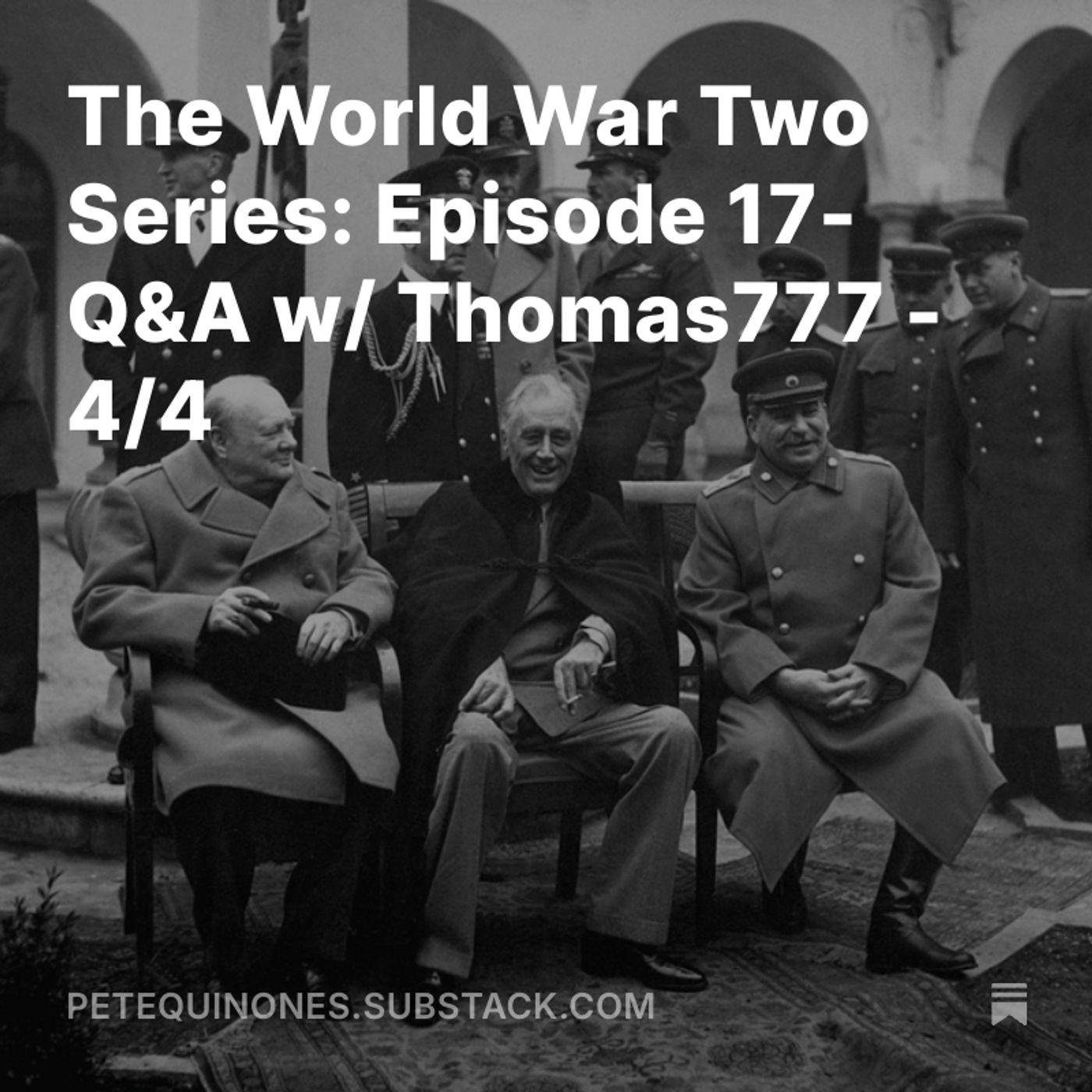
The Pete Quiñones Show
The World War Two Series: Episode 17-Q&A w/ Thomas777 - 4/4
07:59:18
7 Hours and 59 Minutes PG-13 Thomas777 is a revisionist historian and a fiction writer. Here are episodes 17 throught the Livestream Q&A of the World War 2 series with Thomas777 in one audio file. Episode 17: The Nuremberg Proceedings Part 1...
Loading summary
Transcript395 lines
- [00:00]
A
Yeah, maxing is so maxing right now, bro. Get ready for spicy chicken maxing because Carl's Jr. Is saving you big with a 5.99 maxed out double stack, double stack, double stack spicy chicken sandwich. Seriously, just $5.99. Double Stack Spicy chicken. This is unreal value in the Bromosphere. The new spicy chicken Max wallet friendly. Max Tasty only at Carl's Jr available
- [00:25]
B
for a limited time at participating restaurants.
- [00:27]
A
Tax un included.
- [00:27]
B
Not valid for use within a combo or a combination with any other offered discount.
- [00:30]
A
Hey, it's Ryan Seacrest here. And if you're looking for some serious fun, head over to chumbaccasino.com@chumba casino. You can play all your favorite social casino style games for free anytime, anywhere. It's the most fun you can have on your phone or computer. No purchase necessary. BGW Group voidable. Prohibited by law. See terms and conditions 21. Yeah, maxing is so maxing right now, bro. Get ready for spicy chicken maxing because
- [00:51]
B
Carl's Jr. Is saving you big with
- [00:52]
A
a 5.99 maxed out double stack, double stack, double stack spicy chicken sandwich. Seriously, just 5.99 double stack spicy chicken. This is unreal value in the bromosphere. The new spicy chicken Max wallet friendly, Max tasty only at Carl's Jr available
- [01:11]
B
for a limited time at participating restaurants.
- [01:12]
A
Tact not included.
- [01:13]
B
Not valid for use within a combo or a combination with any other offered discount.
- [01:16]
C
I'm Here again with Thomas777. How are you doing, Thomas?
- [01:20]
B
And thank you again.
- [01:22]
C
No problem.
- [01:23]
B
Let's get into about Nuremberg. Yeah. What I wanted to get into today at long last, before, before we. Before we did our deep dive into the kind of bizarre and tragic case of Rudolph Hess, we started to get into the. The politics and intrigues and the nuances of. Of the NUR Tribunal. And. And you know, how. What the implications were for the death of Mr. Roosevelt and you know, the. And. And the ascendancy to office of. Of Harry Truman, you know, and how this was a game changer in some ways, but yet how much of the New Dealer regime, you know, remained very much intact, you know, and that this was essential understanding the kind of form that the tribunal took. And I realized that I've been dropping a whole lot of background on this, but I believe it's essential to understanding if we were. If we were just dive into the proceedings, that would leave too many questions unanswered. Okay. And by the time that. By the time of the actual proceedings, it was Somewhat of a foregone conclusion what the outcome would be. Okay. And it'll become clear what I mean by that as we go on. But where I want to begin this discussion today, you know, is quite literally in the closing months of the war, closing weeks really. Okay? And crazy as it might sound, it was, you know, the first real mention, concrete mention, you know, of any kind of trial was at Yalta. Okay. You know, in the closing months and weeks of the war. You know, it's not like this was something that was planned for years or anything like that. And, you know, as we, as we talk, as we scratch the surface of Churchill, he. He was very, you know, he was insistent that, you know, the. The Reich leadership should just be summarily executed. Okay, which, which, which. Which everybody was really kind of taken aback by, you know, from people within his own cabinet to the Soviet Union of all. Of all parties. You know, as we got into. In the episode before the Hess serious, you know, the Soviets, they. They certainly did not afford people due process. They made a mockery due process. But they also, they. It was. It was their protocol to always avail, you know, political enemies, you know, to a. To a trial, you know, at least a form, at least the formality of it. You know, so the Soviets, even, they were kind of taken aback by this, you know, and Stimson, who was kept on by Truman as a Secretary of War, you know, as we talked about Secretary War, Stimson was an outlier because he was a Republican within the New Deal administration, you know, and he was. He'd be considered a globalist by our standards. He wasn't like an America first kind of Republican or like a Taftian Republican, but he wasn't an outlier in, in the New Deal regime. And I mean, he, like we talked about Stimson, uh, Stimson and Hap Arnold and reached out to Frankfurter to really neutralize in large part, you know, Morgan, thousand machinations after Roosevelt died. And I think that was actually in context, that was a heroic thing to do. Okay. So this was like. This was a strange milieu is what I'm getting at. Okay. When we come into the inclusion of the war, there was this really was very ad hoc. Okay. You know, and exacerbated by the fact that the. That. That Roosevelt had died. And it. Among other things, it goes to show you how much. I mean, the Roosevelt administration, it was a revolutionary administration. It was very authoritarian, but. And it was very much centered around the man of Roosevelt. But, you know, it more so than. Than really any Other administration, I think, save possibly for Lincoln, but that, that's a different story. And, and the force of Lincoln's personality himself didn't shape the administration as much. So like, what I'm getting at is that even though the New Deal regime very much was a constellation of powerful figures and elements and political factions, you know, Roosevelt really was the linchpin of it. And when Roosevelt died with, Roosevelt was in ill health his entire life and certainly during his entire, you know, 12 years as president. It should have come as no surprise, but it goes to show you just kind of like the power he wielded that, that, that things were kind of, things were kind of thrown. So, you know, the proverbial apple cart was so upended by, by his, his death. So the key to understanding what, what became the kind of, the kind of rationale and ethos for Nuremberg that owes a lot to Robert Jackson, you know, and we briefly got into Jackson's background. He was kind of an unusual choice, not just for a Supreme Court justice. Okay. As we got into, you know, he was appointed by Roosevelt to the Supreme Court in 41. But you know, he was born as, he was a relatively young guy. I mean, he was, he was born in 1892. And I mean for a federal judge or Supreme Court justice, even in those days, that was fairly young. Okay. He was born on a farm in Pennsylvania, the same farm his father had been born on and his grandfather had been born on. He practiced law, you know, literally by hanging out a shingle in upstate New York in 1813. He'd never taken a law degree like we talked about, you know, he just learned to practice by being you, an apprentice to experienced litigators. You know, that's the way it used to be, you know, and a, unusual for a small town lawyer, particularly one with agrarian roots. I mean he, he, he made a neighbor until defending trade unionists. Okay. And this made him attractive to New Dealers, obviously, you know, but at the same time, you know, he was, you know, he was a small town, you know, white Protestant and you know, know that the optics of them were like acceptable to a lot of people. Okay. And Roosevelt had to, I'm, I'm being value neutral in saying this is just a fact. You know, Roosevelt developed a reputation for appointing a tremendous amount of, of, of Jews and, and ethnic type people to, to the federal bench, you know, and this, this raised the ire of a lot of people, like even people who weren't particularly anti Jewish or nativist or anything, you know, so there's a reason why Jackson was kind of found the favor the Roseville administration, okay. For a lot of reasons and obviously too that that gave him kind of the right resume, as it were, in optical terms to head up the Nuremberg Tribunal. And we'll get into why it is more like as we go on, okay? So as I said just a little bit briefly about Jackson, 1941, he's appointed the Supreme Court, United States. He was, despite being a staunch New Dealer, he held a lot of minority opinions that frankly I think were pretty, pretty ballsy, okay. In no uncertain terms, he declared, you know, that he thought it was. He felt the court, you know, was unconstitutional, the Bill of Rights to be suspended on grounds of military exigency, okay. Just categorically. And that certainly didn't win many favors among his, his ideological colleagues, okay. He staunchly opposed the internment of Japanese Italians and Germans in the United States. And make no mistake, thousands of Germans and a fair amount of Italians were interned. It was not just the Japanese. You know, he, he declared that that was, you know, offensive to justice, badly unconstitutional and you know, it was discriminatory on, on, on grounds of subjective immutable characteristics of persons and, you know, just defensive. The fundamental fairness. You know, he really had a firebrand kind of opinion about this. Okay. I'm not saying that's right or wrong, but I'm saying like within that milieu like that, that that was a very principled stand to take. Okay. This was an out of popular opinion, okay. And when he'd been attorney, served as Attorney General, he butted heads with J. Edgar Hoover because in the run up to the Second World War, he'd opposed federal wiretapping by the FBI. Okay. And it was pretty. Despite the fact of the FBI in those days, they didn't have nearly the power they did subsequent to the war, you know, and, and um, when, when they, you know, the FBI initially in its earliest days didn't even carry guns. Okay. Like they, but they. By the, by the inter war years and particularly by the time of the New Deal, they very much carted a mandate as kind of a political police force. Okay. And if you were suspected of sedition or having, you know, some of these for the Axis powers, you know, even before the onset of formal hostilities, you could very easily place under surveillance, you know, like Joseph Schumpeter and his wife. They, even though Schumpeter had left Europe because he, you know, he wasn't any kind of staunch anti fascist, but he, he knew a maelstrom was coming and he didn't want, you Know, he didn't want to be involved in it in any way, shape or form. But you know, he was suspect because he was a right wing and he was, he was Austria. He was a right wing in, you know, Austrian. And he'd, you know, his wife was attended paper criticizing, you know, a bellicose disposition towards the Japanese empire vis, Vis a vis, you know, China. So I mean, my point is it was not hard to, to, to, to put somebody under surveillance if they were denounced or, you know, or, or identified as a seditionist. Okay? So I mean, Jackson was not. It's important because as we get into this, you know, it might seem like I have some unflattering things to say about Justice Jackson, but I actually think he was a principled guy. Okay. Wherever I part ways with him and it's important. Okay. You know, Henry Stimson developed a very strong rapport. Jackson, you know, and again, I think Stimson, for all of his faults is principled. And Stimson, I think in a lot of ways was instrumental in getting, uh, in getting, uh, getting Jackson appointed, uh, to the war crimes tribunal. You know, and Stimson, Stimson and very much had Truman's ear. I have no idea how friendly they were in personal terms, but there was mutual respect in, in policy and professional terms. That's why Stimson stayed on, you know, his surgery of war. The, the, you know, Stimson made the point. What he, what he, what he emphasized to Jackson was he said that he'd be in favor of, of prosecuting the entire, the entire officer corp, The Gestapo, then perhaps, you know, everybody of officer rank in the, in, in the SS generally. Because in, in Stimson's view, Stimson thought in somewhat military terms, even though he was in a, you know, a civilian role. He identified, he identified the police and the SS apparatus as outside, operating outside the parameters of, of ordinary military mandates and that it was tailored to apply violence in a way outside of ordinary military exigencies. Okay. Now you can, playing devil's advocate, you can say that's the conceit of a man who, who lived in a very safe, physically secure, continent sized country that was never dealing with actual, you know, violent insurgency from within. That, that's a term that's idiotically bandied about insurgency. But I'm, I'm talking, I'm invoking it in the actual meaning of it, you know, a, A, a dedicated, violent cadre based political movement that, you know, has the ability to, has the ability to compromise, uh, the state's monopoly on violence and impose their will on this on the population by. By force. Okay? So, you know, Stimson was not some guy who had some soft view of. Of. Of the Third Reich or was pro German particularly. Okay? But he. His entire raison d' etre for insinuating himself as much as he did into the. The planning for the. What became the International War Crimes Tribunal was because he identified in Morgenthau an embittered zealot who in his words, had personally internalized his resentment against the entire German people, in his words, as a race. Okay? Without regard to individual guilt, without regard to the. The. The structure of the German Reich and, and how culpability, I mean, presuming that it was proper to impose, you know, the jury liability on. On actors in the German state in the first place. Morgan thou made Stimpan's very candidate in his view. Morgan thou made no distinction between soldier and civilian, between, you know, policemen and you know, conscript Lanzer and. Or anybody else. Okay? This is very much a. In an ethnic ethno sectarian animosity, a bona fide hatred for the German people when that was that. That would have had profound implications for policy moving forward if more had gotten his way. And I will get into that as we go on. But I think the implications should be clear anyway, briefly and because at this time, you know, as. As April 1945, May 1945, you know, the. In other words, the immediate. The, you know, the final denou of. At the Battle of Berlin and the immediate aftermath of. Of the Reich's defeat, the matter of Rudolph Hess came to the forefront, okay? Because Hess had been in custody, you know, for four years, you know, and any, any way that the Allies decided to proceed, they were going to have to deal with the issue of Hess because the position it has was complicated by many factors. Okay. It's like, all right, you know, the. What Churchill and what the Crown was willing to say and what they did allege was that he was Hitler's deputy furor. Like literally he was the titular head of the Nazi party in. In a secondary role. However, he literally, you know, commandeered a Messer Schmidt's plane, defected in fact, if not, you know, in intent, you know, on a mission to see the majesty the King on a mission of peace because he, he was horrified at the prospect of war and the. Even within. I haven't gotten into the interrogation of Hatch and what he endured during his captivity and we will next episode when we get into the actual litigation of his case. But Even members of Churchill's cabinet who did contact with the man during his captivity, including Beaverbrook and Lord Simon. And Lord Simon certainly was not. I think Simon was something of a snake, and we'll get into that. But, you know, Beaver Brook was fairly. Was fairly balanced, I believe, in his view of the. The German people and including the right government. Lord Simon was not. Okay. But they've spent a lot of time around Hess personally, and the transcripts of their talks, you know, in their interrogations of them, they both revealed unqualifiedly that they found has to be dedicated, upright, first and foremost, a soldier. You know, and a guy was haunted by the prospect of, you know, an allout war between the Reich and the U.K. you know, to be characterized as. As came to pass by, you know, area bombing and. And unrestricted, you know, mass homicide against civilian populations. You know, he arrived literally on mission of peace with a letter in his pocket. He'd written address to the King stating in uncertain terms that Germany had no demands to make on Britain or her empire. But. And he subsequently was held in. He subsequently was held in solitary confinement for years, during which time he came to develop the symptoms of paranoid schizophrenia or what was diagnosed at the time. Now, we know these days, you know, I made the point before, and I don't want to go too much on this tangent now, but that sensory deprivation leads to symptoms of mental illness, okay? Even. Even if, you know, the. Even if the subject is not organically afflicted, okay. Or congenitally rather. But the point is, Hess became very, very unwell during his captivity, okay? And, you know, twice he committed. Twice he attempted to commit suicide. You know, he. He'd essentially been denied medical treatment or. Or nor was he afforded any. Any reprieve of his conditions that might have. That might have caused his distress to abate. And under the terms of Geneva Convention, he should have been repatriated as a disabled prisoner of war. Okay? I mean, this is. It doesn't matter that, you know, he was a man of. Of high political rank and a regime that was subsequently declared to be, you know, criminal against. Against firm precedent. You know, he arrived before such things were even word anybody's contemplation. You know, he arrived in uniform. He was a peace emissary in. In. In. In time of. Of a formal state of war. I mean, it was clear what his status should have been. Okay? But. Well, you know, the fact that, uh. The fact he was held indefinitely and kind of deprived any status whatsoever, to say nothing of, you know, again, the. The Crown's Refusal refusal on humane grounds or, or you know, the refusal in either ground, either on humanitarian grounds or on grounds of the letter of the Geneva Convention or patriotism. I mean this itself caused a problem. Okay, because it, you know, aside from the fact that we got into what Hess knew and what his intentions were that you know, tended to cast a shadow on, on, on the legitimacy of what Churchill and the focus declared was the raison Detroit of continuing hostilities against Germany. But also, you know, the case makes clear that you know, what the Allies generally and what, and what the UK specifically what they were engaged in was. They, you know, they were, this was very ad hoc. You know, they were, they were, they, they were, they obviously intended to treat the German Reich as a special case, as it were, you know, and, and, and they were not about to avail themselves, you know to the express conditions of the, the treaties that they themselves were invoking to, to rationalize, you know, the said treatment of the Reich. So this, this, this, there was a certain incoherence here and unfortunately for Hess, you know, he, he became very much a pawn in, in these great intrigues. The, the, there was a documentary, there's a paper trail quite literally. The, the Soviet Foreign Ministry actually contacted Anthony Eden directly and inquired about the, the status of Hess. I mean I think part of that was just their kind of macabre fascination with any man in the National Socialist leadership. And this endured well beyond the end of the war. Okay, that isn't just a mythology. You know, the. Stalin retained some of, some of Adolf Hitler's personal effects and it was cruise shift relayed that sometimes, you know, in a stuporous days like Stalin would have to be reassured that Hitler was in fact dead. You know, really, I mean I realized by that point Stalin was probably compromised in terms of his mental faculties. But there, there was a, the Soviet leadership assigned an almost demonic quality to the Reich leadership which I unlike which I understand in the case of the Russians, okay in more than a little bit. But in any event they, they Moscow is concerned because if you know, they under on grounds that have Hessamental instability had become, you know, common knowledge, the German government at least does, you know, at least the interim structure that existed under occupation. You know, this was before even, you know, the occupation zones had ossified into semi sovereign states. The, the concern was that under the prisoners of war section of the, the Geneva Conventions that you know, they could be a good case not for, not just for his repatriation, but for that of, you know, whoever else might come into custody of, of High political rank. And Eden, Eden was very curt. His reply was simply, we naturally don't intend to let Hess return to Germany and so possibly escape. Answering for his share in German war crimes, Churchill weighed on this, saying that a prisoner of war who committed war crimes was committed crimes against the laws of war can be shot. That's not true. In typical kind of Churchillian fashion, Churchill kind of invoked a half truth and then put a polemical spin on it in a flippant way and, and simply expected his audience to accept, you know, what the old man said is, is somehow, somehow dogma from on high. A prisoner of war, you know, somebody who enjoys that status, you know, like a uniformed combatant and can only be executed after due court martial by officers of appropriate rank, which a lot of people don't know. Um, and that's, I mean that's not just customary. It's, it's, it's the letter of the law. If you accept Geneva Convention, the Geneva Conventions is binding law and only after the protecting power has been notified and after elapse a statutory period of time. And David Irving made the point that there was a paradox here, that this, you know, that the Soviet Union was, you know, advising Eden that they probably ought to abide the Geneva Convention, which the Soviet Union had specifically repudiated and which the British were constantly invoking to rationalize their own conduct at war. The. And finally the. And this, again, this bears on how the indictment was finally structured and becomes relevant. It's not just, I'm not just raising these issues to point out a basic hypocrisy or make a political point about what was alleged against the defendants who ultimately ended up standing for trial at Nuremberg. In the case of Hess, you know, as we talked about in our treatment of him during our, our kind of lengthy series, you know, it's an argument that Hess was characterized like the, the dominant characteristic of him was his moral conscience. Okay? It's not just me putting shine on him. There was a basic sensitivity and earnest naivete. Okay? Everybody who was familiar with the man acknowledged that. And even if one doesn't accept that he personally issued, he issued a formal telegram to all the gal lighters in the aftermath of the crystal knocked, which I assume the listeners are familiar with. You know, Goebbels had very foolishly, you know, stirred up, stirred up, you know, National Socialists in Berlin and Munich to, you know, the violence against, uh, the Jewish minority, you know, owing to, owing to, owing to the assassination of a German diplomat by a Polish Jewish Communist, you know, Young kid. And this really put Goebbels on the outs with Hitler. Not because Hitler had some sort of like abiding sympathy for the Jewish population of Germany's urban centers, but because this could, this, this is a PR disaster in the court of world opinion. It took Germany a long time to rehabilitate its, its image. And there truly was a global media in those days. I mean, nothing like today. But it, there was, you know, the, there was rapid communication across national frontiers by the 1930s that there had not been an epoch's past. So this, this allowed this, this gave Germany's enemies fodder to cast them as truly monstrous. And Hess was outraged by that. But also, I mean, you know, on the things like his relationship with the house offers, you know, Hess really wasn't a particularly. He was, he wasn't particularly prejudiced or wasn't particularly racially oriented. You know, he issued this circular condemning, you know, the crystal KN Demand demanding a. A halt to what he referred to as future outrages. Beyond that, you know, owing to his role, which was not a military or police role, he was not a participant in any of the secret conferences that the furor held with the okw, you know, the military eye command. If you accept the narrative of what became called in the 70s, 1970s the Holocaust. You know, if you accept the. That there's a specific intent, conspiracy to. Of ethnic cleansing and homicide. The narrative of that posits that, you know, the Von C conference in, in 1942 was, was where that policy was decided upon and, and ultimately implemented. Well, I mean it has not only Hess not sitting on a conference, Hess was incarcerated in the United Kingdom at the time that that occurred. I mean it's. Everybody well knew Hess had actually tried to stop the war and end the bombing. I mean, he had left Germany before the attack on the Soviet Union. I mean, we, we go on and on. Okay. The, the idea that the, the, the, the. The idea that Hess in any way shape or form could be held cul for war crimes is absurd. But politically, a man with the rank of Hess in the National Socialist regime could simply not be allowed to be acquitted. Okay, and we'll get into why that is. As we go on, it becomes clear, I think, okay, has became the, the real man in the high castle because he, he just could not be permitted to go free. Because were you permitted to go free? That would have shattered the narrative. Okay, and that this isn't some wild conspiratorial notion. It owes in large part. I mean, obviously there, there was Politics behind this decision of the, of the, of the worst sort. But also, as I'm going to get into, as we deep dive here, you know, something that a lot of lay people don't recognize is that legal reasoning is very self contained. Okay? And there's a way that it must be structured and certain assumptions must be abided and in abiding those assumptions, certain other possibilities have to be absolutely negated. Okay. It's very binary and it'll become clear what I mean by that as we go on. But you know, this is the tragedy of Rudolph Hess, okay? And I believe the reason I make so much of him is because, not just going to humanize the issue, but it's, you know, in very dramatic and concrete terms it demonstrates what was flawed about the entire enterprise of these proceedings. Now bring it kind of back to earth a bit in, uh, in 1945, after Yalta, one of Roosevelt's final acts and, and kind of the planning of what ultimately became the international tribunal, FDR sent Samuel Rosenman to London. Samuel, Samuel Rosenman was one of, he was kind of a trusted functionary. You know, I think we mentioned him before. He uh, he, he enjoyed kind of good offices with Morgan Thaw and with that element. But he certainly wasn't like, he certainly wasn't a zealot. You know, he wasn't a standard bearer of that position. But he was a man who's kind of universally, he's a man who's kind of like universally accepted and respected both by his own core religionists as well as the British, as well as people like Stimson. You know, so he became something of, a, something of an unofficial emissary. Okay? Now the reason why, the reason why FDR deployed Roseman to London was his job was to read some kind of agreement with the British authorities on, on the treatment of the, you know, of the Reich war criminals. Okay. And we, we got into, before the Hess series, you know, we get into the kind of, the rather arbitrary distinction between you know, the mate, quote, major war criminals and others. Okay, well, like Rosenman, his job was to, you know, kind of, for lack of a better way to characterize it, you know, force the British in, in the most diplomatic way possible to, you know, to participate in a kind of road map or you know, at least some kind of basic structure for, you know, how what proceedings are going to look like against these people and, and how it was going to be structured and like how, where authority was going to be vested. Okay. You know, was, was the, was this tribunal going to be acting on behalf of, you know, the, quote, United nations, you know, what was was it going to be on behalf of, you know, the. The allied occupation authorities exclusively? It wasn't going to be some sort of.
- [31:35]
C
Yeah.
- [31:35]
A
Maxing is so maxing right now, bro. Get ready for spicy chicken maxing because
- [31:40]
B
Carl's Jr. Is saving you big with
- [31:41]
A
a 5.99 maxed out double stack. Double stack, double stack spicy chicken sandwich. Seriously, just 5.99 double stack spicy chicken. This is unreal value in the bromosphere. The new spicy chicken Max wallet friendly, Max tasty only at Carl's Jr available
- [32:00]
B
for a limited time at participating restaurants.
- [32:01]
A
Tacked on, included.
- [32:02]
B
Not valid for use within a combo or a combination with any other offered discount.
- [32:05]
A
Hey, guys. It is Ryan. For years, Chum has been setting the bar for online social casino fun. And it just keeps getting better. With new games released every week and daily bonuses to collect, the fun never stops. So claim your welcome bonus now@chumbacasino.com. no purchase necessary. BGW terms and conditions.
- [32:20]
B
21/Step into the world of power, loyalty, and luck. I'm gonna make him an offer he can't refus. Family cannolis and spins mean everything. Now you want to get mixed up in the family business. Introducing the godfather@champacasino.com test your luck in the shadowy world of the Godfather slots. Someday I will call upon you to do a service for me. Play the Godfather now@Champacasino.com Welcome to the family.
- [32:47]
A
No purchase necessary. VGW Group void. We're prohibited by law. 21 terms and conditions apply.
- [32:51]
B
Was it gonna be. Was it gonna be some sort of a temporarily sovereign regime within the German occupation zones of, you know, France, United States, the UK And. And. And the Soviet Union? Like this was not. This is not at all clear as of this point, because it was. There was no precedent, but surprisingly, to Rosenman, uh, Viscount Simon, uh, you know, Lord Viscount Simon, who we've talked about before, you know, who'd been, you know, a proponent of appeasement and a Liberal Party mouthpiece, you know, many years previously, you know, but who now was, you know, the chief, was kind of the jurist in chief of the Church of War cabinet. He simply reiterated that the summary killing of Adolf Hitler and. And in the entirety of the Reich authority structure, it'd be carried out with no. With no trial or without any kind of formality. And Rosemary was pretty shocked by this. Okay, not just because it's barbarity, but because of its. That's just not, that's not politically viable. I mean, for reasons that should be obvious, in my opinion. It was, it wasn't just Churchill's flippancy being kind of contagious within his inner circle, but again, Simon, Simon was doing everything he could to kind of distance himself from his past as, you know, an appeaser. Okay. So the fact that he was situating himself first and foremost as kind of the, you know, Lord High executioner of the anti fascist cadre, I, I should come as no surprise. And it was very, very cynical. It. Simon actually wrote in the Cabinet paper, which I believe in the Englishmen and ladies who are listening and correct me if I'm wrong, I believe that's like the minutes of a Senate subcommittee here in the United States. Okay. The Cabinet paper. Regardless, as a matter of public record, Simon wrote, quote, that these leaders must suffer death. The question arises whether it should be tried by some form of tribunal claiming to exercise judicial functions or not. So I mean, basically he was saying he was admitting that, you know, it's a foreign occlusion. These men are going to be executed. The only question is whether they should be available to a show trial, which is pretty grotesque. That kind of above board cynicism, I think. Okay, there's something, see, see a lot
- [35:23]
C
of that today, don't we?
- [35:25]
B
Yeah, indeed, indeed. And I think that's, that's one of the precedents. I think that was one of the, one of the negative precedents that was set by this entire affair because it's like, you know, the, it's one thing if there's an earnest ding, these things or it's another thing or if, you know, if, you know, the. It's a mere exercise in the appearance of law. But, you know, the, but for the sake of decency as well as for, you know, basic law and order and due process. You know, it's a fiction that must be maintained. But you know, when, when, when people situated in high authority like Viscount Simon are just openly discussing their cynicism of the whole matter, like, yeah, that, that's, that's, that's not, that's not a government that has any kind of moral authority. Okay, it's, it's.
- [36:14]
C
Look what we got now, right before we started recording, it came.
- [36:17]
B
Oh yeah, indeed.
- [36:19]
C
The FBI went into Mar A Lago.
- [36:23]
B
No, it's unbelievable. And that was on my mind actually. And I, we should, moving forward, do a, do a, do an episode on Watergate as well as on Trump and on, you know, the. What I think of as you know, how. How America. How the deep state acts in America relative to, you know, other states in terms of. In terms of, you know, how it manages coups. It does so very much under color of law. You know, it. And yeah, that's an important point, and it's directly relevant. And. Yeah, it's not. It. That's definitely. There's definitely an indirect legacy of, of the proceedings that we're talking about here. And after, you know, after Rosenman returned to the United States, he sought out Stimson because he, again, Stimson was. I don't want to so much save as the moral conscience of the. Of the new Truman administration, because that sounds corny and. But he was. I. He was principled. Okay, let me put it that way, all right? I mean, aside from his politics and whatever. Whatever regimes or whatever administrations he served, however we feel about them, okay with it, within the parameters of his. Of. Of. Of his authority and of the. And of the political values of. Of those presidencies. Stimson was a principled individual, okay? And he was rather horrified by what he called, you know, what he called Simon's advocacy of lynch law, which it was. And again, he noted the irony, as at others, that, you know, Isaac Jackson, that, uh, you know, the, uh. There's something. There's something perverse about the Russians and the French being on your side, that, uh, your vanquish enemy shouldn't be lynched. You know, meanwhile. Meanwhile, the, uh. Meanwhile Lord Viscount Simon, uh, of the. The mighty British Empire is demanding we, you know, we do away with any. Someone to do process and simply lynch people. I mean, that, that. And Simon had that. What's important too, is like Viscount Simon, he wasn't. He wasn't. He wasn't just some functionary or something, okay? It's important even he'd invested full authority as Lord Chancellor and sole authority to reach agreements with the Soviet Union, France, United States, and the disposition of the war criminals. Okay? So, I mean, his, His. His. His decision and his word was law as far as the United Kingdom went in terms of this. In terms of these proceedings. So keep that in mind, too. I mean, that's. That's why this was. That's why this was, uh. That's why these people are so shaken by this. This kind of flippancy about what amount of do in advocacy of. Of extrajudicial homicide. So keep that in mind. But now, what also was underway here was. And again, Stimson, Uh, and this became, uh, a primary concern to Jackson himself as well as the you know, as well as to anybody who was thinking about this in critical terms, I mean, there's a problem relating to what constitutes a, quote, war crime anyway, because as we've talked about, and this is a bit abstract and theoretical, but I think it. I think it needs to be reiterated. We can't. We can't really talk about international law outside of a basic moral consensus, okay? Because treaty law is always permissive. It. It can never be compulsory, okay? Because there's not some world sovereign, and there could never be a world sovereign unless it was, you know, some kind of absolutely autocratic regime that essentially was, you know, owed its. Owed its. Oh, it's universal authority to. To the, you know, to the ability to compel compliance, okay? But the. There. There's not, you know, the. The law is not. Does not come from the law of man, is not the law of God, okay? And, you know, treaties, just like statutes, you know, this is not like, this is not synonymous with moral declarations, okay? That's important to keep in mind, okay? Like, we talk about the law, we talk about criminality. We're not just talking about bad things or bad acts. You know, we're talking. These things have specific definitions. You know, they relate to an ability and willingness to enforce penalties therein. And you know, there, There's. There's an issue of sovereign legitimacy, okay? Now, if you're gonna declare that a national state, particularly one like the German Reich, that was party to a truly global conflict, okay, you're gonna declare that, you know, it. If you're gonna declare that the men within its. Its control group are guilty of crimes, it's like, okay, well, I mean, there, There's a territorial jurisdiction imperative here too, you know, or not as a matter. Not just a due process, but as a matter of rationality. All right, so, you know, are you going to allege that specific instances of. Of. Of. Of. Of mass homicide, you know, constitute the core of the indictment and then, you know, these men going to be healed into court in the territory where these events occurred. That wouldn't really be workable. And it also, it would be treating it. It'd be. It'd be treating what was basically unprecedented, you know, that being that. That. That being hailing heads of state into. In. In. Into court that were, you know, convened for this exclusive purpose of. Of criminalizing conduct at war, that they'd be treating such a thing as. As mere criminal acts like one would within, you know, the. The boards of a sovereign state. So I mean, that not only would it not really be Workable wouldn't really fulfill the, the raison, diatribe of, of the proceedings in the first place. I think that's clear. Okay, so essentially what, what was decided was that the, the way the indictment is going to, what the indictment is going to allege was a general conspiracy, okay, that is going to allege that, you know, the men who were in the defendant's docket, the name parties in the indictment, they were part of a conspiracy to dominate the world through hostile military conquest. Okay, that was initially the, the idea and that, and that, that ended up constituting a substantial body of the indictment. But you've got to understand this, this wasn't just a political narrative. It owed you the, it owed to jurisdiction, it owed to due process concepts which I don't believe were substantively honored, but the appearance of it was, was, was, was necessary. You know, if you're gonna, if you're gonna literally charge a government with, with criminal conduct and you're going to identify its policies like as, as, as, as intrinsically criminal, you're going to have to identify essentially every act in the service of that government, you know, by the men who were in executive authority roles as part of a conspiracy, you know, to carry out these offenses. That's the only way you can substantiate really the case that they wanted to make. Okay, Like, I'm not talking, I'm not speaking the merit of the evidence. I'm saying, just otherwise the narrative doesn't make sense and it can't really be structured any other way. And that's one of the problems with a lot of, kind of people who don't have a great understanding of history. They'll read something like William Shire's book or they'll read, you know, kind of the sort of book that's assigned to high school history students. And it'll describe, it'll describe the Third Reich basically in the terms that were presented at Nuremberg. And that's not correct. I mean, not just, I'm not just in value neutral terms. You know, you can't describe history according to what is, what is alleged in, in an indictment. Okay? Because again, there's, there's an internal logic to legal reasoning that is somewhat remote from the real world, but that conceptually is the only way it can really be structured. I mean, as well as the fact that, you know, this is utilized for polemical purposes and, and to cast the condom in question and in a light most punitive and, and ghastly. But you know, just in, in conceptual terms, it can't really be structured any other way. Okay? So in order to accept basically what was being alleged throughout the proceedings, but even also at this kind of at inception where the theory was, was just kind of coming beginning to ossify, you'd basically have to believe, to believe that the, the verdicts weren't at Nuremberg were legitimate. You basically have to believe that Adolf Hitler was not a, that basically the moment that he joined the National Socialist Party in 1922, he decided he and a group of men around him with shared values and ambitions and goals hashed a conspiracy to conquer the world and to categorically murder people that, that they viewed as, as not compatible with, with that vision of conquest. Now, that's just not the way warfare works, okay? I mean, even if, even if you think that Adolf Hitler was a very, very evil man, and even if you think he was capable of those kinds of things, like, that's not, that's just not the way, that's not the way wars work. You know, a chief executive at war, he's reacting to battlefield conditions as much as he's acting spontaneously. You know, the strategic landscape is constantly changing. The fog of war is a very real thing. You know, like, you can't, you can't plot a global war the way like you can plan like a bank robbery, okay? I mean, it's just not that, that's not that, that among other things, that makes men into gods. You know, like no man, whether he's Muhammad or Adolf Hitler or Hannibal or Oliver Cromwell, no man can just say that. No man can just, you know, plan, you know, the fortunes of, you know, millions of people and, you know, millions of discrete decisions within, you know, the paradigm of a world war and, and, and, and somehow, you know, predict those outcomes and then, you know, every step of the way manipulate those outcomes towards some kind of discrete end. Like that's just, that's not possible, you know, so, I mean, there's, I, I, people think that I'm splitting hairs sometimes or engaging in elaborate apologia. I'm not, okay? This, regardless of how it falls on revisionism, this can't be denied, okay? And legal reasoning is very, very flawed, you know, and it doesn't.
- [47:25]
C
Well, I mean, think about it. Even if, even if they game theory it out right from the start, England declares war on them.
- [47:32]
B
Yeah, exactly.
- [47:35]
C
That throws the wrench right there.
- [47:36]
B
Yeah, exactly. Exactly. Well, it's also too, I try to explain to people, you know, like, people get upset about cases like the O.J. case when they're like, you know, I'VE always tried to explain to people like, you know, courts don't find people innocent, they find people guilty and they find people guilty as a matter of law. Okay. And sometimes they're wrong. You know, like this idea. It's, there's, you know, like legal reasoning isn't the science and it's not like a philosophy, you know, and it's not, it's not this, it's not this kind of splendid system wherein you kind of like tease out the truth of human actions or something, you know, it's, it's, it's a very self contained thing. And yeah, you're absolutely right. Even within the bounded ration of, of the narrative of the indictment. Yeah, I mean there was, there was, that was a, that, that was, that was kind of the elephant in the room was that, yeah, the London and Paris declared war on the Reich first. And also things like this was before, you know, after the Jackson and Stimson were conferring on these things before Hiroshima, but after the atomic bombing in Japan. This caused problems too. You know, we'll get into that. But it, I think it. I want to insinuate some things I've written on this and you know, the people who follow my long form, you know, the Nuremberg book I'm writing isn't just about Nuremberg. It, you know, it's about. I get a lot into the Cold War, okay? And I. One of things I get into is that, okay, take for example, you know, the Vietnam conflict. And take like Mei 4, okay? You know, if I was, you know, let's say, let's say some kind of, let's say some kind of North Vietnamese or Soviet tribunal was in a position, you know, for the sake of the counterfactual exercise, we're in a position to, you know, bring the United States government up on charges owing to the kinds of conduct that was carried out in my life. I'm trying, I'm not trying to say United States evil or something. I'm saying just go with me in this, okay? Like what, what if I argued that. Well, you know, the, the logic of the free fire zone in Vietnam was this idea that the Vietnamese race, you know, were the standard bearers of communism, you know, this revolutionary idea in Vietnam. And it was presumed that, you know, anybody within the free fire zone, once it was declared to be such, you know, was, was, was, was at least sympathetic to the enemy, you know, the National Liberation Front. So, you know, US army infantry elements like the Americal Division, they were deployed to exterminate everybody within these free Fire zones who had been so identified. And, you know, Lyndon Johnson, owing to his hatred of Vietnamese people and his hatred of communism, you know, he plotted this genocide. And, you know, so did. So did Robert McNamara, you know, and so did. So did the Joint Chiefs of Staff, you know, in the Pentagon, you know, when they talked about the body count, what they were really talking about was the genocide of the Vietnamese people. And you've gotta, you know, you got to look within, you know, the, the euphemism. You got to look at the deep remaining, the euphemisms they employed within their own internal bureaucratic language. Like, you see where I'm going with this? And like how one can suddenly confabulate a narrative that really isn't there. Like, like. I'm not saying there weren't like a. Horrible, horrible things done by the right government and every other combatant In World War II, you know, every combatant, you know, but, but do you see how one can, you know, I, you could structure pretty much any, any, any modern executive decision, this paradigm at war, to, to kind of satisfy that, that, that, that sort of narrative to a greater or lesser degree. You know, so I encourage people, you know, if they don't agree with me, to kind of contemplate these things or at least keep them in mind, you know, now bring it back. I'm sorry, that was too tangential. I think, I think this is important to fully flesh out the issue. You know, so I'm sorry if I bored anybody or anything, but the. April 1945. The war in Europe's literally about to end. You know, the, and the Russians, who initially were the most strident in, you know, because, I mean, the Russians basically invented the show trial, you know, like, they were all about, you know, putting everybody on trial. Like, I'm not being flippant, that's, that's terrible, terrible. But they, they were, you know, we got into that in the episodes previous to the Hess series. But the, but by this point, by, by late April 1945, you know, the, The Soviets are engaged in this, the kind of final bloody slog, you know, to conquer Berlin. And, you know, they, the casualties were just staggering. You know, I think, I think the story's lost on a million men taking Berlin. Okay? So the last thing, you know, when, when, when, you know, when Truman approaches, when Truman's people, you know, whether it's, you know, Stimson or anybody else approaches the, The Soviet Foreign Ministry, you know, the last thing on their mind is, you know, how we're going to deal with you know, the war crimes tribunal, you know, so that, you know, through the State Department. There was approach by the State Department, got really no response from them. You know, Samuel Rosenman, once again, he, he basically, he approached Truman personally and said, look, like, you know, if this is going to happen, you're gonna have to take the lead. Like the Soviets aren't going to do anything. The Soviets right now, they're, they got bigger fish to fry. You know, they're, they're fighting the last of the, the last of the Third Reich. In Berlin, the British are talking about hanging everybody. Like, you know, it's some cheap cowboy movie or something. You know, if, if, you know, if it's gonna happen, America needs to take the lead. And Truman. What are people say about Truman? I mean, Truman. Truman was a real article to executive. Okay, Like Truman did what he wanted and in some sense that's admirable. But so Truman went into action immediately and that's when he tapped Justice Jackson. Okay, he knew Jackson before that. Stimson knew Jackson, but, you know, that's in. Truman basically said, okay, I want Jackson. Jackson's the guy who's gonna lead this thing. He's gonna, you know, tell him, you know, he's the man. He's got it together, okay? And you know, then the question became, you know, again, like, was Jackson gonna act as, you know, a trial attorney on, on or a chief process the United States, you know, was he representing, you know, the United Nations? Like what, what. What should it be? I mean, I was ultimately decided was, you know, came to be another peculiar function of, of, you know, of the four powers, occupation authority, you know, which never made a whole lot of sense other than as a pragmatic affair. But I mean, basically the world accepted it because. And if you, if you remove the fact that, you know, the entire purpose of the, of the trials was. Was a punitive measure against Germany, you know, it would. It looked as if, okay, it's like, you know, all major, you know, kind of. All major parties and something being represented. You know, you got. The United States was supposedly, you know, the New Dealers particularly, you know, they were, they were trying to promote the country as, you know, as, you know, as the indispensable nation and you know, the kind of crossroads of. Of all. Of all peoples. You know, the Soviet Union was, you know, represented the communist world, you know, the uk, who I was, you know, kind of its own. It's hard to characterize what the viewpoint was of the United Kingdom. But, you know, and that's also that's why like I think France was included. It wasn't just to appease, you know, the France did not frankly have much power at that point and ability to get their way. But I, I, I believe it was a Truman realized. I don't think I'm just speculating that, you know, including the French and the entire affair gave it the appearance of legitimacy. He goes like, oh, hey, you know, we've got, you know, we've got the other major, you know, continental power here that, you know, is, is kind of making sure that this is, you know, above board and not, not some punitive regime. I mean, which is nonsense. But you understand what I mean. It was good optics for, in a very superficial way. But the, you know, that raised the question as to why it's like, okay, so why, why did everybody else is gonna lie down and let the United States sort of, you know, take control the whole thing. Well, like I said, the French weren't in a position to do anything the, you know, for all practical purposes, I mean, I don't want to get too into this now. Like France was part of the Axis powers, like this idea that like, you know, like, like France under hostile occupation and the French hated the Germans. Like that's nonsense. I mean France, a divided society politically in every other way. But you know, the first, the first troops that engaged the American army in Operation Torch North Africa were the French. Okay? Like the last defenders of, of Berlin were French were French ss. Okay? So it's the France is not just this country that was conquered and then liberated. You know, like that's so keep that in mind. But you know, why the UK and the USSR just kind of like hand the, the enterprise to America? Well, in the case the Russians, they were in a tough position because Vashinski, Andre Visinsky, I'm sure I'm butchering that pronunciation, so forgive me if I am. He undoubtedly was going to be, you know, the, the chief prosecutor, but he was the guy who presided over all the show trials in the 30s. Okay? And plus two, you know, the Soviets had, they had the kitchen massacre which they subsequently blamed on the Third Reich. But like the Soviets, there was a lot of dirty pool here, okay? Like the Soviets realized there's a lot of things they didn't want coming to reveal, okay? Like first of all, it would have compromised legitimacy even more than it would have been even more uphill battle to sell the idea of a Soviet led delegation and for Nuremberg. I mean it was the obvious matter of the fact that know they, they, they were feared and, and reviled by a, a huge number of, of, of people on the planet. Not just the Europeans, but also a lot, a lot of ugly things would have come to light, okay? That the Soviets could not afford to have come to light. And they knew that it. And Viscount Simon, you know, again, Simon, basically, among other things, you know, he'd been uh, he'd been a champion of appeasement back in the 30s and an opponent of Churchill in the Focus, you know, and owing in part to his retrograded pedigree and I believe, you know, his friendship with guys like Anthony Eden, you know, he got like a second lease on life. But you know, he. Church was a Machiavellian. You know, I'm on a very tight leash, okay? You know, like Simon, the Simon started raising hell. Like I, you know, suddenly it would have, suddenly would have been on the, you know, front page news like, hey, why, why is this, why is this, why is this a teaser? Who, you know, you know, who said all these awful things on Mr. Churchill like why, why, why is you know, why, why, why should, why should he, you know, be in charge here? You know, wasn't, wasn't he a Liberal Party wonk who was, was saying we should appease Hitler? Like what is he, is he anti Semitic? You know, I mean, this stuff writes itself, okay? So that's really how the American delegation was able to like insinuate itself as, as, like, you know, the leader of this thing, know, and because a lot of people have asked me that and it's, and it, and it's a good question because it seems, it seems counterintuitive, you know, the, and, and there's also, I mean there's just, there's just problems here. And like I said, until, until Hiroshima, Nagasaki, part of this was management of information, part of it was perception.
- [59:24]
C
Part of
- [59:26]
B
America looked like it had cleaner hands, so to speak, than the other combatants, which again, I don't believe that was true. But also, you know, Hiroshima, Nagasaki obviously was in the Asian theater. But the, some of the really horrible stuff that you know, happened, especially as regards to the air war could be fobbed off on the, on the, on the Royal Air Force, you know, and other things. And there just wasn't, you know, like I said, like the, the, the Office of War Information and just kind of the control of media by the New Dealer regime was very, very tight, you know, and obviously this, this wasn't just pre Internet, it was like pre television. So you know, one of the big problems with, run into the, with the Lead into the Nuremberg trials is that, you know, the, there was a huge amount of people who are being ethnically cleansed by the Soviet Union, you know, with, with, with. With the blessing of America, you know, from formerly German territories, you know, as well as Romanians and Hungarians and other people who would, you know, join the Axis cause the Soviets had made demands, you know, as we talked about in the episode before the Hess series, you know, so it's made demands for literally 2 million slave laborers. Like evil bodied men they could work to death. You know, when this was. There was not the moral high ground here, okay? It, you know, the US if the USSR had had invaded and waged quote, aggressive war, you know, against Poland, Finland, Latvia, Lithuania, Estonia, Romania, you know, they'd maintained a network of death camps and political prisons, you know, gulags, where, where. And they'd, and they'd slated entire categories of persons for murder on grounds of political criteria. Robert Conquest indicated his numbers have largely been substantiated that you know, the Soviet Union exterminated 10 million people before the onset of hostilities, before shot was fired in World War II. You know, I mean this, this is problematic, you know, I mean it even, even with information being a lot easier to manage, you know, than, than, than today. The uh, you know, and say nothing of the fact that, you know, tens of millions of people in Poland, you know, were supposed. Who supposedly, you know, the, you know, the British are going to war to rescue from tyranny. Like these people were now being crushed under the communist boot. You know, when they totally against their consent. Czechoslovakia, Bulgaria, Hungary, Romania, the Baltic, Eastern Germany. These people are all being subjugated by Stalinist regimes with no popular mandate nor consent to rule. Okay. And I mean again. And you know there was, there was, you know, like we touched on earlier the, There was America and turned thousands of Japanese, Germans and Italians in concentration camps and that's what they were. I'm not, I'm not using hyperbole. You know, I pose this point to people too. Like those Germans and Japanese especially, like what, let's say America started losing the war and like American cities started being terror bombed. Like what do you think would have happened to those people? You know, I mean think about that for a minute. Like, and what he thinks that they would have been, you know, amicably treated and, and not, you know, and not brutalized or out and out exterminator diluting themselves, you know, like this, this, you know, and thank God it didn't come to that. But I mean that's, you know, the, the if. And I mean, these things weren't raised, obviously. And in the next episode, we'll get into why these things weren't able to be raised. But, you know, the point is we're not. We're not talking about a case of. We're not talking about a fact pattern here. I mean, even, you know, even within, you know, even. Even within the boundary rationality of the narrative that, that cast the Allies in a particularly flattering light, you know, And I mean, there's just.
- [63:24]
A
Hey, guys. It is Ryan. For years, Chum has been setting the bar for online social casino fun. And it just keeps getting better. With new games released every week and daily bonuses to collect, the fun never stops. So claim your welcome bonus now@chumbacasino.com no purchase necessary. BGW reported by law sea terms and
- [63:38]
B
conditions 21 plus Bubba Wallace here from 23 Xi Racing.
- [63:44]
C
You know what's slower than a pace car waiting at.
- [63:47]
B
At the car wash? That's when I fire up Chumba Casino. It turns those slow minutes into fast fun. With new games every week, you'll never get bored. Next time you're stuck in the slow lane, speed up with Chumba. Play now@chumbacasino.com let's Chumba.
- [64:03]
A
Sponsored by Chumba Casino. No purchase necessary. VGW group void. Where prohibited by law 21/ terms and conditions apply.
- [64:10]
B
Step into the world of power, loyalty, and luck. I'm gonna make him an offer he can't refuse. With family. Cannolis and spins mean everything. Now you want to get mixed up in the family business. Introducing the godfather@chopacasino.com test your luck in the shadowy world of the Godfather slots. Someday I will call upon you to do a service for me. Play the Godfather now@chumbacasino.com. welcome to the family.
- [64:36]
A
No purchase necessary. VGW Group void. We're prohibited by law 21/ terms and conditions apply.
- [64:41]
B
You know, the. The question of planning aggressive war. You know, Britain and France had both planned for the invasion of Norway and Finland in an aggressive capac. You know, the. And these would have fallen well within, you know, the category of crimes against peace as they were codified by, you know, the international lawyers I met in London. I mean, finally, in most. I mean, most critically, you know, style. The Molotov Ribbentrop pact wasn't a treaty of alliance or anything of the sword like we talked about. That was basically the Soviet Union kind of flexing on Germany and declaring that it would tolerate, it would tolerate Germany. You know, conquering the western Polish frontier, but in turn, like the Soviet Union was going to conquer Eastern Poland, it was going to take the Baltic, it was making demands on Romania, it was making demands on Hungary, and it was. It was basically demanding, you know, a completely free hand to act within. Within this dramatically expanded sphere of influence. You know, so it's. If you're. I. You know, in a lot of ways, everything. Everything that Germany did, for better or worse, whether you think Germany was good, evil or neither. Or neither. Everything Germany did and everything every state on the continent did was in response to the fact that the Soviet Union did this military juggernaut that it was liberally deploying with hostility to. To conquer everybody on it, every other state on his frontier. Okay, so you can't. You know, you're not. You're not. You're not. You're not talking about conditions in which, you know, Germany was spontaneously, you know, acting against its neighbors. Even if we, you know, even considering the fact that again, you know, like, we fleshed out, you know, some episodes ago that, you know, what happened at Munich, like, you know, in the myth of appeasement, really, you know, really was nothing of the sort. You know, I mean, even if you. Even if you even. You consider Germany in the most punitive light possible, you know, that doesn't mitigate the fact that the Soviet Union engaged in far more, you know, aggressive wars against its neighbors than. Than Germany did. And, you know, like we talked about too, like the, you know, the Soviet Union, upon conquering Eastern Poland, it. A huge number of Polish and evidence were deported in the Soviet interior. You know, tens of thousands of whom died. The forest of Ketin, you know, the. The, uh, you know, priests, intellectuals, various dissidents, you know, uh, alleged, uh, political unreliables. You know, their hands were tied with barbed wire behind their backs. They were shot in the head and kicked into. Kicked into a mass grave. I mean, this. This kind of thing happened again and again, you know, and in the Giza. Katien was really grotesque. The Soviet authorities blamed it on the. On the German Reich, which. Which itself, I think is. Is. Is there's quite a blight on. On the Nuremberg indictment because, I mean, how many other instances or they're a similar conduct that was either completely redacting the record or blamed on, you know, the. The Germans or the Croats or, you know, the Hungarians, the Romanians. But, you know, there's this. I mean, the list could go on and on. You know, the. You have a quarter. A quarter million German soldiers are taken prisoner at Stalingrad you know, they were forced into slavery and fewer than 10,000 returned to Germany. I mean, whether, whether you sympathize with Germany or not, I mean these men, many of whom are conscripts or ordinary soldiers, you know, they weren't, you don't have to sympathize with Germany or anything like that. You, to see how wrong it is the fourth prisoners of war into slavery or, and summarily execute them or work them to death. I mean that's, that's not that, that's, that's utterly barbaric. Okay. The, The, there was issues with, there's issues with the Admiralty, which is interesting and we'll get into this. This takes on a greater significance than it might appear at a glance. Churchill as First Lord of the Admiralty, you know, was always a proponent of unrestricted naval warfare. And I mean that continued, you know, throughout the Battle of the Atlantic. Um, the British members of the tribunal, many of them came to the defense, the, the Kriegsmarine and the German Admiralty, you know, saying that these were, these were honorable men. And I mean part of this was self interest. You know, they, because they were realizing that if they set this kind of precedent that they could very well find themselves hailed into court by some third World government, you know, and the throes of, you know, national liberation fervor. But the, I made mention of that as being more significant than one might think at a glance because Donitz was named Reich's President, not Fuhrer President by Adolf Hitler. And you know, as, as his successor executive. And that's hugely significant for reasons I'll get into perhaps not now, but you know, in the very next episode and two. And I mean in the case of the U.K. you know, Churchill ordered the occupation of Iceland in 1940, of Persia, later of Madagascar, of Northwest Africa. You know, the British had planned the forcible seizure of the Azores from Portugal, which became something of a row in intelligence circles because that, that would have forced the Portuguese and Salazar potentially into concord with Franco and I. An Iberian, you know, concord which then lied with the Axis would have been a game changer in the Mediterranean. But you know, the, the British turned over tens of thousands of Russians, you know, who were captured with, with German troops, you know, Cossacks, you know, White Russians and including a thousands of pre war emigres who fought the communists, who the British sent back to Stalin, who, you know, were submarily executed. You know, the, the, the British 8th army, specifically any. There's a real sore point for uh, for uh, people in the Balkans. The, uh, Serbian guard regiments that fought, uh, we fought against Tito, um, along with a 10 or 12,000 Slovenian auxiliary auxiliaries. They were all. They were summarily executed. In the, in the forests of Gotchi in Slovenia. The same fate awaited, you know, 80,000 Croats soldiers and 30,000 civilians, many women and children who turned to the British. They were turned over the tio's army and everyone was, everyone was shot, man, woman and child. You know, there was. There's the issue of ham. You know, there's. There's the, there's the bombing at Dresden or even, even if you don't accept. I mean, that's become a controversy into itself. But even. Even if you don't accept the, the casualty figures that Theodore presented and that Bobber Harris, Arthur Harris essentially validated, you know, 50, 000 died at Hamburg, at. Forze, at, at. You know, we're talking. I mean it's, we're talking about, you know, tens of thousands of people dying, you know, within a day, you know, and none, none as horrific as the singular attack on Tokyo, which, which, you know, cost the lives of a hundred thousand people. But, you know, and these, most of these raids were, these were, these were phosphorus bombs, you know, and, and phosphorus was, was banned by the Geneva Convention, you know, so it was an illegal weapon. I mean, it's, you know, I, it's not my, it's not my intent to, you know, kind of bombard the listener with like this laundry list of, you know, of what aboutism or something. But, you know, my point is that the, you know, the Allies are the master of their claim. And if you're gonna. They're the ones who are claiming that this kind of conduct that they themselves also engage in was exceptional and outside the parameters of, of acceptable conduct. You know, the. Interestingly and the. I, I don't want to get. I don't want to upset the YouTube centers, but I also, I don't want to go too much on a tangent, but, you know, the use of. The use of poison gas to kill civilians, which obviously has become, it's become kind of a feature of a lot of the, A lot of the really horrible narratives about, about, about, you know, atrocities in Europe that was not much mentioned during the Nuremberg trials for a couple of reasons. We're going to get into that next episode, but one of the reasons was the UK On Churchill's order, military scientists, they prepared extensively for mustard gas and anthrax warfare. Um, the, The Defense Ministry had ordered a quarter of a million anthrax bombs from the United States. Anthrax was weaponized early on. A lot of people don't know that the ultimately, the ultimately the UK had had had 6,000 tons of phosgene and a comparable number of mustard gas shells that was, that was claimed by the Defense Ministry to be enough to cover Hamburg, Colon Essen, Frankfurt and Castle put together. I mean this was, this is preparation for, you know, area bombing with chemical munitions, you know, to exterminate civilian populations and finally something that mustn't be forgotten. And one of the reasons why, and I don't mean to jump around too much, one of the reasons why I raised the melee issue, not just because it's included in the book I'm writing, but it's kind of a textbook example of asymmetrical warfare and, and the kind of fog of war, the moral fog in when, you know, in asymmetrical warfare, you know, there's many, the Second World War was many wars, okay. And you know, the Balkan theater, which is kind of fascinating to read about, I mean the military dynamics, it's a ghoulish topic, but many Hitler's generals, they were fighting hidden armies of plainclothes irregulars. You know, like the, the situation in, in the Balkans had, had odd parallels with Vietnam. I mean, adjusting for, you know, differences in population density and you know, the cultures, the people involved. You know, the, and in Poland too, one of the reasons why Poland was, you know, depopulated, it's not, it's not just because the terrible animosity when the Germans and the polls and you know, the fact there was no level off between, you know, the Poles and Germans or you know, the Poles or Germans and the Jewish population there. But the, there was a genuine underground army in Poland and they boasted that they'd been making use of weaponized typhus against the Germans. You know, they, they, they, they bragged a lot about, you know, almost like Viet Cong type tactics that they were, that they were employing, you know, and they, and, and, and the kind of terrible reprisals they were enduring. You know, this, the idea that the Second World War was this kind of, you know, these kind of set beast battles and, and these kinds of grand, you know, blitzkrieg operations or you know, these collisions of like, you know, thousands of men and, and tanks, you know, across this, you know, 2000 mile front. But then also, you know, this is kind of organized, you know, like campaign of war crimes. Like that's not, it's, that's not really accurate. You know, it, there's nothing clean about the Second World War. There was no one type of combat or, or, or, or dynamic between forces that was characteristic, you know, with. And that's important to keep in mind too was any, any um, any. And as anyone will tell you who's you know, knows anything of the topic or especially who served in you know, in an active battle theater. And it, what I kind of want to conclude with here because I realize I've been going for a long time is you know, what, what of the, what of the, the right government, you know, after, after defeat. Because you know, Adolf Hitler committed suicide as had Goebbels as at Himmler. Foreman was killed trying to make his way out of the fur bunker in Berlin. That's been confirmed. You know, so there wasn't, there wasn't much left of the, the leadership cast. But who Hitler who you know, again who, who Hitler declared as its successor was Carl Donis. And Donna's really. Donnis was unfailingly loyal, but he wasn't particularly political. You know he was. And he was a grand Admiral who was respected by everybody. You know, it's like. And, and again too Hitler appointed him Reich President. You know it. So it was, it was a declaration of kind of return and normalcy. The end of the constitutional emergency that had facilitated Hitler's power. There's something very sober minded about this. Okay. And Himler was dismissed as Reichsvier ss. Hitler replaced Ribbentrop as foreign minister. Like Hiller basically clean house. And the men that he appointed were men who in large part would be. The most would, would be men who the west would have approved of. Okay. If that makes any sense. So I mean I, I raise this just because it kind of complicated, it kind of complicated the proceedings because Donna himself was indicted too. And we'll get into that next episode. But you know, if Hitler, if Hitler was this raving lunatic who was consulting star charts and, and talking about UFOs and chewing the carpets and commanding imaginary legions, like how is he issuing these kinds of sober minded orders about what was to be done after he died? I mean like that doesn't, you know, it doesn't really mesh. Okay. So what a lot of people don't know is that you know, formal, formal surrender terms were, were, were accepted by Carl Nonitz. He was the Reich President and there hadn't been a Reich President since Hindenburg. You know the, the office was subsequently abolished. You know, it's this kind of proud, upright like older navy man of you know, aristocratic trappings who basically was respected by everybody. You know, including the British Admiralty. And I mean like, it's just, it's, it's not just, it's not as a superficial thing or like just like some historical like, curiosity. Like I maintain it, this is important understanding the characteristics of the regime and it's literally final days as well as like what happened afterwards. And again, I realized this was a very long like setup. But next episode, I promise is basically going to be the story of Herman Gearing, who among other things it was his role to defend the regime in court. You know, I mean, because he was, he was the highest ranking man in, on trial. And you know, it's, it's very interesting because his, that basically is he, he did, he performed very well under cross examination and pretty much everybody liked Gearing even if they hated like what he served for, stood for and the regime that he served. But next episode we'll, we'll discuss the indictment, the letter of it and you know, who the several defendants were and how it proceeded. But I, I appreciate everybody's continued interest in this series.
- [80:57]
C
Give your plugs, please.
- [80:58]
B
I will do so. You can find me on substack@realthomas777.substack.com that's where the podcast is. We release a podcast right about every two weeks. That's where a lot of my long form essays are. About half of the content there's free that which is not. It's only $5 a month and unless you're in truly dire straits, I think everybody can afford five bucks a month. You can find me on Gab. I don't, I'm not real active there, but I back up a lot of stuff there. I'm just on gab at real Thomas777. You can f. We got a very active telegram channel and I, we got some really great contributors there. So I, I, I behoove you to join and, and, and you know, join the conversation with us there. It's T me slash the number 7 homas 777. And those are the best places to find me. I do have an account at True Social just because there's a couple people that I can keep up with. But I, I don't know what the future of that is with Mr. Trump being terrorized by the, by the police state, but we'll see. But if you hit me up on Truth Social, I will answer. So there you go.
- [82:10]
C
All right. So the next time I'm here with Thomas 777. How you doing, Thomas?
- [82:16]
B
Very well. Hi, Pete. Hi, everybody.
- [82:20]
C
What Are we doing today, Thomas, what we're doing today?
- [82:23]
B
I believe we left off in the last episode. We were talking about Robert Jackson, you know, and his appointment to, you know, lead the American delegation. And you know, how, how the, how political intrigues led to America being this, you know, to the International Tribunal really being an American enterprise, you know, just because. But it was by. By political necessity and also because frankly, America had had an, you know, the Second World War.
- [82:55]
A
The.
- [82:55]
B
America was really the Western Allies. Whatever we can say of, you know, Churchill was. The case of Churchill in the focus is the most conspiratorial aspect to the. The Western Allies pursuing a war against the German Reich at all costs. But America really facilitated that war by way of its political. By, by way of its material wealth as well as its political capital. I mean, which seems peculiar, but especially if one considers, you know, any, any student history knows that American relations with the UK were not particularly warm even in the, even into the 20th century. And there was a lot of cynical opportunism on both sides. And you know, Churchill being half American, it's essential to understanding the relationship between London and the Roosevelt administration to take that into account. But, you know, it goes without saying that, you know, this was the, the, the world order that was structured in, in the wake of, you know, Europe's destruction was, was going to be in an American world order. Okay. And even people resented that. You know, we got into the reasons why the UK or some concord of the UK and, and you know, the French regime which had, which was, you know, installed after the cessation hostilities. We talked too about how it's, it's really a false narrative declare that, you know, France was this, you know, democracy that was just occupied with hostility. You know, France was a divided society. There's as much sympathy for, there's as much sympathy for fascism and, and through that, you know, for the German Reich as there was for. As there was for a kind of presidential republican dictatorship that was like nominally, you know, democratic under de Gaulle. And I mean we covered all this, but it, you know, and obviously the, the, you know, neither, uh, uh, Mr. Truman, President Truman certainly was not going to tolerate the Soviet dominated, um, proceeding. Neither would that have been able to. Neither would the Soviets have had the political capital to do that. I mean, for obvious reasons, it was already something of a, a delicate minuet, you know, for America to be so, so, so much responsible for, you know, allowing the Soviets to expand their sphere of influence at the expense of, you know, tens of millions of people who by that point we're under, you know, behind the iron curtain needs it. I don't need to explain any, explicate any further. You know, it's obvious and I believe we sort of concluded with talking about the peculiar structure of the indictment without getting into its concrete particulars. But, you know, I did state that criminal law, I mean all, all criminal, all areas of law, but particularly the criminal law, there is an internal logic to it that is not, that does not lend itself to other forms of reasoning. That one part owes a lim. Part of that owes the limitations of language and intrinsic conceptual tendencies of the human mind. I mean, part of that owes to the inherent. Part of that was the fact that the law presents itself as this, as this, you know, quasi science of ethics, you know, when in reality it's always motivated by political considerations and matters that are, you know, owe to feeling more than reason. You know, unless we're talking about, you know, the most clear cut instances of wrongdoing where, you know, pragmatism dictates that, you know, some kind of remedy needs to be afforded a, you know, the aggrieved party. But, you know, that goes without saying in any proceeding. But if we're literally talking about a war crimes proceeding, the purpose of which is to provide, create rather, you know, a juristic infrastructure for literally a new world order, you're talking about a nakedly political process, you know, and that complicates the issue all the more relating to the, you know, internal logic of, of legal reasoning. So as I indicated before we started recording, we're going to get into some fairly controversial topics here and I'm going to treat as respectfully as I can. I'm certainly not going to, I'm certainly not going to, you know, intentionally upset anybody. But you know, it's a brutal topic and people feel very strongly about it. But everything I'm going to discuss is, is, is, is properly sourced and you know, it's, it's, it. It very respectfully reflects the historical record. Okay. And I'm not, I'm not issuing a value judgment on it other than one way or the other, other than to, other than to explain as best I can why, why the issue of genocide became so prominent in, within the parameters of, you know, not just the four corners of the indictment, quite literally, but, you know, in terms of the entire theory of the case, as it were. Okay? So I'm gonna pick up, I think precisely where he left was, you know, Henry Morgenthau are our kind of recurring villain in, in this series. You Know, I, I, I want to be as objective as I want to be, I want to be objective as the topic demands, obviously. But I mean, Morgan, Morgan Fell really was an incredibly unattractive personality, I think it goes without saying. So Morgan Fowl, as we talked about, is continuing to kind of hawk his, you know, the Morgan Fell planner on Washington. And you know, even, even though he'd basically been cut off at the knees and thwarted by the, by the death of Roosevelt, who more than any, more than anyone was, more than any one single man was his patron, you know, he didn't, he, he was tolerated by, by most others within the, within the, within the New Dealer regime and its orbit. And there's a, there was a vocal minority of policymakers who very much were in agreement with his vision, but there was many more who were not. And as we talked about this was not because they had some abiding affinity for the German Reich or something. It's because they realized, you know, in political terms this could really, really backfire to, you know, essentially eradicate Germany as a, as a functioning high culture and reduce it to this kind of agrarian backwater that functioned at a truly subsistence level, you know, quite literally transforming Germany into a sort of Bantu stand. I, I'm not resorting to hyperbole. I mean, we've gotten into the facts of what the Morganhau plan entailed and it, it, it's really somewhat shocking even for the, even for the time and even accounting for the, the kind of casual brutality that was.
- [90:40]
C
Go ahead, let me, let me ask a question. Wouldn't that basically destroy Europe?
- [90:46]
B
Yeah, absolutely. And that's what, that's what thwarted it because, and particularly as it became, you know, it was one thing I, I don't think anybody on Capitol Hill, except maybe the most kind of diluted ideologues, I don't think anybody had any illusion about the raw power of the Soviet Union and what it could muster as well as the momentum it had historically and the danger it presented to everything outside of its, everything outside of its, its, its own orbit and jurisdiction. But it was one thing when the Soviets were getting hammered by the Wehrmacht, you know, on a, on a thousand mile front. It was another thing when, you know, the Red army was literally in Berlin. You know, then this, and this happened very rapidly. Okay. And within a couple of years, you know, which is not very long and there's an eternity for the men waging the war both in a command capacity and of course, you know, for the men actually doing the fighting Killing and dying. But the political map rapidly changed and really nobody except the, The Axis all, all of the big three Axis powers, the, the Reich, the Empire of Japan and the Kingdom of Italy. They were all very aware of what. That they were running out of time. They were always racing the clock. There was many in America, I'm talking in policy circles who very well thought the war would drag on till 1947. There's those in the UK who thought it might even be 1948 or 49. So very, very suddenly, you know, the, The Red army is in Berlin. So I think there was those who, you know, even. Even when it was a foregone inclusion, the German Reich was going down in flames. You know, when, when the Red army and, And a Soviet presence in Europe was still, you know, something just kind of just, you know, that was considered in the abstract. That was one thing. Now, people like Morgan, thou himself, I didn't care. I. Morgan thought, I believe, was blinded by ethno sectarian hatred and he. He couldn't think clearly or he just was, you know, I'm speculating or, but I, I think it's warranted speculation or he was just a nihilist who, who cared. Not a wit, you know, if, if Europe was destroyed as a, As a functioning political entity and it's. Its culture eradicated and you know, it being swept into the, you know, orbit of the Soviet Union, if not, you know, absorbed and assimilated, you know, by. Under the boots of, of the Red Army. But also keep in mind that this was. This was 1945. The, you know, it was the Berlin Airlift, you know, it was 48, 49, 50, you know, when the Cold War really jumped off and people got really concerned. And then of course, you know, it was 1952-53, if you accept Yaqui's view. And, you know, this wasn't. I mean, whether you, even if you think Yaki is not a credible theorist or was not a credible historian or a documentarian of his time, the Prague trials and the, you know, the quote unquote doctor's plots that gave rise to them. That, that was very. That, you know, all those defendants, I believe again, except two, were, Were Jewish, okay? So there was obviously a, A major restructuring going on within the Soviet power apparatus, particularly within the executive. Within the executive appendage of it, okay, in the police apparatus. And then this, this changed everything. But in 1945, this wasn't the case. And I speculate that, you know, owing to. Owing to again, ethno sectarian sympathies A man like Morgenthau, not only did he have an abiding hatred for Germany. Drew McIntyre here from WWE.
- [95:07]
A
Wielding the Claymore can be a life of chaos.
- [95:10]
B
When I'm not dominating in the ring.
- [95:11]
A
Chumba Casino is how this warrior takes a wee break. With hundreds of online social games and new weekly releases, there's always something fresh
- [95:19]
B
to try and those daily boosts.
- [95:21]
A
Next level. Even my free time feels like Valhalla. So when life feels like a battle, kick up your feet, have some fun and let's Chumba. No purchase necessary. VGW Group Voidware prohibited by law. CTS and CS21 sponsored by Chumba Casino. Tyler Redick here from 23XI Racing Victory Lane. Yeah, it's even better with Chumba by my side. Race to chumbacasino.com let's Chumba. No purchase necessary. BTW Group Void where prohibited by law. CTNCS 21+ sponsored by Chumba Casino.
- [95:50]
B
Drew McIntyre here from WWE.
- [95:52]
A
Wielding the Claymore can be a life of chaos.
- [95:55]
B
But I'm not dominating in the ring.
- [95:57]
A
Chumba Casino is how this warrior takes a wee break. With hundreds of online social games and new weekly releases, there's always something fresh
- [96:04]
B
to try in those daily boosts.
- [96:06]
A
Next level. Even my free time feels like Valhalla. So when life feels like a battle, kick up your feet, have some fun and let's Chumba. No purchase necessary. VGW Group Void where prohibited by law. CTS and C's.
- [96:18]
B
21+ sponsored by Chumba Casino Which, I mean, the. The origins of which should be obvious, but I speculate a man like him, I can't assign any testimony from his. From his lips to this effect, but men of his class and caste and ethnos, many of them in. Who were situated very high in the Roosevelt administration, were very. They discussed the Soviet Union in very praising terms. Okay, so that's something to consider too. So. Yeah, it's also.
- [96:52]
C
Also wouldn't. I mean, basically every country in Europe had a. Had a fascist movement. They sent. Every country in Europe had people in the soldiers in the Wehrmacht. Right.
- [97:04]
B
Well, yeah, yeah, that too. And there was. Yeah, aside from. That's another thing too. The. Once it became clear that the Cold War was upon us and. Or you know, upon America rather, in the west, what remained of it at least. And once it became clear that the Cold War may very well become very, very hot, you know, that. That forced. That forced America to take dramatic steps to rehabilitate Europe. And not just in the public mind, but, you know, in policy corridors. And we should get into that another, in another dedicated episode like that's when these people like Joachim Piper, who, who is literally under a death sentence, like suddenly his sentence was manumitted, you know, suddenly Adonour, who as I've said before, Ed Naur is a troubling figure but you know, he, he's the one who came out and said, and I mean I, this was heartfelt, but it also owed to emerging strategic realities. He's the one who said that, you know, Vermont and you know, VSS veterans should be respected, you know, when they, they fought to defend Germany, you know, regardless of what anybody thinks of the wickedness of, you know, the, the right government. And like I said, I believe in more, I believe in AD's case that was sincere. I mean, despite the fact that he, you know, was, was, was certainly anti fascist in a sense though he, I, I, I can assure anybody he didn't want to see the German nation socially engineered out of existence. But I mean, for, for all his problems of, of and I stipulate that as a man of the right, okay, he, it was, it wasn't just Cold War politicking that he issued these kinds of statements and, and took steps to, in public life to see to it that you know, the veterans in the war that were so honored, but at the same time, you know, if, if you expect the Bundes, the Bundes Republic, you know, to, to be literally the first line of defense as, you know, the Soviet juggernaut smashes into it and you want Germans to fight and die in huge numbers fighting the Red army and fighting their own people, you know, in the East German Army. You know, you better, you better tread carefully in how you talk about them. I know you talk about what, you know, you think of their culture and in existential terms, how you, how you talk about their fortunes, you know, as the occupier. So. But yeah, and answer your question. The Morganale plan was literally insane. Okay, but you know, as we, as we talked about in the, in these series, we do, which I'm very grateful for, you know, the, the entire notion of, of annihilating Europe and alliance with the Soviet Union was totally insane. You know, there's, unless one totally takes leave of reason or completely and totally just like abandons any sort of ethical attachment or aesthetic attachment, you know, to the west on grounds that like, you know, you view culture as just this dead thing that is an obstacle to material progress. And if, you know, your faith in God, you know, kind of stops where matter is no longer observable as, you know, so much. So much meat or material. I mean, you. You know, then I don't see how anybody could. I don't see how anybody could, you know, could wage a total war of annihilation against, you know, the. Against the Europe central, like literally like the ancestral homeland and the cradle of western civilization. So yes, it's insane. But, you know, that said, this kind of. This kind of viewpoint, it caught on with people. And we're not just talking about. I mean, in policy corridors, I mean, we're not just talking about, you know, crazy Zionists or. Or. Or. Or. Or warped people who, you know, came to view the Soviet Union as some kind of a. As some kind of some kind of secular, like, savior state that was gonna usher in this, you know, kind of worldly utopia. But. But what did. What really killed. What really killed. What really killed Morgan Thaw's enterprise or his attempted enterprise more than anything was the fit was those. Roosevelt's death and Truman was not. Truman was not gonna have any part of. Of something that, you know, literally handed. Handed western Europe to the Soviet Union potentially as, you know, by. By breaking any. Any. Any independent military capability of it or by you know, eradicating, you know, any ability of it to culturally. Culturally resist the insinuation of communist ideas into its political and social life or. Or to simply dismantle it to the point where, you know, the Red army would. The Warsaw. The red army later, the Warsaw Pact wouldn't even have to invade. It's just that, you know, Europe would be so kind of such a. Such a. Such a broken, prostrate, you know, client regime of the United States that the Soviets would just be able to absorb it kind of by osmosis. You know, it's political culture. And I think as detente kicked in, I mean, this is way off topic, but I believe that was beginning to happen. That's the reason I'm so fascinated by the later late cold War, you know, detente period through, you know, the reigniting of. Of very, very dangerous hostilities, the evil Archer era. But. But in any event, Morgan, though, by 1945 is his. His ambitions were basically dead in the water. And you know, like I said, it was. It was. It was. It was men like Stimson who, you know, sought out Frankfurter and. And. And really kind of rooked him. Morgan fell. I mean, and, you know, it was also. It was also, you know, it was also, you know, it was also just Truman as we. As we just, you know, fleshed out, but uh, you know, Justice Jackson too. You know, he. His Jackson, for better or worse, you know, he. He became kind of the conscience of America moving forward. I mean, that's, that's the role of a judge in any high proceeding, for better or worse. Okay. And in those days, we talked about a federal judge and a Supreme Court justice, no less. I mean, judges still have a lot of power, but in those days, there was remarkable clout that attended that too. You know, so I. If. Unless. Unless a man had been in the role that Jackson was assigned, you know, who, who shared Morgan Thou's visions, there's no way that the morning plan would have gotten off the ground. I think something arguably just as bad in some ways was implemented. And you're, You're. You're your friend and you know, a guy who I don't know, admire very much, he. Michael Jones, he's gotten very much into this, a lot of his writings, and he's very knowledgeable about it. You know, when he's talked about the. The kind of ongoing psychological warfare, for lack of a better word of, you know, that articulated by people like Wilhelm Reich, about how to, you know, kind of quite literally like, reprogram cultural learning of countries like Germany. And don't get me wrong, like, a lot of the theories of people like Reich and like. And you know, people like Freud obviously would. I mean, was. Was crank stuff, but it. But. But it doesn't matter because that. That it's. Even if. Even if the theory is they're proceeding upon about the nature of mind and the nature of culture and, and, you know, what constitutes the cultural personality, you know, if that's total horseshit, it can still, you know, wreak incredible destruction and, you know, kind of a breaking social bonds between people and, you know, quashing any cultural learning at all, you know, and it doesn't make. Even if, you know, even if. Even if subsequently, you know, the. The victim culture can't be restructured in. In the image desired, it's still been wrecked. You know, so that's something to keep in mind. But that the. What, What Morgan thought digit his way in, in part was, you know, anybody. I've never served in the military, but anybody who has or anybody who's had experience with big government bureaucracy, like a man in a civilian cabinet role, he can manipulate if he gets. If. If he throws his weight around, he can. He can get his way with the military commanders in the field, I mean, in limited capacities. And Morgenthau attempted to do that. He. He was calling for the Destruction of oil and gasoline plants, you know, and, and basically, you know, destroying Germany's ability to reconstitute its energy infrastructure. And this went on for a while. It's kind of this like scorched earth policy. And Stimson got word of it and he immediately put an end to that. Okay. And that, that hurt Morgan though too, you know, because it's like everything else aside, it was making things difficult on the occupation forces, you know, and it was, it was just crazy. The, and that, that's one of the reasons, you know, against his backdrop, that's one of the reasons why Jackson got the knot because, you know, as we talked about, he was this kind of, you know, he was this kind of, he was this kind of do gooder, you know, social liberal, you know, but he, but he also was an outsider in the New Dealer administration in a lot of ways. You know, it. But what I want to focus on now is, you know, like we talked about the introduction, I'm not going to get into the, I'm not, I'm not going to get into the, the other particulars of the indictment until next episode because I, I think to understand those things in con. In, in context, we've got to talk about the defendant, the defendants themselves, but this is a different matter. And again, I realize it's controversial, but we're going to proceed and, and you know, we're not, we're not going to self censor because it's, you know, there's not any reason to. And we're going to treat disrespectfully. But June 11, 1945, this is a few days before Justice Jackson was departed due to departure London, you know, because he, this was at this point, you know, Lord Viscount Simon was still dragging his feet for reasons we talked about. You know, Churchill himself was, was being deliberately aloof, you know, and, and, and Truman made it clear that, you know, the, the British had to, had to come to heel and you know, the, it was imperative to strike while the iron was hot in terms of public opinion. I'll get into what I mean by that shortly. But a few days before leaving for London, Jackson was visited by the FBI in New York City. And probably not. I, I find it hard to believe that he, he set up these meetings, but the FBI told him that they'd been contacted by several powerful Jewish organizations, some of whom were more than obliquely related to the, the focus, including Samuel Untermeyer, you know, who was based in New York City. So there was a lot of, figuratively speaking, incestuous spillover here. But, you know, the, The. The FBI facilitated this. You know, sit down, if you will allow the term with Jackson. Between Jackson, these three leading lawyers, you know, a man named. A judge named, uh, Nathaniel Perlman, a Dr. Jacob Robinson, who was also an attorney, and a Dr. Alexander Kohansky. And these men, essentially, the way they identify themselves and in a. As well as in a de facto way, they kind of. They kind of represented a. A coalition of representative Jewish organizations. Okay? These guys were not hostile to Jackson. You know, they approached him kind of beseechingly by, by his own account. He was very impressed by the intelligence of these guys and, you know, their erudition. And, you know, these were impressive people. Okay? Like, this. This was not. This was not the 21st century. There was not, you know, affirmative action. There was not, you know, I mean, there was. There was ethnic politics going on, but it's. You didn't meet, you know, idiots who were, like, coming out of, like, Ivy League law schools. You know, like, these guys may not have had America's interests in mind. You know, these guys may have had, you know, radical ideas of nothing sectarian nature, but these weren't. These weren't stupid men. You know, they were. They were heavy hitters. So that, that got Jackson's attention. And Judges are a weird fraternity. Okay? I, I've got some. I've seen this from both sides because I was a lawyer, and unfortunately, I, I've ended up on the other side of the bench too. The criminal law, I mean. But at the. And I've never, like, hung out with judges or anything or. But obviously. But I, you know, I, I have had a lot of opportunity to observe them, and this, this kind of makes sense, you know, like, it just. I. It kind of clicked with me when I started first reading about these dynamics. But the. Basically what the purpose of their visit was, they said, look, we want you to, you know, we know what you're doing. We. We approve of it. You know, the. What you're telling me to do with the war crimes tribunal. But they're like, it's imperative that, you know, you. You treat the, you know, the. The Reichs. The Reichs of persecution and in some cases, annihilation of the Jewish people, as is a crime in its own right. Okay? And, you know, Jackson's. He obviously, his big concern was like, well, first of all, what supranational authority. You know, he understood why. Because again, like this. Dramatic as this would be in tactical terms and in political terms, it kind of created a Penumbra theory of the case that had theretofore been elusive, okay? However, what Jackson was concerned about, as he indicated and as I just explained, was twofold. It was, you know, what's the supranational authority, the institutional authority, quite literally, to assert jurisdiction over these men. Secondly, what is the precedent? Well, and that's an interesting case, okay, because this Jacob Robinson, and I'm sure I'm butchering his pronunciation, forgive me, he handed Jackson a copy of the Treaty of Sevres, okay? So. But I believe it's Sivray. Now, what was the treatise of. Right. And this is going to be a little bit tangential, but it's fundamental understanding. Nuremberg, okay? The Treaty of Savre in the. In. In the Great War. In World War I, the Ottoman Empire was a major combatant state, okay? And going back, those that don't know, and I'm not assuming anybody's dumb or anything, but frankly, don't teach history anymore. Ottoman Empire was the Turkish Empire, okay? In. In all but name. And it was. For it. It was for a thousand. Literally a millennia. It was. It was the. It was. It was the political authority of Dar Al Islam, okay, Covered a huge amount of territory, and it's. In the zenith. It had been incredibly powerful, okay? And even though it was very like rotting from within, by the time of the Great War, it was a major geostrategic actor, okay? And traditionally they'd been allied with the. The German states, which is interesting, but that's a subject for another. Another day. But the treaties of re. There was the peace treaty that was imposed upon initially upon the Ottoman Empire, okay? And among other things, one of its primary purposes was to lay down penalties on the Turks for their extermination of Armenians, ethnic Armenians During World War I, between 1915 and 1917, people banned the different numbers, but even the. The lowest credible estimate, you know, there was over a million Armenians were just slaughtered, okay? It's the way to think about it. But I'm not being flippant. I'm just trying to provide an example that people might relate to better. The Rwandan genocide, apparently it was like that. It. You literally had people grabbing blunt objects and slaughtering their Armenian neighbors. Things like this incredible testimony indicates this happened. It's. It's not just horror stories that Armenian nationalists told. And I'll get into how we know that in a minute, owing to one kind of seminal figure who is significant in ways that I think don't need to be elaborately fleshed out. But this was the purpose. The Treaty of Civray, okay? And it created the whole framework, okay? And the. There was an interesting dynamic at play there, okay? Because among other things, the Treatise of Ray, it divided Turkish territory between the British, between the French, between the Greeks. You know, it. It literally carved up. They literally covered up the Ottoman Empire. And this treaty, in the subsequent tweet Treaty which superseded it, this is what created Palestine Mandate eventually. Okay? So for additional context, the. The Turks still held 22 British POWs. And Ataturk, you know, the. The secular kind of warlord who eventually came to preside over, you know, the. The new Turkish Republic in, you know, after the Ottoman Empire had been dismantled, a key tenet of. Of the Turkish nationalist movement that he came to preside over was violent resistance. The Treaty of Sevres and the attempted. The attempted trial and punishment and attempted execution of the Ottoman leadership. And among other things, the Young Turks, quite literally and their political descendants, they threatened to execute all of the British POWs in their custody. And this created a real disaster, a real diplomatic political disaster. And this was also a powder keg because there'd been population transfer between Greece and Turkey, which were less than equitable. It really was a powder keg. Okay? This obviously was not workable. So in addition to 22 dead Englishmen, you know, you would have. It would have. It would have absolutely hardened and radicalized an increasingly hard and radical Turkish nationalist regime. And it probably would have reignited hostilities, okay, in, in at least in limited theaters, but those were key theaters. You know, the recent Levant, the Mediterranean nobody could afford allows to happen. So the Britain capitulated. There was no more talk of. There was no more talk of. There's no, There was no more talk of this, okay. However, obviously people. People like Robinson, you know, viewed an opportunity here because they're. They were not at all these, these same conditions. I'll also add too that. And this is. This is the last kind of complex tangent I'll drop relating to the. The treaty matters. But, you know, the. This was not long after the second Boer War where literally the British had herded men, women and children, you know, in the, you know, among the revolting and insurgent Boer population into concentration camps. And, and there was. There's mass starvation within these camps. You know, real brutality would have been unseemly for all kinds of reasons, particularly considering some of the things that were underway within the Empire proper and, and its deteriorating relations with subject populations. You know, it just, it really was not feasible. But, you know, the, the infrastructure was laid down and it was laid within this treaty and the theoretical infrastructure and the. In the practical. Any. Any practical model for proceeding with. With. With this kind of. With this kind of penal cause of action against state actors. So that's why it. You know, that it was. In some ways it was because there was. There was the absence of much else. But also this wasn't. This. This wasn't in. In living. In. In living memory. Okay. Very much so. And then there just. Just was not much else. Now I'm gonna hop around a little bit. Let me scroll down on my notes so I can get. Yeah, I. I said before the personage who's important to understanding the Reich's relationship to these kinds of categorically genocidal policies that were alleged and in some cases did happen, but not necessarily in the way that was alleged by the. The international tribunal. There's a man named Max Irvin Von Schubner Richter. He was a very early National Socialist, okay? And he died at Munich in 1923. You know, he was one of the. He was one of the November 9th martyrs. Now, Richter, even decades later, Hitler said that Richter was, quote, irreplaceable. Okay? This man really was the backbone of. In part, he constantly part of the backbone of the early National Socialist Party. They really can't be overstated. Okay. He had a background, someone like Alfred Rosenberg. He was lesser nobility. He was a Baltic German. You know, and it's interesting because they were one of the kind of factions within the National Socialist Party and political culture that. That. That kind of distinguished themselves in interesting ways and, you know, being a minority population and, you know, a. A kind of overlord population traditionally, that. That definitely shaped their perspective on, you know, on conflict and on politics and. But he'd. He spent his early life in. In, you know, in the Russian Empire. You know, um, the Bullock Germans, uh, they were the. You know, they were this. They were the standard bearers of like, you know, the German people when the czar's vast empire. But again, they were also kind of a colonial Yaleman Re. And owing to this and just kind of a, you know, an overall patriotic instinct, Richter, he found himself fighting against the. The radicals, you know, the kind of Bolshevik precursors in the 19. Then the 1905 Russian Revolution, which was very much the precursor of the. A perpetuated genocide of. In the. In the Baltic of, you know, Slavs, of Germans, of. Of others, of, you know, non slob. Indigenous elements that were hated. You know, the murder. The murder of the royal family, all these kinds of excesses in 1905. These these things were what was feared, okay? It was a very, very brutal conflict, localized in relative terms as it may have been. So in 1914, Richter, he answers the call of, you know, the fatherland. He joined the Bavarian army as a private, deployed immediately to the Western Front. Later he was redeployed east where the Imperial German army was, you know, in heavy, heavy combat with the czar's forces. And he developed real, he developed strong fluency in, he, he developed strong fluency in the Russian language owing to where he grew up. So obviously that had something to do with it. But he, he also is a real, he was a real mustang personality, as it said. And, you know, he, he rapidly rose through the ranks owing to innate attitude for combat leadership. Interestingly, he found himself in an early iteration of kind of what we consider day special operations. And he was, he was sent to Turkey as the, as the, as the front in Asia Minor in the Mediterranean heated up. He was appointed a vice consul of Resurrem Turkey. This is part of a ploy under light, under light diplomatic cover. His mission was to sabotage the Russian Empire's petroleum reserves and the Caucasus after an anticipated breakthrough by Ottoman forces of the Russian lines. This didn't happen, okay? Operational failure doomed the Ottoman Turkish army. Nonetheless, Richter stayed on as a, in his appointed role, okay, on orders. And in that role, he, he came to witness directly the mass homicide of Armenians by ethnic Turks, okay? Now, one of the ways the outside world learned of this is that Richter began communicating with Berlin about what was happening, quite literally, okay? He. The key takeaway here is that Richter was this battle hardened guy by this point. He was a veteran of both the Eastern Western Front in the Great War. He'd fought in the 1905 radical uprising. This was not a soft man. And he was so shaken by what he was witnessing of outright, this campaign of outright racial murder. He went as far as to formally file protests through diplomatic channels both in Constantinople and Berlin. And at not insignificant, insignificant risk to himself, he rescued individual Armenians who were at risk in the conflict zone and got them out of there. This earned him a strong reprimand by both German and Turkish officialdom. And frankly, I think it's pretty clear that his aristocratic pedigree saved him from a far more, from far more harsh treatment, okay? He was chided for, quote, unworldliness not befitting the political situation. Now this, this may seem just like a, a peculiar tangent, but I put a lot of stock in direct testimony. Maybe it's because at one time I was a lawyer, but I Don't think it's just that, okay. I mean, individual men who are insinuated into, you know, prestigious roles or, you know, command roles in political organizations, like their individual values and their basic disposition, that tells us something about the character of those institutions because they set the tone of culture in those institutions. Okay. Not always, but generally, okay. Ernst Nolte made a lot of Richter's testimony, and I stipulate that that's one of the reasons I started deep diving into the character of Richter. But there's an inductive kind of lesson here, because his. The man himself, his sympathies, the way he approached these things, they just didn't fit with the Nuremberg narrative of National Socialism. And the idea that, you know, from the year 1920, you know, in these beer hall basements when old Anton Drexler was still the leader and no one had heard of Adolf Hitler, that this was a conspiracy to. To, you know, categorically murder, you know, the racial enemies of the Reich. You know, Richter kind of stands as a stark sort of rebuttal of that. That idea. Okay. Nolte made the point, too, that, you know, again, like, Richter was kind of the consummate old fighter.
- [126:38]
A
Tyler redick here from 2311 Racing. The rush of racing. Nothing beats it. But Chumba Casino comes close. Chumba's got fast spins, fun games, daily bonuses, and all the action you can handle. Now that's a ride. Ready to hit the throttle? Get in the driver's seat and head to chumbacasino.com let's Chumba. Sponsored by Chumba Casino. No purchase necessary VGW Group Void where prohibited by Law21+, terms and conditions apply.
- [127:08]
B
Step into the world of power, loyalty and luck. I'm gonna make him an offer he can't refuse. With family, cannolis and spins mean everything. Now you want to get mixed up in the family business. Introducing the godfather@champacasino.com test your luck in the shadowy world of the Godfather slot. Someday, I. I will call upon you to do a service for me. Play the Godfather now@chumbacasino.com Welcome to the family.
- [127:34]
A
No purchase necessary. VGW Group void. We're prohibited by law. 21 plus, terms and conditions apply. Looking for excitement? Chumba Casino is here. Play anytime. Play anywhere. Play on the train. Play at the store. Play at home. Play when you're bored. Play today for your chance to win and get daily bonuses when you log in. So what are you waiting for? Don't delay. Chumba Casino. Casino is free to play.
- [127:55]
B
Experience social gameplay like never before.
- [127:57]
A
Go to Chumba Casino right now to play hundreds of games, including online slots,
- [128:01]
B
bingo, Slingo and more. Live the chumba life@chumbacasino.com no purchase necessary
- [128:06]
A
VGW group Void where prohibited by law. 21/members and conditions apply.
- [128:11]
B
But he was more than that because owing to his kind of aristocratic background and the faith Hitler had in him, you know, he really did constitute kind of the state, you know, again, like a standard bearer of the inner party of the, of the Reich. And it's a no's big, Nolte's big. If I was to distill Nolte's thesis down, you know, about, you know, the, the organized racial murder purportedly of. Carried out by the Reich, we're not, we're not denying that this kind of homicide existed and, and took place and was terrible, but it, you know, the, the issue is, you know, to what degree this is a conspiratorial ambition from the inception of the party, okay? And the most kind of notable shortcoming is that the literature, as nobody said the literature about the German Reich, it doesn't account for that. With the exception of utilizing poison gas to murder non combatants, literally everything that the German Reich did, from exterminations of entire groups, you know, using strictly subjective criteria, you know, public demands for the annihilation of millions of people who were non combatants, who were just categorically turned to be enemies, you know, the, the ethnic cleansing of people, you know, in order to create a kind of utopian political model, the creation of literal death camps, all again, except for the use of homicidal poison gas. Every single one of these things was, was, was done by the Soviet union throughout the 1920s and 30s, you know, and when we read, you know, testimony of people who are privy to Hitler's, you know, kind of candid discussions of, you know, in, in intimate capacities, where he talked about his greatest fear was being subjected to the, quote, rat cage torture, which, you know, was. It kind of exemplified what Europeans thought was, you know, the, the kind of characteristic Asiatic barbarism. You know, he constantly came back to this, you know, Richter being in Turkey and seeing these people just categorically, you know, murdered, racially murdered, you know, and having their heads bashed in, you know, men in all kinds of. And set on fire things you can't even imagine. You know, he was so horrified about this. He, you know, he risked courts martial and kind of the ruin of his reputation, you know, to report what was underway. This doesn't square with A party that's in 1920s saying, okay, we're, you know, we're, we're going to pursue a revolutionary strategy. And then later, of course, after 1923, you know, a ballot box strategy and our ambition is to exterminate entire categories of people. That just doesn't fit. Okay. I mean, you can make the claim that as the war went on, this became something within their conceptual horizon. I don't necessarily agree with that, but that's a sound argument. It's not a very sound argument. If we're talking about what was alleged at Nuremberg, then this kind of intentionalist, conspiratorial, you know, paradigm. It, you know, and if, if people think that the, quote, rat cage torture was some sort of fetish of Hitler's or like some sort of personal nightmare of his, you know, it was kind of so insinuated into the European mind that Orwell made it a major plot point in 1984. You know, I've made, I've, I've raised that with people too. And it, they, I mean, most people who don't see eye to eye with, you know, the revisionist perspective just kind of wave that off. But I, I, I believe very much that some things, symbolic psychology tells us things, you know, I, I don't think it's accidental or coincidental. So bring it back. I realized that was a very, very elaborate tangent, but I think it was necessary to convey the point. Um, but coming back to, coming back to, going back to Judge Jackson and his is meeting as a, with these, with these powerful individuals, you know, Judge, Judge PERLMAN, Judge Robinson, Dr. Alexander Kohanski. You know, he came to Levy increasing pressure on Robinson. But again, it was, it was very much kind of softball pressure. They were more kind of like seducing him in figurative terms and, you know, threatening him or something. This is, this is a very different situation than with the focus, I mean, in terms of the political landscape, but also just like how these men were trying to get what they want from, from this, you know, stately Supreme Court judge. You know, it, the and Nolte's. Nolte's first report to Truman on what he thought the structure of the indictment should entail and, you know, what its primary allegations should be. You know, he came to, he came to, he came, he came to include essentially what, what, what this delegation had, had emphasized. And they heaped elaborate praise on Robinson. And you know, I, I can speculate too, Robinson, by this point was the Supreme Court justice. It's not like he was some small town Hick. But initially he was a small town hick, you know, and now he's, now he's on the Supreme Court. Now he's in New York City. You know, these very powerful men who, you know, have the ear of the president and, you know, call the FBI to, you know, be their errand boys, you know, now they're heaping praise on him. He was. This probably went to his head to some degree. I think it very much did later, as we'll see as we get into the trial. But every man thinks he's immune to that kind of thing. But most men are not. You know, men are. Flesh is weak and men's hearts are weak. You know, they respond to flattery, you know, and they, most people want to be celebrities of sort. You know, this isn't some new thing or something that is like a decadent feature of, of. Of, you know, in a ubiquitous media culture and things and people being over sex. That this, this is perennial, but kind of the, the closing point I want to make in this discussion. And again, I, I'm not, I, I don't want people to interpret this the wrong way, but it must be addressed. Okay, how did, how, how is this 6 million figure arrived upon? As for, you know, the number of, of Jews who, according to the theory of the case, were annihilated, non combatants who were annihilated by the. By forces the, of the, of the German Reich? Well, Jackson, of course, he, he asked one of the first things he asked his delegation was, well, okay, like what, what kind of attrition are we talking about? You know, and Dr. Robinson just kind of matter of fact, they said, oh, six million. And Jackson said, well, how, how would this figure be arrived, how was this figure arrived upon? And Robinson said that, well, the figure included all, you know, Jews and lands occupied by the German Reich from the English Channel to Stalingrad. And Jackson noted in his own diary, I was particularly quote, I was particularly interested in knowing the source and reliability of his estimate, as I know no authentic data on it. Robinson's explanation, at least to Jackson, was that he had arrived at this, at his figure by extrapolating from the known statistics for the Jewish population in, you know, the states in question, relying on census data, relying on birth records, things of this nature, okay, the commonly accepted demographic breakdown of these states, okay, as of in some cases, you know, the year 1920, some cases, you know, 1930s, you know, there wasn't. There was kind of a hodge podge of, of documentary evidence. In other words, as David Irving said, the 6 million figure is somewhere between a quote, hopeful estimate and educated guess. Now I mean, given, given the chaos of a war torn continent, I don't, you know, that's being ravaged by bombs, that's being ravaged by typhus, that's being ravaged by all kinds of death, natural and unnatural. I mean who, what data set could probably be relied upon? And finally it raises the question, it begs the question, who is a Jew? Is a Jewish person what the Nuremberg Laws claimed and that you're a racial Jew if you have a Jewish grandparent? Is it somebody who has any Jewish heritage? Is it somebody who follows the Jewish faith and is accepted by an ethnic community of Jewish people? You know, over 100,000 racial Jews served in the Wehrmacht and there's a great book on this called Hitler's Jewish Soldiers. You know, it goes to show you it's not just kind of a weird fact of history, but it also goes to show you how there were plenty of people who had quote, Jewish blood, a grandfather who had been a Jew and they, they didn't identify with the culture at all and sometimes weren't even aware of their background, but in many cases they were and just didn't identify with it at all. But you know, it's, it mostly what it conveys is how like arbitrary and capricious kind of modern bureaucracy is, you know, and how, you know, masses of people, you know, race is very real, like ethnosis, very real. But this doesn't really lend itself to, you know, kind of being counting quantification, you know, and it's, you know, it's the quote, it's like who, who did these, these kind of, these politically active kind of zealots, you know, like these, these Zionist types who approached Jackson like what in their view, like who is a quote Jew? You know, I mean, I'm, I, I don't know because I'm not Jewish, but I, and I'm not, you know, some kind of religious scholar or, or some kind of, you know, or some kind of ethnic studies type who, you know, studied the Jews, the Jews as an ethnos and a people extensively. Like I, you know, they, they, these men then and their descendants now who share those kinds of values. They, they probably have a radically different view of who is a quote Jew than, you know, the, the German Reich did or even somebody like myself does, you know, so this isn't as simple as, as people, as people suggest. Plus two, you know, when, when the Germans assaulted Poland, there was a huge, there's a big ethnic cleansing effort underway by The Polish junta, you know, Germans were being afforded that treatment, as were Russians, as were, as were Jews and other people, the, the, that weren't particularly liked by the Polish majority. So I mean, are, are the people who perished from, you know, at the hands of this Polish junta who were Jewish or are they part of that total. I mean, you see where the problem is here. I mean, at the, so it's not, it's not nearly as cut and dried, but the, the, it was basically sold, not just, you know, the, this was not a case like the focus. Okay. Like, it wasn't like. Yeah, you know, we talked early on in our series about how ethnic lobbying definitely had a tremendously impactful, you know, effect on the New Dealer regime. And that can't be denied. And, and there were even people who, you know, were active in the Focus who were also active in, in the Roosevelt regime or at least in its orbit, like Samuel Untermeyer. But the origins of the New Dealer regime were not nearly as conspiratorial and for lack of a better word, contrived as the Churchill regime. So it, it's not, it's, it's, it's not correct to just say that like, oh well, you know, there's these powerful Zionist, you know, NGOs and they just got their way and, and created this kind of, you know, this kind of narrative of, of, of murder, Dom and, and things and, and, and you know, and the, you know, Jackson just was a rube. So he abided. Like that's not true. I mean, yeah, obviously these men, they, they were very, you know, they were, they were ethno sectarian extremists. I think that goes without saying, but it's not, that's not simply why like Robin or Jackson signed on with this. It again, it owed to the, it owed to the, the, the inherent difficulty of, of crafting this, this case and subs and, and developing a true penumbra like theory of the case that that would constitute, you know, the kind of core basis of, of, of liability. So this, this very much served, this very much served the purpose that, that, that Jackson and that Truman and others needed to, and that's, that's the key takeaway. We're coming up on an hour here and I, I think I threw a lot at you and, and the audience, I, I, I, I, Everybody has been responding very positively. It's not me put a pat myself on the back. I just want to make sure I'm not boring people with tangents. So I, I fancy myself an independent scholar and what I. So I. I do deep dive into extreme minutia, some which might seem esoteric, like, not because I have a fetish for soterico, because it's essential to understanding, you know, key aspects of the historical record. And I, I want to make this engaging and listenable, but I think that I'm. Thanks to you, I. I owe you a tremendous debt of gratitude and thanks to the listeners as well, but I think I'm kind of finding my legs with this. But I. Last I want to do is. Is bore anybody, but I. I believe this was a central foundation and. And next session, we're going to get into the trial itself and there's only two more episodes, I think, of the Nuremberg story, just like there's one more episode of Better Call Saul. There's like two more episodes of Pete Canon and Thomas. But it. Yeah, yeah, I think. I think this is a good stopping point, man.
- [143:30]
C
Okay. You know, I was just want to bring up. I was looking up Morgan Thio when, When you were talking about him, and after all this, he just became benefactor to Israel. Yeah, very much Israel, and became his whole life until he died 20 years later. Was. Everything was about Israel.
- [143:50]
B
It's an esteemed family. And Hans Morgenthau was a political theorist and he wrote a book, Politics among nations, which is actually a really good book. He's got blind spots relating to the. The Second World War, I mean, for obvious reasons, but like kind of the. The origins of. Of like the origins of the modern state. Like it was Failing state. It's a very good book for that. And one, there wasn't Morgan Thou who was Attorney General. Not all that. I mean, I mean, a long time ago in our terms, but like 50 years, like in the 60s or 70s in New York. So they're. Yeah, they're like an esteemed family, but. Yeah, like. But his wife.
- [144:31]
C
His wife was the granddaughter of Mayor Lehman from Lehman Brothers.
- [144:35]
B
Right, right, right. Yeah. Very, very much. Very, very much kind of, you know, ethnic royalty within that community.
- [144:42]
C
So. So was it. Was it any wonder that he would be in charge of the Federal Reserve and be in charge of the Bretton Wood? Be in charge of the Bretton Woods.
- [144:58]
B
Yeah, no doubt.
- [144:59]
C
Yeah. When you look at. When you look at the history of a lot of this is. There's just. No. When you look at someone with that much power, there's no coincidences.
- [145:11]
B
No. And it's also fundamentally. It's fundamentally corrupting too. Like, even if you're b. Even if we're not talking about Men who had these kinds of prejudices of an ethno sectarian nature. And you know, we're talking about men who, who are basically not any more moral or moral than anybody else. You know, it's that, that degree of power vesting in individual men who kind of become either like king makers or become these kinds of like, or become these kinds of policy fixers, you know, these like ministers without portfolio who kind of become these, these Metternich types. That's a very dangerous, that's a very dangerous tendency. You know, give your plugs. Well then, yeah, I will do so. I'm proud to say that, or I'm happy to say I'm not proud. I'm proud I'm gay and I'm proud. No, no, I'm definitely not. I, I, I'm pleased to say I'm, I'm, I'm writing a book on what we're talking about. You know, like, I think I plugged that before. I'm hoping I can wrap it up by December or January. So I mean if you want, if you want to deep dive more into the kind of the Nuremberg system, you know, not just its origins, but you know, how, you know, from inception to the present day it shapes political realities and power, political decision making and everything else and outcomes. I, I, I, I hope you will check out my book when it drops and Steel Storm 2, the second volume in my science fiction brand that is off to my publisher. The great, great guys at Imperium Press were dear friends of mine and you know, who are doing God's, God's work for this.
- [147:01]
C
And I just, I just released an episode with Mike on Friday.
- [147:04]
B
Yeah, yeah. Mike is a great friend and a great guy and I, I, if you want to buy Steel Storm, my science fiction series or any of my, any of my books which are upcoming, please go to the Imperium Press website. Jeff Bezos gets enough of everybody's money and I, it, it, I, I really again, Imperium Press them very good to me, they're very dear friends and I owe them a great deal and I would not have been able to get done nearly what I have in terms of exposure and everything else were not for them. So yeah, they're, they're, they're just, they're just great people. But you can find me on Substack where my podcast is, the Mind Phaser Podcast, as well as a lot of my long form content, about half it's totally free. That which is not, it's only five bucks a month. It's real thomas777.substack.com We've got a very active community, you know, about 4,000 people. So it's cozy but reactive. On Telegram, it's t me the number 7H777. You can find me on Gab. I'm not super active there, but I will respond if you DM me. And I pretty much back things up that I post on my telegram and other places on Gab, you know, for example, like these shows that Pete is gracious enough to. To. To host me on. So if you get on Gab, it's at real Thomas 777. You can find me there. And I do have a YouTube channel. We've got a lot planned for it. I mean, myself, Ace, and my dear friend Carrie and some other content creators and comrades. I'm gonna start dropping YouTube content. I'm hoping right around mid September. But if you join the channel, it's number seven H O M A S 777. You know, in parentheses Thomas TV. There really will be a Thomas TV in a few weeks. Okay, but there's nothing there right now. But don't think it like, don't you just like, you know, what the hell is this? Like, it's coming. That's what I've been up to. And in my. In my. In my. In my. In my. In my. No good scheming. But yeah, yeah. Again, thank you very much, Pete. And I am very much looking forward to the next episode, which will be quite a bit longer, but I. But probably more engaging than. Than just about, uh, everything, uh, everything we've covered so far.
- [149:37]
C
Thank you very much.
- [149:38]
B
Yeah, thank you, Pete. And thank you cool people.
- [149:41]
C
I want to welcome everyone back to the Pikinones show, continuing with Thomas 777. How are you?
- [149:48]
B
Hello.
- [149:48]
C
All right, what are we doing, Nate?
- [149:50]
B
Well, today I wanted to get into, you know, we. We deep dived substantially into the background of, you know, what became the International War Crimes Tribunal. You know, we. We deep dived into Justice Jackson and his background and. And a lot of the political intrigues that led to the creation of the tribunal in the first place. But, you know, the. The question comes up a lot is like, how the defendants who were indicted were selected, you know, and what. What sorts of political criteria, you know, weighed those decisions as to who ultimately ended up finding themselves under jeopardy, you know, and also I. I want to emphasize a little bit too how, you know, people tend to be dismissive of things, you know, relating to anything really relating to anything. That the vanquish allege in the aftermath of hostilities. So people who only have kind of a rudimentary familiarity or kind of a dilettante understanding of other proceedings, I'm sure that they'll say, like, you know, oh, of course. You know, the detainees claimed that they weren't treated well. But I want you to. I want people to understand that with the exception of a couple of. Of true civilians who found themselves in the defendant's docket, and we'll get into who those men were. You know, these were military men, and these were hard people, okay? These are not guys who complained about poor conditions. You know, they. They were guys who'd been. They were guys who'd literally come of age in the trenches of the great War. You know, there were guys who fought in the street during, you know, the national social was called the years of struggle. You know, there were guys whose stock and trade and vocation was warfare. They were not guys who were gonna. Who are gonna complain about. About middling concerns, okay? So there was an inherent credibility just under the fact, and nothing else, that it was an honor question, that these guys really wouldn't raise issues about their own personal discomfort if such things weren't severe. And beyond that, most people, thankfully, I would imagine, have never been under indictment. I mean, people who are, you know, watching and listening, you know, there's a. There's something that's psychologically brutalizing about being incarcerated and precludes one's ability to effectively advocate for himself. And so, you know, in psychological terms, but also being literally confined, you're not in the world. You know, think about how difficult it is to defend a case. You know, if you're literally incarcerated, you know, not only do you not have freedom of movement, but, you know, it's. If you're lucky, you might have access to a rudimentary law library. But, you know, in a lot of cases, not even that, you know, you've got to challenge. You've got to challenge the facts as alleged by a state apparatus that for all practical purposes has inexhaustible resources. You know, you're at a huge disadvantage, and that's why there's due process protections, you know, afforded to defendants. Because even. Even. Even a juristic regime, even a. And even, you know, even a penal law substantively, that. That's. That's geared towards fundamental fairness as much as that's possible. You know, it's understood that defendants are at a disadvantage. So, you know, the way that. The. The way that Nuremberg defendants were isolated and really kind of brutalized. You know, this really, really was offensive to justice. Okay, and I'm reading, I'm reading Kerry
- [153:29]
C
Bolton's biography of Yaqui. Yeah, and in the second chapter he, he talks about what Yaqui witnessed. And he wasn't even at Nuremberg. He was in. I can't remember where he was. And he. It wasn't even Yaqui who was mentioning how they were treated. It was high ranking military officials. I mean that these men, they were starved, they were frozen. They were, I mean so many of them died in before they could even be brought to trial.
- [154:00]
A
Hello, it is Ryan. And I was on a flight the other day playing one of my favorite social spin slot games on chumbacasino.com I looked over the person sitting next to me and you know what they were doing? They were also playing Chumba Casino. Everybody's loving having fun with it. Chumba Casino is home to hundreds of casino style games that you can play for free, anytime, anywhere. So sign up now@chumbacasino.com to claim your free welcome bonus. That's chumbacasino.com and live the Chumba Life. Sponsored by Chumba Casino. No purchase necessary. VGW Group Void where prohibited by law 21 terms and conditions apply.
- [154:31]
B
Drew McIntyre here from WWE.
- [154:33]
A
Wielding the Claymore can be a life of chaos when I'm not dominating in the ring. And Chumba Casino is how this warrior
- [154:39]
B
takes a wee break.
- [154:40]
A
With hundreds of online social games and new weekly releases, there's always something fresh to try.
- [154:46]
B
And those daily boosts next level.
- [154:48]
A
Even my free time feels like Valhalla. So when life feels like a battle, kick up your feet, have some fun and let's Chumba. No purchase necessary. VGW Group Voidware prohibited by law CTS and CS21 sponsored by Chumba Casino.
- [155:02]
B
Hey, it's Bubba Wallace from 2311 Racing. You know what it feels like forever sitting on a plane waiting for takeoff. Good thing I've got Jumba Casino. With daily boost and social casino games on tap. This is the kind of fun that makes time fly. Why not turbocharge your downtime play now@jumbacasino.com? let's Chumba.
- [155:24]
A
Sponsored by Chumba Casino. No purchase necessary. VGW Group Void where prohibited by law 21/ terms and conditions apply.
- [155:31]
C
Yeah, because of the conditions that they were subjected to. I mean, I mean, whatever you think. I mean, really, how. How does the west come away with clean hands? How does the US Want to come away with clean hands?
- [155:44]
B
Well, yeah, absolutely, you know, so, you know we were talking about the Dachau trials before we started recording. And for clarity, for those who don't know, the Dachau trials weren't trials relating to the concentration camp at Daco. It was held in that facility, which I think is kind of macabre, but that. I've got my own feelings on that kind of symbolic psychology of. Of people of a certain background who. Who kind of make. Who kind of make literally like secular holy sites out of places where people suffered, which I think is really ghoulish. But the trials that were held at DACA were of. Of first Lieb Standard SS or first SS leap standard. You know who they were. They were kind of the jewel of the Waffen ss, and you know that they fought in all theaters except Africa in. In the war. And they. They. They were brought up on charges relating to the Malamity Massacre, you know, at the Battle of the. Of the Arden's Forest, and. Which was a terrible event. I mean, nobody would say otherwise. But that trial was characterized by real prosecutorial malfeasance. And, yeah, the. However anybody feels about a defendant that in a courts martial or in a conventional criminal trial, you, you know, there's no way you can justify abusing detainees, you know, depriving people of the ability, you know, to present their defense. And I mean, if you do, you're. You're just kind of a brutish moron. But beyond that, I mean, you don't really understand the purpose of. Of. Of due process. You know, it's not just for show or something. I mean, it's, you know.
- [157:25]
C
Well, don't. Even if you believe in the rule of law, if you believe it, just take them out and shoot them. Don't.
- [157:33]
B
Yeah, don't.
- [157:34]
C
Don't, you know, just take them in a field and shoot them. Don't pretend like something. Something right and something, you know, under the law, something that. Something civilized is happening here.
- [157:48]
B
No, exactly. And there's also. There's no place for sadism either. Like, you're not like. And these people, too, who, like, take on these kinds of. This kind of righteous guys of wanting to, you know, torture people or something, you know, it's like. No, I don't really believe that. I think. I think they're just. I think a sadist is a sadist is a sadist, and, you know, people who kind of dress up their impulses of that sort, you know, as some righteous thing. I mean, I. There's something wrong with you if you want to torture people or like, brutalize detainees like it's not. It matters not if they're bad guys. You know, I mean, that's why. I mean, I. I suppose I'm kind of extreme in that regard. I object even to victim impact statements. Okay? Because we're not. A court isn't a place for people to, you know, to shriek about how hurt they've been and, you know, and stir up the. And, you know, and. And whip. Whip up the tri. Refact into some kind of righteous fury. I mean, that's not. There's no place in a courtroom, you know, and we don't. We don't. We don't execute people because we're mad at them or because we want to hurt them, either. It's because that's the punishment. And, you know, it gives them a chance to make peace with God and atone for what they did, in addition to the fact that the blood of the victims cries out for justice. But I didn't. I. I don't want to go too far afield, but kind of bringing it. Kind of bringing it back. What. What? The, uh, the prisoners in Nuremberg, uh, you know, they were in primitive conditions. You know, they were in. In a lot of. In a lot of quarters. There wasn't, you know, heat or electricity or running water or anything. You know, so the detainees, you know, they were. They were. They were, you know, very cold. Every hot. You know, they were always dirty. But also, they weren't able to reach the outside world. Okay? Like, the. The prisoners were given. They were given writing supplies. They were given, you know, materials to write private letters. But any letter that was sent out by a detainee at Nuremberg was promptly seized by the chief of interrogation, you know, and read over and kind of dissected, you know, by. By, you know, by. By psychologists as well as, you know, by investigating mps, you know, who in the service, the prosecution as well as, you know, the. The. The prosecuting attorneys themselves. So these. These. These letters are never delivered to their destination. This is. This is simply a ruse, the. To derive information of. Of an intimate nature from the detainees. And. And it was very much kind of a. A psychological game being played with them. And I mean, I. That. That can't be justified. I. I don't believe if one, you know, under the auspices of. Of any kind of fundamental fairness or regime that purports to maintain fundamental fairness, but also, you know, again, just any detain, any. Any defendant who's under indictment, whether we're talking about, you know, a traditional kind of felony indictment in. In a normal, you know, circumstance, you know, like, like, like one would be available. Do as, you know, the citizen of any functioning state or if we're talking about, you know, a defendant brought up on charges by international war crimes tribunal, you know, you've got to be able to reach the outside world to fight your case, you know, and the fact that these men were respondingly isolated in this way, I mean that, that, that didn't. That's beyond just a disadvantage, okay, Vis a vis the prosecution. I mean, it meant really that, you know, even. Even all other abuses aside, I mean that. That meant that there was no way these men could. Could mount a meaningful defense, okay? The fact that. The fact that a couple of them did version foremost, Gearing, is pretty remarkable. And that. That owes to kind of when Gearing was. When Garing was sober, when he wasn't battling a drug addiction, and when he wasn't, you know, kind of suffering under what we'd probably consider to be mania today. He. He was an incredibly. He was an incredibly sharp intellect, okay? And you know, he was privy to things that. That men of lesser rank would not have been. And also, uh. He had. He had something of. He had something of perfect recall, I believe that does exist or something approaching. It does exist. And. But that's, you know, that's, that's not, that's not the point. Regardless. The point is that these measures were tailored to deprive the defendants of an ability to participate in their own defense or in any meaningful way, you know, prepare for. Prefer for trial. And that's unconscionable. And speaking of Gearing, there was. There was. There was a mini scandal within. I mean, within the cloister of. Of the, uh. Of, uh. Of, you know, of the prosecution and the military authorities. Because, uh. I mean, not. Not on one instance, uh, in one instance, I think it was August 46th, August 45. Yeah. Right after. Right after he was captured, Gearing, you know, who's overweight and had health problems, he was marched up three flights of stairs to an interrogation room. He was subject to this meaningless ritual of being, quote, unquote, discharged from the German armed forces and you know, ceremoniously like, stripped of his rank and you know, the. Forcing him to, you know, frog. Marching him up these stairs. Like later that night he had a severe heart attack and almost died. And one of the military doctors said, you know, if you keep subjecting this kind of treatment, you're not going to have a defendant, you know, and for the record, you know, like it's, you know, not. Not permitting him Any exercise and not permitting him to go out of doors, you know, does violate Geneva Convention. And after that, at least in Gearing's case, the, the, the regime was somewhat softened. But it's, it's, it's always been strange to me too. And I mean, I'll move on to the, continuing with the factual record, but just, I want to insinuate, you know, there was guys like this guy Pearl at the, at the, at the Dachau trials, you know, and he, he was a German Jewish refugee. And, you know, people, I, I'd argue he had no business being allowed to participate in the proceedings because he was not an unbiased observer, obviously. But, you know, somebody like him, I said, okay, fine. You know, there's, there's this kind of like, ethno sectarian hostility between, you know, a man like they had and the defendants that kind of precludes, you know, civilized dealings with one another. But like these American mps who are kind of just from random places, like, it's the ability of Americans to whip up a random hatred against people who haven't done anything to them is, like, really kind of incredible to me. It's, it's a strange phenomenon. And I, I don't think that other cultures have a similar phenomenon that's drawn upon regularly by the elites. I mean, most people need a reason to hate others. Like, I, it never ceases to kind of stupefy me that, you know, there was like, there was a huge segment of the American population who were like, calling for, calling for the blood of Germany for no particular reason. You know, I mean, I, I, I understand in the case of Japan, even if I think it was a bit misguided, but, you know, so people should keep that in mind too, that after, you know, three years and nine months, give or take, of, of war and the monopoly that the, that the New Deal regime had on, on media, you know, quite literally, they had, they had carte blanche to censor whatever they wanted and to really control programming through institutions like the Office of War Information, but also by you know, just literal control of the airwaves under auspices of, you know, national sec. Exigent circumstances relating to national security and things like this. But that, you know, there was also, there was, I believe, and this might strike some people as a minor thing. I don't think it is. If nothing else, it's the principle of the thing. Obviously, you know, the international tribunal, there's literally an army of lawyers and bureaucrats and support staff and military personnel, you know, who needed to be housed and needed to have, you know, facilities and amenities availed to them. And in Nuremberg, like in all of Germany's cities, you know, it had been entirely ruined by deliberately, by the, uh, by strategic, by strategic bombing. So the solution to this was that, you know, the, the, the US army simply sought out what remained of a suitable housing and evicted the people living there, thus rendering them homeless, so that, you know, Judge Jackson and his staff and everybody else, you know, could have the most desirable digs basically on the ground. And that, that's not just bad pr. I mean, I can't making people homeless so that, you know, you're, so that your legal team can, you know, can be, can be comfortably accommodated. I mean, there's, there's something, there's, there's something basically wrong with that. And again, I, the basic meanness of the, the American regime to Germany is something I, I'll never really be able to fully understand because it's, you know, I, you, you know, like, deciding going to be outraged on behalf of, like, some random other people who is not of your kind. I don't, I, I can't, I can't imagine insinuating myself into that kind of, into that kind of, into that kind of feeling. But I mean, I, I, I, I guess, you know, I guess people like us in the minority, I don't know. But the, there's also an issue of, and we'll get to the, we'll get to how the defendants were named in a minute or identified rather than the, There was an issue of, you know, who constituted the personnel of the International War Crimes Tribunal and, like, what these men's backgrounds were and whether they were politically tainted or not. Okay. Initially, Initially the French delegation, Initially, the French delegation had had a guy who'd interestingly served in the Vichy government, but, you know, is basically a kind of perennially dissenting parliamentarian, you know, which kind of cuts against the idea that, you know, this was this, this was this kind of, you know, brutish state under occupation where nobody had any political rights at all. But August Champatier, he's actually the man who coined the phrase crimes against humanity. It, he stated that a crime against humanity is a, quote, crime against human laws motivated by an ideology. That is a crime against the spirit returning humanity to barbarism. That phrase doesn't actually mean anything. If you unpack it, it's, it's hyperbole on, on top of metaphor, on, on top of kind of soaring moral, uh, you know, assertion. I don't know how to unpack that in any way, shape or form. You know, I mean, yes, I. I believe in natural law. Like, yes, I believe in good and evil, but in, you know, the. That. That's. That. That doesn't really have a place in a court's marshal. And even if it did, that. That explanation is far from. Not only is it inadequate. Again, it doesn't. It doesn't actually mean anything, but more, uh. More kind of, uh, you know, um, disturbing in terms of, uh, the constitution of the, uh, International War Crimes Tribunal and conflicts of interest therein. The. The prosecution is kind of ace in the hole. Was a man named Robert Kempner. Robert Kempner had a very interesting background. Okay. He was a German. And he'd made most of his career serving the Prussian Interior Ministry. And he'd worked closely with the police, which was interesting. And, uh, he ultimately ran afoul of the Third Reich, specifically Wilhelm Frick. And so intense became these conflicts that Wilhelm Frick ultimately revoked Kempner's citizenship. So Kemner emigrated to Italy and then to the United States, where he. For quite cynical reasons and political reasons, he became this kind of open opponent to the German Reich. He became something of a lobbyist. Okay? His background also included. He. He'd sat in. He'd sat in as an observer during the trial. The guy. This Armenian guy who assassinated a Turk named Talat Pasha in the last session. We talked about the Armenian genocide. Okay. Well, this Armenian, he assassinated Pasha in revenge for the Armenian genocide. Okay? And, uh, so Kempner, early on, he developed kind an interest in kind of this esoteric body of law, if we can even call it that, that was then developing around these kinds of. These kinds of apocalypse political occurrences, you know, that. That. That people in the West, I mean, first and first among them, you know, Wilsonian types were. Were trying to incorporate into some kind of, you know, into some kind of natural law framework that never really got off the ground because it's not workable. But in any event, that Kempter had. Kempter had a serious ax to grind with the German Reich. And as we've talked about, you know, the structure of the Nuremberg indictment, what was alleged, the role of various institutions and, you know, how they interplayed with executive power. There was a. There's a certain narrative within that, that part of which is necessary to establish the theory of the case. But most of this came from Kempner because, I mean, he was. He was alleging that, you know, he had. He had insider knowledge of all these things. In some instances that was true. In some instances it wasn't. But regardless, I mean, it was a conflict of interest of a man like Kempner there at all. Okay. I mean, it. Who obviously had a. A personal. A very personal vendetta against individual men who he may very well be charged. Have been charged with prosecuting, but also entire institutions that he felt had wronged him. Okay. I mean, so it's. That's a. That's a. That's another, uh, nuance of this case. And, uh, Kempner, even though, uh. Even though Kempner. It's not clear that he knew Gearing and the inner warriors, he had this incredible hatred of Herman Gehring. And Gehring would have featured very prominently in the indictment as well as in the narrative substantiating that indictment or alleged to be. To have substantiated it or the fact that, I mean, he was kind of the last living man of. Of. Of. Of comparable executive rank to, you know, to. There was no other man of comparable rank alive left. Okay. And Gearing for a time at least, had been Hitler's designated successor. And beyond that, I mean, he was a key figure in the Third Reich. But it. There was a. I do believe that the kind of. So, I mean, Garing would have had a prominent role within. As a targeted. As a targeted individual. But I do very much believe that the zealousness and the fervor with which Gearing was. Was prosecuted owed very much to Kempner's own own sentiment. And that'll come out as we do get into the case against Gearing, because Kempner did, you know, was. Kempner was not. Kempner was technically a second chair in that. In that phase of the trial, but he. He very much took center stage. And we'll. We'll get into that. But finally, last I'll say about her, Kempner, the Von C Protocol, which is basically what the Nuremberg Tribunal relied upon to substantiate its claim of the Final Solution. They claim that's literally, you know, the. That. That was literally the. The. Not just, you know, the conspiracy. That. That. That's not just when the conspiracy came into existence, but that's when, you know, the. The. The control group of the enterprise, you know, developed its. Its mandate and. And. And then proceeded to, you know, issue orders to realize the, uh, its purposes. And that would not have occurred to anybody or not for Kempner. This. Kempner came up with this. Okay, uh, which begs the question. In my opinion, you know, it's like, okay, this. If, you know, Captor was not even in country at that point, and if this was this kind of super secret, supposedly, you know, murder conspiracy that not even the furor was privy to as per its location. Like how would Kempner rebel this kind of grand insight into these things? But of course that's, that's not uh, the kind of thing people are going to unpack when you know, they were just kind of looking for a penumbra theory of the case. But kind of the last, the sort of last hurrahs that were of Kempner's career was he appeared very prominently at the trial of Adolf Eichmann in Jerusalem when, in 1961 when Eichmann was snatched off the street in the suburbs of Buenos Aires by Mossad agents. And Eichmann who was, I mean he was a man of substantial rank in the algae nss, but he, he was kind of a bean counting functionary of no particular portfolio. But it was declared that Eichmann was quote the architect of the Holocaust. Which is very strange, but he was.
- [176:41]
C
I thought everyone said Heydrich was.
- [176:46]
B
Yeah, I mean that was good that. I mean if, if you're gonna, if you're gonna assign anybody executive responsibility, I mean it would be, it would be the chief of the sv, you know, who was Heydrich and then caltonbrenner. But the, if you read into a. I think it's kind of a mixed bag as a scholar, you know, she was, she was an acolyte and possibly a paramour of Heidegger. And she's got a very, very, she's got a very nuanced and objective view of Zionism, but she does have some blind spots. But her book Eichmann in Jerusalem made that point. Like why, why is this kind of functionary of again, if not, not particular, of no particular portfolio? You know, why. Why was he declared, you know, the quote, architect of the Holocaust? It's, I've got my own theory on that, but I don't want to go too far afield. But yeah, any, if one accepts the Nuremberg narrative and one accepts the substance of what was alleged to be the conspiracy. Yeah, obviously the obvious, the man who would be identified as such would be Heydrich and, and, and, or Kelton Bruner, who took his place. But yeah, I mean it doesn't make any sense. And even if it did, like wow, Zycman tried in Jerusalem. Like, I mean, so, so are the Jewish people an entity as a matter of law, one can offend against. Like that didn't make any sense, but it, but you know, it, But Kempner, you know, very much, he profited very much from this role that he. He'd discovered and. And kind of carved out for himself. But he's another figure, kind of like Morgan foul, although not. Not as important in. In policy terms, obviously. But he's. He's one of these. I mentioned him and I emphasize him because he's. He is important. And he's another man who's kind of like lost a history, you know, and it's important to note for people who don't know or people are just kind of deep diving into the history of these topics, you know, how. How much. These were not neutral arbiters who just kind of developed, you know, ideological sympathies like these. These men were tainted from inception by real conflicts of interest. They were motivated by real animosities of a personal nature, you know, and that. That. That's essential to understand for things to come into correct focus. Kefner also, he. He took away thousands and thousands of. Of pages and trial documents, some of which was to deprive the defense of exculpatory evidence. And that was a big thing. The Nuremberg trials, okay? Like any. As any. As any trial lawyer will tell you or anybody who has any confidence in the criminal law, you know, it's. It's an absolute constitutional imperative that a defendant be availed to any evidence. That is a tendency to expate the defendant. There was no such right at Nuremberg. And evidence that did have a tendency to escalate the defendants was actively suppressed, destroyed, hidden, very above board. This was done, okay? And Kempner, this was. He made elaborate use of that, of that. Of that freedom of action. Because decades later, Kevner died. He was quite elderly. He was in his 90s when he died in 1993. And the entire diary of Alfred Rosenberg was discovered in his personal property. You know, just huge amounts of documents that were thought lost to history. You know, this man had literally just stolen these things and. And stacked them up in his home and in various storage facilities and things like that, which was a. Would, you know, which was a gross violation of law, custom and procedure. I mean, even for the Nuremberg trials, even. Even though that was a kangaroo court, one. One, you know, one couldn't just, you know, steal thousands of documents and. And, you know, you. And make use of them like he would his personal property. I mean, they're so. I mean, there was. There's. There's corruption from the top down here and all in all kinds of. In all kinds of ways. And there's. In the. It's believed and by anecdote, you know, anecdote, eyewitness, testimony and, and kind of incomplete statements that in the forest outside Nuremberg, the prosecutors made a huge bonfire one day and just burned a huge amount of material, most of which was mitigating documents and evidence with, you know, and documentary evidence with a tendency to exculpate, but basically anything that could have foreseeably aided the defense case. Now again, there's, the evidence is murky, but there's a, there's a huge amount of documentary evidence that once wasn't not only in existence but was in the possession of the International War Crimes Tribunal. These included a huge amount of correspondence between Hitler and Ava Braun. Ava Braun's private diaries, you know, her complete private diaries, the diaries of Hans Lammers, of, of Heinrich Himmler, of Herman Gehring. These, these things had been cataloged and identified and, and were in the possession again of, of the. It. Of. Of the International War Crimes Tribunal. And then, and then they just disappeared, okay, for all time. You know, and it's, you know, the, the, the, the sheer volume of material we're talking about, plus, I mean, the value of it. You know, we're talking about, we're talking about documents written literally in Adolf Hitler's hand. We're talking about, you know, Heinrich Himmler's complete diaries. I mean, this was stuff that would really be under lock and key if it would have been literally. Okay. Like the idea that it could just all be lost one day is not credible. And so, I mean, there you go. I mean it's in, you know, this, a huge amount of these were this deprived history of answers as well as this being, you know, a gross breach of due process and, and, and court ethics. You know, I mean it's, there's one of the reasons why there's a lot of question marks on the third round the German Reich is because, you know, just the purposeful destruction of evidence, okay, In a, in a very calculated capacity. So that's something, that's something people should keep in mind too. Interestingly, what, what, what was retrieved and what, what to this day is, is, is available. I, I think the documents, the documents themselves are, uh, are, are in Germany. But Hans Frank, you know, who'd been. He, he'd been, he'd been the lawyer of the party. And then he became. He, he was more than a gal lighter. He was, he was uh, chief executive of the general government in Poland. Okay? So, I mean he was a man of very high profile in the Reich. He turned his diaries over to, to the intelligence officer, the chief intelligence officer of the U.S. 7th Army. I It's incredible to me that he would do something like that. But like, Frank was a weak individual and he was like spear. He was, you know, he was trying to, he was trying to ingratiate himself, the prosecution, any way he could, which in my opinion is really kind of contemptible. But, you know, Hans Frank's diaries are still extant. And that's quite literally the only, the only testimony like that that is still available. Obviously the Geral's diaries were available, but the, that's because the Soviets had them, you know, and, and the first western historian to view them was David Irving. When, you know, he. In the, early in the mid-90s when the FSB, the successor to the KGB, allowed him to access these things. But, you know, just doesn't. Even if, even if somebody thinks that, you know, my opinion doesn't carry. Isn't credible because of my own sympathies, religious sympathies or whatever, it's like, okay, well, you know, how come having the bulk of all this material was cataloged and was acknowledged to be in the possession of the U. S. Military authorities, but then it suddenly all disappeared? I mean, it's not, that's not credible. Now, to give you an idea of what the defense was facing, the Nuremberg documents, what came to be known as the Nuremberg documents, you know, the what was drawn upon to establish the case in chief of the prosecution.
- [185:55]
A
Hey, guys, it is Ryan. For years, chum has been setting the bar for online social casino fun. And it just keeps getting better. With new games released every week and daily bonuses to collect, the fun never stops. So claim your welcome bonus now@chumbacasino.com no purchase necessary. VGW Revoid reported prohibited by law. See terms and conditions 21/ Tyler Redicure from 2311 Racing. Another checkered flag for the books. Time to celebrate with Chumba. Jump in@chumbacasino.com let's Chumba. No purchase necessary. BTW Group void work prohibited by law. CTNC21+ sponsored by Chumba Casino. Tyler Redicure from 23xi Racing Victory Lane. Yeah, it's even better with Chumba by my side. Race to chumbacasino.com let's Chumba. No purchase necessary. VTW Group void where prohibited by law. CTNCs 21+ sponsored by Chumba Casino.
- [186:41]
B
We're talking about quite literally millions of pages of documents, okay? It was so voluminous that an entire code system had to be developed to catalog them, okay, in some. In any meaningful way. So every. All the Nurburgr documents were affixed with a document number. And these document numbers were affixed with a prefix from which somebody familiar with the cataloging system could deduce what, what it was in general terms. Like those prefix with a C indicated primes. Okay? A C and then a C indicated that, you know, these documents were seized by, you know, the British Admiralty or that they related to something you of, of a maritime nature if it was prefixed with an EC related. So you know, economic documents, you know, relating to the rights back, relating to, you know, the Armaments Ministry, like, you know, any number of things. Okay. If something was prefixed with ech, it was something that had been crowded with a Heidelberg document center, okay. Heidelberg University had become this kind of clearinghouse for official documents before it's even within, you know, the contemplation of, of, of anyone with the armies the road to convene a international tribunal. Okay, so just to give you an idea, if you're a Nuremberg defendant, you know, you, you can't communicate with the outside world. You know, you've got, you've, you've got no right to be availed do exculpatory evidence. You know, you've got no resources from which this, you know, you've got no subpoena power. You know, you, you're not even availed adequate food. And what you're facing is you're, you're facing a tribunal that quite literally has the, the ability to avail itself of any surviving documents relating to the government of the German Reich. Okay? And they can redact, they can mischaracterize, they can, they can combine records to say to, to convey any narrative that they want and insinuate you as a defendant into circumstances however they want. And there's no ability to challenge the veracity of that narrative or to impeach the credibility of, of declarance, you know, whose testimony is relied upon to substantiate those narratives. Okay. I mean, it's, it's, it's literally a kangaroo court. And I know, I know somebody's going to raise in the comments section. Well then why did men like Gearing, like, you know, why, why, why did they utilize that to grandstand? Because Gearing had to defend the German Reich in court and because in so doing, he exposed it for what it was. But we're not quite there yet. But I, maybe it's because I was a lawyer for a time. I, and these days I deal a lot in data and trying to manage it and just the sheer, the sheer volume of what's under discussion here. Is just ominous. I mean, even if. Even if there's parody of. Of, you know, resources between the defense and the prosecution, it's. It's one of them. Gets a sinking feeling thinking about how to defend oneself when you're dealing with that voluminous of a record. But, you know, considering, you know, no discovery rights, a situation where no discovery rights would be extended to oneself, I. I can't even imagine. It's like a Kafkaesque sort of nightmare. But moving on, the. What we touched on last time too, you know, we got into some of the intrigues of that. That were underway in London. I mean, there was always intrigues on Mr. Churchill and his. And his patrons. But, you know, we got. We got into the fact that, you know, like Lord Simon, he. He was kind of walking a proverbial tightrope, you know, owing to the fact that he'd been an appeaser in the past. And so it. He, you know, as the Lord Viscount, he had to. He had to take a prominent role in the international tribunal, a private prosecutorial role, but he was very much staying, you know, in the proverbial shadows, as it were, because he did, you know, his enemies were religion. And many of them were in. In media, frankly, and the Soviet Union basically, you know, they. They were getting their way, frankly, owing to the fact that, you know, the. The kind of fix was in by the time Mr. Roosevelt died. But the question of who to indict very much fell on. Fell on the American, uh, delegation. And there's a couple of things that colored this process, okay? Not just the politics of it, but something that comes out in the. In the documentary record and in the papers of Justice Jackson himself. There's a real kind of ignorance of the allied prosecutors as well as the entire kind of American military establishment about Germany and about the German government and about the Third Reich. They, they. These terms are. These terms such as, you know, German High Command and German general staff or Nazi general staff. This stuff's constantly bandied about in. In Jackson's papers and in. And in. And in these communications relating to the. Relating to, you know, who should be indicted when. I mean, these things, you know, these things really were kind of confabulations of. Of. Of the Office of War Information or the fevered imaginings of. Of. Of. Of media. People like there. There was no Nazi high command and there wasn't a general staff under the Third Reich. I mean, there was. There was over Commander Vermont, but there was. There was not a general staff as there'd been in Prussia, or as there had been under the Kaiser. You know, it's this idea that there's this control group of, you know, like hardline national Socialists, you know, kind of in a literal bunker, you know, around Adolf Hitler, who is this all powerful godlike figure. Like, that's nonsense. And it's also, if you know the German army, that's not the way it's organized. You know it at all. You know it. So there was a. There was a basic. There's a basic kind of ignorance about that. And, but owing to this kind of. Owing to this kind of prejudice and kind of unwillingness to sort of familiarize oneself with the facts, you know, both like, individually and severally, like kind of on the institutional level, it. It led to over a hundred German senior officers, you know, general oberst rank, not just field marshals, but, you know, generals and even. And even. And even, you know, men of the equivalent rank of, you know, lieutenant. What would be the equivalent rank in a NATO army of Lieutenant Colonel. Over 100 of these men found themselves under indictment. It was linked only to their, to their relative. Relative relatively high rank, you know, in this, the. In this, in this idea of, you know, a general staff or a Nazi high command that existed in the minds of these, these Allied intelligence officers and, and, and, and psyop. Civil affairs types. I mean, it's really. I mean, if nothing. Oh, that's a gross injustice and nothing else. Okay. I mean, it's. It's that I know that even people who weren't particularly sympathetic to the German Reich will discern the wrongfulness of. Of indicting a man simply only the uniform he wears and you know, the, the prestige of his rank, you know, on grounds that. That and of itself, you know, implicates him in some sort of wrongdoing. I mean, that's, that's absurd. And that's distinctly unamerican too, I might add. You know, I, I don't. I'm not somebody who, you know, goes in for patriotic myths or anything, but there is. There was at one time, and I'd like to think to some degree there still is an American way. And, you know, even at courts. Marshall, we don't. We. We. We don't simply render judgment on. On. On defendants owing, you know, owing to their institutional affiliation or their, or their UN or the uniform they wear. You know, that's, that's, that's. That's grossly offensive to justice, but that's, that's what happened. The finalist, however, of major war criminals, you know, we got into A few episodes ago, you know, the, generally we got into the categorization scheme, you know, of, of how, of how the various defendants were identified and the defendants were legion. But, you know, the quote. What's referred to in kind of pop history is the quote, top Nazis. And we think of the Nuremberg Trials, the men we think about, of, of the most senior rank in the political apparatus and military apparatus, okay, we're talking about the men who are identified as quote, major war criminals and that I'll go down the roll call of who at the end of the day it ultimately constituted. It was Herman Gehring. You know, as we already talked about, it was a grand admiral called Donitz, who you know, in addition to being the commander in chief of the Kriegsmarine, he was the, the final chief executive in Germany. He was, he was, he was the Reich President, you know, designated by Adolf Hitler in his last one testament, Eric Raider. Also Grand Admiral Eric Raider probably only ended up in the defendant's docket on grounds that the Soviets had him in custody. Quite literally. That's why there was Hans Frank. We talked about, you know, as the Governor General of Poland, Wilhelm Frick, you know, Reich Minister of the Interior. Um, there was a Hans Fritz, who again, he like Raider had been. He was in the custody of the Soviet Union. Fritz was a, uh, he worked for Goebbels ministry. And he was really kind of a technocrat. You know, he had a great attitude for radio. I mean, he was something of a broadcast executive. Okay, like in, in, in, in the Public Broadcasting Corporation under the Ministry of Propaganda. Okay. So it was, he was kind of a, a middling personage to be on this to, you know, to be in, in this category. But again, it, I, I believe it was only the fact that, you know, he and Raider were through. The only major war criminals, quote unquote that the Soviets had their hands on is Walter Funk. He was the Reich Minister of Economics There was Helmar shocked. And he's an interesting case too. We'll get into him as, as, as we deep dive further moving forward. There's Rudolph Hess. And you know, we, we've already dealt extensively with the matter of Hess. And we will, we would, we will deal more with Hess when the time comes and discussing, you know, the, the litigation of his case. There's Carlton Bruner, Ernest, Ernest Calton Burner. He replaced Reinhard Heydrich. Ever Heydrich was assassinated as a chief of the sd and thus the chief of the Reich Main Security Office, or rsha. There's Feld Marshall, Wilhelm Keitel. There was General Alfred Yodel. Who was not a field marshal. He's often misidentified as such. There's Robert Lay. He was, he was chairman of the German Labor Front. There's Constantine Nuroth. Uh, he was the foreign minister prior to uh. Ribbentrop. And uh. He was a gal lighter of uh. The protectorate of Bohemian Morovia. Was Franz von Papen. Von Poppen's kind of something of a tragic figure. And he, he. His role in government proceeds that other national socialists. He was Vice chancellor until uh. 1934. And uh. Hitler appointed him as such. Uh really to placate the conservatives in government. After that he uh, was, he was named Hitler's. He was named by Hitler was a special plot in Austria and later ambassador to Turkey. So Hitler basically you know gave him a sine cure and sent him off. So it. Ivan Poppin only found himself indicted in Nuremberg. Only to his literal proximity to Hitler. Which is another gross injustice. Yakim von Ribbentrop of course he was the Reich foreign minister from 1938 onward. Alfred Rosenberg, Reich Minister of the occupied territories. And an old fighter, Fritz Sauckel. He was a general plenipotentiary for manpower. He was insinuated very much into the Armin's ministry and production quotas as the situation deteriorated. There's Balder von Shurok, Gallarder of Vienna. And uh, Commander of the Hitler Youth. There was Arthur Seiss Inquart. Right Commissary of the Netherlands. Albert Spear who I think needs no introduction. And finally it was Julius Stryker Galliter of Franconia. Later dismissed. But the reason he found himself indicted in Nuremberg is because he published a magazine. Quite literally he published a magazine that had crude racial jokes and, and, and. And propaganda that malign Jews. That's it. Think of a, Think of a kind of racialized version of Mad magazine and like that's what he published and that's why he was executed if you can believe that. A fascinating wrinkle of this is that the. Everybody's familiar with the Krupp arms works and the Krupp family. The French demanded that some member of the Krupp family be indicted. But the patriarch of the corrupt family was totally senile.
- [202:01]
A
How to have fun anytime anywhere. Step one, go to chumbacasino.com chumbacasino.com Got it. Step two, collect your welcome bonus. Come to papa.
- [202:10]
B
Welcome. Bonus.
- [202:11]
A
Step 3. Play hundreds of casino style games for free. That's a lot of games all for free.
- [202:15]
B
Step four, Unleash your excitement.
- [202:17]
A
Woo.
- [202:17]
B
Hoo choo choo choo Chumba.
- [202:19]
A
Chumba Casino has been delivering thrills for over a decade. So claim your free welcome bonus now and live the chumba life.
- [202:25]
B
Visit chumbacasino.com no purchase necessary.
- [202:27]
A
VGW Group void where prohibited by law. 21/ terms and conditions apply.
- [202:33]
C
Bubba Wallace here from 23xi Racing.
- [202:35]
B
You know what's slower than a pace car waiting at the car wash? That's when I fire up Chumba Casino. It turns those slow minutes into fast fun. With new games every week. You'll never get bored. Next time you're stuck in the slow lane, speed up with Chumba. Play now@chumbacasino.com let's Chumba.
- [202:54]
A
Sponsored by Chumba Casino. No purchase necessary. VGW Group voidware prohibited by law. 21 terms and conditions apply. Tyler Redick here from 2311 Racing. The rush of racing. Nothing beats it, but Chumba Casino comes close. Chumba's got fast spins, fun games, daily bonus bonuses, and all the action you can handle. Now that's a ride. Ready to hit the throttle? Get in the driver's seat and head to chumbacasino.com let's Chumba. Sponsored by Chumba Casino. No purchase necessary. VGW Group. Void where prohibited by law. 21/ Terms and Conditions apply.
- [203:34]
B
There was an effort to indict the sun, but it was difficult to place him in any. In, you know, in any. In any indictable role. There's discussion of indicting the daughter, Bertha Crook. But Jackson declared it would be, quote, unseemly to hang a woman. But they. They literally were just rolling the dice saying, like, we need an industrialist. A, quote, industrialist to hang. You know, I mean, it's really, really incredible. I mean, even for a politicized proceeding and towards the. In that vein, Jackson, uh, after. After the. After the four corners of the indictment were. Were kind of agreed upon, Jackson took a vacation to Rome. And you might notice because you're a learned guy and other people, the conspicuous abstinence of Italian fascists in the Nurburg indictment. And the reason why is because they. They basically all been hanged and they'd been lynched. You know, uh, Jackson, uh, he visited, uh, the Judge Advocate General for the Mediterranean Theater, a guy named General Richmond. And he inquired about this. He said, like, what. What. You know, basically advised me the status of your. Of your major war criminals. And they were just all dead. They've been literally hanged. You know, some had been shot. Some of these men, they. They'd simply been. They. They'd seem to have been murdered by men who coveted their job, you know, and I mean, like it, it was that, but that's why, you know. No, it's not that the Italians didn't cut a deal or something. I mean, what happened in Italy is really fascinating. I mean, first of all, the Verok was never actually defeated there. Like, the war descended. So the Verok, they've been holding the U.S. army at bay, just went home. The landings at Solo, it wasn't quite as bad as the Hurricane Forest, but it was a disaster for the U.S. army. And you know, the, the entire country was devastated. And, and yeah, the, if you want to know why, there was, you know, there was the Nuremberg trials and there was the Tokyo trials, but, you know, nary an Italian officer or black shirt, you know, found himself in the defendant's docket. It's because there were these, these guys were just murdered without trial unceremoniously, you know, and that's that, that should give people pause. I mean, at least it, I, I, I ordered that as a kid. I think in one of the Irving's. David Irving did a lecture years back. I mean, you, you're, you know, you and I are an approximate age to one another. Like, you know, when the, when history were struggling with you, they literally could order like tapes from them and then like, you know, where they had CDs. That, that was like. The big. Irving actually talked about Italy for one of his lectures, which is hard to find. I'm trying to find it again and I can't. But I ordered it on tape and he talked about that because like, somebody in the audience was like, yeah, well, you know, what happened to the, you know, what happened to the fascists and like, you know, the, the old revolutionaries, you know, under Mussolini and they, they all got shot or hanged or, you know, otherwise done in without trial or any, any settlements to. I, I kind of want to end here and then we're gonna, when we can, we can record again anytime you want. And we reconvene, we're gonna dedicate the entire hour to the trial of Herman Gearing, if that sounds good.
- [207:09]
C
Sounds good.
- [207:10]
B
Okay, great.
- [207:11]
C
Let's give your plugs and we'll end.
- [207:14]
B
Yeah, I shall do so. I'm very happy to state that foreign. I've got three long form projects that are due to be released. First and most imminently is, you know, the second Steel Storm volume. I'm gonna try and release the third Steel Storm volume on the heels of that, hopefully around January. I'm also working What P and I are talking about here, this deep dive into the Nuremberg tribunals activities. I'm, I'm. I'm putting this into book form and I'm going to try and release this by winter time or early spring, maybe like February, March. So that's something to look for. I've got a big announcement on my sub stack because we're adding a regular, we're adding a regular audio component that I think people will be excited about. So look for that by the end of the week, Friday, Saturday. I mean, I love that announced. You can find us on our Telegram channel. It's quite active and there's some really, really great people there, some great conversation. It's TME number 7H777 or it's the Thomas 777. But number 7 you can find me on GAB. I back up all of our stuff on GAB. Even though not real active, it's just at real Thomas 777. Those are the best places to find me. We got a YouTube channel that's, we're going to launch in September. The channel's up, but there's nothing, there's no content there yet. But if you do subscribe, as soon as content does populate that the channel, I mean obviously you'll, you'll have notice of it. And it's just the ch. You can find the channel just under, you know, my, my handle number 7h777 in parentheses. Thomas TV. So that's uh, that's what I got.
- [209:11]
C
I appreciate it. Yeah. I wanted. So you were talking about how you were going to write something based on this, but you're going to just basically make it about surrounding the Nuremberg, the trials.
- [209:22]
B
Yeah, I want to. I think people are hungry for stuff that's dense but relatively, you know, digestible. I want to make it like 180 to 200 pages. You know, just kind of like, you know, just kind of like a, a short but very detailed description of other proceedings. And yeah, it'll kind of be a compliment to what we're doing here. But you know, it also, it'll just kind of give people like at a glance facts and you know, again like a thorough but condensed description of the proceedings itself. I mean what we're doing here is kind of way more thorough and global as it were. But yeah, that's. The book's gonna be called uh, the Nurmer System and International Jurisprudence. And if it goes, it goes over 200 pages, fine. But I'm going to try and keep it to that and if I absolutely have to go far beyond that, you know, I'm probably going to make a second volume. But yeah, that's, that's what is afoot right now.
- [210:18]
C
All right, Thomas, I appreciate it. Thank you. How are you doing, Thomas?
- [210:23]
B
I'm very well, thanks. I wanted to get into today. I made the point earlier as we've gotten into sort of the concrete particular of the International War Crimes Tribunal and the theory of the case. You know, I made mention that Hermann Goering features front and center in this drama for a few reasons. Not just because Goering was a bombastic individual and he, he had a way of sort of insinuating himself into the center of events in a very real way, but also Gearing was not only the highest ranking member of the right government still alive, but as we're going to get into today, after the flight of. After the flight of Rudolph Hess, who was formally assigned the title of Deputy Furor Gehring was. He was designated as, as the successor to Adolf Hitler in all offices by Hitler's own hand, as a, as a codicil to his last will and Testament dating to 1941. And that, that's important to understand as to how Gary conducted himself and the way the International War Crimes Tribunal responded to him. Now, I also want to make the point. I'm going to get into some of the factual circumstances regarding Gary's career during the war years. Gearing, in some ways, in his role as a Reichs Marshal and commander in chief of Luftwaffe, was an unmitigated disaster. Okay, that, that goes without saying. And we're getting to, we're going to get into exactly what I mean by that. But Gearing was incredibly disengaged from the fighting of the war owing to his kind of indulgence. His, his sort of is a decadence and kind of as a, as a psychic defense mechanism to avoid the kind of horror of what was going on around him. And very much earhart Milch, who's a seminal figure of the Third Reich, who's not really afforded enough attention. David Irving wrote an outstanding biography of him and which was essentially Milch's oral history. Because Irving had sought out Milch decades after the war. Remote was living with a niece in a West Berlin suburb just as kind of an elderly pensioner, you know, and, and Irving quite literally knocked on his door, introduced himself and in the way that Irving apparently is able to do, you know, he, he really kind of seduced the man's sympathy. And you know, Milch, Milch wasn't Just kind of a hero of the German Reich and what do you try to do and what he accomplished in terms of defending its, its cities from destruction. But Milch also, you know, he was the founder of, of Lufthansa, which is one reason why, you know, he became so insinuated into the National Socialist Party in the early days. But also in terms of modern air warfare, I mean he really was a pioneer. Okay. I mean he, people talk about Chuck Yeager and I'm not putting shade on Jaeger and you know, they talk about the Mercury 7. It's like, well, you really ought to be talking about Earhart Milch. Military aviation is your thing, okay? And one of the reasons why Milch was, was able to. He was the hero of the battle of Narvik. But also Milt essentially ascended to that role by necessity because Gering had checked out. And why am I, why am I, why am I making such a big deal about this? It's like, well, before the International War Crime Tribunal alleged was true, that would imply that Gearing not only, you know, did he have formal office and portfolio in, in the right, but he had a very hands on executive role. And I don't think that was, I don't think that is true. Okay. I mean that, I realize that if you accept the theory of the International War Crime Tribunal, it doesn't matter. Like competence is not the polestar, but intent and, and, and capabilities and actual authority are relevant. Okay. And Gearing very much acquitted himself as a man when he was on trial. And I think he actually surprisingly, he kind of shocked everybody in, in the gallery from, from the press to the, to the prosecution team to the assembled judges, to his co defendants, you know, he kind of shocked everybody because when he, you know, he'd been starved in prison so he was no longer obese, even forced to kick morphine, so he was sober. You know, he, he, he became the man he was when he, you know, was a, was a hero of the Richtof and squadron in the Great War once again. And you know, he, he kind of, he kind of, he kind of redeemed himself in history in a way that is rare based on what he, what he did in his defense of the Reich and of the men who were facing the gallows along with him. But that was a raider in Gearing and the one who was, who existed during the war years. Okay. And it, I wanted to, to fully convey what I'm talking about. I want to take people to, you know, April 1945, you know, when, when the German Reich literally consists of Berlin and you know, a few miles east and westerly, you know, in its suburbs, you know, and the Red army is, is, is annihilating everything in its path and you know, the furor himself has retreated to the furor bunker with a few trusted adjutants with what remains of uh, of the here, uh, high command, you know, Yodel Keitel, Krebs Bergdorf, you know, uh, Hitler's earth wealth secretary Traudel Young and you know, a handful of other people. Anyone who's seen the film Downfall der Untergang, you know, knows that sets the scene rather accurately. Okay, well, well, Reich's Marshal Gehring was nowhere near Berlin. He was 300 miles away and is over Salzburg Villa and he was quite literally sipping on cognac and smoking good cigars and, and carrying on as if he was going to be in a position to negotiate with the Allies. He really believed this. And what he did was he summoned Hans Lammers, who along with Hans Frank had been. Lammers carried legal paperwork going to executive succession with him at all times, including the console that I mentioned to the, to Hitler's will. Garang summoned Lammers, who was who become Persona non grata in Hitler's inner circle. Already owing to politics, he'd largely been rooked by Martin Borman. But point being, Lammers was still maintaining at least the illusion of, of the chain of command at this point. In part because he had nothing else, you know, so he, he highlighted, he hightailed it to over Salzburg. Gearing ordered him to, to open the rip open the codicils. And there it was in plain language, you know, that Herman Goering dated, you know, July 29, 1941. You know, Herman Gehring was a successor to the Fuhrer in all, in all offices. So what does Gearing do? In the most obtuse, delusional move one can imagine under the circumstances, he, he immediately sends an urgent telegraph message to the fear bunker asking if Hitler's alive and saying that he suspects if Hitler's alive, he's no longer in his right mind. So he, Reichs Marshall Goering should, should, should become the furor. Hitler didn't accept this too well, you know, considering that Hitler was, you know, realized he was going to have to commit suicide and so he ordered Gearing to be arrested immediately and, and under pain of death. Okay. And you know, when Garang got the word that he was now considered an enemy of the Reich, this still didn't disabuse him of the idea that, you know, this was he could still find some way out of this. And when the US army finally showed up at Obersalzburg, Garang put on his best uniform and he, he took his, his Feld Marshal's baton with him.
- [218:51]
A
Looking for a little Hollywood style fun. Check out Ryan Seacrest 10k ways exclusively at Chamba Cassette Casino. There's 10,000 ways to play get spinning for free at champacasino.com no purchase necessary. VGW group void we're prohibited by law. CTS and C is 21 plus sponsored by Chumba Casino. Tyler Reddick here from 2311 Racing another checkered flag for the books. Time to celebrate with Chumba. Jump in@chumbacasino.com let's shamba. No purchase necessary. BTW group void where prohibited by law. CTNCs21+ sponsored by Chumba Casino. Looking for excitement. Chumba Casino is here. Play anytime. Play anywhere. Play on the train. Play at the store. Play at home. Play when you're bored. Play today for your chance to win and get daily bonuses when you log in. So what are you waiting for? Don't delay. Chumba Casino is free to play.
- [219:39]
B
Experience social gameplay like never before.
- [219:41]
A
Go to Chumba Casino right now to play hundreds of games including online slots,
- [219:45]
B
bingo, Slingo and more. Live the chumba life@chumbacasino.com no purchase necessary.
- [219:50]
A
VGW Group void. We're prohibited by Law 21. Terms and conditions apply.
- [219:55]
B
And the colonel who placed him under arrest, Gehring said, well, I'm ready to go see Eisenhower now, you know, so we can negotiate. Because, you know, for all practical purposes, you know, I'm. The fear of the German Reich. And these army officers were really taken aback. And I mean, slowly but surely kind of reality set in with Gehring that, you know, he was going to be sent to the gallows and that, you know, he'd, he'd, you know, there was, there was no way, there was no way he's gonna be viewed as any kind of legitimate executive. And I mean, again, I made the point before too, and I don't want to go too far afield again. But Hitler in some ways was, was the only, I mean, true to his kind of character in the past, whatever you think of Hitler, Hitler was not a delusional type and he was not prone to flights of fantasy. And the fact that Hitler assigned as a, you know, Reich President, not Fuhrer, but President because he thought Donitz would be, you know, he knew Donitz was universally respected, you know, by both the communists and the Western allies. And he knew Donitz, you know, was a man of integrity and would put the German people first. I mean that, that indicates a groundedness that was lacking in everybody else in the executive totary. So I just made that point a lot because people have this kind of cartoon image of, oh, Hitler was commanding phantom armies and chewing on the carpet and looking at star charts. That, that, that's, that doesn't make any sense. Okay? If anybody was in that, if anybody was so compromised, it was hair Gearing, okay? And how we got to this point is important. And this bear is, this bear is also directly on Gearing's liability or is his lack thereof in, in terms of the, the tribunal, and I'm not going to get into right now like whether we accept the legitimacy of the tribunal or not. All that matters is within the bounded rationality of, of its own, of its own self declared legitimacy. You know, was Gearing liable for what was alleged? And as I've said, Gearing was basically the stand in for Adolf Hitler. Okay? I mean he was, he was, he was, he was the ranking man in who, who was still alive and available for trial. You know, he was, he was at one time, you know, the designated successor to the furor. He was until, until he was sidelined really again by his own vices. You know, he was arguably the most powerful military officer in the German Reich. Okay. I'm not changed by 1943, 44. But the, the fact is, I mean there's, there's a, there's, there was tremendous significance to the man in his office. And, and how, how I can say that, you know, he was not really liable owing to the fact that he, he sort of removed himself from, from a true command role. I realize I've got to, I've got to kind of justify that statement. So what I thought I call my notes here so they make sure I'm not screwing up any dates. People have asked me, like when in the course of these sessions you're kind enough to, to record with me, like, what am I looking at on my laptop? Generally it's dates, because I do not, I, I've got a pretty good mind for dates, but my memory is not infallible and I, I want to make sure that I drop an incorrect date. So generally what I've got like on my notes is dates. I'm basically shooting from the hip during this and I, I, nobody's complained yet. So I, I think that that's an okay format. But as I indicated a moment ago, it was June 28, rather not June 29, 1941, that, that Hitler declared that Gehring was his, was his, was successor to all of his offices. And how that came about is interesting. Okay, so mind you, June 28th is only six days after operation Barbarossa has been implemented. Okay. Gearing at this point is still relatively sober. He's very much engaged with the Luftwaffe. He's very much engaged in his, in his role as a military commander in what's become a total war. What he's concerned about is that Martin Borman, who as people might recall was basically Hess's personal agitant and his number, excuse me, number two man at the right chancery, Borman was very much a, a sinister Machiavellian. And he utilized his proximity to Hitler to approve tremendous personal power, acting as something of a gatekeeper to do Adolf Hitler and creating these kinds of, creating these kinds of barriers to access through which, you know, he, he, he had become highly despised by everybody within the executive branch. And Garing's great fear was that Borman would find a way to insinuate himself as his former patron. Hess had and, and become deputy furor of a sort. And that literally had been Hess's office had been literally the staff of the deputy furor that was dissolved after Hess's flight in favor of it was merely rebranded the National Socialist German Workers Party Chancellery under Bormann. But Gearing, you know, Gearing was a lot personally closer to Hitler than Bormann was. You know, they went back decades. Gearing was. Gary had been wounded gravely at the, at the munich pooch on November 9, 1923. And at this point he was very much in Hillary's good graces. So Gehring, on this date, he requested that Hitler grant him basic assurances relating succession to government and event of Hitler's death. So the following day on 6 29, 1941, Hitler drafted the secret decree which became the codicil confirming Goering as the sole successor and identifying him as, you know, the Fuhrer's quote, deputy in all offices. Now why was Hitler so positively disposed towards Gehring? Again at this point, you know, literally a week into the Barbarossa campaign, the Luftwaffe had enjoyed just massive technological supremacy in the Eastern Front. Totally unprecedented. Earhart Milch. Speaking of, of, of Milch, his diary, which was, which was voluminous and prolific and it, and contained, it shows you what a pure soldier and exec and executive Milch was. It, it contained a handful of kind of funny euphemisms about girlfriends and when Milch got lucky, like in his own kind of little code. But other than that, it's, it's essentially all like, military stuff and all things relating to Lufthans and its performance and aircraft specifications and, and, and, and battlefield attrition numbers and production figures. See, I mean, you can take whatever Mills documented you can take to the bank for its accuracy. Okay. Milton's records indicate that on the first. On the first Sunday of the week of Barbarossa, over 1800 Russian warplanes were destroyed. That following Monday, 800557 on Tuesday, over 350 on Wednesday. And on the fifth day, June 26, over 300 fighter aircraft were eliminated. So, I mean, this was incredible, you know, like the, the Red Air Force was just getting annihilated hand over fist. And this has been a big concern because prior to the war, one of the, one of the reports that Gehring issued, when he was far more sober of mind, figuratively and literally, you know, he'd visited, he'd visited Soviet production facilities, and he'd realized that just one of, uh, of the Soviet's three primary aircraft production facilities could outproduce all German fighter production facilities combined. Okay? So, I mean, if the great fear was that, you know, the Red Air Force was, was, was producing hardware on a par with their armor, you know, in terms of quality, in terms of battlefield versatility, and in terms of raw numbers, okay? So not only was this impressive finding metric that the Luftwaffe was, was scoring this kind of attrition, it was essential for the, for the war effort to succeed. Okay? So this, this was probably Gearing at his zenith, okay. Both in terms of his personal performance and, and the favor he enjoyed with the furor. And although, you know, as we've talked about, the Third Reich was not as primitive dictatorship as it's commonly cast as. It was a state in a total war with an unusual chief executive who had a. Had a remarkable mandate vested in the man himself rather than his office. Okay? So access to the furor, as well as fighting oneself in his good graces was imperative in a way it would not be in a more normal regime. Okay, that goes without saying. Now, this by no means eliminated Gearing's rivals, which, you know, owing to the, what I just described, there's, there's a weird kind of agonistic pluralism to the Third Reich. They had a lot of, a lot of kind of midwood historians like Ian Kershaw described as, you know, this intrinsic social Darwinism of Hitler. Like, that's not, that's not the case. That's stupid. However, unlike the Soviet Union, which was, you know, a party state from the ground up that had literally wiped away the ancient regime by a combination of destruction, mass homicide and. And revolutionary restructuring, you know, the, The Third Reagan inherited what was a. A state with hundreds of years of precedent in. And an incredibly developed civil apparatus. You know, if we go. If we consider. If we consider the, the unified Kaiser Reich and subsequently the, the, you know, the Third Reich to the legacy state of, of Prussia, you know, you're talking about. You're talking about kind of the foremost modern government of the era. Okay? The National Socialists could not just sort of impose their designs on. On a tabula rasa. That wasn't their ambition in the first place, because their entire claim to legitimacy was that, you know, they had. They had emerged from within the organic political structure and they were not revolutionaries in the sense that they wanted to tear down what had come before, but rather to perfect it and extricate enemies from within, within, within, within the national organism and hence the state apparatus itself, you know, while preserving the. While preserving the essential structure of it. So, you know, this idea that this idea like Hitler was courting anarchy within his own ranks is not true, but structurally it was there and nobody was truly secure. So unless he was, unless he was absolutely indispensable to the war effort by this point. Okay, and, uh, Gearing, again, still being fairly sober minded at this point, recognize this now, interestingly, kind of paring down the narrative to the hard and fast of what was Gearing's liability, again, according to the boundary rationality of the war crimes tribunal. I'm not speaking in absolute terms. I'm not saying that these, the, you know, the allegations presented were legitimate in absolute terms or, or as a, or as, as a theory of law or as a, or as a claim of fact. Okay, what. In terms of, you know, defending Gearing within those parameters that I just raised, we've got to consider Gearing's relationship to the sfs and specifically to Reinhard Heyrich, who g. Had a very peculiar relationship with Garing, frankly disliked Himmler, but he issued an order to everybody within the Luftwaffe and particularly within the Luftwaffe's own intelligence service, which was very, very powerful and unlike the other. Unlike the other intelligence services within the, within the military, such as that within the Creeks Marine and the. Here, the. The cryptological and intelligence office of the Luftwaffe was. Was flagrantly National Socialist in nature. Okay? It was, it was a political organization and it made, it did not hide that. But Owing to that fact, it meant that Gearing himself and during his people had a lot of contact with Reinhard Heydrich. Because Heydrich wasn't just the number two man in the ss, he. He was. He was the boss of the sd. You know, he was the rank. He was the ranking higher SS and police leader. I mean, so not only did he have military rank and not only did he. Not only did he have a hold a political office and formal portfolio portfolio related to his counterintelligence responsibilities, he was quite literally the top law enforcement officer in the Third Reich. And for a time he was also the chief of Interpol, which and later so is. So is Cal Brenner. That's. I've always thought that was kind of a funny fact. Way to. Not I. Not funny and haha, but like intriguing about Interpol. But so Garing had. Garing was forced to have a rapport with Hydric whether he wanted to or not. And Gary was afraid of him. And Garing would say in confidence to people like Hans and Shanik, who Will. Will. Will he. He will come up again shortly and we'll describe his kind of tragic Course he'd say things like, you know, hey, Drake knows better than to pick a fight with me. That's not the case, Heydrich. I do prefer to keep Gearing's power very much intact. Okay? And there's a good reason for that. I made the point before and some people disagreed with me and that's fine. I mean, alternative history is alternative history. I made the point that Reinhard Heydrich would. Would have been. Would have succeeded at off Hitler as furor in. Somewhere in it. If Hitler had simply a victorious Third Reich, if Hitler had died or you know, stepped down or become demented or you know, cease to be the, the fear of the German Reich. I've no doubt that Heydrick would have succeeded him, okay? And initially he would not have succeeded him directly. A man like Gearing would have. And Gearing, for all of his gaudiness and bombast, the German people really liked Gearing. And Gearing was a gangster. But Gearing also was very much a politician. Okay? It's very easy to imagine a scenario in which Gearing is out front as, you know, the, the Richtoff and Squadron war hero, you know, and the. The Grand Reichs Marshal, you know, and, and him being the front man of the regime, you know, the Heydrick the cop and the, the Machiavellian psychopath, you know, being the true power behind the throne. And eventually, you know, he's Gearing ages. And hey, Drake was a very young man, Hydraulic was in his 30s. Okay? It's gearing ages. And as people become more and more habituated to Heydrich's reign, brutally brutal, inefficient as it may be, you know, Heydrich would slowly but surely emerge as, you know the, as the, the fear of the German Reich particularly too, because the victorious Reich would have, would have come to terms with, would have come to terms the United States in some way. But you better believe a cold war would have ensued between the United States and the greater German Reich. And uh, it uh, it uh, it's. Its intensity would have been every much as uh, as critical as that between the United States and the Soviet Union. It at the crisis points between the two superpowers that did emerge. So I believe this was very much on Heydrich's mind as he plotted his career. You know, so he courted Gearing very much too and, and intimidated him in subtle ways but, but, but also made sure to not do anything that would compromise during standing. Now this becomes very important to the Nuremberg Tribunal and its allegations, the relationship between Heydrich and gearing. On July 31, 1941, during went to the Air Ministry on grounds that he was told by, he was told by the SS adjutant to the Air Ministry that Gestapo Chief Reinhard Heydrich had uh, needed a favor from the Reichs Marshal. And uh, Gary said what is that favor? He was informed that uh, the rice that uh, Heydrich required the Reichs Marshall's signature on the documents. And uh, the SS adjutant that showed up had drafted it himself. He'd even typed Gary's letterhead on it. And he just asked, you know, very deferentially, respectfully if the, you know, if the her ICE marshal would sign it. So Gary signed it, didn't bother reading it, and then hurried off to, you know, whatever it was Gearing did day to day. Okay, now this signature is basically what condemned Gearing to the gallows. And I'll explain why in a moment. The language of this paper, the significant language, empowered Heyrich to take, quote, all necessary measures to resolve or make all necessary preparations for an overall unraveling Thor's Lawsong unraveling solution of the Jewish problem within Germany's sphere of influence in Europe. Now what does that mean in context? It depends on, it depends on where one was standing. It depends on what was within one's contemplation and it depends on what, what, what information one had at their disposal. And I made the point before that there was a Certain insularity to departments within the Third Reich. Part of this was willful ignorance because. And it's just particularly regarding the relationship between Heydrich and Gearing. The less Gearing knew about Heydrich's doings, the safer he was in some basic capacity. And even in a more normal regime, it's not, People do not, people do not want to really be particularly at that, at that level. I do know something about the way political power works in structural terms. And Heidrick was a lot of things and he doesn't really have a parallel in a state like the United States, the UK unofficial sort of counterpart. I mean, but you know, he was a war hero. He was a, he was a counterintelligence chief, but he also at base he was a policeman. Okay. I mean, that's the way one has to look at him. It, you know, and this was around the time too that Gearing really, he really began to develop a kind of avoidant personality as regards, you know, the fortunes of the Reich at war. And this was not accidental. I mean, again, uh, it, it, it was part of his unwillingness to kind of confront failure when, uh, when it was truly emergent. And the, there was a, One of the things, kind of, the final sort of, the kind of, the final sort of conspiratorial act of Gearing was that it's August 1941. Uh, Dragnan, you know, as we talked about before and again, I don't want to go too far afield with, on military topics, but this is important. As we covered when we talk in the Barbarossa episode, this was, this is when the real controversy developed between Hitler and the general staff. You know, Hitler, Hitler demanded the divergence to Kiev, you know, to smash the, the Red Army's reserves so they could not reconstitute in his mind. And then subsequent a two pronged pincer attack extending towards Leningrad and the Caucasus to be accomplished and those armies in place before the assault on Moscow could commence. The idea was that, you know, the assault on Moscow would be postponed until Leningrad had fallen. And Hitler, acting like the siege commander that he was, was overly cautious and not completely habituated to the nuances of modern mechanized warfare. Warfare. This caused the, this, this is, this is, this is what really caused the kind of permanent rift between Adolf Hitler and, and, and the German army for all time. Now Gearing, Garing kind of vociferously took the furor side. You know, the point that some historians, including David Irving have characterized it as, you know, metaphorically, you know, you know, trying to act more Catholic than the Pope. You know, Gary started demanding. He started demanding that these people on the general staff be brought up on charges and things like that. You know, for refusing to execute furious orders in the field. Things like this. You know, he, he went as far as. He went as far as the demand that, uh, one of one of Browse's adjutants be executed. Even Hitler not willing to go that far. But it became clear that it, it became clear that, you know, during it for all time, kind of alienated the military establishment. And yeah, the Luftwaffe was very different than the here on the Kriegsmarine. But soldiers do stand together. And when Gary kind of came out as this sort of nakedly political animal, that compromise. That compromises credibility as a field marshal, frankly. And that, that, that, that plays into this equation too, because it's, it's indicative of the fact that, you know, once, once the, once, once the Luftwaffe began reconstituting itself in earnest, it was really owing to the. It was really only the genius of Milch and had really nothing to do with Gearing's own directive. And that's important too, I believe, if we're going to cast Gearing as kind of the. If we're going to cast him not just as, you know, an architect of the Holocaust, but also as a preeminent military leader within the German Reich. Okay. So I. My point is that these things all taken together, you're. You're looking at, you're. You're looking at something of a broken man. And by the time, you know, by the, by the time, by the time the war truly. By the time the war truly began to resolve against Germany in, I'd say, early 1942. I mean, the, the die was cast. By then I realized most people would put the. The kind of final nail, as it were, at cursed or something. But that's, that's, that's misplaced. But what finally sidelined Gearing was Ernst. Ernst Udet, who I think we've mentioned before. Udet was. He was basically the armaments minister or the Procurement and Technology minister for the, for the Air Ministry. Okay. Think of kind of what Albert Speer's job was in. Wasn't mobilizing civilian infrastructure towards military purposes. Well, UDA kind of, that was his role kind of within. Within the domain of military aviation. But UDA was a complete disaster. He was another hero with a loof of the Richtofen squadron. You know, he'd served with, with Gehring. He had, he had no aptitude for the role. You Know, his pure nepotism that he was assigned it. He. He committed suicide on November 17, 1941. And it became clear after his suicide that he uh. He'd even fabricating productive production numbers. These, the. The. You know, he, he'd sabotaged in it, you know, just by. Just. Just by negligence, you know, the uh. The uh. What would have been suggested by Nester Schmidt's and other other design firms, you know, he'd, he'd set back production timetables by months and in some cases even years. You know, so this essentially Germany found itself by 1942. It, you know, and this was obviously, you know, this was obviously, you know, after the. After the assault in Moscow been stopped in his tracks, the Reich found itself unable to reconstitute its losses in. In. In the Luftwaffe. And Milch took his place. And Milch accomplished what was thought to be impossible in terms of his production in terms. In terms of exceeding production quotas. And that's also why incidentally, the German Air force was able to put such hurt on the U. S. Army over. Over the target area in Germany proper in 1943-44. Because by. By. By 1944, there was months where Germany was producing 1700 fighters a month, which still was not anywhere near adequate to defeat the combined element of the Royal Air Force, the US Army Air Forces. But considering the losses they'd sustained and considering the desperation of the situation, that is remarkable and that owes exclusively to Earhart Milch. Now what was gearing doing this. Doing during this time as the. As the assault on Moscow halted, Gehring was touring around France. He was, you know, having, uh. He was meeting with art dealers in Paris. Uh, you know, he was uh, going. He was. He was. He was dropping in on, you know, on, on aged aristocrats that he made the acquaintance of when he was married to his first wife who was literally a Swedish princess. You know, there's. There's a. There's a. There's an inverse relationship between you know, Germany's fortunes deteriorating and daring disengaging himself more and more from his official duties and roles. And he. He flippantly remarked apparently in. On the 6th of December, he. He visited the. What remained of the Jewish bazaars of Amsterdam, like looking for tapestries and artwork. And he, he said mayor of fag was somebody that. There's far few. There's a lot less. There's a lot fewer Jewish merchants here now than there used to be. You know, like what. He was making a joke. Okay, so I mean, it's like if this was, you know, there's dozens of anecdotes about the disengagement of Garrett. And if he supposedly was this, you know, was this rabid ethno sectarian bigot who had, you know, who had his kind of mind singularly set on, you know, the, you know, planning the kind of racial restructuring by homicide of Europe. It does not seem to be a man who, who, who, who is particularly, particularly engaged with, with such a role. It. It's believed that the very next day when he was vacationing in the Rhineland, when he telephoned Hitler is when he was informed of, of the assault on Pearl Harbor. And that was the, that was only then that he uh. It was only then that he, he was aware. Made aware of the strategic situation. I mean, think about that. This is a man who was uh, who was in, uh. His equivalent today would be, you know, the, the. The Air Force Chief of Staff. Okay. I mean I.
- [249:28]
C
This.
- [249:29]
B
How is this possible? But again, it owes to the. It owes the strange kind of loyalty and esteem afforded the old fighter as a national social, National Socialist regime and you know, the, the ability of daring to insinuate himself into, into the corners of power against the judge. Better judgment of his fellow man. Interestingly, as I'm not sure if we talked about here before, Hitler's Reichstag speech on December 11, 1941 is remarkable for a lot of reasons that are a little too in depth for me to dive into here because they would go off the topic. But that was also when Hitler declared war on the United States.
- [250:13]
A
Hey, it's Ryan Seacrest here. And if you're looking for some serious fun, head over to chumbaccasino.com@chumba casino. You can play all your favorite social casino style games for free anytime, anywhere. It's the most fun you can have on your phone or computer. No purchase necessary. BMW prohibited by law. See terms and conditions. 21/ Tyler Redick here from 2311 Racing. Another checkered flag for the books. Time to celebrate with Chumba. Jump in@chumbacasino.com let's Chumba. No purchase necessary. VTW Group Void where prohibited by law. CTNC21+ sponsored by Chumba Casino.
- [250:44]
B
Score big with the DQ $7 meal deal. Crispy chicken strips, hot fries, a refreshing drink and a tasty sundae. All for just seven bucks. It's so much delicious food. You'll bring home the win every time and keep on winning when you upgrade to a small blizzard treat for just $2. More like the limited Time Biscoff Cookie blizzard treat the $7 meal deal with a $2 small blizzard upgrade for the win. DQ Happy tastes good Participation may vary and in my opinion, United States had been at war with Germany for a long time. And even you don't accept, even if you don't accept that on September 11, 1941, the US Navy had declared unrestricted warfare on all German flight vessels missiles. Okay. But beyond that, Hitler did not consult Gearing before issuing the war declaration. And this was remarkable because that means that essentially Gearing had been had been removed unceremoniously from the Fuhrer's war cabinet. And from that point forward and from that point forward, Gary never recovered that kind of clout that he had at one time. And he was no longer even really treated as a as one would think a field marshal with not just that, but one with permanent portfolio in government, not just as a military commander, but as a high. As a high official. You know, it's, it's incredibly strange that he he continued on in, in this kind of limbo, just sort of living living the sort of like comically lavish lifestyle as a as. As. As an engorged fop. But the particularly particularly because I mean air power, it's always been overstated. I mean from the time military aviation, from the time military aviation was first emergent in 1914 until today, people always overstate air power and its ability to resolve a battlefield exigencies. However, air power is essential. And you know, this the fact that you know, we're not, we're not talking about some middling cavalry general or something who, who, who owed his, owed his prestige, his portfolio. The fact that he was an old fighter or that he was a friend of the, the fear. We're talking about you know, the again too the commander of the air Force. You know, it's, it's incredible that that, that this was allowed allowed to develop frankly and that, that, that, that's kind of the glaring exception to the, to the, to the kind of cliche which, which, which resounds in reality of you know, German efficiency and everything else. But the, the now coming back, coming back to coming back the order that uh, Gary signed for Heydrich. The reason why I bring this up is because obviously what featured very prominently at the Nuremberg trial and particularly with respect to Gearing's liability was the, the Von C Conference. If you accept the Nuremberg narrative, if you accept, if you accept the the Holocaust narrative, essentially the Von C Conference was when was when the plans for for mass homicide was was implemented was, Was Drafted was implemented. Spheres of responsibility were. Were assigned and, and you know, executive authority was what was involved in order to, in order to implement the, you know, the, the several steps that constituted the. The extermination of. Of what the Reich perceived as its racial enemies. The Vante conference convened on January 20, 1942. Heydrich, Reiner Heydrich organized it. The Von C conference happened. That's, that is not. That cannot be disputed. The mythology around it has become so grotesque and grim and massive. People will be surprised to learn that the minutes of it don't indicate much inculpatory or exculpatory. There's just not much there. But something was decided there. And to the letters that Heydrich addressed, to each invitee that were hand delivered to all the Von C attendees, there was attached a. A copied document. And that document was the. A copy the order that on July 30, 1941, Garring had signed at the request of that SS adjutant that arrived at the Air Ministry on behalf of Reinhard Heydrich. Now, what it said in full, what that order read in full, which again have been drafted by Heydrich's adjutant. It said the following quote, amplifying the task assigned to you, meaning Heydrich, by my meaning Gehring decree of January of solving the Jewish problem as rapidly and as conveniently as possible by immigration or evacuation. I herewith instruct you to make all necessary preparations in an organizational, logistical, material context for an overall unraveling. Again, the word is lawsong if I'm mistranslating that, forgive me, of the Jewish problem within Germany's sphere of influence in Europe, where this will impinge upon the purviews of other government departments. These are to be consulted. I further instruct you to lay before me shortly a comprehensive draft of the organizational, logistical and material advance preparations for carrying out the desired Final solution. That word is endless song of the Jewish problem. Now, what Gearing said later when confronted with his document. Now mind you too, by this point, this Gearing's under indictment. He. He realized he was going to go to the gallows. Okay, so you can't just rebut what, whatever, what everyone thinks of Gary's statement here. It can't just be said he was trying to save his skin because he knew that was not going to happen. He said. He said, quote, I was careful not to probe too deeply into Himler's methods. One second, let me scroll down. He said, quote, I heard, for example, that a large population of Jews left for Poland during the winter and that some of Them froze to death in their vehicles. I heard of these things mostly from the ranks of my employees and from the people. When I made inquiries, I was told that such things would not happen again. It was claimed that in some cases the trains had been misrouted. Then there was talk about death squads. What I was told was this, that there were many diseased people in these camps and that they died of epidemics. That some of these squads had the job of taking the corpses to a crematorium where they would be cremated. Since November, official Nazi policy had been to extrude the Jewish community from Greater Germany. The idea to emerge in Berlin of settling somewhere all of Europe's Jews eventually made a gascar. Heydrick suggested adopting what he termed a geographical territorial final solution instead of shipping the millions of Jews overland eastward out of Europe rather than overseas to Madagascar. And it goes on and on like that. Is that sophistry? I don't think so. I think it's basically honest, but it. I. You will not find. You will not find more direct language in the minutes from the Von C conference. If you're looking for a smoking gun relating to ethno sectarian murder in an organized capacity, you will find that in Himmler's statements to the higher SS and police leaders at Paulson in 1940, October 1943, where he openly talks about the extermination of the Jewish people. Okay, and I mean, that makes sense in context, frankly. But again too, that was a statement that was exclusively made to hire SS and police leaders. If you're telling. If the allegation is that from. From January 30, 1942, that there was this, you know, there. That there was this plan that involved everybody who had official portfolio within the executive branch of the party to, to carry out a regime of. Of mass homicide. I, I don't. I don't see how the case can be made. And again, it. I'm not. People misunderstand when I make this comparison. But, you know, like I've said, it'd be like me suggesting that. Or it would have been like the authorities of in Hanoi suggesting that there was a conspiracy to exterminate the Vietnamese people, you know, based upon their race. We can look to the euphemisms used relating to the body count from incidents like My Life 4, which were conducted very above board, I might add. You know, we can invoke the language from macv sog, you know, that refers to the population in question in the most dehumanized language, you know, and we can. We. We can, you know, we can probe into the kind of. The strategic logic as well as the political rationale, you know, of treating the Vietnamese people as standard bearers of. For the idea of communism and you know, adopting a strategy of attrition wherein, you know, if enough human vessels of this idea can be exterminated, then the idea itself can. Will no longer be able to be implemented. Okay, you see where I'm going with that? Like that's, it's not a perfect analogy, but you know, after the fact, you know, drawing connections where there aren't really any and you know, in, in, in, in, in. In. In discerning conspiratorial intent where it really doesn't exist and taking kind of discrete instances of violence, however highly scaled, you know, and assigning sort of an overarching intent where it, it, it doesn't exist, at least in terms of, you know, structural orders. I mean, you can make, you can make a lot of, you can confabulate a lot of things, okay, based on, based on the kinds of horrific goings on of total war. And I guess that's the key kind of issue with Herman Gehring. They really, really made a huge show, for lack of a better word. I'm not trying to be flippant of Gearing's signature being on this document in Heydrich's possession with Heydrich then disseminated, you know, to people who he wanted to persuade of, of. Of his authority to act with the blessing of the furor. Okay? So we're not talking about, you know, it's not Gearing's character itself that's on trial and it's not, you know, the case for quote, aggressive war, I think is, is pretty easy to rebut because that doesn't mean anything. But we're not even talking about that. The real, like the guts of the indictment against Gehring was that Gearing was. Gearing was essentially responsible for a campaign of ethno sectarian murder that was global in scale based on this document that, you know, presumably he gave not just his blessing but conveyed his knowledge and his, his, his endorsement of, of, of the Von C Conference, which then you must. Requires a leap of logic is, you know, declared by the, by the prosecution that, you know, the, the exclusive purpose of this conference was to, was to create a regime of mass murder. Like the defense attorney in me wants to poke holes in that in a few different ways, but I'm just going to stick to the record, you know, rather than hyperbole. But that's, that's essentially where we stand with Gearing. And I mean, again, the, the thing I'm, or the, the point I'm always trying to convey to people is that, is that, is that, you know, I, I, I don't, I don't really find that credible just because it's not really how modern governments work, even ones that do horrible things, if you want to go on. During his own statements, Gearing was considered to be by a lot of hardline national socialists who are very oriented towards the, you know, biological, racial aspect of the ideology as being unreliable. Earhart Milch, who before they fell out, was Gary's protege. He was half Jewish. This was an open secret. You know, Gary had had a Jewish stepfather. Gearing objected. The, the Reich Research Council there was increasingly. The SD under Heydrich was removing ethnic Jews from critical research projects. On July 4, 1942, during express anger that Jewish scientists were being subjected to this treatment and on matters that related directly to military exigency, the furor expressly forbid this. In Gering's words, he said, I've just briefed the fear about this. We've exploited one Jew in Vienna for two years in the field of photography because there's things we need of the utmost value to us at this time. It would be madness to say he'll have to go. Of course, he's a great researcher, he has a fantastic brain, but he's got a Jewish wife and can't be at the university and so on. I mean, so take that for what it's worth. All right? It, if, if we're going to impute, if we're going to impute, you know, Garing's intention to Hydrick, I think you're gonna have a hard time making that case based upon, you know, the character evidence that is available relating to Gearing's views on race and views on the Jewish people and things like that. I'm told that's a weak argument. I don't think it is. Because frankly, what's been placed in a controversy here is you're saying that. Not if you're, if you're a proponent of the indictment. You're saying that not only did, not only did Gary and Heydrich share these opinions, but Gary basically was the source of this entire enterprise.
- [266:23]
A
Tyler reddick here from 2311 Racing Victory Lane. Yeah, it's even better with Chumba by my side. Race to chumbacasino.com let's Chumba. No purchase necessary VTW Group Void where prohibited by law CTNCs21+ Sponsored by Chumba
- [266:38]
B
Casino Score big with the DQ7 dollar meal deal. Crispy chicken strips, hot fries, a refreshing drink and a tasty sundae, all for just seven bucks. It's so much delicious food. You'll bring home the win every time and keep on winning when you upgrade to a small blizzard treat for D. Just $2. More like the limited time Biscoff Cookie blizzard treat. The $7 meal deal with a $2 small blizzard upgrade for the win. DQ Happy tastes good. Participation may vary, you know, because he had superior authority, you know, in his signature as a signatory to this document that was then attached to Von Invitation. You know, this was essentially, you know, Heydrick implementing the will of Gearing. And I do not accept that. And character evidence becomes relevant if, if the idea is that, you know, Gearing is a quote unquote violent anti Semite. Okay? So I mean if that's, that's a weak case. Again, we're not talking about a. We're not talking about a scientific postulate. You know, we're talking about a claim at law. And claims at law generally, you know, they're not science, they're not, they're not even, they're not even based on formal logic, frankly. You know, they're based on the ability to persuade based on totality of circumstances. So that's, that's, that's the, that's the case to be made. The. Finally, what I want to say is uh, how uh, how's the Lu Father so effective if Gearing was this kind of disengaged, uh, morphine addled, uh, degenerate during the war years? Well again that owes to Erhard Milch. That goes to Adolf Galland who was a. He was, he was, he was the general in command of the fighter element, the Luftwaffe Hajo Herman who pioneered was known as wild boar tactics. I mean like Gearing was a Gary. You know, it's the talented people like Millis of people like Gallon to people like Hodgeo Herman. It made was so great that. And particularly Milch because I mean he was in a command role. It meant that, it meant that Gary could be totally sidelined and, and the Luftwaffe could still perform remarkably well considering the odds. But I want to draw to a close here. Now I thought that background was important because when we get into the trial which we. I've already prepped for and we'll, we'll do that next session. I didn't want to keep stopping and explaining. Okay, what do I mean by the Von C document? Okay, what do I mean? You Know, by. By Gearing's, you know, being compromised, you know, after 1942. It's. That foundation was important. Even if it seems like character evidence or minutia, it's not. And you'll see what I mean when we get into the. When we get into the Gearing trial. Because the picture they paint does not really mesh up with what the reality was of Gearing, you know, and again, it's not. We're not saying Garing was a great guy or something or that. I mean. I mean, I stand by what I said. Gary acquitted himself tremendously, you know, as a man as well as a representative of his people. But the issue isn't if Gearing was a good guy or not. The issue is, you know, was Gearing. Was Gearing truly, you know, like the number two man in the Third Reich for all practical purposes? You know, was he not just leading a war effort, but was he plotting, you know, the mass homicide of an entire ethno sectarian group? And I think that's preposterous. But that's what we're going to get into on the next episode. And we're going to deal with the other defendants too, but not as much in depth because frankly, it. The case of Gearing kind of was the make or break aspect of the indictments, if any sense. Because again, he was a stand in really, for the entire executive coder. He had right off Hitler himself. And that becomes very clear. And we will. We will deep dive into that in next episode, which I think will probably be the final episode, frankly. And I. I know we should definitely do a Q A. I mean, it's your show, so you're the man programming, obviously, but you mentioned that. Yeah, I think that. So, yeah.
- [270:48]
C
Let me ask you. Let me ask you one thing.
- [270:50]
A
Yeah.
- [270:50]
C
Because you meant. You mentioned Hydric a bunch in this episode. Yeah. Why don't you tell people why Heydrich
- [270:55]
B
wasn't at Nuremberg, was assassinated by partisans. He was the gal lighter of Bohemian Morovia, you know, in occupied Czechoslovakia. And there's a ma. There's a. There's a tremendous partisan problem there, you know, like a very brutal asymmetrical war. And Heydrich. Heydrich was a brutal guy, frankly. So, I mean, his methods were, uh. Were, uh. Were very much compromising the ability of the partisans to wage their war. And these partisans were very much sustained by the United Kingdom. And he was. He was tra. Hydri was traveling in an open car which was bombed. Hydric. The bomb detonated and Hydric still was able to. To. To. To dismount and shoot and kill his attackers. But the bomb, uh, the wound that it had torn open in him, uh, some of the upholstery from the auto seat had gotten into the wound, and he. He went into something like anaphylactic shock and then died. And he. He was then replaced by Ernst Carlton Brenner, who was an old fighter of the offenses and was a very ruthless bad dude, but nothing heavily. Did not make the same mistake with Hydrant's successor. Okay. He definitely appointed a lesser man deliberately. And Hitler famously eulogized Heydrich as the, quote, man with the iron heart at his funeral. Okay. And if you want. If you're a Third Reich nerd or if you just want to boat up on the Third Reich, Heydrich is one of the. Understanding the man of Heydrick is one of the keys to understanding the Third Reich. And like I said, at some point, when I. When I finish Steel Storm, when I finish this Nuremberg book, I'll write some old history where Reinhard Heidrich is the furor of the German Reich in 1970 or something. But I maintain that he would have been Hitler's successor, and I stand by that point. He's one of the most compelling figures of the 20th century, in my opinion. Not because I'm a ghoul. He's just a fascinating guy, but that's. That's what he was, and that's how he died. It was 42, not 43. I'm sorry that he was. That he was killed.
- [273:06]
C
Yeah, he grew up in a very mute, Like a musical household, too. It was like a very artistic household.
- [273:12]
B
Yeah. And he was a champion fencer. And he was a. He was a. He flew. He flew combat missions on the. On the off front until Hitler grounded him because he, you know, he couldn't. He couldn't risk him dying in action. Just. I mean, whatever you can say about the man, just like an incredibly accomplished and dangerous person. You know, it.
- [273:34]
C
Was he the tallest. Was he the tallest guy in the Reich? I mean, he was one of them.
- [273:40]
B
Yeah. Colton Brenner was 64 or 6 5. But yeah, he. Heidrick or Auto Scorsini, especially for that era. Scorcini was about 6:3. I mean, that was really tall for that era. Like, most guys then in Europe were like, 5, 8, 5, 7.
- [273:53]
C
Yeah. Yeah.
- [273:54]
B
So, yeah, he. He was an intimidating personage, and, yeah, definitely. Definitely a. A frightening guy. But, yeah, that's. That's. Yeah, we'll get into again. I. I, like. I said it was essential. We'll kind of dive into the uh, the, the context, the background especially as related to the, you know, the Von C document and the, the, the order, the Hydric order. That's why I wanted to deep dive into gearing. But yeah, we'll get into the, the actual proceeding next time and then we'll do a Q A whenever you want.
- [274:27]
C
Okay. Give your plugs.
- [274:30]
B
Yeah, we'll do. Thanks. You can find some of my long form as well as the podcast which we drop right about every two weeks. My sub stack, it's real. Thomas777.substack.com we got a real active T gram channel. It's t me the number 7H1A S777. You can also find me on Gab. I'm not real active there but I back up like all the stuff we do. Whether it's you know, when Pete is nice enough to record with me or you know, when I drop a new podcast or you know, I link to my substack long form stuff. You can find me just at realore. Thomas 777 on gab. And I'm pleased to announce that in just a couple weeks here we're going to drop a. We got a YouTube channel. It's just you know, Thomas TV or in parentheses number 7H1 777. Me and some of the fellows, you know, we're going to start uploading content, uh, hopefully just about every day out of the YouTube channel. So if you join it now, there's nothing on there yet, but around the week of the 15th there will start being stuff. So please join it and check it out. That is all I got.
- [275:42]
C
All right, until the next time. Thank you. I want to welcome everyone back to the Pinones show. We're getting close to the end here. How are you doing?
- [275:52]
B
I know very well, man. Thanks for hosting me as always. Today I wanted to get into the nitty gritty of the cross examination of Herman Gehring. That's important for a lot of reasons, not the least of which there's. There were, there were lesser trials if you want to consider in those terms of military and police officials as well as, as well as, you know, as well as some junior officers. You know there was the, there's the Dachau trials which uh, despite the name, they were held at daca. What had been the, you know, the, the concentration gave at Daco and there was not a trial of, of, of. Of the SS who had manned the Dachau concentration camp. It was a trial of first SS Leap Standar to were. Were kind of the, the cream of the crop of SS formations. And uh, it was, it was a trial not just of the leadership but of the rank and file, you know, the NCOs and men for the Mel massacre. The battle of the balls. You know. Why he was held at DA owes to some very peculiar decision making on the part of, on the part of the U.S. army and the occupation authorities. And then there's the Einstein group in trial, you know, which involved a lot of gruesome testimony, you know, relating to. Relating to the, the categorical annihilation of a civilian population's incident to. Incident to, you know, the total war in the East. But I mean those, those were, you know, what stands out about Nuremberg is that it was the trial of the major war criminals who were the political leadership, okay? And Herman Gehring was first among them because there was nobody else left. I mean, Gearing was an incredibly powerful man within the Third Reich anyway. I'm not suggesting otherwise, but you know, Adolf Hitler was long dead. Heinrich Himmler was dead. Ernst Kalten Bruner, you know, who succeeded Reiner Heydrich. You know, he was, he, he was, he was tried. But he, he, you know, he, he was, he was not nearly the personage that. That Heydrich was in terms of his command authority or his charisma, for lack of a better way to characterize it. And also, I mean his tenure was comparatively brief, okay? So you didn't have, you know, in terms of the political leadership, you know, Martin Borman was dead. You know, like there's really, there really was, there was Gearing, there's Alfred Rosenberg, you know, there was Helmar shocked. And shocked was, you know, he was, he was the chairman of the Reichsbank. But I mean, he was, it was, he didn't even, even, even the British, everybody stipulated, except the Soviets, that even within the rather punitive terms of, of the Nuremberg indictment, like he did not belong there. So Gearing, essentially, he was, it was, you know, he was, he was being assigned primary command responsibility for the alleged crimes of the Third Reich. And Gearing himself took that role very seriously. And it was, you know, Gary viewed his own role as, you know, defending, defending the record not just of his own conduct, but that of the entire German Reich. So there's tremendous gravity behind this, okay? And Justice Jackson, you know, who was the chief prosecutor of the American delegation, he was really kind of an ugly guy. I mean, I, we didn't really get into that before. I mean, I think I mentioned that he was an odd choice in my opinion, but it was mainly optics. You know, Roosevelt had been a real, you know, he'd rewarded a lot of these, you know, a lot of, a lot of organized ethnic political blocks, you know, for supporting the New Deal. And a lot of these people found their way to the federal bench, you know, from those respective communities. Jackson was literally a small town lawyer, you know, from upstate New York originally, you know, and he seemed, he seemed like a down home, you know, kind of like white Protestant American. And that was part of it as to why he got the nod. But he, you know, he's really kind of the guy's ineptitude, for lack of a better word. I'm not just saying it to be punitive. And his pettiness and, and kind of like his lack of real understanding of worldly things was exposed by the way he was humiliated by Gary. And he was humiliated. I mean, this was, this was stipulated by Francis Biddle, you know, the presiding, you know, one of the presiding judges who also was the Attorney General, United States, you know, and who Jackson came to, came to hate, like truly hate in a, in a way that was unbecoming. I mean, not just because Bill hadn't done anything to him, but it was unbecoming a man in the role of, of Jackson not only as a Supreme Court justice, but as a man representing the United States. And you know, it's, it's, it's, it's the apparatus adjust it says was suggested. But so, I mean, Gearing, you know, the, he had an outsized impact on the proceedings and, and moving forward too. And there's a lot of courtroom drama too, just kind of surrounding him because as is well known, I mean, during a lot of problems, you know, he had, he struggled with addiction, he struggled with his weight. You know, he, he had problems with corruption. You know, Gearing admitted all this. You know, like, Even before the 11th hour, you know, I, he was well aware of his flaws. But you know, there was, there were, there was multiple aspects to gear. And he also, I mean he'd, he'd inherited the mantle of leadership of the Ribbentrop squadron. When Manfred von Richthofen fell in combat, you know, he, he stood with Hitler at the, at the beer hall pooch and he'd been shot up and critically wounded. You know, he, he, he was a guy who's much beloved by his men and basically everybody liked Gearing. You know, he was, he was a gregarious, larger than life. He was guy. He was A funny guy. You know, he was smart. You know, he was a man's man. You know, he was a combat veteran, he was an outdoorsman. You know, there was this idea that, you know, the, the national social of leadership cadre. They were either these, you know, kind of grotesque evil sort of outcasts so that, you know, they were people who didn't have any political savvy. I mean that's completely at odds of reality. And also, I mean it, that they can't really be true otherwise they would not have enjoyed this kind of meteoric rise. So you know, Gary was a guy who would, was, was going to kind of make an impact whatever context he found himself in. And obviously Gearing was well aware that he was going to be hanged. Okay? There was no way Gary was going to be acquitted. So he had no reason to lie about anything, frankly. I mean is. I make that point of evil too. Like whatever Gearing said, he realized he was being committed to the historical record and that's the only reason why he was doing what he was doing. You know, I mean while, while what he do it. He knew he was going to be hanged and it's not even like. And he certainly wasn't, you know, he certainly wasn't doing himself any favors by, by the, by the way he testified both substantively and stylistically. I mean, if in fact he, he caused himself a lot of grief and physical discomfort by, by logging horns like he did with Ryan Seacrest here.
- [282:44]
A
Every great barbecue has one secret ingredient. Patience.
- [282:50]
B
You do a little and you wait a little.
- [282:52]
A
And while your dinner does its thing, you got a few minutes to yourself, right? Well, kick back with a little Chumba Casino. A flip and a spin. Who knows, maybe even a login bonus. It is the perfect recipe. CHUMBA Casino Always good to have you back. No purchase necessary VGW Group void we're prohibited by law CT's and C's 21 plus sponsored by Chumpa Casino with, with
- [283:15]
B
Jackson and with the entire tribunal. But the, the thing what Gearing did do, and I mean what you could claim was a self serving move. Gearing realized that the longer the trial lasted, the greater the greater were the prospects of the four powers falling out with each other. And that in fact started to happen. So I mean Gearing was in fact trying to say, but you know, Gary was a military man at base. He was a businessman. You know, he was, he was a. Privateer. He was a gangster in a real sense. But at the end of the day, first and foremost, I mean Gary was A field marshal. And he was, he was a combat pilot, okay. And he thought like a general, you know. So even despite the fact Gary knew he wasn't going to get out of this alive, like he was going to treat this like, like, like, like, you know, like an exercise in, in combat, you know, he, he was going to do everything he could to hurt the International War Crimes Tribunal as he, you know, despite the fact that he was going down to. So Gearing endeavored to. To drag out the proceedings as long as he could, you know, and he did it very effectively. He went as far to try and persuade Egon Kubashak or Kubashak. He was the primary. He was lead defense counsel, was defending most of, the, most of the, most of the cab Executive Cabinet of the Third. Right. And Gary was constantly, constantly behooving him to, to subpoena more and more witnesses, you know, even on middling issues that had already been decided, you know, and even though this was nothing, this was not by any means a fair trial or anything approaching that, you know, the appearance of certain protocols were maintained, including, you know, a very, very, very limited subpoena power. And, and Gearing was, uh, he was, he was kind of, he was kind of, he was kind of bullying, you know, the, the defense team into, into exploiting that very little power to the utmost just to kind of harass his enemies as well as, you know, like I said, the longer he could drag this out, the longer Gearing stayed alive. And I wasn't born in cowardice, frankly. Gearing, you know, Gary needed time to repair his defense. You know, not because I had any chance of succeeding, but again, this was, you know, this was the final act of the Third Reich and a man in an executive role of the Third Reich, you know, defending that regime in history. And Gearing had access to almost no materials. You know, it's not like during himself could contact witnesses. You know, he needed a lot of time, quite literally just to think this through and organize his thoughts and, and you know, give form to kind of these ideas and impulses. So that was part of it. Okay. Gary certainly was not afraid of the gallows, all right? And that became clear many times and ultimately Gary killed himself. So I, I don't think it can be said that Gary was a physical coward. That's ridiculous. But, you know, he very much viewed himself as having this historical mission and he was a serious guy. I mean, again, as we come more and more clear, Gearing did some pretty ridiculous things. And you know, there were times where he very much Acted like a buffoon in public. And I mean he was well aware of that. He'd make fun of himself, but he. You know, Gearing proved he was anything but a clown at Nuremberg. And it began kind of like the old Gearing reemerged. What's interesting is that is. Is the reasons why Gearing was viewed as a threat by the. By the international tribunal like in these days. The kind of. The kind of fixation with IQ. This really began kind of in the 30s and 40s, you know. And so all the Nuremberg defendants were subjected to IQ tests. There's a. There's a psychiatrist named Gustav Gilbert who was really kind of a strange character. I mean most psychiatrists of that day especially were strange. He. He's kind of a. Gilbert comes off as kind of the creepy, weird, you know, quasi Freudian psychiatrist of myth and lore like you'd see in like one of those old movies or something. And he made a big deal that. That I daring's IQ was 138. And the. Only. The. It was inferior only to Hellmark. Shocked and Arthur Seisson court shocked. An IQ of 143. Size and core scored at 141. Shocked again was, you know, the. The uh. The. The minister of the Reichsbank or the chairman rather. So I supported briefly been prime minister of Austria just before the Anschluss. And later he. He had a. He had. He had a. He had a high executive role in. In the right general government like under Hans Frank. And he. He. He was probably not. Probably he was the top Austrian National Socialist. That's why he was in the defendant's docket. That and you know, the, The. The right general government, which was Poland. Okay. That. That's what it was administratively branded. That the theory of. The theory of the case was very much grounded on many, many events and occurrences that took place in that theater. Okay. So that's, that's why Sison Court was there. But in any event, so they. All that aside, they. The prosecution made a big deal about Gary having this high iq. Okay. And again, that speaks to kind of the sort of. The sort of fixation of the time with this, you know it. Gilbert claimed that Gehring was an aggressive extrovert, a quote, ruthless adventurer, a cynic and a man who can. A quote. Man who considered in international relations to be no more than a game of opposing self interest in which the clever and strong like himself play the hero's role. The victors Gilbert quoted Gearing will always be the judges and the vanquish the defendants. And in fact, that is true. Okay, it's interesting that Gilbert trotted this out as this kind of like sociopathic, you know, gangster sensibility. Like that's true. That's, that's whatever you think about Gary, that's a totally accurate assessment of international relations. You know, so it's, it tells you something about the fact that this was, this, this was proffered as evidence of Gearing, you know, being morally deformed or something. Like I, I mean
- [289:11]
C
I hear that and I'm like, okay, that sounds accurate.
- [289:14]
B
Yeah, yeah, yeah. Like where is Gearing wrong? And he's not saying like I'm an evil man and you know, everything that the war crime tribunal does is good and everything I do is bad. I mean, is that what that kind of infantile take? Is that, that, is that what he should have held? I mean, what the. In any event, Gearing getting really upset, Gary really upset Gilbert, because during one of their last conversations, government said something to him about like, well, everything else aside, you know, like aggressive wars of imperial conquest are, are just not, you know, acceptable in the community of nations. And Gary said, don't make me laugh. You know, America, England and Russia have all done the same thing. Like you conquered. You, me and America have conquered an entire continent. England control something like one fourth of the planet. You know, I mean like the, the reason I'm here is because, you know, because my government lost. And I'm okay with that, but don't pretend otherwise. And that, that also was like proffered Gilbert in his report. So, you know, there's evidence of Gearing like being unwilling to accept, you know, like his own evil or something. Like it's, I mean it really is that like ham fisted and ridiculous. Say even, even today, you know, it's kind of asinine as kind of anti fish as polemics are. I, I, people would view that as cringe, I think today. I mean, you see that which is progress in some basic sense. But in any event, the crux of Gearing's defense, which again, this was not a normal trial. So Gearing, this was not, Gary was not available to a normal defense. You know, he didn't have real defense counsel. You know, he had a very, he had, he had a very, you know, he had a very, he had very nominal representation. He didn't have a normal power to subpoena, you know, documents or witnesses. He could subpoena witnesses, but whether whether he was permitted to call him or not was completely within the discretion of, of the tribunal. You Know which itself was anything but impartial. You know, he, he had, he had no, he had, he had no right to access. He had no, he had no discovery rights. You know, he had no right to be furnished with the evidence uncovered by the prosecution that had a tendency to exculpate him or his co defendants. You know, so he really, he, this really came down to like what Gary can argue polemically, like what he could recall from memory and you know, what, what, what was presented in open court that Gary could then kind of catalog and, and try and impeach, you know, based upon again, like his own, his own, his own, you know, his own, his own polemic. His own aptitude for polemic and his own, his own memory to, to recall, you know, contradictory evidence that could be substantiated any number of ways. So this profoundly limited the way that he could proceed affirmatively. But the basic core of what Gearing sought to demonstrate is that he'd been against going to war with Britain in the first place. He had tried personally to negotiate with Halifax. As we got into that actually is true. The Air Ministry specifically had good offices with their counterparts in the raf. Gering being a pretty savvy guy about politics, you know, far more so than your average military man, he realized that Halifax was, was kind of, was very much a doubter and he was definitely not within the kind of inner circle of the focus. So Garing consistently tried to, you know, try to make overtures to Halifax towards, you know, some kind of, some kind of, some kind of peace. The problem was he all. And also he, he, he, he stated that he thought the assault on the Soviet Union was premature. Like that's true too. Like Gary, Gary maintained that, you know, Stalin was a maniac and that, and that the Soviet Union was, was fully mobilized for war. But you know, Gearing believed it was premature simply to assault, you know, instead of, instead of making the case in, in the court of world opinion such that that was still possible, you know, and, and, and reaching out, you know, making overtures to, to elements within, within the Moscow regime that were hostile to Stalin. And they were not, they were not, they were not legion, but they did exist. Okay. And that was true too. One of the things that caused, you know, a falling out between. It requires Gearing to fall out of favor with the furor was, was Gearing's basic opposition to Barbarossa, like that's, that's well documented hearing was not making this up. The G's problem was that the, I mean aside from obviously the Fact that, you know, there was, there was no chance of Gearing winning an acquittal in the, in the court, in the Nuremberg court, because it was tailored for that not to be permitted to happen. But the, the scope, the scope and scale of always being alleged in terms of atrocities and the, the, the claim of the tribunal as to what, as to the structure of the National Socialist government. They were basically suggesting that Gearing, because for a time at least, you know, he was the designated successor to Adolf Hitler, you know, and this was in, in Hitler's last will and testament, a codicil to it. And we got into that in the previous episodes. So according to the, according to, according to four corners of the indictment, the, the Third Reich was essentially nothing more than a conspiracy to commit mass homicide on a global scale. This was decided from the top down. You know, the executive had an outsized role, authoritative role within this conspiracy. And Gary was the number two man in the executive branch of that government. Okay? So those that no matter what Gary could present in mitigation, it would be dwarfed by what was being alleged, like whether, whether those were credible allegations or not, again, don't really matter because the, the parameters of, of what was permitted to be introduced in evidence or the exclusive dominion of the prosecution, you know, and they could kind of mold perception however they wanted within that paradigm. The way Gearing addressed this, he addressed it rather head on. Gearing acknowledged that, yes, he was aware that, you know, atrocities were underway, but he said, he said a lot of these stories and a lot of these allegations were so grotesque and so outlandish that, you know, he, he, he dismissed them as fantastic and not possible. You know, all he was aware of was, was, was events, acts and omissions that were within his own direct purview. And he had not ordered any such things that was true. You know, he made the point that, you know, what was being, what was being transmitted over international news wires was coming from the Office of War Information in America, which, you know, obviously was not some objective source of information or is coming out of the Soviet Union, you know, which among other things was blaming the, you know, the Third Reich for its own atrocities. And we'll get into that in a little while, or it's coming from the UK and the UK in some ways had an even more censorious and, and, and kind of controlled wartime media apparatus, neither United States or the Soviet Union. You know, so the fact, you know, Gary said thing, you know, you know, dispatch is coming across his desk, you know, that, you know, tens of Thousands of people were being murdered by the SS and Belarus. You know, why would he believe that? And that's actually credible. And it's also too. And I made the point of people before that. I mean, aside from whether you think Gary's guilty or not, or if you want the Third Reich, this idea that there's some kind of perfect situational and informational awareness in various departments and modern regimes, that doesn't really make a lot of sense. That'd be kind of like saying that like George W. Bush was ordering Abu Ghraib to happen and day to day he was aware of what was going on there. Like, don't get me wrong, he still is responsible because he was the head of state. But this idea that there's some sort of awareness, you know, among all ranks and levels of authority and across departments and across jurisdictions, that's not how things work. You know, just, I mean, I mean, no, there's no desire for that kind of open awareness to be perfected. But even if there were, that's not really possible, you know, so this doesn't really make a lot of sense, this idea of Gary kind of looking over reports of, of war crimes down to the company level and like nodding his hidden agreement and I mean, that's not how things work. Okay. And finally, you know, and I think too, and I don't want to get too far into this, not just because I don't speak in a censorious tendencies, I don't, I don't want to upset the algorithms, uh, in the present plant form, but also I don't want to go too far afield and not because I'm afraid to talk about this, but it's a topic for another, another session. Gary, I believe was speaking of Catian specifically, which now has been proven beyond a reasonable doubt. You know, was, was, was, was, you know, there was a Soviet war crime that was blamed on the Germans and Bobby Yar. Uh, I don't want to get into my own opinion on that, but there, there's some people believe that the Soviets perpetuate, perpetuated that particular atrocity. I, I've got my own opinion on that, but I, I do not, I do not accept what is alleged by court history. Okay? And the. I think these days anymore, people should treat such allegations with a critical eye. That's not just me, you know.
- [298:34]
A
Tyler reddick here from 2311 Racing Victory Lane. Yeah, it's even better with Chumba by my side. Race to chumbacasino.com let's Chumba. No purchase necessary VTW Group void where prohibited by law. CTNC's 21+ sponsored by Chumba Casino making statements.
- [298:50]
B
One of my partisan sympathies. It's, you know, again, there's, there's, there's. There's myriad cases of, of. Of Soviet war crimes being quite literally laid at the feet of the Third Reich. And that's. That, that, that compromises the integrity of, of. Of the entire Nuremberg indictment, in my opinion. Okay. Everything else aside, the fact that it, it, you know, it was offensive to due process and substantial justice notwithstanding just the, the evidence cannot be relied upon even on its own terms. Now I mentioned Dr. Gustav Gilbert a moment ago and his peculiar ideas about, you know, the human mind and behavior. Why. Why was Gustav Gilbert fronting Nuremberg? Well, a couple reasons. Like I said, you know, there was this fixation with IQ and you know, kind of psychology as, as, as a new science. But also Gilbert was, He was supposed to develop ways based on his purported expertise and knowledge of the defendants. He was supposed to, he was supposed to report to the prosecution ways to break these men down. You know, through various tactics that would be considered to be dirty tricks and, and psychological warfare, for lack of a better way to characterize it. Gilbert determined that the way to demoralize Gearing, he decided Gearing was a man who cared very much about. About his reputation, which was true. And he was very social individual, which is true. Garing was, was a natural extrovert. So Gilbert recommended that Gary be isolated as much as possible from his co. Defendants. I mean he was already isolated in his cell most of the time, but at, at, during, during meals. Gilbert recommended that Gearing be. Not be permitted to socialize with the other defendants. So he was detached from the other defendants at their midday lunch tables, which seems incredibly punitive and petty, but I mean this is the kind of thing they were doing. You know, the, and of course, I mean the defense, they, they had no say in this. And like even if they were permitted to raise formal objections, it, it, it would not, it would not have been abided nor even considered. The. And this is on top of, you know, Jackson, as I indicated before, Justice Jackson, who was, it was the chief prosecutor the American delegation. He was a very nasty, petty guy. And that'll become clearer not just based on his treatment the defendants and his disposition at trial, but you know, the kind of him and his son who accompanied him to, to Nuremberg. You know, just, just vindictive kind of the, you know, kind of all the, all the kind of trashy vindictive Tendencies of, of lower middle class types were kind of elevated beyond their station. You know, they're, I mean, I don't think that way because I'm not a snob, nor am I an aristocrat. But that, that kind of, that, that kind of cliche of people like that being, you know, singularly obsessed with status and, and developing real grievances against those who they believe have, you know, kind of outshined them in that regard. All right, that was Jackson to a T. You know, aside from that, he'd, he'd done everything he could to kind of demoralize, injure and terrorize the defendants, particularly Gearing. You know, Gearing went into prison or went into pre trial detention at £264. And he was an overweight guy. By the time he took the stand, he weighed 186 pounds. You know, it was, it was. And he was a big man. Okay. I mean this was a starvation diet. He was on. In addition to everything else, in addition to spartan and needlesy painful conditions of confinement, it, but on, on, you know, but had the opposite effect of an yield. Gearing, you know, like we talked about Gearing took it apart him. So he developed this kind of like monastic focus on, on acquitting the Third Reich at trial or at least committing the historical, to the historical record, the best apologia that could be mustered. And it, one of the things on March 6, 1946, one of the ideas that the prosecution had was that, you know, as we've talked about earhard Milch, you know, who was, you know, the brilliant Field Marshall, the hero, hero of Narvik, the man who replaced Ernst Udet and you know, began really kind of fixing the loofah and despite all expectations, reconstituted it into a deadly fighter force as late as 1943 and 44. You know, and, and Milch is such a brilliant guy. You know, he was, he was the CEO and founder of Lufthansa. But you know, he endearing. It had a terrible falling out. So Milch was being. Milt was incarcerated in the United Kingdom as a prisoner of war. He was brought to Nuremberg because the idea was that, the idea was that Milch could be convinced, you know, to proffer evidence against Gehring. And not only did Mills refuse to do it, he ended up testifying, you know, in, in, in glowing terms about the character at Gearing, you know, and talking about what a hero he was. And this utterly enraged Jackson, who then proceeded to, you know, have, have Miltia sent to a punishment cell for literally Months on end. But as a, an indicator of things to come. On March 6, when, when, when Milch was, was shuttled to Nuremberg, you know, upon arrival, he passed Gearing in the hall and he saluted him, which was against regulation. So I mean, he was, he was punished for that too. But you know, it, that Milch was an amazing guy. And he was an unusual guy too, because you'll get pictures of Milch. He looks smart, but he's kind of short. He's a short, like, pudgy guy, you know, like, he doesn't, he doesn't look like this kind of hard field marshal in this aviation genius. That's what he was like. Millis was actually a personal hero of mine. I think maybe that comes out in the way I discussed him. But he, you know, he, he showed too that, you know, the kind of difference in, you know, u. S. This U.S. military Tribunal. I mean, yeah, these guys were pogues because they were judge avenue in general types or they were civilian lawyers, you know, who, who had taken on the guys of, of military authority. But these guys were familiar with kind of military convention, you know, like there was no way, no matter what erhard Milch thought of Gearing personally, there was no way he was going to sell out his old commander and a German, a fellow German field marshal, you know, in order to just, you know, kind of stick it to him, you know, by, by way of, by way of, you know, helping, helping the Americans and the Soviets and the British hang him. And like, no, no military man with any honor would do that. So the, you know, even if, even if Mills wasn't a particularly good guy, I can't see him doing that. Like the idea that Jackson and company thought that, you know, oh, well, Mills doesn't like Gearing. There's no doubt he'll, you know, do him dirty. That says that tells you a lot about the character of Jackson in my opinion, you know, because that's just not. I, I wonder about a man who thinks that that's, you know, kind of a, a good option of first recourse, you know, when, when you're pressured to, when you're pressured to, you know, sandbag somebody you don't happen to like. I mean, I, I, I just found that really interest him, you know. But the, the Jackson's basic attack. I mean, Jack, as we'll get into Jackson's, Jackson was handily embarrassed by Gearing. I mean, everybody acknowledged that, okay, it, that's not just revisionist, you know, propaganda or something. But on March 8, basically, Jackson went on the attack against Gearing by attacking his witnesses first and foremost. Jackson or Gary called very few witnesses. Not just because the pool wasn't particularly large. A man he would have wanted to call, but also he was limited in who he could call. But Garing's the Luftwaffe bureau chief, General Carl Bowden shots. He. He was one of these kind of like Yodel. Alfred Yodel, you know, the. Another general. He. Some of these guys kind of had a deer in headlights reaction to being on the stand, really. They were just outclassed. They weren't accustomed to being attacked like that, even if they were physically brave guys. We've been in combat and stuff, you know, they, they, they didn't, you know, Jackson wasn't a dummy. However, hand, you know, whatever his shortcomings. No ever handily. He was embarrassed by Gearing, you know, Bowdoin shots was one of these types. He was kind of, you know, he was kind of. He really kind of fell apart. Gearing, however, when Dr. Gilbert asked him, like, what do you think about, you know, Jackson treated Bowdoin shots, Gary apparently laughed and just said, like, you know, wait. Wait until he tries that on me. You know, it. But the real coup, what was kind of an indicator things to come, was when Milch. Milch was brought up immediately after Bowdoin shots. And he. Not only did he speak up very bravely in defense of Gearing, you know, saying no uncertain terms, you know, he said, whatever. You know, whatever. Whatever. Gary's personal shortcomings, there were many. He was no coward. He was not a criminal. And for the record, you know, when. When Jackson asked him, well, Mr. Mill, you know, because he refused to call him by rank. Well, you know, her Mills. What do you. What do you. What do you. What do you think about the civilian bombings? What do you think about the bombings of civilian centers? You know, and Moats is like, well, I got a lot to say about that, you know, because I witnessed it at places like Dresden and Berlin and Leipzig and other places, you know, and I witnessed your. I witnessed your aircraft doing it, you know. And Jackson immediately cut off that line of questioning, realizing what he'd done to himself. But I mean, this is another example of, like, Jackson not being really familiar with the record, you know, despite the claim that, like, the Germans were these brutes who, you know, leveled Rotterdam and London, you know, the Allies killed more people with area bombing in France that they were supposedly liberating than the Germans killed in, you know, in the entirety of the Battle of Britain, like, there was no capability For Germans to area bomb entire entire target areas. You know, they didn't even have a four engine bomber until late in the war when it was fielded. It was basically useless. And the thing had only been developed, you know, essentially to reach industrial targets. He's to the earls. So in this idea it's like, it's like, it's like Jackson had read a bunch of. He'd read a bunch of like New Dealer copy, you know, a bunch of kind of crazy stuff put out by the Focus about how, you know, you know, the epitome of evil is Adolf Hitler and like not bothered to really peruse the record. You know, I mean raising strategic bombing, you know, when you. A few of, you know, like a year after the, the destruction of Dresden, you know, to try and you know, cast Germany in the blackest light. Dumb. Dumb move. Okay. And that kind of came to characterize the, the, you know, he could have brought up Japan. Yeah, yeah, exactly, exactly. It's like, okay, well you're the guys just wage nuclear war on Japan. You know, when you killed 150,000 people in, in minutes. I mean. Yeah. So it's, I mean any guy, any guy with a rudimentary familiarity, like. And this was talked about later by Hap Arnold, he's like what. What the hell was he thinking? Like of all. Of all things could bring up the erhard Milch to cast, you know, the national social regime in a poor light. Why would you bring that up? You know, I mean it's, it. So that was kind of a first indication of, of, of you know, things to come. And one of the. Jackson really. This was really distasteful in my opinion and I've read. I, I'll get into this in more detail but the recording of. There's a really. There's a false record of Nuremberg in terms of the transcript because it's been totally redacted and anything, anything that makes the prosecution look bad has been cut out. The only. The white. The original wire recording which was then later. Which was then later put on a series of records which I mean now you can find anywhere. I mean that's the only actual recording. The transcript is garbage and like what most people saw was garbage and stuff like this exchange between Milch and Jackson was just totally redacted, you know, which is fascinating. So I mean what I'm getting is that people. And other than the people who were listening to, listening to it live and not all the testimony was live, like people didn't even have any idea what was being testified to at Nuremberg until, you know, decades later, most of them, okay. But when Jackson Cross examined Milch, like, his big focus and Robert Kempner, you know, who was formerly, you know, formerly had. Had been in the employ of the air Ministry. We talked about him last episode. He slipped a note to Jackson reading that, you know, oh, Milch is actually a Jew, which seems incredibly distasteful, especially you consider, like, you know, the. What, what, what, what the Nuremberg authorities were alleging. But, you know, I mean, and as we talked about, like, Mills. Mills's father was Jewish, and he had a. There's a very strange story around that. And, like, what some of Milch's friends alleged because Milch was largely raised by an uncle, in part. And there was. There was claims that, you know, like, his mother and like, his uncle had had an affair and like, he was Milch's real father and things like this. But Jackson. Jackson said, quote, you know, you know, didn't. Didn't. Didn't Gary make you a full Aryan in spite of your Jewish father? And Mills said, you know, gary's not capable of making me anything. I'm not going to answer that question, you know, and basically, I'm disgusted by it. And then he started.
- [312:20]
C
And then.
- [312:21]
B
And then Millis just started refusing to answer questions. He just sat there silently because it's like, what were they going to do? Like, find him in contempt? He was already sitting in a punishment cell, you know, I mean, but Jackson would not let it go.
- [312:32]
C
Questions like that are amazing to me because remember the who. Who put out the. The rumor that Hitler's mom slept with a Rothschild? Wasn't that, like, early, like, OSS kind of rumor or something?
- [312:47]
B
Yeah, yeah. I don't. I can't tell you the original source of it, so why would that be a problem? Well, it's also. I don't understand what Jackson was getting at. Was he trying to say that, like, hey, you're a Jew. You're. You're an evil man. Look at this regime you serve. Served. But again, it's like, okay, if Milch was a Jew and people knew that and it wasn't a problem, like, doesn't that kind of cut against the theory that, well, the Third Reich was this. This massively homicidal anti Semitic conspiracy? Like, I don't even get why that. I mean, it's not even clear to me from the record. I've seen the actual record, you know, as it's transcribed from, like, the Wire recording. He just goes on and on. It's not even clear to me. It's like, is he trying to, is he trying to paint Meltzer's a liar. Is he trying to make Gearing look like a man who'll do anything for his friends and doesn't care about what the, you know, what the law of the land is which it then was, you know, that, you know, Jews couldn't serve in these capacity. Like it's not even clear why this is contentious, you know, or is it just like, it just seems distasteful and it. Yeah, and I mean it's Mills, you know, Milch absolutely conducted himself. I mean even if, whether it's true or not, I mean that, that's not. You don't dignify a question like that with an answer. And any real courtroom such a question wouldn't be permitted anyway, you know, because like what's the relevancy of it? You know, it. You know, you don't, you don't, you don't, you don't ask people about their parentage in that kind of punitive way, no matter what the context. And it's, it's just no class.
- [314:07]
A
Hey guys, it's Ryan. I want to tell you about my new pastime, Chumba Casino. Chumba Casino has been around for over a decade delivering the most fun you can have online play social casino style games for free, anytime, anywhere. So sound. Sign up@chumbacasino.com no purchase necessary by law. See terms and conditions 21 +.
- [314:23]
B
You know, but it, you know, like I said, this is when Jackson really, really began to come apart. And again too, this entire exchange about, about, about Milch's parentage was. It was redacted from the published transcript, you know, with uh, I mean for obvious. In that case, for obvious reasons. But the, what was the, what was the initially published official transcript was downright deceitful. You know, was the true record was, was the Y recording which was then processed on a like Thousands literally like 2, 000 like records, you know, like wax records. And but the uh, the uh, the mimeograph transcript which was the only record available, uh, you know, to the public as well as well to the judges in, in reviewing the evidence presented that that was, it was erratic, it was erroneous, it was incomplete and it was, it was, it was actively doctored in cases where, you know, the prosecution looked bad, you know, like in Jackson's entire line of questioning and Mills over his parentage or you know, in instances where gearing straight out embarrassed, you know, the prosecution or if, or the prosecution was caught in lies, you know, this. This. There's another instance where one of the assistant prosecutors. The British delegation actually was top notch in objective terms. I mean, obviously, I don't, I don't have any sympathy for their politics, but, uh, they, they, they were, they were guys who were up to the task, unlike Jackson, who was a slob. But, uh, G.E. roberts was, you know, one of the assistant. One of the assistant prosecutors, the British delegation. You know, he put his foot in his mouth. He, you know, like we talk about Milch was the hero of the battle of Narvik. And he asked him this kind of cool and cocky tone. He asked Mil, like, you're, of course aware that, you know, Norway's neutrality was violated. And Mil said, yeah, that's right. And to our knowledge, and our review was violated twice, which was a reference to Churchill's attempt to invade Norway before the Germans got there. You know, which, which. Which was aborted because, you know, essentially like the Lufwa and the Vermont, like, beat them to the target area. You know, something that's like. There's another example of. And like I said in the. Against the British delegation, it was actually pretty rare. They were pretty well schooled on. On military matters and on the record, but they, but like the examples of these guys on the. On the prosecution team just being kind of ignorant of what actually transpired in the war years and like, what not to address, who has not to kind of, you know, score an own goal. It's. It's really kind of remarkable. The. It. In one instance, Jackson threatened the militant open court. It. You know, uh, and that. That was redacted too. It was trying to intimidate or frighten Mills, presumably. I don't know where Jackson went with this either. I think it was. I think he was trying to suggest that he was gonna. He was gonna catch Mills in a perjurious statement. He said, you know, that spear turned the United. Turned over the United States. Like all of his. All the papers in his possession, his personal papers, his list, the minutes of, of what Jasmine called the Central Planning Committee, which. I don't know what he's referring to. I don't know if he's referring to the, you know, to the, to the, to the Armaments Ministry and, you know, their. And that their use of slave labor. I don't. It's not clear to me because there was no German, quote, Central Planning Committee. But Milt's response was, that's a matter of indifference to me. And Jackson said something like, you know. Yeah, well, you know what? Like in a Little while like everything's going to be indifferent to you. Meaning like I'm going to have you hanged. The, in context. I mean Mills wasn't hanged thankfully, but it, but I mean the just like stuff like that, like what, what, what prosecutor, let alone a Supreme Court justice and a guy representing the United States of America is is. Is like dropping like tough guy threats on, on witnesses. I mean that's, that's real. That's real. That's real nickel dime. You know. I mean it's not even. I, I'd find that. I'd find that distasteful from a county prosecutor, you know. Like, I mean, so it's, you know, stuff like that. It's. Once you, once you deep dive into this, the kind of crudeness of it really kind of jump at least to me kind of jumps out. The, The final kind of. The final. Milton's final kind of coup on the stand was he for purposes of foundation, you know, he was asked if he was currently a prisoner at war of the United States of America, I believe. And, and, and, and Milch said no, he was. You know, he said I'm a, I'm a prisoner of war of the United Kingdom. A subsequently declared an inter. An internee by the American violation of international law. And when challenged on some point of about a date that he was asked about, he mil said forgive me, you know, I've been. I was severely beaten about the head when I was captured by Brigadier Derek Mills Roberts. Which is actually true. Roberts. Roberts seized Milta's Field Marshall's baton from his personal effects and started whacking him over the head for no apparent reason. I mean, I don't like there's a lot of that kind of pettiness. I mean I'd understand it someone on the Soviet side, even if it was, you know, very much conduct unbecoming. But it's like why I, I never understood this kind of Anglo American like where these guys are mustering this kind of rage from at these German officers. Like it's, it's. I mean that's not the way you treat people anyway. Even if they are, you know, deserving of it. Because that's not, that's not for any general officer to decide, you know. And even, even, even if people, you know, are, are going to the gallows properly, you know, we hang them. We don't, we don't whack them over the head with blunt objects. But it that, you know, it was kind of clear. I mean first of all, Milch wasn't a Liar. And I mean like I said, it was, it was, it was kind, it was clear that he wasn't lying about this and that kind of, you know, it was just kind of the final, you know, Milch. It was, it was kind of a very much a precursor to like Gearing's treatment of Jackson, you know, because Milk Milch handled. Milch handled the guy. He treated him, you know, very, very handily despite, despite the fact that, you know, like, like Gearing he'd been in, I mean military specifically was treated better at that point than Gearing. But I mean subsequently he was returned to a punishment cell, you know, owing to the fact they didn't perform as, as, as ordered by the International War Crimes Tribunal. But regardless of the severity of the relative severity of his treatment vis a vis Gearing, you know, Milch was not being treated well and he was not in great health anyway. So it's not, you know, considering he was not nearly at his best, I, I think it's pretty admirable he quoted himself so well the, for, for, for context. It specifically Melch was shuttled, uh, immediately after his testimony to the, the punishment bunker at Dachau concentration camp, which was in use by the Americans. At that point, as I talked about, that's quite literally where the, the trial of the Malmedy trial of the men of 1st SS was held. And he was thrown into this one man punishment cell but with four other, with four other detainees. But they, they were, uh, they were Carl Brandt, you know, the doctor he'd been, he'd presided over much of the T4 program. That's why he was kind of infamous. General Van Falkenhausen, General Van Falkenhorst and Feld Marshall. Hugo Spurl, who was a. Spurl was the kind of short fat guy the Luftwaffe general was. Kugelblitz I think was his nickname. You know, like Lightning Ball. Like he. And he had the monocle like you look like something, you look like trading Hogan's Heroes or something. But he was, uh, but he knew his stuff as an, as an air commander. But, but point being it, these were, these were inhuman conditions and they were, they were treated literally like cattle. And interestingly, these detainees, these regular detainees, Milton, the four others, they would languish there for months. And when the Red Cross began an investigation, they were immediately released and put in proper one man cells and cleaned up and everything else. So that, that tells us something. But at JX and later in his, in his memoirs, he made the point that in a moment of, I guess clarity as well as levity. He said that, uh, the press had been casting. They've been playing up during some kind of buffoon. And that's one of the reasons Jackson didn't take him seriously. But he was in reality, unbelievably tough and sophisticated and just worldly. And, you know, that's. I mean, this was. This is Jackson kind of coping with why he, Gary had so much gotten the better of him. But I, but that is in fact true. Like, the press had. Part of this was. I. I think in some ways Americans, and we'll say the British don't really understand kind of continental personalities like then is now, but it's, you know, decide to deliver the kind of punitive casting of Gearing. I, I don't think they didn't really get it, you know, and I, I kind of do, I think not just because I'm, you know, I'm sympathetic to the regime in question more than some historical writers. But, you know, if you, if you can kind of insinuate yourself into the culture of like, interwar Germany, like durings, you know, people would like Gearing in the way some people kind of like Donald Trump. Okay. Like, Gary's a far more impressive, smart, accomplished guy than Trump, but it's. There's like a. There's a gangster's charisma that like, regular people could relate to. But added to that too, though, was Ging that, you know, was a warrior hero and had like, an aristocratic pedigree. You know, he was the kind of guy you'd want to hang out with, but that you also like, admire as, like, you know, a natural leader. Okay, that's. I don't know why this was lost on people of, in. In those days, but apparently it was it G's own statements, what he told his own, uh, nominal defense counsel. You know, they admonished him not to antagonize the court. Garang said, I'd rather die like a lion than frisk, you know, meaning run like a rabbit. You know, he told his own. He told them he had no doubt that he was going to go to the gallows. You know, he. He was okay with that. I mean, it didn't matter if he was or not. That was what's going to happen. So. But the, you know, there was huge anticipation for Gary Addict to stand again because he was, you know, he was, He. He was the highest command authority who was still Alive. And on March 13, when Garing took the stand, his initial testimony was broadcast live around the world and in. In POW camps In Britain, in Europe and America. And Yakin Piper, who was in one such POW camp, attested to this too. The. The German detainees poured out in the open so they could hear, you know, they hear Gearing's testimony on the loudspeakers. And you know, they said that everyone was just enthralled by it. And they said that it was like, you know, Germany was winning again because, you know, Gearing was, Was showing no fear and he was, you know, he was, he was, he was taking the flight to the American prosecutors, you know, which is fascinating. That was, you know, everybody from. Everybody from, you know, kind of well known and famous and infamous personages like Piper, you know, the guy just like ordinary, like, you know, kind of German lancers, you know, like teenage kids who've been captured were like, relayed the same thing that like, you know, you. It gave us like this huge confidence boost, you know, when, when we, when we heard Gearing again, you know, and he garring was the man, basically. I think that's fascinating. It. So Gearing, Gearing, Gary's kind of finest hour was March 18th. You know, his, his. That. That was his. What could be considered Gary's affirmative defense, I mean, uh, presented by himself obviously began on that date. You know, he showed up to court, obviously he was wearing, uh, you know, he was. He was wearing the poorly sized prison uniforms and all the defendants had. But, you know, Gary was always clean shaven, his hair was slick back. You know, Gearing was awful. Gary was no longer on dope because like, he'd had to kick morphine in. In prison, which had to be horrible. Okay. And Gary was in constant pain owing to his injuries. But he. If you look at the footage, you know, Gary looks lean and mean and, and like I said, almost monastic, you know, and just entirely focused. Gary also spoke very good English and he understood English perfectly, but he, I mean, they obviously gave him a tactical advantage. And I mean, he had something of a heavy accent, but you could, you could understand him easily. So that just gave him an edge. I mean, not. Not just in intimidating the prosecution, but, you know, in the. It meant that the. It meant that two out of the three judges could understand him without translation, you know, or two out of the four in panel judges, you know, could. Could just understand him, you know, with, uh, with a natural ear. But it, you know, basically immediately when, when, when Jackson's cross examine began, cross examination began, like Garan kind of came to dominate the proceedings. What really threw Jackson off was, you know, Jackson sweeping charges, like kind of what Jackson Thought was kind of like his trump card was coming out and saying like, you know, you, you know, you, you and you and the furor and you know, the, and, and, and you know, the murderer Ernst Rom. And you know, you all, you conspired against the democratic Weimar Republic. You know, Gary said, you know, yeah, and I'm proud to have done so because the Vime Republic was an abomination, you know, and it was a contrivance. And you know, it's, you know, Germany had been crushed under a starvation blockade, you know, by you people. You know, we, we reconsidered ourselves, you know, we stood up like men, you know, and we, we swept away this, this, this artifice that, you know, was, was, was nothing more than window dressing. I would amount to do, you know, a regime of tyranny from without. You know. Now when every time Gary would go into these kinds of discourses, like Jackson would interrupt him and object and he'd, he'd, he'd admonish the judges to, you know, to, to, you know, to, to find gearing and contempt. And they wouldn't do it because, you know, frankly, see, here's the problem with Jackson. Jackson literally was a small town lawyer. He was some guy who was used to you know, the, the, the, the judge, the presiding judge and the court working literally hand in glove with the prosecution. And anytime some defendant got the best of him, you know, they'd be shouted down with the crash of a gavel and Jackson could like hitch his pants up and then proceed, you know, kind of moving for the kill. Hey, it's Bubba Wallace from 2311 Racing. You know what it feels like forever sitting on a plane waiting for takeoff. Good thing I've got Jumba Casino with daily boost and social casino games on tap. This is the kind of fun that makes time fly. Why not turbocharge your downtime play now@jumbacasino.com. let's Jumba.
- [330:21]
A
Sponsored by Chumba Casino. No purchase necessary. VGW Group Voidware prohibition prohibited by law 21 terms and conditions apply.
- [330:28]
B
Their Buna wasn't going to let him do that. And gearing. Whatever you feel about gearing or whatever you feel about, you know, the Third Reich. This was a man on trial for his life. You know, there's something unseemly about unless a man truly is just, you know, kind of making a crude mockery of proceedings. You give a man who's on trial for his life the benefit of the doubt, you know, in order to, I mean, these, these are going to be his last words on this planet. And finally too, Lord Justice Lawrence, what he commented later, he said, frankly, I wanted to hear what Gearing had to say. You know, he's like, you know, and Lawrence was as anti fascist as they come, but he's like, I, I was curious as to how this man was going to try and acquit himself. You know, if nothing else, you know, history kind of demands it. So this idea in Jackson's mind that Garring should have just been shut up immediately and he should, you know, be kind of just kind of a veil to the, this, this kind of punitive scolding. And it's not, that's not really what Gearing was there for. You know, I mean, and it's the fact that, the fact that Jackson wasn't really up to the challenge, I mean that says a lot more about him than anything else. And you know, like I said, like the British, ultimately Gearing was kind of such that he was cornered, it was by the British prosecutorial delegation, which is very interesting to me and which makes sense if people say a lot of things about Englishmen, but a proper, a proper English barrister who knows his job, he's, he's very tough to, to get the better of. I speak from experience and yeah, Jackson, Lawrence, Lawrence actually admonished Jackson in open court, you know, saying the tribunal, literally quote, the tribunal feels that the witness being daring should be left, should be allowed to make whatever explanation he cares to make an answer to this or any other question. You know, you're not. In other words, you know, he was smack down. The tribunal was saying, look, you're not upstate New York anymore. You know, I'm not going to crash the gavel down and demand, you know, Gearing like, you know, respond in one word answers. That's not what we're, it's not, we're doing here. Jackson got tripped up again. March 19, 1946, second day of second full day of cross examination of Gearing. It a big part of Jackson's case obviously, in my opinion, believing that this would kind of inflame public opinion against Gearing. It was founded on German documents which dealt with what, you know, the issue with top local townspeople lynching Allied airmen. Allied airmen who'd parachuted into their hands after being shot down. Insofar as these airmen have been involved in terror bombing and machine gunning and strafing civilians and passenger trains. You know, Ging listened as Jackson kind of harassed him at length about this. And then, you know, finally all gang said rebuttal was you know, did, did Allied plays not strafe template civilians and did they not terror bomb German cities? You know, J had nothing to say. You know, I mean it's the, the. And also some of this was kind of, I mean this even came through on without the benefit of, of visual media. You know, Gearing was gearing. You know, obviously the prosecution was hoping he'd be diminished by his treatment. Garring still came off as kind of like this swaggering, aristocratic, you know, devil may care fighter pilot and like, and gangster ish dude, you know. And Jackson really kind of came off like, like, like, like a country bumpkin or like a rube, you know, or like, or like some kind of like half ass cop, you know. Like I said that really, regardless your sympathies, that really comes out and that that was duplicated very much between prosecutor Burton Ellis and Jock and Piper. And there's a fan in the dog. There's a fascinating video of the doggo trials. Piper spoke perfect English, but he, but he demanded a, he demanded a translator which he had to write to which, which was smart because it allowed him more time to think about the question because it was repeated in German. And Burton Ellis was this kind of crude redneck, ish, like dumpy guy, you know, who always had kind of a disheveled looking uniform. Piper, even in, even in prison blues, he was like this dance dashing guy. He looks like a matinee idol. And the girl who was like this kind of, this, this kind of pretty fraulein translator, you can tell she's like swooning over Piper because you translate like it's his testimony. And then there's like Burton Ellis getting like madder and madder like we'll get more and more dumpy and kind of like disheveled like as like Piper looks like more and more kind of cool like I, I don't know. But it, you know, it, it was like this, the similar kind of thing played out like I, you know, an optics matter. Like frankly, I mean I realize politics is politics, but like Jackson is just, Jackson is just not the man Roosevelt should have sent or Truman should have sent for the uh, for the job. And it's interesting if Roosevelt would have had. Roosevelt lived because obviously you know, Jackson owed his ascendancy to Roosevelt's patronage, but Roosevelt, Roosevelt had a, had a keener sense for some things than Truman did. So I mean that's an interesting question in history, at least to me. But the final, kind of, the final slap. This, this, this particular incident set a Series of events in motion that I will get into. But Jackson trying to salvage something from this cross examination which was rapidly, you know, becoming a disaster, a humiliating disaster. He held up these documents that supposedly were proof of the, you know, the. The third planning a remilitration of the remilitarization of the Rhineland one year before the event occurred, you know, in violation of international law. And stenciled on the. On the document was top secret or eyes only, okay? So jazz got on point of saying, you see, you see, you know, this is. This was part of the secret, you know, dealings of the Nazi government, you know, so Gearing nodded, you know, a couple times. He said, yeah, and he said, I can't recall ever seeing the secret plans the u. S. Joint chiefs of staff openly published in the pre war years. Mr. Jackson. And the courts have started laughing, okay? And Jackson literally pulled off his headphones, threw him on the ground, and, you know, very petulantly like, stormed up to the bench to demand that the, you know, the judges call the witnesses to order, you know, saying, like, you know, I demand you admonish Gearing, you know, he's. He's required to answer my questions and not deliver. Not deliver, you know, irrelevant speeches or propagandize, you know, for the regime, you know, and. And Lauren, again, judge Lawrence ruled that gearing was in order, you know, but Jackson in true, you know, Jackson being his own worst enemy, he refused to let it drop, you know, and he started trying. And Jackson started trying to lecture the court, which really kind of. Which really kind of alienated them, you know, and then later, that's when he. That's when. That's when Jackson decided, which I think it was really kind of a paranoia ext. Delusion that Francis Biddle, who was the u. S. Attorney general and was like, you know, the. The chief u. S. Judge on the American delegation, he decided that Biddle was trying to sabotage him and just trying to make him look stupid by somehow, like, allowing daring leeway to, you know, embarrass him, which I don't. I don't see how you can make the case that Francis Biddle had some love for Herman Gearing.
- [337:52]
C
Okay?
- [337:52]
B
I mean, that. That's retarded, but it. But aside from that, that, you know, Jackson. It was. It was. It was Gearing that made Jackson look stupid and himself that made Jackson look stupid. It was. It was not Francis Biddle. And. And Jackson, Jackson's son, wrote this obnoxious letter, the sum of some of their shared colleagues in Washington saying that, you know, Francis Biddle is just jealous of my father. You know, he's just, he's just a quote, piss aunt who's, you know, who's always jealous of my father's bigger office and bigger car and bigger career. Now, Francis Biddle, he was descended from the seventh governor of Virginia. He was related to James Madison. His family had founded the University of Pennsylvania law school. He was the Attorney General of the United States. I can assure you that he didn't give a wit like what kind of car, you know, Judge Jackson drove or like how he decorated his office. This is like total like driver clout chasing. You know, it's like first of all, I don't think Biddle cared one way or the other about Jackson. I think he was just trying to, you know, I think it was, he was treating daring like he would another defendant, any other defendant to his credit. But even, even did he, even if he did hate, even if he did hate Jackson for some unknown reason, like people like the Jacksons don't get that like Biddle was American royalty. Now that doesn't make him a great guy. I mean, he's somebody we should revere. But people like that don't care about the same things people like Judge Jackson do. They don't care about keeping up with the Joneses. I just think that that was really demonstrative of this kind of small minded mentality of, of striverism that like, you know, is so characteristic of these, of these guys who got elevated, you know, in the New Deal. But that's, that's just kind of an aside. But I think it's, I think it's relevant at least obliquely to kind of demonstrate a certain tendency of character. Jackson went as far as the scrap, the cross examination and Gearing all together and, and just, you know, essentially like, essentially just, you know, abandon any pretense of trial at all. And the British delegation was horrified and, and said, you know, look, if, if you were to do that like that, that, that'd be, that'd be viewed as an un as, as like a, you know, an unconditional victory from Gearing. Okay? If you're, if your idea is you're trying to like, you know, shut down Gearing's, you know, an embarrassment of the court or of yourself. You know, I mean, it's like if you want. He's like, if you're worried about like, you know, some kind of, some kind of reconstituted prestige for the, for the German Reich, he's like, well, that's exactly what would confer it you know it. But this was a, this was interestingly, Sir David Maxwell Fry, who was a chief British prosecutor and a really, I had a really, really serious guy, you know, he, he took up the cross examine. He took up the cross examination at Gearing after, you know, Jackson was, you know, kind of soundly defeated by, by any even, even by the most charitable analysis, you know. And everybody can see that. And Fife, Dave Maxwell Fife. I'm sorry, I think I said Fry. Fife. Really. It began with Gary, including himself rather well, the Fife asked him straight up, you know, if Gary was still loyal to Adolf Hitler despite, you know, the atrocities that had come to light. And g. Paused, hesitated and then he gave, he, he gave a kind of splendidly daring answer. He said he believed in remaining loyal in times of hardship as well as in times of prosperity and peace. And he added that in all probability, you know, Hitler had not known much more about these atrocities than himself. It and that really kind of, that opened the door. I don't want to give into the nuances for like why this was permitted is under the rules of evidence, the conventionally accepted rules of evidence is that some particularly, particularly visual aids, you know, are not just, are not just permitted in an absolute capacity. And despite the fact that, you know, due process is not observed in normal evidentiary standards and rules observed at Nuremberg, some convention was observed. And Gary's answers to these questions allowed Fife to introduce some very gruesome displays and allowed him to really, I mean, gearing. Gary got rooked, okay is what I'm getting at. And I'm not going to bore the listeners as to how that works in terms of the mechanism of the laws of evidence, but that it's, it tells you everything you need to know that Fife replaced Jackson, um, in the cross examination because it was the entire tribunal realized that, you know, it, you know, Jackson just not up to the, was just not up to the challenge, which I think should I. I'm convinced that most people, even historians, have not spent a lot of time with the Nuremberg record. I've spent about 20 years with it. I mean quite literally, okay. It, I think people watch like some kind of two hour condensed version like you know, just Judgment at Nuremberg or they read Jackson's own memoirs, which is to say the least not a particularly objective take because I, I, I, I found this in law school too. Even like a lot of people who I thought were otherwise reason acted like, you know, Jackson was just kind of like great litigator. It's like, how could you think that? But it And Biddle, interestingly, such that we do to what Biddle actually did think of Jackson, he did write in his own diary, he said, quote, bob Jackson fell down terribly in his cross examination at Gearing. He didn't know his case. He didn't really study the document about which Gearing was being cross examined during, quote, wise cracked Bob, you know, and that's absolutely true. Jackson didn't know his case. You know, he didn't and he didn't know that he didn't, you know, again too, like I said, it's like, I'm not any kind of military man. I was never in the service. But, you know, if you're dealing with questions of war and peace, particularly in an international law such that it can be said to exist, or at least, you know, the convention they're in, what we can, you know, would hold itself out as international law. You know, when they're talking about Nuremberg, whether you're talking about Kosovo, whether you're talking about, you know, issues presented in Syria now, particularly the kind of thing the Obama administration was trying to allege against Mr. Assad. You, you've got to familiarize yourself in basic terms with, you know, things like rules of engagement, you know, with, with, with, with what's precedented as to, you know, the, you know, targeting of, you know, civilian areas. You know, it's. What is the idea of Jackson studying if he wasn't familiarizing himself with these things. And unlike a guy like me, he was a nobody who just, you know, writes about stuff. If Jackson wanted to, he had a whole team of secretaries, it could, or he could have got on the phone to the Joint Chiefs of Staff and they're like, hey, you know, let me know, you know, give me a, give me a crash course in this, you know, let me know what, what the controlling precedent is on that or, you know, something. There's really, there's really no excuse for this. Okay.
- [345:08]
C
Even you do you think because he knew the fix was in, he just went in there, just.
- [345:14]
B
Yeah, it's like, it's like I said, it's like Biddle kind of hinted at, you know, Jackson was a guy who, I mean, he was an accomplished guy, don't get me wrong. But he, he really was a small town lawyer and he was used to practicing, you know, before, you know, before, before he got elevated the Supreme Court, he was, when he, he hadn't, he hadn't tried a real case in a long time, like as a prosecutor because he'd been a judge obviously. But when he had been he was used to a court that worked hand in glove with the prosecution and basically was there to, you know, correct its screw ups and, and protect and protect the prosecutor from looking foolish and to smack down his witnesses when they started to get the better of him.
- [345:47]
A
Drew McIntyre here from WWE. Wielding the Claymore can be a life
- [345:51]
B
of chaos when I'm not dominating in the ring.
- [345:54]
A
Chumba Casino is how this warrior takes a wee break. With hundreds of online social games and new weekly releases, there's always something fresh to try and those daily boosts next level. Even my free time feels like Valhalla. So when life feels like a battle, kick up your feet, have some fun and let's Chumba. No purchase necessary VGW Group voidware prohibited by law CTs and Cs 21+ sponsored by Chumba Casino.
- [346:18]
B
You know, and that's, that's. He was totally outclassed and. Yeah, yeah, that. It was arrogance and just, I don't know, I don't, I don't think judges do a whole lot. Biddle is rare. I mean biddle was an 8, was the AG. That's kind of its own thing. And Biddle, again, middle kind of represented what's good about like the American old money class. He was like a workaholic. He took his role seriously even if we don't think he was on the side of good, you know, being a new dealer and everything. But you know, there's guys, like, there's more guys than not in particular on the federal bench, let alone Supreme Court, you know, they reach that level owing to politics and then it's just like, you know, life becomes kind of a permanent vacation of, you know, like, of, of, of, you know, three scotch lunches and you know, and, and meetings, meetings on the golf, on the golf links and you know, glad handing with politicians and you know, having, having your ass kissed by, you know, pretty young interns and clerks and I, I think that's it, man. Like it. I've seen this, that. I mean, obviously I've never been around, you know, people at Jackson's level, but I've seen this with, I've seen this with federal district judges, you know, go around acting like, acting like they're the Pope or something or like it's ridiculous. You know, I mean, I think that's what it is more than anything. And plus I just, I don't think, I think JX was a limited guy, you know, I, I really do. And, and when you're talking about lawyering, when you're talking about lawyering at the level like, of handling a witness like Gearing, I. I constantly cringe at the performance of people or trial lawyers, and I've got something. I've got some authority to speak on that because I was one. Okay. You've got to really be able to shoot from the hip to be a good litigator. Okay. And if you're one of these types who, like, reads off of notes like a seventh grader reading a book report, if one of these idiots who, like, relies on, you know, faux soaring language that makes everybody cringe, if you're one of these people who can't think on his feet and isn't very, very, very comfortable not just with the. The controlling authority in terms of the letter of the law, but as well as language and how to frame your case, you're not really up to the job, you know, and Jackson was not up to the job. Would I have handled Gearing better as a witness? Yeah, I think so, because. Not because I'm so smart, but because Jackson was so bad. Okay. And I think any, Any. I think any, Any. Any litigator, seasoned or not, where the salt would have, Would have, would. Would see it the same way. But it. The final chapter of Mr. Gearing is how Gearing his. His demise and his untimely. I mean, I mean, I, I. Untimely in the view of the tribunal because they didn't get a chance to hang him. But our final episode. Let's get into that and we'll get into kind of like the aftermath and what this represents as well as some of the lesser trials, like the doggo trial. It does deserve mention because it's relevant to what we're talking about. But obviously we're not going to take, you know, hours to do that. But, yeah, we're already over an hour here, so, I mean, let's. Let's wrap up for now, I think. If you're comfortable with that.
- [349:19]
C
Comfortable with that. All right, plugs and we'll go.
- [349:23]
B
Yeah, for sure. I'm happy to relay. I'm happy. Yeah, I'm happy to relay that my Steelstorm 2, the editing process is done. I'm actually recording this weekend with Mike from Imperium Press, my Earthw publisher. Now we're going to talk about that. I'm gonna post that up on the pod next week. So you can look forward to that. You can find my podcast, those. My long form on substack. It's real. Thomas.777substack.com you can find us on Telegram. We got a Very active channel like we really do. I'm not just, I'm not just hyping my own stuff. It's T me slash the number 7H1S777. You can find me on Gab Real Thomas 777. We got a lot of good stuff in the wings. I, I just got a bunch of new hardware. I, we're launching our YouTube channel, which is Thomas TV, at the end of the month. And that's really exciting to me. So, yeah, that's, that's what I got for now.
- [350:22]
C
I appreciate it, man. Till the next time. Thank you. I want to welcome everyone back to the Pete Quinones Show. Some people may be sad by this because this looks like it's going to be the last formal episode so in the World War II revisionist. I think this is episode 21 actually, of this.
- [350:45]
B
It's been an incredible opportunity, man. I really, really appreciate it and I appreciate you availing me the, to this forum. But also people have been really, really supportive and, you know, there's, there's been a real sincere, there's been a lot of really sincere encouragement and I, I really, really appreciate that, man. You know, that, that's really what's kept it going and made, you know, inspired me to, you know, keep the quality at the level it has to be. But yeah, moving forward and, and, and,
- [351:16]
C
and, you know, there, there could be something in the plans for the future.
- [351:20]
B
Oh, yeah, definitely. Definitely. Yeah. No, I, I feel that we've accomplished a lot, man. You know, I'm gonna miss doing these two, but we'll, we'll move on to other topics that are related and that, you know, kind of naturally follow temporally in terms of, you know, the, the historical time we're dealing with, you know, as well as topically. So, yeah, I, Every end is a new beginning. What I want to get in today is that, you know, it was, it was some. I want to get into the fate of, of, of Herman Gearing, you know, because that's more than a footnote. It's important. And, you know, I wanna, there's some kind of loose ends that I want to tie up relating to the Nuremberg proceedings that kind of put the entirety of, of the proceedings in context as well as raise some other questions that frankly, weren't ever resolved in terms of, you know, the, the victorious powers being able to rationalize what, what the entire enterprise was supposedly premised upon. A common refrain of people. Not so much these days, because I, I, I think in the post Cold War era, people are less focused on Nuremberg or. It's been so long since the proceedings. You know, we're coming up on 80 years. You know, I think that it's, it's, it's, it's so outside of living memory in people's day to day sensibilities because we've talked about before, Americans have a very short memory. Historically speaking, it might not be as, it might not be as, as relevant to, to, you know, to most people day to day, but in academic quarters it still is very much a lively controversy. And one thing people are apologists for the, the Nuremberg trials. They, they make the point that like, well, you know, not all of the, not all the Nuremberg defendants were acquitted. And I believe that was very much by design. Okay. And the three acquittals at Nuremberg, Franz von Papen, Hans Fritsch and Helmer. Shocked, I think shocked was there to be acquitted. We're going to get into some of the, there's some conspiratorial nuances there, but in terms of the other two men, Hans Fritch was a basically insignificant broadcaster quite literally at Goebbels Ministry. He quite literally was a newsreader, as they'd be called in those days. Okay. Like he was kind of like if you're, if you were, if you were born in the 60s or 70s, like I was in Chicagoland, you know, Bill Curtis was kind of like the, you know, he was kind of, he was kind of the familiar face and voice of like Chicago news. Okay. Well, Fritz was kind of like that. Okay. Really the only reason in my opinion Fritz was at Nuremberg was because he was one of the futurely high profile detainees that the Red army had captured. And he was kind of their prestige prisoner. Okay. Franz von Papen. He was a, he was a Hindenburg loyalist. He was a kf, a conservative. He'd ever so briefly been the Vice Chancellor because his notion was that he could reign in the National Socialists and he thought that Hitler would lose his mandate rapidly after kind of the, after kind of the popular moment in which he was admired past, which of course was meant that Poppin grossly misread not just Adolf Hitler, but the political situation is underway in Weimar. But you know, Poppins rapidly. Von Poppin is rapidly sidelined and you know, after realizing very quickly that his role was purely symbolic and Hitler had no intention of affording him really any authority at all. Like why von Poppen was there. I, I say those to malice in some quarters, but basically, like I said, I think von Poppen and shocked were there to, to Be acquitted. You know, I don't think, I don't think, I don't think there was any intention on, on seeing them go to the gallows and precisely because they were there kind of as alibi defendants. So that makes any sense. Okay, it, There's a couple things here. On May 22, 1946, you know, as the proceedings are dragging on and on Justice Jackson and his son, they took a trip to the, to Soviet occupied territory. They actually went to Prague where a lot of the communists tried a lot of people in Prague. Not just in the immediate aftermath of the war, but years later. You know, that's what the Yaqui essay on the doctor's plot. And you know, the, the, the defendants there, you know, were, were tried in Prague. I don't know why that is. Like somebody who's got, who's more of either somebody, you know, who's ethnically Russian and as linguistic fluency or somebody who's more of a kind of an east block expert than I am might be able to discern this. I mean, it might be because Prague was kind of being the stand in for the symbolic capital of the, of the East Block, you know, before, before East Berlin kind of became the jewel in the crown. But this endured even beyond that. But in any event, Jackson the father and Jackson the son, they go over to Prague to observe the trial of Carl Herman Frank. It was a National Socialist functionary who was, he was kind of the, the Communists kind of. They cast him very much in this kind of butcher's role. Like Klaus Barbie late, like many years later with the west, you know, was tried Barbie, but same kind of figure, like a man who doesn't seem to be that much of an impactful individual, but was kind of made into this monster for, for purposes of, of, of a show trial. And you know, the, the, the, the Jacksons, you know, saw, saw this trial was rapidly concluded and, and, and, and, and then Frank was immediately hanged, you know, and Jackson made the. He remarked that, you know, that he, he had some degree of admiration for
- [357:26]
C
this,
- [357:28]
B
for this practice. He wrote in his own diary that, you know, was a revelation and efficiency and quote, fairness of trial procedure, which I find incredible. Anybody could say that about the Stalin regime. But Jackson by this point, I think, I think his personal animosities and vendettos and plus, I mean like we talked about last episode, just kind of his lack of worldliness, it really, it really kind of brought out ugly features of his character. But he, but I've made the point before, you know, we Were talking about kind of the New Deal regime and it's. Of whom Jackson very much was the product and a loyalist too. You know, they, There was a. There was a. There was a brutality to their sensibilities. It wasn't just naivete. They, they like Stalinist methods. You know, they thought that this was legitimate. Not just legitimate, but laudable for solving problems. But shortly before that, while he was still very much smarting from, you know, the humiliation at the hands of Herman Goering, hell, the case in chief against Helmar. Shocked is being presented and Jackson was very much anticipating this. He looked at this as a chance to redeem himself. You know, and he made it a big point that, you know, he, he wanted to personally cross examine. Shocked. He thought he viewed.
- [358:44]
C
He.
- [358:44]
B
He viewed Shocked as the quote, toughest of them after Gearing, which doesn't really make a lot of sense. Okay. I mean, I'll get into what I mean in a minute. You know, Shock was chairman of the Reichsbank. He was not. He was one of the few guys of that generation. Shock didn't have meaningful military experience. You know, he, he was very much kind of. I mean he was very much a banker in every cliched way you can think of. Okay. I mean and I. He was a ruthless guy. He was a highly intelligent guy. But, but describing him as tough, like, especially vis a vis gearing that, I, I don't get that. But it shocked really, really, really annoyed Jackson because he never treated the court as being particularly legitimate. When, when, when, when Fife, the erstwhile British prosecutor was showing footage of war dead and you know, dead civilians and gory concentration of footage like shocks made a big show of crossing his arms and like turning his back and refusing to watch. Watch the, the visual aids and you know, that, you know, again, like this kind of stuff, it was really easy to get inside Jackson's head. And Shocked became very good at that. It also. Shocked was pretty. He. He acted very arrogantly. Okay. And none of the, none of the Nurburg defendants acted, behaved with cowardies or were obsequious or anything at all. But many of them were visibly afraid. And Shocked was never afraid. He'd regularly, you know, he was overheard in the, in the, in the presence of the guards and the mps as well as the prosecutorial team saying I will be acquitted. You know, just. He was not worried about it. And the. Jackson was, uh, he was taunted by uh, by, by hate mail. Not just from, you know, people were America firsters and were sympathetic to the Nuremberg defendants. You Know, but people who, people who thought it was ridiculous that Shocks was on trial in the first place. And they were, they were saying, it was obvious to them what we just discussed. They were writing Jackson saying, like, you know, you're a chump if you think you're going to convict this man. He's there to be acquitted. You know, he's a big shot banker. You know, there was not, you know, the Great Depression was still well within living memory obviously, you know, really only a decade and a half had passed since it was at its, its most catastrophic phase. And I mean in those days is now like people just kind of blame bankers for these things, okay? And like, I'm not saying people should like Wall street or that they should like people like Hellmark Shocks, but it's more complicated than that. But point being everybody, everybody kind of even people weren't particularly inclined towards partisan opinions. They, they do shock. This, you know, this big banker who was only there for show and it, as it turned out, shocked, did in fact have friends in high places. I mean, like I said, I think there was an optical, an optics aspect to this too for alibi purposes to, you know, make the proceedings appear legitimate. But one of a man on Jackson's team, uh, this, this kind of big shot international New York lawyer, very much the opposite of, of Jackson, okay? A guy named Ralph Albrecht, you know, big, big, literally like a New York Manhattan international law guy. Okay. He, he knew a lot of the British prosecution team pretty well because he'd run across him before, okay, just in the course of business, you know, and before the war years things, and particularly he, he knew Harry J. Filmore or Fillamore, who was one of the assistant British prosecutors. And Fillamore had really kind of accosted him and not really friendly tenor outside of open court, obviously. And he said, look, like you've got to relax this pressure on Helmar. Shocked. And Albrecht's like, why? You know, And Fillmore kind of looked at him like perturbed, like, what do you mean why? And he said, well, you know, this, you know, he's like, certain representations are made to me, you know, by the Governor General of the bank of England. That would be most unfortunate for all of our careers, you know, and most importantly mine, you know, if anything bad would ever fall. Helen are shocked. The, the governor of the bank of England was Sir Norman. Sir Montague. Montague Norman. And he'd had plenty of interwar dealings with Shocked, which his face isn't really conspiratorial, okay? I mean, if you're if you're the chairman of, uh, if you're the chairman of the, uh, of the national bank, you're. You're gonna be dealing with your counterparts in other. In your neighbor nations, friend and foe. Okay? And, I mean, there, There wasn't an. The. The monetary system was nowhere near international in the sense that, you know, even in. Even the terms that it was, you know, at Bretton woods or in the years leading up to that. But, you know, there was a nascent, not globalism, but internationalism that was taking root. Okay. But beyond that, there is evidence that Shocked was basically an informant of a sort. If we even talk about those, it's speaking such terms or in. In high finance. He was passing Norman a lot of insider information. And just like a lot of what would constitute intelligence, which is interesting. Shaq must have believed he was not particularly in the furious good graces. And this became an issue during his trial because he very much emphasized that point. And Jackson tried to impeach that totally and kind of embarrass himself again. But there must have been a basic trust of Helmar Shocked, okay, Because he. If he was being shadowed by the ESD or the Gestapo or if he thought he was really on. On Hitler's bad side, he would not have been doing these things. I mean, but. Or maybe it was. I mean, frankly, shock got things done. That's why he enjoyed the role that he did. It's outside the scope of this episode here, but there's what built the economy, the Third Reich. It's really fascinating. It's complicated, but it's. It's compelling. Even if one is not an economist, and I'm not an economist, but it. A lot of. A lot of what the Germans were able to accomplish owed to Helmar Shock and the planning of a modern economy is no small thing, even in the best of times. Or the planning of a violent monetary system. Rather not. I misspoke. Not a planned economy, obviously, but, you know, Shocked was he. He knew what he was doing. I mean, so in. In very real terms, I believe kind of the. The. The leadership cadre of the, you know, if we can talk about the inner party of the. Of the National Socialist State, they. They very much needed him. Okay. Jackson's response to this was typically. It was typically petulant. Jackson said he. Under no circumstances, not only would he not intercede on Shaq's behalf, but he. He regarded the entire case as a test of, you know, not just the good faith of the prosecution, but of his own lawyering skills. You know, which. That had been bruised in the court of public opinion as well as among his peers, you know, by the, by the poor performance against Gearing, it Jackson, he apparently, years later it was relayed that. And this is in the book Judgment at Nuremberg, which became, you know, a film. Uh, it's not in the film, but, uh, during a meeting of the, uh, prosecutorial team, you know, Jack Jackson, he became history. Positively histrionic. And he said that, you know, if, if, if, if, if this court holds, we have no case against Shocked. You know, we have no case against any industrialist or any of these defendants. You know, the case against him is the strongest case we have, which is ridiculous. Okay. I mean, what it. I, it's even, even if one accepts kind of the, the good faith. Everyone accepts in good faith the allegations of the, of the Nuremberg indictment. I mean, do they think that people like Kaltenbruner and before him Heydrich and, and Himmler and, and the Fuhrer were talking to their banker friend Helmer, shocked about how to deal with, you know, racial undesirables on the Eastern front? I mean, like, how would this even work? You know, I mean. But again it, you could, you could
- [367:46]
C
make a, a bigger argument that Morgan Thau was more responsible for war crimes and death than Shocked was.
- [367:55]
B
Oh, absolutely, absolutely. And I mean it's.
- [367:58]
C
As the head of the Federal Reserve at the time.
- [368:00]
B
Yeah, exactly, exactly. The whole thing was absurd. And like I said, I, it strikes me like everybody. My opinion and I mean again, I'm just, I'm just a guy who writes about historical topics. But I, you know, I think, I think I'm reasonably worldly and I think I know the topic fairly well. The way I read it is, like I said, Shocked was there to be acquitted. Everybody understood this but Jackson, you know, the kind of petty guy who was kind of a bumpkin anyway, still smarting from being embarrassed by Gearing and he wasn't in on, you know, the gentleman's understanding everybody had. And when he came out swinging and shocked the British, basically, they pulled, you know, they pulled, they pulled the guy aside or the other they could rely on and said, hey, what's your. What the hell is your boss doing? Why is he acting like you, you know, we're trying to convict this guy. You know, that's the way I read it. And yeah, the, I mean, frankly, even, you know, even, even if he believed there was a good faith case, you made it in shock, this idea that, you know, he was the linchpin of the entire case. Otherwise it has no credibility. Like, that's, that's ridiculous. But it, and also too, there's a, I'll, it's a little bit outside the scope. I want to get in, I mean, and we'll get into this at a later date because I think it's important. But the, you know, the thing after what, when Truman took office, it was clear that there weren't gonna, there wasn't gonna be the kind of warm and cozy relationship with the Soviet Union that there had been under Roosevelt, you know, but there was no sense that the Cold War was going to kick off in earnest. Okay? At the same time, you know, the victorious powers realized they had to dot their eyes and cross their T's. They wanted to set a precedent that would essentially give them moral authority to, that would give them absolution of all the things they had done while kind of casting, you know, the Germany in the blackest light imaginable. But there had to be limitations. There had to be certain parameters that wouldn't be transgressed in terms of sovereign immunity. And one of those, I think, dealt with, you know, the economic side of, of, of the business of government. I mean, if Shaq had been hanged, I mean, first of all, that, that would have caused all kinds of problems, but it would have said a remarkably bad precedent for the victors. Okay? That basically mean, you know, like, liability could accrue against any kind of bean counter in government or anybody in the executive branch who, you know, if a quorum of powerful countries could be assembled who declare that they wanted his blood, I mean, that the implications here are obvious. So, I mean, it was, it was, it was all those things. And it, I, the fact Jackson didn't discern this is incredible to me. And the fact he also didn't realize why Shocked and Von Poppen were there to begin with. I, is incredible to me too. But maybe a Monday morning quarterbacking. Okay. I mean, I, if, if that's the verdict of the listeners, I mean, so be it. I, again, I'm just, I'm just a guy. I don't have some kind of augury or any kind of like, great insight into history. And I'm not, I'm not, I'm not an international law expert. I mean, I, I, I, I, I was a lawyer, but it's, it's not, you know, there's specialties or specialties for a reason. The crux of Jackson's on, on cross examination, Shocked Shock was kind of a nasty guy. And I mean, he was a super smart guy, but he Wasn't really charismatic. So, uh, you know, he didn't have the wrapped attention of the court like Gearing did. And, um. But he was visibly shaking up. Jackson. Jackson talked to. Call him just shocked a lot. Not. Not hair shocked, not Mr. Shocked, just shocked, you know, and his. His primary. The primary thrust was doing Peach Shock's credibility because Shock said, like, look, I did not really get along with the furor. I was not really in his inner circle. You know, certainly didn't discuss policy matters. You know, basically, you know, it was my responsibility to sustain the integrity of the economics, the, you know, the. The. The financial system and such that. The. Such that, you know, the German political leadership, you know, picked what we think of as picking winners and losers in terms of. In terms of public subsidies. Like, shocked. It basically report, you know, to Hitler like, what was possible and what was not, you know, based upon. Based upon all the conventional metrics of. Of national prosperity. Jackson really, all he had was, you know, he made a big show of. Of. Of queuing up this news reel of Hitler's triumphant return to Berlin after the defeat of France and, you know, this July 1940, you know, and Hitler's train, like, rolls in and, uh, there's, uh. There's a long line of, uh, Of. Of Vermont brass, you know, when. And government luminaries who. Who. Who, you know, almost all of whom, like, held rank in the. In the sa. But then they're shocked. Like the one man in civilian clothes, you know, coming up and like, shaking Hitler's hand with both hands. And Jackson's like, see, you know, he's the one. He's the one man not in uniform, you know, like, on, you know, greeting his furor, you know, and obviously, you know, they. They were thick as thieves, as it were, which doesn't really make a lot of sense. Again, I mean, that's. It'd be kind of like saying, you know, like, you know, take any US President meeting with the chairman of the Federal Reserve, like, it. I mean, it'd be kind of like saying that, like, Alan Greenspan was, you know, it was some kind of essential part of, like, Bush 43's war cabinet. Just look, they're shaking hands and look like buddies. In this picture I have, I mean, I really mean kind of deliberately obtuse and. And what have you, and context is everything. But I. It was a very weak. It was a very weak way to try and impeach a witness. Okay, the.
- [373:54]
C
Can I ask, did Shock. Did he answer his questions on the stand in English or German?
- [374:00]
B
Both Primarily he spoke to a translator, I believe. But I'd have to. I'd have to check that.
- [374:08]
C
I was wondering.
- [374:09]
B
Yeah, no, that's a. That's a great question. It's the. When Shocked was acquitted, I mean, that this kind of solidified. I mean, Jackson was convinced this was another example of Francis Biddle trying to destroy him because, you know, like we talked about last episode, Jackson developed this kind of paranoiac idea that Biddle was his mortal enemy. Biddle claimed months later that he wanted to convict Shocked. And actually he had voted to convict Shock. His alibi was. I had no choice. The British insisted on acquittal and there's nothing I could do. At the time was believed that the French had been the ones who had really intervened on behalf of Shocked. And I believe British intelligence probably dropped that into world media. But what Biddle did or didn't do as regards the fate of Halmar Shocked had nothing to do with him trying to make Jackson look stupid any more than he loved Herman Gehring and, you know, didn't admonish him to, you know, to, to restrict his answers to the, you know, in, in scope and, and maintain, you know, brevity, the point of single word answers in order to, you know, somehow stick it to Jackson. But Shock was acquitted and there was that. The. Now I want to get into kind of a macabre topic, but it's, it's material to what. What we're talking about as well as the fate of Mr. Gearing, among other things. The. I'm sorry, the, uh. There was three gallows that were built in Nuremberg. It was a single apparatus but it. A single platform, but it had three. It had three drop doors and like three actual gallows. The U.S. army at the time it's. Its regulation method was the standard drop method. A standard drop and hanging. It involves a drop of between 4 and 6ft and it came into use in the 1860s because if you're. If your hangman's rope is too short, you. You. You kill the condemned by strangulation, which is incredibly brutal and an incredibly painful way to go.
- [376:40]
A
Tyler redick here from 2311 Racing. Another checkered flag for the books. Time to celebrate with Chumba. Jump in@chumbacasino.com no purchase necessary. BTW group void were prohibited by law. CTNC21+ sponsored by Chumba Casino There was a.
- [376:58]
B
There was a. There was a more. There was a more advanced method called the long drop method that took into account the. The body weight of the condemned and other things. To try and guarantee that the neck was broken when they were dropped. I don't know why the US army did not incorporate this into regulation or why they didn't make the adjustment, but they didn't. Okay? And this isn't just macabre trivia becomes significant. Herman Gehring was not going to allow himself to be executed for a few reasons, not just because Gearing, like Yakim Piper, you know, who, who himself was, was under a death sentence until, thankfully, that was manumitted. Gehring was very, very upset when he found out he would be hanged because infamous criminals are hanged. You know, murderers are hanged. You know, people like rapists and people who take sexual liberties and children are hanged, you know, like thieves are hanged. You know, you, like a soldier is entitled to courts, to be tried by courts, Marshall, and if convicted, to be shot. You know, and that's no small thing. And when people are hanged, like, it's grotesque, you know, I mean, even if, even if they're, even if their neck breaks rather cleanly, you know, it's, it's not a dignified way to die. And Gearing also. And again, he was, he was vindicated on this concern. He had no reason to believe that the execution would be clean or proper. And like Fred Leuchter, made the point. I don't want to get into a debate here about the merits of Luke Leuchter. Those who are keen to revisionism are probably familiar with Leuchter. But Errol Morris did a great documentary on Leuchter, and Leuchter campaigned extensively to reform the methods of execution United States. And he designed most of the execution equipment that was utilized in this country for a time because executions are generally inhumane. You know, it's, it's, it's, as was the case at Nuremberg, it's these, you know, US army military police who don't have any experience. They're not abiding any real, any real parameters to guarantee that it's swift and painless and dignified. You know, it's not, it's not like there's reputable doctors on deck, you know, who are making sure that this goes off effectively. I, I wouldn't, I wouldn't, I wouldn't let a team of military police, or irritated they've got to do this kind of duty, hang me either, if I had any choice. Okay? That was Gearing's notion. And on October 15, 1946, at 10:47pm, one Private First Class Harold F. Johnson, who was, uh, you know, uh, doing his rounds of the, uh, detainees the night before they were to be executed when he, when he peeked through the peephole and in Gearing's cell, he saw Gearing with his back turned to him, lying in his bong, suddenly seemed to stiffen. And then being convulsing, you know, he ran to the phone. He called, uh, he called for the, uh, the corporal on duty, who I believe was the, the, the NCO on duty. You know, he called him and said, you know, we've got a medical emergency. One of the, one of the sergeants of the mps from another building came running over. Finally, finally they, the. The prison chaplain, a man named Garrick. And uh, they, they notified the prison doctor and the prison doctor pronounced him dead. Apparently Garrick, the chaplain, grabbed Gary's arm that was hanging limply just, you know, like out of the bunk and took his pulse and said, good Lord, you know, Gary's dead. You know, the doctor, who was a German named Fluker or Flucker, he was worried that he'd somehow be blamed for assisting Gearing in, in, in, in committing suicide. Fluker, as well as the, as well as the, the corporal, the MP corporal, they both noted that when they went into the cell, there was an unmistakable overwhelming smell of cyanide. And cyanide apparently is a repugnant odor. Okay, so Fluker, he had no doubt that, that Gearing had taken cyanide and classed. In his hand. Gearing had an envelope there. He had two envelopes. One of them had a bunch of papers in it. The other one had a brass casing that looked like a shell casing, but it was empty. And upon examining Gearing's teeth, there was, uh, there were tiny shards of glass. So obviously he'd taken a cyanide capsule of the kind that, um, again, not to be macabre, but it's relevant to, it's topically relevant of the kind that were widely distributed, you know, during the final months of the war in Germany so that, you know, people could opt for suicide in lieu of, you know, being raped to death by, you know, advancing, you know, crazed Red army troops or, you know, being unceremoniously shot for, you know, membership in a criminal organization or, you know, in the case of Gearing, you know, people who would undoubtedly be branded major war criminals and, you know, be available to these kinds of politicized court proceedings. But, but Gary, Gary was dead. And I believe that, uh, Gary had a, he. He had, he had a well known, like, good rapport with many of the guards. Uh, I believe Garing had this, uh, his Cyanide in the shell casing squirreled away among his personal effects. And he, he was able to convince one of the guards to bring it to him. I don't see how else this could have happened. But was it created a real, it created a real scandal. The, the commandant of Nuremberg, uh, of the, you know, of, of, of the, of the detainees of the detained of the jail premises was a colonel army colonel named Burton C. Andrus, who by all accounts was an honorable guy. And he, it was important to him to allow every condemned man to walk freely from his cell to the gallows. But the allied control commission just refused to allow it. After garing suicide, they demanded these men be shackled and frog march the gallows. Then the shackles undone, you know, their hands tied with, with rope, you know, the hood to be put over their head and then to be hanged, which is, is incredibly, that, that's, that's incredibly petty and just wrong, you know, not, not to let a man walk to his own execution, particularly, you know, I mean even if a man's just a common criminal, I think that that's misguided. But particularly, you know, men who were heads of government. So each condemned man was quite literally shackled and then marched to the, to the gallows. And as their hold, as Earhart Milch said, every one of them died bravely. They had ice in their veins. And that's true. Nobody went to pieces. Nobody died like anything but, uh, a stoic, uh. And no, no one appeared at all unmanly or undignified. October 16, 1946, at 1:29am the first Nuremberg defendant to be hanged was Jochen von Ribbentrop. It took von Ribbentrop about 20 minutes to die because the rope strangled him, you know, and so he was gagging and, and bleeding and apparently was something of an awful sight. But before the trap doors opened and being strangling him, ribbon trop's last words were, quote, God save Germany and be merciful on my soul. My last wish is for united Germany, understanding between east and west and peace on earth. And then he nodded and then, you know, he was dropped and strangled. Immediately after Keitel, the field marshal, he was, he was next. His final words were, quote, more than 2 million German soldiers died for their fatherland. I know. Follow them and my sons who gave their all for Germany. And that was it. Alfred Rosenberg, he was the one defendant, or Alfred Rosenberg said nothing. He just, you know, ascended the gallows and that was it. Hans Frank who'd become, who'd returned to His Catholic faith in detention, which I think was very genuine. If you read his letters. I, I. He had a smile on his face and he seemed. Not a smirk, just like a genuine smile. He seemed to be at peace. And that, I guess that took a back like the, not just the, not just the mps who were the execution team, but you know, the officers who were observing it. And he thanked, he thanked colonel Andrus for being kind to him and he, he thanked the jail staff and he appeared to be saying a prayer. And then, you know, he, he, he was dropped and that was it. Wilhelm Frick, who was the Reich Minister of the Interior, he, he was unrepentant and he was, he yelled out, long live the eternal Germany. Julius Stryker, who you know, was kind of the. Like we talked about briefly, he was literally only there for publishing disturmer which however crude or pornographic or offensive people might find it. The guy was quite literally a private sector propagandist. I mean he briefly had, you know, a posting of a gal lighter. And he was an old fighter in the National Socialist party. But this is a guy who got a hang for publishing a magazine. But Stryker, he was the most defiant. And his. Incidentally, the hanging took place on Purim, you know, the, the which among other things, I mean, it's a Jewish, it's one of the high holidays. The Jewish people commemorating their deliverance from Haman and uh, also celebrating, you know, the smiting of their enemies. So uh, Striker's last words were heil Hitler. He said, this is a joyous Jewish festival, isn't it? But it is my Purim festival. The day will come when the Bolsheviks will hang a lot of you. Like often it's translated as the Bolsheviks will hang you someday. He actually said the day will come when the Bolsheviks will hang a lot of you. And they, they dropped it when he was still talking. Like some people say his last words or they said, you know, I love you, Adele, who's his wife. Fritz Sokol. He was Gaulleiter of Thuringia. Plus, what really landed him in the defendant's docket was there was the PL pentiary for labor deployment after 1942. Like in plain English, what that means is that they essentially, they essentially assigned to him full responsibility for the slave labor program. Okay? Especially as a, as total war, very end of 1943 into 1944 as total war mobilization became a reality. They, you know, they, they hung, they hung liability for that on, on sale. Okay? He's, he's kind of overlooked among the defendants along With Robert Lee, who was, you know, the Reich labor leader who committed suicide before the. Before the proceedings. But, uh, so said I die an innocent man. God save Germany and make her great again. Yodel. Alfred Yodel, you know, the general who is kind of unfairly malign. Is just an errand boy of Adolf Hitler. That's not the whole story. And when we. Way back when we were talking about the Munich crisis, you know, Yodel was the one who. He was, he was, he was. He was Hitler's greatest critic. And he even talked about, you know, essentially a. A junta to overthrow him if Hitler moved to make war on the Bennett's government in. In Czechoslovakia. It was only much later, in relative terms, that he. He became a Hitler loyalist. But Yodel apparently stood upright. He said, I send you greetings, my Germany. And that was it. And the final. The final defendant to be hanged was Arthur Seissen court. Who was an interesting guy in all kinds of ways. You know, very briefly, he was the Austrian chancellor during the Anschluss, you know, very kind of the preeminent Austrian National Socialist. And that's really why he was there nominally. He was a. He was. He was. He was a deputy. He was the deputy governor to Hans Frank in the general government, you know, which was Poland. You know, in Reich speak, that's, you know, what the general that was designated the general government. So the. The disaster that was Poland and all things therein was essentially put on the shoulders of. Of frank sights in court. Like I said, I. He was. He was the leading Austrian National Socialist to. To be alive. And incidentally, unless you count Colton Brenner. And Colton Brenner was a brutal guy and a hard guy, but in political terms was something of a. A cipher, in my opinion. But he size incorrected the. He had the most poignant final statement. He said, I hope that this execution is the final act in the tragedy of World War II. And that people will learn from this example. So that truth, understanding can be restored among nations. I believe in Germany. And he was hanged at 2:57am and that was. That was it crudely in my opinion. And, and Colonel Andrews, in his own, uh. In his own diary, this seemed to bother him. They, they. They had. They had Herman Gearing's remains dragged into the room where the gallows had been erected and laid out next to the other condemned. Merely so that, uh. You know, the, uh. Merely so that the, you know, the generals representing the uh. The Ally control console could come view them, you know, then they were photographed. Then they were stripped Naked again and photographed, which I. Seems entirely gratuitous. The. In the case of. In the case of Kaido Yodel and Frick, the gallows door, after opening and driving, it swung back and like broken the bones in their faces. So their. Their corpses appear to be disturbed. And that's why, um, it. On the. The coffins, the ultimate, ultimately the. The con. The remains, the condemned, they're all put in coffins and they were secretly removed. And this wasn't revealed until months later. They were removed. The Dachau. What happened? The Dachau concentration camp. They were incinerated in the crematorium there. And the ashes are strewn into the river where it. Which. And the river runs immediately past the garden in solemn Munich, which apparently is kind of peaceful. Like, I know David Irving visited that area, but that's, you know, that's. That's what became of their mortal remains that people have asked before, like, where. Where's Herman Gearing's grave? And there is none, you know, and that was deliberate it. And that. That was. That was that the. What. There's some outstanding things that I think people are. Might be curious about that'll kind of preempt now, like what happened to Rudolph Hess. You know, we got into Hess's fate in terms of life imprisonment and that kind of unbelievably bizarre and horrible tale. But at Nuremberg, Hess was. He was spirited in Nuremberg from, you know, his detention holdings in the uk and he seemed at first totally out of his mind. And then he slowly, he started to kind of become more rational. And at first he claimed amnesia and he just refused to, you know, he refused to answer anything on grounds that his memory had left him. But then as time went on, he kind of snapped out of it and he declared that, like, you know, I've been feigning amnesia because, you know, I didn't recognize, and I don't recognize the legitimacy of these proceedings, but, you know, I have to have my faculties about me and do the best I can to defend my comrades. And that was that. And when he was on the stand, Jackson tried to make him look like a buffoon or, you know, like a man who had fled to the uk, like out of cowardice, you know, after planning this, you know, aggressive war, which was somewhat ridiculous. But Househofer, Carl House Offer came to visit Hess and has became visibly emotional. You know, he didn't. He didn't weep or anything, but it, you know, and how Shoffer said that, you know, like, hasn't been broken, you know, he's Like, I. I can't speak to whether his amnesia is legitimate or not or if it's a tactic, but, you know, like, there's something like, missing. You know, he's not just diminished. His mind has been broken. And I've no doubt believing that, like, aside from the. I mean, first of all, the ploy of amnesia, that seems crazy, too. And then that kind of thing was never encouraged before. And has it attempted. Has it attempted to bring, like, bread samples from what they'd given him on his food tray because he said the British were poisoning him? I mean, there was. He was showing symptoms of various mental illnesses. Aside from the. Aside from the claim of amnesia, I mean, it was obvious that they destroyed this man, you know, and it's. I. Why he. You know, why. Why he was availed at all? I mean, if they wanted to, particularly out of. If they wanted to do away with him, it's like, okay, hand him over to the Soviets. And if they're insisting upon, you know, him being a veiled to, you know, a punishment regime in addition to what he already suffered, I mean, would seem incredible in its maliciousness. I mean, do that or, you know, try him as a prisoner of war, an ordinary prisoner of war, albeit one of extraordinary rank in the uk. The fact that he was. He showed up at Nuremberg at all or that they produced him there is strange, especially because, you know, crazy or sane or lucid or not, Hess was not a man who was going to crack under questioning or proffer the kind of testimony that the prosecution wanted him to in order to condemn his comrades or his furor and has made, I mean, sadly, just. I mean, not. Not because there's anything wrong with the sentiment, but it showed you that, you know, Hess was kind of too much of a. An earnest guy for the. For the role he found himself in. You know, Hess was making the point that he never let down, eat off Hitler, even if Hitler might have thought that, you know, and that and that crush him. But he needed everybody to know that, like, he. He didn't betray Hitler and that's not why he went on his flight. I mean, I found that incredibly sad. But, you know, that was. That. Was that it? And then pretty rapidly, you know, like I said, there was the. There was the trials of the lesser war criminals. There was the Einsense group in trial. And most interesting to me is the Dao trial, which, again, had nothing to do with, you know, the. The SD personnel who. Who staffed the Dachau camp. It was just the. The venue, which seems random in Macabre for the trial of first SS Leap Standard, the Melanie massacre. And that might be worth diving into in the future because I know people like Jock and Piper, like myself included, and it's, It's a compelling narrative and it shows you kind of some of the basic corruption of, uh, of the. Of the prosecution. And if, if we get into that, people will see what I mean. But, you know, the, you know, within. Within months of. Of the Nuremberg, uh, verdicts coming in and, And. And the defendants being hanged or sent off to prison, you know, the uh, the Cold War began setting in, you know, and then, you know, by the time of the Berlin blockade, it would have begun in earnest, you know, and people. People were like, it's weird how there was a resurgence. David Irving on this. There was a resurgence kind of obsession with Nazis, as they're called, and you know, kind of Western shorthand in the 70s, because by the 50s and 60s, in the 50s, it was like, well, you know, we. We may very well need, you know, Western Germany to kind of absorb the first wave of. Of communist assault. You know, we, We. We. We've kind of got to stop maligning these people as a bunch of brutes and butchers. You know, and it. The. The re Education regime and the. The social engineering regime of, you know, be. Was. Was, you know, continued in earnest in the Bundest republic, but kind of making. Making a boogeyman of. Of. Of the Third Reich, that. That had really kind of faded. And then in the 70s, like it came back in absolute earnest. You know, some people think, you know, the, you know, the kind of changing circumstances indicated by the 1973 war. You know, some people think it. It owed to the, you know, the Israeli lobby really developing an ability to kind of impact public policy through their own narratives. I mean, it's a complicated issue, but, you know, I guess what I'm getting at is that people just kind of rapidly forgot about Nuremberg, you know, and it. McCarthy, to his credit, he did what he could to try and I mean, I, I'm not a huge McCarthy fan. I, I think he's a limited guy. I mean, I think his heart wasn't the right place. But to his credit, he, you know, he. He went to bed a lot for. For German soldiers who'd been incarcerated wrongfully like the Leap Senart boys and others. You know, Francis Yocki was obviously that was. He. He was reactive in. In those causes before he kind of left America for good, you know, physically and spiritually and psychologically. But, you know, it just didn't it just didn't loom large on, on people's radar. However, it, the. The strategic paradigm of the Cold War very much brought into question, I believe, the legitimacy of anything even alleged at Nuremberg. I mean, where, you know, the, the, the, the polestar and nuclear war planning is, as I talked about, assured destruction. Assured destruction is the tipping point at which one has killed an enemy society through, you know, through assault with strategic nuclear weapons. And in the case of the Soviet Union in 1965, that would have entailed killing about 60 million people. I mean, this just became normal, you know, planning for warfare in these terms, you know, levels of destruction and mega side that dwarf anything that came before it. And it was not incidental to the enterprise. It was the, it was the raison Detroit of it. So I mean, I think people who've taken interest in this understand exactly where I'm going. But that's that. That kind of concludes our, Our Third Reich series, man. And like I said, I, I hope we can, uh, collaborate again on a revisionist, uh, series that uh, that takes up the Cold War. But yeah, that'd be great. Oh, and I want to announce that I'm launching my YouTube channel next week. I'm gonna do it with a live stream to as kind of the maiden voyage as it were. It's gonna be Thomas tv and there's gonna be. I'm gonna drop plenty of links on my T Ram and elsewhere to get the word out. You can find us on T Gram. We've got a very active channel. It's T Me, the number 7H1S777. You can find us on substack real thomas777.stu.substack.com. you can find me on Gab at Real Thomas 777 and that's all I got.
- [402:14]
C
Well, I'm sure everybody enjoyed it and pretty soon I'm gonna get it up all in one place so, you know, it's all spread out all over a bunch of different episodes over probably almost 60 episodes now. Over 60 episodes. So I'm going to get it all up in one place and I'll let everyone know and then, yeah, we will talk about what we want to do next.
- [402:39]
B
Yeah, that's fantastic, man. Again, thank you so much and I want to thank all your subs and like all the people just tune in and have dropped really, really kind words and really supported the whole enterprise. And yeah, I. Like I said, as soon as you're able and interested in doing so, I'd like To have a live stream Q A where people can, you know, we can kind of do dive deeper into the particular discrete issues that people want to talk about from this series. That would be really great.
- [403:03]
C
Yeah, we'll schedule, we'll schedule that for a couple weeks.
- [403:06]
B
That's great. Thank you, Pete. And thank you everybody.
- [403:11]
C
Well, we are live. What's going on, everyone? Trying to see if I can get this to pull up in Entropy, but been having trouble with entropy. So let me just try one more time. And.
- [403:37]
B
How's it going, Thomas? Very well, how are you?
- [403:41]
C
Oh, you know, technical difficulties, that kind of thing.
- [403:45]
B
Yeah, it's very much autumn here and it's, it's very dark and rainy. October in, in Chicago is very much October. You know, Ray Bradbury was from Waukegan, Illinois, you know, which is just north of here. That's where the naval base is for. That's where most like Navy people go for their boot camp. But Waukegan's kind of, it used to be properly comparable to the North Shore. It's been pretty rough for about 50 years. But you know, he was always writing about Halloween, you know, like the Halloween trees, one of his classic stories. And it, the Midwest is, is like Halloween country, man. So even though the weather's crummy, I kind of like it when autumn sets in. Pumpkin soon.
- [404:31]
C
Yeah, we're already, we're already getting cool down here like in the evening. I actually broke out the space heater last night in, in Alabama.
- [404:45]
B
I'm thinking, I'm thinking this winter is going to be pretty cold. Like I just got in the mail. Just like literally like before we went live, I, my leather jacket's pretty warm, but it's not sub zero warm. So I got, I got a, I got an M65 cold weather army field jacket and I got it in M81 urban camouflage. And I realized urban camouflage is useless in a combat zone, particularly the M81 Cold War stuff. But it's the coolest looking camouflage that was ever made. So I, I, I, even if I'm, even if it makes me, you know, it does not break up my target silhouette, I, I think it looks pretty dope. So I'll, I'll be a fashionable casually.
- [405:28]
C
All right, before we already have some super chats here. So before I start, if you go to the pinned comment in the chat, you will see a link to entropy, to the entropy stream. And that is not Google. And any super chats you do there, no money will be going to Google. So and entropy doesn't take as much as Google does. So. All right, let's see. We already got some here. So. All right, first question is from. And I can't see the name because of this. I apologize. What would it, what, what do you think it would have taken for Japs. For the Japs to surrender? Absent of nukes.
- [406:13]
B
The Japanese were trying to surrender for months. And as I made the point on our series and other places, if you cut off diplomatic relations and sending it to a total war and you simply declare we will not accept any capitulation other than unconditional surrender and you issue that declaration incident to again, this absence, this deliberate absence of, of diplomatic offices, how do you surrender? That's basically a declaration of I will never stop attacking you. I mean, how, how are the Japanese to surrender? The United States refused to talk to them and they were being subjected to. They were being subjected to bombing raids by a thousand aircraft that were killing literally a hundred thousand people within days. I mean, what, what do you do? You know, that's not, that's not at all a normal way to conduct a war. You always want communication with your enemy. Okay, that's unprecedented. To simply declare we will not negotiate. We will not accept normal surrender terms. Not only, you know, not only that, but we won't even negotiate surrender terms.
- [407:20]
A
Tyler redic here from 2311 Racing Victory Lane. Yeah, it's even better with Chumba by my side. Race to chumbacasino.com let's Chumba. No purchase necessary VTW Group void We're prohibited by law CTNCs21+ Sponsored by Chumba
- [407:35]
B
Casino there's this mythology that the Japanese are just this race of insane people or something who for no reason decided to fight to the last man. Like that doesn't make sense. That's not the case. And the entire Japanese notion was this. I tend to agree with John Mearsheimer who pointed out in his book the Tragedy of Great power politics, out of all combatant powers, the Japanese were the, were the, were the most critically situated, the most disadvantaged. They inarguably had no choice but to go to war either with the United States or the Soviet Union or the UK okay, but that would have turned into a, a battle with the United States or the Soviet Union. The Japanese notion, once the navy kind of won out and got the emperor's ear for, for a war strategy, the Japanese reason that they could defeat the U. S. Navy in the Pacific and then they. That would force some kind of negotiation which actually probably would have happened if the United States had been defeated. At Midway, I think Roosevelt may have been removed from office, but whether even if he wasn't, I don't see how he could have addressed the country, you know, especially after Pearl harbor, and said, okay, you know, we just lost the Pacific fleet again, you know, well, I. I demand, you know, I. I demand Congress, you know, give me what I need to reconstitute and just continue this war, but to bring it back, the. The Japanese unconditional, cutting off diplomatic relations and declaring, I will only accept unconditional surrender. In plain English, that means I will never stop attacking you, and you'll be defeated when I declare you defeated and not before. And that's exactly what happened.
- [409:19]
C
We're seeing a situation in the world right now where one side is refusing to negotiate with the other.
- [409:26]
B
Absolutely. Absolutely.
- [409:29]
C
All right, next question. This is from Pariah Rohani. He says, you seem to imply Germany would have won the war if they had taken Moscow. Napoleon took Moscow and lost the war. Why do you think it would have been different?
- [409:46]
B
Because the 20th century was not the 19th century. Because the Russian army was totally differently situated. Because the world situation was not at all comparable. Because the Vermont had already defeated all of its rivals on the continent. Because what you. You tell me. Okay, Moscow falls. Soviet command control is knocked out. The Soviet defenders at Moscow are eradicated. Those that remain, if Moscow. Why Moscow didn't fall is because the fur diverted forces attached to armed group south, the Kiev and the Kiev region that the Ukrainian military district to wipe out Red army reserves, which the Vermont did. Okay, so had the drive for Moscow continued in earnest, had it not happened, there still would have been reserve elements in Ukraine, but they would have been fighting on reverse fronts without command and control, without the ability to resupply. And once they were. Once they were defeated, with no ability to reconstitute. Okay, like where was. You might keep in mind also that Napoleon had a huge problem in the west because there were armies on the continent mass to engage his forces. Like what. What forces were there to engage? The Wehrmacht, the British army had been destroyed and humiliated. France was occupied. Like what? You tell me, like, what were the allies going to do? The way to. The way. The way Germany wins the second world war is defeating mosque, defeating the Soviet Union in 1941. You defeat the Soviet Union by taking Moscow, wiping out Soviet command and control and. And becoming the master not just of the continent, but of the world island, if you want to look at it like that. And, uh, I'm not a military man, but I do know something about the way Technology impacts strategic decision making and strategic realities. You can't compare the 20th century to the 19th. You just can't. Even before the atomic age that you, it's, it's apples and oranges, that's why.
- [412:00]
C
All right, Heath asks thoughts on Patton. Was he killed for his views on they who shall not be named or for hatred of the Soviets or was it truly an accident?
- [412:13]
B
Either was possible. There's a lot of people who would have had, there's a lot of people would have had the motive and desire and incentive to murder Patton. But at the same time it's somewhat overstated. I mean I'm not saying that's impossible. I mean he may very well have been murdered but at the same time patent had very much been sidelined in favor of Omar Bradley. I mean this was when the war was raging. At 43, 44 he was not particularly well liked by a good swath of America. The incident where he slapped a, a shell shocked soldier, that might not seem like a big deal but that really outraged people. Patton was viewed, everybody respected him as a hard man and a game commander, but he was seen as kind of a cowboy and kind of a crude guy and kind of a lunatic. You know, I mean he, he was. And, and aside from that it's not like Patton was not, he was not going to get a theater wide command and in the burgeoning, in like the prenatal structure, in the pre NATO structure, it's not like he was going to get a prestige role in the occupation of Berlin. You know, he was, he was going to be, he was going to be retired and basically exiled. So I mean it does make the question on the other side like why murder the guy? Like his career was dead, you know, I mean could he have, could he have, could he have, you know, gone on to be some kind of right wing figurehead? Yeah, but I mean Edwin Walker did that. You know, like there's a lot. And yeah, okay, some of these guys were under the profile and prestige of Patton. But it's not like there haven't been military men in the past who became like far right. I mean to this day that happens. Okay, but it's, Americans don't rally about. America's not Italy, America's not Argentina. Like Americans don't rally around, you know, the general and like, you know, just because of his rank or something. That doesn't carry a whole lot of clout in America. I mean it doesn't in some places. Okay, but nationwide it's like, okay, so Patton comes back to America and decides he's, you know, decided he's going to be like the, you know, some big John Bertra type or some, or some big, you know, America first revivalist who, who kind of names the traditional enemy. Okay, well, other guys did that and it didn't, you know, it didn't somehow change the political culture or something. So that's my view. But yeah, it is possible.
- [414:33]
C
All right, this one's over on Entropy from Carter. So. Hey guys, love the show. Thank you both so much. I wanted to ask Thomas's thoughts on the Nuremberg defense or the legitimacy of, quote, unquote, just following orders in the context of command and legal defense.
- [414:51]
B
The problem, aside from the problem, the due process issues and the kind of conceptual problems with Nuremberg, superior orders. Absolutely. As a defense, because it's a crime to disobey orders. Insubordination in a combat zone, it's not just a crime, it's a capital offense. So if you're going to tell me that, say, a guy like Lieutenant Kelly was a 23 year old, inexperienced second lieutenant, you're telling me that if a captain who gets orders from a colonel, who gets orders from a general directs him to, you know, to eradicate civilian elements, Cali is supposed to just commit naked insubordination in a combat zone. And if he doesn't, if he doesn't, if he doesn't break, if he doesn't flagrantly violate the UCMJ and in doing so place himself in, in, in, in, in, in. In mortal penal jeopardy, we're going to charge him with a crime. That's absurd. It's absurd. Ethically, it's absurd in terms of the way, in terms of precedent and the way the law works and what we consider duress and plus, you know, the reason why militaries are structured the way they are, it's not just for the sake of order and for, for the sake of the fact that, you know, complexity requires, you know, men to be insinuated in a certain role, sort of senior, not just in age, but in intellect, but somebody like Kelly or, or even a seasoned nco, he's not in a position to decide what's a war crime. You know, this stuff is not clear cut. People watch the movies and stuff and they think, you know, they think, oh, there's, you know, there's, there's combatants and they're, they're, they're, they're obvious, you know, bad guy looking people and then there's non combatants and they're like old ladies and children that's not how it works. And as any, as any infantry veteran will tell you, you know, who's been in, in direct combat in such capacities, you know, is what the, how the RO rules of engagement translate to real world action is not always clear. And you know, whether a kill is a good kill or not is not always clear. You know, and it's not just a question of, you know, somebody's sex or age or relative health or what kind of clothes they're wearing or, you know, where they happen to be situated. And finally too, I mean think, look, look at the logic of a free fire zone. I mean, and you know, this is, this is where a lot of these issues emerge. Not just in Vietnam or such things are formally declared, but behind the lines in, in, in the Soviet Union. The what, what, what Vermont forces were instructed was essentially identical to what to, to the ROE that American forces received in free fire zones in Vietnam. You know, that anybody who's refused evacuation or deliberately avoided it is presumed hostile, so proceed accordingly. Okay, I mean, so that's, but we don't even really get that far because again, how can, you know, if, if you reject the superior orders doctrine as a perfect defense, you're saying that any man of any rank, he's obligated to refuse, he's obligated to commit raw insubordination and, and risk a risk a drum hits court martial and death sentence after calculating what in, you know, what in fact is an illegal order or not. And that's. On its face, that's preposterous.
- [418:08]
C
All right, this question's from Rock Paladin and I'm not going to use any names in this one. Do you think as time passes that ah, will eventually be rehabilitated by history?
- [418:20]
B
Yeah, it's already starting to happen in subtle ways in the Western world and in, in pretty kind of flagrant ways in, you know, the kind of non white Western world, you know, and not just because, you know, the power of the, of people to craft propaganda narratives in history has been dramatically deteriorated by the Internet and things, but also the, the kind of objectivity at distance, you know, has allowed a more sober reflection on such things even among populations that might otherwise be susceptible to these kinds of politicized narratives. But also it's just becoming clear, you know, what, what the true historical factors were that were altered by the war, including first and foremost among which like this kind of typical Tori historian Chris Bellamy pointed out the, the Soviet Union was crippled for all time by the war. You know, and if you want to Know what? The furor will be viewed as kind of just at a glance and you know, two centuries from now, he'll be viewed as the warlord who, who, who prevented the Soviet Union from becoming this, you know, world dominant superpower for all time. So, yeah, it's already starting to happen.
- [419:33]
C
Okay, I have a bunch on entropy, but I'm gonna do. We got one more over here on YouTube from John Leibel, friend of mine. I think I remember you saying that Wilson was blackmailed into getting into World War I. How did that happen?
- [419:47]
B
How that happened was that one as good offices kind of emerged between London and Washington. And you know, like I played the point before, you know, until the turn of the 20th century, there was not good relations between the UK and the USA. And you know, as late as, as late as the 1870s, there was there, there were real, there were, there were, there were incidents on the northern border and in the mid Atlantic that could have very easily led to war. Okay, what changed? That was, you know, efforts, uh, like, like Wilson, um, wanted to kind of situate himself as an, as an international president. And you know, he made, he made a state visit to the uk which was a big deal. And you know, the, in, in turn, you know, like London reciprocated, but owing to those good offices that have been built up even proceeding the Wilson administration, when war broke out, London approached Wall street and said, you know, basically, you know, our victory is assured, but, you know, we don't have the liquidity. We have the equity, but not the liquidity, you know, to wage this war. So a huge amount of massive amounts of unsecured credit were secured were, were extended to the uk. Obviously that was a complete mischaracterization of what the situation was on the battlefield, you know, what London represented to Wall Street. So when it became clear that the ninth, that the German offensive in 1917 was actually going to prevail, JP Morgan got on the phone to the White House and said, you fixed this right now. You know, you were not going to let, you're not going to let, you know, London lose this war. You know, we are not going to eat this loss. You know, we're, we're not, we're not going to eat billions of dollars, you know, because, because, you know, because, because the Kaiser, because the Kaiser, right, you know, bulls over the, the British army and marches and terrorists. That's what I mean, you know, and that doesn't mean bankers did World War I, but if you're looking for a case where Wall street really was neck deep in terms of its investment in the outcome of. Of a major conflict, that was it, okay? And that was an essential proximate cause of American intervention. And that's also why subsequently the NYE Committee held these public hearings on, you know, what the role of the armaments industry was in lobbying for intervention. Because it was clear. Not even just. Just even with a cursory analysis, aside from the fact that, you know, Wilson's 14 points were just like, shredded and thrown out and, you know, London and Paris had no interest in an equitable peace. You know, people on both sides of the spectrum were. Political spectrum. United States were like, why the hell did we intervene in this war? Like, this was a disaster. You know, like World War I was kind of. World War I was about the most unpopular conflict in American history. You know, I mean, like, people were outraged about it. So that. That's what I mean.
- [422:54]
C
So Odra Noel asks was patent whacked. Thomas has already talked about that. So you can actually scroll. You should be able to scroll back on that one more before we get one more. Before I head Entropy, I want to read Irving, but his stuff is very pricey and out of print right now. Can you recommend any books that are comparable in print and affordable?
- [423:18]
B
I mean, no, nothing's comparable, but you can read pretty much every book Irving ever wrote for free on his website.
- [423:24]
C
Well, there you go. There you go. All right, over to entropy. Phil Barker asks, given how many generals were aware of the July 20 plot and said nothing, do you think any commanders on the Eastern Front sabotaged their own offensives and adopted a defeatist mindset in order to tarnish ah's image and make the coup more palatable?
- [423:50]
B
No, I don't think so for a few reasons. By the. By 1944, the men you had commanding forces in the east were guys like Shorner. I mean, these guys were savage, okay? Because they had to be. And anybody who was on the Eastern Front, I mean, aside from the fact that their survival and that other man depended upon fighting, the reason one, the reason the Germans fought so hard on the Eastern Front, is because they knew what was going to happen and they knew what did happen. You know, a red wave of barbarism descended on Europe and they were. They were slaughtering everybody and everything in their path. They were raping every female to death between the age of 6 and 60. I mean, this is not propaganda. This stuff happened, okay? So all politics went out the window when you were fighting the Red army, you know, to defend it for to this. The halt that's the halted you know advance of advance of of slaughter abject slaughter towards the the Fatherland. On the Western Front it was a different story. And a Helder who went on to you know be be NATO hono, you know who was Romul's Adon. I think he was doing all kinds of strange things leading up to D Day. Okay, that don't really make sense
- [425:10]
C
and
- [425:10]
B
I think he definitely, I think he was probably an OSS asset too. Okay. Was he part of the July 20 plot? I think he implicated Rommel to divert attention from himself and so there you go. But it's not an accident in my opinion what her gearing took notice of. Virtually every man involved in the July 20 plot was Catholic and virtually none of them had served on the Eastern front. Okay. I'm not saying that say bad things about Catholic people or something but what I'm saying is that they had very different loyalties than you know your kind of typical national socials in general who and I've made up way before the true national source's heartland was you know the was, was, was was kind of the Protestant north and got guys who, guys would cut their teeth and, and, and spent their the warriors fighting Ivan were not, they were not thinking about whacking the furor even if they didn't like him. Okay it was just not within their contemplation. And plus at that level, at that level it's, it's different. Something, something like Kurosk or something like, or something or something like the back and forth battles in, in Ukraine in 44, you know like as, like as, as, as the Red army counter attacked again dude, these, these formations were like fight. They were fighting desperate rear reaction to survive. You know I mean it's not, it'd be kind of hard to like pull the plug on something like that operationally without it being obvious. And it's like what how can they make the situation worse? You know and it's, I made the point about Howler because it, they're like I, I, I, I highly recommend not just David Irving's book the Trail of the Fox, but John Keegan has written a lot about Normandy. He's a British historian and he makes the point that there were strange things going on with the construction of the Atlantic Wall and it just deliberate miscommunications between Berlin and between Rommel's headquarters and things and yeah, I, I don't Rommel didn't have anything to do with the July 20 plot. But like I said I, I, the reason why he was implicated is what I just said. But. But no, I don't. I don't think anybody. Plus two, the. This something that's. There's a. Something that's mischaracterized. And this is. This is a propaganda myth that came up that started in the 50s to try and, like, rehabilitate the Bundeswehr. When it became clear that, like, World War III might very well happen and we need the West German army to fight it, this kind of myth came about of, like, you know, the Vermont hated Adolf Hitler, but they just didn't know what else to do because it was too late. You're at your average. Your. Your average. Your average general, your average Field Marshall thought Hitler was great, okay? And, I mean, they. They had a respect and reverence for him that was greater than, like, your average kind of, you know, even your average man in uniform, you know, and for good reason, frankly. Okay, this idea, like, everybody hated Hitler because he was this madman. Like, that's. That's freaking ridiculous. And that's. That's Hollywood. That's literally Hollywood because that's, you know, they. They, they, they. They played a big part in fabulating that narrative for the reasons I just indicated.
- [428:20]
C
All right, Eric over on Entropy has a question. He says, let's talk NATO. What crooked shit took place that made that take root? I can't find all the answers. There's gaps.
- [428:31]
B
What. What crooked shit?
- [428:34]
C
Let me know. Eric, leave a comment and. And I'll come back to it. Marshall Forward asks, what are your thoughts on General Helmet Wielding, the commander of the Berlin Defense Force in the last days of the Reich?
- [428:52]
B
He. I like the way he was portrayed in. In the Untergang downfall. I. And I also like the way Monk was portrayed. You know, he was the. He was the Waffen SS commander. Wielding was a guy, the old guard in good ways and bad. I mean, he fought. If you want to talk about siege commanders versus Blitz Creek commanders, he organized very much like a siege defense of Berlin with what he had. Okay, definitely. He was definitely a game commander. I mean, he. He was a holder of the Knights Cross. You know, he was a stud. You know, that. And. And in the film, you know, when he announces. When he announces the surrender and then he collapses, like that. That actually happened. You know, like, yeah, he had, like, a mild heart attack and it collapsed. You know, like, the. The man was like, at the end of his rope. And I. The fact that he held it together and. And was able to maintain military discipline and. And preside, you know, issue orders and preside over, execution over literally a fortress defense consisting of the city center of Berlin. I, I mean, that's remarkable. So I take my hat off to a man like, I mean, he's. There's few men who can do that.
- [430:01]
C
All right. Life Cry asks, is there any hard, irrefutable evidence of the National Socialist weaponizing rape during World War II? Other than victim testimonies such as House of the Dolls? We know the Soviets did this because of the babies born from mass rape, but I've been unable to find evidence of the National Socialists committing these particular atrocities.
- [430:24]
B
Have you ever hung around German people? Like, honestly, like the guy posing the question, can you really see a bunch of German. Not just Germans, German army guys getting drunk, running around, raping women, acting like a bunch of monkeys. Can you really see that? There's your answer.
- [430:44]
C
All right. Eric says, my understanding of the situation regarding the Brits During World War I, the Morgans bailed them out, The Fed paid it. So Americans ate the loss.
- [430:56]
B
Yeah.
- [430:57]
C
That's how you understand it?
- [430:58]
B
Yeah.
- [431:00]
C
Okay. Toons says, really love this series. Thank you both for the content. I may be asking a lot, but can I ask for a Cliff Notes timeline of the Ukraine from the end of the war to 2014 revolution? He's asking basically about Ukraine at the end of World War II to the 2014, quote, unquote, revolution.
- [431:23]
B
But I mean, there's not, there's not really a story there. I mean, it's like, Ukraine, I don't want to go too far afield. Ukraine's not a real country and about a third of it's not Ukrainian. And it became this, it became Ukraine when Khrushchev decided to declare it Ukraine. Like, what was going on there? What was going on there during the Soviet days? I. Same thing as what any other Soviet oblast. Okay. Or with kind of nominal, like limited devolved independence. Like this idea that Ukraine is this place of like this deep history. Like, I'm not just saying that because I'm like down on Ukrainians. Like, this literally doesn't make any sense. You know, you're not talking about a case like, you know, Poland when they were under the heel of the Warsaw Pact. Like, this is, this is like a made up identity based on madeup grievances. It's, it's literally insane. If you want to look at, look the Chicken Ki, which was a totally idiotic like moniker. But when Bush 41, H.W. bush, he, when he went to Ukraine and the intrigues were between, you know, like I've said before in My own podcast. The intrigues were between Bush Baker Scowcroft and these guys and their man Gorbachev and these crazy neocons and these kinds of, these like Zionist types go like back to Yeltsin and they, they've been trying to stir up Ukraine and create some kind of disaster there for decades. Bush realized that. Bush went to Ukraine in 91 and said, look like you're gonna destroy your country if you take on this kind of deranged nationalist identity and decide that, you know, Moscow's your enemy. So like boys of course got shouted down by media saying like, how dare he, you know, tell the Ukrainians they can't pursue their freedom? You know, it's like, so this is, this is a, this is a psyop that's been going on for ages. Like why do Ukrainians simply go berserk? Like, you know, when, when somebody kind of confabulates this like Soros pretext for, for them to attack Moscow. Who the hell knows? But I mean, why did, why do the Kurds do the same thing? You know, that's another fake ass identity. But there you go. Don't, you don't need to read about like decades of, you know, what was going on in Ukraine under pressure. Just read about, you know, read about what happened in 91. Read about what happened.
- [433:36]
A
Gorbachev versus Tyler Reddick here from 2311. Racing game night's fun until someone spends five minutes lining up one shot.
- [433:44]
C
Chalk. Breathe.
- [433:46]
A
Rechalk still aiming while they figure it out. I fire up Champa Casino. I can spin anywhere, anytime. And there's always a new social casino game every week. Spins happen way faster than that shot. Play now@chumba casino.com let's Chumba. Sponsored by Chumba Casino. No purchase necessary VGW Group voidware prohibited by law 21 terms and conditions apply.
- [434:09]
B
Yeltsin and like ask yourself, ask yourself, you know, ask yourself why this would be happening. And there you go.
- [434:18]
C
Rock Paladin asks, comparing Rommel to other German commanders, do you think he was overrated
- [434:28]
B
somewhat? Yeah, because he never, he, he never ended up in his maelstrom engagements like, like the Dominius Pocket and things. Okay. I mean he, he. One of the reasons people like Ramos, because he fought a clean war like he was fighting, he was fighting the, I mean he fought in Poland, you know, but his, his major commands were in the west obviously, and in. And it went with the Africa Corps, you know, he was fighting Montgomery and the Tommies. And you know, it was, it was like a, it Wasn't, I mean, nor was a gentlemanly affair, but it was not. It was not the race war in the east. And nor is it, nor is it these kinds of desperate late stage bloodbaths like, like happened at the Bulge. Okay. So I mean in terms of Ramos book infantry attacks which, which basically is kind of one of the early. It's an early example of like a modern combined arms treaties. That's. I mean Romo is a brilliant guy and he understood combined arms and in ways we take for granted. But then, I mean this was evolving and developing thinking and he was very much like a student of unseat. And you know, I'm not a military man, so it's, it's not so much for me to say. But yeah, he is somewhat overrated. But I, like I said first man, shorter Theodore Ike. Like guys like this are like my favorite Vermacht and Waffen assistant was Paul Hauser. But yeah, he's somewhat overrated due to romantic longings and things.
- [436:02]
C
Joe asks, do you think Borman escaped to South America?
- [436:06]
B
I know he didn't. His remains have been identified. He died in Berlin trying to escape under cover of night from the Fuhrer bunker.
- [436:16]
C
Okay, I had a question. So when I'm pretty sure that you said that Gehring didn't agree with, with the fear on Operation Barbarossa.
- [436:32]
B
Yeah.
- [436:33]
C
Why, why do you.
- [436:34]
B
Why Gearing was limited in his strategic, in his attitude for, for broad strategic concepts. He just was okay. And frankly, I think a lot of, I think a lot of, I think a lot of Air Force commanders are. That's basically why Gearing late stage before Barbarossa, basically when, when the plan had already been approved and it was just a matter of taking down the clock until the forces were constituted. Gearing had visited the Soviet Union, uh, back when there was reasonably good offices between, I mean, however contrived this was between Moscow and Berlin, you know, and, and, and Berlin is, you know, incident to his role as, you know, head of the air Ministry. He did a lot of this, you know, he did a lot of this kind of military diplomacy of, you know, going to visit, you know, Soviet facilities and inviting their people to visit LUFT facilities. You know, he visited these factories that were in proximity to the Earls. And he realized like one Soviet aircraft factory, it could outproduce all German aircraft factories combined. And they had about four of these facilities. You know, so Gearing's like, you know, we're never going to win an attrition war with these people, but Gary Garage blind spot Was. Yeah, you don't fight an attrition war with anybody in the modern age, okay? You knock the Soviet Union out in weeks. That was not German hubris or whatever. Like people say, you know, you don't plan to fight wars for years. You don't say like, you know, we're gonna, we're gonna get our strategic reserves in order to. We're going to equip our.
- [438:13]
A
We're.
- [438:13]
B
We're going to equip the verand with winter gear because we're going to, we're going to get into a quagmire. You know, we're going to fight. You know, we're going to fight on the step for years. You don't do that. Wars where you pass fail. You either, you either kick the enemy's ass and you knock him the out literally, like immediately, or you got a problem, you know, and then you. And then you're forced to kind of utilize the military situation as a political bargaining mechanism, which is pathological. That's what happens. That was Gary's thinking. And like I said, I don't see why he'd lie about that. Actually. He was facing the gallows. Gary didn't try and mitigate his, his culpability in any other way. I think it was a gap in strategic thinking. But that's what shook him up was, was the productive capabilities of uh, of, uh, of, uh, of. Of Soviet aircraft production centers. So like, so dedicated, so purposed that that's why.
- [439:14]
C
Okay, Death says thanks. Thank you to both of us. You say he's waiting for his flight.
- [439:20]
B
So, no, thank you for participating.
- [439:23]
C
Yeah. So. Got another one over on entropy. Carter asks, I would love to see Thomas come back to talk about how collaborationists were persecuted and maligned after the war. Can you say anything about the legitimacy of the Patane and Quisling regimes?
- [439:43]
B
I mean, they were both legitimate. What I. France was defeated by Germany in a war that they declared. They. They signed the surrender instrument. Hitler agreed France wouldn't be occupied. And it wasn't. I mean, until. Until the, until the security situation, again, critical and Europe was literally under constant assault from the air. I mean, if. When you lose a war, like, what. What was France supposed to do? Like, like shake their fists in the air every day? Like, were they also to commit suicide like, you know, by strapping on explosives like, like a bunch of Hamas drones and like, charging German barracks or whatever? Patan was a man who was trusted. He's a man who, Who'd been in uniform his whole life. He was a national Hero. He, he spoke rudimentary German, you know, he knew how to negotiate with the Germans. What. That was the government of France. Like, what, again? I mean, what's the, what's, what's the alternate? I mean, Patane had far more legitimacy than, than de Gaulle did. Some, like, random guy who declared that, like, he should be the king of France, basically in secular terms. And he was essentially able to raise an army about half mercenaries and a half, like, you know, partisans and get, get Britain and America, you know, give him a lot of, A lot of, a lot of military swag and a lot of money like, so that, that's legitimate. But, you know, Potain isn't the. For the French considered Potain to be the, the, the, the, you know, the President of France. Like, apparently he was.
- [441:18]
C
You. Thomas has said that war is bad for money interests, but is there an example of a country winning a war while its elites end up monetarily worse off? Thank you for the series.
- [441:31]
B
Yeah, you heard of the, you heard of the United Kingdom?
- [441:38]
C
That was. What did they do? They ended up trading. They ended up trading Empire for Gibbs.
- [441:51]
B
Airstrip One,
- [441:55]
C
Marshall Forward. It says, is it true that no one was allowed to smoke around?
- [442:00]
B
Ah, no, you can't, you can't, you can't, you can't. You can't command. You can't spend your days around, around military officers and like, be like, well, you can't smoke around me. That's something overstated too. When they say, like, you know, they act like the furor was like, was. Was some like, autistic, like, like, tight ass. The guy was, the guy was an Austrian German. Okay? So the suggestion like, oh, he hated meat and he hated alcohol. It's like the guy wasn't Woody Allen. He was like a dude who was like, he didn't drink because he thought it made people lose control and he had a bad stomach. And you'll notice he did drink apper teeth and drink schnapps after meals. He drank beer. When he met with Gustav Mannerheim, he, he'd get on Eva Braum's case about smoking so that women shouldn't smoke. Because in Europe in the old days, it was considered, like, uncouth for women to smoke. Okay? Like, it was seen like, it was like wearing a short skirt.
- [442:53]
C
Oh, you needed, you needed a, a campaign in this country, a propaganda campaign by Bernays in order to get. In order for it, to make it okay for women to get to smoke. What do they call them, Freedom sticks
- [443:05]
B
or freedom freedom tortures?
- [443:07]
C
Yeah, yeah, yeah.
- [443:08]
B
So, I mean, it's like, you know, and it's also the, you know, Hitler had a lot of health problems. You know, it didn't help that he'd been hitting a gas attack, you know, during his service in the war. But he, you know, he had all these, like, digestive problems. And I, I don't. I, I understand. I. I've got digestive problems too, okay? Like, going to my rumidoid stuff, eating, like, heavy red meat and drinking alcohol is not something you want to do if you got those issues. It's just not okay. And I mean, that's. Hitler was not. This guy went around proselytai. He wasn't like some. He wasn't some like freaking Gen X vegan or something. You know, he wasn't. And he wasn't some like, tea totaling weiro. You know, he was like a dude who, like, he. He wasn't. He had a health problem. So he was always looking for, like, ways to mitigate that. You know, he didn't like women smoking, you know, because. No, like, nobody like, of kind of his class and station did, you know, in those days, I mean, that's. Yeah, all this stuff's overstated. It's like, you know, by, by kind of pop psychologists. So, yeah, that's the deal.
- [444:15]
C
So when I interviewed Emichael Jones about Weimar, he mentioned that. And I have to question this. From the stuff that I've been reading, he said that the money supply was inflated on purpose to pay off. To pay off the debt. That would seem like something that would happen quickly. It was something that would happen all at once, get it done, boom. But from the books that I've been reading, it looks like the supply was inflated over time. It wasn't for that purpose.
- [444:52]
A
No.
- [444:52]
B
And I mean, they, they played fast and loose with. I mean, governments play fast and loose with interest rates in order to. In order to. In order to manage public debt, like one way or the other. I mean, that always happens, but it's not. It. Jones is one of these guys who's like big, anti, quote, unquote, fiat money. I mean, I don't. I like you, Michael Jones. I'm not saying bad things about him, but it's not. He's got conceptual biases and we talk about economics and, and the viral situation, we'd have to get into a whole. If people want to do a dedicated Q A or podcast about. About. About national associates economics, about early 20th century economics, about vimor hyperinflation, frankly, I need to like, brush up on some academic Sources and I, I need to do like a dedicated episode of that. It's too complicated just to say like, bam, bam. Here's why this. Here's why that. Why, why, why, why, why, why? Why did Vimar currency become literally like as worthless as firewood kindling? It was a combination of. It was a combination of the stranglehold reparations regime, the stripping of productive capital, the. The. The regime, you know, playing fast and loose, not just with interest rates, but with, uh, you know, but with, uh, but with these kinds of garbage financial instruments that were essentially borrowing. Borrowing against what they claim was future prosperity. But that, you know, we're, we're actually like. We're actually like, you know, junk. I mean, stuff like that. It's complicated. But yeah, it's not just. It's not just because there was, you know, it's not just because it was like hyper money production to, you know, to pay off the, the. The reparations regime. But I mean, that was part of it. The reparations regime definitely was like approximate cause, but it wasn't just like fiat money printing.
- [446:36]
C
So just want to let everyone know, if you want to jump to the front of the line for asking questions, hit the. The link that's pinned in the chat over on Entropy and drop a super chat over there or drop one on. Drop1 on YouTube like tb88 just did. Why have there not been more investigations into war policy like the NY Committee?
- [447:01]
B
Because this country is full of literally insane people. Like, America just blew up the Nord stream pipeline. And like, Americans like, don't care. They're like, oh yeah, Russia did it. And that's why. Because people, because people are. They're literally a bunch of coolies in this country. Well, I mean, it's like, why is like the Woke left. Why do they go berserk if you criticize the fact that Washington is like killing a bunch of people for no reason? In Syria, like, there's a people who claim they're under like, social justice. It's like, you know, but they, they're. They're. They're literally like, like mentally. They're like mentally disabled people or something. Like, that's why, you know, so if you got a body politic who like literally will. Will accept anything, like, why would they care? You know, and that's one of the. Apparently I. This is incredible to me. But like, apparently people like James Webb were right. Like once you remove the draft, like Americans simply. No matter. No matter what, no matter what Washington does, no matter how insane, no matter how Immoral. Like no matter how just irrationally self defeating it a policy is like as long as, as long as people aren't being drafted and put in harm's way against their will, like the Americans just don't care. They'll just tolerate anything apparently. Why? Why? How come when Bush 43 literally subord perjury to procure a war mandate and like nobody cares. But then, but then they're like, but then like these rage cases will demand that like Trump be indicted for no reason. But like supporting perjury to procure a war mandate is a. Okay, but like Donald Trump must go to prison like that. You tell me why that is. Because these people are insane. They're literally insane.
- [448:38]
C
So Eric who asked the NATO question earlier said basically he's saying NATO made member states in Europe nothing more than vassals to the US look at. Vassals to the US look at recent events. How would, how, how would they agree to that? How would.
- [448:53]
B
Because, because, because you gotta understand that like NATO post 1989 makes no sense. Like NATO pre1989 makes perfect sense. That's why. Because NATO, NATO, NATO had no raise on detra after 1989, yet it continued to exist. So it just became this fiction, it became a legal fiction such that international law can be said to exist for unilateral American military action and as well as a pretext for America violating the sovereign borders of European states. Like NATO doesn't actually exist as like an alliance. Like if it does, I mean do you realize that, do you realize that the only other combat cape truly combat capable member state other than America is Turkey and American Turkey are periodically at war with each other by proxy. So according to the NATO charter, does America obligated to attack itself? Because, because Turkey is a member state. Like that's why it's ridiculous to talk about NATO. There's no such thing as NATO. That's like, that's, that's the, that's America's alibi for, for, for occupying Europe and for attacking them and for attack. We're leading this crusade against the Russian Federation.
- [450:01]
C
Rock Paladin said, was FDR more absolute than Stalin or ah,
- [450:08]
B
then Stalin, no way. Then the furor. It was about comparable.
- [450:14]
C
Yeah.
- [450:15]
B
Stalin was probably the most powerful man who has ever lived. And I mean people say like no, that was like Julius Caesar. Julius Caesar didn't have the atomic bomb. It was Stalin.
- [450:30]
C
Marshall forward asks Totenkov best military division in all of World War II.
- [450:38]
B
I mean I, I would say so, yeah, them are gross Deutschland, I would say. I mean, Liebestandart was the pride of the Waffen ss. Totenkopf was. There's like this grim mystique around him because not only did they exclusively fight in the east, but I mean, they were in the worst, like, of the worst battle spaces, you know. I mean, they were the hardest. Yeah, they took. They took it on the chin literally the worst that the communists had, you know. But most people. Most people would say that, that, like, the best German formation was. Was gross. Deutschland. Most. And. And people say, like, the best off on assess formation was like, first SS leap standard, which is why it, like, literally bore like the Furious name. But, yeah, I. I gotta, I gotta, I gotta. I got a soft spot for Toad and Co op, you know. That's why, like. That's why I, like, over a bunch of, like, Toad and Cough, like, clothes, you know. Like, I got. I got like a Tony Got sweatshirt. I got like a. I got like a hoodie, like, and a bunch of other stuff. I mean, it's not some weirdo. I mean, I. I met two. But like, I, I got a special passion for Tone Golf. And instead of the sea groons on their collar, they had the toten cough, you know, like, they're, They're. They're just like, grim. Like, with, like, when those guys show up, it's like I. It's like I, I could. I could see the. I could see the rest of the Vermont being like, you know, like, I like it when. I like it when Tone Buff has our back. But, like, I don't know about those guys, man. Like, they're just sick.
- [452:18]
C
Blaze 2019 asks, what do they. We know. Who they is. Have against the Slavic people and our people in general? I don't get it,
- [452:31]
B
really. Like, you don't. You don't know, like, what's between them and. And Slavs. I mean, I don't know. Read about the history of Poland, read about the history of Russia. Like, read about. Read about Cossacks and, like, how they had a certain ethnic. So it's ethno security, minority. Get along. I mean, it. Poland was Poland, Poland, Poland, Ukraine. That. That's like. That's the heartland of the people you're talking about, okay? Like in Europe. And there's a very tragic history there. Hana Arendt, who. People think it's weird when I cite her, because obviously, you know, people think she's like this big Jewish liberal. Like, she really wasn't, you know, and she was. That's.
- [453:11]
C
She.
- [453:11]
B
She and Heidegger were very tight for a reason. Like she wrote about the origins of totalitarianism. That book's more about the Soviet system and its origins than it is about the German Reich. But a goodly portion of it is like about relation between the Ashkenazim and like the Tsarist Russians. And it's a very, very pathological history. I mean that. All I can say is like read about that. There's nobody. There's no, there's no, there's no peep. There's no people more at loggerheads than. Than the tribe and the Eastern Slavs. Like it's not even close. That's why that one, if you want to know why. Generally like there's that disposition. I. Babe. Of. Of the tribe. I, I agree with, I agree with E. Michael Jones and the book he wrote about it, but I don't really want to get into that here because it's not on topic and it. I don't want to upset the YouTube censors.
- [454:01]
C
Yeah, thank you. Eric says the NS pipeline. It was reported that Germany was in talks with Russia about getting natural gas. It had to go away. Vassal states. I completely agree. NATO is a fictional thing. No one would, no one would agree to that. The Nord Stream pipeline he's talking about.
- [454:23]
B
Well, what happened Merkel was. She'd been, she'd been a Stasi asset and I mean she was raised in the DDR. Her big, her big kind of policy coup was creating this interdependence between Germany and the Russian Federation. And she did it in a very Machiavellian way, which I support. I'm not saying bad things. On murder. Her big point, the reason she took. She made a big thing about taking like making taking Germany non nuclear. And that was the pretext for the Gazprom deal. And that's what like created this interdependence which was a great thing. And yeah, that, that's another, that's not the sole proximate cause or anything, but that's another reason why for the crusade against Russia is that decoupled Russia from Europe. I mean that's why, that's why this slob is in. Is, you know, replaced. From Merkel in Berlin, he's just like, you know, this uh, he's just this, uh, this, this stooge of the American occupation regime and he's there to fracture, uh, you know, that interdependence between Berlin and Moscow. But it's incredibly sloppy to somebody just blow up the pipeline. Like, I know everybody thinks America's like got Its together and it's 10ft tall. All right. I'm old enough to remember when America did have its together. I mean, things were bad in like policy terms, but it wasn't like literally run by buffoons. And it didn't just do on the nose idiotic things like, like attacking Europe's like, like carrying out terrorist attacks on Russia's energy infrastructure. I mean, if you're resorting to that, you're. I don't even know what to say about that. It's. It's unbelievable. But, but yeah, that's, that's. That was, that was Merkel's big policy coup.
- [456:06]
C
So John Leibel asked way up up here about the, all the rumors that came out about ah's sexuality.
- [456:17]
B
But who are, who are promoting these rumors? Oss, like some crazy Zionist like psychiatrist who claims everybody's gay. Like what? I. That's the equivalent of like getting on 4chan and saying like, yeah, I heard that, you know, Joe Biden, like, you know, like sucks dogs, dicks, like what. You know, I think that's true. Is it like Hitler always had a girlfriend. I mean, he never married, but he. The weirdest thing you'd say about him is he, he and his knees had a weird dynamic. I. But it's, I mean, was that a sexual relationship? Who the hell knows? I mean, but it. Why. Why were certain. Why were a certain category of people who put out this stuff so interested in people's sexuality and like, who, who is the incentive to like, dig deep in this, you know? Like, I don't. I. You know, it's the people who are sexually weird and perverted. Are, are people like the Bidens? It's not. I mean, and is it people like who, who Mr. Roosevelt surrounded himself with? Like, you know, people like the furor, like are basically normal in those regards. Like most people are.
- [457:28]
C
Oh, I wanted to go back to Ukraine. So it, it seems like the, that campaign. Why did that campaign take so long? Why. Why was that a really hard campaign? It looks like we're 41 to 42.
- [457:45]
B
I mean, initially what happened was the, initially the, the Fairmont ss, they were moving so fast that they armor was overshooting. Infantry and supporting elements were having to literally run to catch up because they were overextending themselves because they were smashing through. They kept smashing the right army's mainline resistance, which then would reconstitute, then get smashed again as after the, after the assault on, after the assault on Moscow failed. What happened was that's when the behind the lines partisan action Began in earnest. So what happened in Ukraine then was a lot of these really kind of awful, this kind of awful categorical violence, you know, owing to the fact that a very kind of asymmetrical war sitting, you know. And Ukraine is like this, it's literally like this vast step, you know, like what we're seeing in this footage from the battle space there. It's just, it's, it's like. It looks like the Folded Gap, but it's like a thousand miles across, you know. So that just kind of lends itself to, to, to bodies being dropped and, and high casualty rates. But then after, after, you know, after, after Kursk, you know, when the long, when the long retreat began, when the long permanent retreat began, you know, because curse of the last time the Vermont was on the offensive in the East. You know, Ukraine is uh, you know, Europe is basically indefensible. It doesn't have like, it doesn't have natural, uh, defensive borders. And Germany was trying to hold, they were trying, they were trying to hold the Red army in Ukraine as long as they could as part, part of his. Ukraine is freaking huge. Part of it is like what I said, it just lends itself to these kinds of like, insofar as we can have like set, pitched set piece battles in the 20th century, they occur in places like Ukraine or would have occurred like at the Folded Gap. And also, you know, the, the Germans were desperately trying at all, at all costs to stop the Red army advance. And once Germany has no defense and Germany's got no ability to defend in depth and once Ukraine falls, you know, because then like you're just fighting a desperate action in Poland, you know, until as, as, as the enemy like approaches, you know, the, the Odor River. I mean, so that, that's why, you know, like that, that's, that's where you stop Ivan or he's not going to be stopped. Plus, like I said, it's just huge.
- [460:26]
C
What evidence, what real evidence is there that at Von C. The. The quote unquote Final Solution, a term that is. Was used by different countries for different things was what they. What everybody claims it was.
- [460:44]
B
The onus is on them to make the claim, prove the claim. I don't have to disprove other people's claims. I don't believe in world conspiracies of races to exterminate entire populations off the face of the earth. Particularly when the Germans, over a hundred thousand men of that background are serving in the Vera Mock. You had field marshals of that background. That doesn't make Any sense. And on his face it doesn't make any sense either. So I don't, you know, it's like I put in the same category as people saying like what it's, it's like if somebody said to me like, whatever, do you have that like the Illuminati don't run the world. Well that's crazy. It doesn't make any sense. And the person who's claiming they do, they're, they're the one who has the burden of proof. I don't. Where's the proof?
- [461:30]
C
Yeah, maximum weebly. Thanks for the super chat. Thanks for having Thomas. 777 on steel storm on my shelf. Hope to read soon. I love cyber cyberpunk. Yeah. Keep telling the truth. Future of our civilization depends on it. Also just re watch Tropic Thunder. Hurt myself laughing.
- [461:52]
B
Yeah, it was pretty funny. That's what I've seen of it. Like I haven't seen it in total but like. Yeah, yeah, it's, it's ridiculous.
- [461:58]
C
It's completely, completely insane. Yeah, we got, we got a couple over on, on Entropy. Eric, Eric has some, some advice for us. He says, listen, Pete Thomas, let's talk about those spike protein titties. That is poison, okay? It's a real threat. Don't put that in your mouth. Thanks, Eric.
- [462:22]
B
I don't know what that means, but.
- [462:23]
C
Okay, I have a feeling I know what it means, but it's, that's, it's still hilarious. Takar. Takar says, do you think the gay control in Europe is stable? What do you think are the primary threats to it?
- [462:37]
B
It's not all stable. The primary threats are and were. I mean look at what Ms. Merkel did. Ms. Merkel went native. I mean it. Merkel was in a bad position. And yeah, I, I know the, I know the nonsense with, you know, her, her throwing open the doors to 100,000 refugees is inexcusable. But as far as the occupation regime goes, she was the most independent chancellor since Helmut Cole, you know, who up and immediately recognized the independence of Croatia under Tujman, which completely monkey wrenched, you know, the West's or America's plan for, for uh, for the post, uh, Soviet order. Okay? So the fact that uh, the fact that Merkel and Putin actually got this done and there's nothing America could do about it until finally, you know, this, this, this, this doddering pervert in the White House, you know, they, they, they were able to, you know, get his, get his shaky hand, the paper as it were, to approve this terrorist attack on the infrastructure resulting from the conqueror between Putin and Merkel. I mean, there you go. It. That means that Merkel's not some outlier, okay? Like, you know, and. And. And. And even smart women like me, they tend to not really make waves. You know, the fact, like, a lady like Merkel is like, saying, like, look, like, enough is enough. We're not, you know, we're. We're not. We're not just gonna, like, you know, we're not gonna kowtow to the point that we're just gonna, like, sacrifice our future by, like, treating Russia as an enemy, like, because this kind of increasingly senile Zionist regime in Washington demands it. So, I mean, if Merkel's thinking that way and doing this, like, you better believe, like, younger people and younger men, like, are definitely, definitely. I mean, that's. That's a huge threat, man. You know, and it's. It's, you know, plus, it's also, like I said, like, I. This. No, no. Nobody is enthusiastic about the prospect of treating a Russian enemy except Poland. And, like, the polls are crazy, you know, like, so, you know, the. The, like, what's. I mean, America can indefinitely bleed Russia and Ukraine, but it's like, okay, at the end of the day, like that.
- [464:44]
A
Hey, it is Ryan Seacrest here. If you love great games and a little extra excitement to your day, I got something fun for you. Shamba Casino and I have teamed up to create an exclusive online social casino game. It's called Ryan Seacrest 10K Ways. It's fun and free to play, just like all your favorites from Chumba Casino. And Every spin brings 10,000 ways to keep the good times going. Check it out and play for free today at Chumba. Chumbacasino.com Purchase necessary vgw group void we're prohibited by law. CTS and C is 21+ sponsored by Chumba Casino.
- [465:15]
B
They're gonna destroy Ukraine. And it's. It's. You know, at some point, you're. The Europeans are gonna. Are gonna start refusing. Bear the burden of. Of. Of. Of. Of, you know, failing energy infrastructure and ruined economies. You know, that's. That's. That's where you're at with it Said.
- [465:36]
C
Brian Boru just commented. There's an Irish comedian named Gabriel Rosen. Stop.
- [465:42]
B
Just one thing. It is clear. He died in Berlin. Why do people keep saying this? His remains have been identified and Borman was. The guy was. The guy was a bureaucrat. He's not. He was not this freaking man of mystery, you know, what the hell's he doing in South America doesn't make any sense. He's dead. Deal with it. Elvis is dead. Borman is dead. Okay. They're not alive. He died in Berlin. He was a fat bureaucrat. I'm sorry that makes you sad? He's dead. All right. Sorry, go ahead.
- [466:09]
C
That's okay. Says there's an Irish comedian named Gabriel Rosenstock whose grandfather was a tribe member who fought in the Wehrmacht. Fought with the Wehrmacht. I got a question, a couple questions over here. Darth Killhoon says what's your take on the relationship between the Hohen Zollern's and the mid century German regime? I know Wilhelm II didn't trust. Ah, but Crown Prince Wilhelm seemed to be warmer to the regime.
- [466:39]
B
Yeah, well, so it went both ways. The Fuhrer denied, denied the Kaiser state funeral, you know and he, the only thing he got from the Reich was when in, when when war came to the Benelux states, there was some foff and SS guards were posted to, to Wilhelm's home, you know, to make sure like it's kind of like a token measure. I mean nobody's gonna harm anyway. But it, you know, it would have been unseemly to do absolutely nothing in terms of, you know, providing for his physical security at least and, and for appearance sake. But Wilhelm was a, Wilhelm was a, was, was not an attractive guy. You know and he, he really, he really. In a lot of ways the real, the real kind of tragic and heroic guy on the German side was Hovig. You know, I mean I, and he, I mean he's the guy who it's, I mean the Kaiser was you know, obviously the ultimate sovereign authority. I mean it was his decision to go to war or not. But I mean it was Hovag who was, who was, who was managing the politics of the thing. And you know it was whole Veg who was desperately trying to put the brakes on it when when Paris withdrew from you know, negotiations done on the eve of battle in 1914. You know, there's a reason why like Vilhelm was like remembered with such hostility. You know, it wasn't just. And I think you know, in terms of uh, you know, the violent. It wasn't just the von Richthofen family. It was, you know there's a lot of lesser nobility who had great relations with, with the, with the German Reich and with the party. I, I, yeah, I think you know, I mean yeah, I realize the horn zones were a lot more high profile than, than these lesser nobles, but I, yeah. Wilhelm Kaiserville hum was an outlier and just kind of a. Just kind of a crummy guy and politically really just kind of illiterate man like he. I'm always coming back to the, to the. The Kruger telegram. I mean don't get me wrong like I, I Germany should have stood with Krueger and the boards but there's a, there's a right way, a wrong way to do that and like rubbing it in King George's face you know like when, when it's when his, when his people are getting killed by boar gorillas in public that's not, that's not the way you do things if you're the Kaiser of the. Of the German Empire. I mean at the yeah maximum weave
- [469:11]
C
said would love to see you to talk to I can never. I never know how to pronounce his name. Robert Seffer I'm subscribed to his YouTube channel. I watch a bunch of his videos great based YouTube channel suppressed history esoteric band videos Wrote. Wrote a book called 1666 Redemption Through Sin about Sabbathien Frank is very eye opening also good on World War II and the Bolsheviks. Yeah he's been really good on ever since this whole. Ever since February 24th he's been good on that situation as well.
- [469:43]
B
I mean I'll deep dive I've seen his stuff before and yeah it seems, it seems serious I'll deep dive into his stuff more like I've been my long form other than the Steel Storm book I just wrote and I know my substack the reason why it's pretty much this podcast now like I'm. I'm writing this Nuremberg book as we speak and that takes up pretty much all my long form time and pretty much everything I'm reading it's either current events stuff like relating to the strategic situation or it's like stuff relating to the book I'm writing. So if I seem like out of the loop with certain content creators and stuff like that's why I'm not just. I just turned into like an old guy who's like just kind of like miring his own fixations. I mean I'm sure I'm that too but that's not what's happening.
- [470:28]
C
Elo now over on Entropy asks could the destruction of the Nordstream pipeline be seen as the realization of the more Morgenthau plan goals of German deindustrialization? Massive cuts in German industrial output are already happening.
- [470:42]
B
Yeah that's part of it. I mean if that's the ongoing ethos is that you know, to hell with Germany what hurts it is good. You know, in, in so far as it doesn't, it doesn't compromise what the regime needs it for. And obviously, you know, the Cold War dynamic, it forced the brakes to be put on some of this stuff. I mean, albeit not because people cared about Germany or anything, but because, you know, the, the Bundes Republic and the Bundeswehr had to quite literally what that was the main line of resistance against the Warsaw picked.
- [471:17]
C
Okay. Takara asks, what do you think of mid century expat communities like in Argentina? Are they producing revisionist works or laying low?
- [471:29]
B
It's interesting because that community, particularly in Argentina and Chile in the Cold War, you know, there was, there was a lot of sympathy in Latin America for the Axis. I mean that culturally that goes way back. I mean, you know, today even the Chilean army like looks like the Vermont. You know, they were Stahlhelms. You know, they're great coats, look like Vermont, great codes, they drill like the Vermont. And Johan von Lears, who I, I've got a lot of esteem for, you know, he ended up converting to Islam and, and kind of situating himself in the court, in Nasser's court in Egypt. But Von Lears published a magazine called Derveg and Derveg is primary and it was German expats. You read it as well as, you know, National Socialists who were, you know, carrying the torch. And Derve, at least most of its readership was, you know, on the cone of South America. I haven't been to South America and there, there's a, there's a ton of German and German speaking people on my platforms, which is dope. I mean, they're, they're about my favorite people around, but not many of them are from Latin America. I don't know a lot about that community other than what I can tell you. Like I said about what was going on during the Cold War years, what was going on with people like Von Lears and, and Hans Rudel, you know, who became very tight with, with Peron. You know, these guys were very high profile down there. And yeah, like I said, I, I was researching von Lears not just because I think he had important ideas on the process of historical dialectic. And he's an orientalist who knew a great deal about Islam. But he, he, I, I was researching him for, for some of some things I'm writing and I started coming across Der V and I'm like, oh, what is this? And there you go. So yeah, they, there's a lot of Croats there too. Like, it's you know, that's why Ante Pavich, you know, found his way there after the war. So it's. And there's a fair bit of Japanese, like in Peru, like, it's, it's. And Italians. It's a who's. Who's who of. Of the powers.
- [473:39]
C
Yeah. Okay. Trouble Armstrong, you set on Jay Burden this week? American society is pointless and then referred to life in the 1940s as the opposite. Is that not the core issue? We live politically, socially, without honor in 2022.
- [473:55]
B
Yes.
- [473:57]
C
Yeah. All right, Fat chipmunk. Thanks, Pete and Thomas, this series has been great. Hope to see you guys continue to. Hope to see you guys continue to collaborate on content. Is DLL87. Says Pete, you should do a reading on the Jewish revolutionary spirit by EMJ. Yeah. A 1500 page reading on the podcast. That's probably going to take a while.
- [474:30]
B
Yeah.
- [474:33]
C
Blaze 2019 asked for a book recommendation on why the tribe went to war with the Tsar. God bless. Thank you.
- [474:42]
B
I mean, it's again too. You're like asking why. Why do any people have enmity between each other? You gotta know, not everything is in a book, man. It's like, okay, you know what this population is like, okay, you understand, they're kind of. You understand their kind of moral particularism, you know, in group versus out group. You know what Russians are like, okay, you know what Russian society was like, especially, you know, in. In the 19th century. You know, you have these populations living together, you know that. You know the tragic history there. Okay, there you go. Well, and yeah, there's not like the big book of like, why Russians and these people don't get along, you know, in like 300 pages or something like that.
- [475:25]
C
Somebody asked me, well, why in 1917, after the October Revolution, why did Lenin take over and why didn't Trotsky. Why didn't Bronstein. It's like 12 years before they. They had like a pogrom.
- [475:39]
B
Yeah, it was. Lenin wasn't just some guy like Lenin. Even. Even the furor acknowledged. Like, Lenin was about, like the greatest. He was about the greatest tactical, like, political genius who ever lived. Like, at least out of that point, like, in terms of, you know, revolutionary organization like Moscow, that was probably the place on this planet, like, least likely to. For. For like a bull shark revolution to be successful. And like, Lenin did it. Okay? I mean, like, we're not just talking about like this random guy, you know, plus Trotsky. Trotsky, you know, Trotsky failed in 1920, 21. Like, he got. He got Stopped in his tracks by Marshall Pasoski in Poland. Like Trots. He was a failure in a lot of ways. He was like a failed military commander. It was like a failed. He was like a failed writer. You know, it's like, why. I'm not gonna follow that guy into combat. I'm still with Lenin. You know that. That's why. And yeah, to your point, too, it's like, plus people saw what happened with Bella Coon and saw what happened with. With. With the Munich Soviet. I mean, it's like they. You've gotta. It's like, okay, when the checker is already is like, you know, like fully. Like half of it is. Is people outside of the ethnic majority, you know, who are out kind of enforcing all these. All this violence, you know, like you. There's not a good look. Okay, I mean. Yeah, I said your point too. You needed a guy who was at least passively, like, you know, native. But also like I said, Lennon was. It's like saying, like, why was Castro, like, why. Why Cash would become boss and not, you know, like his brother or not like one of these. One of these. One of these field commanders he had who, you know, was leading the people against Batista. Because it was. Cash was the man. You know, he, like, did something that should not have been possible. That's why.
- [477:25]
C
Yeah.
- [477:25]
B
I mean, why was Muhammad. Muhammad and not some other just like, random guy? Because Muhammad wasn't a random guy.
- [477:31]
A
Right.
- [477:32]
C
Yeah. And. Yeah. And also, as soon as they took over, they knew that. That they needed to keep it in Russia. And Trotsky was an internationalist.
- [477:42]
B
Yeah.
- [477:43]
C
Yeah. So. All right, so maximum weave says PDF link in chat. Would love to send you to copy of sun and Steel by Yukio Mishima. Take. It's taken me 18 months to read 80 page. An 80 page essay speaks to my soul and hopefully to you too, by the way. Mishima wrote 1968 play My Friend H and played and played A. Yeah, I
- [478:12]
B
know both from on my bookshelf. It's a. It's a strange play. I like it, but it's. It's very Japanese and it's takes on. I, I, I, I, I, I. If people pan, it shouldn't be panned. It's actually one of my. I like plays a lot, which you might think is weird, but I. I'll explain why at some time when it's more topically appropriate. But I like that play. But the dialogue between Rom and between the furor, like, it's not. It's. It's the way, like, A Japanese would imagine it. So that's my only, that's my only issue with it. Yeah, I like it.
- [478:47]
C
Well, if you want to send me a. Yeah, if you want to send me a PDF, tpqs, the initials for the peeking Y show at PM me. And I'll make sure to pass it along to Thomas as well. Marshall Forward. Stupid says, Stupid question. But I got to ask. After seeing the incredible artwork for Steelstorm Volume 2, would you ever consider adapting it into a graphic novel?
- [479:10]
B
It's timely that you say that. There's going to be five Steel Storm volumes and I want to make one of them a graphic novel if there's adequate interest. And I was talking to, I was talking to my illustrator as well as my dear friend Mike and Imperium Press, as well as just some other people who, on my kind of production team and guys, you know, like comrades who I create content with. And everybody seems excited about it and enthused. So, yeah, I, I very much want to make, make one of the volumes of graphic novel, like, moving forward. I mean, if that's received really well, I, I'd consider adapting, you know, the entirety of it into like a big graphic novel. But I, I'm thinking, I'm thinking volume four is probably going to be it for the as like, it's just going to be released as a graphic novel. I gotta focus on this Nuremberg book and some other stuff that I'm working on right now, like the YouTube channel and stuff stuff. So like Steelstorm 3, like, realistically, it's gonna be like a, like a year, a year and a half before, like, it comes out. And then after that, like, you know, it'll like six months subsequent. Like four will come out like five. But they'll, there's gonna be a break in Steel Storm, like after this, after, after volume two drops. But yeah, thanks for raising that. And yeah, I, I, I, I, that, that's helpful. I, I don't just appreciate your complimentary words about the brand, but that's very much on my mind and it's something I want to pursue. So. Thank you, guy.
- [480:37]
C
Somebody we both know, lady of Shalott says asks.
- [480:40]
B
Yeah, he's great.
- [480:41]
C
Yeah. What does Thomas think of Sol Shinissen? I love his work. He was a Red army soldier who came to despise the Soviets and return to the Orthodox Church.
- [480:51]
B
He's an interesting guy. And I really like A Day in the Life of Ivan Denisovich, you know, which is like his gulag memoir. It gives you a sense of how bad these like Soviet concentration camps were. But he also his address to Harvard in the 70s, where he really just kind of excoriated America for being culturally, you know, totally degenerate. And that made a bunch of people mad because they wanted him to basically be a typical, like, Soviet expat and see, like, you know, America's just great, you know, like, and you can do no wrong. So he was a ballsy guy and he had a lot of insight.
- [481:27]
A
Looking for excitement? Chumba Casino is here. Play anytime. Play anywhere. Play on the train. Play at the store. Play at home. Play when you're bored. Play today for your chance to win and get daily bonuses when you log in. So what are you waiting for? Don't delay. Chumba Casino is free to play. Experience social gameplay like never before. Go to Chumba Casino right now to play hundreds of games, including online slots,
- [481:47]
B
Bing, Lingo, Slingo and more. Live the chumba life@chumbacasino.com no purchase necessary.
- [481:53]
A
VGW Group void where prohibited by law 21/ Terms and Conditions apply.
- [481:58]
B
He was very honest about Russia, you know, and he was very critical of the czarist regime proceedings as well as the Russian culture generally. He wasn't one of these guys who acted like Russia's great and his communism, you know, derailed us. And he made the point too, it was not accidental that Russia entered the modern world through communism and that there's something pathological in there. But I, I don't relate strongly to Russian stuff. I, I've not because I look down on it or Russian people or something, but I, I, I never was really into Russian stuff. I'm just not as much as I'm an Orientalist. I, I find, I find Islamic stuff compelling, you know, particularly, particularly the, the kind of whole mythology around, around Shia Islam and things. I don't get too deep into that because it's not topically appropriate here, but I, I just don't really get into Russian stuff. But I, I find souls and needs and yeah, he was, he was a, he loved his people and he was real patriot, the real man of the right and the right kind of Christian. I mean, Orthodoxy is a lot different than my confessional heritage. But, you know, like a man who is inspired to follow Christ, you know, is like my brother in Christ. I, I, you know, and soldanese and was, was whatever, whatever, whatever shortcomings I might identify in his relationship to, to the faith, I, he, he definitely lived a Christian life and that's really laudable. And he was a real man, you know, a Very hard guy.
- [483:30]
C
Cynical skeptic asks, and I'm assuming he's Croat because he paid in Croat in, in rsd.
- [483:39]
B
That's awesome.
- [483:40]
C
Thomas, have you read Corsio Malapart's report from World War II? Croatia is a basket of oysters.
- [483:48]
B
No, but I'm familiar with it.
- [483:50]
C
Okay, I'm going to jump over to entropy right now. Big Brain content says, good morning, sirs. I regret to inform Mr. 777 that he has made a grave mistake. While M81 is nice, the greatest pattern is Serbian karst pattern. Thank you.
- [484:08]
B
That stuff is cool. Serbs have some of the best uniforms, man. Like, even the Chetnik uniforms from what the Croats call the homeland war, like, they're just, like, cool. And they were different than, I mean, I realized Yugoslavia, like, had they, you know, they weren't. Like, they had their own convention that was deliberately different than Warsaw Pact. But even the U SLAB army stuff was very, very cool. And yeah, the I, I agree with you, but I, I, I am not at Chetnik. I'm, I'm a peckerwood in the fine city of Chicago. So I like M81 Urban Camo man, and I'm gonna stick to that. And that's what I'm gonna be wearing this winter.
- [484:46]
C
Sakara, what group of readers are you most excited about for your Nuremberg book?
- [484:53]
B
That's a good question. I basically, people who have, you know, who, who aren't, don't consider themselves to be, you know, revisionists, but, you know, have a critical eye of, of what court history proposes and want to learn more about the subject. Who are thirsty for, you know, the truth, I suppose, because then I, that's part of my purpose in writing this revisionist cop is, is not just for posterity's sake, which is, you know, the historian's vocation, but also, you know, to reach people politically with our message.
- [485:34]
C
Yep. Stash house says no love for Rhodesian. Rhodesian brushstroke camo.
- [485:40]
B
There's a lot of, like, cool camouflage, man. Like, I'm a Cold War kid, okay? And, like, when urban camo dropped, I'm like, that's cool as hell talking to, like, 1986, okay? It's like I, I, I, I come off like a weirdo if, like, I was walking around no matter how cool, and, like, a winter jacket that had a really weird pattern, and people are like, hey, what is that? And I'm like, well, actually, it's like Bulgarian Zy471 camo that was used for 30 days, you know? In 1972. Like, I, there's a lot of cool camel, but I'm not an autist. I'm a dude who just likes urban camel from the 80s.
- [486:16]
C
Oh, man. The. So what do we got here? What do we got here?
- [486:21]
B
Okay, here. The tiger camo from NOM that only, only special operations forces got. That is dope. But it doesn't look as stylish, so I'm not. That's so there. Okay. That's my second favorite.
- [486:33]
C
So Michael T. Asked me, am I supposed to be in a prison cell with this background and blue chevron shirt?
- [486:40]
B
Actually, I didn't think of that. But yeah, man. Yeah. Like, I hope you're okay, man. Hopefully.
- [486:46]
C
Yeah. There's a reason for this background and for some of the clothes I wear, actually.
- [486:49]
B
So
- [486:53]
C
we got here. It was lady shot said. I think she said. I think Solshanism covered that. But there were, there have been others, as many regime toadies did end up in gulags every time Stalin had a purge due to his paranoia.
- [487:11]
B
Yeah.
- [487:11]
C
So I, I guess we're still talking about. So they're arguing in the comments about Solzhenissen.
- [487:16]
B
No, that's fine. Fine.
- [487:18]
C
Yeah.
- [487:19]
B
Participating. They can talk about whatever they want amongst themselves.
- [487:24]
C
Frankly, you're not. What?
- [487:26]
B
I'm not that interesting, frankly. You know, like.
- [487:31]
C
Oh, yeah.
- [487:33]
B
So warning the west. Yeah, thank you. 1975. That's.
- [487:38]
C
Is it. So what's the question? I wanted. I lost it now. I lost my question. Don't, don't get old, people. Don't get old. See if we ever hear the Soviets detain American bombardiers in the Pacific. Did Soviets detain American bombardiers in Pacific?
- [488:00]
B
It's fairly possible, yeah. I mean, categorically no. Like, did it happen? Yeah, I mean, I, I, I'm sure it did.
- [488:08]
C
So let me, let me ask you. I remember my question. When was the war over for Germany
- [488:16]
B
in 1941? Is when that, that's, that's that that's what decided the war in the East. And Germany's only path to victory is is it was the defeat of the Soviet Union could. The best the Germans could have hoped for subsequent was establishing some kind of peace line with the Soviet Union. Okay. And then just preparing for war with America later. And John Toland, interestingly, in his biography of the furor, got into this a bit as an aside, but in terms of NC. Final victory. Final victory. Germany was on the cusp of it in August 1941. The failure to take Moscow cost Germany victory in the east. The. And that. And that cost them, uh, final victory. So that, that, that, that decided the war. That's one.
- [489:26]
C
Who, who in the Reich would have had that realization at that point?
- [489:33]
B
Who would have realized that the war was lost in 1941?
- [489:36]
C
Who would have realized that? I mean, they were, I mean, a
- [489:39]
B
lot of people did. The fewer realized it him, the fewer realized it himself. But like, no man is an Auger. So the idea was we salvage what we can. And now we're, you know, and now from the German, from the perspective of, of the furor and over Commander Vermont, the, the position became we gotta fight as hard as we can, you know, to, to destroy the Soviet Union before America can uh, can fully mobilize and attack us, you know, and you know, either force a peace with Moscow or eliminate their capacity to reconstitute and make war, you know, and fortify, you know, create Fortress Europe and, and prepare to prepare for war with the United States. Exactly what they did, you know, then you're dealt. And you just gotta. And I mean, you know, you don't. It's in God's hands whether you win or a lot or not, okay? In life, in war and love, like, you just gotta show up, man. You just gotta show up and you just got to do it, okay? And that's what the Germans do best. So that's what they did.
- [490:41]
C
Looks like we have a, an ital. A question about Italy here. Do you think that Big Chin man's legacy lives on in Maloney? She seems to be an extremely watered down version of him.
- [490:53]
B
She's nothing like him. It's like she's, she's, she's more liberal than Tony Blair in 2003. It's like, it's like when media claims that like, you know, Donald Trump, who's basically the same guy as Bill Clinton, is like, Donald Trump is the most right wing man ever in America. It's like, no, he's not. He's some goofy TV personality. He was basically an Israel first liberal. And this Italian broad is some like, she's some like weird Zionist European lady who's a huge liberal. And like maybe one time she said that like, you know, like the African immigrants who like urinate in the alley by your house kind of suck. And they're like, that is so racist right wing. She's Mussolini. That's what's going on. Do you really think that America, America does things like, like carrying out terrorist attacks on Europeans energy, infrastructure? You really think they'd allow some like overt fascist or some like hard right politician to become, to become a chancellor or prime minister of a major European country. Do you really think that would happen? Like the odds of that are about zero.
- [491:54]
C
Yeah. You had mentioned when I asked about Nuremberg and I had asked about Julius Stryker, that Striker and like ah, really wasn't a fan of Striker. Well, when you watch Triumph of the Will, he actually, he actually speaks. He actually addresses the crowd in the whole. You know, I think after Rosenberg and.
- [492:18]
B
Yeah.
- [492:19]
C
Was there a falling out later or why would he even be.
- [492:22]
B
It was ongoing. Stryker was, Was kind of a nasty guy. He and Gearing had this ongoing feud and Striker. Striker published. Striker published this because. Because their sturmer really was like a tabloid and it was like. It was like full of rumors and like dirty jokes and just like on top of like, it's like, you know, like racial takes and he, he did stuff like he is like publishing like cartoons like implying that like Herman Gearing was infinite and stuff like that and that he was like literally a cuckold and like. And during finally got sick of it. So like Gearing like banned or Sturmer from. From. From. From Luftwaffe barracks and stuff. And the. There was some. Striker was accused of embezzlement at one point when he was a giter. And that, that probably had some merit. I mean it was nothing like, it wasn't. It was nothing tremendous by the standards of the day or by our standards. But the guy was probably somewhat corrupt too. But Striker, he. He. Striker was an alta comfort and he was a. He was a hard guy during the days, during the years struggle. Like he was a street fighter, you know, he was, he was, he was a hard man. Uh, and he, he definitely spilled blood for the cause and he was resonant with a certain kind of man, you know, like, like think of like it'd be kind of like, let's say like a right wing movement really did jump off in America, like a real one. Okay. And like Alex Jones like shed kind of any prediction of political correctness and he's like, yeah, I'm on board with that. And he became like really powerful. That's kind of like what Striker was like, okay. He was like a nutty guy of the sort of. That. That kind of underground journalists are, you know. And, and he. Yeah, he basically. I mean the fur. The fur and Gary were really tight, you know, even when, even when things got bad between them. I mean Hitler liked Gearing, you know, and at some point, you know, when it comes down to picking between Striker and Gearing, like I was going to pick Gearing, you know, this is the way it is, you know, and it's that. I think that was probably the primary catalyst, but there's other things too.
- [494:39]
C
Let me see if we have any other questions here.
- [494:42]
B
Yeah, I gotta bounce in a minute, frankly.
- [494:44]
C
Yeah. All right, well, then let's end it. Thank you for this. I appreciate.
- [494:49]
B
I mean, no, this was outstanding, man. I didn't. I didn't mean to be super abrupt. I'm gonna go live this weekend with the launch of my YouTube channel. And, well, there's not any dedicated topic. I'm gonna deal with like the news of the day and kind of announce what content's gonna be like on that channel. But anybody who shows up, you can, if you want to ask me questions that you didn't get to hear, that is totally cool. I didn't mean to be abrupt. It's just like the hours getting late and I got to do some things before. I got a big. I got a busy day tomorrow, but. Yeah, let's.
- [495:21]
C
Any other. Any other plugs?
- [495:24]
B
Not really. I mean, just, you know, just. I. I'm gonna. I'm late. I got a bunch of things I'm doing this weekend because I was sick the other week. I'm catching up on. On mind fature content. You know, you can find. You can find the mindvisor pod in my long form on the sub stick@realthomas777.substack.com you know, that's the primary place by me right now. We got a very active Telegram Channel T me the number 7H1S777. Um, and like I said, I. There's a lot of irons in the fire right now. I'm very excited. Steel Storm 2 is dropping this month. You know, my science fiction series to Imperium Press and you and myself. Pete, I'll. I'm gonna review what you sent me tonight that you were kind enough to. And let's. Let's set a time to record a discussion of that too, whenever it's convenient for you.
- [496:19]
C
We'll talk about that in the next couple days.
- [496:21]
B
Yeah, yeah. And thank you cool people for participating. I really, really appreciate it very much.
- [496:25]
C
Yeah, everyone's. Everyone's really excited about this and everyone's saying thanks for the great series and who knows? There may be another series on the horizon.
- [496:35]
B
Yeah, very much so. Thank you, everybody.
- [496:37]
A
Tyler redick here from 2311 Racing. Another checkered flag for the books. Time to celebrate with Chumba. Jump in@chumbacasino.com. let's shamba. No purchase necessary. BTW, group void where prohibited by law. CTNCs21+ sponsored by Chumba Casino.