← The Pete Quiñones Show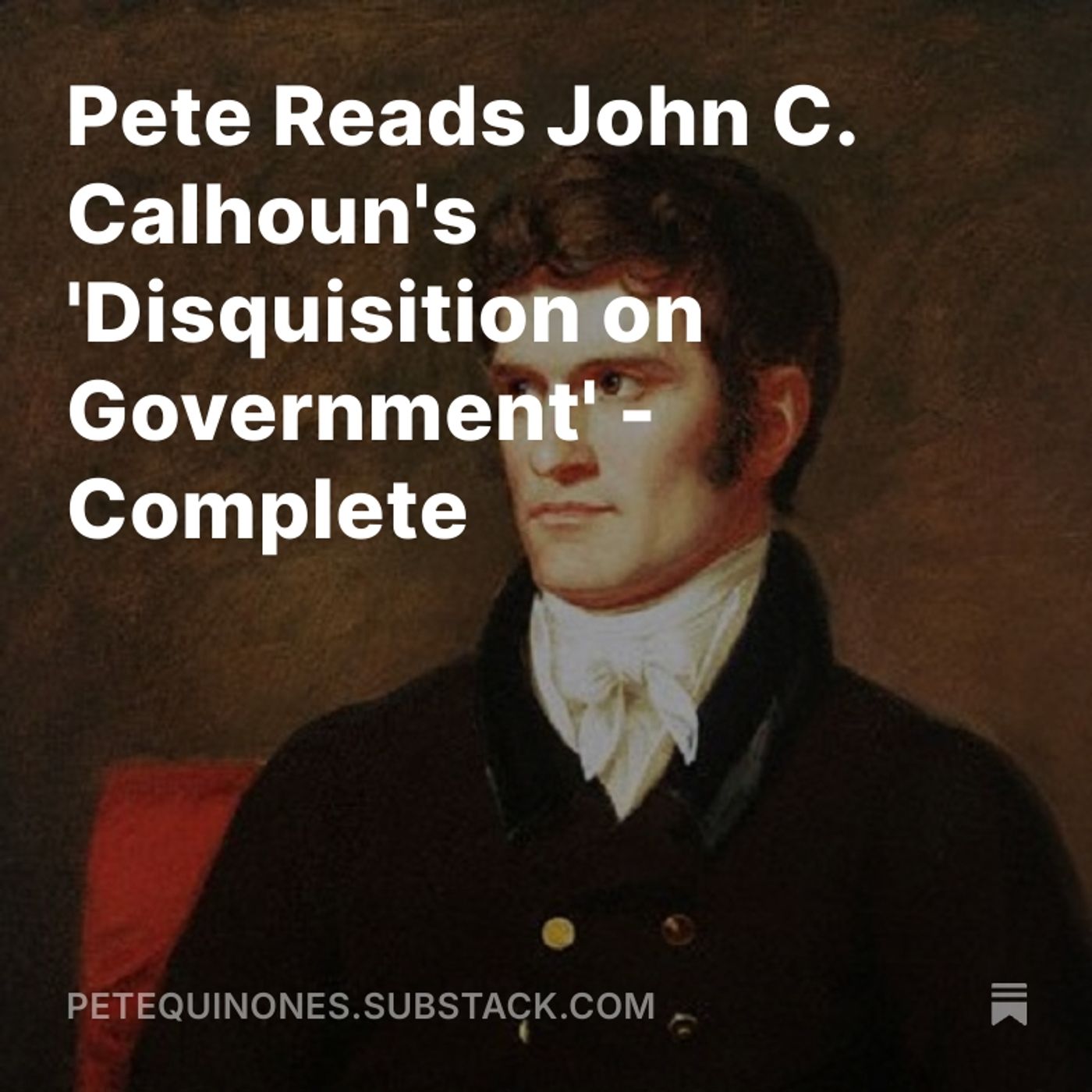
The Pete Quiñones Show
Pete Reads John C. Calhoun's 'Disquisition on Government' - Complete
04:11:13
4 Hours and 11 Minutes PG-13 This is the complete reading and commentary on John C. Calhoun's "Disquisition on Government" that Pete did. https://freemanbeyondthewall.com/movies/ https://freemanbeyondthewall.com/support/...
Loading summary
Transcript62 lines
- [00:01]
A
Tyler redick here from 2311 Racing. The rush of racing. Nothing beats it. But Chumba Casino comes close. Chumba's got fast spins, fun games, daily bonuses, and all the action you can handle. Now that's a ride. Ready to hit the throttle? Get in the driver's seat and head to chumbacasino.com let's Chumba sponsored by Chumba Casino. No purchase necessary. VGW Group. Voidware prohibited by law 21. Terms and conditions apply. Tyler Redick here from 2311 Racing. Game night's fun until someone spends five minutes lining up one shot. Chalk. Breathe, rechock. Still aiming. While they figure it out, I fire up Chumba Casino. I can spin anywhere, anytime. And there's always a new social casino game every week. Spins happen way faster than that shot. Play now@chumbacasino.com let's Chumba sponsored by Chumba Casino. No purchase necessary. VGW Group. Voidware prohibited by law 21. Terms and conditions apply. Tyler Redick here from 2311 Racing. Victory Lane. Yeah, it's even better with Chumba by my side. Race to chumbacasino.com let's Chumba no purchase necessary. BTW Group Void where prohibited by law. CTNCs21+ Sponsored by Chumba Casino I want
- [01:17]
B
to welcome everyone back to my second book reading. I chose this one because this is one of the first books I would read when I was questioning libertarianism. I knew that Murray Rothbard had quoted it all the time, and he always talked about John C. Calhoun. And I had heard about this book, and so I read it and it raised a lot of questions. Let's just put it that way. One of the reasons I picked this one and not someone else is he's an American Southerner and a controversial figure. Let's just put it that way. But just to give you some background on John C. Calhoun, and I'm going to take this off of. I'm going to read this off of the United States Senate's website. Okay, so it's a Featured biography. John C. Calhoun of South Carolina first entered politics in 1808, when he was elected to the state legislature. He moved to the US House of Representatives in 1811, where he served almost four terms before resigning to become Secretary of War under President James Monroe, a position he held from 1817 to 1825. In both positions, Calhoun was known for his strong support for federally funded internal improvements. Calhoun was an early candidate for president in 1824, but dropped out and sought the vice presidency instead. Although he publicly backed Tennessee's Andrew Jackson for president. His vice presidential candidacy received endorsements from both Jackson supporters and those of John Quincy Adams. Calhoun easily won the vice presidency, making him the president of the Senate. While the presidential election was decided by the House of Representatives, which elected John Quincy Adams over popular vote winner Andrew Jackson. When Jackson was elected president in 1828, Calhoun was again elected vice president, but his growing opposition to Jackson's policies prompted his resignation. Elected to the Senate In December of 1832, Calhoun became an influential leader of the Southern states during the antebellum period, a period in Senate history marked by heated debates over slavery and territorial expansion. A staunch defender of the institution of slavery and a slave owner himself, Calhoun was the Senate's most prominent states rights advocate, and his doctrine of nullification professed that individual states had a right to reject federal policies that they deemed unconstitutional. In 1850, as the Senate debated a legislative compromise designed to quell calls for disunion, a dying Calhoun continued to argue for the continuation and expansion of slavery. He died on March 31, 1850. As that debate continued a century later, when a special Senate committee was tasked with choosing individuals to be included in a famous five, quote unquote famous five collection of portraits, it shows three leaders of the pre Civil War Senate whose influence lived after Daniel Webster, Henry Clay, and John C. Calhoun. All right, so let's get to reading this. This is good stuff, and I don't know if it's going to take seven episodes like the last book took, but this really is only 100 pages, but let's see. All right. A disquisition on government. In order to have a clear and just conception of the nature and object of government, it is indispensable to understand correctly what that constit or law, what the. What that constitution or law of our nature is in which government originates, or, to express it more fully and accurately, that law without which government would not, and with which it must necessarily exist. Without this, it is as impossible to lay any solid foundation for the science of government as it would be to lay one for that of astronomy, without a like understanding of that constitution or law of the material world, according to which several bodies composing the solar system mutually act on each other and by which they are kept in their respective spheres. The first question, accordingly to be answered considered is what is that constitution or law of our nature without which government would not exist and with which its existence is necessary? So obviously here when he's using the term constitution, he's talking about the makeup of something and not the written document. In considering this, I assume. And he's also assuming government. Okay. There's no question of whether government should exist or. That's without question here. He's assuming government. In considering this, I assume as an incontestable fact. That man is so constituted as to be a social being. His inclinations and wants, physical and moral, Irresistibly impel him to associate with his kind. And he has accordingly never been found in any age or country, in any state other than. Than the social. In no other, indeed, could he exist. And in no other were it possible for him to exist. Could he attain to a full development of his moral and intellectual faculties. Or raise himself in the scale of being much above the level of the brute creation. Basically, what he's saying is men without other men are brutes. Men need to come together in order to form civilization. I next assume also as a fact not less incontestable. That while man is so constituted as to make the social state necessary to his existence and the full development of his faculties, this state itself cannot exist without government. The assumption rests on universal experience. In no age or country has any society or community ever been found, whether enlightened or savaged, without government of some description. 100% true. Talk about. People can talk about medieval Iceland and med. Medieval Ireland all they want. They had a form of government. And if someone got out of line, somebody would step up, create the exception and handle it. Having assumed these as unquestionable phenomena of our nature, I shall, without further remark. Proceed to the investigation of the primary and important question. What is that constitution of our nature. Which, while it impels man to associate with his kind, Renders it impossible for society to exist without government? The answer will be found in the fact, not less incontestable than either of the others. That while man is created for the social state. And is accordingly so formed as to feel what affects others as well as what affects himself, he is at the same time so constituted as to feel more intensely what affects him directly. Than what affects him in indirectly through others. Or, to express it differently, he is so constituted that his direct or individual affections Are stronger. Than his sympathetic or social feelings. I intentionally avoid the expression selfish feelings as applicable to the former. Because, as commonly used, it implies an unusual excess of individual. Over the social feelings in the person to whom it is applied. And consequently, something depraved and and vicious. My ob. My object is to exclude such reference. And to restrict the inquiry exclusively to facts in their bearings on the subject under consideration. Viewed as mere phenomena appertaining to our nature constituted as it is, and which are as unquestionable as is that gravitation or any other phenomenon of the material world. So so far the statement he's making is that as much as we love our neighbor, if it comes down to choosing, we're going to choose ourself. But he's going to get a little more into that, so I'll have more to say about it. In asserting that our individual, that our individual are stronger than our social feelings, it is not intended to deny that there are instances growing out of peculiar relations as that of a mother and her infant, or resulting from the force of education and habit over peculiar constitutions in which the latter have overpowered the former. But these instances are few and always regarded as something extraordinary. The deep impression they make whenever they occur is the strongest proof that they are regarded as exceptions to some general and well understood law of nature. Just as some of the minor powers of the material world are apparently to world are apparently to gravitation. So what he's saying is when you see somebody who steps out and steps out of themselves and sacrifices for somebody else, the fact that we have to point that out, the exception proves the rule that self interest is more important than the interest of strangers or even neighbor. And he doesn't stop there. I might go farther and assert this to be a phenomenon not of our nature only, but of all animated existence throughout its entire range. So far as our knowledge extends, it would indeed seem to be essentially connected with a great law of self preservation which pervades all, all that feels from man down to the lowest and most insignificant reptile or insect. In none is it stronger than in man. His social feelings may indeed, in a state of safety and abundance, combined with high intellectual and moral culture, acquire great expansion and force, but not so great as to overpower this all pervading and essential law of animated existence. Hope you're following. He's getting deep here. And really it's very simple. It's very simple that you are going to put yourself and your family ahead of anyone else. That's our nature. And if you really look at what they've tried to build with this, what Jason from the two bit podcast calls this devouring mother culture. They want you to be more worried about people outside and especially who they deem to be minorities and people who have been marginalized. They want you to care more about them than if you're a female, the child that came out of your womb. If you're a man, the seed that came out of your wife's womb is truly remarkable. But that constitution of our nature which makes us feel more intensely what affects us directly than what affects us indirectly through others, necessarily leads to conflict between individuals. And here's where we start getting into it. And everybody's gonna have all sorts of comments. When I was reading this, the comment. Because I was still very much in a libertarian mindset at the time, all the objections were running through my head. But stick around. Each, in consequence, has a greater regard for his own safety or happiness than for the safety or happiness of others. And where these come in opposition is ready to sacrifice the interests of others to his own common sense. I hope that's common sense to everyone. And hence the tendency to a universal state of conflict between individual and individual, accompanied by the connected passions of suspicion, jealousy, anger and revenge, followed by insolence, fraud and cruelty. And if not prevented by some controlling power, ending in a state of universal discord and confusion, destructive of the social state and the ends for which it is ordained. This controlling power, wherever vested or by whomsoever exercised, is government. That was a list. That was quite a list. Suspicion, jealousy, anger, revenge, insolence, fraud, cruelty. If there were not somebody there to intercede outside of the individuals who are experiencing this, what does the world look like? Even if they don't, and we look at our government now, they don't. In many cases they don't. They can't get there in time. But just people knowing that they could be subject to an outside force that doesn't care about their feelings, doesn't care who was right or who was wrong, is just going to look at what the facts that are there, what they. How they're interpreting the situation. It does restrain people. No matter how much people don't believe that people are restrained when they think that they can actually be punished for something and they can lose everything. It follows then, that man is so constituted that government is necessary to the existence of society and society to his existence and the perfection of his faculties. It follows also that government has its origin in this twofold constitution of his nature. The sympathetic or social feelings constituting the remote and the individual or direct the proximate cause. If man had been differently constituted in either particular.
- [16:22]
A
Tyler redick here from 2311 Racing. Game night's fun until someone spends five minutes lining up one shot. Chalk, breathe, rechock, still aiming while they figure it out. I fire up Chumba Casino. I can spin anywhere, anytime. And there's always a new social casino game every week. Spins Happen way faster than that shot. Play now@chumbacasino.com let's Chumba sponsored by Chumba Casino. No purchase necessary. VGW Group Voidware Prohibited by Law21. Terms and conditions apply.
- [16:55]
B
Bubba Wallace here from 23 XI Racing on the track, My car's look is everything. But today I'm talking about more than just paint schemes. I'm talking about my favorite games at Chumba Casino. Check out exclusives like Stampede Fury and my own King Kroc Theory. It's just as wild as my car looked in Texas. With over 200 games and new ones weekly. Play for free at chumbacasino.com let's Chumba
- [17:18]
A
sponsored by Chumba Casino. No purchase necessary. VGW Group Voidwear Prohibited by law, 21 terms and conditions apply. Tyler Reddick here from 23 XI Racing game, night's fun until someone spends five minutes lining up one shot. Chalk.
- [17:31]
B
Breathe.
- [17:32]
A
Rechock. Still aiming. While they figure it out, I fire up Chumba Casino. I can spin anywhere, anytime. And there's always a new social casino game every week. Spins happen way faster than that shot. Play now@chumbacasino.com let's Chumba sponsored by Chumba Casino. No purchase necessary. VGW Group Voidware prohibited by Law21. Terms and conditions apply.
- [17:54]
B
If, instead of being social in his nature, he had been created without sympathy for his kind and independent of others for his safety and existence, or. Or if, on the other hand, he had been so created as to feel more intensely what affected others than what affected himself, if that were possible, or even had the supposed interest been equal, it is manifest in either case there would have been no necessity for government and that none would have ever existed. But although society and government are thus intimately connected with and dependent on on each other, of the two society is the greater it is first in the order of things and in the dignity of its object. That of society being primary to preserve and perfect our race and that of government secondary and subordinate to preserve and protect society. Both are however, necessary to the existence and well being of our race and equally of divine ordination. So what's he saying? He's saying that if you. If you had no self interest, if your self interest were on par with. If. If your feelings of self interest were on par with your feelings of interest for your neighbor, government would have never needed to exist. But since that's not true, since that doesn't exist in anyone, no matter how much they want to tell you they're a good person and they care more about their neighbor than they do about them. Government is necessary and divinely ordained. Sorry, Christian anarchists. I have said, if it were possible for man to be so constituted as to feel what affects others more strongly than what affects himself or even as strongly. Because it may be well doubted whether the stronger feeling or affection of individuals for themselves. Combined with a feebler and subordinate feeling or affection for others. Others is not, in beings of limited reason and faculties. A constitution necessary to their preservation and existence. If reversed, if their feelings and affections were stronger for others than for themselves or even as strong, the necessary result would seem to be that all individuality would be lost and boundless and remediless, disorder and confusion would ensue. For each, at the same moment, intensely participating in all the conflicting emotions of those around him. Would, of course, forget himself and all that concerned him immediately in his officious intermeddling with the affairs of all others. Which, from his limited reason and faculties he could neither properly understand nor manage. Such a state of things would, as far as we can see, lead to endless disorder and confusion. Not less destructive to our race than a state of anarchy. He's saying that if everyone had equal feelings and cared for each other equally. We'd be in a worse state than in anarchy. Because it would be endless disorder, endless confusion. How would you be able to run your life if somebody was constantly. Someone from the outside was constantly interrupting and coming in and saying, no, no, I'm seeing. I can feel your. I mean, it's insane. It's insane when you think about it. When he puts it that way, it's almost inarguable. It would, besides be remedyless, for government would be impossible. Or if it could by possibility exist, its object would be reversed. You're saying it would be impossible to govern a people like that? Selfishness would have to be encouraged and benevolence discouraged. Individuals would have to be encouraged by rewards to become more selfish. And deterred by punishments from being too benevolent. And this too, by a government administered by those who, on the supposition, would have the greatest aversion for selfishness. And the highest admiration for benevolence. To the infinite Being, the Creator of all belongs exclusively the care and superintendence of the whole. He, in his infinite wisdom and goodness, has allotted to every class of animated beings its condition and appropriate functions. And has endowed each each with feelings, instincts, capacities and faculties best adapted to its allotted condition. To man he has assigned the social and political state as best adapted to develop the great capacities and faculties. Intellectual and moral with which he has endowed him and has accordingly constituted him so not only to impel him into the social state, but to make government necessary for his preservation and well being. It's amazing to me that at one time I would have thought that this was garbage, that I would have argued against this. And this isn't saying, because this is where the whole strawman comes in. It's like the straw man argument right now is, well, government doesn't do that. Not the point. No one is saying that government does that. As a matter of fact. Wait, wait, you think Calhoun's stupid? Stop. But government, although intended to protect and preserve society, has itself a strong tendency to disorder and abuse of its powers. As all experience in almost every page of history testify. The cause is to be found in the same constitution of our nature which makes government indispensable. I remember people saying, if man can't govern themselves, if man is so terrible at governing themselves, why would you want them to govern others? Okay, if man is so terrible at governing themselves, why would you want no restraints. No restraints except the guns that you can carry. I never understood that. The whole idea that somebody was going to be on their farm and a horde of people comes and they're going to be up on the roof with their.308 just picking them all off. That's not how that works. That's not how that would work. It sounds like a great fantasy. And I've seen Walking Dead 2. I've seen Revolution. Those TV shows. Yeah. It's not how it works. Get real, people. The powers which it is necessary for government to possess in order to repress violence and preserve order cannot execute themselves. They must be administered by men in whom, like others, the individual are stronger than the social feelings. And hence the powers vested in them to prevent injustice and oppression on the part of others will, if left unguarded, be by them converted into instruments to oppress the rest of the community. That by which this is prevented by whatever name called, is what is meant by constitution in its most comprehensive sense when applied to government having its origin in the same principle of our nature. Constitution stands to government as government stands to society, and as the end for which society is ordained would be defeated without government, so that for which government is ordained would in a great measure be defeated without constitution. But they differ in this striking particular. There is no difficulty in forming government. It is not even a matter of choice whether there shall be one or not. Like breathing, it is not permitted to depend on our volition. Necessity will force it on all communities in Some one form or another very different is the case as to constitution. Instead of a matter of necessity, it is one of the most difficult tasks in post on man to form a constitution worthy of the name, while to form a perfect one, one that would completely counteract the tendency of government to oppression and abuse and hold it strictly to the great ends for which it is ordained, has thus far exceeded human wisdom and possibly ever will. From this another striking difference results. Constitution is the contrivance of man, while government is of divine ordination. Man is left to perfect what the wisdom of the infinite ordained as necessary to preserve the race. No matter where you go, no matter what you do, it's, it's one failure after another. It's our self interest. This is something I would hear about free trade. When you would talk to an economist, like an Austrian economist, they would say, well, the reason we'll have in a free trade society or an anarchist society, the reason we'll have all of these things is it's a matter of self interest. The manufacturer, the business owner, they're self interested. So they're going to create it and they're going to sell it. You know, they won't just, they won't just, you know, create it and use it just for themselves. Why wouldn't they? I mean they could. Okay, and then what's going to happen? They're going to get raided, they're going to get killed and people are going to steal the stuff. Is that sounds like a violation of the nap? It does. Maybe I'm wrong, but for the same reason why Calhoun says we need a government. There'll always be a government. Anarchists will say that an anarchist society can, can exist because of self interest. What happens when that self interest gets pushed? What happens when that? What happens? What happens if there's scarcity? Do you think all of these rational human beings are going to rely upon self interest? They're all going to come together and figure it out. Now we have a commune, but oh, as long as it's done voluntarily, right now you're going to have a commune that's going to come together as a voluntary commune. No, no. Where was I? Okay, let me just start over that paragraph. With these remarks I proceed to the consideration of the important and difficult question. How is this tendency of government to be counteracted or to express it more fully? How can those who are invested with the power of government be prevented from employing them as the means of aggrandizing themselves instead of using them to protect and preserve society? It cannot be done by instituting a higher power to control the government and those who administer it. That this would be but to change the seat of authority. And to make this higher power in reality the government with the same tendency on the part of those who might control its powers. To pervert them into instruments of aggrandizement. Nor can it be done by limiting the powers of government. So as to make it too feeble to be made an instrument of abuse. For passing by the difficulty of so limiting its powers. Without creating a power higher than the government itself. To enforce the observance of the limitations. It is a sufficient objection that it would, if practicable, defeat the end for which government is ordained. By making it too feeble to protect and preserve society. The powers necessary for this purpose will ever prove sufficient to aggrandize those who control it at the expense of the rest of the community immediately. If you've read Schmidt, you think of his exceptions. Exceptions need to be made. Somebody has to be able to say. Somebody has to be able to make a decision that other people can't make. Get into a state of exception. In estimating what amount of power would be requisite to secure the objects of government. We must take into the reckoning what would be necessary to defend the community against external as well as internal dangers. Government must be able to repel assaults from abroad. As well as to repress violence and disorders within. It must not be overlooked that the human race is not comprehended in a single society or community. The limited reason and faculties of man, the great diversity of language, customs, pursuits, situation and complexion, and the difficulty of intercourse with various other causes. Have by their operation formed a great many separate communities acting independently of each other. Between these there is the same tendency to conflict. And from the same constitution of our nature as between men individually. And even stronger, because the sympathetic or social feelings are not so strong between different communities. As between individuals of the same community. So powerful indeed is this tendency that it has led to almost incessant wars between contiguous communities for plunder and conquest or to avenge injuries, real or supposed to. So long as the state of things continues, Exigencies will occur in which the entire powers and resources of the community. Will be needed to defend its existence. When this is at stake, every other consideration must yield to it. Self preservation is a supreme law as well, with communities as individuals. And hence the danger of withholding from government. The full command of the power and resources of the state. And the great difficulty of limiting its powers consistently with the protection and preservation of the community and the community and hence the question recurs, by what means can government, without being divested of the full command of the resources of the community, be prevented from abusing its powers? Because that's what everyone reading, everyone who is listening to this or reading along with me is thinking. It's like, sure, but then they're just going to start wars. Because you have special interests. You have the military industrial complex, you have this, you have that. He's not stupid.
- [33:44]
A
Tyler redick here from 2311 Racing. Another checkered flag for the books. Time to celebrate with Chumba. Jump in@chumbacasino.com let's Chumba no purchase necessary BTW group void where prohibited by law. CTNC 21 sponsored by Chumba Casino Drew McIntyre here from WWE. Wielding the Claymore can be a life of chaos when I'm not dominating in the ring. Chumba Casino is how this warrior takes a wee break. With hundreds of online social games and new weekly releases, there's always something fresh to try in those daily boosts. Next level. Even my free time feels like Valhalla. So when life feels like a battle, kick up your feet, have some fun, and let's Chumba. No purchase necessary. VGW Group voidware prohibited by law. CTS and CS21 sponsored by Chumba Casino.
- [34:30]
B
Cha cha cha cha.
- [34:31]
A
Chumba looking for excitement. Chumba Casino is here. Play anytime, play anywhere. Play on the train. Play at the store. Play at home. Play when you're bored. Play today for your chance to win and get daily bonuses when you log in. So what are you waiting for? Don't delay. Chumba Casino is free to play.
- [34:47]
B
Experience social gameplay like never before.
- [34:49]
A
Go to Chumba Casino right now to
- [34:51]
B
play hundreds of games, including online slots, bingo, Slingo and more. Live the chumba life@chumbacasino.com no purchase necessary.
- [34:58]
A
VGW Group void where prohibited by law 21/ terms and conditions apply.
- [35:09]
B
The question involves difficulties which from the earliest ages wise and good men have attempted to overcome, but hitherto with but partial success. For this purpose, many devices have been resorted to, suited to the various stages of intelligence and civilization through which our race has passed, and to the different forms of government to which they have been applied. The aid of superstition, ceremonies, education, religion, organic arrangements, both of the government and the community has been from time to time appealed to. Some of the most remarkable of these devices, whether regarded in reference to their wisdom and the skill displayed in their application, or to the permanency of their effects, are to be found in the early dawn of civilization in the institutions of the Egyptians, the Hindus, the Chinese, and the Jews. The only materials which that early age afforded for the construction of constitutions, when intelligence was so partially diffused, were applied with consummate wisdom and skill. To their successful application may be fairly traced the subsequent advance of our race and civilization and intelligence of which we now enjoy the benefits. For without a constitution, something to counteract the strong tendency of government to disorder and abuse and to give stability to political institutions, there can be little progress or permanent improvement. In answering the important question under consideration. It is not necessary to enter into an examination of the various contrivances adopted by these celebrated governments to counteract this tendency to disorder and abuse, nor to undertake to treat of constitution in its most comprehensive sense. What I propose is far more limited. To explain on what principles government must be formed in order to resist by its own interior structure, or to use a singular term, organism, the tendency to abuse of power. This structure or organism, is what is meant by constitution in its strict and more usual sense. And it is this which distinguishes what are called constitutional governments from absolute. It is in this strict and more usual sense that I propose to use the term hereafter. How government then, must be constructed in order to counteract through its organism this tendency on the part of those who make and execute the laws to oppress those subject to their operation, Is the next question which claims attention. There is but one way in which this can possibly be done, and that is by such an organism as will furnish the ruled with the means of resisting successfully. This tendency on the part of the rulers to oppression and abuse. You know where he's going. Power can only be resisted by power and tendency. By tendency. Those who exercise power and those subject to its exercises, the rulers and the ruled stand in antagonistic relations to each other. The same constitution of our nature which leads rulers to oppress the ruled, regardless of the object for which government is ordained, or will with equal strength lead the ruled to resist when possessed of the means of making peaceable and effective resistance. Such an organism, then, as will furnish the means by which resistance may be systematically and peaceably made on the part of the ruled. To oppression and abuse of part on the part of the rulers is the first and indispensable step toward forming a constitutional government. And as this can only be affected by or through the right of suffrage, the right of the people on the part of the ruled to choose the rulers at proper intervals and to hold them thereby responsible for their conduct, the responsibility of the rulers to the ruled through the right of suffrage is the indispensable and primary principle of the foundation of a constitutional government. When this right is properly guarded and the people sufficiently enlightened to understand their own rights and the interests of the community and duly to appreciate the motives and conducts of those appointed to make and execute the laws, it is all sufficient to give to those who elect effective control over those they have elected. Again, somebody can just stop and say, well, I mean, look at the elections we have now. Yada, yada, nobody. The last election was stolen, this and that. Yeah, well, he also. What else is he saying here? I mean, that just goes without saying. Elections have been stolen since the dawn of mankind. All right, but what else is he saying here? He's saying that it's the people who are voting have to be sufficiently enlightened to understand their own rights and the interests of the community. They have to be intelligent and they have to have skin in the game. I call the right of suffrage the indispensable and primary principle. For it would be a great and dangerous mistake to suppose, as many do, that it is of itself sufficient to form constitutional governments. To this erroneous opinion may be traced one of the causes why so few attempts to form constitutional governments have succeeded, and why, of the few which have, so small a number have had durable existence. It has led not only to mistakes in the attempts to form such governments, but to their overthrow, when they have by some good fortune been correctly formed. I wonder what he's thinking of. So far from being of itself sufficient, however well guarded it might be, and however enlightened the people, it would, unaided by other provisions, leave the government as absolute as it would be in the hands of irresponsible rulers and with a tendency at least as strong toward oppression and abuse of its powers as I shall next proceed to explain. The right of suffrage itself can do no more than give complete control to those who elect over the conduct of those they have elected. In doing this, it accomplishes all it possibly can accomplish. This is its aim, and when this is attained, its end is fulfilled. It can do no more, however enlighten the people, or however widely extended or well guarded the right may be. This right may be the sum total then of its effects, when most successful is to make those elected the true and faithful representatives of those who elected them, instead of irresponsible rulers as they would be without it, and thus by converting it into an agency and the rulers into agents, to divest government of all claims to sovereignty and to remain unimpaired to the community. But it is manifest that the right of suffrage in making these changes, transfers in reality the actual control over the government from those who make and execute the laws to the body of the government and thereby places the powers of the government as fully in the mass of the community as they would be if they in fact, had assembled, made and executed the laws themselves without the intervention of representatives or agents. The more perfectly it does this, the more perfectly it accomplishes its ends. But in doing so, it only changes the seat of authority without counteracting in the least the tendency of the government to oppression and abuse of its power. All right. I would love for John C. Calhoun to be resurrected today and see if he still agrees with this, because at the time, that's what this. It looked like. Yeah. If he would have compared what happened in France, you know, with the French Revolution, would he. Yeah, I mean, would he say that giving the people. That you could trust the people with a vote. I mean, here what he's saying is you can only trust a certain amount of people with a vote. But we know it's gotten to the point where that's never going to happen again. It's either going to be everyone votes or no one votes. And I'm pretty sure I'm not going to speak for Mr. Calhoun. I will speak for myself as someone who grew up in the civic religion and voting mattered and voting was everything. What I will say is that, yeah, I don't believe I would rather have a CEO. I would rather have somebody who. The possibility that they could become tyrannical in themselves than the tyranny of 2.1 million. I think that's how many members there are of the executive, which is not even the executive anymore. Let's just call it the managerial. Yeah, this sounds great. And it probably looked great when it probably worked out pretty well early on when the country was homogenous, when men, when only men and landowners could vote. But now anyone can vote and people who just stepped over the border can vote. I mean, they give. People say, oh, that doesn't. That doesn't happen. You're forced, like, to get a driver's license in California. I think you're forced to register to vote no matter if you're illegal or not. So, I mean, I know it doesn't really mean anything in California because, I mean, Democrats going to win California anyway if California goes red. It'd be weird, but yeah, I mean, at this point, we've seen what voting does. Maybe if you had a country that was homogenous, maybe El Salvador's elections look pretty good and Russia seems to be pretty happy with Putin. Well, maybe in a homogenous society it works. We don't have that here. We need someone who. We need somebody who makes the decisions, basically declares the exception. Right now we have a couple million people who do that. And look at what we have. Onward. If the whole community had the same interests, so that the interests of each and every portion would be affected by the action of the government, that the laws which oppressed or impoverished one portion would necessarily oppress and impoverish all others, or the reverse, then the right of suffrage of itself would be all sufficient to counteract the tendency of the government to oppression and abuse of its powers and. And of course would form of itself a perfect constitutional government. The interests of all being the same by supposition, as far as the action of the government was concerned, all would have like interests as to what laws should be made and how they should be executed. All strife and struggle would cease as to who would should be elected to make and execute them. The only question would be who was most fit, who the wisest and most capable of understanding the common interests of the whole. This decided the election would pass off quietly and without party discord, as no one portion could advance its own peculiar interests without regard to the rest by electing a favorite candidate. But such is not the case. But on the contrary, nothing is more difficult than to equalize the action of the government in reference to the various and diversified interests of the community. And nothing more easy than to pervert its power into instruments to aggrandize and enrich one or more interests by oppressing and impoverishing the others. And this too, under the operation of laws couched in general terms, and which on their face appear fair and. And which on their face appear fair and equal. Nor is this the case in some particular communities only. It is so in all the small and the great, the poor and the rich, irrespective of pursuits, productions or degrees of civilization. With, however, this difference that the more extensive and populous the country, the more diversified the condition and pursuits of its population, and the richer, more more luxurious and dissimilar the people, the more difficult it is to equalize the action of the government, and the more easy for one portion of the community to pervert its power to oppress and plunder the other. Bet you didn't think that I was going to be using this to make an argument for monoculture, did you? Well, you know, Such being the case, it necessarily results that the right of suffrage, by placing the control of the government in the community, must, from the same constitution of our nature which makes government necessary to preserve society, lead to conflict amongst among its different interests, each striving to obtain possession of its powers as the means of protecting itself against the other, or of advancing its respective interests, regardless of the interests of others. For this purpose, a struggle will take place between the various interests to obtain a majority in order to control the government if no one interested if no one interested be strong enough of itself to obtain it, a combination will be formed between those whose interests are most alike, each conceding something to the others until a sufficient number is obtained to make a majority. The process may be slow, and much time may be required before a compact organized majority can be thus formed, but formed it will be in time, even without preconcert or design, by the sure workings of that principle or its constitution of our nature in which the government itself originates. When once formed, the community will be divided into two great parties, a major and minor, between which there will be incessant struggles on the one side to retain, and on the other to
- [50:14]
A
Bubba
- [50:14]
B
Wallace here from 2311 racing on the track, my car's look is everything. But today I'm talking about more than just paint schemes. I'm talking talking about my favorite games at Chumba Casino. Check out exclusives like Stampede Fury and my own King Croc Fury. It's just as wild as my car looked in Texas with over 200 games and new ones weekly. Play for free at chumbacasino.com let's Chumba
- [50:36]
A
sponsored by Chumba Casino. No purchase necessary. VGW Group voidwear prohibited by Law 21. Terms and conditions apply. What's up foos?
- [50:43]
B
Manavitj uso here from the WWE. When it's just me between matches, it's day one ish. And that means it's Chumba time. With hundreds of casino style games and new titles arriving weekly, there's always something fresh to try at Chumba Casino. The daily Boost make it even more fun and have me bout to get em all during my downtime. Ready for a fun way to chill out and enjoy a few minutes for yourself? Let's Chumba.
- [51:06]
A
No purchase necessary. VGW Group Voidwear Prohibited by law CTS and C's 21 Sponsored by Chumba Casino
- [51:13]
B
hey, it's Bubba Wallace from 23Xi Racing. You know what it feels like forever sitting on a plane waiting for takeoff? Good thing I've got Jumba Casino with daily Boost and Social Casino games on tap this is the kind of fun that makes time fly. Why not turbocharge your downtime play now@chumbacasino.com
- [51:33]
A
let's Chumba Sponsored by Chumba Casino no purchase necessary VGW Group Voidware prohibited by law 21/ Terms and conditions apply on
- [51:43]
B
the one side to retain and on the other to obtain the majority and thereby the control of the government and the advantages it confers. I guess the only thing I have here is he said the process can be slow much time organized majority thus formed, but formed it will be in time, even without pre concert or design. I would say there's always pre concert or design because I believe that there's always elites that you may get that majority, but it's only going to be a very, very small minority that's even running that quote unquote majority. So deeply seated indeed is this tendency to conflict between the different interests or portions of the community that it would result from the action of the government itself. Even though it were possible to find a community where the people were all of the same pursuits, placed in the same condition of life, and in every respect so situated as to be without inequality of condition or diversity of interests, the advantages of possessing the control of the powers of the government, and thereby of its honors and emoluments, are of themselves exclusive of all other considerations ample to divide even such a community into the two great hostile parties, saying, even people with tons of things in common with everything in common, can be split apart in such a way. In order to form a just estimate of the full force of these advantages, without reference to any other consideration, it must be remembered that government to fulfill it must be remembered that government, to fulfill the ends for which it is ordained, and more especially that of protection against external dangers, must, in the present condition of the world, be clothed with power sufficient to call forth the resources of the community, and be prepared at all times to command them promptly in every emergency which may possibly arise. For this purpose large establishments are necessary, both civil and military, including naval, where from situation that description of force may be required with all the means necessary for prompt and effective action, such as fortifications, fleets, armories, arsenals, magazines, arms of all descriptions, with well trained forces in sufficient numbers to wield them with skills and energy whenever the occasion requires it. The administration and management of a government with such vast establishments must necessarily require a host of employees, agents, and officers, of whom many must be vested with high and responsible trusts, and occupy exalted stations, accompanied with much influence and patronage, to meet the necessary expenses, large sums must be collected and dispersed. And for this purpose heavy taxes must be imposed, requiring a multitude of officers for their collection and disbursement. The whole united must necessarily place under the control of government an amount of honors and emoluments sufficient to excite profoundly the ambition of the aspiring and the cupidity of the. Of our. Of our avaricious and to lead to the formation of hostile parties and violent party conflicts and struggles to obtain the control of the government. And what makes this evil remedyless through the right of suffrage of itself, however modified or carefully guarded, or however enlightened the people, is the fact that as far as the honors and emoluments of the government and its fiscal actions are concerned, it is impossible to equalize it. The reason is obvious. Its honors and emoluments, however great, can fall to the lot of but a few compared to the entire number of the community and the multitude who will seek to participate in them. But without this there is a reason which renders it impossible to equalize the action of the government so far as its fiscal operation extends, which I shall next explain. Few comparatively as they are, the agents and employees of the governments constitute that portion of the community who are exclusive recipients of the proceeds of the taxes. Whatever amount is taken from the community in the form of taxes, if not lost, goes to them in the shape of expenditures or disbursements. The two, disbursement and taxation, constitute the fiscal action of the government. They are correlatives. What the one takes from the community under the name of taxes is transferred to the portion of the community by who are the recipients under that of disbursements. But as the recipients constitute only a portion of the community, it follows, taking the two parts of the fiscal process together, that its action must be unequal between the payers of the taxes and the recipients of their proceeds. Nor can it be otherwise, unless what is collected from each individual in the shape of taxes shall be returned to him in that of disbursements, which would make the process nugatory and absurd. Taxation may indeed be made equal, regarded separately from disbursement. Bubba Wallace here from 23 Xi Racing. You know what's slower than a pace car waiting at the car wash? That's when I fire up Chumba Casino. It turns those slow minutes into fast fun. With new games every week, you'll never get bored. Next time you're stuck in the slow lane, speed up with Chumba.
- [57:25]
A
Play now@chumbacasino.com let's Chumba, sponsored by Chumba Casino no purchase necessary. VGW Group voidware prohibited by law 21. Terms and conditions apply. Tyler Redick here from 2311. Racing. Game night's fun until someone spends five minutes lining up one shot. Chalk.
- [57:43]
B
Breathe.
- [57:44]
A
Rechock. Still aiming. While they figure it out, I fire up Chumba Casino. I can spin anywhere, anytime. And there's always a new social casino game every week. Spins happen way faster than that shot. Play now@chumbacasino.com let's Chumba sponsored by Chumba Casino. No purchase necessary. VGW Group voidware prohibited by Law21. Plus, terms and conditions apply.
- [58:08]
B
Bubba Wallace here from 23 XI. Racing on the track, my car's look is everything. But today I'm talking about more than just paint schemes. I'm talking about my favorite games at Chumba Casino. Check out exclusives like Stampede Fury and my own King Croc Fury. It's just as wild as my car looked in Texas. With over 200 games and new ones weekly. Play for free at let's Chumba.
- [58:31]
A
Sponsored by Chumba Casino. No purchase necessary. VGW Group void where prohibited by Law21. terms and conditions apply.
- [58:37]
B
Even this is no easy task. But the two united cannot possibly be made equal. Such being the case, it must necessarily follow that some one portion of the community must pay in taxes more than it receives back in disbursements, while another receives in disbursements more than it pays in taxes. It is then. Then. I remember one time we used to just try to trigger government employees by telling them that they didn't pay taxes. Oh, no. I pay taxes every April 15th. No, you don't. They're just taking. They're taking back the taxes that were taken from someone else. Oh, no. But I do this. Okay, sure, sure. All right. Whatever you say. It is then manifest, taking the whole process together, that taxes must be, in effect, bounties to the portion of the community which receives more in disbursements than it pays in taxes, while to the other which pays in taxes more than it receives, receives and disbursements, they are taxes, in reality burdens. Instead of bounties. This consequence is unavoidable. It results from the nature of the process. Be the taxes ever so equally laid. And the disbursements ever so fairly made in reference to the public service. It is assumed in coming to this conclusion that the disbursements are made within the community. The reasons assigned would be applicable if the proceeds of the taxes were paid in tribute or expended in foreign countries. In either of these cases the burden would fall on all in proportion to the amount of taxes they respectively paid. Nor would it be less a bounty to the portion of the community which received back in disbursements more than it paid in taxes, because received the salaries for official services or payments to persons employed in executing the works required by the government or furnishing it with its various supplies or any other, any other description of public employment. Instead of being bestowed gratuitously, it is the disbursements which give additional and usually very profitable and honorable employments to the portion of the community where they are made. But to create such employments by disbursements. Is to bestow on the portion of the community to, to whose the lot disbursements may fall a far more durable and lasting benefit. One that would add much more to its wealth and population than would be the bestowal of an equal sum gratuitously. And hence, to the extent that the disbursements exceed the taxes, it may be fairly regarded as a bounty. The very reverse is the case in reference to the portion which pays in taxes more than it receives in disbursements. With them, profitable employments are diminished to the same extent. And population and wealth correspondingly decreased. The necessary result, then, of the unequal fiscal action of the government. Is to divide the community into two great classes, one consisting of those who in reality pay the taxes and, of course, bear exclusively the burden of supporting the government, and the other of those who are recipients of their proceeds through disbursements. And who are, in fact supported by the government. Or, in fewer words, to divide it into taxpayers and tax consumers. But the effect of this is to place them in antagonistic relations. In reference to the fiscal action of the government. And the entire course of policy therewith connected. For the greater the taxes and disbursements, the greater the gain of the one and the loss of the other, and vice versa. And consequently, the more the policy of the government is calculated to increase taxes and disbursements, the more it will be favored by the one and opposed by the other. The effect, then, of every increase is to enrich and strengthen the one and impoverish and weaken the other. This indeed may be carried to such an extent that one class or portion of the community may be elevated to wealth and power, and the other depressed abject poverty, independence, simply by the fiscal action of the government. And this too through disbursements only even under a system of equal taxes imposed for revenue, only if such may be the effect of taxes and Disbursements, when confined to their legitimate objects, that of raising revenues for the public service. Some conception may be formed how one portion of the community may be crushed and another elevated on its ruins, by systematically perverting the power of taxation and disbursement for the purpose of aggrandizing and building up one portion of the community at the expense of the other. That it will be so used unless prevented, is from the constitution of man just as certain as that it can be so used, and that, if not prevented, it must give rise to two parties and to violent conflicts and struggles between them. To obtain the control of the government is for the same reason not less certain. Nor is it less certain, from the operation of all these causes. That the dominant majority for the time would have the same tendency to oppression and abuse of power which, without the right of suffrage, irresponsible rulers would have no reason, indeed can be assigned why the latter would abuse their power, which would not apply with equal force to the former. The dominant majority for the time would in reality, through the right of suffrage, be the rulers. The controlling, governing and irresponsible power and those who make and execute the laws would be, for the time be in reality the but their representatives and agents. Nor would the fact that the former would constitute a majority of the community counteract a tendency originating in the constitution of man, and which as such cannot depend on the number by whom the powers of the government may be wielded, be it greater or smaller, a majority or minority, it must equally partake of an attribute inherent in each individual composing it. And as as in each of the individual is stronger than the social feelings, the one would have the same tendency as the other to oppression and abuse of power. The reason applies to government in all its forms, whether it be that of the one, the few, or the many in each there must of necessity be a governing and governed, a ruling and a subject portion. The one implies the other and in all the two bear the same relation to each other, and have on the part of the governing portion the same tendency to oppression and abuse of power. Where the majority is that portion, it matters not how its powers may be exercised, whether directly by themselves or indirectly through representatives or agents, be it which it may. The minority for the time will be as much the governed or subjected portion as are the subject in an aristocracy or the subjects in a monarchy. The only difference in this respect is that in the government of a majority, the majority may become the majority. In the government of a majority, the minority may become a majority, and the majority the minority through the right of suffrage and thereby change their relative positions without the interference of force or revolution. But the duration or uncertainty of the tenure by which power is held cannot of itself counteract the tendency inherent to government to oppression and abuse of power. On the contrary, the very uncertainty of the tenure combined with a violent party warfare which must ever precede a change of parties under such governments, would rather tend to increase than diminish the tendency to oppression. And I'm going to stop right there. That's what's wild about this. That's what's wild about Calhoun on this disquisition. He gives you the reason why government needs to exist, and then he gives you all the reasons why it doesn't work. It's truly amazing. And it made me. This is one of those things that made me come to a conclusion that, yes, we need a government, but do we need one like this? He's basically spelling out why this can't work. And the question is, what comes to what kind of government do you want? So if you want something where it's like this, this is what you're going to get. If you want something like monarchy, where there's just one person in charge, CEO, basically a king type of administrator, you're going to have your own problems, too. But what he's showing is that this is just. It's a cluster necessity. But what makes it a necessity is why it doesn't work. And then you have people who say, well, then we should just get rid of them altogether. Not understanding that what makes a government necessary. Would make insane chaos with that one. So that's it. Now I know that most people are going to listen to this one or read the. Read along with this one, watch the video, and that's when the drop off happens. Episode two will have less people tuning in. And then three, and on down the line it goes and everything. Try to tune in for episode two. Okay. Unless you just didn't get through to the end of this. But if you got through to the end of this, come for episode two because we're gonna. There's gonna be more of this. And it's just gonna. It's fascinating the road he takes us down in this. And we got through a lot of it today, so, yeah, we got through a lot actually there. As I mentioned, at the end of when I did 0 to 1, there are gonna be ads in here. If you wanna avoid the ads, you can go to Freeman. Beyondthewall.com support support me on my website through Patreon or through subscribestar. And I you can get these without commercials. And it also helps just keep me going and allows me to do more. I'm basically putting out like six episodes a week right now. And a couple weeks I put out seven. I put out one every day. And people may say that's just too much. I can't keep up and everything, but you know, some people are going to be more attracted to one thing and some people are going to be attracted to other. So I'm trying to hit a couple different audiences with the things that I'm doing, especially with the readings and the live stream kind of stuff appearing on other people's shows and then my regular episodes where I have a guest. So think about supporting the show and come back for episode two of John
- [69:50]
A
C. Calhoun's Tyler Redicure from 2311 Racing. The rush of racing. Nothing beats it, but Chumba Casino comes close. Chumba's got fast spins, fun games, daily bonuses, and all the action you can handle. Now that's a ride. Ready to hit the throttle? Get in the driver's seat and head to chumbacasino.com let's Chumba Sponsored by Chumba Casino no purchase necessary VGW Group Void where prohibited by law 21 terms and conditions apply.
- [70:22]
B
They don't realize smart people use smartphones, huh? Download TextNow, pay what you want or not at all. Show these ridiculous carriers were way too smart to pay. Dumb free app based talking Text via the TextNow app. Requires WI fi or data connection. Data plan sold separately. 5G where available. Hey, it's Bubba Wallace from 2311 Racing. You know what it feels like forever sitting on a plane waiting for takeoff. Good thing I've got Jumba Casino. With daily boost and social casino games on tap. This is the kind of fun that makes time fly. Why not turbocharge your downtime?
- [70:56]
A
Play now@jumbacasino.com let's Chumba sponsored by Chumba Casino no purchase necessary. VGW Group Voidware prohibited by law 21 terms and conditions apply.
- [71:07]
B
Disquisition on government IT thank you. I want to welcome everyone back to part two of John C. Calhoun's Disposition on Government. We ended yesterday talking about how he saw suffrage as the one thing that could push back tyranny of government. And then as he's explained with everything that he sees as a necessity for government, he starts talking about the problems with suffrage, the problems with universal suffrage, the problems with suffrage in general. And we're going to continue talking a little bit about that. And I hope you stick around for this one, because, like I said, this whole thing is great. And people have a tendency to drop out after the first episode. And I don't know why that is. Once I listen to something. I mean, I don't know. But. Yeah. So let's check this out here. All right. Picking up where we left off from yesterday. As then, the right of suffrage without some other provision cannot counteract this tendency of government. The next question for consideration is, what is that other provision? This demands the most serious consideration. For of all the questions embraced in the science of government, it involves a principle, the most important and the least understood, and, when understood, the most difficult of application in practice. It is indeed emphatically that principle which makes the Constitution in its strict and limited sense. From what has been said, it is manifest that this provision must be of a character calculated to prevent any one interest or combination of interests from using the powers of government to aggrandize the itself at the expense of the others. Here lies the evil and just in proportion as it shall prevent or fail to prevent it in the same degree it will affect or fail to affect the end intended to be accomplished. There is but one certain mode in which this result can be secured, and that is, by the adoption of some restriction or limitation which shall be so effect effectually, which shall so effectually prevent any one interest or combination of interests from obtaining the exclusive control of the government as to render hopeless all attempts directed to that end. There is again but one mode in which this can be effected, and that is, by taking the sense of each interest or portion of the community which may be unequally and injuriously affected by the action of the government separately through its own majority, or in some other way by which its voice may be fairly expressed and to require the consent of each interest either to put or to keep the government in action. This, too can be applied only in one way, and that is, by such an organism of the government and, if necessary for the purpose of the community also, as will, by dividing and distributing the powers of government, give to each division or interest, through its appropriate organ, either a concurrent voice in making and executing laws, or a veto on their execution. It is only by such an organism that the ascent of each can be made necessary to put the government in motion, or the power made effectual to arrest its action when put in motion and it is only by the order by the one or the other that the different interests, orders, classes, or portions into which the community may be divided can be protected, and all conflict and struggle between them prevented, by rendering it impossible to put or to keep it in action without the concurrent consent of all. Such an organism as this, combined with the right of suffrage, constitutes in fact, the elements of constitutional government. The one, by rendering those who make and execute the laws responsible to those on whom they operate, prevents the rulers from oppressing the ruled and the other, by making it impossible for any one interest or combination of interest, or class, or order or portion of the community to obtain exclusive control, prevents any one of them from oppressing the other. It is clear that oppression and abuse of power must come, if at all, from the one or the other quarter. From no other can they come. It follows that the two suffrage and proper organism combined are sufficient to counteract the tendency of government to oppression and abuse of power, and to restrict to it the fulfillment of the great ends for which it is ordained. I'm going to keep going in coming to this conclusion, I have assumed the organism to be perfect and the different interests, portions, or classes of the community to be sufficiently enlightened to understand its character and object, and to exercise with due diligence the right of suffrage.
- [76:21]
A
Tyler redick here from 2311 racing game night's fun until someone spends five minutes lining up one shot chalk breathe re chalk still aiming. While they figure it out, I fire up Champa Casino. I can spin spin anywhere, anytime and there's always a new social casino game every week. Spins happen way faster than that shot. Play now@chumbacasino.com let's Chumba sponsored by Chumba Casino. No purchase necessary. VGW Group voidware prohibited by law 21 terms and conditions apply. Drew McIntyre here from WWE. Wielding the Claymore can be a life of chaos, but I'm not dominating in the ring. Chumba Casino is held in this warrior takes a wee break with hundreds of online social games and new weekly releases, there's always something fresh to try and those daily boosts next level. Even my free time feels like Valhalla. So when life feels like a battle, kick up your feet, have some fun and let's Chumba. No purchase necessary. VGW Group Voidware Prohibited by law CTS and CS21 Sponsored by Chumba Casino what's up foos?
- [77:23]
B
Main event J USO here from the WWE. When it's just me between matches, it's day one ish. And that means it's it's Chumba time. With hundreds of casino style games and new titles arriving weekly, there's always something fresh to try at Chumba Casino the daily Boost make it even more fun and have me bout to get em all during my downtime. Ready for a fun way to chill out and enjoy a few minutes for yourself? Let's Chumba.
- [77:46]
A
No purchase necessary VGW Group voidware prohibited by law CTs and Cs 21 sponsored by Chumba Casino to the extent that
- [77:54]
B
either may be defective. To the same extent the government would fall short of fulfilling its end. But this does not impeach the truth of the principles on which it rests. Very theory cell here in reducing them to proper form, in applying them to practical uses. All elementary principles are liable to difficulties. But they are not on this account the less true or valuable. Where the organism is perfect, every interest will be truly and fully represented. And of course the whole community must be set. So it may be difficult or even impossible to make a perfect organism. But although this be true, yet even when instead of the sense of each and of all, it takes that of a few great and prominent interests only, it would still in a great measure, if not altogether fulfill the end intended by a constitution. For in such case it would require so large a portion of the community, compared with the whole, to concur or acquiesce in the action of the government, that the number to be plundered would be too few and the number to be aggrandized too many to afford adequate motives to oppression and the abuse of its powers. Indeed, however imperfect the organism, it must have more or less effect in diminishing such tendency. And what's the problem with that? Well, conspiracy. People coming together, people of like interests coming together. And as he has talked about previously, getting their way, taking over, becoming the majority. And how do they keep their power? They have to keep being the majority and they have to squash the minority. And his point is? Well, the minority can become the majority. But when you really look at this, we're not talking about groups of people from the community, just people like you and me. What we're talking about is elites that do this. It's the elites who make constitutional government impossible. Because once you have elites, and once you have their money, and once you have people who are self interested, who are in power and are taking that money, well, very quickly this check on powers starts to melts away. So take a sip. It may be readily inferred from what has been stated that the effect of organism is neither to supersede nor diminish the importance of the right of suffrage, but to aid and perfect it. The object of the latter is to collect the sense of the community. The more fully and perfectly it accomplishes this, the more fully and perfectly it fulfills its ends. But the most it can do of itself is to collect the sense of the greater number, that is, of the stronger interests or combination of interests, and to assume this to be the sense of the community. It is only when aided by a proper organism that it can collect the sense of the entire community, of each and all its interests, of each through its appropriate organ, and of the whole through all of them united. This would truly be the sense of the entire community. For whatever diversity each interest might have within itself, as all would have the same interest in reference to the action of the government, the individuals composing each would be fully and truly represented by its own majority or appropriate organ, regarded in reference to the other interests. In brief, every individual of every interest might trust with confidence its majority or appropriate organ against that of every other interest. It results from what has been said that there are two different modes in which the sense of the community may be taken. One simply by the right of suffrage unaided, the other by the right through a proper organism, each collects the sense of the majority. But one regards numbers only, and considers a community as a unit having but one common interest throughout, and collects the sense of the greater number of the whole as that of the community. The other, on the contrary, regards interests as well as numbers, considering the community as made up of different and conflicting interests, as far as the action of the government is concerned, and takes the sense of each through its majority or appropriate organ, and the united sense of all as the sense of the entire community. The former of these I shall call the numerical and absolute majority, and the latter the concurrent or constitutional majority. I call it the constitutional majority because it is an essential element in every constitutional government. Be its form, what it may so great is the difference, politically speaking, between the two majorities that they cannot be co founded without leading to great and fatal errors. And yet the distinction between them has been so entirely overlooked that when the term majority is used in political discussions, it is applied exclusively to designate the numerical as if there were no other. Until this distinction is recognized and better understood, there will continue to be great liability to error in properly constructing constitutional governments, especially the popular form, and of preserving them when properly constructed. Until then, the latter will have a strong tendency to slide first into government of the numerical majority, and finally into absolute government of some other form, to show that such must be the case, and at the same time to mark more strongly the difference between the two in order to guard against the danger of overlooking it, I propose to consider the subject more at length. This is getting good. The first and leading error which naturally arises from overlooking the distinction referred to is to confound the numerical majority with the people, and this is so completely as to regard them as identical. This is a consequence that necessarily results from considering the numerical as the only majority. All admit that a popular government or democracy, is the government of the people. For the terms imply this. A perfect government of the kind would be one which would embrace the consent of every citizen or member of the community. But as this is impracticable in the opinion of those who regard the numerical as the only majority, and who can perceive no other way by which the sense of the people can be taken, they are compelled to adopt this as the only true basis of popular government, in contradistinction to governments of the aristocratical or monarchical form. Being thus constrained, they are in the next place forced to regard the numerical majority as, in effect, the entire people, that is, as the greater part of the whole, and the government of the greater part as the government of the whole. It is thus the two come to be confounded, and a part made identical with the whole. And it is thus also that all the rights, powers, and immunities of the whole people come to be attributed to the numerical majority, and, among others, the supreme sovereign authority of establishing and abolishing governments at pleasure. This radical error, the consequence of confounding the two, and of regarding the numerical as the only majority, has contributed more than any other cause to prevent the formation of popular constitutional governments, and to destroy them even when they have been formed. It leads to the conclusion that in their formation and establishment nothing more is necessary than the right of suffrage and the allotment to each division of the community. A representation in the government in proportion to number, numbers. If the numerical majority were really the people, and if to take its sense truly, were to take the sense of the people truly, a government so constituted would be a true and perfect model of a popular constitutional government, and every departure from it would detract from its excellence. But as such is not the case, as a numerical majority, instead of being the people, is only a portion of them. Such a government, instead of being a true and perfect model of the people's government, that is, a people self governed, is but the government of a part over a part, the major over the minor portion. But this misconception of the true elements of constitutional government does not stop here. It leads to other, equally false and fatal, in reference to the best means of preserving and perpetuating them, when for some fortunate combination of circumstances they are correctly formed. For they who fall into these errors regard the restrictions which organisms impose on the will of the numerical majority as restrictions on the will of the people, and therefore as not only useless, but wrongful and mischievous and hence they endeavor to destroy organism under the delusive hope of making government more democratic. Such are some of the consequences of confounding the two, and of regarding the numerical as the only majority. And in this may be found the reason why so few popular governments have been properly constructed, and why of these few so small a number have proved durable. Such must continue to be the result, so long as these errors continue to be prevalent. There is another error of a kindred character, whose influence contributes much to the same results. I prefer to the prevalent opinion that a written constitution containing suitable restrictions on the powers of government is sufficient of itself without the aid of any organism, except such as is necessary to separate its several departments and render them independent of each other, to counteract the tendency of the numerical majority to oppression and the abuse of power. You can see that Calhoun is not a fan of democracy at all. He is not a fan of 50.1 rule over the other. So I assume that everyone who's been listening to this knows basically what he saw, what this organism is.
- [88:30]
A
Tyler redick here from 2311 Racing Victory Lane. Yeah, it's even better with Chumba by my side. Race to chumbacasino.com let's Chumba. No purchase necessary VTW Group Void where prohibited by law. CTNCS 21/ sponsored by Champa Casino Drew McIntyre here from WWE. Wielding the Claymore can be a life of chaos, but I'm not dominating in the ring. Chumba Casino is how this warrior takes a wee break. With hundreds of online social games and new weekly releases, there's always something fresh to try and those daily boosts next level. Even my free time feels like Valhalla. So when life feels like a battle, kick up your feet, have some fun and let's Chumba. No purchase necessary. VGW Group Voidware prohibited by law CTS and CS21 sponsored by Chumba Casino Tyler Redick here from 2311 Racing. Game night's fun until someone spends five minutes lining up one shot. Chalk.
- [89:23]
B
Breathe.
- [89:24]
A
Rechock. Still aiming. While they figure it out, I fire up Chumba Casino. I can spin anywhere, anytime. And there's always a new social casino game every week. Spins happen way faster than that shot. Play now@chumbacasino.com let's Chumba Sponsored by Chumba Casino no purchase necessary VGW Group Voidware prohibited by law 21/ Terms and conditions
- [89:45]
B
apply A written constitution has many and considerable advantages. But it is a great mistake to suppose that the mere insertion of provisions to restrict and limit the powers of the government without investing those whose protection they are inserted with the means of enforcing their observance will be sufficient to prevent the major and dominant party from abusing its powers. Being the party in possession of the government, they will, from the same constitution of man which makes government necessary to protect society, be in favor of the powers granted by the constitution and opposed to the restrictions intended to limit them them as the major and dominant party. They will have no need of these restrictions for their protection. The ballot box of itself would be ample protection to them. Needing no other. They would come in time to regard these limitations as unnecessary and improper restraints and endeavor to elude them with a view of increasing their power and influence. You getting it? The minor or weaker party, on the contrary, would take the opposite direction and regard them as essential to their protection against the dominant party. They'd be waving constitution pocket sized constitutions everywhere. Be saying what about my rights? Look at at. Haven't you read the Constitution? What does the party in power think? Well, if it's the Republicans, they're like yeah, we, we care about your rights. Go ahead, start chopping body parts off of your kids. Sure, that's your right. I don't. They're four years old. It's your child. Do what you want. But what about. And hence they would endeavor to defend and enlarge the restrictions and to limit and contract the power powers. But where there are no means by which they could compel the major party to observe the restrictions, the only resort left would be a strict construction of the constitution that is a construction which would confine these powers to the narrowest limits which the meaning of the words used in the grant would admit to this the major party would oppose a liberal construction. One would oppose a liberal construction, one which would give the words to the words of the grant the broadest meaning of which they were susceptible. It would then be construction against construction, the one to contract and the other to enlarge the parties of the government to the utmost. But of what possible avail could the strict construction of the minor party be against the liberal interpretation of the major when the one would have all the powers of the government to carry its construction into effect effect and the other be deprived of all means of enforcing its construction in A contest so unequal the result would not be doubtful. The party in favor of the restrictions would be overpowered. At first, they might command some respect and do something to state the march of encroachment, but they would, in the progress of the contest, be regarded as mere abstractionists, and indeed deservedly, if they should indulge in the folly of supposing that the party in possession of the ballot box and the physical force of the country could be successfully resisted by an appeal to reason, truth, justice, or the obligations imposed by the Constitution, for when these of themselves shall exert sufficient influence to stay the hand of power, then government will be no longer necessary to protect society, nor constitutions needed to prevent government from abusing its powers. Wow, that sounds familiar, right? Like, if you have a society that already doesn't steal stuff, it doesn't hurt people and doesn't take their stuff, do you really need a constitution? No. You want a society where as soon as you start writing stuff down, you're pretty much screwed. Because, as I say, lawyer can step in and make it mean anything, especially if you're not the party in power anymore. The end of the contest would be the subversion of the constitution, either by the undermining process of construction, where its meaning would admit of possible doubt, or by substituting in practice what is called party usage in place of its provisions, or finally, when no other contrivance would subserve the purpose by openly and boldly setting them aside by the one or the other, the restrictions would ultimately be annulled, and the government be converted into one of unlimited powers. Have we seen that? Nor would the division of government into separate and, as it regards each other, independent departments prevent this result. Such a division may do much to facilitate its operations and to secure its administration greater caution and deliberation. But as each and all the departments, and of course the entire government, would be under the control of the numerical majority, it is too clear to require explanation that a mere distribution of its powers among its agents or representatives could do little or nothing to counteract its tendency to oppression and abuse of power. To effect this, it would be necessary to go one step further and make the several departments the organs of the distinct interest of portions of the community, and to clothe each with a negative on the other others. But the effect of this would be to change the government from numerical into the concurrent majority. Having now explained the reasons why it is so difficult to form and preserve popular constitutional government, so long as the distinction between the two majorities is overlooked and the opinion prevails that a written constitution with suitable restrictions and a proper division of its powers is sufficient to counteract the tendency of the numerical majority to the abuse of its power. I shall next proceed to explain more fully. While the concurrent majority is an indispensable element informing constitutional governments and why the numerical majority of itself must in all cases make governments absolute. You think he's going to talk himself out of concurrent majority? The necessary consequence of taking the sense of the community by the concurrent majority is, as has been explained, to give to each interest or portion of the community a negative on the others. It is this mutual negative among its various conflicting interests which invests each with the power of protecting itself and places the rights and safety of each where only they can be securely placed under its own guardianship. Without this, there can be no systematic, no systematic, peaceful or effective resistance to the natural tendency of each to come into conflict with the others. And without this, there can be no constitution. It is this negative power, the power of preventing or arresting the action of the government, be it called by that, by what term it may veto, inter, interposition, nullification, check or balance of power, what in fact forms the constitution. They are all but different names for the negative power. In all its forms and under all its names, it results from the concurrent majority. Without this, there can be no negative, and without a negative, no constitution. The assertion is true in reference to all constitutional governments, be their forms or what, what they may. It is indeed the negative power which makes the constitution and the. And the positive which makes the government. The one is the power of acting. The other is the power of preventing or arresting action. The two combined make constitutional governments. Now, where's the problem with this? Basically, what he's talking about. He's talking about federalism, and he's talking about what we saw some governors do during COVID You know, just basically saying, this isn't constitutional. We're not going to do it. Well, what's the problem with that in the modern age, in the way things are set up now? I think the main problem is the fact that so many states and so many localities take federal money that they become reliant upon it. And now they can't stand up and say, no, there's so much graft, there's so many contracts, there's all of these things. If the states just concentrated on creating their own economies, their own, to the point where they could secede and they could survive, then you can have something like this. But people are people in special interests, which is why you need somebody to step up and say no, and it's got to be one person. I know I keep saying that, but as you. As he argues for this and then argues against it, and you see that this is the government that was started in this country, and you see how in this document, how we got to where we are, there has to be something. There has to be a better alternative. And what is the alternative? Maybe I'll read that next. What I think the alternative should be, I don't know. But as there can be no constitution without the negative power and no negative power without the concurrent majority, it follows necessarily that where the numerical majority has the sole control of the government, there can be no constitution. As constitution implies limitation or restriction, and of course is inconsistent with the idea of sole or exclusive power. And hence the numerical unmixed with the concurrent majority necessarily forms, in all cases, absolute government. It is indeed the single or one power which excludes the negative and constitutes absolute government and not the number in whom the power is vested. The numerical majority is as truly a single power and excludes the negative as completely as the absolute government of one or of the few. The former is as much the absolute government of the democratic or popular form as the latter of the monarchical or aristocratical form. It has accordingly in common with them the same tendency to oppression and abuse of power. Like I said, I think I said last time, he's basically crapping all over monarchy and aristocracy here, and I'd like to see if he could come forward to where we are now. He's a man of his time. He wasn't alive during the revolution, but he was born shortly after he was brought up in the early 1800s. It's still fresh in everyone's mind. You have the War of 1812, which, which shows exactly the Brits came and burned the White House down. So he has this aversion to monarchy and aristocracy, one person being in charge. Don't have to call him king, you can call him CEO, you can call him whatever. But you'd have to wonder what he would think. Now. Constitutional governments, of whatever form, are indeed much more similar to each other in their structure and character than they are respectively to the absolute governments, even of their own class. All constitutional governments, or whatever class they may be, take the sense of the community by its parts, each through its appropriate organ, and regard the sense of all its parts as the sense of the whole. They all rest on the right of suffrage and the responsibility of rulers directly or indirectly. On the contrary, all absolute governments, of whatever form, concentrate power in one uncontrolled and irresponsible individual or body whose will is regarded as the sense of the community. So you could see in his language right there that he by calling it uncontrolled and irresponsible, an uncontrolled irresponsible or an irresponsible individual or body, you can see what his presupposition is. So, and hence the great and broad distinction between governments is not that of the one, the few or the many, but of the constitutional and the absolute. So there's no other. There's nothing else really. Okay. From this there results another distinction which, although secondary in its character, very strongly marks the difference between these forms of government. I refer to their respective conservative principle, that is the principle by which they are upheld and preserved. This principle in constitutional governments is compromise and in absolute governments is force, as will be next explained was it Thomas Sowell said is only compromise is no such thing as perfect. There's only compromise. I can't remember the exact term, but yeah, I mean you're not. If you're going to have a government like this, this, it's going to be founded on compromise. Unless you have an autarky or what he calls an absolute government which he calls force. I mean, as a constitutional government, do you think you we have a constitutional government that prides itself on compromise. It has been already shown that the same constitution of man which leads those who govern to oppose oppressed the governed, if not prevented, will with equal force and certainty lead the latter to resist oppression when possessed of the means of doing so peaceably and successfully. But absolute governments of all forms exclude all other means of resistance to their authority than that of force. And of course leave no alternative to the governed but to acquiesce in oppression, however great it may be, or to resort to force to put down the government. Bubba Wallace here from 2311. Racing on the track. My car's look is everything. But today I'm talking about more than just paint schemes. I'm talking about my favorite games at Chumba Casino. Check out exclusives like Stampede Fury and my own King Crock Theory. It's just as wild as my car looked in Texas. With over 200 games and new ones weekly play for free at chumbacasino.com let's Chumba.
- [105:16]
A
Sponsored by by Chumba Casino. No purchase necessary VGW group voidwear prohibited by law 21 terms and conditions apply. What's up Foos?
- [105:23]
B
Main event J USO here from the WWE. When it's just me between matches, it's day one ish. And that means it's Chumba time. With hundreds of casino style games and new titles arriving weekly, there's always something fresh to try at Chumba Casino. The daily boost make it even more fun and have me bout to get em all during my downtime. Ready for for a fun way to chill out and enjoy a few minutes for yourself.
- [105:46]
A
Let's Chumba no purchase necessary VGW Group Voidware Prohibited by Law CTS and C's 21 Sponsored by Chumba Casino Drew McIntyre here from WWE. Wielding the Claymore can be a life of chaos when I'm not dominating in the ring. Chumba Casino is how this warrior takes a wee break. With hundreds of online social games and new weekly releases, there's always something fresh to try and those daily boosts next level. Even my free time feels like Valhalla. So when life feels like a battle, kick up your feet, have some fun and let's Chumba. No purchase necessary VGW Group Void where Prohibited by law CTS and C's 21+ Sponsored by Chumba Casino I mean I
- [106:25]
B
can immediately think of three Kings. I mean talking about big kingdoms where he's just. He's basically going to the worst possible. And I think if you read Hoppo's Democracy, the God that Failed, you could see that it was not in most kings interest to be this heavy handed or to even come close to the kind of thing he's talking about. Talking about. It's just. Yeah, it's. He's a man of his time. That's all I can say. But the dread of such a resort must necessarily lead the government to prepare to meet force in order to protect itself, and hence, of necessity, force becomes the conservative principle of all such governments. On the contrary, the government of the concurrent majority, where the organism is perfect perfect excludes the possibility of oppression by giving to each interest or portion or order, where there are established classes, the means of protecting itself by its negative against all measures calculated to advance the peculiar interests of others at its expense. Its effect then, is to cause the different interests, portions, or orders, as the case may be, to desist from attempting to adopt any measure calculated to promote the prosperity of one or more by sacrificing that of others, and thus to force them to unite in such measures only as would promote the prosperity of all, as the only means to prevent the suspension of the action of the government, and thereby to avoid anarchy, the greatest of all evils. It is by means of such authorized and effectual resistance that oppression is prevented, and the Necessity of resorting to force, superseded in governments of the concurrent majority, and hence compromise instead of force, becomes their conservative principle. It would perhaps be more strictly correct to trace the conservative principle of constitutional governments to the necessity which compels the different interests or portions or orders to compromise as the only way to promote their respective prosperity and to avoid anarchy rather than to compromise its itself. No necessity can be more urgent and imperious than that of avoiding anarchy. It is the same as that which makes government indispensable to preserve society, and is not less imperative than that which compels obedience to superior force. Traced to this source, the voice of a people uttered under the necessity of avoiding the greatest of calamities through the organs of a government so constructed as to suppress the expression of all partial and selfish interests, and to give a full and faithful utterance to the sense of the whole community in reference to its common welfare, may without impiety be called the voice of God. To call any other so would be impious. In stating that force is the conservative principle of absolute and compromise of constitutional governments, I have assumed both to be perfect in their kind kind, but not without bearing in mind that few or none in fact have ever been so absolute as not to be under some restraint, and none so perfectly organized as to represent fully and perfectly the voice of the whole community. And not even close. I would assume in. In most cases of polities above a very small size, where pretty much everyone might be related and then you still might have some problems there. There such being the case, all must in practice depart more or less from the principles by which they are respectively upheld and preserved, and depend more or less for support on force or compromise, as the absolute or the constitutional form predominates in their respective organizations. Nor in stating that absolute governments exclude all other means of resistance to its authority than that of force, have I overlooked the case of governments of the numerical majority, which form apparently an exception. It is true that in such governments the minor and subject party for the time have the right to oppose and resist the major and dominant party for the time through the ballot box and may turn them out and take their place if they can obtain a majority of votes. Well, let's see what happened. Trump 2016 presidency they had the Supreme Court, they had Congress. He had everything. Oh, what happened? Oh, that's right. He could have the. He could get all the votes he wanted, but everything had already been co opted. All of these checks and balances, they were gone. Might be something. I don't know. May just be something. May have something to do with human nature. But it is no less true that this would be a mere change in the relations of the two parties. The minor and subject party would become the major and dominant party, but the same absolute authority and tendency to abuse power and the major and dominant party would become the minor and subject party with the same right to resist through the ballot box and if successful, again to change relations with like effect. But such a state of things must necessarily be temporary. The conflict between the two parties must be transferred sooner or later from an appeal to the ballot box to an appeal to force. So I shall next proceed to explore plane. This is where I've had people, people I respect tell me to my face that, well, any power that you create to fight back against your enemies will just be used against you. Well, yeah, that's what happens in what we have now, which is basically, which is a democracy, which is really an oligarchy, but it is a democracy. You got to get rid of the democracy. And anarcho capitalism isn't the answer. Anarcho capitalism doesn't have an answer for. I mean, unless you're going to exclude and get rid of people. And there are a lot of people out there who understand human nature and they're called social engineers. And, and they basically the reason that you most people believe something is because of them. Even their stuff. Probably. I mean, I'm not immune to this either. Social engineers have put things into your mind and until you get rid of them or you figure out a way to bypass their influence. I don't know, taking CNN's license to do business away and freezing their bank accounts. Same with MSNBC at this point, same with Fox. Until you do that, I mean, do you think you're going to control the narrative? You think there's a reason why maybe Elon Musk and whatever people were behind him buying Twitter did it. The conflict between the two parties and the government of the numerical majority tends necessarily to settle down into a struggle for the honors and emollients of the government. And each, in order to obtain an object so ardently desired, will in the process of the struggle, resort to whatever measure may seem best calculated to affect this purpose. The adoption by the one of any measure, however objectionable, which might give it an advantage, would compel the other to follow its example. In such case, it would be indispensable to success to avoid division and keep united. And hence, from a necessity inherent to the nature of such governments, each party must be alternately forced, in order to ensure victory, to resort to Measures to concentrate the control of its movements in fewer and fewer hands. Hands. As the struggle became more and more violent. This, in process of time, must lead to party organization and party caucuses and discipline, and these to the conversion of the honors and emollients of the government into means of rewarding partisan services in order to secure the fidelity and increase the zeal of the members of the party. The effect of the whole combined, even in the earlier stages of the process, when they exert the least pernicious influence, would be to place the control of the two parties in the hands of their respective majority parties and the government itself virtually under the control of the majority of the dominant party for the time, instead of the majority of the whole community. Where the theory is. Where the theory of this form of government vests it. Thus, in the very first stage of the process, the government becomes the government of a minority instead of a majority. A minority usually, and under the most favorable circumstances, of not much more than one fourth of the whole community. Community. But the process as regards the concentration of power would not stop at this stage. The government would gradually pass from hands of the majority of the party into those of its leaders. As the struggle becomes more intense in the honors and emollients of the government of the government. The all absorbing objects at this stage, principles and policy would lose all influence in the elections. And cunning, falsehood, deception, slander, fraud and gross appeal, appeals to the appetite of the lowest and most worthless portions of the community would take the place of sound reason and wise debate. Does any of this sound familiar? After these have thoroughly debased and corrupted the community and all the arts and devices of party have been exhausted, the government would vibrate between the two factions. For such will parties have become at each successive election. Neither would be able to retain power beyond some fixed term. For those seeking office and patronage would become too numerous to be rewarded by the governments and the patronage at the disposal of the government. And these being the sole objects of pursuit, the disappointed would, at the next succeeding election, throw their weight into the opposite scale in the hope of better success at the next turn of the wheel. These vibrations would continue until confusion, corruption, disorder and anarchy would lead to an appeal. Appeal to force, to be followed by a revolution in the form of the government. Such must be the end of the government of the numerical majority. And such, in brief, the process through which it must pass in the regular course of events before it can reach out. Before it can reach it. This transition would be more or less rapid according to circumstances. The more numerous the population, the more extensive the country, the more diversified the climate, climate, productions, pursuits and character of the people, the more wealthy, refined and artificial their condition, and the greater the amount of revenues and disbursements, the more unsuited would the community be to such a government and the more rapid would be the passage. On the other hand, it might be slow in its progress among small communities during the early stages of their existence, with inconsiderable revenues and disbursements in a population of simple habits, provided the people are sufficiently intelligent to exercise properly the right of suffrage and sufficiently conversant with the rules necessary to govern the deliberations of legislative bodies. I hope everyone else is listening to this and reading this along and smiling with me because this is just so. It's so great and reveals so much. It is perhaps the only form of popular government suited to a people while they remain in such a condition. Any other would be not only too complex and cumbersome, but unnecessary to guard against oppression where the motive to use power for that purpose would be so feeble. And hence colonies from countries having constitutional governments, if left to themselves, usually adopt governments based on the numerical majority. But as population increases, wealth accumulates, and above all the revenues and expenditures become large. Governments of this form must become less and less suited to the condition of society until if, if not in the meantime changed into governments of the concurrent majority. They must end in an appeal to force to be followed by a radical change in its structure and character and most probable into monarchy in its absolute form. As will be next explained. He saw this so long the country is barely 50 years old and he's this. How amazing is this? You can find this anywhere. I mean, it's free on the Internet, there's good copies of it. It's in the. It's in the. It's open domain now. So people publish it for real, inexpensive on, on Amazon. I have a hard, a little hardcover version that has his discourse on the constitution and well, I'm not going to read that though Constitution bores me. Such indeed is the repugnance between popular governments and force, or to be more specific, military power, that the almost necessary consequence of a resort to force by such governments in order to maintain their authority is not only a change of their form, but a change into the most opposite that of absolute monarchy. The two are the opposites of each other from the nature of popular government, the kind of absolute monarchy the change he's talking about is. He's talking about that basically what this country started as becomes a monarchy and you can see that under fdr. I mean, FDR basically became a monarch. Problem is he didn't pass it along. If he would have given Truman all that power, if he would have taught Truman how to do all that, if he would have liked Truman at all, it wouldn't all that power wouldn't have spread out and dispersed itself to the whole rest of the government. So we're at the point now where we have a blob that hi, Ryan
- [121:41]
A
Reynolds here for Mint Mobile. Are you looking for a beach read this summer? May I suggest your big wireless bill? It's got suspense, mystery, a slightly flat emotional arc, and a shocking twist where you realize you've been overpaying the entire time. Fortunately, though, Mint's story is better. Every every plan, $15 a month, even unlimited. That's it.
- [121:58]
B
Happy ending, zero tears. Give it a try@mintmobile.com Switch upfront payment
- [122:03]
A
of $45 for three months, $90 for
- [122:04]
B
six months, or $180 for a 12 month plan required $15 per month equivalent taxes and fees Extra initial plan term only greater than 50 gigabytes. Me slow when network is busy. See terms DQ presents the Blizzard Double Flip Deal for a Limited Time when
- [122:15]
A
you buy one Blizzard treat, you get
- [122:16]
B
a second for just 99 cents. That's two Blizzards, two Spoons, two flavors
- [122:21]
A
and two flavors flips.
- [122:22]
B
So don't miss out on the Blizzard
- [122:24]
A
Double Flip deal, available only for a
- [122:25]
B
limited time and happening now at dq.
- [122:28]
A
Because the only thing better than a
- [122:30]
B
Blizzard treat is a second Blizzard treat for just 99 cents. It's a deal to flip for the
- [122:36]
A
Blizzard Double Flip Deal.
- [122:38]
B
Get it in the app Participation may vary. Basically, no one knows where it begins, and no one knows where it starts. The two are the opposites of each other. From the nature of popular governments, the control of its power is vested in the method many while military power to be efficient, must be vested in a single individual, all of government, to be efficient, must be vested in a single individual, a single competent individual. When then the two parties in governments of the numerical majority resort to force in their struggle for supremacy, he who commands a successful party will have the control of the government itself and and hence, in such contrasts in contests, the party which may prevail will usually find in the commander of its forces a master under whom the great body of the community will be glad to find protection against the incessant agitation and violent struggles of the two corrupt factions looking only to power as the means of securing to themselves the honors and emollients of the government from the same cause. There is a like tendency in aristocratic radical to terminate in absolute governments of the monarchical form, but by no means as strong, because there is less repugnance between military power and aristocratical that between it and democratic that between it and democratical governments. A broader position may indeed be taken that there is a tendency in constitutional governments of every form to degenerate into their respective absolute forms, and in all absolute government governments into that of the monarchical form. But the tendency is much stronger in constitutional governments of the democratic forms to degenerate into their respective absolute forms than in either of the others, because, among other reasons, the distinction between the constitutional and absolute forms of aristocratical and monarchical governments is far more strongly marked than in democratic governments. The effect of that this is to make the different orders or classes in an aristocracy or monarchy far more jealous and watchful of encroachment on their respective rights, and more resolute and preserving in resisting attempts to concentrate power in any one class or order. On the contrary, the line between the two forms in popular governments is so imperfectly understood, that honest and sincere friends of the constitutional form, not infrequently instead of jealously watching and arresting their tendency to degenerate into their absolute forms, not only regard it with approbation, but employ all their powers to add to its strength and increase its impetus in the vain hope of making the government more perfect and popular. The numerical majority, perhaps, should usually be one of the elements of the constitutional democracy. But to make it the sole element in order to perfect the constitution and make the government more popular, is one of the greatest and most fatal political errors. Among the other advantages which governments of the concurrent have over those of the numerical majority, and which strongly illustrates their more, and which strongly illustrates their more popular character, is that they admit with safety a much greater extension of the right of suffrage. It may be safely extended in such governments to universal suffrage, that is, to every male citizen of mature age, with few extraordinary exceptions. But it cannot be so far extended in those of the numerical majority without placing them ultimately under the control of the most ignorant, independent portions of the community. For as the community becomes populous, wealthy, refined, and highly civilized, the difference between the rich and the poor will become more strongly marked, and the number of the ignorant independent greater in proportion to the rest of the community. With the increase of this difference, the tendency to conflict between them will become stronger. And as the poor and dependent become more numerous in proportion, there will be in governments of the numerical majority no want of Leaders among the wealthy and ambitious to excite and direct them in their efforts to obtain control. The case is difference in governments of the concurrent majority authority. There mere numbers have not the absolute control and the wealthy and intelligent become identified in interest with the poor and ignorant of their respective portions or interests of their community become their leaders and protectors. And hence, as the latter would have neither hope nor inducement to rally the former in order to obtain the control. The right of suffrage under such a government may be safely enlarged to the extent stated without incurring the hazard of to which such enlargement would expose governments of the numerical majority. In another particular. Governments of the concurrent majority have greatly the advantage. I allude to the difference in their respective tendency in reference to dividing or uniting the community. That of the concurrent current has been shown. Has been shown is to unite the community, let its interests be ever so diversified or opposed, while that of the numerical is to divide it into two conflicting portions, let its interests be naturally ever so united and identified. I think I'm going to stop right there. So I think the great thing about this is it does show that when you have a more republican form of government, you can last a lot longer than if you just have a democracy. It's one of the reasons why the progressives are always talking about getting rid of the electoral college. The electoral college has saved us to some extent up until now. A lot of people would say how could it be much worse than it is right now? And I would say that it could be much worse than it is right now. And maybe that little bit, maybe that the federalism that is left is saving us from something, is saving us from full on, on catastrophe. But yeah, I mean what this shows is it shows that once, once you take the, the reins of power out of the hand hands of one person or a very, very small group of people, or usually it's going to be one person. You have your CEO and you're going to have the board. And once you take, take the reins away from him and you start giving it, you give it to the board and then the board passes it down to HR and then HR passes it down into the, you know, the secretarial pool, you're screwed. You're screwed. The more people who, the more people who have a say in quote unquote order, the more disorder you're going to have have, the more self interest, the more headbutting over self interest is going to be and the easier it is for special interests to come in and take over. All right, so we're going to stop right there. We'll pick this up in part three. I want to remind everybody this is going to. You've already heard, if you made it this far, you've already heard ads. You can get my episodes early and ad free on it. Freeman beyond the wall.com forward slash support. You can do that through my website there. You can do it through subscribestar, you can do it through Substack. I still have the Patreon and I also added Gumroad, so there's a link there directly to Gum Road, which is a place where a lot of our. A lot of our people sell stuff. They try to do their best to help our guys out and not pass the censorship that a lot of us see. So Gumroad is now an option. And you'll have at Gumroad, you'll have access to early episodes without ads and you'll have. If you subscribe through there, you'll have access to the Telegram group as well. So. All right, I'll be back for part three in and I'll be back with part three in a couple days if I know, if I can remember how to talk. And until then, thanks for tuning in. Take care.
- [131:36]
A
Bye.
- [131:39]
B
I want to welcome everyone back to the third reading of John C. Calhoun's disquisition on government. Looks like I'll be able to knock this out in five. So this will be shorter than the last one. Still trying to figure out what I want to do for the next one, but yesterday we were pretty much finished up talking about. He's still talking about elections, the numerical majority, things like that. So I'm just going to jump right back in. So here we go. That the numerical majority will divide the community. Let it be ever so homogenous into two great parties which will be engaged in perpetual struggles to obtain the control of the government has already been established. The great importance of the subject at stake must necessarily form strong party attachments and party antipathies. Attachments on the part of the members of each to their respective parties through whose efforts they hope to accomplish an object dear to all and antipathies to the opposite party as presenting the only obstacle to success. Reminds me me thinking of Carl Schmidt right here. In order to have a just conception of their force, it must be taken into consideration that the object to be won or lost appeals to the strongest passions of the human heart. Avarice, ambition and rivalry. It is not then wonderful that a form of government which periodically stakes all its honors and emoluments as prizes to be contended for should divide the community into two great hostile parties. Or that party attachments in the progress of the strife should become so strong among the members of each respectively as to absorb almost every feeling of our nature, both social and individual. Or that their mutual antipathies should be carried to such an excess as to destroy almost entirely, entirely all sympathy between them and to substitute in its place the strongest aversion. Nor is it surprising that under their joint influence the community should cease to be the common center of attachment. Or that each party should find that center only in itself. It is thus that in such governments devotion to party becomes stronger than devotion to country. The promotion of the interests of party more important than that than the promotion of the common good of the whole. And its triumph and ascendancy objects of far greater solicitude than the safety and prosperity of the community. It is thus also that the numerical majority, by regarding the community as a unit and having as such the same interest throughout all its parts, must, must by its necessary operation divide it into two hostile parts, waging under the forms of law incessant hostilities against each other. What's the way to solve this hostility? To break apart. And then somebody will say, well, eventually it's going to happen in the new. You break apart again. Yeah, unless you want. Unless this is the way you want to live. This is the way you want to live. In constant hostility politically. And you want your kids, you want your grandkids, you want your progeny to live this way forever. You continually break apart or get away from. Get away from each other. That's just basically what has to happen over and over again. You want to be what, like minded people? People or you have one person who makes the decisions. The concurrent majority, on the other hand, tends to unite the most opposite and conflicting interests and to blend the whole in one common attachment to the country. By giving to each interest or portion the power of self protection, all strife and struggle become between them. For ascendancy is prevented. And thereby not only every feeling calculated to weaken the attachments of the whole is suppressed, but the individual and the social feelings are made to unite in one common devotion to country. Each season feels that it can be best. That it can best promote its own prosperity by conciliating the goodwill and promoting the prosperity of the others. And hence there will be diffused throughout the whole community kind feelings between its different portions. And instead of antipathy, a rivalry amongst them to promote the interests of each other. As far as this can be done consistently with the interests of all under the combined influence of these causes. The interests of each would be merged in the common interests of the whole. And thus the community would become a unit. By becoming the common center of attachment of all its parts. And hence, instead of faction, strife and struggle for party ascendancy. There would be patriotism, nationality, harmony. And a struggle only for supremacy in promoting the common good of the whole. It seems like at some point someone or someones figured out that the best way to do this. Would be to find a common enemy outside of the population. If Anyone who remembers 911 remembers that new York was attacked, Washington was attacked. But people from all over the country volunteered to go get the bastards. Well, that wouldn't happen. Normally, if somebody commits a crime, if there's a crime committed in Baltimore where somebody gets killed. The whole country doesn't come together unless it's turned into something by the narrative makers. But the narrative of an outside influence attacking all of us. That has a habit of bringing people together. But is that the way you want to live? Again, where that's the only thing that can bring people together? An outside enemy. But the difference in their operation is that in this respect would not end here. Its effects would be as great in a moral as I have attempted to show they would be in a political point of view. Indeed, public and private morals are so nearly allied. That it would be difficult for it to be otherwise. That which corrupts and debases the community politically. Must also corrupt and debase it moral morally. The same cause which in governments of the numerical majority. Gives to party attachments and antipathies. Such force as to place party triumphant ascendancy. Above the safety and prosperity of the community. Will just as certainly give them sufficient force to overpower all regard for truth, justice, sincerity and moral obligations of every description. It is accordingly found that in the violent strife between parties for the high and glittering prize of government honors and emoluments. Falsehood, injustice, fraud, artifice, slander and breach of faith. Are freely resorted to as legitimate weapons. Followed by all their corrupting and debasing influences in the government of the concurrent majority. On the contrary, the same cause which prevents such strife as the means of obtaining power. And which makes that the interest of each portion to conciliate and promote the interests of the others. Would exert a powerful influence towards purifying and elevating the character of the government and the people morally as well as politically. The means of acquiring power, or more correctly, influence in such governments would be the reverse. Instead of the vices by which it is acquired. And that the numerical majority, the opposite virtue, truth, justice, integrity, fidelity, and all others by which respect and confidence are inspired. Would be the most certain and effectual means of acquiring it. Nor would the good effects resulting thence be confined to those who take an active part in political affairs. They would extend to the whole community. For of all the causes which contributes to form the character of a people whole. Those by which power, influence and standing in the government are most certainly and readily obtained Are by far the most powerful. These are the objects most eagerly sought of all others by the talented and aspiring. And the possession of which commands the greatest respect and admiration. But just in proportion to this respect and admiration Will be their appreciation by those whose energy, intellect and position in society are calculated to exert the greatest influence in forming the character of a people. People. If knowledge, wisdom, patriotism and virtue be the most certain means of acquiring them, they will be the most highly appreciated and assiduously cultivated. And this would cause them to become prominent traits in the character of the people. But if, on the contrary, cunning, fraud, treachery and party devotion be the most certain, they will be the most highly prized and become marked features in their character. I think we know which one. So powerful indeed is the operation of the concurrent majority in this respect. That if it were possible for a corrupt and degenerate community to establish and maintain a well organized government of the kind it would be of itself. It would of itself purify and regenerate them. While, on the other hand, a government based wholly on the numerical majority Would just as certainly corrupt and debase the most patriotic and virtuous people. People. So great is our difference in this respect. That just as the one or the other element predominates in the construction of any government, in the same proportion will the character of the government and the people rise or sink in the scale of patriotism and virtue. Neither religion nor education can counteract the strong tendency of the numerical majority to corrupt and debase the people. Where do you think we end ended up? I think it's pretty clear. If the two be compared in reference to the ends for which government is ordained. The superiority of the government of the concurrent majority Will not be less striking. These, as has been stated, are twofold. To protect and to perfect society. But to preserve society, it is necessary to guard the community against injustice, violence and anarchy within, within and against attacks from without. If it fail in either, it would fail in the primary end of government. And would not deserve the name. When I see this, what he's writing right here. When he talks about morality, when he talks about virtue, when he talks about honor and when he talks about protecting the society. I think he's talking about gatekeeping. It's something that I talk about all the time. Time. How did we get here? We started out a certain. This government started out a certain way. Clearly it was designed for certain people of a certain temperament, of a certain color, of a certain religion. Including religion and of a certain background. And it kind of screwed. Screwed, kind of screwed the pooch by importing millions from the dark continent to labor here. And then. Well what happens in the 1800s you have people who are. Well, I mean it starts earlier than that but Marx's theories start making it over here and influxes from all over the world. World. What was going to happen. What he's talking about here is he's talking about a very tight knit homogenous, culturally homogenous society. Well didn't do everything they could to guard the community against that. To perfect society it is necessary to develop the faculties, intellectual and moral with which man is in endowed. But the mainspring to their development and through this to progress, improvement and civilization with all their blessings is the desire of individuals to better their condition. Do we have that when you have all of these entitlements out there? When you have all of this. Is there any. There's whole classes of people now who don't seek to better themselves because they know they'll be taken care of of. And now it's become intergenerational. For this purpose, liberty and security are indispensable. Liberty leaves each free to pursue the course he may deem best to promote his interest and happiness as far as it may be compatible with the primary end for which government is ordained. While security gives assurance to each that he shall not be deprived of the fruits of his exertions to better his condition. Condition. These combined give to this desire the strongest impulse of which it is susceptible. 4. To extend liberty beyond the limits assigned would be to weaken the government and to render it incompetent to fill its primary end the protection of society against dangers internal and external. I immediately think of the borders being wide open and a decision being made this week that people who have not been screened to be here, we have no idea who they are, that they can carry weapons. And libertarians are like no, I'm fine with that. I'm fine with that. Perfect. Perfect. Liberals are like I'm fine with that. Yeah. The second Amendment, the rights in the Constitution are for everyone in the whole world. I'm a libertarian universalist list. If I get those rights, everyone gets those rights. That's bullshit. Not everybody is equipped to know how to deal with those rights. Not everybody is equipped to know how to deal with a modern society. And oh, well, you know, if they pass these laws, then they'll just come for your guns too. Because they can come for their guns too. Well, I mean, okay, they could try. I brought up the, I brought up the example of, in France, you can buy a suppressor in a hardware store, but an American can't, who's traveling can't go in there and do that. And if they get found with one, they get in trouble. Why? How come France can enforce that law and we can't? And someone's like, oh, well, you're just using France. They have, they have harsh gun laws. That's not the point now. You're just dodging. No, enforce the law. Okay, well, the government there, the government that's in charge isn't enforcing the law. So we have to abandon the ideas of legal order. Well, isn't that the same thing? It makes no sense to say that we can't, that we, because we're not enforcing laws, that we can't enforce laws, or to say because laws are being enforced poorly, that we shouldn't still enforce laws just gives you a narco tyranny. They see that, they see your arguments and they run with them and they exploit them. Every argument you make like that can and will be used against you by people who are smarter and have power and desire power, which a lot of people do and don't. The effect of this would be insecurity and of insecurity to weaken the impulse of individuals to better their condition and thereby progress and improvement. On the other hand, to extend the powers of the government so as to contract the sphere assigned to liberty would have the same effect by disabling individuals in their efforts to better their condition. Herein is to be found the principle which assigns to power and liberty their proper spheres and reconciles each to the other under all circumstances. 4. If power be necessary to secure the liberty the fruits of its exertions, liberty in turn repays power with interest by increased population, wealth and other advantages which progress and improvement bestow on the community. Community. By thus assigning to each its appropriate sphere, all conflicts between them cease, and each is made to cooperate with and assist the other in fulfilling the great ends for which government is ordained. But the principle applied to different communities will assign to them different limits. It will assign a larger sphere to power and a more contracted one to liberty, or the reverse according to circumstances to the former. There must ever be allotted under all circumstances a sphere sufficiently large to protect the community against danger from without and violence and anarchy from within. The residuum belongs to liberty more cannot be safely or rightly allotted to it. But some communities require a far greater amount of power than others to protect them against anarchy and external dangers. And of course, the sphere of liberty, and so such must be proportionally contracted. The causes calculated to enlarge the one and contract the other are numerous and various. Some are physical, such as open and exposed frontiers surrounded by powerful and hostile neighbors. Others are moral, such as the different degrees of intelligence, patriotism and virtue among the mass of the community, and their experience and proficiency in the art of self government. Of these, the moral are by far the most influential. A community may possess all the necessary moral qualifications in so high a degree as to be capable of self government under the most adverse circumstances. While, on the other hand, another may be so sunk in ignorance and vice as to be incapable of forming a conception of liberty or of living, even when most favored by circumstances under any other than an absolute and disparate despotic government. The principle in all communities, according to these numerous and various causes, assigns to power and liberty their proper spheres. To, to allow to liberty in any case, a sphere of action more extended than this assign than this assigns would lead to anarchy, and this probably in the end to a contraction instead of an enlargement of itself sphere liberty, then, when forced on a people unfit for it, would instead of a blessing be a curse, as it would in its reaction lead directly to anarchy. The greatest of all curses. No people indeed can long enjoy more liberty than that to which their situation and advanced intelligence and morals fairly entitle them. If more than this be allowed, they must soon fall into confusion and disorder, to be followed, if not by anarchy and despotism, by a change to a form of government more simple and absolute, and therefore better suited to their condition. And hence, although it may be true that a people may not have as much liberty as they are fairly entitled to and are capable of joining, yet the reverse is unquestionably true, that no people can long possess more than they are fairly entitled to. And here I will make a statement that always pisses people off. Maybe the government is the way it is because of the way the people is is. Maybe the people are out of control. Maybe the people can't show self control. Maybe the people are violent. Maybe the people want anarchy so that they can do whatever they want. And maybe the government grew because out of that. I forget who said it, but someone said, you get the government, you deserve serve. Maybe the government is so violent because the people are so violent. Maybe the people are so violent because the government is so violent. Maybe it's chicken and egg. But for a long time, I've thought that maybe the government is a reflection of the people. And if the people are liberal, live and let live, yada, yada, I don't care. Let them all in. I don't care who they are, are. Maybe the government's going to give you what you want. Maybe they'll force it upon you, and then when you try and reverse it, they'll be like, no, screw you. Now you're the enemy. Government is for. The kind of government that was designed for the United States, was a small government. And it presupposed people who self control, high morals. Yeah. Does that look like. Does that look like the population of the United States to you? Sure. And where I live, people are cool. And where you live, people are cool. But look at the places that aren't. Are they just going to concentrate on those. You know, they're not even concentrating on those places to stop. Stop them. Maybe in some odd way they're waiting for us to do it. But then you see the D.A. then you look and you're like, well, how does this get solved? Well, I think I'm trying to answer that question over and over again. Liberty, indeed, though among the greatest of blessings, is not so great as that of protection. In as much as the end of the former is to progress improvement of the race, while that of the latter is its preservation and perpetuation. And hence, when the two come into conflict, liberty must and ever ought to yield to protection, as the existence of the race is of greater moment than its improvement. Think about that last sentence. And hence, when the two come into conflict, liberty must ever ought to yield to protection, as the existence of the race is of greater moment than its improvement. It follows from what has been stated that it is a great and dangerous error to suppose that all people are equally entitled to liberty. Thank you very much, Mr. Calhoun. It is a reward to be earned, not a blessing to be gratuitously lavished on all of alike a reward reserved for the intelligent, the patriotic, the virtuous and deserving, and not a boon to bestowed on a people too ignorant, degraded, and vicious to be capable either of appreciating or of enjoying it. Nor is it any disparagement to liberty. That such is and ought to be the case. Liberty is not hurt because there are people who can't. People who would treat it in a way that would hurt it, would treat it as a freedom to hurt other people. That's not liberty's fault, on the contrary, its greatest praise, its proudest distinction, is that an all wise providence has reserved it as the noblest and highest reward for the development of our faculties more moral and intellectual. A reward more appropriate than liberty could not be conferred on the deserving, nor a punishment inflicted on the undeserving more just than to be subject to lawless and despotic rule. This dispensation seems to be the result of some fixed law. And every effort to defeat, to disturb or defeat it by attempting to elevate a people in the scale of liberty above the point to which they are entitled to rise must ever prove abortive and end in disappointment. The progress of a people rising from a lower to a higher point in the scale of liberty is necessarily slow. And by attempting to precipitate, we either retard or permanently defeat it. If you are in a place that values liberty and you see somebody who is, and what does valuing liberty look like? It means a moral people. It means a, A, an intelligent people. It means a people of a high culture. If somebody is in that polity and they are doing, and their actions are destroying it, you get them the hell out of there. You deal with it, because it will permanently destroy you. It will permanently destroy what has been built. It will permanently destroy liberty. Look at this fucking country. Country. We let people in who don't know how to act. We allow people to act out and act any way they want, and we no longer have liberty. And people can say, oh well, the government did that. The government allowed them to do that. It was, you know, why did no one step up to stop it? There is another error, not less great and dangerous, usually associated with the one which has just been considered. I refer to the opinion that liberty and equality are so intimately united, that liberty cannot be perfected without perfect equality, that they are united to a certain extent, and that equality of citizens in the eyes of the law is essential to liberty and a popular government. Government is conceded. But to go further and make equality of condition essential to liberty would be to destroy both liberty and progress. The reason is that inequality of condition, while it is a necessary consequence of liberty, is at the same time indispensable to progress. In order to understand why this is so, it is necessary to bear in mind that the mainspring to progress is. Is the desire of individuals to better their condition. And that the strongest impulse which can be given to it is to leave individuals free to exert themselves in the manner they may deem best for that purpose, as far at least as it can be done, to be consistently with the ends for which government is ordained, and to secure to all the fruits of their exertions. Now, as individuals differ greatly from each other in intelligence, sagacity, wisdom, energy, perseverance, skill, habits of industry and economy, physical power, position and opportunity, the necessary effect of leaving all free to exert themselves to better their condition must be corresponding inequality between those who may possess these qualities and advantages in a high degree and those who may be deficient in them. The only means by which this result can be prevented are either to impose such restrictions on the exertions of those who may possess them in a high degree as will place them on a level with those who do not, or to deprive them of the fruits of their exertions. But to impose such restrictions on them would be destructive of liberty, while to deprive them of the fruits of their exertions would be to destroy the desire. Desire of bettering their condition. Does this sound familiar at all? It is indeed this inequality of condition between the front and rear ranks in the march of progress which gives so strong an impulse to the former to maintain their position and to the latter to press forward into their files. This gives to progress its greatest impulse. To force the front rank back to the rear or attempt to push forward the rear end into line with the front by the interposition of the government would put an end to that impulse and effectually arrest the march of progress. Can anyone? Can. Let's talk about the progress that has been made since 1964 and 1965. And go back to 1954. Go back to World War II. What's the progress? Technological. Great, Great, wonderful. Just look at wages since the seventies. These great and dangerous errors have their origin in the prevalent opinion that all men are born free and equal, than which nothing can be more unfounded and false. It rests upon the assumption of a fact which is contrary to universal observation, in whatever light it may be regarded guarded. It is indeed difficult to explain how an opinion so destitute of all sound reason ever could have been so extensively entertained, unless we regard it as being confounded with another which has some semblance of truth, but which, when properly understood, is not less false and dangerous. This reminds me of me talking about during the Round Table with dark Enlightenment Charles Bedil and Jose Nick how this is just widely accepted now. And it wasn't like it. It was planned. It was. It was thrown into the culture. It was put. A switch was flipped. And we have this attitude. All we have to do is flip the switch in the other direction. All people have to do is go, no, no, no. Now I'm not. No. Not doing that. No. I refer to the assertion that all men are equal in the state of nature, meaning by a state of nature, a state of individuality, supposed to have existed prior to the social and political state and in which men lived apart and independent of each other. If such a state ever did exist, all men would have been indeed free and equal in it, that is, free to do as they pleased and exempt from the authority of control of others. Others as by supposition it existed anterior to society and government. But such a state is purely hypothetical. Not anymore, John. It never did nor can exist, as it is inconsistent with the preservation and perpetuation of the race. It is therefore a great misnomer to call it the state of nature. Instead of being the natural state of man, it is of all conceivable states, the most opposed to his nature, most repugnant to his feelings, and the most incompatible with his wants. His natural state is the social and political, the one for which his Creator made him, and the only one in which he can preserve and perfect his race. As then there never was such a state as the so called, as the so called state of nature, and never can be. It follows that men, instead of being born in it, are born in the social and political state. And of course, instead of being born free and equal, are born subject not only to parental authority, but to the laws and institutions of the country where born, and under whose protection they draw their first blood. With these remarks I return from this digression to resume the thread of the decoy of the discourse. Get another drink. It follows from all that has been said that the more perfectly a government combines power and liberty, that is, the greater its power, and the more enlarged and secure the liberty of individuals, the more perfectly it fulfills the ends for which government is ordained. To show, then, that the government of the concurrent majority is better calculated to fulfill them them than that of the numerical. It is only necessary to explain why the former is better, better suited to combine a higher degree of power and a wider scope of liberty than the latter. I shall begin with the former. The concurrent majority, then, is better suited to enlarge and secure the bounds of liberty, because it is better suited to present, prevent government from passing beyond its proper limits, and to restrict it to its primary end, the protection of the community. But in doing this it leaves necessary necessarily all beyond it open and free to individual exertions, and thus enlarges and secures the sphere of liberty to the greatest extent which the condition of the community will admit. As has been explained, the tendency of government to pass beyond its proper limits is what exposes liberty to danger and renders it insecure and it is the strong counteraction of governments and the concurrent majority to this tendency which makes them so favorable to liberty. On the contrary, those of the numerical, instead of opposing and counteracting this tendency, add to it increased strength in consequence of the violent party struggles incident to them, as has been fully explained, and hence their encroachments on liberty and the danger to which it is exposed under such governments. So great, indeed, is the difference between the two in this respect, that liberty is little more than a name under all governments of the absolute freedom form, including that of the numerical majority, and can only have a secure and durable existence under those of the concurrent or constitutional form. The latter by given by giving to each portion of the community which may be unequally affected by its action a negative on the others, prevents all partial or local legislation, and restricts its action to such measures as are designed for the protection and the good of the whole whole. In doing this, it secures at the same time the rights and liberties of the people regarded individually, as each portion consists of those who, whatever may be the diversity of interests among themselves, have the same interest in reference to the action of the government. Such being the case, the interest of each individual may be safely confided to the majority or voice of his portion against that of all others. And, of course, the government, government itself. It is only through an organism which vests each with a negative in some one form or another, that those who have like interest in preventing the government from passing beyond its proper sphere and encroaching on the rights and liberties of individuals, can cooperate peacefully and effectually in resisting the encroachments of power, and therefore reserve their rights and liberty. Individual resistance is too feeble, and the difficulty of concert and cooperation too great. Unaided by such an organism, to oppose successfully the organized power of government with all the means of the community at its disposal, especially in populous countries of great extent, where concert and cooperation are almost impossible, even when the oppression of the government comes to be too great to be borne, and forces resorted to in order to Overthrow it. The result is rarely ever followed by the establishment of liberty. Liberty, the force sufficient to overthrow an oppressive government. Is usually sufficient to establish one equally More oppressively in its place. Or more oppressively in its place. Sorry. And hence, in no governments. Except those that rest on the principle of the concurrent or constitutional majority. Can the people guard their liberty against power. And hence also, when lost, the great difficulty and uncertainty of regaining it by far Force. This is where we are. This is where we've been for a long time. So it may be further affirmed. That, being more favorable to the enlargement and security of liberty. Governments of the concurrent must necessarily be more favorable to progress, development, improvement and civilization. And, of course, to the increase of power which results from and depends on these. Than those of the numerical majority. Majority. That it is liberty which gives to them their greatest impulse. Has already been shown. And it now remains to show. That these, in turn Contribute greatly to the increase of power. In the earlier stages of society, numbers and individual prowess Constituted the principal elements of power. In a more advanced stage, when communities had passed from the barbarous to the civilized state. Discipline, strategy, weapons of increased power. And money as a means of meeting increased expense. Became additional and important elements. In this stage, the effects of progress and improvement. On the increase of power. Began to be disclosed. But still, numbers and personal prowess. Were sufficient for a long period. To enable barbarous nations. To contend successfully with the civilized. And in the end, to overpower them, as the pages of history abundantly testifying. But a more advanced progress, with its numerous inventions and improvements. Has furnished new and far more powerful and destructive implements of offense and defense. And greatly increased the intelligence and wealth Necessary to engage the skill. And meet the increased expense Required for their construction and application to purposes of war. The discovery of gunpowder and the use of steam as an impelling force. And their application to military purposes. Have forever settled the question of ascension tendency. Between civilized and barbarous communities in favor of the former. Indeed, these, with other improvements belonging to the present state of progress. Have given to communities the most advanced A superiority over the least. So almost as great as that of the latter. Over the brute creation. And among the civilized, the same causes have decided the question of superiority. Where other circumstances are nearly equal. In favor of those whose governments have given greatest impulse to develop progress and improvement. That is, to those whose liberty is the largest and best secured. Among these, England and the United States afford striking examples. Not only of the effects of liberty in increasing power. But of the more perfect adaptation of governments. Founded on the principle of the concurrent or constitutional majority to enlarge and secure liberal liberty. They are both governments of this description, as will be shown hereafter. But in estimating the power of a community, moral as well as physical causes must be taken into the calculation. And in estimating the effects of liberty on power, it must not be overlooked that in in it that it is in itself an important agent in augmenting the force of a moral as well as of physical power power it bestows on a people elevation, self reliance, energy, and enthusiasm and these combines give the physical power a vastly augmented and almost irresistible impetus. These, however, are not the only elements of moral power. There are others, and among them harmony, unanimity, devotions of country, and a disposition to elevate to places of trust and power those who are distinguished for wisdom and experience. Experience these, when the occasion requires it, will, without compulsion, and from their very nature, unite and put forth the entire force of the community in the most efficient manner, without hazard to its institutions or its liberty. We could only wish all these causes combined give to a community its maximum power. Either of them, without the other, would leave a comparatively few feeble. But it cannot be necessary, after what has been stated, to enter into any further explanation or argument in order to establish the superiority of governments of the concurrent majority over the numerical in developing the great elements of moral power. So vast is the superiority that the one by its operation necessarily leads to their development, while the other, as necessarily provided, prevents it. As has been fully shown, such are the many and striking advantages of the concurrent over the numerical majority against the former. But two objections can be made. The one is, that it is difficult of construction which has already been sufficiently noticed and the other, that it would be impracticable to obtain the concurrence of conflicting interests where there were numerous and diversified or, if not, that the process process for this purpose would be too tardy to meet with sufficient promptness the many and dangerous emergencies to which all communities are exposed. This objection is plausible and deserves a further notice than it has yet received. The diversity of opinion is usually so great on almost all questions of policy that it is not surprising, on a slight view of the subject, it should be thought impracticable to bring the various conflicting interests of a community to unite on any one line of policy policy or that a government founded on such a principle would be too slow in its movements and too weak in its foundation to succeed in practice. But, plausible as it may seem at the first glance, a more deliberate view will show that this opinion is erroneous. It is true that when there is no urgent necessity, it is difficult to bring those who differ to agree on any one line of action. Each will naturally insist on taking the course he thinks best, and and from pride of opinion will be unwilling to yield to others. But the case is different. When there is an urgent necessity to unite on a common cause of action, as reason and experience both prove, when something must be done, and when it can be done only by the united consent of all, the necessity of the case will force to a compromise be the cause of that necessity. What it may on all questions of act acting necessity, where it exists, is the overruling motive and where in such cases compromise among the parties is an indispensable condition to acting, it exerts an overruling influence in predisposing them to acquiescence in some one opinion or course of action. Experience furnishes many examples in confirmation of this important truth. Among these, the trial by jury is the most familiar, and on that account will be selected for illustration. This just goes back to when you get attacked. 9, 11 everybody comes together. But really the best course of action here is what what Rome did put one person in charge until the until the condition was met and dealt with, in my opinion, in these 12 individuals selected without discrimination Nation that's not true. Must unanimously concur in opinion under the obligations of an oath to find a true verdict according to law and evidence. And this too, not unfrequently, under such great difficulty and doubt that the ablest and most experienced judge and advocates differ in opinion after careful examination. And yet, as impracticable as this mode of trial would seem to a superficial observer, it is found in practice not only to succeed succeed, but to be the safest, the wisest, and the best that human ingenuity has ever devised. When closely investigated, the cause will be found in the necessity under which the jury is placed to agree unanimously in order to find a verdict. The necessity access as the predisposing cause of concurrence in some common opinion, and with such efficacy that a jury rarely fails to find a verdict. The problem you have with that now is, is that you say, oh, I'm going to get a jury of my peers. Really? Am I going to get a jury of 12 podcasters, 12 podcasters that I've had on the show before? Or am I going to get two people who immigrated here from India, two people who immigrated here from Asia, a couple who may have walked over the border a year ago? Is that what happened happens? And then if you want to have a jury trial? They say, okay, well, here's the thing. You're looking at 20 years for this act, whatever it is, but we'll give you three years if you take this plea. If you don't take the plea, you're getting the whole 20. If it goes to trial and they scare the shit out of people. If everybody. I remember Monica Perez said a few years ago, if everybody just decided, screw it, we're going to do a jury trial, it would. The system would. Wouldn't know what to do. Wouldn't know what to do. That would be a. I guess I was gonna say that'd be a whole lot easier than, oh, we'll just get everybody to stop paying taxes and everything like that. But that wouldn't be easy because people. The masses can't. The. The masses can't coordinate. The masses can't plan together. The masses can't organize. So stuck with this. But I guess at this time it was. It was good to be on a jury. It was good to have a jury trial, I guess. Under its potent influence. The jurors take their seats with a disposition to give a fair and impartial hearing to the arguments on both sides meet together in the jury room, not as dispute, not as disputants, but calmly to hear the opinions of each other and to compare and weigh the arguments on which they are founded. And finally to adopt that which on the whole is thought to be true. Yeah. In a Monica. In a monocultural society and a homogeneous society, sure, that could happen. Under the influence of this disposition to harmonize, one after another falls into the same opinion until unanimity is obtained. Hence its practicability, and hence also its peculiar excellence. Nothing indeed can be more favorable to the success of truth and justice than this predisposing influence caused by the necessity of being united, unanimous. It is so much so as to compensate for the defect of legal knowledge and a high degree of intelligence on the part of those who usually compose juries. Compose juries. But it. I mean, the people, even if the person on a jury at this time weren't. Weren't book learned, they would know how to milk a cow, build a fence, do things like that. These aren't unintelligible people. They just may not be able to quote. They may not be able to quote Adam Smith or some other jackass from back then. If the necessity of unanimity were dispensed with and the finding of a jury made to depend on a bare majority jury trial, instead of being one of the greatest improvements in the judicial development of government. Would be one of the greatest evils that could be inflicted on the community. Community. It would be, in such case, the conduit through which all the factious feelings of the day would enter and contaminate justice at its source. But the same cause would act with still greater force in predisposing the various interests of the community to agree. In a well organized government founded on the concurrent majority, the necessity for unanimity in order to keep the government in motion would be far more urgent. Would act under such would act under circumstances still more favorable to secure it. It would be superfluous, after what has been stated, to add any other reasons. In order to show that no necessity, physical or moral, can be more imperial, more imperious than that of government. It is so much so that to suspend this action altogether, even for an inconsiderable period, would sub subject the government, the community, to convulsions and anarchy. But in governments of the concurrent majority, such fatal consequences can only be AVO avoided. By the unanimous concurrence or acquiescence of the various portions of the community, such as the imperious character of the necessity which impels to compromise under governments of this description. But to have a just conception of the overpowering influence it would exert, the circumstances under which it would act must be taken into consideration. These will be found, on comparison, much more favorable than those under which juries act. In the latter case, there is nothing besides the necessity of unanimity in finding a verdict. And the inconvenience to which they might be subjected in the events of a division to induce juries to agree. Except the love of truth and justice, which was not counteracted by some improper motive or bias, more or less influences all, not expecting the most depraved. In the case of governments of the concurrent majority, there is, besides the these, the love of country than which it was not. If not counteracted by the unequal and oppressive act of government or other causes, few motives exert a greater sway. It comprehends, indeed, within itself a large portion both of our individual and social feelings. And hence it's almost boundless control when left free to act. But the government of the concurrent majority leaves it free by preventing abuse and oppression. And with them the whole train of feelings and passions which leads to discord and conflict between different portions of the community. Impelled by the imperious necessity of preventing the suspension of the action of government with the fatal consequences to which it would lead. And by strong additional impulse derived from an ardent love of country. Each portion would regard the sacrifice it might have to make by yielding its peculiar interest to secure the common interest and safety of the all, including its own, as nothing compared to the evils that would be inflicted on all, including its own, by. Pertinaciously adhering to a different line of action. So powerful indeed would be the motives for concurring, and under such circumstances, so weak would be those who oppose it. The wonder would be not that there should should be, but that there should not be a compromise. I think I'm going to stop right there. I mean, he goes back and forth, he makes these incredible points. Shows you what government can become. Shows you see what jury can become. He's talking about these juries and then he talks about how. Well, if it's just done this way, everything. Everything's fine. Well, I think we tried that. So. All right, I'll be back for part four. Like I've been saying at the end of these. If you. You've been getting ads throughout this, and if you wish to not receive. If you wish to get these episodes without ads, subscribe, you can go to freemanbeyondthewall.com support. You can subscribe through my website right there. You can subscribe through subscribestar. Still have a Patreon substack. And I added gumroad because I know a lot of people like to use gumroad on our side of things. So, yep, that's it. Please support the show if you can and be back for episode four in a couple days. Thank you very much, very much. Take care. I want to welcome everyone back to part four of my reading of John C. Calhoun's. A Disquisition on Government. Should be able to knock this out in two more. This one and one more. And there was a question from the last episode on what exactly does Calhoun mean by a concurrent government? And you will see when I made some notes, notes on it to give basically a brief analysis of what he sees as would be able to prevent the majority, quote, unquote democratic, from subjugating the minority. So what basically does he mean by concurrent? So he's looking at. It consists of voices of conflicting interests which are given veto powers against each other in a way that basically qualitative and quantitative features exist. So any government action can only be taken with widespread consent across basically all the sectors and strata of government. So he basically said that an organism can more fully collect the sense of the community. Community and therefore aid and perfect the right of suffrage. So you can see how really, this would almost have to be brought down to the local level. Unless you are, well, what are you going to have? Lobbies, Things like that. One of the reasons I think I've said this before, wanted to read this is because it talks about our government. It talks about the system of government that we probably recognize the most. But also he does a job in sections of showing why it doesn't work. So. Yeah, and the concurrent majority is one of those things that once you understand that, you're like, yeah, well, how would that even work now? You don't even have. There's not even a foundation of subjective truth or, I mean, of objective truth and. Or morality. I mean, we're basically at war because of that. So, yeah, no, it's not going to work. But I still think finishing this and reading it in the first place helps because in my opinion, he was the greatest political thinker, probably when it comes to political theory, the greatest American political thinker. So, yeah, all right, I'm going to continue reading. I think we're at page 69, and I'm going to pick up where I left off. But to form a juster, that should be. Why do I want to scream? More just. But to form a juster estimate of the full force of the impulse to compromise, there must be added that in that in governments of the concurrent majority, each portion, in order to advance its own peculiar interest, interests would have to conciliate all others by showing a disposition to advance theirs. And for this purpose each would select those to represent it, whose wisdom, patriotism and weight of character would command the confidence of the others. Leaders that everybody can agree upon. Natural elites, maybe Hans Herman Hoppe might call them. But you're talking about elite elites here under its influence and with representatives so well qualified to accomplish the object for which they were collected, the prevailing desire would be to promote the common interest of the whole. And hence the competition would be not which should yield the least to promote the common good, but which should yield the most. It is thus that concession would cease to be considered a sacrifice would become a free will offering on the altar of the common country and lose the name of compromise. And herein is to be found the feature which distinguishes governments of the concurrent majority so strikingly from those of the numerical. In the latter, each faction in the struggle to obtain the control of the government elevates the power to designating the artful and unscrupulous, who, in their devotion to party, instead of aiming at the good of the whole, aim exclusively at securing the ascendancy of the party party, when traced to its source. This difference will be found to originate in the fact that in governments of the concurrent majority individual feelings are from its organism necessarily enlisted on the side of the social and made to unite with them in promoting the interests of the whole as the best way of promoting the separate interests of each, While in those of the numerical majority the social are necessarily enlisted on the side of the individual and made to contribute to. To the interest of parties, regardless of that of the whole, to affect the former. To enlist the individual on the side of the social feelings to promote the good of the whole. Is the greatest possible achievement of the science of government. While to enlist the social on the side of the individual to promote the interest of parties at the expense of the good of the whole is the greatest blunder which ignorance can possibly commit. And yet that's where we. We are. To this also may be referred the greatest solidity of foundation on which governments of the concurrent majority repose. Both ultimately rest on necessity for force by which those that numerical majority are upheld and is only acquiesced in from necessity. A necessity not more imperious, however, than that which compels the different portions in governments of the concurrent major party to acquiesce and compromise. There is, however, a great difference in the motive, the feeling, the aim which characterize the act in the two cases. In the one, it is done with the reluctance and hostility ever incident to enforce submission to what is regarded in injustice and oppression, accompanied by the desire and purpose to seize on the first favorable opportunity for resistance. But in the. The other, willingly and cheerfully under the impulse of an exalted patriotism impelling all to acquiesce in whatever the common good requires. Do you think. Does anyone think there's any possibility that you will ever see that again with the system of government that we have today? If that's impossible, then the system needs to be changed. I'm not talking about here's the. Here's. Here it is. If your car breaks down. If your car is broken, you have two choices. Repair it or replace it. Can this system be repaired? I think anyone who understands the slightest political theory Dread Burnham, which I've read on the show before, knows that the only way. It needs to be replaced. Replaced. Something new has to be done. It's not going to. You're not going to repair this. It needs to be replaced. It is then a great error to suppose that the government of the concurrent majority is impracticable or that it rests on a feeble foundation History furnishes many examples of such governments, and among them, one in which the principle was carried to an extreme that would be thought impractical practicable had it never existed. I refer to that of Poland in this it was carried to such an extreme that in the election of her kings, the concurrence or acquiescence of every individual of the nobles and gentry present in an assembly numbering usually from 150 to 200,000, was required to make a choice, thus giving to each individual a vote on his election. So, like likewise, each member of the Diet, the supreme legislative body consisting of the king, the senate, bishops and deputies of the nobility and gentry of Palatinates, possessed a veto on all its proceedings, thus making a unanimous vote necessary to enact a law or to adopt any measure whatever. And as if to carry the principles to the utmost extent, the veto of a single member not only defeated the particular bill or measure in question, but prevented all others passed during the session from taking. Taking effect. Further, the principle could not be carried. It, in fact, made every individual of the nobility and gentry a distinct element of the organism, or to vary the expression, made him an estate of the kingdom. And yet this government lasted in this form more than two centuries, embracing the periods of Poland's greatest power and renown. Twice during its existence, she protected Christian Christendom when in danger, by defeating the Turks under the walls of Vienna and permanently arresting thereby the tide of their conquest. Western word. What's the difference between Poland then and the United States now? If you thought I was going to say multicultural, a multicultural society versus a homogenous society, you'd be right. Also, he's writing here at the beginning and going, basically, the Industrial Revolution is on. I personally think that the Industrial Revolution, when people are out there working, when people have to really put in the work to make money, even the elites, that there's a tendency to. There's no real easy money to be made. Sure, there can be easy money in monopolies, sure, there can be easy money in. In cronyism, but it's not the easiest money. Once you get out of the industrial. Once you get into the age of banking, where you can just make money by sitting at home, if you have enough of it and you have access to the power you have, like our government right now, government officials can trade, can inside trade legally, okay, there's no. There's no cohesiveness. It's every. It's every man for himself. And I really think that's what banking and that's what usury and the stock market. All this is what brought us here that you can you there's no skin in the game. There's no skin in the game. You just want what you can get and that's what bringing in central banking and that's what bring in the stock market. Things like that. If you want riches, if you want a government that's based off of you want a society that's based off that you think is a healthy society. Because line go up. Well, that's our society. Congratulations. It is true. Her government was finally subverted and the people subjugated in consequence of the extreme to which the principle was carried. Not, however, because of its tendency to dissolution from weakness, but from the facility it afforded to powerful and unscrupulous neighbors to control by their intrigues the election of her kings. But the fact that a government in which the principle was carried to the utmost extreme not only existed, but existed for so long a period in great power and splendor is proof conclusive both of its practicability and its compatibility with the power and permanency of government. Another example, not so striking indeed, but yet deserving notice, is furnished by the government of a portion of the Aborigines in our country. I refer to the confederacy of the Six nations who inhabited what now is called the western portion of the State of New York. One chief delegate chosen by each nation, associated with six others of his own selection and making. In all, 42 members constituted their federal or general government. When met, they formed the Council of the Union and discussed and decided all questions relating to the common welfare. As in the Polish Diet, each member possessed a veto on its decision, so that nothing could be done without the united consent of all. But this, instead of making the confederacy weak or impracticable, had the opposite effect. It secured harmony in council and action, and with them a great increase of power. The six nations, in consequence, became the most powerful of all the Indian tribes within the limits of our country. They carried their conquest and authority far beyond the country they originally occupied. I pass for the present the most distinguished of all these examples, the Roman Republic, where the veto or negative power was carried not indeed to the same extreme as in the Polish government, but very, very far and with great increase of power and stability, as I shall show more at large hereafter. It may be thought, and doubtless many have supposed, that the defects inherent in the government of the numerical majority may be remedied by a free press as the organ of public opinion, especially in the more advanced stage of society, so as to Supersede the necessity of the concurrent majority to counteract this tendency to oppression and abuse of power. Yeah, we could try trust. We're going to trust in the press. It is not my aim to detract from the importance of the press. Nor to underestimate the great power and influence which it has given. Which it has given to public opinion. On the contrary, I admit that these are so great as to entitle it to be considered a new and important political element. Its influence is, at the present day on the increase, and it is highly probable that it may, in combination with the cause of which have contributed to raise it to its present importance. Affect, in time great changes, social and political. But however important its present influence may be, or may hereafter become, or however great and beneficial the changes to which it may ultimately lead, it can never counteract the tendency of the numerical majority to the abuse of power, Nor supersede the necessity of the concurrent as an essential element in the formation of constitutional governments. These it cannot affect for two reasons, either of which is conclusive. The one is that it cannot change the principle of our nature. Which makes constitutions necessary to prevent government from abusing its powers. And government necessary to protect and perfect society, Constituting, as this principle does, an essential part of our nature. No increase of knowledge and intelligence, no enlargement of our sympathetic feelings, no influence of education or modification of the condition of society can change it. But so long as it shall continue to be an essential part of our nature, so long will government be necessary. And so long as this continues to be necessary, so long will constitutions also be necessary to counteract its tendency to the abuse of power. And so long must the concurrent majority remain an essential element in the formation of constitutions. The press may do more much. But giving impulse to the progress of knowledge and intelligence to aid the cause of education and to bring about salutary changes in the condition of society. These, in turn, may do much to explode political errors, to teach how governments should be constructed in order to fulfill their ends. And by what means they can be best preserved. When so constructed, they may also do much to enlarge the social enter and to restrain the individual feelings. And thereby to bring about a state of things when far less power. Power will be required by governments to guard against internal disorder and violence and external danger. And when, of course, the sphere of power may be greatly contracted and that of liberty proportionally enlarged. Good luck. But all this would not change the nature of man Nor supersede the necessity of government for so long as Government exists the possession of its control. As the means of directing itself its action. And dispensing its honors and emoluments. Will be an object of desire. While this continues to be the case, it must, in governments of the numerical majority, lead to party struggles. And, as has been shown to all the consequences which necessarily flow in their train. And against which the only remedy is the concurrent majority. The other reason is to be found in the nature of the influence which the press politically exercises. It is similar in cases most most respects to that of suffrage. They are indeed both organs of public opinion. The principal difference is that the one has much more agency informing public opinion. While the other gives a more authentic and authoritative expression to it. Regarded in either light, the press cannot of itself guard any more against the abuse of power than suffrage. And for the same reason, if what is called public opinion. Were always the opinion of the whole community, the press would, as its organ, be an effective guard against the abuse of power. And supersede the necessity of the concurrent majority, just as the right of suffrage would do where the community, in reference to the action of government, had but one interest. But such is not the case. On the contrary, what is called public opinion, instead of being the united opinion of the whole community. Is usually nothing more than the opinion or voice of the strongest interest or combination of interests. And not unfrequently of a small but energetic and active portion of the whole. That we call an elite. And they'll always be here. This is a pipe dream. Public opinion in relation to government and its policy. Is as much divided and diversified. As are the interests of the community. And the press, instead of being the organ of the whole. Is usually but the organ of these various and diversified interests respectively. Or rather the parties growing out of them. It is used by them as the means of controlling public opinion. And of so molding it as to promote their peculiar interests. And to aid in carrying on the welfare of party. But as the organ and instrument of parties in governments of the numerical majority, it is as incompetent as suffrage itself. To counteract the tendency to oppression and abuse of power. And can no more than that supersede the necessity of the concurrent majority. On the contrary, as the instrument of party war warfare. It contributes greatly to increase party excitement. And the violence and virulence of party struggles. And in the same degree the tendency to oppression and abuse of power. Instead, then, of superseding the necessity of the concurrent majority, it increases it by increasing the violence and force of party feelings. In like manner, as party caucuses and party machinery of the latter, of which, indeed it forms an important part. You can just see how this can't work anymore, right? In one respect and only one, the government of the numerical majority has the advantage over that of the concurrent, if indeed it can be called an advantage. I refer to its simplicity and facility of construction. It is simple indeed, wielded as it is by a single power, the will of the great number, and very easy of construction. For this purpose, nothing more is necessary than universal suffrage and the regulation of the manner of voting, so as to give the greater number to supreme control over every department of government. When he says universal suffrage, he's not talking universal within the scope of a certain group, but whatever advantages simplicity and facility of construction may give it, the other forms of absolute government possess them in a still higher degree. The construction of the government of the numerical majority, simple as it is, requires some preliminary measures and arrangements, while the other, especially the monarchical will, in its absence or where it proves incompetent, force themselves on the community. And hence, I hate when he does that, because you can pull numerous, numerous examples. This isn't one of those things where these are exceptions. I think Hapa did a really good job of proving that it's pretty much the rule. It was the rule. If anything, they were indifferent to your existence half the time. And even under feudalism, the feudal lord and the serpent serfs would drink at the same bar. And. Yeah, and hence, among other reasons, the tendency of all governments is from the more complex and difficult of a construction to the more simple and easily constructed, and finally to absolute monarchy as the most simple of all. Complexity and difficulty of construction, as far as they form objections, apply not only to governments or the concurrent majority of the population. Popular form, but the constitutional governments of every form, the least complex and the most easily constructed of them, are much more complex and difficult of construction than any of the absolute forms. Indeed, so great has been this difficulty that their construction has been the result, not so much of wisdom and patriotism, as of favorable combinations of circumstances. They have, for the most part, grown out of the struggles between conflicting interests, which for some fortunate turn, have ended in a compromise by which both parties have been admitted in some way or another to have a separate and distinct voice in the government. Where this has not been the case, they have been the product of fortunate circumstances, acting in conjunction with some pressing danger which forced their adoption as the only means by which it could be avoided. Avoided. It would seem that it has exceeded human sagacity deliberately to plan and construct constitutional governments with a full knowledge of the principles on which they were formed, or to reduce them to practice without the pressure of some immediate and urgent necessity. Nor is it surprising that such should be the case. For it would seem almost impossible for any man or body of men to be so profoundly and thoroughly acquainted with the people of any community which has made any considerable progress in civilization and wealth, with all the diversified interests ever accompanying them as to be able to organize constitutional governments suited to their condition. But even were this possible, it would be difficult to find any community sufficiently enlightened and patriotic to adopt such a government without the compulsion of some pressing necessity. A constitution to succeed must spring from the bosom of the community and be adapted to the intelligence and character of the people and all the multitude, various relations, internal and external, which distinguish one people from another. If it did not, it will prove in practice to be not a constitution, but a cumbrous and useless machine which must be speedily superseded and laid aside for some other more simple and better suited to their condition. There it is. I mean, it's a constitution. To succeed, succeed must spring from the bosom of the community. I think Orin McIntyre has talked about this. He's like, once you have to write it down. Once you have to write the laws down. If you have to write the laws down because you think that's what's going to control the community, you've lost. I love this. It should spring from the bosom of the community and be adapted to the intelligence and character of the people. I don't know how, I mean, this goes to so many arguments. It goes to not only the, I mean, obviously the immigration argument. You don't want people coming in here who don't, who can't grasp it, who don't care, who will do anything to supersede it, to get around it. But you also have to teach your children. You have to teach your children, you have to teach each other, you have to remind each other. Because, you know, one of the biggest problems with Hoppy and like the Hoppy and Covenant community that I used to always talk about is the fact that, you know, in a generation you're going to have new. You're going to have new members and you can teach them and bring them up all you want in the ways that you. Of the community, but they could rebel and then what are you going to do? Are you going to kick them out? You're going to keep them ready and kick your kids out because they don't believe, believe in, you know, everything that's on the Covenant Constitution. Well, maybe you will. I don't know how you're going, how that will last past one generation or two, but hey, at least you had something there for a while, right? It's not like you want to Would want to build anything lasting. It would thus seem almost necessary that government should commence in some one of the simple and absolute forms which, however well suited to the community in its earlier stages, must, in its progress, lead to oppression and abuse of power, and finally to an appeal to force to be succeeded by a military despotism, unless the conflicts to which it leads should be fortunately adjusted by a conflict compromise, which will give to the respective parties a participation in the control of the government, and thereby lay the foundation of a constitutional government to be afterwards matured and perfected. Such governments have been emphatically the product of circumstances, and hence the difficulty of one people imitating the government of another, and hence also the importance of terminating all civil conflicts by a compromise which shall prevent either party from obtaining complete control and thus subjecting the other. Of the different forms of constitutional governments, the popular is the most complex and difficult of construction. It is indeed so difficult that ours, it is believed, may with truth be said to be the only one of a purely popular character, of any considerable importance that ever existed of any considerable importance. Let's see what he says about practice, practicality. The cause is to be found in the fact that in the other two forms, society is arranged in artificial orders or classes. Artificial orders or classes. Where these exist, the line of distinction between them is so strongly marked as to throw into shade, or otherwise to absorb all interests which are foreign to them respectively. Hence, in an aristocracy all interests are politically reduced to the nobles and the people, and in a monarchy with a nobility, into three the monarchs, the nobles, and the people. In either case they are so few that the sense of each may be taken separately, though its appropriate organ, so as to give to each a concurrent voice and a negative on the other, through the usual departments of the government, without making it too complex or too tardy in its movements to perform with promptness and energy all the necessary functions of government. The case is different in constitutional governments of the popular form. In consequence of the absence of these artificial distinctions, the various natural interests, resulting from diversity of pursuits, condition, situation and character of different portions of the people, and from the action of the government itself, rise into prominence and struggle to obtain the ascendancy they will, it is true in governments of the numerical majority, ultimately coalesce and form two great parties, but not so closely as to lose entirely their separate character and existence. These they will ever be ready to reassume when the objects are for this for which they coalesced are accomplished. To overcome the difficulties occasioned by so great a diversity of interests, or an organism far more complex is necessary. Another obstacle difference overcome opposes the formation of popular constitutional governments. It is much more difficult to terminate the struggles between conflicting interests by comprehensive compromise in absolute popular governments than an aristocracy or monarchy. In an aristocracy, the object of the people in the ordinary struggle between them and the nobles is not, at least in its early stages, to overthrow the nobility and revolutionize the government, but to participate in its powers, notwithstanding the oppression to which they may be subjected. Under this form of government, the people commonly feel no small degree of respect for the descendants of the long line of distinguished ancestors, and do not usually aspire to more in opposing the authority of the nobles than to obtain such a participation in the powers of the government as will enable them to correct its abuses and lighten their burdens among the nobility. On the other hand, it sometimes happens that there are individuals of great influence with both sides who have the good sense and patriotism to interpose in order to effect a compromise by yielding to the reasonable demands of the people, and thereby to avoid the hazard of a final decisive appeal to force. It is thus, by a judicious and timely compromise, the people in such governments may be raised to a participation in the administrative sufficient for their protection, without the loss of authority on the part of the nobles. In the case of a monarchy, the process is somewhat different. Where it is a military despotism, the people rarely have the spirit or intelligence to attempt resistance, or, if otherwise their resistance existence must almost necessarily terminate in defeat, or in a mere change of dynasty by the elevation of their leader to the throne. It is different where the monarch is surrounded by a hereditary nobility in a struggle between him and them. Both, but especially the monarch, are usually disposed to court the people in order to enlist them on their respective sides, a state of things highly favorable to their elevation. In this case, the struggle, if it should not be continued without decisive results, would almost necessarily raise them to political importance and to a participation in the powers of the government. The case is different. In absolute democracy, party conflicts between the majority and minority, and such governments can hardly ever terminate in compromise. The object of the opposing minority is to expel the majority from power, and of the majority to maintain their whole hold upon it. It is on both sides a struggle for the whole, a struggle that must determine which shall be the governing and which the subject party and in character, and in character, object and result not unlike that between com competitors. For the scepter in absolute monarchies, its regular course, as has been shown, is excessive violence and appeal to force, followed by revolution and termination. At last in the elevations of supreme power of the general of the successful party. And hence, among other reasons, aristocracies and monarchies more readily assume the constitutional form than absolute power. Governments of the three different forms, the monarchical has the heretofore been much the most prevalent and generally the most powerful and durable. This result is doubtless to its attributed principle, to be attributed principally to the fact that in its absolute form it is the most simple and easily constructed. And hence, as government is indispensable, communities having too little intelligence to form or preserve, the others naturally fall into this. It may also in part be attributed to another case already alluded to, that in its organism and character it is much more closely assimilated than either of the other two to military power, on which all absolute governments depend on for support. And hence also the tendency of the others of constitutional governments, which have been so badly constructed or become so disorganized as to require force to support them, to pass into military despotism, that is, into monarchy in its most absolute and simple form. And hence again the fact that revolutions and absolute monarchies end almost invariably in a change of dynasty, and not of the forms of the government, as is almost universally the case in the other systems. But there are, besides these, other causes of the higher character, which contribute much to make monarchies the most prevalent and usually the most durable governments among them. The leading one is, they are the most susceptible to improvement, that is, they can be more easily and readily modified so as to prevent, to a limited extent, oppression and abuse of power. Without assuming the constitutional form in a strict sense, it slides almost naturally into one of the most important modifications. I refer to hereditary dissent. When this becomes well defined and firmly established, the community or kingdom comes to be regarded by the sovereign as the hereditary possession of his family, a circumstance which tends strongly to identify his interests with those of his subjects, and thereby to mitigate the rigor of the government. It gives but besides great additional security to his person, and prevents in the same degree not only the suspicion and hostile feelings, incidents insecurity, but invites all those kindly feelings which naturally spring up on both sides between those whose interests are identified when there is nothing to prevent it and hence the strong feelings of paternity on the side of the sovereign and of loyalty on that of his subjects. Which are often exhibited in such governments. There is another improvement of which it is readily susceptible, Nearly allied to the proceeding. The hereditary principle not unfrequently extends to other families, Especially to those of the distinguished chieftains. By whose aid the monarchy was established. When it originates in conquest. When this is the case, and a powerful body of hereditary noble nobles surround the sovereign, they oppose a strong resistance to his authority and he to theirs, Tending to the advantage and security of the people. Even when they do not succeed in obtaining a participation in the powers of the government, they usually acquire sufficient weight to be felt and respected. From this state of things. Such governments usually in time settle down on some fixed rules of action. Which the sovereign is compelled to respect. And by which increased protection and security are required by all. It was thus the enlightened monarchies of Europe were formed. It was thus that the enlightened monarchies of Europe were formed. Under which the people of that portion of the globe have made such great advances in power, intelligence, and in civilization. Well, it's nice of him to say that to these may be added the greater capacity which governments of the monarchical form have exhibited. To hold under subjugation, along a large extent of territory and a numerous population, and which has made them more powerful than others of a different form. To the extent that these constitute an element of power. All these causes combined have given such great and decisive advantages. As to enable them heretofore to absorb in the progress of events. The few governments which have from time to time assumed different forms, not accepting even the mighty Roman republic. Which, after attaining the highest point of power, Passed seemingly under the operation of irresistible causes. Into a military despotism. I say heretofore. For it remains to be seen Whether they will continue to retain their advantages in these respects over the others. Under the great and growing influence of public opinion. And the new and imposing form which popular government has assumed with us. These have already affected great changes. And will probably affect still greater, adverse to the monarchical form. But as yet, these changes have tended rather to the absolute. Than to the constitutional form of popular governments. For reasons which have been explained. If this tendency should continue permanently in the same direction, the monarchical form must still retain its advantages. And continue to be the most prevalent. Should this be the case, the alternative will be between monarchy and popular government. In the form of the numerical majority or absolutes of democracy, which, as has been shown, is not only the most fugitive of all the forms. But has the strongest tendency of all others to the monarchical. If, on the contrary, this tendency, or the changes referred to should incline to the constitutional form of government of popular power and a proper organism comes to be regarded as not less indispensable than the right of suffrage to the establishment of such governments. In such case that it is not improbable that in the progress of events the monarchical will cease to be the prevalent form of government. Whether they take this direction, at least for a long time, will depend on the success of our government and a correct understanding of the principles of which it is constructed. Or technology can create great weapons in which you can go to war and you can wipe out monarchies through banking too. Through, let's face it, to comprehend more fully the force and bearing of public opinion, and to form a just estimate of the ch the changes to which, aided by the press, it will probably lead politically and socially, it will be necessary to consider it in connection with the causes that that have given it an influence so great as to entitle it to be regarded as a new political element. They will, upon investigation, be found in the many discoveries and inventions made in the last few centuries. Among the most prominent of those are an earlier date of those of an earlier date stand the practical application of the magnetic powers to the purposes of navigation by the invention of the mariners compass the discovery of of the mo of the mode of making gunpowder and its applications of the art of war and the inventions of the art of printing. Among the most recent are the numerous chemical and mechanical discoveries and inventions and their applications to the various arts of production. The application of steam to machinery of almost every description, especially to such as is designed to facilitate transportation and travel by land and water and finally the invention of the the magnetic telegraph. All these have led to important results. Though the invention of the mariner's compass through the invention of the mariner's compass the globe has been circumnavigated and explored, and all who inhabit it, with but few exceptions, brought within the sphere of an all pervading commerce which is daily diffusing over its surface the light and blessings of civilization. Though that of the art of printing. Through that of the art of printing the fruits of observation and reflection of discoveries of and inventions with all the accumulated stores of previously acquired knowledge are preserved and widely diffused. The application of gunpowder to the art of war has forever settled the long conflict for ascendancy between civilization and barbarism in favor of the former, and thereby guaranteed that whatever knowledge is now accumulated or may hereafter be added shall never again be lost. The numerous discoveries and inventions Chemical and mechanical. And the application of steam to machinery. Have increased material many fold the production powers of labor and capital. And have thereby greatly increased the number who may devote themselves to study and improvement. And the amount of means necessary for commercial exchanges. Especially between the more and the less advanced and civilized portions of the globe. To the great advantage of both, but particularly of the latter. The application of steam to the purposes of travel and transportation by land and water. Have vastly increased the facil. The facility, cheapness and rapidity of both. Diffusing with them information and intelligence. Almost as quickly and as freely as it is borne by the winds. While the electrical wires outstrip them in velocity, rivaling in rapidity. Even though even thought itself. The joint effect of all this has been a great increase in diffusion of knowledge and. And with this, an impulse to progress and civilization. Heretofore unexampled in the history of the world. Accompanied by a mental energy and activity unprecedented to all these causes, public opinion and its organ, the press. Owe their origin and great influence. Already they have attained a force in the more civilized portions of the globe. Sufficient to be felt by all governments, even the most absolute and despotic. But as great as they now are, they have as yet attained nothing like their maximum force. It is probable that not one of these cause. That not one of the causes which have contributed to the formation and influence. Has yet produced its full effect. While several of the most powerful have just begun to operate. And many others, probably of equal or even greater force. Yet remain to be brought to light. That's good. Looking ahead by him. When the causes now in operation have produced their full effect. And inventions and discoveries shall have been exhausted. If that may ever be. They will give a force to public opinion. And cause changes political and social difficult to be anticipated. What will be their final bearing? Time can only decide with any certainty. That they will, however, greatly improve the condition of man. Ultimately, it would be impious to doubt. It would be to suppose that the all wise and beneficent. Beneficent. Beneficent. Creator being the creator of all. Had so constituted man. As that the employment of the high intellectual faculties. With which he has been pleased to endow him. In order that he may develop the laws that control the great agents of the material world. World. And make them subservient to his use. Would prove to him the cause of permanent evil. And not of permanent good. If, then such a supposition be admissible. They must, in their orderly and full development. End in his permanent good. But this cannot be unless the ultimate effect of their action politically shall be to give ascendancy to that form of government best calculated to fulfill the ends for which government is ordained. For so completely does the well being of our race depend on good government, that it is hardly possible. Any chance. The it is hardly possible. Any change the ultimate effect of which should be otherwise could prove to be a permanent good. It is, however, not improbable that many and great but temporary evils will follow the changes that have affected and are destined to effect. It seems to be a law in the political as well as in the material world that great changes cannot be made except very gradually without convulsions and revolutions to be followed by calamities in the beginning, however beneficial they may prove to be in the end. The first effect of such changes on long established governments will be to unsettle the opinions and principles in which they originated and which have guided their policy before those which the changes are calculated to form and establish are fairly developed and understood. The interval between the decay of the old and the formation of the establishment of the new constitutes a period of transition which must always necessarily be one of uncertainty, confusion, error, and wild and fierce fanaticism. I'm gonna leave it right there. I can't think of a more perfect place to stop and finish the next time. Page nine Governments. All right. I hope you're getting a lot out of this. I think that Calhoun is indispensable to understand where a political mind was at at the time and what he saw, the future. And it's really easy to see that he knew that all this was going to fall apart, that it was. It wasn't going to work the way he wanted it to work as much as he would want it to. It wasn't going to. It wasn't going to turn out the way he wanted. So that's it. I'm not going to attack an add on to the front of this. So if you go to freemanbeyondthewall.com support, you can support the show. This episode had ads in it. You can avoid the ads and get the show early before it's released to the public. Freemanbeyonthewall.com support, you can do it right there through my website by subscribing. You can subscribe through Substack, you can subscribe through Patreon Subscribestar. And I started a Gumroad. Now you got a couple subscribers over there. So if you go to Gumroad, they take care of our people and they make sure that we don't experience Any censorship and yeah, we'll be back for the finish the final episode, which will be part five of Calhoun's Disquisition on Government. And then I've already decided what the next one's going to be. And it's going to be long. There's. Well, it's not going to be as long as it could be. You know, some books that I. I would love to read, but would take 20 to 30 episodes, but this one could take possibly a couple more than Race Warren High School did. So that's it. See you on the next. We'll see you for the final, final episode of John C. Calhoun's Disquisition on Government. I want to welcome everyone back to the finale of John C. Calhoun's Disquisition on Government. Let's get this done with so I can move on to my next project, my next reading, which I'm sure a lot of you will be interested in. So I'm going to pick up where we left off, and then I go to the end. All right. The governments of the more advanced and civilized portions of the world are now in the midst of this period. It has proved, and will continue to prove, a severe trial to existing political institutions of every form. Those governments which have not the sagacity to perceive what is truly public opinion, to distinguish between it and the mere clamor of faction or shouts of fanatic fanaticism, and the good sense and firmness to yield timely and cautiously to the claims of the one, and to resist promptly and decidedly the demands of the other, are doomed to fall. Few will be able successfully to pass through this period of transition, and these not without shocks and modifications more or less considerable. It will endure until the governing and the governed shall better understand the ends for which government is is ordained, and the form best adapted to accomplish them. Under all the circumstances in which communities may be respectively placed, I shall, in conclusion, proceed to exemplify the elementary principles which have been established by giving a brief account of the origin and character of the governments of Rome and Great Britain, the two most remarkable and perfect of their perspective forms of constitutional government. The object is to show how these principles were applied in the more simple forms of structures, such governments, preparatory to an exposition of the mode in which they have been applied in our own more complex system. It will appear that in each the principles are the same, and that the difference in their application resulted from the different situation and social condition of the respective communities. They were modified in each so as to conform to these, and hence their Remarkable success. They were applied to communities in which hereditary rank had long, long prevailed. Their respective constitutions originated in concession to the people, and through them they acquired a participation in the powers of government. But with us they were applied to communities which all political rank and distinction between citizens were excluded and where government had its origin in the will of the people. His idea of the concurrent majority. Majority, you get the idea that in his idea of the concurrent majority would be a perfect kind of polity for a perfect kind of system for a people who know each other, who respect each other, who have foundations in the same things, who built upon, who come from the same place, who share the same culture, share the same background, share the same, same religion. But when it comes down to multiculturalism, it's just not going to happen. Factions are going to fight against each other or in. McIntyre had a great, great tweet today in which he said that I will find it because I don't want to mess it up. He said, once men and women become political interest groups, your civilization is over. The total state is the politic, politicization of every aspect of society. And nothing demolishes social coordination faster than introducing this into the sexual dynamic and family formation. Yeah, if politics has come down to men's rights and women's rights, you're lost, you're done. So a concurrent majority, you can never have a concurrent majority in that. You can't have one in the system. But however different their origin and character, it will be found that the object in each was the same. To blend and harmonize the conflicting interests of the community and the means the same, taking the sense of each class or portion through its appropriate organ, and considering the concurrent sense of all as the sense of the whole community, such being the fact, an accurate and clear conception how this was affected in their more simple forms will enable us better to understand how it was accomplished in our far more refined, artificial and complex form. It is well known to all the least conversant with their history that the Roman people consisted of two distinct orders or classes, the patricians and the plebeians, and that the line of distinction was so strongly drawn that for a long time the right of intermarriage between them was, was prohibited. After the overthrow of the monarchy and the expulsion of the Tarkins, the governments felt exclusively under the control of the patricians, who with their client independence, formed at the time a very numerous and powerful body. At first, while there was danger of the return of the exiled family, they treated the plebeian, the plebeians with kindness. I'm not going to say plebeians. I'm going to say plebeians with kindness, because that's the way I learned it in school. But after it had passed away. With oppression and cruelty. It is not necessary, with the object in view, to enter into a minute account of the various acts of oppression and cruelty to which they were subjected. It is sufficient to state that, according to the usages of war at the time, the territory of a conquered people became the property of the conquerors, and that the plebeians were were harassed and oppressed by incessant wars in which the danger and toil were theirs, while all the fruits of victory, the lands of the vanquished, and the spoils of war accrued to the benefit of their oppressors. The result was such as might might be expected. They were impoverished and forced from necessity to borrow from the patricians at usurious and exorbitant interests funds with which they had been enriched through their blood and toil, and to pledge their all for repayment at stipulated periods. In case of default. The pledge became forfeited, and under the provisions of law, in such cases the debtors were liable to be seized and sold or imprisoned by their creditors in private jails, prepared and kept for the purpose. These savage provisions were enforced with the utmost rigor against the indebted and impoverished Irish plebeians. They constituted, indeed, an essential part of the system through which they were plundered and oppressed by the patricians. A system so oppressive could not be endured. The natural consequences followed. Deep hatred was engendered between the orders, accompanied by factions, violence and corruption which distracted and weakened the government. At length an incident occurred which roused the indignation of the plebeians to the utmost pitch and which ended in an open rupture between the two orders. An old soldier who had long served the country and had fought with bravery in 28 battles made his escape from the prison of his creditor. Squalid, pale and famished, he implored the protection of the plebeians. A crowd surrounded him, and his tale of service to the country and the cruelty to which he had been treated by his creditor kindled the flame which continued to rage, rage until it extended to the army. It refused to continue any longer in service, crossed the Anio and took possession of the sacred mount. The patricians divided an opinion as to the course which should be pursued. The more violent insisted on an appeal to arms. But fortunately the counsel of the moderate which recommended concession and compromise prevailed. Commissioners were appointed to treat with the arm with the army, and a formal compact was entered into between the orders and ratified by the oath oaths of each, which conceded to the plebeians the right to elect two tribunes as the protectors of their order, and made their persons sacred. The number was afterwards increased to 10, and their election by centuries changed to elections by tribe, a mode by which the plebeians secured a decided preponderance. Such was the origin of the tribunate, which in process of time opened all the honors of the governments of the plebeians they acquired, required the right not only a veto in the passage of all laws, but also their execution, and thus obtain through their tribunes a negative on the entire action of the government, without divesting the patricians of their control over the senate. But this arrangement, the government. By this arrangement the government was placed under the concurrent and joint voice of the two orders, expressed through separate and appropriate organs, the one possessing the positive and the other the negative Power powers of the government. This simple change converted it from an absolute into a constitutional government, from a government of the patricians only to that of the whole Roman people, and from an aristocracy into a republic. In doing this, it laid a solid foundation of Roman liberty and greatness. A superficial observer would pronounce a government so organized as that one should have the power of making and executing the laws and another, or the representative motives of another, the unlimited authority of preventing their enactment and execution, if not wholly impracticable, at least too feeble to stand, the shocks to which all governments are subject are subject, and would therefore predict a speedy dissolution after a distracted and glorious career. How different from the result, instead of distraction it proved to be the bond of concord and harmony. Instead of weakness and unity, unequal strength, and instead of a short and inglorious career, one of great length and immortal glory, it moderated the conflicts between the orders, harmonized their interests, and blended them into one, substituted devotion to country in the place of devotion to particular orders, called forth the united strength and energy of the whole in the hour of danger raised to power the wise of the patriotic, elevated the Roman name above all others, extended her authority and dominion over the greater part of the then known world, and transmitted the influence of her laws and institutions to the present day. Had the opposite council prevailed at this crucial juncture, had an appeal had been made to arms instead of the concession and compromise, Rome, instead of being what she afterwards became, would in all probability have been an inglorious and as little known to posterity as the insignificant states which surrounded her, whose names and existence would have been long consigned to oblivion had they not been preserved in the history of her conquest of them. But for the wise course then adopted, it is not improbable, whichever order might have prevailed, that she would have fallen under some cruel and petty tyrant and finally been conquered by some of the neighboring states, or by the Carthaginians or the Gauls. To the fortunate turn which events then took, she owed her unbounded sway and imperishable renown. It is true that the Tribunate, after raising her to a height of power and prosperity never before equaled, finally became one of the instruments by which her liberty was overthrown. But it was not until she became exposed to new dangers, growing out of the increase of wealth and the great extent of her dominions, against which the Tribunate furnished no guards. What's he saying? Its original object was the protection of the plebeians against oppression and abuse of power on the part of the patricians. This is thoroughly accomplished, that this it thoroughly accomplished. But it had no power to protect the people of the new, numerous and wealthy conquered countries from being plundered by consuls and pro consuls. Nor could it prevent the plunder plunderers from using the enormous wealth which they extorted from the impoverished and ruined provinces to corrupt and debase the people, nor arrest the formation of parties, irrespective of the old division of patrician and plebeians. Having no other object than to obtain the control of the government for the purpose of plunder against these formidable evils, her constitution furnished no adequate security. Under their baneful influence, the possession of the government became the object of the most violent conflicts, not between patricians and plebeians, but between profligate and corrupt factions. They continued with increasing violence until finally Rome sunk, as must every community under similar circumstances circumstances. Beneath the strong grasp the despotic rule of the chieftain of the successful party, the sad but only alternative which remains to prevent universal violence, confusion and anarchy. The Republic had in reality ceased to exist long before the establishment of the empire. The interval was filled by the rule of ferocious, corrupt and bloody factions. There was indeed a small but patriotic body of eminent individuals who struggled in vain to correct abuses and to restore the government to its primitive character and purity, and who sacrificed their lives in their endeavors to accomplish an object so virtuous and noble. But it can be no disparagement to the Tribunate that the great Powers conferred on it for wise purposes, and which it had so fully accomplished, should be seized upon during this violent and corrupt interval to overthrow the liberty it had established and so long nourished and supported. It's very interesting that the, when you look at civilizations through history, that as long as they stayed tight knit, as long as they stayed homogenous, things were fine. As soon as they started to try to branch out or got overrun, obviously overrun. But branch out, bring people in from the other outside, get rich, is when things start to fall apart. In assigning such consequence to the Tribunate, I must not overlook other important provisions of the constitution of the Roman government. The Senate, as far as we are informed, seems to have been admirably constituted to secure consistency and steadiness in action. The power, when the Republic was exposed to imminent danger, to appoint a dictator, vested, for a limited period with almost boundless authority the two councils, in the manner of electing them, the auguries, the sibylline books, the priesthood and the censorship, all of which, appertained to the patricians, were perhaps indispensable to withstand the vast and apparently irregular power of the Tribunate. While the possession of such great powers by the patricians made it necessary to give proportionate strength to the only organ which the plebeians could act on the government with effect. The government. Government was indeed powerfully constituted and apparently well proportioned, both in its positive and negative organs. It was truly an iron government without the Tribunate. It proved to be one of the most oppressive and cruel that ever existed, but with it one of the strongest and the best. The origin and character of the British government are so well known that a very brief sketch with object in view will suffice. The causes which ultimately molded it into its present form commenced with the Norman conquest. This introduced a feudal system with its necessary appendages, a hereditary monarchy and nobility, the former in the line of the chief who led the invading army, and the latter in that of his distinguished followers. They became his feudal feudatories, the country, both land and people. The latter, as serfs, was divided between them. Conflict soon followed between the monarch and the nobles, as must ever be the case under such systems. They were followed in the progress of events by efforts on both parts of monarchs and nobles to conciliate the favor of the people. They, in consequence, gradually rose to power. At every step of their ascent they became more important and were more and more courted, until at length their influence was so sensibly felt that they were summoned to attend the meeting of Parliament by delegates, not, however, as an estate of the realm or constituent member of the body politic. The first summons came from the nobles and was designed to conciliate their good feelings and secure their cooperation in the war against the king. This was followed by one from him, but his object was simply to have them present at the meeting of his parliament and order to be consulted by the crown on questions relating to taxes and supplies, not indeed to discuss the right to lay the one and to raise the other. For the king claimed the arbitrary authority to do both, but with a view to facilitate their collection and to reconcile them to their imposition. From this humble beginning, they, after a long struggle, accompanied by many vicissitudes, raised themselves to be considered one of the estates of the realm, and finally, in their effort to enlarge and secure what they had gained, overpowered, for a time the other two estates, and thus concentrated all power in a single estate or body. Give me a second right here. Do something real quick. All right. This, in effect, made the government absolute and led to consequences which, as by a fixed law, must ever result in popular governments of this form, namely, to organize parties, or rather factions, contending violently to obtain or retain the control of the government, and this again by laws almost as uniform to the concentration of all the powers of government in the hands of the military commander of the successful party. His heir was too feeble to hold the scepter he had grasped, and the general discontent with the result of the revolution led to the restoration of the old dynasty, without defining the limits between the powers of the respective estates. After a short interval, another revolution followed, in which the Lords and Commons united against the King. This terminated in his overthrow and the transfer of the crown to a collateral branch of the of the family, accompanied by a declaration of rights which defined the power of the several estates of the realm, and finally perfected and established the common constitution. Thus a feudal monarchy was converted, through a slow but steady process of many centuries, into a highly refined constitutional monarchy, without changing the basis of the original government as it now stands. The realm consists of three estates, the King, the Lords, temporal and spiritual, and the Commons. The Parliament is the grand council. It possesses the supreme power. It enacts laws by the concurring ascent of the lords and commons, subject to the approval of the king. The executive power is vested in the monarch who is regarded as constituting the first estate. Although irresponsible himself, he can only act through responsible ministers and agents. They are responsible to the other estates, to the Lords, as constituting the High Court, before whom all the servants of the Crown may be tried for malpractices and crimes against the realm or official delinquencies, and to the Commons as possessing the impeaching power and constituting the Grand Inquisitor inquest of the kingdom. These provisions, with their legislative powers, especially that of withholding supplies, give them a controlling influence on the executive department, and virtually a participation in its powers, so that the acts of the government throughout its entire range may be fairly considered as a result of the concurrent and joint action of the three estates, and as these embrace all the orders of the concurrent and joint action of the estates of the the realm. He would take he would take an imperfect he would take an imperfect and false view of the subject, who would consider the King in his mere individual character, or even as the head of the royal family, as constituting an estate regarded in either light, so far from deserving to be considered as the first estate and the head of the realm as he is, he would represent an interest too inconsiderable to be an object of special protection. Interest. Instead of this, he represents what in reality is habitually and naturally the most powerful interest. All things considered under every form of government in all civilized communities. The tax consuming interest, or more broadly, the great interest which necessarily grows out of the action of the government, be its form that it may the interest that lives by the government it is composed of recipients of its honors and emoluments, and may be properly called the government interest or party, in contradistinction to the rest of the community, or, as they may be properly called, the people or commons. The one comprehends all who are supported by the government, and the other all who support the government and it is only because the former are strongest, all things being considered, that they are enabled to retain for any considerable time, advantages so great and commitment commanding. This great and predominant interest is naturally represented by a single head for it is impossible, without being so represented, to distribute the honors and emoluments of the government among government, among those who compose it, without producing discord and conflict and it is only by preventing these that advantages so tempting can be long retained and hence the strong tendency of this great interest to the monarchical form that is to be represented by a single individual. On the contrary, the antagonistic interest, that which supports the government, has the opposite tendency, a tendency to be represented by many, because a large assembly can better judge than one individual or a few, what burdens the community can bear, and how it can be most equally distributed and easily collected Good luck. In the British government, the king constitutes an estate because he is the head and representative of the great. Of the great this great interest he is the conduit through which all the honors and emoluments of the government flows, while the House of Commons, according to the theory of the government, is the head and representative of the opposite, the great taxpaying interest by which the government is supported. Between these great interests there is necessarily a constant and strong tendency to conflict, which, if not counteracted, must end in violence, and an appeal to force to be followed by revolution, as has been explained. To prevent this, the House of Lords, as one of the estates of the realm, is interposed and constitutes the conservative power of the government. It consists, in fact, of that portion of the government who are the principal recipients of the honors, emoluments and other advantages derived from the government, and whose condition cannot be improved, but must be made worse by the triumph of either of the conflicting estates over the other. And hence it is opposed to the ascendancy of either and in favor of preserving the equilibrium between them. This sketch, brief as it is, is sufficient to show that these two constitutional governments, by far the most illustrious of their respective kinds, conform to the principles that have been established alike in their origin and in their construction. The constitutions of both originated in a pressure occasioned by conflicts and interest between hostile classes or orders, and were intended to meet the pressing essential exigencies of the occasion. Neither party, it would seem, having any conception of the principles involved or the consequences to follow beyond the immediate objects in contemplation. It would indeed seem almost impossible for constitutional governments founded on orders or classes to originate in any other manner. It is difficult to conceive that any people among whom they did not exist would or could voluntarily institute them in order to establish such governments. While it is not at all all wonderful that they would grow out of the conflicts between orders or classes when aided by a favorable combination of circumstances. The constitutions of both rest on the same principle, an organism by which the voice of each order or class is taken through its appropriate organ, and which requires the concurring voice of all to constitute that of the whole community. The effects, too, were the same in both to unite and harmonize conflicting and interests, to strengthen attachments to the whole community, and to moderate that to the respective orders or classes, to rally all in the hour of danger around the standard of their country, to elevate the feeling of nationality, and to develop power, moral and physical, to an extraordinary extent. Yet each has its distinguishing figures resulting from the difference of their organisms and the circumstances of which they respectively originated. In the government of Great Britain, the three orders are blended in the legislative department, so that the separate and concurring act of each is necessary to make laws, while on the contrary, in the Roman one order had the power of making laws and another of annulling them or arresting their execution. Each had its peculiar advantage advantages. The Roman developed more fully the love of country and the feelings of nationality. I am a Roman citizen was pronounced with a pride and elevation of sentiment never perhaps felt before or since by any citizen or subject of any community, in announcing the country to which he belonged. It also developed more fully the power of community, taking into consideration their respective population and the of state, state of the art of arts. At the different periods, Rome developed more power comparatively than Great Britain ever has, vast as that is, and has been, or perhaps than any other community ever did. Hence the mighty control she acquired from a beginning so humble. But the British government is far superior to that of Rome in its adaptation and capacity to embrace under its control extensive dominions, without subverting its colonies constitution. In other words, they can be an empire without the constitution falling apart. Well, in this respect the Roman constitution was defective, and in consequence soon began to exhibit marks of decay after Rome had extended her dominions beyond Italy, while the British holds under its sway, without apparently impairing either an empire equal to that under the weight of which the constitution and liberty of Rome were crushed. The great advantage it derives from its different structure, especially that of the executive department, and the character of its conservative principle. The former is so constructed as to prevent, in consequence of its unity and hereditary character, the violent and factious struggles to obtain the control of the government, and with it the vast patronage which distracted, corrupted, and finally subverted the Roman republic against this fatal disease. The latter had no security security whatever. While the British government, besides the advantages it possesses in this respect from the structure of its executive department, has in the character of its conservative principle another and powerful security against it. Its character is such that patronage, instead of weakening, strengthens it. For the greater the patronage of the government, the greater will it be the share which falls to the estate constituting the conservative department of the government. And the more eligible, tangible its condition, the greater its opposition to any radical change in its form. The two causes combined give to the government a greater capacity of holding under subjection extensive dominions, without subverting the constitution or destroying liberty than has ever been possessed by any other. It is difficult indeed to assign any limit to its Capacity in this respect the most probable which can be assigned is its ability to bear increasing increased burdens. The taxation necessary to meet the expenses, incidents of the acquisition and government of such vast dominions may prove in the end so heavy as to crush under its weight the laboring and productive portions of the population. I have now finished this brief sketch I proposed of the origin and character of these two renowned governments and shall proceed to consider the character, origin and structure of the government of the United States. It differs from the Roman and British more than they differ from each other. And although an existing government of recent origin, its character and structure are perhaps less understood than these others. And if you want to read about that, it's called a Discourse on the Constitution and Government of the United States. You can read that on your own. All right. It reminds me of when he was about talking about Rome, was saying Rome, people didn't love Rome because it was great. Rome was great because people loved Rome. And it seems like when the people like something, when they love something, when they're invested in something, it sticks around, it will keep its form. But unfortunately we've just gotten to the point where even through this reading, five readings of this, you see that what he was proposing and would have been proposed since the beginning just couldn't be held on to. And you can, you can look at him talking about Britain becoming an empire but still being able to hold their constitution together. And a lot of people point to the beginning of our empire building, which, let's say turn of the century, 19th to 20th, and see how things fell apart there. But two world wars didn't help, Cold War didn't help. And basically getting involved in other people's businesses where we could have been concentrating on. I think even at a point around 1991 where the Soviet Union fell and Pat Buchanan said, great, no more enemies. Let's concentrate on the homeland. If they hadn't decided to switch over to concentrating on Islam, things would be a lot different now. But it's hard to say. Mistakes were made long before anything. 1991, who still lived under a basically Nuremberg new New Deal, anti fascist regime. 1991, you already started seeing political correctness coming through and yeah, so can it be? Would it have. It probably would have kicked the can down the road a little bit, but people would have got tired, they would have got tired of peace and they would have won a war. They would have went, wanted enemies. And that's the way elites look, look at things. They see war, see an enemy, and see it as something that can bring people together Common enemy people in Hawaii volunteering for the military after 911 even though there were no attacks anywhere near it. We're all Americans right But I think fallen more and more away from that. So it's like I said through this whole thing I don't think any of this is gonna is gonna help us. I just think it shows where we went wrong and shows what doesn't work and that we need something new and that's about it. Look forward to my next reading. There were ads on this. Sorry about that got to pay the bills. If you want to be able to get the episodes ad free go to freemanbeonthewall.com support if you subscribe on my website right there on subscribestar on substack on patreon or on Gumroad I give you the episodes early and ad free so consider doing doing that and I just want to thank everyone and on to the next reading. Take care. Bye.