← The Pete Quiñones Show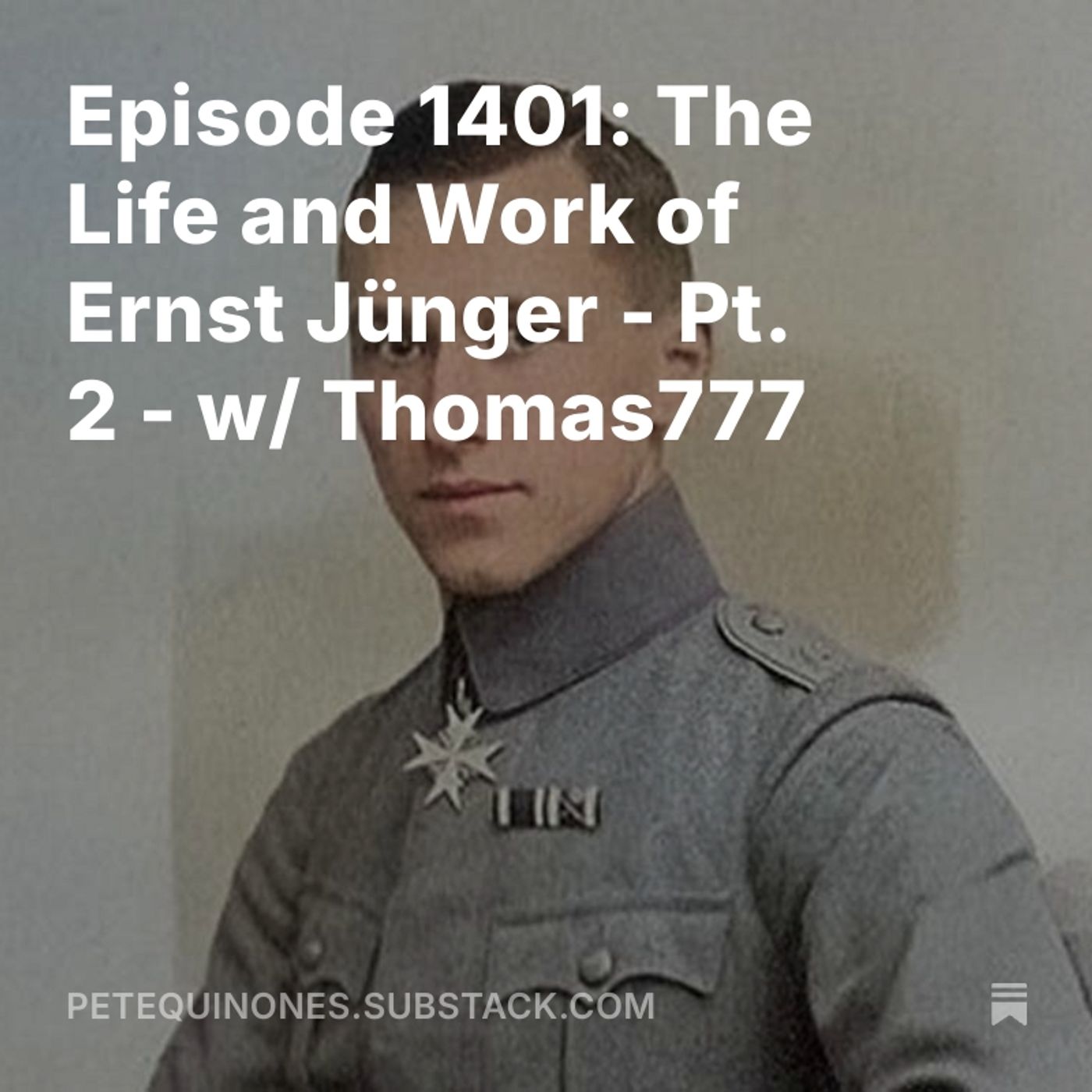
The Pete Quiñones Show
Episode 1401: The Life and Work of Ernst Jünger - Pt. 2 - w/ Thomas777
00:54:24
54 Minutes PG-13 Thomas777 is a revisionist historian and a fiction writer. Thomas continues a series exploring the life and work of Ernst Jünger. https://radiofreechicago.gumroad.com/l/lciqo https://blitz-ink-studio.creator-spring.com/...
Loading summary
Transcript13 lines
- [00:00]
A
Sam,
- [00:38]
B
With election time approaching, political ads will be inserted into the episode along with other ads that frankly I'm not going to like and you aren't going to like. So please ignore them, skip by them, whatever you have to do. I don't endorse any of the ads that are inserted, but it is another way for me to generate income. So I appreciate you guys putting up with them. If you don't want to deal with them, go to the peak and yonas show.com you can subscribe through Patreon. You can subscribe through Substack, which is my preferred one because with both of those you get an RSS feed. Only Patreon and only Substack give you an RSS feed. There's also a link to my Website Gumroad and SubscribeStar where you will get the audio files that you can download and listen to or you can stream in most cases through those locations as well. So if you want to avoid the ads, consider supporting the show. If not, just know none of these ads get any endorsement from me. Skip by them, do what you need to do. I appreciate all of you. Head on over to the Peak and yonashow.com you can get the show early and ad free over there. If not, here's the show. Want to welcome everyone back to the Pete Canono Show. Thomas is back and we are going to continue the series on Ernst Younger. Thomas, how are you?
- [02:06]
A
I'm doing well. Thanks for hosting me. Something that's fascinating about Junger and that revolutionary conservative and fascist and national socialist Milou intellectual Malu. There was a great deal of correspondence between Personages and Ernst Younger. Carl Schmidt and Marcia Elioti, they all maintained correspondence with each other and individually they maintained correspondence with, with, with Julius Evil. And after the war in particular Younger developed a. A deep and ongoing correspondence with, with Heidegger. And so let me.
- [02:48]
B
I'm sorry, let me interrupt. I mean if it was modern day, that would be a hell of a group chat, wouldn't it?
- [02:53]
A
Yeah, yeah, no, it's fascinating, man. And I've always been parcel to Mercia Eliade as well, you know as I when we went to Oakwood Cemetery for the cemetery walk, you know, for Halloween year before last. Well that was one of the big reasons I wanted to go there. I mean there was Confederate Mound and we paid our respect and I laid some white roses. But Marcia Eliade and his wife, that's their final resting place. And Eliade was a fixture at University of Chicago and he was very much targeted in the 1970s by, you know, vengeful Zionists as well as anti fascist organizations. And there was pressure to try and indict him. The osi, you know, which is the Department of Justice's, that, that's, that's the legacy organized prosecutorial organ of the International Military Tribunal. And one of the reasons, Leo Strauss. A lot of people, including some friends of ours that shall not be named. Not, not for some. Not. I'm not trying to be like insulting or something. I just don't want to put anybody on blast who may not want to be put on blast. But I've been taking a task for being some Leo Strauss hater, and I'm really not. And one of the reasons I respect him, even though I, I think it's misguided for people on the right to invoke him as some intellectual polestar, is because he really went to bed for Elioti. You know, he openly defended him when Elioti was very beleaguered, you know, because he, and he said, you know, this man's my friend. And also, whatever, whatever Strauss's faults, he wasn't somebody who wanted to see people being indicted for being fascists. You know, I mean, that wasn't what he was about, you know, and even, I don't think even within the paradigm of what OSI claimed was indictable, which has no merit whatsoever. But even within those parameters, Eliade hadn't done anything wrong. You know, I mean, he, he served with the Iron Guard and he was intimately associated with the leadership element. But I mean, I, I realize it wouldn't have mattered if, I mean, if you're gonna, if the federal government's going to charge somebody, they're going to charge them. But point being was it was very, very much a cynical effort to silence somebody who was really a, an intellectual, leading light of, you know, of that generation and cadre. But I also think, like I said last week, I'm partial to the Glass Bees, that's probably my favorite novel by Younger. People differ on what they suggest is his best, you know, is his best theoretical stuff. I'm partial to the Worker, and I think that's actually got far more of a National Socialist coding than On Pain, even though On Pain is generally characterized as a sort of fascist, romantic fascist tome. The Worker really much encapsulates Junger's metaphysics and his political ontology, and it's very much in line with Heidegger, in my opinion. It's sort of an unusual compliment piece to something Younger wrote in 1943. And some of These people who want to try and claim Younger as being this anti Hitlerian, anti Nazi partisan. He wrote this essay that translates as the peace and peace, not peace as in an incremental portion. And it was intended for. The intended audience was allied political and military personnel looking to a post war Europe, you know, and then later that was augmented by a sort of more concrete suggestion of what European collective security would look like. So people try and lump this in with, you know, as well and they cherry pick statements that, you know, to. Taken together, they try and suggest that this is evidence of sympathy for the July 20th plotters. And I, I don't accept that at all. But regardless, Junger was fundamentally considered the human condition, but and its relationship, you know, and, and, and the, the relationship of man to technics writ large. But he was very much a right Hegelian. And he also took race very seriously. And he viewed categories of mind and the experience of being in Heideggerian terms. He considered that to be very discreetly organized by what he called Gestalt. And gestalt is really when Heide. When Junger says Gestalt, that's really. He's speaking of the same phenomena as when Heidegger says Dicene. That's the way to think of it. It's difficult to translate and it's also highly abstract. But you know, in his view, Gestalt, that essentially encompasses not just categories of mind with respect to immediate perception of a sensuously present mind, but the entire category of mind that exists outside of the physical and that allows us to orient ourselves within the world and to Younger that was had a discrete racial and cultural coding because. It's entirely derivative and essentially partakes of the historical process and historical phenomena and. Younger sense that really the only way human beings in an individual and in communitarian capacity can make sense of the world that they're thrust into the world of the senses and categories of physical reality is by understanding not just the alternative of that which is oblivion, but also this drive towards one's own mortality because people are dying from the minute they're born. And he didn't mean that in some macabre way or some nihilistic way, but you've got to look at Gestalt as perennial and eternal really and the sensuously present physical body that can perceive things by immediate presence in their being. You know, it's almost as if the natural state of man is to be asleep, as it were, and to exist not as a self conscious individual and a self aware, you know, Waking mind, but within this sort of ethereal category of mind that encompasses almost, you know, almost. Almost like a dream. Almost like a subconscious dream state, you know, in the brief time that you're alive is. Is. Is the waking aspect. And then you return to, you know, whence you came. And that's very resonant with the sort of German mystical tradition of people like Meister Eckert. And I think at base that's what Younger was. He was a German mystic. He will try and lump him in with Nietzsche. That. I think that's somewhat incorrect. You know, I. He. He was way more of a pure Hegelian than people, you know, acknowledge. He was what. He would have way more in common people like Schopenhauer, you know, than he did Nietzsche. And I think in some ways he was very much a National Socialist, you know. And like we were talking to Dr. Johnson about the other week, National Socialism was really the distilled essence of, you know, how German political thought resolved in theory and praxis in the 20th century, which was really the ultimate. When. When the ultimate zenith of. Of modern statecraft, you know, emerged into reality as a. As a historical phenomenon. Excuse my coughing. I'm. I'm dealing with some. I'm dealing with some rheumatoid symptoms. I got cough drops, but if it gets too unpleasant or annoying, let me know. But. Yeah, you know, the. And that's why, you know, again, it's not. It's misguided to say that Sid is Younger with some National Socialist ideologue because he wasn't. And he was very heterodox thinker. But I guess the issue is you can't. You can't. You can't extricate National Socialism from German statecraft as a historical phenomena. And the entire enterprise of continental political theory, which all derives from Hegel in. In broad conceptual terms, A guy named Nicholas Sombart, no relation to Verner Sombart, at least as far as I know. He wrote a book on the National Socialist worldview. And he posited that Younger's the Worker embodied three essential aspects of National Socialist political ethics and the National Socialist historical mindset. First and foremost was in the Worker. Younger talked about what he considered to be the. The final completion of the Industrial Technical Revolution and how that itself was a pure historical phenomena, you know, which was acting upon man far more than man was. Was guiding, you know, technics and technological society as, you know, as a developmental characteristic of human societies at scale. Secondly, Younger very much believed that the state as it had come to exist as the National Socialist revolution was consolidated. That was the realization of the highest instantation of his potentiality. And third, how this related to the ontological aspects of the German people within the Reich, both as individuals as well as members of the folk community and the racial organism was through their role as worker soldiers, you know, through that vocation, they're surrendering to the awesome power of the technical technological revolution as it reveals its full intentions, you know, as a formative aspect of the cunning of reason and providential design in history. So by definition or by virtue of essential aspects of this historical human type of the worker that finally for all time resolves the dichotomy between master and slave, which, as we've talked about with Dr. Johnson, is the origin of Hegelian statecraft and all political organization is that paradigm and the essential characteristics of that relationship. Because, and this doesn't have to do with some enlightened view of justice whereby slavery is suddenly condemned, it suddenly becomes obsolete. And the only human type that can function as this warrior, this, this, this warrior worker who's fully assimilated into technological processes and apparatus, you know, that that man must be habituated to hierarchies of command and obedience. But he's a self contained sovereign individual and his inner life is such that he's transcended conventional attachments. And he's so purely insinuated into the political process that he neither laments nor concerns himself with petted bourgeoisie concerns and things. And what's required of him is an ability to tolerate pain of an emotional and physical sort, and to take on a mode of endurance and to develop intellectual capabilities that allow him to understand and interpret the world, which is rapidly changing and fluid and characterized by velocity and violence and in some ways dehumanizing aspects. He's got to be intellectually strong enough to conceptualize these things. It's not just a historical process, but the zenith of historical phenomena. And he's also got to be totally comfortable with finding himself at the helm, albeit in limited capacities, not as an ultimate causal factor of these technological processes. So again, there's there naturally accrues a sort of self contained sovereign decision making ability within that human type, Even if he understands that he's not in control of historical processes as they are being revealed. That's what renders obsolete the conventional class paradigm that really for 40,000 years, when humans became behaviorally modern, you know, from the most prim, rudimentary organizational modality of, you know, a stone age tribe until the then present, you know, 20th century has been the defining sociological variable within the process of history and political development. They're in. And that's really, you know, again, that this Heidegger, especially in the question concerning technology, but also all through being in time. I mean, these are questions that Heidegger is fundamentally concerned with. And in Younger, what mitigates the alienation of the technics driven, you know, hyper modern state industrial state at zenith is two things. It's its insinuation into the racial organism in a perfect historical capacity. And there's a, there's a contentedness that mitigates existential anxieties in a way that, that supersedes things like comfort and a belief in security. It really has nothing to do with that because it's neither comfortable nor secure, but it's an understanding of the trajectory of not just historical processes, but also of individual lives which are all tending towards oblivion and mortality. But that ceases to be something to be afraid of because again, the category of mind that renders possible man's ability to participate in providential design, they're interpreting the cutting of reason and thus acting in accordance with the demands of historical processes, removes fear of the unknown from the equation and additionally the ability to function within that hyper modern structure. It calls for a certain resoluteness because everything that the worker experiences really tends towards physical destruction. As Younger said in the Worker quote, in the sphere of death, everything becomes a symbol of death. So this really can't be avoided. Really the antithesis of what underlies the psychological environment in, in a, in a, in a liberal state, in a liberal postmodern state where even though there's a sort of contempt for life and an antinatalism and a basic cruelty to things, death is, is, is suggested to be something unnatural or, you know, and, and that's, is, is deliberately hidden from view or, you know, viewed as unclean, not just in ritual or symbolic terms, but in terms that almost make people recoil from the very concept of it. You know, and to be clear, also, this isn't purely symbolic within the, under the conditions that that Younger is talking about because, you know, this was just, this was, this was only a decade after the Great War where tens of thousands of men would die in, in hours. And not just that, but you die anonymously. You, you die because you get, you know, torn to pieces by flak that's fired from miles beyond visual range by a crew of artillery men who will never even know you existed, let alone that you got torn to pieces by a shell and industrial labor of the 1920s and 30s, it was the kind of things that Upton Sinclair wrote about were true men to get torn apart on the factory floor, or if you worked in the stockyards, you might get gored by a bull that realized what was going to happen to it and went nuts. I think the statistic was something like in the roar, you know, workers in the steel foundries, something like 11 of them died at work. You know, that by contemporary metrics, that's, that's kind of the combat level attrition, you know, so whether one wants to acknowledge this or not, he becomes habituated to do it in his historically assigned role because it's inescapable. You know, every worker is, is, is. Is living towards his own termination, either violently or because he's going to catch flu and die or, you know, he's going to get injured and then just succumb because he can't work anymore. You know, so there's no, there's no sense in asking, you know, for what reason am I dying, or whether whether it's justified or not, or whether there's. There's some just war motivation behind what he's doing that doesn't matter. And it's, it's, it's, it's neutral anyway. And this is important because one of the things, one of the ties that. Excuse me, one of the ties that binded Eliade especially, and Younger, Eliade was very, he was very fixated on the concept of human sacrifice, quite literally. And it's clear early on. Well, you know, one of the things I. Fascinated. I think it's clear reading the lines. I don't think I'm projecting my own fascinations or anything out of their correspondence. But, you know, Ernst Younger being this, this hero of the Great War, that, that really kind of fascinated Eliade because the concept of human sacrifice and martyrdom, he considered them sort of synonymously. And when, around the time Elioti was arrested, you know, because there was, There was, There's great tension between Antonescu and, and the Iron Guard. Like I think I mentioned before, there was, there was a fascinating tension between the Hitler faction and the, the, the sort of Party Chancery faction, who were solidly behind Antonescu and the ss, who were very, very close to the Iron Guard. And these were tendencies very much at odds with each other. But after, after Kadrianu was murdered, you know, and Eliot was arrested, and then after a few months, he was, he was released. This was very much on his mind as well as when, as well as the martyrdom of Seal Marine and Ayan Mota, who were. Who fell fighting against the communists in Spain and such that a genuine fascist international was ossifying around that time, they very much. Their sacrifice became a rallying point. And I find that fascinating too, Eliade. In 1937, right around the time when Marin and Mota were killed in Spain, he dedicated a series of essays to both men as heroes of the legionary movement, but also as martyrs of the Romanian cause and fascism and in the Orthodox faith. But then he wrote a play titled Iphigenia. And for those that don't know, in Greek mythology, Iphigenia was the eldest daughter of Agamemnon, the king of Mycenae, and his wife Clytemnestra. And as the Greek army prepared to assault Troy, Agamemnon realized that he had a problem because he defended the goddess Artemis by killing off one of her deer without permission. And in retaliation, when Artemis the goddess realized Agamemnon was going to assault the Trojans, she stopped the. The winds so that the Greek fleet wouldn't be able to reach Troy. And there's a few different versions of this myth, one of which is that Agamemnon deceived Iia and told her that she and. And. And pretended that she was going to marry Achilles as part of a, you know, to solidify a piece, you know, when in reality he was. He was leading her to her death by deception. There's another variation where Artemis intervenes and spares the girl, but the most common one in Romania at the time and in a lot of the Latin world, as I understand it, was that Iphigenia. She either overheard the seer Agamemnon, seer Calchas, relaying what was going to happen, or she just pieced together through some kind of divination that she was to be sacrificed. She willingly offered herself as payment for, you know, Greek victory, or at least to realize, you know, the meeting of. Of the two armies and allow the, you know, hostilities to develop as they were. And Eliade and Younger, Younger wrote a lot about the civilians as well as the soldiers who died in. In both world wars, you know, and he, he was emphatic that this shouldn't be considered, and this shouldn't be considered in rigidly moral terms. He said that all these people should be honored, whether they were our enemies or our friends, because their sacrifice is what purchases peace. And war arrives like the seasons and the grand sacrifice of male youth on the fields of battle, as well as, you know, everybody from little children to the Old and infirm to young women in the prime of their life are going to be sacrificed. That's the noblest of sacrifices because it's what, it's what allows peace to arrive, you know, and even within warfare there's great depravity, but there's great heroism. And you know, the best and worst of man is on display. And that's what makes human culture possible. Because otherwise there is no production of human culture, you know, and otherwise people are existing not with a. An acceptance of trajectory towards oblivion, but they're quite literally simply eating, sleeping, defecating, reproducing. But even increasingly they become, you know, averse to that because partakes of the, the life process and the death process. Until recently, you know, it was the norm for women to die in childbirth. You know, so a lot of the court, a lot of their correspondence deals with these sort of utopian humanist objections to war that we've got to end war. I mean that's, that's ridiculous. I mean not just ethically, but that's like saying we're gonna, we're gonna end winter, you know, we're gonna end, we're gonna, we're gonna end the sun right rising, you know, and. The supposedly Elati wrote this play in only four days in a kind of feverish state. And. It, you know, and once again too the concern of the Iron Guard. And I think one of the reasons why Younger found it to be a compelling ideological commitment in a way he didn't National Socialism. Because again, as I think I relayed the last time and relying upon Younger's own testimony, Younger revered Adolf Hitler. He did not have some great affinity for the nsdap and he was not a member of the party. I mean, honestly, I can't see Younger joining any political party. But you know, the, the Iron Guard, the Legionary movement, one of the reasons why they were, as far as I know, they were the only European uniformed movement that Eliade or that Evola praised at all. And they were clear that the Legionary Movement was not a party and its concerns are metaphysical. It was national palingenesis. It was the propagation of the orthodox faith which to the Iron Guard, you know, like, like Carl Wolf said about, you know, Catholicism losing its way and as well as Bible Protestantism. When Westerners decided that they had to try and share the Bible with, with. With non white races because it's not for them. You know, God reveals himself and Providence reveals its designs to all the races of people in, in discrete ways that they can understand. And that abides the historical trajectory of, of the, of the racial organism as a historical phenomena and as a human quantity. You know, so the Romanians that they, the Romanian Iron Guard, they weren't narrow nationalists, but they, you know, they viewed, they viewed Orthodoxy as being, you know, the, the spiritual essence of, of a new Byzantium essentially. It's more complicated than that. But I, I, I don't want to get into a long discussion of, of how the Orthodox view race and nation and things. And plus I'm, I'm not really qualified to discuss that because it's not my heritage. But that's, you know, the fundamental concern of, of Younger Avelioti, of Carl Schmidt, although there was a sort of detached and analytical tenor because Schmidt was, you know, a legal theorist and his work product was him describing these phenomena in formal terms. That's similar to the kind of stuff that I write, although obviously I'm not a genius like Schmidt, but it's a very different kind of thing. But Schmidt's politics, I would say, were very much in line with his correspondence. And they weren't worried about, they weren't considered labor and capital paradigms. They, they weren't worried or concerned with bourgeois priorities. You know, they weren't worried about striving for security or reconciling hostile worldviews between competing classes. You know, again, when Younger talked about the worker, and again, this is why I view this as a seminal ideological statement, is it draws a clear line between the subject matter and that of Marxism or these people who like to hold themselves out as, you know, liberal democrats when in reality, you know, they were utopian socialists like the New Dealers. You know, Younger was talking about a basic way of conceiving reality and the emergence of a new type of self contained human being on the world stage. And this was inevitably underway in Europe. It was happening as he was writing about it. He wasn't postulating about potential futures and possible outcomes. And he wasn't talking about socially engineering some sort of new ethical schema through availing people to various modalities of conditioning by way of the public bureaucracy and you know, a series of formally administered rewards of, and punishments. You know, that's, and Younger talked about planetary forces. And what he means really are those causal factors, material and metaphysical alike, that advance and shape and characterize the historical process and that acts upon the human being in affirmative ways. But within Junger's paradigm, people acknowledge that, like the worker acknowledges that he has no real ability to manipulate these things or to force outcomes according to their interplay contra the bourgeois social order which insists that technicians or political managers are at the helm. And the real worker, the authentic worker soldier, the authentic National Socialist, not only is his role to reject that bourgeois perspective, he's got to take on a revolutionary commitment and annihilate violently and destroy the bourgeois social and economic order wherever he finds it. And that's what the National Socialist revolution was, you know, but it also calls for a sweeping away of old styles and forms and assumptions. And that's why conservatives, they've either got to reorient themselves or they've got to perish. You join the what younger called the race of the defeated, if you cannot adapt to this, and not just that, but you become a cancer on the racial organism and the body politic, you're worse than dead weight because you're attempting to sabotage the historical mission of the modern state, which is the expressed will of the racial organism, self conscious of the historical forces acting upon it, so that it can come to full realization of its intended potentiality as devised by Providence. So this, this, this, this sort of pure worker, he's not operating according to external aims or conventional rewards, incentives. He's, he's not, he's not seeking better living standards. He's not seeking to liberate himself as part of some laboring class from the need to perform the work that he's doing. Similarly, he doesn't go to war when the race goes to war, owing to some formal imperative. He does so for the because war has arrived and he realizes that either through his labor he's going to die in the factory floor or through combat he's going to be martyred on a high tech battlefield. So it doesn't matter what the causes belli is because life struggles against life. And obviously what's paramount is the survival of the racial organism and the continued the continued existence of, you know, historical categories defined by gestalt, you know, which is what forms the mentioned material of the race and what endures beyond individual lives in perpetuity eternally and recurringly. But that's again in the hands of Providence. You know, he wages war for the sake of war when called to do so. The real worker is a warmonger in this way, you know, but not in the sense we think of it in. American terms where people have this idea that, you know, you wage war to end history or, or to fight evil. It has nothing to do with that at all. It's not that kind of warmongering. It's the antithesis, you know, and what distinguishes the bourgeoisie or the liberal. From the national soldier to the worker is that the bourgeoisie actor. He views war as either something that must be negotiated at all costs in lieu of violent resolution because he's terrified of the alternative when in reality, you know, again that war is not a. Is not a rational process. Tactically it is, you know, weren't once underway. But it's not caused by rational imperatives or by conspiratorial designs. You know, it arrives like the seasons, owing to providential design. And the worker in the younger sense, the National Socialist sense, if people permit that characterization, the communist also the. The communist accepts the struggle. You know, the Stalinist, the Marxist Leninist. And he views class warfare as his mandate and as essential to the process of history. But he views it as incident to a material reward and a liberationist political theology. You know, and for the real. For the true worker soldier, the battlefield is. Is the realm where. Where. Where men are sacrificed. That's why they're there. And if you happen to survive it, you've escaped death for the time being as an initiate, you know, and that's the secondary purpose. But, you know, the primary purpose is that it's a sacrificial altar where men. Where men are. Are sent to die in a matter befitting a National Socialist and the standards of the European Reich. And I think. I think anybody who understands the conics from where Younger speaking can't avoid that conclusion. And the only reason there's any contrary behind that is because again, like our friend Dr. Johnson is want to point out, you can't. You can't escape Hegelian thought if you want to understand political theory. And you can't escape German political philosophy derivative of Hegel. If you want to understand continental political traditions, you want to understand the 20th century and what animated these. These mass movements and particularly National Socialism and fascism. But so what people want to do is, you know, people in academe and court historians, they. They try and recharacterize these things as. Oh, but you know, Younger was actually a liberal Democrat. He didn't really believe these things or that's not what he meant. Or you know, Nietzsche was. Was speaking ironically or oh no, Schopenhauer. He was. He was just engaged in this ongoing thought experiment. Or, you know, Hegel was actually a liberal. He really believed in. In the dignity of the individual and. And you know, human agency and the ability to alter historical conditions and political phenomena. They're in. And you know, that's. I'm not gonna say that's where confusion comes in. There's nothing confusing about it. It's very much ideologically coded. But that's why there's this incoherent sort of discussion around this subject matter. And that's why anytime we discuss this stuff, I get, I get hate email from weirdos in academe who say I don't know what I'm talking about. And then they talk about other, They've got like a special little PhD or something and I'm not like them, so I'm stupid. I mean I don't mind that kind of stuff's kind of funny to me. But then, so I'm not just, I'm not as straw manning when I say like this is what cord historians think. I, I know what they think because they send me hate mail. Was also a, you know, I, I do keep up with what is being discussed in the mainstream of academia on this subject matter just because I, I think that's important to know sort of what these conceptual biases are and you know, but I think even there really is a distinction between, I mean there's a distinction obviously now what's suggested is, oh, there's continental philosophy, which is metaphysics, and then there's analytic philosophy, which is really formal logic, like formal logic and, and really abstract like high level mathematics. And it's, I'm not a math guy at all. But when you, when you get into truly theoretical mathematics, you're not talking about mathematics as you learn it in like college trigonometry or something, you know, you're talking about something very, very abstract but nonetheless distinguishable from, you know, metaphysics. But there's a divide as well. There really is a difference between Conel philosophy and anglophone political theory. You know, and Hobbes Hobbs is the Anglophone hail that, I mean not, not just because he's in it. He was an intellectual giant and Habeasian thought touches and concerns everything in the, in the Anglosphere, you know, when you're talking about political theory and concepts of statecraft and, and everything else, you know, but also there's, there's odd commonalities. I, the way I think of it is, speaking of Carl Schmidt, I can't remember if I made this point before. I'm not trying to panel something back, but I, I think it's important to sort of explicate what I'm talking about. I think what Schmidt does do, what Schmidt takes from Hobbs, it's, it's tantamount to what Marx and Angles took from Hagel. But I, I, I think it's more intellectually rigorous. But Schmidt really kind of turned Hobbs on his head because Schmidt's account of symbolic, psychological interpretations of sovereignty, that's 100% heian. But obviously the ontological claims of Habizian theory or containment of using theory are totally at odds with Schmidt's understanding of, you know, the organic development of a. Of a communitarian racial consciousness. But. That's all I got for now because I'm. I'm kind of tired out, frankly.
- [53:04]
B
That was a lot, man.
- [53:06]
A
And again, I'm sorry for the carving and stuff. I hope it wasn't super annoying. If it was, I apologize, man. I. I didn't. Especially after I had to cancel on. On our. Our good buddy De. I didn't. I didn't want to cancel another recording session if I could avoid it, and I feel pretty good. I. I just sound like. So I apologize.
- [53:26]
B
No, I appreciate it. I guess we come back for part three.
- [53:30]
A
Yeah, that'd be great, man. I hope the subs are enjoying it and. Yeah, that'll be just great, man.
- [53:36]
B
Awesome. Go to Thomas's substack. Real thomas777.substack.com Best way to hook up with them.
- [53:44]
A
Yeah. Thank you, Pete. And thank you, subs.
- [53:47]
B
Take care,
- [54:09]
A
Sa.