← The Pete Quiñones Show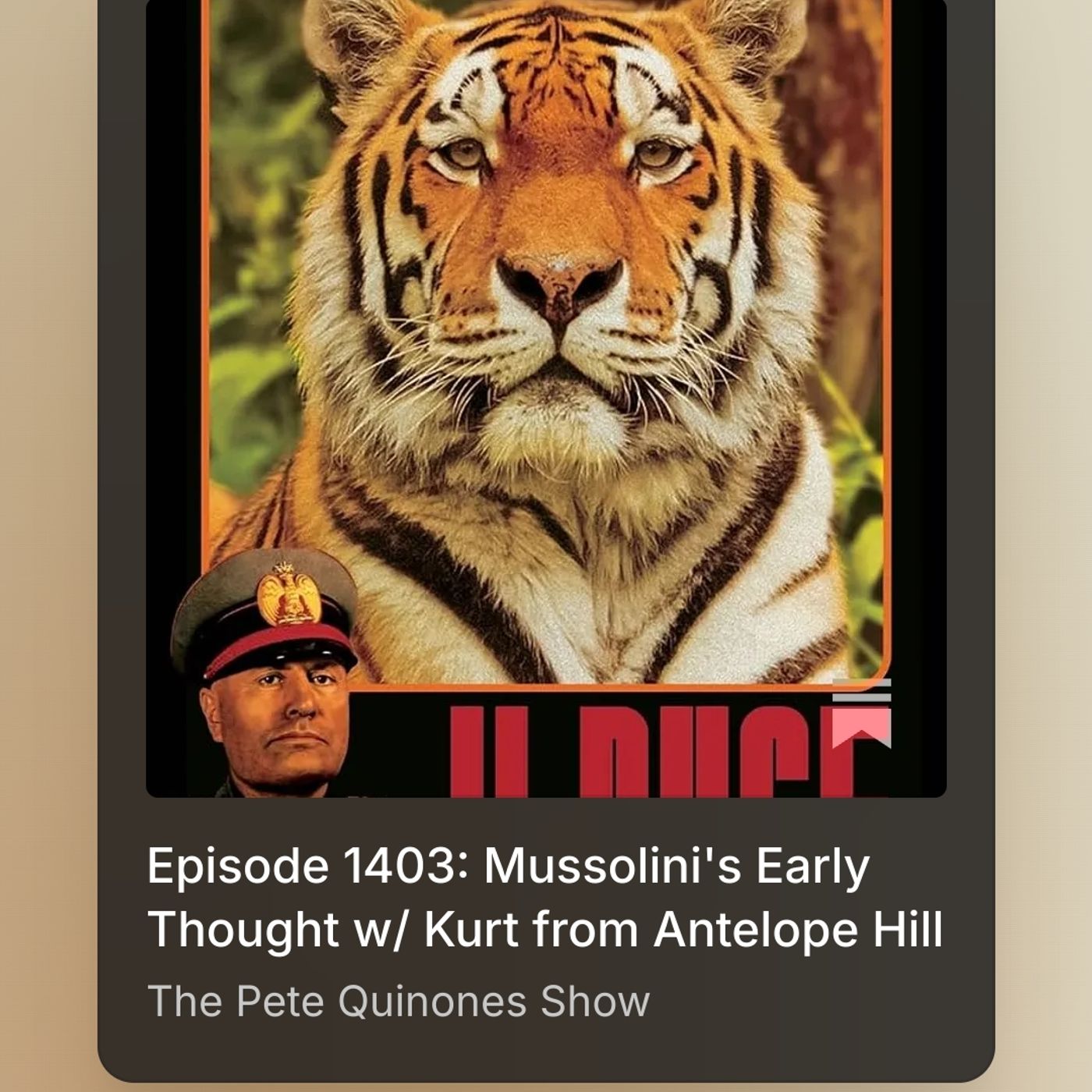
The Pete Quiñones Show
Episode 1403: Mussolini's Early Thought w/ Kurt from Antelope Hill
00:51:08
51 Minutes PG-13 Kurt works for Antelope Hill Publishing. Kurt joins Pete to talk about the speeches and writings of Mussolini from the earliest period of his public life. They are compiled in Antelope Hill's release, "Il Duce Massimo: Selected...
Loading summary
Transcript80 lines
- [00:01]
SpinQuest Advertiser
Hanging out at the pool is great. Relaxing and playing Vegas style games on my phone at the same time. Drink in one hand and a blackjack in the other. It's all at spinquest. Over a thousand games including your favorite slots and table games. Be cool with this summer special new players get 30 coin packs for 10@Spinquest.com
- [00:24]
SpinQuest Disclaimer Announcer
Spin Quest is a free to play social casino void where prohibited. Visit spinquest.com for more details.
- [00:32]
SpinQuest Advertiser
Forget everything you had planned for this weekend because you are sitting on your couch and winning from the comfort of your own home. I'm here with Spin Quest where you can play hundreds of slot games, all the table games you love and you could even win real cash Prizes. New users 30 coin packs are on sale for 10@Spinquest.com SpinQuest is a free
- [00:54]
SpinQuest Disclaimer Announcer
to play social casino void where prohibited. Visit spinquest.com for more details.
- [00:59]
Kurt from Antelope Hill
It.
- [01:39]
Podcast Host
With election time approaching, political ads will be inserted into the episode along with other ads that frankly I'm not going to like and you aren't going to like. So please ignore them, skip by them, whatever you have to do. I don't endorse any of the ads that are inserted, but it is another way for me to generate income. So I appreciate you guys putting up with them. If you don't want to deal with them, go to the peak and yonas show.com you can subscribe through Patreon. You can subscribe through Substack, which is my preferred one because with both of those you get an RSS feed. Only Patreon and only Substack give you an RSS feed. There's also a link to my website Gumroad and Subscribestar where you will get the audio files that you can download and listen to or you can stream in most cases through those locations as well. So if you want to avoid the ads, consider supporting the show. If not, just know none of these ads get any endorsement from me. Skip by them. Do what you need to do. I appreciate all of you. Head on over to the Peak and yonashow.com you can get the show early and ad free over there. If not, here's the show. I want to welcome everyone back to the Pikinono Show. Kurt from Antelope Hill is back. How are you doing today Kurt?
- [03:03]
Kurt from Antelope Hill
Hey, I'm doing great. Hi everyone. Happy to be back.
- [03:08]
Podcast Host
Well, we are going to talk about talk about another book that Antelope Hill has published. It is I Will. I always struggle to pronounce but il duce Massimo Volume 1.
- [03:21]
Kurt from Antelope Hill
I'm sure, that's close enough.
- [03:23]
Podcast Host
Yeah, yeah. Il duce Massimo. Volume 1. Selected speeches and writings of Mussolini from his beginnings to the first attempted assassination, December 1901. October 1911. Big picture. What do you get out of this, out of these speeches and writings?
- [03:46]
Kurt from Antelope Hill
Well, the big thing that most people know about Mussolini but aren't really familiar with is that he of course came out of the Italian Socialist Party. And he wasn't just sort of a participant in that. He was a big name. He was someone who was headlining a lot of their publications. He was a well known speaker, writer, propagandist, agitator, and he knew his stuff. He was very familiar with all of the sort of classic socialist writings. He comments a lot on Marx and dangles, of course, but also other maybe slightly lesser known but still prominent European European socialists as well as on a lot of other philosophers. So that's what I think is really interesting about this book is that we're really going back to the formation of Mussolini's political and philosophical and economic thinking. And so you're getting the Mussolini from before fascism was even really an idea.
- [05:08]
Podcast Host
Yeah, he really seems to, you know, the first question I had when I'm like, okay, so what is a young Mussolini from his beginnings, you know, how much is he influenced by Marx obviously? So from the speeches and the writings, what do you, how do you see his Marxist priors? Let's just call it that.
- [05:32]
Kurt from Antelope Hill
Well, I, I think he appears as someone who definitely is a Marxist, would, would probably describe himself as a, a maybe, if not a Marxist, at least a follower of Marx, someone who, who highly valued Marx's ideas. He's, he's very much not a sort of doctrinaire of any one sort of school of socialism. He describes himself as a couple of different things. A syndicalist is one of the terms he uses to describe himself, which basically means he believes in a revolution through the power of trade unions and that sort of organization rather than through parliaments and parties. Which is kind of interesting because that obviously changes later. But he, in his commentary on Marx, he definitely rejects the people who want to throw out Marx entirely, while at the same time saying, yes, obviously Marx wasn't right about literally everything, so he's somewhere in that sort of middle ground of socialists in this time period.
- [06:54]
Podcast Host
I think it's interesting when you look at some of the people who considered themselves to be syndicalists, a lot of them, the paths they took or the people that they inspired tended to be more on the right.
- [07:09]
Kurt from Antelope Hill
Yeah, it is interesting. The biggest Name, I think, is Georges Sorel, who's a French syndicalist. He's at least the one that I find the most interesting, even though Mussolini comments on him not a whole lot. But he does excerpt a few of his writings and reprints them in one of the newspapers that he is writing for at the time. Sorrel, basically the sort of tldr for those who don't know much about him. He is a revolutionary socialist of the syndicalist variety, as we've said. He sort of really believes in the power of revolutionary violence, of the general strike as the tool of the proletariat. And he makes a few different major contributions to socialist thinking. One of the big ones is the power of, of the myth, as it's. As it's put, the base, which is basically referring to the power of violence as a sort of energizing force, something around which a mythos can be built that will strengthen the social classes. And he even refers to this, the violent contest between the classes, as hopefully also reforming the bourgeois classes as well, which is kind of interesting. So he's definitely a class warfare rather than a class cooperation guy. But he does think that through this the rest of society, beyond just the proletariat, will also be improved, where I think you're seeing kind of an early step into a sort of fascist thinking. And he ends up, interestingly enough, becoming like an integralist later on and saying essentially that. That socialism has failed and gravitates more towards the. The sort of French integralists like Charles.
- [09:34]
Podcast Host
Let's stay on Sorel for a while, because I think Sorel is really important. And we'll get back to Mussolini, of course, but it seems like Sorel, when you look at fascism and you look at even national Socialism in Germany, people like to bring up Nietzsche as an inspiration, and obviously he was. But it seems to me that probably Sarel is unsung there and that there was probably in practice there was more inspiration from Sorel Thenietzsche. Do you agree with that or am I wrong?
- [10:22]
Kurt from Antelope Hill
I'm not sure, because they're different sorts of contributions. Nietzsche obviously is not programmatic. He doesn't. Or. Or systematic. Nietzsche is really at sort of the maybe subconscious level and inspiration for all of this, including for Sorel himself. But Sorrel is. Sorella is a huge contributor to this sort of radical revolutionary attitude and the, the way that violence is understood as in the end, a social tonic or, or amenable to creating positive social change. And it's very much against the Sort of parliamentarism. One of the things that you see as a common thread throughout all of Mussolini's inspirations is an anti parliamentarism. That's really the ultimate bad guy.
- [11:38]
Podcast Host
We will come back to Mussolini. I just want to stay on this for a while because you mentioned Sorel and the general strike. How relevant do you think a general strike is today? Or is, is. Are things just too automated at this point?
- [11:54]
Kurt from Antelope Hill
That's a good question. I, I would have to say I, I haven't thought about it too much. Although the thought did occur to me as I was reading this whether or not such a thing is even possible at this point. My first instinct is that I don't think it is. I don't think that the laboring class certainly in America has the requisite level of political consciousness for such a thing. In many ways it's gone backwards. That genie has been putting back in the lamp through all sorts of means, just state propaganda and essentially the victory of the reactionary liberal so called democratic classes in the us Possibly in Europe. It's still possible. But we of course run up against the fact that all of the, the so called socialists of today have just completely changed their positions. They have just decided that their constituency are freaks and degenerates and foreigners. Which has completely cut the legs out from under any kind of labor organizing.
- [13:29]
SpinQuest Advertiser
What's going on everyone? It's bluff here. And you know what's more American than America's 250th birthday? Supporting American owned companies like Spinquest, America's number one social casino with over a thousand games like Live Dealer, Blackjack and craps. They're offering new users a $30 coin package for just $10. Go to spinquest.com and sign up.
- [13:50]
SpinQuest Disclaimer Announcer
Today Spinquest is a free to play social casino void where prohibited. Visit spinquest.com for more details.
- [14:01]
Podcast Host
Yeah, I mean I've had these thoughts a lot from reading Sorel and I think you're right. Really the only way you're going to have that is if you have a coherent culture. And there is no coherent culture. There is no culture on a mass scale. So yeah, everything keeps coming back to localism, but. All right, moving on with the text. So from what I got from reading this, early views are anti statist. He sees economic transformation suppressing current property relations, proletarians or the main actors or the sole actor. But he also seems to, when he starts turning away from Marx, I think he just sees Marx. It seems like he sees Marx as an economist concerned solely with labor and Material conditions. And I think that basically what Mussolini starts to see is this. Do you think this is when he starts to just start looking at the Italian people as the Italian people and the. It would be difficult to take a coherent culture and see to deracinate it as such?
- [15:32]
Kurt from Antelope Hill
Well, I think it's his stance on nationalism as such really in the beginning is doctrinaire Marxist. He's very much against the idea of nationalism. He views patriotic appeals as basically being a tool of the bourgeois to fool the proletariat into fighting their wars for them and so on and so forth. I'm not really sure where the turn towards a sort of Italian nationalism comes in. He, he has positive feelings about some figures in, in the history of Italian nationalism like Mazzini, who was one of the leaders of the Risorgimento, but they're sort of limited. He, he. He's equivocal about his praise for these people. On Mazini for example, he notes of course in comparing him to Marx that Mazini really is not an economist and he doesn't value Mazini as an economist. Mazini is a liberal, basically. He's a liberal Republican who wanted to set up these sort of social democratic mechanisms that are completely against doctrin or socialism. But at the same time praises him as a man as sort of. As a political agitator. But I'm not quite sure where the ultimate verdict would fall on these people as far as Mussolini is concerned. It seems to me like in this period he's. He sees them as well intentioned people with perhaps some noble virtues. But ultimately I don't think he sees himself as following in their footsteps.
- [17:43]
Podcast Host
Well, one figure that probably people who don't know, who haven't read the early history of Mussolini and once again, thanks for putting that out there. One figure that he was really inspired by was Vilfredo Pareto actually going to his lectures and doing commentary on his work. And it seemed like he described Pareto's ideas as like a healthy positivism. Is that what you get from the reading?
- [18:19]
Kurt from Antelope Hill
Yeah, yeah, I would, I would tend to agree with that. Pareto's sort of analysis of the way that democratic states actually function is I think something that naturally would have appeal to a socialist who, who, who believes their worldview to be scientific right or, or values, a sort of scientific worldview. And Pareto is, is used by Mussolini in a couple different ways here. Firstly by breaking down the, the sort of idea of social majorities. Vilfredo Pareto, for those who don't know was actually. Am I correct on this? He, he began as more of an economist and then moved into more political science.
- [19:16]
Podcast Host
You are correct. Yes.
- [19:17]
Kurt from Antelope Hill
Okay. And so he, he applies a more systematic, analytical sort of economics based framework to analysis of politics. And, and basically he's saying that democracy is fake and he can prove it mathematically, that there is essentially never any such thing as a majority in politics. That the idea of majoritarian rule itself is sort of a fiction. Everything is always run by an organized minority. Something that I think a lot of people on our side of things today will, will take for granted that that's essentially true. But he's sort of the founder of that principle and the one who, who did the most to demonstrate it scientifically.
- [20:08]
Podcast Host
Yeah. Pareto. When Mussolini writes in 1904 that Pareto is basically likening the sovereign right of majorities to the divine right of princes. And Pareto also says, I think you mentioned moral majorities or even intellectual majorities, that those have to be looked upon with suspicion because at least at this time, at the time he's writing, the world has changed so much and so much thought in the west has progressed away from throwing an altar that it's kind of hard not to see that individualism is really taking over. And that's what Preto says. Even the terms like individual and social in the social sciences can't even be made precisely
- [21:15]
Bretzky
right.
- [21:16]
Kurt from Antelope Hill
Yeah. And I think the value that Pareto has for Mussolini at this point is basically exploding the mythology of the liberal republican, or not even necessarily Republican at this point, but of liberal parliamentarian, I should say, states.
- [21:39]
Podcast Host
Yeah. And it seems like Mussolini was inspired by Pareto his insights teaching socialists at the time about unity and party tactics, suggesting that Pareto, his critical analysis of societal structures and limitations of conventional political concepts resonated with Mussolini and seemed to push his. I think it pushed his socialism more and it looks like it could have possibly be. Be pushing away his Marxist kind of socialist leanings towards more of a Kinnist kind of socialist leanings, if you get what I'm saying.
- [22:26]
Kurt from Antelope Hill
Yeah, perhaps. I think you, you see in a lot of his, his writings at this point, there's some stuff that definitely seems contradictory, especially as it concerns those sort of later developments of his ideology. I think this is, this is one of them because he'll, he'll cite or he'll write approvingly of Nietzsche or Pareto's ideas on one page and then on the next he's sort of back to this very classical Marxist universal brotherhood of man. Stuff this sort of universal humanism that doesn't really seem to mesh with what he's been talking about on the page before. So. And of course, being a man of contradictions at this point in his life is really no criticism. He's basically trying to synthesize all of these things together. And he hasn't done it yet, of course, because it's very early in the process. But I do agree, I think you definitely see the seeds of those later developments coming in at this point. Pareto, after all, is. I'm not sure how I would describe him. Perhaps a conservative revolutionary at this point.
- [23:51]
SpinQuest Advertiser
Forget whatever plans you have this weekend because you're staying at home and playing on spinquest and there's never been a better time to sign up than right now. New users get $30 coin packs for just $10. All the table games you love, with hundreds of slot games and real cash prizes. That's at spinquest.com S P-I-N Q U-E
- [24:12]
SpinQuest Disclaimer Announcer
S-T.com Spin Quest is a free to play social casino void where prohibited. Visit spinquest.com for more details.
- [24:22]
Podcast Host
Yeah, probably a conservative revolutionary. It's. It's very strange. People, different people read Pareto and get different things out of him and see him as different things, which I guess that's a good thing. I guess that's a compliment to him. The thing you mentioned about seeming contradictions, I think anybody who is, who has gone like if when you talk to people who were like on the left and now they're on the right or libertarian who basically pretty much the same thing as being on the left and moving, you know, moving to what we would call the far right. In that process of evolving, the contradictions are going to abound because you don't want to leave things behind. You don't want to leave your past beliefs behind. You can start to believe that you're. Why should I, if I believe something was right at one point? Why. You know, what makes it wrong now? And there's also the. You don't want to lose acquaintances and friends along the way. So any kind of what you see from his writings where he's analyzing somebody who's obviously not a doctrinaire Marxist and struggling with that and still holding some. Still holding some Marxist beliefs, I think that's just a logical for anyone who's ever made a big shift, I think they're sympathetic to that.
- [25:59]
Kurt from Antelope Hill
I did notice as well that some of the commentary where he seems to me anyways to be sort of at his worst in terms of this sort of sappy universal humanism, it seems to coincide with his time writing for one specific outlet. So it may have even been the influence of his editor or whatever council was setting the editorial line for that publication, which I thought was kind of interesting. That was during his time in Trentino. I noticed especially he tends to write like that. Trentino being the Austrian at the time, Austrian province that was populated by primarily Italians.
- [26:54]
Podcast Host
Let's move on to probably somebody who inspired him. It appears much more than Pareto did Nietzsche. I mean, first and foremost, it seems like Mussolini was just drawn to the brilliant spirit, the, the challenging of traditional morality and systems. Almost like Nietzsche offered a basis for every revolt and every moral and political attitude of the revolutionary at that point.
- [27:32]
Kurt from Antelope Hill
Yeah, I mean, I think his reading of Nietzsche is quite good, actually. I found very little in it that I, that I really disagreed with. And I think his use of Nietzsche to explain or to justify some of the radical positions that were taken by sort of revolutionary socialist figures, I think it's quite enlightening for someone who's coming at it from our side of things. People who are fans of Nietzsche might find something valuable in there, that Nietzsche is not simply justifying their politics, that is sort of right wing radical politics, but also people who are coming from the left and came up with some pretty valuable interpretations of them.
- [28:34]
Podcast Host
Yeah. It seems like he almost draws directly on the genealogy of morals, describing the origin of the state as a violent act by a pack of blond beasts of prey and race of lords and conquerors who impose their laws on weaker populations. And while all of that sounds negative, it seems like it definitely resonated with him when it came to strength and force in the formation of a society.
- [29:05]
Kurt from Antelope Hill
Yeah. And that's the theme that you see coming through with him and with Sorel and some of the others that we've talked about. This clear thread through all of Mussolini's arguments on the value of action, of power, on self reliance he's always pushing for. And he, and he quotes Marx on this saying the workers have to liberate themselves. They can't rely on outside help or charity from guilty bourgeois millionaires. The workers utopia is not going to be built by charity cases. And that's, I think, an interesting way to synthesize Nietzsche with Marx, even in a certain way.
- [30:03]
Podcast Host
Do you think it's in Nietzsche that he starts to see that even the blond beasts of prey require a principle of solidarity for the collective and the state to endure like it would involve obedience to collective rules and protection of slaves or production represented by a first limitation of individual will also, which could be a fatal flaw of solidarity that even the strong can't escape. But even he, like Mussolini, noted that the contradiction of Nietzsche's thought between the unique Ubermensch and the need for communal rules. But it seems like this is where he starts to get some of his inspiration to move away from being a doctrinaire Marxist towards more of a kinship kind of model.
- [31:09]
Kurt from Antelope Hill
Yeah, I mean, I think it's certainly he sees this as a dilemma in Nietzsche's thought. He has a pretty interesting passage where he sort of explores it more in depth that honestly, I felt like I had to go back to and reread it because it's pretty complicated conceptually. I think it is notable how much of a philosopher Mussolini really is at this point. He has a very, very good grasp of these things and a lot to say. A lot to say about it. I'm not sure if. Did I answer the question?
- [31:56]
Podcast Host
Yeah, well, I mean, it's, I mean that's a rabbit hole. Yeah, that's like. That's a series just to, to examine certain figures and how they, how they rectify the Ubermensch and, and communal rules and. But you know, it's like, I guess at that point where he, he's embracing the concept of the Ubermensch and he really starts to, I think, as you just said, starts to question everything. And he even sees like the Ubermensch representing a being who surpasses man, battling against not only the plea, you know, the, the plebs, but also God.
- [32:48]
Kurt from Antelope Hill
Mm. Yeah.
- [32:51]
Podcast Host
Yeah.
- [32:51]
Kurt from Antelope Hill
I mean, I certainly think that, that his reading is, I think it's a good one really. And he also, everyone will, will notice at this point he's really leaning on Nietzsche for his anti Christian views. And Mussolini throughout this book is very much an anti clerical radical. He really sees in the church like one of the greatest enemies, one of the greatest reactionary forces.
- [33:29]
Podcast Host
Yeah, I guess it can't be overstated that considering the, the, the priors that he comes from, that would definitely be something that would be. He would carry forth and that would probably be the hardest thing for him to, to throw off.
- [33:53]
Kurt from Antelope Hill
Yeah, well, in. The interesting thing I think is that when you look at what happens in, in what was it, 22 or 23 that the, the actual. That the fascist party comes to power.
- [34:10]
Podcast Host
22, I believe.
- [34:11]
Kurt from Antelope Hill
Yeah. Yeah. So, you know, with what happens in 22, he ends up compromising on a lot of things that probably he, he shouldn't have. Most especially the Monarchy and the sort of parliamentary system, even the Grand Council of Fascism ends up ultimately being basically a little better than a parliamentary system. So you see, of course the old rule expressed that all movements are more pure in the beginning and become less so as they go on. And he, and of course he compromises with the Church as well. In the end there's the, the various accommodations that are made. Of course in the beginning the Church is very much opposed to fascism, but then in the end he's of course supporting the Spanish nationalists who are very much aligned with the Catholic Church. You see the same thing play out basically in Germany, right, where the Church manages always to sort of escape the, the clutches of these anti clerical movements because they have bigger fish to fry. But I don't think Mussolini really ever in his heart returned back to Catholicism. I think he might have made his peace with it, but you still have the sort of anti clerical streak in him.
- [35:54]
Bretzky
What's up everybody? It's Bretzky. And America is turning 250 and I can't think of a better way to celebrate that than playing on an American owned social casino. Spinquest.com with all of your favorite games, live craps, bubble craps, live blackjack, there's no better place to play for free and win real cash prizes.
- [36:16]
SpinQuest Disclaimer Announcer
Spinquest.com Spinquest is a free to play social casino void where prohibited. Visit spinquest.com for more details.
- [36:27]
Podcast Host
No, I mean Padre Pio did as much as he could, but yeah, he can only do so much.
- [36:34]
Kurt from Antelope Hill
And it's, it's funny because you almost see like a Napoleon here because Napoleon follows the same trajectory, beginning as a radical, never really quite making his peace with the Church or never coming the whole way back around to it. Of course, taking the crown from the Pope's hands and crowning himself, but yet also restoring some of its privileges and some of its status. The Church has always had a tricky relationship with these sorts of radical movements.
- [37:13]
Podcast Host
Yeah, yeah. Well, the, speaking of the Church, Some of his writings are extremely short and so he, I mean just to bounce on like a couple, just cover a couple of these. I mean he has a very short one on the Masonic question. He wrote this in 1910. And yeah, he's like, to the question, can a socialist join Freemasonry? We will answer no. Must a socialist who is found to be a member of Freemasonry be expelled from the party? We will answer, yes. There are a few hundred of our leaders who instead of working in the interest of the proletariat, work in the Interests of the lodge to which they belong, they must be swept away. Purify the air infected by the old secular left wing clique. Then we will breathe better. Just some amazing, some amazing writings and just he could turn a phrase which is. Which basically what, what your enemies and I mean there's a lot of people who don't like Mussolini at all. Dr. Matthew Raphael Johnson can't stand them. I, I'm more like neutral. I look upon him as a historical figure that needs to be studied. Good things, bad things and, but to underestimate his importance and because of, basically because of the timing of his rise is, and to not study him is just. I think you're failing yourself. And also to get back to. My mind's all over the place. I get scatterbrained sometimes. His enemies, and they still exist to this day will tell you that he was just a brute of a man who would fight anybody on the street. Which is obviously true. But I think one of the things his speeches and his writings prove is he was also an incredibly intelligent person.
- [39:25]
Kurt from Antelope Hill
Oh absolutely, yeah. It's. Mussolini is certainly underrated. I'm sure I've said that before talking about our other Mussolini book that we have, which is a collection of his late war speeches which are much more sparse. Of course he didn't have time for all this writing when he was a head, head of state. But yeah, I mean personally I think these, these early writings are the most interesting part about him. Like reading Mussolini and his, his younger radical stage and you know, you, like we've said, you, you can detect the seeds of where he's getting develop later ideologically but he still really has this radical edge that a lot of people like him had before the war. The first World War of course ends up changing everything in Europe. So getting that window into what things looked like beforehand is always fascinating.
- [40:46]
Podcast Host
Well, and it's so obvious like the, what the war did to so many. I mean he's a, you know, he would be a. Considered to be a fan, a hero of the trade unionists, of the working man, you know, of the proletariat. And then he gets into power and who are the anti fascists who try to kill him? Trade workers, Republicans, former former soldiers from World War I. And it just. Because we didn't live at that time and because so little, and I actually believe so little has been preserved from that time or just hasn't been translated yet that we don't understand exactly how revolutionary a time that was coming out of that war and how the average man returning to his country who fought in that war, what he found at home and how we probably know better how the National Socialists dealt with it. But this was every country that had to deal with it and come home to radicals trying to infiltrate in pretty much every, every country. And yeah, just knowing the path that he took and then how the people who before the war would have been his comrades are now trying to kill him. Absolutely amazing.
- [42:25]
Kurt from Antelope Hill
Well, I, I think that's, that might even be an overstatement. I don't think that he, I don't think that Mussolini's transformation from a socialist to a fascist was as much of an about face as people tend to think. I believe he really did hold on to a lot of these, these ideological tenets. And of course to, to really get in depth on the reading there, we'll have to wait for the next volume to come out of, of this collection because even if you look into the 20s and 30s, there's a lot of, even military collaboration between Mussolini's Italy and the Soviet Union, especially in the naval realm. There's a lot of comments from Mussolini that paint the Soviet Union in a favorable light during this period or at least highlight the positive things that Mussolini sees developing there. It really is quite interesting. And I think a lot of his sort of cadres from the socialist period follow him into the Fascist party. There's not necessarily a view that they're inimically opposed to each other. It seems to me that a lot of the, a lot of the opposition to Mussolini's rule in Italy really is more of a coalition between these sort of anti authoritarian radical liberals on one hand and the sort of Trotskyist types on the other. Like you see these fractures within socialism becoming more pronounced. And that's, I think, where a lot of the opposition comes from.
- [44:26]
Podcast Host
I think that's what I was trying to say more than anything was how people were viewing him, how people who would know who he was before the war were viewing him now. And it goes to show how much, pretty much everyone was actually changed by the war. I mean, not everyone. I mean obviously the Marxist, the Bolsheviks, the, they pretty much stayed in their, in the lane that they were in before. But just people's perceptions how much they changed and also how, how much of a sense of urgency it seemed coming out of the war, which, you know, if you understand exactly what the war was, what it did, what it did, and the world coming out of it makes a lot of sense. I don't think it's something that it's hard for us to grasp just by reading a book at this point.
- [45:29]
Kurt from Antelope Hill
Oh, I did want to say though, because I don't think I had the opportunity to make much of an introduction to the book at the beginning and I just mentioned now that this will be part of a series. So this, this is volume one. We're gonna have a lot more of these coming out. I think we're shooting for one book in this series per year for the foreseeable future. So we're going to cover a lot of Mussolini's writings through Analla Pill. And I really recommend that people do get familiar with the intellectual developments during this time period. This volume one. I really cannot overstate how much more of an appreciation it's given me for that sort of turn of the century radicalism and the way it led into all the political developments that we're more familiar with later on into the interwar period.
- [46:34]
Bretzky
I have had no luck lately. Wait, Lady Luck Bretzky.
- [46:38]
Lady Luck
I got you. I've had so much luck on spinquest.com they have all of my favorite games, slot games, live blackjack craps and bubble craps. You can even get a 30 coin pack for just 10 bucks.
- [46:51]
Bretzky
10 bucks for 30. I'm headed over to spinquest.com right now.
- [46:55]
SpinQuest Disclaimer Announcer
Spin Quest is a free to play social casino void where prohibited. Visit spinquest.com for more details.
- [47:03]
Podcast Host
Yeah, awesome, Awesome. I know people are going to look forward to that. So I guess one other specific. I don't know if this is a letter or. Yeah, this is a letter. He actually writes a letter on the need for propaganda. I mean just explicitly.
- [47:25]
Kurt from Antelope Hill
Oh sure.
- [47:25]
Podcast Host
And I think that's just something that you didn't see in the day. And even today when I don't think we call it proper. I think the term a lot of us use is just narrative control. We need our own narratives. It's not as explicit and he's incredibly explicit about how this is needed to guide the people and control the people. And it's just, it's a breath of fresh air to read somebody being this out in the open about it.
- [48:08]
Kurt from Antelope Hill
Yeah, propaganda back then hadn't become like a dirty word. It was understood as really the textbook definition of the word propaganda is called propaganda because it is to propagate an idea or a viewpoint. I mean, if you even look at like Reichsminster Goebbels was. He was Minister of Propaganda. That was his official title. It wasn't something shameful to say we're doing propaganda.
- [48:44]
Podcast Host
Yeah, I think people just think of Goebbels as being like, we don't care. You know, we're, we just, we're being explicit about it. But no, it was just something explicitly talked about back then. Nowadays it's, it has become such a dirty word. I mean, and even more explicitly than like, if you read, I'm sure you've, you've probably read Bernays's propaganda. Yeah, he, he couches it in advertising language. I mean, he's not, he's not even explicit about it and he's considered the father of propaganda and he's writing at the same time.
- [49:22]
Kurt from Antelope Hill
So it's funny. I think it's like Westerners have this idea that propaganda is like something that happens to other people or in other, in other countries. It's like this dirty word. It's. No, you're being propagandized all the time, every day. You can't, you can't step outside your door without being propagandized. Hell, you can't stay inside your door without being propagandized.
- [49:46]
Podcast Host
The guy on Fox News told me that there's no propaganda going on on the channel. But if there is one, if there's one thing that we, one theme that you think that's really important in this volume that, that we haven't covered, let me know now.
- [50:04]
Kurt from Antelope Hill
Yeah, I mean, I think my, my big takeaway is, is that what we're looking at in Mussolini's early work is how fascism and sort of third positionism more generally really comes out of a fusion of radical ideologies and radical thinkers. It is not the inheritance of any one particular historical political trend. It really is its own thing. I think often people forget that or people want to identify our sort of politics as being quote unquote, right wing or far right. But really I think we have to destroy that notion. I think it feeds back into bad thinking, it feeds back into priors that a lot of people have that are wrong and embracing that sort of radical heritage. That willingness to throw out these old ideologies that feed the system that we're supposedly opposed to. That really needs to happen.
- [51:23]
SpinQuest Disclaimer Announcer
Yeah,
- [51:25]
Podcast Host
well, good work on this. People should go to antelopehillpublishing.com the books right at the front there with another book that right next to it is another book featured products that I've covered with the, that the Gentleman, Antelope Hill were nice enough to allow me to speak to the translators. Germany and Stalinist Crosshair. Germany and Stalin's Crosshairs by Bernd Schwipper. And that's A, an episode that people really got a lot out of and actually had people in. I sent my copy to somebody in a European country because they couldn't order it. They weren't allowed to order. You're shocked, aren't you? Yeah, but yeah, go order the book there. Order. I can't count how many Antelope Hill books I have that I've actually purchased with my own money and use promo code PQ and you get 5% off. And yeah, check this book out because we are this collection. There'll be a volume two. And I think for those who are interested in the subject, learning about the genesis and taking this, basically taking the journey with Mussolini through, through the rise of fascism in Italy. We'll, we'll learn a lot from it and there may even be some things in there that could be useful in the future.
- [53:03]
Kurt from Antelope Hill
Yeah, I mean, I've got to say, and I, I genuinely, I don't say this about all of our books, but this one really impressed me. I found this one particularly valuable and insightful. It'll also point you towards some other thinkers who certainly have valuable things for us, like Sorrel as the headline example.
- [53:28]
Podcast Host
All right, Kurt, always enjoyed talking to you. Thank you very much.
- [53:32]
Kurt from Antelope Hill
Absolutely. Thanks again for having me.
- [53:43]
Bretzky
Sa.
- [54:10]
Lady Luck
Hey everybody, lady luck here. And we're celebrating America's 250th birthday. Now all summer long I'm going to be celebrating by playing on spinquest.com which is an American owned social casino. It obviously features over a thousand slot games and live blackjack, live craps, live bubble craps. Head on over to spinquest.com get yourself a $30 coin pack for just 10 bucks.
- [54:34]
SpinQuest Disclaimer Announcer
Spin Quest is a free to play social casino void where prohibited. Visit spinquest.com for more details.