← The Pete Quiñones Show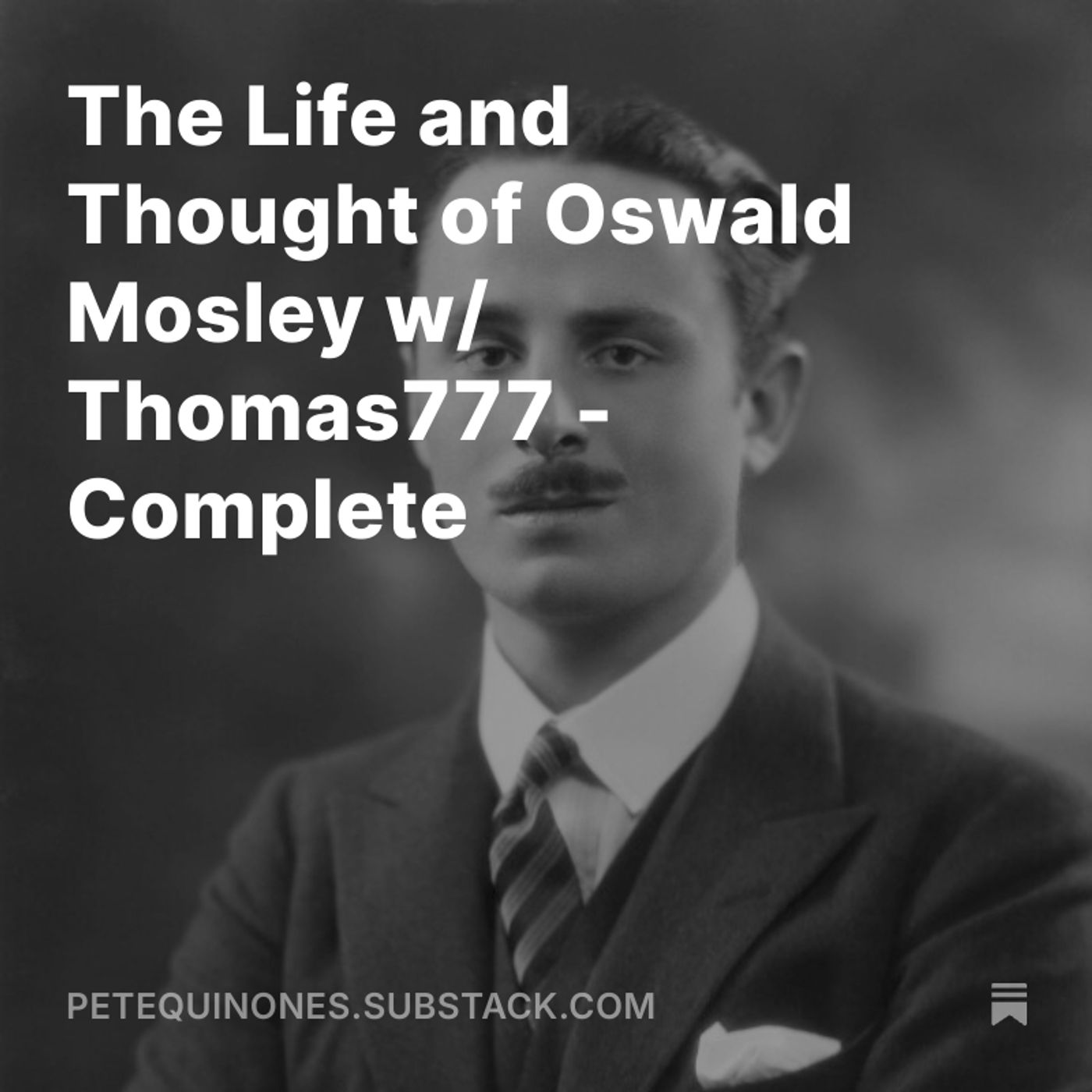
The Pete Quiñones Show
The Life and Thought of Oswald Mosley w/ Thomas777 - Complete
07:03:49
7 hours and 4 Minutes PG-13 Thomas777 is a revisionist historian and a fiction writer. This is the complete audio to the series exploring the life and work of British Union of Fascists founder, Oswald Mosley. ...
Loading summary
Transcript1 lines
- [00:00]
A
Step into the world of power, loyalty and luck. I'm gonna make him an offer he can't refuse. With family, cannolis and spins mean everything. Now you want to get mixed up in the family business. Introducing the godfather@champacasino.com test your luck in the shadowy world of the Godfather slot. Someday I will call upon you to do a service for me. Play the Godfather now at champacasino. Com welcome to the family. No purchase necessary. VGW Group void where prohibited by law 21/ Terms and Conditions apply. Hey guys, Lady Luck here. Are you going on any road trips this summer? I know I'm going to be going on a bunch of road trips. And being that I'm going to be passenger princess, I Love playing on Spinquest.com Spinquest has all of my favorite slot games. Live blackjack, live craps. Head on over to Spinquest right now and get yourself a 30 coin pack for just 10 bucks. Spin Quest is a free to play social casino void where prohibited. Visit spinquest.com for more details. Oh, I have had no luck lately. Wait, Lady Luck Ritzky. I got you. I've had so much luck on spinquest.com they have all of my favorite games, slot games, live blackjack, craps and bubble craps. You can even get a 30 coin pack for just 10 bucks. 10 bucks for 30. I'm headed over to spinquest.com right now. Spinquest is a free to play social casino void where prohibited. Visit spinquest.com for more details. I want to welcome everyone back to the Picanono Show. Thomas, how are you doing? I'm doing well, thank you. Awesome. Well, after finishing the California series and then covering the 1988 movie, Dennis Hopper movie colors for those of you who haven't heard. Living under a rock, Thomas and I watch movies and comments on them and do our sort of owners. Mystery Science Theater 3000. And it is available on my website for manby on the wall.com forward/movies Links to all the movies we've done there. And right before that, we actually did Triumph of the will, the 1935 Lenny Rifenstahl. So there's some good stuff there. Go check it out. All right, new topic. And this is one that I probably brought up a year ago and we just decided to do other stuff. So the life and the. The thought of Oswald Mosley. Where do you want to start? Mosley's background going back quite literally four centuries. There's a lot of liminal events in British history. I mean, that, that, that's not just some sort of like literary trope or something. Like do you understand like where Mosley ended up and like why he took the path he did? Like you've got to understand the trajectory of his family. Like he wasn't, he wasn't an ordinary, like a lesser noble or whatever. You know, it makes perfect sense why he established what became the only viable like fascist tendency in Britain because there were a number of them and, and none of them gained any traction because the people at the helm were, were bizarre people who weren't plugged into the Zeitgeist or they were just, you know, or they were just half ass Tories who had some kind of admiration for Mussolini. So they, you know, they didn't like communism. So I go, I'm a fascist. Or you know, they were, they were these simple minded people who were kind of taken in by Darwinist intellectual cultism, you know, like Arnold Lee and we'll get into that. You know, Mosley actually understood fascism and he actually understood like the historical implications of it. And like I said his, he had a storied family but like not in the way that people think. You know, like the, the kind of traditional and punitive description of his heritage is oh well, he was this lesser aristocrat. And as those people lost their privilege, they became fascist. Like that doesn't make any sense and that doesn't really track, you know. Mosley was basically middle class, his family had a lot of money, they were incredibly wealthy for hundreds of years, but they weren't this powerful like Noble House or something, you know, and the unreconstructed House of Commons, like really until the middle of the 19th century, you know, most of the UK had like no representation in Parliament. And the House of Mosley as it were, was one of those, was part of that unrepresented demographic, you know. So they weren't this idea that the Mosleys were, you know, these kinds of like this kind of aristocratic faction in Parliament trying to like deny people their, you know, being manumented and given the franchise. Like that's not what happened. Like they didn't really have the franchise, you know, like it wasn't. And understand like where Mosley came from. Like you've got to understand that peculiar kind of localism that emerged in England, like specifically England. And like the Mosleys, their fate was, was bound up with clergy of the Church of England and like the British Military Officer Corps. Like I was kind of like the such that they had like influence in their locale. Like those are really the people they indexed with, which makes perfect sense. But they had this basic mistrust like both of parliament and of like traditional nobles. And that's like where fascism comes from, you know, I mean like it, this should be clear as day to anybody. Like most. He wasn't a guy who followed fads and he wasn't, he wasn't somebody who did stuff for clout, you know, I mean obviously like nor was he a guy who just like enjoyed being an iconoclast. Like he believed in everything he was saying. And I think it's not just because like I'm an anglophone person. I, I find Mosley to be the most relatable of like fascist leaders. You know, Hitler was a messianic personage and almost like a great con. Like he, it's hard to find people like that relatable. You know, people like Kodrianu were like orthodox mujahid. Like it does. It's, you know, I find that to be like literally Byzantine, you know. But you know, Mosley is somebody I think who doesn't really get enough ink in America. Like the British write about him all the time. It's usually punitive and stupid and simple minded, but he's kind of ignored in the United States or such that he's granted any attention at all. People act like he was some like weird crank or like some, or some, some like insignificant personage like George Lincoln, Rockwell. Like they don't understand, they don't understand like where he was speaking from. The guy had tens of thousands of followers. And for, for somebody after, after the, the kind of modern House of commons after 1832, like after the Reform Acts for, for a true like kind of revolutionary party like upstart party to get like 40 or 50000 members. And for clarity, these are like dues paying members. Like the, the UK has actual parties. It doesn't just have brandings. It's not like the Republican Party, which isn't an actual party, you know. And before Mosley these, these schismatic, you know, kind of self declared fascists and, and National Socialists, they'd clock at peak like 4 or 500 dues paying members. Like Mosey was a serious guy and there's a reason why, you know, he was targeted the way he was and there's a reason why you know, he, he got an audience with, with Goebbels and, and some of these other Third Reich personages. He wasn't a joker, but you know, and also too like I, it's not most of These counterfactuals there wasn't jumping around a bit. I'll get into the, the a more kind of coherent narrative in a moment. But a lot of these counter factual speculations about what would have happened in, you know, if Edward VII hadn't abdicated and if the War Party hadn't prevailed in the UK or alternatively, if SE lion had actually been a seriously devised mission to conquer the United Kingdom, you know, by, by force of arms by the German Reich. Like, like Mosley, absolutely, like would have been the man that the Reich looked to, to, you know, to act as, as kind of like a proxy regime, you know, in no small measure. Because Mosley, he, he wasn't really a fringe figure, you know, like he was, he was like a very respectable guy, you know, like he became something of a fringe figure, particularly after the War Party was able to, you know, kind of shut down. I mean all opposition, you know, in the House of Commons as well as in, in the, the national media and everywhere else. But you know, what, but mostly was dangerous to the War Party precisely because he, he wasn't like this fringe character, you know, and he wasn't. Anyway, he wasn't just like the scion of, of like a respectable family who, who went on some crazy lark, you know, like Rockwell or something. Like he was a serious fascist. It wasn't, it wasn't a, you know, some kind of, some kind of theatrical protest posture. But. Like the background of fascism in Britain is strange. The first true, like self identified, like British Fascist Party was literally like the British fasisti who then became the British fascists in 1923. Like they, they, they incorporated after the Mussolini's March on Rome. It was a lady who formed the organization. It was Rotha, Lintern Orman. Very strange lady. Very much. I mean, I'd be crass, very much kind of like a butch lesbian. I mean it's just like a fact. She'd volunteered in World War I as an ambulance driver and she was under pretty heavy fire. You know, she was like a serious person, but she was like this weird eccentric and she was, she was born to an officer who served with the Essex Regiment who was kind of like the Essex Regiment was kind of the pride of like the British army infantry a long time, you know. And her, her mom was Blanch Simmons, who was another aristocrat. Her maternal grandfather had been a field marshal. You know, these people were extraordinarily wealthy. Okay. And she was kind of like the strange, like lesbian daughter. She was like. She actually was one of the Founders for all practical purposes of like the scouting movement, like the Boy and Girl Scouts in Britain, they call it something different. I think they call it like the Girl Guides. But you know, so she was, she was kind of like one of these. She was kind of this like rich kid aristocrat, you know, and like aristocrats do like, you know, she, she was all about national service when the Great War came. But then she developed this hero worship on Mussolini which for context, you know, really up to the Four Powers Pact, you know, really in. Until the late 1930s, like Mussolini was viewed as like this kind of heroic personage in the UK and is considered this kind of like moderating influence contra Germany, you know, who really after, after Disraeli's tenure, you know, like we got into, in our World War II series, you know, the Germans were cast as in, in the most like in the blackest colors imaginable. But Mussolini wasn't colored the same way in British media, quite the contrary. And people like Roa Orman, they, they basically admired Mussolini for his anti communism. Like she was not a sophisticated person in any sense, you know, which seems incongruous maybe, but there's something to the cliche of, you know, it's almost like Monty Python. Like, like these British aristocrats who actually aren't cultured and aren't educated. That's not just like a trope or it's not just something that, you know, the middle class is like to kind of hold out as, as, as some, as some kind of, you know, slam on, on people who they resent for, for posturing as their betters. You know, the. She was not, she was not an educated nor intelligent person in any real sense. And so like her, her like fascist outfit, it was basically just like this kind of like Tory. It was basically like this Mussolini fan club of like aristocratic Tories, you know. And she literally established this British fascist outfit. She placed an ad in what was then kind of like the dominant like right wing alternative paper in the uk. It was called the Patriot. You know, she said she was like looking for anti communist partisans who wanted to you know, basically, basically constitute a pressure group, you know, to force a more serious posture against the Soviet Union. Which in early on that was like a big rallying point of the Tories is that like, well, you know, labor is gonna, they're too soft on Sovietism and this is like a fifth column in, in the empire and you know, all this, all this kind of stuff. So that was later on and we're talking like Much later, you know, like a decade subsequent, the. Most of the male membership of the British fascists defected the buf. But by that point the, the organization, um, Ms. Orman's organization was kind of like existed in name only. But just for context, I, I think it's relevant. The. And famously Mosley said. Mosley referred early on to the British fascist as quote, three old ladies and a couple of office boys. Name and. Which wasn't really inaccurate. The success organization. Not. It wasn't a success organization. I don't mean like linear, I mean in linear terms. I don't mean that was. It came from the same ideological persuasion or had membership in common. The, the kind of subsequent iteration of a national socialist or fascist tendency in the UK was the Imperial Fascist League. It was founded by Arnold Lees in 1929. People are familiar with like our lineage, our lineage being people of the right. They probably know Lee's because he's an elderly guy like in the 50s. And he, he made a habit of slandering Francis Parker Yaqui in right wing press despite having never met him. And by that point lease was a total nobody. And Yaqui famously, he used to go around claiming that like Yockey was Jewish. Then he claimed that Yaqui was part black. Then he claimed that he was an Indian, like an American Indian. And Yaki Yaki famously said like I don't know who this camel doctor is. What's his name? Laos. And le literally was a camel doctor. Like he was a veterinarian. And his specialty was diseases afflicting camels. Like I'm not kidding. And his claim to fame was that he'd met Julius Stryker during some lark to Germany. And Stryker was a crude guy, but Striker also was like a cutting satirist and like a skilled artist and, and just like a tough bastard, even though he was something of a vulgarian and a dummy otherwise. Like Lee's had none of those skills and he had none of that insight. Like he was just a idiot, you know. So Lisa's whole thing was. Well, because I know how camels breed and I know how you know, traits are heritable, you know, in, in camel populations. But extrapolate like zoological principles like human populations. So the Jews are this like evil race, you know, and they have, you know, bad racial characteristics and you know, we need to breed the right kind of race, you know, just like abject, abject, abjectly moronic, you know, reducing politics to the principles of animal husbandry. With the Imperial Fans League they're like lasting legacy. They had an incredibly dope like heraldic standard. It was like the Union Jack with like a hacking cruise, like in the center in black. It like looks incredibly cool, but other than that it was, it was like an embarrassment. The BUF famously, they shut them down through a lot of ledgered man and through direct action. And one of the things Mosley did. Mosley had a very gangsterous streak. BUF black shirts, they dress up as communists. And then when the Imperial Fascist League had hold meetings, they'd assault and like beat the. Out of everybody. And then like Lee Sigurd saying, like this was Mosley. And like mostly be like, what are you, an insane person? You got, you got moved on by the Reds. You gotta, you gotta, you know, provide better security for yourself. What's the matter with you? What kind of outfit are you? Which is kind of brilliant and it's in, in and it's gaslighting. But that was, that was. The Imperial Fascist League had like an outsized profile in no small part because people like the Board of Jewish Deputies and, and, and some of these left wing newspaper types, you know, they'd say. Or they'd hold them out as an example. I mean, very much like today, you know, they hold them out as like, oh, we're being subverted from abroad. You know, this is, this, this is the Germans. This is the Huns trying to, you know, undermine and, and meddle in our, in our affairs. You know, the. During a moment of, I guess, amicability in 1932 when the buf and we haven't gotten there yet, but we will in a minute, when the BUF was very much ascendant, they'd made something of a peace offering to the Imperial Fascist League by like allowing their members to essentially patch over, you know, the Imperial Fascist League, like turn this down. And so Mosley returned to like having his peoples like, like smash them. You know, like it was lease then and later in his. Later in his life. And I'm not going to dignify it by calling it a career, but he, as is typical today with like right wing schismatics, he had like delusions of his own significance. You know, it's like this guy had a couple hundred members. Like the BUF was tens of thousand strong. You know, like Mosley, in a moment of, you know, again, like in, in a moment of charitable impulse, like offered him, you know, a chance that it kind of cloud and respectability. And of course, like, what did he do? Like, Lee's turns it down owing to some delusion that, you know, he was Actually a relevant personage, but at least like I said, the reason why, like he, when, when Yaki went to Europe, you know, and Yaqui famously approached Mosley himself and they, they didn't get along at all. And, and Mosley very much was a cold warrior by that point. And I, I think there was some degree of jealousy and of Yaqui and his intellect, but also resentment at the fact that, you know, he's like, who the hell is this American trying to dictate, you know, to the European scene how, how we should do things and conceptualize, you know, theory and policy and praxis. But you know, Lisa Lee's was still kind of like floating around the fringes of, of the, you know, of the right wing resistance, you know, because even, even then, you know, like some of these marginal figures could kind of carve out some sort of niche. And that's exactly what he did. But. Getting the Mosley. The kind of the fortunes the Mosley family. It began with Nicholas Mosley really. He was born in or near Manchester, that's not clear. But Manchester became the like ancestral home of the Mosleys like when they, when they acquired their, their aristocratic pedigree. And I'll get into how that developed in a moment. But Nicholas Mosley was born around 1527 and. For a brief period he was a Lord Mayor of London, which is different than the mayor of London. Like the Lord mayor, it still exists, although now it's largely like a ceremonial office. The Lord Mayor of the city of London is like the administrator like of, you know, what's now the financial district of, you know, the city of London. In those days it had a directly military obligation and Nicholas Mosley, during that time Britain's main adversary was Spain. And this was kind of the beginning of the Mosley family's involvement with affairs revolving around the security of the British Isles. Hey guys, lady luck here. Are you going on any road trips this summer? I know I'm going to be going on a bunch of road trips and being that I'm going to be passenger Princess, I Love playing on Spinquest.com Spinquest has all of my favorite slot games. Live blackjack, live craps. Head on over to Spinquest right now and get yourself a 30 coin pack for just 10 bucks. Spin Quest is a free to play social casino void where prohibited. Visit spinquest.com for more details. Hanging out at the pool is great. Relaxing and playing Vegas style games on my phone at the same time. Drink in one hand and a blackjack in the other. It's all at spinquest. Over a thousand games including your favorite slots and table games. Be cool with this summer special. New players get 30 coin packs for 10@Spinquest.com Spin Quest is a free to play social casino void where prohibited. Visit spin spinquest.com for more details. Step into the world of power, loyalty and luck. I'm gonna make him an offer he can't refuse with family. Cannolis and spins mean everything. Now you want to get mixed up in the family business. Introducing the godfather@champacasino.com test your luck in the shadowy world of the Godfather slot. Someday I will call upon you to do a service for me. Play the Godfather. Godfather now@Champacasino.com welcome to the family. No purchase necessary. VGW Group void we're prohibited by law 21 terms and conditions apply. And this endured for centuries. And in 18, one of the reasons why the left hated Oswald Moseley so much during 18, during the Chartist Riots in 1848, his great grandfather and his great grandfather's brother, they'd organized these strike breaking attacks like on the Chartists and like the 1848 Revolutionaries. You know, like the Mosley family. They like literally like we went back centuries of them like crushing like left wing radicals. You know, this became like their role, you know. And that started really with Nicholas Mosley's role as lord mayor, you know. And again in those days this wasn't just a ceremonial office. Lord mayor of London, you know. He basically was responsible for planning and organizing, you know, what amounted like a civil defense, a civil defense schema in anticipation of, you know, a possible like invasion on the continent. Okay, The Mosley became very, very rich. Manchester was a center of the wool trade and manufacture. Nicholas Mosley became a very wealthy merchant and he became a member of the worshipful company of Cloth Workers, which was basically like a guild and like a corporatist firm that set prices and established standards for the industry. You know. So he was very much like, like he was very much like a self made capitalist. Okay. And what he did with some of that money is for £3,500 in 1596 he purchased a lordship incinery of Manchester. And this was easy to come by if you greased the right palms because Manchester, it was basically an unimportant market town. I mean it was important, it became important economically because of the monopoly on the world trade. But in terms of the way aristocrats and this was still, this was before the Reform acts that you know, kind of transformed the house of Commons into, like, a normal Parliament. Like, in those days, this was the. This was. These are the days where you still had, like. You had, like, literally empty burrows, where, like, you know, some aristocrat, like, you know, dating back to, like, the 1100s or something, like, he was able, like, monopolize, you know, an entire voting block in the House of Commons, you know, like, based on some, like, ancient charter of some, like, then worthless land. So, I mean, there was no relationship between, you know, the. The productivity of. Of a territory and its representation in Parliament. So the guy like Nicholas Mosley, who's like, just like, some rich guy is like, yeah, I want to buy, like, a lordship in Manchester. Like, a House of Lords would be like, go ahead, you know, like, whatever terms you want, you know. But English Mosley was smart. Among other things, like, with this great wealth he'd accumulated, not only did he, like, basically buy himself into a lordship, he hired Inigo Jones, who was at the time, like, the top architect in England, and he hired him to build and design and build his manor house, which is Hawth End Hall. Okay? Now, I think it's an art museum. It still exists. Okay. But that was like. That was like Mosley Manor, essentially. Indigo Jones, he was the first. He was. He wasn't just like this. This top architect in England, but he was the first. He was really the first architect in the modern era to, like, employ the conventions of classical Roman and Italian Renaissance architecture, like, in Britain, you know, so this was a big deal, and it was no small matter to, like, have him design your manor house. You know, like, this. This conferred a lot of clout for context. The. The queen's house. Well, you see, one of the royal residences, it's in Greenwich, London. It's been repurposed a bunch of times, and it's obviously historic building, and, like, it's. It's no longer like, a royal residence, but at the time it was. And he designed that. Okay. So, I mean, this was. This was a big deal. The. He also. He. He'd been involved in, like, designing stuff for the stage, and he was buddies with Ben Jonson, and Jonson was. He's considered basically the most significant playwright other than Shakespeare. Probably his most notable works are Every man and His Humor. The Alchemist Bartholomew, Bartholomew Fair. So, you know, this. This is the kind of company that Nicholas Mosing is keeping, you know, and not. I mean, very deliberately, too. Like, when Nicholas Mosley got married, he got married in the city of London, you know, to. He was obviously trying to, like, establish some Kind of, you know, familial presence there. It didn't take because the Mosleys ended up basically after his sinecure, like the Mosleys were once again like relegated to Manchester. But you know, the, aside from like their great wealth, the family managed to kind of skate on the cloud, captured by the, you know, the great patriarch Nicholas for a very long time. The. And yeah, he, owing to his service as Lord Mayor, he was knighted by Queen Elizabeth the first and subsequent to his knighthood was the High Sheriff of Lancashire. So he was an accomplished guy. And this is significant too because again, this dude was an upstart capitalist. You know, like he wasn't really a noble and like that didn't really happen in those days. You know, he was one of the first to essentially like make that jump. So again, when you read, when, when you read some of these like left wing histories that deal with Mosley produced in the uk, I mean like they talk about him like he's basically some like lesser version of King Charles or something. Who, oh, he became a fascist because he lost his noble type. That like that's nonsense. Like, it's not what he was at all. And frankly a man like that, like, such as the caricature is painted, like wouldn't have been attracted to fascism in the first place. I, I don't think like it wouldn't, it wouldn't track with anything. But the, like I mentioned a minute ago the, the, the Chartist and the Peter Louis Massacre. The chart is rising. The Peterloo Massacre. These were and are going to held out as like the great sins like the Mosley family. The Peterloo Massacre. On August 16, 1819, there was this mass demonstration demanding parliamentary representation. Okay. It was basically a precursor to like the Chartist movement that kind of peaked in 1830s. And it's, and it's kind of final. It's kind of final zenith was 1848. But there's a crowd of like tens of thousands of people. Obviously the, the crown was terrified of some kind of, some kind of Jacob and style revolt. Cavalry assembled as well as, you know, chartered men under arms. This armed element assaulted the crowd, including like a calorie charge like dead into the center of it. A couple dozen people died, several hundred were injured. The Mosley family played a direct role in organizing the forces that suppressed this mass protest. And even into the, like even into the late 1950s when Mosley was staging his comeback, you know, this was. Oh, Mosley's MOS is a descendant of, you know, the, the brutes. Of the Peterloo massacre. It's, it's really strange, but that's, I mean that, that's, that's kind of the way the UK is. The, The Mosleys started to lose, interestingly they started to lose their influence in Manchester after the, after the reform of Parliament really from like 1832 to like the 1850s. You know, the Mosley family was in a strange position because on the one hand they made their fortune through industry, but they purchased noble title. So in Manchester, local merchants and industrialists, they had to pay what's called a tollage to the Mosley estate. It amount of kind of tax not just on goods entering the municipality, but if you wanted to make use of a stall or a market space like you, you, you had to, you would literally like pay rent to the House of Mosley. You know, leading the charge against this system were with a contingent of Jewish merchants in Manchester, Mosley's grandfather very much this kind of like, very, very hostile situation developed between like the House of Mosley and the Manchester Jewish community, which is really interesting, you know, and that, that endured, you know, it. And because the Mosleys weren't. And when they appealed to, to, when, when they, when they appealed to the House of Lords, you know, again, until, until the mid 19th century, Manchester didn't even have representation in the House of Commons. And after it did, you know, basically like the true aristocracy. Their, their view was like, we don't care about you. Like what, what is Manchester? Who are the Mosley? You know, so they couldn't count on any support from London. Their fellow industrialists resented them because to them locally they were like this aristocratic clan that taxed people. So the Mosley's basically their allies became the Church of England and like the local military contingent, you know, which again completely tracks with how, you know, Oswald Mosley viewed the world. You know, this is like a constantly like middle class problem. You know, it doesn't matter that there's like a kind of veneer of like nobility like hung on it, you know, and I'm not somebody who resorts to class analyses to describe fascism, but there is an aspect of that, you know, particularly in a place like England, you know, that can't be denied. So it's kind of like this perfect storm of, you know, kind of like conspiring to design like how the life of Oswald Mosley would develop, you know, particularly when you consider that, you know, he was born, he was of the lost generation who fought World War I. You know, he, he, he didn't live In, In. In. In real poverty. Hey guys, lady luck here. Are you going on any road trips this summer? I know I'm going to be going on a bunch of road trips and being that I'm going to be passenger princess, I love playing on spinquest.com Spin Quest has all of my favorite slot games. Live blackjack, live craps. Head on over to Spin Quest right now and get yourself a $30 coin pack for for just 10 bucks. Spin quest is a free to play social casino void where prohibited. Visit spinquest.com for more details. What's going on everyone? It's bluff here and we're driving through the states in the bluff mobile and the best thing that we can do is play our favorite casino style games on Spin Quest. They have over a thousand games including live dealer blackjack and craps. With tons of slots and unlimited options. You can get a 30 coin pack for just $10. For new users sign up today. Go to spinquest.com right now. Spinquest is a free to play social casino void where prohibited. Visit spinquest.com for more details. Hanging out at the pool is great. Relaxing and playing Vegas style games on my phone at the same time. Drink in one hand and a blackjack in the other. It's all at Spinquest. Over a thousand games including your favorite slots and table games. Be cool with this song Summer special. New players get 30 coin packs for 10@Spinquest.com Spin Quest is a free to play social casino void where prohibited. Visit spinquest.com for more details. In. In the inner war years. But he wasn't exactly well off. He was like suffering like everybody else was. You know, his family quite literally like had like this running vendetta and vice versa with like the local Jewish community. I mean it, it's, it's like Mosley like faded to like take the path that he did, you know. And there's something I, I'm a big fan of CS Lewis. Like I'm not into like toll kind and stuff like that. Like I like Somerset mom, I don't like C.S. lewis and that'll go too off track. But something both of them write about, you know, reading between the lines. It's about how like if you're English, like specifically English, you know, like these, these kind of like liminal and historical phenomena like dictate your life and like you can't like escape from it. And I think that's really true, you know, like it's not really like that in America. I mean, yeah, like you can't like familial tragedies have a way of like, reaching out across generations. And the past is a way of insinuating itself into the present. Like, especially if you're from like a prestigious family. But it's not quite the same, you know, like in, like in England. Like the whole issue with Mosley and going back literally centuries, his family's reputation as kind of like enforcers of the ancient regime, like people in the 20th century, to them, that might have well been yesterday. And they're like, you know, look at this son of a. He's, you know, he's, he's, he's responsible for the Peterly massacre. That was two centuries ago. It doesn't matter. It might have well been yesterday. And other societies, even, you know, even, even other, like ancient European cultures, like, they're not like that. You know, there's something, there's something peculiar about England and that, that really can't be denied, you know, I don't think. But that. Mostly was, You know. And so this was. They like, the family kind of became this, They became very committed to kind of like traditional, like, English sensibilities, you know, like. They were cut off. Like, despite this, despite being this family that made their fortune an industry, like they were in this weird, like, market town. They weren't in like industrial London or something, you know, they. And again, like the, the, the true aristocrats at Westminster, like, wanted nothing to do with them. You know. In 300 years, only two Mosleys were elected to Parliament. You know, they, they didn't contribute anybody from their ranks to academia. Like, there weren't any Mosleys who were like artists or architects. Like, basically they, they were a family of, of soldiers, of persons, of, you know, businessmen who had good hustle and were good at making money. You know, this very much like the middle class, like, backbone of England, you know, it's Mosley himself got okay. Mosley was born in November 16, 1896. His mom was 21 year old, Catherine Heathcote, known as Maude. It was a very difficult birth. It was 18 hours and it almost killed his. It almost killed Maude, his mother. His dad was Oswald Earnald Mosley. He was basically a functioning alcoholic. He was a cad. He was a gambler, a womanizer. He was known for having a filthy mouth and being something of a hooligan. Like, even, even in the middle age, like, he'd get in trouble for brawling and just for, you know, kind of crazy annex, you know, that you'd associate with some kind of unhinged frat. Boy. When Oswald Mosley was born, his father telegrammed basically everybody he knew, you know, and, you know, he seemed to be incredibly proud of the fact is wife had borne him a son. And in Maude's diary, she expressed with relief, you know, that it was a boy, because obviously the kind of. The purpose of the. Of the pregnancy was to produce an heir. But other than the fact that Walt Mosley was happy that he had a son, he seemed basically uninterested in his family, you know. And like Oswald Mosley later, he'd talk about his family. I mean, not so much in idealized terms, but he'd insist that he had this, like, happy home life, which it seems to be anything but the case. You know. Like, he, like his mom doted on him, well, accounts. But, you know, he had this. His parents from this, like, loveless marriage. His dad again, was like this caddish kind of mean guy who like, didn't really have any interest in his kids, you know, it. His father had been a boxer too. Like, he. He was an accomplished featherweight boxer. You know, reputation is kind of a bully, you know, like not. Not a happy upbringing. Mosley was known as Tom or Tommy by his whole family, presumably to distinguish himself from his father. Eventually the. The parents separated, um, without formulating and formally seeking divorce. And it was understood pretty much by everybody that it was. It was Wal Mosley's compulsive promiscuity that led to it, I guess. Walt Mosey, like any reasonably attractive woman, like under a certain age, like, you try to nail her, you know. I mean, it. You know, like I said, it seems. It seems like a very unhappy home. And Oswald Mosley himself, he was something of a compulsive womanizer too. And we men, often inherent, inherit the sins of the father. Mosley's kids liked him. Oswald Mosley's kids. And, and. And he. He seemed to be like an engaged father, but it. Unlike his dad, but he. He. He had similar problems with, you know, improperly, you know, pursuing these kinds of extra. Affairs, you know, And this like Mosley's mom, whatever her shortcomings, she did like, live by kind of like the values of the family. Like, she was. She was very much like a churchgoer, very much a believer, you know, very much kind of disgusted by the infidelities of her. Of her husband. That. That had to be a weird environment to grow up in. I mean, frankly. I mean, I mean, that, that kind of. That kind of infidelity is gonna. Is gonna be hard on kids anyway. But frankly, like most, most guys who grew up with, with a father like that, like the mother just kind of tolerates it know, and she doesn't really care that much because, you know, she's somebody like Lady Bird Johnson was. And it's like, well, that, you know, I, I've got mine, so what do I care? Like, you know, I got a good life and I got a, I got a husband with a prestigious role. Like, it's got to be very strange to have a, have a father who's a true cat and a mom who's like, you know, like a church going basically like modest, you know, proper lady. Like, I, I'm sure that led to some screwy psychological vagaries, but where are we at? Yeah, I really only going 50 minutes, but frankly, I'm not feeling great. And before I get into most of these war service and stuff, like, I, I kind of want to save that for the second episode. Again, I'm sorry to be abrupt. I'm just, I, I'm not feeling well today. No problem. Not a problem at all. Yeah, let's do some plugs and we'll get out of here. Yeah, yeah. No, again, forgive me, man. No problem. Yeah, I, I'm, I'm in the process of recording content for season three of the Mind Phaser pod, which I'm very excited about. I had to postpone a couple days because my health hasn't been great. But that's underway this weekend and you can find the pod at substack as well as some of my longer form writing. It's real. Thomas777.substack.com I'm removing season one and two from behind the paywall. And there's. So there's about, there's about 15 episodes of season one and about 10 of season two. As of now, you can access for free. And every day or two I'm, I'm uploading like five or six episodes from behind the paywall. So be aware of that. You can find me on social media c@capital reor number7h777.com I've got a website that's kind of a one stop for my content. It's number7h777.com. And yeah, my Instagram on telegram just seeking you shall find. All right, pick it up in a few days. Thank you. Yeah, no, it's great. Again, I'm sorry. Thank you, man. Yeah. I want to welcome everyone back to the Pikin Yono Show. Thomas is back. Part two of the Life and the Thought of Was it? Was he, sir? Did he ever become Sir Oswald Mosley? Yeah, yeah, we'll get into that. He did, yeah. This is his. Okay. His claim and nobility was complicated. We got into some of that in the first episode. I'll get into that in the conclusion, which, among other things, I'll tie up loose ends relating to his biographical data. So where are we gonna. Where are we jumping off today? The key to understanding Mosey's political trajectory is World War I. His experience was more like that of Adolf Hitler than people will acknowledge. His time under fire was a lot more brief. And unsurprisingly, there's this really insipid tendency of English historians to try and throw shade on Mosley's war record, which is ridiculous, you know, But I'll get into Mosley witnessed from the air as an aerial observer with the Royal Flying Corps, the first chemical weapons assault of the war at I in 1915. And about 10 kilometers from where Mosley was on that day was Adolf Hitler on the ground, you know, with the opposing element. It's fascinating, but, you know, we talked about in the first episode, Mosley's. Mosley's lineage, the people that they captured as allies over generations tended to be military officers and Church of England clergy, people and adjacent elements, you know, which, like I made the point that the consummately middle class resume in the. In the UK sense, not in the American sense. And Mosley himself, Mosley was mostly self educated, you know, and for an aristocrat, even one who had kind of an unusual pedigree like he did, that was pretty unusual. And he, he essentially educated himself in politics when he was convalescing, you know, he didn't. He didn't have a discreetly identifiable political psychology prior to really the conclusion of the, of the war years. And why he was this young prodigy of parliamentarian and how he got. Who encouraged him in that direction is interesting. It was. It was one of Churchill's cronies. Not because Churchill and the organization around him, like, looked favorably upon Mosley. It was they very much owed to Machiavellian politic and, and they want. They wanted him to run on the Liberal ticket, hoping that the Lib Dems could split what was a burgeoning consensus among labor, you know, and the Labor Party had a lot of momentum. Tyler Redicure from 2311 Racing. The rush of racing. Nothing beats it. But Chumba Casino comes close. Chumba's got fast spins, fun games, daily bonuses and all the action you can handle. Now that split arrived ready to hit the throttle, get in the driver's seat and head to chumbacasino.com let's Chumba. Sponsored by Chumba Casino. No purchase necessary. VGW Group voidware prohibited by law 21/ terms and conditions apply. Hey everybody. Lady luck here and we're celebrating America's 250th birthday. Now all summer long I'm going to be celebrating by playing on finquest.com which is an American owned social casino. It obviously features over a thousand slot games and live blackjack, live craps, live bubble craps. Head on over to spin quest.com get yourself a $30 coin pack for just 10 bucks. Spin Quest is a free to play social casino void where prohibited. Visit spin quest.com for more details. What's up everybody? It's Bretzky and America is turning 250 and I can't think of a better way to celebrate that than playing on an American owned social casino. Spinquest.com with all of your favorite games, live crafts, bubble craps, live blackjack, there's no better place to play for free and win real cash prizes. Spin Quest.com Spin Quest is a free to play social casino void where prohibited. Visit spinquest.com for more details. In the immediate aftermath of the Great War, but that's a bit outside the scope, but we're gonna get into Mosley's early, his adolescence and early adulthood here because that's essential. And I think Mosley's an important personage and should be for anybody is philosophically oriented towards the right, you know, and people should become competent in, in the biographies of these people and what sorts of ideological tendencies they represent and what they're the standard bearers of. So I spent more time in that kind of thing than some historians. But you know, Mosley grew up without a father really. His father was not a good man. And Mosley unfortunately emulated a lot of his vices. Mosey really liked violence as a young guy and he was marinated his military education that was very much encouraged, you know, like militarism. There's, it's like the scare word, you know, like militarism that and people talk about the culture of the Kaiser, right? Like, oh, it was steeped in this kind of like toxic militarism. That's the way it was everywhere on the continent as well as the uk, you know. And part of this really, you know, from after Disraeli's tenure onward, a lot of this was kind of cultivated, like we've talked about in other Series owing it part to the rudderlessness of the. Of the empire and the need for kind of a coherent polestar around which to orient policy. But it's also, it's just kind of like violence at scale and martial impulses were just in the zeitgeist. You know, Moses weren't swept up in that, but I think he was probably uniquely susceptible. And I'm not trying to play, you know, dollar store psychologist, but you know, Mosley's. The marriage with his parents had essentially been breaking down from the time Mosley came out of the shoot. You know, his father was literally absent when he was born. He sent out a bunch of telegrams, you know, like effusively, you know, gushing over the fact that his wife had given birth to an heir. But he, he didn't really have any interest in. In the actual, you know, investment required to be a parent, you know, psychically or emotionally. He was. He was a degenerate womanizer, like gambler, brawler, you know. And by. And Mosley's mom, Maude, she was this really stately looking woman. She was about 5:10, I mean, which is still like very tall for a lady. But in, in those days, you know, that was highly unusual. She was a very pious believer. You know, she. She took their, her faith seriously. You know, she. She very much held the family together. And mostly his grandfather, his paternal grandfather was kind of like his surrogate dad and Waldy Mosey's own father, like his, his wall. These own father like, like thought very poorly of him and the way he treated his family. So Moses grandfather kind of stepped in as much as he could to be his father figure, you know. And by 1901, when Mosley himself was five and Maude was very pregnant with Mosley's younger brother Edward. I know Edward was already born by 1901. Yeah, I think he was about 2 years old. So like toddler Edward who was born in 1899. But Maud finally left, you know, like enough was enough. And the, the, you know, the gossip in those days around philandering husband, especially for somebody who, you know, admittedly the, the Mosley were. Were not conventional aristocrats, but they had a. Enough of a public profile that this was a gross embarrassment, you know. So it, you know, mod separated when, when Mosy was over. Small boy, you know, in this. Even with, you know, a paternal influence in his life, like especially that generation and especially considering their station, this had to have had a profound effect on, on Mosley and that I found in my own life. I mean, this is anecdotal, but I mean, all life is anecdotal. Like men who develop under similar conditions with an absentee father like that, they, they tend to be very uncompromising, I've noticed. Okay. But, you know, mostly was very devoted to his mom, but not in like a, not, not in a contemptible way, but, you know, in a way that was probably somewhat unusual for Anglophone people, like we Anglo Protestant people, you know, Germanics, but specifically, you know, Anglos were a very patriarchal culture. And that's something that I think a lot of people don't really understand from without. And that's one of the reasons for the, the tenor of discourse, like cultural discourse of a punitive nature in America. That's so, I mean it. Mosley was something of an outlier, like I. And why do I emphasize this? Not just because it's. I, I enjoy speculating on people's psychology or not just because it's, it's trivia. But Mosley's detractors, and even some people should know better, they cast him as kind of like, oh, he was this lesser aristocrat who, owing to declining fortunes when he reached the age of majority, became a fascist. That's like lazy thing for all kind of. All kinds of reasons. And I don't really think it tracks even with more traditional personages, but. Or more conventional personages. But in Mosley's case, he was very much an outlier, you know, and the. Owing to Moses grandfather being his substitute parent, though especially during his like, trails and formative years, he was a very uncompromising guy. Morals, tradition, a kind of martial ethos. You know, you're. You're a nobleman. You know what. However alienated we might be from London and from the House of Lords, you are a nobleman. We're the vanguard. We're the ones who, you know, quash the, the, the working class traders in 1848, you know, were the ones who are like the guardians of the race and the faith of the empire, you know, and that's something mostly internalized very much, you know, and being raised by grandparents always, especially in the 20th and 21st centuries when there's, you know, generational divisions are a real thing that, that'll put you. I think in some ways that puts men like, in better stead to understand their historical situatedness, you know, if they're people who are thoughtful in that regard. But it also, it, it very much indicates a different formative experience between a child and their, and their parent figure, particularly their father figure. They're like their values are going to be out of step with most of their peers, okay? And that was very much the case with Mosley. You know, it wasn't. He was a natural leader, and people were attracted to him, but he didn't. He didn't fit in with boys his own age, even of his own even who had class and station in common with him. You know, and I think all these things kind of conspired for that, you know, and the. This kind of atmosphere of. This kind of atmosphere of strife within the family, within the paternal lineage that had to have. That had to have bred an intolerance for certain kinds of behaviors and dispositions. And most. I mean, I know it did. How could it not? And despite mostly his own problems with, like, sexuality and, like, womanizing and stuff, he had. He had very, very little tolerance for what he perceived as weakness in the ranks of his own men, okay? And in a way that was above and beyond what a. A political soldier should, you know, adopt as. As a. As a standing doctrine. Mosley, He. He attended what was considered then about the best English prep school, West Downs. It was run by a guy named Lionel Helbert. I mean, if that's not like a school master name, like, I don't. I don't know what is. Buddy. He was at West Downs with the son, the scions of a bunch of military families. One of his classmates was John Sinclair, who went on to be the Chief at MI6. Mosey was remembered by people, his classmates, including Sinclair, as being incredibly bright, but, you know, had basically no interest in schoolwork. You know, he. He was interested in his own kind of fascinations, again, like very much like Adolf Hitler, you know, who also had an incredibly contentious relationship with his father, who was a real bully, you know, in the pure sense. And of course, Hitler, the parish priest and one of his history teachers at his elementary school kind of took him under their wing as, you know, his kind of stand in paternal figures. But you know, what an early indicator of Mosley's trajectory was. He. He established reputation as being about the best debater in the school, you know, and he. He could basically wrong foot anybody in these kinds of discursive exercises and make them look stupid, you know. And in the uk, the reason why question time remains a thing, even as deteriorated as the culture is across the pocket bond is being competent in. In letters and being competent in that kind of, you know, combative verbal advocacy. I mean, that's. That's something like every. Every Englishman of. Of any station is supposed to excel at you know, and mostly was second to none. I've told people that they should watch. There's a lot of film of Mosley and a lot of it's been restored and it's pretty easy to find. Unlike. Unlike some. Unlike some footage from the era and unlike, you know, a lot of footage that's, you know, owing to the kind of hegemony of the cloud, proverbially speaking. You know, a lot of this stuff is kind of being censored and just by being, like, redacted. But there's. There remains this day a lot of Mosley stuff. And, you know, Mosley was. I think he was about. Out of the entire coterie of kind of. Of radicals, you know, both on the right and the left, I think he was about the best public speaker. That includes Adolf Hitler. I mean, Hitler's. Hitler's energy and his, like, messianic sort of mystique gave Hitler kind of gravitas that mostly didn't have what you're talking about in terms of, like, pure command of the language and a man who's kind of like a pure politician and kind of like the Greco Roman sense, he know, I don't. I don't mean in the pejorative sense, you know, that. That's Mosley, you know. And there's a. There's a profundity and an exciting energy to Mosley speeches that don't resort to, like, idiotic soaring language and a lot of these things that everything else. I mean, aside from the fact that stuff comes off as stupid and puerile, it just. It's just not suited to the English languages. Isn't suited to that, you know. And Mosley. Some Mosley speeches are better than others, but none are subpar, you know. So I strongly suggest people taking as much of that as they can. Helbert, the headmaster, He was very much. He very much sought to inundate the. The student body with a kind of strong communitarian tradition. And he. It, like, bordered on, like, blood and soil kind of stuff, you know. Ralph Gardner, who later became a net. Like an English National Socialist, he recalled that Helbert was like a hero to him and a lot of the boys at the school, you know, and he, He, He. Without directly saying it, it was clear he was kind of suggesting that Halbert very much kind of inundated the boys with the values that later, you know, made himself a National Socialist. He said Halbert wanted every. He felt that every man and woman, you know, had to abide what was their own peculiar destiny. According to the Laws of, you know, not just character and spirit, you know, but according to their, you know, kind of like racial destiny and things and historical situatedness, you know. And he, he tried to, he tried to inundate the boys with a kind of like patriotic fervor, you know, but not in some superficial way. You know, it was bound up with being an Englishman, being of a certain class and station, having certain responsibilities, you know, viewing yourself and like your race as, as, you know, the best, but also that containing certain moral obligations to other people, you know, within, you know, the, the folk community, but also just generally, you know, a kind of noblest obligee for, for a population presiding over an empire, you know. And Mosley, later in life most. He was like a huge prankster. Like he'd do mean spirited stuff to his ops, but like to his friends and comrades, the men under his command, you know, he, one of the reasons people liked him is because like he'd break up sober moments by doing like, funny. And apparently that was like Headmaster Helbert. Apparently that was like something that according to Gardener, like that, that was something Mosley had gotten from him, you know, which I find that kind of thing interesting not just because it's humanizing, but that, that tells you something about the person. Like stuff about like a great man's sense of humor, like what kind of women he liked. Like, that's. It's not just trivia, you know. I mean, I realize I probably got a, a stronger fascination with this than people who aren't engaged in, you know, kind of like an obsessive, obsessive study of history. But I maintain it's important. Mosley's secondary school was Winchester. It had been founded initially as a monastic institution in the 14th century. It, by the 20th century particularly, you know, this was kind of the, this kind of the peak of the Progressive era, like a tail end in the uk, like public secondary school. It became this like revered ideal, you know. And it was part of that was despite, you know, from the Disraeli, from Disraeli's tenure on, or Disraeli himself wasn't particularly Germanophobic. But from that period onward there was this tendency to talk about, you know, the Kaiser. Like it was lacking in every way compared to the UK in cultural terms. You know, there was a suggestion it was actually culturally impoverished. Well, I mean that, that, that, that came from a basic, from a place of basic anxiety. Okay. And like the Bismarckian, like public education system, in some ways the British were trying to emulate that, you know, but with, but while insinuating their own kind of like characteristics into it and obviously like very much including stuff suggestive of, of, you know, what they viewed as their, you know, kind of imperial mandate, which of course, you know, had a, had a providential origin according to the whole kind of pastiche of influences that made up the late British empires mythologies. But the Eaton, Harrow and Winchester, they, they were considered to be like the top, like public schools, okay? The curriculum was loyalty, honor, chivalry, faith in Christ, patriotism, sportsmanship and competence in, in physical pursuits. And above all, you know, like leadership. Particularly going to the era with an eye for military command, you know, because again, not only was this not the exclusive domain of continental and specifically Teutonic people, but this was truly a global phenomenon. Okay? There was, there was war and rumors of war on the minds and lips of men from east to west and quite literally in the air. Okay? Mosley also in the 50s, especially when he was staging his comeback and he obviously, this was like the nascent era of television and one of the favorite ways to try and rook then, you know, elderly Mosley was for these like left wing journals, you know, to say, like, well obviously, you know, at these, at these institutions that, you know, we now know we're inundating people with the wrong ideas. This is where you learn anti Semitism, you know, and something. Mosey would be kind of flippant about it, you know, and he said one time, well, there's a whimsical brutality in the English character, you know, ha ha ha. And that's probably not so different from the way I answer questions related to the same topic because it's a stupid question and it's something that no self respecting man like, lets himself be checkmated by. But there wasn't a counterpart of Julius Stryker, the Sturmer type anti Jewish media or kind of subcultural sentiment in the uk. But there was just, there's a basic understanding in before, you know, Churchill's true ascendancy that, you know, Disraeli was an outlier. Like no Jew is truly an Englishman, you know. And that should be, that should be obvious to anybody who knows the culture. But this idea that Mosley somehow developed this like unique hostility to Jews and Jewry doesn't really track. And in fact Mosley, he was lambasted by a lot of people on the right as being, you know, soft on the question, you know, lately. When I say lately, I mean past like 30 years, okay? I'm talking in historical time. You know, how the English maybe. You don't know. I didn't know this till I went there, like years and years back. Speaking of ancient history, there's these like little circular plaques. They almost look like plates or something. They're like these like unobtrusive like markers. And in the UK they put them on historical sites. You know, like I'll be like, oh, this was, you know, Benjamin Disraeli's like childhood school. Or on this spot, you know, like this happened. They've got one that I think went up in the late 90s commemorating the quote, battle of Cable Street. That was the BUF march where they brawled with a constellation of, of enemies, including you know, a mob of. I think we're under the banner of the Jewish war veterans or something because that was a traditionally Jewish section of London. And so this is like held out as you know. Oh, these Nazi brutes went to like Pogram, you know, the, the Jews of London. But you know, they got, they got fought. They were, they were beaten back by this kind of rainbow coalition of, of people who realized that's not international character. Like that's a weird way to. Hey, it's Bubba Wallace from 2311 Racing. You know what feels like forever sitting on a plane waiting for takeoff. Good thing I've got Jumba Casino with daily boost and social casino games on tap. This is the kind of fun that makes time fly. Why not turbocharge your downtime play now@chumbacasino.com. let's Jumba sponsored by Chumba Casino. No purchase necessary. VGW group voidware prohibited by law 21/ terms and conditions apply. How to have fun anytime, anywhere. Step 1 Go to chumbacasino.com chumbacasino.com Got it. Step 2 Collect your welcome bonus. Come to papa. Welcome bonus. Step 3 Play hundreds of casino style games for free. That's a lot of games all for free. Step four, Unleash your excitement. Woo hoo. Chumba Chumba Casino has been delivering thrills for over a decade. So claim your free welcome bonus now and live the chumba life. Visit chumbacasino.com no purchase necessary. VGW group Void where prohibited by law 21. Terms and conditions apply. Hey, it's Bubba Wallace from 23xi Racing. You know what it feels like forever sitting on a plane waiting for takeoff? Good thing I've got Jumba Casino with daily boost and social casino games on tap. This is the kind of fun that makes time fly. Why not turbocharge your downtime play now@jumbacasino.com let's Chumba Sponsored by Chumba Casino. No purchase necessary. VGW Group Voidware prohibited by law. 21/plus terms and conditions apply. Come at the BUF because they really weren't like, don't get me wrong, the BUF absolutely was, Was, you know, favorable to the German Reich. And, and they certainly viewed, they certainly viewed Jews as the enemies of the empire in political terms. Like Mosley. He didn't have some like, racialized view of, of Jews. But like, holding Moy and the BUF out is kind of like the mortal enemy of English jewelry is kind of strange, but I think it owes more to the illiteracy of, you know, the body politic as well as the, you know, I mean, the, the academe has been nakedly politicized in the U.K. just like here, you know, since, since the New Deal Sl Churl era. But I, I think it's also just like a basic ignorance. But, you know, that, that, forgive me if that was too tangential, but the. Mosley was very much a Christian during this period. And this is significant, and I'm going to get into what I mean by this in a minute. Mosley, he became very interested in spiritualism and theosophy and even some ariosophy. When he was convalescing. He, he, he read a lot of the stuff that came to like, inform people like Savitri Devi later on and things Mosley openly acknowledged that he felt caught between, like a pious belief in, you know, the kind of Anglophone interpretation of the faith and legitimate paganism and this kind of like, liminal phenomenon in the cult Jaspers and Jungian sense of being caught between historical imperatives and the ancient past informing the present in critical ways. And this kind of weakening of the barrier of reason between what is actual historical memory, what is myth, what is a matter of faith, what is the historical, you know, occurrence. Nowhere is this greater felt than in England. And CS Lewis wrote about this. Okay. Mosley embodied that tendency to a T. And if you want to understand true English fascism, it comes from a different place than German National Socialism or like Spanish syndicalism or, you know, Italian Fascism, you know, I mean, in the case of the German Reich, yes, it very much, it very much came from what Noli called fear of practical transcendence. And that has a liminal implication, but it's not, it's not really the same thing. Okay? And I make this point not just I respect Mosley, and in a lot of ways I've modeled myself on him, but because this is key. And it mostly did not gravitate to fascism owing to some, like, faddishness, like, nor did he view it as some sort of skin one takes on, metaphorically speaking, you know, for pragmatic reasons or to combat, you know, the opposing tendency of communism or anything like that. This is very like, this is a very much like auto cathodes like mode of fascism that Mosley developed, you know, and that's why, that's something that owes to his staying power in the public mind. Because guys who, like third rate guys who tried to bandwagon on the right, you know, and model themselves on Adolf Hitler or something, those guys were a dime a dozen. And like, nobody followed them and nobody thought that they were serious people and nobody even remembers them, you know, like, what sets Mosley apart, you know, that Mosley wasn't prime minister. I mean, Mosley didn't, you know, it for, for a man who, I mean, yeah, he was a significant political figure, but, like, so is Ramsey McDonald. Okay? And like, there's not like volumes written on Ramsey McDonald who was prime minister. I think the point stands, you know, But Mosley during this time, you know, Mosley's mom being a single mother, Mosley's father, who was still quite wealthy, but was basically, you know, he absent in every sense, including in, in terms of, you know, any, any inclination to provide material assistance. Moses mom was struggling to meet the tuition demands, you know, just like the expenses of, you know, Moses education. His grandfather set up a trust fund for the boys. Mosley and his brother Edward Mosley. Something that helped him was he took up boxing and he became a, a very good boxer. You know, at 15, he was formidable enough that he was beating guys, you know, two and three years older than him. You know, he had a, he had a, he had a, a strong mentor and influence and his commitment to training. In his boxing coach, a man named Sergeant Ryan. Like, Sergeant was his first name, it's not a rank. Mostly won the lightweight championship during this time as an amateur boxer. And this helped. He, owing to his prowess, obviously, you know, like, he was given a partial. His family's given a break on, on his tuition and things, you know. He later transitioned to fencing and it's believed a combination of his grandfather as well as the influence of some of these, some of these aristocratic types that he came into contact with who were like the fathers and uncles and, and brothers of his schoolmates who said, basically like, look like, you know, trouble as your family may be, you are a nobleman, and that's great you know how to fight, because everybody needs know how to fight. But no, women aren't champion boxers. They're fencers. So Mosley took up fencing and he became a fencing prodigy, you know, which is pretty remarkable because. Yeah, I mean, the kind of kinesthesis that lends itself to boxing and the kind of mental toughness that translates somewhat to fencing, but not. But they're very, very, very different pursuits. But Mosi basically excelled at everything he took on. You know, it. The headmaster at Westminster, Dr. Rendell, he. He'd gone as far as to try and forbid Mosley entering the public schools boxing championship. You know, saying that this is. This is just like distasteful for like a man of your station. Like, that's how extreme it was, you know, and there was kind of. There was like a disconnect too, because the. Military training at the time, even for officers, and if you wanted to be an officer, then unless you were. Unless in time of war you were like a mustang NCO who got promoted owing to the fact that you basically pulled some Audie Murphy, like you wanted to be an officer in the British army, you know, you had to have the right pedigree and military training and the entire culture. Just Before World War I of the British army, it was very, very savage, like almost loudish, you know, it. The way Mosley described it and the way other guys have like, in their, like, war diaries and things, you know, it's. It's almost like Clockwork Orange or something, you know, like going out, you know, these, these officer candidates who are like the sons of a nobleman, you know, going into London on the weekend on leave and like getting it. Getting into like razor blade brawls with, with like working class jobs or like sailors, like just, just for the hell of it, you know, I mean, like, that's not really what you associate with. With the British army, you know, the officer corps, you know, I mean, this isn't the US Marines, I guess, the British army, you know, but that it was, you know, it owed, like I said, like that kind of zeitgeist of violence, but just the same, I mean, the kind of. That kind of pretentious overlay that's obsessed with kind of certain modalities and decorum remained. And it's like, well, you know, gentlemen. Gentlemen know how to fight, know how to defend themselves. Gentlemen like violence, but they don't box. You know, that's for. That's something that poor men do. But just before we move ahead, just to bring it back, what I meant by Liminal figures. Let me clarify that because I think this is important. I don't think it's just a silly tangent. I really, really like CS Lewis and he kind of speaks to me like I think racially, owing to my own heritage. Oh, I've. C.S. lewis was a Catholic convert, but he was very, very English. And I said the English character better than almost anybody. Okay. My favorite bug of his is that hideous strength. It's the final chapter. It's the sequel to out of the Silent Planet, you know, and it's part of like his space series and it follows some of the same characters, but it doesn't have to do with, with space. Although some of, like the, some of the deities and things that feature in the earlier books of the space trilogy feature in it. But like briefly. It's about this young academic and like literally as World War II's ending, he's a senior fellow in sociology at this fictional university, okay. As the war is ending, this, this kind of mysterious administrative body emerges that starts kind of absorbing everything of a political or police and military or academic sociological character. Like within its penumbra. It's, it's called N I C E, like nice, which obviously is a riff, you know, it's. It's supposed to represent this kind of like superficially benign institution, but it's an acronym for the National Institute for Coordinated Experiments. And it turns out that this thing is staffed by these like occultists, okay? But they've got this weird transhumanist view of things and they think that spiritual matters and like occult energy and like the summoning of old gods and malevolent deities. They believe there's like a scientific basis for this or at least like this can be reduced to things like analyzing disturbances and atoms or like, you know, the manipulation attempt temporal phenomena around like these, these entities when they emerge or something. And that'll like reveal through principles and material science like what they are. But it turns out that the reason why NICE has co opted this university is because it's adjacent to this, this land called Bragdon Woods. And this guy, this sociology fellow, discovers that in Bragdon woods that's the resting place of Merlin, who's a real guy. And this isn't like widely known in the story, but it's like people in the know, like know that Merlin was real and that he's either in repose or his body is here. But this is like a bragged in woods is powerful and it's clear if you like disturb Merlin's corpse or you know, Person in suspended animation, like something terrible will happen, you know, so it basically, as it develops, like this guy Merlin's eventually revived, it's not clear with the implications of that are going to be, but something apocalyptic is emergent. And as the story goes on, it becomes clear, like, well, this is something unique to England, you know, like what history is and what mythology is it. So in. In certain institutions and certain patterns of thought, in certain belief structures, these two things collapse into one another, okay? And if you're not indoctrinated into that or initiated into that in some way, like you don't really understand what it is to be English, and you're not really part of that cultural milieu, you know, and there is tremendous power in being able to access this kind of liminal memory, but there's also tremendous perils that are involved there too. Okay? And Mosley not only was a believer in these kinds of things, but he somehow like embodied the characteristics culturally and psychologically that give rise to that kind of paradigm. Okay? And that's the key to English fascism. You know, there's a. There's a. An aspect of historical memory that is. That's something different than the kind of phenomenological aspects of national socialism. But that's what I meant. I wanted to clarify that. The. Yeah, but I'll. Let me see what kind of time we got. Yeah, I'll. I'll pick up the pace a little bit. But. By January 1914, you know, young Mosley, obviously he was coming to the end of his public school studies. He saw it admittance he had no idea what he was going to do for a profession. But, you know, again, even though, Even though World War I hadn't broken out yet, you know, something not quite, but precedent to war fever seem to be in the air. Mosley entered. He. He took the test for the Royal Military College at Sandhurst. He was accepted. For the next nine months, he trained as a cavalryman and a dragoon. Dragoons and lancers, for clarity, lancers are basically force reconnaissance. Like they still exist. They're still like designated lancer elements, like in the British army today and on the 20th and 21st century battlefield. They do what like force reconnaissance would do, like in. In an American military organization. Dragoons are mounted and dismounted into cavalry. Heavy dragoons basically ride to the battle space or in like the Napoleonic era, they'd like, ride to the front, dismount in formation, and then unload heavy weapons that they'd like manhandle as like infantry. But they were basically pre mechanized mobile infantry that's the way to think of them in like World War I. Context. Mosley would have been an avid horseman his whole life. That's another thing that, you know, his grandfather had kind of insinuated into him so militarily like what he wanted to do. Like he wanted, you know, he wanted to do something with cavalry, you know, as, as the war broke out, Mosey intended, as I said, to join the 17th Lancers. Their commander was a man in Vivian Lockett. Vivianne Lockett was a cousin of Mosley's. Okay. And he was also like a leading, like polo player. So he was like, he was a stud. But Mosley, Mosley had more personal social capital than he did money or, or business connections. And this is something throughout his life that kind of helped him get ahead, you know. But he was persuaded to make the switch to the 16th light Dragoons by a friend of his mom's family. So. Lovely stammer, but it was basically the same element. At 17, he was billeted to the 16th Lancers. On October 1, 1914, he's commissioned as a second lieutenant. He reported the Kura Barracks and County Kildare, 20 miles south of Dublin. That was like the home base for 16th Lancers who were attached to the 3rd Cavalry Brigade, which had been reinforced in anticipation a trouble because Prime Minister asks Home Rule act and there was grave concern that there was a. Going to be some sort of coup staged in Northern Ireland by like Ulster born officers or you know, an event of a breakout of general hostilities in, in Ireland that like the ultimate among the officers would simply desert and like go to defend Ulster, you know, and this, this, obviously this is outside the scope of our discussion on, on, on Oswald Mosley. But one of the reasons why the Irish situation like developed the way it did after the Easter Rising is obviously because, you know, the British were engaged in essentially like, you know, total war on the continent. But this was. Mosley was the youngest man, he was the youngest officer in the regiment, you know, and this must have been this constellation of factors like knowing you're gonna deploy to the continent. And it was turning into a meat grinder. You're in Ulster, there's this fear of, you know, like a 30 year officers who are like native sons deserting. You know, you. There's also concern of, you know, some sort of general war with, you know, with, with the, the, with, with some Irish Republican element. I mean this, this definitely wasn't, this definitely wasn't opposing for guys who didn't, didn't have and didn't have balls you know, that's one of that resent people trying to throw shade on Mosey's service record. I mean, it's ridiculous anyway. But the. Just before Christmas, Mos's regiment had embarked for France. Mosey was expected to be sent right into action. It quickly became clear there was no need for conventional cavalry. So he realized he was going to find himself, like, leading an infantry platoon, which he was, you know, he was fine with. But he. There was an appeal sent out because there's a desperate need for aerial observers in the Royal Flying Corps. And at that time, this was a very dangerous job for all kinds of reasons. And the Germans, one of the reasons why Richtoffen and Ernst Udet and Young Gehring and the rest of the, you know, the Richtof and Flying Circus, as well as a bunch of these other Kaiser, right, air aces, they. They were ahead of the game. The Germans were in tactical versatility of aircraft, and they were really chewing the UK and the French to pieces in the air for about the first 12 to 18 months of hostilities. This was not like light duty. Also, there was no. There was no ejection and no parachutes in these World War I aircraft. So when the. When the aircraft went down, you. You just braced yourself and you crashed with it. You know, I mean, it. It was definitely a man's job. But Mosley volunteered for the Royal Flying Corps in no small measure, because that's where aristocrats went, you know, especially when, you know, the absence of a true role for the cavalry element, you know, it. So that's where he made his home in, you know, in his deployment to France. It was also something of an elite fraternity, the Royal Flying corps. As of 1914, it had fewer than a thousand men. It was made up of two wings and 64 aircraft. The number one wing, it was literally wing number one wing number two. Tyler Redick here from 2311 Racing. The rush of racing. Nothing beats it, but Chumba Casino comes close. Chumba's got fast spins, fun games, daily bonuses, and all the action you can handle. Now that's a ride. Ready to hit the throttle, get in the driver's seat and head to chumbacasino.com let's Chumba. Sponsored by Chumba Casino. No purchase necessary. VGW Group voidware prohibited by law. 21 terms and conditions apply. Tyler Redicure from 23XI Racing Victory Lane. Yeah, it's even better with Chumba by my side. Race to chumbacasino.com let's Chumba. No purchase necessary. VTW Group void where prohibited by law. CTNCs 21 plus, sponsored by Chumba Casino. Hey, it's Bumba Wallace from 23 Xi Racing. You know what it feels like forever sitting on a plane waiting for takeoff? Good thing I've got Chumba Casino. With daily boost and social casino games on tap. This is the kind of fun that makes time fly. Why not turbocharge your downtime play now@jumbacasino.com? let's Jumba. Sponsored by Chumba Casino. No purchase necessary. VGW Group void where prohibited by law. 21 plus, terms and conditions apply. It's commanded by Hugh Trenchard. Mosley was Posted to Wing 2. You know, again, as an observer, he hadn't qualified to, to fly yet as a solo flyer, which is, was, and when he did that, ironically is one of the things that conspired to take him out of action permanently in a combat role, I mean. But two weeks subsequent he joined Number 2 Wing, Number 6 Squadron, which had been established on the coast of Dunkirk and was deployed to protect, was deployed to assist in the relief of Antwerp. And observers played a key role because they'd spot for indirect fire. You know, just for context, the, these, these, these spotting flights usually took three hours. Obviously they were behind enemy lines because they were essentially sighting in, you know, counter force artillery, you know, so they'd have to spot for, you know, where German guns were situated and the heavy artillery element, you know, was sometimes, you know, 70, 80 miles behind the lines. So you're basically surveying German defenses in a slow flying prop plane that with a maximum ceiling of 6,000ft or so, you know, you're, you're a sitting duck for ground fire as well as, you know, for, for enemy fighters, which again, were a lot more versatile at this time than, than Royal Flying Corps aircraft, you know, and then top speed is, you know, 70 to 80 miles an hour in a strong wind. If you're carrying ordinance, if it's a bombing run in addition to a recon run, your speed might slow to 30 to 40 miles per hour. You know, I mean, again, this, the, the amount of casualties from just like ground fire, including small arms, was, it's, it's absurd by, you know, contemporary metrics. But the Mosley's, Mos's pilot that he was assigned to, he and Moy were both shot. I mean, they, their plane was shot down during a low flying run where at lowest altitude they were only 500ft above ground. For, for the mission, Mosey's pilot received a Distinguished Service Order. Mosley injured his Knee and suffered a concussion. This is the first of many injuries he got, you know, directly owing to hostile action. You know, like I said it, Mosey was in. He was in combat for about 75 days, all told, before he was injured catastrophically and taken out of action. Ironically, he was injured when he was qualifying as a solo pilot, which he probably had no business being in the air, like, going to these previous injuries he'd sustained. But you know, that for those 75 days, he was basically in, in constant, constant action. You know, the Mosley, he said he wrote a letter to his mother when he was flying these recon sorties. He said she should not grieve if he's killed in action because he was sure he would find death, quote, a most interesting experience. He said that. He said being under fire was terrifying, but it was also exhilarating and very exciting. He said it was a, quote, peculiar ecstasy which soon were off, after which time one had to resist a profound depression. But he. He wrote a lot, both to his mom and some of his friends and a lady he was trying to court about this weird dichotomy because he said, compared to the infantry, he's like, you know, we live well, you know, he's like, we live in nice quarters, you know, he's like, a lot of the guys are gourmands, so we eat a lot of good food, you know, but then he's like, every day, like more of us die, you know, so it's like there's less and less of us at dinner, you know, and he's like, he's like. He's like. When you're on the ground, he's like, he's like, I'm sure to the infantry, death seems very much organic because it's all around you, you know, he's like, we're kind of like a gentleman's like flying society, but then like every day some of us like get blown to hell. You know, it's. There's something like. There's something very funny about that in a gallows way. But. Yeah, let's see what the. Okay, I'll wrap this up in a second. But the. Yeah. So the. Mosley's squadron in April 1915 became a bombing squadron. And this involved literally dropping hands from a thousand feet or like strapping like 100lb bomb to the fuselage of the plane and then cutting it loose, you know, and like dropping it approximately over the target. On. On the 18th of April, Mosley and his pilot were dropping bombs on a zeppelin shed at the convent. This is what earned. This is a mission that veteran Mosley a distinguished service order of his own. But. And there's an interesting dynamic to. Between the, the soldiers kind of in this first early phase of World War I, like Lloyd George became like a real hero to the men at the front, including Mosley, and this was his inspiration to become a parliamentarian, which we'll have to get into in the next episode. This might go. This might get stressed out to four episodes. I hope that's not a problem. Or cumbersome. Yeah, okay. I figured judging by where. Yeah, yeah, I'll abrogate because I don't want to screw up the schedule. But Mosley's reverence for Lloyd George, which seems, which I'm sure seems ironic or peculiar to people who, you know, think of the BUF as it ultimately was constituted as being the kind of the ultimate like anti establishment element. And in some ways it was. But I'll get into why Lloyd George became this like, iconic figure to like the British combat element at the front in the next episode. But yeah, and we'll, we'll get into the meat of the BUF in the next episode, I promise. I just, I think this stuff's fundamentally important and I figure if it wasn't holding people's attention, they'd complain. But the, the feedback thus far seems to be effusive than it's praise and that's great. I'm very honored by that. Yeah, we can wrap up, man, and I'll, I'll, I'll, I'll cover more ground in less time next episode, I promise. No problem. Very good, very good. Do plugs, please. Yeah, man, I'm retooling my website or like my dear friend, he's doing all that work because I don't, I don't really know how to do that stuff. But the. You can find me at thomas777.com like number7HMAS777.com on social media at capital re e a lcore number 7h 777. Best place to go is Substack. That's where long form stuff is. In my podcast, I'm watching season three of the pod by February 28th, but I don't have an exact date yet. It's real. Thomas777 substack.com you should search for me just under my alt or under my government name, which is Thomas Sear. And you'll find my stuff, man. Thank you, thank you. I appreciate it. And yeah, all the feedback we've gotten on the first episode is great, and I'm sure this is going to be no different. No, it's awesome. Yeah. You're welcome, man. Thanks for hosting me. I want to welcome everyone back to the P Show. Thomas is here for part three, talking about Mr. Oswald Mosley. How you doing? P.S. i'm doing well, thank you. Something that's important to understand. There's a few things, and they're all related in terms of substantive significance. You know, Al Moley, other than a Sinn Fein MP who was boycotting the House of Commons, he was the youngest member of Parliament, and he was viewed as this prodigy. And Churchill viewed him as something of a rival. Okay? And in those days, the Tories weren't really the. The ruling party. I mean, they weren't at all like the coalition that ultimately kind of morphed into the Tories was. But really the only thing they had in common was legacy membership and a kind of class consciousness that they'd inherited. The coalition that Mosley ultimately joined when he went to the House of Commons, it was the Liberal Party, not the Liberal Democrats, the Liberal Party, which was defunct by the 80s, okay? And the Liberal Party had a split between Unionists who, like, refused to accept home rule in Ireland as the Civil War was raging, and guys who had a more moderate perspective on it. And these guys were. Were in coalition with the Conservatives, Contra Labor. And those days, labor was a revolutionary party. Like, they weren't communists, but they were close, you know, And Mosley, his big thing was that there could never be another war like the Great War. And despite the way that he's slandered by court historians, he was in heavy action as an aviator. He was catastrophically wounded, admittedly, like, you know, during a training maneuver. But he. He'd been wounded in action before that, although not critically, you know, and like I said, he was at ipra, where, you know, young Lanzer, Adolf Hitler was. Was in action. I mean, Mosley was literally witnessing that with a bird's eye view. Like, he saw the first poison gas assault, you know, and a bunch of men in his squadron, like, went down in combat. You know, like, he. He was prone to gallows humor about that. So he wanted to salvage the League of Nations, but it's a collective security kind of arrangement. Even when Wilson threw his hands up, and subsequently, you know, the US Congress refused to ratify it outright. Moses said, look, like we. We need some kind of collective security arrangement, you know, and despite being. Despite backing the imperialist position, which wasn't a dirty word then, you know, he said We've got these manufacturers, and if we want to continue to be a great power, you know, our competitive manufacturing needs a destination in these destination markets. And saying, we're going to, like, perpetually be at war with the Germans to fight over those. It's not viable, you know. And he's like, if half the planet can't purchase or manufacturers, where we're done, you know. So he was a free trader with qualifications. And in those days, like, free trade didn't mean we're gonna throw the borders open and we're gonna socially engineer identitarian things out of existence. Like, Mosey made the point he was a huge immigration restrictionist. You know, he said, like, this is going to become a problem, you know. And because he was an aviator, not only did he have a. A very deep understanding of the technological curve and how future shock impacted things sociologically at scale, but he understood this, mentioned the mobility of human populations. He understood also, like, you combine that with mass literacy, with the kinds of things that Spangler discussed in man and Technics and the Hour of Decision, you know, Mosley was like, something of a racialist. I mean, like. Like I am. But he didn't have ideas that, like, oh, the colored world are stupid, or they're a bunch of monkeys, or they. He's like, look, these people are going to master technology, and some of them are. Are as capable of managing it as a white man, you know, you're gonna have to deal with that reality, you know, and one of the things that we're going to have to be aware of is that our shores are going to be swarmed kind of like with the world's wretched and poor, like, not even by design, although that would, you know, although we acknowledge, like, that was part of something that was in the. In the cards. But he's like, you know, just the. There's going to be masses of people who can't adjust to the future, which is arriving with punctuated rapidity, you know, and they're. They're going to be attracted to, as Hitler said, the works and structures of superior men. You know, so Moses was a complicated guy, okay? And what ultimately caused his defection to the Labor Party and then his founding of a fascist party was these values that I'm talking about, you know, it wasn't some opportunist thing. And Mosey wasn't this, like, marginal figure or this aristocrat, this lesser aristocrat who was out bad with the establishment, who struck a protest pose. Like, I think some people look at, like, the rotter exposed caricature, and they confuse that, like, with the man. It'd be like if people, like, took like the Charlie Chaplin movie and we're like, yeah, that. That's Adolf Hitler. He was really like that. I mean, I think there's some degree of that, but Hitler kind of features. It's too much of a sinister figure in people's minds. Like, he's a Mosley. Like, people don't realize, like, he, he really was. He was almost like Kennedy was like John F. Kennedy in, like, his early career. He was like this war hero and he was a big womanizer because, like, you know, ladies all liked him. He looked like a matinee idol. He cultivated this kind of incredible aptitude at rhetoric, you know, and when he was basically not much more than a teenager, you know, you had. You had parliamentarians, like, guys, a real pedigree. And in the uk that matters to this day, like, stepping over themselves to draft him onto their front bench. You know, he was a. He was a very serious guy. You know, one of the things that drew a wedge, he. He was branded a class trader and he was out bad with. And I'll get into this in a minute with the man who'd basically vouched for him and whose coalition he led these liberal Unionists in coalition with, you know, these, these. These kind of neo wig Tories. Mosley was a friend of the Irish in a big way. And when the Black and Tans, who were a bunch of Great War veterans and most of them were Ulstermen, they started putting huge hurt on, not just Feans, but on like, regular Catholic people. Like, it's not propaganda. And the front bench, we're getting a little ahead of ourselves. But just to be. I. I want to get this. Put this out front. The original Bloody Sunday, which was November 11, 1921. Sure, one of the Irish guys or girls will correct me if I'm wrong. That's when a bunch of. A bunch of British intelligence service officers were. Were murdered by the ira. So the Black and Tans, they started resorting to retaliation against the general Catholic population. And the front bench of Unionists in Parliament said them, you know, that's our policy. You know, you would you. Would you. Would you attack. You attack the agents of the Crown, like, we're going to kill your people. And Mosley said, that's barbaric. Like, you can't do that. You know, he's like, I. I can't. I can't co. Sign this. You can't murder regular Catholic people because because our. Our guys are going down in theater, know. And he's like, I don't care what the, what the IRA does, you can't do that, you know. So obviously the Ulster man, like a cor of them, look at him, they're like, well, what do you like tags or something? You know, race trader, class trader, you know, like it. So this is where he was at. And in the 60s, one of the inter. One of the. When he was doing his like, kind of like round of interviews late in life, he popped up a lot on British media in, in the 60s and early 70s. And one of these typical BBC types was. Was, you know, trying to put him on the spot on matters of race and stuff. And this especially too, this is one like Y. Powell was at the peak of his, of his clout and Moy said, look, you know, he's like, you know what happened to me? He's like, he's like. He's like, my own former comrades wanted me dead because I, I took the side of the Irish, you know, in a sense, you know, like, he said that Ulster needs to be partitioned and get part of the uk. But he's like, let. Let iro, let the Republic go. Don't try and force him into some kind of. Into some kind of, you know, like, like treat them as men, you know, don't. And don't try and force them into. Into some kind of lesser dominion status as the price of. Of Home Rule. But he said, he's like, look, he's like, I was in the same position as people on the right were who opposed the Vietnam War. He's like, I couldn't cotton what was going on here. You know, he's like, you think I did that? He's like, how did it help my life? You know that. Did that win me friends? Did it win me influence? You know, it's like I became a pariah, like among my own people, you know. And he's like, I. What. What did I get out of it? You know, and like he. Then he had a point because Mosley, regardless of what the court of public opinion, regardless of the tenor of it, you know, he did what he did according to principle and apparently he was right on basically all counts. I part ways of them on the, on the issue of. On the issue of Ireland in some respects, qualifiedly, but, you know, I. As we get some distance between, you know, as living memory of the war years fades into the rear view mirror and the bully pulpit is no more, you know, people actually can speak on the 20th century. In objective terms, like I, you can't say like Mosi was wrong. Okay? What? The UK is a better society now. They're doing great. You know, I mean, it's, I, it's not going to be able to perpetuate itself beyond another generation. Like, like that doesn't mean like the white race in the UK is gonna go extinct or something, but it's not in a good place, you know, but this is key and I'm giving Mosley more time than probably some historical authors or revisionists would, because he's fundamentally important, you know, and I don't think he's granted enough ink or enough content, but, you know, this was a big deal. Like the course is his career talk as a parliamentarian. I can't remember he got into this last time or not. And correct me if I'm repeating myself and I'll jump ahead, but you know, Lloyd George, one of the things, one of the main catalysts for Mosey wanting to pursue a parliamentarian's career was to get this hero worship of Lloyd George and what came to be known as the Shell scandal. When George was the armaments minister and he insinuated himself under that role because owing to what was called the shell crisis in 1915, you know, there was, there was a catastrophic shortage of shells for heavy guns. So the British Expeditionary Force, they basically had no capability to bring a direct fire to bear on the enemy, you know, and they, they got, they got slaughtered. And Lloyd George, he became, he became a hero to the front line soldiers, you know, like airmen, as well, as well as the ground element in the infantry. And, you know, not, not just because George like stood up to the, these kinds of establishment interests and George had an aristocratic background, but he didn't really have any clout with, with, with big business and, and, and the industrial concerns. Okay, but, but mostly turning on George. George was almost kind of like his father figure too, you know, because like we talked about Mo happy family life, despite the fact that he'd minimize that and act like he, he had this great upbringing. Like, he didn't. He was very close to his mom, but his father was what was a real bully and a, and, and just like a, a shitty guy. And unfortunately, Mosley. Mosley never had his, his, his gambling and drinking vices, but he certainly had his, he certainly had his hounding vice rooms being crass and that, that was definitely not admirable. And it, it led to some really ugly incidents in Molsy's personal life and it alienated him from his friends and all kinds of other things. But you know, the. So. So what Mosley lost by basically defecting from kind of liberal union slash Tory coalition. I mean that they said a catastrophic effect on his personal life. You know, it can't be said to have been some calculated decision. But to take us back a bit, how Mosley got to this point where a house of common seat was a real stability. July 1918, that's when he was rendered, declared, quote, permanently unfit. That's the equivalent of being, you know, totally disabled under like VA criteria. And around this time he was hanging around a lady named Maxine Elliott. Maxine Elliott, she was kind of like some of Yaqui's female patrons. She was like an older lady. She'd been a silent film actress who have some repute and she owned her own studio and there was only a handful of like actual movie studios in those days, you know, like the 19 teens, like let alone like some lady and some actress, like owning one like that was a big deal. Especially consider that the stuff was all run by, by gangsters. You know, this was, this was like the cusp of silver age Hollywood. But Maxine Elliot was American, but she, she'd relocated to the, to the uk. Her kind of common law husband. I can't remember if they were actually married or not. He was a younger guy. He was a Palmy. He was like an Englishman but who had Australian citizenship. He was a younger guy because Maxine Elliott was still, she still had her feminine wiles in the middle age. And he, he answered the call to go fight in World War I. And like within days of being deployed to the front, like, he got killed. So she was really heartbroken and she dedicated herself to these kinds of charitable relief efforts, you know, for like civilians impacted by the war, but in like a real way, not in like a lame like Bono way, like, look at me, I'm so great. You know, like, she was low key about it, but, you know, she threw her substantial fortune at like relief for like displaced persons and stuff like that. But she also, she, she, she liked, you know, she was into soldiers. And there's no evidence that Mosley and her like were had like a romantic relationship. And by that point, I mean, he was with the kid. He was like 19, 20 years old. And she was, you know, she was, she was like in her 50s or something. Instead of that probably was not on the table, but you know, she, these kinds of, she had a lot of like right wing studs, as we'd think about it, kind of like in her orbit. And she liked, she liked young guys hanging around her estate and a lot of Churchill's cronies that kind of call on her to, you know, try and sort of like, win her favor because. Because Churchill was always straight of money, you know, and, and, and obviously, like, they were sning around for money. And the Freddy Guest, if that's not like a limey name, I don't know what is. But he was, he was, he was the Chief Whip of Lloyd George's, the Lloyd George Liberals in the coalition government. And he was actually a cousin and like a crony at Churchill. Like, he, he was always hanging around. And because of Mosley's, because of Maxine Elliot's, like, affinity for Mosley, this opened a lot of doors for him in part. Okay. And I guess she and some of her male friends, they really encouraged Mosley and told him, like, look, like you've got to represent the war generation in Parliament because, like, we don't have a voice, you know, like, the front fighters don't have a voice in the House of Commons. And even, like, Lloyd George is a good man and he helped us when we were under fire, literally. But he even, he doesn't really understand, you know, so the guy really stepped in as kind of. Mosley's patron was Sir Harold Nicholson, who was a really crazy guy. Like, like, literally. Mosley had met him when Sandhurst initially had expelled him. Sanders Military Academy. When Mosi was a cadet, he had a rivalry with some other upperclassmen. This is, this was when Mosey was still, you know, a polo player before he transitioned to boxing and then fencing. But this guy was some upperclassman polo star. And Mosley straight up knocked him out, I think, in the dining hall. And obviously, like, much as Sanders cultivated a kind of controlled loudishness, like chin shaking an upperclassman, like, that's not how we do things in the British Army. But Nicholson, who knew Mosley, and Nicholson was pretty obviously gay. He, like, he had a wife who, who left him for a time for another woman. Like, very decadent aristocrat stuff. But Nicholson, I, I think he, I think it's clear, like, he was, he was like, literally attracted to Mosley. And that was not reciprocated in sexual terms. But Nicholson intervened and he basically pulled strings and like, look, give. Give Cadet Mosley another chance. You know, it's important to me. And, you know, you, You, you, you want my cloud and approval, my money, so that, that goes away if Mosley doesn't, you know, get, get a second chance. But Nicholson was an interesting guy, I mean, aside from like, whatever degenerate habits he had in his personal life. He'd been born in Tehran, you know, when. When Tehran was the capital. Persia, like, properly Persia. He was the youngest son, the Baron of Karnak, one Arthur Nicholson. So he'd spend his childhood, like, all over the world. You know, he'd been posted to St. Peter or his father, like, his family goes to St. Petersburg, to Madrid, to Bulgaria, to the Tangiers or Tangier thing in the casino. But he, you know, he. He staked out a career in the Foreign Office by the time, you know, Mosley. He made Mosley's acquaintance. And so when Mosley got, you know, permanently, like, discharged in the Army, Nicholson got him a job with a Foreign Office and, you know, made. Made sure that he had what he needed. You know, it. And Nicholson had a. Had. He had a heterodox perspective. You know, he was very much. He was very much part of the war party, you know, once hostilities got underway. But he had no truck with the, you know, the. The kind of incessant warmongering that, you know, towards the. The Germans that emerge from some quarters, you know, like we talked about in some of our previous series, this wasn't just demented people like, like vancetart. I mean, obviously people like him led the charge in critical ways, but the empire was really rudderless. And as we see in America, you know, since 1989 and especially in the 21st century, you know, in the last 25 years, in earnest, you know, whether you. I mean, there aren't empires in original sense anymore. But, you know, if you're talking about an empire or a superpower or you're talking about any political structure at scale, if it, if it doesn't have a dedicated oppositional actor towards which to kind of Orient policy and can, like, configure the literal architecture of. Of the state, this causes real problems, you know, so there was this kind of need to keep Germany in the figurative and literal gun sites, you know, to a lot of these kinds of government careers. But Nicholson really wasn't like that. And that's one of the reasons why, if there's something that exonerates or validates the claim that you need traditional aristocracy in government as like, a moderating tendency, and that's kind of what underlies a lot of what people like Hans from and Hop Advocate like, if you read between the lines. I don't. I don't particularly share that perspective, but it. It's. It's a serious perspective. And in the historical record I'd say guys like Nicholson kind of represent that tendency. But Nicholson also, he'd been close to Sir Eric Drummond who, like, he worked as his private secretary. Nicholson did. And Drummond was the first Secretary General of the League of Nations. Okay, so I think a lot of, a lot of Mosley's early ideas on, okay, we take a League of nations and look, forget the utopian, you know, kind of flourish around it when it's discussed in chambers as well as public wise, we can transform this into a collective security apparatus, you know, which is desperately needed, you know, and I speculate that came directly from Nicholson and that's, you know, this is where Mosley derived this stuff. Nicholson grossly offended General Reza Khan Razakhan deposed the last shot and incented himself under the Peacock throne. It. Nicholson said that Raza Khan was quote, a bullet headed man with the voice of a sickly child. That probably sounds a lot more devastating if you, if you put like, like the gloss of an estuary accent on it. But this made, this made, this made Raza Khan really upset and it made like all the Iranians really upset. And so it made the Foreign Office upset as a consequence of that. And Nicholson kind of got, was like out bad from then on. But, you know, he, but by that point, you know, he, he'd already kind of helped nudge Mosley along in the ways that he needed. But the, Sorry, let me call my outline here. Yeah, Mosley, when he finally, the constituency that finally adopted him was Harrow, which is no longer a constituency in the House of Commons. I, I won't bore the subs with the kind of finer points of like UK gerrymandering, but it was, you know, Mosley kind of seemed like a good fit because if not in terms of true geography or class or character or vocation of the constituents, it was very much kind of like in spirit like a Middle England constituency. And you know, having a guy who wasn't a traditional aristocrat, but he had some of that pedigree and it was a war hero and basically had a martial bearing. Like it's, it was like a natural fit, you know, and that's where he found himself. It's, you know, and it's significant too because obviously like a patriotic guy like Mosley, especially like a young guy, you know, he'd, he'd intended, when he first entertained the possibility of going into politics, you know, to enter as a Conservative Member of Parliament, you know, and he had no university education because he'd been in the service, you Know, he was driven basically by, you know, a kind of passionate, like, English patriotism and like a belief in the Empire and, you know, the Church of England and the British army and the fact that, I mean, don't get me wrong, like the Liberal Unionists were an essential part of that coalition, but they were something different, you know, and this also, this is why he was in demand. You know, both Conservatives and Labor were trying to poach him for, to fill their vacancies, you know, for the reasons we just talked about and the fact that he got taken in by the unionist wing of the Liberals. And then upon becoming privy to what was actually going on as regards the Crown's response to Fanian guerrilla activity, you know, he basically defected. I mean, that, that, that's kind of a pure crisis of conscience. We can't look inside the mind of any man or woman, and even if you know somebody intimately, there remain idiosyncrasies that render judgments like that opaque. But since then we can derive or speculate on the motives of any man in public life with any semblance of accuracy. I don't think that there's any case that is more kind of clear cut than that of Mosley and his change of heart, as it were. But yeah, the. Interestingly too, but it tracks with the epoch. Mosley was an early Keynesian disciple. And I believe that in part, when you look at like what the BUF program was in terms of how it broke down management of labor and capital into these publicly managed corporations, quite literally and, you know, key industry was subsidized while at the same time abandoning a protectionist regime of tariffs that's 100% keys, you know, and I'm very much, I'm very much an American and I'm a dyed in the wolf supply cider, you know, I mean, Keens is garbage. And I know something about economics, but you've got to put this in context. There were no supply ciders in the 1920s, okay? The idea was industrial capitalism. Not only does it lead to intolerably catastrophic outcomes, but to the working classes, like, you know, a true tragedy of the commons at global scale. But pre information age and even pre digital age, when you literally had accountants dealing with corporations that in some cases were global in scale and they were keeping the books with an abacus. Okay, you understand how people would think, like, well, the only way to eliminate uncertainty is leading to catastrophe. And the only way to manage critical shortfalls in, you know, the ability of a capitalistic structure to provide for human needs is if we basically like, plan, you know, from inception, know like what our production schema is as much as possible without killing the golden goose. Like, that's where a lot of this came from. Okay. And then obviously after 1929, it was, it was just like an absolute, you know, that's just. This is the way things are. There was no countervailing tendency. That's why people, I mean, some of these people are just dishonest. I'm talking about like academic types or like, oh, you know, Hitler was a socialist who didn't really believe in capitalism or, oh, you know, Mosley was just another laborite, you know, but, you know, he was also a racist. That's not that, that's, that's completely off base, just in brass tax terms. You know, if people want a more complete treatment of that, read Murray Rothbard's History of the Great Depression or read what, read what James Burnham wrote about macroeconomics. And he wrote more than one might think. Think. It was most in the form of submissions to periodicals and essays. But, you know, the, there, there was no. Really until the 70s, this, this is just the way people thought, you know, at least in the quarters that mattered. I, I cite Shumpeter all the time because Schumpeter really was shocked. Magnum opus, Business Cycles. It's an incredibly difficult read, but I consider it to be the most important statement on economics of the 20th century. And I'll die on that hill. But beyond that, it's also, it's a direct rebuttal to Keynes. Okay, but that's, that's viewed as very heterodox these days, unfortunately. But by the, When Mosley entered politics, the, the war was still raging in 1918. You know, the degree to which an entire generation of, of, of British youth got blown to hell in France and Belgium. They can't really be overstated. Like, one of the things. This was on my mind and forgive me if there's too tangential or, or if people think it's a corny thing to invoke a symbolic precedent, but I've listened to a lot of Pink Floyd lately. I, I really like their last record, the division bell. And obviously that's the Gilmore era, but I was re. Watching the wall while I was like working on some long form stuff. And you know, there's two. You know, this segment where Hank, who's obviously Roger Waters, he's like this little kid and he's at the park and like, nobody, nobody's a father. It's much like women and old men and little kids and and obviously Waters dad died in the war, you know that that's the way it was. It's like there was just like this missing generation. You know, the UK recovered somewhat, Germany bounced back demographically, France never recovered. And that's one of the things that took them down as, as a great power. But in any event, as, as 1917 became 1918, there basically was no more manpower. So it was a bunch of like raw teenage conscripts who were like taking the place in these line companies that had suffered catastrophe, like 150 attrition, you know. So there was no enthusiasm to continue this conflict. You know, it was like, it was a bunch of, it was a bunch of high school age boys like being like ripped off the farm or like ripped out of the factory. And they're like mom and dad's house and like sent to the slaughter and nobody was coming home, you know. So the end of the war when the armistice finally arrived, there was this like tremendous kind of like outpouring of emotion, no less from, you know, Mosley himself who'd been there, you know. And when the armistice was signed, it's interesting, Mosley's oldest son, Nicholas Mosley, he said that he never saw his dad. He said, he said his dad was like impassioned and like emotional in the sense that he'd get very fervent and angry. But he said he never saw, he never saw him get emotional in terms of, you know, losing control of his, of his feelings other than when he discussed the war. And Nicholas Moseley said, he said anytime World War I came up, his father, like, he'd speak like with a genuine sense of horror, you know. And Nicholas said a few times he saw like tears well up in his eyes just when people would casually bring up the war and like Mosey would like recuse himself. Like this wasn't an act, you know. And so like the enormity of this experience, it kind of caused him to like re examine things, you know. And he, he made the statement later in life, after the BUF days after World War II, but before he began pushing the, the they revitalized Europe and nation concept. Like he said that, you know, the reason why, like providence or fate, I think is what he assigned him is the causal agent had like brought into politics was, you know, because he had, he had, he had, he had to represent like all the men who paid the ultimate price, you know. And he had, he had to stand up for Britain so that it could survive. But he had to see to it that this never, ever Happened again. You know, and that probably sounds messianic to people who don't really understand what formative experiences like that are like. And I mean, yeah, there's got to be like a strong component of egocentrism if you're going to nominate yourself for that kind of ambition. But, you know, it's, it's not, it's not a matter of coveting clout or prestige, you know, and the, the life of Mosley didn't, it didn't go the way of like the life of Churchill, the life of Tony Blair. Like at every key juncture, Mosley made a decision that put him at odds with powerful people and with interests that had become entrenched in, you know, the new establishment. You know, I, it can't be said that any man would pursue this course in order to somehow enrich himself or to guarantee his own posterity by, you know, situating himself on, on the side that would be favorably documented by court history. But the, the key kind of event to like post armistice was, Well, I mean, the first kind of the fall of Asketh as, as prime minister previously, which have facilitated Lord George's, Lloyd George's ascendancy. That's what it's, that's what it split the Liberal Party into the Unionist faction and, and you know, I guess would be the moderates. But it was the end of the war and the issue of Ireland that really brought down the coalition. And Mosley and again him basically siding not with the Fenians, but with Ireland, the Irish as a people, that wasn't, that wasn't like the sole proximate cause, obviously, but it was an essential cause, you know, and so, I mean, so there's that too. And it, I, I think that that speaks for itself. But the. Let me find my place here. Sorry. Both these other big thing too that put him somewhat at odds with kind of everybody, not just on the front bench of the coalition, but also the moderate labor rights were willing to reach across the aisle. He'd opposed the public education structure as it existed for the same reasons that some of these utopian progressives had. And that being that he basically viewed it as taxing the commons to kind of put forth an education that was determined by the Church of England, which meant that like non conformists, you know, dissenters would have really like no option and they'd be kind of like mandated into, you know, a, an educational paradigm at odds with their culture and devised by, you know, their class betters. But he also said that, you know, the model has to be that the educational model has to be that of the Prussian system or you know, the American system, you know. And again, he was looking, he was looking basically towards, you know, although obviously people didn't think in, in terms of this vocabulary literally or conceptually. He was, he was looking forward and saying like we're going to have to become a superpower and change the way that we do things from the ground up, you know, from our, the way we approach, you know, labor and, and management relations, you know, to this idea that, you know, we can, we can tailor our production schema, you know, based on, you know, guarding markets for all time against competitor imports. And you know, well, if the, if, you know, if the Huns start, start getting too greedy in, in terms of the markets they stake out in Africa, we can just go to war with them again, like that, you know, his idea was like all that had to stop. And you know, if you, the only way that the empire can manage those demands is, you know, you need a population that is basically competent in technics, you know, and that has to be the focus of, you know, the, of the educational system. And this was quite revolutionary at the time, you know, and again in those days too, state centric models were like a foregone conclusion in part by necessity. And public education wasn't this thing that's decades obsolete like today, like it actually had a purpose. I mean you gotta, this was literally a century ago. You know, I can't emphasize that enough and nothing bothers me more than when people should know better. Try and project contemporary biases onu past it. And he said too like he, he drew up these, the, the kind, a lot of these, like a lot of these utopian progressives. Among them Field Marshal Edmund Ironside who commanded not just troops on the Western Front, but he'd served in Northern Russia with the White army and allied elements. Like he, he was very much an imperialist and very much a British patriot, but also very much a socialist. And moy make the point again and again like look like being an imperialist and being like a socialist and, and, and, and, and viewing you know, like the, the races that make up the UK like you know, the, the indigenous elements, you know, he's like, you know, viewing an integral socialism. It's essential to our posterity. Those things aren't somehow mutually exclusive like northern conflict, you know, and that, that is a point he came back to again and again as the buf got established. Does that the, the paradigm of class conflict, it runs far deeper in the UK than on the continent, and he acknowledged that. But, you know, that was very much exploited for cynical reasons by, you know, by the. And then there's perverse incentives to sustain those kinds of tensions, the force. Political outcomes and to build coalitions and other things. You know, it's. Which is absolutely true, you know, but I, I wanted to deep dive into a lot of this stuff today because that's. That's really the context of the BUF and it. You know, and like I said it. Much as Mosley was like a qualified racialist, like, he, you know, he. He had a very equitable view for a man of his station and. And cast. It's complicated. The mostly cited Joseph Chamberlain a lot. Joseph Chamberlain was a. Was. He was. He was related to. To Neville Chamberlain and he was a liberal unionist who was pretty extreme in his opposition to Home Rule, but he also. He was among the founders of what was called the Birmingham Education League. Birmingham was his home constituency. And he. He was an advocate of, like, secular, patriotic mass education on the Prussian model. And a lot of. A lot of Chamberlain's ideas, if you dig into, like, what he said on the floor of the Commons and things, a lot of that is like, basic. Like Mosley, like, lifted it almost word for word. I don't say it punitively. I mean, there's. But that's, that's the source of a lot of it. But there was, you know, that. I mean, Mosley obviously wasn't any kind of arch unionist. Quite the contrary. But, you know, this idea that Mosi was appropriating some continental tendency that had no precedent in the uk you'll be trying to create this kind of pastiche of a socialist imperatives and, and, you know, kind of like imperialist fervor like that. There's nothing in Congress about that in terms of the. Was the political culture which was then, like, still very much extant. The. And Mosley too, like, he thought he was taken in by this idea that, you know, oh, well, okay. You know, these reforms, especially the post 1848 reforms, which Mosley's family didn't look too highly upon. The silver lining to Mosley was that, well, you know, this. This. This creates new potentialities. And he thought that, like, you know, there. There could be some kind of, like, there could be some kind of. Not like national palingsis, but they're kind of like revival of political culture, you know, through parliamentary means. And he very quickly became like, disabused those ideas. You know, like, he. He gave a long speech in support of the. It was his maiden speech in support of was called the Aerial Navigation Build. It was a per, it was, you know, it proposed like kind of token funding and stuff for like, you know, civil aviation. So mostly said like, no, he's like, look, the key to any other cutting edge technology is our, is us mastering, you know, like a national culture of, of civil and military aviation, you know. And having been a fighter pilot, Mosley had obviously a lot of credibility to speak on this, you know, and he said the fact that a lot, a lot of these parliamentarians, they're really dismissive of him as just, you know, some kind of young professional soldier who wanted to build himself up by appeal to, you know, a romantic subject matter or they just had no understanding what he was talking about. You know, you realize, you know, like, my God, we're in real trouble here. You know, especially looking to America and you know, even Germany, which was in a catastrophic state at the time. You know, they, people in both respective states, you know, they had, they had a far greater understanding of kind of the, the velocity and the kind of trajectory of technology as it was. You know, as it was at that moment. You know, the British were really lagging, you know, which is one of the things that did them in. You know, I, I believe it wasn't inevitable, but it, it was definitely a, a necessary cause. One of many. This and his, the second speech he gave on aviation, he called for basically the elimination of the kind of military bureaucracy as it existed, like the military and diplomatic bureaucracy, which was more integrated in the UK than in America, except for maybe peak Cold War. You know, there was a, he said like why, why is aviation civil and military? You know, why is it under partial control of the Secretary of State for War and Air? You know, why, why is there a parliamentary committee devoted to it, you know, that has no actual expertise over the matter? You know, he said there should be one single air chief, almost like a joint chiefs or a, or, or like the staff system that existed in, in Prussia and then the, the, the, the Kaiser Reich, you know, but obviously not devised for the, the exclusive purpose of military command. And Churchill took notice of this and started to kind of like mimic what Moy was. The kind of facts and, and concepts that he was relaying about aviation and you know, Churchill and his cadres and his cronies, like later claims that were totally confabulated, you know, about supposed, the supposed German build up in air power and you know, they're the ability of non existent German bombers to strike at the heart of the UK such That, you know, he. He was in those claims, presenting actual aviation concepts. Some of this stuff is directly lifted from like, Mosey's early aviation speeches, which is really interesting but unsurprising and very much in character for Churchill. But it was around this time too, like 1921, 22, you know, an immediate aftermath of him completely falling out with the Liberal Union front bench. He started speaking of the current. The then current epoch as the, you know, the twilight of the gods. You know, he's like, we're living in a period where, you know, we're like. Like the passing of the great race, you know, is. Is. Is upon us. And like, we're that great race and we're. We're watching ourselves essentially march into oblivion, figuratively and literally. And this is model of aviation management and development at national scale. It attracted. It attracted a lot of guys to his corporatist model, which at that point he was. He'd become something of a gadfly in the commons. But, you know, he was. He was viewed as a guy who had very serious ideas, at least in terms of, you know, things that were. That were within his wheelhouse. And he attracted a lot of prestige personalities to his ideas, specifically with, you know, what he was proposing about. About aviation and adjacent technologies. Which is really interesting in that David Irving makes that point a lot. Not specifically about Mosley, but his book on the rise and fall, the Luftwaffe, which is essentially like the. It all but name. It's. It's like the memoirs of Earhart Milch. You know, Earhart Milch was. Was incredibly important to the way the Third Reich developed. And in addition to being like a great. A great general of the air arm, you know, and a war hero, he was also. He was the first like CEO of a commercial airline, you know, and this, you know, and Lindbergh is a counterpart of this type in America. You know, this was. This was essential. If the UK had been kind of less dysfunctional, like, even if. Even if Molesey's ideas hadn't been resonant in the way that he intended and, you know, even if. Even if the fascist tendency that he became the standard bearer of, like, never truly got off the ground, if the UK hadn't totally committed suicide, like, Mosley would have been assimilated into the In. Into the ruling apparatus and his talents would have been, you know, directed in constructive ways. This kind of waste of human capital is something that it's so clear and so clearly catastrophic in not just in the uk, the era. But that's. That's kind of the seminal example, in my opinion. And I mean, that's apparent today, like in America, but it, there's, there's less of an obvious pool of talent to draw upon or willing to dedicate their time and waivers to the business of government. And I guess back then, obviously that wasn't, that wasn't the case. You know, there was, There was a remarkably deep pool of incredibly talented men. I think I'm gonna wrap up for now and. Oh, yeah, right. About an hour anyway. But yeah, well, I promise we'll get into more like, exciting and sexy stuff with the actual founding of BUF and I'll conclude with part four. We might need to go for like an hour, 15 or an hour and a half though, but if that's okay with you. That's fine with me. Sure. One question before we go. You, you mentioned the Spenglerian term there. Technics. Yeah. Can you just tell everybody what. Technic. How you describe technics? It's one of those words in German that doesn't truly translate because of the nuance. It's. It refers to like actual technology, like the physical stuff of technology and like machinery, but it also refers to like a conceptual paradigm, like technological thinking. So like when Spangler says technics or when you know, any, any kind of German political philosopher or sociologist. Lexus. Technics. Like, he means that this entire kind of paradigm, like the actual stuff of technology, the, the modality of thinking that incorporates it into, you know, political life, that the, the thought process that historically contextualizes it, you know, the moral implications that derive from it, the kind of sociological disturbances and benefits that stem from it. It's kind of like, it's like a zeitgeist word as well as a word that describes a physical thing. That's what it means. Cool. All right, two plugs, real quick. Yeah, I'm happy to report I have a lot of exciting things going on. If you visit the sub stack, that's where the bulk of my work product is. In terms of the podcast and like long form writing. It's real. Thomas.777substack.com if you'll include my social media in the description, that'd be great. My social media alt is at capital re lcore number 7H777 and I think. Yeah, that's all I got. All right. Until part four. Thank you so much, Thomas. Yeah, you're welcome. Take care. I want to welcome everyone back to the Pikino show. Thomas is here and we're going to continue the series on Mr. Oswald Mosley. How you doing, Thomas? I'm doing well, thanks for having me. As always. There's a, a critical aspect of British fascism that tends to be neglected. The UK and Japan both, interestingly, there was in, in the later Showa era, Japan's, the Japanese Empire's economic profile. It, it wasn't. The internal situation wasn't configured anything like the UK despite, I mean, superficial parallels between like monarchy or something, if you want to draw such conclusions like some of these, like midwit court historians do. But they, their financial system proved more robust than some. But it's still. There were still some pretty catastrophic effects. So like in 1929, the UK didn't end up like Germany and their structural unemployment wasn't as bad as the United States, but there were some pretty catastrophic problems. And people forget the UK went off the gold standard. There was this mutiny, like an out and out Royal Navy mutiny, because both officers and enlisted saw their pay cut by something like 25% in real terms. Okay. And it was explained that, well, these are austerity measures and the, the leadership element of the Royal Navy, I mean, obviously the direct line to, not just to the Crown, but, you know, but to the, the Prime Minister. And they were trying to give all these assurances but you know, to no avail. And that kind of thing is a way of, of catching fire, proverbially. I mean, that's what in, in, in the. I mean, that's, that's what happened in the final days of the Great War in the German Empire, okay? And the Royal Navy had outsized clout for obvious reasons. The people who know the culture of the uk so this was pretty catastrophic. Mosley, the way he came to fascism, you know, we talked a lot about his class origins being discreetly congruous with that sort of trajectory, you know, And I make that point a lot in my own work product and stuff because this idea that it was opportunistic or cynical is asinine because nobody would have taken on that kind of rogues, You know, position if he, if he didn't believe in it and plan on seeing it through despite the consequences. But you know, Mosley also, he, he was a genuine friend of the working man and he had like, he had an integralist view of, of what, you know, of what progressive politics should look like. And something else to keep in mind too. One of the reasons why, especially in the uk, like everybody was a Keynesian, like right and left and everything in between. The reason people were susceptible to that error is because the entire global financial system, nascent as it may have been in comparative and absolute terms, had completely collapsed. And these uncertainties couldn't just be allowed to resolve themselves over the next decade or two decades. There would have been, you would have been just capitulating to revolutionary conditions. And had there not been an out communist revolution, there would have been like a total collapse of state institutions such that the confidence of the body politic would have, would have evaporated and people would have resorted to self help in ways that would have culminated in literal anarchy. And even guys like Schumpeter who was, you know, I, I believe that Schumpeter's business cycles is, is like the academic rebuttal to Keane's. Schumpeter was no kind of demand cider, okay, like at all, quite the contrary. But even he favored one time shock therapy, you know, because he was, he was commissioned to try and help resolve the American situation early on before he became Persona non grotto with the New Dealers, you know, and he favored, you know, like an infusion of about $5 million, which I can't give you the exact figure adjusting for inflation, but that was a tremendous amount of money in 1929. He favored like a shock therapy flooding of, of currency markets with public funding as like a one time event that would try and that would sort of stop or at least mitigate the deflationary spiral. Okay, so everybody, there was not a single person who had like a laissez faire view at this point and you really couldn't. And in Schumpeter's view, he said, look like, you know, the, yes, there will be corrective structural features in coming decades, but the political system won't abide that. So it doesn't matter if that's, you know, incorrect in terms of pure macroeconomics. That was a bit of a digression, but it was essential understand the political situation in the UK So what in real terms, what this led to was the emergence of the national government in the United Kingdom and that this was basically unprecedented. You know, and again the, the economic slump, while not as catastrophic in the UK it was the most severe it had ever been in history. A key figure that kind of compromised confidence in the government in the immediate aftermath of, in the immediate aftermath of the 1929 crash. Philip Snowden, 1st Viscount Snowden, he was the, he was Minister of the Exchequer and withdrawal practical per, it's like a, that's like a cross between like a cabinet position at the head, at the head of the treasury as well, as being, like, chairman of the Federal Reserve, if such things existed, then, you know, he was basically the chief, like, financial officer of, of the Crown, you know, and he, He. He was uniquely like, like labor interested. A unique sympathy for him. Okay, because he, he tended. He kind of built his reputation as a rhetorician, as in. And sort of a dynamic figure with these denunciations of capitalism and a kind of encyclopedic knowledge of monetary theory and things. You know, the problem was, like, there was no real substance there. It was just that it was, it was, it was knowledge of elaborate trivia. And he was the first Chancellor the Exchequer, who represent, you know, who represented the Labor Party. But he broke with what was official labor policy in 1931 vis a vis austerity measures, and he got expelled from the party. And then later that year, labor was crushed by the National Government Coalition, and he was succeeded as. As a Chancellor the Exchequer by Neville Chamberlain. Interestingly, I mean, I think. I think Chamberlain would have eventually become Prime Minister anyway, but it was the crisis situation that really sort of leapfrogged Chamberlain into the role. But at the helm of the national government coalition was McDonald, James McDonald, James Ramsey McDonald. He went by Ramsay McDonald's. He's kind of a forgotten prime minister. And that's, That's a major blind spot even of a lot of revisionists, not just court historians, because he was fundamentally important. McDonald had been one of the founders of the Labor Party along with Keir Hardy and Arthur Henderson. And he, he had been a staunch opponent of the Great War, and he never wavered from, from that perspective. And he basically, he's the one. He was able to break ranks with labor in doctrinal terms in the wake of the. In regard. And mutiny is what I just referenced at the outset of this discussion. But, you know, and he, he formed initial. And he also, he was able to court the Tory, the Tories, who defected to the National Coalition because he promised to carry out austerity measures that would defend and protect the gold standard so it would survive as, like, the basis of monetary policy, which failed. And that's one of the things that took down Ramsey's government. But the, the phraseology that he employed in 1931 in calling for a general election was he said, I need a. I need a, quote, doctor's mandate to fix this economy. You know, and again, like, people are going to look at that. Oh, that's just typical, like, interventionist Keynesian socialism. Like, yeah, it is. But you can't consider this, you know, in, in like, 1960s or 70s or 80s terms or today's terms. You know, I. I think. I think McDonald would have advocated that anyway, just because of his understanding of economics or like, misunderstanding, if you will. But to say there was like, fertile ground for those kinds of proposed administrative remedies to macroeconomic frailies, like, nothing to begin to describe it. It was a totally different world. And information awareness and the ability to manage data at scale in real time that has totally and completely changed everything in terms of fiscal policy, economic planning, consumer confidence, the trajectory of money, the way people approach stocks and capital investments. Like everything, okay, it's. It's like comparing mathematics by abacus to mathematics by, like a 1960s supercomputer, if you'll allow an imperfect metaphor. But this was the backdrop that Mosley was. Was dealing with, you know, and he, You know, he was about the youngest parliamentarian, save a Fenian candidate who was boycotting the Commons. You know, when he began, when Mosi began his. His political career, you know, he. He was kind of perfectly Mosy. I mean, was kind of perfectly situated to represent like a revolutionary tendency that was at the same time patriotic. You know, Mosley started talking right around this time. He had a. A more than casual friendship with H.G. wells, and he started talking about corporatism. And he said, look, the only chance of successful progress in this country and really the only, the only way we're going to salvage the United Kingdom, salvage Britain not just as a. A society that's not wrecked by class war and that retains an integral culture and moral consensus, but like, the only way that. That Britain is going to endure as a world power, you know, is we. We've got to find a way to cooperate with, you know, the, the kind of top intelligentsia of big business. Wells, interestingly one of his lesser known works these days, it's. It was like a novella. You'd probably describe it in terms of length and, and sort of narrative structure. It's called the autocracy of Mr. Pelham. And it's basically sort of like the, like, like a. An Anglo Saxon version of Citizen Kane. But it's about this fascist political leader. He was kind of like an Anglophone Mussolini. And it's really. It's interesting, you know, and this is going to become significant in a moment as turn in terms of what we describe as far as this, like, temporal snapshot of Mosley's career as well as the European situation. Molini at this point was viewed as a heroic individual and people like them. You know, that's why some Years later, the Four Powers Pact, which when ultimately, like the signatories put pen to paper, figure literally the substance of it, had been gutted by redaction. But Mussolini was viewed as this, like, dynamic savior of Italy and a man who was like, on the cusp of, you know, like the new political theory and praxis. And Italy was an important country then. You know, like, I'm not trashing Italy. I think Italians are great and I think Italy is an awesome culture. But Italy had. They were far more significant, not just in power political terms, but in cultural terms. You know, like a lot of, A lot of trends, like, emerged from there. Kind of like the way. Kind of like the way people looked at the UK in the 60s, you know, which is kind of like the last gas. But like, the UK is like cultural relevancy on the world stage. Okay? Like in political terms, like, that's kind of how people view it in Italy. And this was augmented by the fact that on the continent, but especially in Italy, like the arts and. And cultural product had this outsized impact on politics and vice versa, you know, so the fact that these, like, died in the wall, like Anglos as well as, as well as some of these on the other side, some of these, like Irish, Catholic and Fenian types, like, looked at Mussolini as, as. As like a heroic, like, man, you know, like a man's man. And, and the kind of, the. The kind of. The kind of revolutionary you. Who can reconcile, you know, the, The. The class war crisis, you know, that there wasn't like, most. That wasn't just like A.G. wells and, and Mosley being a couple of eccentrics. That was, that was a not uncommon thought or sentiment. And George Bernard Shaw was another figure in this kind of early Mosi Milou. And I made the point a lot. And the guy who wrote. There's this interesting academic, I think he was at University of Vermont. He's the guy who wrote this really good biography of William Pierce that Pierce collaborated on. It was called Fame of a Dead Man's Deeds. I believe the guy's name is Robert Griffin. But Griffin wrote a really good book about British fascism. And he talked about how George Bernard Shaw was an essential cultural figure in that milieu. And he was. And people totally misunderstand this. I don't know if it's deliberate because they, they don't want to credit an important literary giant with having anything to do with fascism. I don't know which is ignorance, but, you know, like man and Superman, which we'll get into in a moment. Like the stage play that's both like an Ichi terrible, but also is like a political metaphor in defense of fascism. Okay. And Shaw was. Shaw directly behooved young Mosley. He said, look, you've got to. You've got to break with Labor. You've got to break with the Labor Party, and you've got to start. You've got to start a new movement. You know it. And he's like, you can't. You've got to avoid the. You've got to. You've got to avoid the impulse to moderate or to compromise, like McDonald did, you know. And he. And this was when McDonald's on his way out, he's like, that didn't. That didn't save the Prime Minister. It's not going to save you either. But also, obviously, like, Shaw's sensibility was one of extreme vitalism and historical situatedness. So we, you know, he's like, we. This is something that's, that transcends like, parliamentarism and anything like that. Shaw later stepped back from involvement in party politics, oblique or otherwise, but I, I see no evidence that he ever changed his mind, you know, and. But that's, That's a, that's an essential influence, even more so than some of these. What's that? Can I interrupt? Yeah. Most people would relate Shaw and Wells more to the Fabian society. I mean, H.G. wells is four volumes set. I read his four volumes set on the history of man, and it's very. It's, it's almost like a progressive bible. Oh, yeah. And. Well, Wells wasn't any kind of fascist, and his, his. But I think Shaw basically was, you know, but the, one of the reasons why the communists were always saying that fascism is just like a crisis modality of capitalism, and that's why it's so insidious and it's hijacking the labor movement and poisoning the minds of the proletariat. There, There, there's a reason why they. That was such a grave area concern and why it, like, stirred their hostility so much. Because fascism was what a lot of people in part, probably subconsciously wanted to see develop, but they didn't have the conceptual vocabulary yet to describe it, but they could identify it when they saw it. And especially in the uk, the roots of this kind of, like, toxic secularism was already, like, well underway. So, you know, if you were, if you were part of, like, polite society and you were going to like a bide bourgeois convention about what's morally appropriate, well, you're any, Any, any kind of radical or dynamic ideas you have, you're gonna, you're gonna suggest that those energies be mitigated by appeals to utopian socialism and garbage like that. But Wells, I don't think Wells was particularly political. I think Wells, he obviously read a lot of Carlisle and he had a belief in messianic personages in, in history and he thought hero worship was a good thing. And he liked Mussolini and a lot of left wingers like Mussolini for, I mean I. Some of them for half baked reasons and, and for thing, you know, for ill understood on grounds of ill understood, you know, concepts and incomplete understandings. But a lot of them who were sophisticated like Mussolini for reasons that aren't inconsistent with, you know, they're the core of that ideological culture. So that's important to keep in mind. And already at this time, Mosley's enemies were, were talking about him as like the, the, the, the English Hitler, you know, which was something of a, a backhanded compliment because Hitler at this point was what was killing it. You know, 1929 was the real breakthrough, you know, but you know, so Mosley, this, all this, this culminated in Mosley establishing the New party. Like literally he called it the New Party. Mosley and his first wife, who also at that time was a member of parliament. And they were joined by a cadre of laborites who def. And Mosley was able to court their loyalty by the dissemination of what came to be known as the Mosley Memo. Okay, It was basically capitalizing on, we talked about a minute ago, this enthusiasm for Mussolini that was born of, you know, a belief and the need for like an interventionist restructuring of the economy and a belief that a nascent globalized economy, you know, variables, could not be left to uncertainty, awaiting structural correction because it would lead to one tragedy, the commons after another. You know, the people like Danunzio and FT Marionetti among British society and like literary circles, they were respected like, like literate people read them and admired their output. You know, Shaw himself around this time, he said that Mussolini exemplified true socialism more than any British labor. Right. I mean part of that was probably he liked to be an iconoclast, but he wasn't wrong. I mean, if as it should be clear to anybody who is familiar with irrelevant lore and source material. And there was also there, there was this kind of just like fixation on Caesarism at the time in the uk There's a whole bunch of like pop history books that came out about the Roman Empire. There's this one popular historian named George P. Baker he wrote this book called Solar the Fortunate, the Great Dictator. There was another book he wrote on Hannibal. There was a bunch of popular biographies of Julius Caesar, you know, and they, they, virtually all of them contained these sorts of polemic about the contemporary relevance of, you know, of Caesarism and how like dictatorship is not this evil thing, you know, and how history, particularly crisis modalities, they're in, you know, they select for, you know, heroic personages, like rising to the occasion, you know, and you, you know, the, you can't just like one of the problems, you know, the part of the malaise as well as part of the callousness that's led to class war in the UK is just kind of like writing off the suffering of the other laboring classes as well. That's, that, that's just, you know, the tragedy of history, you know, that's just, you know, creative destruction, you know, where that's just, you know, corrective mechanisms need mean that some people are going to entire classes or humans are going to proverbially drown, you know, while others, you know, swim and fry, you know. So there was a much more organic kind of foundation, the emergence of a British fascism of like a true sort because like we talked about last time, kind of the early iterations of like British fascism, it was basically these like out of touch Tories who, they like the anti communism of Mussolini and the fascists and they like the pageantry and optics but they, they didn't really know what the hell they were talking about, you know, or they were like simpleton, like white racialists like Arnold Lee, sue were trying to extrapolate, you know, like Darwinian reductionist nonsense to, you know, to, to power political affairs, you know, that, but that, that, that kind of, that kind of had largely been swept away by, you know, the climate of post 1929 for reasons like what I just enumerated or elucidated rather. So the new party it was. His ascendancy was brief and kind of meteoric and the foundations of what became the British Union of Fascists were absolutely laid during this kind of nascent phase is December 6, 1930, that Mosley, he published like an expanded and probably properly annotated version of, of the Mosley memorandum, which Mosquito and his wife, who was also a member of Parliament, like I said, Lady Cynthia and 15 of these defecting Labor MPs signed off on. It was February 1931. Mosley formally resigned from Labor. He launched a new party the following day, March 1st, 1931. Excuse me. And. Most of these guys Most of these defecting labor rights sat in the House of Commons as independence. A couple resigned. Because this will become clear in hindsight, Mo. This early kind of cadre that Mosley built around himself, with some exceptions, some of these people weren't really committed. And even if they were, they. They didn't, they didn't really. They kind of viewed Mosley as trying to insinuate himself in like a kingmaker role and a spoiler element and if that makes any sense. And they figured that, you know, we'll be able to, like, reconstitute the government, like within, you know, the parameters of what's feasible, you know, according to the, the political situation, you know, according to, like, what we want to accomplish in terms of, you know, repealing these austerity measures and, and, and creating some kind of corporate structure that will have permanent legs. That. That was not realistic for a lot of reasons. That's also not what Mosley was trying to do. And I'll get into what I mean in a minute. What Mosley was, it was able to do. He started being able to attract money, particularly from some of the lesser nobility and most significantly from this guy, Lord Newfield, who was trying to carve out a presence in print media. And Mosley, what he always coveted. He knew that William Randolph Hearst was an admirer of Mussolini. And I'm getting a little ahead of myself, but Mosley's objective was to capture a patron like Hearst. But what he got was about 50, 000 pounds sterling from Newfield, which he utilized to launch a magazine called Action, which later kind of morphed into the British Union of Fascists newspaper. But as the New Party got underway, there was an information blackout from the establishment. So this was especially imperative. The New Party produced a film. A. It was like 1/2 propaganda film, like 1/2 statement of their, like, platform and core principles. It was edited by Harold Nicholson, who was, who. Who was. He had. He had his. He had his hands in, in print media and, and the newspaper and publishing industry as well as in, you know, like the NAS and film industry. You know, he was, in the early days, you could kind of view him as like the New Party information minister. And this film was actually very professionally done, but it was the, the censors bandit on grounds that it would, quote, bring Parliament into disrepute. And there was one. It was. The film was interspersed with like, dramatic reconstructions and, you know, staged scenarios with actual footage. And there was some film of some parliamentarians literally sleeping while Commons was in session. And that's what they focused on. They're like, this is slanderous. You know, this is, this is, this is a hit piece on the Commons. You know, it's trying to. It's trying to bring the government into this repute, you know, which was obviously nonsense and basically without precedent other than during wartime. You know, most importantly, what Mosey did at this time, he established a direct action militia. Later they became the Black Shirts Cloak really. They were called the Biff Boys. The captain of this militia was this English rugby star named Peter Howard. And Mosley's notion was, you know, we've got here. I mean, Mosley was kind of a roughneck character anyway. You know, that Sanders, you know, he was known for brawling and stuff, like just for shits and kicks, as well as to defend matters of honor. You know, he'd been a boxer until some of his superiors and sort of. Mentors like, advised him, you know, you, you should take up a gentleman's sport like fencing. That's what he did. But, you know, Mosley really did have like a thug element to him, you know. And so, I mean, he, he enjoyed that kind of stuff, but also it was essential. And he saw the writing on the wall. And even at this time, he'd been watching what the Hitler government was. Was doing or when the national. So he was watching like what the national soldiers had been doing when they broke through to the, to the Reichstag. This is before. This was just before Hitler was made Chancellor. Reichs Kozler. But, you know, he realized that, you know, the least of our problems are, are gonna be the fact that, you know, our movies aren't. Aren't shown in the cinema and, and there's a blackout on. On our affairs and our successes in, in. In. In print media. You know, we're, we're. We're gonna have to fight it out in the street if, if we're gonna break through like the National Socialist did and, and like the fascists did. And like I said, although most of what the New Party, most of its kind of infrastructure was shed by the time they rebranded as the buf. But the New Party mal. The New Party Youth Militia, you know, which became the black shirts like that that remained. The first electoral contest was that it was for. There was a by election for Ash and under Lynn Line because the MP had died in office. Alan Young, who was an early Mosley acolyte, stood against William Risdon. And there the New Party had only a thread to organization on the ground. Young pulled 15 or 16%, which effectively did split the labor vote and allowed a Conservative MP to return to the Commons, which could be viewed as mission accomplished because I mean that did force people to take the most organization seriously. But again, even, even at this early stage, Mosley wasn't trying to position himself as spoiler and he wasn't the purpose of the New Party, it wasn't like the Dixiecrats or something who were, you know, had in mind what Wallace was trying to accomplish. Not like, I mean what Wallace accomplished was, was remarkable. When I, in the American system that was kind of a stroke of genius, but so I'm not suggesting something punitive about that, but that's simply not what Mosley was trying to accomplish. The kind of critical, the kind of critical event or juncture was when Mosley and a delegation of New Party types went to Rome. Mosey went to Rome twice. He went in 1932 and 1933. And. The both of these were instrumental in the fortunes of, of what became the BUF as well as in Mosley's kind of personal development as a, as a fascist. And at this time too, Mosley issued a statement and he said that, He said that class war and particularly the situation of the communists and some of the affiliated trade union movements. He said that they said this, this was supposed to be an internal memo, but it was, it was leaked. I think people speculate it might have been deliberately leaked by Mosley himself. I don't believe that, but I, I there might even some like ledgered Maine on the side of the New Party that just to kind of bring attention to the organization. But Mosey was accused of welcoming revolutionary conditions because he said that, he said that we need, we need some sort of class war, at least the threat of it to facilitate a what he called a provocative rather than tranquilizing effect. And he directly referred to the situation in Var and in Italy. And he was savaged in the mainstream press. You know, he was called an anarchist, he was called a communist. He was accused on, in open session of the Commons of quote, cynically welcoming disorder as a way of publicizing his readiness to deal with red disruption, end quote. Mosey's rebuttal was he said our long term purpose needs to, quote, to be to take control at a revolutionary situation. Which was absolutely correct. But this made headlines quite literally, not just in the UK but also on the continent. And this is also when he began openly within his inner circle and particularly in the way he addressed the, the New Party militia. He started holding out the National Socialist Movement as the model organization. In June 1931. He actually sent two emissaries, Major Thompson and Leslie Cummings to Germany to liaise with National Socialists and to talk to SA cadres and, and gal lighters and whoever else he get an audience with about, you know, the, the direct action methods employed, you know, under revolutionary conditions. And they actually visited the Brown House in Munich, you know, National Socialist headquarters. And this very much came from Mosley. The party had more of a, a committee structure. There wasn't the kind of furor princip or equivalent. But Mosley controlled the party's funds and ultimately, I mean policy emanated from, from him and his pen, you know, so the, it's not as if he like fell under the influence of like at the time, like some of his like well intentioned but misguided friends. And, and this kind of mythology endured like for decades for people thinking that this was like, you know, they were helping Mosley or his memory. Like, oh, he just fell under the influence of fascists, you know, that this, you know, Mosley was, was misled. I mean that's nonsense. I mean for all kinds of reasons. It should be obvious, but it, but he wasn't, he didn't come under the sway of, of some like Nazi cadre or whatever, like, or you know, what, whatever, whatever, whatever. Some of these Tory types like admired and admire Mosley. Like, like the claim. But that's also had the effect like Alan Young, you know, who, who, who'd stood for, who stood, you know, who challenged the by election on the new party ticket. You know, he, he, he left the party immediately when it became clear that, you know, they were moving towards overt F. Beaverbrook said correctly, he said not. He said any party that's going to challenge the establishment for, for the loyalty of the body politic, but especially, you know, like a, a fascistic element would require immense sums of money but also like a base of true journalistic support, you know. And in Mosley's view, you know, raising money, money is always a problem, but that's, but it's a problem that can be remedied. Overcoming what he called not incorrectly, the conspiracy of silence in, in media was, was the real issue. And so I mean the branding, I mean don't get me wrong, Mosey was a, he was a doctrinaire fascist and kind of the pure purest sense. But he, he knew that Randolph Hearst, for example, had invested over a million dollars in Mussolini's cause early on just for the sake of disseminating, you know, the, the, the fascist position and, and facilitating the, the psychological effect of it being, you know, like a truly ubiquitous movement, you know, and in those days like print media was really the only game in town in like day to day electoral terms. You know, I mean like yeah, you, visual media, nascent as it was, had a huge impact, but that was expensive, it was infrequent and you know, you needed, you, you needed a, you basically needed like a newspaper that was already established that would carry the, your propaganda needs, you know, and the way the national social is accomplished. Accomplished. That was somewhat unusual, but it was a very different media culture on the continent and especially in, especially in Germany. And also it was, I mean not. This isn't a discussion of the, of the German situation, but it, it does need to be noted. You know, Hitler's barnstorming was something that made up for a lot of the, you know, a lot of these, a lot of these kind of shortfalls in, in, in an active propaganda sector. You know, but like that wasn't, that wasn't feasible in the United Kingdom for a few different reasons. And also like the UK was really the first true kind of like newspaper culture in my opinion. You know, like way more so than the United States, although the United States it was even more so than on the continent. But that's, that's kind of a subject for its own dedicated pod. But when, When Moy actually when he visited Rome for the first time in January 1932, he justified it to the party cadre as, you know, we need, we need to study, you know, the modern fascist movement wherever it, it lives, you know, and he all he intended on visiting, he intended on visiting the Soviet Union too, although it never came to fruition because knowing as he did that, you know, Mussolini spent a lot of time studying Leninist political warfare. The Soviet Union as Stalin was truly kind of consolidating the political infrastructure. It wasn't, it wasn't really clear what the internal situation was in the Soviet Union, like all. Oh, but what was clear was that, you know, against all expectations and against all probabilities, you know, a revolutionary cadre structure without real support on the body politic at scale was able to conquer the largest country on this planet. You know, just for context, but in, In and plus two, like Lenin had, there'd been a weird kind of conceptual discourse within the communists. And Mussolini, like before in Mussolini's revolutionary socialist days, Lennon had viewed him as like the most potentially, Lennon viewed him as the revolutionary on the continent with the most potential. Mussolini and interestingly, Lenin. Lennon believed that lucillini had been corrupted by his experience at the front and that the. The adoption of the fascist party platform was both cynical and pragmatic and you know, owing to communist epistemic assumptions, you know. Well, you know, Mussolini was co opted by capitalists, you know, because this is just, you know, a crisis modality of capitalism and it's. It's drawing upon symbolic psychology to you know, to convince people that it represents a different tendency when it. It's really. It's. It's really just, you know, crisis mode cap industrial capitalism under like a different apparently fresh guys. But Mosey was treated like a celebrity in Italy, which is. Which is interesting because Mussolini notoriously was not welcoming of people who were for you know, prophetical purposes like making Hodge the fascist Italy to you know, pay homage to Till Duce or to try and glean some. Some esoteric knowledge of. Of. Of. Of revolutionary ambition or something or political soldiery. You know, it's. But the Italians I think had a certain. The Italians in the English traditionally kind of respected each other. Each respects the other for what. What they're not. For what they themselves are not. I think that's part of it. But you know, it's also the key to. Just as Hitler recognized, you know, Mussolini was more overly ecumenical in ideological terms. I mean, Hitler was no German nationalist, quite the opposite. I mean we've discussed that before. However, Hitler didn't view National Socialism as some ideological paradigm that was, you know, universally applicable to, you know, world historical processes. You know. That's why with the exception of the independent state of Croatia, Hitler really didn't back, you know, like national socialist movements like out outside of the. The core of the Reichstag. Mussolini believed in a fascist international quite literally. And there actually was like a fascist international conference which I think is a really fascinating topic in 1935, I think. But be as it may like, despite somebody congruously like Mussolini was notorious for snubbing, you know, fascist cadres and, and their leadership element when they come to visit. But Mussolini was. Was treated or mostly was treated like you know, like a. Like a celebrity in Italy. Interestingly too, and one of like most or most of these biographies tend to fall back on. They tend to fall on one side or the other of this issue. Some people claim that Mosi wasn't at all anti Semitic. I mean I don't like that term. But just for the sake of, you know, intelligibility. Fascist Italy in the. They were race laws that were basically reflected the Nuremberg Laws that were passed later on in part owing to A I think the brutalizing effect of the war as well as the increasing influence of the Reich on their internal situation. So there wasn't, there wasn't this like a hard and fast like racialism in Italy. But to say like they weren't like anti Jewish in political terms I, I think is naive and just like incorrect. You know, Mosley had some prominent Jews in his inner circle, at least in the new party days. You know, Mosley being like an avid boxing aficionado throughout his whole life. There's a welterweight champion, Saul Mendel off he fought under the name Kid Lewis. You know, he was like an ethnic Jew and he, and he'd, he'd do security with, you know, with what became the black shirts, you know, and he seemed very much to be on board with the program. He wasn't just doing it for money or something on that order. Mosley never shied from the Jewish question later on, but he also never talked about it in biologically racialist terms. I think that owes the internal situation of the uk. I don't think it owes any emulation of Mussolini as some sort of moral arbiter of, of fascist ethics or something. But I just put that out there because I know what's going to come up either in the comments or you know, people are going to want to discuss it. I mean, which is fine. I'm not saying they shouldn't, but it was, that was, that was the true turning point in my opinion. I think by 1931 Mosley was a fascist in all but name. But after the return from Italy and obviously it was, you know, it was mere months, not years later that the BUF was, was consolidated essentially by assimilating all the fascist elements that exhibited any viability and gameness in, in England and Scotland. Interestingly, you know, one of the things that caused Multi's initial falling out with, with his National Liberal fellows was on the Irish issue and what he viewed as their, you know, abject callousness towards the Irish. In Scotland, many if not most of the fascists of any significance, Fascist cadres, they were, they were arch loyalists, they were very sectarian. And Billy Fullerton, he was the, he was a gangster and he was the original, the, the original Billy Boys Mob. You know, they, they were like a, they were a sectarian gang and he was a BUF partisan. So that, that led to kind of a delicate situation which I think would have caused a real rift had the BUF, I mean the BUF's fortunes ultimately became inextricably bound up with that of the Axis and the German Reich, for obvious reasons and the Kingdom of Italy had had fascism endured in a counterfactual historical scenario. It's an interesting question, like how the matter of Ireland and sectarian hostility would have played out, but that's probably too kind of speculative and abstract. But I think we're coming up on about an hour. I promise we'll wrap it up in the next episode. I hope this was informative and entertaining to all the subs and not just dry and trivial. But like I said, this is a subject near and dear to my heart in addition to being, you know, very much in my very, you know, very much kind of at the center of my research interest. So, yeah, we'll, we'll reconvene in a few days. I'm going on vacation this weekend. I know you know that, but I, I think I deserve a thomascation. Like I travel a lot, but even though it probably seems like I don't do much like on these traveling jaunts, like I, I, I just saw, we just saw each other in Atlanta. Yeah, man. Which was great. Yeah. But I'll, I'll be back Sunday night and I, I'll be crossing paths with a bunch of the OGC guys. So I'll, I'll give them your best, of course. Yeah. But yeah, well, we'll reconvene as soon as I get back, man. Yeah, I don't think anybody, any of the subs are going to complain about five episodes on Mr. Mosley. So do quick plugs. Yeah, for sure, man. The best place to seek out my content is this is substack is real. Thomas777upet.com I I'm a good candidate with my friend Rake who, who edited our movie. When I get back from Arkansas, we're gonna release the movie and I'm gonna Release Steel Storm 2 and not Steel Dorm 2. I mean, in addition, also, I've got plenty of Mind Phaser Season three content that is on schedule to be released bi weekly moving forward. But I know there's been some delays in Steel Storm and I want to keep people posted on the movie. As soon as I get back, I'm going to decide the best way to upload it, like in terms of what platforms and I'm very excited and I think people will really enjoy it. But I'm on social media. My ALT is at capital RE A L_ number 7H O M A S777. You can always visit my website. It's thomas777.com. But it's, It's. It's under construction. I mean, you can still access it and stuff, but it. It needs work, and I've got a lot of my play right now, but that's going to get resolved too, I promise. But, yeah, that's, That's. That's what I got. And I'm still not feeling great. So forgive me if I. I. Forgive me if this was less cogent than it should have been. I don't think any. I don't think anybody. I don't think anybody will be able to tell you were sick. This was a. This was. This was great. Okay. No, thank you. I appreciate that. Until. Until episode five. Thank you very much. Yeah, thank you. I want to welcome everyone back to the Picanono Show. Thomas is here, and we will continue talking about Mr. Oswald Mosley. How are you doing, Thomas? I'm doing well. Something that's. There's two things that I think are very interesting about the period of about 1931 and 1933, you know, not just because I was the National Socialist ascendancy. And that changed things globally quite literally, but especially it changed the perception of fascism. But not. Not in ways that people might think in that early on. Okay. And also I made mention before that Moseley considered himself an acolyte of. Of Keynes, and Keynes actually thought highly of Mosley, and he endorsed his economic model. You know, and like, later, like, like the British establishment had a strange relationship with Keynes on account of this, you know, they. They'd held him out as kind of like the savior of. Of the global economy, the nascent global economy. So it was not anybody's interest to slander him or try and sideline him on grounds that he was some sort of unpatriotic fascist sympathizer. But they stopped trusting him after that. And, you know, I'll get into this, too. But like, the British Home Office, when it became clear moles, they had actual support, they issued this statement that was deliberately leaked about how, oh, the British Union of Fascists is populated by criminals and, and men who find themselves in trouble with the law. And it's, you know, and. And commoners and servants, you know, and men who don't have the skills to make it in the industrial economy. That was completely at odds with reality. You had a bunch of guys, the kinds of guys who ended up settling Rhodesia. You had a bunch of, like, really game NCOs who were war heroes. You had a bunch of young guys who kind of had a resume like Orwell did They'd been to Burma, they'd been to, they'd been to India, they'd been to Africa. Like these guys were adventure hungry, like very like, you know, kind of Marshall oriented, like, like very tough people. And they were kind of the backbone of the late British Empire. They were the kinds of guys who joined like the Black and Tans. Like I'm not saying that's like a good thing to do, but like these were very aggressive people who believed in, in, you know, in Britain. Like these are the kinds of guys who, you know, joined the, the answered the call in Ulster, you know, the 36 Ulster Division and, and got creamed at the s. These, the kind of guys who, who signed up to be constabulary police in Burma. Like that's one of the reasons why they were dangerous. The establishment. See this is, this is like the myth about like fascism. It's like on the one hand it's like, oh, fascists are a bunch of no account losers who live with their mom and can't stay out of jail. But then on the other hand it's supposedly the most dangerous people anywhere. It's like, which is it? You know, so that, this, this mythology very much, you know, that was kind of like the founding narrative because early on Chamberlain's ascendancy after McDonald and when Churchill was kind of on the outs with everybody, you know, the, the, the British street didn't particularly like Hitler, but they viewed him like they did Mussolini. Like, they viewed him as, as an incredibly important figure and a consummately serious guy. You know, this like, like, you know, and if for no other, if for no other reason, you know, people forget that the prospect of a communist revolution in the UK and specifically in England, that was a very real possibility. That wasn't that, that wasn't like nonsense, that wasn't like Eisenhower era nonsense. You know, where these like Bircher types of bandy that like the communists are going to take over Iowa. There's a reason why Mark said that in his mind, you know, a Marxist, Lennon's revolution was going to happen in the UK and it'd be staved off for a time in Germany because Germany had already moved towards state socialism. But you know, this is a very real danger. And even, a lot of, even a lot of polite society types who, who thought that the BUF or bully boys and thought that Molesy was kind of a dangerous, sinister person, they were like, I'm glad that these guys are stomping communists. You know, I'm glad that if push came to shove, you Know, we, we'd have this like, vanguard of men to, to deal with it, you know, and I'm getting a little bit ahead of myself. But, you know, one of the things that happened, the National Socialist ascendancy. In, in March 1933, the National Socialists they pulled 43.9 on the Reichstag February 28th of 1933 was the Reichstag fire decree, which for all practical purposes banned the Communist Party. And Ernst Tolman got arrested. Like how the different, like how the constituent elements of, of of the former German Empire dealt with the. The Reichstag fire decree varied because there was still something of a devolved federalism at play. That was, that was all done by about 1935, 36. But even in, even in Gauss and you know, territories that were friendly to the National Socialists, or at least like not unfriendly, Hitler and Hindenburg weren't issuing diktats. And this is how you must handle. This is how you must implement the Reichstag decree. So the Communists still had some breathing room some places, but for all practical purpose. But their leadership had been arrested. The sturm up to was, was, was, was, was stomping the. Out of them. You know, they had the entire state apparatus turning on them. And the most important thing is the KPD could no longer send delegates to the Reichstag. So for all practical purposes, in political terms, the national soldiers had a super majority in like parliamentary terms, you know, although not in like absolute population terms. The way the Communists responded to that was the Communists declared like a united front. And they're like, from now on, like, we're not gonna, we're not gonna antagonize labor parties. We're not going to antagonize Democratic Socialists. We've like, we got to present a united front to fight the fascists, you know, and this had real implications on the British street because up until then, one of the things that early on before the buf. The buf, when it was under the banner of the new party, the Independent Labor Rights, Mosley had managed to poach a lot of those guys, including his original head of security, which later became like the direct action element, like the Fascist Action Force, which was basically like the buf's like stirruped along. I'll get into that in a minute. But the reason why the Independent labor rights gravitated the fascists, like, it wasn't just because a lot of these guys are basically patriotic, even though they were, you know, like left wing. But the Communists were attacking their meetings and, and, and and, and stomping them out because basically it was like, you're not, no, nobody's going to ride under a red banner unless they're communists, you know. And they stopped doing that because Basie wanted to put bodies in the street and, and, and smash the, the fascists. And this really alarmed people. Revolutionary conditions that were brewing. And in Mosley's view. Mosley. Mosley had a pretty nuanced view of this. You know, he was not by any means a symbol in on political matters. Like nobody would have said he was dumb in absolute terms, but he was actually very sophisticated in practice and theory of, of politics. And his view was, I don't think the communists can win here. But he's like, politics have become starkly binary, you know, and there is no position anymore other than that of a fascist or that of, of, of the, the Bolsheviks, you know, there does not, there's not like a discursive space outside of that, you know, and how Churchill and the Focus hijacked policy that owed to the fact that things had, things had abated in a large part, especially after the communists lost in Spain and they lost in Germany. You know, people gotta understand that the communists were winning at this point. You know, this was still three years before the Spanish were even kicked off. You know, they definitely had momentum on their side. And that's, I mean, I think Mosley was a fascist anyway. And if you read what he wrote, especially when he was outlining the corporatist model and that was his first real long form political testament was the coming corporate state. And that attracted again, not not only the praise of Keens, but guys like George Bernard Shaw. And Shaw was still addressing Fabian Society meetings, but he was talking like a fascist, you know, and Even in the 20th century, I mean even even in the inner war years, a lot of people still who weren't particularly sympathetic to communism or particularly left wing in their colleagues, that's just where the animating energy was and political life since they gravitated to. I mean obviously after 1945 that's where anybody with any radical inclination was funneled to. Because the Zeitgeist wouldn't permit anything else, because anything else would have been a fool's errand. But the, the fascist perspective in the uk, I'm like on the Continent was a minority perspective, you know, not as much of one as the Home Office wanted to allege, but it wasn't, it was a minority perspective. And only certain kinds of men found a home there. And so that's important to, that's Important to understand. I, I think some people who don't understand the history, they've got a tendency to consider Mosley in, in some are they. Because they watch like Peaky Blinders and they have to say they have this caricature in their mind of Mosley as being, as being like George Lincoln Rockwell, but with a limey accent or something that's completely off base. You know, like I said, that's one of the reasons why, despite what I view of as some of his blind spots in the post war years and Moses a hero of mine, he was a great man. And you know, in part, I, I consider him those terms because he, he was a sophisticated political theorist and as was Mussolini in his own arrival. Mussolini was kind of, kind of like the right wing Lenin. You know, Mosley wasn't just a tad really sophisticated guy and like a tough individual, he had every sophisticated view of politics and a lot of that owed, I believe, to, you know, his familial lineage and things. But it was October 1931. That's when Mosley formally broke with conventional politics. And in part, like I just mentioned, that was because of what he observed as the experience of the Independent Labor Party. And for clarity, the Independent Labor Party broke with the mainstream labor rights because they viewed them as basically like a stop gap. View them as either like a. They View People like McDonald as kind of like trying to force a stopgap solution whereby, you know, a parliamentary solution could, you know, where some concessions would be granted to the laboring classes, but essentially the system would remain as it is, or they viewed it as, you know, a mechanism of active sabotage of revolutionary ambitions. Okay. And as the Independent Labor Party developed, you know, a direct action capability and a presence on the street, like the Communists began, not. First they began disrupting them, and then when they didn't quit what they were doing, the communists started violently assaulting them. Like, it got so violent that the ilp, they couldn't carry on the business of electioneering. You know, Mosey was looking at this and Mosey's like, okay, if this, if this is the way that, if this is the way the left is treating one of their own sectarian tendencies, you know, we're, we're, we're tripping over our own feet, proverbially speaking, and thinking that, you know, some kind of, some kind of patriotic alternative to the Tories or the, you know, or the National Unity Party, as it was called, is viable, you know, and one of the. John Beckett, who himself had been one of the main organizers of The ILP before they, before they disbanded for all practical purposes, he'd set up his own defense force, you know, like, like sturm to long type element because he'd been a boxer, you know. And he ultimately clicked up with Mosley when Mosley set up the New Party. And this kind of became the background of the br. This kind of became the backbone of the British Union of Fascists, you know, like guys like this, you know. And this is also when the seed was planted in his mind of cultivating a direct action element like a party militia which preceded the, the British Union of Fascists. You know, it. The, like, like the, the New Party youth movement was, was, was as mostly called them, the shock troops, as well as the security echelon of the New Party. And this became a lot more formalized obviously as the BUF became the British Union of Fascists. And they were the first guys to wear the. Where the, you know, the, the flash in the circle, you know, which represents action within unity. But originally it was, it was the, it. It was the direct action element, the, you know, the youth core that, that wore those. And then, because initially the British Union of Fascist. Their symbol was a fascist, just like the Italians. It's only. But surely it developed its own aesthetic. And incidentally, you know, Mosley had been a champion fencer and he kept it up like even into his political career. The British unit of Fascist black uniform, it looks like a futurist kind of thing. And it is. But the, the tunic is a fencing tunic, like painted or dyed black, you know, in part because it's, it was, it's like a primitive form of body armor. But also it was supposed to represent like kind of like the dialectical collision and resolution of you know, like the past and like things like swordsmanship with like the future, you know, which I think is really cool. But. And it was also distinctive from both the National Socialists and, and, and the National Fascist Party in Italy. But it was in October of 31. That is kind of that, that's like the seminal date that, you know, like Mosley abandoned normal parliamentarism. But the Mosi also held something in common with Cadre Onu. He didn't know Cadre Onu. I think he probably knew Ion Moza. And I'll get into why. I think that as we proceed. Ayan Mota was a right hand man of Kadrianu. He fell fighting the communists in Spain and he was very much martyred. Vasil Marin, who was his comrade, another Iron Guard guy, they were both kia and this was like a. This was like a. A rallying point for fascists when. When they were killed. And Malta had an internationalist view of fascism, which I find, which is important to our discussion, but something that's interesting on its own. Interesting on. On its own terms. But the. Interestingly to the. The New Party Youth Militia, these guys at first were surreptitiously attending Communist meetings to kind of see what their ops were doing, but they ended up actually poaching a fair number of Communist members to their ranks, which is interesting. And these guys moved in a lot of similar social circles and mostly did that very deliberately. Like, the reason I made. I drew the analogy to Caudriano in the early Iron Guard, mostly believe very much. He said, we got to concentrate on, like, a cell structure and you've got to do stuff like insinuating, you know, our peoples into athletic clubs and, like, social clubs, but where people are serious. You know, it's like we need to post the youngsters, you know, for. For the. For the youth militia, you know, from, like, boxing and fencing clubs. You know, we need. We need to poach older guys, you know, from like, the Fabian Society. And some of these guys who, you know, are, you know, bright intellectual lights in the Communist movement, but who obviously don't really belong. They're under their patriotic bonafides, which was. Which might seem like a. A foregone conclusion, but the UK is not America. And, like, it's not the same thing. You know, that. That was actually pretty radical thinking and not particularly easy to accomplish. But one of the things about Mosley being a lesser aristocrat and his, like, unique background and his family's heritage, literally of crushing radical elements, and his ability to kind of, like, move in different circles, as well as the fact he was a genuine man of action, this, like, allowed him to kind of jump the. The class and cast barriers which to this day remain quite rigid in the UK for, like, a developed country. It's. It's anachronistic, you know, But. And what's most. And what I think I. I mean, I think it's. I think it's so indisputable, you know, Mosley, despite Diana Mosley's personal friendship with Adolf Hitler, which was a very real thing, that's not Home Office propaganda and it's not creative license by court historians. It was. It was very real. But aside from all of that and superficial commonalities between the National Socialists and the buf, Mosey was first and foremost a fascist. You know, in his view of fascism, was Distinct. It wasn't merely derivative, but I'll get into such that the Italians developed a fascist and called it a fascist international which had some success. And I'll get into that because it's important. One of the reasons they like Mosley, it wasn't just because he liaised with them personally and that made Mussolini feel important and they obviously had a genuine rapport. But also Mosley, Mosley didn't abide National Socialist race doctrine, you know, he just didn't like. That's not to say it was some egalitarian. He was very anti Jewish though not, not in like racialist terms. He was very pro white vis a vis the white dominions of the UK and what do you imagine the future of them being? But you know, he, he didn't have any time for this kind of stuff that guys like Arnold Lease did, you know, who spend his days kind of pouring over stuff that Julius Stryker published or you know, this kind of Darwinian racialist stuff and is a model for a political doctrine, you know, and the Italians approved of it. I don't think a lot of the National Socialist leadership cast didn't go for that either, but a lot did. And Germany, like the United States, that's something people just accepted. They thought that that's, they thought that that was the essence of racial personae, if you will. My friend Giles was nice enough to publish a, an article I wrote on that. I guess more of an essay really. But you know, the 1931 also, I mean this is when Keynes was openly, this one Keen was openly banning Mosley as a, as a progressive thinker and an important man. You know, Keynes had sympathized with the national government when he viewed it as viable. And that wasn't unusual. I actually have some respect for Ramsay McDonald like we talked about last time and I think the time before, I think McDonald was in an impossible situation and as a head of government in a parliamentary system, okay, I mean you take the fall for the failure of that government or coalition, okay. But you know, Keynes, I, I think Keynes was a. Is essentially worthless as an economist in terms of, you know, true economic theory, but I understand the limitations of the time and frankly that's why everybody became a Keynesian. This idea that, you know, it's a kind of embrace of anarchism to just flip the nuances of, of, of, of. Of a rapidly integrating global economy. Just, you know, be like left to, left to fate or chance, you know, the, the inability to, to code data correctly and to identify what variables must be coded and most importantly the inability to register information in real time, which we didn't acquire until the 2000s. Really. You know, I made a point again and again that some, even something, something like the crash of 87, like wouldn't happen or couldn't happen again. Like structurally it's precluded but you know, it, it's the equivalent of. It's like talking about. It'd be like throwing shade on Pythagoras. This is probably an imperfect analogy because I'm not a math, a math guy at all. It'd be like throwing shade up at Sagarus because to him like theoretical math was restricted by you know, like available instruments like an abacus. Okay. Technology is just positive in these things. Especially when you're talking about systems where you know, variables and the ability to corral, identify them, corral them and calculate them are, is entirely contingent upon high tech. You know, and this is exacerbated in economics because time is of the essence in a way. It's not in other endeavors except for maybe warfare. I'm sure Marxist would have something to say about that. That's obtuse but I think the subs understand what I mean. You know, and the Keynes also accepted, he basically accepted Mosley's paradigm of politics moving forward, that it would, it was going to become very binary. And one of the few things Schumpeter is always pointing out and Keynes had agreed on was that a communist revolution is probably inevitable. You know, Schumpeter thought this could be staved off by concessions, the body politicians and by, you know, a prosperity having a, you know, as corrective functions set in in the, in the globalizing economy that would have an effect of kind of neutralizing the most radical elements. But Keynes was looking at this as basically a neutral arbiter. And he's like, okay, you know, if, if you want to preclude a Soviet style nightmare here, there's got to be some kind of planned economy. And the, the corporate state was basically, it was basically kind of like a demand siders dream. And I would argue that the strange as it might seem as a model of administrative efficiency, I think that the British system of the 1920s and 30s, like the interwar system, I think it was uniquely situated to administer something like the corporate, the corporatist model, it would not have led to long term prosperity. There would have been terrible problems. But in terms of mitigating the initial crisis and facilitating short term development in a punctuated way which in turn would have generated real capital, I think it probably Would have worked very well. Okay. I don't want somebody to cut that out of context and then say I'm some kind of fuckhead Keynesian, because I'm not at all, okay? So please don't do that. I mean, it's funny sometimes when people do that, but that wouldn't be funny. Yeah, I mean, it would be, but you know what I mean? In any event, January 1932 is when. That's when Mosley made his second visit to Rome, and that's when Mosley truly became a fascist. Okay? And Mussolini very much kind of cultivated this. I mean, I don't. I don't think. I don't think Mosley was some kind of simpleton. It was taken in by the. The kind of hero cult of El Duce. I mean, I'm sure he was somewhat. I mean, anybody would be like. Like Mussolini was an impressive man, and he was a man's man and just a remarkable guy. But I, you know, mostly. Mostly was young, but he'd, you know, he was a combat veteran. He. He was a. He was an aristocrat. He was a natural leader. Like, he. He wasn't somebody who was snowed or by this kind of thing, you know. Why did. Why did Mussolini cultivate Mosley so much? I mean, I think especially when initially there was mutual respect, but there was a coldness that Mussolini exhibited towards Hitler, in contrast. Okay, my view on that is a few things. You know, the Italians, despite what they might say then or now, they. They want the approval of the British. You know, I mean, the British kind of cult, not kind of. The British do kind of COVID the aspects of their own kind of racial and national character that are. Are lacking and that are expressed with great vitality and in continental people and specifically, you know, people as impassioned as the Italians. But, you know, there's a. There was a huge prestige in those days to the British Empire, and it's like some vestige of that endures today, albeit a shadow of its former self. But. So there is that. But also, you know, contra the National Socialists and Hitler specifically, this caused some tension with Hitler and the ss. That's way too much of a tangent. But, you know, other than the Independent State of Croatia, which was a totally unique case, and the relationship of the Croats as a people of the Germans is unique. The only thing comparable really, is like the Serbs are to the. To the Russians. But the Hitler government went out of their way to disabuse anybody of. Of, you know, including their staunch allies of any sense that oh we're going to try and model our government on the National Socialist state. The fascists are trying to cultivate something very different now. People forget this. It's kind of been lost to history. Kind of like the Four Powers Pact in part because I think conflicts with the sort of simple minded narrative of what fascism represented. Mussolini had. I can't read or pronounce Italian so I'm gonna try. Mussolini convened. This office within the party and within the government. It translated to the Action Committee for the Universality of Rome. That's kind of a bastardized translation like with it basically like, like the. Colloquially it translates to you know like office for like the promotion of the Roman culture or you know like. Or the Roman political education is basically like, is basically common form became later okay for the Soviet Union and its purpose was to identify fascist tendencies and friendly states as well as movements behind enemy lines that could be cultivated and brought into you know, some kind of internationalist political tendency. So this culminated in the 1934 Montreux Fascist Conference in Switzerland also known not incorrectly and not just colloquially as the Fascist International. The first Fascist International Congress. It was held on, in December 1934 on the 16th and 17th and there was a. There was representatives of what had been identified by the Action Committee for the Universality of Rome as bona fide fascist movements in something like over 30 countries but such that it was. The delegates came from 13 different states including Ayan Mota from Romania, you know the Iron Guard Quisling was there, the Greek National Socialists and the delegation, One of the phalangest deputies came but the phalangest like command element refused to endorse it because they claimed the phalange are not fascist. The Irish Blue Shirt sent the delegation the movement Franciste which was not affiliated with Charles Morass's movement. They, they identified explicitly as fascists. And what became of them? I think a lot of them ended up being folded into various militias because they kind of disappear from historical record by 1937 38. So that's part of the problem is I can't, I can't even read like passable French. Like I mean I can read passable German. But there was a Baltic contingent, Salazar, some representatives of the Salazar's movement. You know you get the idea, you know there was some of the, some of the Austrian National Catholic types. Belgium have sent a contingent. So did the Danes, the Netherlands. You know you get the idea. And there's an indigenous like Swiss element obviously notably absent was any delegation the Third Reich. There weren't any of the Austrian National Socials present. But at that time, there was a delicate minuet going on between them and Mussolini, especially because they were waging an insurgency campaign against Dolphus and they actually ended up murdering him. I mean, which is which, to say the least, caused some real consternation between El Duce and the Fur. But that and Mussolini, there weren't that. There was obviously, like, Italians, elements of the Italian government, Fascist government were facilitating organizing it. But there weren't any, like. There weren't any like, ideological commissars there from, like, the Fascist party because mostly he wanted to. He didn't want. He said he wanted to get like, an accurate rendering without, you know, people trying to jockey for, like, favoritism, money, geostrategic benefit, you know, from, from the party. It was basically put these, put these men in a room and like, see what they do and see what their priorities are and, you know, see if we can properly call them constituent representatives of constituent elements of an international tenancy. Mosley did not attend, and he did that for very specific reasons. Because by this point, as I just mentioned, I mean, this was. This was late 1934. Not only was Hitler Reichskanzler, but the Reichstag Fire Decree had been passed. There was a state of emergency. The National Socialists were also, like, busy passing laws like disenfranchising Jews politically. So all over the British press, Mosley's ops are saying, Mosley is a Nazi. Mosley is a. An agent of the Kingdom of Italy. You know, Mosley is this anti Semite who has been insinuated into our mist because, owing to failing political fortunes, he looked abroad and he's basically like a paid asset, you know, and this man, this man should be behind bars, you know, and if we can't put him behind bars, you know, we, we, we. We. We need to shame him and, and, you know, expose him as this, as this genocidal biological, racialist or whatever. But first and fore, first and forest concern was to deprive the enemy in the domestic press. And these, this element that became the focus later deprived them of. Of the ammunition to claim that Mosley was some kind of foreign agent or foreign asset. You know, and that was, that was wise. But, you know, I emphasize that because, I mean, for a few reasons, not just because it's essential to understanding kind of the various iterations of the revolutionary right in the inner war years, but, you know, the, the fascists, like the capital F fascists. Whether you're talking about. Whether you're talking about Mosley whether you're talking about Mussolini, whether you're talking about Iron Mota and some of these Iron Guard partisans, these guys were basically adjusting for cultural. Discrete cultural tendencies and animating elements. These guys were basically the ideological progeny of George Sorel. You know, they. They viewed themselves as arguably, you know, they. They believed. They believed in a total kind of regeneration of the race and the national community and a new conceptualization of. Of. Of man in the 20th century. But at the end of the day, you know, they. They came. They. They were emergent from, you know, not just the spiritual crisis of the Western world, but the radicalism of the labor movement, you know, and something had to change. What was imperative was not to allow. Not to allow the Communists and in their estimation, you know, the Jews, to subvert this historical momentum, you know, to destroy the national community or the racial community or to, like, rip man out of historical existence. But that's very different than the way the National Socialists approach things. You know, like, like Hitler wasn't a fascist. You know, I'm not being. I'm not being obtuse and saying, oh, because he was a National Socialist. I mean, that goes without saying. But Hitler was something very different, as were the men in his inner circle, as were the control group of the. Of the nsdap, who were somewhat. Who Hitler had something of a contentious relationship with, despite the Fuhrer, Princip and everything else. But even, but even. Even the National Socialists, who found themselves kind of at odds with Hitler doctrinally, they represented something very different, you know, and. And that's important. And I think that. Because, you know, shorthand for Marcus Lennon is shorthand for all their enemies basically is fascist. And that's something I think I. I think because people in America generally are kind of intellectually impoverished in matters of politics. The kind of simpleton, like liberal laugh, sort of like appropriated that vocabulary, you know, and there's an unfortunate tendency of people to kind of accept these things as colloquialisms, which is a very deleterious effect on. On the ability to conceptualize stuff accurately. But I think that's a lot of this misunderstanding comes from. It's like, oh, anybody. Anybody who. The left uses their ops and anybody who's European and, you know, right wing, but not a conservative, oh, they're fascists. Like, that's not. That's not constructive. And it's, It's. It's. It's particularly inaccurate in the case of the National Socialists. I highly recommend Ernst and Olti's Three Faces of Fascism. That was his first major work translated into English. And he backed away from some of the, some of the epistemological claims contained therein and some of the conclusions. But I, I, I, I, I don't find any substantial flaw with its methodology or its conceptual paradigm. If you want to understand what I'm talking about here. That's a very good starting point. But let me check for a minute to see how long I've been going. Okay, yeah, we're definitely have to like wrap it up in another episode before you tell me that's okay. I just didn't, I didn't want to Monopoly that I didn't want to monopolize your time or be too long winded on this topic if it was making people bored or they wanted to move on. What? Yeah, I, I don't think anyone, I don't think anyone's bored and wants to move on. So. Yeah, no, no, I, I get, I probably get self conscious in ways that I shouldn't. I think it's a holdover from when I was young and I used to worry a lot about that kind of stuff. No feedback. I mean, obviously you get more direct feedback on this than I, because it's your show, but it's been uniformly positive. But I, I still worry about it sometimes, man, and especially when somebody's kind enough to, you know, gift me with a, a platform and discuss stuff with me. But the, one of the things it was right around, It was March 1932. So I mean, right around a lot of these critical events, but before the, before the fascist international conference, when Mo mostly been back from Italy for a couple of months, the BUF was, you know, formally kind of being launched in a political, in the Political Quarterly, which was kind of like Foreign affairs magazine is here, but like more widely circulated. Like basically everybody read it. It was politically engaged, you know, like regardless of their ideological strip. Mosley kind of laid out the case for fascism, but he did so from like a very, in a very Hegelian way. He said, look, we are in the UK specifically is in the midst of a crisis. You know, he's like, materially, like, obviously the Germans were hit harder than us, but politically our system is, was and is in greater crisis than any other. You know, and he said this crisis is producing new parties, new new types of men and new forces. And he said that the only way this crisis can be met, let alone mitigated, is by men who, quote, turn their backs on the old world and on the old political system. He said that communism, it won't just supersede Social Democrats and labor rights. It will smash them. You know, he said, conservatives think that they can bring these people, that they can, you know, kind of gelder these people or cut them off at the knees by bringing them into the coalition. He's like, they, they. That's not possible, you know, because he's like, they're operating on the assumptions that were just enumerated, you know, like they are that vanguard of new men. And he said only the corporate state can defeat the Bolsheviks. Because he says not only does the corporate state present a model for, you know, economic planning that on the one hand doesn't leave, you know, macroeconomic decision making to chance, but it also doesn't strangle the golden goose. And it like, allows private capital, you know, to, to reap the benefit of its bargain and incentivizes, you know, investment in the nation. But he said also, like, out of this structure, you know, will comes like a defense mechanism of like, men who are like, mobilized in service of the nation already, you know, and who have a stake in the corporatist enterprise and contain therein is, you know, a very kind of brass tax political education that draws very sharply the distinction between, you know, friend and enemy with respect to the internal situation. You know, so he says that this is imperative, you know, to basically not. Not just to guard the empire and guard the racial community and to protect Britain's political system from, you know, destruction and subversion from within. But he said it's also necessary to create and generate basically, basically an apparatus that they can inculcate, you know, men with the necessary political doctrine. You know, he's like, basically like by creating the structure which will then force a direct confrontation with the communists, it will become very, very clear like who is the friends are of. Of the working man and. And who is not. And those that would seek to subvert it will quickly be exposed as people who, you know, want to destroy any patriotic impulse which they view as vestigial and reactionary, you know, in, in. In Englishmen specifically. So, you know, he was making his case not just for political economy of a Keynesian stripe, but like, with teeth. But he was also suggesting that this is the only structure that can facilitate, you know, national salvation and, and like the basic defense of. Of life and capital. And he wasn't wrong about the conditions emergent. You know, I don't think people realize that in this country. I think they, they have some idea that the UK is kind of like America light or something, or just like a smaller version. They don't like, they don't understand the degree to which revolutionary communism had had momentum there. You know, it's not an accident and you know, it's not an accident that Cambridge 5 were these like society type guys, you know, like it wasn't, it wasn't just like shop stewards and like angry, you know, kind of middle class types who, who, and in the British sense that means something very different than here, you know, who, who realize that, you know, they're kind of saddled with diminishing returns and, and the industrial system kind of found themselves in the role of like underpaid overseer. You know, the, the. These were guys like Kim Philby and, and his friends. These guys were like the best and the brightest. You know, I mean it. And that they weren't outliers and the, in the, in the British system, guys like that were groomed for certain roles within the, within the empire. You know, you, this, you can't just chalk it up like, oh, that's just limousine liberalism or that's, oh, that's just rich people being, you know, commies. It's, it's. You can't explain it away like that. It's something very different. The. But it was that October 1932, right around the time that Mosley turned 36 years of age, that the British Union of Fascists was officially formed with 32 founding members who kind of became the altcom for. One of the most important figures, personages rather in the party was Raven Thompson. And a proud enough time to fully flesh that out in this hour. But, but yeah, the, the degree to which, to. The kind of, the kind of internal mythology, the buf. You know, like what, what Mosey and the members and, and, and men like Raven Thompson who was the propaganda officer, these guys were very, it's very much nietanism through the lens of Bernard Shaw. And make no mistake, like Shaw was very much an Ian and I'm kind of fascinated by. He was writing about the tragedy of the Commons and I can't remember the name of the essay and he famously, he famously said that Jack the Ripper was, was a great eugenicist and he was like performing an invaluable service and he was serious about, serious about that kind of stuff. Like he wasn't just being, he wasn't just being like an eccentric limey who likes to make tasteless jokes about like cutting up hookers or something. I mean, yeah, there was some element of that too. But you know, this kind of constellation of ideological and, and kind of conceptual Tendencies from like George, George Bernard Shaw to, To, you know, the, the Fabians that he associated with and, and Keynes and Mussolini and the kind of direct influence that early on he, he wielded, intentionally or not or Mosley. This was a very unusual constellation of aspects, but it was very genuine. It wasn't just this kind of grab bag of rationalizations or something, you know, and it was a very, it was a very British and specifically English fascism. Like there's a heavy Scottish contingent in the BUF And Ulster guys like interestingly, Billy Ferton, the Billy Boys of sectarian lore. Were founded by Billy Fellerton. And he was a buf. He was he like a day one, like BUF Street Fighter, which seems peculiar on its face in some ways if. Because Mosley was, you know, quite sympathetic to the Irish. But it, but there's something very, there's something very English and in, in some way Scottish as well, at least in some aspects of the party that, you know, it can't just be understood as, as a kind of like a racialist or right wing tendency that, oh, wrote under a fascist banner owing to some derivative impulse or something like that. It was very much its own thing. But we're coming up on an hour, so yeah, let's. I will finish up on Mosley and, and the, the epoch in question next time and I'll talk about the. I'll talk about the, the British Free Corps, which of course is the, the Britishers who joined the Waffen ss, some of whom were British Union of Fascist Veterans. But I think that would be very good, man. Alrighty. Two plugs. Yeah. I'm very excited to announce that the movie, the documentary that my dear friend Rake and I made, it's finally finished. So I'm going to spend this like the editing is finished and stuff. I plan to spend this weekend figuring out the best way to upload it so that people can see it. I haven't decided where I'm going to. Ideally I want to upload it to Substack. I don't know if it's possible yet. I might have to upload it to Gumroad. But believe me everybody, it'll shout it out on all my social media. It won't be hard to find. My sub stack is real. Thomas777.substack.com I'm also on Instagram. I'm on X. I'm like many, many places. My social media alts is at number seven H O M A S777.com that's what I've got all right until part six. Thank you, Thomas. I want to welcome everyone back to the Pican Yena Show. Thomas is here and I. I think we're going to close out the talk about Sir Oswald Mosley, aren't we? Yeah. We can continue for one more episode to discuss the British Free Corps, if you want. I mean, I'll discuss some of that today, but it's up to you in the subs. Yeah, we'll play it by ear. That's fine. The thing that's imperative to understand is a lot of what happened to Oswald Mosley, you know, and he was interned under Defense Regulation 18B, which allowed for the internment of anybody who was actively sympathizing with enemy states during wartime. This was so loosely defined, it could entail pretty much anything, including mere statements. And as Lady Diana Mosley pointed out, you know, Mosley scrupulously obeyed the law, and he. There was precedent for this in terms of his personal as well as political conduct. When the police ordered him to do something, he refused to provide information on his comrades or members of the BUF or anything like that. But if they ordered him to disperse, he did it, you know, and if he was threatened with a charge of a fray, he'd stand his people down, you know, and there was a substantial, in relative terms, number of BUF members, you know, who were in the British army or with the police. And he told them, don't. Don't disobey your superiors. Don't undermine the chain of command. Don't ever do that. You know, he's like trying. Trying to encourage your fellow, you know, white, Christian and Scottish and Welsh and sympathetic Irish men and women to see our point of view. But this idea that he was some dangerous revolutionary or that he was trying to subvert the Crown by way of espionage, that's laughable. Now, there was a weird precedent, though, as the kind of what gave rise to this paranoia, like, don't get me wrong, the Churchill government, and particularly cretins like Vanart, they wanted to harm Mosley for personal reasons as well as political ones. But there was odd intrigues that, you know, led to Chamberlain adopting some very draconian policies, including the Treason act, which made it very, very easy to convict people of treason. And under the common law, as well as under the previous act defining treason in the United Kingdom, which dated to the 1690s, not coincidentally, there had to be two witnesses accusing the defendant of the acts alleged in the indictment. And somebody could only be charged with treason by indictment. And the discreet and specific acts had to be witnessed, the Treason act, get did away with all of this, okay? You could be convicted by the same standard of evidence as any other felony. And it was a mandatory death penalty. There's only one penalty, and it was death, which is quite completely insane. Okay, but why this came about, and this is important, I'm not, I don't want to derail us, but in the World War II series, we talked about how the New Dealers, and specifically Roosevelt, he quite literally sent Joe Kennedy away to the UK he did it for a couple reasons. The American establishment and the Bridge didn't particularly like each other. This was not some like, close, cozy relationship at all. And Roosevelt didn't. Roosevelt didn't like Churchill. He had contempt for him. Roosevelt didn't like Chamberlain. He thought he was an effete snob and, and, and, and a jerk. You know, the US Government didn't like the crown, you know, so sending America first, Iris, Joe Kennedy over there, it did two things. It subtly antagonized the British and prevented some kind of sympathetic ear being offered to them from Department of State. It got rid of Joe Kennedy, who's a thorn in the side of the New Dealers. But it also, you know, one of the things that people like Vance Attard, in typical kind of conspiratorial British fashion, one of the things they use the presence of people like Kennedy, therefore, is they wanted to see, like, who he was making contact with. Like, they wanted to see who in like, the wider cultural milieu between the UK and America was stoking access, sympathy. And this, this, this led to a very, very strange case. Let me just call my outline real quick. I want to see what. I, forgive me, it was the case of. It was the Kent affair. Okay? And this is relevant to some of the other things we talk about, like Tyler Gatewood Kent. He was a legacy diplomat. Like, he'd been born in Manchuria and his father was the consular, the U. S. Console, okay? He developed a fluency in Russian because he was something of a polymath, okay? And he literally just like studied Russian. You know, he went to the University of Madrid for a time through his father's connections. You know, then he joined the State Department. He was the first American ambassador to the Soviet Union under William Bullitt. But then weird stuff started happening. On the eve of the war in 1939, some of his colleagues began to suspect that he was a Soviet sympathizer. And they went as far as suspecting that he was spying for the Soviet Union and he had knowledge of, of Cipher pads and things, you know, like a lot of State Department officials, especially in those days, he was basically an intelligence man. They were under like light diplomatic cover. But basically what, what some of his colleagues were sympathetic to say the least to the Roosevelt New Deal program were saying was look, just so you know, he's a Soviet agent. And OSS later insisted on the same thing. The British were convinced he was a fascist. And this is where this gets interesting because he got removed from his posting in the Soviet Union. But obviously Roosevelt was cultivating deep interdependence with the Soviets even amidst the non aggression pact. So when Kent arrived in London, where he got sent, you know, in part because so his superiors could keep an eye on him when he got, when he got there, he immediately made contact with a guy named Ludwig Matthias. And Matthias was almost certainly an ABER agent and he was under investigation by Special Branch. Okay. Then Kent was seen hanging around this kind of haunt for in South Kensington that Russians were known to frequent. You know, both, you know, emigres from the White army, you know, who'd fought the communists and like died in the old Soviet types. And he met this Russian woman, kind of like lesser society type woman who'd been married to this, this rich British merchant. And he started having an affair with her, you know. And they started going back and forth between the UK and the Soviet Union. Now through, through a lady named Anna Volkov who was another kind of society person. He met Archibald Ramsey. Now Ramsay had been an associate of Oswald Mosley and he founded what was called the Right Club. He defected from the Conservative Party and then from the Scottish Unionists that found the Right Club. And the Right Club was basically like an anti Jewish pack. Okay. And it, it had his ability to kind of attract like society people, you know. And this made, this made Special Branch really upset and it made Chamberlain really upset. And when Churchill ascended to the Prime Ministership he basically resigned to destroy it. This is another thing that Regulation 18B was tailored to crush. But it's interesting aside, it begs the question like what was Kent's deal? And Kent, he was ultimately brought up on charges for his associations with people engaged with the Right Club, as well as him acting as an intermediary between various pro axis elements. And he probably knew Lord Haha William Joyce personally. Yeah, he definitely delivered coded cipher messages to him. Okay, and we'll get into like who Joyce was in a minute. But MI5 essentially they approached Joe Kennedy in May 1940 and said look, if you don't waive Kent's Diplomatic immunity. We're going to assume you're in cahoots with him and we're going to charge you, too. This was like the implied threat, okay? So two days later, Kent's home got raided by MI5. And they found almost 2,000 official documents, as well as messages between Churchill and Special Branch, which beg the question, how the hell did he get hold of. Of that kind of data? But they also found he made copies to the code room at the US Embassy. Him and Anna Volkov were both charged with violating the Official Secrets Act. And he's lucky because he probably could have been executed despite being a foreign national, had, like, the treason ad, come down and been tested. And while obviously he couldn't have been tried for treason, it would have set a precedent of killing people who were viewed as acts as agents and had been insinuated into sensitive roles. He was tried at Old Bailey in a secret trial. No witnesses were permitted. The only witnesses permitted were from MI5 so that they could document, like, what exactly he had and what he knew. MI5 and MI6 were there. But Ramsey, Archibald Ramsey actually testified against him, which was grimy. But Ramsey's supporters or apologists in the present day would suggest that he was convinced that the man was a communist. Which doesn't make a difference to me because, like, you don't rant people out and, and lie on them. I don't care what they are. You know, if there's some kind of horrible person like a child molester, okay, deal with them extrajudicially and give them some justice. You know, you don't testify on people. Okay? So Ramsay kind of showed his true colors as a coward. But that's. That's actually a credit to Mosley is the reason why he didn't associate with people like the Right Club. But he was sentenced to seven years. He was eventually released after, as the war was coming to a close. Okay. He immediately left the UK upon release, which is understandable. He went down to Texas in the early 50s and he married this, like, wealthy heiress down there. And he immediately joined this organization that was probably an undercover, like, clan outfit, like KKK outfit. And he started publishing this pro segregation, like, tabloid. And he started railing against Kennedy, saying Kennedy is a communist. Now, the FBI investigated him as being a KGB asset, but they could never shore up enough of a case to charge him formally. They just made his life miserable, and they couldn't conclusively figure out what his angle was. I mean, to me, it's pretty clear he was like a Francis yockey type, you know, and he started making Soviet contacts after the, after the non aggression pact was signed. And then he saw the writing on the wall and realized, I'm going to do everything I can to kind of swing the strategic balance in favor of the Soviets because they're definitely going to win this war. And I, I want to do everything I can to undermine the Anglo American Zionist alliance. That's very clear to me. Okay, but it makes sense that The FBI and MI5 couldn't figure this out. Okay, But Kent really, really upset. The whole incident, really, really upset British intelligence, and it specifically upset the focus, okay? And as it became clear that war was inevitable between the Axis and the uk because Chamberlain had been totally compromised in part by his own, you know, by checkmating himself with the war guarantee to the, to the Polish hunter, but also because the focus and, and, and the war party was just gaining too much power. I mean, it should have been clear that Chamberlain's days were numbered anyway. And, and politically he was, he was, he was dying. But often, especially in a system like the UK's, in a parliamentary system, the Prime Minister, he developed, he's insinuated, he's insulated by something of an echo chamber. And the information he's privy to is not truly insinuated into what the opposition is thinking. It's not like America, okay? There's, there's blind spots kind of built into the executive. But as, as it became clear that the British were not going to come to terms no matter what Henry Williamson approached Mosley. And Williamson wasn't a fascist, but he was very much like, enamored with Teutonic stuff and with Germany. And he had, you know, he had kind of a long view of what was underway. And he said, quote, if I could see Hitler, you know, a fellow common soldier of 1914, you know, I might not be able to give him the, the German common soldier, the enmity he so desired from England. You know, to be fair, in those days, like, people weren't really privy to a broad conceptual horizon in terms of policy as it was developing. I mean, Williamson was like a, a society type and a novelist. He, he, he probably was naive, but, you know, it wasn't clear that the fix was in. No matter what, the Crown was going to war. That was the whole point. But he sought out Mosley. He sent him a letter. And then when Mosley, like, asking if Mosley could arrange somehow, William. To get an audience with Hitler, which was very naive because, like, despite, I mean, Hitler very, was very fond of the Mitford Sisters and Goebbels in particular, respected Mosley himself, like, as a man and also, like, as a political soldier. But this idea, you could just like, get an audience with, the furor, that's. That's somewhat ridiculous, but Williamson went to Visit Mosley on August 26, you know, days before 1939, you know, days before the onset of war. And Mosley was totally resigned and is like, look, I read your letter. I. I understand you're upset, I sympathize, but this is pointless and we're probably all going to be interned if we keep doing what we're doing, but I'm going to see this through. And so Williamson left, like, thinking Mosley was some kind of, like, maniac. But of course, he was absolutely correct. You know, what really. What really kind of changed things from, you know, rumblings by people like Vance. It's hard. And the war party talking about, you know, like, locking up traitors and whatever it was when the Germans overran the Low Countries. And, you know, it became clear that, you know, this. This entire enterprise of. Of drawing Germany into some attrition war on the Belgian frontier and then either humiliating them on the battlefield or trying to force terms that they would undoubtedly find unconscionable, whereby, you know, the Vermont would overthrow Hitler or whatever these MI6 types were thinking. I mean, it became clear that that was like a ridiculous fantasy. So as the battlefield situation turned for the worse, as the British Expeditionary Force or the Allied Expeditionary Force was fleeing in terror at Dunkirk, the establishment became obsessed with this idea of we're going to be subverted from within, and there's some Fifth Column leaking information to Berlin, and Mosley and his supporters are agents of the AB there, which is laughable. Especially consider the AB there was like the Fifth Column in Germany. But the degree to which people like Vance Aart believed this or not, and whether they believe some, like Fei assault by the Vermont and the Kriegsmarine was going to happen, it's hard to say. I mean, to me, that seems incredible. Anybody would believe that. But Hitler did. You know, he assigned von Rundstedt to actually, in fact, engineer an operational program for Sea lion, going as far as the outfit civilian barges with literal aircraft engines to pilot them across the English Channel, having Frankenstein them into landing craft. I mean, Hitler did that as a strategic ruse, you know, for the. Not to frighten the British, but, you know, to essentially spoof, like Stalin's intelligence apparatus. And, I mean, Hitler wasn't a fool, you know, in terms of his ability to empathize with others and their likely perceptions. But it's one thing to convince the Soviet Union of something, it's another thing to convince the British. Not because the Soviets are dumb and the British are smart, but there's cultural and linguistic barriers there. And there was this physical distance in those days where you couldn't have like an electric eye on something 800 miles away west. So this was kind of a perfect storm of conditions whereby the War Party could, could begin treating Mosley and, and, and anybody else they decided was insufficiently enthusiastic about the war effort as, you know, traitors and enemies of the state. And this was exacerbated by the fact that Edward VII, the former King Edward VII, he'd only reigned from January 20, 1936 until December of that year when he abdicated to marry Wallace Simpson. You know, the American divorce kind of flapper party girl. She's a woman, she was like in her late 30s, but, you know, Edward VII was a known anti war partisan. And Vance at heart began insisting that, you know, obviously we can't place the Duke of Windsor under arrest, but, you know, him coming out publicly in favor of the Peace Party could sabotage the war effort, which is already becoming desperate in strategic terms. And this basically was when the fix was in, okay, for Defense Regulation 18B and when Mosley was arrested, to be clear, at peak, there was only 65 or so internees. And a lot of these people were there, like a lot of these people were, were right club members, some of them were Imperial Fascist League holdovers. But it was basically tailored. Like a lot of that was cosmetic. It was, it was very clearly tailored to incarcerate Mosley and, you know, ruin his. Without making him a martyr. I think by then they realized even if they had the, even if they had the nominal legal authority to execute him, that that would have been disastrous for reasons I'll get into. But 18B was the, was like the imprisoned Mosley act in all but name, okay, the immediately before or in the year, in like the six to 12 months before he was incarcerated. In the days after the UK's war declaration against Germany, Mosley went on a tear. But he framed this very skillfully. Like, I don't mean anything cynical. He believed everything he said. But he, again, he, he was, he was sticking to his ammunition, to people to scrupulously abide the law and not to try to undermine the war effort. Although, you know, obviously, like, he admonished people not doing anything to help it. He started characterizing the Peace Party cause like what it becomes Kind of the Peace Party de facto as, you know, leave that, leave foreign elements on the continent to fight out their own quarrels. You know, he's like, we, we've gotta, we've got to curate the empire and what, what remains of the empire, you know, because at that point there was the Irish situation, you know, there was real talk in the Parliament of letting India go. I mean, this was, this was a, this was a critical juncture in historical terms, you know, and he said that we've gotta, we've gotta curate the empire. We've got to shore up, you know, this vast capital that we do still possess. We've got to transition somehow into a post imperial condition without sacrificing our power projection ability and our, our, our truly global capital. You know, and this made a lot of sense. Not just the fascists and you know, people who are disgusted with the war party and the focus, but it made a lot of sense. Even the Tories, you know, like those who hadn't been totally compromised by, you know, by the focus and, and adjacent element. And Mosley was saying something that was on people's minds but was not supposed to be said. You know, he said, like war, even if we win this war, it will lead to the disaster of defeat, it will lead to the triumph of communism on, in planetary terms, it will be the end of the British Empire. You know, the only winners will be international Jewish finance. You know, his words, not mine. I'd agree with that. But just to be clear, America in the Soviet Union and world communism, this is a suicidal effort, you know, the Germans are not our enemies, but even if you hate them, we can't win this war, you know. And a certain energy started developing behind that, you know, like Diana Mosley made the point like years on and that October 1939 at the Stahl Theater, just under 3, 000 people turned out and Mosley started openly condemning Jewish capitalists, you know, American Jewish capitalists and, and radical, radical elements, you know, who, who, who have, who have a Zionist cause in mind who are driving us towards war when, when Britain's have no interest in this war. And she said that people were going nuts like it effusively, they were like throwing Romans at him and stuff. You know, this at the new Hippodrome it was the same thing. It was 2,000 or so people, you know, almost all of whom were like throwing Roman salutes. Like it was like a mini like Nuremberg rally, you know, and obviously special branches on the ground watching this stuff and hostile media, I mean Other than the Daily Mail, the entirety of, of national media was against Mosley. But you know, just by word of mouth and just by, you know, getting facetime with regular people and all these districts where there might be fertile ground for his message. And of course too, these are the guys and the parents and sweethearts and wives of guys we're gonna get, who are going to get drafted, you know, living in these places. There was a real momentum there. And this was London also, in large measure. Okay. And I mean, that's huge. And especially in the uk, it's like if you want thing, if Mosley was, was only raising mobs of this, of this numerical magnitude, you know, in the sticks or in, you know, kind of far flung constituencies, I mean, like his own, frankly, that'd be one thing. But I mean, this was, this was in London he was doing this, you know, and the Mosleyite rallying cry at this point just before internment was like, raise your arm for peace. Meaning like, you know, hail victory, but you know, for peace, you know. And that, that really, really, really upset Van Art. Van Art took to going around handing out. I mean, what, what, what, what a petty piece of this guy was. He's there going around doing up a list of people he wanted to see shot for treason. Like what, what kind of a, like, like what kind of an adult man presumably, you know, sound mind, goes around drawing up a list of people he wants dead. I mean, you can't, you can't make this up. But these are the kinds of people who were, you know, in, in the true seat of power, which speaks for itself. But another thing that kind of not just sealed Mosley's fate in terms of the Focus regime, but also raised his profile and made him indisputably the, the, like, the, the. The. The leader of British fascism and National Socialism. It was the matter of William Joyce, as I think of it, and also Goebbels openly praising Mosley. And Goebbels didn't really praise anybody outside of the greater German Reich as part of that was political. Part of that was because Goebbels was. It just wasn't really in his nature to be that charitable, you know. But William Joyce was executed in a gross miscarriage of justice. And I'll get into why that is. Who is William Joyce? William Joyce joined the British Union of fascists in 1932 so he could be considered an altcom. He became a leading speaker. He was an Irishman, he was Protestant, but he was an Irishman. Like, I don't mean he was An Ulsterman. I mean he was Irish. Irish. But I'll get into his family's loyalism and, and his mother's confessional heritage, but he, he was a typical kind of. Or not typical. There's nothing typical about this. But he's kind of like a cliched like great kind of like Irish order and like partisan. You know, he was this like very thin, almost kind of, almost kind of spectral looking man, like very pale but super intense. You know, he wasn't conventionally handsome, but like women really liked him and, and like, and like guys looked up to him and you know, he, there's like this kind of dynamic, like really, really forceful, angry tenor to his delivery that never seemed like theatrically ridiculous. Like the guy, he just seemed like stone, like a stone cold artisan who also had like a gift of like beautiful flourish that was never obnoxious and soaring in its quality. But he became the BUF's director of propaganda. He replaced Wilford Risdon and later became arguably the like, like the closest man after Mo. The closest man to Mosley, like in, in the leadership element. He also, you like as another like cliched Irish character is. He was a brawler. Like he, he'd go, he'd go toe to toe with any man. He had no fear. And despite like not being physically strong, he was incredibly tough and people were afraid of him. He was like a legit like street fighter. But what's significant though is he, he'd been born in Brooklyn, you New York City, usa. His parents were from the west of Ireland. His mother was a this devout, like Anglican, like Church of Ireland Anglican. His dad was a Catholic, but his mom definitely ruled the roost. And when he was still an infant his parents moved back to Ireland, you know, but he, his citizenship was American and Irish. He was not a British citizen. And this becomes significant not just for academic reasons, but for reasons to do process and other things. But his big, his big contribution in part he spearheaded the effort to he. First of all, he was instrumental in changing the name of the BUF to the British Union of Fascist and National Socialists. He identifies the National Socialist first, last and always. Okay, he had no time. I mean he was obviously pro white like all National Socialists are, but he had no time for the racialism of people like Arnold Lees. You know, he said our enemies first, last and always are the Jews. You know, if, if we're not going to attack Jewish power and identify Jews as like the enemies of, of, of. Of the European race, then we're not Serious, you know, and the transition of the party platform away from this kind of like in ideological terms, that kind of secular corporatism and away from this kind of like racialism towards, you know, a real kind of National Socialist disposition that was very, very focused on combating what they perceived as the Jewish enemy. This, this was, this was because of Joyce, okay. He was ultimately sacked by Mosley and he went on to establish his own National Socialist firm, which wasn't the mass membership organization. That begs the question as to whether Joyce, despite his brilliance for oratory and political soldiery in partisan terms, I speculate he might have thought that a sea lion assault was coming and he was trying to form a cadre. But be as it may, him and Mosy's falling out. Mosi refused to condemn him or speak against him. It was pretty clear it was personal or Joyce mayor will have had designs on, on, on leadership. And that's something you can't tolerate. It doesn't make you an egomaniac or somebody who's in the game for clout. You, you can't, you, you can't have people who are like, intriguing to like, replace you in the ranks. But one of the reasons I believe that Joyce thought sea lion was going to be a reality, Joyce said to his intimates and confidants openly, he was really outraged by the government of India bill which was passed in 1935. I mean, outraged at the government because that basically was a plan for like a kind of devolved federalism or devolved administration in India similar to what had gone to. Gone on in Ireland with eventually obviously like letting India go. Joyce said, you know, I'm gonna be the Viceroy of India someday when we win, meaning the Axis powers, you know, who, who is there gonna be underarms as a cadre, you know, but, but us and, and, and the buf. You know, a national Socialists who've proven themselves by fighting the communists in the street. I'm paraphrasing, you know, and, and Edward VIII is gonna, he's gonna, you know, he's, he's gonna reclaim his rightful place again, you know, on the throne and I'm gonna become the Viceroy of India. You know, he's like, mostly told me that. I mean, whether Mosley told him that or not, who knows? But obviously as late, as late as 1941 or so, there's nothing he, he believed that this was going to like actually gonna happen. And don't get me wrong, everybody thought that Germany was, was going to realize nc that's what I'm talking about. He literally thought that, like, there was going to be like a national socialist United Kingdom, like, under German hegemony, and the empire was gonna, you know, become like the fascist guardian of. Of the sea or something, which seems pretty fantastical, but again, I've noticed that in my own life as well as in my studies of the historical record, a lot of guys who make the best partisans, you know, in. In the way that Joyce was, they don't really understand, like, conceptual geopolitics and. And zeitgeist things. Okay? So I'm not gonna sit here and make fun of Joyce for being like an Irish. An angry Irish romantic who, you know, was. Was at base, like a political soldier. But Joyce realized the way things were going when the Second World War broke out and that he realized, okay, I'm probably imminently going to be arrested, you know. So Joyce and his wife emigrated to Germany. He'd been tipped off probably that he was going to be detained somehow even before. Even before Defense Reg. 18B came down, especially because he wasn't the British citizen. You know, if they wanted to really play perfidious hardball, they could say, well, you're an enemy alien, aren't you? You know? And in 1940, he became a naturalized German citizen. And upon owing to his own kind of gumption and charisma, as well as the fact that again, he and Mosey had a falling out. But Mosi never condemned the man or anything of the sort Joyce had. He had a chance of meeting with a lady named Dorothy Eckersley, who'd also emigrated to Berlin, and she'd been in the. In the women's division of the buf and she got him in Interview or at least a sit down at the Ruth Funk House, the Broadcasting House, okay? That is how Lord Haha came to exist, okay? Because Goebbels, who was always looking for people who could propagandize fluently, you know, in languages that would be impactful in key constituencies, you know, I can't remember his name was on my head, but there was. There was this Iraqi guy who became buddies with Goebbels, and he broadcast, you know, Arabic language pro Axis propaganda to Iraq, the Levant, you know, Palestine. I mean, that's fascinating too. But Joyce's first broadcast, he read the news out in English on September 6, 1939, just three days after the onset of hostilities. And they were so impressed. And he had, he had. He had perfect diction, you know, which. He was an educated guy. And again, he had a cosmopolitan upbringing, despite, you don't think of like an Irish street fighter is having that sort of intellectual resume. But he did, and he, he became the exclusive English news reader of the propaganda ministry. He got his name, a guy named Jonah Barrington. A Daily Express radio critic. He referred to him as a man, quote, moaning periodically from Ziesen, who speaks English, of the Haw, haw, damn it, get out of my way variety. So Joyce decided to lean into that instead of identifying himself as Lord Ha Ha, which is actually pretty funny. But it. What's ironic, though, is later there's this guy who's a comedian who was also on, on, on. On Berlin Radio then named Wolf Mittler. And he was a comedian and a journalist. And he'd affect this, like, almost flawless English accent that sounded deliberately moronic, almost kind of like a Monty Python ish caricature, you know, and just like, say, like ridiculous. And it's, it's, it's believed Barrington might. Even though he said that it was Joyce that he heard, he might have heard Mittler, which makes it even like, more funny, but, you know, like, as on the side. I mean, admittedly, like, I've, I've got, uh, I've got kind of a strange sense of humor, but, uh, if you know what to look for and you understand the context, like adjusting for historical, uh, nuances. Uh, like a lot, A lot of the stuff that came out of Germany of like, that was deliberately comedic was actually like, really funny. Like, it's not like Germans are just like a funny people, you know, like, figuratively and like, literally and in terms of their comedic chops. But this, I mean, this whole thing kind of seems like, like, like something you'd see in like a comedic satire movie. Like, it's just weird. But I mean, like, everything, everything that happens with respect to the British awards, everything involving the British at war time is weird. But the, the combination of Lord Haha suddenly appearing like whoever Barrington heard, like HAHA was like a real guy and he was broadcasting on the daily and that and British Intelligence, you know, which was. And they were very good and they still are in comparative terms, them coming to understand that Geral thought highly that BUF and he basically never mentioned, like, any other, like, national socialist element abroad. MI6 Secret Intelligence Service, they relayed back to, they relayed back to the, The War Cabinet. Look, Goebbels considers the BUF to be like the National Socialist cadre in, In. In the United Kingdom. That's literally what they said. And that's when the fix was in finally. You know, I mean, it Was I, I think it was an out. Mosie was going to be incarcerated regardless. But that was when even, even accounting for the deliberately loose language, statutory language devised for regulation 18B, now they had what was, you know, concrete evidence that Mosley was a clear and present threat to national security and that that was, that what became a Joyce. This is important and just horrible. Joyce was captured at Flensburg, which is near the German border with Denmark, which of course was where like the last, like it was near where like the last, where the Donna's government was. You know, Joyce got captured. The British army intelligence, obviously they took a very strong interest in what was going on in that operational area. They spotted this disheveled looking guy gathering firewood, you know, so they confronted him. The German Jew who's adopted name was Jeffrey Perry, he'd been born Horst Pen Shiver or Pin Shiver Pinchever. Like a lot of, a lot of German Jewry, German and Polish Jews had found their way to the UK and the USA and they were very deep in military intelligence. And of course one of the men who testified, interrogated and testified on, on Piper and Le Standard was Pearl, who later came out was, was, was a torturer. You know, his, his, his whole thing was enhanced interrogation, you know, which is really, really grotesque in all kinds of ways. But I have no idea if, if Perry AKA Pin ever tortured anybody, but he was an intelligence man and he engaged Joyce in conversation and he was about to let him go and he said, you've got a really interesting diction, you know, have you ever, have you ever been west? Have you ever been, you know, to the United States or the United Kingdom? And I guess Joyce answered him in English and they carried on for a moment, you know, Joyce kind of carefully guarding his identity. And one of the other men in Pinch Ever's detail said, that's Lord. Haha, I recognize that voice. And Joyce had a really like deep register that was distinct, you know, if you hear somebody on the radio all the time and especially intelligence types who I'm sure were, were studying these broadcasts. Pin Sheffer then detained him and after a while, you know, Joyce is like, look, I'm not, I'm not gonna pretend I'm. I'm William Joyce, I'm Lord hall. You. He was driven to a border post and then he was handed over to the mps. He was taken to London and he was tried on charges of high treason because again, the treason law, the only punishment was death, you know. And he pled not guilty on a theory of I'm not a citizen of the United Kingdom. I can't be a traitor, you know. And a lady named Rebecca west wrote a book called the Meaning of Treason. And this kind of brought the case to kind of greater awareness. Like people, I think people didn't fully realize, especially because about propaganda as they were, as well as the lack of availability of information that we take for granted today. Take for granted. Take today. I think they just assumed that he'd been tried for, you know, some, some kind of propaganda related war crime or something, you know, and didn't really think about it, you know. And of course Julius Stryker had been executed for quite literally publishing a magazine or a newspaper that was in bad taste, you know, I mean, so. But he was literally tried and executed for treason, you know, And AJP Taylor, who's a not. He's a revisionist in a sense, he's a great historian. I highly recommend him. Norman Davies was a disciple of Taylor. Taylor wrote in his History of England techn. Quote, technically, Joyce was hanged for making a false statement when applying for a passport. The usual penalty of which is a small fine, which is kind of. That's literal gallows humor. But it also happens to be true. The statement, just for clarity and I'm sure the subs are probably interested. The statement, the literal statement that was attributed to Goebbels regarding the matter of Oswald Mosley and the BUF was this is submitted by Special Intelligence Service. They claimed Goebbels was on record as saying, quote, mosley is making his presence felt. If he goes ahead skillfully, he will have several opportunities. That seems weirdly cryptic and scripted. I mean I, I've read a lot of what gerbils wrote. I don't want to get into some debate about like what is authenticated and what is not. Just take my word for it. I've written a lot of what Gerals. I've read a lot of what Goebbels has written that doesn't sound like his writing voice. And it's just, what does that mean? Like, you know, this guy will have many opportunities like that seems tailored to kind of substantiate a charge of some kind of subversive activity in the role of proxy of an enemy element. Maybe I'm looking too much into this, but I don't find it hard to believe that Goebbels praised Mosley. He probably did directly in the presence of somebody who then availed this hearsay to some British agents or, you know, it was recorded on some document that was then appropriated and delivered to, you know, the Home Office and Intelligence Branch or whatever. And this is just kind of like what the way they decided to paraphrase it and, and cross their proverbial T's and dot their eyes. But yeah, let me see what the time it is. Yeah, I'll wrap up and I think we're looking, I think we're looking at another episode. So. Yeah, yeah, yeah, I'll wrap it up here in a minute. And next episode we'll deal with like the British Free Corps because that's actually important and it's like a good addendum to this. And plus it's just cool, like Britishers being in the V is just cool. I mean I, I think it's cool, but I'm sure people who are inclined to listen will too. But there's also been a theory and I don't know where David Irving fell on this. I, I tried to find it, but his God love Irving as well as anybody in his orbit. But the other than his bookseller website for Focal Point Publications, the David Irving archive is like a mess. It's become like a non navigable mess, which sucks. And I, I really, if, if anybody close to Mr. Irving is watching this, please salvage that stuff and make it accessible in a coherent way. Because God forbid Mr. Irving passes away, we're not going to be able to access that stuff and it's going to be wiped from the cloud. But I digress. I think Goebbels may very well have been talking about Albert Arthur. Albert Tester. Arthur Albert Tester, he's referred to in a lot of MI5 and MI6 memorandum is Dr. Tester. Tester was the son of a British Foreign Office guy, a diplomat and he married a German woman. And his father was the long serving consul in Stuttgart where Tester spent like his early childhood. And because that's where he learned to speak, speak both English and German for the rest of his life. He spoke English with like a slight German accent. Okay. When the first World War broke out, Tester was interned in Germany as a British citizen. After that his life kind of goes dark. But he was chased out of France under suspicion of espionage for Germany. Then he ended up in the UK in the 30s. He moved into this like luxury penthouse apartment in London. He also had this like stately mansion on the sea and like nobody had any idea like where this guy got his money, you know, it's like there's some prestige to like being a diplomat like his father was, but those guys didn't have money, you know. So early on Tester joined The BUF and kind of before Joyce really became a force within the. The British Union, Tester was advocating National Socialism. You know, he. And he was basically. He was translating a lot of National Socialist literature into English. His significance isn't really clear. He claimed that, like, he was the mind behind it. He said, yeah, Mosi was, like, a hard man and. And a charismatic man, but I was the brains behind the buf. Like, I wrote their propaganda. I was the aide de campa, Mosley. I. I was the one on the ground at Cable street who rallied everybody. I mean, the guy was, like an egomaniac. Okay, So a lot of this was probably cap and bullshit, but he did play some role. And because he was rich, as. For reasons nobody could explain. You know, suddenly when he joined, that's when, like, Mosley stopped being desperate for money all the time. It's like, obviously, like, he was throwing a lot of his wealth into BUF coffers. And Tester was also. He was the only direct link to the. In. In terms of a chain of money or information or liaison with the German Reich. He founded what he called the. The European Press Agency, which was. He held himself out as. I'm just like, an independent newspaper man, but this was like a Reich propaganda apparatus. Like, that's not that. That's not pejorative, but this is what it was, okay? And it's believed by a lot of people, like, you know, like revisionists and others that, okay, yes, Goebbels made this statement, but he was talking about Tester. You know, like, why. Why would Goebbels just, like, randomly mention Oswald Mosley conveniently, when there's a need to, like, identify some statement that can, you know, kind of sew up a charge under 18B. So take that for what it's worth. I. I accept that perspective. I think Tester was the subject of the statement. But, yeah, yeah, I hope people are continuing to enjoy this series. And, yeah, we'll go one final episode in the British Free Corps, and that'll be a change of pace. But it's important, and it bears directly on. On the fortunes of Mosley for the remainder of his life. But, yeah, yeah, that's what I got. All right, cool plugs, please. Yeah, the best place to find my work product is on substack. It's real. Thomas777.substack.com at long last, I'm gonna upload the movie that my dear friend Rake and I made this weekend. I'm just sussing out the right platform. But regardless, even if I got to put it on gumroad or something. You'll be able to like link it from there or it'll always tell you where it's at. My alt on social media is at capital RE A L underscore number 7H777.com and you can also search me under my government name. I'm Thomas. Search and seeking you shall find. Yeah, that's all I got. All right. Until episode seven. Yeah. Thank you, buddy. I want to welcome everyone back to the Picano Show. Thomas is here and he's going to finish up the series on Sir Oswald Mosley. So how are you doing, Thomas? I know. Well, thanks for hosting me. I, if memory serves, and I reviewed the brief outline I made last time to refresh my recollection. I think I ended talking about Lord Haha William Joyce and his fate, his grim fate and Oswald Mosley and Lady Mosley being detained. Incidents of Defense Regulation 18B. Which Mosley could have made that into something of a propaganda coup because there was sympathy for him. You know, beyond the 9 or 10,000 member cadre, they were sort of the hardcore of the British Union of Fascia said peak. They had about 40,000 members, but about a quarter or a third of that was kind of like the Qu core vanguard. But and the there a lot of people made a show of demanding Mosley be detained. You know, like I said, there's only about 65 people who were detained under Defense Regulation 18B. It was basically to target Mosley as well as some of these society types because there was, there was grave concern and we'll get into this today and it's oblique to the main thrust of the subject matter I want to cover. There's grave concern, especially after Edward VII and you know, his friendly disposition towards the German Reich and the Duke of Hamilton, you know, who has had gone to visit. I mean I, I didn't, I wasn't trying to be flippant. That sounds Monty python. Like when Mr. Hurst went to visit him, the man Hess wanted to make contact with during his ill fated flight to try and you know, reach a peace concord with, with the, with the Anglo establishment. Hamilton wasn't like a national socialist or a fascist, but he'd known Hess and he was an interesting guy. He was an independent thinker. Like it made sense. I, I think Hess was, had kind of had his head in the clouds. Okay. I mean we got into that in our series on him. But the point being it made sense that. Hamilton would be the man he wanted to make contact with. Long since it may have been, but there was concern that Hamilton, Hamilton himself had been somehow compromised, which, like his life wasn't ruined or something. But I, you know, these kinds of rumors followed him and you know, that, that, that has ugly implications considering the, the climate in the UK as whether it was a, a strategic ruse or not. And I will die on that Hill 100 was a strategic ruse. The fact that sea lion wasn't going to be a reality and Hitler had devised this elaborate, you know, ledgered main essentially to deceive Stalin. It had very little to do with, you know, what the British thought about it, whether Churchill was exploiting that, you know, to solidify his war mandate or, you know, in purely cynical terms, or if he believed that was a, A, A, a possibility, a scenario that would come to pass, I don't know. But there's definitely some people in the war party who believed it absolutely. And this stoked lot of paranoia they were trying, they were, they were incessantly trying to seek out people who they believed had been compromised and in event of a massive German assault, these people supposedly were going to collaborate with what was to become, you know, a fascist government and things. It all became kind of surreal. You know, the old show, Dad's army, for those familiar with it, it's kind of a silly old show, but it was actually pretty funny. But the subtext of it, I think, and like, you know, and granted there's, there's kind of an opaque character to a lot of what the, to a lot of what the English should do. But I don't think I'm reading subtextual things into it that aren't there or weren't there. But it kind of cast the entire, it kind of cast. The entire domestic climate is preposterous. You know, it's almost like the old movie 1941, which is about the battle of Los Angeles. It's kind of in the same vein, you know, so I think there was among people who weren't taken in by the, the propaganda, you know, I think that there was a lot of people realized this is ridiculous, but there was plenty that didn't. And plus there's other people who, absurd as any of you, the entire narrative, they just hated Oswald Mosley and thought he was a bastard and wanted bad things to happen to him. And the capacity for schadenfreude of the English is basically bottomless, you know, and that had a lot to do with it. Be as it may, though, an important subtext to the entire story of British fascism and kind of the last gasp of the, the, the. The. The Reich Executive trying to cultivate some sort of concord with at least some element of the British establishment was the attempt to, the, the, the attempt to, you know, poach British army volunteer from the ranks of POWs, you know, and as people will remember, ribbon trop, when he was the ambassador of the United Kingdom, he considered it his mission. And a lot of this, you know, was on the direct orders of the furor. But also Ribbentrop was very much a believing National Socialist. And the National Socialist ambition was that there must be an alliance with the United Kingdom. You know, and if you read Hitler's second book, that becomes clear. And Brendan Sims books on Hitler are the best. Other than John Tolan's biography, there's a, in terms of like pure biographical information and kind of a glimpse into the subjective sort of psychic tendencies of Hitler. You know, there's, there's guys like rhs, STI and, and like David Irving who, Who wrote about Hitler as, as warlord. And that's fundamentally important. But just in terms of kind of general biographical treatments, Sims, this stuff is great, and he gets into some of that too. But, you know, as, as the situation deteriorated at the front, you know, something Hitler spoke of a lot and also elements within the Vermont was, you know, are. Are the other Western allies going to simply let the Red army overrun Europe? You know, that doesn't seem like any. This, that doesn't seem like something that would gain any traction with reasonable men either in the, you know, what remains of, you know, the, the patriotic element of the American establishment or the military and a particular concern, you know, if, if, if the Soviets reached Berlin, I mean, the United Kingdom had a serious problem. I mean, they had, they had a serious problem anyway because they, they'd essentially committed suicide in bargaining away the empire to, to wage the war. So, you know, the reasoning in Berlin, especially after Kursk, was well, there's got to be a substantial portion of the body politic in the United Kingdom that, you know, is gravely concerned about the fact that Communist victory seems imminent. You know, and so that wasn't totally off base. So the idea was that these guys who were to constitute what became the British Free Corps, you know, the, The British national element of the Waffen ss, They'd, they would absolutely, you know, they'd be. Garret. All these men would receive a guarantee they would not be deployed to fight against their own countrymen. You know, they'd be deployed exclusively to the Eastern Front and they'd sign an oath that was In English, you know, pledging their fealty to Europe and Adolf Hitler, but also to the UK to like resist Bolshevism as like a European patriot, you know. And the idea was like, well, you know, if we can get even like a thousand or fifteen hundred men, you know, and we can propagandize this extensively of these Englishmen and Scots and, and Irish guys and Ulster guys and Welshmen, you know, going into action against the communists, you know, under the swastika, you know, people back home in the, in the UK will be like, well, wait a minute, like we're fighting the Germans when our boys are fighting the communists who are trying to overrun Europe and would probably slaughter us. Like they, like they did the, you know, a quarter of the Russian population, you know, like I. So I mean it did. There was an internal logic to it, you know. And this is really kind of the brainchild too of, of Gotlib Burger. Gottlett Burger was a really interesting guy and he was actually the man who intervened when crazy old Oscar Der Lavanger was, you know, getting into all kinds of on account of his alcoholism. And you know, as this isn't aside because there's a lot of people, including that. I can't remember his name, there's like this hysterical limey who's always dropping third, right. Content. But he goes into these like, he goes into these like histrionic diatribes about how evil like the subjects of his like little content tidbits are. And he loves talking about how like Darla Vanger was a quote, child molester and a rapist. Darryl Vanger, like a lot of military guys who can't grow up like teenage. He liked teenage girls a lot. So he'd carry on with 15, 16, 17 year old girls and he'd get caught doing it. An angry father is a demand you go to jail. And finally the Reich's like, you know what? We're tired of this. I think you need to go to a concentration camp for a while and think about like keeping it in your pants. That's what happened. He wasn't hanging around schoolyards touching little kids. And I'm sorry, are you a creep if you're like 40 and you like kick it with teenage girls? Yeah, Darryl of Anger was a creepy. Okay, he was not a child molester. That's retarded. But in any event, Berger was his, was his day one comrade from the great war. So he intervened to get him sprung from the concentration camp. He basically convinced the Chance, the right chancery, the party Chancery to like look like deploy danger to, to Spain, you know, let him lead part of the ground element. If the b. If, if like, if the crusty horny bastard survives, you know, and doesn't drink himself to death or get blown away, like consider him redeemed. So like that's exactly what happened. And danger. Like the guy, the guy had like, the guy had brass balls. And so he, let me say he like led from the front. He had, he had like incredible, incredible aptitude as, as like an infantry commander. Like even when he became the, even when he became a, a standard sphere, you know, he was still doing the same thing. And that's one of the reasons why Comp group Derlovanger like, you know, these were very rough men to say the least. That's the only reason they respected him. But any event got Le Berger when he wasn't trying to get his, his friends out of prison for their indiscretions. He's the guy who really pushed hard with Himmler. Like look, you've gotta, you've gotta give up this sort of like racial purity nonsense respect to the Waffena as he's like, yeah, we're not, we're not going to let you know, non Germanics enjoy the full status of, of the Praetorian Guard, you know, like our own people do. But like this idea that we, we can't have like non Europeans in our ranks so long as they're not, you know, our enemy, as long as they're not Poles, long as not Russians, we'll get into at some point like the Russian elements and the Ukrainian elements, because that's complicated. But it was Berger for example, who brought the, the Ostman divisions in. It was him who like advocated for the Muslim Waffen SS troopers. And it was him who said you've got to try and get these British POWs in the Waffen SS, you know. And at least his view was at least some of them will go for it. That's all we need. And the British army also had a rep for professionalism and obviously the guys they approached with this were like combat soldiers. They weren't pose and like pose wouldn't have been in a position to get captured anyway. But that's Gottlieb Burgers who, it was his brainchild interestingly. And some personages from the Foreign Ministry too. But I'll get into that in a minute. But the, there was, and interestingly in the UK there was, there was rumors until after the war of there being like company sized elements and larger like English POWs or British POWs fighting in the Waffen SS. That's not, that's not the case. It never numbered more than, you know, a few dozen men at one time. But initially the name for those floated was the British Legion. But there was a, there's a veterans organization in the U.K. you know, it's a counterpart to the American Legion called the British Legion. Then the idea was floated to call it the Legion of St. George, but that was dropped because it didn't really resonate with the National Socialist ideological culture. And you know, the Greeks, the Greek Orthodox and the Russian Orthodox, they have the same patron saint. It would cause confusion that they wanted something that had like a unique identitarian significance to, to Great Britain. Okay. So it was decided, you know, to call it the British Fry Corps, the British Free Corps, you know, and for the first time in, in the RSHA documentation of it, the name British Free Corps appears for the first time in November 1943. And again, it was in, it was around May that the idea was first floated, you know, and then again in the aftermath of the Kursk became something that was promoted in earnest. And so first there was a, there was a special detachment under the authority of the sd, specifically, specifically charged with attempting to increase the recruitment of officers. That was largely a failure. They were only able to poach about six volunteers. And I mean, this is essential too. The SS said these men have to be volunteers. We can't press these guys into service. First of all, we're probably just going to get guys who are, are going to try and FUBAR the program. And that's why they're, you know, because they're going to resent this. Secondly, we actually want this to be a combat effective formation, you know. And finally the propaganda aspect was paramount. So these guys had to be volunteers and, you know, look, moving, looking forward. Obviously the idea was they'd allow their testimony to be recorded and broadcast. As, you know, I'm a, you know, I'm an English man or I'm a Welsh man or I'm a Scotsman or I'm, I'm an Ulsterman. And I, you know, I'm a patriot, but, you know, I also stand with, you know, the European race and again against Bolshevism. You know, there's another dedicated detachment that was formed and charged with recruiting potential volunteers. It was special attachment517 and they identified around 300 British people, POWs who were viewed to have like, the physical and psychic and aptitude, you know, for, for a combat role with the Van SS and who are viewed to have, you know, either the political disposition that would complement service therein or, you know, guys who were malleable enough or at least open to the idea such that, you know, they, they could be persuaded. The. As it started to take shape, a kind of, a kind of command structure developed with special attachment. 517 of British volunteers. There was a, a handful of British army and Royal Air Force NCOs and about 20 enlisted men who kind of were the first cadre of what was to become the British Free Corps. As by the summer 1943, as this kind of core of original membership was identified and, and kind of corralled into this formal structure, you know, they were, they were given SS identification booklets and they were put under the authority of the SS help dumped D1 department. D1 for context, hobsman D1 was they were also responsible for the Germanic SS. These are the guys who formed the alamine SS in places like Denmark, Norway, the Netherlands, you know, any, any, any Germanic country as per, you know, cultural commonality as well as, you know, according to the Nuremberg Laws that defined who was an Aryan. You know, that's, that's what the Germanic SS was. And from the Germanic ss, a lot of the national legions, you know, from these same countries, that's who they, that was the original population they drew upon for volunteers. You know, By 1944, like, right after the new year, you know, January 1944, the British free Corps, they were fully integrated into the Bakan ss. Like they, they became like an official, you know, like S.S. waffen S.S. element. And at that point they were given, they were given field gray uniforms, you know, combat fatigues, and they received the, the shield patch, you know, the, the national insignia that all, like, foreign volunteers got. Theirs had the Union Jack, you know. Yeah, it's on my shirt here. The, the national shield patch always went on the left arm. And their collar patch, with a nod to St. George, it was three lions, you know, which is like the standard of St. George. By the end of the war, when they were finally deployed, they also had a, they had a cuff title, which it said, it read in German and English, British Free Corps, British Fry Corps and then British Free Corps, which is interesting. Those are really hard to find. If, if you're somebody who seeks out authentic like Third Reich militaria, if you can find one of those and validate is authentic, like you're, you're very lucky and, or you've got like, very good investigative shops because they're highly coveted. Just because the British Free Corps is cool and if you don't think so like I, you're kind of lame. But the it's. And, and oh some people make a lot of the fact too like the British Free Court did have like really keno uniforms. There was other like national legions where it was like more subdued but who were really combat effective. So like the, the claim is like oh this was just a propaganda attempt at a propaganda coup. Like yeah it was, but that wasn't all it was. And the fact it didn't make an impact on the battlefield owed to kind of like a conspiracy of circumstances. It wasn't because Gottla Berger and the SD and, and Himmler himself and, and Carl Wolf. It's not because like they, they didn't have some intention for it to be, you know a combat capable formation. They absolutely did. Like the fact they didn't hit the fact that it didn't happen. Well, I mean that you know nobody denies that large catalyst or impetus for its creation was. Was propaganda. I mean that goes without saying. But there was, there was unique considerations with respect to the UK America and there's a prestige that didn't exist elsewhere. And I mean for people things it was like some retarded pipe dream or something. I don't know. Okay. I mean it was the final defenders of Berlin were 33rd SS. They were a bunch of Frenchmen. Okay. I mean like this was not the Vavina SS was a pan European army and there were people who, whose nations were de facto or de jure at war with the Reich who you know, literally fought to the last man to defend the German Reich. It was. It's more complicated than court historians allow. I mentioned a moment ago about the oath that British Free Corps volunteers signed. The relevant language is quote I, you know the name of the subject or volunteer being a British subject, consider it my duty to offer my services in the common European struggle against communism and hereby apply to enlist in the British pre court. Which is what I believe was in the minds of most of these guys. You know, I mean it wasn't being a prisoner and losing your liberty is awful no matter what. But British army prisoners and American POWs until, until really night, you know, end of 44, start of 45 when the terror bombing really took its toll and and, and people started lynching down airmen. British and American POWs were treated very well. They were treated in line with the demands of Geneva Convention. You know, that's why I mean obviously stuff like Hogan's Heroes was goofy but I know the Common refrain is people these days get mad at that show and can't believe it aired on prime time or they act like the great escape with some kind of softball treatment. If you were, if you were a Royal Air Force POW or like a U S. Army or US army, ergo powder weren't being tortured every day, you weren't being thrown in daka like you weren't being like whipped with a cat of nine tails. Like you were being treated like POWs were always treated in according to the, you know, Westphalian consensus. You know, so like that wasn't weird that those kinds of settings would be depicted in, in light hearted stuff. You know, it, that's, that's important. The, the British Free Corps, it, it had a kind of confused existence in terms of what command it properly belonged to in part because the situation was getting very critical. You know, this was 16 months before the day of defeat that it finally was, you know, validated if you will, as, as a Waffen SS legion. It, there were some commanders and especially later in the war, despite you know, the party and the, and the SS asserting itself against the Vermont after the attempt on Hitler's life, you had a lot of power. If you were the equivalent of a colonel or higher in the Vermont, you know, in the field, you, you were kind of a law unto yourself within reason. So when the British free Corps showed up and some of these, and some of these panzer element generals or van SS commanders were said like okay, like you know these, these British POWs are joining your command now. They weren't handing it, you know, they were like, look like this is going to cause problems. And in the back of their mind it was like, if we're going to try and negotiate some kind of peace with the allies before the Red army burns it all down. If, if it looks like I'm ordering Englishmen to, to go into combat, I, how am I going to explain that, you know, which on the one hand you could say is kind of up, but on the other hand it's like, well any, any general officer who is commanding men in combat, his job is to keep those men alive, you know, and within reason make sure as many of them get to go home as possible. You know, that doesn't mean you forfeit victory conditions to, to prioritize that humanistic aspect. But if the war is lost anyway and you know, accepting these British POWs into your command is going to screw up the odds of, you know, the collective fate of the unit, you've got to consider that very seriously. So there's that. There's unsubstantiated rumors that have endured and some of this I believe to be true of after the British Free Corps was all prep was for all practical purposes disbanded individual members. There's people who claim that they fought with them at Berlin. You know, like, they were. They were attached at 33rd SS because they like showed up there or they were fighting with Volks Sturm or they were, you know, you know, some like older Englishmen, like, older. I mean like a proper military age was like leading some Hitler Yugen kids to try and help them break out. I, I think at least some of that is true because some of these guys were never accounted for. And if the Soviet. I guarantee you if the Soviets had captured or killed these guys and the Soviets were obsessed with documenting things, they would have made a big deal about it. They would have been like, you know, oh, they. The capitalist English are turning against us now. You know, look, look at this. Or you know, it would have, it would have really upset the, the Western Allies. If I'm not for, not, not for moral reasons necessarily, but I mean like would have caused consternation. You know, if they, if they'd come across these guys before the Battle of Berlin and they'd been KIA or captured, this wouldn't have been kept a secret. And I mean nobody was getting ID when Berlin got overrun. So like, who would have known after that? You know, like for decades after there was rolls and rolls at MIA presumed dead and like mo. A goodly number of these people have never been identified. So that's definitely not impossible. Okay. The numbers we're talking about are few, but they. There are some unaccounted for. The this further the case at John Amory and he was executed by hanging expeditiously several months after the war in December 29th. And Amory. We'll get into who Amory was in a minute because he plays a significant role in how this came to pass and the entire enterprise the British Free Corps, but. Such that the documentation I could find about other British subjects. I'm talking, I mean like, I, I not from the. Not, not, not from the Empire. I mean, you know, like actual Britain's. In the. When the Battle of France was underway, there were seven British subjects said to be serving in various units of the Totenkov Viand, including in what became 3rd SS Totenkopf. This was before the Waffen SS existed. It's believed there's at least a handful who served in Leart Adolf Hitler first SS and the, the the, the propaganda and war correspondent unit. Standard Kurt Eggers. It's. That's where James Monty served. You know, the American defector who joined the Waffen ss. It's also believed that there was two guys who might have been deserters who served in the flack detachment of Leaf Stendard, Adolf Hitler, both of whom were apparently awarded the Iron Cross second Class. There's a book that hasn't been translated about Leafstandards and specifically the flak detachment that apparently deals with these guys. I haven't had time to dig that out yet and work on translating it as much as I can to interpret what it actually says. But the original six of British Free Corps recruits, and the guy is most known to, to the public. The, the guys who achieve the most prominence or I guess like infamy were a guy named Thomas Heller pooper and Frank McLarty. And both of these guys were British Union of Fascist Veterans who apparently immediately upon you know, being offered opportunity to join the British Free Corps, did it and they became important in the effort to, to recruit more. And this really came back to haunt Mosley because even though it's not like there was a great number of British Union veterans who joined up, there was enough that the narrative became, oh, well, these guys were all a bunch of Mosleyites. And look, now they're not, you know, now, now they're trying to join the Third Reich. You know, this is one of the things that really harm Mosley's post war political thought fortunes. I mean, I don't think. I think Moy's moment kind of passed by then anyway. And there's a really good treatment of this. The seminal biography of Francis Yocky is by Carrie Bolton, that goes without saying. But there's another biography from the late 90s which is actually great in its own right. The end notes alone or a treasure trove of valuable information for researchers. I include myself in that category. It's by this guy named Kevin Coogan who was kind of this like left wing anarchist type guy from the Pacific Northwest. But the book was remarkably balanced and H. Keith Thompson contributed his testimony. Elsa DeWitt, who is Yaqui's longtime mistress. A bunch of guys who knew James Hartung, Maddow, some contemporaries of George Sylvester, Viric. It's a fantastic book. It's called Dreamer of the Day. But he gets into the rivalry between Yaqui and Mosley and Mosley's efforts to sabotage Yaki's efforts on the continents in the aftermath of, you know, the Day of Defeat. And it, it doesn't cast Mosley in a particularly flattering light. I mean, the historical record doesn't. It's not Coogan's conceptual prejudice or something, but such that the British Free Corps did see active service in March 1945. You know, just weeks before the capitulation. There was a detachment of British Free Corps volunteers who deployed with 11th SS, which was Nordland, which consisted primarily of Scandinavian volunteers. They were attached to 3rd SS Panzer Corps, which was under Felix Steiner. Steiner was the commander of Viking 5th SS and Nordland. There's a lot of membership in common in terms of the ethnographic makeup. You know, Norwegian, Swedes, Danes, some fins, some folks to which these guys were the records such that they can be cobbled together and the movements of these men identified with any clarity. They were specifically sent to the reconnaissance battalion there was, which was under the command of a Swede, a Hans Gosta person. Their squad leader was an SS sarfir, Douglas Martin. His alias was Hodge. Richard W. Landver, who is a great documentarian of the Waffen ss. He was involved with a lot of veterans organizations into the 90s, you know, who were producing a lot of material as a kind of counterweight to what court historians were producing. And whatever you think of Richard Lan, he had unprecedented access to veterans testimony as well as records, personnel records, original personnel records of the Vaan SS and. And other things. He claims in his book on the British Free Corps that the Britons who were attached to the recon Battalion of 11th SS, they ended up in the village of Schoenberg, which is on the west bank of the Oder River. And presumably these guys wanted action against the Soviets because if they were there, I mean, they were coming under heavy assault. Okay? In April, the entire Panzer Corps was moved to Templin. As you know, the long retreat continued. They were then assigned to the transport company of Steiner's headquarters staff. And when Nordland Division left for Berlin, you know, the final retreat to the capital, as Berlin became a frontline city, as the Fuhrer called it, the transport company went to Berlin and, you know, British Free Corps elements included Steiner, by April 29, Broke contact with the enemy. What remained of what remained of. Of third Panzer was. Was engaged contra the Red Army. And he did that with the intention to try and surrender, you know, to the. To the Americans or. And. Or the English. Thomas Heller Cooper and Fred Croft, who are two members of the British Free Corps with Steiner's transport company. They surrendered on 2 May to the 121st Infantry Regiment. The rest of them it's entirely possible these guys died fighting in Berlin, you know, because the record puts them there. For context of what I mentioned earlier about these reports of some of these guys, you know, being in Berlin, you know, in the final days and hours. Okay, we still got a few minutes. Kind of the roots of, of this ultimately, you know, like I said it, this was a long standing. This was derived out of a long standing desire, a recognition of the need, more probably perhaps of the fur, his staff, the Foreign Ministry, elements of the military and the ss, you know, who, who understood that there needs to be some kind of conqueror with the United Kingdom. Otherwise this grand ambition of National Socialism is not going to be realized. So early on, the Reich foreign ministry, around 1942, they set up in Berlin. They, they set up this, this kind of study group to try and cultivate contact and build relations with dissident elements in the UK or at least sympathetic elements to the Reich against the Soviet Union and against the war party then led by Churchill. And specifically they wanted to cultivate guys and women who were part of the establishment and preferably part of the nobility. Some funds were given to the Duke of Bedford, Edward Godfrey. He set up, he's. And he proceeded to set up the original British National Party, which later, you know, the BNP, as we know it was like John Tyndall's outfit. And then later, like Nick Griffin, who I think is kind of a con man, you know, became honcho. That obviously they were evoking the legacy of the original bnp, but this had nothing to do with them. This is the, this is something totally different, this British National Party. They became this, they gave this pressure group demanding a settlement with Hitler, like a negotiated peace. And the war party and specifically the Home Office, they, they, they really freaked out. They're like, this is a revival of the British Union of Fascists. This is a fifth column. You know, these people are trying to overthrow the government and. But it garnered for what it was, it garnered a chorus sympathy beyond what people might think was possible. Especially consider that, you know, 18B, as well as the reformed treason law, which provided for, you know, a mandatory death penalty for a very kind of loosely defined range of conduct that could be demonstrated that provided aid and comfort to the enemy. You know, obviously the hope of the Foreign ministry and the SD was that, you know, kind of like the nine or 10,000 core members, the BUF, who were presumably still active, would flock to this British National Party, you know, and as Britain's fortunes continue to decline on the battlefield, you know, this this would be sufficient to kind of plant the seed that would ultimately bring down the war party, which seems like a long shot, but, you know, like I said, this, this actually did gain some traction, much as it was blown out of proportion portion by the Home Office. These guys also, the British National Party, they started. They started a. A newspaper called the Patriot, which made headlines by setting up a fund, an 18B detainees aid fund. You know, and this was. In those days, there was still a pretty strong tradition, particularly among society types of respecting civil liberties and stuff. A lot of people were appalled that Mosley and some of these other guys and women had been, you know, unceremoniously locked up and what amounted to, you know, and what amounted to a concentration camp for indefinite duration. This was intended to become the nucleus of, you know, a political movement. The Home Secretary in the wartime coalition was Herbert Stanley Morrison. And he really agitated about the purported threat posed by this. He issued a report that, that December, that claim that fascism in London was resurgent. You know, that there's going to be imminent pogroms against Jews, that the threat of sea lion is never abated. You know, that there's a. An active fifth column within that's in direct contact with the enemy and they have social pedigree and that renders them untouchable and we're all in grave danger. You know, and this, this environment really continued until, until around 1944, you know, when in a rare moment of clarity, through the haze of delusion and alcoholism and cynicism, Churchill basically said, you've got to scale back on this and this kind of propaganda because it's going to stoke sympathy for these people. Which was entirely correct. The, you know, and for clarity too, because not a lot's written about this. By the time the war was well underway, after the Vermont was halted at the gates of Moscow, after America joined the war in earnest, Hitler, in 1942, he met with Paul Otto Schmidt, who had a lot of clout at the Foreign Ministry. He was an interpreter. He'd been at one of the first world economic forums, I think in 1933, and he was fluent in French. When Hitler had to talk to Antonescu, who ironically, they were close friends and, And Antonescu was Hitler's best ally. Like, he wasn't as personally close to him as he was the Mussolini, but Antonescu is definitely Hitler's best military ally and they had a great mutual respect. But Hitler didn't speak Romanian, Antonescu didn't speak German, but Antonescu spoke French. So like Hitler would. So Schmidt would Translate. And Schmidt didn't speak Romanian either, but he was fluent in French and English as well as a slew of other languages. So Paul Otto Schmidt would interpret for the fur and then relay in French to Antonescu who then answer in French and then Schmidt would really back in German. But Schmidt headed up the, the England Committee, you know, to try and as I mentioned a minute ago, to, to try and cultivate, you know, an alliance with a sympathetic cadre among British society types. And you know, Hitler's, you know, and what Hitler said in Hitler privately told Borman, you know, like kind of unpleasant of a character as Borman was, there's a reason why, you know, he, he took on Hess's role as essentially party secretary and gatekeeper of access to the fur. And, and Hitler confided him a fair amount. And you know, Hitler said in early 1942, he said it, you know, he said it's definitely possible that Churchill will fall. And he's like, we need to do everything we can to facilitate that. But he's, you know, he said it's not going to accomplish anything unless, you know, they. We have, quote, men like Mosley in reserve and a cadre around them. Hitler said, quote, when I think that Mosley and more than 9,000 of his support supporters, including some belonging to the best families are facing prison because they didn't want this war, you know, he said that that's unconscionable, but also we can use that in our favor, you know. But he said it's essential that we cultivate this cadre. It's not enough to just kind of, you know, for some sort of return of veterans from the McDonald, the Ramsy McDonald government, the national coalition, you know, bringing down Churchill because the war is a disaster, you know, we, because there's no guarantee there. Like we need an alliance, you know, we need. People are ideologically committed, which was absolutely correct, you know, in terms of what the Reich had to pull off, I mean, which. Yes, that was a complete long shot. And Hitler made mansion. He said that like we need a Cromwell, which is really interesting. And I mean Hitler obviously had read his Carlisle, but that was, that was the climate and. Yeah, that's. I guess I can stop there. Yeah. Oh, that was a new scatter shot. That's essentially the story of the British Free Corps. It's, it's hard to piece together. Like I said, I think I'm, I think I got better research shops than many men. But it's an esoteric topic. There's a lot of like, kind of lurid stuff written about it in the 70s. Like there's this paperback, I think 77 called Hitler's Jackals. I got it somewhere here. It's just this like crazy, there's like no citations. It's this crazy stuff. It's, you know, it's like something out of some grindhouse Nazi exploitation movie. And don't get me wrong, I like that kind of stuff, but it does not help if we're trying to identify, you know, facts in the historical record. So this is what I could put together because this topic is like a pet kind of obsession of mine, like many esoteric things. So yeah, I, unless people are really truly thirsty for more Oswald Mosley or I have like quite questions they want me to cover or clarify, I think we can move on from Oswald Mosley and the, the British Free Corps question about the American and the British press. How much were the, how much during the war were they reporting on the. How international the German army was? It's hard to say. Everything in the United States, anything that the press wanted to cover relating to the war, it had to go through the owi, the Office of War Information, you know, and they had, you know, they, they, they wouldn't allow photographs of dead Americans to be shown. And when somebody, when somebody snuck some through, that was a huge deal. And it was odd like what they objected to and what they didn't, but the consistent, kind of, the consistent pattern, the way they cast the Germans and part of this ode, part of this ode to the, the delegate situation of like having to negotiate with Darlon in like North Africa who wasn't actually, who was a fascist. They kind of had to pretend that this is the German army, you know. And yeah, there's some turncoat volunteers helping the ss, but these are the Huns just oppressing everybody. You know, there was kind of without the omissions of the fact that this was a. There was a million non Germans under arms. Like the omission of that from what was being reported kind of speaks for itself. You know, like in the case of, in the case of UK propaganda it's a bit more nuanced but I mean a lot of there's prejudices in Britain against, you know, like during World War I, despite the fact that like Bismarcky in Germany, which Wilhelm I in Germany was very much the legacy of and Wilhelm's wife wouldn't even let Catholics in their house. But they're trying to kind of cast like the Hans in World War I is like these retrograde like Catholic brutes. You know, who are, you know, they, they, they're, they're, they're not in the modern age. Like, like civilized people are. And there was some aspect of that, you know, kind of caricaturing like the Han is sort of like the stand in for like European barbarism. But yeah, and stuff that went to the owi. You never saw like any statement of like, you know. Yeah, there's like a bunch of, you know, there's, there's a bunch of Kazakhs and Romanians and Italians and Frenchmen and Norwegians, you know, like engaging the US army right now. There was like none of that. Not to mention the French that were the first to engage the, the American forces. Yeah. On the Operation Torch. Yeah, exactly. They were just like Nazi forces. All right, well, if people want to do a Q A, we'll see what kind of questions. I'll throw it out there for people to let questions roll in. And if there's enough, if there's enough, we can do a Q and A. But yeah, otherwise we'll move on from this as I think it was a great topic. And like I said, we didn't expect this to go seven episodes, but. But it. Yeah, no, it's perfectly fine. I think we had enough comments of people saying, yeah, glad it did. So, yeah, just do plugs real quick and one. Yeah, for sure. My substacks real Thomas777 substack.com that's my main platform and I am at long last, like uploading the. The movie that my friend and I made. The first Thomas tv like proper like episode, you know, it's a couple hours long. I had to figure out the best way to monetize it. I'll explain and I promise I will upload it this weekend. There was a couple delays and I'm dealing with like identity theft now. I want to like my business bank account. I shouted this out on a sit rep on Substit, which is nobody's problem but my own. And I'm indemnified. It'll be fine. It's just a hassle. And obviously because it's my business account, I. I can't like link anything to it until it gets resolved, so. But it's coming, I promise. Thanks for being patient. And on social media, my alt is at capital re lcore number 7H777 and that's where you can find me or you can search me under my government name and I will come up till the next subject. Thank you so much, man. Take care. Yeah, you're welcome. Thanks for hosting me, man.