← The Peter McCormack Show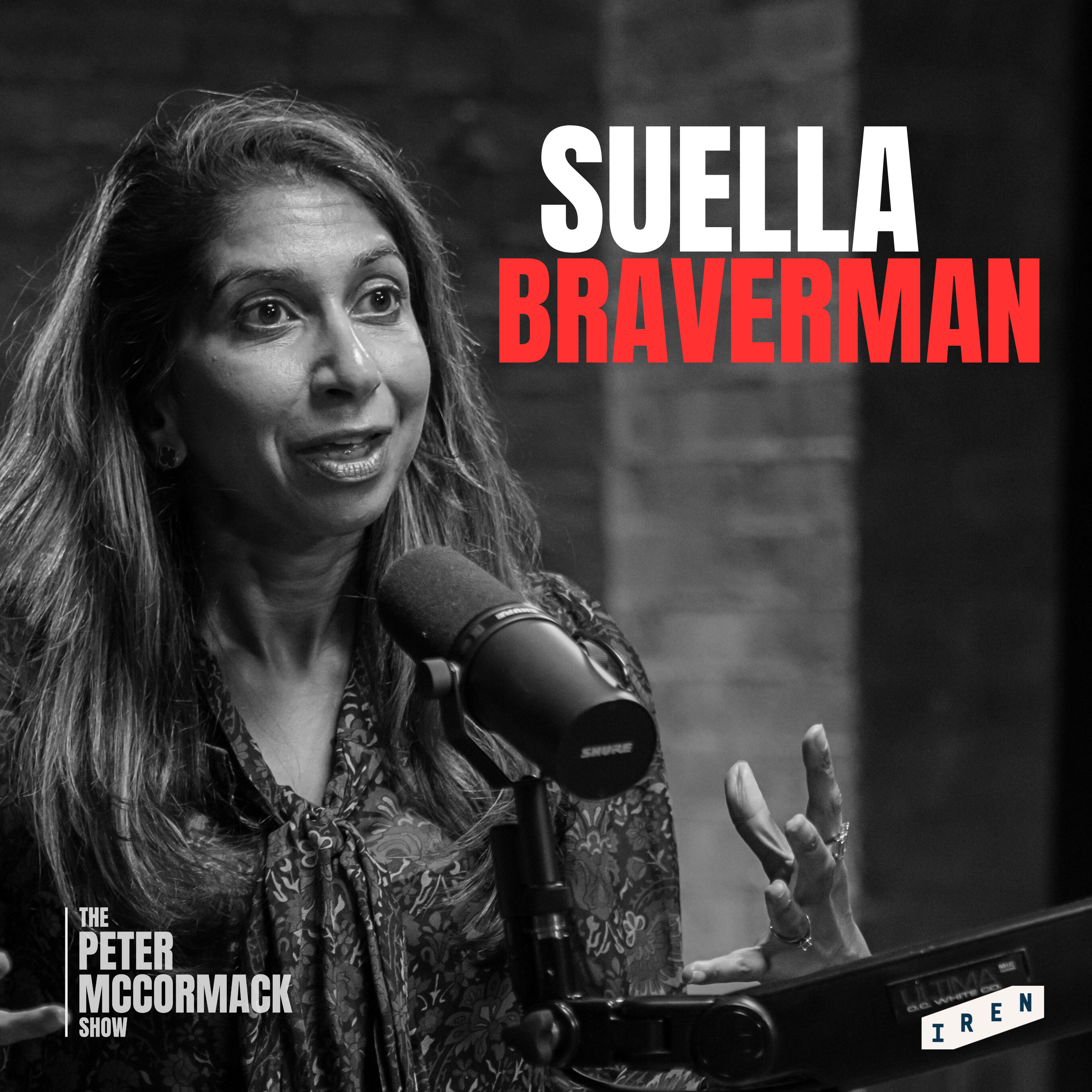
The Peter McCormack Show
#112 - Suella Braverman - Too Conservative for the Conservative Party
01:19:31
Suella Braverman served as Home Secretary in the UK’s last Conservative government and was sacked for telling the truth. In this interview, we talk about: – Immigration, mass migration & legal loopholes – Grooming gangs, trans ideology &...
Loading summary
Transcript226 lines
- [00:00]
A
There's a real sense that there isn't fairness in our society, that there is this two tier rule, there's a double standards. If you say the wrong thing, if you have a particular view of the world, you will get harsher treatment than if you're on the left and on the liberal elite side of the argument. People are really feeling sad and heartbroken, I would say, about the state of our country. People often say, and I agree with them, where we want our country back. We feel that it's slipping through our fingers and people are really scared that our culture, our history, the pride and the bravery and the genius that's defined Britain and the British people for decades and centuries is being undermined, eroded, beaten down. And people are feeling, people are feeling frustrated, angry and scared.
- [00:54]
B
This episode is brought to you by our lead sponsor and massive legends iron, the largest Nasdaq listed Bitcoin miner using 100% renewable energy. Now, they're not just powering the bitcoin network, they're also providing cutting edge computer resources for AI, all backed by renewable energy. Now, my boy Danny and I have been working with their founders, Dan and Will for quite some time now and we've always been super impressed with their values, especially their commitment to local communities and, and sustainable computing power. So if you're interested in mining bitcoin or harnessing AI compute power, Iron is setting the standard. And so you can find out more@iron.com which is iren.com that is iron.com Morning, Suella. Hi.
- [01:39]
A
Hello.
- [01:40]
B
Welcome. We got here finally.
- [01:41]
A
Eventually.
- [01:42]
B
Damn.
- [01:43]
A
Unions battled the strikes.
- [01:46]
B
Four hours it took us to get in today.
- [01:48]
A
No way.
- [01:48]
B
Yeah. So Norm, we screwed up because we could have got the train in, which is 40 minutes and it's 40 minute walk. And so rather than do that because I didn't want to walk, we took, we drove and it took four hours. Four hours.
- [02:05]
A
Thank you, RMT and Sadiq Khan and this Labour government.
- [02:08]
B
Yes. Should we talk about this labor government?
- [02:10]
A
I need to get off your chest.
- [02:11]
B
Get off your chest.
- [02:12]
A
I need to have a rant.
- [02:13]
B
Have a rant. I'm ready for it.
- [02:15]
A
Well, I mean, I did actually write about this recently that effectively we've got the government run by unions and I describe it as a hostage situation. It feels like the unions and the union bosses are holding this government hostage. And since the last general elections, the unions have amassed increasing levels of power, whether it's resident doctors, 60,000 of them went on strike earlier this year. Just remember, this is not about complaints about Dickensian conditions. Of working. This is because they wanted a 20% pay increase. The average salary of a resident doctor is 65, 70,000 pounds. Or whether it's today and the RMT and the train strikes, there's a total shutdown of the London Underground, pretty much, you know, millions of people will have had their working day disrupted and Sadiq Khan and this labor government just roll over and appease. You can't appease terrorists and you can't appease militant union bosses. And that is what is happening. Interestingly, the government actually has a legal power that the Conservatives enshrined, which would require London Underground TFL to maintain a minimum service in such an event where a strike is called, they haven't bothered to use that power. So because they're scared of the unions, they would rather disrupt the lives, the jobs, the working day of millions of Londoners than take on the unions. That is the set of priorities that this government has. And no wonder. We are seeing productivity plummet, we're seeing business confidence fall and frankly, the country is disintegrating into a mess because of union control. And, you know, the government's being held hostage and it's a disgrace, frankly.
- [04:19]
B
What would you do with the unions and how would you rein them in?
- [04:21]
A
Well, I would, first of all, take much more stringent powers. So the last Conservative government passed some legislation to raise the thresholds, for example, before a strike can take place for ballots and votes. That's actually, incidentally, all going to be repealed in the Employment Rights Bill, which was Angela Rayner's big flagship legislation.
- [04:45]
B
See you later, Angela.
- [04:47]
A
Less we say about Angela, the better. But, you know, that was. It's effectively a legislative love letter to the unions. And it feels almost as if the McLinches of this world have written this law. It actually lowers the threshold. It makes it easier for the unions to, you know, bring. Bring down public services. It increases collective bargaining, for example. So this, this legislation on the table at the moment is going to be a disaster for business owners.
- [05:17]
B
It's like a horror movie, is that.
- [05:19]
A
It's the unions coming.
- [05:20]
B
Yes, the union's coming. Kia's got his cameras in here, the Stasi watching us.
- [05:26]
A
But what would I do? I would raise the thresholds. I would restrict in a much greater way the powers of the unions. I would. You know, Mrs. Thatcher got it right. She was the last real prime minister who took on the unions and won. You know, I. I'll tell you, I'll let you into a little secret, Peter. My mum tells me that I don't Think it was quite my first word.
- [05:52]
B
What was? Thatcher.
- [05:54]
A
Arthur Scargill. Arthur Scargill was, I think, one of my earliest two words that I uttered when I was a baby. I would have been about four, three or four. Four or five. I know. I don't know if that's.
- [06:08]
B
I'm laughing at something else. Connor, do you remember your first word? Connor, tell someone what your first word was. I pointed at my father and I said Nobby. Yeah, seriously, his first word was knob.
- [06:24]
A
Wow.
- [06:25]
B
Cheers, son.
- [06:26]
A
Was that affectionate or insulting?
- [06:28]
B
I just think I knew very early. That's my son. This is my son, Connor.
- [06:34]
A
I see. Oh, he's your son?
- [06:35]
B
Yeah, it's my son Connor, yes.
- [06:36]
A
Wonderful, wonderful. Oh, do you, do you remember the moment then?
- [06:39]
B
I remember. I remember picking him up out of the cot and his mum was there and he just cut his finger and he went into my chest. He went, knob. We were cracking up. He might have said mama before that or something else. But yeah, no, he called his dad a knob. And so we laugh about that.
- [06:55]
A
Well, it worked out well where he is now, so. But yeah, no, Arthur Scargill. In the early 80s, I was a little girl, but Arthur Scargill was the union baron and with the NUM and was effectively declaring war on the government and really wanted to, you know, to paralyze the country. And there was strike after strike. It wasn't just in the industrial sector, but it was actually in the public sector. In schools. I used to have a regular day of school actually in the early 80s, strike day. I used to love it, by the way. When I was about five or six, I used to really look forward to strike day because it meant I had had a day with exclusive access to my mum and she would have to take a day off work. And as a five year old girl, I loved that. But my mum and dad had different ideas. They didn't quite see it that way. They thought it was really disruptive. They had to make other arrangements and they got fed up of the strikes in the education sector in the 80s. But Mrs. Thatcher took on Arthur Scargill and generally the other unions through really good planning and an uncompromising approach. And she won that battle. And as a result, she liberated our economy and got our economy and our GDP to grow and our, you know, our national confidence, our national self confidence back. So I would take a similar approach, I'm afraid.
- [08:17]
B
Do you think, do you think we should have unions? Do you think they have a role?
- [08:21]
A
Yeah, I do think there is a role for employees and salaried workers. And even professionals who might be self employed to have some kind of, kind of organized way in which their voices can be heard. Because I think there can be unscrupulous practices in the workplace and I think unions can have provide a lifeline and an invaluable service for those workers who are being taken advantage of. But I do think the balance has got too far. They're out of control. And the power that unions currently have is far too excessive.
- [08:55]
B
Well, and in this employment bill, and I see it, somebody employs people that they now are going to have access to. They want access to all our digital communications and the ability to come in and market and sell their services to all employees, which, which does worry me. And it's happened at a time when union membership is dropping. But union leaders do seem to get paid very well. So I, I just worry about the incentives of union leaders.
- [09:19]
A
Yeah, I think there probably is a disconnect between union leaders and you know, on the ground members. I don't think the members are as nearly as militant and aggressive and politicized as their leaders are. And they don't necessarily speak, those leaders don't necessarily speak accurately for the majority of members.
- [09:39]
B
You're worried about the state of the country. I could tell. I think a lot of people are.
- [09:43]
A
I think. Yeah, it's a very, it's a time of despair, I'm afraid, and we are desperately looking for some kind of hope.
- [09:51]
B
What's your diagnosis of where we are?
- [09:53]
A
My diagnosis? Well, I think we are facing some profound systemic crises actually in, in our country. At the top of the list I would put mass. Unprecedented uncontrolled immigration and the lack of any border control for the last few years, which is, which is tearing our country apart, which is putting unsustainable pressure on our public services, which is destroying our sense of cohesion and harmony. Secondly, I'd say the economy is on its knees. I've lost count of the number of businesses, largely small and medium sized businesses in my constituency of Fare and Waterlooville. You know, your white van man or a lady who's been a hairdresser for 20 years, set up by herself, maybe got a little shop in the high street, employs a handful of people, doesn't know whether she'll survive the next few years. Those, you know, the backbone of our British economy. So many, many businesses are struggling and the cost of living is, is rising rapidly. Productivity, as I said, is, is on the floor and we are facing very dark days when it comes to the economy. It looks like tax rises further tax rises are on the, on the horizon which are only going to further cripple our economy. And then, and then lastly, I think there's a real sense of malaise when it comes to law and order, policing, confidence in the authorities. There's a real sense that there isn't fairness in our society, that there is this two tier rule, there's a double standards. If you say the wrong thing, you know, if you have a particular view of the world, you will get harsher treatment than if you're on the left and on the liberal elite side of the argument. And people are really feeling sad and heartbroken, I would say, about the state of our country. People often say, and I agree with them, where we want our country back. We feel that it's slipping through our fingers and people are really scared that our culture, our history, the, the pride and the bravery and the genius that's defined Britain and the British people for decades and centuries is being undermined, eroded, beaten down and people are feeling, people are feeling frustrated, angry and scared.
- [12:38]
B
Is this then a problem of the, is it a problem of the institution of government rather than because labor have been in power for a year or so? I mean it's very easy to blame that. I've never voted Labor, I never would, but I find it very hard to blame everything on them. These are long term issues. I think you can point to a lot what's happened in the Conservative government 14 years in time, where you were there, but also stuff back to Tony Blair. Is it, do we have a fundamental problem with the machinery government?
- [13:07]
A
Yes, but that has largely been the case for, for decades and we have had periods of strong and effective leadership. I think it's been a failure of politicians.
- [13:19]
B
Okay.
- [13:20]
A
And, and I'm not one of these politicians to blame the administrative state or the civil servants. I think that's, that's weak politicians, that's weak politics. Politicians are put in place. We're elected. We, we have agendas. We should be judged on our outcomes and on our delivery as you would be in any other effective workplace. And I think the last Conservative administration failed on many fronts. That's why I was, I think, the first Conservative MP to say sorry. On election night, July 2024, I was reelected. And what were you apologizing for? For the failures of our last, of the last Conservative administration. Failing to stop the boats, failing to cut taxes, failing to clamp down on the woke ideology and transgender ideology, failing to be proper common sense conservatives. We were not that definitely in the last few years of the last Conservative administration. And, you know, I don't think we can apologise enough.
- [14:24]
B
Sure. But at some point you've got to stop apologizing and the party has to change, become what it, what it's meant to be.
- [14:31]
A
Yeah.
- [14:33]
B
One thing I was talking about beforehand is that or asking, are you, are you too Conservative for the Conservative Party?
- [14:43]
A
Well, it's quite odd that you should ask that question. Right, isn't it? The fact that you're asking that question reflects a lot of problems with the Conservative Party. What is too Conservative for the Conservative Party? I mean, I've been a card carrying member of the party for 30 years. I've always felt very comfortable in the party, always been welcomed with by the party. My family is a member. My mother was originally a Conservative counselor, you know, in the 90s and she sowed the seed of political campaigning and, you know, we, our whole family, my dad supported her. I grew up, you know, in the Conservative Party. So I've always felt very much at home in the Conservative Party. And I do sometimes think, yes, the Conservative Party has lost its way in recent years and fallen victim to faddish ideas. It's lost its confidence and its courage to stand up for bread and butter Conservative values. And it's been too liberal, ultimately, it's been far too liberal and statist and technocratic. And it's fallen into the trap of trying to do the right, doing the thing that's going to make us win, rather than faithfully responding to the desires of the British people and doing the patriotic, common sense thing. You know, they've been far too tactical than just straightforwardly conservative. And that's where I think they've lost their way. Well, we. And what I mean by that is what you would often see is a. I was a minister for many years in various departments. You would see the Conservative Party ministers around me. Well, we don't want to make this decision because it's going to upset that lobby group on the trans stuff. The trans stuff got out of control on our watch. There were thousands of children who were mutilated at the Tavistock Clinic, for example, who were encouraged down a road of transgender ideology in schools, in the nhs, because that was allowed by the government. Ultimately, we had Conservative ministers stand up at the dispatch box and say, trans women are women. Now, they would have done that because they didn't want to upset the LGBTQIA lobby and Stonewall and various charity groups that advocate for this kind of thing. And it was all about tiptoeing around various vested interests and not Doing the right thing, which would have been to stand up for biology and to say, no, we're not going to allow teachers to indoctrinate young people into changing their gender. We're not going to allow the NHS to put young boys and girls on puberty blockers before, you know, when they're just merely children causing irreversible life changing conditions and treatments to them. So that's one example of where Conservative ministers tried to be nice, tried to be accommodating, tried to be friendly and inclusive, but in doing so got their, got their bearings wrong and went down the wrong path on a lot of things leading to tragic outcomes. Another thing, another example, another clear example would be on multiculturalism and the issue of race. There were Conservative MPs who were confessing on television to be beneficiaries of white privilege. Conservative, Conservative. You might expect that from Labour MPS, you might expect it from Lib Dem MPS, you might expect it From Greed MPs, Conservative MPs, white men going on television saying, yeah, you know what, I am, I've benefited from white privilege. And actually blm, that movement's got a point and I support them. We had Conservative MPs taking the knee following the George Floyd incident and the BLM marches. They did that because they wanted to appear nice, they didn't want to look racist and they didn't want to look cruel, but they opted to. In doing that, they completely dismissed and demonize the views of the vast majority of British people who don't believe that they are beneficiaries of white privileges. Particularly when you talk to, say, white working class boys who are the lowest achieving in our educational system or the victims of grooming gangs, white girls, vulnerable white girls who have been raped systematically over decades by largely British, Pakistani, Muslims. Gangs of men. Tell them that they're victims of white privilege. No. So you have Conservative MPs trying to be nice, trying to detoxify the Conservative brand, but in doing so went down a holy wrong.
- [20:01]
B
Virtuous.
- [20:02]
A
Yeah, wrong path and, you know, stood on the wrong side of history. I would say I want to talk.
- [20:08]
B
To you about one of my sponsors, Incogni, and that means we're going to talk about the weird world of spam. And I don't just mean those spam emails that you get day after day from companies you never heard of and companies you've never signed up to. I'm also talking about those spam phone calls you get from those people who seem to know a little bit too much about you, trying to get your bank details. It's all a bit creepy right now. This all comes from the world of data brokerage. There are companies out there collecting your data, building profiles and sending that data to anyone who wants it. Which is why when one of those scammers phones you up, they seem to know everything about you. Now, I've tried, I've tried myself to get off these lists, tried to get off the phone lists, try to get off the email list. I unsubscribe from every one of these emails that comes in. But this game, a whack, a mole, it just never ends. And so this is where Incogni comes in. They do all the hard work for you, they reach out to these companies and they will get you legally removed from these lists. And I know because the last time they sponsored my show I signed up and I didn't take the free option that they offered me, wanted to pay for it, I wanted to see if you get value for money. And they removed me from 79 data broker lists. And so I've stayed on, I've stayed a subscriber and I have seen a massive decrease in the number of emails and phone calls I've been getting. So it's a great service. I recommend you check it out. If you're sick of this like I was, please head over to incogni.com Peter and sign up. If you use the code Peter, you will get a lovely 60% discount. So that's incogni.com forward slash. Peter, do some of these problems come from CCHQ? I'm not sure how honest you can be about this, but I hear regular constant criticism of problems with CCHQ and problems from advisors. And this seems to be, it seems to me that every MP has be surrounded by advisors which seem to be young people as well. People are younger than less experienced with them and perhaps they're sourcing data and information for them. But shouldn't politicians just be able to have their own backbone to stand up with integrity and say what they believe in? And all this strategy work is just a distraction.
- [22:13]
A
There is a huge focus on what we call optics in politics and there's a lot of time and effort and energy spent on the media side of things. What lines is a minister going to use when they go on BBC breakfast tv? You know, you've got to get the lines right and if you haven't used a particular word then you know all hell will break out with number 10 and the chief of communications at number 10. So every minister is very heavily Scripted and those scripts are approved by the central body. There's a lot of focus on how things are going to run with social media and a lot of things on, focus on when announcements are made so they might make the front page. Every minister wants to get a splash because that will show that they're getting cut through, you know, so there is a, there is an obsessive focus on the media. I mean, it doesn't.
- [23:10]
B
But it doesn't work.
- [23:10]
A
We are part of the media. But that does lead to quite short term gimmick, gimmicky, slightly superficial policymaking. And it doesn't work, though. And fundamentally it doesn't work.
- [23:24]
B
I'll tell you why it doesn't work is that I think people prefer to see a politician they know is honest and flawed. Because we're all flawed. We all want to be forgiven for our flaws. I mean, of course we're going to talk about Nigel at some point today, but one of the things about Nigel is it doesn't matter. Whatever they throw at him, it doesn't matter if the Labour Party obsessively tweets about him. Whatever. Everything they try and find that's wrong with him, it's not hurting him as a politician, it's actually making him grow stronger. Because despite his flaws, he comes across as, you know, a little bit more real to people. When I say honest, just a bit more real. Problem I have is when you watch something like Question Time, the only people that stand out as interesting is always the person they have on who's not a politician, who's not constrained by their party because they speak to everyone honestly. And that's why something like this is great. You and I get to sit and have a chat. We can talk about anything and, and. But people get to see you honestly. Not with some, you're not here pre programmed with approved. Well, we know you've got into trouble by not following the party line.
- [24:36]
A
There we go.
- [24:37]
B
I was just gonna say you lost your job.
- [24:39]
A
Well, you see, when you don't follow the script.
- [24:41]
B
Yeah.
- [24:42]
A
Which is quite clinical and not necessarily, you know, reflects your views, you do get into trouble. And I, I found it quite.
- [24:51]
B
That was bollocks. Can we just call it what it was?
- [24:53]
A
Well, I mean, the thing is my time as Home Secretary, it lasted just over a year, you know, effective. The reason why, I mean, I was there as a Conservative Home Secretary and I agreed with the promise to stop the boats and, you know, the overall agenda. The problem I had really was I didn't fit in with the RISHI Sunak Cabinet and so at various moments, that came to a head. So, you know, for the large part of it, you know, you, you, you sit around the cabinet table, you listen to things, you, you, you don't really agree with what you're hearing. Yeah, but because of collective responsibility, because you're part of a team, you're not going to go and, you know, say that you don't agree publicly, so you have to bite your tongue. And that is, that is a necessary feature of government. You can't have everybody freewheeling and speaking completely, you know, their honest, unvarnished views, because there would be confusion. The government has to have a view. Collective responsibility is there for a reason. So, you know, for large parts of working with the Prime Minister and the cabinet, there were lots of things I didn't agree with. But you bite your tongue in the spirit of loyalty, however, that was just unsustainable. And by the time I left government, by the time Rishi Sunak sacked me, there were so many disagreements that it was actually quite astonishing that I'd lasted that long, if I'm honest. Because on the boats, for example, Rishi, Rishi wasn't, you know, he originally said, yeah, well, you know, we can do something. On the echr, the real reason we've not stop the boats is because we haven't come out of the European Convention of Human Rights. That's the real reason, and it's what needs to be done. And all this talk about the new Home Secretary, she's going to review this and reform that. None of it matters if you're still tied to the European Court of Human Rights in Strasbourg. Anyway, going back to my time as Home Secretary, what became very clear, despite his original promises, was that Rishi Sinatra was not willing to take radical and challenging action on the European Convention on Human Rights. And he wanted to do everything else and tweak the system here and tweak the system there. But he didn't want to go to the root cause of the problem. He considered it too controversial. And that was not my view as Home Secretary. My view was like, we had to be bold. This was our last chance to possibly fix this problem. And. And there was only one way of doing it. And we had to leave the convention or at least heavily, heavily, heavily restricted. He wasn't. So we had a big difference of opinion for many, many months. And ultimately I was right because he failed to stop the boats according to his plan on legal migration. I went in on day one and I said to him, you know, Prime Minister, we've got a crisis. And I use that word deliberately, a crisis. When it comes to legal migration, the numbers are out of control. The previous Home Secretary, previous Prime Minister have issued a record number of work and study visas. For the first time ever, they've surpassed 1 million. That's despite Brexit. That's despite our promise in our manifesto in 2019 to cut the numbers, which stood at that point at about 300,000. Net migration, the numbers were going up to 600,000. By the end of 2022, there was 700,000. This was, this was a crisis of epic proportions. And I said to Rishi, we've got time, we've got maybe a year, 18 months before another election. We've got the powers, we've done Brexit, we've taken back control, we've got our points based system. You just need to give me the green light and I can put in place the measures to bring down migration in quite a short order of time. So I could have raised the salary threshold. It was, it was lowered, it was lowered. Under Boris, the salary threshold stood at 26,000. So that means if you're an employer and you want to bring in a foreign worker, or all you need to prove is that you're going to pay them a minimum of 26,000, isn't that basically minimum wage? Well, that's far below the average wage. So this, we were basically designing a system to bring in low paid, low skilled workers. So no wonder the numbers went off the scale. I could have raised that. I wanted to raise it to 45,000, but I would have been willing to settle on 40 grand. 30, 38,000. You know, that would have, that would have been raised the barrier to migration. I wanted to restrict the number of dependents. One of the big reasons the numbers went off the scale, off the charts, was because you'd have a one worker come in mainly from China, India or Nigeria, top three countries, sending people over, and they would bring in on average 1.52 dependents. So basically a partner and a child. And that was pushing the numbers up. They wouldn't necessarily be working. And I said, let's restrict the number of dependents. If you're a foreign student, there's no need to bring in your partner. If you're doing a one year mba, there's no need to bring in your kid. If you're doing a postgraduate degree. No. So it's a loophole.
- [30:38]
B
They found a loophole.
- [30:39]
A
It's a loophole and it was massively exploited. If you look at the numbers they just saw exponentially following 20, 20, when that, when that. When the rules were loosened. Anyway, so I said to Rishi, we can reverse all of these changes. We don't need an act of Parliament, we don't need to worry about human rights, we don't need to worry about the Strasbourg Court, we don't need to worry about the House of Lords. We've got very significant powers to lower migration. I just need you to say yes because I cannot act unilaterally, I cannot act against the wishes of the Prime Minister. He wouldn't say yes.
- [31:14]
B
Why?
- [31:14]
A
He wouldn't say yes.
- [31:16]
B
Why though?
- [31:17]
A
So this is because, again, of one of the problems in the Conservative Party, he was of the view, as with many of the members of my Cabinet, that more immigration into the country was a good thing for the economy.
- [31:35]
B
His view, grow gdp.
- [31:36]
A
Yeah, yeah. He believed that more people coming in, earning even peanuts, would still be good, a net benefit for the economy. And that was the view shared by the treasury, very strongly held by the treasury, the view held by the obr, the Office for Budget Responsibility, who has to sign off a lot of the government's fiscal decisions. And Rishi was very heavily wedded to that view. Jeremy Hunt was very heavily wedded to that view. He didn't even want to talk to me.
- [32:07]
B
So, so, so the, the accusations that this was to grow GDP at the cost of GDP per capita and the cost to public services is true.
- [32:15]
A
Exactly. They did. They only focused on gdp. They were not interested in GDP per capita, which was falling, and they were not interested in taking into account the costs of low skilled, low wage migration, significant cost. They, the numbers coming in, which are heavily weighted in favor of low skilled, low wage migrants, put a net cost on our Social Security. There's a net cost in terms of housing, house prices because of the supply being depleted and they use our public services. And so the obr, the Treasury, Rishi Sunak, were unwilling to look at those costs and factor those into the equation. Other sectors, other departments were unwilling to support me on cutting the numbers. The Health Department. The Health Department said, well, Soella, we can't cut the numbers because who's going to work in our nhs? And I said, well, we've got millions of Brits who are claiming out of work welfare. We should be training them up to fill these vacancies. The Agriculture Department would say, well, Suella, we can't cut the numbers because who's going to pick the fruit in our farms? The Business Department said, well, we're not going to have a shortage of construction workers. The Education Department said, well, you know, if you cut the number of foreign students, our universities are going to go bust. So I was a lone voice and this is what I mean, I didn't fit.
- [33:34]
B
This is what pisses Conor off. We were talking about this recently. It's the privilege. It's almost like, no, I can't pick fruit because I'm British. No, go work, go work.
- [33:45]
A
Absolutely.
- [33:46]
B
Go work, go work.
- [33:47]
A
And that. And that's why cutting immigration must go hand in hand with welfare reform, because frankly, to go to your point, Connor, we've made it too easy for people to turn their noses up at certain jobs because it's easy to claim welfare. And if we made it more robust and rigorous as a system, people would vote with their feet because if, if picking fruit paid you more than claiming benefits, you would do it. And at the moment, the balance, it's, it's out of balance. So, so that's what I mean. So I, he was not with me on that issue and there were many issues, so illegal migration, legal migration, and there's many more, if you want to know. And so I couldn't act unilaterally. You know, a lot of people say to me, suella, you know, you were Home Secretary, why don't you stop the police? And you complain now. And that is a fair criticism. But the reality of government is no minister, however clever or charismatic or wonderful they may be, can act off their own back or on their own accord or unilaterally. Basically, you need the Prime Minister to agree to your idea or your policy. And if the Prime Minister doesn't agree, it ain't happening. And that's how our system of government works. And there's a value to that because this is the Prime Minister's agenda, it's his government, and we all have to fall into line behind him. If we don't agree with that agenda, we have to, we can't be in government. And that is ultimately why, you know, he and I couldn't work anymore and go together. I. On the issue of policing, which is the reason why I left government, ultimately, I got incredibly frustrated and I lost confidence in the Met Commissioner, Mark Rowley. After October 7th, after October 7th, the marches were out of control. They were shouting Jihad in the streets of London. They were throwing flares and fireworks at our war memorials. They were chanting anti Semitic abuse. Hundreds of thousands of people were doing this on a regular basis. I would speak to the Met Commissioner and he would say, well, sorry we don't, we're not going to, we're not going to arrest them for all sorts of reasons. I was pulling my hair out the month of October with him and in the end it was apology after apology after apology from the Met Commissioner. If you look back on October, they were messing up in so many regards. They discovered that they had had one of their advisors had indicated support for Islamism online and he was advising the Met Commissioner and the Met Police on their strategy and that was exposed by the media. And the Metcalf practitioner had to come out and apologize. Apology after apology after apology. I lost confidence in him. It was two tier policing. I said as much because to your point about being honest and straight forward, I believe by that point someone had to speak honestly to the British people and say what was happening instead of just perpetuating the myth that the police were doing a good job. No way were they doing a good job. No way was the Met Commissioner doing his duty. I said as much. Rishi Sunak didn't agree with me. He thought the Met Commission was doing a very good job and that's why he said, suelle, you gotta go. And that was right. I had to go because I didn't fit in with that Cabinet. So there were too many clashes of policy and, you know, it, it was an agenda. I just couldn't agree with it. As I said, it is remarkable that I lasted that long.
- [37:27]
B
So if we, if we just really had a succession of poor leaders in the Conservative Party, then people who aren't willing to be Conservative, I think, I.
- [37:37]
A
Think, I mean, listen, I should say Rishi Sunak is a very nice man. I don't know if you've ever met him.
- [37:46]
B
No. But, you know, he's too nice. My biggest issue with Rishi Sunak is whenever I saw him speak to the camera, I thought like he, I felt like he was talking to a child.
- [37:57]
A
Yeah, I mean, he, I actually thought he was quite a good media performer. He's always, he was always very well briefed. He always knew the detail. It's very language, well prepped, but it's very patronizing. I didn't find that myself, personally.
- [38:14]
B
I can see, you know, I didn't vote that. I didn't even vote in that election.
- [38:18]
A
You didn't vote at all?
- [38:19]
B
I haven't voted in the last three elections because. Because I think not. I think voter turnout is an important indicator for the feeling of the nation. I know in Australia it's. You're legally required to vote, it's mandatory, but I think voter apathy is something you need to know. You don't know what voter apathy is if you force people to vote. And if I don't think somebody, if there's nobody worth voting for, I won't vote. Because I think. I think that's still a vote. Does that make sense?
- [38:46]
A
Right. Yeah. It's a vote with no confidence in any of them.
- [38:49]
B
60% of the last election was a vote of no confidence on the Conservative Party.
- [38:53]
A
Yeah.
- [38:54]
B
And I think that's an important number to have. So that's my view.
- [38:56]
A
That's interesting. Well, a lot of that was. It was a lower turnout.
- [38:59]
B
Yeah. And I just. I just felt Richie wasn't a Conservative. I felt he was just wet, so.
- [39:06]
A
Because I'm trying to be balanced. And so he is a very. As a person, he's a very nice man and very polite and very smart. But as a Prime minister and a leader, he was arguably our worst ever prime minister in the history of the country. Definitely in the history of the Conservative Party, I would say, because I prefer him from Kier. I would. I would. I would actually take him over Kia. Definitely I would take. Because he, you know, I think, I mean, at the end of the day, he did raise taxes as well. You know, he raised corporation tax.
- [39:36]
B
Corporation tax, yeah. Yeah, thanks.
- [39:38]
A
You know, on non doms.
- [39:40]
B
Yeah.
- [39:40]
A
Were changes there which have led to an exodus of some of our wealth creators and our big taxpayers, actually, you know, and I think we overspent on Covid. The furlough scheme. I think with hindsight, was way too excessive. That was Rishi's decision. But instinctively, he is a tax cutter. Instinctively, he's skeptical of more regulation. And that does make him, you know, conservative. But when he didn't have the courage, he didn't want to do the bold, necessary, sometimes difficult things to solve some of the crises we've been talking about. And he wanted to keep everyone happy. And so that's why ultimately, again, judging by results, he led us to our worst ever defeat in our history.
- [40:35]
B
This episode is brought to you by Ledger, the most trusted bitcoin hardware wallet. Now, if you're serious about protecting your bitcoin, Ledger has the solution you need. Their hardware wallet gives you complete control over your private keys, ensuring that your bitcoin stays safe from hacks, phishing and malware. And I've been a customer of that since 2017. Love the product. Use it for my bitcoin. I use it with my Castle multisig for protecting the football club. Bitcoin, too. Now With Ledger's sleek, easy to use devices and the Ledger Live app, managing your Bitcoin has never been more secure or convenient. And whether you're a longtime holder or new to the world of Bitcoin, Ledger makes it simple to keep your assets protected. So if you want to find out more, please do head over to Ledger.com and secure your Bitcoin today. That is Ledger.com which is L, E D G-E-R.com that is Ledger.com. yeah, but isn't that almost the most important characteristic of a political leader is courage? Because you have the courage to make decisions that are potentially unpopular rather than just being virtuous and not nice? I don't vote for nice. I vote for policy.
- [41:43]
A
Correct. I think that's right. And I think trying to be liked is very, very damaging in politics because that's not necessarily the same as doing the right thing, which. For which people will be grateful afterwards.
- [41:58]
B
So what do you. What do you see your role is now within the Conservative Party as a outsider, disruptor, nuisance?
- [42:07]
A
Well, well, I mean, they. They've. They've. You know, I'm not in the shadow Cabinet team, so I'm. I'm not disrupting. Listen, I was elected as a Conservative mp. It's. It's a great honor. It's a great honor to be elected to Parliament. It is the mother of all parliaments for a reason. And every day I step into Parliament, I feel incredibly humbled and honored. To follow in the footsteps of many great political heroes of mine and to be voted in by your fellow citizen, thousands of them, is an immense privilege. And I'm always really grateful to have this role. How do I see my role? Listen, there's a lot for me to do for my constituents. I get hundreds of messages a day from people, so I do a lot of constituency work. We had a success recently in Waterlooville because the Home Office were going to accommodate illegal migrants in the heart of our town. And with local Conservative councillors, I exposed this plan. It was a secret plan originally with local council and. And 10,000 local people signed my petition. There was a march or there was a demonstration with over a thousand local people in Waterlooville. You may not have heard of Waterlooville.
- [43:27]
B
Well, I've heard of it because of you.
- [43:29]
A
Right, there we go. Not a lot of people have heard of Waterlooville, but I'm telling you, after thousands of people of Waterlooville, the good people, Waterlooville took to the streets. Many people have now heard of Waterlooville because the great people of Waterlooville, with All their common sense and patriotism were able to stop these plans through their peaceful protest and through their persistence. The Home Office backed off, the council backed off, and the illegal migrants are no longer being housed in Waterloo. So, listen, there's a lot of work for me to do locally and then I will keep advocating and campaigning for my kind of conservatism, which I think is pretty clear to people, but very much needs a voice behind it. So I recently. Well, that's why I recently published a policy paper on my pet subject of leaving the European Convention on Human Rights. Instead of just complaining about it, which many people have done, and I have done for many years myself, I've set out a very detailed plan of how to actually do it, diplomatically, legislatively, strategically. And listen, if Keir Starmer's listening, the plan's on the table. He can pick it up and I'd be very happy for him to adopt it. I would be overjoyed if Keir Starmer picked up my plan and left the echr.
- [44:47]
B
How complicated is it?
- [44:49]
A
It's not necessarily easy. It's not necessarily easy. It's not necessarily nice. Talking about nice. It will require challenging conversations and debates, but necessary ones. But it's eminently possible with the political will of the Prime Minister and a supportive cabinet, it can be done.
- [45:10]
B
Okay, for you, what is. What is more. Is it more important to be loyal to the party or the country? Where do you feel you have more loyalty?
- [45:19]
A
To the country? Absolutely. Country. Country first, party second.
- [45:25]
B
You know what I'm going to start talking about now?
- [45:26]
A
I know what you're going to.
- [45:27]
B
Yeah. So look, and I've heard you talk about there's not enough room in the country for two center right Conservative parties. And we have two at the moment. One is growing and looks. They look, you know, on target to potentially be the next government. Nigel Farage looks like he has a very good chance of becoming the next prime Minister. Here we go. 28. The voting intention. 28% for offense. 17. The conservatives down to 17. I'm surprised Labor's that high. What was the. We had the. That's the voter turnout. Sorry, the voting intention. But we had the one of potential seats, didn't we? But. So look, look, Reform are riding a wave at the moment and that they. This to me feels like a response to the failure of the Conservatives. If the Conservatives have been a Conservative party, there would be no reform.
- [46:21]
A
Yes, correct.
- [46:22]
B
Yeah. Here we go. So what's this? This is predicted seats. So right Now Reform at 368 Labour 119, Conservatives down to 36 seats. They could end up becoming the fourth party in the country.
- [46:42]
A
Oh my God. Even fewer than the Lib Dems.
- [46:45]
B
Yes. And if much lower, less than the snp. So it feels existential for the Conservatives. And so talk to me about reform. What do you think of the rise of reform?
- [47:02]
A
Well, as you, I agree with a lot of what you said. They are a consequence of the Conservative Party's failure that we've just talked about. So I lost count again of the numbers of people I went all around the country campaigning for other Conservatives at the last general election, my friends, to get re elected. I lost count of the number of doors I knocked on where the people would tell me, suella, I've been a lifelong Conservative and you're not a Conservative party anymore and I'm going off to reform. And that was a phenomenon that's that kind of dominated the last general election, really. And that's the reason we lost so badly. It's a reason why two thirds of our MPs were kicked out of Parliament, some in extremely safe Conservative seats with majorities of 2930,000 votes. You know, unthinkable. And so people are really disillusioned. Reform are a consequence of our failure. And I think they're. Yeah, I mean, I did warn about this. I, you could you. I hate politicians, say I told you so. But I did actually warn about this, you know, two years ago. And I said we're heading for a wipeout. This was before the general election. And I said if we don't change course, we are going to be wiped out. Everyone said oh swell. Is grandstanding and she's such an attention seeker. But unfortunately I wasn't grandstanding and I would have preferred to be grandstanding because it wouldn't have led to such a tough, devastating outcome. You know, we have been devastated because we've not been Conservative and I have been warning about it. I'm afraid the warnings have come true and it's now for the Conservative Party to fix itself and rebuild. And the question will be, can, can that be done?
- [48:58]
B
So how did you feel when you heard Nigel Farage say they would be more left than the Conservative Party? Do you think that was an own goal?
- [49:08]
A
I mean, I think that's, I think that's actually quite hard to do right now as things stand. The Conservative Party, for example, is ambivalent on the ecr.
- [49:19]
B
But hold on, didn't he say wants to leave it wasn't that quote in relation to the next Next election? I think by the next election. Yeah, by the next election. I think his point was that for the Conservatives to have a voice, they would have to go extremely right. Not extreme right, just more right of, of reform. I think that's the point he was trying to make.
- [49:43]
A
I think that's a big dilemma for the Conservatives because we've got this kind of the 2019 coalition was, you know, a masterstroke really. Yeah, we combined the kind of small C, Conservative, Brexit, northern vote, working class votes in the Red wall and the kind of more liberal home counties, Surrey, Hampshire seats as well, commuter belt. And that marriage ended in a divorce really last year and we lost large swathes of that to reform. That leaves the Concerto party with a policy and a direction, a choice to make. Are we going to try and, you know, focus on those home county Lib Dem facing seats for want of a better expression, or are we going to try and regain some of those red wall seats? And that's a. Or can we try and do both? And that's the, that's the question really. And I don't know, I don't know which direction we are heading in at the moment.
- [50:55]
B
Does the party realize how cooked it is itself? I'm saying this, trying to say as respectfully as possible. I just think the party's kind of done in, that people have found a new home. They found something that's a bit more optimistic from them. By the way, I think there's some good people within the Conservative Party. We've had Katie Lam in here I think is excellent, really, really like her and I think there's some great people in there, but it feels like directionless boat at the moment. I like Cammie, but I don't think she was the right choice for leadership at the time. But.
- [51:30]
A
So you're. Are you a member of the Conservative?
- [51:32]
B
No, I don't join political parties just because of doing this, just doing this. If I was to join one, I would actually join them all to hear all the messages. I'm happy to declare I'm a small C Conservative. I've probably voted in four or five elections and I've only ever voted Conservative Party because my dad was a Conservative. My dad was a working class Conservative. So my first election I voted at 18, I was still in school. My dad voted Conservative, was paying my school fees, so I voted Conservative. And he always said to me, because he would look like a typical labor voter, aircraft engineer, but he said the Conservatives would always leave me more money within my pockets. And so that's why he. So I agree with him. And then I voted alongside him and then I voted conservatives. I missed one election, I didn't vote, I spoiled my paper. And then like I said, I haven't voted in the last three elections.
- [52:29]
A
And why did you stop voting Conservative then when.
- [52:32]
B
So I will. So my politics has changed a lot, Suella, over the last 10 years I would say I've become a bit more libertarian, but I'm not an anarchist in that I believe a lot. I think I probably believe a lot more what Thatcher believed in. I've read a lot of Austrian economics, I am a Hayek fan and I believe the bigger government is. There's more advantages, there's more chances are for people to take advantage of it and find the loopholes to grift the system. And so I just like small government. I don't believe we've. The last person to promise small government and talk like a libertarian was Boris Johnson, but I think he isn't really a libertarian in any way, shape or form. And so I'm interested in somebody who makes government smaller not because I'm a meanie. I'm happy to pay tax and I'm happy to support people. But I think government has only been getting bigger. Reform might win my vote if I believe they're going to make government smaller and society fairer. That's it.
- [53:37]
A
And which party do you think represents that view of that view you've communicated there about the state size of the state government, spending bloatedness. Which party right now would you say reflects accurately that sentiment?
- [53:53]
B
No party enough for me. No, my fear for reform is it will be much of the same because to reduce the size of government now there's some big tough decisions that need to be made. The only person who's recently really attacked this has been Malayan Argentina and even he's faced a tough time doing it. I believe the Conservative Party is a historical institution represents that the current shape of the Conservative Party doesn't right now. But that's what I'm interested in. I'm waiting to see really reformist policies on this and how they. Because we just need to wind back the welfare state. We need to support businesses. For me it's not that hard. Law and order reward risk taking in business and reduce the size of the welfare state. And I don't think these things are mean, but so I felt politically homeless for a long time and I can be more effective just in the private sector building businesses. So that's. I think that's where I'm at. But, you know, if you ask Connor, he will have different opinions as a youngster trying to get on the house than that who's just starting out his career. So I feel like we're at a very strange time.
- [55:01]
A
Yes. So you're a thatch, right? Economist, really.
- [55:06]
B
And sorry, just to add to that, Liz Truss definitely spoke some of the language that agreed with what my views are on the economy.
- [55:16]
A
Yes, yes. And I think the objective to cut taxes, roll back some of the frontiers of the state were the right ones, but unfunded tax cuts will never work. And, you know, that was done in tandem with a massive bailout on energy bills. And so it wasn't necessarily well delivered, but it was the right idea in many ways. I mean, my views have evolved over time. I would have said 10 years ago I was exactly where you are on the economy as well. And actually a resurrection and a reinvention of, you know, the free market. Liberal economics would be the right thing for our country. Let's just cut taxes. Let's just shrink the size of the state as much as possible and liberate. Liberate the animal spirits of the private sector and get people to take more personal responsibility as well. And I think that. I think we need to reimagine Thatcherism for the 21st century, because I think there can be a lack of a safety blanket with that unbridled approach to the free market. I think we do need some state intervention. I think we do need some industrialization. I think we do need to inject, and that may come from the state at some times a catalyst for manufacturing or certain sectors of our economy. I think leaving it all can also be quite damaging. Austerity, for example, if you look at the Cameron agenda of austerity following, you know, the Brown years, yes, it was good for getting the deficit down, getting unemployment down and increasing economic growth. But when you have the police hollowed out and when you have some other public services hollowed out, then you have a real challenge in other respects. And I think it's about striking the right balance. I'm very interested in the kind of Vancian approach to the economy, which is not kind of, you know, Thatcherite approach to the economy with, you know, minimal taxes and the smallest state possible. There's actually a role for the states to provide that buffer and positive influence in our economy. And I'm. I'm interested in that.
- [58:05]
B
For those of you out there who want to protect your Bitcoin, I want to tell you about casa, the leading Bitcoin security solution and a solution that I use for my Bitcoin and my football club's Bitcoin treasury. Now if you're serious about protecting your bitcoin, you will need a rock solid security plan. And CASA gives you just that. With their multi signature security and key management services, KASA makes it easier than ever to take control of your Bitcoin without ever having the risk of a single point of failure. Now they offer multiple levels of protection or all designed with simplicity and ease of use in mind. And that works even if you're not a tech expert. So don't leave your bitcoin security to chance. Go to Casa I.O. and check out the services that I am using today to protect my Bitcoin so you can protect your stack and sleep easily. You can find out more at CASA IO, which is C A S A IO that is CASA IO. Interesting. Okay, so back to reform. You will know as well as I do there have been lots of rumors that they have been courting you. Can we talk about this freely?
- [59:16]
A
You can ask whatever you want. So.
- [59:20]
B
Does there come a time where you may believe that there would be a role for you in a different party that is perhaps going to be the government of the country where you can, you can be more. Sorry, Let me word this differently. You know, we talked about loyalty of party and country. If there is a party coming to power that you share similar views with similar conservative opinions, would you not be better in that party able to deliver what you think the country needs?
- [59:50]
A
Listen, I, I'm. I'm very much a Conservative, as I said. I was just elected very recently on the Conservative banner and you know, it's an honor to be a Conservative. So I am right now, you know, a member of the Conservative Party in Parliament. And I have a great team of Conservatives in Fair and Waterlooville. The job for the Conservative Party is to rebuild and renew and it is under Kemi. The party is working on that. And she's got the right. She's been very good at diagnosing the problems, actually. She's been very honest about where we went wrong. And time will tell. Time will tell whether it's fixable. I, I hope it is, but I do, you know, I think that ultimately what must be avoided at all costs is a significant division on the right which only allows labor to get in at this point in the parliamentary cycle. It is very hard to make bold predictions. You know, we're potentially years from a general election. I think, you know, as we approach a general election, it will become clearer about how the cards are falling.
- [61:06]
B
Would you, would you still have any personal ambition to one day lead a party?
- [61:11]
A
No. Listen, I've, I've seen close up how horrendous a job it is to be a leader or Prime Minister and I'm, I'm very happy just to, to be a team member and to be a, a loyal foot soldier for people.
- [61:26]
B
Does the public not really understand how tough it is for somebody?
- [61:29]
A
I think it's almost an impossible actually these days because of the media cycle, the demands on a Prime Minister to be at the G7 summit in Washington D.C. but also to be, you know, answering a, to a crisis about, you know, strikes in on the London Underground. You know, I think there's, or, you know, one of his cabinet members being caught for tax evasion. I think there's just so much so multifaceted management of a party has become more difficult. I think that's one of the big issues actually, with, you know, at first sight, it looks as if labor have got, you know, a dream situation with a massive majority and hundreds of MPs voting with the government every, every day. But in reality, there are many divisions within the labor ranks and that has proved very, very difficult ideologically for Keir Starmer. He's, he's really in a quandary about whether he wants to go left or right. I think after this reshuffle, we can see that he wants to go a bit more centrist and a bit more right wing. He's left. He's kind of partially got rid of some of his more extreme left wingers, but that's a real problem on the left and the left is really splintering. We talk about the division on the right, but we've not only got the Labour Party and the divisions within the Labour Party, we've got this new party coming up, we've got this Green Party and actually, and of course the Lib Dems. I would not be, you know, we've got to, on the right, be very conscious of the risk of a left wing coalition. It might not be labor, but it might be some kind of rainbow coalition of left wing parties that wins the next election. And that's what we've got to be careful about.
- [63:19]
B
Yeah. This splintering is fascinating. I feel like it's a reflection on the kind of temperature of the nation.
- [63:26]
A
Yeah.
- [63:27]
B
In that we feel like a divided nation. And one thing I wanted to ask you on that is with my podcast, there's a lot of people I talk to, they watch my shows and Somebody recently I was talking to was talking about using too many labels and how do we create more harmony? And it made me poise for a second. I wonder how you think about this. If you fundamentally disagree with somebody's ideas, should you still work with them to try and create harmony on unity? Or is it best to actually defeat, try and defeat bad ideas, but in defeating bad ideas you might have less harmony?
- [64:06]
A
It's a great question. I mean, yeah, I'm this, yeah, pragmatism or principle and pragmatism or purity. I think it all depends on how, how the idea, doesn't it really. And it depends on the impact and the. If you disagree with something and you consider something to be so offensive, wrong, damaging, it's worth fighting, it's worth fighting against that and engaging in the battle of ideas, as uncomfortable though that may be. And you know, to a degree, I've tried to do that myself as Home Secretary, I spoke out against prevailing narratives which I believe to be wrong because I thought they were damaging to our country. I spoke out about grooming gangs and I called it out for what it was. I said this was largely British, Pakistani, Muslim men who were raping vulnerable white girls and the authorities were turning a blind eye. A lot of people didn't like to hear that. I was called Islamophobic by countless people. Letters were written in, complaints were made, but it was the truth. And speaking the truth is a way of countering these myths which are so pernicious because actually in that instance, it's a great example because silence was part of the problem. People self censored police officers, teachers, social workers, counsellors, politicians didn't want to talk about the truth because they were scared of being called racist. So they gave in. They didn't take on the battle, they didn't take on the fight. They saw wrongdoing, they were very much aware of it. It was an open secret. In some towns they turned a blind eye deliberately because they were scared. They were cowards. They didn't want to rock the boat, they didn't want to upset this group, they didn't want to cause community tensions, they didn't want to be called racist. Out of fear, they chose to step away from justice, fairness, helping girls. That's why you need to take on these fights sometimes.
- [66:17]
B
But are we battling ideas now? Are we battling ideology? Because I don't feel like we're battling ideas anymore. I feel like there's this divide now down the country and you can pick any topic. I can tell you if I Know their politics, what side they're on, on every argument. So I feel. That's why. I feel like it's almost like right now, it's a. It's kind of like a fight for the future, what this country is and what it means.
- [66:44]
A
Absolutely. I really agree with you. I mean, I would generally encourage people to stand up, to step up, to speak up, because I think there's been a complacency and maybe a little bit of fear, which has led to these very damaging ideas, ideologies. People take over and. And dominate, impose their views on the vast majority of people, you know, kind of crowding them out, smearing them, denigrating them, making people feel ashamed of their common sense and their patriotism and their love of our country. And that's because they've. I think that's because of the English British temperament, actually. I think there's something about temperament which is very polite, it's very civil. Generally, the British are, you know, courteous. They don't like a fight. You know, other nationalities, other people, they're, you know, they love to jump into. They're more, you know, fiery as personalities generally. And I think the British temperament, the English temperament is more. Is gentle. And I think that gentleness has actually been exploited and abused over several years, and people are waking up to the results of that. That civility, that courtesy, that welcome, the camaraderie that the British people are so well known for has been abused by many people, and it's now damaging British culture, British life, British sense of self. People are waking up to it. They're saying enough is enough, and they're finding their voice to speak up and fight back.
- [68:42]
B
Are you optimistic?
- [68:47]
A
I don't think pessimists go into politics because it's a grueling world, and you do need a. A real golden thread of optimism to keep you going. But I do worry. I do worry about the future of our country because I do feel that we're losing it. We're losing all that's great and good of our country, and that wartime generation is dying and going, and the stories of heroism, British courage, the richness, the genius of the British people, I think is being. It's there. It is still there. I see it in my constituency. I see it alive and well, but it's being beaten down. And I'm. I'm very. I. I do. I do worry. I worry about the future of our country. Definitely.
- [69:46]
B
Have you got to any of the Oasis concerts on the reunion?
- [69:50]
A
I haven't, but I went. I went I went to Net. I went to Nebworth.
- [69:55]
B
I heard about this.
- [69:56]
A
You heard about this?
- [69:56]
B
I heard about. Did you go to the Night with Prodigy or Chemical Brothers?
- [70:00]
A
Prodigy.
- [70:02]
B
So jealous.
- [70:02]
A
They were amazing.
- [70:03]
B
I'm so jealous. I saw them at Wembley Stadium.
- [70:07]
A
Oasis.
- [70:07]
B
The Oasis at the old Wembley Stadium. When I was at university in High Wycombe. And we're talking 26, seven years ago. Something crazy. It was them and Happy Mondays and it was incredible. But took my kids to the reunion tour, right? And it was probably one of the best nights I've had in years. It was felt. How would you explain it, Connor, as a youngster, seeing it. Bunch of old people dancing. Yeah. But it was like this, like, togetherness. Yeah. It felt like a. Like a. Almost escapism from everything that's going on. It was without doubt one of the best concerts I've ever been to. And everyone was just singing every song and dancing and happy. And I'm sure a few people take some drugs. But honestly, it was genuinely brilliant. If you haven't. Yeah. I'd advise trying to get tickets, but you went to the one that I wish I'd gone to.
- [70:58]
A
You went to the other night, did you?
- [70:59]
B
No, I didn't go to Networth. I skipped Nebworth. I was like, oh, I'm not that. I couldn't. I hadn't realized what a big deal Nebworth was going to be. My brother went. But he went to the night with the Chemical Brothers. Right, but the night with the Prodigy. I was like, you should have been in that shit. I should have been near the front.
- [71:14]
A
We had good tickets. Listen, I went. I actually. I didn't appreciate what it was at the time, but people have. You know, when I've gotten older, I've told people I went to Networth. They've been. They've had your reaction. And that slightly startled. Startled me. And I had some very cool friends, really. I have to credit the time. Maybe I was. I had a modicum of corners because they were friends with me, but I had a very. I had some very trendy friends and they. My friend got this. These tickets and she said, come along. And it was after our GCSEs, so it would have been 1996, I think. Was it summer 96? If it's 96 or 95? It was one of those years.
- [71:55]
B
I can't remember if it was 96.
- [71:56]
A
I would have just finished my GCSES. And it was part of our summer of fun.
- [72:00]
B
This show is sponsored by Gemini. We live in a really Strange time. With governments driving inflation with their reckless spending and endless money printing. There is a way out of this. There is a way to protect your money, and that is by stacking bitcoin. I've made loads of shows about bitcoin. You can go and research this, you can go and read the books, but the truth is, it is the hardest money ever created. If you are interested in protecting your financial future, it's time for you to get on the bitcoin train. I have. I've been stacking bitcoin personally and through my businesses since 2017. It's protected me, it's secured my family's future, and it also strengthens all of my businesses. So if you want to start stacking bitcoin, where do you do it? Well, for me, it's with Gemini. They're a fully licensed, full reserve exchange and custodian. So they give you a secure way for you to buy and own your bitcoin. There's no risks and no funny business. So if you're serious about stacking bitcoin the right way, head over to gemini.com, which is G-E M I N I.com some Wembley. The Wembley I went to might have been after that then, because I'm sure the Wembley I went to was like 97. 96. 19. 96. Was in Edworth.
- [73:07]
A
96, right? Yeah.
- [73:08]
B
So I would have been 18. Right, okay. Yeah. So I. So the Wembley one I went to was after then.
- [73:14]
A
Right.
- [73:14]
B
I probably went afterwards because I regretted not going to that. Do you know?
- [73:17]
A
But what was amazing was it was open air and in this field and, you know, when every. Everyone's singing Champagne Supernova together and the. Similarly to what you describe, you know, you do feel a sense of unity and it's so inspiring. And your heart just.
- [73:37]
B
It's not far from where I live either. We're in Bedford.
- [73:41]
A
Oh, right.
- [73:41]
B
So it's not far from there at all. And so do you get to do less things like that now because you're. Does it being a politician stop you doing things like that?
- [73:51]
A
Have I been to any. I haven't really been to any live.
- [73:54]
B
Music in how long?
- [73:56]
A
In many, many years.
- [73:57]
B
Oh, come on.
- [73:58]
A
I also went to. There was something in Hyde park that summer, I think you'll know, with Alanis Morissette.
- [74:04]
B
Okay.
- [74:05]
A
And I went to see her live and Ocean Color Scene played live and they had us. And I think. And my very cool friend got those tickets as well. So this is what I mean. That summer that was. We really maxed out on live music. I really liked Queen when I was at school.
- [74:26]
B
Wembley. I wish I'd gone to that.
- [74:28]
A
I didn't see. I didn't see them at Wembley. But what I did do was when, after Freddie died, the other band members tried solo careers. And I did go and see Brian May at the Brixton Academy when he was branching out on my solo career. And Roger Taylor. I went to see Roger Taylor live.
- [74:46]
B
Do you remember when they put the show? It was on tv. I think the whole nation stopped, sat on their sofas and watched it. My uncle was there at Wembley. He was at Wembley. He saw them, said it was amazing.
- [74:58]
A
My husband recently went to see Elton John live at Watford.
- [75:02]
B
Oh, wow.
- [75:03]
A
Do you remember a few years ago, because he owned Watford.
- [75:05]
B
He's a director there.
- [75:06]
A
Right. That's it. And he played at Watford, like kind of one of his many farewell tours. But my husband. I couldn't. I couldn't go.
- [75:15]
B
When I was in la, I went to see the Los Angeles Philharmonic Orchestra play the soundtrack to the film as the film was being watched.
- [75:24]
A
Oh, wow.
- [75:25]
B
And then Elton came out with the actor. I can never pronounce his name, Taro. And they came out and they did three songs together. Yeah, it was incredible.
- [75:33]
A
And he was great. He did Elton justice in that film.
- [75:36]
B
I think he did. I loved it. I loved it. Well, look, this was great. Oh, by the way, I should have said your parents background, Mauritian and Kenyan, is that correct? I've been to both countries.
- [75:46]
A
Have you?
- [75:46]
B
Yes. And also Connor worked out in Kenya for three months.
- [75:49]
A
No way. Whereabouts in Kenya?
- [75:51]
B
Nairobi. But I was all over the place.
- [75:53]
A
Wow.
- [75:54]
B
Yeah.
- [75:55]
A
I've not been to Jambo. Swahili. Did you pick up any Swahili?
- [75:59]
B
A little bit. Niji.
- [76:02]
A
What does that mean?
- [76:03]
B
How are you?
- [76:04]
A
I only know Jambo.
- [76:05]
B
I've been to Nairobi. It's cool.
- [76:07]
A
What is it like?
- [76:08]
B
It's really. It's really cool. I mean, the. I was making a document there, making a documentary, and we ended up going. We went to one of the slums and that was rough. I mean, millions living there. It was rough, but also it was great country, brilliant people, brilliant food. Loved it. Honestly loved it. But Mauritius, you must. Must have been to Mauritius.
- [76:23]
A
Yes, I have.
- [76:24]
B
Love Mauritius. I love Mauritius.
- [76:27]
A
So anyway, favorite hotel.
- [76:30]
B
Well, haven't you.
- [76:31]
A
Have you been more than once?
- [76:32]
B
No, I've only been once and it was really weird when we got there. So you'll know this story when I tell you. We got to this hotel. It's beautiful. And I didn't have much. A lot of money at the time, so we got whatever we could afford. And there was a room that was taped off and we're like, what's going on here? It was. Sadly, we stayed at the hotel where. Do you remember the Irish couple where she was murdered?
- [76:51]
A
No, I don't.
- [76:52]
B
Oh, God. It was all this awful story and they renamed the hotel afterwards because people weren't booking. We obviously got a. We spoke to them and that was one of the saddest things that came after that is the. The economic damage to the hotel and the staff that worked there was really terrible.
- [77:06]
A
But did they catch them?
- [77:08]
B
Yeah, they did, yeah, they caught them.
- [77:09]
A
And were they local people?
- [77:10]
B
Yes, but I loved. I loved Marisha. I love the wild monkeys. I love the. Is it the roti?
- [77:16]
A
The food?
- [77:16]
B
Yeah, it was like 17p. I remember doing the conversion, but I loved it. But. But look, I'm a big fan. I think you represent the kind of conservative conservatives that I care about. I appreciate you coming in, spending time with me. Is there anything you wish I'd asked you about? I haven't.
- [77:32]
A
Oh, gosh, you're too well. You mentioned my parents. Listen, I tell you what, you talk.
- [77:36]
B
About them a lot.
- [77:37]
A
I do. And the thing is, that's the other thing that I really get sad about. My. Yeah. My parents came in the 1960s and they were. They were welcomed with open arms by the British people and they worked. My mum worked for the NHS for 45 years. My dad had different jobs. But, you know, they really felt part of Britain. They felt they were so patriotic, they were so grateful. Overall, my parents felt a huge debt of gratitude to Britain and the British people who, as I said, welcomed them and gave them a life, gave them camaraderie, security and opportunity. And it's very, as I say, the abuse, the exploitation, the beating down of the great British people. It saddens me so much because the Brits are not racist. People protesting against migrant hotels are not far right. The British people have extended the hand of friendship for decades, for centuries, to people coming from other countries. And they've welcomed them and absorbed them and, you know, been richer for it. What's happening now is on another scale and another nature. And that's why, you know, the Brits have had enough. Their patience, their friendliness has been tested. And it is right now for everyone to stand up and say, enough is enough.
- [79:13]
B
Fair. Well, thank you. Hopefully we'll do this again sometime. I would love, maybe with your husband.
- [79:18]
A
Don't give. Don't give him ideas.
- [79:19]
B
We'll give him ideas. Thank you, everyone, for listening. We will see you all soon.