← The Peter McCormack Show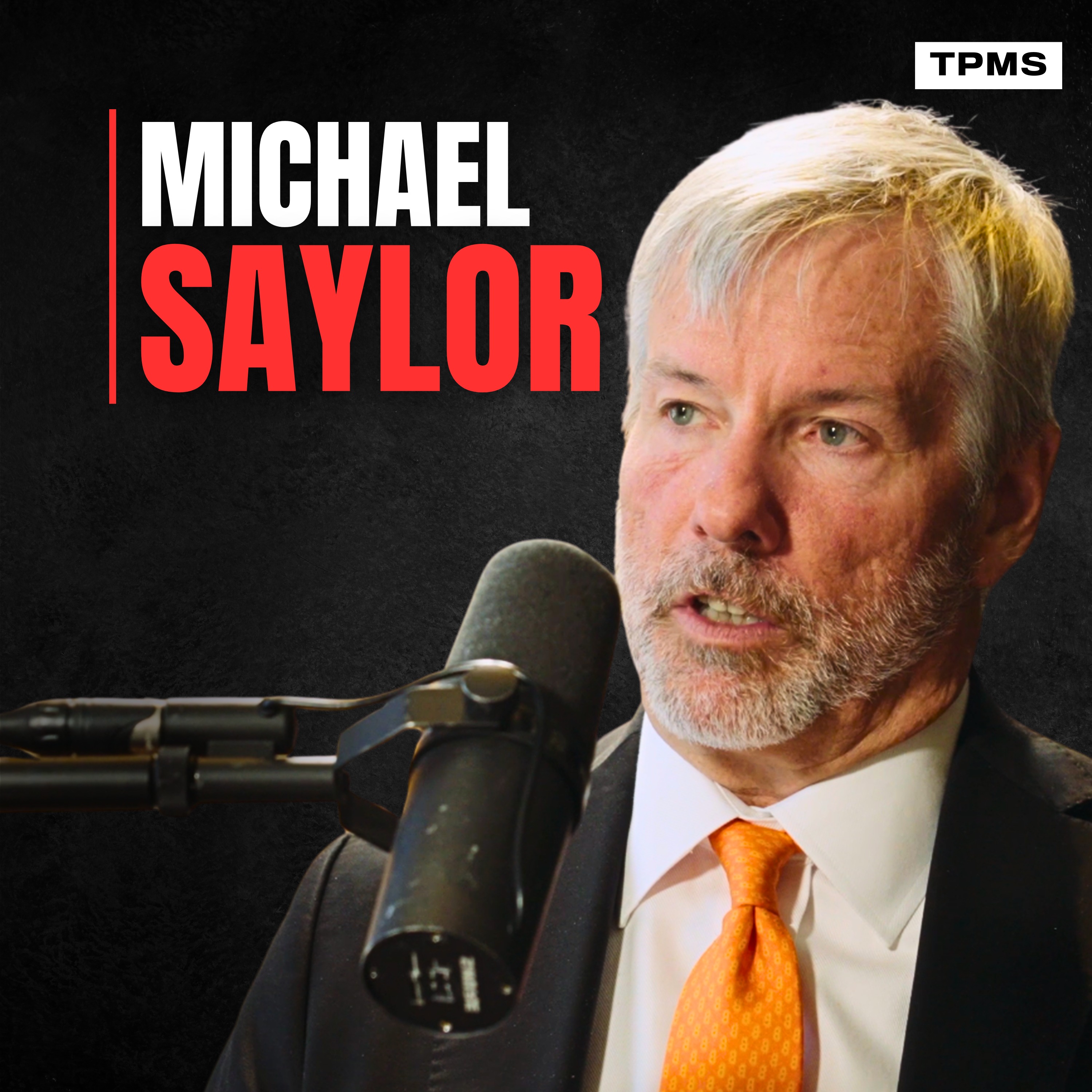
The Peter McCormack Show
#171 - Michael Saylor - Why You Feel Poorer (And Why AI Will Make It Worse)
01:16:55
Michael Saylor on why you have 10 years to position yourself before AI rewrites the economy - and why Bitcoin is the only asset that wins.
Loading summary
Transcript102 lines
- [00:00]
Michael Saylor
There's going to be an explosion in prosperity because a billion robots will do all the work.
- [00:05]
Peter McCormack
You've got 10 years to stake your claim in that world.
- [00:09]
Michael Saylor
The currency supply, measured in dollars, is continuing to expand, probably expanding 7% a year. It's been expanding about 7% a year for 100 years. People that don't own assets are suffering from that monetary debasement. Without realizing it, human capital is getting demonetized. So what is scarce, desirable property? Well, bitcoin simply represents the highest form of capital that the human race has yet to discover. White collarbots are here right now. Make sure that you know, you're not in the critical path of what the AIs can automate.
- [00:46]
Podcast Host / Sponsor Announcer
This show is brought to you by my lead sponsor, Aaron the AI Cloud
- [00:50]
Peter McCormack
for the Next Big Thing.
- [00:52]
Podcast Host / Sponsor Announcer
Aaron builds and operates next generation data centers and delivers cutting edge GPU infrastructure automation, all powered by renewable energy. Now, if you need access to scalable GPU clusters or are simply curious about who is powering the future of AI, check out iren.com to learn more, which is Irene.com. michael, hi. It's first.
- [01:12]
Michael Saylor
How are you?
- [01:12]
Podcast Host / Sponsor Announcer
I'm good.
- [01:13]
Peter McCormack
This is the first time we've done this in. It's just about two years. It was May 24th. We did this last. And since then there's been a. The continuation of our money changing. I think a lot of people are sensing they're getting poorer but don't really understand why. Can you explain to them what's really happening?
- [01:33]
Michael Saylor
Yeah, well, I think the overarching dynamic is that the currency supply, measured in dollars, is continuing to expand, probably expanding 7% a year. It's been expanding about 7% a year for 100 years. And that currency printing goes to finance wars, foreign wars, trade wars, social programs, government deficits, any kind of political program. And I don't think that's new. It's been going on for thousands and thousands of years. The last two years have been no different.
- [02:09]
Peter McCormack
And would you say therefore it is those people who don't own assets are paying for government expansion without even realizing it?
- [02:18]
Michael Saylor
I think everybody pays for government in their own way. It's true that people that don't own assets are suffering from that monetary debasement without realizing it. For the most part, government's expensive. It's always very expensive whenever you have political ambitions. And it's got to be paid for in either with taxes or with inflation or with some kind of confiscation or regulation of some sort that impairs somebody's property. Rights.
- [02:54]
Podcast Host / Sponsor Announcer
So is this how the system should
- [02:55]
Peter McCormack
work or is meant to work? Is there an alternative?
- [02:59]
Michael Saylor
I don't know if there's an alternative. I mean, I've read 50,000 pages of history, and it didn't work any better in Babylon or Egypt or Greece or Phoenicia or Carthage or Rome or Russia or China or India or Pakistan or South America or anywhere in Europe. And if you read Rothbard's history of America before the Revolution, Conceived in liberty, every single colony had bouts of debasement, hyperinflation, and they all taxed or inflated their own currencies or defaulted on their credit instruments in order to support their programs. And that means Massachusetts, when Massachusetts was more than one colony, multiple colonies in Massachusetts were defaulting on their credit and debasing their currency. And it also happened in Rhode island and Virginia and South Carolina and Georgia and North Carolina. And during the Revolutionary War, the Continentals printed currency and that got debased. But every state paid all of its bills with credit cards and they defaulted on that. And then the driver for the Constitution and the formation of the United States was a federal government to absorb all these debts. And Rothbard, who's a libertarian, he laments in the fifth volume of Conceived in Liberty that the real problem was the states weren't smart enough to default on their credit and the Massachusetts colony was trying to pay their debt back at par. And that created Shays, rebellion, attacks rebellion. And that catalyzed the breakdown of the Confederacy and the formation of the United States, which he laments, was an awful thing.
- [04:54]
Peter McCormack
So if you've read 50,000 pages of history, where would you say we are right now in terms of the cycle of currency? Because I'll give you my experience in the uk, we're experiencing currency debasement, a level probably the highest and fastest in my lifetime. And we're seeing certainly a crushing of the middle class. So in that cycle, where do you think we are and what should people expect over the next 5, 10, 15 years? I know you don't have a crystal ball, but.
- [05:25]
Michael Saylor
Well, I mean, you have the world reserve currency, the dollar, and probably with regard to that, you've got a steady 7% debasement or depreciation against scarce desirable assets that just continues to grind. On. Some years it accelerates, some years it decelerates. Then you've got all of the second tier currencies pegged to the dollar. If they're stable against the dollar, the pound, the euro, the yen, the Swiss Franc, the DRAM, et cetera. When they're plus or minus 20% against the dollar, oscillating, they're not as strong as the dollar, they're probably debasing just a little bit faster. And the problem is they don't have the ability to create more of their own currency. So they tend to get into currency crises or debt crises more often than not. And then that results in lurching to and fro. And then you've got the third tier currencies and they're the ones that are losing 10% of their value against the dollar every year and they probably run more like 14% debasement rates. And then you've got the fourth tier currencies and those are the ones that are obviously collapsing against the dollar. And what happens, the second tier countries, they just suffer from economic stagnation, bureaucratic malaise and economic stagnation. I would say in Europe, the uk, Japan, you could argue many, many countries, they look stable politically, but they all suffer from economic stagnation. And in the US there's still a large section of the economy that's fairly free. And that free part of the economy can create an Nvidia or it can create digital intelligence, digital assets, digital communications, digital media, et cetera, self driving cars, robo AIs and things that might create extreme wealth. The way you can tell you've got a segment of the economy that's healthy is you see multi billion dollar startups from 20 somethings, or if companies can get to $100 billion in 10 years, if they can create a trillion dollar company, you've got a functioning economy. That doesn't mean it's perfect even in a functioning economy. In the US large segments of the economy are kind of state captured and not so dynamic. But in the second tier countries they've got a pegged quasi pegged currency and stagnating economies. And the third tier, everybody is struggling to simply keep their head above water and most are failing. And the fourth tier states are all just welfare states. They're just waiting for someone from the first world to go and give them something.
- [08:39]
Peter McCormack
Do they eventually move? Does a third tier eventually become a fourth tier and second tier become a third tier?
- [08:44]
Michael Saylor
Well, I mean if you look at the history of the world, you have the success stories. Say Singapore and UAE are examples of places nobody really noticed, but they implemented rational tax policies and trading policies. A free port, you can bring your ship here, we won't steal the stuff in it. So if you have no income tax, no capital gains tax, a free port and you're able to freely trade. And if you combine that with rational protocols like Singapore, famously, right, you had a good tax policy, you had a good trade policy, and then they adopted English as a, as a communication protocol and a rule of law. And they elevated themselves from poverty and an economic malaise to being maybe one of the richest, if not the richest city in the Pacific Rim. If you go to Dubai or Abu Dhabi, you see similar things. They started with the desert. And in the desert they didn't have fresh water, they had no trees, no grass, no fresh water. But they had ambition and vision. And so they put in place free trade policies, a rule of law, security, relatively liberal regulation, low taxation regime, and they built something out of the desert so you can lift yourself out of poverty in that way and then you can go the opposite direction, right? Which is if you. I think that the trend you see is with every great empire, right, they start with nothing and then they have to. And the ones that are virtuous rise from nothing. Because if they're not virtuous, they don't work hard, then you never heard about them. Eventually they peak and they have a lot of power and a lot of money and they're leaders and universally admired. And that might be Paris, that might be London, that might be Rome, that might be Carthage, might be, fill in the blank, Nineveh, Babylon, right? And at some point somebody inherits, you know, you have a good emperor, Marcus Aurelius, and then he leaves Commodus, and you have a very bad emperor and an idiot grandson or idiot son or someone comes along and they think that, that they were put on Earth to use all this money and power and so they start to squander it and eventually the society breaks down, the currency debases. A simple indicator that maybe have overstretched is when you can no longer pay your soldiers. The uk right now, you can't pay the soldiers, the soldiers quit, you call it a mutiny, you blame them, then they won't fight. And then someone that actually is willing to pay their army comes and takes over and then you basically blame your demise on the barbarians. So I think that's a life cycle of civilizations. And ironically the places that are universally admired are normally the ones that decay. Whether it's a Paris or London or New York or California, they're so rich that they think they can right every wrong and they can implement any social program they wish to. And when you don't have any money, when you're in the desert, it doesn't occur to you that you should pay Slave reparations to people who lived a thousand years ago. You have no money. But when you have a lot of money, you start thinking about universal entitlements of every type. And first it's universal entitlements and then it becomes a mandate and then it becomes confiscation to fund the mandate. And then you just have a socialist collapse.
- [12:48]
Peter McCormack
I had this similar conversation recently talking about the fall of Romans with Freddie New. He studied classics and he was talking about the same, about paying armies. And we kind of compared it. We thought it was analogous to, rather than the uk, we cannot pay our army. We can actually. We cannot pay our dependent class anymore, which is anything that works in the public sector. Public sector's got so big that we cannot afford to pay anymore. And we're starting to see that fracturing in society that was like analogous to the army because essentially that as an army of voters will vote for the state because the state pays them. But we have discontent now because even doctors and teachers, their wages aren't keeping up with inflation.
- [13:29]
Michael Saylor
You're just describing political metabolic disease. It's just everything gets too big. Big government, big charity, big bank, big education, big medicine, big foreign policy, big defense. Everything just gets too big and somebody's got to pay it. And in nature, when a creature gets too big, it collapses under its own weight. There are no hundred ton mammals on land. The elephant is the limit to what nature can create. And you try to get any larger than that and you collapse under your own weight. So I think natural law dictates humility and generally less is more.
- [14:19]
Peter McCormack
What is the right size of government?
- [14:22]
Michael Saylor
Smaller, the better, the smallest possible government, the minimum right? That would be the libertarian answer, but that would be an economist's answer too. Because not every economist, the bigger the government, most government intervention is iatrogenic, right? Crippling it cripples everything. Right? Look, if you go back and you try. What's funny though is it's not new. Like there were laws. There was a monopoly on who's able to bake bread in colonial New York. Like the governor thought that it was rational to basically prohibit people from baking bread. You know, like silly laws, you're not allowed to cross the Hudson River. And so generally governments form. And the first thing the government forms is it begins to issue licenses and monopolies on who gets that land and who gets to cross the river and who operates the ferry and who bakes. There was a monopoly on making of hats. Okay? Only someone with a license from the governor can make a hat. Huh? Some guy's willing to pay the governor for exclusive license to make the hat. But you know, it's like, you would laugh. It's like really going to create a monopoly on making of hats and baking of bread. But yeah, you know, a foreign airline cannot connect two cities in the U.S. the Jones act prohibits you from hauling cargo in a foreign vessel between two points in the US on the ocean. So we have all sorts of restraints of trade, right? Yeah, you name it. But why did the Romans have to kill the Carthaginians? Because the Carthaginians were restraining trade on the Mediterranean. And you can't be an empire if someone else wants to take half the stuff in the ship. So why did the Carthaginians form. Well, because the Phoenicians were doing it. Why did people fight the Crusades? Because the Byzantines wanted to control the Eastern med. And the Venetians didn't want that. And then eventually, so the Catholics or the Christians in Venice managed to get the Crusaders to sack the Christians in Istanbul. Right. In Constantinople. And when we got done with that, the Turks wanted to control the trade in the eastern medicine and we couldn't have that. So ultimately, all these wars are fought over commercial networks and the flow of money and power.
- [17:03]
Podcast Host / Sponsor Announcer
All right, let's talk to you about my sponsor, Leden. Now, if you're borrowing against your Bitcoin, there's one thing that matters more than anything else. Is it actually safe? Well, Leden have just dropped their lowest rates ever. But more importantly, they haven't changed the
- [17:16]
Peter McCormack
thing that matters most.
- [17:16]
Podcast Host / Sponsor Announcer
Your Bitcoin is never lent out, so they're not chasing yield. There's no hidden risk and there's no rehypothecation. Just collateralized loans done properly. Now, they've done over $10 billion in loans. And they've done this through bull markets, through bear markets and everything in between. And they've done it without ever losing any client assets. So now you get lower rates, which means the bigger the loan, the lower the rate. And full transparency before you apply. There's no monthly payments or early repayment penalties. And they give you tools to stay in control. Control from auto top ups to LTV alerts. So you're not choosing between a good rate and safety anymore. Because with Leaden, you get both. Now you can check out your rate using the calculator at Leddon IO forward slash.
- [17:59]
Peter McCormack
Peter. When I was in Argentina, I went for a barbecue breakfast and one of the guys I had breakfast with said to me, he said, there's two truths In Argentina, the sun rises and there's inflation.
- [18:12]
Podcast Host / Sponsor Announcer
And when I spent my time there,
- [18:14]
Peter McCormack
it was interesting spending time with them because they learned to live with inflation, they understood it.
- [18:18]
Podcast Host / Sponsor Announcer
Whereas I think in the UK and
- [18:20]
Peter McCormack
maybe here in the us like within communities I know who are struggling, people who used to be able to afford a certain lifestyle and they can't now, they haven't fully accepted inflation, that it is permanent. And so I've kind of felt like even before selling the idea of Bitcoin, you have to convince people that every year you're going to get somewhere between 7 and 12% less purchasing power. And if your wages don't keep up with that, you have to find a defense. Do you say that's a fair starting point?
- [18:50]
Michael Saylor
Yeah. If you live in the Western world, your hurdle rate's probably 7%. And so if you have any amount of wealth or capital, you want it to appreciate 7% in nominal terms in order to keep your relative wealth intact.
- [19:09]
Peter McCormack
I think for some people that's a hard reality to come to.
- [19:13]
Michael Saylor
Well, the simple observation is that if you construct a market basket of products that are manufactured by robots, like say ketchup or chocolate bars or cereal that comes in boxes, you can manufacture that more efficiently today than 200 years ago. So some things are getting cheaper to manufacture. Electricity, petroleum, machines. They made it possible to stamp out 18 million pencils quicker and cheaper. So if I construct a market basket of consumer goods that I can manufacture with machines or I can automate, that's not going to increase in cost 7% a year. That's going to increase in cost at the CPI, say 2% a year. But on the other hand, if I create a market basket of products that cannot be manufactured by a robot or by a factory, that's going to increase in price. If not 7% a year, it might increase in price faster. A practical example of that in the real world, the land that my house is on in Miami beach cost $10,000 an acre 100 years ago. It costs $10 million an acre today. Thousand X, the thing you put on the land, if you manufacture it with concrete and glass, it did not go up in cost by a thousand x. Because we make glass and concrete much more efficiently today than we did a hundred years ago. We just can't create waterfront property as efficiently now. People have noted with AIs, the next decade we're going to automate out all sorts of white collar chops. So the cost to get a medical opinion or to get a will constructed or get some legal advice or to compose any sophisticated contract that's falling exponentially. Ten years from now, we'll get this robot wave, and pretty soon you'll have the robots walking around. And the cost to move furniture around or the cost to paint your drywall or the cost to install a door is going to fall exponentially as well. Just like the cost to get from point A to point B will fall when the cars drive themselves. And it seems pretty clear the cars are going to drive themselves. So certain things are going to get exponentially cheaper. On the other hand, it costs you $50 million an acre for an acre of beachfront property in Palm Beach. Why? Well, because the robots can't make beachfront property in Palm beach, right? The robots are. But the cost of the house on the property won't go up as fast, because if I can deploy 1,000 robots that cost me $20,000 each, or I can rent the robot for 100 bucks a month. Imagine a world where I basically rent robots at the cost of $100 a month and I have them build the house. The house may not be as expensive. Let's say it this way. If the robot can do it, it's not going to appreciate in price at 7% a year. It's going to appreciate at the CPI or when I was a kid, rich people had record collections, and if you wanted to impress a girl, you invited her over to your house and you showed her your 200 records. And that was a rich dude, right? Today, anybody has 50 million songs in their hand, and it is not a sign of being rich. So if I want to construct a consumer price index, which is going up 2% a year, I just put an infinite record collection and infinite free streaming YouTube videos in the market basket, along with something drywall and a bunch of packaged starch that I manufactured at a big factory. All that stuff is actually getting cheaper. On the other hand, if I want to make you feel bad, I ask you about what it would cost you to buy three acres of beachfront property, and what you're going to find is that does not get cheaper. If affluent, intelligent, cultured people want it, it's going to get more expensive. It's what I call the Bernard Arnault test. If you want to preserve your wealth, you buy assets that someone richer than you, more cultured than you, more intelligent than you will want to buy from you in a decade.
- [23:44]
Peter McCormack
Okay, so lesson one, understand currency debasement. Lesson two, understand assets and scarcity. And then you're ready.
- [23:55]
Michael Saylor
It's a start. Are we talking about generalized advice. Yeah. Because look, I think for the person struggling to navigate the winds of change in the modern world. Yeah.
- [24:10]
Podcast Host / Sponsor Announcer
Because when you try and approach somebody
- [24:13]
Peter McCormack
to explain Bitcoin, if you start with Bitcoin, I think it's a challenge. Sometimes they've had various bits of information they've seen or read and they've got their lines ready. But I think if you start with inflation and debasement and then understanding scarcity, then you can get to assets, and I generalize assets and then why bitcoin is the best.
- [24:35]
Michael Saylor
Well, here's a simple thought experiment. If the year 1600, and you have the choice of owning a square mile in the middle of London, all the land, or owning any building constructed in the past decade in London, or owning the finest luxury goods manufactured in a shop in London in the year 1600, or owning anything consumable, or owning any vehicle operating on the land, in the sea or in the sky in the year 1600, or owning all of the British pounds or a bunch of British pounds or currency or paper money in 1600, which of those things do you think would still be valuable in the year 2026?
- [25:30]
Peter McCormack
The land. The land, of course, the land.
- [25:34]
Michael Saylor
The only thing, right? The richest family in the uk, the wealthy, they own the land. And why? Because the other stuff was obsolesced by technology. You can produce infinite copper tokens and the ships rot and the buildings decay. The land is good for quite a while, right? And so scarce, desirable property means literally that you want to own the land in the middle of London or the land in Manhattan. You don't want to own the land in Greenland or Antarctica. You don't want to own a bunch of Rocky Mountains. Why, it's property. It's just not desirable. And it's not necessarily scarce. There's a lot of it. So what is scarce, desirable property? Well, obviously the most desirable land that any affluent, intelligent person would want, that changes, right? It used to be the middle of Rome or the middle of Carthage. The royal palace of Cleopatra and Alexandra was pretty desirable until the empire falls or the monarchy falls. So scarce, desirable property can be redefined. But in the modern world, it would be the most desirable real estate capital, which is land, the most desirable cultural capital. That might mean the best sports team in the middle of the uk or it might be the nicest artwork, old masters, paintings. It might be the most desirable metallic capital, not silver, not copper, not palladium, but gold. And it might be the most desirable digital capital. Bitcoin might be the most desirable intellectual Property. I own the music rights to the Beatles, all the songs. I'm the only person that can license you to listen to Beatles songs. That's worth something. So those are all forms of scarcity. Oh, mineral rights. I own the mineral rights over the North Sea to all the oil in the North Sea. That's valuable. Right? So all of those are examples of scarce, desirable property. If you happen to own those rights or that property, then you will outpace the rate of currency debasement. You want to be a property owner of some sort. What you don't want to do today is you don't really want to make money by being talented and working hard. That sounds pretty provocative. But the problem is the robots are going to work hard, the cars are going to drive themselves, and once you train the AI on a Shakespearean sonnet, the AI will spit back Shakespearean sonnets just as good as Shakespeare in his prime. And so if you went to school and studied for 20 years to be able to compose Shakespearean sonnets and great prose, that's getting to be less and less valuable. Just like being able to compose 100 page last will and testament that used to be valuable. Maybe that's still valuable for the next five years. But sometime this decade you're going to say to the AI, hey, just compose an entire network of trust and wills for my entire family and then optimize it for these. For which tax jurisdiction? You tell me. Okay, well give me 16 of them now implement it and it's all going to happen for 10 bucks. And it used to be that I'll cost you $10 million. So hard work and talent are getting. Human capital is getting demonetized. And that's really the lesson, which is, if you think the glass beads are money and someone comes along with gold, then glass beads get demonetized and you'll be poor if you hold onto them. It used to be that people that were big and strong, that could work in a farm field, had value. And then the machines came along and it's like no matter how strong and how hardworking you are, you're not as hardworking as a tractor. So that's not interesting to me anymore. And I think you see the progression of waves. So today what you want to do is make sure that you're not in the critical path of what the AIs can automate in the white collar world. And you don't want to be in the critical path of what the robots can automate in the blue collar world. You got about 10 years before the robots arrive, the AI, white collar bots are here right now and they're going to run pretty hard.
- [30:28]
Peter McCormack
I'm asking you about people worried about what's happening right now and you're saying, yeah, I mean, there are things you could do right now, but you need to be ready for the radical change that's coming over the next 10 years. Is this an imperative to prepare for that world?
- [30:42]
Michael Saylor
Well, for example, if you had a choice, if you're going to spend £200,000 to get a law degree or buy £200,000 worth of desirable property, you might better off to invest it in buying the asset as opposed to getting the law degree. The value of being a lawyer is going to go from here and it's going to get whittled down over time. When everyone gets 10,000 lawyers for 10 bucks a month, there may be a living, but it's not by drafting the contracts. So really most of these things, your company has 10,000 employees. What's your competitive edge? While we have 10,000 talented people to work hard, not really. Now, what is valuable? Like who achieves the value? People with influence. Do you have power? Do you have money? Do you have fame? Do you have influence? Do you have distribution? If you have an account with 5 million followers, then you can take an AI generated video and run it to 5 million people and monetize it. If you're the guy that creates the video by hand, laboriously, but you have an account with 50 followers, you can't monetize it. So just like Apple, if you got a billion people holding a device in their pocket, you can put any AI you want on that device and you can distribute it to a billion people. You have power through distribution. Amazon, they've got distribution the last mile to hundreds of millions of households. When the robots come along and the cars drive themselves, can Amazon cash in on that? Sure, because the robot will drive to the household and they've already got the back end distribution channel and the brand so they can monetize it. On the other hand, if you don't have that distribution channel at 250 million households, you're not going to be able to monetize the robot or the self driving vehicle in the same way.
- [32:52]
Peter McCormack
You've got 10 years to stake your claim in that world.
- [32:56]
Michael Saylor
Just figure out if you're starting your career. My advice to anybody would be figure out how to do something nobody's ever done before with tools that were never available to your parents. It's like Justin Bieber gets discovered on YouTube, right so are you trying to do what your parents did in the way they did it with the tools they used? Not a good idea, right? Are you doing something that you couldn't do 30 years ago that there was no market for, that no one ever conceived of, with a tool that didn't exist? Yeah, there may be a chance there, right?
- [33:42]
Peter McCormack
But if you don't stake your claim, how do you picture the world for people who don't stake their claim 10 years time, they don't acquire assets. We radically changed AI and robotics. What's the world like for them?
- [33:54]
Michael Saylor
I think there's going to be an explosion in prosperity because a billion robots will do all the work, a billion cars will drive themselves, will produce infinite entertainment, infinite drugs, infinite education, infinite stuff. If you can stamp it out with a factory or robot, we'll produce it. And then I think you'll just see probably a socialist wave of entitlements where you'll start seeing universal healthcare. We already see it right now. Universal healthcare, universal basic income, universal housing, universal entitlements to transportation, public transportation, you know, fill in the blank, right? What is it that if you think about in Europe, right, there's this concept that everyone has a right to a list of 27 things and the state should provide them, right? Didn't used to be that way in the U.S. but in the U.S. it's becoming more and more like that. Like, I went to mit, right? They never offered me a drug when I was in college, right? There was no Adderall. Adderall didn't exist. Xanax didn't exist. We didn't know about those things. If you needed a boost, you drank a Mountain Dew, right? And you stayed up all night. Then it became, well, every college kid needs to have health care. And then it became, well, you need free health care. Then it became, well, free health care means let's give them prescription drugs. And then it became, well, you know, we can't wait till college. We need to give this to people in high school. And then pretty soon you had models wearing things like, I believe in teenage mental health. And then it became universal teenage mental health. And that became, I believe that every teenage person ought to have unlimited free state sponsored drugs. And then it became, oh, and we don't want the parents to stop them from taking them, right? And so, so I'm like, are you kidding me? At this point we've normalized the idea that everyone should have unlimited free drugs in junior high. And if your parents wanted to stop you, that's a violation of your civil liberties. And that is so far removed from the world where I grew up.
- [36:19]
Peter McCormack
We lost the plot.
- [36:21]
Michael Saylor
I think you just. There's this struggle between the Orwellian future and Brave New World. Right? And Brave New World was. No, we just give everybody infinite entertainment and happiness.
- [36:41]
Peter McCormack
Sex and drugs.
- [36:42]
Michael Saylor
Yeah, right. All this Huxley, all this Huxley said we'll just give infinite everything. So I don't know. What I think though is people worry that there won't be enough. That's not the problem. There'll be too much. Too much music, too much entertainment, too much food, too much alcohol, too much sugar, too much. Too much stimulation. You can sit and watch TikToks 80 hours a week and then we can debate whether TikTok reels are better than Insta. Reels are better than the reels that are coming up on X, or better than YouTube shorts, or better than Twitch, or better than listening to Infinite Spotify. Is that better than blah, blah, blah? It goes on and on and on and on and on and on. I think that different civilizations will be distinguished by just how they react to it. One reaction is try to create more freedom, and the other reaction is probably just socialize more things and create more entitlements.
- [37:54]
Peter McCormack
You don't think the human experience aligns with abundance? We need scarcity, we need struggle, we need something like purpose.
- [38:08]
Michael Saylor
I think it's healthier to have a natural. The natural order of things is scarcity and Darwinian competition. I think that when that breaks down, you get an artificiality. If you think about the difference between equilibrium in nature versus in a garden. In a garden, there's infinite curated everything. But you end up dumping fertilizers and dumping water and then pulling weeds. And you create this beautiful garden, but it's not stable. So as soon as the gardener disappears, then the entire thing, the system collapses under its own weight.
- [38:55]
Peter McCormack
I mean, you would arguably have access to the abundance, the existence of abundance yourself. I have a certain amount compared relative to others. What does that access to an abundant life taught you?
- [39:12]
Michael Saylor
Less is more humility. Just because you can do a thing, you shouldn't do the thing. I think you eventually find stoicism. I've said this many times. The reason Bitcoin was successful was because of the humility of the ambition. And I think that the more grandiose the ambitions, the more likely it is that the society, the corporation, the ideology of the network collapses under its own weight. Like imagine that. Remember the Napoleonic era? Napoleon first ended up inheriting control of France and then he decided he was the king of France or the emperor, and then he decided he needed to spread French values to the rest of Europe. And somehow it got to be spread French values to the frozen tundra, you know, steps of Russia in 1812. And somewhere along the line, he lost the plot, right? And it starts with these grandiose ambitions, you know, and you see that over and over again in history, right? Some grandiose ambition, whether it's Julius Caesar or whether it's Napoleon or whether it's the spread of the British Empire, at some point you've just reached too far.
- [40:31]
Peter McCormack
So actually, before I ask that question, because I should really ask you for the listeners, like, why bitcoin? And then I want you to tell me what the ambition of bitcoin should be.
- [40:48]
Michael Saylor
Bitcoin is digital capital. It is the digital manifestation of economic scarcity. So if you want a functioning economy, actually, if you want a prosperous civilization, there are certain protocols you have to develop. One of them is language protocol. It's conservation of communication or clarity of communication. Can I tell you that north, beyond the mountains, there is a land of plenty? Or can I explain to you that you can eat that. That vegetable, but this one will kill you. You need a communication protocol, and it needs to be conservative. That is to say, if I tell you that's good, but I really meant bad, and if I tell you this will kill you, but I'm lying to you, the civilization breaks down, right? You have to have communication protocol with integrity. There are many. But whichever one you settle upon, in this case, English, which is what we for the most part settle upon, it needs to have integrity. And if you have a protocol with integrity, you can create a civilization, a market. You can cooperate, you can send your kids to school, you can work, you can create things, you can share, you can trade, then you need a mathematical protocol. I need a way to explain to you that I need six inches of steel, not three inches of steel, to avoid having the building collapse and kill everybody in it. Needs to have to have mathematical integrity, right? The conservation of energy. There you need science. You need, for example, enough science to figure out how to create a steel refinery that doesn't explode and burn everybody to death. And if you figure it out, then you can create guns. And if you figure out the guns and you figure out the germs, and you figure out the steel, then maybe you're going to actually rule the world. So scientific protocols, language protocols, mathematical protocols, these things matter. But what if you want to be rich? Why would you want to Be rich. Well, because if you don't have economic energy stored up, then on the day you lose your job, you starve to death. Or you would like to be able to store enough food so that if you have one year of drought, you don't all starve and die. Okay? So you need to be able to store energy. Animals store organic energy via fat. Fat is organic energy and organic battery. If you take away the fat, you're a type 1 diabetic. Go without eating for a week or two and you'll be dead. Societies store economic energy with what we call money. Maybe we call it capital. If you're a capitalist, you have enough money to live for 10 years without working, you can take a long view. You can actually posit that in seven years when the building is finished, that might be a profitable endeavor. If you don't have any capital, and if you stop working next week, you don't have any money, and then your kids starve to death. You don't have the luxury of making long term investments or dreaming about the future. You're never going to build a bridge or a building or a hospital because you just don't have the access energy to do it. So why Bitcoin? Well, all civilizations, they have a protocol. And I think the history of civilization is the most powerful ones displace the least powerful ones. This is almost a tautology, right? Who won? Oh, the most powerful nation won. Well, how do you define power? The ability to channel energy. Okay, so why would a nation that was on the gold standard be able to displace a nation on the glass bead standard? Because glass beads are stupid. Because you can manufacture a billion trillion glass beads and you can buy everything in the country on the glass bead standard, take it all for a nickel, and then you own them. And gold is not easy. You cannot manufacture a billion trillion ounces of gold quickly in an afternoon. There is no gold factory. So the nation on the more powerful protocol displaces the least powerful protocol. And it turns out that bow and arrows are better than fist, and bronze is better than wood, and iron is better than bronze, and steel is better than iron, and explosives are better than steel and cannons trump masonry. And if you study what happened in the New World when the Spaniards showed up, the fact that they had explosives and they had gunpowder and they had steel was very helpful. So Bitcoin simply represents the highest form of capital that the human race has yet to discover. We've been on a journey and gold reached. It reached a stable point, and it was the highest form of portable capital for a while. But in the 20th century, gold wasn't fast enough. It was too slow, too heavy. And if you can't move capital back and forth across the ocean 14 times a day, you cannot do high frequency international trade. So gold didn't keep up with the speed of the modern economy. What we wanted was a digital gold that we could actually move back and forth. And so how do you send $10 billion from here to there in an hour? I can't move a building, I can't move land, I can't move $10 billion worth of oil. Doesn't make any sense. I need a very dense, efficient, stable form of capital I can move. Bitcoin was born out of this idea of a peer to peer cash system. If you study the history of economics, cash settlement meant that I showed up with a container full of gold bullion or gold coin, and I traded it to you in return for whatever goods you had to sell or for your credit paper. And so the idea of bitcoin was, how do we settle our differences with something of global universal value. And why did it succeed? Because it was the best engineered network to do that. The most secure, the most reliable, the highest integrity one, the hardest one to hack, the one that was hardest to break, something that was stable and robust. It's like, why did Arabic numerals replace Greek or Babylonian or Roman numerals? Because Arabic isn't the first. It just happened to be the best. And when it came along, it totally obliterated all other mathematical systems because it was the most stable and the most rational and the most efficient. Bitcoin has done the same thing in the global capital markets. It's something that everybody can agree on. You can trade it, you can peer to peer, trade it between millions and millions of people. You can trade it on thousands of exchanges. It's got integrity and it's thermodynamically sound. If you wish to build something that'll last for 100 years, you need to know that it'll be stable for 100 years. And that means the materials in the building can't rust over 100 years, right?
- [48:44]
Peter McCormack
But is it two things then, that just bring it back to people trying to stake their claim in the future that in some ways, bitcoin rescued a Keynesian economy by giving a spine of truth, but also as a way of storing capital for the future? They got to think about both of those things.
- [49:05]
Michael Saylor
I think smart, affluent people had already abandoned the Keynesian. They knew Keynesian economics didn't make any sense for them a long time ago. That's why they bought land, that's why they bought sports teams, that's why they bought art, that's why they bought gold, that's why they bought companies. Right? They bought private equity and public equity, all of those. That's why they bought beachfront property in Palm beach or the Hamptons, or fill in the blank. All of those things are examples of scarce, desirable property to escape the Keynesian debasement dilemma. The really smart ones, they don't just buy the property, they borrow money to buy the property. It's like if I can borrow money at 3% and invest it in an asset appreciating at 8%, I'm not just gaining 8% a year on my capital, I'm actually shorting the currency, and so I'm getting the arbitrage difference. So this is not something we'd invented with bitcoin. That's been around for a long, long time.
- [50:04]
Peter McCormack
But has bitcoin democratized that?
- [50:08]
Michael Saylor
I think bitcoin perfected it as a digital asset, which meant that it was now possible for a billion people to engage in this trade at the scale of 20 bucks. You can't borrow £100 million to buy a building in London if you're an individual or a taxicab driver. But you can actually buy $87 worth of Bitcoin off of an iPhone. And so bitcoin changed the scale of this. It's like you have a building, the property rights of the owner of the building are much higher than the property rights of the person that owns the reit. And so when you buy the entire building, you have a lot more power than when you buy a share of the building. With bitcoin, you're able to buy the actual property in quantities $22 at a time, or $87. And you are the original property owner. So you have property rights parapassu to the person that owns outright other forms of property. But it's kind of like you own the Monet painting. That's good. I can take it anywhere in the world. I can borrow against it, I can sell it, I can display it, I can charge people money to look at it. If I offer to sell you 1/1 millionth share of my Monet painting, you're a limited partner, you're owning a security right not as good. You have no say over what happens with the Monet painting. So the thing about bitcoin was it was the most desirable property network in the world, available to a Billion people without any middleman, without any gatekeeper, without a regulator. You have this much Bitcoin, you want to trade it for that truck. You want to do it on a Saturday afternoon in Africa. And maybe a politician in Egypt said it's illegal to buy trucks on a Saturday afternoon. Right. You can still buy the truck. There's no one in the middle. When you rely upon a currency, you have to get the approval of anywhere from one to six banks before you can transfer the currency. So if you're working with a banking network, and that's a challenge, and when you own other forms of securities, there are always securities laws. It's illegal to trade them on Saturday. Why? Just because. It's illegal to trade them at 6pm why? Because the bankers wanted to go home at 6pm With Bitcoin, you can do what you want with your property and you can do it where you want.
- [52:44]
Peter McCormack
Well, isn't it. They could still make. They could still create laws that make it illegal to transfer bitcoin, but you still can route around that if you choose to. It's like you can be an anarchist.
- [52:58]
Michael Saylor
There's an island in the Mediterranean. They made a law putting a tax on luxury yachts, like 2% of the value of the yacht. And the day before the tax went into effect, there was a marina full of luxury yachts. And the economy was booming and everybody's spending a lot of money. And then the day the law went into effect, the marina was empty and the yachts all pulled up anchor and left. Okay, so that's portable property.
- [53:23]
Peter McCormack
Yeah.
- [53:24]
Michael Saylor
Okay. You can't move a building. The real problem with buildings is they can't run, they can't hide. So when the socialists or the communists take over, the first thing they do is they take your building because they can. And in fact, even in a capitalist nation, let's take the United States. What's the worst possible tax treatment? It's a triple tax treatment on a piece of real estate. We tax you when you sell it, we tax you when you inherit it, and then we tax you just when you hold it, even if you're just holding it for a year without doing anything, you get taxed on the coming, the going and the in between. Right. There's nothing that's that bad. Right.
- [54:08]
Peter McCormack
I mean, yeah, there's no jurisdictional arbitrage with the building.
- [54:11]
Michael Saylor
And that's because you can't run.
- [54:12]
Peter McCormack
Can't run.
- [54:13]
Michael Saylor
Okay. So the thing about this is with bitcoin is it's the hardest thing to tax. It's the hardest thing to steal. Like, it's the hardest thing to impair. It's like, I can pass a law that says that your 10 acres in the middle of Manhattan is zoned rural, agricultural, and you can grow daisies on it, but you cannot put a building on it because you made me mad, okay? And your $100 million of real estate is now worth nothing. On the other hand, if you could teleport the property from one city to another city, then when someone passes the law, let's say I pass a law saying you're not allowed to generate yield on your assets if the asset is a building, that's the same as rent control. The rent on your building is now zero. You're not allowed to charge rent. You have to give away the use of the building for free because the public requires the use of your building. If you can teleport the building, you've still got value because you can move it to a jurisdiction where they're not going to rent control it. But you can't teleport buildings generally. You can move a yacht, you can move a container ship, so you can move a truck. So there are certain things that you might be able to move, but other things you can't move with Bitcoin. I could move the bitcoin to Singapore or London, but if the law is better in Monaco or the law is better in fill in the blank, you can move it. Now, here's the thing. The law is probably going to be bad everywhere at some point, or let me say it a different way. Over a long enough timeline, the mortality rate is 100%. That is to say, if you have gold in a bank anywhere in the world, if it stays there long enough, it's likely the government will collapse, the bank will be seized, and your gold will be seized. But if you can move the gold and if you're smart, then maybe you're smart enough to move the gold ahead of the seizure. But the problem is it takes like one to three years to move to gold. And everybody knows you have the gold. And so that's very hard. I think people got their gold seized in the US And Japan and Germany, everywhere in the world, except for maybe a couple of banks in Switzerland over the last hundred years, right? There's nowhere in the world where your gold didn't get stolen from you over 100 years. With Bitcoin, it's like, okay, well, maybe you're comfortable with your bitcoin in a bank in UAE right now maybe, or Singapore or Britain or where fill in the blank. Will you be comfortable with it in 30 years? Who can say? The whole genius of bitcoin is the whole idea is this. A bunch of people get together and they have a conference and they think, well, you know, we just like to keep our money forever. And we don't trust each other, and we don't trust any bank and we don't trust any government. And I kind of trust you right now, and you trust me right now, but I'm not going to trust your idiot grandson in 100 years. So let's construct a bank in cyberspace. We'll all put our money there. Who's going to run the network? Who's going to run the bank? Well, no one. We're all going to run the bank. Well, why? Because nobody trusts anybody ever. And where are we going to run the bank? Anywhere. Everywhere. But what if one nation goes bad? Well, then the network will migrate out of that nation. What if a company fails? The network will migrate away. Well, what if I start lying? What if my node broadcasts improper or erroneous or fraudulent transactions? You get kicked off the network. So the whole idea of bitcoin was, let's create a viral bank in cyberspace that feeds on chaos. And let's start with the assumption that we can't trust anyone or anything anywhere over a long enough timeline. But saying to you, I don't trust a bank in New York over 1,000 years, which I absolutely will tell you, I'm sure that over 1,000 years, whatever you own in any given place in the world will be lost. That doesn't mean that I can't find anywhere today where I do trust a counterparty. So I can find a custodian or I can find a jurisdiction to domicile my capital now. And if I have the option to change jurisdictions in an hour and Bitcoin, you could reasonably, if you were in a hurry and you knew it was coming, you could do it in a minute. But otherwise, you could definitely do it in an hour. If I have that option, then, as they say, an armed society is a polite society. If I know it's going to be impossible to steal from you, I probably won't try to steal from you. Right. The person you pick the fight with is not the guy holding the gun. And it's like they used to say about cars. You can't make it impossible to break into a car, but you can make it marginally harder than the car parked next to it. The car thief will go to the easiest car to steal. They won't go to your car because yours is a little bit more effort. So I think with digital capital, the idea is, in theory, anybody on earth can be a custodian or a counterparty. So you've got 8 billion choices. In fact, you've got every computer on earth. So you've got billions and billions of theoretical choices. Are they all safe? No. Are any of them safe? Yes. Can you conserve your economic energy in time and space? That's really the question. People were using Renaissance Italian art as a source of capital preservation in 1600s. So people have used diamonds, they've used art, they've used gold. In the biblical times, they used ox, cows, livestock. What are these things? They're just economic wealth that's portable and I'm using the best technology. And for a while it was camels or cows. The Mongolians thought it was horses, right? And maybe it was gold. But now we've got bitcoin. Bitcoin happens to be the best technology for moving economic energy through space or through time.
- [61:07]
Peter McCormack
So what should the ambition be? I mentioned that earlier.
- [61:10]
Michael Saylor
Keep your money.
- [61:11]
Peter McCormack
No, the ambition of who? The ambition of bitcoiners for what bitcoin should be.
- [61:19]
Michael Saylor
Don't break the network. Preserve the network. Which means defend the network, keep it
- [61:25]
Peter McCormack
secure, keep it decentralized.
- [61:28]
Michael Saylor
It means preserve the integrity of the protocol.
- [61:32]
Peter McCormack
What does that mean to you though?
- [61:34]
Michael Saylor
Don't break it.
- [61:37]
Peter McCormack
How would we break it? Where could we have our eyes shut? What's the risk?
- [61:45]
Michael Saylor
You had bells and whistles. You load it up with features. You implement DEI programs on it. You implement entitlements on it. I have numbers. 0, 1, 2, 3, 4, 5, 6, 7, 8, 9. Okay? That's how many numbers there are. Some dude comes along and says there ought to be like a nine and a half. I'm going to create a squiggly nine and a half. And I'm like, why? Because I like the squiggly and my friend needs that. Right? The word up means up and someone wants to make it mean down on every other day. Don't corrupt the protocol. Right? The protocol works fine. Don't corrupt it. At this point, bitcoin is won. The battle emerges. Global digital capital. Just like Arabic. Math is one, just like the English language is one. There are certain protocols that have emerged and we base western civilization on those protocols. And bitcoin is one of those protocols. The biggest risk to bitcoin is bad ideas driving iatrogenic protocol proposals. It's like somebody wants it needs to go faster. We don't have Enough bandwidth, right? Remember the block size wars? Have you gone to Clark Moody's Dashboard in the past week? If you go to Clark Moody's Dashboard, the average bitcoin transaction cost $0.32. And the cost was 1sat per V byte for instantaneous transaction, 1sat per V byte for our transaction, 1sat per V byte For a transaction. This day, 1sat literally the lowest measurable transaction fee on the network. And this is 10 years after the block size wars. And there was a war fought over that. People thought, bitcoin will fail unless we increase the bandwidth of bitcoin because it needs more. And the answer is no, it didn't need more.
- [64:00]
Podcast Host / Sponsor Announcer
I want to talk to you about one of my new sponsors, which is monetary Metals. Now, if you're like me, you probably spend a lot of time thinking about sound money and how to protect yourself from currency debasement. Now, for some people, that's bitcoin. For others, it's gold. For me, it is both. But here's the thing about gold. Most of it just sits in vaults doing absolutely nothing. Monetary Metals is changing that. They let you earn a return on your physical gold holdings, but they pay it in gold itself, not dollars. So instead of your gold just sitting there, it can generate more gold for you. So to put it simply, if you deposit 100 ounces and earn around 4%, at the end of the year, you're going to have 104 ounces of gold, regardless of whatever happens to the price of gold in dollars. And in a world where fiat currencies are constantly losing value, earning a return in actual gold ounces is pretty cool. It's essentially making your gold productive instead of idle. Now, if you hold gold and want to learn more, check them out at monetary metals.com forward/mccormack that is monetary metals.com
- [65:03]
Peter McCormack
mccormack so if we won, where do
- [65:08]
Podcast Host / Sponsor Announcer
you see the things that you are
- [65:09]
Peter McCormack
building now, the products you're building, say outside of bitcoin, to give access to bitcoin? Is that. Are you. Are you recreating parts of the financial system in a bitcoin world?
- [65:20]
Michael Saylor
Yeah. I think the big innovations are layer two, layer three innovations, and layer four. It's like, I give you Manhattan. There's granite. It's been there for 200 million years. And some dude wants to cast a spell to turn the granite into steel or copper or cotton candy because he wants to. And you're like, that's pretty stupid. Just leave the granite in Manhattan. You want to innovate, Put a building on the Granite. You want to innovate some more? Change the building. You want to innovate some more? Put a company in the building. You want to innovate more. Upgrade the technology that the company runs on in the building, on the granite in Manhattan. Right. You can have much higher frequency innovations above the base layer. Bitcoin is the base layer of the cyber economy. It doesn't need the innovation. What are we doing here that is innovative? Well, the explosion of ETFs wrapped Bitcoin. It has brought the premise of bitcoin or the promise of bitcoin to somewhere between 50 and 100 million beneficiaries in the past two years. That's innovative. $150 billion of capital has flowed into that. Our company created a bitcoin backed security, basically amplified bitcoin. Last Wecheck we had 55 million beneficiaries on the equity MSTR. Another innovation, but the most interesting one I think that we've done is digital credit. The idea of digital credit is can you give a bank account to a billion people that pays them 10% without volatility? Who wants that? Everybody wants that.
- [67:08]
Peter McCormack
Everybody wants that.
- [67:08]
Michael Saylor
Who wants a bank account that pays them 10%? Everybody. What's your bank account pay you now? Nothing. What's the money market pay you right now? 3% after tax? 2%. Okay. What's the Bitcoin performance for the past five years? 39%. Ever since we got in this business, Bitcoin has appreciated 39% a year. ARR. More than double the S and P. Okay, so why don't a billion people just all buy bitcoin? It's because the volatility is 40. It's 40 times the volatility of a money market. They can't stand the volatility. Right. It's too scary. The performance is fine, but you cannot get anybody to agree. Even sophisticated financiers will not agree to buy Bitcoin. Takes 1000 hours of discussion to sell an asset appreciating 40% a year with a volatility of 40.
- [68:05]
Peter McCormack
Hold on. So the win win here is you're the sponge of volatility for the people who want to get a better interest rate than they'll get with their bank.
- [68:13]
Michael Saylor
Yeah, let's just say I want the 40% and I'll take the 40% volatility and I'll give you 10% and I will strip away the risk, strip away the volatility over, collateralize the instrument. You have a million dollars. You can either buy a million dollars of Bitcoin and get on a roller coaster. By the way, if your time horizon is 10 years, I would tell you, you make a lot more money that way.
- [68:40]
Peter McCormack
Get on the roller coaster.
- [68:41]
Michael Saylor
But you're going to have to go without anything for four years. So do you want a capital asset with no cash flows, massive volatility, and you got to have a time horizon of 4 to 10 years, or do you want to give me the million dollars? I just give you 10% a year and I will peg the principal to $100 to par. So the volatility falls to 2 or 1 or whatever the number is, but closer to a money market and you collect. Right now, STRC pays 11.5%. And the beauty of that instrument is it's a return of capital dividend. So it's a tax deferred dividend. So what we have done and what we've discovered is the market for the first 11% of the return is 100x larger than the market for all 40%. If you walk down the street and ask 100 people, do you want a bank account that pays you 10 or 11%, it's like everybody. And if you say, would you like a highly volatile crypto asset that's a 40 volume, that'll probably return you 30% or more over the next decade, but there are no cash flows and you're going to have dramatic swings and you can't count on paying any bills within the next two or three years. Well, that number is less than five, maybe two. And if you convince, it'll take you 100 hours and then they will put a small portion of their capital in. So it's a much more difficult sell. But let me say it a different way, Peter, like how many people want unlimited free electricity?
- [70:21]
Peter McCormack
Everybody.
- [70:22]
Michael Saylor
And how many people want to run a nuclear reactor in their backyard?
- [70:26]
Peter McCormack
Not very many.
- [70:27]
Michael Saylor
So we're running a crypto reactor. Right. What we discovered is the real unlock is we'll just run the crypto reactor. We've invested $60 billion and a crypto reactor. Now we can turn around if we have $60 billion of capital, if we have that much equity. For every dollar of equity, you can sell 10 to 20 cents of credit. So we can create $10 billion to $20 billion a year worth of a high yield bank account backed by bitcoin and that will grow 30 to 50% a year. The people that want that are retirees. 20 something. The truth of the matter is the only security that I've ever created that I would ever recommend to Friends and family is strc like to my brother to 20 somethings to retirees, they're like, well, what should I buy the Bitcoin, or should I buy MSTR or should I buy STRF or STRD or convertible bonds? Like those are all good investments if you're a professional investor, but you have to have a 4 to 10 year time horizon and they're very sophisticated and you have to understand delta and duration and liquidity and the like. And you might even have to be a qualified institutional investor. It's illegal for a retail investor to buy a convertible bond, right? So they're all complicated. But let me give you this simple one. This one, it's designed to trade around 100, and if it falls below 100, the company is going to use all of its capital, all of its efforts to get it back to 100. Okay? And so it's the simplest possible, it's a 15 second sales pitch.
- [72:13]
Peter McCormack
But is there risk? It has to be some risk.
- [72:16]
Michael Saylor
It's 5x over collateralized by Bitcoin. So the risk is Bitcoin goes through zero tomorrow, forever, Forever. It's the risk and that's the first risk. And the second risk is you're trusting the issuer to competently manage the credit facility, to manage it. That is the management team of strategy. I would say it's similar to you bought a note or a credit instrument on a building in Manhattan and the risk is will Manhattan sink below the ocean? And if so, you're not going to get your monthly payments or will the building manager set the building on fire? You've got the risk of the issuer strategy and the risk of the underlying capital asset. And you have to get comfortable with those two risks. The reward is instead of getting paid 2% after tax, you get paid 10% or 11% tax deferred. So that's the benefit. Now, of course, there are countervailing risks. If you have money and you don't put it in digital credit, you're going to put it in a building, you're going to buy an Airbnb, you're going to buy the S and P index, and the S and P index is going to go up and down. So you're either taking equity risk or you're taking property risk. Or you can buy a government bond which has no theoretical risk other than the collapse of the government, but it has a negative real yield. It's guaranteed to underperform the cost of capital by 4% or 5% a year. So you're just getting Poor slowly, over the course of 20 years, if you
- [74:05]
Peter McCormack
could take the 11.5% interest, plug 7% back into STRC and live on the remaining 4 and a half percent, you've got par for life. Ish.
- [74:18]
Michael Saylor
Yeah. One thing people do is there's a carry trade. I mean, a lot of people can borrow money at SOFR plus 50 or 100 basis points. You borrow money at 4%, you invest at 11, and you just keep the 7% or 8% spread. The other advantage, the thing that we discovered, and this was just accidental, we discovered that if you sell a credit instrument and you invest in it and you make a capital investment, and then you allow the capital to appreciate tax deferred to be an unrealized capital gain, and then you monetize the capital gain intelligently, then the dividend you pay is tax deferred. So what we're doing is we're just scraping a percentage of the capital gain. And if you invested in bitcoin and you never sold it, you would have a deferred capital gain. But credit investors, normally they never get deferred tax treatment on a credit yield. Normally you pay ordinary income on corporate bonds, or you pay long term capital gains on qualified dividend instruments. But because we invest in Bitcoin forever and we never realize that capital gain, we never realize that tax obligation, we don't have to pass that through to the credit investor. So if you're a credit investor and you value principal protection and stability, but you also want to compound your money tax deferred, the way stretch works is you buy $100 share, the first $100 worth of dividends will be tax deferred as long as you don't sell the inst. If you then pass the instrument to your heir, they get a step up in basis and their next hundred dollars become tax deferred. So you could in theory go 20 years without getting taxed on the dividend between you and your heir. And if you actually calculate the benefit, if you were to reinvest that, the compounding benefit is pretty extraordinary compared to most other credit investments.
- [76:31]
Peter McCormack
You remember my son Connor?
- [76:33]
Michael Saylor
Yeah, yeah.
- [76:34]
Peter McCormack
He's the editor of the show now. So I think his light bulb is gonna be going off right now. Look, we did an hour and a half here. We could have done another three, four hours. Thank you. We just can't wait two years till we do this again. And I appreciate your time, man. Thank you.
- [76:47]
Michael Saylor
Yeah, anytime.