Loading summary
Transcript164 lines
- [00:00]
Michelle Lim
I did my internships from 12,000 people to 1200 at Slack and then 300 at Robinhood and I found that every time I went down roughly an order of magnitude, I felt way more ownership. Obviously the next step is joining a two person company and then starting my own. The stack at Warp actually first started out with Typescript and then two to three months in we decided to scrap that repository and just rebuild everything in Rust.
- [00:23]
Host (possibly named George)
I have to ask why?
- [00:24]
Michelle Lim
It was for performance reasons and it was also speed of development. There was also a very strong sentiment amongst developers that they would only use high performance terminals that were built at low levels.
- [00:34]
Host (possibly named George)
How do you think a product engineer versus a founding engineer differs?
- [00:38]
Michelle Lim
I think founding engineer counts.
- [00:40]
Narrator/Producer
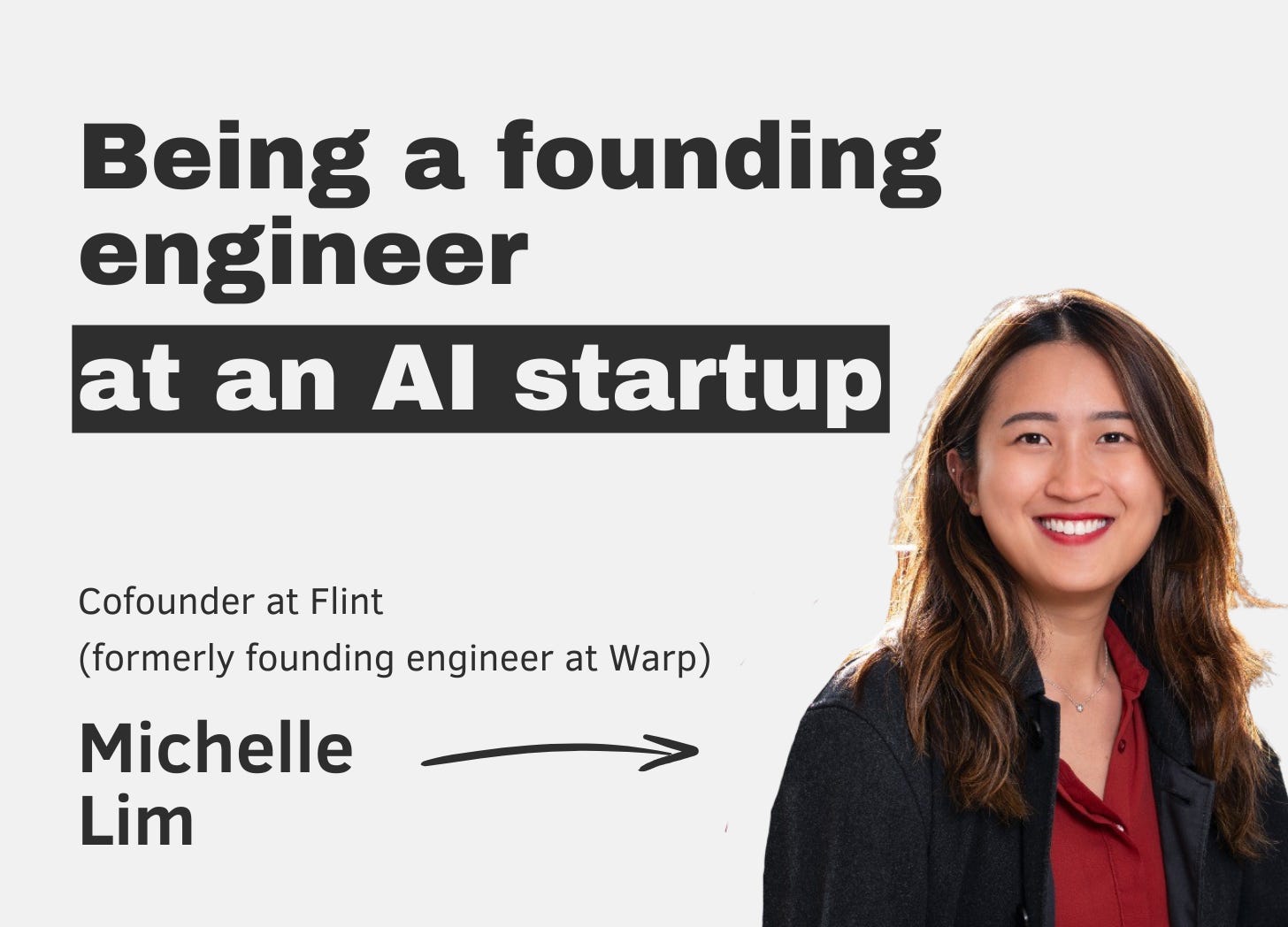
What does it take to be a standout founding engineer? Michelle Lim was the founding software engineer at AI startup Warp and is now the founder at her own startup Flint, where she is now also hiring founding engineers. In this conversation we cover Michelle's thinking process to take a risk and join as engineer number one at a little known startup when she had better paying and safer options. Thriving as a founding engineer. And why? Only to pick up work that no one else wants to do. Figuring out if you're more of a product first or code first engineer so you find your place better.
- [01:09]
Host (possibly named George)
How?
- [01:09]
Narrator/Producer
Michelle's current startup builds autonomous websites and uses AI coding day to day and many more. If you're currently working at an early stage startup or want to work one day at a place like this and want to know the tactics on how to do well in these environments, this episode is for you. This podcast episode is presented by statsig, the unified platform for flags, analytics, experiments and more. Check out the show notes to learn more about them and our other seasoned sponsor.
- [01:33]
Host (possibly named George)
So Michelle, welcome to the podcast.
- [01:36]
Michelle Lim
Thanks George. I'm so glad to be here.
- [01:38]
Host (possibly named George)
It's awesome to have you. How did you get into software engineering?
- [01:41]
Michelle Lim
So I actually started in college. I first joined an entrepreneurship club and I was working on a bio company. But every week I saw that the companies in my club that were making the most progress were people who had programmers on their team. So I felt like, oh, if I wanted to move faster in entrepreneurship, I wanted to actually build the thing myself so we could move a lot faster. So I took my first computer science class ever in the spring of my freshman year, which is very late compared to, I think most of your listeners.
- [02:15]
Host (possibly named George)
Yeah, but it's never too late, is it?
- [02:18]
Michelle Lim
Never too late.
- [02:19]
Host (possibly named George)
And then from there on did you move over to computer science? Did you start studying at a university or did you do it on the side?
- [02:25]
Michelle Lim
Yeah. So at that moment, I actually then started majoring in computer science. I really fell in love with computer science. Especially the debugging was my favorite part, which is really funny for most people, I think. So the backstory was that I almost became a medical doctor. Like, I grew up in Singapore where that was the thing to do if you're good at the sciences. And I really fell in love with medicine, but because I really liked diagnosis, like differential diagnosis. You know, someone comes in with a swollen left leg and you're like, oh, that could be a problem of your right lung. And I thought that that was so cool. Or based on the vision that you're seeing with your eyes, it could be a very specific part of your brain that was malfunctioning. So I really liked the debugging part of my computer science assignments where I started seeing that there was always a pattern in which debugs occurred and then I could trace it back to the specific lines of code or systems that led to it. So I felt like almost like I was a doctor for the computer. And it also helped me a lot in terms of being able to build things, which I really love. I started interning at tech companies and really fell in love with the art of software engineering. And that just further validated that I really love software engineering.
- [03:43]
Host (possibly named George)
And then you interned at some really cool companies. I think it was Meta, Slack, Robinhood. How easy or hard was it to get your first internship? Obviously the first one is always going to be the hardest. And then what did you learn at these places?
- [03:58]
Michelle Lim
I was very lucky to have had this university program where they actually placed students in tech companies. And my very, very first internship actually was in Sao Paulo, Brazil, where I was working as an intern for a healthcare company. And that was where I really got my start and really learned software engineering from a very senior developer there in Brazil. So I'm very thankful for that. And for the listeners who have university programs, when students school, reach out to the careers office, they could be really helpful in helping you get your start for Facebook. It was also, it was me code applying to the website to this program called Facebook University. So this is for folks who are underrepresented and who are new to computer science and they bring you into the program and then bring you through a two week bootcamp where you're building an app every single day. So that every single day.
- [05:00]
Host (possibly named George)
This is pre AI, right?
- [05:02]
Michelle Lim
This is pre AI. So I was using my hands to write Android apps in Java and so Every day we were building apps, and then after the two week bootcamp, we were put into pods where we had to build a fully functioning app by the end of the internship. And that's when I learned Git for the first time. I learned how to collaborate with my friends. I learned how to read really large code bases because we were building a receipt splitting app through OCR as well as Bluetooth, where you could find your friends near you and then drag and drop avatars into the receipt items. So if there are three broccolis and you ate two broccolis and I ate one broccoli, I would drag your avatar twice into the receipt item and mine once, and then it would split accordingly. It was really fun, really cool, because this was a personal problem of mine, splitting receipts, but we ended up having to dig really deep into the open source libraries of the OCR from Google as well as like a Bluetooth protocol that was online. So I became really good at that. And I was also very fortunate that our team actually won for being one of the best apps in the internship program. Awesome. And got to meet Mark Zuckerberg in his office.
- [06:18]
Narrator/Producer
Wow.
- [06:18]
Host (possibly named George)
So after a Facebook internship, you ended up working a little bit at Slack and at Robinhood as well, right?
- [06:23]
Michelle Lim
Yeah, that's right. And that was where I really caught the startup bugs. So I joined Slack through the Kleiner Perkins Fellowship program. So this is like a fellowship program for students to intern over the summer with the portfolio companies of this VC called Kleiner Perkins. And at the time, no one I knew was really using Slack. It was only 1200 people at the time. And I was really excited about the chance to see what this whole startup scene was like. I mean, at the time, I considered Slack a startup. Like, looking back, it's not a startup, but it felt like a startup to me. Like someone who at the time wasn't really familiar with tech companies. And I had such a good time at Slack.
- [07:11]
Host (possibly named George)
And I think we can also be fair, like, sure, Slack today is maybe not a startup, but like, compared to a lot of companies, they still act way more than a startup even today.
- [07:19]
Michelle Lim
Oh, yeah, it was. It was really awesome. Everyone had so much product ownership. It was a lot of fun because it was also incredible to be at a company where you were using the product that you were building every single day. Yeah, I would start using a feature, then I would be like, oh, I think that instead of me having to search through my emojis every time I need to react, what if we put a frequently used emoji I'll design it myself, post it in this feature request channel. And Stuart Butterfield at the time responded being like, yes, we should do this. And then I had another idea around scheduling messages so that I didn't have to wait till the time I wanted to send the message to send it out. And I posted it to the channel as well. And Hugh said, that's so unnatural. We'll never do that.
- [08:09]
Host (possibly named George)
But that's really cool. Getting feedback straight from the CEO or co founder. That's awesome.
- [08:14]
Michelle Lim
That was such an awesome culture to be in where the CEO was so excited about the product.
- [08:19]
Host (possibly named George)
I feel the culture talks a lot both at Meta and at Slack. The fact that the CEO and co founder is very. Is open to talking. Okay. They're not going to spend whole day, you know, talking with like, interns or new joiners, but they do and they're accessible. I feel that's going to make a big difference between, you know, like some companies and then other companies where this is impossible.
- [08:39]
Michelle Lim
Absolutely. Yeah. Especially now as a. As a founder myself, like, I always make sure to spend a lot of time and be generous in my time with people on my team.
- [08:49]
Host (possibly named George)
And then. What did you learn at Robinhood?
- [08:50]
Michelle Lim
So Robinhood I found through a tech fair. Robinhood was where I really found my sweet spot about what I loved to do in software engineering. I was working on the Robinhood News tab. So this is a tab that let users see the news for the day and how that would affect their stocks. And at the time, Robinhood only had three tabs. The first tab was the main tab, you know, trade.
- [09:24]
Host (possibly named George)
Portfolio. Trade. Yeah.
- [09:26]
Michelle Lim
And then the third tab was like settings, so notification. And I was working on the second tab and I had. It was maybe like five or six of us working on that main tab. And I was in charge of deciding what news to show on every person's feed. Yeah.
- [09:44]
Host (possibly named George)
And this is like millions of people using it. Right. And making decisions based on that. Like, this is like not some, like, hidden features.
- [09:51]
Michelle Lim
Yeah. And I was 19 or 20, very young, and they gave me that opportunity to build that. And I really found that. I love, I love that I found my sweet spot in that I felt like I got to work on very cool computer science concepts. Like, we were using Robinhood version of Kafka to do the data pipelines when we received.
- [10:13]
Host (possibly named George)
For messaging.
- [10:14]
Michelle Lim
Yeah, for the messaging, because we had to parse the video feeds and news feeds coming from a lot of our partners. Like Bloomberg was selling the news to us, and then we had to then tag them and then based on the tags as well as what the users were invested in, figure out what are the relevant news, what to do if it's too sparse, how do you populate the feed? Such as there's no bias for machine learning because we also wanted to keep learning what to rank first. And if you had a very prescriptive way of ranking your feed, then you would just be giving biased data to the machine learning algorithm for deciding what is the most interesting item. So to me that was really exciting because one, I was learning a really cool computer science concept, but then two, I was also deciding a lot of the product requirements, what does the user want, but then what is technically feasible based on what are the business partners we had and based on our tech stack and then based on latency requirements. So I felt like I was able to activate all parts of my brain thinking about the technical side, but also the product side. And because of that I felt like, oh, I really love software engineering, this is where I want to be.
- [11:35]
Host (possibly named George)
Do you love software engineering startups or both?
- [11:38]
Michelle Lim
It was actually both. Facebook's Slack and then Robinhood, they actually became smaller and smaller right as I did my internships from 12,000 people to 1200 at Slack and then 300 at Robinhood. And I found that every time I went down like roughly an order of magnitude, I felt like way more ownership and I felt like the line of sight between me building and the users impact that I was making was extremely clear. And so I knew like, okay, now that I've done the 12,000, the 1200 and then 300, obviously the next step is like joining a two person company.
- [12:16]
Host (possibly named George)
And then starting my own and then Slack. Did you work after graduation or was that your last internship?
- [12:21]
Michelle Lim
Robinhood was my last internship.
- [12:23]
Host (possibly named George)
Robin Hood was your last internship.
- [12:24]
Michelle Lim
So Facebook, Slack and Robinhood were my internships.
- [12:26]
Host (possibly named George)
Okay. And then like it's. Well then you had a healthcare company.
- [12:29]
Michelle Lim
Before and the healthcare company. Yes.
- [12:31]
Host (possibly named George)
So it's incredible. You had four internships and I guess in four different summers, three summers and three summers you kind of had them together, which is amazing. And now like you had all these companies behind your back on your resume. I'm assuming, you know, you could have decided to go into a bunch of different companies and then yet you decided to go into this unknown company that at the time was, was completely unknown. It just raised something. It seems like a pretty risky bet to go into a early stage or like seed stage startup. Tell me, what was your thinking after this? Again, you've seen these different companies and how did you end up at such a small company? It felt like taking a big risk, I'll be honest.
- [13:08]
Michelle Lim
Oh, yeah, it was a very big risk. There wasn't any code written yet at the time.
- [13:14]
Host (possibly named George)
There was no code.
- [13:15]
Michelle Lim
No code written.
- [13:16]
Host (possibly named George)
So it was just an idea. And like a founder with an idea or.
- [13:19]
Michelle Lim
They were very nice mocks. The first hire at Warp was actually a designer.
- [13:23]
Host (possibly named George)
And then can you tell me what was the kind of idea? What was the stage at Warp when you came there? What was the vision? What were the mocks like?
- [13:30]
Michelle Lim
Oh, yeah. Well, first of all, it was called Denver at the time. Denver, Denver.
- [13:37]
Host (possibly named George)
No wonder it didn't stick.
- [13:38]
Michelle Lim
I remember being like, if you want to think about SEO, Denver Terminal is definitely not the way to go. Back then, I already had a lot of growth intuition, but it was meant as a placeholder as they figure out what Zach, the founder, was thinking about names. So the key mock was a terminal that had the terminal input at the bottom, anchored at the very bottom. And then there was a blinking cursor that was a line instead of a rectangle. And then there was a concept of blocks where terminal inputs and outputs were grouped together and there were lines between the blocks, and that was the key one. And then I think the second mock was collaboration. So we had, like, different avatars on each of the terminal blocks. So it was almost like Google Docs or figma. Like, oh, you could have multiple people looking at this mock at this terminal. That's so cool. And then there was the concept of, like, sharing environment variables and presets because we all know, like, everyone is such a pain to get environment variables, especially in teams. I mean, no one wants to confess this, but I'm sure everyone has experienced experience of sending environment variables through Slack, and that's no good.
- [15:00]
Host (possibly named George)
Yeah. And also, of course, I mean, you always have them in your local files, which is a necessity. But yeah, as you said, sharing them. You don't want to put it into GitHub, but yeah, how do you transfer them? Yeah, exactly. Sharing those keys that should not be shared because your colleagues need them or your teammates. Yeah, as you said, do I understand the vision was. Basically the vision was like, hey, the terminal has been around forever. Here's a couple of cool ideas on how we can innovate. And this was pre AI, right?
- [15:27]
Michelle Lim
This was pre AI.
- [15:28]
Host (possibly named George)
Okay, but already that was the vision. Now, can you tell me a little bit about, like, I feel not many people talk about this, especially when you're still earlier in your career, you're a New grad. Okay. You know, like you've had a couple of really cool internships, which means probably a lot more companies will be open to hiring you. Were you interviewing at other companies as well or was this the first one you did? And how did you think about and how did you go about negotiating your first full time composition? Because I guess with internships you don't have much negotiation, but here you probably had some leeway.
- [16:01]
Michelle Lim
Oh yeah, everyone wanted engineers at the time. The thing is that I never really envisioned myself joining such a small company. It was only two people and there was no Corinne. So my focus during my job search process was focusing on 15 to 20 people teams. Series A. I had a couple options that had $10 million ARR already. So I could join a rocket ship, see fast growth, and then get to know for sure that there would be a lot of opportunities. Because when you have a fast growth company, there's just way more things to do than there are people.
- [16:41]
Narrator/Producer
Michelle was just talking about how she had the option of joining startups that were growing really fast. Even today, what I'm seeing is many serps are growing even faster because they can get to incredible velocity with AI coding tools and so they can ship features a lot faster than before. But without measurement, you don't know which features are helping and which are hurting your growth. When you're shipping 10x faster with AI that uncertainty compounds, you could be shipping faster towards better metrics, or you could be shipping more features that hurt conversion and retention. This is where our presenting partner static comes in. Static built experimentation and feature management that acts as guardrails for AI accelerated development. Here's how it works. You ship a feature to 10% of.
- [17:23]
Host (possibly named George)
Users in a controlled experiment.
- [17:25]
Narrator/Producer
Static automatically creates a control group and measures the impact. If the feature improves metrics, you confidently scale to 100%. If it would hurt metrics, you cache it early. When it's only affecting 10% of users, not your entire user base, you're making data driven decisions at the same pace you're shipping code. Companies like Notion went from single digit experiments per quarter to over 300 experiments. With Statsig, they shipped over 600 features behind feature flags, catching the ones that would hurt metrics early and launching the winners. This is the faster testing, validation and learning loop that matters when you're shipping at AI velocity, most teams stitch together separate systems, wait on queries and try to correlate user segments that don't match. By the time they know if something worked, they've already moved on to the next Feature with statsig, you have everything in one place. Feature flags, experimentation and analytics with the same user Data Static has a generous free tier to get started and pro pricing for teams starts at $150 per month. To learn more and get a 30 day enterprise trial, go to stattech.compragmatic and now let's get back to why TimMyShel chose to join a very early stage startup.
- [18:29]
Michelle Lim
So I actually had a lot of those options. But ever since talking to Zach, the founder of Warp, I kept thinking every day about the product and how we could make it better. And it was just a product that I discovered that I had a lot of passion for because when I was doing the software engineering internships, I actually found that there was a lot of real business impact from improving the terminal. In the summer of 2018, Slack had multiple outages. That was the first time that Slack was bringing on new enterprise clients like IBM and Disney. And so what, you know, the double nested loops that could have worked for selling to startups no longer worked at IBM and Disney scale. And so a lot of things were breaking. A lot of internal tools were run through clis, a lot of commands were being shared on Slack. There was an ops rotation.
- [19:35]
Host (possibly named George)
So I felt like you were seeing the potential of how just sharing commands, better tooling, a collaborative cli, even as Slack could have been helpful at your time. Right?
- [19:47]
Michelle Lim
Yeah. So I saw a huge business impact. And then second, I also personally, as someone who just learned computer science just a few years back, saw that it was a very big barrier to entry for a lot of computer science students, because computer science is already so scary to learn for someone who's new to it. But what is even scarier is trying to move the cursor from one character on your command to another and realizing that the mouse doesn't work. I felt like there was also a lot of impact on society that can be made if coding was a lot simpler for everybody, if we could make a terminal more accessible, if you could move the cursor with your mouse instead of memorizing control A and Emacs shortcuts. So it was like, okay, this business idea, there's a lot of business impact and potential revenue. And if we do well, we can make computer science a lot more accessible. When else can I join? Such a cool idea. As the first engineer, I could always look for a job in any of these $10 million arriving like every quarter things. But it's so rare to kind of coincide with the window in which this company was being started and that I get the chance to be the first engineer. The other thing was, in other companies, if I were to join, I wouldn't get the opportunity to work so closely with someone who was a principal engineer at Google.
- [21:16]
Host (possibly named George)
Yeah. So Zach was a principal Google engineer, Right? Like, he's a longtime software engineer.
- [21:20]
Michelle Lim
Yeah. Former CTO at Time magazine. And I felt like some of my friends would go study master's programs to be better at computer science. But here I had this opportunity to go through Zach University to become a really good software engineer very quickly, working directly with him. He was looking through all my tech docs, all my pull requests, and I just became a very good engineer very fast. That was how I made the decision. It was definitely very atypical. I could have gone back to Robinhood. I had that return offer, but I just knew that I needed to be somewhere a lot smaller.
- [22:01]
Host (possibly named George)
Did you negotiate your compensation? Especially with startups, when you're joining early on in a Silicon Valley startup or at. Honestly, most startups that are either have venture funding or plan venture funding, a part of compensation is equity, which is always a bit tricky subject for most software engineers. How did you research equity? How did you learn about it? Did you negotiate it or just kind of took whatever was on the offer? Because I feel this is a topic that not many people talk about, but it does get pretty important, right?
- [22:31]
Michelle Lim
It is so important to negotiate for equity. I really negotiated hard for as much equity as possible, and what I was willing to trade off was cash.
- [22:44]
Host (possibly named George)
How was your offer presented?
- [22:46]
Michelle Lim
Yeah, I was presented a spreadsheet that had three options with increasing salary and decreasing equity. It was a really good spreadsheet and I actually used this today where it.
- [23:00]
Host (possibly named George)
Actually at your startup, if someone gets an offer, they're going to get a spreadsheet like this.
- [23:04]
Michelle Lim
Yes. At Flint, my company, you will get this spreadsheet that helps you calculate what the equity actually means in terms of the compensation value. We also calculate tax as well as dilution at every stage. And then we also have this calculator that helps you calculate the expected value of your stock based on different outcomes and the likelihoods of each outcome. And all credit is to Zach from Warp, who let me use this spreadsheet. But anyway, there are three options and I argued very hard for the one with the most equity. And I was willing to go extremely low on cash. And in terms of what leverage I had, this is probably a bad negotiation strategy. But the way that I negotiated that was saying, hey, Zach, I actually, really, really want to work with You, I will work with you. I will sign this offer. This is, I really want to build this thing. Let's go do it. I would really appreciate we could do this number instead of this number. Some might say that that's a really bad negotiation strategy because you are losing all the cards by saying that you don't have any other options. And some might say the best way to increase your offer is by having competition. But I think that early stage companies where you're joining as just like one or two people, it really means a lot to the founder that you are bought in, ready to go, excited to help them and they want you to be happy and they want to make sure that you have a good deal.
- [24:39]
Host (possibly named George)
I will say the general advice of negotiation that you read online, first of all, a lot of it is written when you're negotiating against faceless corporations where the person giving the offer, let's say an engineering manager or hr, they don't own this thing. They're given numbers and it's. They have a job to do, which is close people and they don't have too much emotion. And a lot of that advice will work, you know, like that they do. But as you say in a startup, it's people, it's a very small team. The founders do care. And I will say this like a lot of good founders will actually just not make offer to people who they don't think believe in what they do because it's so early. So I feel like what you did, like, of course it probably goes against all the advice out there because the advice is not for this. I feel being authentic, like being excited. I cannot talk for all founders, but I know some founders and I do think this means honestly, in the end, following your gut is a pretty good strategy a lot of times.
- [25:39]
Michelle Lim
A funny thing about gut is that actually the day before the offer I was making the decision. I had the 10 million ARR company that was doubling and I had warp. I'm in Denver at the time and my stomach was actually acting up the night before because I think it was feeling that it was the dissonance between what I was going to do versus what I really wanted to do.
- [26:03]
Host (possibly named George)
Now one thing I've heard that is also atypical and no one will suggest but you still did it is, you know, when a company makes you an offer, they often ask for references for you to talk with other people or before they make an offer. I heard you did that with Zach. Warped CEO. How did that happen?
- [26:20]
Michelle Lim
Yeah, I actually pulled up the email before this and I saw that, I said like, hey, Zach, really excited about this, happy to send you my ref checks. I would also like to learn more about how you are as a manager. Can you send me references for people that you have managed before, especially when they were a junior engineer?
- [26:44]
Host (possibly named George)
Ballsy.
- [26:45]
Michelle Lim
I mean, I would recommend everyone to do this actually. They say like, you don't leave companies, you leave managers. And at a startup you can't pick your manager, you can't leave a team. Yeah, my friends working at Google could be having a bad time with one team and then they could switch to another team. At a startup, you are married to that manager. So you need to learn as much as possible about what it would be like working with them. And you have reference checks are, by the way, the most important part of any interview process that is sometimes even more important than the on site itself.
- [27:29]
Host (possibly named George)
So at your current startup you're also doing reference checks.
- [27:32]
Michelle Lim
Always, always, always.
- [27:33]
Host (possibly named George)
And what do you look in a reference check now? Just kind of, you know, thinking a little bit from a founder, you've been on the other side because I feel they are coming back, but I don't hear it that frequently and I don't think a lot of people know how to do it.
- [27:44]
Michelle Lim
Well, if I as a founder am evaluating a candidate, the most important question I ask is, would you want to work with this person again? And the answer I'm looking for is not yes. The answer I'm looking for is hell yes. I don't even know why you're even asking me this question. You're so lucky to have this person. I don't know what's happening in the waters of your company, but how are you able to pull someone like this? That is what I'm looking for. If I'm hearing, oh yeah, I think that they could be great or yeah, they're very strong. That to me is like a bad reference check that does not pass my test. One day of a work trial is a very good approximator, but it's just not the same as working long term with someone. So this is very important. I actually think that engineers have a lot of power and leverage because the good ones, a lot more people want them. But at the same time, it's very hard for you to assess what is it going to be like working at this AI startup because it doesn't have that much reference points from the outside. So it's very important to assess how they are as a manager. As a more junior person entering a company, I think one of the Ways that you could have a bad time is if you join a company where they don't promote and mentor and grow younger people. I've seen this happen at my friends companies where they would be the first 10 people who built the company and then as soon as the company does well, they're replaced by executives and then they're never promoted beyond the entry level that they were in, even though they built the company and they spent a lot of their time and effort and youth and energy working on the company. So it was really important in my reference check to check how much opportunity did someone young and junior get? Like, what were career conversations? Like, how did promotions work? What was it like during the tough times? And Zach passed, like, exceeded all of the tests in that. I talked to two engineers that were new grads, interns working for Zach, and then very quickly became director of Engineering at Google Sheets. So he was clearly someone who would bet on young talent and then help to promote them. And I saw that again and again at Warp, where a lot of younger new grads were given positions of tech lead or being able to run the most critical project streams at Warp, because Zach always bets on the young talent.
- [30:31]
Host (possibly named George)
I think in general, this probably sounds like a great strategy of trying to get or asking for references from your future manager and asking them about what you care this might be in your case. It was like, yeah, can I have a career trajectory? If you're looking for, let's say, stability, maybe look for that. But I think it's just like such an underrated thing. I haven't heard anyone else do this, so congrats on doing it and sharing it with us.
- [30:54]
Michelle Lim
Yeah. The last thing I'll add there is that even if it's not for evaluation, it could be for advice. How would you be able to work with this manager best? Maybe it's insisting on the weekly one on ones. Maybe it's about proactively asking for advice in this specific way so it doesn't hurt you to do it. And you can always frame it as that you're getting advice on how to work closer with them.
- [31:16]
Narrator/Producer
I love how Michelle shared the story of how Warp was founded and how she joined as a founding engineer. Talking about the founding of a startup touches nicely on the origin of our season sponsor, Linear. The idea for Linear came about when their founders were going through hypergrowth phases at Airbnb, Coinbase and Uber. As you'd expect with real scale, these companies started to slow down. What used to take days started taking weeks, sometimes even months. Not because People work less, harder, but because there were a lot more moving parts that needed to be coordinated. As an example, in the early days of Uber, it took a single engineer about five days to integrate, test and ship a new payment method to the app Google Wallet. But years later, it took around two months for three engineers on my team to build and release Google Pay because there was so much more planning, coordination with stakeholders, working with other stakeholder teams and the vendor themselves. As teams grow in size, product development gets hit particularly hard. Every team involved in the product process using a different set of tools and workflows. This fragmentation means there's no scalable way to answer what has been committed, what's at risk, who's actually accountable, who are we building this feature for? It's often a total mess. The conventional approach is to compensate for tooling gaps with more headcount or with more status meetings, but in my experience it doesn't help much. This is why Linear exists. To give high growth teams the clarity and coordination they need without the overhead, Linear's founders built a tool they wish they had during those chaotic hypergode scaling phases. You can try it yourself at Linear App Pragmatic and see why teams like Ramp and Clay also switched over. And now let's get back to Michelle and her time as a founding engineer at Warp.
- [32:52]
Host (possibly named George)
When you joined Warp, what kind of technologies did you work on and how did you find your so called kind of stack or place? Because you later talked about how in startups or in tech companies there's kind of like more product and more infrastructure, more front end, more backend. Where did you end up in this sense?
- [33:10]
Michelle Lim
So the Stack at Warp actually first started out with JavaScript and then within not even TypeScript. Oh, it was TypeScript.
- [33:18]
Host (possibly named George)
TypeScript, okay.
- [33:18]
Michelle Lim
And then two to three months in, we decided to scrap that repository and rewrite every. Just like rebuild everything in Rust.
- [33:26]
Host (possibly named George)
I have to ask why. Although I suspect why.
- [33:29]
Michelle Lim
Yeah, so it was for performance reasons and it was also speed of development. So while it was really fast to push out JavaScript code, we then needed to spend a lot of cycles testing, stress testing it against a lot of performance constraints. So one thing I did with our JavaScript app was that I drew 1,000 rectangles and then I started scrolling the terminal and the scrolling was breaking. And it's extremely important for us to be able to draw a lot of rectangles because yeah, like terminals output a lot of logs and everything needs to be really fast. There was also a very strong sentiment amongst developers that they would only use high performance terminals that were built low level. So even if there were two applications that were completely identical, but one was built in Rust, it would just be distributed a lot better. People would love it. People would. You had this back then. Like the Rust community was small, but growing very fast and extremely passionate. And so it was also very important for marketing that we built it in Rust. It was very, really funny when we decided to build in Rust. And then Zach sent the O'Reilly Rust Book to everybody. So me, the other founding engineer, Alok and he. And then we would just read every day and then every time we learned something new, we're like, oh, let's rewrite what we wrote previously. There are way too many unwraps, so let's go fix that. We also had the privilege of working with Nathan Sobo, who was the inventor of the Atom editor and then eventually started Z. And he had a lot of Rust experience and every day he would pair program with me and I just learned all of the Rust idioms that work really well.
- [35:20]
Host (possibly named George)
I guess pair programming does work.
- [35:22]
Michelle Lim
Oh yeah. I really enjoyed pair programming with Nathan because I learned a lot of small ergonomical things. Things that makes a big difference in using guide. You asked a question earlier about product engineering versus infrastructure engineering and I wrote a piece many years ago before the word product engineer even became in everyone's lexicon. Product engineering and product first coding are people who are more motivated by user problems and excited about solving user impact. And then they see technology as a means to an end of user impact. And then there's like the code first people who tend to more map onto infrastructure engineering where they're really excited about the best performance, the best libraries elegance. I found through my Robinhood internship that I very much am like a product engineer at heart. And I find that this division of product versus infrastructure engineering is a way better split to think about engineering than front end and back end because of the mental models of people tend to segment into, roughly speaking, two camps. So the product first, people who care about user impact, they've gone into computer science because of the things that computer science can do for people. And then the second camp, which is code first, people who are really excited about the code itself and really excited about pushing the limits of code and they tend to map to more infrastructure problems. When you split people up in front end and back end, it's like there's a mismatch in the mental models of people. Like this is my experience. I was a front end engineer at one of my internships and all I was given are mocks to implement. And so I wasn't able to solve problems for users. So then I felt like, oh, I want to go to backend engineering. And then in my other internship I was placed into infrastructure. So I spent two weeks migrating from Amazon Athena to Presto and all I did was write SQL and migrate to database roles. And I was finally working on something that was closer to the mettle. But also I wasn't really seeing how I was solving any user problems. And so it made me feel like, oh, wow, maybe I don't really want to do software engineering. And it was only after I got that opportunity and I advocated for joining the News Tab team, the Robinhood news team, that I finally saw like, whoa, I actually really love solving user impact problems and user problems. And then while solving the user problems, I got to use tools like backend and front end. And it didn't matter to me which one I was using as long as I was solving the problem of the user, which is what news do I see and how does it look?
- [38:08]
Host (possibly named George)
And I really sense that product engineer, it's also kind of a word or phrase that is now spreading across startups. So many startups are now hiring specifically product engineers. So it is happening. As a founder yourself, I assume at some point you will hire product engineers if you're not already hiring. But what would you look for outside of the this person can code and has the basics, but what are the things that will tell you if okay, this person would be good at product engineering versus maybe not as much.
- [38:41]
Michelle Lim
One key signal is whether or not they have worked for a company that was product first in nature. Like if they had worked on more of like a user facing type SaaS tool like Figma, Notion or Slack. You know that those companies are very focused on product first thinking and they pick people who are product first. But then in an interview you can also kind of tell based on how the candidate answers questions. So when you ask them what they were doing, some people at their previous roles, some people will focus a lot on the really cool technology and then others will focus on the business problem of oh, we were leaking $700,000 a year to Amazon. And so it was very important that we migrated over to our own open source hosted presto. And then we did this and then this is what happened to the business as opposed to like, oh, it was very important for us to do this thing and it was very difficult because of XYZ reasons. And we used this library, but then this library didn't work, you could really tell the difference. And it was very important also for our interview process to involve a product round where we asked people, what would they change about the terminal? What would they change about a favorite app that they're already using? And then the best people who are thinking in terms of product would know how. Well, first of all would have an opinion about how to improve a product, and then second of all would know how to talk about it from the user's perspective. And last of all, are able to create milestones in that product based on user visible milestones. So if you have like 100 things to do, how do you group it and sequence the things to do in a way where every milestone the user could see a difference as opposed to like Maybe spending like 60% of your time improving performance or latency that would not be seen by the user until this front end was added, for example.
- [40:42]
Host (possibly named George)
Yeah. So I'm hearing that understanding the business, caring about the product, having a lot of things that we might have associated purely in the past with just product managers, having some of that is increasingly important. And for engineers who have none of it, that's also fine. But it feels like increasingly they might be a better fit for infrastructure work or places where you don't need to think about product. There's like someone or a, a company where there is a product manager and they take care of all of that. And it's just implementation, which sounds a little bit less fun, but these places exist. And some people, there are engineers who appreciate this.
- [41:16]
Michelle Lim
There are so many. I mean, and they're all extremely important. When you're at a company with a lot of scale, really like performance memory, like the infrastructure you use is so important. But then when you're talking about startups, you're just starting out and so you need someone who is able to plug in all the holes in a company. And the scale at the very beginning doesn't tend to be something that requires that many billions of roles to handle or requests per second to handle.
- [41:48]
Host (possibly named George)
Yeah. So you've been a founding engineer, you're now a founder. Clearly you're also hiring founding engineers. And at Warp, you also hire product engineers. How do you think a product engineer versus a founding engineer differs? Or do they? Is it just the timing or is it also a little bit of different personality or different kind of challenges?
- [42:06]
Michelle Lim
Yeah, that's a very good question. So I would say like founding engineer versus product engineer, they're like different Xs. So you could be a founding product engineer, you could be A founding infrastructure engineer. Or you could be like a later stage product engineer. Later stage infrastructure engineer, later stage software engineer, AI engineer. I think that folks might differ on the definition, but I think founding engineer counts if you are in the first five or so that joins within the first few months of the company starting. A product engineer in my definition is someone who is excited about solving user problems and they are full stack in being able to do that. So they could go in and build a front end feature, a backend feature or something that's end to end. They could also go into AI, they could go into infrastructure. They would use whatever tools in the tool belt of programming to solve the problem for the user. I think these days, the way that startups are putting these job descriptions out, I think that they are actually more looking for purely front end engineers. No one uses the term front end engineers anymore. I think when someone is like reading a job description, one should read it closely because I think that a lot of startups here are using the word product engineer more as a kind of like a synonym for front end only engineering.
- [43:37]
Host (possibly named George)
So not all of them mean the product engineer that we were talking about.
- [43:42]
Michelle Lim
Yeah.
- [43:43]
Host (possibly named George)
What do you think today at your startup, for example, now that we have all these AI tools, do you think think it's going to push us away from even pair programming even if people are in the same space? Or do you think the people who still do it are actually going to benefit a lot from it?
- [43:58]
Michelle Lim
I think almost like with the rise of AI, everyone now is pair programming with an AI and having someone to talk to or some bot to talk to allows everyone to have a rubber duck every day and that helps everyone get better. I think that with the rise of the return to office, there's also a lot more opportunities for sitting next to each other and just learning how people use their tools that we didn't get during the remote time because Warp was remote first. And during the first two years, I don't think I ever saw Zach in person.
- [44:39]
Host (possibly named George)
Oh, wow. Yeah, yeah. During 2020, of course it was that time at your current startup. How much are at fl? How much are you using AI?
- [44:48]
Michelle Lim
Oh, all the time. It's almost a requirement at this point to use AI to code because then you can be more productive.
- [44:57]
Host (possibly named George)
What are your favorite tools or commonly the tools that you reach for?
- [45:01]
Michelle Lim
Always cloud code.
- [45:03]
Host (possibly named George)
Do you still use the IDE or not as much or to review stuff?
- [45:08]
Michelle Lim
So we use cloud code inside the.
- [45:10]
Host (possibly named George)
Ide, inside VS code or I'm not sure if you can do a Cursor.
- [45:14]
Michelle Lim
Or one of them, it's cursor. And then we have an engineer who only codes on vim, so he uses cloud code on vim.
- [45:20]
Narrator/Producer
Oh.
- [45:20]
Host (possibly named George)
But then cloud runs there as well. That's pretty cool. It's crazy how quickly we've changed from like ide only most engineers to actually just like warming up to this.
- [45:31]
Michelle Lim
Yeah, technology gets better.
- [45:33]
Host (possibly named George)
One interesting topic that you mentioned earlier is some cautionary tales about how when you're joining an early stage startup, especially an AI startup, some engineers can feel a little bit like screwed by founders. And I think we talked about how you managed to get a great offer at an AI company with a founder who checked all the boxes. But I think it's important to talk about some negative patterns you might have seen or heard and how to avoid it. Because again, there's an explosion of startups, of AI startups, of founders who want to recruit engineers. And sometimes I guess things can be too good to be true.
- [46:15]
Michelle Lim
Yeah, I'm sensing a lot amongst my friends as well that people feel like specifically the founder might be equi hired away by a bigger company and then be the only one in the company that received any monetary benefit from.
- [46:35]
Host (possibly named George)
That. We've seen in the news.
- [46:37]
Michelle Lim
Yeah.
- [46:38]
Host (possibly named George)
Of some of the founders being hired away and then the team is left hanging.
- [46:41]
Michelle Lim
That is the specific scenario that people are really scared of. And I actually had a friend who told me that because of all these equi hires of the founders that's happening, she's just going to join OpenAI instead because it's safe. I think it's all about really understanding the character of the founder. One great way to find out about the founder is to do reference checks. Is this someone who actually has a good character who is generous with their people, who care about their team? The other good approximator is to see if the founder themselves were founding engineers to begin with. Because there's just like that lived experience and empathy that you just cannot get unless you went through the ritual of having been a founding engineer, where you're in there, the day that there wasn't even any code, to the day that there was code. And then the day we had our first user, the days where we didn't have the first user, all that pain and struggles to now have all this empathy that, hey, these folks are entrusting me with their career and they are taking a lot of risk. I cannot see a world in which I wouldn't offer secondaries and tender offers and opportunities to them.
- [48:02]
Host (possibly named George)
It's a big sacrifice and maybe it's even worth asking on the interview. Specifically these questions that if the company was to have some, has a kind of raise, a new round and the founders would take secondaries, would it be offered to other employees if there was an acquisition to happen, would you bring the team with you? I guess it's not binding, but I feel there's a difference between when people don't ask and everyone just assumes, versus it doesn't hurt too much to ask potentially. Especially if it's a startup that seems to have just a rocket ship trajectory.
- [48:35]
Michelle Lim
Oh yeah, absolutely. You definitely have the leverage to ask that in this times.
- [48:41]
Host (possibly named George)
I mean, it's an innocent question. Right. Worst thing is they don't answer it or they refuse to answer or they can say something. Right. And then you have some data point.
- [48:49]
Michelle Lim
Yeah. The other thing is also to not listen too hard on what their answer is and to listen to whether or not they. I had thought about it before when I was asking Zach about how he thought about early employees. It was very clear that he had been thinking about it for years. And so the answer that came out was very well thought out and it was a really obvious thing for him to be thinking about. Where I was, a less thoughtful manager might give you a good answer, but it's very clear they just came up with it on the spot.
- [49:21]
Host (possibly named George)
So now that you have a startup and you've now moved from again working at companies to being a founding engineer to now founding your own company. And congratulations on coming out from stealth.
- [49:32]
Michelle Lim
Thank you.
- [49:33]
Host (possibly named George)
With Flint, how do you find what does it take to hire world class engineers in an environment like Silicon Valley or with other founders you're talking to? And also from your own experience, I.
- [49:45]
Michelle Lim
Think it's about showing that you care a lot about the team and that you value people on your team and that there's high trust between you and them, that you will do every measure it takes to make sure that they are going to have a good time. And then it's also about having really big vision about how this company is going to change the world and it's going to be huge and that this is a chance to change the world.
- [50:17]
Host (possibly named George)
Speaking of which, your startup, Flint, can.
- [50:20]
Narrator/Producer
We talk about how you came up.
- [50:21]
Host (possibly named George)
With the idea around websites and also how both what you're building, but also how you're thinking these AI agents will change the world, the web.
- [50:31]
Michelle Lim
So the website itself become agentic. They build themselves. That means that if you wake up in the morning to a competitor having launched overnight, your website would have Already generated you a comparison page that compares you with their competitor and then it's already optimizing for conversions and it's also keeping track of the differences in your product and them every day and then updating it. So something that would have taken five agencies three months to do suddenly gets done overnight when you were sleeping. And we were thinking of also automating all of the other marketing workflows around that. Like we can hook into your sales calls and your gong calls and then find out ways of selling your product or solution pages that you might be missing.
- [51:19]
Host (possibly named George)
Oh wow. Yeah, this is proper next level.
- [51:23]
Michelle Lim
Oh yeah. Like marketers really love this.
- [51:26]
Host (possibly named George)
I mean, I'm not just talking obviously from the marketing angle, but just from a software engineering and how you have all these different input channels to capture feedback and then to eventually generate. This sounds really cool.
- [51:39]
Michelle Lim
Yeah, it is bringing autonomy to the web. We're really building a new kind of Internet here where the website is now not only generated, generated by AI and for AI, but it's also becoming AI itself to be more dynamic and proactive. My co founder actually ran teams at Neural, which is an autonomous vehicle company. And we talk a lot about how autonomous websites are similar to autonomous vehicles in that they take in data through a perception system. Then there's a decision making system about, okay, based on this competitor, based on these sales calls, what should we do? And then it would then have a control system that then actually implements the pages and then it would then start off that loop again where based on how the page is doing in the environment which is the market, what should we then do? So by putting all of that perception, that decision making and control systems into the same entity, we finally close the feedback loop. That is the reason why it requires five agencies talking to each other to build a page. We had to have the five agencies because there were separate tools and different specialties to be passing information between. And now if you put all of the tools in the same entity, you start having a closed loop where the website continuously optimizes itself for your business. It's very exciting. So the first phase is that which is let's respond to your market based on real time data streams. And then the next phase will be real time morphing and shape shifting of the page based on who is visiting. It could be a healthcare executive that comes and then we morph the page to highlight healthcare case studies or like compliance related requirements from healthcare. And then we could even generate a sales demo that's specifically for that healthcare executive. Instead of needing to click Contact Sales and then wait a week for a zoom call where someone is extremely bored talking to you. Just have the the website generated a demo closely on the spot. And then if it's an AI agent that's visiting, we can also speak different. The website could also speak differently. The agent doesn't want to speak in HTML, they want to speak in MCP. They want to speak in tool calls. APIs, markdown JSON. There is a new agent to agent protocol that we're building here to redefine the way that agents interact with the web. We also create the concept of an agentic web where instead of going to Google to find links, you could have the agents talk with each other to tell which agents are more credible than others and be able to communicate very quickly to help to sell a customer on a deal.
- [54:29]
Host (possibly named George)
This is so interesting because I feel like we're so focused right now, or at least I'm so focused on how LLMs can help developer tools just change how we do things that we kind of forget that there's a whole world out there where these tools can really just change a bunch of stuff like how we think of websites and how dynamic they are and how ultra dynamic or ultra personalized they can be. This is really cool.
- [54:52]
Michelle Lim
Yeah. Everything we know about the Internet is about to change and Flynn is building that even today. One really interesting problem that we're solving, it's almost a research level problem. It's in terms of creating on brand landing pages. So it might seem very simple from the outside because, oh, can we just choose the background color and the typography of a page and then churn out a page? Turns out that especially today, brand is very important. If you're a SaaS company, you wouldn't put a cursor generated page in front of a Fortune 500 client you're trying to close. You want to make sure that your page really matches your brand down to the very pixel. And we have developed that capability in Flint to create a page that looks almost as if the customer themselves built it. So we work with cognition on their events pages as well as their comparison pages between Windsurf and Cursurve, for example, and that's being cited by LLMs.
- [55:55]
Host (possibly named George)
So it feels to me you've got an exposed one part of how you got here. Maybe you've gotten otherwise, but it feels you really got here because you were at a founding engineer at a startup. You've seen so many things. So what would your advice be to software engineers who would love to Join as a founding engineer, maybe an AI startup or a fast growth startup. These days a lot of them are AI, not all of them. If it's someone who has some experience in the field, what tactics do you think might work for them?
- [56:25]
Michelle Lim
It's about showing that you've built in AI before because that scale is very much high in demand and it's very new. Very few people, relatively speaking, have ever built an AI product before. So just spending some time over weekends knowing how to build an AI product already helps you stand out above many people.
- [56:49]
Host (possibly named George)
Yeah, and by an AI product we mean something that is using LLMs underneath the hood to do whatever it might be, I don't know, may that be just a search engine based on LLMs or anything that scratches your itch?
- [57:01]
Michelle Lim
Yeah, really? Anything that scratches your itch that uses any of the models, the completion APIs. In terms of excelling in that role, it starts off with picking the right founder. But then once you do join, it's all about volunteering to do the things that no one wants to do, but it's the most important thing for the business. So I did what most engineers would consider to be the worst job ever, which is to be the face of the company on Hacker News at Warp. So I wrote the blog posts, I published them on Hacker News and I answered all the questions on Hacker News. I went out there and I created our company, Twitter and I was writing tweets for the company, then starting a YouTube channel for the company. Before any developer tool companies really thought about doing YouTube, starting a Discord channel, filing every feedback, starting the GitHub, things that very different outside of engineering, but the business really needed.
- [57:59]
Host (possibly named George)
And then you were still doing your engineering job, you were still fixing bug and et cetera, but on the top of it you're figuring out how to help the company, right?
- [58:07]
Michelle Lim
Yeah. You still have to make sure that you're doing your number one job, which is software engineering. So that needs to still stay the main focus and you should only volunteer for other stuff if you are already doing well in your main job. The benefit of doing a lot of these things and learning how to do a lot of these things is that then you get to learn what businesses need. You can come up with ideas that are not just developer tool companies, for example. And at one point, because I was doing all of these things and then hiring all the people, I remember it was after one of the board meetings, my founder reached out to me and said that hey Vishal, you hired all these people in Grove, I want you to be head of Growth Growth. You're going to be starting and managing this team from now on. And I don't know, I was like 22 at the time. And suddenly an executive suddenly reporting to the board every quarter on, wow, numbers and revenue. You wouldn't get that unless you volunteer to do random things. And then make sure that every time you do this, you do them exceedingly well. Because it's not necessarily just about doing well in that domain. It's about the founder knowing that whenever they pass you a job to be done, it would be done excellently. And then this way you get more and more responsibilities. Eventually, I ended up leading enterprise sales for Warp.
- [59:36]
Host (possibly named George)
Oh, wow.
- [59:36]
Michelle Lim
Because we had this problem where we started getting a lot of security questionnaires from companies that were using Warp. And I saw that problem and I was like, oh, oh, this is not a security problem. This is an enterprise sales opportunity. This is the start of a conversation in which if we have an enterprise deal, we could fill your questionnaires and we could have SOC 2 reports and we could have all these nice compliance controls and admin panel if you paid us this amount of money. Yeah. It's things like this that really help you do well in a company. It's doing the things that are very unsexy that nobody wants to do. Because before you know it, you might be running enterprise sales because no one wanted to work on security questionnaires. It was a hot potato that was passed around multiple quarters until it went to me.
- [60:24]
Host (possibly named George)
And I guess it's probably needless to say, but if you are working as a founding engineer or even as a software engineer, you're picking up all these things and you're balancing all these things. And from the outset it's like, how are you doing all these things? I guess as a founder, it's kind of preparing you to be a founder. Because as a founder, you'll definitely have to balance all these hot potatoes at the same time.
- [60:45]
Michelle Lim
Oh, yeah. As the job of a founder and a manager is to always. It's always about taking the things that no one wants to do so that everyone else can be in their zone of genius. They can spend all their time working on this engineering problem. And yes, I will deal with hacker news as closing.
- [61:01]
Host (possibly named George)
Let's just do some rapid questions. I'm going to ask a question and then you tell me what comes to mind. Sounds good?
- [61:06]
Michelle Lim
Yeah, that sounds great.
- [61:08]
Host (possibly named George)
What's your favorite programming language and why?
- [61:10]
Michelle Lim
Oh, rust. I feel like I get a lot of satisfaction every time I pass to borrow Checker because it's very difficult to write code that compiles.
- [61:21]
Host (possibly named George)
And at Flint you use Rust as well.
- [61:23]
Michelle Lim
Flint, we are a typescript shop. We are building autonomous websites and we're building websites that build themselves with like, you know. So it's helpful to be writing in a language that builds the website.
- [61:37]
Host (possibly named George)
I'm sure Russ will find his way in there sooner or later.
- [61:40]
Michelle Lim
All right, we'll see.
- [61:40]
Host (possibly named George)
What are one or two movies that you would recommend that you enjoyed?
- [61:44]
Michelle Lim
Yeah, I really enjoyed Weapons. It looks like a horror movie on the outside, but it is very enjoyable. There are many comedic moments in it and and I also really enjoyed the non linear narrative where it's a story about sometime in the early 2000s. There were children who started running out of their houses at 2am and then they all disappeared for a month. And the movie, it's just a real life story and then the movie creates a narrative for what could have happened. And then every chapter in the movie was showing a different character's perspective and every perspective added a different way of viewing the story altogether and almost changed the genre each time. And as a horror movie fan, I also saw that every chapter was a different character in the horror movie trope, which I also found like it was really smart. So yeah, highly recommend.
- [62:43]
Host (possibly named George)
I am not a horror movie fan. I watched this movie not knowing what I got myself and I will say it's memorable. It still gives me the shivers and it still makes me think so. So great recommendation. Thank you.
- [62:53]
Michelle Lim
Highly recommend.
- [62:54]
Host (possibly named George)
Michelle, thanks for being on the podcast. This was just really interesting to see how much you can learn as a founding engineer, how you can do it and how it can lead to starting your own company, doing super exciting things with Flint. So good luck with Flint and thanks for being here.
- [63:08]
Michelle Lim
Thank you so much.
- [63:10]
Narrator/Producer
I always find it interesting to hear how someone became a founder and Michelle's story felt pretty approachable to me. What really got my attention attention was how Michelle was volunteering to do the unattractive work in this case working with a marketing agency to build marketing websites at Warp. And this got her the idea and expertise to start her current startup which is about creating marketing and launch websites with AI. Michelle's story is a great reminder that to be a great founder you probably need more than just software engineering. It's also helpful if you understand different parts of the business and you get your hands dirty with the non tech work as well. One other thing I found interesting is how Michelle thinks that Geo Generative engine optimization basically LLMs recommending websites will soon become perhaps even more important than search engine optimization. Things are changing fast in the web thanks to AI, and perhaps web pages will become a lot more responsive and fluid thanks to AI. And in response to LLMs. For more details on how to be a solid founding engineer, see the Pragmatic Engineer Deep Dives linked in the show notes below, including an article on lessons from the trenches of being a founding engineer. If you've enjoyed this podcast, please do subscribe on your favorite podcast platform and on YouTube. A special thank you if you also leave a rating on the show. Thanks and see you in the next one.