← The Pragmatic Engineer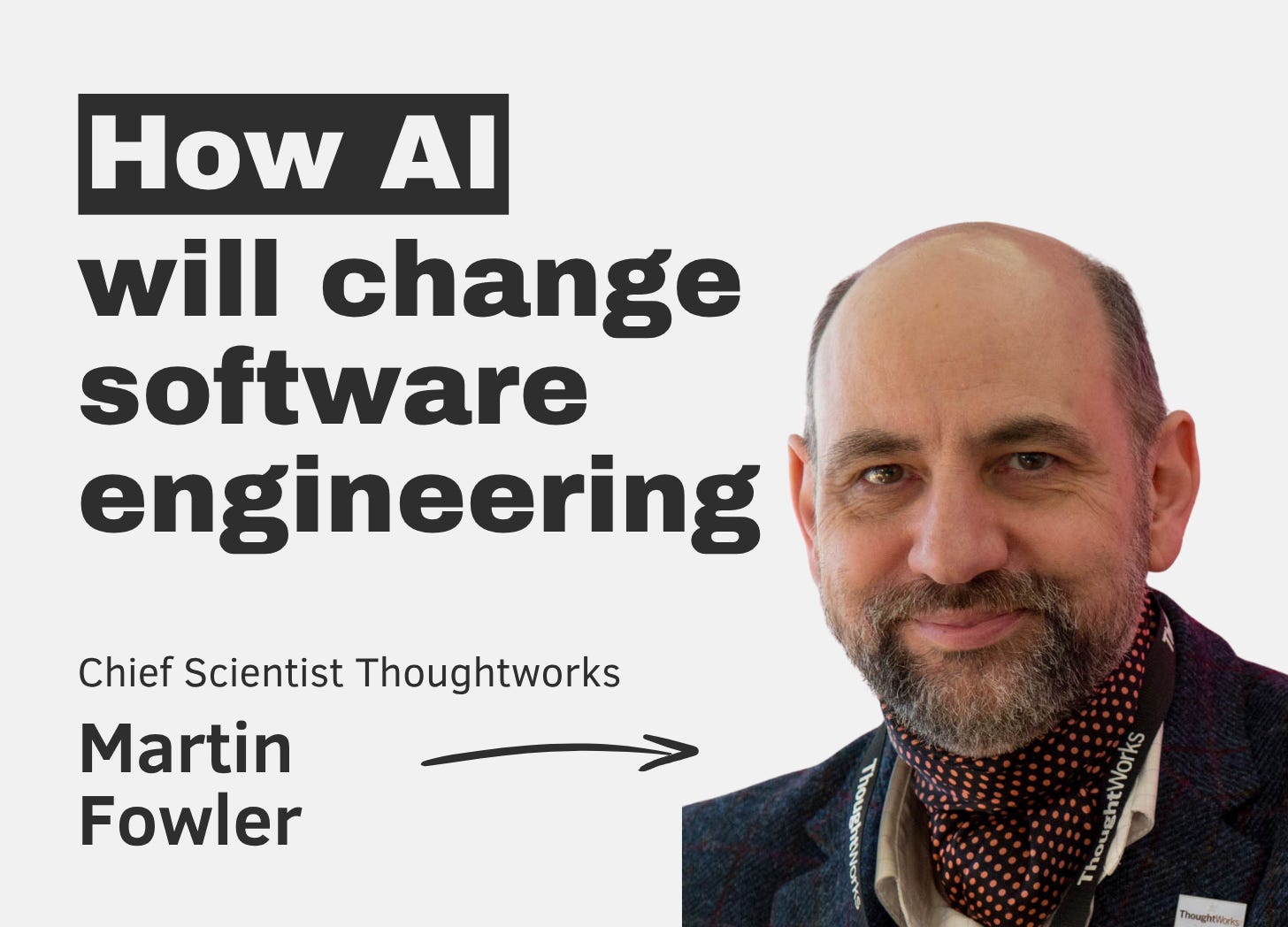
Loading summary
Transcript204 lines
- [00:00]
Host (possibly a tech podcast host)
What similar changes have you seen that could compare to some extent to AI in the technology field?
- [00:07]
Martin Fowler
It's the biggest, I think in my career. I think if we looked back at the history of software development as a whole, the comparable thing would be the shift from assembly language to the very first high level languages. The biggest part of it is the shift from determinism to non determinism and suddenly you're working in a non with an environment that's non deterministic, which completely changes.
- [00:25]
Host (possibly a tech podcast host)
Fda, what is your understanding and take on Vibe coding?
- [00:29]
Martin Fowler
I think it's good for explorations, it's good for throwaways, disposable stuff, but you don't want to be using it for anything that's going to have any long term capability. When you're using Vibe coding, you're actually removing a very important part of something which is the learning loop.
- [00:43]
Host (possibly a tech podcast host)
What are some either new workflows or new software engineering approaches that you've kind of observed?
- [00:47]
Martin Fowler
One area that's really interesting is Martin.
- [00:50]
Host (possibly a tech podcast host)
Fowler is a highly influential author and.
- [00:51]
Narrator/Announcer
Software engineer in domains like agile, software architecture and refactoring. He he is one of the authors of the agile manifesto in 2001, the author of the popular book Refactoring, and regularly publishes articles on software engineering on his blog. In today's episode we discuss how AI is changing software engineering and some interesting and new software engineering approaches. LLMs enable why refactoring as a practice will probably get more relevant with AI coding tools, why design patterns seem to have gone out of style the last decade, what the impact of AI is on agile practices, and many more. This podcast episode was presented by statsig, the unified platform for flags, analytics, experiments and more. Check out the show notes to learn more about them and our other seasoned sponsor. If you enjoyed the show, please subscribe to the podcast on any podcast platform and on YouTube.
- [01:35]
Host (possibly a tech podcast host)
So Martin, welcome to the podcast.
- [01:37]
Martin Fowler
Well, thank you very much for having me. I didn't expect to be actually doing it face to face with you. That was rather nice.
- [01:43]
Host (possibly a tech podcast host)
It's all the better this way. I wanted to start with learning a little bit about how you got into software development. Which was what, 40ish years ago?
- [01:52]
Martin Fowler
Yeah, it was. Yeah. It would have been late 70s, early 80s. Yeah, I mean, like so many things, it was kind of accidental really. At school I was clearly no good at writing because I got lousy marks for anything to do with writing. Really? Yeah. Oh absolutely. But I was quite good at mathematics and that kind of thing and physics. So I kind of leaned towards engineering stuff. And I was interested in electronics and things because the other thing is I'm hopeless with my hands. I can't do anything requires strength or physical coordination. So all sorts of areas of engineering and building things. You know, I've tried looking after my car and you know, I couldn't get the rusted nuts off or anything. You know, it was hopeless. So. But electronics is okay. Cause that's all very, you know, it's more in the brain than, you know, you need to be able to handle a soldering iron. But that was about as much as I needed to do. And then computers and it's a step easier. I don't even need the soldering iron. So I kind of drifted into computers in that kind of way. And that was my route into software development. Before I went to university, I had a year at working with the UK Atomic Energy Authority, or UKULELE as we call it. And I did some programming in Fortran 4. And it seemed like a good thing to be able to do. And then when I finished my degree, which was a mix of electronic engineering, computer science, I looked around and I thought, well, I could go into traditional engineering jobs which weren't terribly well paid and weren't terribly high status, or I could go into computing where it looked like there was a lot more opportunity. And so I just drifted into computing.
- [03:38]
Host (possibly a tech podcast host)
And this was before the Internet took off. What kind of jobs were there back then that. That you could get into? What was. And what was your first job?
- [03:46]
Martin Fowler
Well, my first job was with a consulting Coopers and Lybrand or as I refer to them, cheat em and lie to em. And we were doing advice on information strategy. The particular group I was with, although that wasn't my job, my job was I was one of the few people who knew UNIX because I'd done UNIX at college. And so I looked after a bunch of workstations that they needed to run this weird software that they were running to help them do their strategy work. And then I got interested in what they were doing with their strategy work and kind of drifted into that. I look back now and think, God, that was a lot of snake oil involved. But hey, it was my route into the industry and it got me early into the world of object oriented thinking. And that was extremely useful to get into objects in the mid-80s.
- [04:36]
Host (possibly a tech podcast host)
And how did you get into object oriented was back then back, we're talking probably the mid-80s. That was a very kind of radical thing. And you said you were working at a consulting company which didn't seem like the most cutting edge. So how does a two plus two get together? How did you get to do cutting edge stuff?
- [04:54]
Martin Fowler
Because this little group was into cutting edge stuff and they had run into this guy who had some interesting ideas, some, some very good ideas as well as some slightly crazy ideas. And he packaged it up with the term object orientation, which wasn't really, really the case, but it was, it kind of, you know, it's part of the snake oil, as it were. I mean that's a little bit cruel to call it snake oil because he had some very good ideas as well. But that kind of led me into that direction. And of course in time I found out more about what object orientation was really about. And that events led to my whole.
- [05:28]
Host (possibly a tech podcast host)
Career in the next 10 or 15 years. How did you make your way and eventually end up at ThoughtWorks? And also you started to write some books, you started to publish on the side. How did you go from like someone who was brand new to the industry and kind of wide eyed and just taking it all in, learning things to starting to slowly become someone who was.
- [05:46]
Martin Fowler
Teaching others well again, bundles of accidents, right? So while I was at that consulting company, I met another guy that they'd brought in to help them work with this kind of area. An American guy who became really the biggest mentor and influence upon my early career. His name is Jim Odell and he had been an early a doctor of information engineering and had worked in that area. And he saw the good parts of these ideas that these folks were doing. And he was an independent consultant and a teacher. And so he spent a lot of his time doing work along those lines. I left Coopers and Lybrand after about a couple of years to actually join this crazy company which is called P Tech. And I was with them for a couple of years. It was a small company. There was a grand total of four of us in the UK office and that was the largest office in the company.
- [06:43]
Host (possibly a tech podcast host)
Wow.
- [06:44]
Martin Fowler
Kind of thing. And so I did, I saw a bit of, you know, having seen a big company's craziness, I then saw a small company's craziness, did that for a couple of years and then I was in a position to go independent and I did, helped greatly by Jim o' Dell who fed me a lot of work basically and also by some other work I got in the UK and that was great. I remember leaving P Tech and thinking, that's it, independence, life for me, I'm never going to work for a company again.
- [07:18]
Host (possibly a tech podcast host)
Famous last words.
- [07:19]
Martin Fowler
Exactly. And I carried on. I did well as an independent consultant throughout the 90s and during that time I wrote my first books. I moved to the United States in 93 and I was doing very, very happily. And obviously you got the rise of the Internet, lots of stuff going on in the late 90s. It was a good time. And I ran into this company called ThoughtWorks and they were just a client. I would just go there and help them out. The story gets more common. I had had met Kent Beck and worked with Kent at Chrysler, the famous C3 project, which is kind of the birth project of extreme programming. So I'd worked on that, seen extreme programming, seen the Agile thing. So I'd got the object orientation stuff, I got the Agile stuff. And then I came to ThoughtWorks and they were tackling a big project, a big project for them at the time, still sizable. They had 100 people working on the project. So it's a sizable piece of work. And it was clearly going to crash and burn. But I was able to help them both see what was going on and how to avoid crashing and burning. And they figured out how to sort of recover from the, from the problem, but then invited me to join them. And I thought, hey, you know, join a company again maybe for a couple of years. They're really nice people. They're my favorite client. You know, I always thought of it as other clients would say, these are really good ideas, but they're really hard to implement. And while ThoughtWorks would say these are really good ideas, they're really hard to implement, but we'll give it a try. And they usually pulled it off. And so I thought, hey, with a client like that, I might as well join them for a little while and see what we can do. That was 25 years ago. Yeah.
- [09:05]
Host (possibly a tech podcast host)
And then fast forward today, your title has been for I think over a decade, Chief Scientist since I joined.
- [09:10]
Martin Fowler
That was my title since you joined.
- [09:13]
Host (possibly a tech podcast host)
So I have to ask, what does a Chief Scientist at ThoughtWorks do?
- [09:16]
Martin Fowler
Well, it's important to remember I'm chief of nobody and I don't do any science. The title was given because that title was used a fair bit around that time for some kind of public facing, ideas kind of person. If I remember correctly, Grady Butch was Chief scientist at Rational at the time, actually.
- [09:37]
Host (possibly a tech podcast host)
True.
- [09:38]
Martin Fowler
And there were other people who had that title. So it was a highfaluting, very pretentious title, but they felt it was necessary. It was weird because one of the things of ThoughtWorks at that time was you could choose your own job Title Anybody could use whatever job title they like. But I didn't get to choose mine. I had to take the chief scientist. One they didn't like titles like Flagpole or Battering Ram or Loudmouth, which is the one I most prefer.
- [10:06]
Host (possibly a tech podcast host)
And One thing that ThoughtWorks does every six months and the latest one just came out is the ThoughtWorks radar. And this latest radar, it just came out I think a few days ago. It's the.
- [10:16]
Martin Fowler
Just today it was launched, I think.
- [10:18]
Host (possibly a tech podcast host)
Actually it was today. So by the time this is in production, it will have been a few weeks. But it's actually really, really fresh. So I just looked at it and things that it lists, I'll just list a few things that I saw there. And the adopting, which is the ones that they recommend using pre commit hooks Clickhouse for database analytics Vllm this is for London LLMs on on cloud or on on Prem in a really efficient way for trialing Claude Code FastMCP, which is a framework for MCP servers. And they're also recommending a lot of different things related for example to AI and LLMs to assess. Can you share a little bit of how ThoughtWorks comes up with this technology radar? What's the process? And it feels very, very kind of on the pulse every time. Like it feels close to the pulse of the industry. And again, I talk with a lot of other people. How do people at thoughtworks stay this close to what is happening in the industry?
- [11:11]
Martin Fowler
Okay, well this will be a bit of a story. Okay, so it started just over 10 years or so ago. Its origin was one of the things that we've really pushed at ThoughtWorks is to have technical people, practitioners really involved of various levels of running the business. And one of the leaders of that was our former cto, Rebecca Parsons. So Rebecca became CTO and she said, I want an advisory board who will keep me connected with what's going on in projects. So she created this technology advisory board and it had a bunch of people whose job was to brief her as to what was going on. And we'd meet, you know, two or three times a year. She had me on the advisory board, not so much for that reason, but because I was very much sort of a public face at a company. She wanted me present and involved in that. And originally that was just our brief. We would just get together and we'd talk through this stuff. And then one of these meetings, Daryl Smith, who was actually her TA at the time technical assistant, he said, well, we've got all these projects going on. It Would be good to get some picture what kinds of technologies we're using and how useful they are and so as to better exchange ideas. Because we like so many companies, we struggle to percolate good ideas around enough. I mean, even then, when we're only just a few thousand, it struggled and we're 10,000 now. So yeah, it's hard. So we thought, okay, this is a nice idea. And he came up with this idea of the radar metaphor and the rings of the radar that we see today. And we had a little meeting and we created the radar. And it's a habit that if we do something for internal purposes, we try and just make it public. And that's always been a strong part of the ThoughtWorks ethos. It's part of why I'm there, of course, is we talk about everything that we do and we share everything. We give away our secret sauce all the time. So we did that and people were very interested and so we continued doing it. Now the process has changed a bit over time. At that original meeting, many of the people that were in the room were actually hands on, on projects advising clients all the time. Now as we've grown an order of magnitude, it's much harder to do that. And we've also created more of a process where people can submit blips, nominate them. A blip is a point on the radar, an entry. And they will go to somebody that either connected through geographically or through the line of business or technology or whatever and say, hey, we think this technology is interesting. They'll brief us a little bit about it. And then they brief the members of the. What's now called the Doppler Group. Because we make a radar. Yeah, I mean, we can be a bit loose with our metaphors at times. And then at the meeting we'll decide which of these blips to put on the radar and not. And obviously you get some cross pollination because somebody will say, oh yeah, I talked to somebody about this as well. And so it's very much this bottom up exercise. And that's how it's created now. So we will have these. We will do blip gathering sessions about a month or two before the radar meeting and gradually shake them up. And then in the meeting itself, we go through them one by one. And for me it's a bit weird because I'm so detached from the day to day these days that it's just this lineup of technologies and things. I have no idea what most of them are, but interesting to hear about. And sometimes I latch onto certain themes or something like that. And that was an important part of microservices about 10 years ago because that came up through that radar process and we got together with James Lewis and we ended up writing a good bit further about that. But that's really what happens is we go through this process of spotting this stuff.
- [14:53]
Host (possibly a tech podcast host)
Yeah. And the radar analogy, I know some companies also take the idea which by the way, ThoughtWorks encourages, say make your own radar, take it in your own company. You can, I think they even like have tools around it. I really like how thoughtworks never said like this is the thing for the industry. They said this is the thing for us. This is what we see, this is what we recommend our team, our team members or maybe our clients to consider. Or there's also. I like that there's a hold, maybe just beware we're not seeing great results with this and here's the reasons for it. And yeah, I guess the reason it feels fresh is probably a lot of work that ThoughtWorks does is it feels cutting edge because it's all about half of it or a third of it. Feels that it is around the hottest topic right now, AI LLMs and all the techniques that people are trying to see if they work or the things that we are seeing that actually starts to work.
- [15:44]
Martin Fowler
Yeah, thought. ThoughtWorks has basically got several thousand technologists all over the world doing projects of various kinds, all sorts of different organizations. And the radar is a mechanism that we've discovered is a way of getting some of that information out of their heads and spreading it around both internally and to the industry as a whole. And you're right, it is a recommended thing for clients to do is to try and do their own radars. It's slightly different when it's a client radar thing because sometimes there it can be more of a this is what we think you should be doing with a bit more of a forcefulness to it than we would give. And also they can be a bit more choosy in the sense of they can say, yeah, we're just not interested in doing certain technologies. Well, for us it's a case of if our clients are doing it, then we're going to find, find out about it. Right. We have to use it.
- [16:30]
Host (possibly a tech podcast host)
Of course the radar is full with a lot of AI and LLM related things because this is a huge change in my professional career. It feels by far the biggest technology innovation change that's coming in. Looking back on your career, what similar changes have you seen that could compare to some extent to AI in the technology field.
- [16:53]
Martin Fowler
It's the biggest, I think for my career. I think if we looked back at the history of software development as a whole, the comparable thing would be the shift from assembly language to the very first high level languages, which is before my time. Right. When first started coming up with COBOL and Fortran and the like, I would imagine that would be a similar level of shift.
- [17:12]
Host (possibly a tech podcast host)
So you started to work with Fortran and you probably knew people who were still doing assembly or at least knew some people from that generation.
- [17:19]
Martin Fowler
There was a bit of assemble around when I was working.
- [17:22]
Host (possibly a tech podcast host)
Still from what you picked up around that time, what was that shift like in terms of mindset or you know, like. Because it was a big change, right. You really needed to know the internals of the hardware and the instructions and the different. I did very little assembly at university, but it's been very useful because I never want to do it again.
- [17:42]
Martin Fowler
Very wise.
- [17:43]
Host (possibly a tech podcast host)
But what did you pick up in terms of what needed to change and how it changed the industry just moving from mostly assembly to mostly higher level languages?
- [17:51]
Martin Fowler
Well, I mean, for a start, as you said, things were very specific to individual chips. The instructions were different on every chip. The you know as well things like registers where you access memory. You had these very convoluted ways of doing even the simplest thing because your only instruction was for something like move this value from the memory location to this register. And so you've always got to be thinking in these very, very low level forms. And even the very relatively poor high level language like Fortran, at least I can write things like conditional statements and loops elsewhere is in my conditional statements in Fortran 4. But I can at least go if and I can get one statement. I can't do a block of statements. I have to use GOTOs. But you know, it's better than what you can do in assembly. Right. And so there's a definite shift of moving away from the hardware to thinking in terms of something a bit more abstract. And I think that is a very, very big shift. I mean, of course once I'm using Fortran, I can be insulated to some degree away from the hardware I'm running on. I'm now, am I running this on a mainframe? Am I running this on a minicomputer? I mean there's issues because the language is always varied a little bit from place to place, but you've got a degree of decoupling there that was really quite significant, I think. I mean I only did it on small microprocessor like units, because again, it was the electronic engineering part, right? So we were fairly close to the metal anyway for some of that. But you definitely had that mind shift and I think it's with LLMs it's a similar degree of mind shift, although as I've written about the interesting thing is the shift is not so much of an increase of a level of abstraction, although there is a bit of that. The biggest part of it is the shift from determinism to non determinism and suddenly you're working with an environment that's non deterministic which completely changes fdf. Think about it.
- [19:46]
Narrator/Announcer
Martin just talked about how AI is the most disruptive change since the move from assembly to high level languages. That transition wasn't just about changing the language we use, they required entirely new tool chains. Similarly, AI accelerated development isn't just about shipping faster, it's about measuring whether what you ship actually delivers value. That's where modern experimentation infrastructure comes in and where our presenting sponsor Statsic can help. With statsig, instead of stitching together point solutions, you get feature flags, analytics and session replay all using the same user assignments and event tracking. For example, you ship a feature to 10% of users as you do, the other 90% automatically become your control group. With the same event taxonomy, you can immediately see conversion rate differences between groups. Drill down to see where treatment users drop off in your funnel, then watch session recording of specific users who didn't convert to understand what went wrong. The alternative is running jobs between different services to sync user segments between your feature flag service and your analytics warehouse.
- [20:47]
Host (possibly a tech podcast host)
And then manually linking up data that.
- [20:49]
Narrator/Announcer
Might have different user identification logic. It's a lot of work and it.
- [20:53]
Host (possibly a tech podcast host)
Can also go wrong.
- [20:54]
Narrator/Announcer
Statsic has a generous free tier to get started and pro pricing for teams starts at $150 per month. To learn more and get a 30 day enterprise trial, go to static.compragmatic and now let's get back to the shift in abstraction with LLMs.
- [21:08]
Host (possibly a tech podcast host)
Can we talk about that shift in abstraction? Because one very naive or naive way of looking at is saying like well we've had the three levels, right? We have assembly where you have commands for the hardware, you need to be intimately aware of the hardware. We have high level programming languages starting with C Later Java, later JavaScript, where you don't need to be aware of the hardware, you're aware of the logic. And what you might say as well, we have a new abstraction is you have the English language which will generate this code. You're saying you don't think it's an abstraction jump. Why do you think this is?
- [21:44]
Martin Fowler
I think it is a bit of an abstraction jump. I think the abstraction jump difference is smaller than the determinism non determinism jump. And it's worth remembering one of the key things about high level languages which I didn't mention as I was talking about earlier on, is the ability to create your own abstractions in that language. That is particularly important as you get to things like object orientation towards more expressive functional languages like Lisp, which didn't really have so much, I mean Fortran and cobol, you could do that to some extent because at least with Fortran you can create subroutines and build abstractions out of that. But you've got so many more tools for building abstractions when you've got the abilities of more modern languages. And that ability to build abstractions is crucial.
- [22:25]
Host (possibly a tech podcast host)
So you can build a building block inside of the language that sets you. And of course here we have like domain driven development later enables these things and so on.
- [22:33]
Martin Fowler
Exactly. I mean an old Lisp adage is really what you want to do is to create your own language in Lisp and then solve your problem using the language that you've created. And I think that way of thinking is a good way of thinking in any programming language. You're both solving the problem and creating a language to describe the kinds of problems you're trying to solve in. And if you can balance those two nicely, that is what leads to very maintainable and flexible code. So the building of abstractions, that's I think to me a key element of high level languages and AI helps us a little bit in that because we can build abstractions a bit more easily, a bit more fluidly. But we have this problem and now we're talking about non deterministic implementations of those abstractions, which is an issue. And we've got to sort of learn a whole new set of balancing tricks to get around that. My colleague Unmesh Joshi has written a couple of things that I really been really enjoying about his thinking about how, because he's really pushing this, using the LLM to co build an abstraction and then using the abstraction to talk more effectively to the LLM and that I'm finding really, really interesting way of thinking about how he's working with that because he's really pushing that direction. There's a thing I read in and I can't remember the book off the top of my head. We'll have to dig it out later about Adams that talked about how apparently if you can describe to an LLM a whole load of chess matches and describe it just in plain English and the LLM, when you do that, the LLM can't really understand how to play chess. But if you take those same chess matches and describe the LLM to those chess matches in chess notation, then it can. And I thought that was really interesting that you. That by obviously you're shrinking down the token size because you. But you're also using a rigorous, a much more rigorous notation to describe the problem. So maybe that's an angle of how we use LLMs. What we have to come up is a rigorous way of speaking and we can get more traction that way. And of course that has great parallels in, with the ideas of domain driven design in ubiquitous languages and also some of the stuff that I was working on a decade or so ago around domain specific languages and language workbenches. So there's some fascinating stuff around there that'll be interesting to see how that plays out. Yeah.
- [24:56]
Host (possibly a tech podcast host)
And I guess is this the first time we're seeing a tool that is so widespread in software engineering that is non deterministic? Because we did have neural nets, for example, in the past. They were not. But they were more. I feel the application of those was a lot more kind of niche and not everywhere. Now every single developer is. I mean, if you're using co generation, you are using non deterministic things. Of course we're integrating them left and right, trying out where it works. Is it fair to say that this is probably the first time we're facing this challenge of deterministic computers, which we know very well, we know their limits and all those things. And of course there are some race conditions and some exotic things. But now we have exactly this problem to solve for.
- [25:36]
Martin Fowler
It's a whole new way of thinking. It's got some interesting parallels to other forms of engineering. Other forms of engineering, you think in terms of tolerances. My wife's a structural engineer, right. She always thinks in terms of what are the tolerances. How much extra stuff do I have to do beyond what the math tells me? Because I need it for tolerances. Because, yeah, I mean, I mostly know what the properties of wood or concrete or steel are. But I've got to go for the worst case. We need probably some of that kind of thinking ourselves. What are the tolerances of the non determinism that we have to deal with and realizing that we can't skate too close to the edge because otherwise we're going to have Some bridges collapsing. I suspect we're going to do that, particularly on the security side. We're going to have some noticeable crashes, I fear, because people have skated way too close to the edge in terms of the non determinism of the tools they're using.
- [26:25]
Host (possibly a tech podcast host)
Oh, for sure. But before we go into where we could crash, what are some either new workflows or new software engineering approaches that you've kind of observed or aware of that sound kind of exciting that we can now do with elems, or at least we can try to give them a goal that would have been impossible with our old deterministic toolkit.
- [26:44]
Martin Fowler
Right. One area is one that has got lots of attention already, is being able to knock up a prototype in a matter of days. That's just one way more than you could have done previously. So this is the vibe coding thing. But it's more than just that because it's also an ability to try explorations. People can go, hey, I'm not really quite sure what to do with this, but I can spend a couple of days exploring the idea much, much more rapidly than I could have before. And so for throwaway explorations for disposable little tools and things of that kind of, and including stuff by people who don't think of themselves as software developers, I think there's a whole area and we can with good reason be very suspicious of taking that too far because there's a danger there. But we also realize that as long as you treat that within its right bounds, that's a very valuable area. And I think that's really good on a completely opposite end of the scale. One area that's really interesting is helping to understand existing legacy systems. So my colleagues have put a good bit of work in this year or two ago and basically the idea is you take the code itself, do the essentially the semantic analysis on it, populate a graph database essentially with that kind of information, and then use that graph database as kind of in a rag like style and you can begin to interrogate and say, well, what happens to this piece of data? Which bits of code touch this data as it flows through the program? Incredibly effective. And in fact, if I remember correctly, we put actually understanding of legacy systems into the adopt ring because we said, yeah, if you're doing any work with legacy systems, you should be using LLMs in some way to help you understand.
- [28:34]
Host (possibly a tech podcast host)
So in this ring, in the ThoughtWorks radar, the fewest things are in the adopt Adopt, as we strongly suggest that you look at this at least you know ThoughtWorks themselves. Look at it, there's only four items and one of them is yes, to use genai to understand legacy code. Which to me tells that you have seen great success. Which is, it's refreshing to hear. By the way, I did not hear this as much and I guess it helps. At ThoughtWorks I'm sure you have to work with a lot of.
- [29:01]
Martin Fowler
Well, I mean it came from the fact that some of the folks who'd done some really interesting work on legacy code stuff happened to bump into and look at this and say, hey, let's try this out. And they found it to be very effective. And it also has been an ongoing interest for many of us at ThoughtWorks because we have to do it all the time. And how do you effectively work with the modernization of legacy systems? Because every big company that is older than a few years has got this problem.
- [29:29]
Host (possibly a tech podcast host)
Yeah.
- [29:29]
Martin Fowler
And they have it in spades.
- [29:31]
Host (possibly a tech podcast host)
And then especially just simple things people leave.
- [29:34]
Martin Fowler
Right.
- [29:35]
Host (possibly a tech podcast host)
As simple as that. And having Gen AI that can help you make some progress. It's already better than making no progress.
- [29:43]
Martin Fowler
Exactly. So those are two areas that are clearly right away, I would say those are there's great success using LLMs and then there's the areas that we're still figuring out. I mean I'm certainly seeing some interest more, more and more interesting stuff. As people try to figure out how to work with an LLM on a one to one basis to build decent quality software. We're seeing some definite signs of how you got to work with very thin, rapid slices, small slices. You've got to treat every slice as a PR from a rather dodgy collaborator who's very productive in the lines of code, sense of productivity. But you know, you can't trust the thing that they're doing. So you've got to review everything very carefully. When you play with the genie like that, the genie is Gus Kent's term for it. Or Dusty, the sort of the anthropomorphic donkey, which is how Birgitte.
- [30:36]
Host (possibly a tech podcast host)
Yeah, I love her take.
- [30:38]
Martin Fowler
Yeah. But using it well, you can actually definitely get some speed up in your process. It's not the kind of speed up that the advocates are talking about, but it is non trivial. It's certainly worth learning how to make some use of this. And it's folks like Birgitte or Kent or Steve Yeag. Those are the folks, I think who are pushing this. We're still, I think, learning how to do this.
- [31:03]
Host (possibly a tech podcast host)
Everyone is learning it. Absolutely.
- [31:05]
Martin Fowler
And it's still the question. And most of the experience we're gaining is building in a greenfield environment. So that leaves big questions in terms of a. The brownfield environment. Well, we know that LLMs can help us understand legacy code. Can they help us modify legacy code in a safe way? It's still a question. I mean, I was just chatting with James Lewis because he's in town as well this morning and he was commenting about. He was playing with Cursor and he was just building something like this and he said, oh, I wanted to change the name of a class in a not too big program. And he sets it off to do that and comes back an hour and a half later and has used 10% of his monthly allocation of tokens. And all he's doing is changing the name of a class.
- [31:49]
Host (possibly a tech podcast host)
And we actually, in ides we actually have functionality, which I still remember when I was cutting edge. This was probably 20 years ago when Visual Studio, it wasn't even Visual Studio, it was Jetbrains who came out with an extension called resharper which helped refactor code. And people paid serious money. This was like $200 per year or something to get this plugin. And now you could right click and say rename class. And it went. And it built that graph behind the scenes somehow it went and changed. You could rename variables and again, this was a huge deal. In fact, in xcode, Apple's developer ID for a while when Swift came out, you couldn't do these refactors and it was, you know, people were like, so it's interesting how some things are easy, we've solved it and LLMs are not very efficient at it and not very good at it. Yep.
- [32:37]
Martin Fowler
Yes. And then, I mean, he did that just to see what it was going to be like. Right, because he knows you can just. I mean, we've had this technology for a long time, so it's kind of amusing. I mean, but it's also to the point that when working with an existing system and modifying an existing system that's still are really up in the air and then another area that's really up in the air, both Greenfield and brownfield, is what happens when you've got a team of people. Because most software has been built by teams and will continue to be built with teams. Because even if, and I don't think it will, AI makes us order of magnitude more productive. We still need a team of 10 people to build what a team of 100 people needed to build. And we'll always want this stuff. There's no sign of demand dropping for software so we will always want teams. And then the question is, of course, how do we best operate with AI in the team environment? And we're still trying to figure that one out as well. So there's lots of questions, we got some answers, some beginnings of answers, and it's just a fascinating time to watch it all.
- [33:37]
Host (possibly a tech podcast host)
You mentioned Vibe coding. What is your understanding and take on Vibe coding?
- [33:43]
Martin Fowler
Well, when I use the term Vibe coding, I try to go back to the original term, which is basically you don't look at the output code, maybe, you know, take a glance at it out of curiosity, but you really don't care. And maybe you don't know what you're doing because you've got no knowledge of programming. It's just spitting out stuff for you. So that's how I define Vibe coding. And my take on it is kind of as I've indicated. I think it's good for explorations, it's good for throwaways, disposable stuff, but you don't want to be using it for anything that's going to have any long term capability because, I mean, again, this is a silly anecdote, but I was working my colleague Unmesh, he just wrote something that we published yesterday. And as part of doing this, we create this little pseudograph of capability over time kind of thing, which is one of those silly little pseudo graphs that helps illustrate a point. And he asked AT LLM to create this. He described the curves he wanted and came up with the album, put it up there, and he committed it to our repo. And I was looking at it and thinking, yeah, that's a good enough graph. I want to tweak it a little bit. The labels are a bit far away from the lines they're labeling, so I like to bring them closer. So I open up the SVG of what the LLM has produced. I mean, it was astonishingly how complicated and convoluted it was for something that I had written the previous one myself. And I knew it was, you know, a dozen lines of svg. And SVG is not exactly a compact language, right, because it's xml. But this thing was gobsmackingly weird. And I mean, that's the thing. When you Vibe code stuff, it's gonna produce God knows what, and often it really is, and you cannot then tweak it a little bit. You have to basically throw it away and hope that you can generate whatever it is you're trying to tweak. And the other thing, of course, that's a difference. And this is the heart of the article that Unmesh wrote that we published yesterday, is when you're using Vibe coding in this kind of way, you're actually removing a very important part of something, which is the learning loop. If you're not looking at the output, you're not learning. And the thing is that so much of what we do is we come up with ideas, we try them out on the computer. With this constant back and forth between what the computer does with what we're thinking, we're constantly going through that learning loop program approach. And Nunmesh's point, which I think is absolutely true, is you cannot shortcut that process. And what LLMs do, they just kind of skim over all of that, and you're not learning. And when you're not learning, that means that when you produce something, you don't know how to tweak it and modify it and evolve it and grow it. All you can do is nuke it from orbit and start again. The other thing I've done occasionally with Vibe coding is, oh, Vibe coding as a consulting company. So many problems to fix.
- [36:39]
Host (possibly a tech podcast host)
For sure. But you are right on the learning, the learning side, both on Vibe coding and AI. One thing that I'm noticing on myself is it is so easy to give a prompt. You get a bunch of output, and, you know, you should be reviewing a lot of this code, either yourself or in a code review. But what I'm seeing on myself is I'm, at some point I start to get a bit tired, and I just let it go. And this is also what I'm hearing when talking with software engineers is the ones who are working at companies which are adopting these tools, which is pretty much every company. There's a lot more code going out there, a lot more code to review, and they're asking, how can I be vigorous at code reviews when there's just more and more of them than before? Have you seen approaches that help people, both less experienced people and also more experienced engineers, keep learning with these tools? Just approaches that seem promising, Not a huge amount.
- [37:37]
Martin Fowler
I do. I am very much paying attention to what Unmesh is doing with this, because his approach very much is that notion of, let's try and build a language to talk to the LLM, work with the LLM to produce a language to communicate to the LLM more precisely and carefully what it is that we're looking for. And I do feel that is a promising and very much a more promising line attack. We should have to create our own specialized language for Working with whatever problem that we're working on. And I think that actually brings another. When we were talking about things we know, LLMs are useful for another thing, and this is again, something Unmesh has highlighted, is understanding an unfamiliar environment. Again, I was chatting with James. He was working with. He's working on a Mac with C, which is not a language he's terribly familiar with, using this game engine called Godot. Godot, yeah.
- [38:33]
Host (possibly a tech podcast host)
Yeah.
- [38:34]
Martin Fowler
And he doesn't know anything about this. Right. But with the LLM, he can learn a bit about it because he can try things out. And if you take it with that exploring sense. And I mean, I do. I mean, I can't remember. I've certainly got to the point where I'm typing in to the ll, oh, well, how do I do so and so in R? But I've done 20 times, but I still can't remember how to do it. And exploring. And Umesh makes a point again, setting up initial environments. You know, give me a starting project, a sample starting skeleton project so it can just get moved. And so that kind of exploratory stuff and helping in an unfamiliar environment and just learning your way around an unfamiliar set of APIs and coding ideas and the like. It can be quite handy for.
- [39:20]
Host (possibly a tech podcast host)
I wonder if this is not all that new in the sense that I remember. You know, one of the last kind of big productivity boosts in the industry about 10 or 15 years ago was Stack Overflow appearing. So before Stack Overflow, when you Googled for questions, you bumped into the site called Experts to Change and there was the question and you had to pay money to see the answer, or you had to pay money to get an expert answer. But usually there was nothing behind it, even if you paid. And most of us, I was a college student, I just didn't pay.
- [39:49]
Martin Fowler
Right.
- [39:49]
Host (possibly a tech podcast host)
So you just couldn't find the answer and you were all frustrated. But then Stack Overflow came along and suddenly you had code snippets that you could copy. And of course, what a lot of young people or less experienced developers, even like myself did is you just take the code, put it in there and see if it works. As you got to more experienced engineers or developers, you started to tell junior engineers, like, you need to understand that first, or even if it works, you need to understand why it works, you should read the code. And I feel there was a few years where we were going back and forth of people mindlessly copying pasting snippets. There were problems with. I think there was a question about Email validation and a top voted answer was not entirely correct. And turns out that a good part of software and developers just use that one. I feel we kind of been around this already.
- [40:38]
Martin Fowler
Yeah, it's a similar kind of thing.
- [40:39]
Host (possibly a tech podcast host)
But maybe at a smaller scale.
- [40:41]
Martin Fowler
Yeah, but even more boosted and on steroids. And with the question of how are things going to populate in the future? Because who's going to be writing stack overflow answers anymore?
- [40:51]
Host (possibly a tech podcast host)
Yeah. So I wonder if what we're getting to is you need to care about the craft. You need to understand what the LLM's output is and is there to help you. And if you're not doing it, I mean you should, but if you're not, you'll eventually be no better than someone just prompting it mindlessly.
- [41:09]
Martin Fowler
Exactly. Yeah. I have no problem with taking something from the LLM and putting it in to see if it works. But then once you've done that, understand why it works as you say. And also look at it and say, is this really structured the way I'd like it to be? Don't be afraid to refactor it, don't be afraid to put it in. And then of course the testing combo, anything you put in that works, you need to have a test for. And if you constantly are doing that back and forth with the testing process.
- [41:39]
Narrator/Announcer
Martin Fowler was just talking about the importance of testing when working with LLMs and in general when building quality software. Speaking of quality software, I need to mention our season sponsor, Linear. I recently sat on one of Linear's internal weekly meetings called Quality Wednesdays and I was completely blown away. This was a 30 minute meeting that happens weekly. In this session, the team went through 17 different quality improvements in half an hour. 17. It's a fast and super efficient meeting. Boom, boom, boom. Every developer shows a quality improvement or performance fix that they made that week. And it can be anything from massive backend performance wins that saved thousands of dollars to the tiniest UI polish that most people wouldn't even notice. For example, one fix was fixing the height of the compose window very slightly changing when you enter the new line. Another one was fixing this one pixel misalignment. Can you imagine caring that much about about the details after doing this every.
- [42:31]
Host (possibly a tech podcast host)
Single week for years?
- [42:32]
Narrator/Announcer
Their entire engineering team has developed this incredible eye for quality. They cached these issues before they even ship. Now one of their engineers told me that since they trained this muscle over time, they start noticing patterns while building stuff so fewer of these paper cuts ship in the first place. This is why Lenire feels so different for other issue tracking and project management tools, thousands of tiny improvements do add up and you feel the difference. When you use Linear, you're experiencing the results of literally hundreds of these Quality Wednesday sessions. Thomas, their cto, recently wrote a piece about this wiki ritual and I'll link it in the show notes below. If your team cares about craftsmanship and building products that people actually love using, check out Linear at Linear App Pragmatic. Because honestly, after seeing how they work up close, I understand why so many of the best engineering teams are switching and now let's get back to the importance of testing when working with LLMs.
- [43:24]
Martin Fowler
One of the people I particularly focus on in this space is Simon Willison, and something he stresses constantly is the importance of tests. Testing is a huge deal to him and being able to make these things work. And of course Birgitte is from ThoughtWorks. We're very much an extreme programming company, so she's steeped in in testing as well, so she will say the same thing. You've got to really focus a lot on making sure that the tests work together. And of course this is where LLMs struggle because you tell them to do the tests and I'm only hearing problems or experiencing them myself. Like when the LLM tells me, oh, and I ran all the tests, everything's fine. You got NPM test five failures.
- [44:06]
Host (possibly a tech podcast host)
Yeah, I see some improvements there by the way, with clock code also like other agents, but yes, it's the non deterministic angle. Sometimes they can lie to you, which is weird. I'm still not.
- [44:17]
Martin Fowler
They do lie to you all the time. In fact, if they were truly a junior developer, which is how sometimes people like to say they should be characterized, I would be having some words with hr.
- [44:27]
Host (possibly a tech podcast host)
Yeah, the other day I just had this really weird experience which is the simplest thing. I have a configuration file where I add just new items, a new JSON blob and I put the date of when I added it just in the comments saying added on October 2nd, added on November 1st. It's always a current date. And I told the LLM, can you please add this configuration thing and add the current date? And it added it and it added. It just copied the last date. And I said that is not today's date. I said oh I'm so sorry, you know, let me correct that for you. And it put yesterday's date and I feel you need to get this experience to see that it can gaslight you for a simple thing of today's date, which you know you know, you could call a function whatnot, but it's down to which. Who knows which model I was using, how that model works, whether the company creating it is optimizing for token usage or not, etc. Etc. Etc. So like, in the end, even for the simplest things, you are as a, when you're a professional working on important stuff, you should not trust it.
- [45:31]
Martin Fowler
Yeah, absolutely never. Yeah, you've got to don't trust, but do verify, Verify.
- [45:37]
Host (possibly a tech podcast host)
Yes. Speaking with developers at ThoughtWorks and the people you're chatting with, what are areas that they are successfully using LLMs day to day? Though, like we did mention just right now, testing, we also mentioned things like prototyping, but do you see some other things where it's starting to become a bit of a routine? Like if I'm doing this thing, let me reach for an LLM, it can probably help me that.
- [46:02]
Martin Fowler
Yeah, I mean, I've mentioned many of that.
- [46:05]
Host (possibly a tech podcast host)
Right.
- [46:05]
Martin Fowler
The prototyping, the legacy code, understanding the fact that you can use it to explore new technology areas, potentially even new domains, as long as you, you know, you trust it significantly less than you would trust Wikipedia 10 years ago. Those are the things that I'm hearing so far.
- [46:25]
Host (possibly a tech podcast host)
Yeah. One interesting area that Birgitta is exploring is spec dividend development. There's this idea of what. Well, you know, LLMs have their own limitations, but what if we define pretty well what we want it to do and give it this like really good specification and you know, it can run with it, it can run long, it has iterations and so on. What is your take on this? And do you have a bit of a deja vu? Because we've heard this once, right? Your career started around this thing called waterfall development. So how are you seeing it similar but also different this time?
- [46:58]
Martin Fowler
Well, the similar to waterfall is where people try and say let's create a large amount of spec and not pay much attention to the code. And here, I mean, whether you talk about, again, this is what you mean by spec dividement, is it so much focusing on that or is it doing small bits of spec? Do the tight loop? I mean, to me the key thing is you want to avoid the waterfall problem of trying to, to build the whole spec. First it's gotta be do the smallest amount of spec you can possibly get to make some forward progress, cycle with that, build it, get it tested, get it in production if possible, and then cycle with these thin slices. What role a spec may play to drive in either case could be argued to be a spec form of Spec driven development. But to me what matters is the type, the tight loops, the thin slices, that kind of thing. And I know Biggie to definitely agrees on that point. And you have to be the human in the loop, verifying every time that's clearly crucial, where the spectrum development then ties in. Interesting. Again, it comes back to this thinking of building domain languages and domain specific languages and things of that kind. Can we craft some kind of more rigorous spec to talk about? And I mentioned what the wooden masher was doing there, using it to build an abstraction. Because eventually what we're saying is that it gives us the ability to build and express abstractions in a slightly more fluid form than we would be able to do if we were building them purely within the code base itself. But we still don't want them to deviate too much from the code base.
- [48:34]
Host (possibly a tech podcast host)
Right.
- [48:34]
Martin Fowler
We still want the ubiquitous language notion that it's the same language in our head as is in the code and we're seeing the same names and they're doing the same kinds of things. The structure is clearly parallel, but obviously the way we think is a bit more flexible than the way the code can be. And then can we blur that boundary a bit by using the LLM as a tool in that area? So that's the area that I think is interesting in that direction.
- [49:00]
Host (possibly a tech podcast host)
It's interesting as new because I feel we've never been able to use language as close to representing code ever. Or like business logic. And this is very new.
- [49:11]
Martin Fowler
Yeah. Although again, there are plenty of people who take that kind of DSL like thinking into their programming. And I would, I know people who would say, yeah, I would get to the point where I could write certain parts of the business logic in, you know, a programming language like say Ruby, and show it to a domain expert and they could understand it. They wouldn't feel the ability to be able to write it themselves, but they could understand it enough to point out whether what was wrong or what was right in there. And this is just programming code. But it. That requires a certain degree of the way you go about projecting the language in order to be able to get that kind of fluidity. But that kind of thinking, trying to make an internal DSL of a programming language, or maybe building your own external.
- [49:57]
Host (possibly a tech podcast host)
DSL and DSL meaning domain specific language. If you're working with accountants, you're going to have the terms that they use, the way they use it and so on.
- [50:07]
Martin Fowler
Yeah. And what you're trying to do, of course, is create that communication route where a non Programmer can at least read what's going on and understand it enough to be able to find what's wrong about it and to suggest changes which may not be syntactically correct, but you can easily fix them because as a programmer you can see how to do that. And that's the kind of goal. And some people have reached that goal in some places. So the interesting thing is whether LLMs will enable us to make more progress in that direction and see that happening more widely.
- [50:41]
Host (possibly a tech podcast host)
And I guess this must be, I'm just assuming, correct me if I'm wrong, this must be especially important to enterprises, these very large companies where software developers are not the majority of people, let's say they're 10 or 20% of staff and there's going to be accounting, marketing, special business divisions who all want software written for them and they know what they want. And historically there's been layers of people translating this. May that be the project manager, the technical, et cetera. So you're saying that there could be a pretty interesting opportunity or just an experiment with LLMs, that maybe we can make this a bit easier for both sides.
- [51:18]
Martin Fowler
That is the world I'm most familiar with. Right, it's that world. My sense is you're very familiar with the big tech company and the startup worlds, but this corporate enterprise world, of course is a whole different kettle of fish because. Exactly the reason that you said suddenly the software developers are a small part of the picture and there's very complex business things going on that we've got to somehow interface in. And of course also there's usually a much worse legacy system problem as well.
- [51:48]
Host (possibly a tech podcast host)
And there's going to be regulation, there's going to be a history, there's going to be exceptions because of all the knowledge. I think we can all just think of banks, of all the things. Because there's perfect Storm, right? They have regulation that changes all the time. They have incidents that they want to avoid going future. They'll have special vip, I don't know, accounts or whatever that they'll want to do. And of course they have all these business units that all know their own rules and frameworks and they've been around since before technology. Some of the banks have been around for 100 plus years.
- [52:17]
Martin Fowler
Yeah, and remember, the banks tend to be more technologically advanced than most other corporations in software. You're looking at the good bit when you're talking about banks.
- [52:30]
Host (possibly a tech podcast host)
You have worked with some of the less advanced folks as well.
- [52:33]
Martin Fowler
I mean retailers, airlines, government agencies, things of that kind. I mean it was interesting. I was chatting with some folks working in the Federal Reserve in Boston, and they have to be extremely cautious. They are not allowed to touch LLMs at the moment because the consequences of error when you're dealing with a major government banking organization are pretty damn serious. So you've got to be really, really careful about that kind of stuff. And their constraints are very different. And it brought to mind there's an adage that says that to understand how the software development organization works, you have to look at the core business of the organization and see what they do. Interestingly, I was at this Agile conference in the Federal Reserve in Boston and they took me a tour of the Federal Reserve, but where they handle the money. And so I saw the places where they bring in the notes that have been brought in from the banks and they kind of clean them and count them and all the rest of it and send out the stuff again. And you look at the degree of care and control that they go through. And as you can imagine, I mean, when you're bringing in huge wadges of cash and it has to be sorted and counted and all the rest of it, the controls have to be really, really strenuous. And you look at that and you look at the care with which they do all of this and you say, yep, I can see why in the software development side that mindset percolates because they are used to the fact that they really have to be careful about every little thing here. A lot of corporations, of course, have that similar notion. You're involved in an airline, you are really concerned about safety, you're really concerned about getting people to. That affects your whole way of thinking, or ought to, and it does.
- [54:22]
Host (possibly a tech podcast host)
And I guess this is a reason we are clearly seeing, we always see a divide in technology usage because you have the startups, which is a group of people, they just raised some funding, or they have no funding, they have nothing to lose, they have zero customers, they have everything to gain. They need to jump on the latest bandwagon, they want to try out the latest technologies, oftentimes build on top of them, or sell tools to use the latest technology. And they're here to break the rules. And midway, when you start to have a few customers in a business, you're starting to be a bit more careful. And of course, 50 or 70 years down the road, when the founders have gone and now it's a large enterprise, you will just have different risk tolerance. Right?
- [55:02]
Martin Fowler
Exactly.
- [55:03]
Host (possibly a tech podcast host)
But what I find fascinating talking about this, that I'm unsure if there has been any new technology that has been so rapidly adopted everywhere. You mentioned that let's say the Federal Reserve or some other government organizations might say, let's not touch this yet, but they are also evaluating it sounds like. So if they're, you know, they're one of the most, I guess behind in the technology curve for very good reason, they're already aware of it or using it. It just probably means that it's everywhere now.
- [55:30]
Martin Fowler
Oh, it is. I mean, it is. I mean we see it all over the place. But again, with more caution in the enterprise world where they're saying, yeah, we also see the dangers here.
- [55:41]
Host (possibly a tech podcast host)
And then you're seeing kind of more nimble companies that you work with and the more enterprise focused. What would you say that is the biggest difference between their relationship of AI, their approach? Is it this caution or are there other characteristics that the big, more traditional, more risk averse companies approach it differently?
- [55:59]
Martin Fowler
The important thing to remember with any of these big enterprises is they are not monolithic. So it'll be small portions of these companies can be very adventurous and other portions can be extremely not so. And so what you'll see is small. I mean, like, you know, when I started at Cheetahman Lightoworm, right. And I was in this little bit that was being very, very aggressively doing really wacky things. Right. I mean you'll find that in any big organization you'll find some small bits doing some stuff. And so it's really the variation within an enterprise often is bigger than the variation between enterprises.
- [56:35]
Host (possibly a tech podcast host)
Good to keep that in mind. So Speaking about refactoring, LLMs are very good at refactoring. And you've written the book back in 1999 called Refactoring. This is now the second edition, which 20 years later it's been refreshed and it's actually a really detailed book Going through different coat smells that could show where the code is. Techniques of refactoring it on the first page already I really like this. It has a list of refactorings on. I don't know how the publisher printed this because it's so unusual, but it's right here on the table of contents. Why did you decide to write this book back in 1999? Can you bring us back on what the environment was like and what was the impact of the first edition of this book?
- [57:17]
Martin Fowler
Okay, so I first came across refactoring at Chrysler when I was working with Kemp Beck, right Early on in the project. I remember in my hotel room, the courtyard or Whatever in Detroit, him showing me how he would refactor some small talk code. And what. I mean, I was always someone who liked going back to something I'd already written and make it more understandable. I've always cared a lot about something being comprehensible. That's true in my prose writing and in my software writing. And so that I knew. But what he was doing was taking these tiny little steps. And I was just astonished at how small each step was. But how. Because they were small, they didn't go wrong. And they would compose beautifully, and you could do a huge amount with a sequence of little steps. And that really blew my mind away. I thought, wow, this is a big, big deal. But Kent was, at the time, his energy was to write the first extreme programming book, the White Book. He didn't have the energy to write a refactoring book. So I thought, well, I'm gonna do it then. And I started by. Whenever I was refactoring something, I would write careful notes, and partly because I needed it for myself. How do I extract a method so as I don't screw it up? And so I would write careful notes on each one, and then each of those turn the mechanics in the refactoring book would be that step. And then I'd make an example for each one. And that was the first edition in a book. And I did it in Java, not in Smalltalk, because Smalltalk was dying, sadly. And Java was the language of the future, the only programming language we'd ever need in the future, in the late 90s. And so that's what led to the first book and the impact. Well, I mean. And the Gorseau refactoring, I should also stress it wasn't invented by Kent. I mean, it was very much developed by Ralph Johnson's crew at University of Illinois, Urbana Champagne. They built the first refactoring browser in Smalltalk, which is the first tool that did the automatic refactoring. So we talk about now, that was the original. The refactoring browser built by. I'm blanking on. John Brandt and Don Roberts did that. And then when the book came out, that got more interest. There was already some interest from the IBM Visual Age folks because they came out of SmallTalk. The original versions of Visual Age were in fact built in Smalltalk. And so they were already aware of what was going on to some degree. But it was the Jetbrains folks that really caught the imagination because they put it into the early versions of IntelliJ IDEA and really ran with it and then you ran into it with Resharper of course. And they really made the automated refactorings become something that people could rely on. But it's still good to know how to do them yourself because often you're in a language where you haven't got those refactorings available to you. So it's nice to be able to pull out that stuff and some of them aren't obviously in there. And yeah, so the impact it's had is refactoring became a word and of course like all of these words got horribly misused and people use refactoring to mean any kind of change to a program which of course it isn't because refactoring is very strictly these very small semantics, behavior preserving changes that you make tiny, tiny steps. I always like to say each step is so small that it's not worth doing, but you string them together and you can really do amazing things with it.
- [60:41]
Host (possibly a tech podcast host)
I, I think we've all had that story. At least I had the story where one of my colleagues, or it could have been me, but oftentimes one of my colleagues would say like, oh, it's stand up saying like, oh, I'm just going to do a refactoring. And then next day oh, I'm still doing the refactoring. Next day oh, I'm still doing the refactoring. And you know, that missed a part of the small changes for sure. What made you do a second edition for the book 20 years later in 2019, which was fairly recent?
- [61:08]
Martin Fowler
Well, it was a sense of wanting to refresh some of the things that were in it. There were some new things that I had. I was also concerned that, I mean when you've got a book that's Written in late 1990s Java, it shows its age a bit.
- [61:24]
Host (possibly a tech podcast host)
Yes.
- [61:25]
Martin Fowler
And although the core ideas I felt were sound and people could still use it, I felt you coming giving it a more doing it in a more modern environment. And then the question was, would I stay with Java or did I switch to another language? And in the end I decided to switch to JavaScript. I felt it would reach a broader audience that way and also allow a less object oriented, centered way of describing things. So instead of extract method, it's extract function because of course it's the same process for functions and also some things that you wouldn't necessarily think of doing in an object oriented language. But it was mainly just to get that refresh to redo the examples, to really hopefully give it another 20 years of life because it's got to keep me going until I croak.
- [62:11]
Host (possibly a tech podcast host)
Yeah. So you published this book 25 years ago or 26 years ago in the industry, based on your interactions with developers, how has the perception of refactoring changed? Because in the book you specifically wrote that you see refactoring as a key element in the software development life cycle. And you've also talked about how when you refactor, the overall cost of changing code over time can be a lot cheaper. Was there a time where there was a lot more uptake on this? Or is there still? Or do you feel it's kind of like a little bit like being maybe refactoring went a little bit out of style as some of those really innovative tools at the time, like Jetbrains and others, they're maybe not as kind of referenced, even though they're everywhere.
- [62:56]
Martin Fowler
It's hard to say for me because, I mean, again, most of the interaction I have is with folks at ThoughtWorks. They tend to be more clued up with this kind of stuff than the average developer. Certainly I read plenty of things on the Internet that make me just shake my head at how even refactoring is being described, let alone the lack of doing it, and certainly in the kind of structured way, controlled way. But I like to do it because I like doing it quickly and effectively. And it's one of those things where the disciplined approach actually is faster. Even though it may seem strange to describe it that way, but I mean, I have to. It's at least been part of our language now. People talk about doing it, it's in these tools, and they do it very effectively, the refactorings that they do. I mean, it's wonderful to work in an environment where you can actually automatically do so many of these things. And so I feel we've definitely made some progress. Maybe not as much as I'd have hoped for, but, you know, that's often the way with these things.
- [63:54]
Host (possibly a tech podcast host)
Looking ahead with AI tools, they generate a lot more code a lot faster. So we're just going to have a lot more code. We already have a lot more code.
- [64:00]
Martin Fowler
Right.
- [64:01]
Host (possibly a tech podcast host)
How do you think the value of refactoring, thinking about your intended meaning of those small ongoing changes is going to be important? And are you already seeing some of this being important?
- [64:12]
Martin Fowler
I wouldn't say I'm already seeing it, but I can certainly expect it to be increasingly important because again, if you're going to produce a lot of code of questionable quality, but it works, then refactoring is a way to get it into a better state while keeping it working. These tools at the moment can't definitely refactor on their own, although we've combined with other things. Adam Thornhill does some interesting stuff with combining LLMs with other tools to be able to get a much more effective route. And I think that kind of approach, combining could be a good way to do it. But definitely the refactoring mindset and thinking how do I make changes by basically boiling them down to really small steps that compose easily. That's really the trick of it, the smallness and the composability. Combine those two and you can make a lot of progress.
- [65:10]
Host (possibly a tech podcast host)
That's interesting because right now if you want to refactor, you need to have your IDE open for sure. And I mean the fast way is just using the built in tools or you moving things around. What I found as well is describing it. When I have a command line open with like cloth code or something similar, it's tough where I spend more time explaining it than me doing that small change. And I do wonder if we will see more integrations in this end as well so that LLMs can actually do it or some of them might do it automatically because as you say, it doesn't work out of the box. But I think for any quality software that, I mean, we all learn the hard way that if you just kind of leave it there and don't go back and don't change it up, when your functions get just the simple things right, when your function gets too long, when your class gets too long, you break it up, otherwise you're not going to understand it later.
- [65:59]
Martin Fowler
Yeah, it'll be interesting as well to see if it provides a way for us to control the tool. I mean, one of the things that interests me is where people are using LLMs to describe queries against relational databases that turn into SQL. You don't know how to get the SQL right, but if you type the thing at the LLM it will give you back the SQL and you can then look at it and say, oh, this is right or not right and tweak it and it gets you started, right. And so similarly with refactoring, it may allow you to get started and say, oh, these are the kinds of changes I'm looking at and be able to make some progress in that. I mean, particularly where you're talking about these automated changes across large code bases. There was an example of this, was it a year ago or so, one of these big companies talked about this massive change they'd made to change APIs and clean up the encoder and they mentioned it as an LLM thing, but it wasn't an LLM. It was that different tool. And I'm completely blanking on what the names of all of these things were. Oh, to have a 60 year old brain and can't be able to remember anything anymore. It'll come to me at some point. But actually it was a combination of maybe 10% LLM and 90% this other tool. But again provided that extra leverage that allowed them to make the progress. I think those kinds of things are really quite interesting. Using the LLM as a starting point to drive a deterministic tool and then you're able to see what the deterministic tool is doing. That's I think, where there's some interesting information to play.
- [67:31]
Host (possibly a tech podcast host)
Speaking about going on from refactoring to software architecture, you were very busy writing books around the early 2000s. You wrote the book Patterns of Enterprise application architecture in 2002. And this was a collection of more than 40 patterns. Things like Lazy Load, Identity, Map, Template View and many others. And I remember around this time there was your book about enterprise architecture patterns. There was also the Gang of Four book. There was a lot of talk when I was interviewing around that time on interviews, they were asking me questions about how to do a factory pattern and singleton and all of these things software architecture was talked about. My sense was in a lot of places or a lot more. Then something happened. Some things starting from the 2010s. I no longer hear most technologists talk about patterns or architecture patterns. How have you observed this period of when the book came out? What was the impact of it and why was it important to talk about it and put it into the industry? And how have you seen this change of where we stopped talking more on patterns and why do you think it happened?
- [68:41]
Martin Fowler
Yeah, I mean, I've always found it. I mean, what you're doing with patterns is you're trying to create a vocabulary to talk more effectively about these kinds of situations. I mean, it's just like in the medical world they come up with this jargon in Greek and Latin to more precisely talk about things that are quite involved and complex.
- [69:03]
Host (possibly a tech podcast host)
Yes.
- [69:03]
Martin Fowler
And with patterns, what we're trying to do is trying to evolve that same kind of language, except we're not doing it in Greek and Latin. I certainly feel that they do help communication flow more effectively once people are familiar with that terminology. I mean, you don't look at them as some kind of how many of them can you cram into the system you're building? It's more a sense of how can you use it to describe your alternatives and the options that you have and also think more about when to apply things or not apply them. I mean, patterns are only useful in certain contexts, so you very much got to understand the context of when to use them. And yeah, it's kind of a shame that some of the wind has gone out of the sails of that perhaps because people were overusing them in terms of trying to use them as a sort of like pinning medals on a chest. But it can still be very. I mean, I mean, I worked very recently with Unmesh on his book on patterns in distributed systems. And I felt that was a very good way of coming up with, again, a language to describe how we think about the core elements and better gain an understanding of how distributed systems work, which is an important aspect of how to deal with life these days because we're all building these kinds of distributed systems. So I still feel that they can be a very good way of expressing that. It's hard for me to get a sense of why they kind of became less fashionable. Maybe they'll become more fashionable again, who knows? But I'm always looking for ways to try to spread knowledge around and make things more understandable. And I do feel that this idea of trying to identify these, create these nouns that we can talk about things more precisely is a good way of part of doing that.
- [70:44]
Host (possibly a tech podcast host)
I wonder if, because I've worked at places where we used these things and then places where we just threw them out the window. No one was using it. And a difference was honestly just kind of the age and the attitude of the company. Because there was a sense at some point that the patterns, they were for legacy companies. So startups would just start from a blank sheet of paper whiteboard. UML was a perfect example where UML had pretty strict rules on how to do the arrows. And if you do that right, you could even generate code and do all these things. And at startups, software architecture still exists, but you just put it on the whiteboard and you just drew a box or a circle and you didn't care about the arrows. And it was just, I guess we're not going to lock ourselves into existing ways of doing things. And it's a bit of an education as well. Like you do need to onboard to these things. You all need to have a shared understanding. And maybe it's just a combination of these two things. And I guess it's a generational thing as well. You know, every. Every few years a new generation comes out. And the same way where at some point I was one of the first people in college where it was super cool to use Facebook and it was just us college students. And then when my parents went on there, it was super uncool to use Facebook and my grandparents came on there. I kind of stopped using it when they started using it. So I wonder if there's these waves going back and forth, because inside of these startups there is a language like lingo about how they talk about the architecture and it starts to form over time. You start to see it, whether it's longer tenured people, you get more and more of the jargon. Except it's not in a book that anyone can read. But you have to go in there or go to similar company where they take the jargon with them.
- [72:28]
Martin Fowler
Exactly. And people will create these jargons. And it's an inevitable part of communication. You need to. You need to. Can't explain everything from first principles requiring five paragraphs every single time. If you're using the term all the time, you just make a word out of it and then everybody creates their own words. And all you're doing when you're coming up with a book like Patterns of Distributed Systems is you're trying to say, okay, here's a set of words with a lot of definition and explanation of them, and let's hope we can kind of converge on that so that we can communicate a bit more widely. But it's also quite natural for people to say, within our little environment, we create our own little jargons, so we don't take notice of that. And then you get the mismatches that occur as you only really notice that as you cross these different environments.
- [73:17]
Host (possibly a tech podcast host)
Grady Booch had an interesting take on this, by the way. So I asked him about the same thing because he's been so much into software. He still is into software architecture, and he's progressed the field a lot. And he said that what he thinks happened is that starting in like 2000, because the patterns died out from mainstream industry, I'll say again, it's still in some pockets. But around the 2010s, one interesting thing that happened around that time is cloud. The cloud started to get bigger aws, Google Cloud, and a lot of companies started to build similar things. They started to build either initially on premise backend services where you had most of your business logic. Later it moved to the Cloud. And Grady said that these hyperscalers, the cloud providers, aws, for example, they built all these services that are really well architected so you can kind of use one after the other and it's well done. You don't need to worry too much about your data storage. You just use, let's say DynamoDB or a managed postgres service. So suddenly architecture is not all that important because these blocks take care of you. You have these building blocks and now you're talking about using this database on top of this system. His observation was maybe architecture was solved with a well architected building block that you could use and you didn't have to reinvent the wheel.
- [74:34]
Martin Fowler
Yeah, but I suspect there's still patterns of using these things. And that's something I haven't delved into because I just haven't had the opportunity to focus on that. Or more precisely, I haven't had enough of my colleagues banging me on the door with draft articles to be able to publish on it.
- [74:53]
Host (possibly a tech podcast host)
Well, one pattern that I do see is every company names their system. Some have wacky names, some have logical names. But when you talk about architecture, you typically talk about, like at Uber we had the bank emoji service which was being migrated to Gulfstream, which was. These all sound like, doesn't make too much sense if you're from the outside. Sometimes they have proper names. They try with that, the payment profile service, but then there's a new version and that's now the payment. That's PPV PP2 anyway. But inside every company you will talk about these specific names and you will talk about how they work, how small they are, how large they are. And that's kind of, I feel that's oftentimes a lingo.
- [75:32]
Martin Fowler
Yeah, it is. It becomes that's again, again part of the lingo of larger organizations. And again, you take a company that's been around for much longer than Uber and of course that lingo is baked into the organization can take you several years just to figure out what the hell's going on, because it just takes you that long to learn all of these systems and how they interconnect.
- [75:52]
Host (possibly a tech podcast host)
Well, one of the fascinating conversations that I had many years ago was someone very high up in American Express and we were talking about how he was responsible for re architecting their system to the next generation. And he was just getting ideas on how to socialize ideas and get things out. And I asked, how long have we been working on this? It's been three years. And I was like, okay, so we're like, where are you? Are you like done is like no, no, this is just a planning, like we're close to finishing the planning and to me it didn't compute because like in three years for planning. But again once you, I start to understand the, the, the scale of the business, how much money, how many legacy systems they have. Half of, half of what he did was talk with business stakeholders to convince them or get buy in. I guess this eventually, eventually happens with like most companies except when we are at the younger company or digital first or tech first companies meaning founded in later. You still don't see this, but it might come in 10 years.
- [76:50]
Martin Fowler
Oh yeah, it certainly will. It's interesting. I remember I was chatting with somebody who had joined a bank, an established bank, and they joined from a startup and one of their jobs was to modernize the way the bank stuff was learning. And the comment was now we've been here three years now. I think I can understand the problem, I've got some idea of what I can do, what can be done. But it just takes you that long to just really understand where you are in this new landscape because it's big and it's been around a long time and it's complicated and it's not logical because it's built by humans, not by computers and it's not a logical system. And there's all sorts of history in there because all sorts of things happened because so and so met so and so and had an arous with so and so and, and all of these things kind of percolate over time. And this vendor came in here and was popular over here and then the person who liked this vendor got moved to a different part of the organization. Somebody else came in who wanted a different vendor. And all of this stuff builds up over time to a complicated mess. And any big company is going to have that kind of complicated mess because it's very hard to not get that situation. And yeah, I mean the Uber's lucky that it's only relatively young company, but it will be assuming it survives in 50 years time it'll be like American Express's.
- [78:16]
Host (possibly a tech podcast host)
Right?
- [78:17]
Martin Fowler
Yep.
- [78:17]
Host (possibly a tech podcast host)
You can already see the changes, the layers of processes and so on, which is kind of like it's necessary as you grow. Speaking of change and iteration and Agile. So you were part of the 17 people who created the Agile manifesto. And I previously asked Ken Beck about this, who was another person involved. Can you tell me from your perspective what was the story there on how you all came together, how this pretty Chaotic, I think day played out. And what was the reception, as you recall, back then? This was 2001, right.
- [78:52]
Martin Fowler
So I mean, the origin of it, I always feel was actually a meeting we had that Kent ran about a year before we did the Agile Manifesto. And it was a gathering of extreme programming folks who were working with extreme programming. And we had it at this place near where Kent was living at the time in Middle of Nowhere, Oregon. And he also invited some people who weren't directly part of Extreme programming group folks like Jim Highsmith along as well. And part of the discussion we had was should extreme programming be the relatively narrow thing that Kent was describing in the whiteboard, or should it be something more broad that had many of the similar kind of principles in mind and Kent decided he wanted something more concrete and narrow. And then the question is, well, what do we do with this broader thing and how it overlaps with things like what the SCRUM people were doing and all that kind of stuff. That's what led to the idea of getting together people from these different groups. And we had the argument about whether we were going to hold it in Utah because Alistair wanted it in Utah and then Dave Thomas wanted to have it in Anguilla in the Caribbean. And for whatever reason we ended up in Utah and the skiing and we gathered together the people that we did. And of course it was a case of who actually came along because obviously lots of people were invited who didn't come. And I wasn't terribly involved with that, although Bob Martin does insist that I was involved. I got involved in. He mentioned some lunch in Chicago, which is very likely because I was going to Chicago all the time before work at the time, so I probably did, but I don't remember. And of the meeting itself, I actually don't remember very much of it, which is a shame. I curse myself for not writing a detailed journal of those few days. I'd love to know how did we come up with that this over that structure for the values, for instance, which I think was really wonderful, but I have no idea how that got put together. So unfortunately I get very vague about the actual doing of it. I do have a couple have a fairly clear memory, although we should be wary about that. I'll come to that perhaps later about why of Bob Martin being the one who was really insistent on I want to make a manifesto and me thinking, oh well, yeah, we can do that. The manifesto itself will be a complete useless and ignored of course, but the exercise of writing it will be interesting it. And that was My reaction to it, and that's how I feel about the manifesto. I felt, well, nobody will take any notice of this.
- [81:20]
Host (possibly a tech podcast host)
Oh, wow.
- [81:21]
Martin Fowler
But hey, we're having fun writing it and we're understanding each other better and that will be the value. Right. We'll understand each other better. And then, of course, the fact that it made a bit of an impact was kind of a shock. And then of course, it gets misused by most of the time because there's that lovely quote from Alistair Coben that your brilliant idea will either be ignored or misinterpreted and you don't get to choose which of the two it is.
- [81:44]
Host (possibly a tech podcast host)
Well, it also helps the manifest to us four different lines. And so people just pick and choose which one they want.
- [81:50]
Martin Fowler
And knowing 12 principles.
- [81:52]
Host (possibly a tech podcast host)
Oh, and as well, principles which. Yes.
- [81:54]
Martin Fowler
And the fact that it says and says at the beginning, we are uncovering that it is a continuous process and the manifesto is just. This is what we've got, how we've got so far. So it's a snapshot of a point in time of where we were in 2000, 2001. Yeah. All sorts of subtleties to the manifesto, but it. I think it had an impact in the sense that my feelings were there's a certain way that we wanted to Write software at ThoughtWorks for our clients in 2000, and it was a real struggle because they didn't want to work the way we wanted to. We said, we want to put all this effort into writing tests and we want to have an automated build process and we want to do these kinds of things. We want to be able to progress in small increments, all of these kinds of things which were anathema, you know, no, we've got to have a big plan over five years and we'll spend two years doing a design and we'll produce a design and then it'll get implemented over the next year or so and then we'll start testing. Right. I mean, that was the mentality of how things ought to be done.
- [82:58]
Host (possibly a tech podcast host)
Yeah, that was just the commonly understood wisdom.
- [83:01]
Martin Fowler
Right, yeah. And our notion of, no, we'd like to do that entire process for a subset of requirements in one month, please. Only a month. And of course, we really wanted to do it in a week, but, you know, baby steps. And so to me, the great thing about Agile is that we can actually go into organizations and operate much closer to the way that we'd like to be able to do. Our clients will let us work the way we want to to a much greater extent. Than we would have were able to do back in 2000. And so that is the success. I just wanted the world to be safe for those people that wanted to work that way. To be able to work that way. Yeah. There's all sorts of other bad things that have happened as a result of all of this, but on the whole, I think we are a bit better off.
- [83:44]
Host (possibly a tech podcast host)
And do you see the way you look, especially when you look at the enterprise clients that you have a lot more visibility to, you see the definite change from 25 years ago to the concepts of Agile are way more accepted. Working with the customer, having a lot more incremental delivery, forgetting about these very long pieces of work. It's just common everywhere. Can we say that?
- [84:08]
Martin Fowler
Or at least I would say we've made significant progress, but compared to how we'd like it to be and where our vision is, it is still a pale shadow of what we wanted. I mean, I suspect Most of the 17 that are still with us would agree with that. We still feel we can go much, much better than we've been, but we have actually made material progress. And the thing is that we, we were always in that situation where we're kind of nudging our way forwards at a much slower rate than we'd like to be. Yeah.
- [84:42]
Host (possibly a tech podcast host)
Now, of course, AI is coming and it is everywhere and it will be everywhere. And one thing with AI, so the core idea behind Agile was that you make incremental improvements and the shorter the better. Now with, and you could then build software that incrementally start to improve. But today with AI, especially with AI, there's going to be more software everywhere. There already is. And there's a sense that customers don't necessarily want to wait for incremental improvements. They want to see quality upfront. Do you think that Agile will work just as well with AI with even shorter increments? Or do you think we might start to think about some different way to work with AI? Putting on the quality lens up front as well and getting back to a little bit of the spec, the driven development, like getting a version of the software that is just great to start with.
- [85:34]
Martin Fowler
I don't know how the AI thing is going to play out because we're still in the early days. I still feel that building things in terms of small slices with the human sort of humans reviewing it is still the way to bet what AI hopefully will allow us to do is to be able to do those slices faster and maybe do a bit more in each slice. But we need to I'd rather get smaller, more frequent slices than more stuff in each slice. Improving the frequency is usually what I think we need to do and just cycle out those steps more rapidly. That's where I felt we've had our biggest gains, is through that more rapid cycle, rather than trying to do more stuff in the same cycle, as it were. And I still get a sense of that when talking to people, still saying, can you look at all of the things that you do in software development and increase the frequency, do half as much, but in half the time and speed up that cycle, look for ways to speed that through and also just look at what you're doing, look for the cues in your flow and figure out how to cut those cues down. If you were able to get some ideas, from idea to running code in two weeks, how do you get it down to a week? Just try to constantly improve that cycle time. And I still feel that that's our best form of leverage at the moment, is improving cycle time. Yeah.
- [87:02]
Host (possibly a tech podcast host)
And I've been talking with some of the leading AI labs on how they use it, because of course they're going to be on the bleeding edge. They will use this. They are also in their own interest to use their own tools at Anthropic, the Cloud code team. One of the creators of cloud code, Boris, he shared how he did 20 prototypes of a feature of how the progress bar, when you do a task, how it lists out the different steps and how it shows you where it's at. And he built 20 different prototypes that he all tried out and got feedback on and decided which one to go in two days. And he showed me. So actually he had videos. He just recorded these as he went, the exact prompt that he used the output. And these were interactive prototypes. So they were not just on the paper, but they were inside. And to me, this was like, wow. If you would have told me I built 20 prototypes and you asked me how long it took it, I would.
- [87:52]
Narrator/Announcer
Have said two weeks, maybe a week.
- [87:54]
Host (possibly a tech podcast host)
If there were small paper prototypes. But you can still speed it up and it is still manageable. Some of them he threw it away. Some of them he shared with a small group, bigger group. So I feel you're right on how we have not reached the limit of how quickly can we look at things.
- [88:13]
Martin Fowler
Yeah, it comes back to feedback loops. I mean, so much of it is trying. How do we introduce feedback loops into the process and then how do we tighten those feedback loops so we get the feedback faster so that we're able to learn? Because in the end, again, it comes back to we have to be learning about what it is we're trying to do.
- [88:29]
Host (possibly a tech podcast host)
Speaking about learning and keeping up to date, how do you learn about AI? How do you keep up to date with what's happening, what approaches work for you and what are approaches you see your colleagues follow who are also staying up with what's going on?
- [88:44]
Martin Fowler
Well, the main way I learn these days is by working with people who are writing articles that are going onto my site because my primary effort these days is getting good articles onto my site. And my view is that I'm not the best person to write this stuff because I am not doing the day to day production work I haven't been doing for a long time. The only production code I write is ironically the code that runs the website. I still write code, I still generate stack traces, but it's only within this very, very esoteric little area. So as a result it's better for me to work with people who actually are doing this kind of work and help them get their ideas and what their lessons and express them to as many people as possible. So I'm learning through the process of working with people to write their ideas down, which is a very interesting way of learning because of course you're very deeply involved in the editing process for a lot of that material and that's my primary form. I do some experimentation when I get the chance. Not as much as I'd like, but I do see that as a second priority to working with people. So it's necessity only in the off time that I get to do that. And of course, reading from where I feel are some of the better sources. I mean, fortunately one of those better sources is Birgitte who has been writing with me. So that's good.
- [90:04]
Host (possibly a tech podcast host)
Simon woods, which is excellent.
- [90:05]
Martin Fowler
Yeah, Spaghetta stuff is superb. Simon Willison, I keep an eye on what he's doing all the time. I wish I had his energy work rate for getting stuff out. Actually I wish I had your energy, the amount of stuff you get out these days. And so I look for sources like that. I'm always interested in what folks like Kent are up to because let's face it, so much of my career has been leeching off Kent's ideas and there's no reason to stop doing that if it's still working. Right? And so those are the kinds of sources, I mean, then sometimes some books that come out that come through and work through those. So a lot of it is in that kind of direction. I might even Watch a video occasionally, although I really hate watching videos.
- [90:48]
Host (possibly a tech podcast host)
So it sounds like find the sources of the people you trust, the sources you trust. Again, your blog, I can very much recommend it because you have several people writing on it. So you actually have a pretty good frequency of in depth articles about interesting like I. I rarely see topics that have been discussed in depth and so I enjoy checking out because of it.
- [91:10]
Martin Fowler
One of the questions that I've been pondering on is when asked, how do you identify what a good source is of information? And this is more general. This is due to our profession, but of course due to the world generally, as we seem to be in an epistemological crisis of trying to understand what's going on in the world. And at some point I'm gonna sit down and write this down and I'll get a more coherent answer from it. But part of what I'm always looking for is a lack of certainty is, I think, a good thing. When people tell me, oh, I know the answer to this, I'm usually a good bit more suspicious and I'm much more conscious of when people say this is what I understand at the moment, but it's fairly unclear. I remember one of my favorite early books when I was writing on the the software architecture. I remember desperately looking for something in the Microsoft world as opposed to something in the Java world. There was a lot being written in Java world. This is back around the late 90s. Lots of stuff was being written in Java Land, not much in Microsoft land. And when I discovered this Swedish guy, Jimmy Nielsen, and his book was full of stuff that says, well, this is how I'm feeling about this is the way to approach this stuff. He was very tentative all the time, very much clear of this was how he was currently feeling. But he understood that things might change. I've since got to know Jimmy really well and he's a fantastic guy. But what impressed me so much and what influenced me so much is I felt very much the degree to which, oh, this is somebody I can trust because they're not trying to give me this false sense of certainty and confidence. And I think that's important. Also someone who's keen to explore nuances of saying, well, this works in these circumstances. If somebody tells me, oh, you should always use microservices, or somebody says you should never use microservices, I mean, both those arguments can be completely discounted. It's when you say, ah, these are the factors that you should be considering about whether to go in this direction or that direction. Whenever someone is stepping back and saying, ah, it's a trade off, there's various things involved, here's the factors you should go. And it's not going to be a simple answer, you've got to dig into the nuances. Then again, that increases my confidence because again, I'm feeling this is someone who's thinking these things through and not just coming on a sort of simple railroad and going down it.
- [93:36]
Host (possibly a tech podcast host)
And I guess with these sources you can also trust that everything we do in software engineering, it's going to be trade offs. Right. The most common answer of how long will it take is it depends. It depends on are we doing a prototype? It depends on do I know the technology, et cetera. So if you're reading sources or if you're accessing sources where they tell you, okay, in my situation, you actually learn about their situation and you can figure out like, okay, in this specific case for them, this worked or it didn't work and later you can probably apply it a bit better because again, it's very different. If you're going to be working as a software engineer inside a highly regulated retailer that's 70 years old versus you've just started a brand new startup where go and knock yourself out, zero customers.
- [94:22]
Martin Fowler
Context, find product markets. That's a big, huge difference.
- [94:24]
Host (possibly a tech podcast host)
Yeah.
- [94:25]
Martin Fowler
And then that's, I mean, and again you see it, I mean we see it with, we frankly, we see it with clients. A lot of clients say, give us the answer, give us the cookbook, straightforward answer that I just need to apply.
- [94:37]
Host (possibly a tech podcast host)
Yeah.
- [94:37]
Martin Fowler
If you're looking for that kind of cookbook answer, you're going to get in trouble because anybody who will tell you there's a cookbook answer, they either don't understand it or they're deliberately covering it up for you because there's always tons of nuance involved.
- [94:49]
Host (possibly a tech podcast host)
We keep going back to this like now more than 50 year old article, the no silver Bullets.
- [94:53]
Martin Fowler
Right.
- [94:54]
Host (possibly a tech podcast host)
One question I got from online, I asked what people would like to ask from you is what would your advice be today for junior software engineers who are starting out? There's all this AI stuff going on. We know with learning. I think you also mentioned, or it might have been Umesh who mentioned with junior engineers it could be a bit iffy of if you're relying too much on AI, will that hinder your learning? Because learning is important. If one of these engineers asks you like, hey, I'm a junior engineer, I'd like to eventually become a more experienced engineer, what tactics would you advise me Especially with AI tools, should I rely on them? Should I not? Is there something that might work better than other things?
- [95:35]
Martin Fowler
Well, I mean, certainly we have to be using AI tools and exploring their use. The hard part with, if you're more juniors, you don't have this sense of to what extent is the output. I'm getting good. And in many ways the answer is what it's always been. Find some good senior engineers who will mentor you, because that's the best way that you're going to learn this stuff. And a good, experienced mentor is worth their weight in gold. And in fact, many ways it's worth prioritizing that above many other things that you mentioned when it comes to your career is getting that mentor. I mean, again, me finding Jim o' Dell early on in my career was enormously valuable. The best thing that could have possibly happened to me is just blind luck. But seek out somebody like that who can be your mentor. I mean, although we're peers in some ways, I often think of Kemp Beck as a mentor because we may be the same age or whatever, but his thinking is always leaping forwards. And so watching what he's doing has been very valuable. So again, find somebody like that. The AI can be handy, but always remember it's gullible and it's likely to lie to you. So be probing on asking it, okay, why are you giving me this advice? What are your sources? What's leading you to say this? I mean, I remember this is generally a good thing whenever people are giving you something is to say, well, what is leading you to say that? What is the background? What is the context you're coming from? What are the things that are leading you to this point of view? And by probing that, you can get a better understanding of where they're coming from. And I think you have to do the same thing with the AI, because in the end, the AI, it's just regurgitating something it saw on the Internet. So the question is, did it see good stuff on the Internet or did it see most of the crap that's on the Internet? That. Right. But if you can find your way to the good stuff, then that can be much more useful.
- [97:37]
Host (possibly a tech podcast host)
And looking at all this change that's happening right now with AI LLMs, how do you feel about the tech industry in general?
- [97:44]
Martin Fowler
I mean, in the broad sense, I'm positive because I still feel there's so many huge things that can be done with technology and software. And we are on. We're still in a situation where demand is way more than than we could imagine. But that's a long term view. I mean at the moment we're in this very, I'm going to say very strange. Life has always been a strange phase. I mean strange in different ways. The current strangeness is we're basically in a huge, certainly in the developed world, depression. I mean we've seen a huge amount of job layoffs. I mean I've heard numbers banded around of quarter million, half a million jobs lost, spend. I mean it's that kind of magnitude. I mean we're seeing it. I mean at ThoughtWorks we used to be growing at 20% a year all the time until about 2021. I mean we've hit a wall and we see our clients are just not spending the money on this stuff. I mean AI is doing its own separate thing, but it's almost like a separate thing going on and it's clearly bubbly, but we don't. But the thing with bubbles is you never know how big they're going to grow. You don't know how long it's going to take before they pop and you don't know what's going to be after the pop. I mean all this stuff is unpredictable. I do think there's value in AI in a way that say there wasn't with blockchain and crypto. There's definitely stuff in AI, but exactly how it's going to pan out, who knows. And I mean I went through this cycle with the dot com stuff in the 90s and 2000s so it's a repeat of that, only probably an order of magnitude more scale. So all of that's going on but really what's happening, the most important thing that's hit us is not AI, it's the end of zero interest rates. That's the big thing that really hit us and that's what the job losses started before AI because of that kicking in. And we don't know how that's going to change because this is a much more macroeconomic thing. We have Lunear driving the bus in the United States. We have all sorts of other pressures going on internationally. Great uncertainty at the moment. And that's affecting us because it means that businesses aren't investing. And while businesses aren't investing, it's hard to make much progress in the software world. And so we have this weird mix of no investment, pretty much depression in the software industry with an AI bubble going on and they're both happening at.
- [100:11]
Host (possibly a tech podcast host)
The same time and one of this mass the other. And yeah, it depends on where you are, I wasn't Silicon Valley. And if you're an AI company inside, it looks all great. If you're outside again, you can benefit from it, but it's a lot more careful. And if you're outside of this bubble, let's say you're at a startup or a company that is not in AI, it's just tough. So you have these worlds happening.
- [100:33]
Martin Fowler
I mean this is still, I think an industry with plenty of potential in the future. I think it's a good one to get into. The timing is not as great as it would be getting into this industry in say 2005. But you know, I still feel there's a good profession here. I don't think AI is going to wipe out software development. I think it'll change it in a really manifest way like the change from assembly to high level languages did. But the core skills are still there. And the core skills of being a good software developer in my view are still. It's not so much about writing code that's part of the skill. A lot of the skill is understanding what to write, which is communication and particularly communication with the users of software and crossing that divide, which has always been the most critical communication path.
- [101:23]
Host (possibly a tech podcast host)
And you've also mentioned the expert general is becoming a lot more important, which all of that, when I looked into the details, will link it in the show notes the article that I think it was again.
- [101:33]
Martin Fowler
Yeah, Unmesh has been on fire.
- [101:35]
Host (possibly a tech podcast host)
He's on fire. But all the traits seem to do nothing to do with AI. It's about curiosity, it's about going deep, it's about going broad. It sounds like I'm hearing more and more people who are thinking longer of like what it means to be a standout software engineer. The basics don't seem to change.
- [101:53]
Martin Fowler
Right. Yeah. And I do think that and it has always been communication and being able to collaborate effectively with people has always been to my mind the outstanding quality of what really makes the very best developers come through. Certainly in the enterprise commercial world, which is the one I'm most familiar with, because all the software we're writing for is for people who are doing something very different to what we do. I remember when I was working in health service, I mean I always said, you know, here I am doing this conceptual modeling of healthcare. I understand a huge amount about the process of healthcare. You are not gonna want me to treat whatever your medical problems are. Cause I am never gonna have that skill because I'm not a doctor. And so therefore the doctors have to be involved in the process.
- [102:40]
Host (possibly a tech podcast host)
So as closing I just wanted to do some rapid questions where I'll fire and then you come. What comes to mind? What is your favorite programming language and why?
- [102:49]
Martin Fowler
I would say at the moment my favorite programming language is Ruby because it's become. I'm so familiar with it, I've been using it for so long. But the one that is my love is Smalltalk. Without a doubt, Smalltalk. There was nothing as much fun as programming in Smalltalk when I was able to do it in the 90s. That was such a fantastic environment.
- [103:09]
Host (possibly a tech podcast host)
You and Ken Beck and Ken Beck is writing his small talk server. It's his baby. I think he's making progress and I.
- [103:16]
Martin Fowler
Mean there is still stuff going on. There is the Pharoah project in small talk and I keep thinking if I could just take off some weeks and stop everything else I was doing, maybe investigate, see what's going on in the Smalltalk world again because it was, I mean, and has still so much power in that language.
- [103:33]
Host (possibly a tech podcast host)
What are one or two books you would recommend and why?
- [103:36]
Martin Fowler
So a book I do particularly like to recommend is Thinking Fast and Slow by Daniel Kainman. I like it because he does a really good job of trying to give you an intuition about numbers and spotting some of the many mistakes and fallacies we make when we're thinking in terms of probability and statistics. And this is important in software development because I mean, a lot of what we do is greatly enhanced by the fact that if we could understand the statistical effects of what we see, but also in life in general, because I think our world would be a hell of a lot better if way more people understood a bit more about probability and statistics than they do. I mean, like most kids probably when they did maths at school, it was heavily calculus based. I really do feel that it would have been a lot better if it was much more statistics based because the knowledge of being able to use that well, I mean one of the things that has helped me more with probability and probabilistic reasoning has been the fact that I'm heavily into tabletop gaming where you have to constantly think in terms of probabilistics. And I just honestly feel that. But knowing that is important. And this book is, I think, a great way to get into that. And so it was one of the best reads I've had in the last few years. Another book that I'd mention that is completely separate and is challenging in a completely different way that I've been totally obsessed with is a book called the Power broker. So this is a book about a guy called Robert Moses who most people have never heard of, but was the most powerful official in New York city for about 40 years, from about 1923 to 1960. He was never elected to any office. He controlled more money than the mayor or the governor of New York during that time. And this book is about how he rose to power, how power works in a democratic society, often not in plain sight. And it's a fascinating book for that. It's also a fascinating book because it is so well written. There have been moments when I would just. I've been reading a several page passage of something and I would just have to stop to just appreciate how brilliant what I just read was. And that's valuable because to be a better writer, and I think we all gain by being a better writer. It's really important to read really good writing. And his writing is magnificent. The downside is it's 1200 pages, it's a really long book, but I was enjoying it so much that I didn't mind. And then once you go on from that, you move on to his second biography because he's only written two biographies and that's his currently five volume biography of Lyndon Baines Johnson, lbj, which is equally brilliant. And I've been reading it, but it's a lot more to ask because it's four volumes so far and he still hasn't finished a film. But again, there are moments when I was just gobsmacked by how brilliant the writing was and gobsmacked by the way, again, power works in a democratic society. And I think to understand how our world works, these kinds of books are really, really valuable.
- [106:52]
Host (possibly a tech podcast host)
And finally, can you give us a board game recommendation? You are very heavily into board games. Your website has a list of them as well.
- [107:00]
Martin Fowler
Yeah, it's a tricky one because it's kind of like saying I'm really interested in getting into watching movies. Which would be the movie you would recommend. Right. Because so many different tastes and things. If I'm going to pick something that's I think, not too complicated for someone to get into, that I think is still got quite a lot of richness at the moment. I think the game I'd pick out would be something called Concordia. It's fairly abstract in its nature, but it's easy to get into and it's got quite a good bit of decision making in the process.
- [107:32]
Host (possibly a tech podcast host)
So, Martin, thank you so much. It was great that we could make it happen in person as well.
- [107:37]
Martin Fowler
Yes, I think that worked out really well. I just happened to be in Amsterdam for something else and I know somebody in Amsterdam, so I thought I'd get in touch and we finally get the chance to meet face to face.
- [107:48]
Host (possibly a tech podcast host)
It was amazing. Thank you.
- [107:49]
Martin Fowler
Thank you.
- [107:50]
Narrator/Announcer
Thanks very much to Martin for this interesting conversation. One of the things that really stuck with me is how the single biggest change with AI is about how we're going to from deterministic systems to non deterministic ones. This means that our existing software engineering approaches that were based on assuming a fully deterministic system like testing, refactoring and so on, this probably won't work that well and we might need new ones. Unless we can make elements more deterministic, that is. I also liked how Martin mentioned to us that the problem with vibe coding is that when you stop paying attention to the code generated, you stop learning and then you stop understanding and you might end up with software that you.
- [108:28]
Host (possibly a tech podcast host)
Have no understanding of.
- [108:29]
Narrator/Announcer
So be mindful in the cases when you are happy with this trade off. For more reading on AI engineering best practices and an overview of how the software engineering field changed in the past.
- [108:37]
Host (possibly a tech podcast host)
50 years, check out related Deep Dives.
- [108:39]
Narrator/Announcer
In the Pragmatic Engineer, which are linked in the show Notes below. If you've enjoyed this podcast, please do subscribe on your favorite podcast platform and on YouTube. This helps more people discover the podcast and a special thank you if you.
- [108:50]
Host (possibly a tech podcast host)
Leave a rating as well.
- [108:51]
Narrator/Announcer
Thanks and see you in the next one.