Loading summary
Transcript63 lines
- [00:01]
A
A reminder that the body of Ron Gvili is still being held in Gaza today, 796 days after he was taken hostage on October 7th. We hope that by the time you hear this, Roni Gvili will have been returned for burial to his loved ones and to all of us.
- [00:24]
This is TLV1. This episode may contain explicit language.
- [00:42]
Welcome to the Promise Podcast brought to you on TLV1, the voice of the city that this week started the somber, moving at once strangely inspiriting and dispiriting work of dismantling Hostage Square, starting with disassembling the main stage on the east end of the expanse in front of the Municipal Courthouse building. Although pledges have been pledged and promises have been promised that the stage will be built right back up again for a final mass demonstration to be held at the square on the Saturday night after the body of Ron Gvili is returned home for burial. God willing, in just two days. But for now the stage is gone and so are most of the tents, most of the signs, most of the art installations, and also the volunteer run merchandise booth which made a lot of the money that the Families Forum used to do. All that they did over those many long months though for now anyways, not everything is gone. The symbolic concrete replica Hamas tunnel at the north east end of the square is still there, as is the big Robert Indiana inspired Hope sculpture. And also still there right now as I speak, being pelted by rain is the sticker covered piano brought to the square as a talisman for Alon Ohel, the then Ramon School of music bound 22 year old pianist who was taken hostage along with Hirsch Goldberg, Poland and others from that shelter into which the Hamas men pitched hand grenade after hand grenade and the sticker covered piano was an effective talisman in the event as Alon Oel was driven out of Gaza this past October 13th after 737 days captive there. 737 days during which some great and beloved musicians here in Tel Aviv played the piano in the square as a sort of homage and prayer for Alon Oel's release. Ivry Leiter did and Hanan Ben Ari did, and Rami Kleinstein did and Marina Maximilian did and David Brosa did. And the list goes on and on until finally on November 19th three weeks ago as I record, Alon Oel himself came to the square, sat down at the piano and played the song he says ran constantly through his mind during those 737 days, a song called with some irony, I guess, a song with no name by Shalom Chanokh Though when we hear it in our heads it is Yudit Ravitz singing it and the words to it start because my song is an echo of God in the wind, the letter I have sent, the path of my life, my longing, the echo of my prayers for my song is a leaf in the wind driven forgotten it is the soft light that goes on in my nights it is you who comes toward me in my wanderings Pictures and souls pass in front of me and names, names and you come and go to me Ay, darkness is all around if only you are listening maybe, maybe, maybe you will come and go to me and three weeks ago there was Alon Oel at the piano in Osted Square, the piano dedicated to him, his picture taped to the front of the wood playing that song.
- [04:27]
And today, even after much of the square has been cleared, the piano that Alonoel played is still there, wet after this week's storms and getting wetter right now. But still, when you add it all together this week, you could just feel Hostage Square starting to go back to being just the square where the main city library, the art museum and the city court face one another, symbolizing the magisteria of justice, learning and art. You could just feel Hostage Square reverting to something it has not been since October 7, when already on that day, families who could not reach their loved ones in the south, mostly the thousands of kids at the music festival came to the square as if drawn by some instinct. At another time, no doubt they would have gone to Robbing Square, but it was closed then as now, so they could build a subway station under it. So everyone came, as if drawn by some instinct, to this square instead. Lots of people came carrying masking tape and pictures of their people who were missing, usually their kids or brothers or sisters, sometimes their parents, and they taped up the pictures already on that first day as missing notices. And over the next days more and more people came, and over the next days and weeks, some of the missing were found in hospitals, and many, well, it took that long for their bodies to be identified, taking them off the list. And slowly, the list of people who are missing went down from 12,000 to 10 to 5 to 1,000. And it was on October 24, two and a half weeks after the massacre, that the square was officially named Hostage Square. A plaque with its new name was unveiled on that date, making it official, though months passed before they knew for sure that 251 people, living and dead, had been taken into Gaza. That was the number, and by then Hostage Square became Hostage Square. In it every one of the hostages was represented. Their picture was there, their name was there, and by then long tables were put out with tablecloths and table settings for each of the 251. Their chairs had a picture and a name. And the place has stayed Hostage Square until this week when, as Dani Bargiora, the head of the Family Forum, said, quote, the square is shrinking, though its mission is not over until Ronnie Gvili comes home and one of the volunteers at the Merchant Noah is her name, she said of letting the square start to go back to what it was before. Quote it symbolizes something good, a resolution of a sort that Roni Gvili's family also deserves. And arguably nothing captures the improvisational moral genius of the people of this city we love so well. Tel Avivo better than a wisdom of the crowd Square rising as a site of solace and solidarity, love and longing, rage and recrimination, demonstration and remonstration, brought to life by no one and everyone and becoming the center of the city and of our lives for 26 long months and then slowly receding bidden to do so by no one and by everyone as the time has come for something else. Exactly what, though, none of us knows for sure. With us today from the TLV1 satellite studio in Ranana is a woman whose lovely prose is as surprising and delightful as a baby grand piano out exposed in the elements in a public square, and whose lovely prose is crafted with the same meticulous care as a beautiful music instrument here polished to a fine gloss there roughened by the years and the weather, given of graceful shape and beauty in balance seemingly simple, but upon investigation intricate in its mechanism and operation, capable of capturing the warmest of timber, finely tuned, resonant with a perfect sustain, her profound ideas lingering like a held cord, capable at once of great subtlety but also crashing Jerry Lee Lewis gleeful emphasis, her narrative arcs like movements in a sonata, her counterpunctal layers interlaid like voices in a fugue, imbued of major and minor tones and brilliant in its use of discord to leave an emotional impression. Obviously, that woman, the author of such prose, could only be Alison Kaplan. Summer Allison has written for Politico, the New Republic, Foreign Policy, the Jerusalem Post, the jta, the Forward, and many other of your very best papers and magazines. She is a columnist with Haaretz. You have seen her on i24 television and Al Jazeera TV, and you have heard her on NPRPRI and the BBC and of course, the Haaretz podcast that she hosts very often twice a week. People. And which is played on his phone. New Yorker editor David Remnick, even before he eats his morning cereal in what is known in the business as a pre flake Listen. What is generally considered the highest tribute in podcastery, Alison holds a B' Nai Brith World Center Award for Journalism recognizing excellence in diaspora reportage, and a Simon Rockau Award for excellence in covering Zionism, Aliyah and Israel. Alison, how are you doing?
- [09:11]
B
I'm doing good, but I feel like I should be breaking into song or, I don't know, punching out a piano sonata or, I don't know, something.
- [09:19]
A
You know, it's the words, baby. You do it with the words.
- [09:22]
B
Yeah, I do it just with the talking. And thanks for mentioning my two seconds of fame on Netflix on the documentary of 100 Years of the New Yorker, where they had David Remnick, the editor in chief, waking up to. To listen to my podcast, among other podcasts. So, yeah, I got a lot of. Actually, the first person to write me and say I heard your voice in the documentary was none other than our. Our co host, Don Futterman.
- [09:48]
A
Well, it's quite a wonderful thing. I. I'm pretty sure that on my flip Netflix, it's called 100 Years of the New Yorker and Alice and Kaplan Sommer. Absolutely. I'm pretty sure that that's what appears on my screen.
- [10:00]
B
We deserve equal billing now.
- [10:01]
A
Also with us from TLV1 satellite studio in Kfar Saba, is a man who is the closest that we got to an egot, having over the last while published a National Jewish Book Award finalist novel, Adam unrehearsed and launched a sacco podcast of autobiographical monologues and done endless good for countless people through the Mariah Fund, of which he is the director in is, and the Israel center for Educational Innovation, of which he is the director worldwide throughout the entire universe. On top of all that, which is already a busy schedule, he finds time to have occasional brain surgery, which is kind of a copy that he's developed. Plus, even as we speak, Don is fighting the frou. Little bear says I have the frou. Obviously, that quadruple threat could only be Don Futterman. Don, how are you doing?
- [10:50]
C
Well, other than the flu and hearing Alison on Netflix, which was amazing because I had time to watch TV because I was home. So we live actually right next to the Kvarsaba version of Hostage Square. And I'll just mention that there have been two things. It's right Next to the. It's just above the big town square where we used to have the May Day rallies 70 years ago. And there were two enormous things out there on the wall. One was a gigantic wall with a poster for every single one of the hostages. And next to it, over the last two years, someone painted a huge mural of the six hostages from Kfarsaba. And what's been amazing to watch over the last few months is the pictures that were on the first wall were taken down one by one as the hostages or the remains of bodies were returned. And next to it on the mural. No one's taking down the mural. It's ginormous. But a gigantic heart was placed on each one of the six men who were taken. Four of them came back alive, so that's also miraculous, including two brothers. And I heard them speak a couple weeks ago, so that every time I walked past that, I moved. And I've been taking pictures of it as it's changed. So that. That is very heartening. And of course, Ron Gvili is the one poster still up on the first wall. And the rest of it is all empty. And we're hoping that the whole thing will be very empty soon.
- [12:24]
A
Hear, hear. Now, as for me, my name is Noah Ephron, and I was having a terrible, horrible, no good, very bad day over at City Hall. I had promised that there'd be no problem getting all the bureaucracy done so that a beautiful conservative congregation in Yada Eliyahu could daven this Shabbat and all the Shabbatot to come after that at elementary school until we find the better spot. And I had been told over and over again that there would be no problem. There was no problem. It was practically done. You could just scratch it off your list. And then there was a problem, and everything was moving with this crushing sloth. Every morning I had a new promise that by the end of the day, the loose ends would all be tied up and the thing would be done. And every evening I had a new promise that first thing in the morning, the thing would be done. And I felt like Joseph K. Until day before yesterday, I had stoods all I could. Stands I could stands no more, as Popeye put it. And I went up to the 12th floor of Stadium City hall, the mayor's floor. And I burst into the office of the mayor's chief of staff, who was not there. And I said to his very, very, very wonderful assistant that this is it. I am on strike. I am not moving from this chair until the thing is taken care of. And she said, I can see how frustrated you are, and I understand it. But the chief of staff, he's gone for the day and soon everyone else will be gone and you can stay in that chair, but I'm not sure what it will do and and you should do what you think is best. But I don't know, if I were you, I would go home to my family and all at once that I could see that I could only wish that I was Joseph K. But in fact I was Gregor Samsa, just a bug who maybe dreamed he was a man wondering with Gregor Samsa what now then? And please do not think that I'm bragging. God knows that that is not how my parents raised me. But one way or another, I am kind of a literary sort Today we've got two topics that are so terribly important that you might want to press the button on the intercom on your desk and bark into it, Ms. Honeycutt. Clear my day. But before that, we have this matter that we are following with alert interest and with great concern as part of an occasional series that we like to call the Promise Podcast. The Paradoxes of Epistolary Primacy and Periphery and the Power of Polyphony.
- [14:36]
There was great excitement here this past week as the news spread that, as one headline put it, newly Discovered Einstein Letter Surfaces in Tel Aviv, Revealing Praise for Jewish Assistant. The story under that headline, I saw it in the Jerusalem Post, which picked it up from a wire service, was this quote. A newly surfaced letter attributed to Albert Einstein offers a rare, intimate look at the man behind the equations, including one striking note in which the physicist reflects with warmth and candor on a former research assistant who helped him work on the theory of relativity. Discovered last week by Tel Aviv's Gnazim Institute, the world's largest archive of Hebrew literature, the document adds fresh texture to Einstein's Persona as both a towering scientist and a deep human, sometimes sentimental figure. At the center of the discovery is a German typed letter from April 1953, signed by Einstein in his own handwriting, in which he praises his exceptional research assistant, Jakob Gromer, a Jewish mathematician from Brisk in Lithuania. In the note, Einstein describes the assistant not only as a sharp mathematical mind, but as someone who, quote in a quote, was always ready to advise and help others. He came to Berlin and worked with me as a private assistant on the theory of relativity. We published several papers together. He stayed with me until the early 1930s, then moved to Minsk after accepting a respectable job offer. Mr. Gromer was not only A sharp thinker, but also a man of wide ranging interests, especially in matters related to Judaism. And he was always ready to advise and help others. End quote in a quote and the article goes on, the tone is unusually personal for Einstein. Gnazim's archivist, Amir Ben Amram, said another quote in a quote. It represents Einstein in a human light and reminds us that he had research assistants who are usually forgotten. It shows that Einstein respected them. Einstein even wrote in an article that Gromer did all the mathematical calculations for his him. End quote unquote. Ben Amram said, referring to a 1925 article titled Unified Field Theory of Gravitation and Electricity, in which the great scientist praises Groemer. While Einstein's breakthroughs are often told as feats of solitary brilliance, the correspondence hints at a more social, collaborative process, a reminder that even the most brilliant minds rely on the people around them them, Ben Amram explained. The letter also shows Einstein's compassion for Gromer's struggle with acromaguli, a rare hormonal condition in adults that causes bones, organs and other tissues to grow abnormally large. Einstein wrote of Gromer in the letter. Still another quote within a quote. If we take into account that he suffered from a severe illness that distorted his face and weakened his body, then one can imagine how exceptional his qualities and imagination abilities must have been. End quote in a quote. The letter was addressed to Nahum Chinitz, an Israeli author who was then editing a book about the Jewish community in Brisk.
- [18:08]
Now, in all the reporting and this story was everywhere last week. Papers, tv, radio, social media. The focus was always on the same two great celestial figures of unequal importance in the firmament of physics. Professor Albert Einstein the sun and Professor Jakob Gromer the moon. Of Albert Einstein, you know, and you do not need me to tell you, and of Jakob Gromer, maybe you do not know. He was in fact a remarkable person. He grew up Jankela Rothenberg, Rothenberg being his mother's father's name. And it was in his mother's father's house, in his grandfather's house, that Jankela Rothenberg grew up, for reasons lost to history, making a name for himself in Bremen Lotovsk Already as a little boy who left the cheder young, he had learned all that they had to teach him there, which was a wonder, if also a bit of a scandal in Bresk and at the Beit Midrash where he went to learn. Next he took a stender, the lectern that yeshiva bachers put their books on and that they rock back and forth while learning and arguing. And they say that you could find him at Ishtender from before the first lecture to long into the night. And he was an eloi, a prodigy. And he became a favorite student of Rav Chaim Soloveitchik, who founded the Brisker method of Talmud study, which prized divining the conceptual categories at work in the holy texts, seeking deep structures and broad mechanisms. The influence of contemporary scientific method on Rav Chaim Soloveitchik's approach was real. And the people embresched in the first decades of the 20th century prophesied a brilliant rabbinical career for Yankela Rothenber, despite his illness. And it was his illness, they said, that scuttled the good marriage that had been arranged and that so befit so great a prodigy, and would have ensured Jo Rotenberg a comfortable life with no material worries, only intellectual ones to keep him up at night. But in any case, it was around this time, when he reached marrying age, as a teenager, that Yankela Rotenberg found on a shelf a book of mathematics. Mathematics being as brisker a discipline as there is outside of rabbinics, all system and mechanism. And looking at the symbols and the drawings, Jakkala Rotenberg he was smitten. You may think that this link between Brisker Talmud and mathematics that Jonkelo Rotenberg fell in love with is my invention, and a too fancy invention at that. Just a poetical reverie of the sort that I'm given to. But after Jakob gromer died in 1933, Zalman Chazar, who 30 years later was elected Israel's president, he served from 1963 to 1973 and who himself grew up Lubovitch near Minsk, and who loved Yankela Rothenberg ne Yakob Gromer. Salman Chazar wrote in the socialist daily Davar a long obituary for Jacob Gromer, saying, among much else, that Jacob Gromer had in his last years worked on a book on the interpenetration of Jewish Talmudic genius and Jewish mathematical genius. The key commonality being the way the abstractions brought order to the messiness on the surface, meaning that Jacob Gromer never stopped being a Brisker scholar himself. He only changed what he was a Brisker scholar of. In the event, after discovering mathematics, Jankele Rotenberg went first to Warsaw to learn. And it was there that he became, then and forever after Jacob Gromer. And from Warsaw he went to Gottingen, where he met David Hilbert, one of the great mathematicians of the age then, deep in his program of axiomatizing physics and mathematics, he would soon start his project of establishing the mathematical foundations of general relativity. And David Hilberg saw the genius in Jakob Gromer, and he saw to it that he was awarded his doctorate, even though he'd never matriculated high school, even though he'd never been to high school. And Einstein was at this time close with David Hilbert and other mathematicians, mathematical physicists at Gottingen, men like Felix Klein, who was busy unifying Euclidean and non Euclidean geometries, and men like Edmund Landau, who had made great leaps in number theory, something about primes, and Hermann Minkowski and Emily Noether, about whom I know from a paper my girl wrote about her. And when Einstein came to Gottingen From Berlin in 1917, introductions were made all around. And David Hill told Einstein he should take on Jacob Gromer. And Einstein was in need of a mathematical mind as piercing as David Hilbert assured him that Jacob Gromer's was. And in that same year, 1917, Jacob Gromer moved to Berlin and became Einstein's assistant, his staff mathematician, checking his derivations, supplying his proofs, formalizing the arguments that Einstein had seat of the pants sketched heuristically intuitively. But the collaboration between the two men went still deeper than that, with the two jointly publishing an important article in the Sitzungberishte der Prussian Akademie der Wiesenschaft in the Proceedings of the Prussian Academy of Sciences, called in my poor translation, proof of the non existence of a generally regular gravitational field representing the motion of a material point and the consequences derived from this law of motion. The article described what came to be celebrated as the Einstein Grawmer Theorem of motion. And the working relationship between the two men was a very productive one. Though when Einstein started after 1921 to spend most of his time trying to pin down unified field theory, Jakob Gromer and the entire Hilbertian tradition of mathematics no longer had the same utility force in 1925, in part sensing with the rise of the Nazi party that Europe would not always have a place for Jewish scholars to work. Albert Einstein, for whom in that year in Jerusalem, a new institute of mathematics was named, inaugurated on April 1, 1925, as part of the big founding ceremony of the Hebrew University, the founding of the place coming exactly 34 days after the Nazi party was established afresh in Germany. And Einstein started working his connections as arguably the most famous Jew in the world and as arguably the most beloved, and as a man who had barnstormed the United States, with Chaim Weizmann raising money for the new Hebrew University to try to get for Jakob Gromer a ground floor job in the new Einstein Institute of Mathematics, to which end he wrote to Judah Magnus, the first chancellor of the Hebrew University, and to Eliezer Strauss, a member of the Zionist executive and the Hebrew University board, and also to Chaim Weiss Weizmann, telling each of these men that Jacob Gromer was a mathematician of rare gifts, one of the few who understood the mathematical structure of general relativity, and he was a perfect fit for the new Albert Einstein Institute at the New University. But the man in Jerusalem had different ideas. Judah Magnus preferred Edmund Landau, one of the mathematicians who had taken such a shine to Jacob Gromer when he first came to Gottingen. And Jacob Gromer did not get the job. Instead, Einstein pressed Soviet physicists to hire Gromer. And they did. Jakob Gromer took a job in Minsk at the Belarusian State University. The job was set to start in 1930, and at the end of 1929, he stopped on his way to Minsk in his hometown of Brisk, where an old friend from the base, Midrash Vinograd was his name, saw him and pressed him to stop for a drink. But the Soviet scientists, who had come on a train with two cars set aside special to take the mathematician to his new home, brushed Vinograd away. There was no time for reminiscing, though Gromer bid the Soviets wait, and he walked alone through the streets of Brisk back to the base Midrash, the Soviet liaisons following him at polite distance, and Jakob Gromer went into the base, Midrash looking around and looking around some more until finally he said, this. This is the spot. This is the spot where my stander stood right here. After that, there was a moment of silence broken when Vinograd, who had followed the entourage to the base, Midrash, he shout.
- [26:33]
And Jakob Gromer walked over and shook his hand and said, quote, instead of going back to the lessons of Rav Chaim Soloveitchik, who was the greatest scholar of his generation, I must now go on to my formulas and calculations, each generation and its own interpreters. End quote. Jakob Gromer was well received in Minsk, inducted into the Belarusian Academy of Science, and apparently he was granted dispensation to lecture on mathematics in Yiddish. In 1933, he died in Minsk. He was 54 years old. Four years after that, in 1937, Jakob Gromer's name was expunged from the records of the Belarusian Academy. He had become a non person. This owing to the ups and downs of Soviet politics under Stalin, all of which to me is. Is a better story than the not all that unusual story that Albert Einstein had written a warm letter about an assistant. But there is a better story still, much better, only hinted at in the articles this week about the astonishing discovery of Einstein's 1953 letter about Jacob Gromer. Which letter, by the way? The letter the discovery of which made such a huge stir this week is in fact reproduced in full in a wonderful book published in 1971 by Nachum Chinitz, called in Hebrew in the company of distinguished men from Bialik to Einstein, raising the question, is it in fact a big discovery to discover a letter reproduced in the original German with the original signature and also in a Hebrew translation in a book that is already sitting on the shelves of most every good library in the country? Which question led me to ask a further question of the two men that captured so much attention this week, Albert Einstein and Jakob Gromer, could it be that the most interesting figure is actually Nachum Chinitz, the man to whom Einstein addressed his letter about Ser Goethe, Herr hinitz, most esteemed, Mr. Hinitz signing off with Mit ausch Geseicht Netter Hochtachtung with distinguished respect.
- [28:41]
And it was in trying to answer this question that I spent most of my week this week not with Einstein or with Gromer, but with Herr Hinitz. Nachum Kinitz was one of those figures. He was born in Rzice, near Slutsk in Belarus. In 1895, growing up in the Eitz Chaim Yeshiva, and as a young man moving to the Leda Yeshiva of Rav Yitrak, Yaakov Reinas, a 5, founder of Mizrachi, a friend of Theodor Herzl's, who in a yeshiva had religious and worldly studies side by side. And Nachum Khinitz studied to be a Hebrew teacher in Grodno and then taught at a Tarboot school in Russia. And then he moved to Brisk to become the principal of a Tarbootish academy called hatriya. And in 1921 he moved to New York and from there to LA, where he taught Hebrew and wrote for papers in America and Europe and Palestine, in Hebrew and in Yiddish, eventually in la, landing a job as the editor of the kids magazine Die Kinderwelt, the world of children that came with the Californier Eddish Steima, the California Jewish Voice. And he wrote for those kids in Yiddish about what it is like to ride on a train. And he wrote and he wrote for those kids about California, and he wrote about Abraham Lincoln, and he wrote poetry and he wrote about rabbis, and he wrote about pioneers in Palestine, and he wrote about scientists like the Roman playwright Terence. Nothing human was alien to Nachum Chinitz. He wrote a great essay for kids about jokes making fun of Nazis, jokes that had grown popular underground in Nazi Germany. This in 1942, when he was well into his writing career, five years after he and his wife Esther had moved to Tel Aviv. And in Tel Aviv, Nahumkinitz got a job teaching kids at Max Fine, the first trade school in the city sponsored by by the Histadrut labor union. Adnachum Chimiz taught night classes for immigrants, and in time, he took to writing books, the one about the distinguished people he had known and another called Great Jews and Their Jokes, Writers, artists, scientists, leaders, mahers and Philanthropists, in which, for instance, he tells this anecdote about the politician and philanthropist Menachem Schenken, one of the founders of Tel Aviv. And Nahum Cheniz writes, quote, menachem Chenkin was used to making long speeches. One time he was speaking at a meeting and his speech went on long. The chair hinted that he should start to sum up. And when he did not stop, the chair pulled on his sleeve and whispered to Menachem Chenkin, end your speech already. And Chenkin whispered back, if I knew how to end, I would have finished a long time ago. End quote. About which joke? It's hard to know just what to say, save that there is a whole book of these jokes. And I biked out to my friend Alon Green and his brother's bookstore, Green Brothers in Florentine, to buy it. Nachom Kinitz says in the introduction to the book, quote, apropos my conversations through different periods of my life with many great Jewish writers and other men of culture and spirit, I got it in my head to also collect in one book the different jokes that our people pass around that originated with our great men, jokes that tell you a thing or two about these accomplished personages. End quote. Nahum Kinnes amazement at the brilliance, decency and humor of the great people of his age, especially the great people he had met. It is a golden thread that runs through all his work, and as he says, it is the guiding idea behind his book, in the Company of Distinguished Men, which opens with, quote, in the pathways I have traveled through my life from a child, in the famous Yeshivot of Slutsk and Lyda to being a student in Grodno and a teacher, journalist, and magazine writer in Hebrew and Yiddish. A windy path through life from Russia to the United States and then the land of Israel. I had the privilege of meeting many distinguished people, lights of our times, who left their mark on Jewish culture and literature, and of speaking with them personally. End quote. And you can see the pleasure and the pride with which Nahumchenitz experienced meeting the people he met. His description of spending Yom Kippur on a transatlantic boat with the great Yiddish and Hebrew poet Chaim Nachman Bialik is so full of love and wonder, the same kind of love and wonder you register, that he tried over and over again to produce in the kids who read his hundreds of articles and poems and jokes and riddles in Yiddish and Hebrew over the years. But the more you read Nachumchinitz, the more you see that through all he wrote, he was making a point. Like, I think the point that comes through in this essay that he called Chaim Nachman Bialik at the Jewish Writers Conference in New York. That goes in part. Quote. When Bialik came to New York in 1926, the Yitzchok Leibish Peretz Writers Union threw him a reception. At the same reception, an argument broke out owing to the insulting behavior of several Yiddishist writers who could not stand the fact that the gathering opened with a reading of some of Bialik's poems in Hebrew, and they interfered with the reading. This caused Bialik great sadness, and what especially bothered him was the hatred for Hebrew and the insult delivered to Hebrew at this large Jewish gathering. When Bialik responded, he was all hot fire with sharp arguments that pricked the heart. He reproached those who were introducing a new rift into the life and aspirations of the Hebrew people. When Bialik finished his remarks, they clapped for him only from the left. Some found his remarks painful and felt the need to speak out to reply to what Bialik had just said.
- [34:20]
After that, Nahumchenitz writes about the many famous writers who on that day spoke, explaining their hurt and anger that Yiddish was being belittled, and they claimed the familiar claims about the persecution of Yiddish in the land of Israel.
- [34:34]
After going on in that way for a time, Nahum Chanitz writes, I looked at Bialik as all this was happening. He sat and listened calmly to what they said. Hours passed, and Bialik listened attentively. Eventually he stood up and answered with measured and balanced words, but they came from the depths of his agitated Heart Bialik advised the writers to always remember the principle of creating a nation is not only about literature. Literature is just one small link in a big long chain with many links involved in creating a people. And literature is not the most important link, because no link is more or less important than all the rest. End quote. And that is the sort of treatment that everyone gets in the book. Tchernachowski and Peretz and Katzen, Nelson and Chazar, whom Hinitz loved especially, and Rav Chaim Soloveitchik and Rav Yitzchak, Yaakov Reich and the violinist Yehudi Mnuchin and Gromer and Einstein and so many more. I think the books by Nahumchenitz that I love the most are the Yizker books that he edited, books about towns destroyed in the Holocaust, Wondrous memorials. And he had one for Brisk and he had one for Slutsk that I found online. And my favorite, I think is the one the Green Brothers had to sell me, one that Nachum Hinnitz edited in 191952 with three other men, Josef Zevi, Asher Plotnik and Chaim Rubenrout, about the communities of Luninjets and Cosen Horaduk, which was sponsored by the association of Luninjets and Cosen Horaduk Landsmannschaften on Emmanuel Boulevard in Tel Aviv. And it opens with a fold out map of Lunenjets, which is really just 15 streets big. And on the map are marked the courthouse and the water tower and the Great Synagogue and the other three synagogues and the mass grave of victims of the Nazis in the Lonejc Ghetto and the post office and the General Zionists Club and the Baytar Club and the cinema and the theater and the Hashomeratza IR Club. And the book's many chapters together tell the story of the city, the history and the political parties and unions and the schools and the orchestra and the drama clubs and the painters and the sculptors and the Zionists and the anti Zionists Zionists. And some of the book is in Hebrew and some of it is in Yiddish. And there are chapters about the great women and men of the place. Rudel Zukerman, who was for years the volunteer treasurer of the jnf, and Abrahamela Kotzakovich, who devoted himself to teaching in Tarboot schools. And Golda Rubinrot, who moved to Israel, a pioneer, but went back in 1937 to Lonec to care for his sick father and was there when the war broke out and never returned. What her exact relationship was to Chaim Rubinrot, one of the editors of the book I have not yet discovered, but surely it was a close one. And at the end of the book there is a tally street by street of who died on Skolna Street. There was first Rav Alter Yuda Solier and his wife, the Rebbetsen, and next door Asher and Svia Zipperstein and their daughter Batya. And it goes on like that, door to door. And after that there is a tally of sons and daughters of Lonec and Cozenhorse in Israel, maybe three hundred and fifty of them in all, this one in Tel Aviv and that one in Netanya, and the other one at Kibbutz Misra. And my copy of the book has an inscription from another of the editors of the book, Yosef Zevi, and it goes quote, to Yeshua Manoach, a man of the Ganya, who gave of his elevated national soul to the sons and daughters of the community of Lonetz. May their memories be for a blessing. With appreciation. Yosef Ze', Evi, Tel Aviv, the month of Teyvet, 5714. End quote. And maybe Yosef Zevi would have used the Hebrew date in any case. But Yeshua Manoach is famous not just as a brilliant journalist and writer, and not just as a revered socialist politician, and not just as one of the people who served on the committee to build the Bima National Theater, and not just as a member of what would become the Academy for the Hebrew Languages, and not just as a kibbutznik on one of the great storied kibbutzim in the country, but also as a man who tirelessly, some would say also tiresomely advanced the cause of stopping the use of the Gregorian calendar in favor of using only the Hebrew or Jewish calendar. And spending this week, as I did, with Nachum Chinnitz, a figure once well known with best selling books and now so forgotten, forgotten that when a letter Albert Einstein sent him makes news by being found once again in the Nachumkinitz files in the archive, a letter that Nahum Kinitz himself published decades ago in one of his now forgotten books, Nachum Chinnitz is barely mentioned. But Nachum Knitz is even more than Albert Einstein and even more than Jakob Grummer. The person I need, I think the person we need at this moment, the moment when I feel so worried about so many things, Nachumchenitz, a person who knew that we live in an age of wonders and wondrous people, and a person who knew that though it seems to be in our nature to fight, and though it seems to be in our nature to seek divisions, we have long, maybe always lived in towns where socialists are just a block over from revisionists, where the Marxists are across the way from the Yeshivish sorts of where the Yiddishists and the Braeists eat their lunch under the same trees, where the chain is made of so many different links and where all the links matter.
- [40:18]
Today two discussions. Our first discussion, the Drang after the storm and that storm with a you baby. That's how classy and high culture this show is. As experts say as the war winds down, hopefully maybe bringing some amount of of peace that will be measured in years, not days, that the country is now bracing for a quote unquote mental health tsunami with hundreds of thousands of cases of PTSD and millions of cases of depression and other maladies of spirit and mind. And we will wonder if these estimates seem true and what it augurs for all of us as a society, as folks with families and as just plain people, individuals. And our second discussion, Hush Memory with apologies to Vladimir Nabokov as Kibbutz Be' eri held a vote this week about whether to preserve as a memorial the dozens and dozens of homes wrecked, bombed, burned by Hamas and Islamic Jihad men, as well as the rank and file civilian Gazans who came on October 7th to shoot and loot, or instead to wipe those destroyed buildings off the face of the earth in an effort to make their soon to be once again home as clean a slate as possible so they can rebuild their lives not around the death that was, but rather about the life that will be. We will try to make sense of the decision they came to.
- [41:44]
See. That's a very click baity way to say that right there. Not telling you what they decided until hour 14 of this podcast. And I hate that clickbaity stuff. So I will just say that they decided to wipe the slate clean, save for a single wrecked house that will be preserved until it can be disassembled and sent for reassembly and display at some national memorial site, maybe at the NOVA site. But there is still much left to say that we will say at hour 14 of the podcast and for our most unreasonably generous Patreon supporters in our extra special special extra discussion, the link to which you can find in our show Notes on your podcast app or at patreon.com promisepodcast on the world Wide Web, we will talk about a new poll taken by the Israel Democracy institute finding that 71% of us 3 of 4 almost believe that within a year we will once again be at war with Hezbollah in Lebanon. 69% of us think that there will be another war with Iran, 53% think that Israel will be actively battling Hamas in Gaza. On the positive side of the Ledger, only 47% of us think that we'll be back fighting with the Houthis in Yemen over the next year, taking all of this personally. We will talk about whether we feel like now is more of a lull in warfare than it is a cessation of warfare. Oy. And I should say that I finally worked out the details of my podcastological hiatus. But first I have to say how really, really, really moved and buoyed up I have been by the hundreds and hundreds of notes you people sent me about the show, saying mostly that I should go the hell away for a while, but also saying that the show means a damn to you and that that you would wait out the time that I am presumably going to be at the Riviera in a blackout lost weekend of unspeakable debauchery and that you'd make a point of listening again when I sobered up. If indeed I ever sober up. So where the plans stand now is next week there will be a show and Christmas Day and New Year's there won't be and that'll be the start of my licentious revelry. And then I will be mostly off for January, February and back on Monday, March 6 if all goes to plan. The small print is that one. I do plan to do a special or two through my drunken haze during the time off, so maybe check the feed if that interests you. And B if the country tumbles into elections, we are going to come back straight away because I loves me election campaigns and here they are only three months long and full of action, so we don't want to miss any of that Patreon people. We will be in touch. We don't plan on taking your hard earned money while I am off waving a bottle of Cristal from a 100 foot yacht. Though I will be in touch with you about buying Promise podcast crypto coins while their price is still at hiatus. Nadir. But I digress. Thank you really all of you for your kindness. But before I get all maudlin, listen to this.
- [45:16]
C
Sam.
- [45:43]
Sum.
- [46:28]
A
That song is Lin Chom by Dalia Gorson off her new debut record, the launch party of which will be at the Timuna Theater Theater on Christmas Eve. Though we really don't call it that here and now it is time for our first discussion. So Allison, are we just down in the dumps or are we in fact facing a full on mental health tsunami?
- [46:50]
B
I think we're kind of in trouble and I think it's something we haven't wanted to to face for a while. A 27 year old man named Thomas Adgauskas, an immigrant from Lithuania, shot himself in Adhalom park in Ashdod this is week. He was an officer in the Gadi Brigade that fought at Kibbutz Aza on October 7, and he told his sister Carolina that the things he saw on that day, the people murdered, some burned, the destroyed homes, the terrorized residents simply haunted him after he was led out of the army in April 2024, seven months into the war. Owing to the mental anguish he suffered, he never much recovered, even though he was under psychiatric care. The papers and TV and radio reported quotes from letters and social media posts that Thomas Adous wrote after he died, including these. October 7th destroyed my life, he wrote. Every day that passes is another day I should not have lived. Thomas died long ago. He also wrote, if you read this by now I've already found peace. I did enough. Burn me and throw me to the sea. See, I feel shame. I am bleeding shame.
- [48:01]
So somewhere between 40 and 50 IDF soldiers and discharged IDF soldiers have taken their own lives since October 7, and somewhere around 300 have tried to take their own lives. The statistics are not precise because there's some disagreements about when a discharged IDF soldier should be counted as an IDF soldier and when they should be counted counted as a citizen. But however you count them, it's clear that the war has shaken and troubled many soldiers who fought in the last war. This week, the Defense department estimated that 82,400 people who are presently under treatment by its rehabilitation unit. About 31,000 are under treatment for PTSD or for other forms of emotional and psychological maladies. A Tel Aviv University study published six months ago found that one in eight Gaza reserved service suffer from ptsd. And it's not just soldiers. A report from the State Comptroller from the start of the year found that as many as 580,000 Israelis suffer from one severe symptom, at least of PTSD. As a direct consequence of October 7th and all that has come since. A recent study in the scholarly journal Psychiatry Research found high comorbidity among ptsd, depression and anxiety, as well as greater distress in women. Women 580,000 is about 6% of all Israelis, which is a very high number. And by some reports nearly half of all Israelis report ongoing grief. The number of people in some form of short term psychotherapy has grown 471% in the past two years. So therefore the sources in government and NOS say that Israel is experiencing a mental illness health tsunami. Don, is Israel experiencing a mental health tsunami? Do you feel like the impact of the psychological and spiritual hardships people are experiencing? Do you sense that in your day to day life? Is this something that's going to have long term impact on the country? And if so, what do you think these might be?
- [50:09]
C
Well, yes, we are definitely experiencing a mental health tsunami. You just gave all the figures and I think it's impossible to, to argue with that. And that doesn't mean that everyone in the country is walking around in a daze or not functioning. Anyone who lives here for a long time has to learn to compartmentalize in order to just get through their day. I've been saying to friends abroad who asked me about post trauma the past two years that we're not up to post trauma yet. They were still in trauma. And I think that's part of it. I mean, consider what Thomas Zichon Olivrecha wrote in the rest of his suicide note. He said, said, I know they say that whoever takes his own life is weak. I mean, what a terrible message. And the idea that there's some conventional wisdom, something they say about people committing suicide that this soldier would know about, that's also horrifying. I mean, he went on to say, I did unforgivable things and I can't live with this anymore. It's not going away in any way. No one understands me. So we don't know what ax he's referring to, but we know other soldiers have left behind suicide notes described like he did, the horrors they witnessed, or that they couldn't forgive themselves for not saving more people. I mean, what a burden to be carrying. I mean, in the weeks right after October 7th, our friend's son had to go to 14 funerals for soldiers in his unit. I mean, that will affect him for the rest of his life. But the 300 soldiers who've attempted to take their lives, that's only the most extreme manifestation. And bear in mind that in Israel, the Gaza war is universally considered a just war, almost universally so. It's not parallel to American soldiers returning from Vietnam and being shunned by society. But I would say there are signs of trauma and post trauma everywhere. There's been a dramatic increase in domestic violence that's always a sign that things are out of whack in society. I mean, I'll give an example from my own work. My NGO works with 60 elementary schools, a little more even. And we've seen an unprecedented number of principals leaving the profession over the past two years. There's been a lot of talk about a teacher shortage. But principals, principals generally do not quit their jobs. And the challenge of trying to hold themselves together personally while trying to support their teachers, their faculties and keep them on track, at the same time trying to help the kids stay focused and prevent them from acting out all of this, this burden. Two years plus has crushed them. And people have just picked up and left. And bear in mind that October 7th and the aftermath began only three years after the peak of COVID of Corona. So people's souls, I think, are worn down. And in Arab community is a whole nother, emotionally draining dynamic going on. You have an unimaginable crime and murder rate from criminal gangs terrorizing everyone. And at the same time, Arabs have gotten the message that they're not allowed to speak publicly about anything about their situation and certainly never show sympathy for Gazans. So, yes, it's taking tolls on all of us. And again, it doesn't mean people are paralyzed, not functioning. Life is going on here. But I think it will have to affect us. I think it's already hardened us to other people's suffering. There's very little empathy for the suffering of Gazans. We're having Israel's worst storm of the year right now as we're recording and imagine what they're going through. But people don't have any space. They don't have any emotional space for that. So I think it'll either force us into some deep questioning or deep denial, shutting ourselves off more to the outside world being more distrustful. I think all those things are already happening. And I'm sure there's other dynamics. Usually there are religious revivals when people are in great spiritual and emotional distress. I'm sure somewhere in our society that's happening too. What will come out of it? Maybe it'll shake things up and there'll be some positive outcomes. But I think we're all still in the middle of it.
- [54:00]
A
I'm really happy for the, the. For the fact that from the very, very beginning, I mean really in the. Already in the first days, people were alive to the fact that among the many other kinds of events this event was, one of them was a psycho spiritual event that, that we needed to pay attention to. So from the beginning, for instance, in the army, people were very alive to the possible psychological and spiritual costs of this to soldiers and every fighting unit when it left Gaza after a period that could have gone from two months to six months of just fighting day to day in Gaza, they would go and end their tour of duty by having a mental health unit in a place where they didn't wear their uniform, usually a hotel somewhere, because the hotels were all empty. And they would spend three, three days with therapists and psychologists talking and getting advice, also advice about how to go back to being a civilian, which was another problem that people faced. It wasn't. It wasn't. And there were a lot of tensions within couples. And that's just one example of the many, many ways in which, from the very beginning, people, people who are somehow in charge of this, and then just people in the public sector, NGOs or whatever, were deeply aware of this. And there's been a lot done about it. And one of the reasons why those numbers are so high in comparison to the numbers that arose after the Yom Kippur War, which were very young, is that now we know how to identify and we care to identify these things. And we're actively trying to. Trying to find every single one of those. Now. 580,000 people is the number that you said, Allison. And it could be going up. No one's seeking to hide that or to hide from that. That's a good thing. But at the same time.
- [56:19]
There'S something that confuses me about all of this, just personally, because I don't know exactly how you. You draw a line between grief and a mental health issue, a mental health tsunami. And surely all of us.
- [56:38]
Are feeling a kind of grief and expressing grief in all sorts of ways, many of which seem to be healthy. And then alongside all the ones that aren't healthy, like drinking and taking drugs and getting divorced and being angry and enraged, the people that. All the things that you said, Don.
- [57:00]
So.
- [57:03]
We'Re all overwhelmed by grief. And.
- [57:08]
It'S expressed very, I think, everywhere in the public square, and people feel comfortable saying that they feel like they're in mourning in response to the banal question of, how you doing? Good morning, how you doing? But being able to figure, even for myself, when grief is just grief and inevitable and something that one has to.
- [57:39]
Make their peace with over time, and when it's something different. And I myself, I've been saying for some time that I'm clearly. I was clearly crazed when my boy was in Gaza, and I went for six months without any sleep at all. I was insane.
- [58:01]
I mean, I think quite literally, I don't think I was perceiving reality right though I was the head of a, you know, of a university department and I was calling all of our students, all of our 80 students every week to make sure that they were doing okay. And I was going through life and doing things, but I was crazy. And I think that I'm crazy now in a different way too. But it's bad. It feels bad. And I know that I'm drinking like, you know, twice as much or five times as much as I ever drank in my life. And I don't know, like, I don't know, should I see a doctor? Or should I just say this is what grief is like for me at this moment. Alison, how do you feel about all this?
- [58:44]
B
It's just been so obvious to me since the beginning. I have friends and relatives too, in fact, who volunteer on the suicide hotlines at Iran, which is our suicide prevention organization, and they have, you know, stories about huge increases of the, of the calls there. I mean, it's, it's been impossible to escape, to put like a little positive, I suppose, asterisk on it. I feel like it's eased a little bit since the return of the living hostages. I feel like people really, really could not fathom even some, you know, know, enjoying life while the Israelis hostages were being held in, in Gaza. And, and that has lifted, and it has lifted since the ceasefire, even though, you know, people continue to die in Gaza and there's this feeling of impending doom. It doesn't help when there's headlines that, you know, there's going to be any minute, you know, something breaking out in the north. But, you know, it's horrible. And there was a little of a bit of a political fuss a few last week, I think, when tried to cut the budget for the mental health centers in the, in the south, in the, in the Gaza envelope. And there was an immediately, a huge outcry against that and they had to turn around and reverse the decision, which just shows sort of how tone deaf this current government is to, to what's going on there. But yeah, no, the, the, the, the, the suicide rate is bad and it's just sort of a, overall, you feel people need to escape and they need to cope. We didn't even go into the, the huge increase in antidepressant prescriptions, making of, of. Of drugs in order to cope with that. So the, the suicide rate is sort of a horrible extreme of that. And Don talked about people like principals, you know, leaving positions or trying to. Needing to downscale the amount of responsibility and investment that they. That they take in the life in society because they can't handle the pressure. I worry also just about the number of people needing to leave the country over it. The polls are showing that one fourth of Israelis leaving the country because they can't handle it. And just to, you know, to. To round it up. I think the worst part of it is not just what we've been through in the past and the terrible trauma and coping with that, but it's the lack of any kind of horizon for the future, because I think that Israelis have been incredibly resilient in their characters. You know, Yeto It Will Be Good one of our hit songs. I think that kind of optimism, that no matter how terrible, terrible things are, we have our eye on the prize and things are going to be better and get better in the future. And I feel as if, you know, one of the big changes I've seen in the past two years is sort of the loss of that optimism, even though people are. Are struggling to. To hold on to it. And it's in the national character to try. But I think maybe the suicide rate, the talk of leaving the country, that kind of desperation. The problem is, is we don't have. Have anyone. We can talk about political leadership. We could talk about, you know, societal leadership, that. That sort of, you know, optimism towards the future. Which is why, Noah, I will end this by saying that you are one of the exceptions to that rule, which is why you need to be prime minister.
- [62:06]
A
Which I guess everyone would agree is the perfect place to end this discussion. Now listen to this.
- [63:31]
B
Kibaka.
- [63:36]
C
Salah.
- [63:42]
B
Gives.
- [63:56]
A
That song is Nitzachon Muhlat by Ariq Aber and Tamar Sara Kapsuto. More music of our odd moment. And now it is time for our second discussion. So, Don, people do not want to live in a memorial to the worst day of their lives. But people do not want to destroy a memorial to the worst day of their lives either. What are people supposed to do?
- [64:20]
C
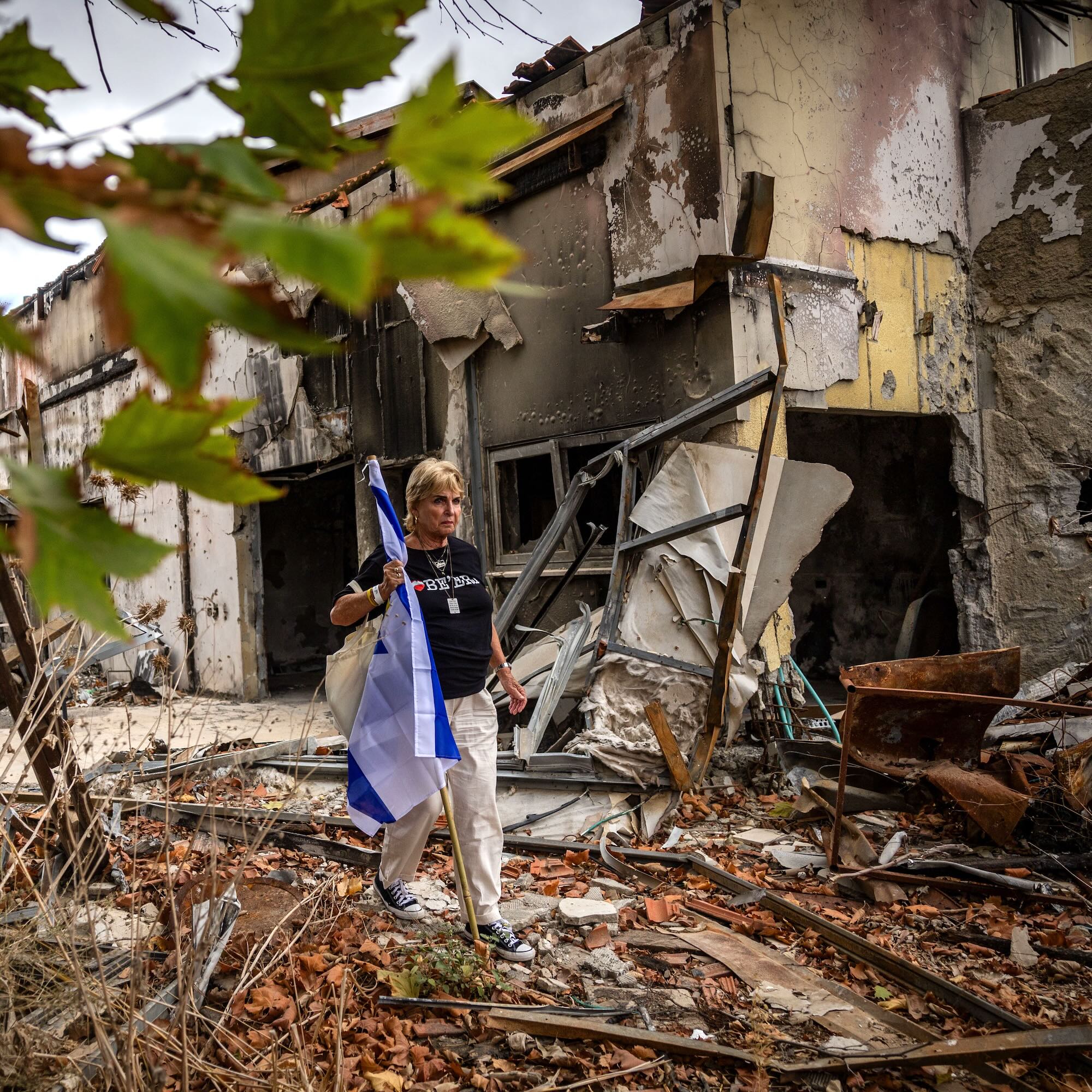
Not long after sunup on October 7, more than 100 highly armed Hamas men in white pickup trucks and motorcycles entered Be' Eri from the main entrance of the kibbutz on its northeast perimeter, near the Kibbutz industrial area, and drove to a housing development on the western perimeter, known on Be' eri as the Olives neighborhood and the Vineyard neighborhood. There they went from house to house, murdering and abducting residents. By the end of the day 98 Israelis were dead and 32 were taken to Gaza as hostages. After that, the Hamas men who were then joined by fighters from something called called the Democratic Front for the Liberation of Palestine and importantly a great number of civilian Gazans among the many teenagers who together set ablaze the houses in the Olives neighborhood, leaving the houses as charred shells, some of them largely destroyed by the grenades and shoulder held rockets the Hamas men used in their attack. It was not until two days had passed on October 9 that IDF soldiers killed or drove off the last of the Hamas attackers. By this time, the surviving residents of Be' Eri were relocated to hotels near the Dead Sea, where they remained for 10 months until they were resettled in a new satellite kibbutz neighborhood built for them adjacent to Kibbutz Hatzerim. Plans are for the reconstruction of the original Be' Eiri to be completed over the next 12 to 18 months, at which point the expectation is that most of the kibbutz members will go back to the home and resume, such as they can, the lives they led before October 7th. In the meantime, first in the hotels and then at Kibbutz Katzerim, Be' eri continued to function as a kibbutz, holding general meetings for members to make important decisions that affect the future of the community. This week the members of Kibbutz Be' eri held one of these general meetings to make one of these important decisions what to do with the Olives Neighborhood There were broadly three options. One option was to raze the old neighborhood entirely, leaving none of the original structures intact. Another was to preserve some or all of the old burnt out buildings as a sort of reminder or a memorial to what happened on October 7 and to the people who lost their lives and the families who lost their homes. Another option was preserve the husks of the old building as a sort of memorial burial site so that kibbutz members could visit the places where they last saw their loved ones and so that others from around the country and around the world could come and learn the story of what was done to Beiri on October 7. A third option was something in between to preserve some of the houses, but to destroy the others. In none of these options would the destroyed neighborhood be simply renovated and pressed back into service as if nothing happened. In every scenario, the replacement homes for the families who lost their homes in the Olives neighborhood are destined to be built on land that was in the past agricultural fields. No one will be asked to set up home on the blood soaked soil upon which their loved ones were killed. On October 7, the members of Kibbutz Be Erie held two votes on the matter because the first vote was contested. In the end, the members voted to destroy all of the rectangles homes save for one at the corner of the kibbutz that would be preserved with the expectation that eventually it would be disassembled and reassembled at whatever national memorial site the government eventually chooses to establish. On the second ballot, 196 members voted to destroy all the homes save the one, while 146 voted to preserve the buildings in some fashion or other as a moment memorial. One of the leading voices for destroying the old burnt out buildings was Avida Becher, who lost his son Carmel and his wife Donna in the massacre and the fate of whose home was on the line. In the vote, he said, I am on the side of rising up in recovery and destroying the homes instead of leaving intact the destruction and the wreckage. Another of the kibbutz members on the same side of the debate said, no one wants to live in Auschwitz at the same time, as an attorney and journalist named Gadi Ezra asked in Yidiot this week in an essay headlined Between Auschwitz and would you destroy Auschwitz? Obviously not. The 146 people who voted to preserve the buildings ravaged by Hamas voted as they did because they felt like they had a responsibility to preserve the memory of what happened. For some people, this responsibility was as personal as can be to preserve the place where they last saw their father or mother or son or daughter. To others, this responsibility was a national obligation to keep intact a place where other people can come to understand better the tragedy of October 7? To most people, probably their sense of responsibility was both personal and national. Alison, what should we think of all this? Should this even be a decision made by the members of Kibbutz Be' eri alone, given that what they decide will affect forever what and how all of us remember and memorialize our past, whether it should or shouldn't be their decision. Do you agree with the decision they made and what, if anything, can we learn from this about broader questions we all face of how to find the balance between remembering what happens happened and letting what happened go enough so we can get on with our lives? What do you think?
- [69:56]
B
Oh, I absolutely think that it should be the decision of the members of Kibutzberry. They're the ones who have to live there. They're the ones who have to see it every day or not see it every day. And so I think that it is very appropriate that the decision be made. I think they made a, a really good decision. Again, I can't decide because I don't, I don't live there. Right. But you know, when you say it's for all of us, there are so many sites, right? There's the Nova site, there's all the other kibutim that were affected. So I don't think that Berry is the, you know, one and only place where, where things are going to be remembered or not remembered. I think it's an individual decision for, for each of these communities to make. The overall issue is very interesting. You know, my experience with it because, you know, I'm very old and experienced. I lived really just a couple of blocks away from Rabin Square. So I remember that whole process. It was at first just covered all graff graffiti, all candles. No one wanted to touch that, that place. That feeling of trauma and, and then at a certain point, you know, a certain amount of time afterwards, it was just, you know, okay, you know, this is still the, the municipality of the city of Tel Aviv. People need to go in and out and just the whole, the whole square could not remain and the graffiti could not remain to the extent. So they preserved pieces of it and I'm documented all of it and they built that memorial and now it's a place and it's definitely marked as a place where, where this happened. But I think, you know, a similar balance was established there. So it sounds like the, the right decision was made by, by the BE residents.
- [71:41]
A
I agree with you, Allison, that this had to just be Berry's decision. It's. It sort of sounds like it would be monstrous for anyone else to tell them what to do, especially because it is going to be a matter of their day to day lives forever after.
- [72:04]
One of the, like my main feeling in reading about this and I, and it really like touched me and I read everything I could and I listened to all the interviews on the radio because, because it seemed to me to be its own special kind of tragedy. Like that discussion where some of the people, some of the 146 people voting to keep 20 buildings intact or eight buildings intact. There were a number of different proposals or all of the destroyed buildings intact. Some of them were in fact saying right out, I want to be able to go and visit the last place where I saw my mother. That's important to me. And then other people had to find it within them to be able to say as they should have.
- [72:56]
For me, it's very important to be able to walk by that part of the kibbutz and not be confronted with my trauma, sometimes not be confronted with the place where my son was killed or my wife was killed. And the idea of 350 people in a room debating this, where the stakes were so huge and so personal, is overwhelming to me. It just seems so tragic that people had to be making their case.
- [73:33]
One of the things that came out of reading all these reports and listening to everything, and I wish that there was a transcript of everything that was said, but there's not. Or at least. At least it's not public. But one of the happy things that came from listening afterwards was that almost everyone I heard, including the people who really disagreed with the decision and for whom it was that kind of personal, they all said, look, this is what a kibbutz meeting a kibbutz asifa is like. We decide on the most important things in our lives. And oftentimes, you know, it seems like most of the time, the vote doesn't go the way that you think. And. And you think, oh, that's it. My community, my world has just destroyed itself. They've taken this terrible decision. But after a while, you realize, I heard one person say, after a while, you realize that it's the asifa, it's these meetings that are the community. The fact that we are so committed to one another, and everyone in the room knows that even if the kibbutz makes a decision that you. You think is terrible, that you are going to live there tomorrow and the next day and the next day, and that it will be fine because there will be more decisions and you'll be making them together. And that was kind of moving and beautiful. So it was all powerful and overwhelming, and I was so sad, and I didn't know. Didn't even have the category for this kind of tragedy that these people who have seen so much tragedy now have to experience. Don, what did you think of it all?
- [75:06]
C
Well, I'll just say, you know, as you know, a kibbutz is a unique kind of community. And these kibbutzim in the Gaza envelope are geographically isolated from other communities. So I think, you know, living on a kibbutz, the entire community is people's home in a way that all of Kvar Saba is not exactly my home. You know, it's different. And their home was violated and, you know, their families were destroyed or harmed. And I think that that's obviously their decision. There's a wild card. I saw in the news yesterday that the Sara Moreshit, the Heritage Minister Amichai Eliyahu can take control of these buildings and decide to declare them historic landmarks that have to be conserved. And he's considering doing that. So I hope that doesn't happen. I can think of no one that the community in Beirri would trust less to be making any kind of decision here. And I think another question, I mean, I've visited Khfar Aza several times because my friend is funding the foundation to reconstruct Far Aza. And it is absolutely overwhelming to walk around there. And I was there three months after October 7, which at the time seemed very distant from the event. And now, looking back, seems very close to the event. And what really struck me were two things. The Sukkot were still standing. The Sukkot were still up. And the second time I went this past year, they're not there anymore. But I also went to the young people's neighborhood, which is usually young singles in their 20s, which was one of the first places attacked. And most, a lot of the, I think 11 people there were murdered and seven were taken as hostages. And that was still standing. And what was unbelievably overpowering is to walk in and one place, the family had posted all the WhatsApp messages that had been going back and forth between them and their daughter, I think, on October 7th. But you looked at the family pictures still on the wall and the books that were still there in the houses, and it was just like, oh, those family pictures look just like my family pictures. And the books are the same books I have on my shelves. And, you know, it was just completely overpowering. Now, could you go back and actually live there? And I know some people can't. Some people are not planning to go back and live on the kibbutzim that were devastated. You know, that is also a personally overwhelming decision. And I know some families, families are being torn apart just about that decision, what they do, how we memorialize things, how we deal with trauma in this country, with loss and grief. It goes right back to our first discussion. Do you keep the grief open or do you try to go through the stages of grief and move on? I think the uniqueness of what we've been dealing with the past two years was because of the hostages, the wound couldn't even begin to close. You know, it was like two events. The atrocity at first and then the hostages that we were all following. I mean, to go to Hostage Square to be reminded of this, not just every weekend, for those, you know, people who actually, who made it there, like you, and here for us but to watch the television news and see a segment every day about a hostage family, someone who was killed or a fallen soldier soldier, all those things keep the grief open in a way that, you know, is, is completely abnormal, but also seemed to be fitting and right. So, you know, I think for the families there, obviously it's their decision. It's not the same as Auschwitz. That was the headline of the article I mentioned in the intro. You know, these, these are their homes. These are places, you know, that they, they want to rebuild and they don't want, want someone else, Hamas and all the other people who joined in the attack to be the ones deciding the fate of their homes. And they want to go back and rebuild. But it is going to be hard, you know, and I don't, I don't envy anyone torn between commemoration and resurrection and trying to rebuild their lives.
- [79:09]
A
Now listen to this.
- [80:08]
B
La.
- [80:41]
A
That lovely song is Yesh Olam by Eli Ashdot and Daniel Torjaman. More music of these strange days, all of which you can find in all the usual places. And now it is time for our Voda country segment. This is a part of the show in which each of us describes something that maybe brought us solace over the last little while if we needed it, but also maybe surprised or amused, delighted or enchanted, ensorceled or maybe even fluged us as we did our wending through our world over that last little while. Don what is your what a country.
- [81:11]
C
Back when the nonprofit I head, the Israel center for Educational Innovation, was an exclusively Jewish organization, we would gather all the staff before Rosh Hashanah for a haramat kosit to raise a glass of wine or whiskey or drambui for a communal toast. As we plunged into another year of yeoman's labor in low income elementary school schools, I would thank my staff, praise their remarkable resilience and dedication while spoiling them a bit with a catered meal. When our center started working in Arab schools, Sali Awad, as for my director of Arab programs, was concerned that some of the Muslim staff, the more religious ones who wore headscarves, would feel uncomfortable at an event, peeking with a glass of alcohol or might not even come. Wright hadn't thought of that, that the staff had become more diverse and we had to adapt. So we reconceived the gathering as a team building day of fun. Now, with words of encouragement from both of us since last year, Sally became my deputy director. And then some of the Jewish staff got upset that they had lost their haramatkosit, which celebrated how the start of the school year in Israel coincides with the start of the Jewish year. So I had to be sensitive to their expectations as well. Well, even if I know you can't please everyone or even grasp who everyone is. Sally was telling me how people outside of Israel can't figure her out. When I say I'm Israeli, she told me, they say, oh, you're Jewish. When I say I'm Arab, they say, oh, you're Muslim. When I say I'm Palestinian, they say, oh, you're from the West Bank. When I say I'm Christian, but I'm also Palestinian and I'm from Nazareth. I live in Israel, I'm Israeli. They look at me like I'm Christian. Crazy. Each of us contains worlds within worlds. I want to share, with her permission, excerpts of Sally's personal story which she told at a conference we just went to together. It's painful, but I think, also hopeful. My father. This is Sally speaking. My father, Yousef had a garage in Kiryat Shmona, a Jewish city on the northern border, two hour drive from our home in Nazareth. He was the first and only Arab to have a business in this city and some people weren't so happy and organized demonstrations against it. He didn't let this stop him. Instead, he built a successful business, made many Jewish friends and opened the door to the rest of our family to be part of Israeli society. I remember spending my summers on kibbutz with Yossi Ziv, Tzvika, his co workers and friends and their families. When I stopped being a principal and joined icei, that's our organization. In some ways it was a dream come true. We started a pilot in three Arab schools and five years later we're working in 36 Arab elementary schools. But it was also a shock for me to encounter impoverished Arab towns and villages for the first time. Now the crime crisis in Arab communities is beyond imagination and nothing is being done about it. Already it's taken the lives of teachers, a principal, parents, and last week, a story student. Since October 7th, we're not allowed to speak about what we're experiencing. An entire school had to be moved away from the border, but they can't talk about why with their students. This doubles the pain and anguish. Ten years ago, we fought for equal opportunity. Today we fight to breathe. When the state can identify where Nasrallah sits in an underground bunker in Lebanon, but can't find the criminals here, the message we hear here is we won't help you and we don't trust you. My children know how proud I am of the work in Arab schools that I joined in this Jewish organization which has become a Jewish Arab organization. I raised them with the same values my father gave me. But the challenge of belonging is getting harder and harder. My kids are on social media. They feel disconnected and angry. They don't want to speak Hebrew or go to after school activities that have mixed Jewish and Arabic kids. I now have a deeper understanding of how important it is that our children build a strong and resilient identity and how important it is we give them the space to do so. It can protect us all in times of crisis. Being the deputy director of ICEI became much more than a job. The responsibility to fix our society is a shared responsibility and staying united in a shared workplace, giving hope in the weakest communities. These are the foundations we need to continue building for the years of healing to come. And to Sally's words, I can only say Amen and thank you.
- [85:40]
A
Alison, what is your what a country.
- [85:43]
B
I'm not an art person. I did not take an art history course in college, which I deeply regret. But there's nothing better for me these days than to go to a museum or a gallery, preferably accompanied by a person much more knowledgeable about art than I, if it's not a guided tour in order to help me understand and appreciate what I'm looking at. And when it's combined with the stroll through downtown Jerusalem, even better. And so that's what I did recently. I went to visit the Jerusalem Biennial of Drawing, which kicked off on November 8th, and it's going to be up until February 7th. It was a stroll because this Biennial, this festival, is located in four different venues in Jerusalem. Jerusalem. I went to two of them, the two kind of most historic and iconic locales. Part of the exhibition was in the Jerusalem Artist House, and the other part that I saw was in the Anatico House. The theme of the Drawing Biennial this year is Sloughing. So the drawings and the sculpture and the theme were about life and death and change, and that seemed just so very apt, inappropriate in these times and Israel. The chief curator of the exhibit, she tries to do something different and original every time. This is the ninth year of the Biennial. There were all kinds of genres and styles and textures and dimensions. And in an interview she said, quote, these were all these images that moved me, thinking about creatures that can regrow limbs, others that shed their sloth in order to grow, and some that die with the slough due to adverse gifts conditions. It's been noted that this Festival opened just as its founder, Russian born artist Sasha Okun, passed away. I don't know if either of you guys have heard of Sasha Okun. Sure, I've. I happened to be good friends with his daughter Masha. And in fact, in fact my previous visit to Jerusalem before I went to this drawing exhibition was to his Shiva, where I went to to sit next to Masha who, who was in mourn morning.
- [87:49]
We just had his Shloshim, I think. Anyway, if you're in Israel, speaking of Sasha, go to the Tel Aviv Museum which is exhibiting some of his masterworks. Sasha Okun was really passionate about drawing. He was really the godfather of the genre ever since he immigrated from Russia as this young dissident artist in the 1980s. And he was a legendary lecturer for many, many years at Bezalel Art College. When I was sitting at the Shiva, there was all kinds of, of, you know, former students, people he lectured to, influenced by who Masha had never met, and they were all just coming to pay tribute to him. But back to the exhibit, I went for the art, but I also appreciated the beautiful historic buildings they were in, which have over the years been used for different things. So it kind of fits in right with the sloughing and growing new uses. The Anatico House, as I'm sure you know, Noah famously started its life as an Ottoman villa, which was built in the early 1980s, one of the first buildings outside the Old City walls. And in 1924, ophthalmologist Abraham Tycho bought it with his wife, who was an artist and Dr. Tycho used it as an ophthalmology clinic as well as his residence. He was wounded during the 1929 Palestine riots. His wife, as we know, Anna T. Tycho, who the house is named for, was a very, very acclaimed artist. And she left the house to be a beautiful museum, sort of an extension of the Israel Museum. And the Jerusalem Artist House also began its life as a mansion in the 1800s, and then in 1906 began to be the home of the Bezalel Art School, which became this amazing art academy that we have now in a different location. And it was actually the country's first public museum, the Jerusalem Artist.
- [89:46]
And it has all the time now changing exhibitions of Israeli art featuring works of different artists. And since 2001, the biennial for Drawing has been held there. So my one unfortunate note, on that day I wanted to look artistic and fashionable, so I wore these new boots I had just bought. And I didn't realize until walking around Jerusalem between one place and the other that in new shoe fashion, the boots were rubbing against my toe, creating a really bad blister and wound. And I'm still limping to this day because of. But at least the pain is reminding me of the really lovely art and the fun day in Jerusalem. And maybe the transformation of the new skin over the wound of my blister sort of echoes the theme of the exhibitions. So I regret the boots, but I don't regret the walk. And as I wandered the streets of Jerusalem between the two venues, I noticed I'm not a Jerusalem person. I don't walk around a lot from place to place. But really, the transformation of downtown Jerusalem as the result of the expansion of the light rail, we provincially observe, moan and groan about Tel Aviv and what it's going through. Like it's the only city in the country that's transforming, and it's really not. Things are happening over there in Jerusalem. And so, yes, like the exhibit theme reminds us, everything is constantly changing, dying, growing, evolving. Cities to slough off the dead so that the new things can emerge.
- [91:09]
C
We had lunch at Ana Tycho's house with Anatico and her husband when I was 11.
- [91:13]
B
Oh, wow.
- [91:15]
C
My father had a doctor friend who knew her husband, so they invited us to come meet them. And I walked around the house looking at all these drawings, and she, you know, all the drawings were of, like, shrubs and, you know, or like weeds. And I was like, going, why doesn't she paint anything pretty?
- [91:34]
A
Wow, what a story.
- [91:35]
B
In addition to the drawing Biennial exhibit, I have to say, there's also an amazing video installation there at the moment. So any listeners who happen to be be in or adjacent to Jerusalem, I highly recommend visiting the Anatico house right now.
- [91:48]
A
Well, I just want to say, Alison, first of all, I admire someone who's willing to sacrifice for style. I think that that's what makes us human. That's what divides us from the animals. But then beyond that, I don't know much about art, but I know what I like. And what I like is the word slough. I like the word slough. Yeah. So as for me, there is a guard stand at the end of the hallway that leads to the mayor's suite in City Hall. The hallway has portraits of all the mayors of Tel Aviv since the city was established 116 years ago. Mayor Dizenghov, Israel Rokach, Mordechai, Namir, Yeshua Rabinovich, Chich Lahat, Roni Milo, and for the past 27 years, Ron Huldai. And depending on what day and time you go up to have a word with the mayor's chief of staff. There are different guards there at that garden, and most of them know me by now because I gotta go up there for this or that two or three times a week and sometimes much more than that. So they let me breeze by with a mashlemcha. But there is one guard who, for a year and a half now, every time I go up, he asks me who I am there to see. And almost always the answer is Segev, the mayor's chief of staff. And the guard says, you have an appointment? And I say, no, but I just have a question. And he's not answering my WhatsApp, so I need to pop my head in his office to get his attention. And the guard says, you cannot go by without an appointment. And I say, pretty sure there's no rule like that. And he says, of course there is. And then we're at a standoff, usually until I call someone in the mayor's office just down the hallway with the portraits, and they call the guard, and then he lets me go by. I bet this exact thing has happened maybe 75 times, and it always starts the same way and it always ends the same way. And he says, look, man, I am just trying to do my job. And I say, look, man, I am just trying to do my job. And the thing has created a kind of out. I don't know, it's not quite hostility, but a sort of active weariness between us. Like, I know when he sees me coming, he thinks, o this guy. And when I walk up from the 11th to the 12th floor and I see that he's the one at the guard stand, I think, o this guy. All this until the other day when I was walking up the stairs from the 11th to the 12th floor, and he was walking down the stairs, and he says, no, Achanita, talk to you. And I think, oi. And I say, sure, knowing that he's going to lecture me about how it is his job to see that the rules are followed close. It's a matter of safety, the mayor's safety. And even if I don't believe that, I can't be asking him to risk his job just for the sake of me being able to go in without an appointment. And the wheels are turning in my head, and I'm trying to figure out how I'm going to respond to that, what the right thing to say is. Maybe he's right about everything. I don't know. But instead he says, I Gotta talk to you about the hedgehogs. And I'm surprised. And he sees this and he says, you're the head of that committee on animals and nature in the city, right? And I say, yeah. And he says, I'm worried about the hedgehogs. I saw a hedgehog in my yard already years ago, and I got interested in them and I went to the library and I read every book that they have about hedgehogs, and I studied them too, on the Internet. And they are remarkable animals. Hedgehogs are smart, they are very gentle creatures. Although they are solitary creatures, requiring no complex social structure to exist. He says they're also capable of great sociability. And they do not over graze, they do not strip vegetation, they do not wreck people's gardens. Their foraging is delicate, he says, and their foraging is diffuse. Even though they're shaped like cute little little balls, these animals, they run very quickly and they can swim. They are amazing animals. Also, wherever they turn up, they do us good. They eat all sorts of pest insects, doing much more good than harm for the trees and the plants where they live. But we are not repaying the favor. He says to me, the way that we maintain the underbrush in the parks, in the city never takes the hedgehogs into account. It is like nobody is ever thinking of the hedgehogs. I'll give you an example. After trees are trimmed, the branches and leaves we cut, cut off are piled up somewhere, which is good because the hedgehogs love this, and they eat there and they hide there and they live there. But then the city just comes along and brutally collects all that stuff that it put down there, all this organic material with an excavator or with a power shovel. And sometimes the machines themselves just kill the hedgehogs. But even when the hedgehogs escape the danger, which is what usually happens, we've still taken from them their food and their home. And it is often so thoughtless. It is like the hedgehogs don't exist.
- [96:22]
And I say, I'm sorry, I did not know any of this. Not about the hedgehogs and not about the cuttings and the clippings and not about the power shovels. And I say, I'll look into it and see what can be done. I'll talk to the city veterinarian, I'll start there and then I'll talk to the people with the power shovels and see what they're doing and I let them know. And that was just a couple of days ago. And for the power past Few days on breaks that I've been taking from reading Nachum Chinitz. I've been reading about hedgehogs and noticing now the hedgehogs, many of them actually, that I see when Lucy and I go for a walk. There are a lot of them in Independence park, right down the street. But mostly, once again, I was reminded. And Jesus, if I don't need to be reminded this over and over and over yet over again. How I'm sure, everywhere. But boy, especially here. Everyone, everyone, everyone always has these things going on, these depths, these great depths that you don't see until you see them. But once you see them, you see them. And they are always there even before you see them. And I have been trying to make appointments now when I need to see Sege so that when he asks me if I have one, I'll be able to say yes. And I still can't do it a lot of times. And we will fight about this more, I know, but when we fight about it, I will know a little more about who I am fighting with and that will make it easier.
- [97:50]
And that brings us to the end of our show. Thanks to Itay Schelem, our station manager, without whom we would have none of this. Thanks to Achibo Lim, my favorite band from Kibbutz Gewa. They give us some music at the start and the end of our show. Thank you Alex. Alison. Thank you Natalie. Thank you Don. We would like to thank all of our Patreon supporters for your generosity and support. It keeps the show going, it keeps the station going, it keeps us moved and grateful and in your debt. And we'd like to thank all of you out there for taking the time to listen and ask you to like us on Facebook and drop us a line. We are going to answer. After you do that, go to Apple Podcasts and give us a five star review. Maybe one that starts with this. It could well have been with the Promise podcast in mind. That challenge wrote and Yudit Ravitz sang Darkness is all around. If only you are listening. Maybe, maybe, maybe that's not. Finish that any way you want. But before you do that, remember that today as we record on December 11, we celebrate International Mountain Day, or IMD as it has been helpfully acronymized so stipulated by the United nations way back in 2002 in in Resolution A RES 57 245, somewhat misleadingly called International Year of Mountains 2002, which after all the wherefores and such quote recommends that the experience gained during the International Year of Mountains be valued in the context of an appropriate follow up and decides to designate 11 December as International Mountain Day as from 11 December 2003 and encourages the international community to organize on this day events at all levels to highlight the importance of sustainable mountain development. End quote. And I have said it before and dad gum, I will say it again, there is no prose like United Nation prose in the context of appropriate prose comparison, the importance of which I would highlight at all all levels. Go to the official site of International Mountain Day run by the Food and Agriculture Organization of the UN and you will find there these great suggestions for marking the day under the somewhat pushy headline of how you will mark the day. Quote Check out the International Mountain Day social media kit for resources that can be shared widely across your networks. Join the conversation on social media using the hashtag Mountain Mountains Matter. Hashtag pass on some of this year's key messages. Organize or participate in activities that celebrate mountains, including virtual presentations and events, photo competitions and art exhibits, and promote your planned event by officially registering it on our gallery of events happening around the world. End quote. All of which, absolutely all of it is absolutely great because it allows you to celebrate International Mountain Day without getting up from your community computer. Follow the link to this year's key messages and you'll find that there are five of them, and I'm quoting 1 Mountains are the world's great water towers 2 Glaciers are melting fast because of climate change, 3 as glaciers disappear, vulnerable mountain communities will suffer the most 4 glacier loss is also a loss of cultural heritage and 5 global action is needed to preserve glaciers for future generations. Which is all great, but I think, and this is just me, that there ought to be room for at least one key message about yodeling. Although, and this is true, we do have a World yodel day on August 8th. I remember celebrating it. And we can also look forward to International Yodel for your Neighbor Day on January 30th. But I digress. Even without the yodeling, I absolutely adore International Mountain Day. Or to save time, because God knows this podcast is already too long, I will just say that I absolutely adore imd, IMD being the acronym for International Mountain Day. It must be my favorite day of the entire year because it is my favorite day to use the hashtag Mountains matter and because of the virtual presentations of very real mountains and because of the yodeling and because mountains are beautiful and because I'm reading this new book here beside the Rising Time, and I think about the important role that Mountain Girl Carolyn Garcia Nay Adams played in the story of the Grateful Dead and the spread of 60s counterculture more generally, and that story has not yet fully been told. Mountain Girl Won't anyone think of Mountain Girl? And when is a better time to tell the story of Mountain Girl than International Mountain Day? But even though, as I say these words, IMD or International Mountain Day is not yet halfway halfway over, I know that all too soon it will be gone like so many glaciers not to be back for a long, long time. Not so the Promise Podcast. We will be back for you next week and after a short 10 week hiatus unless new elections bring us back earlier every week, reminding you that while clear mountain air, crisp mountain water and vistas of open spaces viewed from above as if from the vault of the gods themselves can make you realize the ethereal, truly divine beauty we too often overlook in our day to day lives when you need it, you can also be reminded of all that is venal and low and diminished and debased about the world and about the human condition on this the Promised Podcast.