Loading summary
Transcript111 lines
- [00:00]
A
We record this podcast while the bodies of four hostages remain in Gaza, hoping that by the time we next record, by the time you hear this, they will all be back and laid to rest near their families and loved ones. This is TLV1. This episode may contain explicit language foreign. Welcome to the Promise Podcast brought to you on TLV1, the voice of the city where this past Saturday night at the Chabad Lubovitch center at number 16 Merkaz Baale Melacha street on the corner of Yohanan Hasandlar street, just meters from Chenkan Avenue, there was a gate gathering of all the Tel Aviv Yafo, Chabad Lebovish Shlokhim or emissaries. This ahead of the worldwide kinus or gathering of Chabad Lubavitch Shlochim that will take place in New York this weekend. Or as it says in the Chabad Lubavitch press release on the matter on Shabbos Chaye Surah, the Shabbat upon which we read the Torah portion from Genesis called Hayes Hara, which is in the event tomorrow as we record why the Tel Aviv Yafo Shluchi, More emissaries needed to gather before making the trip stateside is perhaps made clearer in this explanatory video. Shluhime havate velikh dav' levi et haguela be' foul mamash. Now, whether or not Hebrew comes easy to you, this requires a bit of explanation. The speaker says to us, the Rebbe gave the mission to prepare ourselves and the entire world to welcome our righteous Messiah, and we have it in our hands to do this. The gathering of the Shluchim this year will be under the sign of or with the theme of the the word Shaliach Emissary with the addition of 10 powers or capacities is in Gematria Mashiach or Messiah. In the shluchim gathering in 5786 we will come together, each of us with his 10 powers or capacities of his own soul, and all of the emissaries together will bring redemption in actual reality. End quote. Now this is all pretty clear. It pretty much speaks for itself. But still, maybe a little unpacking is in order. First of all, the 10 powers or capacities of the soul are a Hasidic Kabbalistic matter, maybe most associated with Rav Schnir Zalman of Ladi, a descendant of the great Maharal of Prague who thrived in the 18th century and early 19th, I think mostly around Vitebsk in what is today Belarus, and Schneer Zalman of Ladi was a leader, I think the third generation of Chabad or Lubavitch. He was a student of Dov Baird, the magid of Medic Mezrich, who was a disciple of the BAAL Shem Tov. But I do not know for sure if that is true, as I had to split my childhood between memorizing rabbinic dynasties and memorizing the starting lineup of the Chicago Cubs. But I know that it was Schneer Zalman Avladi who enumerated the 10 powers of the soul in his controversial book the Tanya. There are three intellectual powers, wisdom, understanding and knowledge. And there are seven emotional spiritual powers, loving, kindness, restraint, harmony, endurance, humility, unity, leadership. Each of those words loses something in the translation, but you get the idea. Now, where the 10 powers or capacities of the soul meet. The Shlochim gathering is that the word chaliak or emissary in Gematria Hebrew numerology is 348, while the word mashiach Messiah, who is what? The shlochhimeen to bring is 358, which is pretty close to 348. But when you add the 10 powers to the 348 of Shaliach, you get there, you get to the Messiah, you get to Mashiach. And if you think there is maybe something a little, I don't know, ad hoc about adding the 10 powers of the soul to the word for messenger in order to get the word for Messiah, it may be that you yourself are a little short on one or two of the ten powers of the soul, maybe chesed loving kindness, or maybe Tiferet, which I think has a hint of compassion to it. And if this is the case and you are missing a couple of the powers, then if you go out as a emissary, all you are likely to bring back with you is not the Messiah, but at best the mashi o. And what good is that? But I digress. Now, one lovely thing about the gathering of the Tel Aviv Shlochim was that it took place at the city's Chabad center on Merkaz Baleh Melachah Street. Merkaz Baleh Melachah street is named after Merkaz Baale Melachah, of course, which was the organization founded in tel Aviv in 1908 as a sort of union of all sorts of independent craftspeople, carpenters, cobblers, tailors, milliners, cordwainers, blacksmiths, whitesmiths, coppersmiths, locksmiths, glazers, bookbinders, upholsterers, signwriters, tinkers, farriers and such. The aim of the organization, as their founding charter says, was to organize all the craftsmen in the country and abroad, to strengthen their material and spiritual condition, to protect their products from unfair competition that goes against the interests of the country, to assist them in times of crisis and work stoppage, and to raise the general and profess education of the craftsman. End quote. It was this union that set up one of the first neighborhoods in Tel Aviv outside the city's first founding neighborhood of Ahuzat Bayt or Neve Tzedek, with a good deal of funding coming from Menachem Shenkin, after whom the main street of the new neighborhood was named, Menachem Chenkin, being the son of a Chabad Lebovich Hasid and Rabbi Rav Zvi Chenkin of Vitovsk. And when Menachem Chenkin, by the way, died in Chicago, when the streetcar he was riding was hit by a train, there was a big ceremony in that city honoring him. And then his body waited for weeks until it could be accompanied back to Jerusalem, accompanied in the event by Avraham Isaac Cook, the Chief Rabbi of Palestine, who wrapped up his business in New York in order to sail back with the founder of the Merkaz Balehemilachah community, which was made up to a significant degree of Chabad Hasid craftspeople, which explains in part why the streets in the neighborhood were given dual purpose names like Yohanan Hassandlar Yohanan the cobbler, who was the illustrious disciple of Rabbi Akiva and who is much cited in the Mishnah. And there's another street named Rabbi Yitzhak Nachah. Rabbi Yitzhak the blacksmith, about whom the Talmud reports after he got in a kerfuffle with Rabbi Yochanan Resh Lakish said that the better of the two men was in fact Rabbi Yitzhak Nafcha and Reish Lakish has a lot of pull in my book, but again, I digress. Arguably nothing captures the spiritual palimpsest nature of the city we love so well Tel Aviv Yafo better than seeing that the Chabad Shluchim who this week met on the corner of a street named after the Artisan Craftspeople union and a street named after a towering Talmudic cobbler are the spiritual descendants, and some of them may be the actual descendants as well, of Chabad artisan craftspeop who set up one of the first neighborhoods in the city with the aim of being around folks who, like them, make stuff and fix stuff. The through line through the generations being they are all people living a life and a place, aiming to redeem the world. And if not that, to make it a better place. And if not that, to see that your shoes don't pinch and that your hat fits just right with us today in the underground vault that is the beautiful Serenity studio beneath Lesser Houry street in Tel Aviv. Yafo in is a woman who you ask anyone who knows her, anyone, and they will tell you that with her kindness, humor and humanity, she is always redeeming the world. Then she goes to sleep and wakes up to redeem the world all over again. Obviously, and I think you know this, that woman could only be Miriam Herslag. Miriam Herzlag is the OPS and Blogs editor of the Times of Israel, creating and residing over the biggest and most profound forum of Jewish discourse and debate since the Talmud was codified. Miriam was in the past the anchor of the Israel Broadcast Authority English Language Television and an editor and anchor for the Israel Broadcast Authority English Language Radio News. Miriam, how you doing?
- [09:16]
B
I'm great. It's a historic day because I turned on my Dude Kashmal, your water heater. My water heater for the first time this year.
- [09:27]
A
Winter is coming or fall is coming.
- [09:28]
B
I no longer rely on the sun to be sure we'll get a hot shower in the morning and they're saying
- [09:33]
A
it's going to be the first big rain starting tonight.
- [09:35]
B
There we go. I'm getting ready.
- [09:37]
A
Things are changing now. Also with us and set your faces to stunned. Here, deep under Lesser Horry street is a man who. Well, instead of me trying to describe him, why don't I just let him describe himself?
- [10:04]
C
I'm the very model of a promised podcast listener. I've read by oz of Khada, am Ben Gurion and Kissinger. I know the PMs of Israel and I quote the war's historical from Atsumo Tetsuketan in order categorical. I'm very well acquainted too with matters technological. I understand the startups, both the simple and zymological about Zionist forefathers. I know exactly who is who, including what they think about Prime Minister Netanyahu, including what they think about Prime Minister Netanyahu, including what they think about Prime Minister Netanyahu, including what they think about Prime Minister Netanyahu. I'm very good at Israeli and international politics. I know the proper prayers for the different Jewish candlesticks in shorten matters of Chada. I'm Ben Gurion and Kissinger. I am the very model of a promised podcast listener.
- [10:47]
B
A tour de force.
- [10:48]
A
Absolutely. And I know that I do not need to tell you that that man could only be Judah Ari Gross. Judah Ari Gross is managing editor of E. Jewish Philanthropy. Before that, Judah was a correspondent for the Times of Israel, reporting first on the military, the army, and then on Israel, d', ar, diaspora affairs, and also religion. He has lately been an inaugural Elson Israel Fellow at the Jewish Federation of Tulsa, Oklahoma, and he totally rocks in every way imaginable. What's more, Judah has promised that throughout this show, and this is amazing and at first, I think in all podcastery he will speak only in anapaestic tetrameter, like he did in what you just heard. I've read the bios of Achada, am, Ben Gurion and Kissinger. I've read the bios of Achada, am, Ben Gurion and Kisser. Also, you hear. You hear this same thing. Anapestic tetrometer. That's what you hear in the Grinch. Hated Christmas the whole Christmas season. Now, please don't ask why. No one quite knows the reason. It could be his head wasn't screwed on just right. It could be perhaps that his shoes were too tight. But I think that the most likely reason of all may have been that his heart was two sizes too small. So if you are willing to keep talking this way, I will tell you, dear Judah, you may be here to stay. How you do it. Now it's your turn.
- [12:08]
C
I'm not going to follow with that, but thank you very much for having me. Yes, I am the very model of a Promise Podcast listener, and I'm very happy to be the very model, hopefully, of a Promise Podcast participant.
- [12:19]
A
We are so delighted that you're here. Now, it doesn't fit. I know you're saying it's not anapestic tetrometer.
- [12:25]
C
I'm a writer. First and foremost, I'm a writer, so if I can sit down and work it out for a while, I think I can get there.
- [12:31]
B
ChatGPT is calling.
- [12:33]
A
I don't think ChatGPT is good at meter and rhyme. I don't think it knows that. Now, as for me, my name is Noah and I do not mean to boast, but last week I finally got to fly business class, which is super comfortable and I'm not complaining. But when I walked on the plane, the flight attendant greeted me with a glass of champagne and said, welcome, Mr. Efron, like she knew my name before I came in. And she said, can I hang your sports jacket in our garment compartment. And I said, why, thank you, that would be lovely. But people inside, I did not like this. I did not like it. I did not like it one bit. And the flight attendant, she was wonderful. She was not condescending and she wasn't a bit subservient. She was just perfect. I'm sure it would never have crossed her mind that I was acting superior to her, because it would never have crossed her mind that I could possibly be superior to her in any way. She was just doing her job and being nice. But I was shaking with anxiety, though, by the time that I had my third champagne before wheels up, I had the anxiety under control. And please do not take me to be bragging. I mean, my folks taught me better than that. But if in the past I thought I had never gone into the world of business because I don't really have any practical skills or any skill at thinking practically, now I see that there is a whole nother psychological aspect to the thing that I think to figure out we'd need to fly in from Vienna, a team of the finest psychotherapists. They got there today. We got two topics of intense importance and intellectual gravity that you will probably want to consider before you listen to the show, ensuring your memory with Lloyd's of London. But before we do that, we have this matter in post memoriam. Last Thursday, as We record, on November 4th, we marked the 30th anniversary of the murder of Yitrak Rabin. On Saturday night, a few days before this Graham anniversary, more than 100,000 people, they say, came to the streets around what is left right now of Rabin Square, around the Memorial Wall, at just the spot where the Prime Minister was sh. The square itself is at the moment a construction site while they build a subway station under it. And Jair Lapid, the head of the opposition, he said to the crowd, among other things, Three bullets from a handgun said here in the square, if there is a contradiction between Judaism and democracy, Judaism comes first. And if you don't accept that Judaism comes first, we will shoot you in the back. And Tzipi Livni, who started out as a Likud, Greater Israel sort, but over the years she changed her view, eventually negotiating as foreign minister under Prime Minister Ehud Olmert, almost until a deal was done, a peace agreement with Palestinian President Mahmoud Abbas that would have led to a Palestinian state on 96% of the occupied territories, with land swaps making up the other 4%. This until Mahmoud Abbas ghosted Tzipilivni Olmert and the negotiations, he could not take that last step. And Tzipi Livni said, among many other things, on the spot where Rabin was killed. 30 years ago, they tried to murder democracy with three shots. In this square at the historical crossroads where we stand, the choice is one of either a religious society closed, without rights for minorities, without civil rights, without the rule of law and justice for the corrupt members of the government, a country that brings together two peoples filled with hatred for one another between the Jordan and the sea, or a Jewish and democratic state, a startup nation open to the world, a state with a Jewish majority in which there is unity around the Declaration of Independence, that basic document of the Jewish people with equality for all. And after the speeches, Miri Ohloney, who, if you're old enough, you remember as a 19 year old lovely who sang the song a Song of Peace in the Nahal army singing troupe in 1969, with all the life of a lovely 19 year old with everything then in front of her, or if you are not that old, but still plenty old, you will remember Miri Ohlone as the woman on the stage exactly 30 years ago last week, when she was 45 years old, pressing Yitzhak Rabin in Shimon Peres to sing the song of peace, reading the words from a mimeographed sheet. Now miri Ohlone is 75, and a few years ago during the corona she got a strange violent virus and she lost her leg. So this past week she sang from a big fancy wheelchair she gets around in. And it was hard not to think the too fancy thought that somehow she is us, battered, tired and still here, though not all in one piece. And the speeches and the songs at the spot where Itzhak Rabin was shot, they brought back that night 30 years ago last week, Rabin and Perez awkwardly singing the song. And it brought back Eitan Haber saying in the parking lot of Yechielov Hospital at 11:14 that night, 30 years ago last week, The government of Israel announces in shock, with great sadness and deep sorrow, the death of Prime Minister and Defense Minister Yitzhak Rabin, who was murdered by an assassin tonight in Tel Aviv. And they brought back the months that led up to that night 30 years ago last week. That was 30 years ago last week. 30 years ago this week, time passed as if it was in a dream. We'd watched on TV Yitzhak Rabin's funeral. We'd watched eulogies by King Hussein of Jordan and President Hosni Mubarak of Egypt and President Bill Clinton of the United States and Boutros Boutros Ghali, the head of the un. And we heard Noah Ben Artsy Filosov, one of Yitzhak Rabin's granddaughters, then just 18, say, Saba, you were the pillar of fire ahead of the camp. And now we are left here, just the camp, alone in the dark, and we are so cold and sad. And at the funeral, we watched Eitan Haber take out the sheet with the words to Shir la Shalom that Rabin had folded back in his pocket just before he was murdered. And the paper was covered with Rabin's blood. And we heard Eitan Haber say, though I don't have the tape now, he said, five minutes before that scum shot you, you sang Shir la Shalom from a page they gave you so you could mumble the words as you always did. Yitzhak, you know, you had a thousand virtues, you had a thousand advantages. You were great. But singing was not your strong side. You went off key a bit in that song. Afterwards, like always, you folded the paper into four equal parts, like always, and you put it in your jacket pocket. In the hospital, after the doctors and the nurses cried, they gave me the paper they found in your jacket pocket. Yes, it was once again folded into four equal parts, as always. I want to read now some words from that paper, but it is hard for me. Your blood, Yitzhak, your blood covers the printed words, Your blood on the paper with Shir la Shalom. This is the blood that drained from your body in the last minutes of your life and flowed onto the paper between the lines, between the words from this now red paper, read from the blood that cries to us. I want now to read the words as though they were written just yesterday after you sang them and after they shot you and shot Peace. And if you pay close attention, you will notice that Ethan Haber started his eulogy talking about that scum who shot you, meaning Yigal Amir, one specific young man. But by the end, he was talking about a they who shot you, meaning many. The many people who, I guess, with the Gala mir serving as their instrument, shot Peace, which, having been shot, has, in the 30 years since, never really recovered. The next days, exactly 30 years ago, this week, and the days and weeks that followed then passed, like I said, as if in a dream. The spot where Robin was shot filled with teenagers sitting cross legged, holding candles, singing and crying. They were there all the time, night and day, some with their heads in the laps of their friends, dozing. People took to calling These young people, Noar Hanerot, the kids of the candles. And I think it surprised a lot of us. I know it did me to see how shattered these teenagers were. Guy Ronen, who these days writes for our Aretz, said, For me, the 4th of November was the day when my innocence died. Faith was gone, Pure, wholesale love for this land was over. It was the birth of cynicism. Emptiness spread. Suddenly we were old. They said that we lost the country, which is a good summary of it all. And all this, at age 17, Yitzhak Rabin Shiva, brought thousands of people into the living room of the Rabin's apartment on Rav Ashi street in Tel Aviv. Generals, ministers, ambassadors, singers, actors, and lots of people who had no purchase on fame of any kind. Yassir Arafat, who had never been to Israel, arranged a secret visit, dressed in fatigues and accompanied by Mahmoud Abbas and Ahmed Kure. And they stayed for an hour and a half, drinking tea and telling Leorabin of her husband's courage. Yisra' El Harel, the head of the Council for Judea, Samaria and Gaza, sent word to Leorabin that he wanted to come to offer condolences at the Shiva, and he got word back that he'd best not come. So much hate for her husband had been stirred up by settlers, Lerabin said, and it was hard to accept comforting words from them now. Already at the funeral, when Benjamin Netanyahu extended his hand to Lerabin, you can see in the video, she looked him straight in the face, looked at him, before finally offering her hand to him, at the same time leaning in and saying, it is too late, meaning that Benjamin Netanyahu had done his damage and it could not be undone. Asked about it the next day, Lerabin said, yes, surely I blame them. If you ever heard their speeches in the Knesset, you would understand what I mean. They were very, very violent. In their expressions. They said that we are selling the country down the drain. There will be no Israel after this peace agreement, they said. Later, Lerabin said in an interview, as if speaking to Benjamin Netanyahu, you stood there in Zion Square in Jerusalem, Mr. Netanyahu, and you incited the crowd against Yishtaq Rabin. I blame primarily the leadership of the Likud. For God's sake, why did you people assassinate him? The circumstances of the assassination were horrible. It is the combination of political manipulation and of the religious establishment. End quote. Leah Rabin was not alone in thinking that Rabin's political opponents had some responsibility for his Murder, even if they condemned it after the fact. Harel remembered of this time that the blame fell not just on settlers, but on all religious Jews. You couldn't board a bus if you had a skullcap on your head. He said. This was an exaggeration, but not much of one. Five days after Rabin was murdered, a religious Zionist named Yitzhak Spur told this story on the radio. I was driving in the right lane on my way to Tel Aviv, and all of a sudden someone lurched their car to the right and hit my rear bumper. I thought at first that it was an accident, that someone was just driving like a crazy person on the road. And then he pulled around me and reached his hand out the window with an obscene gesture. And he said angrily to me, hamas, we'll liquidate you. And he drew his finger across his throat and then he drove away. It became a thing for a time for religious kids to take off their kipot or to cover them with hats when they came to Tel Aviv, like some people do today when they go to Paris or to Malmo. Mati Golan, a journalist, editor, critic, playwright and sometimes diplomat who I liked. He died a couple of years ago now. Wrote in the financial paper Globes, quote, this is a murder that grew out of extreme religious circles. And Yigal Amir was just a simple. This is a murder that flourished in circles that turned their politics into a religion, and vice versa. Many educators, rabbis, some of whom get salaries from the state, granted legitimacy to this murder. One odd thing about Rabin's murder for me is that I owe my job, my career, and the lovely life that I have today to the assassination. Yigal Amir was a second year law student at Bar Ilan University, which is a religious university. It's where I teach. So what that means, exactly what it means that it is a religious university, has never been fully clear to me. But after Yiga Lemir killed the Yitzhak Rabin, a great call rose in papers and on TV and in the Knesset to somehow sanction the university, maybe to close it down altogether, because it, in its orthodoxy, had somehow, not directly, but still murdered the Prime Minister. The university had murdered the prime minister. And the heads of the university held emergency meetings, and they devised an emergency plan to demonstrate to anyone with doubts that what Igal Amir had done was antithetical to what the university stood for. And one of the things that the emergency plan called for was setting up a unit of interdisciplinary graduate programs, Gender studies, hermeneutics and cultural studies, dispute resolution, and in the event, the history and philosophy of science. All to show that the school was open minded, eager to think out of the box, thoughts where the box were stodgy 19th century disciplines. This will show the world that Bar Ilan University is an open minded place that seeks open minded students eager to have their minds opened still further. Which was a sort of free associative response to the calls that the university be shut down. I thought it was hallucinatory, but it did lead to me being hired to start that history and philosophy of science program. And it also led to a bunch of queer, postmodernist and free free radicals finding their way to what had been a somewhat conservative campus with lots of religious people and the impact of dozens and dozens and dozens of students who between them had many more tattoos than they had tichels and tallises. Well, it changed the place, which is to say the people doing the hiring were smarter than this person whom they hired me. But that should be no surprise. Thirty years ago today, the week after Yitzhak Rabin was killed, it was already becoming clear that although the murder had been one of those rare events, to which I think almost everyone's first response was the same shock, great sadness and deep sorrow. As Eitan Haber said, it was also an event, not rare at all, that would divide us. Speaking on the 30th day after the assassination, the Shloshim marking the end of the traditional Jewish month of mourning, Meir Shalev, my all time favorite Hebrew writer, a man of exquisite sensitivity, told an audience quote, and what now it is with memory, that last weapon of the dead and the sword of his friends, that we will avenge not through a civil war, but with that good old Jewish weapon, a long and sharp memory. We who remember every mad dog of our history, we will remember this assassination. We will remember who was murdered. We will remember who murdered. We will remember how and why. And we won't ever forget. End quote. In 1997, to announce the second annual memorial demonstration to mark the second anniversary of the assassination of Yitzhak Rabin, the great graphic artist David Tartakover, who died just a few months ago, I spoke about it on the podcast, made a poster that all at once one night turned up pasted on walls all over the city. For all I know, all over the country. And I don't know if a day has gone by in the 20tw 28 years since when you couldn't find a copy of that poster somewhere in Tel Aviv on some wall. On the top of the poster in blue, is a photograph of Rabin his gaze is fixed on you. On the bottom of the poster, in red and black, looking to the side, is a picture of then as now, Prime Minister Benjamin Netanyahu. In bold white letters, over Rabin it says we will not forget. And over Netanyahu it says we will not forget. Give. 18 years later, 20 years after the assassination, David Tartakover put out that poster again. Only this time the words were scrawled out as if to say we have forgotten, we have forgiven. Lately, a one time student of David Tartakover swapped out the picture of Rabin for a picture, all in red, of rows of bodies laid out on a kibbutz lawn after October 7, restoring the words we will not forget and the words we will not forgive on Benjamin Netanyahu's face. And the poster had still another new life, though this old life, it never really ended. To the day she died in the year 2000, five years and a week after her husband, Leah Rabin never stopped talking about how while Yigal Amir had pulled the trigger, Benjamin Netanyahu also bore responsibility for Yitzhak Rabin's death a dozen years ago. Shmuel Shetach, an old school Torah and labor lefty religious Zionist educator. He's been the vice principal of Yeshiva High School and he's run NGOs. He wrote an essay that moved me about how he was a kid in the religious B' Nai Akiva youth movement when Rabin was killed and he took to organizing his friends in the youth movement to come to Rabin Square, at first to join the kids with the candles and each year to come to the big memorial. But he wrote how it got harder and harder to convince people to come because, well, it was so clear that he and they were not wanted at Rabin Square. And the memorials, quote, because of the kippah on my head, they did not distinguish, they could not distinguish between me and a violent kahanist. And I kept hearing what everyone who wears a kippah will tell you that he has heard. But you, you killed Rabin. The equation that says that the secular left is democratic and tolerant while the right and religious people are violent led even the most moderate of the religious to feel uncomfortable. Comfortable. So we stopped coming, end quote. Eight years ago, some of the longtime leaders of the left, the former Minister of Environment Tamar Zahnberg and MK, and one time leader of Peace Now, Mosi Raz, and former Minister of Interior Ophir Penis Paz, and the great playwright Yoshua Sobel, under the auspices of an NGO called the Secular Forum petitioned the Supreme Court to change the way kids are taught in school about Rabin's assassination. The petitioners described what they wanted, like this quote, the esteemed court is asked to give a binding order requiring the respondent, that is to say the Ministry of Education, to explain why the respondent will not teach the story of the murder of the Prime Minister as part of the Israeli Judaism curriculum and as a response to the declared aims of the curriculum as it happened in reality. To wit, the murder should be taught as such. 1. Yigal Amir murdered the Prime Minister against the backdrop of opposition that arose from religious nationalist motives. 2. The Messianist religious worldview conflicted very loudly with a worldview that stands for territorial compromise which led to the murder of the Prime Minister. Three rabbis issued religious rules according to which the Prime Minister of blessed memory was subject to Dean Mocer, the law concerning traitorous informers. And they even carried out for him a pulsa d' nora ritual calling for his murder. 4. The Jewish tradition has a long history of violent bloody struggles for reason of religion, the destruction of the second Temple, the giving of the Torah, the Great Priest Pinchas, etc. The 10 page petition is a remarkable that document meant to force the court to force the schools to teach that it was not Yigal Amir but religious zealotry and messianism that murdered Yitzhak Rabin. To which the three judge panel headed by justice now Chief Justice Yitzhak Amit responded with a 59 word verdict that started with at our recommendation the petitioners withdrew their petition and ended with quote. We have noted the respondents assertion that they will listen with an open heart and an eager soul to the claim of the petitioners. All this is what was underway 30 years ago this week, a week after Rabin was murdered and buried and after the Shiva was over. And when we started to go forward 30 years ago this week was when Rabin's murder, this thing that many of us share in intuition could have united us in shock, great sadness, deep sorrow, maybe also in worry and determination and concern for one another. Thirty years after this thing that could have united us started to become yet another thing that divides us. And as I've said Again and again, 30 years have passed since we saw that starting to happen 30 years ago this week. And now in the fullness of time, I think we can see at least two things that stand in some opposition, one to the next. The first thing is I don't know if there was ever any way for this robbing murder not to become Another thing that divides. I don't know if there is anything we could have done or said or thought that could have kept things from going in this way. Because as is so often the case with this sort of thing, the thing of it is everyone is right, or at least somewhat right. The people so angry that they swing their car around to jolt another car on the road because it is driven by a guy in a quipa. They had a point that it was at least statistically true and sociologically true, that when they blamed anyone and everyone who had Orthodox religion for being part of a collective that never gave a real chance to the peace that the Prime Minister was pursuing, in a way who was pursuing it, they were right. And the people who feel like still and all there is a bit of blood libel in this thing, that this thing they're being accused of, they are not guilty. They did not kill the Prime Minister. Even what Benjamin Netanyahu is accused of, what Leah Rabin accused him of until the day that he died, I do blame them. The rally in Kikar Tion in Jerusalem
- [38:33]
B
that showed him in the uniform of a Nazi. So Mr. Bibi Netanyahu, now he can say from here to eternity that he
- [38:42]
A
didn't support it and didn't agree with his. But he was there and it didn't stop it. Those same crimes that just a few weeks ago John Oliver packaged together as part of his omnibus condemnation of the Prime Minister. In this way, Bibi went scorched earth,
- [38:59]
C
even speaking at an infamous rally where the crowd burned images of Rabin in a Nazi uniform and chanted for his death. Just a month later, he was assassinated by a far right, and many blamed Netanyahu for stoking the anger that led to that assassination. Now, Netanyahu denies inciting political violence, and in his defense, it's not like he was filmed leading a mock funeral procession before Rabin's death with a coffin labeled Rabin Kills Zionism in Hebrew. Except, of course, he was very much filmed doing exactly that. There is Netanyahu right in front of one of the bluntest and most unfortunate metaphors imagined. Honestly, the only way that could get any more on the nose is if he'd held a sign reading Plausible Deniability and burned that too.
- [39:44]
A
Even these two ostensibly incriminating events, the evidence that is at the foundation of the brief against Benjamin Netanyahu, the demonstration in Zion Square in Jerusalem and the political march with the coffin are, when you look into them, hardly as incriminating as they seem. The pictures of rabin in an SS uniform were photoshopped by two brothers, one 15, the other 16. And the kids photocopied them and handed them out at a demonstration at which Prime Minister Netanyahu spoke. But it seems so unlikely, almost impossible, that one of these pictures made it to Benjamin Netanyahu, who attended the demonstration from the balcony of a hotel that overlooks the square. Though the anger in the crowd at Yitzhak Rabin that he surely felt and encouraged this, that he obviously knew about. In any case, a thing like that, the Prime Minister in an SS uniform becomes gravely threatening a call to violence only after the violence has come. I have a friend who lost his job as an editor of a big newspaper site that matters maybe a decade ago because he posted a picture of Benjamin Netanyahu in an SS uniform. A dumb thing to do and I think a bad thing to do. I'm pretty sure that he would say the same thing. But it was not the cause of Benjamin Netanyahu's assassination because, well, Benjamin Netanyahu was not assassinated. The same thing with Benjamin Netanyahu marching in a march ahead of a coffin holding the corpse of Zionism laid low by Rabin. It is only after what happened, happened that it is hard to see how absurd the accusation is that this was suborning assassination, because of course, it was not. And the feeling that there is something unfair about the accusation that religion killed the Prime Minister or settler message or right wing zealotry gets support too, from what a lot of religious folks and settlers and Likud voters felt and said and wrote at the time of the murder. Hatzofeh, the paper read by religious Zionists and settlers back then, it no longer exists, wrote in a front page editorial after the assassination that, quote, there are no words sufficient to condemn this criminal act. Everyone, without exception, bitterly mourns this murder. The heart bewails this horrifying act. It is also apprehensive in the extreme about what will happen next. Everything must be done during these hours to unify the ranks. The Prime Minister's opponents also mourn his death. The entire nation mourns, end quote. The second thing we can begin to see now is that for all that, the same fundamental divisions are still there, there for all that we are scarily divided. Still something has changed and for the better. And you can feel it. You can feel it in the words of Yair Lapid at the end of his speech last week at Robin Square when he said, Seeking peace, that is a Jewish act. Accepting the fact that there are people who see things differently than you do and to work together with them for the sake of a country that we all love. That is a Jewish act going out on October 8th to help your people like brothers in arms did. That is a Jewish act to defend the civil rights of the stranger who lives among you or the 20% of Israel's citizens who are not Jewish. That is a positive commandment and a Jewish responsibility. Fighting for the hostages is a Jewish act going out of Hamas captivity like Gaudy Moses did, saying I am going to rebuild kibbutz near Oz. That is Judaism. To stand over the grave of your son like Rabbi Doron Perez, the father of Dani', El, and to speak about forgiveness and love and to say that we may be the smallest nation in the world, but we are the biggest family. That is the essence of Jewish existence. There is in the state of Israel no battle between the Jews and the Israelis between because there could never be, end quote. And you felt it last week at the demonstration when Dana International, a trans traditional Yemeni Jewish woman, took the stage and what she picked to sing was this.
- [44:44]
B
Know my name.
- [45:43]
A
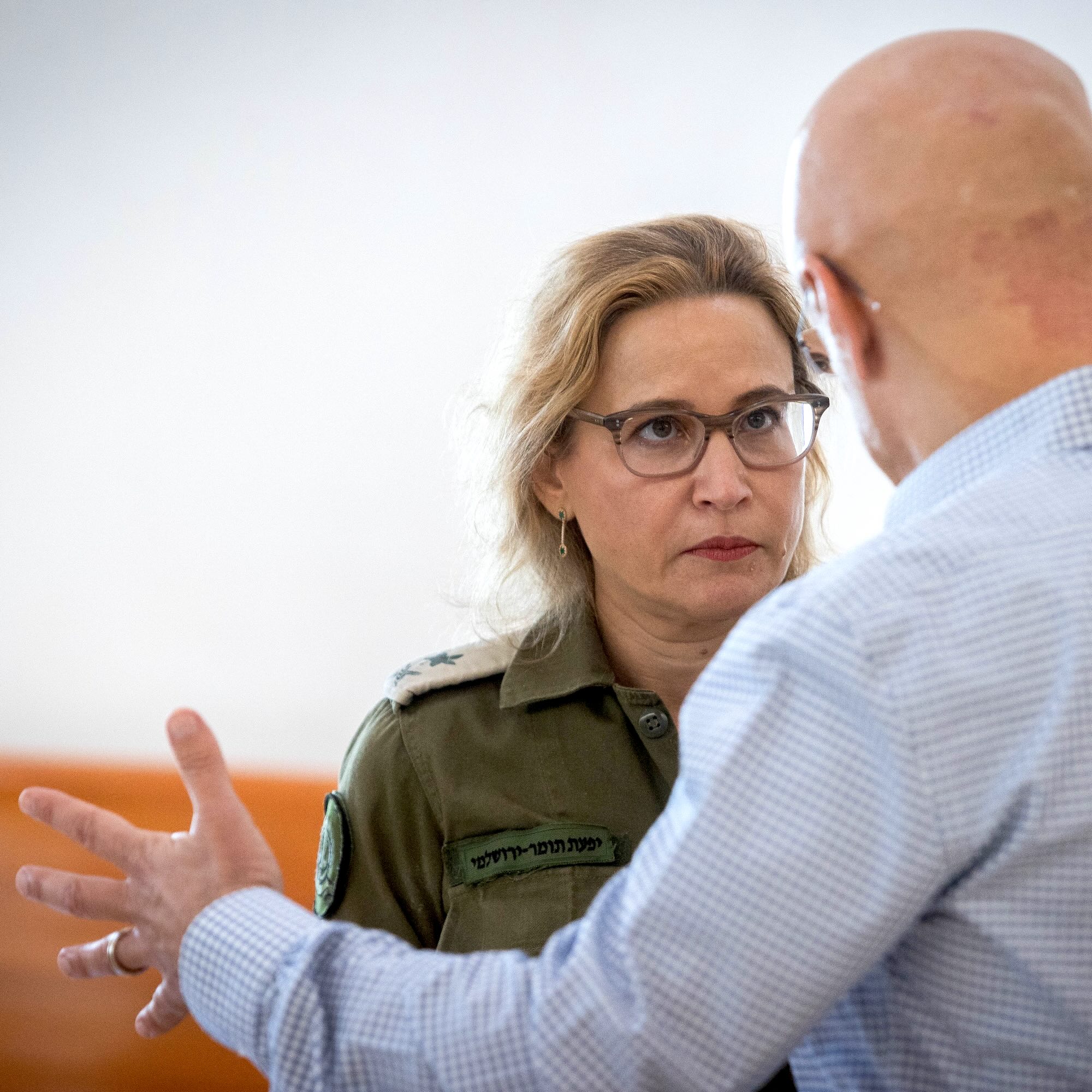
Sa. Today two topics up for discussion. The first we are calling oh, a Yammerer's Futility, which title obviously anagrams to Yifat Tomer Irushalmi as Major General Yifat Tomer Irushalmi, who was until a week and a bit ago, the Commander of the IDF's Military Advocate Generals Corps, the army's chief lieutenant. She melts down tragically, terribly, dramatically, sadly, after she admits to last year leaking a video of reserve soldiers allegedly abusing, including sodomizing, a Gazan prisoner, though what you see on the video is hotly debated and we will try to make sense of this cascade of sad and worrying affairs. And our second discussion, New Time Religion as one thing that seems to have come with the war is a new sort of of religiosity or spirituality in the public square and it seems, in people's homes and souls. And we will try to understand what this is and whether it is likely to have any lasting impact. And for our most unreasonably generous Patreon supporters, in our extra special special extra discussion, the link to which you can find in our show Notes on your podcast app or at patreon.com promisepodcast on the world Wide Web, we will talk about a recent article in New York magazine that was called At First Anyway, does it matter what your therapist thinks about Israel? Which essay follows mostly Jewish therapists and people who go to therapists, many of whom find they cannot keep their therapeutic relationship going until they know that they see eye to eye about Zionism, Israel and Palestine and this essay. It broke my heart people. Which heart? I am hoping that Miriam can help to mend as so many times in the past. And you too, Judah, you can try your hand too at mending a broken heart. But before we get to any of you that listen to this, That song is Hakola Colitova by Odea, who is one of our greatest mistresses of what we now call pop emuni belief pop music, examples of which we will listen to over the course of the show. And now it is time for our first discussion. So Miriam, in the end, end, it always comes down to iPhones and oceans, doesn't it?
- [49:26]
B
It does. And you said that Yifat Tomer Yerushalmi anagrams to O a yammerer's futility. And I will note that you cannot spell Yifat Tomer Yerushalmi without rush to frame or moral haste. That and much more. So buckle up folks.
- [49:46]
A
Those shtuchim are right man. It's all there. It's all in the words. We don't need to look at the world. It's all in the words, the letters.
- [49:53]
B
So on Sunday, Major General Yifat Tomer Yerushalmi, until last week, the IDF's top attorney, the commander of the Military Advocate General's Corps, was rushed from her home where she was under house arrest, to Ichilov Hospital after overdosing on pills in what is understood to have been an attempt to end her own life. The Military Advocate General was under house arrest after she was arrested the week before last on suspicion of four fraud, breach of trust, abuse of office, obstruction of justice, and unauthorized disclosure of official information. That arrest came after Tomer Yami went missing for some hours, having left a suicide note in her Ramata Sharon home and gone to Hofatuk, the cliff beach on the border between Tel Aviv and Herzia, where she was found disoriented, having, as it later emerged, tossed her mobile phone into the the sea. Major General Tomer Yurushami was arrested Sunday before last after she admitted that she had approved leaking material to the media. That material was surveillance video footage from July 5, 2024. So we're talking 16 months ago of 18 minutes of IDF reserve soldiers surrounding and apparently abusing a prisoner from Gaza. This took place in an army base that was repurposed after the October 7th attack into a military jail. It's called ST. What we see in the tape is a prisoner being escorted out of A room full of bound prisoners lying on mats on the floor. We then see a cluster of guards surrounding the prisoner, holding large shields that block the camera's view. We can tell that the prisoner is on the floor. You can spot him there between the legs of the guys with the shields. And we see other guards struggling with him. And we also see a German shepherd being brought near the prisoner by the dog's handler. Soon after that, the prisoner was brought to a hostel hospital where a doctor documented his many injuries, including several broken ribs and a tear in the lower bowel and damage to one of the lungs that required emergency surgery. And that had been caused, according to a doctor, by an object inserted deep into the detainee's rectum. It was then that Major General Yifat Tomer Yerushalmi initiated an investigation. And it was at her instruction that three and a half weeks later, on July 12, 29th, military police raided Stateman and detained nine of the 10 reserve soldiers in the video. After this, there was bedlam. National Security Minister Itamar Bengvir called the arrests shameful. Finance Minister Bitzal El Smotrich warned Ifat Tomer Yerushami to take your hands off our heroic warriors. When word of the arrests got around, hundreds of protesters came to the gates of Stateman, including right wing mks like Zvi Sukot and Almog Khan of Ben Jewish Power Party and Nissim Vetturi and Tali Gottlieb of the Likud. Two ministers from Ben Gvir's party were also there. Minister of the Galilee, the Negev and National Resilience Yitzhak Vasarlov and Minister of Heritage Amichai Eliyahu. After a time, the protesters tired of protesting outside the camp and broke in, doing some light damage and making a wild rumpus. The protesters main point seems to have been that 21 months after October 7th and after 21 months of exhausting reserve duty service, it was a crime against our soldiers to hold them accountable for what they did in their service, even if what they did in their service included torturing through sodomy a bound prisoner. Another point seems to have been that no Hamas prisoner jailed in State Tayman is truly innocent. They deserve what they get. It was we learned last week after that MK studded demonstration at State Tayman at the end of July that Major General Yifat Tomer Yerushalmi gave the order to leak the surveillance video. The most positive spin on why she did this is that she did it for at least two reasons. One, to show Israeli citizens that the arrests of the nine reservists were justified and two, to show the world that the Israeli justice system, including the IDF justice system, is continually monitoring the behavior of Israeli soldiers and bringing those who commit crimes, including war, war crimes, to justice. This, Ifatomer Yerushalmi believed, was necessary to keep the International Court of Justice from trying and convicting Israel for war crimes, as the ICJ does not intervene in the doings of countries that are judged to have vigorously functioning independent courts. Thus, in her resignation letter, Tomer Yerushalmi said she leaked the tape, quote, in an attempt to counter false propaganda against the Army's law enforcement authority authorities. There was an ironic logic to her decision to leak the tape. It is only by making the Israeli reservists look bad that she could make the Israeli courts look good, which is something she thought that the country desperately needed. People can argue about whether leaking the tape was wise or not, justified or not, maybe even brave or not, but what Major General Yifat Tomer Yerushalmi did after the leak is maybe harder to defend. She lied. She apparently told then Defense Minister Yoav Galland that she did not know how the tape reached the press. She oversaw an internal investigation that concluded that the leak did not come from the department she headed. She stayed mum as this report went up the chain of command and finally made its way to the Supreme Court. This is the basis of the charges against her now, of course, fraud, breach of trust and all the rest. It is maybe a sad sign of the times, or maybe it would be inevitable at any time that the scandal surrounding Yifat Tomer Yerushalmi's questionable judgment and flat out lies immediately became part of other long standing and important political struggles. Prime Minister Benjamin Netanyahu said that the leak caused so great damage to the image of Israel that it has no precedent in his history. Supporters of the Prime Minister said that Tomer Yerushami's perfidy was yet further evidence of the deep state anti democratic nature of the courts. And they were quick to argue that the Army's Attorney General is a crony and fellow traveler of Gali Baharav Miyara, the country's Attorney General whom the coalition has been long trying to fire. It was for this reason that Minister of Justice Yariv Levine appointed as a special investigator of the Tomer Yerushalmi affair, a retired judge named Asher Kula, who serves as the State Ombudsman for judges, meaning that he investigates public complaints about judges, meaning that he knows a thing or two about Judicial hanky panky. This state of affairs left two people in charge of the investigation, Gali Baharav Miara and Asher Kula. That's a sticky situation. Until the Supreme Court decided on Tuesday that this had to be resolved and literally begged the sides to come up with a solution by the ending the of of the day today, Thursday. All of which is a lot. And this story is almost all that we've talked about the past two weeks, save for the drip, drip release of the remains of hostages held in Gaza. So Judah, what matters about this story? What should we make of it? What do we learn from it?
- [57:31]
C
This story is a mess. I think think the easiest way to break it down is in sort of three discrete but interconnected issues. One is this case of abuse that is seen in the video that was leaked, that is still sort of making its way through the courts. And a broader issue of how and if Israel is prosecuting war crimes that were allegedly committed by Israeli soldiers in Gaza and against Palestinians during the war. That's sort of one topic. The other is the leak itself and how this came about, why it came about, the apparently boneheaded nature of the way it was done, where it was apparently openly discussed in a group chat on WhatsApp before she did it, which is and then tried to get rid of the evidence by throwing away her phone, as if that works in 2025. So there's sort of that issue and then there's the larger issue that this has gone into of the judicial overhaul, the, you know, the government's dissatisfaction with the attorney general and the general system and how this is being fed into that. And just in some cases justifiably so, in some cases probably not. But sort of those three things and how they interplay with one another. The military advocate general, there's a certain amount of, you know, short term, long term debate going on here because you do. If Israel wants to avoid prosecution in international courts, it needs to have a functioning system that is prosecuting soldiers for war crimes. And I really don't think it's that crazy to say that war crimes have been committed by Israeli soldiers during this war, because war crimes are committed in literally every war. It's not, you know, it's not something that's specifically against Israel. But the only way that you stave off international investigations is by prosecuting them, which really has not happened in a sufficient efficient way in Israel, which is really opening Israeli and Israeli soldiers. Sort of when this news broke, sort of the first thing that I said to friends of Mine who had done reserve duty was, I'm a journalist. I had gotten an exemption from reserve duty. When I go abroad, I'm not going to get stopped and arrested for my service during the war. But they might be now because why
- [59:45]
B
do you think anyone cares? Makes a difference between whether you served or not in that category.
- [59:49]
C
I mean, oh, because there's, oh, people might hate me, but I'm not going to get arrested for war crimes that I allegedly committed in Gaza because I wasn't part of the army during the past.
- [59:58]
B
Because the army's not prosecuting.
- [60:00]
C
Yeah, but if the army's not prosecuting, if there's no way for the army to prosecute, then that becomes a real, real source of concern for any reservist that's going abroad. That's a very real discussion that needs to be happening. And maybe the short term arguments that are happening about this are going to get in the way of that and is going to have real long term implications for the hundreds of thousands of Israelis that performed reserve duty over the past two years.
- [60:22]
B
I want to hear you talk about the journalism side of this, as you in particular, but I want to hear what Noah has to say.
- [60:29]
A
Well, first of all, for me, what this story is most of all is so nearly infinitely sad. I mean, Tome Yerushalmi has a family. She's pretty young. She looks like every person that you see on the street in Tel Aviv. I do think that there was something brave about her decision to leak this. The there was something cowardly about lying about it after the fact as well. But just the stress that she's in, the fact that she has now twice tried to kill herself because this story has so many moving parts. There were obviously, we couldn't describe them all, but a week before she tried to commit suicide on this past Sunday, the Sunday before that when she went to the beach, she had left a suicide note and tried to commit suicide.
- [61:29]
B
Then you're really cutting her a lot of slack. I mean, obviously you're very sympathetic to anyone who is in that kind of distress. But she is the military Advocate General. She knows the law. She did multiple things that jeopardized herself, her team, her country.
- [61:48]
C
And people have pointed, and it's been pointed out by others that she didn't have to leak it. She could have done this in an above board way. So that's where I think calling it brave becomes a little bit more complicated because she could have gone about this in a different way. She could have organized a press conference and gone here, look this is what we're prosecuting and held up.
- [62:08]
A
Show the video, then.
- [62:09]
C
Yeah, done it completely openly. Not hiding behind a leak. Not. That's brave. I mean, that's going to get you fired the next day, whatever. But that's brave. Doing it in a leak is kind of, by definition, not brave. You know, it's sort of, in its own way, not brave. It's cowardly. It's doing it in a, you know, roundabout way instead of saying, here, here's the evidence. This is what I'm contending with, and this is why we have to prosecute.
- [62:33]
A
I guess you're just absolutely right about that. The reason. One of the reasons why she leaked the tape, one assumes, in addition to the reasons that she gave, is that she was being attacked for having launched the investigation and having had these reservists arrested. And one of the things she hoped for in the leak was that it would reduce pressure on her by making people say, oh, my God. I guess there. Obviously there needed to be arrests here, because look at this. So I see what you're saying. Still, for me, there is this personal drama here of a person whose life is ruined, whose will to live is hopefully just for the time being, entirely vanquished, entirely gone. And it's just really, really sad. And I think that these issues are very, very difficult to deal with. Well, maybe they're fiendishly difficult, maybe impossible to deal with. Well, because the video, you know, I watched the video over and over again. I was trying to figure out what I learned from the video, and there's. There's really pretty little information. I mean, you come away from it being pretty damn sure that something terrible went on there, but you really didn't see it in the video. But the question of what do you do to reserve soldiers who may have gotten orders to do this or may have felt it was the right thing to do, or whose sister or brother may have been, you know, murdered or killed in fighting. It's. They're. They're really, really difficult issues or who
- [64:21]
B
are in the most difficult situation in a. In a. In a facility full of mostly Nukhpa, you know, people, murderers who forget about retribution. They're very dangerous people. And so wait. But I also, like, I wanted to add to the sympathy list alongside her. Tomer you. Those suspects who after all this time have not been charged, they certainly haven't been charged with sodomy. And so they're sitting there in limbo as well. And they are becheskat chaf me pesha. They are innocent at this stage and their lives are completely on hold. So it's really a mess. I think if you go back like this story just keeps taking a turn this way and that way and I kind of wanted to mine, you know. So first you hear that there has been this horrible abuse. Then you see this horrific behavior by these, you know, extreme right wing extremists invading an army base, unprecedented lawbreaking and
- [65:26]
A
really I have a little warmth for that.
- [65:29]
B
It was for storming the base of ministers in a government, storming an army base.
- [65:35]
A
This was not January 6th in the capital of the United States. This was people who were protesting and then they found like a, a hole in the fence that they could go through and they went through. And that's what protests are like to me.
- [65:46]
B
All of this goes back to El or Azaria. And if you look, if you follow, if you trace the story of that, that soldier who shot on video, shot a prisoner, a, a, a, a captured terrorist in, in the west seems to
- [66:03]
A
be unconscious on the ground, who was
- [66:04]
B
on the ground and shot him dead. And that's filmed on video. And you go okay, this is a black and white case. There's no question here what happened. There's no question that this person, you know is going to get some form of. And then he became Ayelet Chilculano. He became our boy for the right and led to the end of, you know, the, of the political career of Boge Aylon. And you know, it's like he was tried and went to jail and he became the source of a movement of, he galvanized a movement of righteous people saying you do not prosecute soldiers somehow and certainly not ones who, you know, whatever they committed it was against a terrorist. And you watched political careers kind of rise and fall on that story. And you know that what's happening here is that there's an opportunity for people's political careers to rise or fall. And as you know, you pointed out for this to be used as a battering ram even, even if you know the attorney general deserves criticism, it's an incredible opportunity for the right to cash in on it.
- [67:11]
A
Yes. Though I don't understand why it makes sense to view it simply as cashing in these people. And I believe that you probably don't doubt this either. Strongly believe that it is a mistake to charge. No.
- [67:27]
B
Agree. She should have recused herself.
- [67:29]
A
She long ago. I lost ago ended my reserve service in, in my 40s. You know, it was time I was, I was the, had been the oldest person in my Reserve. So like last year in reserves. Yes, for, for years by, by that time everyone had gotten out before I was. I mean, I was a. But I ended it when every year I did reserves in Hebron. And one time my reserve duty was, was. Was to man a. An ad hoc jail that had been set up for Palestinians and it was impossible for me to find myself there. Like, there is no way to be decent. And it wasn't, you know, there were none, no crimes like this, no one was being sodomized there. But just between the people and the
- [68:22]
B
people, in addition to, to that kind of. That wasn't happening. The people that you were dealing with, as bad as they were, don't match the level of.
- [68:31]
C
Not everybody was necessarily.
- [68:33]
B
No, no. In that quantity.
- [68:34]
A
No, absolutely. I had less reason to have to be fearful. I had less reason to seek, you know, no reason to seek revenge or anything like that, but just the situation was such that it was impossible to maintain like any sort of morality or human dignity. I sort of felt. And that's when I went to my commander and said, throw me in jail. Jail. And he said, he laughed. He said, go home. And then I was never called again. But look, but part of the issue
- [69:02]
C
with State Taeman was that it was not a real prison. It was set up as this ad hoc thing housing all these people, which even more so is part of the problem.
- [69:12]
A
People like me who don't have a clue about how you guard people did
- [69:16]
B
either hear the interview on Galatz like I was I think a week and a half ago with a guy who had been there, just describing the conditions of trying to figure out how to function in this incredible sort of chaos of rage and disorganization following. Imagine like the number of people that were brought in. We saw that on TV lines and lines.
- [69:40]
A
There were hundreds and hundreds of prisoners that needed to be processed. Nobody knew who they were. Nobody could tell apart the people who were truly dangerous from the people who were just swept up and were truly, truly innocent. It's really a mess. But just to get back for one moment to the right wing people, I think that they genuinely believe that there is something wrong about holding to too great a degree people responsible for what they do in that situation. And I disagree with them. But I do not think that that's not a morally serious position. I think it is, is a morally serious position. You say, here are people who have just given, you know, 300 days to the reserves. They're exhausted, they, they're losing their jobs. They don't have. They're they're away from their family, they're away from their, their kids. You, they get, get orders to do things and then they do something that is inhuman and terribly wrong. How, to what degree do you hold them accountable?
- [70:47]
C
I think I, I agree because we're giving people reservists even. I mean, we give 18 year old kids a gun and say do this job, which is horrible and includes unimaginable moral and ethical considerations. You need to give people leeway. We're asking them to do a job that we're requiring them. This isn't a country that has volunteer. You know, you're not volunteering for the army. You have to serve. You get called up, you get an order to perform reserve duty. We're forcing people to do this. You need to give people leeway. That is the nature of the contract that we have with soldiers. But that's leeway. It's not carte blanche to do whatever you want to do. And there needs to be a line. And I think if you look at the level or lack thereof of prosecutions that there have been within the military on these issues, we're giving people a lot of leeway. And obviously this was something that particularly
- [71:39]
A
the right way position.
- [71:40]
C
But I'm saying that's the argument that just saying carte blanche to do whatever you want is not, it might be a moral argument. I don't know that it's a morally serious argument.
- [71:48]
B
I don't think also that the right wing's predominantly making that case. No, I think they're making the case that this was cooked up and these guys are innocent. That this was, this was a.
- [71:57]
A
They're not making the case that what we see on the video didn't happen. They're making the case that what we
- [72:01]
C
see on the video, there's definitely people that are saying that it's, that it's edited, that it's.
- [72:06]
B
First of all, it is ev. It is edited. It is. There are, there are some confusing aspects of it. And that is being pushed very, very strongly. And in fact it should be because we don't have the skills or the information or the additional footage yet to judge exactly what's happening in that video. But, but more importantly, the guys themselves are saying, we did not apply excessive force. We were dealing with, you know, you didn't, you, you don't hear what was going on there. We were dealing with a guy who was resisting and was biting us and was kicking us. And we used our training to restrain him the way we were trained to restrain him, which includes putting shields up to avoid all kinds of things. That's what their claim is. I don't know if they're right. The right is not leaning entirely into this idea that they are allowed to do whatever they want. They're leaning more into the idea that this is the deep state cooking up a case against innocent reservists for whatever reason.
- [73:07]
A
I think that they're saying what Judah said, that these people need to have some leeway and that the. That we ought to assume, until we learn very, very clearly the opposite, that the way that they acted was with decency and within the bounds of morality and the law. And I do not think that that is the case exactly either. But I do think that it's serious. We have to bring this to an end. But I would just want to flag that. The issue about the damage to the judicial system that this does and the. That we're having now about who should investigate. Who should investigate this entire affair, whether it should be people from within the judicial system, is a serious one, too, because we have Tomer Yerushami. She organized an investigation into herself and found herself completely innocent. And that was accepted within the court system system. And that is a really big problem for those of us who go every Saturday night to demonstrate, to say, leave the court system alone. We can rely upon them.
- [74:28]
B
Yeah. I just feel like we need to add. You have, you know, a former military reporter sitting here, and this also was a story about journalism. And Guy Peleg was the guy who broke the story. He framed it. He convicted them in his report. Ayala Hassan has now of Guy Peleg is from Channel 12. Ayala Hasson is from Cannes. She's, you know, now bringing her case. And this is being tried in the media with musical backgrounds played behind, as our friend Rachel Nyman points out. You know, once they put music behind news, we know we're not in news anymore, and we are in a post. We're really moving towards a post truth world where it's really just about what you think happened and what you should feel about it. And. And on the other side of it is that Israeli news functions on leaks. So it's not as if this is the first time an important piece of evidence has been leaked to the media very, very strategically, and we gain from that. But this story is so much also about sideism in the media, and it just drives me nuts. Yes.
- [75:40]
C
I mean, it's a. I agree. It's not being done in a way that's object very much sides in this. And who's leaking to who and which side is is arguing which side. I think it's also there is something about it that what Ifatomer Yareshami did is something that people do every day of the week in Israel. Including and I'm like stressing including from the investigation into her. There have been leaks left and right, which is apparently not a problem, though I will say they're probably being done through the proper clearances that they were approved leaks and not what she did, which was without informing her superiors that she was doing this.
- [76:17]
A
Apropos functioning on leeks. You know what I like as Winter is coming is a good soup. Leek and potato soup in particular I think is good.
- [76:24]
B
Yep.
- [76:25]
A
Now listen to this. That song is Et Sha' ar Ratzon More pap emuni by Yuval Dayan and speaking about belief, Pop Judah has the war given us more and maybe a little bit of a different God A
- [78:16]
C
two panel cartoon appeared in last week's Yatad Ne Iman magazine, the paper of the Lithuanian Haredi Degel had Torah Party. The cartoon was by 81 year old illustrator Yoni Gerstein. In the first panel labeled Tav Shin Peidaled, the numerological designation for two years ago, 5784, a kibbutznik with a classic blorit forelock and a stereotypical kovatembel bucket hat on his head is seen forced by a machine gun bearing Hamas fighter into a pit with Gaza City in in the background. The second panel is labeled Tavshin Pe Vav 5786 that is now, and it shows the same kibbutznik ascending out of the pit against the backdrop of a raised Gaza City. Now, though, in addition to being thinner and barefoot, the kibbutznik is wearing tzitzit. His forelock is shaved clean, making room for the tefillin that he now wears on his head and on his arm. On his chin is a scraggly beard. In his hand is a prayer book and a short comma of peis or forelocks appear on his temples. Two years ago he was frowning. Now he is smiling a big smile. The aphorism may be that there are no atheists in foxholes, but Gerstein seems to be implying that there aren't atheists in Hamas tunnels either. You can see why this message might appeal to readers of Yeted Neyman Proof in the truth of their Haredi lifestyle, and even more so appeal other to each Gerstein, who himself found religion in his mid-30s. But the idea that the ordeal of captivity somehow strengthened the religion of at least some, maybe many of the hostages, and at least some, maybe many of their parents and brothers and sisters is not just wishful thinking on the part of people who are religious all along. There seems to be something to it. Take Bar Kupferstein, for instance, one of the 20 hostages who came home just before Simcha Kahtorah. He was the one whose father, Tal, taught himself to walk and talk over the two years that his son was being held hostage as a welcome home surprise for his boy after a stroke five years before. Like many of the 20 and of those who were released earlier, Bar Kuperstein was kidnapped from the Nova Rave on Simchat Torah two years ago. The Nova Rave was, after all, a drugs and techno music party on a Jewish holiday, and Shabbat to boot, an event incompatible with Jewish observance. Yet upon being discharged from the hospital, Bar Kuprasin went to Bnei Brak to meet with the mayor and the head of a famous yeshiva, saying, I want to tell you all thank you very much. I am sure that it is because of all of your prayers and those of the entire Jewish people that I am here. If it weren't for you, I might still be there. Bar Kufristein wore a baseball cap that read, he is in the hands of the Holy One, Blessed, blessed be he. He said that he managed to keep Shabbat by making kiddush over a glass of water and singing Shalom Aleichem. He marked the end of Shabbat by saying Havdala using a flashlight instead of a candle and water again for wine. Or take Agam Burger, who refused to eat non kosher meat that was served to her by her captors during her 482 days in captivity. There are lots of stories like this of hostages or members of the family who, over the course of their ideal, drew closer to religion. Secular hostages found themselves praying for the first time in Gaza. Secular parents found themselves visiting rabbis and spending early mornings in synagogues. Ori Megadisha's mother, Margalit famously performed Hafrashad Challah, the sacrificial separation of a portion of bread dough with a prayer for her daughter's return days before her miraculous rescue by IDF troops, boosting the practice's popularity across. Across the country, of course, lots of people went through trials without changing their attitudes towards religion or their practice or their belief, but still responding to all that had happened in a way inflected by religion. It was surprisingly common, and something like that was maybe true for the rest of us too. In the early weeks of the war, tseit became the hottest commodity for soldiers and reservists, religious and secular, becoming a sort of talisman for troops on their way into battle. It's still common today to see men with long fringes dangling from their shirts, even without kipot on their heads. On the radio, you hear more and more religiously inflected music, including the songs that we just heard on the podcast. And this very podcast also noted the great swell of slichot events In Elul the month leading up to the High Holidays, it became common to see performers at secular concerts singing the Adon Haselihot prayer during the month of Elul. Of course, all of this stuff is anecdotes, but it's also undeniably there at the same time. Confoundingly. A recent study by the Rushinac firm for Israel's Channel 12 found that while nearly a quarter of Israelis say they that they have gotten closer to religion since October 7, 2023, 13% say they've moved away from religion since then. And most of us, some 65%, say we haven't changed at all. All in terms of rubber Meeting Road, religiously speaking, the survey found that levels of Shabbat observance haven't changed since 2022. So what gives, Miriam? Is Israeli society becoming more religious, more spiritual, more superstitious? Is this a lasting, fundamental shift or something fleeting and superficial? And what does it mean for us going forward?
- [83:39]
B
Well, I, I, first of all, yes, I do feel it. I feel it and I see it. I feel it personally, in the way that I've experienced such, I think, overwhelming emotions of grief and bewilderment. And I do find that religious expression in Tefillah and prayer, I, I find a sense of, like, language for what I otherwise can't articulate. And I also, in, I mean, I'm thinking a lot about the prayer that became sort of the centerpiece, which is part of the standard sidur in weekday prayers, but was brought into the Shabbat prayers for many, many congregations. And, and what's amazing about it is it's a prayer that is from the 9th century. And it's, you know, it does two things. One is it gives you, or three things, I guess it gives you a language to talk with God. No matter where you are on the God issue, you get a script that is very relevant. It gives you something to sing and say together with your community, which is also part of this experience, the need for being with other People, and it connects you back into this history of Jewish experience, of Jewish tragedy. And it's something that I think we, as those of us who grew up as American Jews had there. But it wasn't the centerpiece of our Jewish experience. It was somewhere in the background. And so, yes, I expect I found that to be true during 2014, in the summer in the war, personally, just because my son was a soldier at the time. So I, you know, and his friends were. We were experiencing, you know, casualties of people we knew or indirectly connected to. And so that kind of experience. So there's that. Early in the war, you mentioned hafrashat challah as a ritual. I see some also, like a sense of mental magicalness that happens with religious ritual where you kind of, you know, that vow that you make, like, oh, if I. If I keep this halacha, if I. If I become more religious, somehow, somehow God will, you know, will reward me by releasing, by engineering the release of hostages or keeping my. My son safe at war. And, you know, these are things that I, you know, in my normal sense, my baseline is I'm cyn and I kind of intellectually, I look down on that idea of reward and that kind of way of expressing it, but in my gut, I so get it. And I walked through my neighborhood when there was somebody who was held in Gaza from nearby, and large ceremonies of women doing hafrashat challah, doing this ritual where you take a piece of challah and you make a certain blessing. And it's supposed to be a schoola. And I so get it as far as whether it's gonna. How it's going to be affected. This is an energy that is being harnessed by forces who know how to harness it. So you mentioned chabad at the beginning, and I think chabad is growing tremendously. It always is. So I don't. I can't. I don't know if we can, you know, link it to the war, but I would suspect that Chabad has had a major surge forward of people who weren't connected to Kehilo, to communities, looking for community. And I think that could be a lasting effect in some of these rituals. And certainly the art and songs that came out of this, which are very inflected with religion, will be with us for many years.
- [87:45]
A
Yeah, I also feel it, and I think that it's beautiful. I don't know if it's actually harnessable. So I don't worry about it, about it somehow, you know, allowing people to advance their. Their agenda. I think a Little bit the opposite. One of the reasons why I'm so moved by this and also why it makes me hopeful is that I think it doesn't end up sitting well with any kind of pre existing, you know, institution or, or ideology. There are a few. There are a lot of things happening here. One is that you see people who are clearly grasping towards, and myself as well, towards understanding in a deeper way our connection with our long history. And there was a long time when Zionist culture was scornful of what came before Zionist culture. And now I think you see from really the passing of that Slilat Gola, that rejection of the Diaspora that came before. And people want to feel as though the words that come to their mind when they're trying to make sense of their lives might be similar to the words that came into the minds of their great grandparents or at Baba Yar or all through history. It's not just tragedy. So there's an effort to try to become part of history. And I think that there's also an effort to seek connection with the other people around us through this. It's not the only way that people seek to connect. But there is something that. There is something about a person who's not at all religious, but suddenly coming to appreciate something like Hafrashat Khalah that you were talking about or Talasint fill in that that reduces the barrier that divides that person from people in the country who are more religious or from a different culture. There's something unifying about it. And that's. So there's the diachronic and the synchronic, the long history thing and the connecting us along at this moment, one with the other. I started going back and reading Gershom Shalom, who I feel, feel holds a key to understanding this. And he wrote, I mean, his first very, very, very famously influential article. He wrote in 1936 about how after the trauma of the false messiah of Shabtai Zvi, there was this great sense of loss and this great sense of lack of direction and worry about the future. And that out of that grew this new kind of, kind of Jewish spirituality. And it was like increased interest in Kabbalah and Hasidism came out of that. And I think that we're in a moment of a kind of neo Hasidism. And what was so powerful about Hasidism is that they. And the reason why Hasids, why Hasids were hated and beaten up by people who felt differently, Jews who felt differently than them in Europe, is because they like, had no need for the institutions, they had no need for all the rules. Some of them were quite traditionally pious. Some of them were less so, or some of them were differently so. And they just were sort of drawn forward by this sense of, like, spirit. And they. They saw things in nature and in the world and in their. Their fellow human beings that Jews had not seen before in a way that they talked about or in a way that became central to their experience. And I think some like that is happening, and you feel it in what you were talking about, about the magical thinking. Just like the world is kind of re. Enchanted in all sorts of ways. That seems to me to have just real potential for connecting people and healing. And Judah, what do you think?
- [92:06]
C
I'm a bit ambivalent about it. I don't know why you say it's not something that's harnessable. I mean, religion is one of the most harnessable, harnessable things out there. And especially, you know, in the wake of October 7, when people are questioning so many things in terms of their ideology, their spirituality, whatever, that people can come in and say, okay, let me show you the path. Let me show you the way. And it can start with Hafershad Chala and putting Antfil in. And then you say, okay, really, you need to go here, and you need to do this, and you need to read this, and you need to study that. And then people go on trajectory. That's not necessarily a trajectory that I associate with. You know, I don't want to be dismissive of it. You know, I think I'm also looking at it, seeing what's happening in the United States as well. There's something that's been described as the surge. That's the term that the researchers who sort of first identified it have called it, of people coming. And one of the things that they found is that one of the great beneficiaries of the surge is chabad. That a lot of people are going to chabad, and they're going to chabad because chabad is very welcoming. They're very nice. They open you with open arms. They bring you in, they give you nice food. And they don't. They're not overly pushy. They want you to come and do their things, but they're not trying to convince you of anything. It's just a very open and welcoming environment, something that a lot of other shuls in the US Aren't, because they charge a lot of money for you to go there and whatever. And it's a similar thing here, people. There's a Huge outreach program. Kiruv, you know, that of kind comes out of orthodoxy. And you don't really have that with non orthodoxy, with, you know, the conservative movement does not have a strong Kiruv game. The reform movement does not have a strong Kiruv game. And so, yeah, when that's. I'm as a, as a religious Jew, you know, I'm more, more. The more the merrier. But I'm also aware of the fact that there's a lot of politically inflected, maybe infected was the right word, but politically inflected, you know, religiosity that points people towards a specific, you know, right wing path. And that's also a part of it. And that's something to be aware of and wary of and to be, to be watching at the same time. Yeah, I think, yeah, people, religion's great. Like Shabbat is great. And if this is getting more people to do Shabbat, it's good for them, I believe. I don't think that's why we do it, but I think it does have the benefit of being a spectacular way to live your life. And that's a good thing. So that's why I'm ambivalent. I'm worried about where it can go. But I also think that it has, you know, pretty profound ways of connecting people to community at a time when we're very disconnected from one another.
- [94:47]
A
But also it's very. This particular version is very anarchic and very disorganized. It's true. Surely somebody.
- [94:55]
C
I don't know that it's that disorganized. I think there's a lot of. I mean, and me watching this as somebody who follows philanthropy and whatever, there's a certain amount of it that's very organized.
- [95:04]
B
Spill it, spill it, Judah.
- [95:06]
C
No, I'm just. If you can. In pictures of. I'm a little uncomfortable getting into this, but, you know, this was a debate that has been going on a little bit within sort of religious circles in Israel especially. But one of the people who you see photographed the most with released hostages is a guy named Shai Graucher, who is a rabbi. He's the son of a very influential singer, Dedi Groucher. And he has significant philanthropic backing from the Haredi community. And I genuinely believe that they're trying to do nice things for people that have been through horrible.
- [95:41]
B
He's the guy that gives people bicycles.
- [95:43]
C
He gives them bicycles, he gives them iPhones, he gives them iPads. And sort of somebody said they didn't have chocolate in in captivity. So he gave them a platter of chocolate. Like he's just trying to.
- [95:53]
B
So.
- [95:54]
C
But at the same time, that's beautiful and important and. And he's giving tefillin and, you know, tally tut and everything.
- [96:00]
B
I think, by the way, Eretz Nadera did a parody of.
- [96:03]
C
Yeah, a lot of people have.
- [96:04]
B
And it's very important to get give in secret. He brings a camera crew with him as he's giving secrets.
- [96:09]
A
Exactly.
- [96:10]
C
So there's questions about that. But also that's not something that's happening by accident. He has very strong philanthropic backing from different sources. So that's not something that sort of happens to be going on. It's not anarchic. It's kind of concerted and organized in that way.
- [96:25]
A
There are certainly people who hope that all the people becoming religious will become religious in the way that they understand and have always been. But there is also the potential. I mean, Gershom Shalom was right that Hasidism was something new. Occasionally there are new spiritual movements. And I went to Bar Kupershtein called, said that while he was. While he was in captivity, he had this dream that he was going to put on tefillin with a huge crowd of people. So he called the Friday before last, he called us to come to Hasid Square and put on tefillin. So I went, and there were thousands and thousands and thousands, thousands of people. Some of them were clearly like. Most of them were clearly people who, like, know their way around fillin. Bar Kufenstein, though, did not. His mother stood up and very charmingly said, said for years I said, barr, why don't you put on fillin? And he would never, ever do it. And now he's. But then when it came time to do it and he was, you know, weeks after he was released, he did not have a clue and did not seem interested in this being part of his life. But he did have this. So this. This idea that we would do it together. And then this group ended up being this. This, like, unusual thing of mostly. Mostly modern Orthodox Jews, no doubt a lot of people who were in it all that there was Chabad was all around, by the way. They. They brought an extra couple of hundred pairs of tefillin to give to people to put on. I mean, they took them back at the end and. And it was this, like, interesting moment. Now what. Bart Kuberstein could end up being Haridi. He could be like Uri Zoar in the end. Who knows?
- [98:03]
B
But.
- [98:03]
A
But he could. But he represents at the moment he represents something that's really different.
- [98:07]
B
If only you had some, I don't know, grad students who could be like tracing this for the next five years and see how it goes.
- [98:13]
A
I think that we're all gonna be experiencing it for the next five years, but I identify what I take to be something like a new form here of people who are both religious and not religious at the same time.
- [98:25]
B
Oh, it's like people wearing tzitzit, like as sort of talisman.
- [98:29]
A
Exactly.
- [98:30]
C
No, but we're at the end, I
- [98:31]
A
mean we're at the tzitzit is talisman.
- [98:33]
C
We're at the end of our discussion. But I the question of is that gonna be something that's just kind of benign and aesthetic and superstitious or is that something that's going to sort of fundamentally shift the makeup of Israeli society? Like I think that's the ultimate question here.
- [98:47]
A
Yes. So I would not use the words benign and what did you say superstitious to describe it as much as like spiritually open hearted and seeking some way to connect both with your history and with the people around you. That has like an odd relationship to ritual as we have known it. And I think that it could well influence us. But when you say that it sounds
- [99:16]
C
like, well, cause I'm a Yeshaya Olevich guy who's, you know, you do the mitzvah. Because it says you do the mitzvah and that's.
- [99:23]
A
You're the people who are beating up. You're the one who's beating up the Hasidler.
- [99:26]
C
In my life I'm the guy who
- [99:27]
A
would go, I think had a footnote about that about how you beat up the church. Now listen to this. Foreign. That song is Tamid o Hevoti by Sasson Ephraim Chaouli and it is more pop Emoni belief pop music. You can find all the songs that you heard today in all the usual places. And now it is time for what a country segment. This is the part of the show in which each of us describes something that might have given some solace as we wended our way through our worlds over the last last little while. Or possibly something that surprised and amused, delighted and enchanted and source holder could be even flug death since we did that self same wending Judah what is your what a country.
- [101:54]
C
On Monday morning I found myself on the 5:56am train from Binyamina barreling toward Beersheva. I was heading to the so called capital of the Negev for an 8:30 meeting with Dr. Shlomi. Kodesh, Director General of Soroka Medical Center. Some of you may know that last week Canadian Israeli real estate tycoon sylvan Adams donated $100 million to Soroka Medical Center, a gift that was matched by the Israeli government and the Khalit Medical Service, which owns the hospital. Now. I assume that all of you know the reason why this 300 million dollar infusion was needed for Soroka. On June 19, at 7, 13 and 48 seconds, one of the main buildings of the hospital, which serves roughly 1 million residents of Southern Israel, was struck by an Iranian Sijil ballistic missile. It's one thing to read the stories and see the pictures and videos from the missile strike, and it's another to feel the crunch of shattered glass under your feet and to smell the stink of hospital food that's rotting because the cart that it's on can't be removed because the elevators in the building are all broken. Seeing the fearsome damage in person makes it all the more terrifying to think about the fact that 16 hours before the missile struck the floor that was hit, most had been full of patients. Kodesh, who grew up in a religious family but is no longer observant, begrudgingly calls it a miracle. He says he's not comfortable with the term, but acknowledges that the circumstances call for it. If the voluntary decision to evacuate the floor hadn't been made, or if the missile had just hit a day prior, it's a distinct possibility that we would still today be involved in an active war with Iran. It's hard to imagine the conflict ending after 12 days, as it did if dozens of innocent Israeli hospital patients had been wiped out out in an instant. But the missile, with its 750 kilogram warhead not only rendered the building that it directly hit entirely unusable, but the mammoth shockwave that it produced destroyed several floors of the surrounding buildings and caused widespread damage throughout the hospital grounds. Indeed, the windows of Dr. Kadosch's office, some 250 yards from the blast site, were blown out, flung into his back wall, where they caused cracks that I could still see on Monday morning, as I sipped my desperately needed espresso and scraped scribbled my notes. The reason why I was sitting in Kodish's office is that he had recently discovered my admittedly niche news outlet, which focuses on Jewish philanthropy, nonprofits and the Jewish communal world. I like to think of E. Jewish Philanthropy as a binary sort of publication. Either you've never heard of us or you read us every day. And I was sitting there because Kodesh had gone from being the former to the latter. After news went out about Adam's gift, several supporters of the hospital started reaching out to Kodesh. All of them citing our article specifically. Made me feel nice.
- [104:37]
A
Yeah.
- [104:37]
C
You see, before Sylvan Adams made his jaw dropping hundred million dollar donation to the hospital, a number of other foundations had also made major gifts to Soroka after the Iranian missile strike. And Kodesh suddenly made aware that not only does e Jewish philanthropy exist, but that most of his funders read us daily wanted to tell me all about them. To be clear, this wasn't a jealousy thing. No one was upset that they hadn't been mentioned. The other men, major funders, most notably WhatsApp founder Jan Koum, who donated $50 million to the hospital, and the Helmsley Charitable Trust that donated $15 million to the hospital, had made their donations with a stipulation that they not be publicized. But now that Gadam's gift was made public, the rest of the philanthropic effort was fair game. I always think about my job reporting on philanthropy as like getting a new lens through which I can see the world. I see the names on museum walls, on national institutions, institutions, on nonprofit programs and on hospital wards. And it means something to me. I know that guy. When you go to a demonstration in Kekara Bima Noah, I see Bronfman hall and know the Bronfmans. When people do the Schusterman programs, I know the Schustermans and I can go on and on like that with the Wilfs and the Mandels and the so ons and so forths. And it raises for me all kinds of questions on a regular basis about the role that private people play in our world. Why are people like Sylvan Adams and Jan Koons necessary? Isn't the government supposed to provide these things like hospitals and concert halls and ambulances? In Israel especially, there's a popular hatred for being a schnorer, for asking people for money, for not being a normal country that pays for its own things. That depends on the goodwill of Jews abroad. As soon as the news came out about Adam's donation, people immediately started, started blowing back. Why are we asking this guy for money? Aren't we supposed to be getting this from the government? And I get it. I really get it. I understand the sentiment. I'm also like all good, eat the rich types people. I'm also skeptical of these billionaires who can change the world because they feel like it. But I also love the fact that Jan Koum, a Ukrainian born American Jew, and Sandy Frankel, a Jewish trustee of the Head Helmsley Trust, feel such an affinity for Israel and its people that they are willing to donate tens of millions of dollars to a hospital in need and encourage others to do the same. There's profound power in that connection, one that would surely be missed if we became a normal country. And in about six years time, I look forward to walking through the new building that's made possible by that generosity of our brothers abroad.
- [107:18]
A
Here, here, Miriam, what is your weta country?
- [107:23]
B
I've said it before and I'm saying it again. A trip to the Shook does me good. It's all those vegetables and fruits, the colors and the people and the kitchen gadget stores and the fact that it's outdoors. It's life, it's stories, it's food. So much food. Now in Tel Aviv, going to the Shook usually means shukarmel, but I live out in the southeast in the Bitsaron neighborhood. The market closest to me, just under a mile and a half away, is Shah, the market of the Hatikva neighborhood. It's smaller and calmer than the Carmel market, less crowded, less hysterical, less touristy. We, my guy and I, pedaled over a few afternoons ago. We picked up arugula, parsnips, a monster bunch of green onions, and a smooth pale yellow melon with green streaks, a delicious specialty variety I'd never seen before. The Internet tells me this melon variety is called Ponto in Hebrew and in English ivory, Gaia or snow leopard, among other names. There were little eggplants everywhere. Apparently it's tiny eggplant season and I saw a woman rifling through a bin of somewhat tired looking ones, so I asked if they were any good and what she was planning to do with them. Sure, they're fine, she said. Cheaper than the ones over there in the package. She was going to preserve them. She shared her recipe. It involves garlic, lemon and vinegar, and we got to chatting about food and cooking. She asked if I was Polish, which is very funny to me. I knew she meant Ashkenazi, so I said not only am I Polish, even worse, I'm vegetarian. She told me about her Polish son in law who doesn't eat meat either, except when she cooks it, because really, who could possibly resist her cooking? At my new favorite shop, Naama Spices on Mivaser street, just parallel to the Shook, you can find every kind of spice, grain, bean, nuts, seed and dried fruit. There's candy, including these striped chocolate cylinders with folds in them Like a drawn curtain, you can buy coffee beans at naamah for just 60 shekels a kilo. That's eight and a half dollars a pound. When David Naamah, who took over running the business from his father Ovadya, grinds the beans, he still waves the smell toward his face like it's the first time, even though he's been working there most of his life. Ovadya Naamah came from Iraq as a boy. I found an interview with him from four years ago, when he must have been around IR81. He said that during the deadly Farhud riots In Baghdad in 1941, his mother hid him in an oven. He was just a year old, and he said Muslim friends had kept the family safe from the rioters. Ovaja Naamah started his spice business from nothing in 1963 without any background in the field. The company has grown since into a thriving business. They have outlets and they supply restaurants and retail chains. In that interview, I noticed Ovaj's Hebrew was quite limited, but it clearly never held him back. In the early years, most of his customers, like most of the sellers and buyers in Shukha Tikva, were Iraqi Jews speaking Iraqi Arabic, coming to buy ingredients for dishes like kube Tibet chicken and saluna fish. Back then, he said, the selection in Israel was very limited. People made their own tomato paste and toasted watermelon seeds at home. Not so today. The variety is dizzying. I found all the spices I could want and even vital gluten flour. Yay. And bought for the first and probably last time, a bag of cracked corn kernels to experiment with, which I did. You win some, you lose some. We ended our little adventure with a treasure hunt for water borekas. We'd had this Turkish dish, su borek, at our friends, the Burmans. Their friend had brought it and said he got it near Shukatikva. Su borek is a savory, cheesy pastry that's more like lasagna than a filled dough. It's not a common item in Israeli bakeries. There's one place to get it around here. Delex on Haganah Road, just up from the market. It was already dark when we went looking, and between that and the light rail construction chaos, we actually rode right past the place. Luckily, we figured it out and grabbed two portions to heat up up at home. Insanely tasty. The whole neighborhood is in flux. I passed a shop selling CDs. Who's buying those? Are CDs coming back or were those videos and was that porn? I have to go back and check and get more borek and ask for more recipes. That's the thing about the Shook. It's never still. Stores open, close, reinvent themselves. Next to their traditional nahwa spice mixture, Naamah is now selling galangal root. People come and go, produce shifts with the seasons. You can almost feel the city breathing there. All that movement, all that change, and somehow it feeds you. Maybe that's why a trip to the Shook does me good. It's not just the colors and the food and the chatter. It's that reminder that life keeps unfolding. Messy, noisy, deliciously alive right there in front of you.
- [112:35]
A
Yeah. So on Monday, the same day, probably not that long after Judah was on the 556 trip, maybe while he was sipping his espresso, the city consecrated its newly much improved medical clinic for animals. It's a still small but spectacular thing. And when, after the speeches were spoken, we went in for a tour. Ruby Zloof, who is the deputy CEO and the head of operations of the city, out of whose budget the 7 million shekels to buy the new ultrasound and CT scanners and microscopes and anesthesia monitoring systems and bacteriological incubators were bought, he exclaimed that quote, ichilov doesn't have a system like this, meaning ichilov hospital for humans. After which, Nouriel Shuv, the city veterinarian, who, as you will hear, I adore, he pointed to an image on a screen on one of the new machines and he said, what do you see here in this image? And Ruby's loof said, a cat with a broken bone, a broken leg. And Nouriel Shuv nodded and said, tomorrow we're going to perform orthopedic surgery for him. We're going to put in a pin and a steel plate. And Ruby's loof said, he's here, this cat. And Nouriel Shoe said, yeah, he's right here. We admitted him this morning. Last week, that cat would have had no hope of ever really walking right again. But this week he does. He will. Which is beautiful, of course, and also the most important thing about the day. But there was something else that I noticed that day, which began early, not 5:56 early, but still pretty early, at 7:30 when Mira and I went out to the city veterinary headquarters to meet with Nouri Alshuv to understand from him the whys and what, what fors of his department. And we talked for an hour and a half about all sorts of things, about what he's doing to keep the jackals from wandering from the park into people's yards, as they've done more and more ever since the Corona. And about some research that he's doing and about the new kennels that he's building, and about some budget that he needs to keep on some wonderful young kid, a new immigrant from the United States who's volunteering now, but really he needs to get paid and a lot of other stuff, both various and sundry. And it was only after a while that I saw started to notice that time and again as he was talking, Nouriel Shuv was adducing proof text for his point from Jewish sources. Like when he was talking about the jackals and why they started visiting the neighborhoods and how to make them go away. He said, The moment the jackals don't have food, they won't be here. Like I said, both animals and people can be found where there is food. The children of Israel descended to Egypt because here there was no food. Now it's important to say that Nouriel is a secular Tel Aviv sort. There is nothing Yeshivish about him, there is nothing religious. And still, when he was talking about why he is using part of his never big enough budget to pay for research, he said, You want to solve a problem, first learn about it. That is what the research is for. They ask me, what's with the research? Isn't it a waste of money? And I say, because you want to solve a problem, learn about it. If you don't learn about it, you'll come without knowledge. You need to come with knowledge. In our sources it says problem, solve it when it's still small. If you don't solve it when it's small, you'll have to deal with it when it's big. And it will get big. End quote there. I think Nouriel Shuv is referring to that passage in Midrash Rabba that says a small hole in a ship brings in a great amount of water. Or maybe the passage in Masechet Chabad, in the Bavli, a small spark ignites a great fire. When he was describing a fine that he had assessed to a person who after three warnings was still abusing dog while he walked him out in the street and people had complained. Nouriel Shuv said, I wrote him that with the powers granted by the Prevention of the Abuse of Animals law, we are hereby trying to resolve this issue. And I even quoted the Tanakh, the Bible, that if you see a donkey belonging to someone you hate, that is carrying a too heavy pack. Even though you hate the person, you still have to remove the pack from the donkey, which is a reference to a verse From Exodus Shmote 23 5. If you see the donkey of someone who hates you collapsed under its burden, you must surely help him unload it. End quote. And continuing on the topic of cruelty to animals, Nouriel Shuv said. Preventing cruelty to animals. There was someone here, we called him in for a hearing on his cruelty to his animal. And I said to him, do you know where preventing cruelty to animals is mentioned in the Shema? I will give you grass in your field for your animals and you will eat and be satisfied. That is to say, the animal eats first, only then you eat. Why a person, after he eats, what happens to him? He's so tired and the poor animal is there, shut in, tied up, and she cannot speak and she hasn't eaten yet. So first give food to the animal so you don't forget. And one of the things I wonder about sometimes is what does does it mean? What could it possibly mean for Israel to be a Jewish state? And an answer is in a Jewish state, this is what the very secular, very worldly, very universalist, very humanitarian city veterinarian sounds like. Where alongside Shakespeare and Kant and I don't know, Amos Oz and Naomi Shemer, in his world of associations, there are these things too. And that brings us to the end of our show. Thanks to Itay Shellam, our station manager, without whom there would be be none of this. Thanks to Achibo Lim, my favorite band from Kibbutz Geba. They give us some music at the start and the end of our show. Thank you Miriam. Thank you Natalie. Thank you Judah. It was wonderful to have you. We'd like to thank all of our Patreon supporters for your generosity and support. It keeps the show going and the station going and it keeps us moved and grateful and in your debt. And we'd like to thank all of you out there for taking the time to listen and ask you to like us on Facebook and drop us a line. We are going to answer. After you do that, go to Apple Podcasts and give us a five star review. Maybe one that starts with this. The numerological value of the promised podcast, Hahesket Hamuftach in Hebrew is 560 and if you add to that the 10 powers of the soul, you get 570, which is the precise value in gematria of the phrase or hamashiach, the light of the Messiah. Eh, Eh, eh, eh. I mean, you can't make that stuff up, can you? Finish that any way you want. But before you do that, remember that today, as we record on November 13, we celebrate world Kindness Day. So stipulated way back in 1998, 27 years ago by the World Kindness Movement, a coalition of national kindness NGOs from many different countries, including Canada, Australia, Nigeria and the United Arab Emirates, which consortium. Consortium. Has grown and grown over the past 27 years, presumably as the world has grown kinder. The purpose of the day is, quote, to highlight good deeds in the community, focusing on the positive power and the common thread of kindness for good which binds us. End quote. The BBC this year put together what in media circles is called a package for kids about World Kindness Day, which includes articles called called for instance, how do you show kindness? Or when did world Kindness Day start? And the one that I thought was most telling is called why is it important to be kind? And the text reads in its entirety, quote, when it comes to kindness, help doesn't just go one way. While you being kind to someone can make someone else smile and improve their day somehow, it also benefits you. There have been scientific studies into showing how acts of kindness can even help yourself. Immune system, reduce stress, give you energy, and it can also be good for your heart, end quote. Which explanation reaches level one, stage two of Lawrence Kohlberg's six stages of moral development, what he called a self interested orientation. What is in it for me? End quote. Which is better, I suppose, than level one, stage one, obedience and punishment orientation. How can I avoid punishment? Which would have led the BBC to include in their package for kids something to the effect of when it to comes comes to kindness, you better do it or mama's gonna whop you good when she hears. But the BBC is still four stages below what a level three, stage two Kantian BBC would write, which is when it comes to kindness, you should act in such a fashion in which you would will that it become a universal imperative. Of course, the Internet is also full of fabulous World Kindness Day songs like this one. Be kind every day show love in every every way.
- [122:33]
B
High five.
- [122:34]
A
You're amazing.
- [122:35]
C
Too happy World Kindness Day to you. Be kind every day show love in every way.
- [122:46]
A
Say please and thank you to kindness.
- [122:49]
C
Start squats with me and you World
- [122:55]
A
Kindness Day Hooray, hooray. Let's be kind. Kind in every way. Kind of makes you want to be kind. And obviously I adore World Kindness Day. It's got to be probably my favorite day the entire year because of songs like that, and because I got nothing specific against kindness as a concept, and because, well, I'm not made of stone, I want my immune system to work and my heart to be strong. You don't dicker with your ticker. But even though, as I say these words, World Kindness Day is not yet even halfway over, and already I can feel it waning. Like when you do something nice for someone and you expect that they're gonna be all grateful about it, but then they take it as sort of like the most natural thing in the world that you, like, took off the morning to help them move their stuff into a new apartment. And when they order the pizza, it's from Domino's and it's not from Brooklyn Pizza. Even then, you can just feel your own goodwill waning, waning, waning, not to return for a long, long time. That is nothing like the Promise podcast. We have been here for you, week in, week out for 15 years, REM reminding you that while very often the very soul of kindness is just being there to offer an encouraging word to help someone do something that might otherwise seem overwhelming, or just a reminder that things have been better in the past and will surely be better in the future, at other times, the real act of kindness would be to just quietly go away, to not overstay your welcome, and to realize that people have better things to do than to just listen to you yammering on and on. On this, the promised podcast.