← The Promised Podcast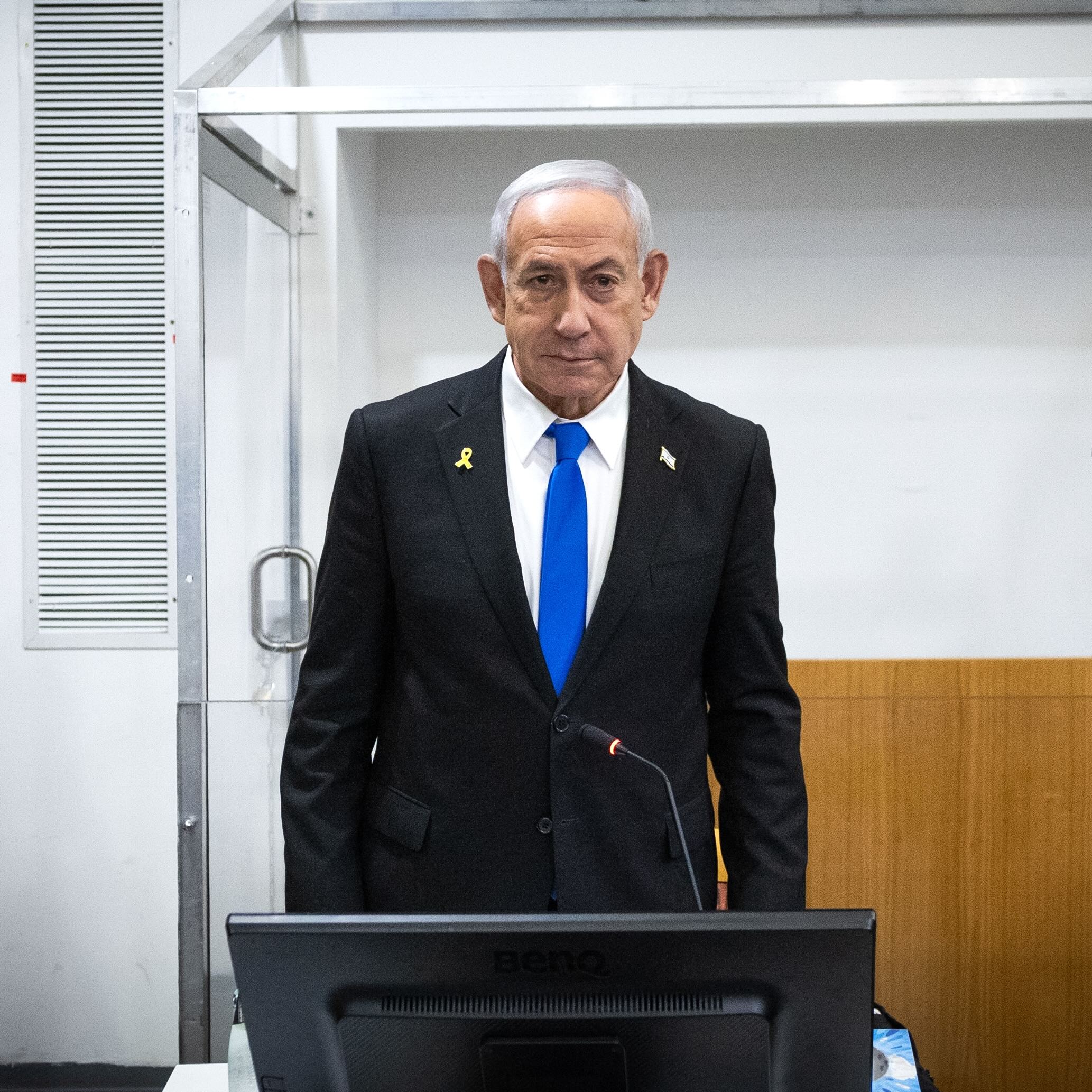
The Promised Podcast
The “Let My Bibi Go!” Edition
01:34:51
Linda, Don and Noah discuss (1) U.S. President Donald Trump’s Truth Social posts demanding the immediate cancellation of Israeli Prime Minister Benjamin Netanyahu’s trial—calling Netanyahu a ‘great hero’ who, along with Trump, ‘saved...
Loading summary
Transcript108 lines
- [00:01]
A
Today is day 636, which are 89 weeks and five days of the captivity of 50 hostages living and dead in Gaza.
- [00:16]
B
This is TLV1.
- [00:20]
A
This episode may contain explicit language.
- [00:26]
B
Foreign.
- [00:34]
A
Welcome to the Promise Podcast brought to you on TLV1. The voice of the eponymous city that is the titular subject of a song that was for a time this week the most trending song on TikTok, the soundtrack to thousands of viral and viralish or viral adjacent videos written and performed by Lucas Gage. Though not that Lucas Gage. Another more in the shadows Lucas Gage, who is an American, though his song has been promoted gustily, including by payments doled out to the different platforms by the government of Iran. Which viral song is called Boom Boom Tel Aviv? Going in part cry victim and say.
- [01:19]
C
You didn't start this, but the whole world sees that your lies are retarded.
- [01:24]
A
You could avoided all this if you.
- [01:26]
C
Wanted to, but humanity never expected good behavior.
- [01:47]
A
In case you couldn't make out those lyrics, they were you cry victim and say you didn't start this, but the whole world knows that your lies are retarded. You you could have avoided all this if you wanted to, but humanity never expected good behavior from you Jews. Boom Boom Tel Aviv. And so on. The song also has one of those middle parts like they have on that Moody Blues record that I bought with my bar Mitzvah money. With a man with a British accent and a stentorian voice who on the Moody Blues album says Cold Hearted Orb that Rules the Night removes the colors from our site. Red is gray and yellow white, but we decide which is right and which is an illusion. And and I was like, whoa, that's deep man. Now in Boom Boom Tel Aviv, an eerily similar voice says.
- [02:39]
No one believed they would strike so deep.
- [02:42]
B
Not Tel Aviv, but in the dead of night with no warning, the skies lit up. The world watched in celebration as the iron dome cracked and in that moment the balance of power began to shift.
- [03:03]
A
Now all of that is disconcerting, and it is disconcerting that it has millions of views across all the platforms and dude, I am begging you, do not read the comments underneath it. But there is something cheering about some of the response here, as when Chetzkel tweeted out in Hebrew that you gotta admit the song is crazy catchy. Or when Eliao Mazaki tweeted out that that the lyrics of the song had at least one boom too many in his opinion. And I saw an influencer who responded to the video by making a chilled caffeinated drink using Iron Dome brand coffee roasted in and imported from America. Its slogan Saving Israel one cup at a time. All of which she called a quote unquote appropriate Zionist response to the song. And then there was someone who set to Boom Boom Tel Aviv, old reels of Haridim dancing wildly at a wedding, which had the strange and ironic effect of making the threats seem like Norriskeit and the song like a chance to celebrate heaven and earth. And on Mako. On the Mako news site, music reviewer Yiftach Karmeli gave the song a mixed review, ending with this quote, we have a feeling that Boom Boom has the potential to be a hit here. It is just a shame that like always, all the focus is on Tel Aviv and everyone ignores the periphery, the outlying cities. End quote. And arguably nothing captures the unsinkably buoyant nature of this city we love so well Tel Avivo better than responding to our social media filling up with a song filled with animus and ill will, responding with fine spirits, with humor, with bonhomie and inevitably strong coffee. With us today from TLV1's most venerable satellite studio in Jerusalem is a woman who may well be the country's hell, could be the world's foremost expert in the intersection of strong coffee, bonh amie, and also fine spirits in both senses, the word fine spirits meaning a constant state of her soul, being open to all that is beautiful in the world of people and things that surround her, as well as fine spirits in the sense of having open hearted appreciation for delicate and sublime inebriate, especially of the enological sorts. Obviously, that woman could only be Linda Gradstein. Linda Gradstein has long covered Israel, first for NPR and most recently for the Voice of America. Linda is also a lecturer in journalism at NYU Tel Aviv and the Hebrew University, and not too long ago at NYU Abu Dhabi, Linda has won an Overseas Press Game Club Award and an Alfred I. Dupont Award for Excellence in Broadcast Journalism. Linda, you have been away and I am so glad that you are back. How are you doing?
- [05:36]
B
I am doing fine and I had quite a story that I'm going to talk about later in terms of getting back, but it is just so good to be back, I have to say. I was actually in Australia and New Zealand and they're actually very far away if you hadn't noticed.
- [05:51]
A
And all the farther when the airlines are hardly flying at all. I'm glad that you made it back now. Also with us today from TLV1 satellite studio in Kfar Saba is a Man from whom humanity always expects good behavior and always gets it. Which is why his novel Adam Unrehearsed was a finalist in last year's National Jewish Book Awards. And if you haven't read it yet, I am telling you, you gotta. And which is why his podcast of autobiographical monologues, Fetterman's One man show, is beloved from east to West. Which if you have not listened to it yet, I am telling you, you gotta. When Don is not writing award winning books or making brilliant monological pod, he is the director of the Moriah Fund in Israel and also the director of the Israel center for Educational Innovation. Don, how are you doing?
- [06:34]
C
Well, we were supposed to be traveling west to go to Rome to see the Caravaggio exhibition and luckily we canceled our trip just a couple of days before. Cause we would have been stuck in Rome for several weeks.
- [06:47]
A
Oh, that would have been.
- [06:48]
C
So we missed some of the most amazing art in history, but we got to be with our kids running up and down the stairs to the shelter for 12 days. So that was a much better adventure.
- [06:58]
A
Yeah, that was really. That was really a treat. We had that too. But you were going to go to Rome to see specifically the One exhibit, which of course is amazing, but the One Exit.
- [07:09]
C
Well, we were gonna do it. It was our 30th anniversary and we were gonna take this trip. And originally you take the kids with us too. And then the flights started getting canceled and then that didn't happen. And I got to watch on video the wedding of Yishai Miriam and Jonathan's son last week to know me. So that was beautiful. But even though we were here, get to be there in person, but at least we got to see it and feel it a little bit.
- [07:36]
A
And I guess it's appropriate because the 30th anniversary is the Italian master's anniversary, if I remember correctly.
- [07:43]
C
Yes. Yes, whatever that means. Yes.
- [07:45]
A
Now, as for me, my name is Noah Ephron and I don't mean to boast, but I have been attending a conference online this week about religion and environment. I was supposed to actually be there. I was supposed to be in the place, but the airlines canceled the flight and a new ticket to London was going to cost thousands of dollars. And the trip was going to take dozens of hours, 41 hours to get from Tel Aviv to London. So I switched over to Zoom, which is of course the modern thing to do. And the lectures are mostly crazy fascinating, but after two or three of them in any given day, I start to have out of body experiences watching myself watching the screen with screen turns into swatches of geometric shapes and colors and disconnected sounds. And please believe me when I say I'm not bragging. God knows that is not how my folks brought me up. But other people have to pay good money for drugs to get the same effects that I get just by virtue of having some sort of brain damage or cognitive misfunction. Today we got two topics of rich and dense importance, but first we have this matter that we are following with alert, interest and great concern as part of an occasional series we like to call the Promise Podcast ponders the permeability of performance and pure rapport and the passage from performer to progeny. Ruth Efroni writes essays, she has a novel, and she writes, directs and produces for television. She posted on her Facebook feed this week two photographs side by side. The one on the right of a middle aged man in a black T shirt, rugged and good looking, his hand raised to his mouth, maybe squelching a laugh. And next to him there is a young woman, beautiful, in a black tank top, her plaited hair pulled back with a big smile, one hand resting on the arm of the man and the other photograph is of the same woman, it seems again in a black tank top, same plaited hair pulled back. And behind her unmistakably, are the colorful shade tents of the Nova Festival. And to go with these two side by side pictures, Ruth Efrony has written this quote Just before the war with Iran began, we finished filming a drama series based on real people from October 7th. This post isn't about that series. It is about a small moment behind the scenes that comes back to me sometimes. Like tonight. It was lunchtime. At one of the tables there was a man about my age, a quiet and handsome man, a guest who had come to visit the set that day. A young woman with a plate of food from the makeshift buffet sat down next to him. She was dressed exactly like his daughter had been dressed at the Nova Festival. Her hair was braided into two intertwining braids, an exact copy of the daughter's hairstyle that day. She had the same build, the same bright smile, the same inner calm and composure, just like in the videos I saw of the daughter. The young woman is an actress who plays the daughter in one small scene in the series, and she looks so much like the real thing that my heart skipped a beat. The man and the young woman talk quietly, I cannot hear what they are saying, and for a moment it seems like the daughter herself has just dropped by to have lunch with her. Abba the most natural thing in the world, almost like a normal thing you don't think about, and at the same time it is something that you do not see in this world. It is surreal, like in some horror movie.
- [11:17]
And I feel like I have to see it more up close to feel it. I can't resist, even though maybe I should have. I approach them with hesitation and I ask if I can take a picture. They look at each other and say, sure, go ahead and smile for the camera the way people do. For a moment they laugh from the awkwardness, maybe from the absurdity. And then in the next moment, all at once, the laughter turns to sobs. And the young woman, who did not know and yet is the spitting image of the man's daughter, she puts her hand on the bereaved father's hand. And this gesture, it is not acting and it is not pretend. It is a real thing, a soft, comforting, intimate hand. And I think, God, do not let this moment end because there is so much healing in it. And I also think, enough. What a cruel illusion this is. And I do not know if the sum of sorrow in the world has just gotten greater or if it's gotten smaller. I only know that no matter how much people talk about victory or about miracles, nothing will make me forget this father Avi Berda, or this actress Edna Aharon, or this moment. And certainly nothing will make me forget Lirone Berda, of blessed memory, who in her last conversations with her father, he begged her to get out, to run for her life, and she said no. She kept extending her own soft and comforting and intimate hand to complete strangers, to wounded people who could not run away, calming them, simply being with them until her own very last moment. In the one photograph, Lirone Berda at the Nova. In the other photograph, Avi Berda and Eden Aharon having lunch on the set. End quote.
- [13:23]
Today, two discussions, but first I will say this. Yesterday US President Donald Trump posted to his social media operation a post that said, quote, my representatives had a long and productive meeting with the Israelis today on Gaza. Israel has agreed to the necessary conditions to finalize the 60 day ceasefire, all caps. During which time we will work with all parties to end the war. The Qataris and Egyptians, who have worked very hard to bring peace, will deliver this final proposal. I hope, for the good of the Middle east, that Hamas will take the deal because it will not get better, it will only get worse. All caps. Thank you for your attention to this matter. Exclamation point. End quote. The long productive meeting was apparently between US Special Envoy to the Middle East Stephen Witkoff and Israeli Minister of Strategic Affairs Ron Dermer. And the necessary conditions are apparently what's known as the Witkoff Plan that Israel agreed to for the first time some weeks ago. Actually, this is not new news as we record we don't know what this means or where it is going. Maybe by the time you are listening you do know, but even if you do, you can't tell us because of all the paradoxes of time travel, which if I understood popular movies that I've seen on the subject, somehow inevitably end in us probably dating our mothers. And my point is, by next week in our fold of the space time continuum, we will know enough to talk about this. But I just wanted to explain why we are not talking about it today. There having elegantly explained that, I will say that today we have two discussions. The first let my Bibi go as a vigorous debate erupts over whether or not the trial of Benjamin Netanyahu should be bargained out, postponed or simply canceled 5 years in the timing of which is explained by 2 more posts on social media by American President Donald Trump, who wrote in the one that it is going to be the United States of America that saves Bibi Netanyahu and who wrote in the next that, quote, the United States spends billions of dollars, capital B, capital D a year, far more than any other nation, protecting and supporting Israel. We are not going to stand for this. End quote. The this being Netanyahu's trial. Some people here say, hey, we are not a vassal state of the US but is that really so? We will wonder and topic two Moral abyss as Haaretz puts out an article they call an expose headlined It's a killing field IDF soldiers ordered to shoot deliberately at unarmed Gazans waiting for humanitarian aid. Which article is baleful, as its headline suggests, and also hard to figure out. And we will put our heads together to try to do just that, trying to figure out what awful thing, if any, the IDF has done now, while also asking what exactly was Haaretz trying to accomplish and what did it accomplish? With this article and with its headline and for our most unreasonably generous Patreon supporters in our extra special special extra discussion, the link to which you can find in our show Notes on your podcast app or at patreon.com promisepodcast on the world Wide Web, we will talk about that frightful moment at the Glastonbury Festival of Contemporary Performing Arts or Glastow in lovely Somerset, England where Bobby Vilan, one of the Bobs of the punk duo Bob Vilin, the other one also named Bobby Villan, of course, but that Bobby spelled with an ie at the end. It was the Bobby Villan with a y at the end who whipped up the huge Glastonbury crowd to chant death, Death to the IDF.
- [16:57]
C
Death. Death to the IDF.
- [16:58]
B
Death.
- [16:59]
C
Death to the IDF.
- [17:00]
A
Death. Death To, IDF.
- [17:02]
C
Deaf Death to the IDF.
- [17:04]
A
Which whipping up was denounced by Glassdoor's organizers but kind of celebrated on a lot of social media. We will talk about what sense we ought to make of this in hope that the measured analysis of Linda and Don will be enough for me to stop rocking back and forth in fetal position saying my mama loves me, my mama loves me. But before we get to any of that, listen to this.
- [17:39]
C
Sam.
- [18:52]
A
That song is Valleji or a brand new just out this week's song of Uplift or hope or something by Hatik Vashesh. More music of these complicated days. And now it is time for our first discussion. So Linda, has the time come to bury the hatchet and just end Benjamin Netanyahu's trial?
- [19:12]
B
Well, that's a good question. You know, the trial of Netanyahu celebrated its fifth anniversary six weeks ago. It was called to order on May 24, 2020. Which is why there is something surprising to the fact that this week a great many of our headlines in a great many panel discussions on television and radio were about the question of whether it was time to put the trial to bed. Now, it's not the first time that this question has been debated in public, of course. In fact, we've even talked about it a few times over the years on the podcast. But now, five years into the trial, and according to some legal experts, probably some years from the end of its likely appeals, unless the present stage ends with a complete acquittal in the doldrums of the trial, you might not expect the question of whether it should be taking place at all suddenly to be again the subject of wide and vigorous debate. If you listen to this podcast, you probably know that the reason why people were suddenly asking of the Jerusalem trial, should it or should it not continue, can be located far from Jerusalem, in another capital across the Sea, Washington, D.C. where President Donald Trump posted this week two messages to his truth social social media platform. The first post read in its entirety breaking news all in caps. I was shocked to hear that the state of Israel, which has just had one of its greatest moments in history and is strongly led by Bibi Netanyahu is continuing its ridiculous witch hunt against their great wartime prime minister. There's lots of caps here. Bibi and I just went through hell together, fighting a very tough and brilliant longtime enemy of Israel, Iran. And Bibi could not have been better, sharper or stronger in his love for the incredible Holy Land. Anybody else would have suffered losses, embarrassment and chaos. Bibi Netanyahu was a warrior. That's all caps. Like perhaps no other warrior in the history of Israel. And the result was something that nobody thought was possible. A complete elimination of potentially one of the biggest and most powerful nuclear weapons anywhere in the world. And it was going to happen soon. We were fighting literally for the survival of Israel. And there's nobody in Israel's history that fought harder or more competently than Bibi Netanyahu. Despite all of this, I just learned that Bibi has been summoned to court on Monday for the continuation of this long running. He has been going through this horror show since May of 2020. Unheard of. This is the first time a sitting Israeli Prime Minister has ever been on trial. Politically motivated case concerning cigars, a Bugs Bunny doll and numerous other unfair charges in order to do him great harm. Such a witch hunt, that's all caps. Witch hunt for a man who has given so much is unthinkable to me. He deserves much better than this, and so does the State of Israel. Bibi Netanyahu's trial should be canceled immediately or a pardon given to a great hero who has done so much for the state. Perhaps there is no one that I know who could have worked in better harmony with the President of the United States, me, than Bibi Netanyahu. It was the United States of America that saved Israel. And now it is going to be the United States of America that saves Bibi Netanyahu. This travesty of justice cannot be allowed. And that last sentence was all in caps. The second post covered much of the same ground. Bugs Bunny makes an appearance in that one too. But in it, President Trump added at the end what many interpreted as a veiled threat, writing, the United States of America spends billions of dollars a year, far more than any nation, protecting and supporting Israel. We are not going to stand for this. After Donald Trump posted these things, a lot of people responded in ways that may have surprised people. Simcha Rutman, the chair of the Knesset Constitution, Law and Justice Committee who spearheaded the judicial reforms in the Knesset, said, it is not the job of the President of the United States to interfere in judicial procedures in Israel. Foreign Minister and former Justice Minister Gidon Sar said. When the president of the United States calls for an annulment of the trial or for a pardon, can anyone say that he is wrong? Many other members of the coalition posted similar things. President Yitzhak Herzog said that it would be appropriate for Netanyahu's trial to conclude at this time with an agreed upon plea bargain. Former Supreme Court President Aharon Barak said, I'm in favor of an agreement with Netanyahu. It doesn't matter whether it's a pardon or a plea bargain. The most important thing is that we come to an agreement. It can bring about calm. Don, there are at least two things here. First, what should we make of President Trump's posts? And then what should we make of the thing that Trump posted about? Is Chief Justice Barak right that Donald Trump is right that Prime Minister Netanyahu ought to be pardoned or entreated to a plea bargain?
- [24:18]
C
Well, these posts sounded to me like they were written by ChatGPT with instructions from Bibi's advance team. So I did my own experiment and I gave ChatGPT this prompt. I said, create posts in the style of Donald Trump calling from Benjamin Netanyahu to be exonerated. Mention Bugs Bunny, political persecution and decisive hero while threatening to cut off US Aid to Israel. So this is what it came up with. Stop the witch hunt. All in caps. Benjamin Netanyahu, a great and decisive leader. All in caps. Is being treated worse than Bugs Bunny in a bad cartoon. Pure political persecution. All in caps. The radical left in Israel is out of control, just like in the US. We stand with Bibi 100%. Exonerate him at once. All in caps. Or maybe Israel doesn't need $4 billion in US aid. Just saying. Another one. Bibi is a hero. No one has done more for Israel or world peace, except maybe me. This nonsense trial is a disgrace to justice. The people of Israel love him. The world respects him. Enough is enough. The fake charges must be dropped immediately. I know political persecution when I see it. I've lived it. What they're doing to Benjamin Bibi Netanyahu, one of the strongest, smartest leaders in the world, is un American even though it's in Israel. If this continues, we'll have to take a very hard look at where our money is going. No more aid for kangaroo courts. So pretty close. You know, it's.
- [25:45]
A
I'm beginning to worry about for the safety of Elmer Fudd. I think that there's so much concern these days for Bugs Bunn.
- [25:56]
C
I didn't give ChatGPT enough background on why Bugs Bunny should be mentioned. So it had some irrelevant comments there. But I will start with the second post where he talks about the money. And I say, yes, that's a threat. Trump makes threats all the time. He follows through on some of them, especially when he makes a specific demand and doesn't get what he wants. In this case, the dismissal of the cases pending against Netanyahu. So our massive American aid, $3.8 billion a year, is under threat. Now, Amit Becher, the head of the Israel Bar association, quoted in Times of Israel saying that, you know, if Netanyahu actually asked Trump to do this, that itself would qualify as a crime. But, you know, what disturbs me is that the post repeat Netanyahu's talking points. These are the same points we hear his political lackeys saying on TV all the time or his online trolls repeating endlessly in the media, especially that point about the Bugs Bunny doll, which apparently Sarah Netanyahu asked Hollywood mogul Arnaud Milchen to bring for their son almost 30 years ago. And the messengers have repeated that one to claim that that's what this trial is about, a Bugs Bunny doll, which, of course, is nonsense. They're very serious charges pending against Netanyahu. Now, since the successful attack on Iran, the talking points have shifted to how bold and decisive Netanyahu was as a military leader, which contrasts with how he's usually portrayed when making decisions about military operations. Again, repeating pro Netanyahu tropes. There was a stunningly detailed account of our truly astonishing success the first night of the war in the Wall Street Journal, and it repeated these messages there as well. So the conflation of Netanyahu with Trump, that both men are great leaders, persecuted for political reasons and not for any misdeeds, is interesting. The persecution claim is not new, but the linkage between the two of them is new. And it's fascinating to me that Trump sees it as beneficial to himself to be likened to Netanyahu. I would understand the other direction, but less why it's going in this way. And you can say that maybe there's a trace of truth in all this, because had these men not been in positions of power, some of these cases might not have been brought in the first place. But the charges are not about small things.
- [28:14]
And then what about Trump's posting citing Chief Justice Barak, that it's time to end the trials? Look, I think ultimately, I mean, apparently Barak tried to mediate a plea bargain with Netanyahu six months ago, which wasn't public made public until right now. But it would have required Netanyahu to step down from office and diminishing of the charges to something more amorphous, like the charge of moral turpitude. But this fell apart because Netanyahu wouldn't agree to it. Herzog, the president pardoning him, I mean, there are people who think all along that that's how Herzog got the job as president, that there is a secret deal in place. I wouldn't accuse him of that. But can you pardon someone who hasn't been convicted? I don't think it works that way. But I would say the biggest problem, as I see it, as making a deal with Netanyahu, especially one, would assume that it would require him to promise to leave politics and not return is that he's not an honest person. So even if he swears that he will leave politics forever, I would assume he would come right back and he would require, he would say that the people of Israel have demanded that he return to save the state of Israel. So I think it's very, very problematic. It's also more problematic because nobody wants to piss off Donald Trump because we don't know what the consequences would be. So I think it is a quite complicated mess. But the way the trial is being handled has been criticized roundly, you know, by all the commentators for weeks and weeks before he got to this one. But this is a. This is a difficult turning point.
- [29:45]
A
Well, let's try to sort out some of the issues. First of all, there is the issue of how Israelis ought to react to the United States president tweeting something like, they're posting something like this on Truth Social. And it's striking that the only person in the ruling coalition that responded fully in the way that I would have hoped that everyone would respond is Simcha Rothman, who is, of course, you know, a bete noire. He's hated by anyone who is not a supporter of the ruling coalition because he is, aside from Yariv Levine, the Minister of justice, he's the main author and advocate of the judicial reform that has been so controversial since the year before the war. And he was the only one who came out and said, look, you know, this is not something that someone outside the country should have an opinion about. And including maybe especially the President of the United States. One would have loved to hear something in that direction from the prime Minister himself, something on the order of saying, oh, what a good friend you are, President Trump, and what a brilliant ally you have been. And together we did bring the greatest victory in the history of victories in the history of the universe, including Star wars episodes I through nine, you would have hoped that he would say, we've brought these victories. But still, despite the fact that our friendship is so great, maybe one of the greatest friendships in the history of friendships in the world, this is something that really needs to be decided within the borders of Israel by the judiciary and by the politicians and by the citizens of Israel. But we didn't hear anything even remotely like that. And Don, you intimated that maybe you sense that Benjamin Netanyahu's thumbprint can somehow be located, could be dusted off and found in these posts of Donald Trump. And maybe it could.
- [31:48]
C
It seems like it. I mean, it's the first time I ever agreed with some Carotmans, but I.
- [31:52]
A
Don'T see any reason to think that that's the case. But it could be the case. But in any instance, he certainly hasn't come and said, gee, you know, Chumalee said, gee, I wish you hadn't said this. And nobody else has except for Simcha Rothman, as far as I know. I understand why it's really frightening.
- [32:12]
When the president of the United States has given this threat, saying it would be a shame if something were to happen to this military aid, without which probably Israel could not survive, and I want this trial canceled. It might be hard to say, gee, as a matter of principle, Mr. President, this is none of your damn business. So I understand that. But it is disappointing that more people haven't found a way to say that about the issue itself, of the trial. I put anyone who listens to the podcast knows that I have thought since before the trial began that it should not begin. And since it began, I have thought that the trial should end in some way or another, or be postponed until Prime Minister Netanyahu is no longer prime minister of the country. So I am firmly in the camp of the president and in the camp of the former president of the Supreme Court, Aron Barak. As far as that, I think that the price that we're paying for this trial is much, much greater than any benefit that could get, both including to justice and including to the proper running of the state. But it shouldn't happen this way. If it were to happen at all, it shouldn't happen this way. Linda, what do you think?
- [33:20]
B
So I'm not sure that I agree with you on that, Noah. I mean, I was just thinking about Ehud olmert resigned in 2008 because of the corruption probe, because he said, you can't be prime minister of Israel and be on trial for corruption. And if I remember correctly, he was pretty close to a peace deal with Mahmoud Abbas, who was still around, and then they had apparently sketched out a map on a napkin. There's all these of exactly which land swaps Israel would give, and he resigned. So Netanyahu chose not to resign and chose to say, I can be Prime Minister three days a week and be on trial two days a week, which is kind of ridiculous. And I think that. That I agree with both of you in terms of that this is the first time I find myself agreeing with Simcha Ratman, because I think that what President Trump is doing is just an embarrassment, and it's completely wrong. That said, I think once this trial started, maybe it shouldn't have started to begin with. I mean, I think the sort of gentlemanly thing would have been if Netanyahu resigned, but he didn't, and he refused to resign. And so therefore, I would say that ending the trial is a mistake. And the other thing is that Aharon Barak said, yes, the trial should be ended, but only if it's clear that Netanyahu will not ever return to politics. Now, Netanyahu has been prime minister since 2009. That's a long time. And I think that he should have resigned. The fact that he didn't, the trial started, I think that there has to be a way to see it through.
- [34:57]
C
Look, I mean, I think one of the frustrations is that it feels like Netanyahu has just outmaneuvered everybody else in this whole situation. He's outmaneuvered the courts. I mean, before we got to the Trump tweets, which I think we all agree President of the United States should not be interfering in a trial going on in another country, even though we are, you know, the United States is Israel's greatest ally, and we are utterly dependent on the United States now. I mean, the whole world's been groveling to Donald Trump. Many countries who are not such close allies to the United States and are not utterly dependent on the United States are groveling before Donald Trump. So it's not surprising that political leaders are scared to come out and say anything that could be taken as criticism and then would be used as fuel to get a whole, you know, endless stream of tweets against them personally. So, you know, I see that. I mean, Netanyahu has never done the honorable thing in this whole long trial. I don't want to rehash all the arguments we had for five or six years, but it's, you Know, I agree what's happening now is just is super destructive. And I look back and I go, okay, if he hadn't been a trial, they probably wouldn't have done the judicial overthrow. He probably wouldn't have gone in any of these directions. The country might look utterly different. You know, the guy saw Olmert go to prison and said, I'll take the country down with me and my family, you before I'll go to prison. But that's, you know, what do we do now? What do we do?
- [36:20]
A
At this point, I agree with you that we probably shouldn't, and we don't have the time to reopen this. I would just like to say so that it is out there that the position of Benjamin Netanyahu is that every single prime minister.
- [36:37]
Since before Yitzhak Rabin has been criminally investigated in this country, and that if we allow prosecutors to remove prime ministers simply by virtue of opening a case against them, then we no longer will have a democracy. And he would say, look, Robin was investigated and Begin was investigated. Shamir was investigated. I don't know if Paris was investigated, but Barak was investigated and Sharon was investigated. And if all of those people were forced to resign, then we would just not be living in a place where the people elected their leader anymore. And that is his position. You may think that.
- [37:22]
That'S an excuse. I mean, if one is convinced that he is absolutely, patently and obviously guilty of what he's been accused of, then it could sound as though.
- [37:32]
C
I don't say that. I think they're all oddball cases, to tell you the truth. And I think had they just been managed the way they should have been and should have taken under a year and a decision made, we'd all have been better off.
- [37:48]
It's a problem. I mean, I'm also so.
- [37:52]
Despairing of this government and where they're leading this country. I don't want to do anything that's going to help make them stronger. And I just have no trust in this man. But.
- [38:06]
I don't see any reason why the cases should be tied to a victory in Iran to begin with. And I don't see why the United States president should be getting involved in this. I'm sure he probably knows that himself, but maybe he does genuinely identify with Bibi, but more likely it's just the result of a lot of message testing.
- [38:25]
A
Well, also, I think that Donald Trump is someone who we know believes that he was himself wrongly tried in the United States. I think there is something, and he was actually something quite personal about this.
- [38:38]
B
He was convicted and then he, and.
- [38:40]
A
Then he was, was potentially gonna be under trial another half dozen times as well, though now he has stopped all those trials. So I think that he was. Donald Trump was writing in the only way that Donald Trump knows how to write, from his very, very personal experience, narcissistically, as though the whole world is some pale reflection of Donald Trump's experience. And, and so, and I think that this has brought him closer to Netanyahu, the realization that, like he feels that he was almost hounded out of office by prosecutors, so too his comrade, Benjamin Netanyahu is being hounded out of office. I would also say as a last word, that I wouldn't be surprised, though I don't know if we'll ever learn this, if part of Donald Trump's thinking isn't that he is about to turn the screws on Prime Minister Netanyahu and force him to end this war that Netanyahu does not want to end and that it would be to his benefit to come out seeming as though he is a great ally of Netanyahu just before he forces Netanyahu to do this thing that Netanyahu will kick and scream and not want to do too. But who knows? Now listen to this.
- [41:34]
That song is.
- [41:38]
It's new by Almog Tabeca. More music of these days. And now it's time for our second discussion. So, Don Killing Fields really well, David.
- [41:49]
C
Myers, the great scholar of Jewish history, one of the best we have, which is saying something. And until not too long ago, the president of the board of the New Israel Fund posted to Facebook a link to an article late last week adding this on the top. If these accounts are true, this policy represents yet another stage in the descent of Israel into a moral abyss marked by an unbearable and criminal inhumanity. I have now heard from sources who report that the story is not true, as well as from others who say it appears to be true. I hope that we have clarity on this in the coming hours and days. The article that David Meyers shared was published last Friday in Aretz under the headline in English, it's a killing field. IDF soldiers ordered to shoot deliberately at unarmed Gazans waiting for humanitarian aid. The headline in Hebrew is somewhat different. The essay is long for a newspaper story. It runs well over 3,000 words. And to get everything it says, you'll have to read it. But here are some of its most wrenching points. The lead reads, israeli soldiers in Gaza told Haaretz that the army has deliberately fired at Palestinians near aid distribution sites over the past month. Later it adds, it's a killing field, one soldier said. Where I was stationed, between one and five people were killed every day. They're treated like a hostile force. No crowd control measures, no tear gas, just live fire with everything imaginable. Heavy machine guns, grenade launchers, mortars. Then once the center opens, the shooting stops and they know they can approach. Our form of communication is gunfire. Soon after that, it says Gaza doesn't interest anyone anymore, said a reservist who completed another round of duty in the northern strip this week. It's become a place with its own set of rules. The loss of human life means nothing. It's not even an unfortunate incident like they used to say. An officer serving in the security detail of a distribution center described the IDF's approach as deeply flawed. Working with a civilian population when your only means of interaction is opening fire, that's highly problematic, to say the least. At night we opened fire to signal to the population that this is a combat zone and they mustn't come near, the officer said. Once he recounted, the mortars stopped firing. We saw people starting to approach, so we resumed fire to make it clear they weren't allowed to. In the end, one of the shells landed on a group of people. In other cases, he said, we fired machine guns from tanks and threw grenades. There was one incident where a group of civilians was hit while advancing under the COVID of fog. It wasn't intentional, but these things happened. He noted that there were also fatalities and injuries among IDF soldiers in these incidents. It goes on like that, though the way the article is written, it's impossible to know how many soldiers and officers have made these claims. It seems at minimum, there was at least one soldier and two officers, but the number may be higher. In response to the Haaretz expose, the IDF said that it strongly rejects the accusation raised in the article. The IDF did not instruct the forces to deliberately shoot at civilians, including those approaching the distribution centers. To be clear, IDF directives prohibit deliberate attacks on civilians, unquote. Several days after the original article, Haaretz published a follow up headline, Senior Israeli army officers Admit Uncalculated Fire on Gaza Aid Seekers After Haaretz expose, it reported that these senior IDF officers acknowledged that civilians had been killed due to inaccurate and uncalculated artillery fire, as they called it, explaining that the shelling was aimed at maintaining order at food distribution sites. But the army has since shifted to other methods. The second article reminded readers that the previous Friday, ARS had revealed a series of testimonies from IDF officers and soldiers who served in Gaza stating that they had received orders in recent weeks to fire at unarmed crowds approaching food collection points even when they posed no threat. The article ends with a quote from the IDF spokesperson saying, if the army strongly rejects the accusation raised in the article, the IDF did not instruct the forces to deliberately shoot at civilians, including those approaching the distribution centers. All weekend, social media filled with shares and comments on the article, most of which did not share David Meyer's hesitation in concluding that Israel had descended into a moral abyss of criminal inhumanity. Here in Israel, there were many who disputed the claims of the article. Prime Minister Netanyahu and Defense Minister Katz called it a blood libel. And there were also those who correctly pointed out that the translation of the article in the English language, Aretz, was more extreme and damning than the original Hebrew, starting with the fact that there are no killing fields mentioned in the Hebrew headline. But David Meyer's hope for clarity about the facts of the matter has so far gone unfulfilled. And given that almost a week has passed, that hope probably will remain unfulfilled. Linda, you're the journalist among us, and you have been a journalist for long enough and at the highest levels, so you've seen a thing or two. What should we make of the Haaretz report, and what can we conclude of anything about the wretched thing that Haaretz is reporting?
- [47:15]
B
Well, this is really a tough one, and I think that basically several things can be true at the same time, and it can be true. And in fact, the army has admitted that Palestinians have been killed by army fire near the Gaza Humanitarian foundation sites. Now, the GHF itself is extremely controversial, and a lot of human rights organizations, international organizations, have called for the GHF not to have anything to do with distributing the aid. They say that it violates humanitarian principles. Israeli soldiers are not at these sites. They are at the perimeter of these sites. And yet, from everything that I've seen on all of the videos on social media, it's complete chaos there. And what happens is that these sites are just overrun. There's such food insecurity in Gaza. People are actually starving. So when they have any kind of a chance to get some food, they will do whatever they need to. Now, part of it is the access routes. You're allowed to walk on a very specific path in order to get to these food distribution sites. There are only four sites, while the UN and other places had dozens of sites distributing food. So what happens is there's just an incredible crush of people. Now, I find it very hard to believe that there were widespread orders to just open fire on people at the same time. I asked my son who had fought in Gaza, and he said that, you know, it's known that Hamas, you know, operatives wearing civilian clothes have basically penetrated everything so that some of the people coming to get this food are Hamas. And there's no screening process as far as I've been able to determine. So it means that Hamas is there. He said, my son, that Hamas has hidden guns in all kinds of places. And in fact, as you mentioned, Don, a whole bunch of soldiers have been killed in the past month. So I think also, you know, it said something like between one and five people are killed. There were several incidents in which dozens of people have been killed. The Palestinian Health Ministry in Gaza says that since this whole system started at the end of May, more than 500 Palestinians have been killed at these distribution sites. But to me, there is a difference if there's a question of intent or if it's just chaotic. And the implication of the Haaretz article is that at least in a few cases, it's intentional, that they were told fire on and basically just. Just kill people. I find that hard to believe. I think that in the fog of war, there's a lot of stuff going on. These soldiers perhaps might not be trained for crowd control. They're soldiers, from what I understand, that have been taken from other missions in Gaza and basically just put there. And so they're scared and they open fire. So does the situation need to be reformed? Absolutely. Is it actual killing fields where Israeli soldiers are mowing down innocent Palestinians? I'm somewhat suspicious.
- [50:26]
A
There is a very good podcast episode of the podcast, Ask Khaviv, I think it's called, But Chaviv, Rita Gore, Ask Aviva, Ask Khaviv anything. And just last night as we record, then that episode dropped, and he spends 35 minutes diving deep into this issue in a way that I think is very illuminating and rings very true. So I would recommend to any and all of you listening to us to listen to that as well. And.
- [51:00]
You will hear details that you won't hear in our briefer conversation. And one of the things that Khaviv talks about in that podcast is how the exact numbers of how many people have died around these things are. Around these distribution centers are disputed. The IDF, I think, documents 23 people that IDF soldiers have killed. Like you said.
- [51:36]
The Gaza Health Ministry documents somewhere approaching 500 people who have been killed. Those numbers are not necessarily as far apart as they seem. The IDF does not say that.
- [51:53]
There might not have been more people than the 23. It has identified 23 people. And the Gaza Health Ministry, famously overseen by Hamas, includes deaths that may have come at the hands of Al Shabaab, the other Palestinian militia that is guarding these centers that is being being armed by the Israelis and is, you know, is anti Hamas. And some of them were also likely killed by Hamas as well, who, you know, are known to shoot as well at some civilians going to these centers. Because there is a profound struggle between Hamas and Israel about who will control the distribution of humanitarian aid. And that struggle ends up having a really terrible cost in civilian life in Gazans.
- [52:53]
What the Haaretz article describes this article, like you said, Don, was very confusing. I think it was very confusing to me. It was really hard to pick out even what they were saying happened and much less to understand what the evidence for what they were saying was, et cetera. But it seems to be at the core of what they were saying, seems to be a true statement that the army had no strategy for controlling the crowds of Palestinians, mostly civilians, but perhaps infiltrated, like you said, Linda, with Hamas, people had no system for controlling these crowds. And seeing that the distribution of the humanitarian aid of the food went in a way that was orderly and in a way that was nonviolent, save for communicating, as you said, Don, when you quoted one of these soldiers that was quoted in the article anonymously, save for shooting. So they let people know that it was too early in the morning to come to these centers by shooting, sometimes by exploding grenades, sometimes by shooting semiautomatic rifles into the air, and sometimes by shooting artillery.
- [54:12]
That was a signal to the people that it was too early to come. And when the distribution times were over, the signal to the people was shooting, which is both moronic, both ridiculous, and also obviously dangerous. And it also, I think, obviously cost Palestinian lives, as some of the soldiers and officers who were interviewed in the Haaretz article said. So that seems to simply be a fact that is now, since the article first came out, has now been more or less corroborated by the. By the army. And that is a doleful, baleful, horrid fact. But I think it's just, you know, what happens when the army is suddenly given this task of protecting these new distribution centers without having time to plan and without having experience in this and without a plan at all. And right now, the army says they are fixing that quickly. They are learning from all of their mistakes, which is to say they are learning from all the innocent people who they killed along the way. They are learning to do things differently and Godspeed to them. I hope that that happens very quickly. Don, I want to hear what you have to say, but then I also want at some point to go to the less important because it's not a matter of life and death. But still to me, very important question of why the Haaretz, in publicizing this article, particularly in English, did it in a way that was so close to screaming fire in a crowded theater, why it chose to.
- [55:57]
Have the English language version of this be so much more extreme in a way that immediately turned up, you know, last weekend. I have never experienced anything like last weekend. I've never seen Israel vilified by as many people in as extreme terms as it was this past weekend by people who were sharing this Haaretz article saying that's it. If you ever wanted proof, now you have proof that these people are monsters and it's reported in their own newspaper. And so after hearing what you have to say about the general issue, Don, I'm also interested in what you think about how are it is trying to do.
- [56:37]
When it ratchets up beyond the point where it's supported by the facts, at least to a degree. The extreme presentation in these English language articles.
- [56:48]
C
Well, I'm going to circle back to that though. I will mention those all of us have some experience with journalism. The people who write the headlines are not the people who write the articles. And I don't know who put that headline in, but that certainly was clickbait and that just may have been disastrous. Clickbait. I want an obvious, I mean, I don't want to repeat things that you already said. Clearly the army was not prepared for this and used whatever was at their disposal, which was disastrously live fire, including heavy fire, which killed people, which is horrible. I will say the article also mentions other things like a breakdown of the chain of command, a loss of discipline in the field. Those are things we've heard about in other places, not just from this article. And some things I've heard from anecdotally from people who are out there in the field. And those are disastrous things in wartime. And specific officers, specific commanders are named in the article as being in charge of areas where the death rate of civilians is particularly high. So you'd think, and I hope that Sahal is investigating these things seriously and adamantly because these are things that are completely against the ethos of the idf. So there I Think there's very potentially valuable information. Again, like you said at the very beginning, we don't know how many officers are sharing this information. But since these articles came out, some of these things were corroborated by the IDF itself.
- [58:25]
I do want to mention the way.
- [58:28]
The responses from the political echelon, which has been to attack Haaretz, which is to treat this as a PR problem, which according to your feed, is a PR problem. It's a serious PR problem. But to attacking the messenger to the point where the mayor of Arad was interviewed on TV saying he would outlaw the sale of Haaretz in his town. And if anyone tried to sell Haaretz, he would order that street to be torn up so it'd be repaired so no one could get to their store. I mean, that's, you know, that's, you know, basically saying he's gonna run a shakedown operation in his town. So I think.
- [59:07]
These things are also problematic in a democracy. You know, he says it's incitement against the idf.
- [59:15]
A
Let me just say this about that. First of all, I agree with you. Obviously, that's crazy what the mayor of Arad said, and it's completely unacceptable and it's absurd. And then Rabbis for Human Rights under the leadership of Avi Dabush went there and handed out free Ha' artzis to people who happily took them for a couple of days. I have nothing to say in defense of that. But what I will say in defense of the people who expressed outrage about this is that I also feel outraged and I have torn off outrage in general. But I also feel I made the decision after this that I will never, until something changes again, write for English, Haaretz, which it lost me entirely. I will not read it and I will not write for it anymore. Because I think my hunch is that, like you said, clickbait. My hunch is that Haaretz is very excited about the fact that.
- [60:20]
These articles get so much play abroad and so many clicks and so many shares, which must, you know, must be valuable, which must translate into money. And I think that this article was extremely irresponsible. I mean, it was essential in Hebrew and it might be essential in English too. But you have to think about how. You have to pay attention to how the article will be understood.
- [60:49]
B
No, I have to disagree with you here. I think you think that I will.
- [60:53]
A
Write for Haaretz again.
- [60:54]
B
Well, I don't know if. No, you can write for whoever you want. But, I mean, I read Haaretz in English mostly. Because, I mean, even though my Hebrew's fine, but it takes me much longer to read in Hebrew, so I read it in English. And I think that. And Haaretz in general has played a very important role in all kinds of things, and especially now, that said, I agree with you that the headline was misguided, but I think that it's a slippery slope to say. Wait one second. It's a slippery slope to say, what will the goyim say? We can't be critical of Israel. We can't say things like this because it'll be used as ammunition against us. I think that's wrong. In other words, so to say, well, we can say it in Hebrew, but we can't say it in English. That's.
- [61:40]
A
No, I'm not saying that. Pay attention to what they did. What they did was took an article in Hebrew and made it. I think not just the headline made it significantly more extreme. And the message that got across to world leaders who all, many of whom tweeted about it and then to a vast number of people, is that Israeli soldiers have been given orders to aim their guns at and shoot as many people as possible until they. Until they are comparable to the Khmer rouge, which killed 2 million people by mowing people down. I just think that that's very irresponsible for a newspaper to do.
- [62:24]
C
No, I think that comparison is horrific. And, I mean, they are quoting one of the people. They didn't.
- [62:30]
B
That's what I was about to say. From one of the soldiers.
- [62:34]
C
From one of the soldiers. So that, you know, that may be the most dramatic quote. And it's. And I would.
- [62:39]
A
But as a journalist, you don't have to print every quote.
- [62:42]
C
I would highly doubt that the soldier who said it put it in the context of the Khmer Rouge or that it has any idea who the Khmer Rouge are. So, you know, it reads differently.
- [62:54]
In that context. And I think, you know, it's meant to be an expose. I would say that, you know, whether someone was giving an order to fire or whether someone. Whether just. Or the rules of engagement obviously have been drastically relaxed throughout this war, which to me is also something that needs to be looked into. And we've had, in some ways, cataclysmic results from that as well.
- [63:21]
But it's complicated. I was thinking of it in a different context of, okay, you're trying to wake up the public and you're trying to wake up the government to look at the policies and the military establishment, look at its policies and say, maybe we've really gone off the rails here. And we need to change things. And we have the principle of Tochikha. When you're giving criticism, you have to give it in a way that people can actually hear it. Instead, it just provoked these extreme reactions against hats, attacking arts, attacking the left, attacking anyone who says a critical word against Sahel.
- [63:56]
But I think there's a lot of questions raised by this war, just by the number of deaths on the other side. So that's. It all gets.
- [64:03]
A
Absolutely.
- [64:05]
I'm not arguing in favor of some sort of a broad apologism. And Linda, I'm not saying that there shouldn't be a completely open and vigorous debate in Israel about Israeli politics and about Israeli policy and about the war, and that there shouldn't be criticisms and that there shouldn't be trials for people who commit war crimes, if people are committing war crimes, all of that, all of that stuff. But to when the article in Hebrew, first of all, as I said many times, is less extreme and, you know, it's something that is more measured than the English version. But also the article in Hebrew is read by people who know how to put in context, who know, for instance, that the army is filled with people from the radical left to the radical right. It's filled with. It's filled with all sorts of people. And so when you take two or three anonymous sources, you have to be very careful. And we know to say, well, sure, when I'm in Miluim.
- [65:13]
I can picture Yossi would say something just like that. And you know who Yossi is and you know what he means, and you know how to do the proper exegesis of this. But when you just say to the world that IDF soldiers are saying that we are being ordered to shoot, which it turns out is not. We are being ordered to shoot at innocent civilians walking towards these centers, which turns out not to be the fact of the matter, then I think as the newspaper needs to ask itself, I.
- [65:41]
C
Think we don't know what the. I think we still don't know what the facts of the matter are. And I think things should be investigated. And I don't think it's a newspaper's place to censor the information that's coming in. That being said, yeah, it's being used around the world against Israel.
- [65:55]
B
That's people are getting killed at these distribution centers. My understanding is that also there was a difference in the translation where in the Hebrew they said to fire towards groups of Palestinians, and in the English it was to fire at groups of.
- [66:11]
C
Palestinians, for instance, this be a tragic mistranslation also. That's the difference.
- [66:17]
A
But it's still there in the English language version if you go look at it today. And, and the difference is very, very huge. I mean, when I read, you know, I read the article in Hebrew first on Shabbat, you know, in my home, and it was upsetting. And then I read the article in English and it feels very different, I have to say. It feels like the description of Israel in the English language article feels similar to the stuff that I read coming out of, you know, I don't know, from progressive circles in Ireland about Israel. And the stuff that I read in Hebrew sounds like Israelis talking about very, very critically and worriedly and self critically about IDF policy. It just sounds different. And.
- [67:06]
I don't think that you can say, oh well, you know, we have to be honest with ourselves. We shouldn't blinker ourselves. What? The article that Haaretz published for the readers reading it was unintelligible. It could only be misinterpreted in a way that makes Israel seem worse than it is. There was no other way that your average reader in London or in Belfast could have read it. And maybe the people in Haaretz didn't realize that.
- [67:31]
B
So, Noah, my only question is, what is the intent of Haaretz and whether, you know, at the beginning I think somebody said either you or Don said something about clickbait. Was Haaretz intentionally trying to skew the English to make it sound worse than it was? Or was it a perhaps translation error or not a good translation? And I think that's also important.
- [67:57]
A
It might be important. I don't think that it's the difference that makes a difference. Just like I think that the person yelling fire in a crowded theater may smell smoke or may not smell smoke, but either way that is not what that person should do. And I think that the same thing is true for Haaretz. But we have to end this segment and I do strongly recommend all of you out there to listen to Ask Khaviv anything. The last episode that just dropped over the last couple of days. For further perspective on this now listen to this.
- [70:02]
That song is Regga by Shira Lyncha. More new music of the complicated days. You can find all the music you heard in the show in all the usual places. And now it is time for our Vada country segment. This is the part of the show in which each of us describes something that maybe brought us solace as we wended our way through our worlds over the last little while. Or possibly surprised and amused, delighted and enchanted and source older could be even flugged us as we did that self same wending Linda, what is your vote of country?
- [70:31]
B
Well, the war between Israel and Iran caught me very far away in Australia and New Zealand where I had gone following in your footsteps, Noah, to present at Lemud, which is this annual Jewish learning festival that brings the whole Jewish community together. And in New Zealand there are actually only anywhere between 5,000, 7,000 Jews and a lot of people flew to get there. And I had planned that I was going to do a road trip in New Zealand after Limu and then when the war started, I wasn't sure if I should try to come right back or what I should do. Israeli airspace was closed anyway, I decided that I would continue my road trip but come back a little bit earlier. Now my original plan had been to fly from New Zealand to London via San Francisco and to meet my husband in London. And then we were going to go on what I was calling the Good Wife cruise, but it was really a board game cruise and that is what I was supposed to be on as we we record this. But we were on Wizz Air, not on El Al. And so our flights in any case were canceled. So on Sunday of the war, in other words, two days before the ceasefire, I actually spent my last day in New Zealand on a little island called Waiheki Island. That's a big wine place. It's this wealthy playground and it's got about 25 wineries. And I was going around sipping wine and so, so I had booked a flight. Maybe it was not such a smart thing because the Israeli airspace was still closed. So I decided that the cheapest thing in Skyscanner was to go from Auckland in New Zealand to Doha, Qatar, then to Saudi Arabia and then to Jordan and then come overland over the Sheikh Hussein Crossing, the northern border crossing near Beitian. Now all of that should have taken about 24 hours and I thought it would be kind of fun to see the airport in Qatar. And instead it actually took me three days to get home and left me kind of nervous and exhausted. I have both an American and an Israeli passport and according to the law I have to enter and leave Israel on my Israeli passport. And knowing that I was doing that, I perhaps might not have shouldn't have booked that itinerary. Anyway, I left New Zealand on Monday afternoon for the 17 hour, can I say that again? 17 hour flight to Doha on Qatar Airways, which was recently named the world's best airline at the 2025 Skytrax Airlines Award the planes were new, the movies were good, and the service was excellent. Now, the one sort of drawback of this 17 hour flight, besides the fact that it was 17 hours in a metal tube, was that I usually like talking to my seatmates. I mean, I like to hear people's stories and it's always a chance to kind of meet new people. But the couple next to me were an elderly Sikh couple who only spoke Hindi. He wore a bright orange turban. She wore a beautiful traditional dress. And they did not turn on their TV once. They either were sleeping or sitting quietly through the very long flight. However, about 45 minutes before landing in Doha, the pilot came on and announced that the airspace over Qatar was closed and that we were being diverted to Muscat, Oman because of an Iranian attack on the American air base in Qatar. And again, this came after more than 16 hours of a flight where I hadn't slept at all. So about half an hour later we land in Oman and we were told to stay in our seats. And now I was getting a little bit nervous because Qatar has had a very close relationship with the United States. Qatar has been very active in negotiations to free the hostages. But Oman actually has had some tensions with the United States over the US Support for Israel's war in Gaza. And during the flight, I had put my Israeli passport in my left pocket and my American passport in my right pocket. And I kept saying to myself, right pocket, right pocket, right pocket. And then I said, wait a minute, if I have to go through one of those, you know, those souped up X ray machines, then they'll say, what's in your pocket? And then I'll actually have to take out the passport. So at some point during this 17 hour flight, I furtively buried the passport in the bottom of my knapsack and was hoping that they wouldn't search me too thoroughly.
- [75:15]
And all of this made me a little bit uncomfortable. I mean, when I started my career as an Arabic speaking Middle east journalist more than 30 years ago, I had made myself a promise that I would never lie about who I was. And in fact, for many years I did not become an Israeli citizen, mostly because I wanted to be able to travel to Gaza, which is illegal for Israeli citizens to, but also so that if I was asked if I was Israeli, I would not be lying if I said no. And I was asking myself, you know, is hiding my Israeli passport in Oman kind of lying about my identity? I thought that we would get off the plane and I would be stuck there for at least a day and. And I was wondering if the Mossad has anyone in Oman and did they know or care that I was actually there. And in the end, we didn't enter Oman. We stayed on the plane for almost six hours for most of Monday night. And I asked one of the flight attendants who spoke Hindi, if he could explain to my seatmates what was happening because they were looking kind of confused. And after almost six hours, we took off. We landed less than an hour later at 5am Tuesday in Doha, which is an impressively modern airport. But I was not alone. Along with me came tens of thousands of my closest friends whose flights had also been diverted. And there were these huge lines of up to 8 hours to rebook your flights. And you know, the Qatar air personnel were completely overwhelmed. At one transfer desk where I was, people started pushing and shoving and I heard that people passed out and there was a fist fight and they needed medical attention. And I was sitting kind of on the floor in a corner. And after a couple of hours the airport started assigning security personnel to keep order in the lines and prevent people from cutting in. And I just sat on the floor and I started to cry. Now I had missed my connecting flights and I had been rebooked on a flight to Saudi Arabia for 10 o' clock that night. It was now 5am and I just wanted to get home. So I asked my husband to buy me a new direct ticket from Doha to Amman. And in less than an hour he booked me a ticket direct on Qatar air, leaving at 9.30am and landing at 12.30pm it cost $700. But at that point I was just at the end of my rope and I didn't care. Then once I landed in Amman, I would have to get a visa and then travel two and a half hours to the Sheikh Hussein crossing into northern Israel. Now the border, the Sheikh Hussein border. Israelis are not allowed to go over the Allenby Bridge, which is actually much closer to Jerusalem. The border closes at 4:30 and it's about a two and a half hour drive. Now I had gotten a recommendation of a driver from a friend in Jerusalem and had already set up that he would meet me at the airport in Amman and take me to the border crossing. And I said, worst comes to worst, if I won't make it, I'll spend the night in Amman and then cross very early the next morning. Now I bought myself a coffee at the airport in qatar that cost $9 and kept looking at the large screens for the gate for my flight and as soon as the caffeine started to hit, I felt a little calmer, and I was more fortified. And I was like, okay, I can do this. And I started thinking about what would be the first things that I would do when I got home. And the plans involved a long shower, alcohol, and a good steak. And the flight continued to be listed, but there was no gate. And the time that the flight was meant to depart came and went. Now, I knew that hundreds of flights from Doha had been delayed and thought it would be just a few hours of waiting. And I saw that I wasn't going to get to the bridge in Jordan in time to get home. But I would sleep in Amman and then cross very early Wednesday. Now, I was also starting to get pretty hungry. And I didn't think the Doha airport had a lot of kosher restaurants to choose from. And after looking around a while, I found a vegan food stand. I bought something to eat. I felt relatively safe in the airport. There was a lot of security, and I felt that everything was going to be okay. However, after 12 hours in the airport, at around 5pm they finally canceled the flight to Jordan and rebooked all of us on the next morning's flight, which meant I had to stay overnight in Qatar, and it meant I had to get a visa. And so I got myself a visa. I booked a hotel that had an airport shuttle, assuming that the guy on the airport shuttle probably wouldn't want to kidnap a nice Western journalist. But I was definitely nervous, and I was also exhausted. And as I was standing on the line to get the visa to Qatar, I was surrounded by all these young men from all over the Arab world. And I was wondering, does anyone know who I am? Does anybody care? Who are all these guys? Is anybody from isis? Is anybody from Hamas? I called a friend who knows someone who works in the Israeli Embassy in London, and he said, she's on her own. We don't have anybody there. My son was getting very nervous. He called. He found somebody at the American Embassy in Qatar. He said, my mother is getting a visa as we speak. She's American, but she's also Israeli, and she's a little bit nervous. He said it would be fine, but I was nervous, and I didn't sleep very much that night either. Early the next morning, I headed back to the airport, already feeling more comfortable than the first time I was there. And after another $9 coffee, I went to the gate, boarded, and then we sat on the tarmac for over an hour. So we landed at 1:30 and I knew if I didn't leave the airport by 2, I wouldn't make it to the border crossing before it closed at 4:30. So I waited anxiously for my suitcase after I had been promised by three different gate agents in Qatar that it would be on the flight. And in the end I left without filling out the claim form, which I later did online. The short version is the suitcase is still in Amman, but it is there. And I had to get a Jordanian entry visa. I had to change money to pay the taxi, and when I got there, Yousef, this lovely taxi driver, was waiting for me. And after a two hour ride, we reached the overland Sheikh Hussein crossing where I crossed the border with a busload of Arab citizens of Israel. My son was waiting for me. He drove me two and a half hours home and I arrived in my house in Jerusalem Wednesday night, more than 72 hours after having left. In retrospect, the ceasefire was declared while I was in Qatar and I could perhaps have returned on an LL flight from London, although people who were trying to return had to wait days, if not weeks, to eventually get back.
- [81:44]
A
Yowza. Well, we are really, really happy that you're here.
- [81:47]
B
Isn't that crazy?
- [81:49]
C
Crazy?
- [81:51]
A
Don, what is your. What a country.
- [81:53]
C
Well, after 12 days, we were not awakened in the middle of the night by the ear splitting 30 minute warning screech, or once that was eliminated by the five minute Ka Chung, an amped up version of the Netflix sign on. Unfortunately, my body clock didn't get the memo. So I Woke up at 3, and again at 5, and again at 7, and at 8 I got up for good to get to an end of school year prize ceremony, an event that had been planned, moved to Zoom, moved off of Zoom, canceled, replanned, and finally it took place hybridically with the prize givers gathering together in Rosha Ayin, broadcasting to a thousand competitors who zoomed in from home or their sparsely populated classrooms for awards. Ironically, in whole class conversation. This was my first attempt to splutter towards my daily routine, part of a national folly that we could and should snap back into full work mode after 12 days of victory, tension, tragedy and improvisation. What we needed was not business as usual, but a day after the war day off, or maybe 12 days off. Instead we had meetings, Zoom classes, postponed birthday celebrations, and Shiva calls. She Ra's aunt, her mother's sister, the only surviving sister of the four, had been 97, almost 98, but she'd had dementia for a decade, a present absentee. She Ra's cousin was understanding about our absence at the funeral, but she missed the expected crowd had there been no missiles. We ended the week at the shiva for the 97 almost 98 year old father of our friend Mike. An avid Promise podcast listener, his dad had a long rich life and his Shiva reunited us with good friends, which seemed fitting. Our three kids had been with us since the early days of the war, and now that we could leave the three block radius around our apartment in which we had carefully mapped all accessible shelters, we took them out to celebrate our 30th anniversary. Okay, Hoda, Sharon's Diner, a place for meat is not exactly the most satisfying substitute for the Caravaggio exhibition in Rome. But when our flight were canceled, we postponed that trip and that city suffered zero missile attacks, but had one brutal heat wave and it turned out to be a good thing since we would have all been stranded abroad. The next morning our boys attended the wedding of the first of their high school pals to get married. The groom is the son of one of their teachers and famous in their crowd as the master chef of the carnivorous, but he was marrying a vegetarian, which prompted many jokes. For 12 days this wedding had been planned and postponed and replanned and finally restored to the original plan with everyone showing up. Their union turned out to be a post war feast of diametrically opposed cuisines and a hypercharged democratic School of Quarsaba student and faculty reunion. Over Shabbat dinner, we made a postponed toast for the engagement of our niece and her fiance. At least we would have toasted the young couple had anyone remembered to bring champagne. What her fiance did bring was his 35 minute proposal film. He had secretly recruited friends and family to send him short videos advising her niece on what she should say when he popped the question. Sitting in a swivel chair, for example, our daughter Mayan gave a heartfelt endorsement of eternalizing their relationship, then swiveled to the side to reveal a poster on the wall behind her which read simply run. Our nephew in New York had offered a chart of pros and pros for his sister. Pros for getting engaged and pros for refusing to get engaged. One example a pro for accepting you will have someone to go with to family things and a pro for not accepting you won't have to go to family things. Less ambiguously, Shiraz, 88 year old father sang this dogda hagidilanuken anuru king.
- [86:03]
Auntie say yes, we want to get married. Our niece's fiance, who had worked as a video editor, boiled down the hours of material he received, not into a succession of clips which we had expected, but rather an intricate montage, including talking pets, star wars effects, and each of us chiming in along with his own very passionate proposal. Arniece, of course, had already seen the film in a quiet corner of a park in tel Aviv where he used his super powered mini projector to screen it on a wall. It was over the top and terrifically romantic. And our niece said yes. So for those of us not in the army and not affected by a direct hit, our Covid like isolation was one of the hardest aspects of our short war. And it may be coincidence that we had so many such events in such a short time, starting the minute after the war. But they affirmed for me that Israelis like to be united or reunited, even in the most ballistic circumstances.
- [87:03]
A
Mine is in a somewhat similar vein. On Sunday morning I was having a meeting with Mira at her desk in her office. We have adjoining offices at city hall. And Lizzie came in. Lizzie is the office manager of one of the people in my party, and she is close friends with Mira, who is the manager of my office and my chief of staff, which staff includes just me and her. And I said, hi, Lizzie. And Mira said, did you know that Lizzie was stuck outside the country during the war? And I said, no. And Lizzie said, it is a fact. And Mira said, and did you know that Lizzie's apartment was one of the ones damaged by a missile? And I said, oh my God, no, I am so sorry. And Lizzie said, do you want to see pictures? And I said, of course, yeah. And Lizzie took out her phone and tapped, tapped, tapped, and there was picture after picture of shattered windows and floors covered with glass and busted table and busted chairs and shelving units. And I said, oh my God, this is terrible. And Lizzie said, nah, stuyot, it's nonsense. And I said, you know how long it's gonna take to fix all that up? And Lizzie said, no idea. They say maybe a few weeks, maybe a few months. Then lizzie said, do you want to hear the strangest thing about all of it? And I said, yeah. And she said, we have this one bookcase where I put sidurim prayer books and other jewish books. And I think she said something about her father and Philip, though I might have imagined that. Anyway, she says, there's this one bookcase in the house that has all the Jewish things, all the jewish books and ritual things. And look at this. And then Lizzie swipes, swipes, swipes through her pictures and she holds up the phone to me and there's a bookcase and all around it there is shattered glass and debris and broken furniture. It's like after a hurricane. But the bookcase, it is in perfect shape. It is pristine, it is untouched. And Lizzie says, I am not religious, but this is the sort of thing that makes you think. And I say, I guess so. And then I say, can you live in the apartment now, like in one or two of the rooms while the rest of it is being fixed up? And Lizzie said, what, are you nuts? And I said, then where are you living? And Lizzie said, well, they gave us a room in a hotel right on the beach and it's perfect for me because I love the beach. And last night Mira came over and we played cards until 2 in the morning. It's like summer camp. And I say, but still. And Lizzie says, no, but still, believe me, this is nonsense. It is going to go by just like that and then it will be like it never happened at all, only better because we'll have good stories. And us, we are fine. We are great. And there's always the beach. And that brings us to the end of our show. Thanks to Itay Shellam, our Sachem manager, without whom we would have none of this. Thanks to Achibo Lim, my favorite band from Kibbutz Geba. They gave us the music at the start and the end of our show. Thank you Linda. Thank you Natal. Thank you Don. We'd like to thank all of our Patreon supporters for your generosity and support. It keeps the show going and the station going and it keeps us moved and grateful and in your debt. And we'd like to thank all of you out there for taking the time to listen. And we'd like to ask you to like us on Facebook and drop us a line. We are going to answer. After you do that, go to Apple Podcasts and give us a five star review. Maybe one that starts with this. The Promise Podcast.
- [90:20]
Sometimes you can actually feel the growing quiet desperation. Finish that any way you want. But before you do that, remember that yesterday on July 2nd, we celebrated World UFO Day, so stipulated to memorialize July 2nd, 1947. 78 years and 1 day ago when there was a mysterious crash near Roswell, New Mexico that was described in a banner headline in the generally considered authoritative for such matters Roswell Daily Record Record which read quote RAAF Roswell Army Airfield captures flying saucer on ranch in Roswell region. No details of flying disc are revealed. Man and wife report disc scene end quote. Although I should mention that there are those who celebrate World UFO Day on June 24 to memorialize June 24, 1947, 78 years and nine days ago, when pilot Kenneth Arnold saw what he called a string of nine shiny unidentified flying objects whizzing past Mount Rainier at speeds he estimated to be in excess of 1,200 miles, or 1900 kilometers an hour, which event was captured by a headline in the Chicago sun as Supersonic flying Saucers sighted by Idaho Pipe. End quote. And if I can get personal for a minute, I would just like to say it does not matter whether you are a June 24 World UFO Day person or, like me, a July 2 World UFO Day person. Because if we learned anything from Cocoon, and I think that we have, it is that a date is just a date. An age is just a terrestrial construct. We'll never be sick.
- [92:10]
We won't get any older, and we won't ever die.
- [92:14]
C
Beyond the innocence of youth and the wisdom of age lies the wonder of Cocoon.
- [92:23]
A
And if we have learned anything from Close Encounters, and I think that we have, it is that we should not let unimportant things divide us, like what galaxy we come from or what day we celebrate World UFO Day on. As long as we all share a love for the same Fox Notes.
- [92:47]
On the other hand, of the two dates, only July 2 is sanctioned by the World UFO Day Organization, or the Wu Fodo, which is run by the renowned Turkish UFO researcher and activist Haktan Ogdagon, whose name anagrams to thank a dank O, a reference to Haktan Adohgan's stolid reliability in UFOs. Ian matters. And I guess I don't need to tell you that I adore World UFO Day. I wait for it all year. It is probably my favorite day on the calendar. And yet, almost as soon as it arrived, I knew that it would soon be gone. Like how you know when you're driving up a freeway at, say, three in the morning, and suddenly you see behind you, maybe 100ft in the air, a huge cigar unlike any that you have ever seen before, as it has no propellers and no jet engines, and it seems to be accompanied by theremin music, and when you switch lanes, it sort of follows you, and suddenly you find that you don't feel so alone. And you think, you know, I've always felt so terribly, terribly alone, and now I see that I was never really alone at all. And just that minute, the hovering cigar zips away at a fantastic rate over the horizon, and you know immediately that you will probably never see it again. Or in any case, not for a long, long time. Not so the Promise Podcast. We will be back for you next week and every week, reminding you that while there is always hope that someday soon, beings will come from far away bearing wisdom and insight of a sort that you can scarcely imagine, maybe allowing you to improve your life here, finally finding peace and fulfillment. Until then, though, you will most likely find only terribly flawed, terribly mortal, terribly human people stammering out the same useless and tired old bromides on this, the Promised Podcast.