← The Rachman Review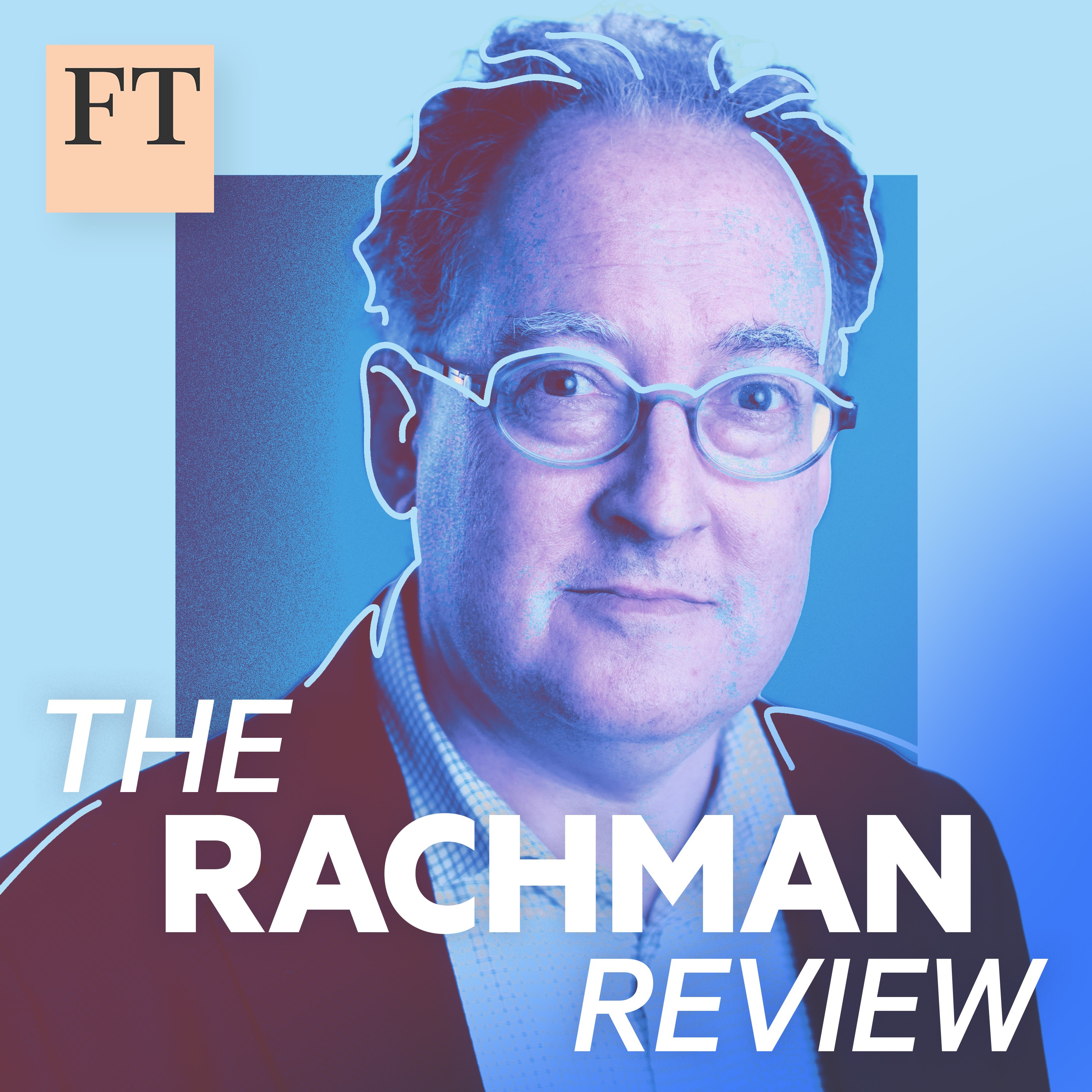
The Rachman Review
Europe’s rocky relations with Donald Trump
00:25:49
Former Nato leader on the future of the transatlantic alliance
Loading summary
Transcript58 lines
- [00:00]
Podcast Host (Next Five)
The latest episode of the Next Five podcast is all about the energy transition. I speak to Elizabeth Cremona at Ember.
- [00:06]
Energy Expert
It costs far more to not invest in your grid than to actually invest.
- [00:10]
Podcast Host (Next Five)
Massimo Bataini at Prismian Data center in US Requires significant investment for utilities. And Maria Mendeluce at We mean Business Coalition.
- [00:19]
Environmental Economist
US$1 trillion are spent in subsidizing fossil fuels, benefiting the richest people and not the poorest.
- [00:27]
Podcast Host (Next Five)
Listen to the next five wherever you get your podcasts in.
- [00:29]
Jens Stoltenberg
Intro.
- [00:34]
Gideon Rachman
Hello and welcome to the Rachman Review. I'm Gideon Rachman, chief foreign affairs commentator of the Financial Times. This week's podcast is about NATO and the transatlantic alliance. My guest is Jens Stoltenberg, who was Secretary General of NATO from 2014 to 2024 and who's just published a memoir called On My Watch. Stoltenberg's years running NATO included the chaotic end to the war in Afghanistan in 2021 and Russia's full scale invasion of Ukraine in 2022. And now, with Donald Trump back in the White House, there are growing questions about America's commitment to the alliance. So does NATO have a future?
- [01:17]
Last week, America issued a national security strategy with some scathing words about its NATO allies in Europe. Europe, the strategy document claimed, is at risk of civilizational erasure. Donald Trump's often sounded negative about the alliance and its European members. Here he is talking to Politico earlier this week.
- [01:37]
Donald Trump
They talk, but they don't produce. And the war just keeps going on and on. But most European nations.
- [01:49]
They'Re decaying. They're decaying.
- [01:53]
Energy Expert
You can imagine some leaders in Europe are a little freaked out by what your posture is.
- [02:00]
Donald Trump
And Europeans should be freaked out by what they're doing to their countries. They're destroying their countries.
- [02:05]
Gideon Rachman
Those kinds of words will cause some alarm in NATO headquarters in Brussels, from where Jens Stoltenberg led the organization for a decade. So I began our conversation by asking Jens Stoltenberg how worried we should be about the future of NATO.
- [02:19]
Jens Stoltenberg
I think what we have seen is a reminder of the fact that we can never take the security relationship between North America and Europe for something which is guaranteed or written in stone. But I believe it is possible to preserve that bond because a strong NATO, a strong transatlantic bond is good for Europe, but it's also good for the United States.
- [02:40]
Gideon Rachman
But the US Under Trump at least seems to be concerned that its European allies are unrealistic, particularly towards the Ukraine war, and they're trying to negotiate directly with the Russians, also with the Ukrainians, to end the war how do you feel about those negotiations? Do you worry that they could go wrong?
- [02:57]
Jens Stoltenberg
Of course, there's always a risk that talks about how to end the war can go wrong. But I welcome that talks are taking place, and I welcome also that the US with the European NATO allies, are playing an important role to try to facilitate some kind of peace negotiations. But fundamentally, what we need to realize is that the quickest way of ending a war is to lose a war. But that will not bring peace. That will bring occupation. So the challenge is, how can we end the war in Ukraine in a way where Ukraine prevails as a sovereign, independent nation? I don't think we can change Putin's mind. He wants to control Ukraine, but I think it is possible to change his calculus. If the price he has to pay is too high for controlling Ukraine, then he may be willing to accept a solution where Ukraine prevails as a sovereign, independent state. And the only way to change that calculus is to provide military support to Ukraine. So weapons to Ukraine is actually a path to peace in Ukraine.
- [03:56]
Gideon Rachman
The sticking point in the current negotiations seems to be the American endorsed demand by the Russians that Ukraine give up more territory, including territory that it currently occupies, the whole of the Donbas. What's your view of that demand?
- [04:11]
Jens Stoltenberg
Of course, any change of border caused by the use of military force is unacceptable. At the same time, it has been obvious for a long time that there will be a dilemma between territory and security. And, of course, maybe Ukraine has to give up some territory to obtain security. So therefore, I think that whatever kind of territory Ukraine has to cede as part of a ceasefire deal or a more permanent agreement, the more important it is that they get the necessary security arrangements that ensures that it stops there and that Russia doesn't continue or just wait and pause and regroup and reconstitute its troops and then attack again.
- [04:51]
Gideon Rachman
Now, you, as you make clear in your memoir, know all the principles quite well. You know Putin, you know Trump, you know Zelenskyy Trump. First of all, I mean, you were Secretary General in his first term. How do you, as the Secretary General of NATO, keep Trump happy? Because some people think that your successor, Mark Rutter, has at times gone almost too far to keep Trump on board. He referred to him as Daddy, or rather, Trump seems to think he referred to him as Daddy. Because I saw in Trump's latest interview with Politico, he said, NATO calls me Daddy. How did you handle it? I'm not going to ask you to criticize Rutte, but that balance between, you know, he's clearly the leader, the most important member of it, but also sticking to principles, not humbling yourself.
- [05:37]
Jens Stoltenberg
So first, I would like to say that I think Margaret is leading NATO in a very good way, keeping the alliance together and also ensuring that NATO is delivering both on increased defense spending, but also on support for Ukraine. Then, of course, what I can say is how I handled it in those four years I was Secretary General and Trump was president for the first time. What I did was to actually take very seriously the criticism President Trump expressed. And the main message then, but also to a large extent today, has not been against NATO. It has been against NATO. Allies not investing enough in NATO, and that's a very different thing. And the paradox was that some of those allies were very concerned about NATO. They actually didn't invest in the alliance. This has now really changed. More and more allies are spending more than 2% on the fence, and the aim is now to go to 5%, including some military infrastructure. So we saw in the first period that because allies started to invest more, the US And President Trump became more positive. And I remember President Trump and I, we had a joint press conference, and he said, I used to say that NATO is obsolete, but NATO is not longer obsolete. So overall, NATO came out stronger at the end of those four years than when it started.
- [06:55]
Gideon Rachman
And how about Putin? I mean, you say in the book that your first dealings with him, he seemed somebody you could do business with, somebody who was basically quite rational and somebody who even stuck to agreements you made. And yet you then are in charge of NATO when he makes this decision to launch the biggest war in Europe since 1945.
- [07:13]
Jens Stoltenberg
So my relationship to President Putin has evolved over the years. For many years, I actually had a good working relationship with him and with Russia, and also at that time, Prime Minister Medvedev. The first time I met President Putin was in September 2000. He was the newly elected President of Russia. I was newly elected Prime Minister of Norway. And in the following years, we met several times in Russia and different capitals around the world. And also we had many agreements on energy projects, on the environment. We agreed to open the land border between Russia and Norway in the north for visa fee travel. We developed what we call the Barents Corporation. And not least, we agreed this delimitation line in the Barents Sea and the Polar Sea. We had negotiated that for 40 years, Russia and Norway, and then we agreed in 2010. So over all these years, as a Prime Minister of Norway, I actually had a good relationship with Russia, and Russia respected the agreements, including Fishing quotas. Russia and Norway manage a big North Atlantic cod stock together, and the Russian ships or fishing vessels respect the quotas. So actually, these worked quite well for many years. So when I came to NATO in 2014, I brought with me years of experience of working and making agreements with Russia. And my main message was that we need deterrence, defense and dialogue. And I really tried. And we also managed to strengthen the dialogue with Russia. We were able to reactivate the NATO Russia Council, which is a kind of institutional framework for cooperation and dialogue between NATO and Russia. And we also agreed on some measures on, for instance, air safety of the Baltic Sea. But of course, gradually it deteriorated, and with a full scale invasion of Ukraine, meaningful dialogue was not possible anymore.
- [09:04]
Gideon Rachman
Was there a moment when you thought, this isn't the same guy, something's gone badly wrong, or was it a gradual process?
- [09:10]
Jens Stoltenberg
It was a gradual process. But for me, moving from a country that for decades had some kind of working relationship with Russia, including on search and rescue in the high north, to a different position, being the Secretary of NATO, that happened the same year as Russia really violated international law and annexed the Crabia.
- [09:27]
Gideon Rachman
There was a bit in your book where I thought, without quite stating it, you suggested that the Russians at some level do believe that the west is a threat to them.
- [09:36]
Jens Stoltenberg
Well, of course, I'm not certain about what they believe or not believe, but in the book, I describe a conversation I had with then Prime Minister Medvedev. We walked from the Norwegian border post to no Man's Land over to Russia in the high north. And that was on the occasion of the celebration of the 20th anniversary of the Barents Corporation, which is a regional corporation to bring Russia and the Nordic countries closer together. And then I asked him, so why are you so aggressive against NATO? Then? At that time I was Prime Minister of Norway. And he said, well, I'm not afraid of un. I'm not afraid of Angela Merkel or Barack Obama either. But you have to remember that every century there is a crazy guy from the west coming and invading us. In the 18th century, it was the King of Sweden. He tried to invade and take Moscow. We defeated him. And then in the 19th century, it was Napoleon. We had to burn down Moscow. And in the 20th century, you came twice. So the first and the Second World War. And now we are only in 2012, beginning of this century. So we are afraid of what will happen later with all the leaders in NATO, in US and in Europe. So maybe that was only something he told me. But I think there is this idea that the west is a kind of potential threat. And I think we need at least to take that into calculation. That doesn't mean that we should be weak on Russia, but we need to talk to Russia about how to end the war in Ukraine. We need to talk to Russia at some stage about arms control. All the agreements we had for decades on nuclear arms control, on conventional weapons, they have now vanished. And to prevent a new, very expensive and dangerous arms race, we need new arms control agreements also with China. And then we need to talk to Russia, just because Russia is our neighbor. So I don't think it's given by nature that Russia and the west has to be adversaries. I think actually we have seen many examples in Europe and also in the Nordic region that countries who have been fighting each other for centuries are now the best friends. So we can also become friends with Russia at some stage, but not with the current Putin regime.
- [11:37]
Gideon Rachman
Yes. So you had those relatively civilized conversations, but also when things get bad, the accounts you give in the book of your conversations with Lavrov, I mean, he is staggeringly aggressive towards you, very disrespectful. What do you think he was trying to achieve? Was he genuinely angry? Was he trying to unsettle you? And how do you keep your cool with somebody who's being so insulting and aggressive?
- [11:59]
Jens Stoltenberg
In the first conversation, I was surprised because I had met him many times in my bilateral meetings with Putin on the day. He was often there and he was very instrumental in negotiating the delimitation line in the Barents Sea, which Russia has respected since we agreed it. So I thought it was possible to talk to him. But I've been in politics for many years and I think that's a good experience also when you move from domestic to international politics, because in politics we are used to tough debates, disagreements, sometimes tough language. So I know that it doesn't gain my case if I get too angry or react in the same way.
- [12:38]
Podcast Host (Next Five)
The latest episode of the Next Five podcast is all about the energy transition. I speak to Elizabeth Cremona at Ember.
- [12:44]
Energy Expert
It costs far more to not invest in your grid than to actually invest.
- [12:48]
Podcast Host (Next Five)
Massimo Bataini at Prismian Data center in US requires significant investment for utilities. And Maria Mendeluce at We mean Business Coalition.
- [12:57]
Environmental Economist
US$1 trillion are spent in subsidizing fossil fuels benefiting by the richest people and not the poorest.
- [13:04]
Podcast Host (Next Five)
Listen to the Next five wherever you get your podcasts.
- [13:07]
Jens Stoltenberg
Enjoy.
- [13:11]
Gideon Rachman
So we talked primarily about Ukraine, and I'll come back to it in a minute. But the Other big and kind of traumatic event towards the end of your period as NATO Secretary General is the end of the Afghan war and the trauma of the Afghan withdrawal. How big a failure do you think that was for NATO and how do you view the decision in retrospect? Was it still the right thing to do?
- [13:32]
Jens Stoltenberg
Yes, I still think it was the right thing to do. But I try in the book to be very honest about the successes. NATO, we succeeded in defeating ISIS in Iraq and Syria, we succeeded in getting Finland and Sweden into the alliance. We succeeded in implementing the biggest reinforcement of collective defence in decades. But we also failed on many accounts, including in Afghanistan. And that was very painful. And I tried to describe what happened with me, because I was Prime Minister in NORWAY Back in 2001, when we made the decision to send the first Norwegian soldiers into Afghanistan. And I was Secretary General of NATO in 2021 when the last NATO soldiers left. And one of the last soldiers to leave was actually Norwegian Special Operation Forces who operated the hospital at Kabul airport and some medical personnel there. But I think what happened in Afghanistan was that it started as a very targeted and focused counterterrorism operation. And in that we succeeded, but it gradually evolved into something much more ambitious, and that was nation building operation. And that was not only NATO, it was the eu. And it was a lot of individual countries that all had this ambition, and I was part of that, to create a democratic Afghanistan, a free Afghanistan, equal rights for men and women. And I think that that was just too ambitious and a task that we could not fulfill. And I think we spent too many years realizing that before we actually made the painful decision to leave. But I still believe it was the right thing to do.
- [15:04]
Gideon Rachman
But did the end have to be quite as chaotic as it was?
- [15:07]
Jens Stoltenberg
The answer is, of course, no. It didn't have to be that chaotic then. Having said that, I think we all have to understand that to leave a country, to end a military presence is extremely difficult, because as soon as it becomes known that actually we are leaving, panic spreads. And that was exactly what happened. Everyone wants to get out. Not only all the military personnel, but civilian personnel from NATO allied countries and also all the Afghans that worked with us. So this huge evacuation from the airport was in many way a very impressive undertaking. I think it was about 100,000 people lifted out within weeks. Hardly any time before in history has so many people been helped out. But of course, then there was a big failure, especially the first day, and then with the suicide bomb attack a bit later in the process. But I Think we should not mix those tactical serious errors with a bigger strategic decision. It was the right decision to leave Afghanistan.
- [16:08]
Gideon Rachman
Some people make a connection between what happened in Afghanistan in the summer of 2021 and Putin's subsequent decision to go for the full scale invasion of Ukraine in early 2022, arguing that he sensed weakness in the Western alliance. What's your view on that?
- [16:25]
Jens Stoltenberg
I don't think so. I think that Putin had a long term plan. I think he wanted very much to control Ukraine. He actually started the first buildup in the spring of 21, then it paused and then it continued and then invaded in February 2022. So I think that's far too easy. I think the big failure we did in Ukraine is not about Afghanistan, but the failure in Ukraine is that from 2014 when we actually saw that Russia's intention was to be aggressive against Ukraine, to not respect Ukraine's border by annexing Crimea and going into Eastern Donbas. Those eight years, from 2014 to 2022, NATO allies did far too little to support Ukraine, to arm Ukraine, to train Ukrainians, to provide them with the weapons they needed. Most NATO allies said, no, no, no, that's dangerous, it may provoke an invasion by Russia. So we didn't arm them and Russia invaded. If we had armed Ukraine over those years with just a fraction of the military support we are providing to Ukraine today, at least Ukraine would have been in much better position. Russia will have controlled far less territory now than they do. We could even have prevented invasion by arming Ukraine. So if you want to support Ukraine, we should not stay in Afghanistan, but we should probably support Ukraine. And that was the failure that we didn't do that.
- [17:44]
Gideon Rachman
At what point did you realize, were you frustrated the whole way through that we weren't doing enough?
- [17:48]
Jens Stoltenberg
I had to admit it was gradual. I traveled to Ukraine very early in my tenure. I think it was back in 2014. I saw some of the training we did, but it was, was not big scale. We provided very little weapons. We had a big discussion in NATO about whether NATO could facilitate the delivery of sniper rifles. And the majority Allah said no, no, no, we should not do that. It's dangerous. It may provoke the Russians. It was actually President Trump that in 2018, I think it was made a decision and Jim Mattis, the Secretary of Defense pushed through that decision to deliver the Javelins, the anti tank weapons. But that was controversial and that was the right decision to do. They proved extremely important, those Javelins, when Russia invaded. But it was too little and too late and few other Countries did the same as the US Providing weapons like the Javelins. I traveled around and tried to push for more NATO military support to Ukraine. I pushed for the sniper rifles and some other military equipment. But of course we need consensus. NATO there, for NATO as an alliance did too little. I still ask myself whether I could have done more or sounded alarm bells stronger earlier to convince more allies to provide military support to Ukraine.
- [18:59]
Gideon Rachman
And when the war actually starts, there's this moment of astonishment. When Russia fails, it retreats. They lose Kherson, they lose Kharkiv, and there's hope that the whole Russian effort could collapse. And in retrospect, there's controversy because some people say that the Biden administration and maybe NATO as a whole allowed themselves to get bluffed by the Russians a threat of the use of nuclear weapons and that we were too slow to provide Ukraine with crucial aid even when the war was happening. What's your view on that?
- [19:32]
Jens Stoltenberg
I was among those who actually were afraid or concerned about potential Russian use of weapons of mass destruction, nuclear weapons or dirty bombs inside Ukraine to scare us from supporting Ukraine. Maybe we were too concerned. But at the same time, I agreed at that time, and I continue to agree that we were too slow in providing advanced weapons, although NATO allies have provided unprecedented military support to Ukraine, and that has made a huge difference on the battlefield. But it took too long time to also agree to deliver battle tanks, long range artillery, missiles, fighter jets. And of course, had we done that earlier, again it would have helped.
- [20:15]
Gideon Rachman
And then in the summer of 2023, a lot of hopes placed in the Ukrainian counteroffensive, but it fails. Why do you think it went wrong? Why couldn't they break through?
- [20:23]
Jens Stoltenberg
NATO allies, especially the United States, delivered an enormous amount of ammunition, of artillery, of armored vehicles. It was really an enormous military buildup. But of course the Ukrainians wanted more before they launched an attack. The problem was that the longer they waited, the more defensive lines the Russians were able to build with all kinds of minefields and other kinds of defensive positions. And then the Ukrainians were not willing to really push through. And as it was said, you have to be willing also take casualties, so you had to risk the force to accomplish the mission. So that's one theory. That was the explanation I often heard from Western NATO NAT military leaders. And then Ukrainian version of the same was that, no, no, you gave us too little, too late, so there was no way we could launch the offensive. But that was a big disappointment because first of all, they succeeded in Kherson and Zapol and In Kharkiv, the Ukrainians liberate roughly 50% of the territory that Russia occupied in the beginning. So that, of course, gave us some optimism, some reason to believe that the Ukrainians could deliberate even more. Then we planned for this big spring offensive that gradually turned into a summer offensive. And when it was launched, it didn't work. And when we realized that over the summer 23 then we also started to realize that this will be a war that will last for a long time. It will become a more static war and it will become a war of.
- [21:51]
Gideon Rachman
Attrition to finish off. Then let's come up to the present day. As you said, it's turned into a war of attrition. But the Russians are sounding more optimistic. What would be the consequences of Ukrainian defeat, not just for Ukraine, but for the NATO alliance?
- [22:06]
Jens Stoltenberg
It will be a tragedy for the Ukrainians because a country that really wants to become a free, democratic nation, sharing the same values as we do in the rest of Europe, being part of the European and transatlantic family, they will then be part of a Russian controlled territory, something which is then not that free, independent, democratic nation they aspire to create. So it will be a tragedy for them, but it will be also dangerous for all of us, because we'll have seen that the use of military force, the blatant violation of international law, crossing international recognized borders actually pays off. They get what they want and that will make the world more dangerous. And therefore, it is in our security interest to continue to support Ukraine and to make them as strong as possible on the battlefield, because that will give them the strongest possible hand around the negotiating table.
- [22:59]
Gideon Rachman
And finally, many Europeans are beginning to think, because of the way that Trump talks about the world and about Europe sometimes, that we're going to have to get used to the idea that maybe Europe is going to have to defend itself without America at some point. Do you think that's possible? Is that conceivable? And should we be preparing for that moment?
- [23:18]
Jens Stoltenberg
There is a risk and we don't have certainty about what the future will bring. But I think for politicians, of course, it is important to analyze, to try to predict, to assess, to speculate about future possible or impossible scenarios. But more important is to actually look into what kind of actions can we take to minimize the risk for bad outcomes. The US And Europe splitting apart and to maximize the likelihood for good outcomes. Europe and North America staying together. I remember we had the same discussions back in 2016 when President Trump was elected the first time. And then I remember we developed what we called no regret strategies, things that we can do regardless of whether you believe in the bad scenario or the good scenario. Of course, the first action that should be taken was to increase defense spending. Because by investing more in European defense, then I think we increase the likelihood that the US Will stay committed to NATO and they will see more balanced burden sharing. But if it happens that the US Actually leaves NATO or is no longer committed to North Atlantic security, then it's even more important that we are invested in defense in Europe. So that's the first action we should take, invest in defense. It is costly, it's difficult, but it is absolutely necessary. The other action we should take is to engage with the United States, because back in 2016, again, some allies thought that you just sit still, freeze down the alliance, and then hope that things will change by the next elections. We had the other strategy. We decided to spend time with the United States, with the Trump administration at all levels, and I think that helped. And the third thing was actually to demonstrate for the United States that it is in their security interest to have more than 30 friends and allies. The US is concerned about China. The size of China, US is big, 25% of world GDP. But together with NATO allies, we are 50% of the world economy and 50% of the world's military might. So it makes the US stronger when we are together. And I had the privilege of meeting President Trump in the Oval Office this spring together with the Norwegian Prime Minister. And he put on the table a map where the North Pole is in the center. And the good thing with that map is that Norway looks very big. But the other thing is that you see that the shortest distance between Russia and North America is not transit via Frankfurt. It is actually directly over the North Pole. And then we pointed at the Kola Peninsula, which is just over the border with Norway and Finland. And we said that some of the highest concentration of nuclear weapons in the world, it's actually here, just over that border from NATO territory, Norway and Finland. The submarines, the strategic bombers and the missiles, and they're not aimed at Norway or Finland, they're aimed at the United States. But we help you to track the submarines. We help you to monitor what happens on the Russian side of the border. We give you early warning. So that makes the United States stronger. I cannot promise you that that will help. But I believe that security matters when the US Is making the decisions, and we should follow a no regret strategy, invest in defense, spend time in the United States, and demonstrate that it's in the US Interest to have friends and allies.
- [26:37]
Gideon Rachman
That was Jens Stoltenberg, the former Secretary General of NATO and author of On My Watch, ending this edition of the Rachmann Review. Thanks for listening and please join me again next week.
- [26:59]
Podcast Host (Next Five)
The latest episode of the Next Five podcast is all about the energy transition. I speak to Elizabeth Cremona at Ember.
- [27:05]
Energy Expert
It costs far more to not invest in your grid than to actually invest.
- [27:09]
Podcast Host (Next Five)
Massimo Bataini at Prismian Data Center US Require significant investment for utilities and Maria Mendeluce at We mean Business Coalition.
- [27:18]
Environmental Economist
US$1 trillion hours are spent in subsidizing fossil fuels, benefiting the richest people and not the poorest.
- [27:26]
Podcast Host (Next Five)
Listen to the Next five wherever you get your podcasts.
- [27:28]
Jens Stoltenberg
Enjoy.
- [27:29]
Joe from Vanta
Hi, this is Joe from Vanta. In today's digital world, compliance regulations are changing constantly and earning customer trust has never mattered more. Vanta helps companies get compliant fast and stay secure with the most advanced AI, automation and continuous monitoring out there. So whether you're a startup going for your first first SoC2 or ISO 27001 or a growing enterprise managing vendor risk, Vanta makes it quick, easy and scalable. And I'm not just saying that because I work here. Get started@vanta.com.